After the warm days of October and November, now we are seeing a bit of cold with a first freeze (barely, in some places) yesterday morning. And it is December now; in the “meteorological” way of tracking seasons, winter starts on December 1st. Most of us use the winter solstice, December 21st this year, as the boundary between autumn and winter, but North Texas is at least hearing a few rumors of the winter to come. And that calls for a walk somewhere, putting our ear to the ground to listen.
I walked at Sheri Capehart Nature Preserve, eastward along the “yellow” trail near the big pond and then turned and walked up through a tangle of woods to the “blue loop” and back toward the boulders. It was 63 degrees, a jacket needed only when the breeze blew. The place was full of sun and damp sand, native grasses going dormant and a coolness that balanced the sun perfectly.
In my journal I wrote “Phenology Note” on a sketched calendar page, and made a few notes about the trees and leaves. “The trees are still mostly leafed out and green. Many oak leaves are tinged with caramel …. Some trees look ragged but we’re still waiting for autumn color and/or leaf drop.” Back near the parking lot, many of the cedar elm trees are becoming bare, but the oaks seemed barely touched by autumn.
Phenology is the study of seasonal events in nature, and so looking back through a nature journal can show how the seasons change from year to year in a place. What’s the average time when trees lose their leaves, and how much is climate change pushing such events to new places on the calendar?
Some caramel color or a tinge of red in leaves that are mostly still green
Using a journal in that way puts me in the mode of science and data, my thoughts separated from emotions about climate change as if severed by a scalpel. But journaling can – and I think should – be more than intellectualizing. On a good day I’ll make room in those pages for what I miss from a time when life was anchored by things you could count on. Winters could be hard or they could be mild; summers might vary in how hot or dry they got; but after whatever variation in the weather, we always returned to an arithmetic mean, an average that we all recognized as something we could count on. But now the math isn’t our friend, and the arithmetic mean is shifting upward and we don’t know what we can count on.
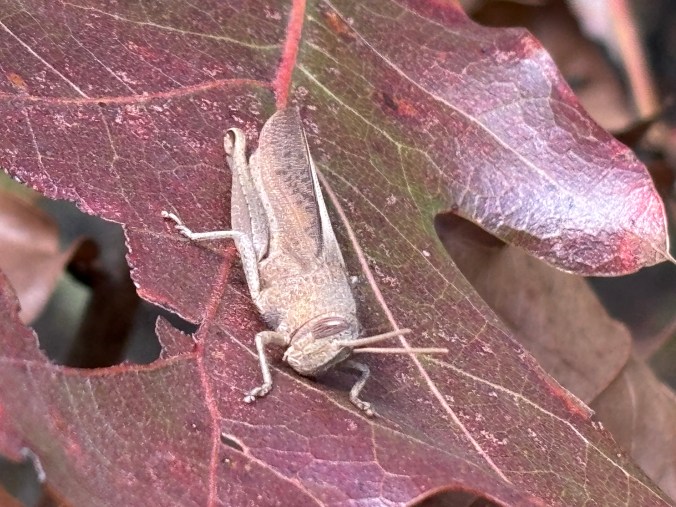
I kept walking, looking and listening for wildlife. A one-minute sample using the Merlin app detected no sounds of birds. I did find a delightful grasshopper resting on a leaf turned nicely red. Uploading a photo to the nature app iNaturalist, the insect was identified as a “mischievous bird grasshopper.”
The mischievous bird grasshopper
Now this was a find – what kind of mischief does this sort of grasshopper get into? This particular one was sitting motionless, perhaps too cool for tomfoolery and just feeling lucky to have survived yesterday’s freeze. Adult grasshoppers often don’t survive winter except as eggs deposited in some protected spot, although with increasingly mild winters, more adults like this one might get lucky.
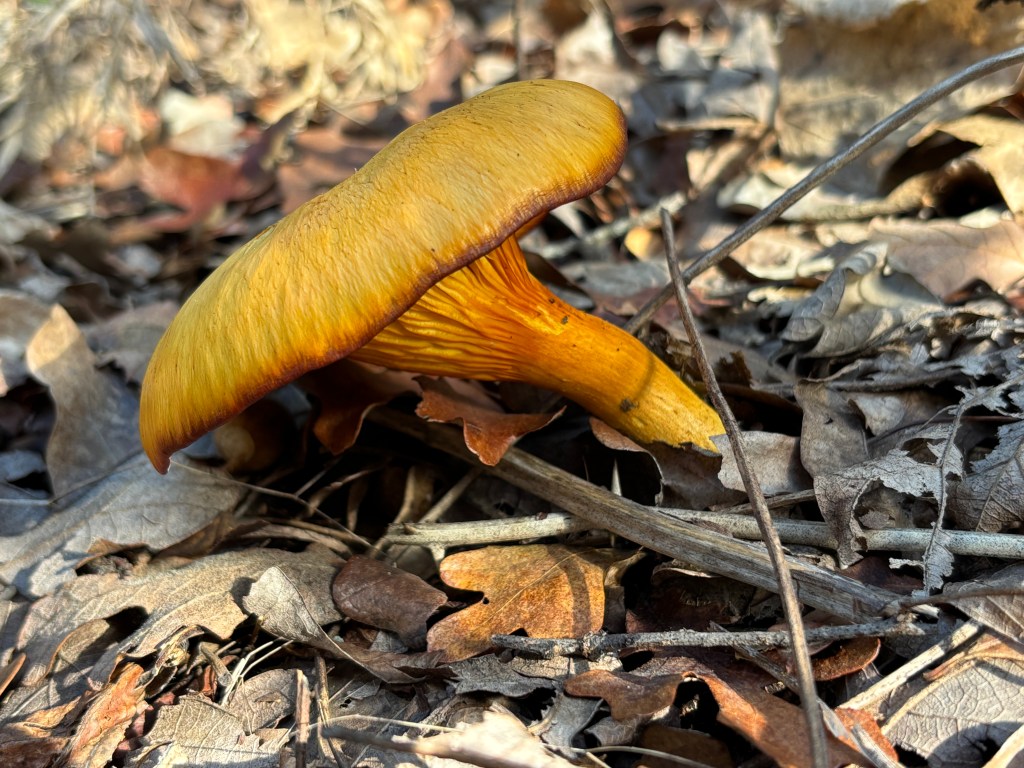
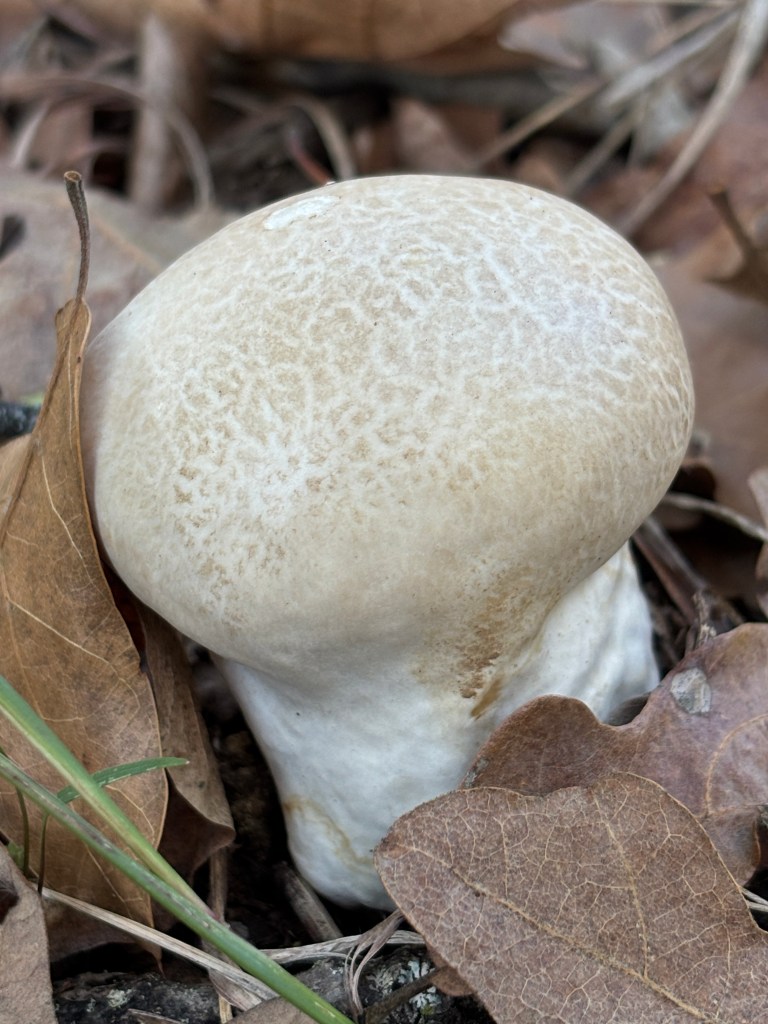
southern jack o’ lanternunidentified mushroom, probably genus Calvatia
I wanted to follow up on the walk with Logan a few days ago in which we saw southern jack o’ lantern mushrooms. In that particular spot we visited, mushrooms were still there. It might be some particular combination of the right soil, shade, and moisture, but that place stood out with all those mushrooms. There was even a new one of a different sort. According to iNaturalist, it was a type of puffball mushroom. I want to go back to see if it matures to rupture and release a tiny cloud of spores.
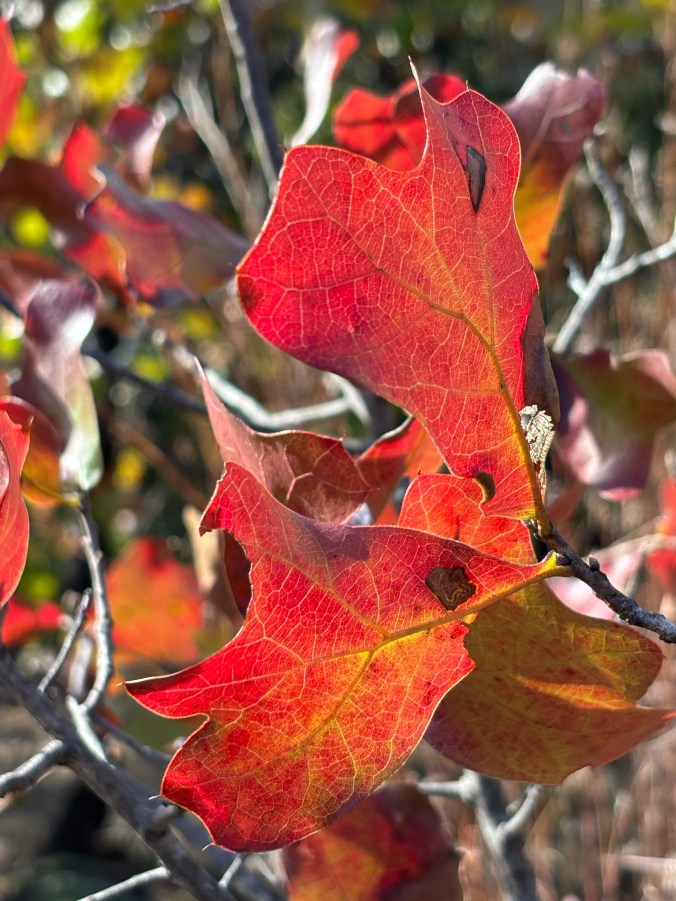
Even without a lot of fall color, there were places where the bright, slanting December sunlight backlit a group of leaves and created a dramatic display of color. Going slow, we can notice so many small and wonderful things.
Beautiful blackjack leaves
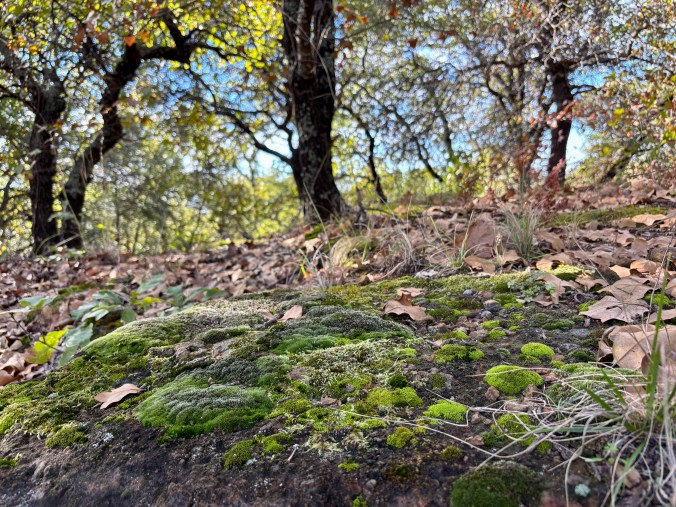
And that includes the mosses. After the way Logan brightened with every new patch of moss he found, I was attuned to them today and really appreciated how they grow on the sandstone up at the bluff. Looking at some boulders was like seeing a miniature topography of meadows and hills.
I also noticed, on the way down the hillside, that the bee tree is active again (there were no bees visible on that cool and cloudy November 29th). I stood for a moment, imagining the extent of the hollow space within that tree, and all the honeycomb built within the spaces, and all that honey!
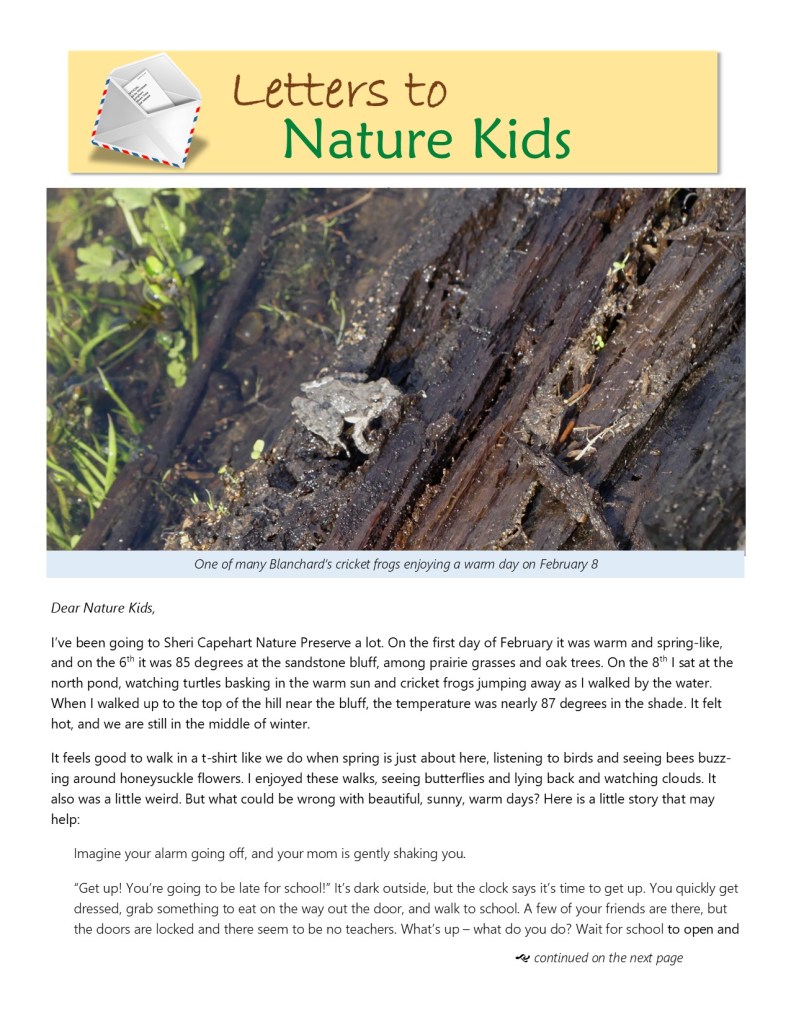
The weather lately is kind of a roller coaster. We’ve had some snow and ice, and last weekend the temperature out in the woods where I sat was 87 degrees. Maybe some wild weather is par for the course for North Texas, but as I wrote to nature kids, a warming climate makes it hard for the plants and animals to show up at the right times. What if flowers bloom before some of the pollinators arrive? What if some species become active but something they rely on for food, or nesting, or other critical function isn’t ready?
So I introduce the word phenology and the ideas behind it, not a lengthy discussion but just something to think about while enjoying a few unusually warm days in winter. Letters to Nature Kids is intended for older kids, teens, and adults, too. It’s a free download on the “Letters” page.
Mild winter days are a gift, one that can make us uneasy and yet grateful for the soft warmth of sunshine in midwinter woods. The uneasiness comes when we recognize that the gift often comes from climate change. A recent Texas Monthly article reported that this past December was 4 to 5 degrees warmer than average, and that January of last year was the sixth warmest ever seen in Texas. In winter, our off-the-rails warming climate can feel good, but it is still brought to us by the worsening climate catastrophe.
Let’s get to the gratefulness part; while some days I try to wrap my head around climate issues and see what I can do, on other days I want to accept the wonder and joy that nature gives. On those days I’ll live in today, not next year or last year. Even as I sit under a blue sky, surrounded by the sheltering oaks, some part of me knows where the gift comes from, but that will not spoil the day. And so here are a couple of slightly edited entries from my journal, reflecting solitude and time in the woods at my favorite preserve.
On February 1st I made my way to the top of the hill under a sunny sky with no clouds. The local weather service said that it was 73F. I was on a little-used trail and the traffic noise was in the background. There was a sense of quiet because the noise seemed distant and subdued. I noticed a little chatter of crows. Nearby it was quiet and peaceful, warmed by the afternoon sun and surrounded by oaks reaching their bare branches up into the blue sky.
It was as if I had a distant memory of sleeping outside on such a day, in a peaceful place with all noise far away. Being lulled to the edge of sleep with a warm sun and soft breeze, in the close company of trees. Or perhaps it just seemed like a perfect place to drift away.
And then a strong breeze blew through, dislodging a remaining leaf or two. “Rock-a-bye baby, in the tree-tops…” Will the bough break? The cradle fall? What a strange lullaby.
A fungus in delicate and beautiful concentric rings
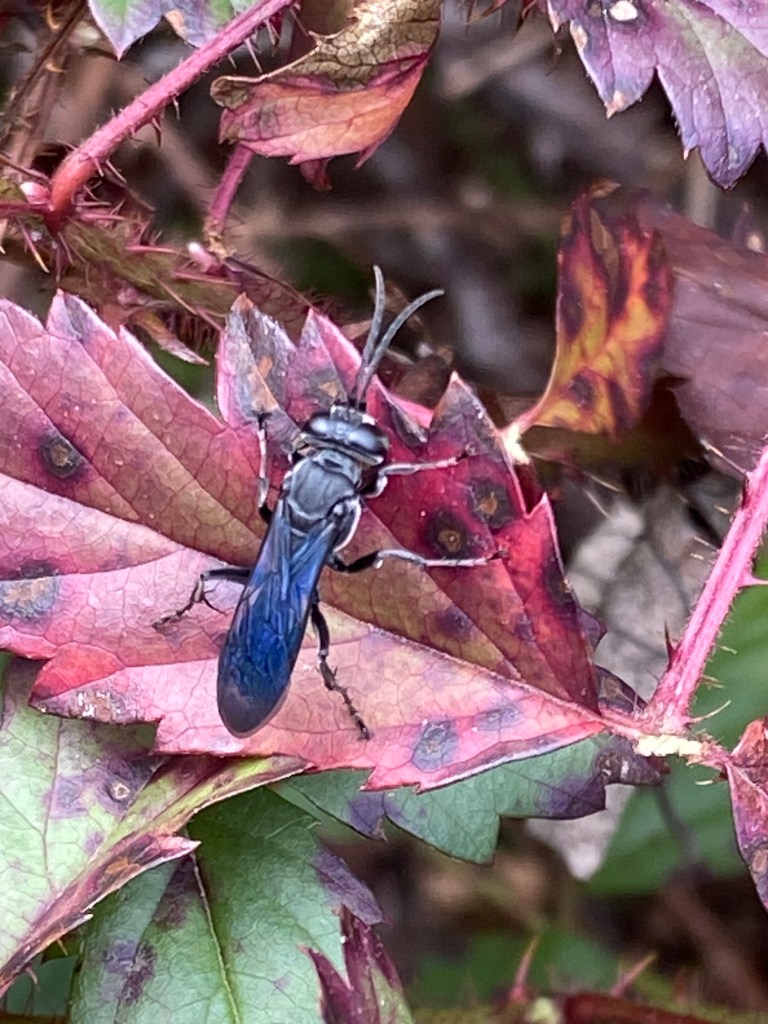
On February 4th it was partly cloudy and a little less warm (61F, reportedly) but at the start of the walk it was mostly sunny. The clouds that moved through were low, thick and heavy, slipping eastward and sometimes hiding the sun. After making my way up to the boulders, I wandered down the trail past lots of small sulphur butterflies and found a small wasp in a tangle of dewberries. Nearby, a Carolina chickadee called from low branches. Blue jays fussed somewhere as the breeze came and went, blowing a few loose leaves.
A small wasp that survived the recent freeze
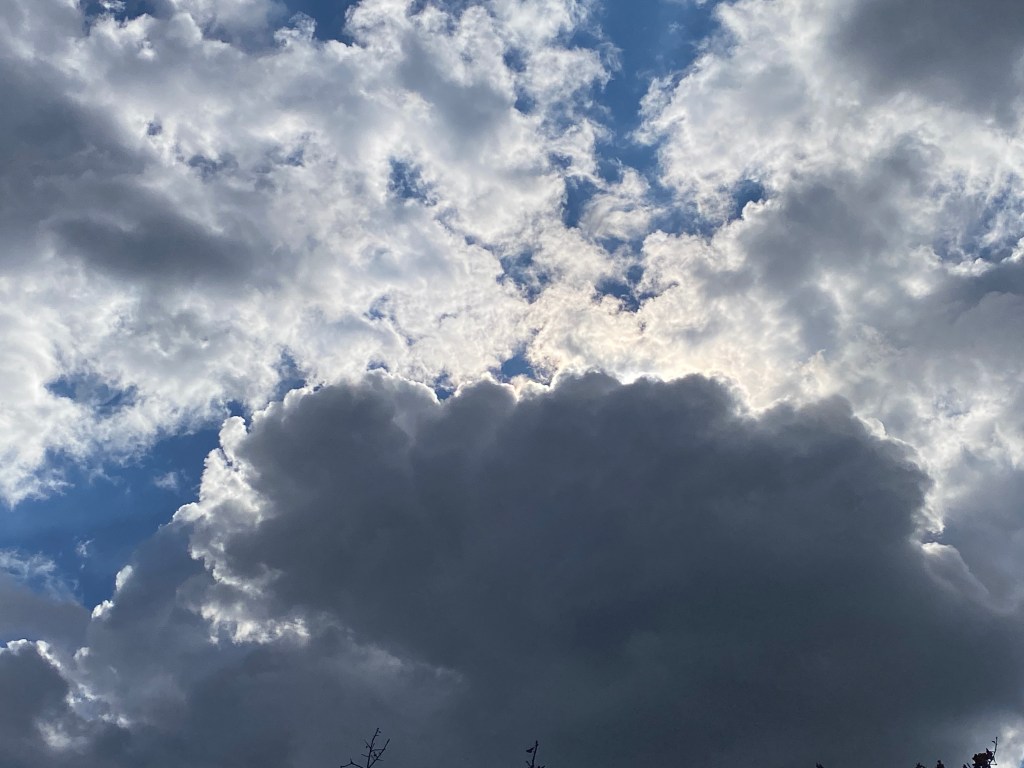
I came back to the sandstone bluff, and the movement of clouds was putting on a delightful show. Using my shoes as a pillow I lay on the rocks and watched those clouds. Sometimes the thicker gray clouds obscured the sun, and I was glad for my jacket, and then the sun re-emerged with wonderful radiant heat.
Looking up at clouds
There were low clouds still sliding to the east, sometimes wispy and light, and other times wet and gray. High above those, a layer of clouds slowly crept in from the north. Some of those were thin and feathered in intricate bands, but others were ropy and white. The edges of the low, gray clouds were rimmed in bright white from sunlight and almost too bright to look at. As always, the slow graceful movement of clouds was mesmerizing.
Darker clouds were massing nearby, and I started my walk down the hillside. Somewhere along the way I heard thunder, and rain began to fall as I reached the car.
Rain clouds visible from the bluff
I hope you are able to get outside sometimes on days like this. I’d love to hear in the comments whether you feel the same as I do about these warmer winter days, or if you prefer days when winter has a little bite and maybe brings some snow.
“To sharpen our gaze is to behold not only the passing beauty of this world, but also its deep suffering, and I’m afraid of the pain and purgation such vision will entail, that it will break my heart open in ways I’ve only begun to fathom.”
– Fred Bahnson
We know the trouble we are in, and we feel the stress of it. The Sixth Assessment Report of the Intergovernmental Panel on Climate Change (IPCC) tells us that human-induced climate change has caused widespread damage to nature and people. This does not just represent normal weather variability. Over 3 billion people live in situations that make them very vulnerable to climate change, and a “high proportion” of species is vulnerable. Further, “current unsustainable development patterns” are increasing our danger.
The danger includes more wildfires in various parts of the world, “100-year” floods now happening every few years, glaciers melting, stronger and more frequent hurricanes, drought, and extreme heat. Warmer climates allow mosquitoes and other pests to thrive, leading to disease for humans and trees (milder winters let bark beetle populations expand).
Our sense of safety erodes and the world feels less familiar as we watch world leaders make excuses and see too many fellow humans who are unconcerned or too preoccupied with their immediate challenges to take action. That can lead to helplessness and despair if we’re not careful.
How did we get here?
How did we get to a point where things are so crazy? Who is to blame? We elect leaders, we use fossil fuels and buy all kinds of stuff – are we to blame? I’ve been on the planet for over seventy years, surely there’s more that I should have done. On the other hand, we were born into a culture of growth and consumption. Many of the world’s cultures see nature as a sort of big-box store where it’s all for sale and the more you buy, the higher your status. Western culture enshrines unending economic growth as the only possible path to a satisfying life. It’s hard to swim against those cultural currents. And no matter how much I recycle or try to live “off the grid,” the fracking wells keep getting drilled and Congress keeps giving about $20 billion a year to the fossil fuel industry.
We can’t wait for the culture to change. The culture is us, even if each individual is a drop in the ocean. But we do what we can, even if it’s just for our own sense of integrity. And we reach out to others, pulling drops together until we fill a bucket, and buckets become waves, until we can get something done. Our actions can be guided by what is good for more than just “me,” we can place the well-being of living things above the acquisition of more things, and we can be satisfied with what we have.
The toll it takes
The damage to the planet takes a heavy toll on us, whether we’re watching from the sidelines or working hard in climate activism. A report from the American Psychological Association and others discussed the impact of the anxiety and loss that people are experiencing. There can be trauma from climate-worsened disasters such as tornadoes, floods, and fires. Sometimes the images and fear of future harm can lead to pre-traumatic stress.
There can be a loss of a physical place (a home, a favorite creek, a glacier, etc.), and a person may experience pain and longing when such a place is gone. Such an experience has been termed “solastalgia.” In the opening chapter of Richard Louv’s Last Child in the Woods, there is a fifth-grade girl whose loss of an important place sounds like solastalgia. The girl loved being out in nature:
“I had a place. There was a big waterfall and a creek on one side of it. I’d dug a hole there, and sometimes I’d take a tent back there, or a blanket, and just lie down in the hole, and look up at the trees and sky. Sometimes I’d fall asleep back in there. I just felt free; it was like my place, ….
“And then they just cut the woods down. It was like they cut down part of me.”
– Last Child in the Woods, p.14
Some environmental losses may be very significant, even when they are on a smaller scale than melting glaciers or burned forests.
Many people are experiencing anxiety and other emotions. A survey of 10,000 teenagers and young adults in various countries found that 59% of them were very or extremely worried about climate change. Most had feelings such as sadness, anxiety, anger, helplessness, and guilt.
It’s not just the kids. Many of us – whatever our age – are grieving for the loss of a healthy and familiar climate. This past summer reminded us how much has already changed, and how we took for granted summer days when you could take a walk or work in the garden without risking heat stroke. We might not have thought about how good it was to live in the old climate. With the new climate, we watch the sense of normal and safe begin to slip, and it’s slipping on a planet-wide basis.
Is it too late?
In some places, especially among young people, you hear considerable hopelessness about climate. We have missed many opportunities to act, and the further we go, the harder it will be to slow down that enormous freight train of climate warming. The question that keeps coming up is, “are we doomed?”
A recent book by Rebecca Solnit, Thelma Young Lutunatabua and other contributors has the title “Not Too Late.” It is certainly not an optimistic book, if optimism is believing everything will be OK, don’t worry. Solnit writes that “to hope is to accept despair as an emotion but not as an analysis.” She makes the case that there are still possibilities for action and she reminds us of all the times that something looked impossible until it actually happened. Public opinion has shifted, over $40 trillion has been divested from fossil fuels, and renewable energy is becoming more feasible and affordable. The outcomes are still uncertain; the authors’ point is not that everything will be fine. Maybe it won’t. But uncertainty means that things could turn out better than our fears suggest.
Taking care of ourselves
Even if we accept that things are not hopeless, we are still left with more frequent, climate-driven catastrophes and losses. What do we do about the resulting grief and anxiety? We can share grief – including grief for losses we see coming – with trusted others. We can put anxieties into words and make them more manageable. We can figure out ways to keep from being overwhelmed and actions that reduce our sense of helplessness.
There are already some avenues for doing this, such as the “Climate Cafés” provided through the Climate Psychology Alliance. These are online gatherings where people can discuss climate fears and anxieties, led by the Alliance’s facilitators. There is also the Good Grief Network, “a peer-to-peer support group for people overwhelmed by eco-anxiety, climate grief, and other experiences of eco-distress” (quoting from their website). At least in Texas, all such events are available online only.
I recently started a small face to face discussion group where we can talk about environmental anxieties and grief. There are real advantages to talking with a few trusted others in a situation where we feel heard and understood. The group is for adults – people 18 years old or older. Children’s understanding of these issues and ways of coping with them and expressing feelings about them are somewhat different, so the group does not include children.
My professional career and training has been in psychology and I am a licensed Psychological Associate. That does not mean that this is group therapy, and participants are not clients. I simply support and facilitate our discussion and gently keep us within the boundaries of supporting each other and encouraging self-expression. There is no charge for the group.
One of the central issues for the group will likely be what we can do to take care of ourselves. I recently wrote about coping with the record-breaking heat this summer and I outlined the following ways to help cope with the anxiety and loss:
Express yourself – talking, journaling, drawing, etc. Most things are easier to carry when we share them with people who listen with empathy. Writing in a journal or drawing are other helpful modes of self-expression.
Practice mindfulness and acknowledge beauty. When in natural settings, paying attention to the present moment, with an attitude of acceptance, is a helpful way to let go of persistent thoughts and emotions. The beauty we find in flowers, a woodland, or a sunset reminds us of the good that still exists.
Accept uncertainty. Mindfulness is a good way to work on this one. It is hard to live with uncertainty, but letting go helps more than trying to control what is not controllable. We can still take helpful action (see below) but with less struggle.
Engage and act. We can easily feel helpless with a problem this big and complex. It helps to find something to do (as noted above, drops come together to fill buckets and buckets become waves). We can be part of something bigger, such as Arlington Conservation Council, 350.org, or other groups.
Find a therapist. If things become too heavy, we can seek out a counselor or therapist. Climate Psychology Alliance-North America maintains a climate-aware therapist directory.
It’s easy to be anxious or sad in an uncertain climate future, with painfully slow progress in fighting climate disruption. If those are your feelings, you’re not alone. A recent poll by the American Psychiatric Association found that more than two-thirds of Americans are “somewhat” or “extremely” anxious about climate change. Do what you can, find a community of people who understand, and take care of yourself.
(The epigraph at the beginning of this article is from Fred Bahnson’s “The Ecology of Prayer” (2017) in Orion, v.36 No.4. More information about my climate grief/anxiety group can be found on the climate anxiety & grief page of this website. This article was also published in the November issue of The Post Oak, newsletter of the Arlington Conservation Council)
The story of this day has a connection to the story of climate change and the pandemics of Covid 19 and of violence. This was an afternoon of sanctuary that felt like freedom, and it was a paradoxical gift from our out-of-whack climate.
Yesterday’s high temperature for the Dallas-Fort Worth area, according to the National Weather Service, was 81F. With the usual caveat that it is hard to know if an individual weather event was caused by climate change, we all know (or should know) that our fossil fuels are harming the climate and bringing crazy weather. Occasionally that crazy weather is absolutely delightful for us humans, like the warm sunny day yesterday, December 5th.
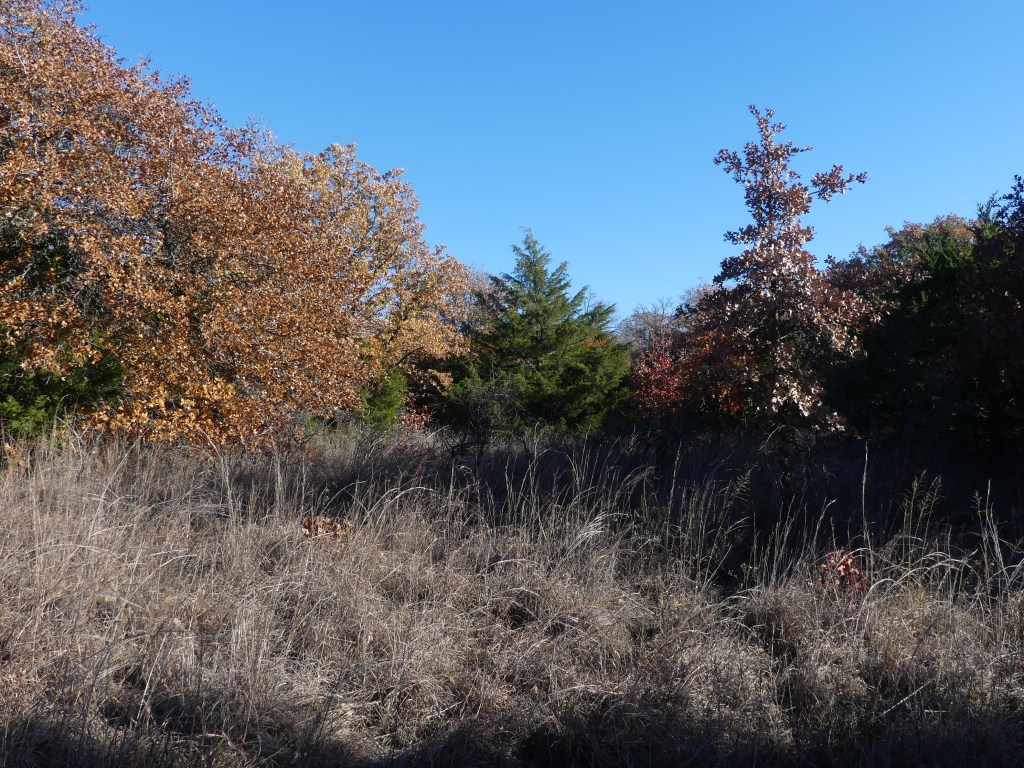
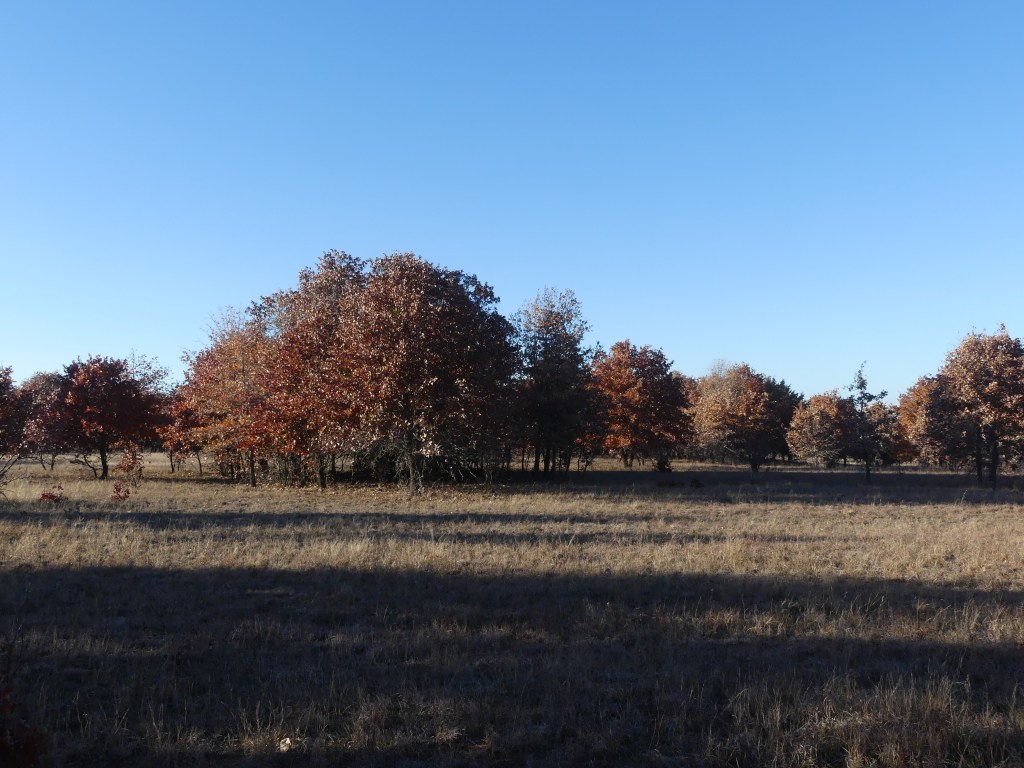
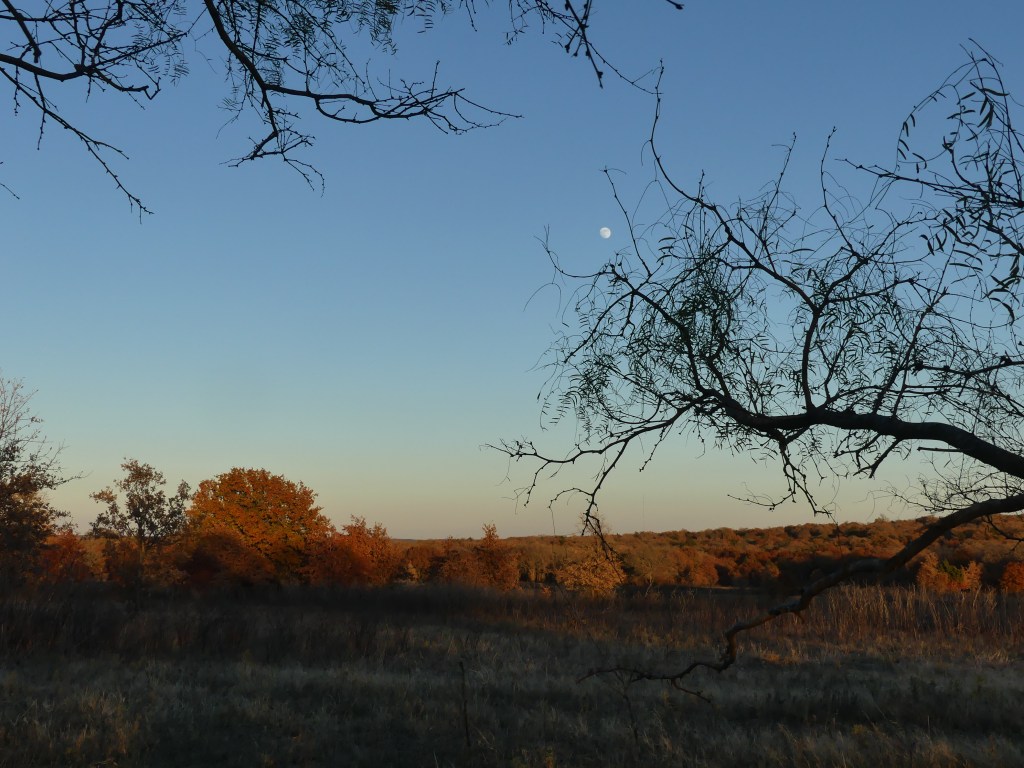
At around 4:00pm I was back at the LBJ National Grasslands in Unit 76 (near Alvord, TX). Under a sprawling mesquite tree, it was 79F under a sunny blue sky. A nearly full moon was rising above a line of oak trees in soft colors of caramel, orange, and yellow-green. I sat in my t-shirt, listening for crows to exchange greetings and thinking how fortunate I was to be there.
Weird to love weather that is a consequence of something monstrous. Warm, sunny weather in late autumn and in winter is among my favorite things. The light is beautiful and in the woods and prairies the range of colors is subtle, lovely and inviting. The smell of leaves returning to soil is like the fermenting of nature’s wine, recycling the year that is ending and preparing for new life. There can be an emotional tone of quiet reflection with a little nostalgia in the peaceful woods. For me, a bright sun and warmth brings all of this out even more strongly. Even a day that is an aberration, with temperatures outside what is normal, can feel this way.
Where is my guilt for loving a gift from climate change? Nowhere. I would gladly give up very warm winter days in return for a climate more like the one I grew up with, if I had that control. I do what I can for a healthy climate and then I enjoy beautiful days, even the weird ones.
The best way to experience a day like this is away from the mechanical grinding and whining from leaf blowers, air conditioners, highways, the constant soundtrack of the world we have built. It becomes a background noise that we pay little attention to and may forget about, but our auditory nerves and our brains are in constant reverberation with it. Go to some place where you are free of it, where it is quiet and the sounds that emerge are birds, water, and breeze, and see if the world doesn’t seem less chaotic and more sensible.
I stood just inside a woodland of oaks and junipers, watching a few stray leaves fall. A wave of breeze whispered and the trees replied “shhh,” while more leaves floated down like snow.
The LBJ National Grasslands can also be a place for solitude. On this day, a group of three people on horseback passed me on the trail, but these were the only people I saw in nearly four hours. Perhaps it’s not that I’m a grumpy old man, a would-be hermit. I’ve shared walks out there with people who have a similar style of walking slowly, noticing things, being attentive to the nature around us, and those are great walks. But there is also great value in just being by yourself.
It’s hard not to see that people are growing more out-of-whack just like the climate, with increasing extremes that do a great deal of harm. I don’t think the pandemic caused it, but it certainly gave a considerable boost to the troubles that are all around us. News reports say that children are in a mental health crisis. The news also tells of a pandemic of violence toward women. Anyone who is a little different (people of color, gay, immigrant, Jewish) is at greater risk. Whatever was going on before, the pandemic pushed us into greater isolation, more job loss, fears of getting sick and dying, and lots of toxic thinking about what and who was causing all this pain.
In the midst of all this, an afternoon in the company of crows and cricket frogs, blackjack oaks and bluestem grasses is an ideal sanctuary. I like it that the origin of that word refers to a holy or sacred and protected space. I remain engaged in the world of people, but for a time I rest in a place that feels like a refuge.
One of the small ponds feels very sheltered, and as you climb down through some erosion there is a gently sloping, sandy bank. I stayed at that pond for a while, sitting and then lying on this bank with my attention captured by little things. A tiny bee mimic fly landed inches from my face where I could see its thin yellow and black banded abdomen. A honeybee buzzed around as if looking for something inches above the sand and finally flew off. A few feet away, a cricket frog took a small hop but was in no hurry. A small snout butterfly swept in, landing on the sand. Intermittently it shifted position until it had turned itself around 360 degrees, and then it flew away. I was happy with these small and interesting companions.
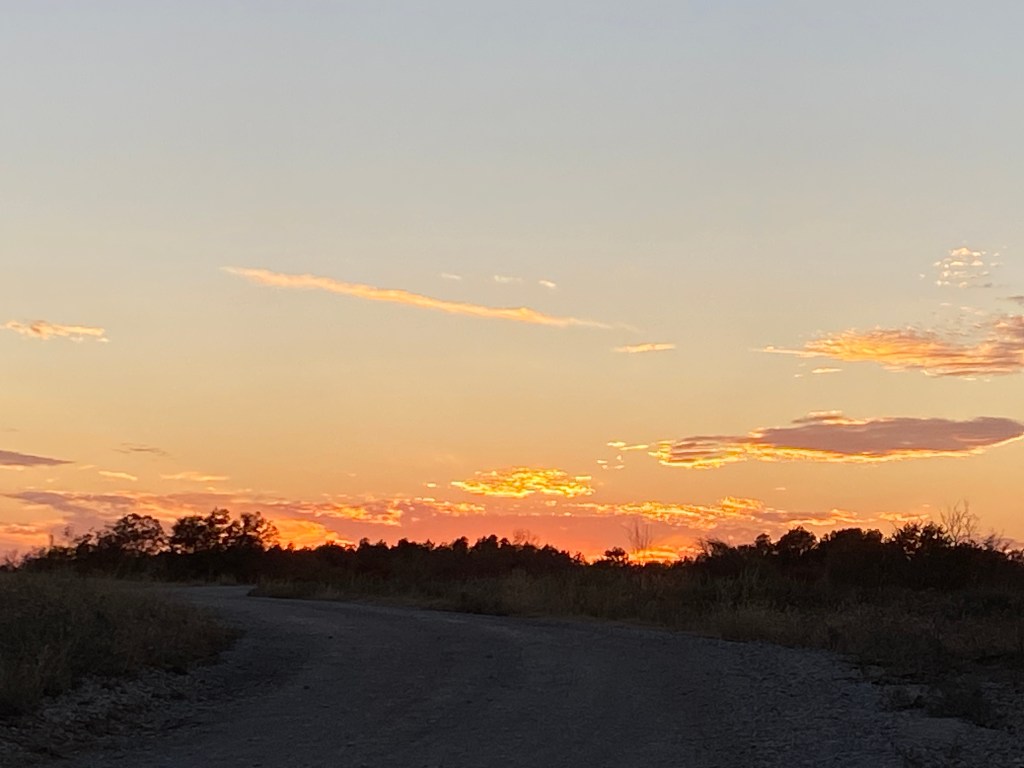
Late in the day, I walked in Unit 76 where there are big open areas of grassland and a few more mesquite trees in higher, well-drained places. The sun was getting lower and the shadows longer. I sat under a mesquite looking across a patch of prairie at a line of oak trees lit by the setting sun. The rest of the landscape was darkening, and the world was still. A nearly full moon was rising in the east, and I watched it climb in the sky framed by mesquite leaves.







 Our Lives In Nature