I have experimented with writing letters to you, because I want to communicate about nature and I love the idea of doing so in a personal way. I started with Letters to Nature Kids, which are short and informal “letters” about being out somewhere, or about how nature experience is related to gratitude or coping with fear, and so on.
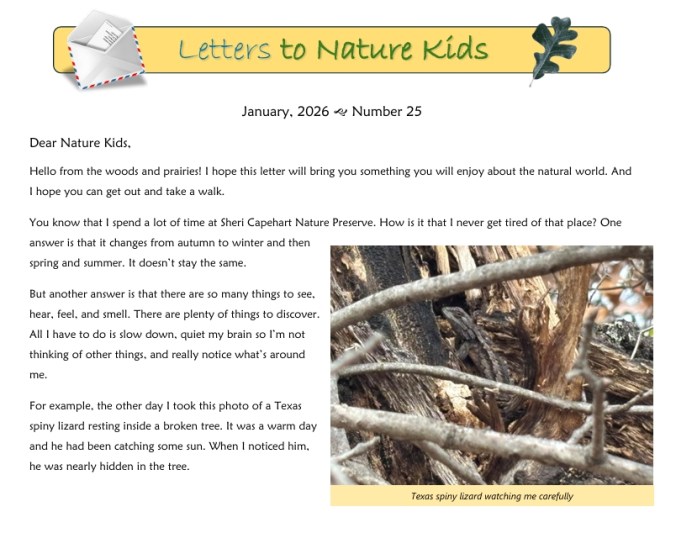
This latest one has to do with all the small wonders we can notice when out for a winter’s walk. Finding a half-hidden lizard or noticing a tiny shell and tracking its identity down (it was a Texas liptooth) make a walk fascinating, even when the discoveries aren’t very dramatic. Being able to notice and appreciate small things is a valuable skill, and the letter is an attempt to show that this is true.
I notice that these letters get downloaded fairly regularly, but I rarely hear from anyone about them. That makes the whole thing very experimental – writing for the reader who I imagine might read it but not really knowing how a reader felt about it. If you wanted to bring the whole idea of a letter closer to reality, you could write back to me. One way would be to use the contact page here, or there is an email address at the end of the letter. Then we would be having something closer to a conversation, and I would be very grateful for that.
But if not, it’s OK. My hope is that the letter gets read, and that it gets the reader thinking about things and wanting to get outside for a walk.
We had black-eyed peas and cornbread at my house today, like many people do on New Year’s Day. It’s supposed to bring luck, and we can use all the luck we can get in the coming year, so I’ll throw a bit of salt over my shoulder if it will help.
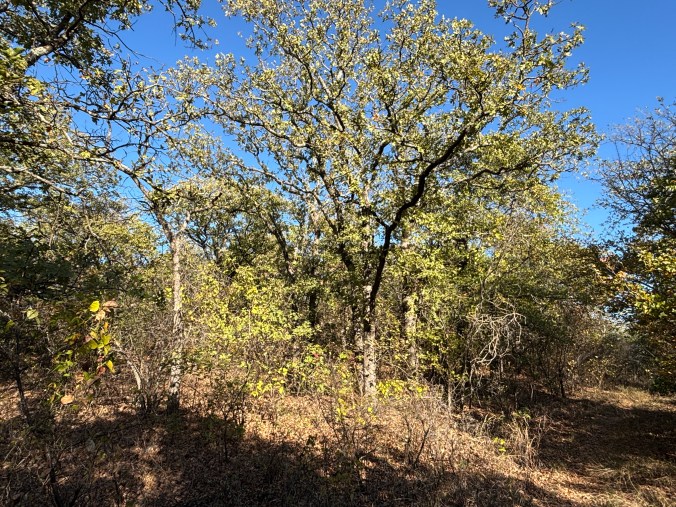
And after lunch I took a walk in a lucky place, a familiar place that I thought should be visited at the start of the year. Sheri Capehart Nature Preserve is clearly a lucky place. It escaped the bulldozer and remains a little fragment of the original oak woodlands and little prairie openings while everything around it has been scraped, paved, and built to become streets and houses. It’s a survivor. And it’s a talisman for all the people who have spent time there and become rejuvenated, charmed, educated about the living world, calmed, or inspired during their visit. So, to start the year off right, I made a loop to the north pond, up to the bluff, and back down the south side of the hill.
It felt somewhat warm but looked like winter. It was 72 degrees in the area, but long, gray clouds with filmy edges stretched across the sky, and the sun shone in a diffused way through part of them, like a light behind a thin cloth. This sky would have been a match for a winter day with temperatures in the 30s.
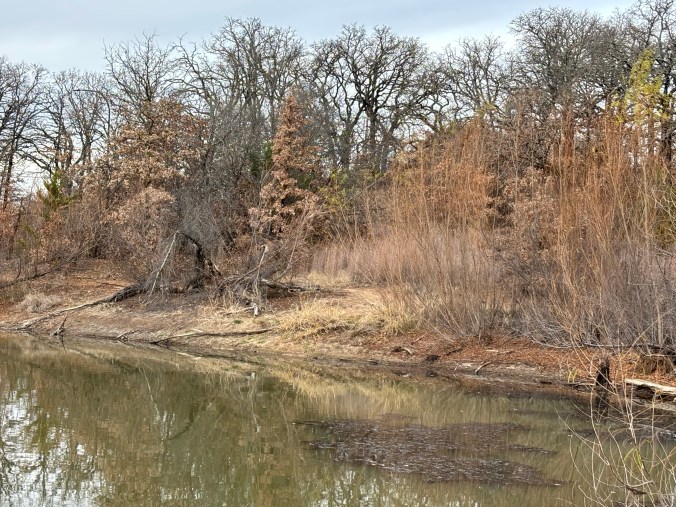
The shrinking north pond
The north pond has become smaller and more shrunken as the weeks have gone by with no rain. I skirted the water and climbed the hill behind it, and then sat for a little.
Sitting looking south toward the pond
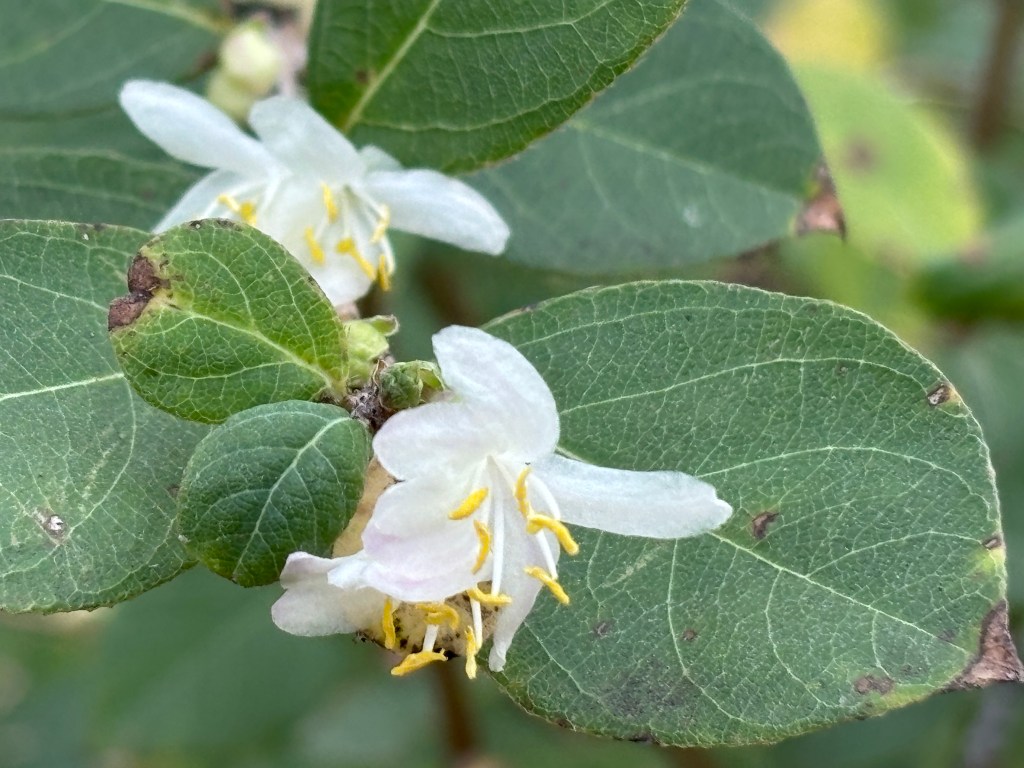
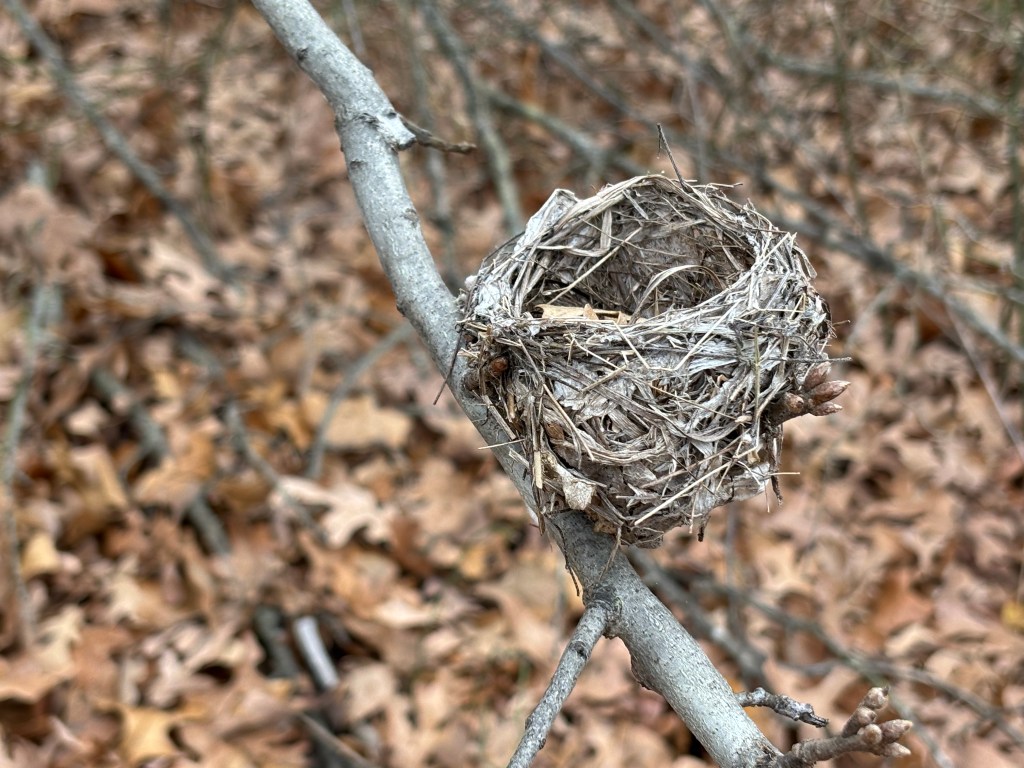
After that, I walked eastward along the north prairie. On that walk at the edge of the woodland, honeysuckle was beginning to bloom. And really, how can you blame the honeysuckle for such a crazy thing, when we’ve been breaking records for warmth. So the preserve can be forgiven for sending out mixed signals like this. I also noticed a very small bird nest from last year, now plainly exposed in a low branch after the leaves have dropped. I hope it brought the birds good luck.
I climbed up to the bluff, where there is a spot nearby that is great for sitting, writing, or just being there. As I sat, pulses of breeze came through, a whoosh of air or hiss in the branches and a papery rattle as the breeze scattered a few leaves on the ground. And a butterfly blew in, a painted lady (or maybe American lady) that landed about eight feet away and rested briefly before taking flight on the wind.
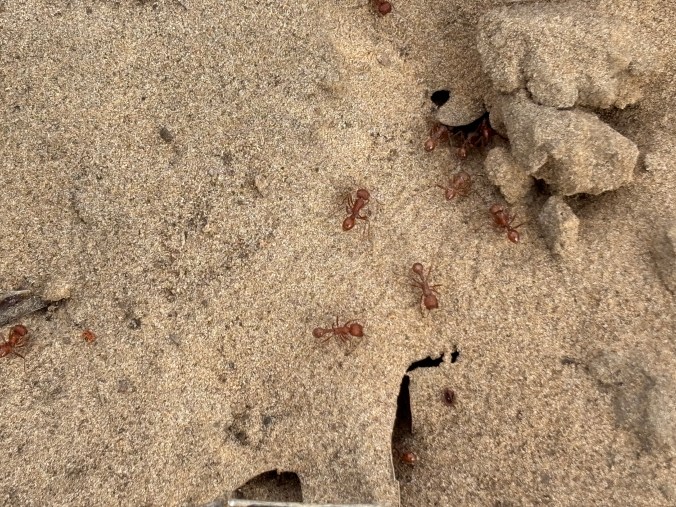
Comanche harvester ants
More insects were busy today, like the bees coming into and out of the bee tree. Maybe they found the blooms of honeysuckle, or maybe they were bringing water from the pond back to the hive. The colony of Comanche harvester ants was clearing another opening at trailside and maybe searching for a few more seeds.
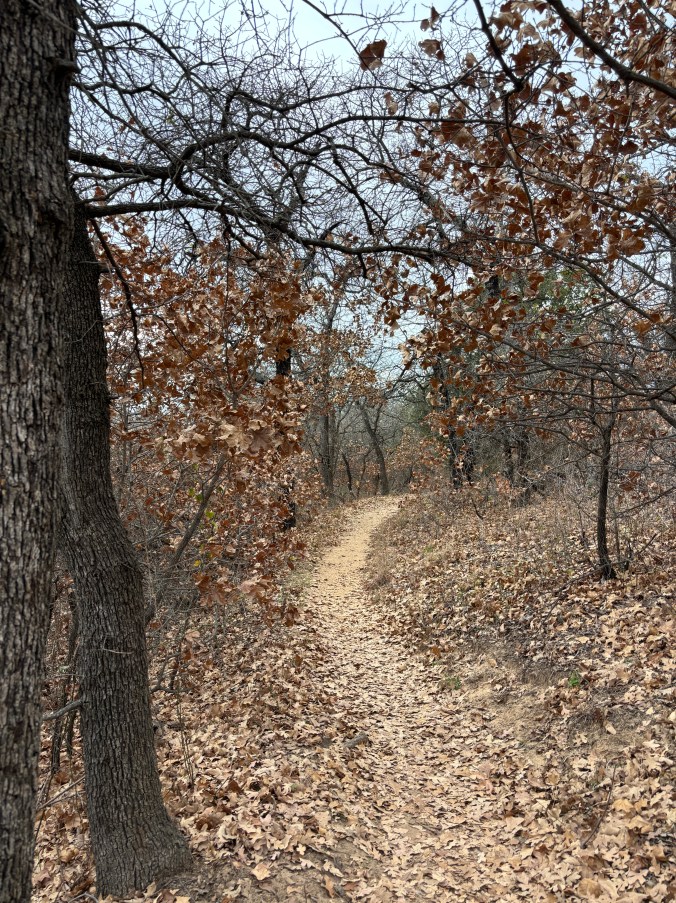
Path curving around the hillside
My walk lasted just over an hour, but it was enough. Now 2026 is off on the right footing, with a little time in nature along with that southern tradition of black-eyed peas and cornbread. May we all have a good, healthy, peaceful year in the coming months. It’s not too late for a walk at the preserve, and you can come by for some peas.
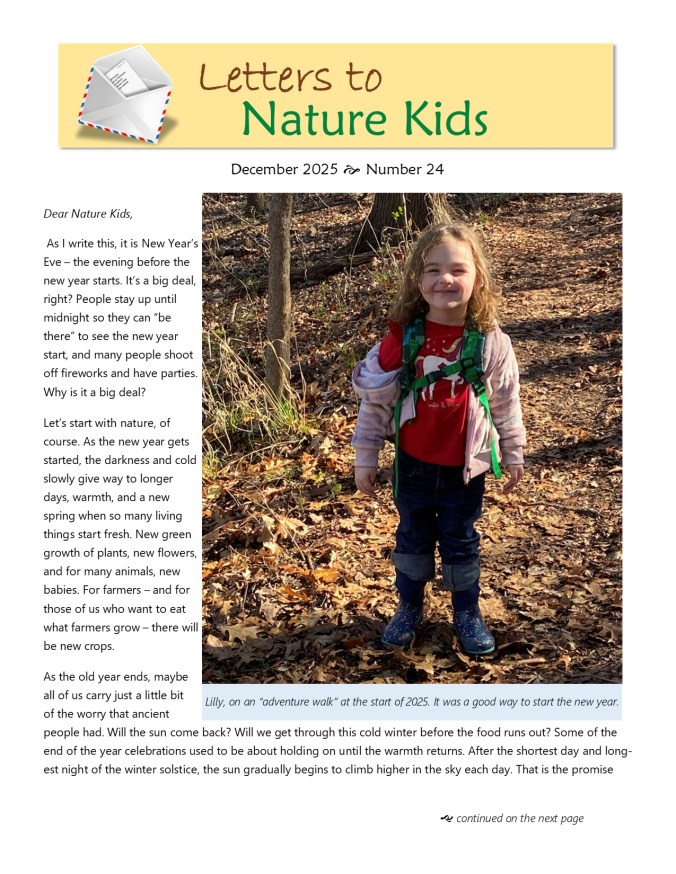
Happy New Year everyone! Thinking about what we do to mark New Year’s Eve and where it comes from, I’ve written a new Letter to Nature Kids. I hope you will have a look and share it with any kids who might want to have a look. (When you click the link it will download as a pdf)
Have a safe and happy New Year’s Eve. May we all have a good 2026; may the light return figuratively as well as literally.
I’m updating the website, and I hope you’ll find the changes useful. The primary change is the addition of a page for my “online book,” Naturalists and Nature Kids in North Texas. I want to write about what naturalists do, how to observe, practice mindfulness, keep a nature journal, and how to encourage and guide kids toward a love for and an interest in nature. I also wanted to include sections that describe these things in practice, experiencing the woods and prairies of North Texas. I hope you will have a look at this work in progress at the Online Book page.
It really is a work in progress, and if you read some of the chapters or journal entries, I would be very grateful if you would share any comments about them. Could Naturalists and Nature Kids join my other in-print books? I don’t know at this point, but for now I offer the completed sections and hope that you will like them.
This week I met several groups of kids in a little patch of wildness at their school, looking for the various ways that plants make seeds, or, with younger ones, playing a game of “Food Chain” (no one was eaten, even during the wild rumpus). The kids know the place well, and many of them have explored the Ranger Circle, the Dark Forest, Maria’s Meadow, and other spots many times over several years at the private school.
The climbing tree – a juniper with well-worn limbs perfect for climbing
My role is to channel some of their energy into new forms of discovery and understanding of what lives there. I can be a counterweight to a child’s fantasy about “poisonous” spiders or aggressive snakes, trying to replace such ideas with realistic caution and a sense that, overall, nature here is a safe place. I can invite them to think in new ways about animals in nature.
For example, the third and fourth graders know a lot of animals, but their knowledge of what the animal eats – and in turn what eats it – is limited. And so, in the “Food Chain” game, when we name one of the animals that the kids have seen there, a child who can name that critter’s predator or prey comes over to the “naturalist’s corner” and we ask about the next animal, until all the kids have come over to the naturalist’s corner.
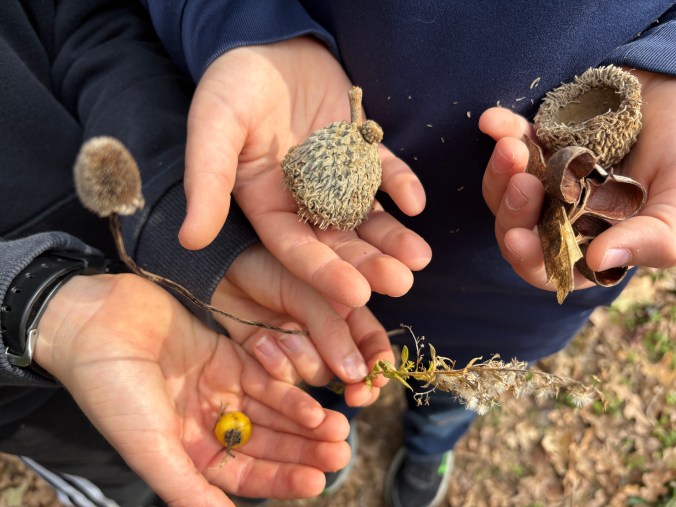
But running around and exploring is part of it. When I sent the older kids out in groups of three or four, they sprang into the woods and fields as if shot from a slingshot. They scoured the place and came up with lots of wonderful examples of seeds. There were huge bur oak acorns with the stiff, curly fringe around the acorn cup. They found the small, dried pods of the partridge pea that was flowering just a couple of months ago. They noticed all the yellow, fleshy berries of horse nettle that we had talked about on an earlier outing. Yes, they look a little like tiny tomatoes, and they are even related (but poisonous). There were mimosa pods and the dark blue berries of privet, and I mentioned how invasive and destructive privet is in a place like this. They found seed heads of Indian grass and a couple of other grasses. One girl brought a sprig of juniper, so I mentioned that this species has separate male and female trees (and the sprig with the yellowish tips was from a male plant).
The kids found acorns, berries, dried flowers, a buckeye pod, and other things
The younger kids were ready to run well before I was able to tell them what they should do. They would have been delighted to simply run. There was a lot of “wait, sit back down – no, you’ve got to stay with your group.” The instructions were as short as I could make them. “This group goes to this area, your group goes this way … and look for animals or signs that the animal was there, like a bird nest.” Then I sent them out. I might as well have said, “Let the wild rumpus start.” And kids started coming to me in excitement, “We found a bird nest! Also a beaver nest!” I had to see what this last really was, and they led me to some piled up brush someone had cut. That’s fine; the important thing was excitement about finding things. A spider web. A hole or burrow of some kind (armadillos had been digging in various spots). A dragonfly.
If you’re looking for evidence of animals, you might find these
The trick which I do not claim to have mastered is to allow and even join a bit of wild rumpus while keeping things structured enough to accomplish what we set out to do. Some kids are quieter and are already locked in on the goal, and usually they bring a good bit of knowledge to the activity. For other kids, nature study is not on their “to do” list, but running and discharging energy is. I think that we won’t get anywhere without some kind of curiosity and joy, so I would never turn any of this into “nature boot camp.” Working with groups of kids gives me additional appreciation for what teachers do (and they do it every day, not occasionally as a volunteer).
But it’s great to hear a kid say they look forward to these outings, or ask hopefully if we’re going to “play that game again” (from last month, an activity drawn from Joseph Cornell’s book, Sharing Nature).
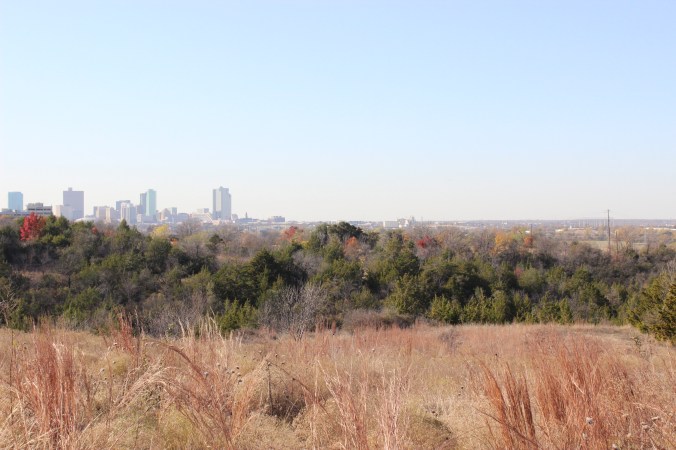
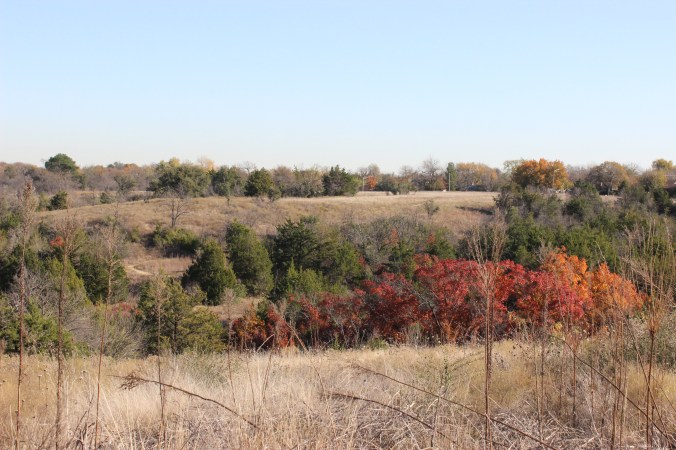
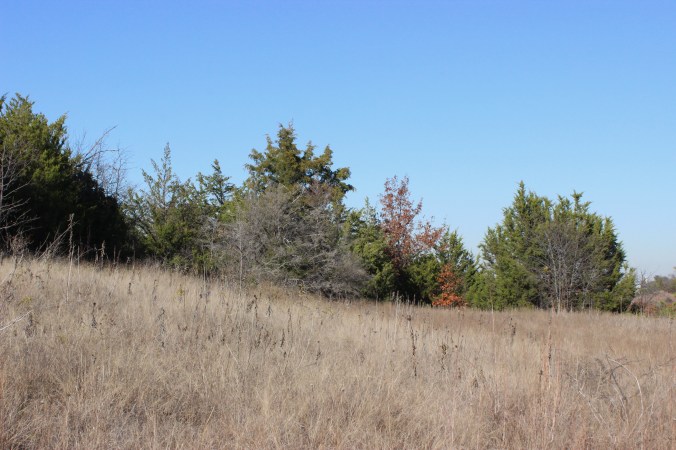
Tandy Hills Natural Area is over 200 acres of prairie in east Fort Worth. In spring there are beautiful wildflower meadows at the top of a ridge, and then the prairie drops down toward the Trinity River (on the other side of Interstate 30) to the north. The whole area has stands of oaks and other trees, with many of the ravines having thick stands of juniper.
The Fort Worth skyline seen from the Tandy Hills prairie
I paid Tandy Hills an overdue visit today. It had been a while, and I missed this lovely place. When I wrote Mindfulness in Texas Nature I wanted to wrap up the purpose and the message of the book in an epilogue, and a late winter visit to Tandy Hills was just right. Its significance was that it is a survivor in spite of everything, and it offers small and humble but beautiful gifts like the annual appearance of trout lilies. Its resilience and the broad support it receives gave me reason to hope for a renewal of connection between humans and nature.
I talked about it as an island of nature that was under constant pressure by the surrounding city. The city has done many things right, from buying the property to the support of the parks department. What I meant was that it absorbs the impact of a lot of human visitation, including prohibited motorized vehicles (for example, I saw motorcycle tracks in a muddy spot today) and certain commercial photographers who cynically treat it as a backdrop while trampling the area. Its boundaries do not shut out the nearby highway noise, and invasive plants – especially privet – are constantly trying to make inroads, choking out the native species.
Tandy Hills Natural Area is looked after by a devoted group, the Friends of Tandy Hills, who work with the city to battle invasive plants, manage and improve trails, catalogue the over 2,000 species of plants, animals, and other organisms, and offer programs to the public.
The prairies are beautiful, and they remind me of the places I explored at the western edges of Fort Worth as a kid. Thin, dark soil over white limestone, and a treasure trove of grasses and other plants: little bluestem, Indiangrass, eryngo, basket flower, gayfeather, and many others. And even at this time of year, in their dormant state, they amaze me. There are the subtle colors as well as the beautiful shapes of flowers and seeds.
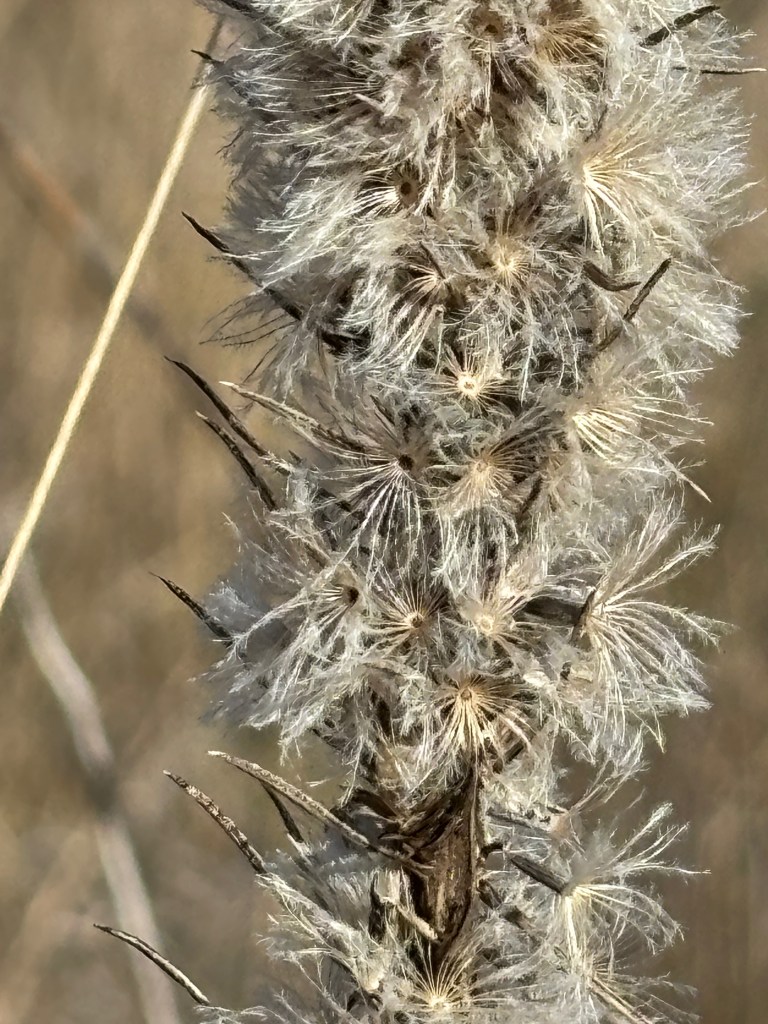
basketflowerlittle bluestemLiatris or gayfeatherLiatris – detail
This was one of those days when the weather is unusually warm, and I go for walks in a t-shirt and enjoy the bright blazing sun when it is low in the sky and makes everything just a little bit warmer in color without the walk itself being overly hot. A few grasshoppers hopped and flew away and several dragonflies hovered and darted around. The prairie changes in each season, and much of it may become dormant in winter, but it is never quiet for long.
Thank you to the prairies, oaks, and junipers. And thank you to the people who keep this place as natural and undamaged as it can be.
After the warm days of October and November, now we are seeing a bit of cold with a first freeze (barely, in some places) yesterday morning. And it is December now; in the “meteorological” way of tracking seasons, winter starts on December 1st. Most of us use the winter solstice, December 21st this year, as the boundary between autumn and winter, but North Texas is at least hearing a few rumors of the winter to come. And that calls for a walk somewhere, putting our ear to the ground to listen.
I walked at Sheri Capehart Nature Preserve, eastward along the “yellow” trail near the big pond and then turned and walked up through a tangle of woods to the “blue loop” and back toward the boulders. It was 63 degrees, a jacket needed only when the breeze blew. The place was full of sun and damp sand, native grasses going dormant and a coolness that balanced the sun perfectly.
In my journal I wrote “Phenology Note” on a sketched calendar page, and made a few notes about the trees and leaves. “The trees are still mostly leafed out and green. Many oak leaves are tinged with caramel …. Some trees look ragged but we’re still waiting for autumn color and/or leaf drop.” Back near the parking lot, many of the cedar elm trees are becoming bare, but the oaks seemed barely touched by autumn.
Phenology is the study of seasonal events in nature, and so looking back through a nature journal can show how the seasons change from year to year in a place. What’s the average time when trees lose their leaves, and how much is climate change pushing such events to new places on the calendar?
Some caramel color or a tinge of red in leaves that are mostly still green
Using a journal in that way puts me in the mode of science and data, my thoughts separated from emotions about climate change as if severed by a scalpel. But journaling can – and I think should – be more than intellectualizing. On a good day I’ll make room in those pages for what I miss from a time when life was anchored by things you could count on. Winters could be hard or they could be mild; summers might vary in how hot or dry they got; but after whatever variation in the weather, we always returned to an arithmetic mean, an average that we all recognized as something we could count on. But now the math isn’t our friend, and the arithmetic mean is shifting upward and we don’t know what we can count on.
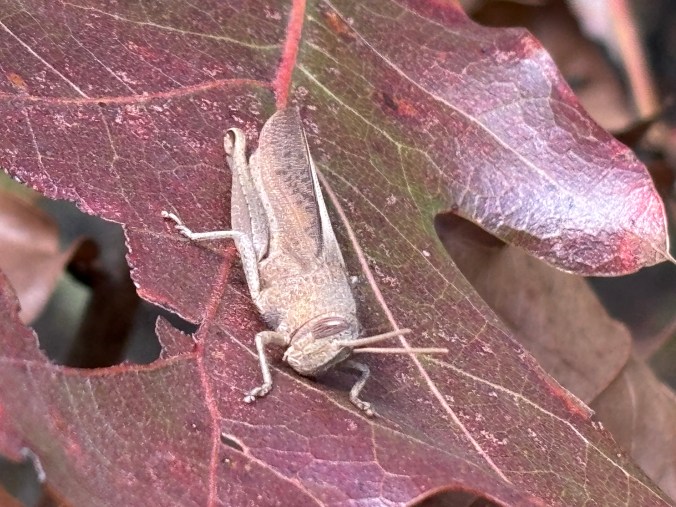
I kept walking, looking and listening for wildlife. A one-minute sample using the Merlin app detected no sounds of birds. I did find a delightful grasshopper resting on a leaf turned nicely red. Uploading a photo to the nature app iNaturalist, the insect was identified as a “mischievous bird grasshopper.”
The mischievous bird grasshopper
Now this was a find – what kind of mischief does this sort of grasshopper get into? This particular one was sitting motionless, perhaps too cool for tomfoolery and just feeling lucky to have survived yesterday’s freeze. Adult grasshoppers often don’t survive winter except as eggs deposited in some protected spot, although with increasingly mild winters, more adults like this one might get lucky.
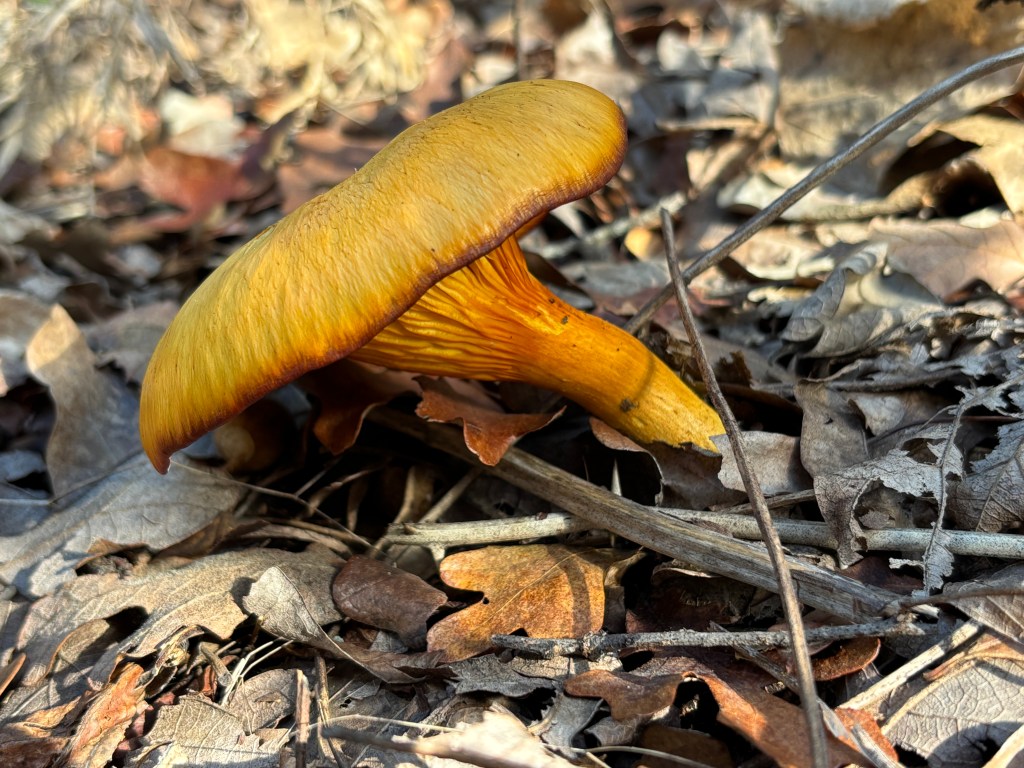
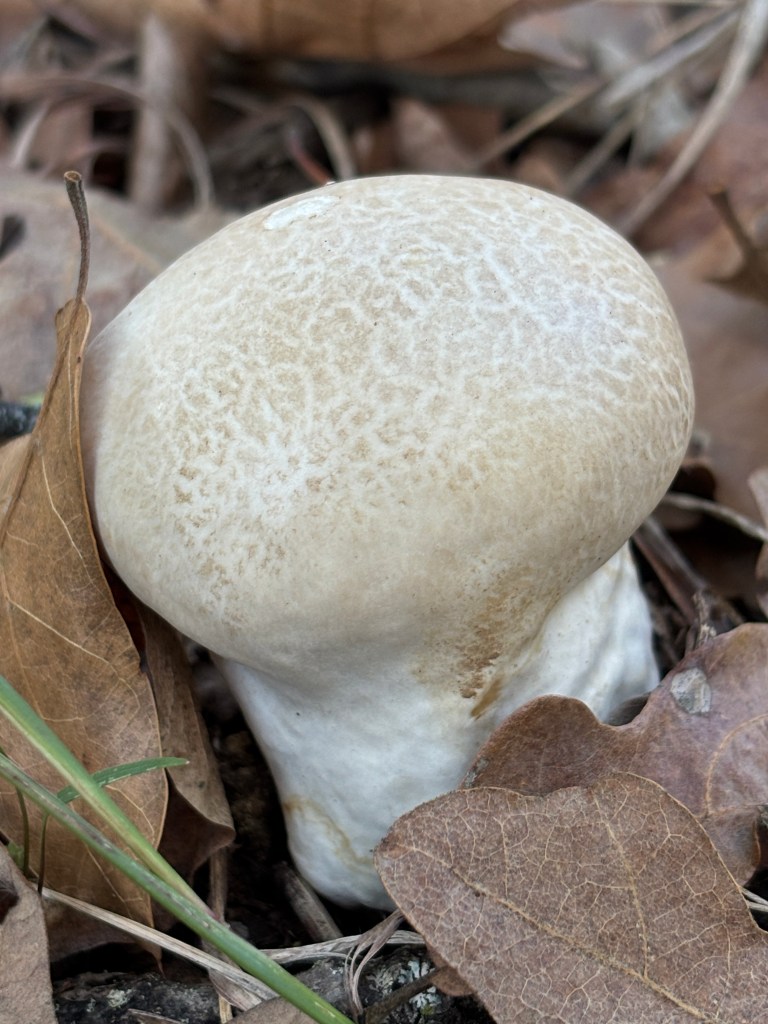
southern jack o’ lanternunidentified mushroom, probably genus Calvatia
I wanted to follow up on the walk with Logan a few days ago in which we saw southern jack o’ lantern mushrooms. In that particular spot we visited, mushrooms were still there. It might be some particular combination of the right soil, shade, and moisture, but that place stood out with all those mushrooms. There was even a new one of a different sort. According to iNaturalist, it was a type of puffball mushroom. I want to go back to see if it matures to rupture and release a tiny cloud of spores.
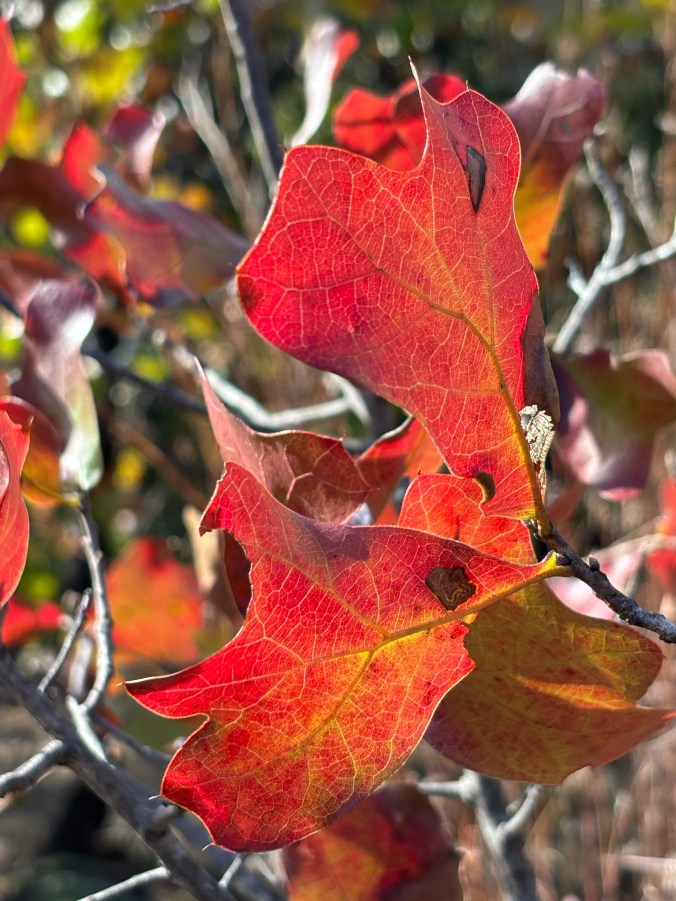
Even without a lot of fall color, there were places where the bright, slanting December sunlight backlit a group of leaves and created a dramatic display of color. Going slow, we can notice so many small and wonderful things.
Beautiful blackjack leaves
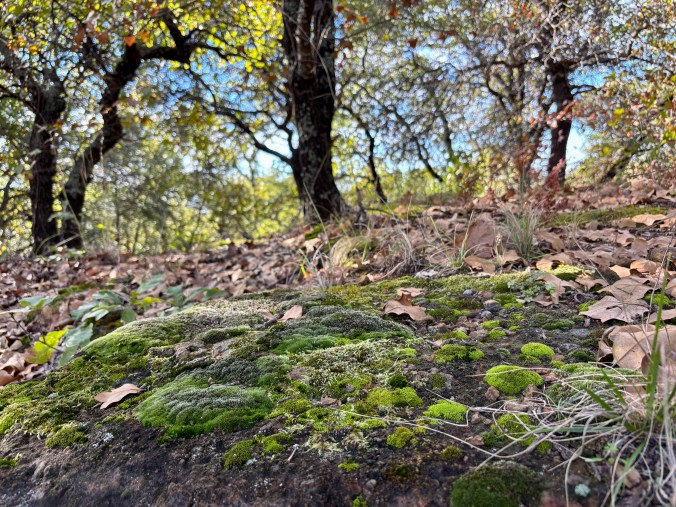
And that includes the mosses. After the way Logan brightened with every new patch of moss he found, I was attuned to them today and really appreciated how they grow on the sandstone up at the bluff. Looking at some boulders was like seeing a miniature topography of meadows and hills.
I also noticed, on the way down the hillside, that the bee tree is active again (there were no bees visible on that cool and cloudy November 29th). I stood for a moment, imagining the extent of the hollow space within that tree, and all the honeycomb built within the spaces, and all that honey!
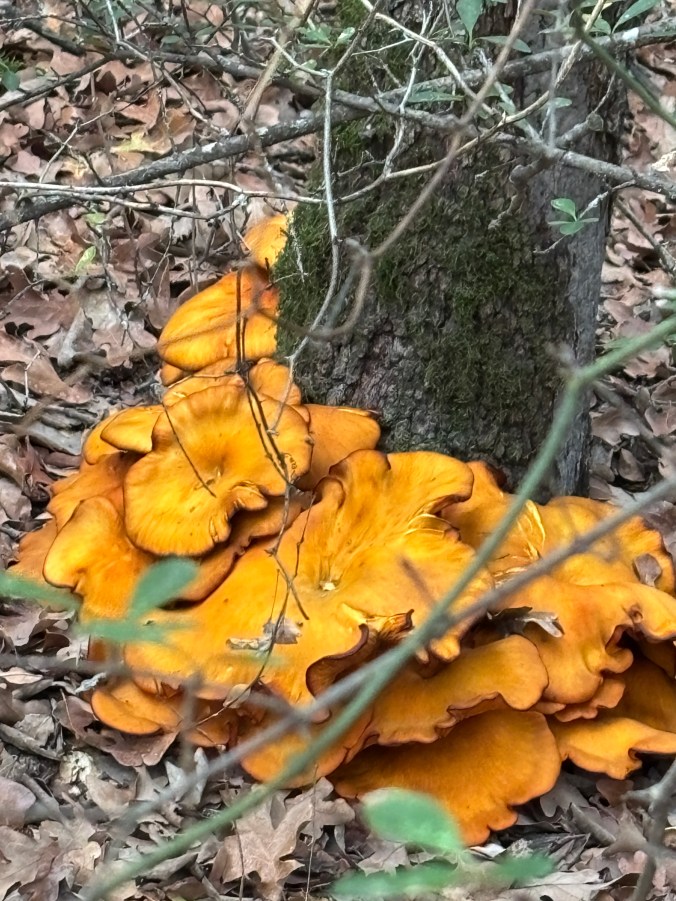
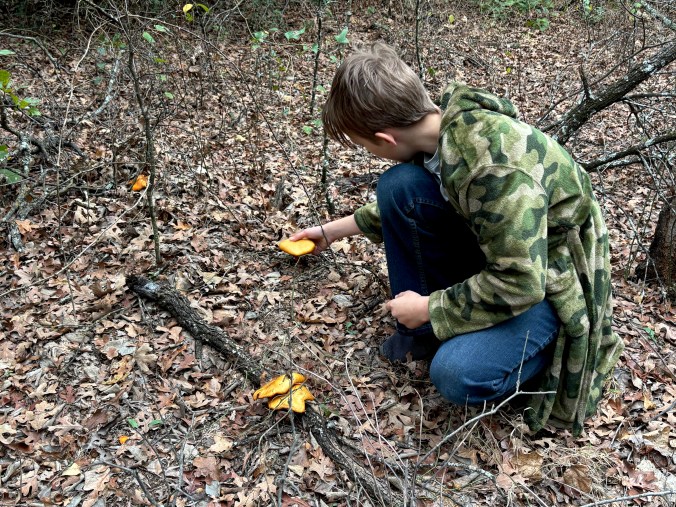
Yesterday we found several golden orange jack o’ lanterns in the woods, though it’s been a month since Halloween. There were no carved faces, just smooth clumps of orange. My young friend was delighted to find all these mushrooms, just as he was with all the mosses growing in the woodlands. And I was, in turn, delighted to watch his excited discovery of these small wonders.
Southern Jack o’ Lanterns
The “southern jack o’ lantern” is a large mushroom that grows from wood, often in clusters at a fallen tree limb or at the base of a tree. They’re common from summer through autumn at Sheri Capehart Nature Preserve, which is where we were. It has been very dry from late summer through much of autumn, but now that rains have come, orange mushrooms are popping up.
A Missouri Department of Conservation website says that the southern jack o’ lantern is bioluminescent, so that “the gills of fresh specimens may sometimes give off a faint greenish glow at night or in a darkened room.” It would be fun to return at night and see if we could observe that.
A big cluster of jack o’ lanterns that Logan found and photographed
We are used to seeing a plant or animal that we can point to, whose body or structure is gathered together in one place as one “thing.” However, with fungi it’s more complicated. For much of the year, the jack o’ lantern is a network of tiny filaments and threads running through soil and decaying wood – the mycelium. If I said, “show me a jack o’ lantern,” you would have to dig in the soil or turn over a rotting log to find those little fungal threads and say, “well, there’s part of one.” The mushroom itself is just the reproductive structure, producing spores that are almost (not quite) like seeds that will grow tissues that will become a new fungus. So a mushroom is a little like a flower – the part that catches our attention but is only the reproductive part of a larger organism.
Logan takes a closer look at a jack o’ lantern
Logan wanted to know if it was edible, so I looked it up using iNaturalist and found that it is poisonous. Not like a death cap mushroom that might be fatal, but the jack o’ lantern would give you the sort of upset stomach that one website said might “make you wish you were dead.” Definitely a mushroom to admire just where it is.
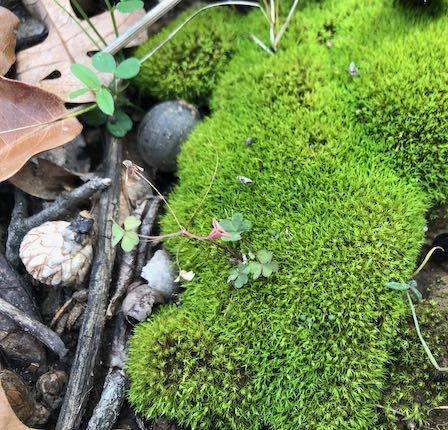
The other thing that really captured Logan’s imagination were the mosses. These little soft, green mounds growing along the ground in protected places can bring many of us into miniature worlds, sitting beside a butterfly and drinking from an acorn cup. They are plants, but without true roots and without the little tubes (vascular tissue) that flowers and trees use to move fluid and sap around. And so they must grow in short, compact mats or mounds. In shady places, an oak tree may grow a garden of moss along one of its bigger branches or at the base of the trunk. At the preserve, the sandstone at the bluff can also provide good growing conditions. The porous rock can hold moisture and is easy for moss to anchor itself to.
Mosses can survive periods of drought to an amazing degree, seeming to spring back to life after a rain. At the top of the preserve there are many partially-shaded places where mosses grow. In the heat of summer, especially when it is quite dry, they become dark green crusts along the rocks, waiting for rain. Then, the plant’s cells fill with fluid and they become green and springy.
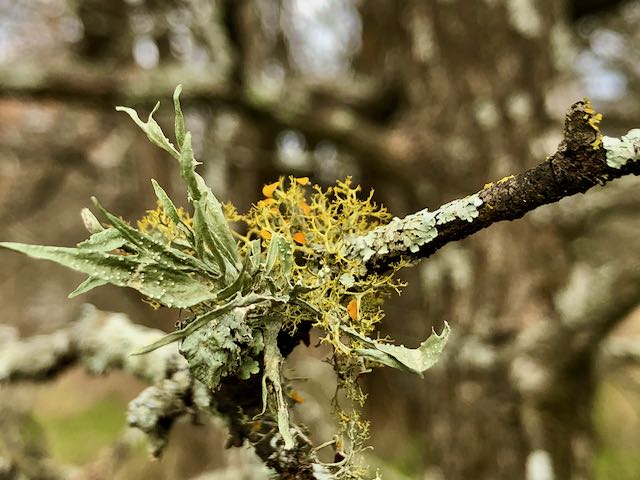
Another small growing thing that can produce a sort of miniature garden is lichen. Dead oak branches provide a great substrate for lichen to grow, either as the greenish- or bluish-gray foliose lichens that cover the surface in a ruffled coating, or else as little shrub-like fruticose lichens. One of the latter, the golden-eye lichen, is a favorite of mine.
Lichens are not plants. They are partnerships between two things. Not just a fungus, and not just an alga, but the two things fused together (or sometimes a fungus and a cyanobacterium). The fungus provides a structure and anchors the partners to a rock, a branch of wood, or other suitable place. The algae provide a means to manufacture food via photosynthesis. Together, they can survive sun, drought, freezing, and keep on going.
Several forms of lichen growing on a twig
Regardless of the biological details, these living things add wonder to a walk in the woods. To pause and get on the same level as a moss or mushroom shifts our focus from the everyday world down to a small scale and we see everything in new ways. The details of leaves and the texture of moss, or drops of dew like tiny crystal orbs on the strands of a spider’s web, these things can transport our imagination to new places. It was wonderful to watch Logan find each new patch of moss and each new mushroom with that sense of delight. It was a little like what I see when I take my granddaughter to such places; the emotion and fascination isn’t tied to a particular age (you might see it in me if we took a walk together).
Experiencing nature in this way with children is just the best. It can be a window back into our own childhood, or the childhood we would wish for our younger selves or for others. It is also a hopeful sign for our future, that children can still find magic and connection in nature. And if they carry that forward, we might protect wild places and heal some of the Earth’s hurts.
From our house to your house, we hope this is the kind of day when it’s easy to reflect on blessings, when good food and good people inspire gratitude. May it be a day when challenges and troubles quietly recede to the background for a while.
Autumn color a few years ago at Sheri Capehart Nature Preserve
And beyond today, of course. A regular practice of gratitude, acknowledging even the little stuff, is good for us. I hope that we all have plenty of reason for gratitude every day.
Among my reasons to be thankful are those of you who read what I write here (or at Green Source Texas, or my books). After retiring from my work as a Psychological Associate nearly six years ago, I have been able to do more with my writing than I would have guessed. I’m very glad for anyone who has read an article or book of mine and got something worthwhile from it.
So today, don’t let those turkeys, sweet potatoes, or pumpkins have died in vain – enjoy it all and remember all the little things that we can be thankful for.
I went for a walk at Sheri Capehart Nature Preserve with gratitude for the warm day and yet wanting very much to find autumn. That’s a season I look forward to each year, and in this changing climate it is apt to hide behind 80 degree days and dusty drought.
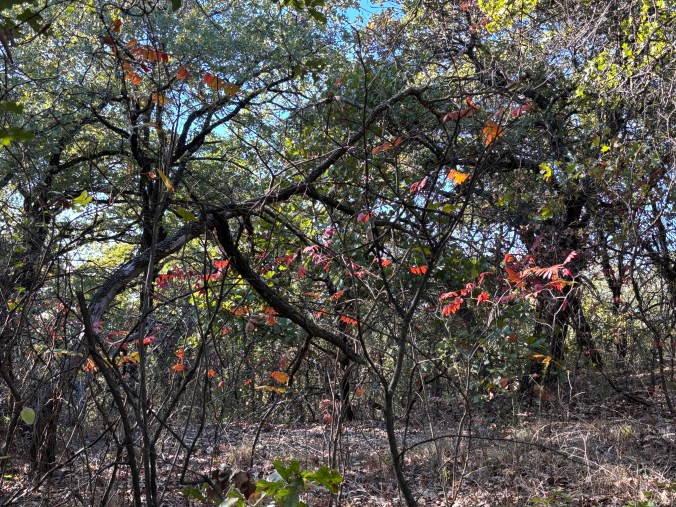
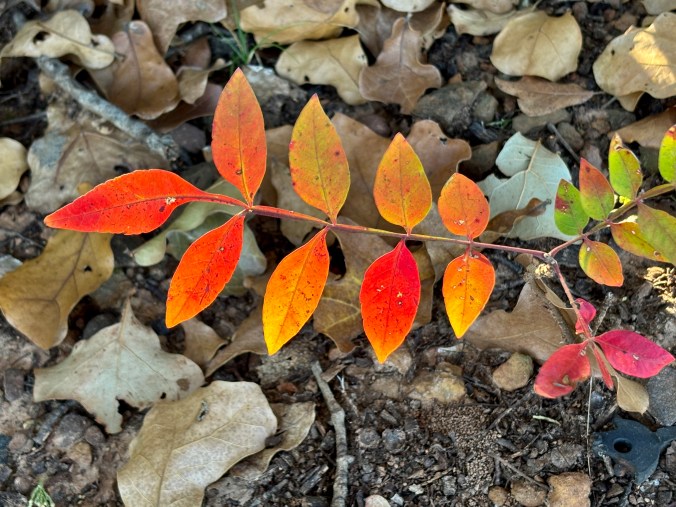
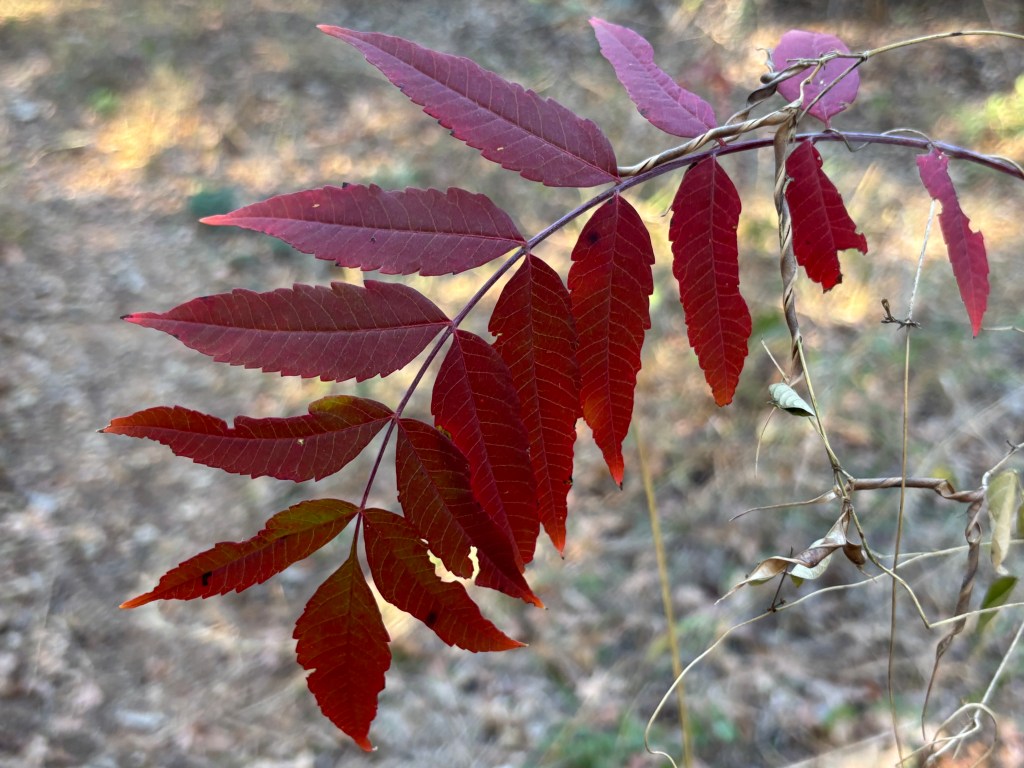
Starting at 3:00pm under sunny skies, I walked up to the top of the hill and sat down to watch, listen, and write a little. it was 82.7F in the shade, with the crowns of post oak trees still covered in green leaves and swaying in the breeze. A little sumac shrub in front of me was brightly backlit by the sun in vibrant green with a little red. Other sumacs had mostly just dropped their leaves, skipping the part where they might live up to names like “flameleaf.”
A few red leaves on some sumac along the hillside
After a while I walked over to the boulder trail and watched a couple of gulls wheeling and hovering above me. There was some wispy high clouds like a feathery splash of cream in the pale blue sky, while on the ground the shadows were lengthening as 4 o’clock approached.
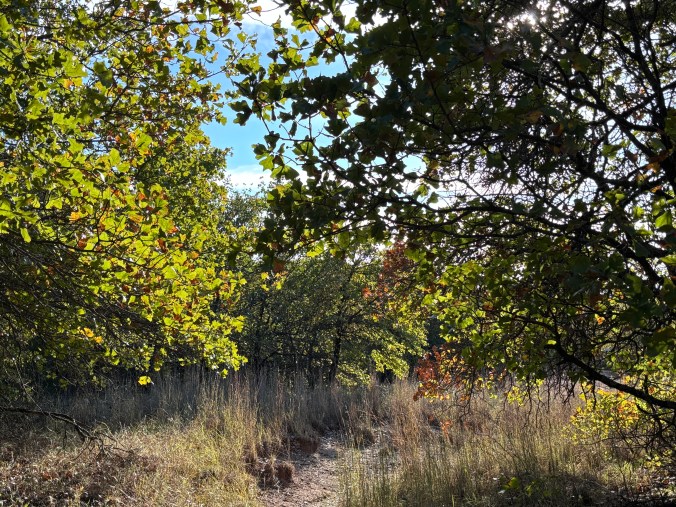
There was some red in nearby sumacs and a few red leaves of some other plant species. The scarcity of colorful leaves made them that much more welcome. Part of my wish for autumn is the hope of seeing yellows, reds, and oranges as the retreating chlorophyll exposes whatever other colors were masked behind the green. Those colors are part of what confirms that autumn is here, and so I’m grateful for each turning leaf. The rest of the woodland, in somewhat desiccated shades of green, seemed stripped of their place within the season, a shadow of summer.
A patch of sunlight backlit this sumac so that it glowed like fire
The clouds drifted, and a few had a hook or curve before stretching out southward or westward, caught and pulled by the currents flowing across the sky. This would be a great afternoon for lying back and watching how clouds are pulled along or drift with the upper winds. Yesterday they seemed in a hurry, but now their movement played out in slow motion.
Merlin reported a blue jay and a hermit thrush, though I did not hear them. Overall it seemed quiet; the traffic seemed to be some distance off and the preserve itself was nearly silent. At 4:12pm it felt like sunset was approaching, and the breeze had come up a little.
In a few days, things will change. There are reports that it will rain, maybe quite a lot. After that, the high temperatures are supposed to remain in the 60s for a while, like we might expect in late November. I will keep walking regardless, because these places like Sheri Capehart Nature Preserve, Tandy Hills Natural Area, the Fort Worth Nature Center and Refuge, are gifts that must not be neglected in any season.
I walked back to the trailhead and was gone at 4:30pm. But I won’t be gone for long.
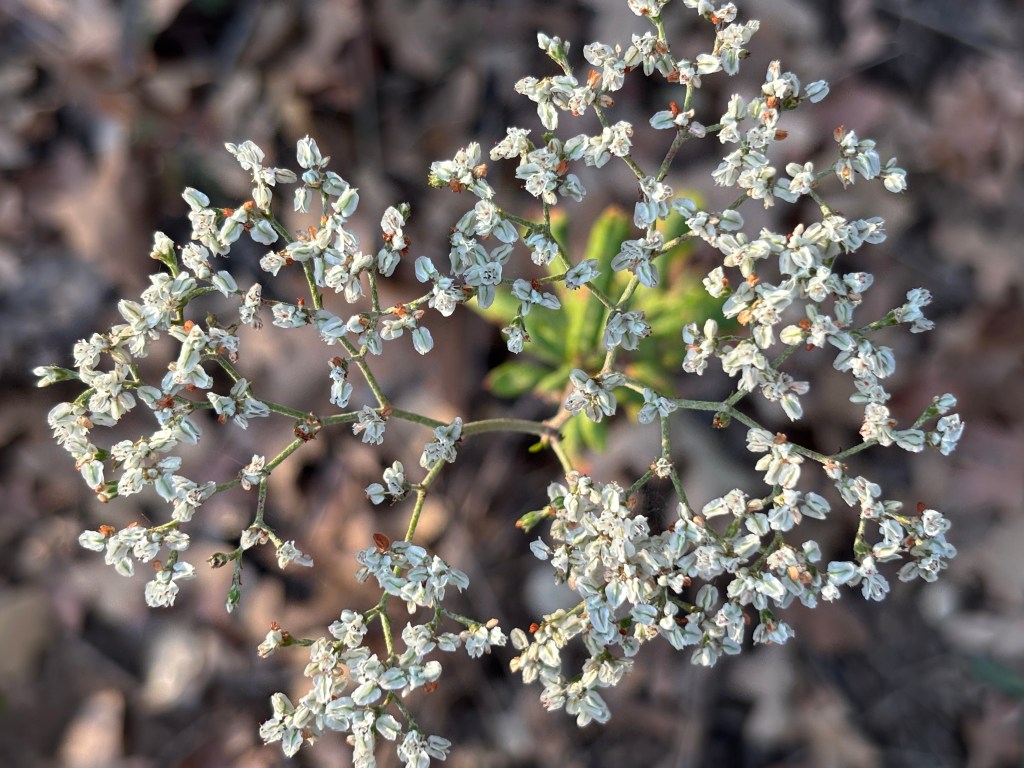
The top of a heart-sepal wild buckwheatA sumac in darker red








 Our Lives In Nature