Hi y’all. You recall that I’ve been talking about the “end” of Our Lives in Nature, suggesting that you come see me at Rain Lilies or Cross Timbers Connection. Here’s one more request.
The end of my paid website/blog here will be here in a couple of days. I’m not taking this website down immediately, but as a “free” WordPress site, it will have ads and very limited storage of media. Photos will presumably disappear along with downloadable pdfs.
So I hope you will check out Rain Lilies (at Substack). And please check out Cross Timbers Connection, a project that Rob Denkhaus and I are doing. I’ve been transferring some of the natural history stuff from here to that site.
And I continue to write for Green Source Texas and will be following up on my recent article about the border wall and related destruction in the Big Bend region.
A number of you have been very supportive of my writing here and elsewhere. I really appreciate it, and hope to keep running into you.
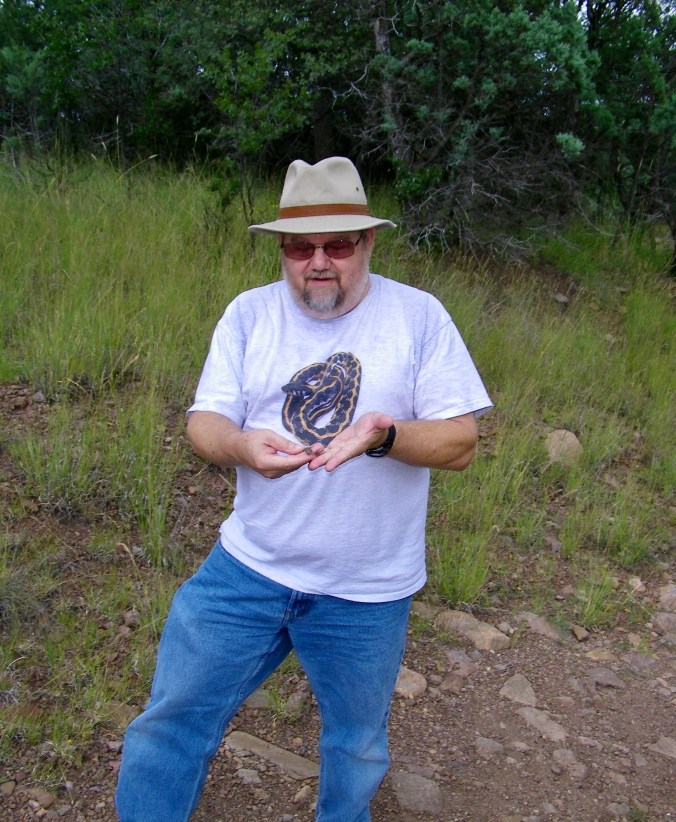
In the Davis Mountains years ago, examining a hatchling whiptail lizard
Another step towards moving away from “Our Lives in Nature” – new Letters to Nature Kids will be offered at the Cross Timbers Connection website. I just wrote about our brutal summer and how to still get out there safely. Recently I’ve had chances to watch green herons and have a surprise encounter with young raccoons out on a teenage ramble. Those are in this letter, found here.
I hope you will have a look at Cross Timbers Connection (CTC). I’ll be transferring quite a bit of the natural history material to CTC. I wrote that:
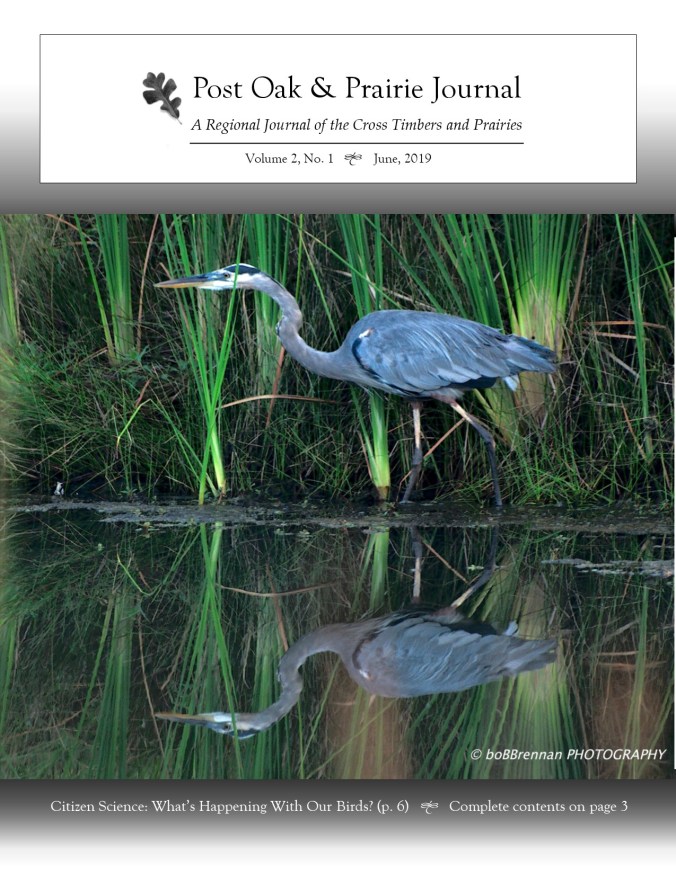
Cross Timbers Connection is an effort to connect people with the prairies and oak woodlands in North Texas and share the natural history of the region. That effort takes the form of a website, the Post Oak & Prairie Journal (POPJ), and other publications and activities.
It is a project of Michael Smith and Rob Denkhaus, who have co-edited POPJ through its history and who were officers in a more formalized organization several years ago.
Rob, Michael, and several others formed an earlier version of Cross Timbers Connection in 2013 out of a desire to connect people with nature in North Texas. We provided naturalist-led field trips for kids, wrote and distributed Frog Calls (a newsletter centered on young people), and we published the first volume of POPJ. The corporation was dissolved in 2017, but the journal was continued under the editorship of Michael and Rob, and articles were intermittently submitted and published.
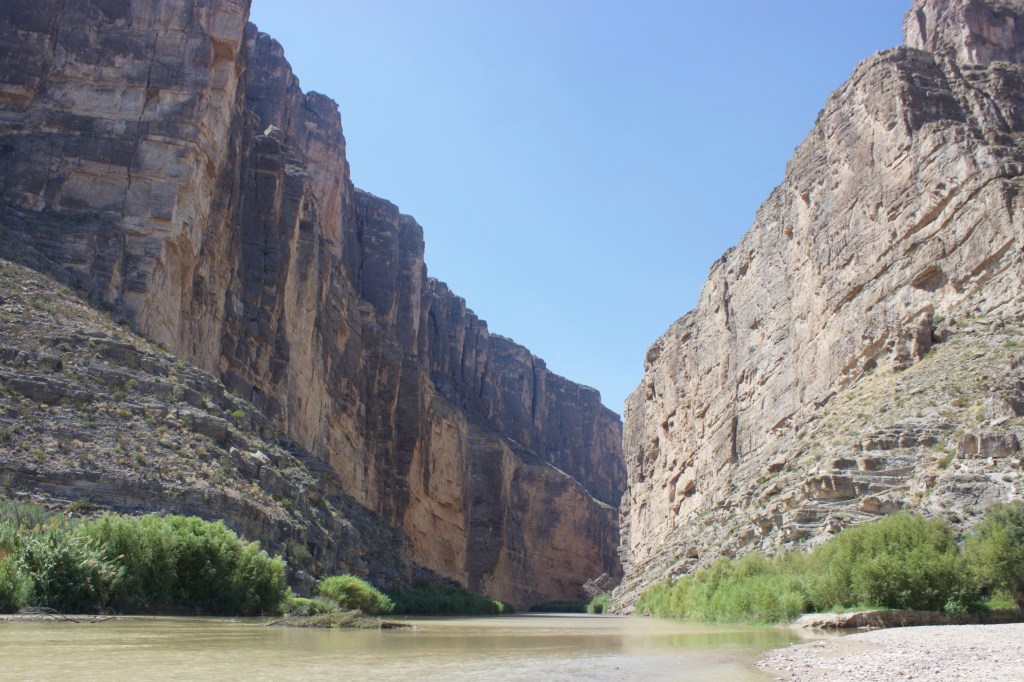
And I’ll still be writing at Rain Lilies. In the coming week I will be traveling to the Big Bend region to write about that place and the damage that’s done and the threats it is under (for a couple of planned articles at Green Source Texas). But as much as anything, I’ll be writing about how much we love the desert and the mountains, the hidden gems and open sky and the wildness that we have mostly lost. I hope you will follow that story and help us hang on to the parks, the wildlife management area, the ranchland, and the river, the Rio Bravo del Norte.
Hi everyone – recently I mentioned some changes going on, and I want to invite you once again to visit and subscribe to “Rain Lilies” at Substack. In about a month, Our Lives in Nature will phase out and I’ll be focusing on Rain Lilies. I will also be working on the project and website, “Cross Timbers Connection,” and a good bit of the downloadable stuff stored here will reappear in some form over there. For example, I’ve already updated and transferred the pdf guide for identifying venomous snakes to that site.
I’d love to see you in either or both places. When I write something that is a good fit for Cross Timbers Connection, it will appear over there, and Rob and others will be contributing as well. I continue to write for Green Source Texas (for example, my articles about “nature kids” there). And I’m on the board of Friends of Sheri Capehart Nature Preserve and I offer talks and blog articles there as well.
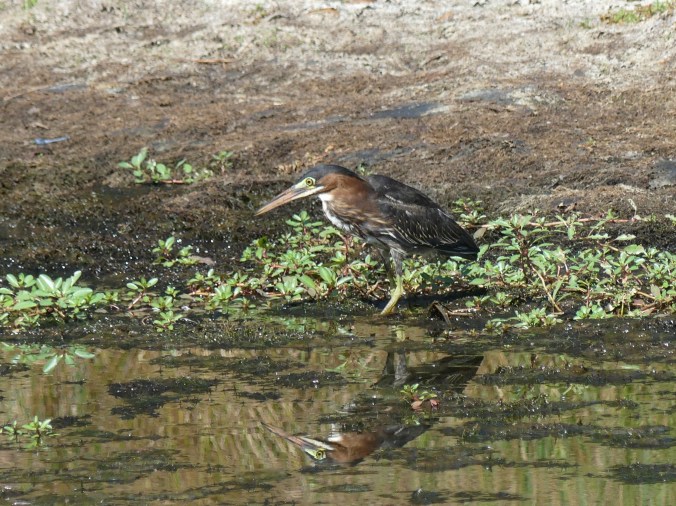
I recently spent part of a morning at one of the ponds at Sheri Capehart Nature Preserve and wrote about the green herons that were hunting there. That is at Rain Lilies, and there will be more short pieces from the woods and fields. And more meditations about the human condition and our relationship with nature.
Green heron
I value all of you who are here and hope to keep in touch (and I invite you to make it a two-way street by commenting or making suggestions!). See you at Rain Lilies!
Hi everyone. You may have seen that I have a Substack titled Rain Lilies. It has been a kind of parallel creation to Our Lives in Nature for some time, and I am going to move everything there – and I really hope you’ll follow me over to Rain Lilies.
Much of it is similar to blogging here. If you subscribe at Substack, you get new posts emailed to you, with photos. There are more options for feedback and community, including “liking” posts, posting notes and participating in site-related chats. I’m interested in taking advantage of some of their podcasting options, too. One difference is that there is not an option for downloadable PDF documents such as my letters or some of the herpetology resources (but see below).
There is an option to be a paid subscriber, but I want to share what I write without money getting in the way, so it will be much like here: contribute if you like and can afford to, or subscribe for free if that works better for you.
Here’s what I said at the Rain Lilies site about its contents: Subscribe to see if my thoughts offer any light about nature, community, society, and how we navigate the world. I am a nature writer who had a career in psychology and I am deeply concerned with our well-being and how we live out our values. I’m also deeply grateful for unspoiled places in nature.
I’m very glad for everyone who has subscribed here, and I hope you’ll give Rain Lilies a try if you haven’t.
I’m also happy to tell you that Rob Denkhaus and I have decided to restart “Cross Timbers Connection,” which was a nonprofit nature organization some years ago. This time it will be more informal. We do want to make some resources available for download, so some of the resources here may be available from the forthcoming Cross Timbers Connection website. And other resources will include the Post Oak & Prairie Journal (POPJ).
POPJ was “A record of observations, description, and analysis of plant and animal communities in North Texas. The focus of the Journal is on the Cross Timbers, the Blackland Prairies, the Rolling Plains, and the Post Oak Savanna ecoregions.” There was and will be everything from data-driven natural history reports to essays about the places and how we fit in those places – our roles in understanding, managing, and conserving. Authors of articles are largely Texas naturalists ranging from university faculty and students to naturalists with less formal training. Have a look at the sample issue and see if you might want to write for it!
There has never been a day without transitions. The deepest and darkest blue in the sky lightens toward dawn. Birds awaken and add their song to the pre-dawn quiet. Clouds become visible, gray and then pale orange and rose, and finally white. Night becomes day.
Somewhere in there, we awaken. Dreams give way to the waking world. Rest gives way to activity – stretching, making breakfast, and everything else. Preparing for another day that I hope contains possibilities for good things, though I know that for some, the preparation is touched with a little numbness or dread.
The world around us is full of transitions. Recently, cicadas have been emerging from the ground, crawling up the trees and walls, emerging from the outer skeletons that contained their earthbound forms and flying to a nearby tree canopy. During their short adult lives, the soundtrack of summer afternoons is their rattling buzz, sometimes rising to a continuous call for as many as thirty seconds or with a loud pulsing buzz. The nymph that lived for years underground is suddenly a winged adult that will die within a month.
Our human development never seems as sudden or strange. It doesn’t involve crawling out of our skin and flying away, as shocking as some teenage transitions might seem.
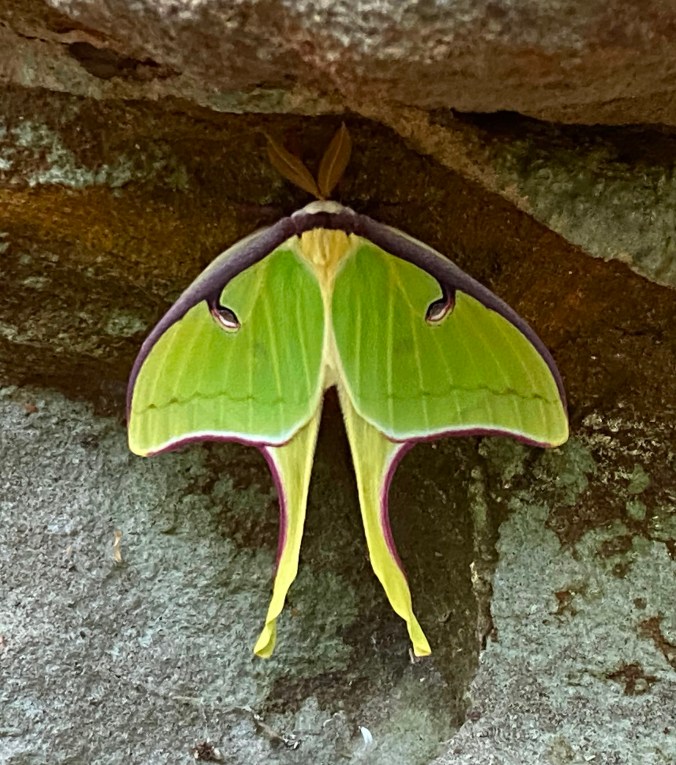
Transitions happen over time. Our perception of time feels to us like something universal, the same for a mountain or a mayfly. A minute is short, and a year is a very long time. We imagine that the week-long lifespan of the beautiful adult luna moth must seem, to the moth, to be over almost before it began. For that moth, maybe the few days spent flying, avoiding predators, finding a mate, and laying eggs seems like a full life. Just as we feel that living for 80 years is a chance at a full life.
Luna moth
And yet, to the 4,853-year-old bristlecone pine in California our lives might seem tragically short. We might want to consider that a minute is our own arbitrary unit of time, experienced very differently according to different lives. Do bristlecone pines have their own minutes?
So, transitions happen to every living and nonliving thing, quick or slow, welcome or resisted, overwhelming or able to be taken in stride. Experienced on a time scale that might be different from one life to another.
Does that perspective offer anything to us when the ground slips away and we have to adapt? I don’t know. Maybe it helps to know that the task of adapting to change is something we share with every other life in the world.
I got started with my walk at the preserve just before 9:00am, with the bright sun climbing the sky and a group of painted buntings calling in nearby trees. Maybe I arrived toward the end of what the birds would consider prime time for hunting, gossiping, or coaching new fledges in the fine art of flying. The Merlin app detected red-winged blackbirds and a Carolina wren also singing, but soon the woods and ponds would be quiet as the day became brighter and warmer.
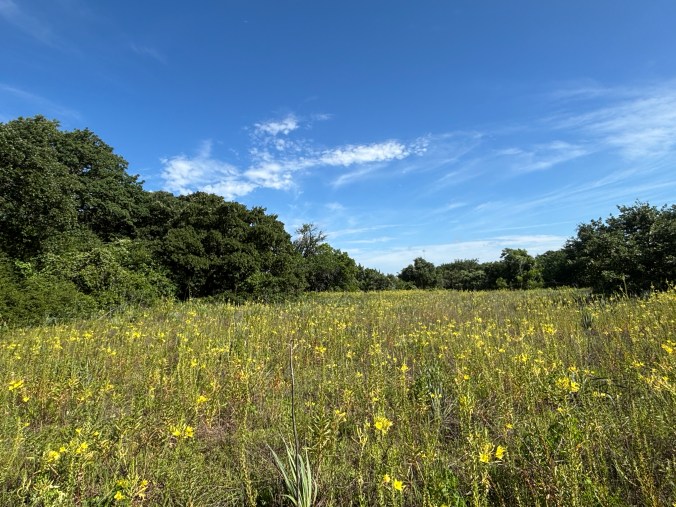
Yucca meadow, with four-point evening primrose
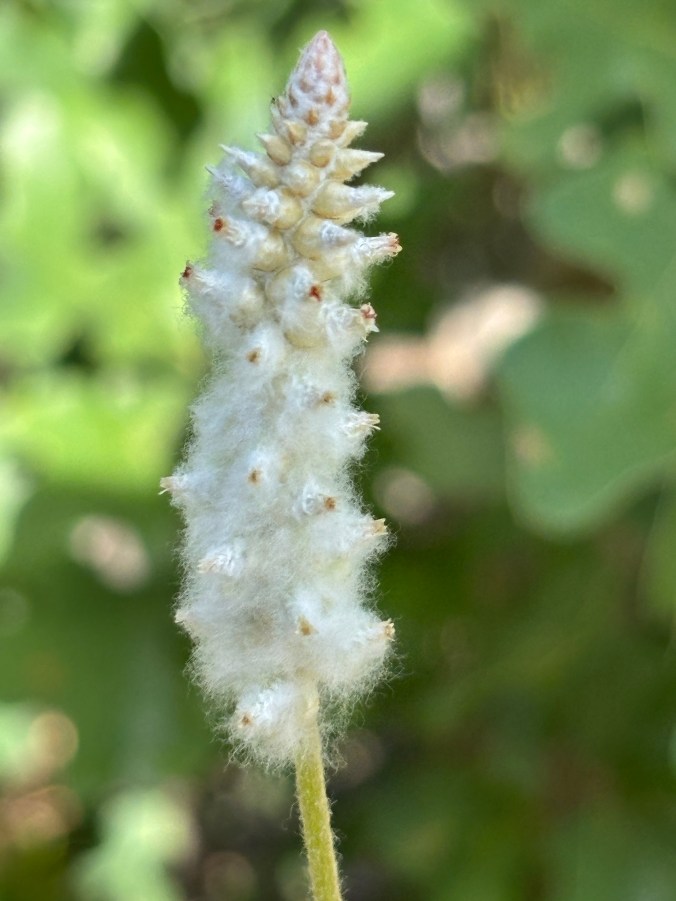
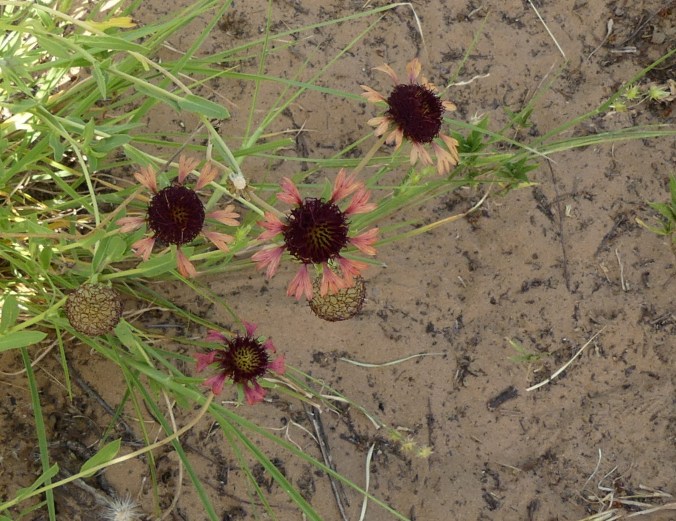
I followed the path through the oak woods and visited what we call the “yucca meadow,” which is a field of deep sand, Glen Rose yucca, various flowers, and colonies of the Comanche harvester ant. Not many days ago the meadow was filled with four-point evening primrose, many with clusters of yellow flowers at the tops of leafy stems standing two or three feet tall. Today I took a few photos of flowers like lanceleaf blanketflower and snakecotton (with flower stems covered with white cottony stuff), while I began to toast under the blazing sun.
Snakecotton
In other places, far from North Texas, the heat was much worse. In the Midwest there was an “extreme heat warning” covering several states and then extending up into New England. Europe’s heat wave was called “unprecedented,” with 1,300 deaths in the last ten days blamed on the heat. The temperature has reached 107˚F in Germany. And heat-related deaths are climbing in the U.S. since 2020, corresponding to a warming climate. In the coverage of national weather, Al Roker talked about “dry storms” bringing lightning but no rain and aggravating the fires in Colorado and New Mexico. And look at us: we’re beginning to think of annual catastrophic western wildfires as normal things.
On my walk at the preserve, I began to think about the summers when I was 12 or 13 years old. Throughout the summer I would walk and wade a big creek, the white limestone reflecting the heat of the sun back up at me. I could wade into a deeper pool or find some shade, but I don’t recall the heat slowing me down much. There were watersnakes and ribbonsnakes cruising around the pools or hiding under some of that limestone, and earless lizards scampering over the rocks. At the end of summer, hatchling softshell turtles would sometimes turn up in the puddles. I remember a bullfrog that I nearly had to tackle in order to catch it. (Don’t let all my reptile and amphibian examples distract you – they were what I paid the most attention to back in 1964, but other things were more common, too.) There were fireflies in the backyards at night then, and the summer dark carried the soft scent of flowers and you could still see the band of stars that make up the Milky Way.
Today, on the last day of June, I thought about those things. In the journal entry for my walk I wrote, “I miss summer days when I could go all day in a place like this. Age is part of it but increasing temperatures are most of it.” The summers sixty years ago were hot but not like this, not with extreme heat warnings all the way to Canada. There were fires but the western states did not burn annually.
According to Axios, in 2023 the heat waves in Fort Worth lasted on average 4 days longer than they did in the 1960s. We are experiencing an increase not only in summer temperatures but also in humidity. Heat and humidity interact to produce the “heat index,” or what it feels like to us. When it is muggy – the humidity is higher and sweat is slow to evaporate and cool us – the heat index is greater. When the heat index is 90˚ to 103˚F, the National Weather Service recommends “extreme caution” because of the possibility of heat exhaustion or heat stroke. While I was out walking, the heat index was 93˚F.
Folks might say, “Oh, Texas has always been hot.” And a person growing up in the last 25 years might read what I’m writing and say, “he’s just getting old.” It’s true, that last part. But younger folks have grown up with a different baseline of what’s normal. It’s a shifting baseline in which each generation might believe the current warm winters and scorching summers in Texas are the same as they always have been.
Nature is something else that is not the same as it always has been. Fort Worth and Dallas have expanded and sprawled year by year, to the detriment of the oak woodlands and prairies that once covered North Texas. The 2025 U.S. State of the Birds report warns of continued widespread declines in birds. Loss of frog and toad species worldwide has been described as an extinction crisis, and reptiles hardly fare better. There are numerous reports of insects declining, and that represents decreases in pollination of beneficial plants, fewer insects to do the work of returning organic material to the soil, and a shrinking prey base for other wildlife.
And humans see these losses, even if shifting baseline syndrome skews our perception toward normalizing them. Our response to significant loss is grief, whether it is from the loss of a family member, the dog that has been our companion for a decade, loss of independence following an illness, or the loss of what constitutes our home. We may not be accustomed to or even recognize the grieving of environmental losses.
Is grief the expected response to the loss of that creek and much of the wildlife that lived there, the prairie that was a quick bike ride away, the bright but not unbearable summer sun, and the soft, dark nights? Is it still a loss if there are still prairies, just not that prairie, if birds still sing but in smaller numbers, and if not all summer days are dangerously hot? By contrast, the loss of a family member is sudden and complete; leaving only photos and memories. I have written before about the loss of nature, “There is no attending a funeral and going home; there is only sitting at the bedside of a patient whose condition slowly worsens.”
Lanceleaf blanketflower
In her very thoughtful 2020 article, Lisa Sideris explored the topic of environmental grief. She noted that some people react to a damaged world with an upbeat approach that celebrates how we will adapt and use technology to address the degradation of earth. Or they shrug and say that the planet has been through worse and will still be here after whatever we do to it. We cannot destroy the Earth if the planet is reduced to a rock spinning through space. And if it is reduced in that way, there is hardly anything to mourn. However, when you spend time listening to birds where the woodland meets the savannah, or notice the many lives in a marsh or along a stream, you know what we live on is more than a rock. When we take a breath of air, listen to friends or family and hear their stories, or sit for a while under a tree, we know that our home is rich and alive. When part of that home dies or disappears, it should be remembered and honored.
Sideris wrote of grief and vulnerability as “potentially transformative, contemplative states that reconnect us with human and nonhuman others, and with our own painful history of losses and failures.” (p.2). If we make the living world around us nothing more than a backdrop for our entertainment, a storehouse of resources for our use, or a project for our technology, it is then just a thing, nothing we should mourn. That diminishes us as well as the Earth.
Where was the grief on my walk today? You know that moments of remembrance can be serious and thoughtful without obvious sadness. Part of my walk, the part where I sat and thought about the changes over the past sixty years, was like that. And part of it was celebration of what is here today, still a wonderful home, one that deserves our protection.
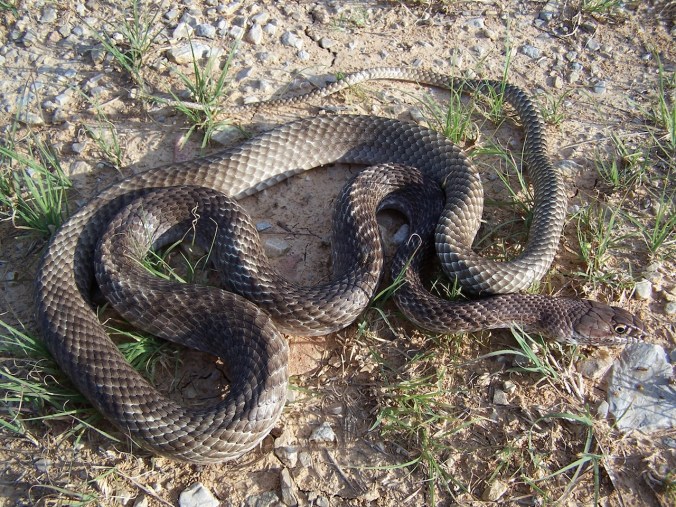
On a walk in the prairie, I see him at some distance,
Head and neck raised above the grasses, the eyes of the grasslands.
No lizard or grasshopper, nor strolling human escapes his gaze,
And the chase is like watching a living shadow slipping silently
Through bluestem, flowers, and stones, agility and speed
In a slender serpentine form.
That chase is for the grasshopper, for the striped lizard sprinting for cover.
Never for the human, although we imagine it that way.
We see six feet of scales looking like a braided whip,
And we give him the name “Masticophis,” Greek for “whip snake,”
And see him through the lens of our own lives – “he’ll whip you!”
We barely see him at all.
It doesn’t matter what a coachwhip looks like to us.
I wish we could know him the way the prairie knows him.
Naturalists with a deep interest in reptiles like to dig into issues and discover all the complexity. However, the average person might like a more easily digestible answer. “Is it venomous or not?” When they ask it, most folks are asking, “If I were bitten by this snake, would I have medically serious consequences?” The answer might not be as simple as we would like. I want to take a look at what happens when a gartersnake or hog-nosed snake bite causes symptoms of mild envenomation.
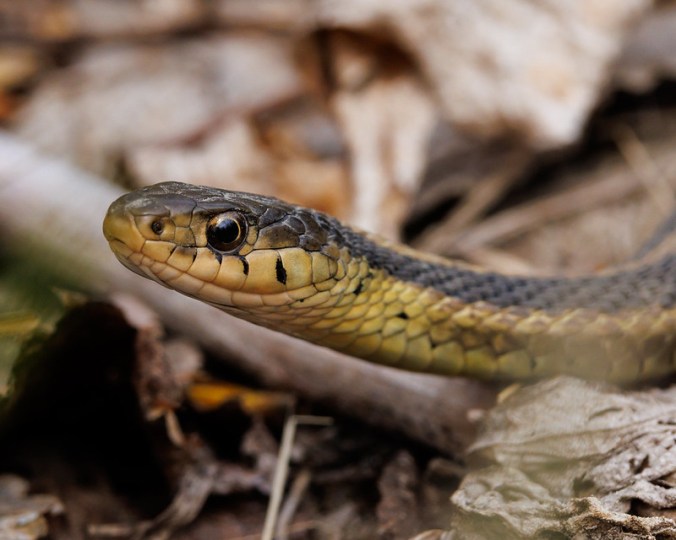
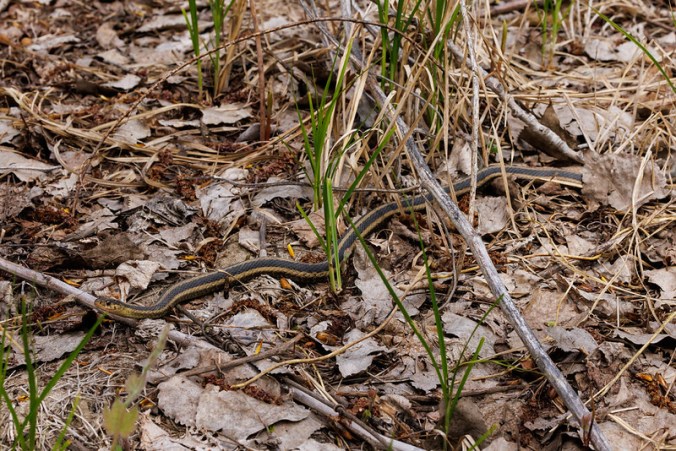
A red-sided gartersnake seen in Minnesota (photo: Meghan Cassidy)
“A gartersnake?” you say. “What could be more harmless than a gartersnake?” Generally speaking, I agree, and so do untold numbers of kids who catch them out in a meadow or woodland edge as they learn about the natural world. I would not worry about my granddaughter or anyone else’s kid picking up a gartersnake (assuming it really is identified correctly). But are they venomous?
First, we should quickly review some information about the snakes everyone agrees are venomous. In the United States, that includes the pit-vipers (rattlesnakes, copperheads, and cottonmouths) and the coralsnakes. These snakes have fangs in the front of their mouths, and venom glands that connect with those fangs so that the snake can inject venom during a bite.
All of this came about in their evolution as a tool for subduing what they eat. A rattlesnake bites a rat and releases it. Letting go minimizes the counterattack from the rat, and the venom quickly subdues and kills the rat so that it cannot get far away. It’s easy to track it down and eat it. A coralsnake bites a small ratsnake, and its neurotoxic venom induces paralysis, making it easier prey for the coral snake.
But when threatened or attacked, biting the attacker is a natural response by the snake, and the venom of pit-vipers and coralsnakes makes that bite a more potent weapon. And so that is a second evolutionary advantage of having powerful venom and the glands and fangs to deliver it.
These are front-fanged snakes, but there are some species with enlarged teeth toward the back of the mouth and venom with some degree of toxicity. In the U.S., some of these are small snakes that pose no risk to humans, such as black-headed snakes (genus Tantilla) and night snakes (genus Hypsiglena). The hog-nosed snakes (genus Heterodon) are larger but almost always unwilling to bite. Because it is nonaggressive, the western hog-nosed snake is a very popular pet, despite being rear-fanged and having what is regarded as mild venom.
Other snakes followed different evolutionary paths for food-getting. Some, like the kingsnakes and ratsnakes (as well as boas and pythons), became constrictors. These muscular snakes bite a prey animal and very quickly wrap several coils around the animal’s body. This immobilizes the prey to keep it from getting away or counterattacking, and it quickly causes circulatory and respiratory arrest. With strong constrictors, the pressure on the prey’s body prevents the blood from circulating, which leads to a quicker death than simply being unable to breathe. Snake species that are good at constriction usually have little need for venom – but if you look hard there are exceptions to almost every rule (find some of them here).
Because snakes have no limbs or claws to tear prey apart, and mouths and teeth designed for holding on rather than for cutting and tearing, you would think that all of them need some kind of advantage like venom or constriction. However, there are snakes whose approach to hunting seems to be to chase it down and simply swallow it, while maybe using a loop of the body to hold the prey animal still. Examples would include coachwhips or the gartersnakes and watersnakes and some others in the U.S.
But sometimes it is not as simple as that. Many of our “harmless” snakes have a gland running under the upper lip from the eye back to the corner of the mouth which secretes toxins. It is called Duvernoy’s gland, and herpetologists consider it to be homologous to the venom glands of pit-vipers and the coralsnake. That is, they think it has a similar evolutionary origin to venom glands. However, Duvernoy’s gland does not store a volume of venom, nor does it empty through a duct associated with fangs or enlarged teeth.
Venom researcher Bryan Grieg Fry argues that the Duvernoy’s secretions are used to help subdue prey and because they are produced in a specialized oral gland, the right name for the secretions is “venom” and the correct name for the gland ought to be “venom gland.” Sometimes what is correct biologically may be confusing to the public.
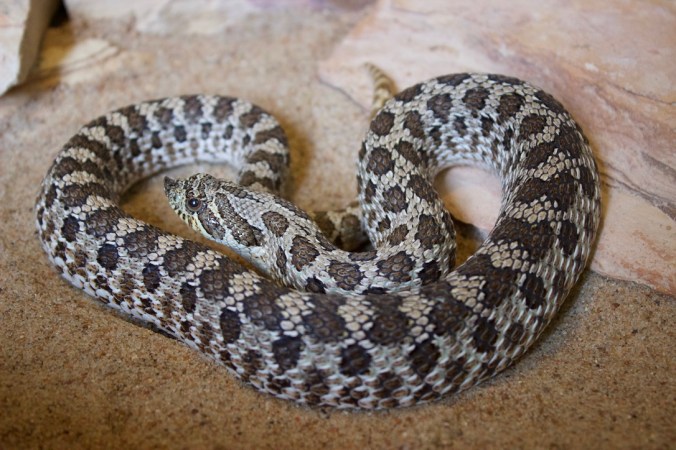
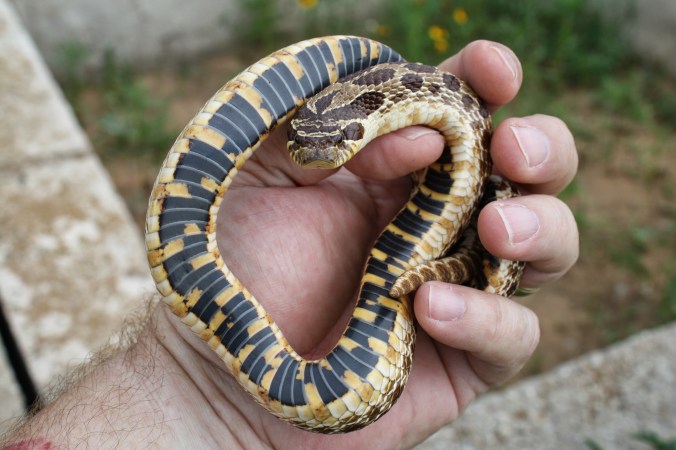
A western hog-nosed snake
Here’s what I mean: The average person divides snakes into a simple binary, venomous or non-venomous. When we start talking about gartersnakes with venom glands, there is going to be a lot of “wait a minute!” We have to go back and try to insert some shades of gray in those black and white distinctions between venomous and non-venomous. And some might think it’s only an academic point, that it doesn’t really matter because whatever the gartersnakes might secrete, it must be mild because people handle these snakes and are sometimes bitten, almost always with no ill effect. And the hog-nosed snakes bluff in a threatening way, but they don’t bite people. So Duvernoy’s glands or venom glands or whatever we call them are only academic details, right?
Duvernoy’s gland secretions occasionally have real impacts on human handlers. There is a report from 1985 of a 13-year-old child who developed swelling and bruising of the bitten hand after a “prolonged” bite from an eastern gartersnake (Thamnophis s. sirtalis). I suppose the bite was prolonged because the child was not afraid and was either curious or afraid of harming the snake. In any case, vital signs and laboratory tests were normal and the child quickly recovered. A 1994 report described a person bitten by a wandering gartersnake (Thamnophis elegans vagrans) who developed local swelling, bruising, and small blisters containing blood or serous fluid. Systemic signs and symptoms did not develop, that is, the symptoms were confined to the area near the bite.
Red-sided gartersnake (photo: Meghan Cassidy)
In 2009, a report described a person bitten while feeding their pet western hog-nosed snake (Heterodon nasicus). Such snakes often have a strong feeding response and will try to chew and swallow a hand if it is holding the prey item. The snake held on to the person’s arm for several minutes, with resulting swelling, bruising, swollen lymph nodes, “cutaneous signs suggestive of mild cellulitis and blister formation.” The patient recovered completely after about five months. Reviewing other such bites, the authors concluded that western hog-nosed snakes should be considered capable of inflicting medically significant bites but should not be considered dangerous.
A later (2019) report described another feeding bite from a western hog-nosed snake. A 20-year-old female was bitten, “causing local symptoms and thrombocytopenia.” On the third day after the bite, the patient came in with pain, swelling, and blisters. She had a very low platelet count, that is, thrombocytopenia. The symptoms in the bite area peaked on the seventh day after being bitten, and those symptoms as well as the platelet count improved within four months after the bite. This was the first reported case of hematologic toxicity (systemic effects on the blood) from a North American colubrid snake. (A technical note: in recent years, hog-nosed snakes have been moved from Colubridae to a separate family of rear-fanged snakes, Dipsadidae.) Again, this is a species that may bite in a feeding context but almost never bites in an encounter in the wild.
A report from 2026 described a survey disseminated via personal contacts and social media asking about bites by the western hog-nosed snake. Of the 91 replies, 63 were able to be used. All 63 incidents involved captive pet snakes, with bites occurring during handling or feeding. When bites were extended or involved chewing, there was a greater chance of symptoms. The authors ranked the symptoms according to the percent of respondents who said they experienced them. People reported swelling in 79% of cases. Decreasing percentages of people reported pain, itching, stiffness, red and discolored skin, bleeding, burning sensation, numbness, and then a few cases of nausea, weakness, blistering, and scabbing. Seven respondents in this study sought medical treatment and reportedly were, in some cases, given antihistamines or steroids. (Snake bite experts remind us that symptoms of snake envenomation are not allergy-based, and so antihistamines like Benadryl are not helpful.) Most symptoms resolved within approximately a week, but two cases took longer.
The black and yellow ventral scales of a western hog-nosed snake
What do we make of all this, apart from the conclusion that there is wonderful, fascinating complexity in the natural world? On a practical level, there are a couple of reasons to share this information. One is to help the public with those shades of gray between “venomous” and “non-venomous,” and the other is to suggest a little bit of caution to those who keep hog-nosed snakes as pets.
Without some introduction to this part of snake biology, the average person might hear about some of our “harmless” snakes having venom and (1) have their prejudices confirmed – “See, I told you that there’s no good snakes” – or (2) react to snakes with an even greater degree of unnecessary fear. Reports of medical symptoms from bites of gartersnakes are rare, mild, and temporary. Most of the rear-fanged snakes in the U.S. (nightsnakes, ring-necked snakes, black-headed snakes, etc.) are very small, making bites from them improbable. And I’m not aware of any wild hog-nosed snake ever biting someone when encountered in the wild. These snakes do deserve to be called harmless.
That brings us to the issue of keeping western hog-nosed snakes as pets. I have kept them and have had them try to chow down on my finger while feeding them. They are completely inoffensive but easily mistaken at feeding time. If I currently had one, I would not use it in educational presentations in which people are allowed to touch the snake. And I would not offer food by hand, nor would I allow the snake to chew on me, should a bite occur. Like many other snakes, they are harmless depending on what we do with them.
It’s surely unnecessary for me to tell kids about pretending. However, I’ve written one of the “Letters to Nature Kids” to talk about using imagination in nature. How often do kids make use of nature as a setting for pretend play and imaginary stories? I guess any kids who spend much free time in nature bring their imaginations to their time in nature, but I wanted to encourage such pretending and imagining.
I also wanted to include a little about the use of imagery as a coping strategy. It’s a particular use of imagination that can reduce anxiety and stress or help someone become more calm. Or simply provide a very pleasant few minutes of imagined time in nature.
The letters to nature kids are written for older kids, teens, or anyone who is a bit of a “nature kid,” regardless of age. They are archived on the letters to you page of this website.
If you know me, or if you have looked around at the website at my books or found the herpetology sub-page, you know that reptiles and amphibians are a nearly lifelong passion for me. And I am in the middle of a series of talks I’m offering on this subject. This Thursday, May 28, is the next one, covering the American alligator and the turtles of North Texas. The talks are free and offered via Zoom; you can register here.
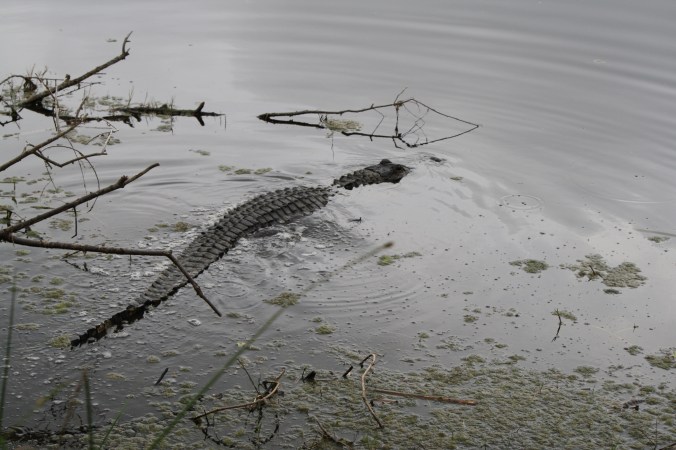
American alligator seen at Aransas National Wildlife Refuge
These presentations came about after I taught incoming groups of Master Naturalists for a number of years and I always wished I had just a little more time to cover more of the story of these remarkable animals. The participants often seemed to feel the same way, and so I put this series together. The topics are:
Part One: Getting Started (past session)
We will discuss what these animals are and introduce the topic of herpetology and things like scientific names and community science. We will also try to answer the question, “what good are they?” We’ll also cover some essential skills in the field, skills that can help participants find the animals safely. There are photos of a poison ivy, bull nettle, and our local venomous snakes.
Part Two: Amphibians (past session)
We’ll start with what makes a species an amphibian, and the frogs, toads, and salamanders that represent this group in the U.S. The presentation offers photos of most of the species encountered in North Texas along with the calls of frogs and toads. We will talk about amphibian extinctions and the threats to their survival.
Part Three: Crocodilians and Turtles – this week
These are the oldest reptiles in terms of evolution and paleontology. We will talk about our American alligator and its adaptation for aquatic life and get into the strange but successful structure of turtles and their shells. There are plenty of photos of most of our North Texas turtle species. We will discuss turtle conservation issues.
Part Four: Lizards and Snakes (two hours)
We will talk about the natural history of these species (why do some lizards’ tails break off, and how do snakes move and swallow big food items?). Photos will illustrate representative species from each family, including each of our venomous snakes. We also will discuss venomous snake bite. This presentation will be longer than the others.
Part Five: Herp Conservation Challenges
These animals are facing severe conservation challenges. We will talk about how conservation scientists keep track of various species, how federal and Texas state laws and policies may help protect them, and we’ll take a good look at several representative Texas species. We will also take a look at how we, as citizens and naturalists, can help.
Our local Master Naturalist chapter considers these sessions to be advanced training, and perhaps other chapters will as well. If you have some familiarity with reptiles and amphibians and wonder if the sessions will offer some depth, I believe that they do. On the other hand, if you are concerned that they will be too technical, I think that the answer is no.
If you are not on Facebook (the link above is to a Facebook page) and you want to attend, please send an email to events@friendsofscnp.org.