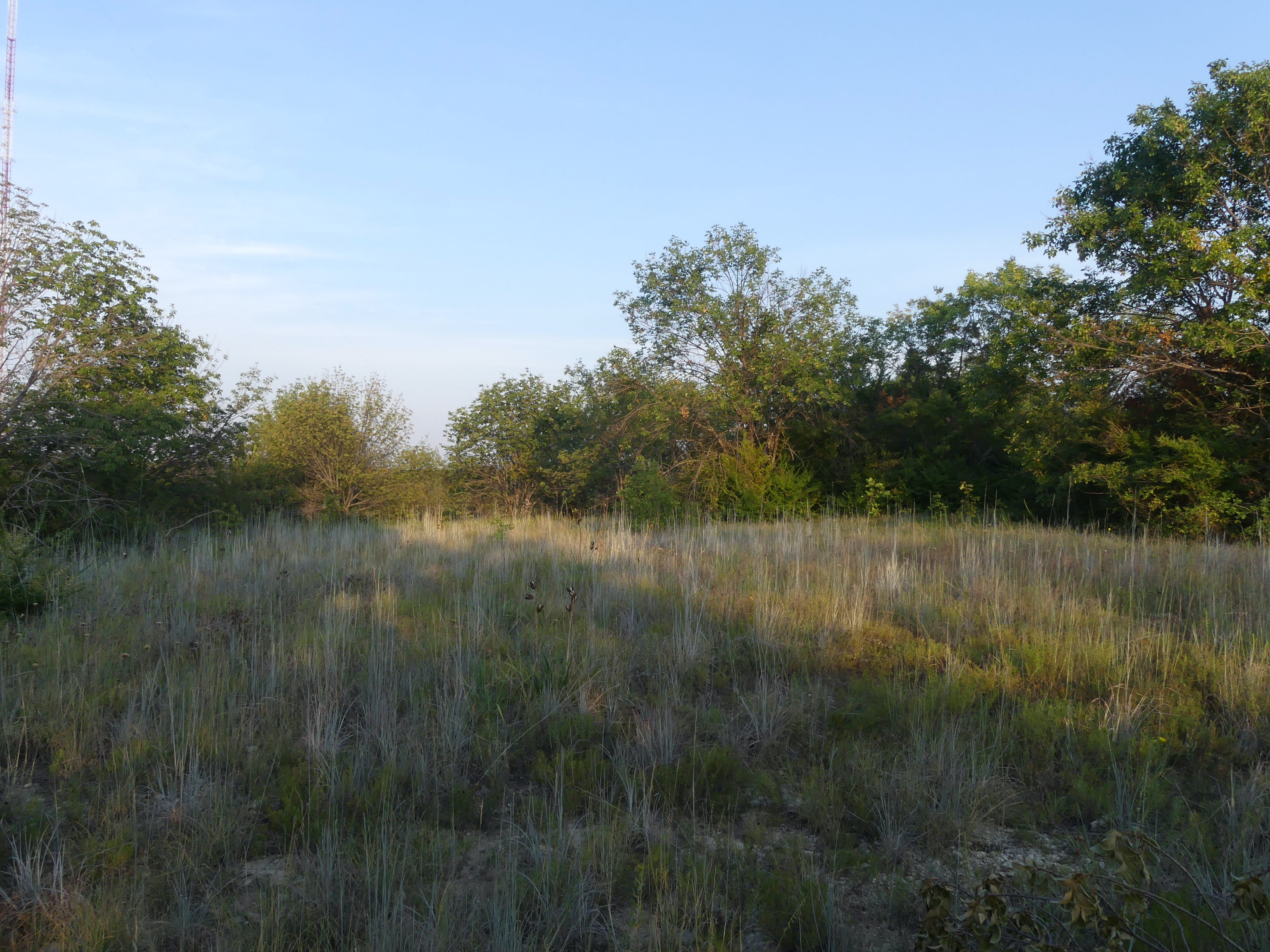
As Fort Worth grew, with buildings and highways proliferating, a little patch of the east side remained in a natural state. Much of it is dominated by hills and ridges, making it less attractive to developers. Over the years it was sometimes treated as a dump and also as a playground for recreational vehicles, but the native grasses, flowers, juniper, and lots of other life persisted. Finally, it was recognized and protected as a Fort Worth treasure, Tandy Hills Natural Area.
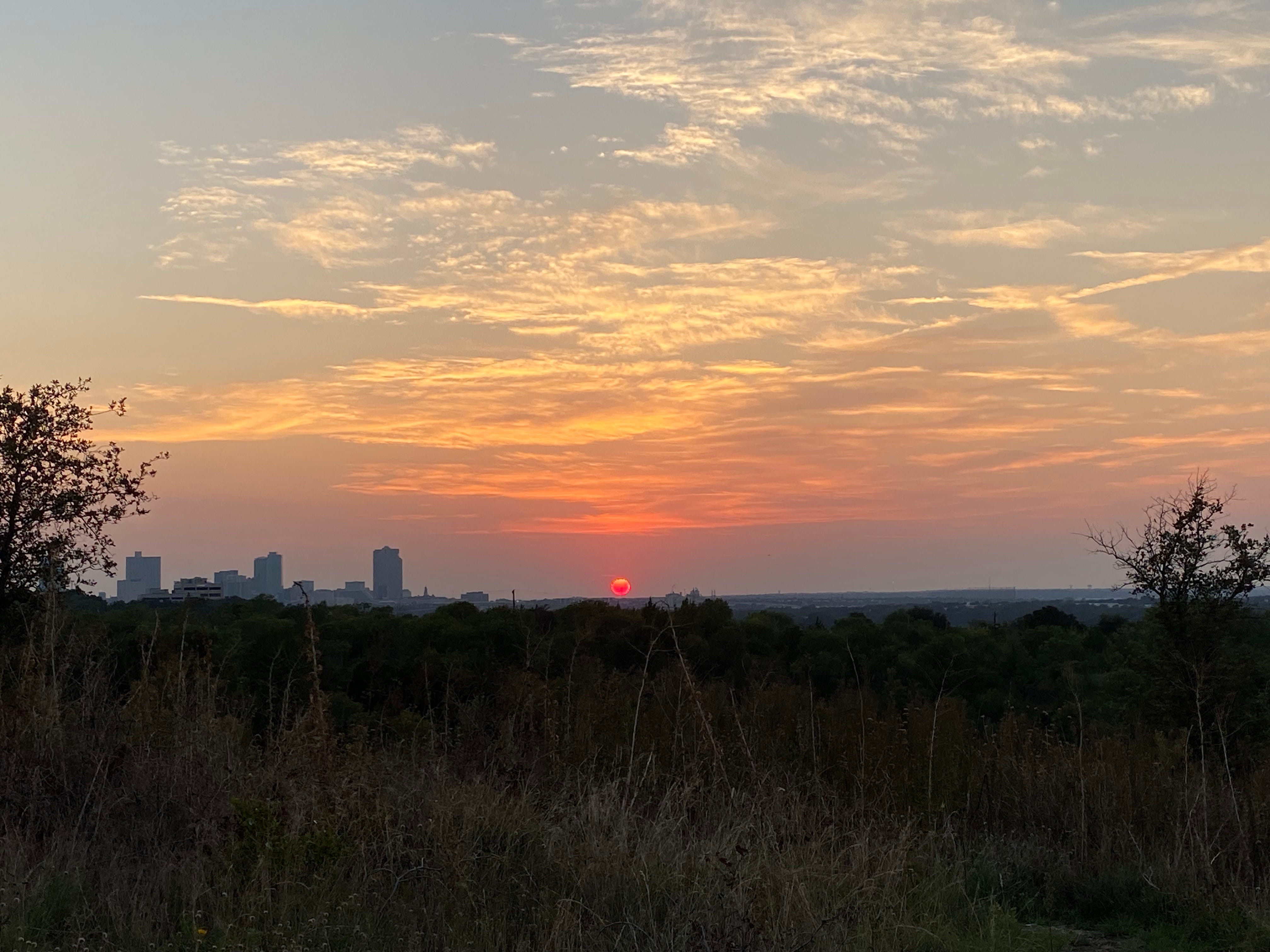
Yesterday, at the end of a hot August day, I took a walk there with my friend Kat as the sun sank toward the city skyline. We followed those beautiful limestone trails through native grasses and the stalks of the past spring’s basketflower, over patches of prairie and along the ridge.
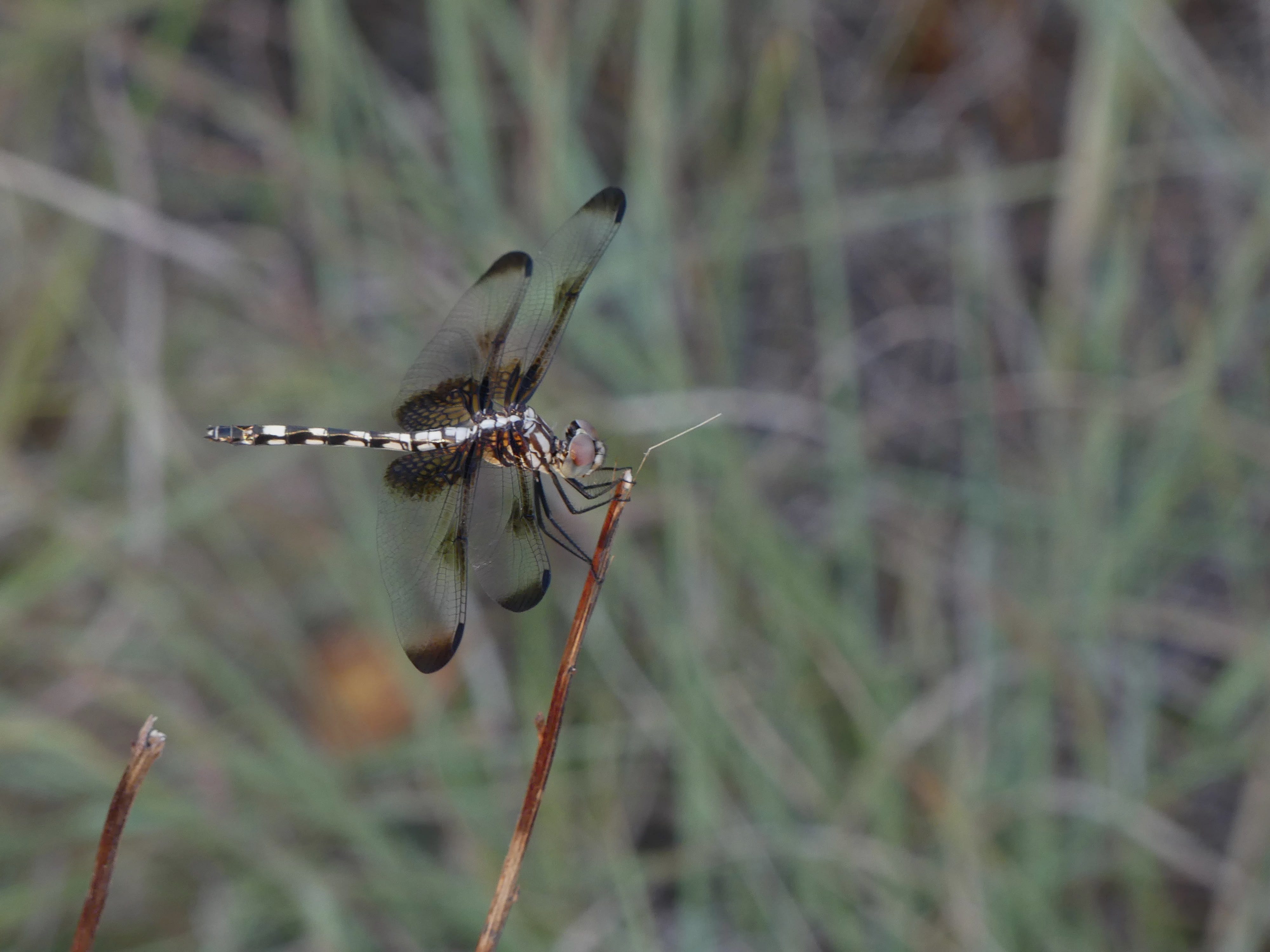
A checkered setwing
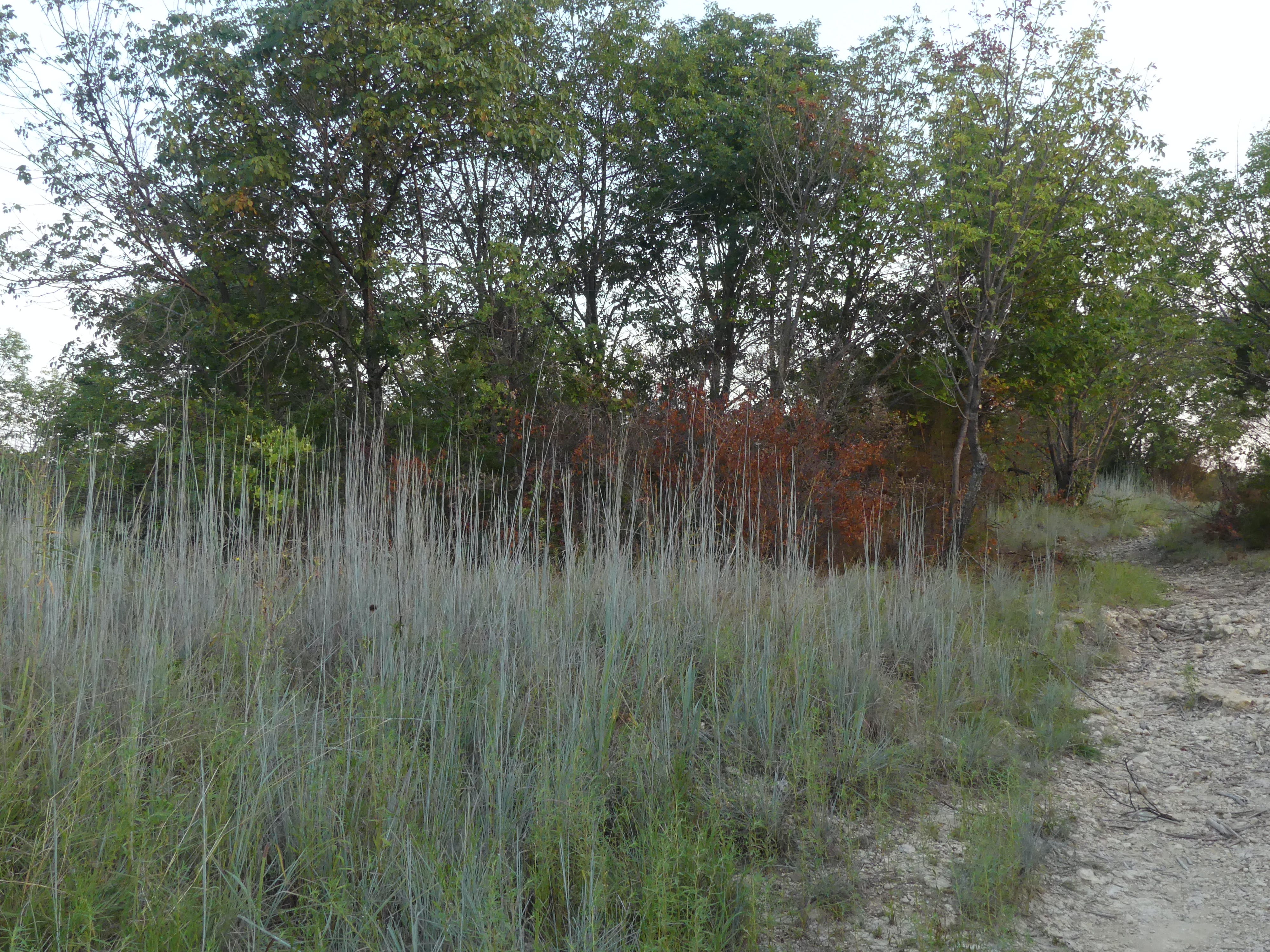
Kat is an ideal person to take a walk with, to share these hills with. We talked about absent friends and missing their presence, and we talked about the dragonflies and the succession of prairie plants around us. Snow on the prairie is starting to make its late summer appearance, and the little bluestem is beautiful as always. Kat and I discussed how we look for the myriad subtle colors of this grass, pastel blue-green with a few scattered suggestions of almost-violet. On a previous walk I told her that I’ve described those tall thin stems as “vertical brush strokes” on the prairie’s canvas and complained that I had no other way of describing little bluestem. She immediately suggested, “icicles,” and yes, they are like upside-down thin icicles!
Hardly anything allows a person to unwind and become content and restored like a walk at the end of the day in a place like this, with a friend like this. The shadows lengthened and the heat diminished, and there was always something wonderful to pull us around the next bend of the trail. However, our plan for the evening brought us back to the top of the ridge just at 8:10pm as the orange disk of the sun touched the horizon. Having found a quiet place to sit, we wordlessly watched what unfolded.
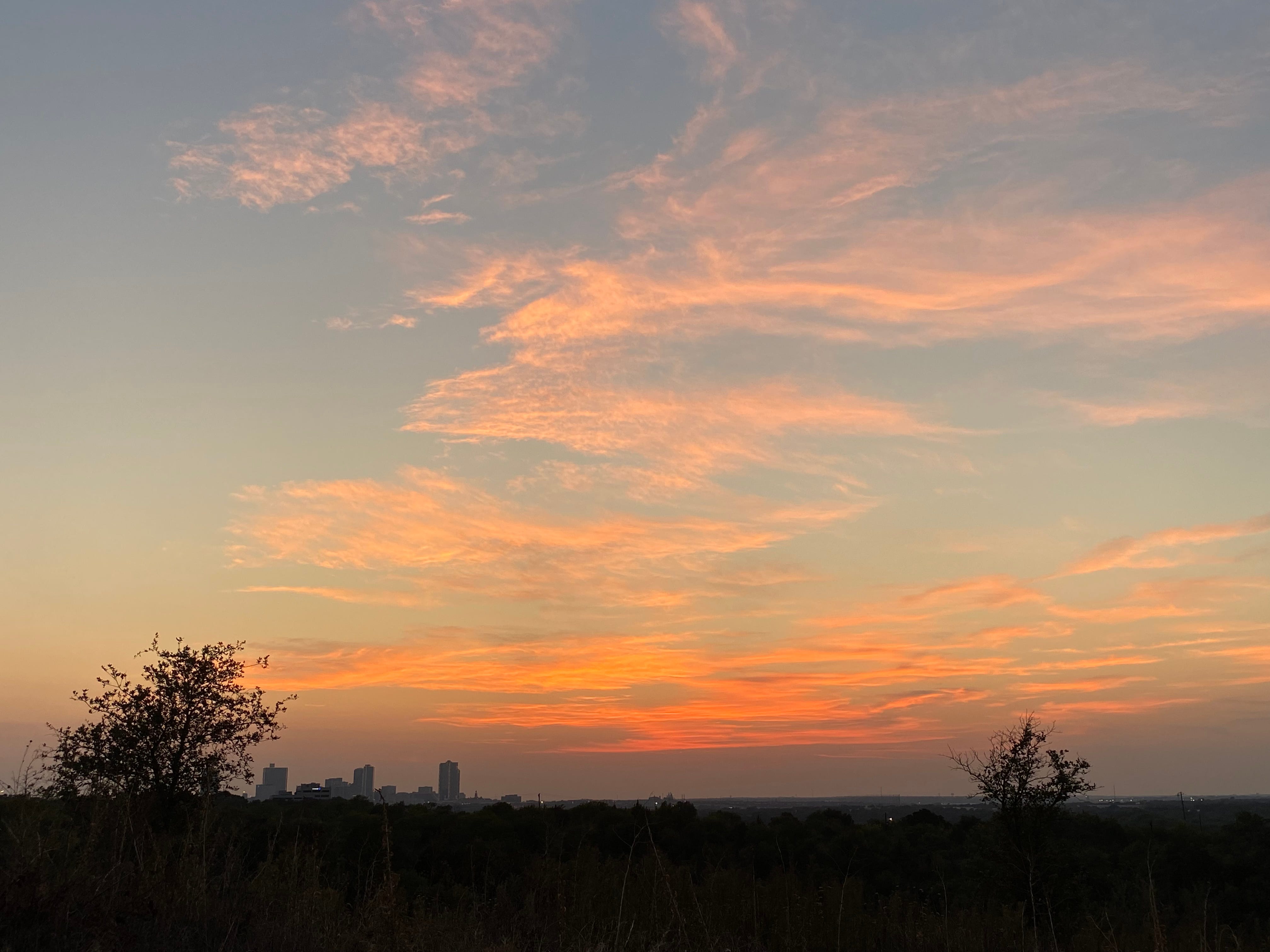
It took five minutes for the sun to disappear beyond the horizon, and it continued to illuminate the streaks of cloud in red, orange, and pale yellow. A good, fairly steady breeze blew across the ridge as we sat. The pale, almost pastel blue sky shaded deeper blue to the south, where the half-moon shone in the sky.
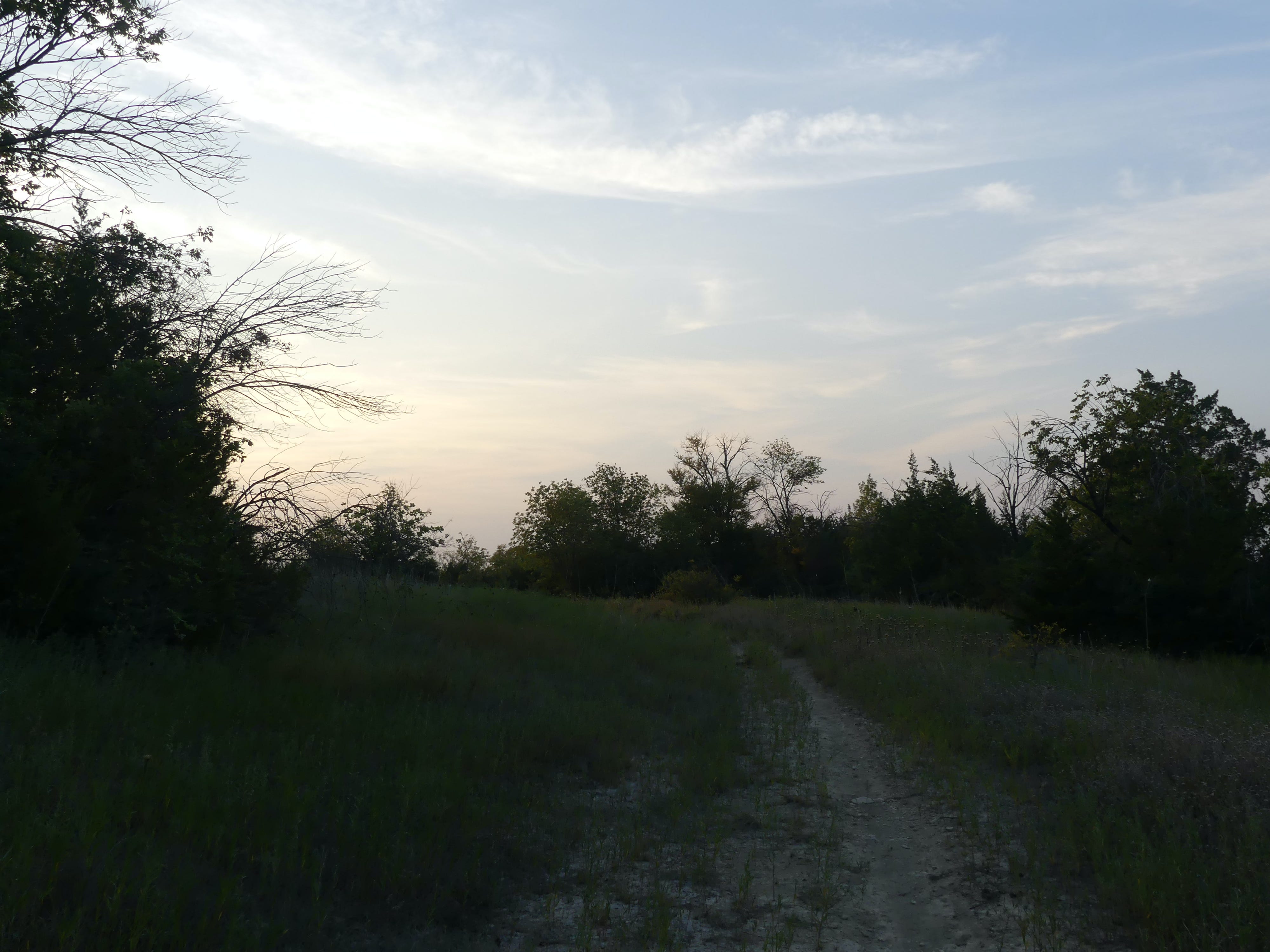
As light faded, we could see the rocky limestone path in front of us bend and disappear behind the taller dried plant stalks and the green growth near the ground. The ground dropped away and there was a dark sea of green tree tops beyond, stretching out toward the city.
It struck me that the clouds near the horizon rippled and waved in bright sunset colors like waves on water somewhere. And then the angle of the sun hit the clouds in a particular way for one more bright moment, and those clouds were bright streaks of orange against a turquoise sky. Even the hazy clouds above us were rose pink.
At 8:27pm the drone of insects began from nearby trees, and after a short time they just as abruptly stopped. We were left wondering if some disturbance, maybe people leaving the area, caused this, but I don’t know.
Sitting and maintaining our attention on the sky, there were several subtle shifts. Color faded from parts of the sky in a couple of places, probably when some irregularity of the land to the west blocked the sun. Where the color drained away, the clouds were left like patches of ash in the wake of the fiery sunset. Above us, the traces of cloud were white again. The western sky became more pale, no longer turquoise, while behind us the blue was deepening.
By 8:35pm the steady breeze carried less warmth – the heat of the day was fading along with the twilight. And even with the surrounding city lights and nearby highway, it felt quieter and calmer with the oncoming darkness. We heard a few dogs bark in the distance. When we finally spoke, Kat agreed that it seemed quieter, and yet we wondered if sound levels had actually decreased. Maybe the enveloping darkness brings a perception of quiet that is not about measured sound levels.
At 8:50pm we picked up our stuff and walked out, in silence or else speaking in quiet voices as if not wanting to disturb the tranquility of the night. Kat said that I could expect a different sort of sunset when there are more clouds, and she wondered what the winter sunset will be like on the ridge where we sat. I look forward to finding out.
(This article first appeared 8/13/24 at Rain Lilies on Substack)
I have begun writing something that starts with what I experience somewhere in a prairie or the woods, and ends up in front of you, like a letter. I’ll write to tell you what I saw and experienced (and if you write back, that would be great!). I’m drawn to the idea of letters, a throwback to a time when we wrote to each other on paper, to be delivered to our houses and held in our hands as we read them. Now when we send something, we use the Internet and the delivery is more foolproof and quicker. I guess we don’t so much mind reading on screens.
I’ve been doing something similar when I write “Letters to Nature Kids,” nineteen of them so far in the past couple of years. They are written with older elementary school kids and teens in mind, exploring such topics as seeing horned lizards, writing in a nature journal, venomous snakes and safety, thankfulness (on Thanksgiving), and so on. Each one is a free download from the Letters to You page of this website.
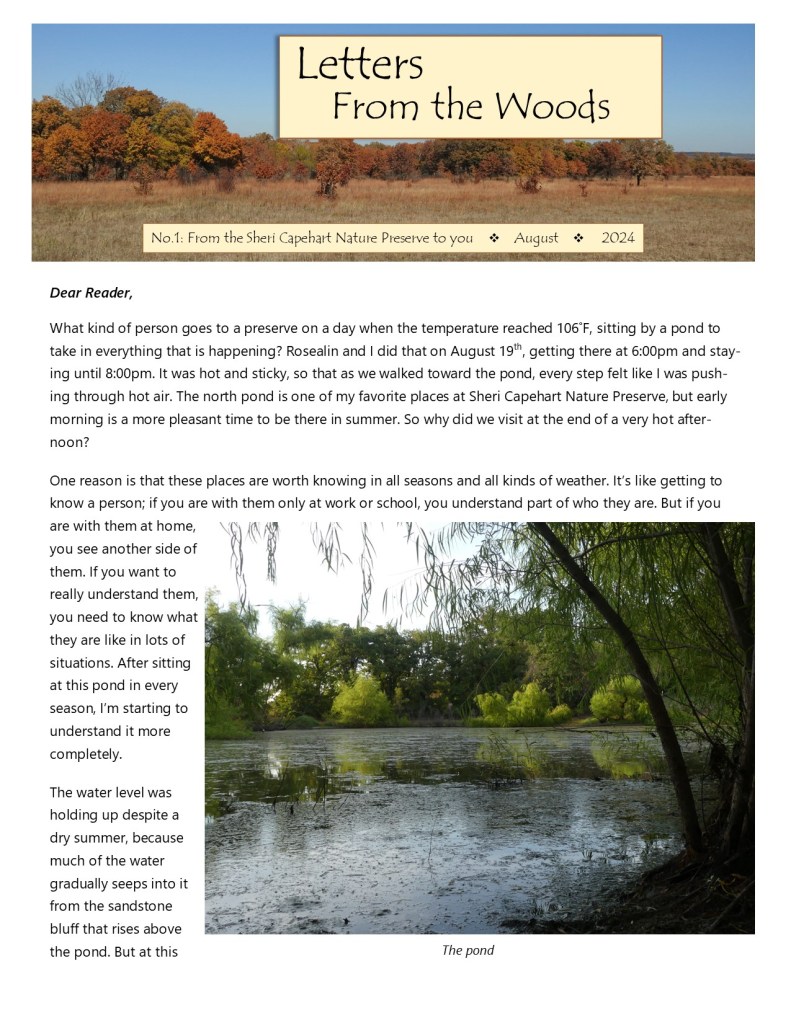
And now I’ve written the first of what might be many “Letters From the Woods,” also downloadable as a pdf document at this website. I can design and format it more flexibly than I could a blog post, and you could easily hang onto it or share it if you wanted. I can post a link to each new one here on the blog, and you could click the link or go to the Letters to You page.
It’s kind of an experiment – would you let me know what you think? I’d truly be grateful for any feedback, either as a comment on this post or an email to me (livesinnature@outlook.com). Here is the first one:
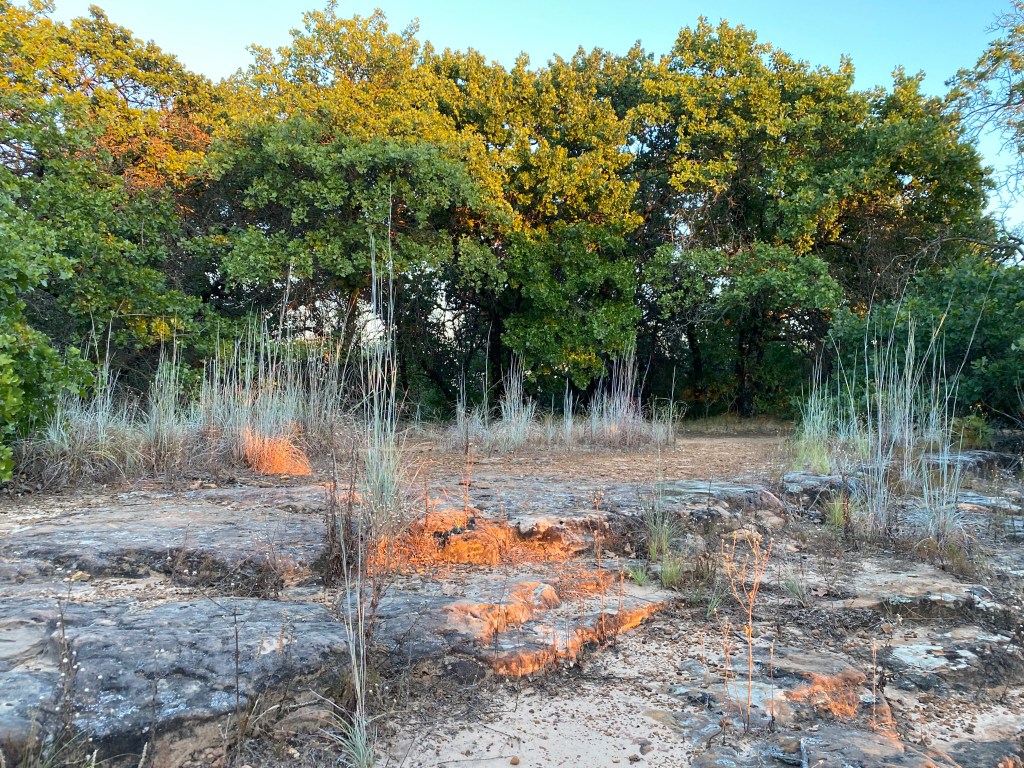
A recent mid-August Sunday was the hottest so far in 2024, with a high of 104F. When Kat and I walked up the trail at Sheri Capehart Nature Preserve to the sandstone ridge, the stone was quite warm to the touch. Regardless of the day’s heat, we wanted to experience a summer sunset there, and we arrived at the ridge about 8:00pm with the sun still glaring yellow through the leaves of oaks. Those trees grow immediately below the sandstone ridge, a curtain that hides the Fort Worth skyline and offers some shade.
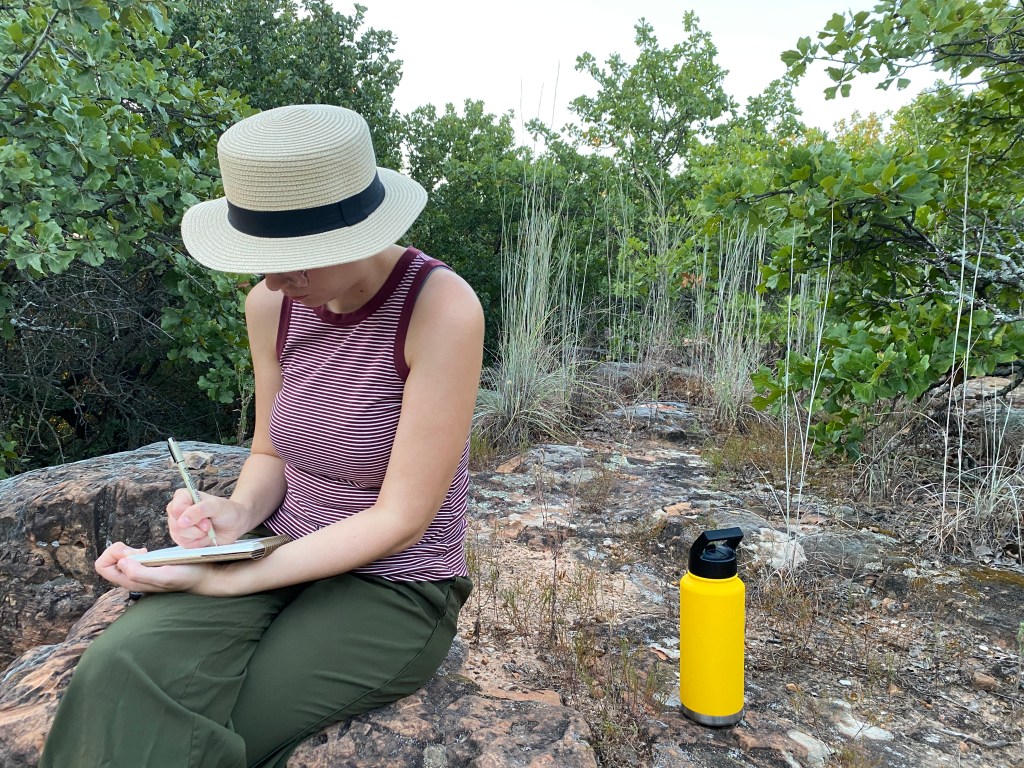
Kat, making a few notes in her journal
We sat on the stone ledge with water bottles and notebooks at our sides. Looking behind where Kat was sitting, there were tall stems of little bluestem reaching above our heads, and with each little breeze they waved as if they were the tops of trees. The breeze was welcome, of course, but for the most part the air was still and with the humidity at 50%, it felt sticky. Turning back to the west, the disk of the sun peeked through branches and leaves in yellow-orange sparkles, as if coming from the facets of a jewel.
The constant nearby traffic sounds dominated, but at 8:10pm a wave of insect calls moved through the area and then stopped. Although at some point the Merlin app picked up the call of a northern cardinal, I could hear no birds. After a few minutes another wave of insect sounds lasted several seconds and then abruptly stopped.
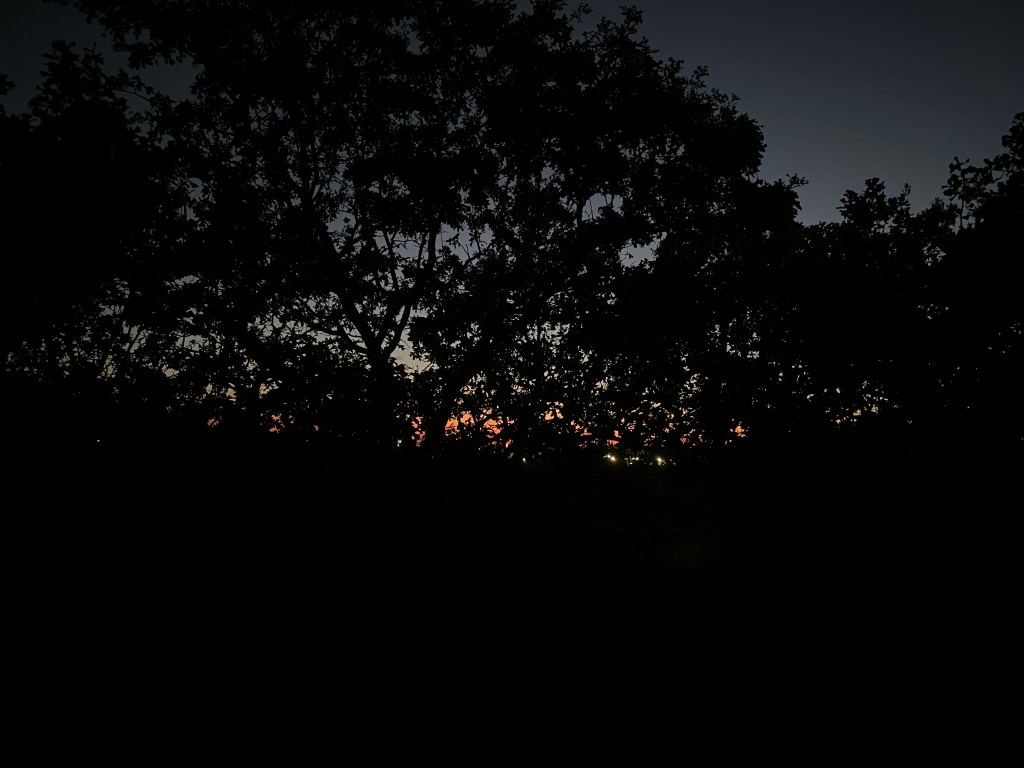
Meanwhile, a pastel yellow sky at the horizon filtered through the trees, silhouetting leaves and branches. I reclined on the still-warm rocks to be able to see the whole field of the pale blue sky, watching for birds or insects and hoping to see the first star become visible. I saw none of those. At 8:26pm the temperature at the ridge was still 92F, with humidity dropping a little. The western horizon was a deeper orange.
Sandstone, little bluestem, and sunlight in the blackjack oak
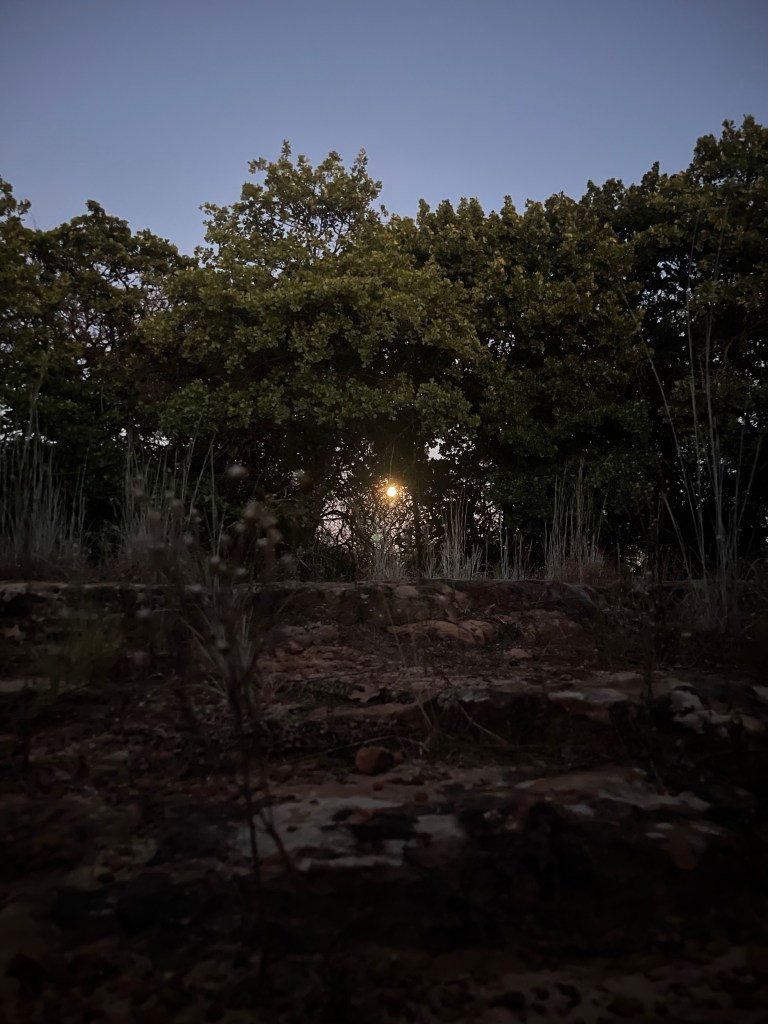
Behind us, the canopies of blackjack oak were dimly lit by the remaining light from the western horizon, almost glowing with a yellow tint that contrasted a little with the surrounding vegetation. And when we looked lower down in those blackjacks, through bare branches we could see the bright, round full moon rising.
It was about ten minutes later that we could see the first glimmers of a couple of stars. “Star light, star bright, first star I see tonight,” but these tiny bright pinholes in the not-yet-dark heavens did not seem bright. Kat’s younger and more perceptive eyes could soon make out four stars.
Moonrise through the trees (photo by Kat Oliver)
Shortly after that, we started walking back in the relative darkness, much darker under the trees. But in open areas, the full moon had risen higher and provided enough light for walking. When the moon is bright enough to light your way, and you walk along a path just visible, it may bring to mind childhood adventures in back yards or campgrounds. Something about it makes it seem special, a moonlit faery world much different from the bright daylight colors.
And what is the attraction of sitting with the sunset, riding that transition between day and night? The world rides along with us as we notice the settling of birds, the emergence of insects or frogs, the way any clouds transform the last light of the sun. Most days we declare our independence from the rhythm of the Earth, turning on our lights and continuing whatever we are doing while the sun disappears and gives the night to the moon and stars. Sitting outside with the sunset is a way of reconnecting with that rhythm. Through such a connection, perhaps we synchronize ourselves with something important.
It has happened several times – driving out in the grasslands or desert, I pull up on a long, slender snake that sees me before I see it. Perhaps its head and neck periscope up a foot or more for a better look at me. If I get out and creep slowly toward it, the snake keeps a careful watch on my distance and speed. At some point I cross a line in the snake’s calculation of risk, and decides it is time to go. It bursts into agile and athletic motion that carries it unerringly around rocks and through brush piles. In my younger years I sometimes chased but rarely caught them. The only realistic opportunity to catch one was to surprise it, lifting a log or discarded piece of plywood and finding the snake hesitating for a moment.
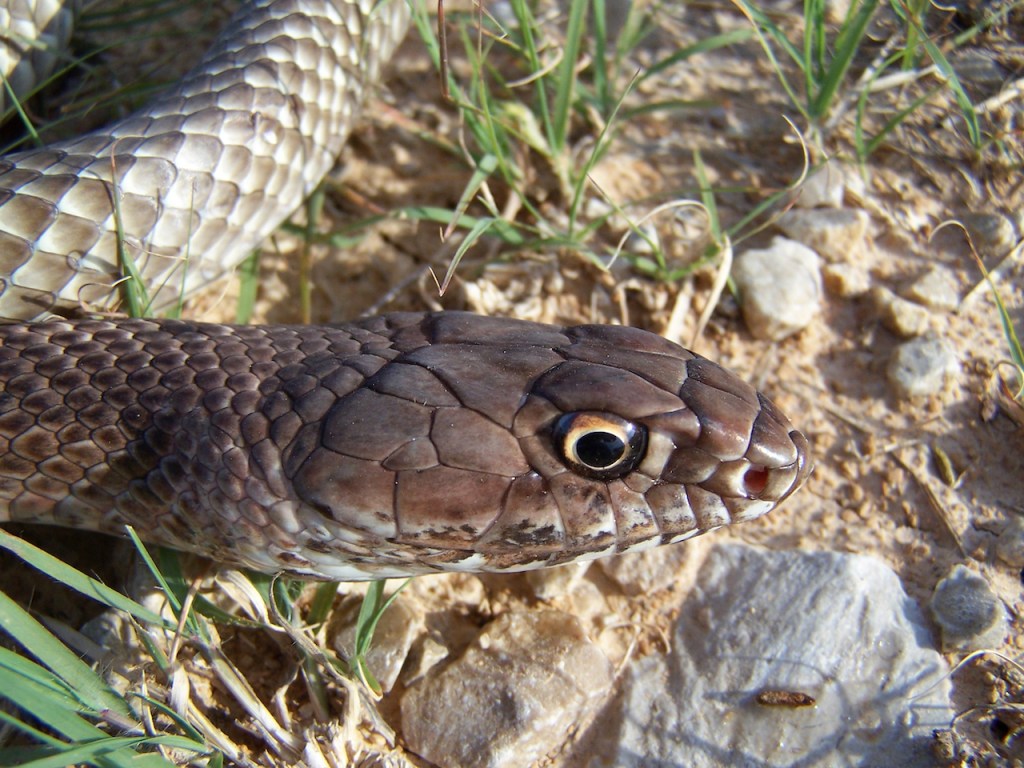
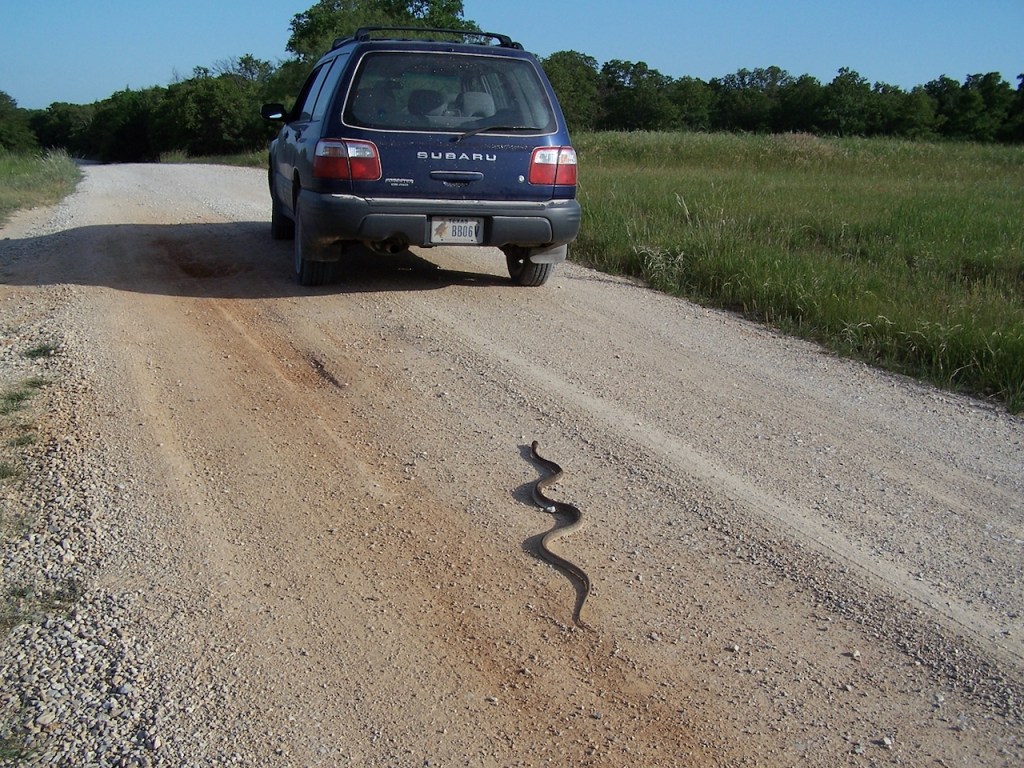
The western coachwhip seen in 2006 at LBJ National Grasslands
Occasionally I caught a coachwhip when it believed itself to be concealed or camouflaged. I once surprised one on a gravel road in the LBJ National Grasslands, and it quickly slipped off the road. I pulled over and investigated a grassy area where I last saw it and found four feet or so of tan scales blending very well in the dappled sunlight along the ground. I grabbed the snake and then worked to calm its thrashing body so that I could take a photograph. After a short time the snake was calm enough for me to put it on the ground, covering its head and restraining its body just enough so that it did not struggle.
Then it tried a different strategy that suggested some form of death-feigning. Coachwhips have occasionally been described as feigning death to discourage an attacker from continuing whatever it is doing. After all, there is no need to attack a dead snake. This one went limp but turned its head and neck to the side. A hog-nosed snake will flip over in death-feigning, as if the only way to be properly dead is upside-down, and this snake seemed to be doing a much less dramatic version of “playing dead.”
The coachwhip’s headWhen released
I posed the snake in a more normal position, took a couple of photos, and then encouraged it to be on its way. I positioned the snake in something closer to a straight line and backed away. In a moment it came back to itself and took off, crossing back across the road at typical coachwhip speed.
What are coachwhips?
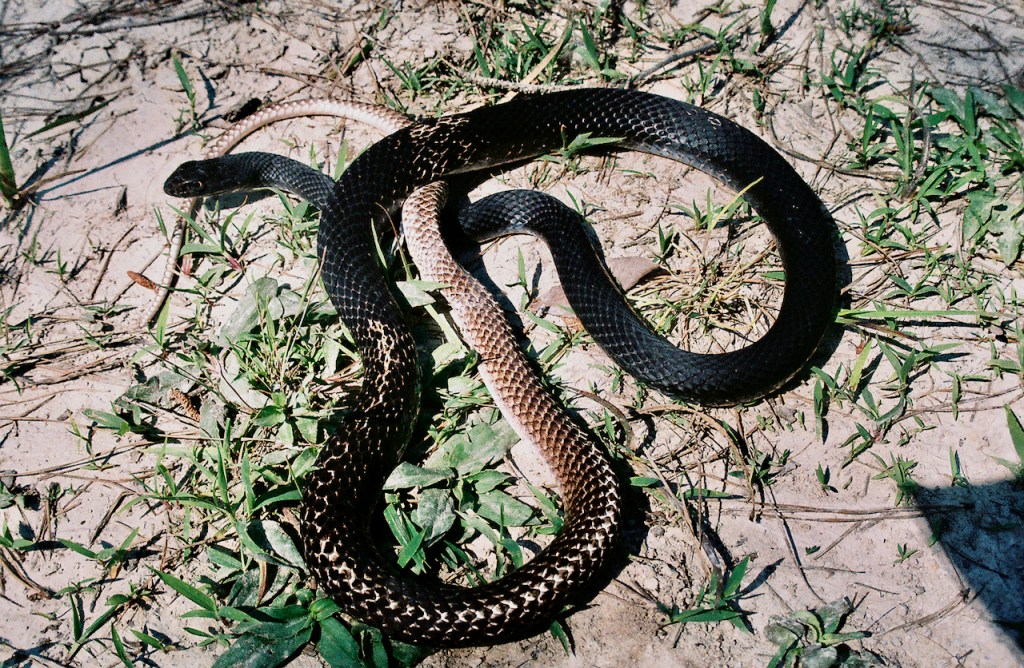
One or another species or subspecies of coachwhip is found all across the southern U.S. In the east, including in parts of east Texas, much or all of the eastern coachwhip’s body may be velvety black. In central and west Texas the subspecies is the western coachwhip, with light brown or tan colors, often with a darker head and neck that may be rusty brown. In parts of their range, some of these coachwhips may have a banded appearance, with long, broad bands of a little darker color alternating with broad lighter bands. In the Trans-Pecos region, some of the western coachwhips are pink or reddish. Traveling with friends, we found one in Big Bend National Park that propelled itself off the road nearly in a blur, and I described it as looking like a snake with the world’s worst sunburn. (We stopped, but never found the snake.) Western coachwhips usually reach four to five-and-a-half feet, sometimes longer. Coachwhips are related to racers and whipsnakes, all of which are active by day, visually alert, and very fast.
Eastern coachwhip seen in the Big Thicket region
The name “coachwhip” comes from the color of the dorsal scales. Each one is light-edged as it emerges from under the previous scale, then becomes darker until it is dark brown along its trailing edge. This highlights the edges of scales, and toward the tail it gives the appearance of a braided whip.
Where do they live and what do they eat?
Coachwhips are, even in East Texas, snakes you expect to see in patches of prairie, openings in woodlands, or rocky hillsides. In the rest of Texas, they are well-adapted to open arid or semi-arid regions where they take advantage of openings beneath rocks, rodent burrows, and such refuges. They are able climbers and may take refuge in shrubs or lower tree branches when escaping predators. Within the Chihuahuan Desert they are seen in dry arroyos and desert flats, with desert shrubs and clumps of cactus offering shelter, along with mammal burrows.
As witnessed recently by my friend Rosealin Delgado, they are able climbers and may take refuge in shrubs or lower tree branches when escaping predators. She was at the edge of a pond at Sheri Capehart Nature Preserve and saw one emerge from the water’s edge (where the snake may have been getting a drink), periscope up and take note of her, and then climb up in low trees. The snake watched her for the better part of ten minutes before she left.
The coachwhip’s diet can be quite varied, depending on the prey available where they live. They readily eat lizards, spotting them and chasing them down. In some places they are reported to sit at the base of plants such as mesquite and wait for prey such as a lizard to dart into the shade to cool down. Coachwhips will eat smaller snakes, and they may poke around in crevices or burrows where they may find and eat mice. Around bat caves, coachwhips sometimes find and eat bats that are injured or stranded on the ground. They eat large insects such as lubber grasshoppers.
Having no venom to subdue prey, and not using constriction to kill the mouse or lizard before eating it, the coachwhip relies on strong jaws and a strategy of pinning prey against the ground. After catching a lizard and holding onto it with sharp little recurved teeth and a powerful bite, the snake points its snout toward the ground and pushes its prey against rocks or soil to help prevent escape and then begin swallowing. In our book, Herping Texas, co-author Clint King described watching a western coachwhip catch a Great Plains skink and beat the lizard repeatedly against the ground. Some of this might have been to dislodge the lizard’s biting the snake in a counter-attack, but it also appeared to be to stun or disable the lizard before swallowing it.
Reproduction
Coachwhips mate in the spring, typically in April or May. Within a month, the female lays a clutch of eggs in some place where they will be protected from drying out or overheating, and hopefully where predators will not find them. Such a place might be an abandoned burrow or under a rotting log. By August or September, the brightly marked babies hatch, measuring 12 to 14 inches long according to Werler & Dixon (2000).
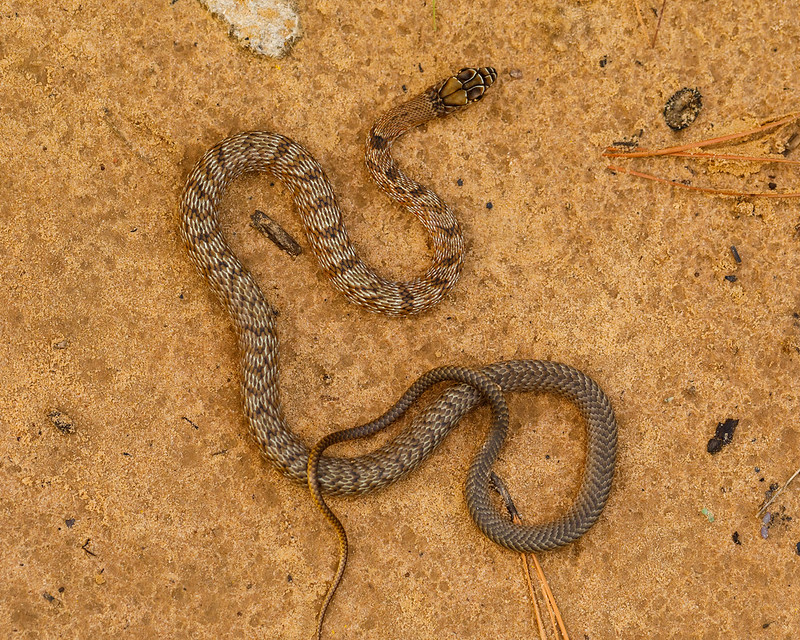
Juvenile western coachwhip found by Meghan (photo by Meghan Cassidy)
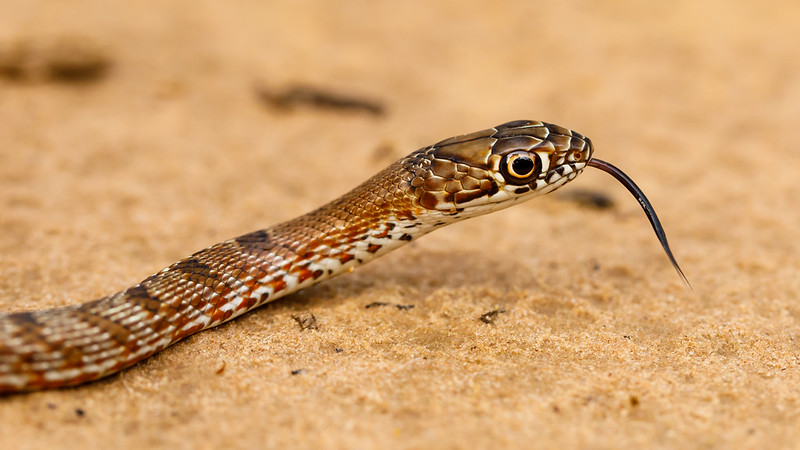
On a walk at LBJ National Grasslands in September of 2020, my friend Meghan Cassidy found a hatchling coachwhip and she took a number of beautiful photos of this little reptile. As is typical, its eyes were large (as befits an active, visual snake such as this) and it was slender and fast. Its coloration was bright, verging on orange along its neck. There were a number of thin crossbars of darker scales that would likely fade as the snake grew. I described our encounter with this snake in Mindfulness in Texas Nature.
The head and neck of the juvenile coachwhip (photo by Meghan Cassidy)
Human perspectives and tales
No matter what your grandpa told you, a coachwhip is not going to wrap around you and whip you, regardless of its name and appearance. It seems likely that those old stories might have begun when someone caught a coachwhip and its long body wrapped around the person’s arm and, as it thrashed and tried to escape, whipped its tail against its captor.
Fewer people seem to have heard such stories, and we usually think of that as a good thing. After all, we don’t want people believing misinformation such as hoop snakes that roll down a hill and sting you, or milk snakes that will suck the milk from cows in a barn. But I worry that the disappearance of tall tales is not because people today are more savvy, but instead that they have so little contact with nature that there is no experience that would give birth to the tales. Stories about writhing balls or nests of cottonmouths arise when people see something and struggle to understand it, and they fill in missing details with fanciful explanations.
So I hope that you and your friends and family will be out in the field enough that you notice coachwhips and other things in nature, and come up with stories to account for what you saw. Read and listen and learn what you can so that your stories are mostly based on accurate understanding. But I would gladly live in a culture that is connected to nature enough so that we have stories and legends about the natural world, such as the coyote as a mythical trickster or the snake that will whip you.
Smith, M. 2024. Mindfulness in Texas Nature. College Station: Texas A&M University Press.
Smith, M. & C. King. 2018. Herping Texas: The Quest for Reptiles and Amphibians. College Station: Texas A&M University Press.
Werler, J.E. & J.R. Dixon. 2000. Texas Snakes: Identification, Distribution, and Natural History. Austin: University of Texas Press.

 Our Lives in Nature