Each generation of us takes a snapshot in time of the natural surroundings in which we live. What we experience is what is – for us – normal, and it feels like how things have always been. For those growing up in the last twenty years, road trips are not troubled to any great extent by bugs on the car windshield. You might assume that it has always been that way. Your grandpa has a picture from when he was a child, holding up a spikey little horny toad, the only one you’ve ever seen. Summers may involve outdoor fun some of the time, but for part of the summer the baking, searing heat is a gauntlet you run, from one air-conditioned place to the next. That’s just Texas, right? The night sky is hazy and yellowed, with a few stars, and the magic of fireflies twinkling on a summer night can be found in a child’s picture book, but not out your back door. The sound of airplanes, trucks, highways, and air conditioners is so ever-present that you barely notice, but if it all fell silent you might ask, “what’s wrong?” All of this is normal for twenty-year-old you.
If you have paid attention to conditions as you grew up, then when summers get hotter, nights lighter, every place noisier, and wildlife more missing in action, you will notice because it is “different from how it used to be.” Just like when those of us who grew up in the middle of the last century noticed how a quieter world got noisier, dark skies gray with stars less visible, summers became dangerously hot, and so on. Our world became the next generation’s world, and for that generation it was a new normal.
The way a changed world becomes the new normal for a new generation is described as “shifting baseline syndrome.” It was first described as it pertained to fisheries, where people with longer experience noticed declines while younger folks did not. As defined in a 2018 article in Frontiers in Ecology and the Environment, this is “a gradual change in the accepted norms for the condition of the natural environment due to a lack of human experience, memory and/or knowledge of its past condition.”
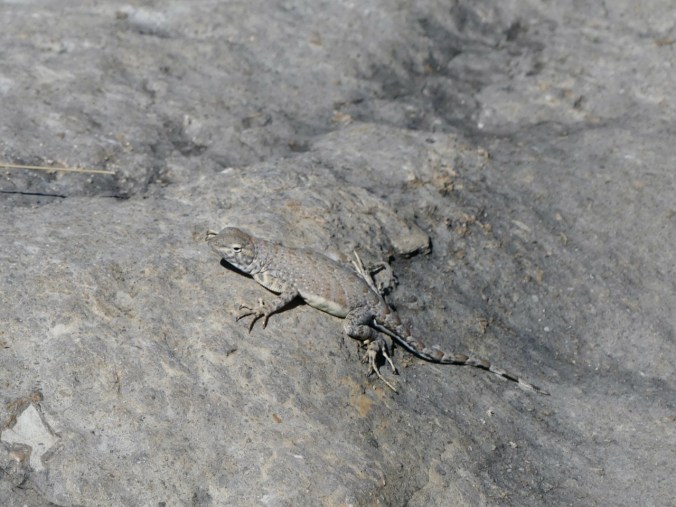
My baseline, what I considered normal in the 1950s-1960s, included lots of box turtles after summer rains and lots of small massasauga rattlesnakes at sunset on the road west of Benbrook. I explored a large creek throughout the summer, often feeling hot but never fearing heat stroke. Each visit to the creek included ribbon snakes, probably a couple of species of water snakes, and numerous other wildlife species. Spotted Whiptail lizards nervously poked around in exposed rocky areas. Baby softshell turtles turned up at the end of summer, and pale gray Greater Earless Lizards scampered over limestone rocks of the same color.
A Greater Earless Lizard, in a spot in Central Texas
I still visit that creek occasionally, and if eleven-year-old Elijah is with me, his perception of normal for Mary’s Creek will include almost none of these animals. His baseline perception of normal is mosquitofish and some shiners in the water, dragonflies here and there, a few spiders, and the occasional appearance of a cooter or slider turtle. That, for him, is the richness of Mary’s Creek.
That creek is a microcosm of the bigger world in which so much is getting lost. And losses in nature are among the many worries of the world. Our attention and energy can hardly keep up, and we are even more likely to be slowed in our conservation efforts if we don’t even know what we once had. If we could imagine the diversity and richness of an earlier time, clear water and air, the peace of a quiet day and the depth and mystery of a dark, starry night, perhaps we would fight twice as hard for those things. And that is a good reason for us to seek out the quiet places that remain, the places with dark skies, and locations that retain more wildness and richness, to know that more places in the world could (within the limits of a damaged climate) be that way once again. If we could rein in our development and extraction and be able to say, “enough, I don’t need more than this.” If we could walk humbly through the world and be members – not rulers – of it.
Shifting Baseline Syndrome is worsened by our retreat from nature. When children don’t play outside, when they, like their parents, spend their time indoors, and when birds and plants and wild places are strange and foreign to them. The child grows up and the young person matures with even less appreciation for what is lost over time.
Those who study this syndrome say that what is needed is more good data and more people involved in nature. Good data helps establish what we have, so we know when we are losing it. And when more people spend time in nature, learn to recognize various living things and more accurately see what we have around us, then future degradation will seem less normal and less acceptable. That is certainly a recommendation for community science and tools like iNaturalist that facilitate both of those things.
I’ll soon be planning to lead another “Know Your Nature Neighbors” walk at Sheri Capehart Nature Preserve in Arlington. Want to come along?
Yesterday I took a couple of friends to visit the LBJ National Grasslands (LBJNG). There was a little light rain as we walked around the pine trees and ponds, seeing a few frogs and toads. We wandered out onto the prairie at sunset, seeing some flowers that are a reminder, for a while, of the spring that has just passed. Some time ago, Kayla West and I led walks there regularly to introduce people to this amazing place, and we had a Facebook group for a while.
I’ve adapted some of what I wrote during that time, providing it here for those who may not have visited yet, to help you get acquainted and consider taking a walk there. You might also want to subscribe to Mary Curry’s blog, “Looking Out in North Texas,” in which she describes lots of ramblings in places like the National Grasslands and finding plants, fungi, mosses and lichens, and wildlife.
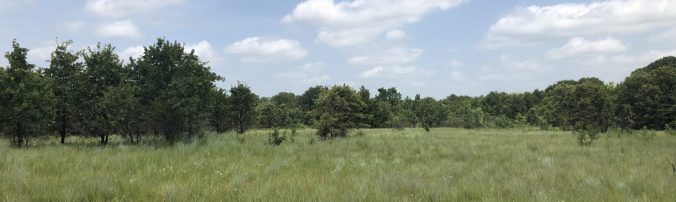
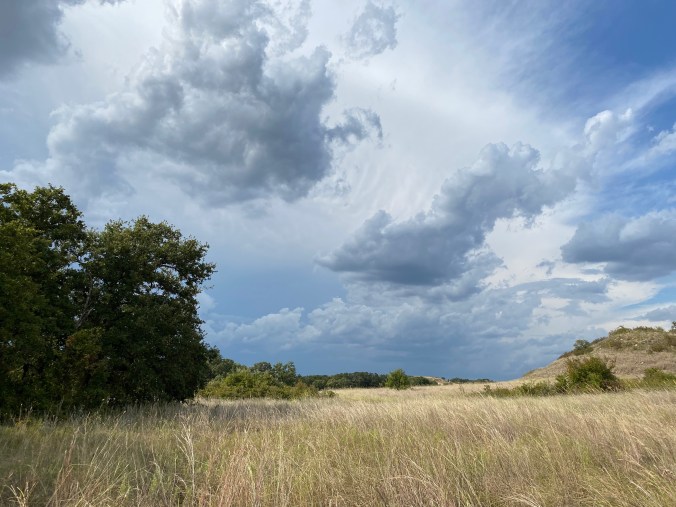
The LBJNG is located along the eastern edge of the Western Cross Timbers, which is an area where patches of prairie are mixed in with woodland (largely Post Oak and Blackjack Oak). You rarely walk very far in the oak woods without emerging into a little meadow or perhaps a large expanse of grassland. The grasses include Little Bluestem, Indiangrass, Switchgrass, and some other native species, some smaller ones like Sideoats Grama and big ones which, in some patches, stand above your head.
A prairie in Unit 71 with an oncoming afternoon storm
The soil and rock beneath it is largely Antlers Sand with some Walnut and Goodland formation limestone and clay (see “Geology of Wise County, Texas“). These geological features are from the Cretaceous period (roughly 145-65 million years ago). Walking the trails of LBJ National Grasslands, you come into contact with reddish sand and clay, or along ridges in southern units there is limestone filled with fossil oysters.
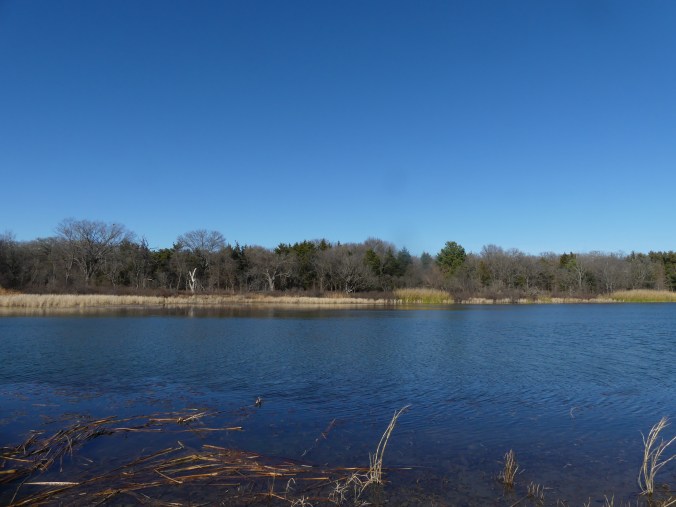
A winter view of Black Creek Lake
The grasslands are dotted with many small ponds, and many were created by people with the aim of reducing runoff and soil erosion as well as providing water for cattle. There are also several small lakes constructed for the same purpose as well as providing recreation. Those include Cottonwood Lake (about 40 acres in size), Black Creek Lake (about 30 acres), and Clear Lake (about 20 acres, with a small fishing pier).
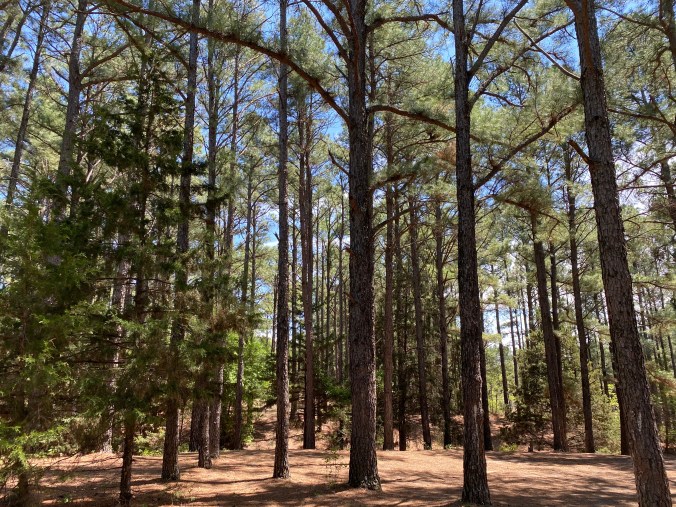
In several spots within the grasslands there are areas dominated by Loblolly Pines. They are generally in areas of deep sand with one or more ponds and are popular with campers. Pine trees are not a typical part of the Cross Timbers plant communities, and we have been told by Forest Service staff that pine seedlings were brought to the area 40 or 50 years ago and planted. Today many of the trees have grown quite tall, and smaller trees and seedlings show that these pine groves are well-established and even expanding.
Pine grove in Unit 30
As delightful as the pine trees may be, there is nothing that compares with the prairies and their spring flowers or the native grasses in autumn, or the oak and juniper woodlands on a quiet autumn afternoon.
A spring meadow at LBJ National Grasslands
Visiting the Grasslands
From the Dallas-Fort Worth area, it’s a little drive to get there (somewhere in the neighborhood of 45 miles, depending). However, it’s one of the best nearby opportunities for some solitude and quiet that I know of, along with thousands of acres of oak woodlands, grasslands, and ponds.
Here is a basic map of the grasslands, showing the administrative units (in green), county roads, and many trails. A more detailed map of the major trails can be downloaded here.
Making Your Visit Great
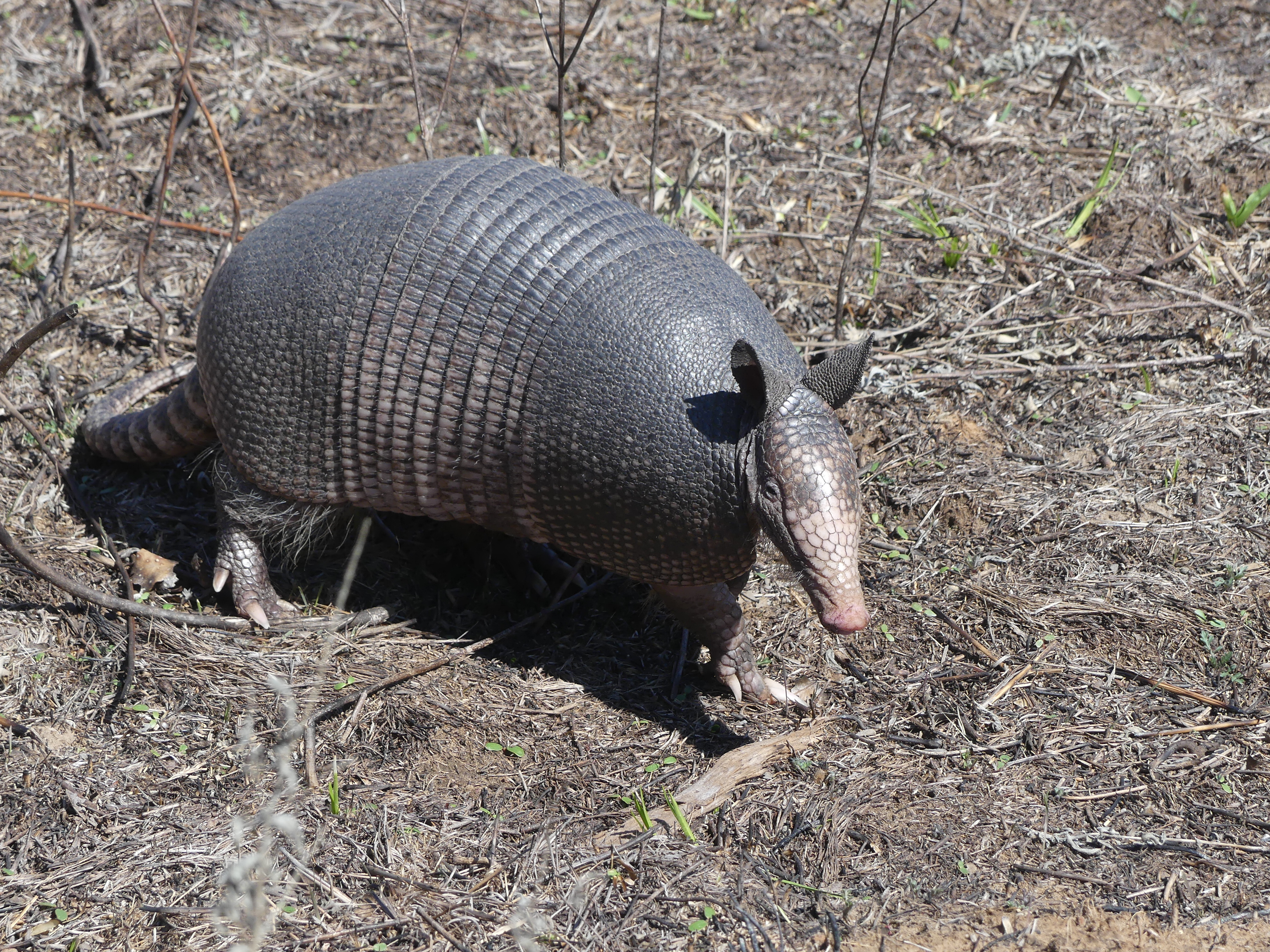
Before you walk the trails out there, ask yourself, “What do I want to get from this visit?” and also ask, “How can I be open to what the LBJNG offers?” Perhaps you are looking for beauty. You might want to see wildlife – birds or butterflies, Armadillos, Tiger Beetles, or a beautiful Rough Green Snake masquerading as a vine in the shrubs. You could sit in a pine grove and listen to breezes whispering in the treetops. You might keep walking to see the endless ways that prairie grasses, Post Oaks and Junipers can appear as you explore around the next bend of the trail.
An Armadillo seen during a winter walk
It also is helpful to be open to what a particular visit may offer. Things might be different than you expected, and if you can be flexible you might find that different can still be rewarding. Another way of being open is to widen your attention beyond what you expected or planned to receive. Become quiet and still for at least part of your visit. Be aware of everything around you, noticing sounds, smells, the feel of sunlight, water, and soil. As much as you can, let thoughts and worries go (you cannot stop your brain from coming up with thoughts, but you don’t have to hold onto them and let them take over). Such a practice of mindfulness can be a great way to visit any place in nature.
Leave some room to reflect on what the experience meant to you and, now that you have some connection with the grasslands, what that connection means. For some people, the opportunity to be away from the “built” world of cities, towns and crowds is like being rescued from chaos and recovering for a while. For others, the multitude of living things is some reassurance of life’s – or a creator’s – benevolence and creativity. Some of us see the grasslands as a sort of sanctuary we can share, and at the same time a place that needs our care and support in order to survive in the world.
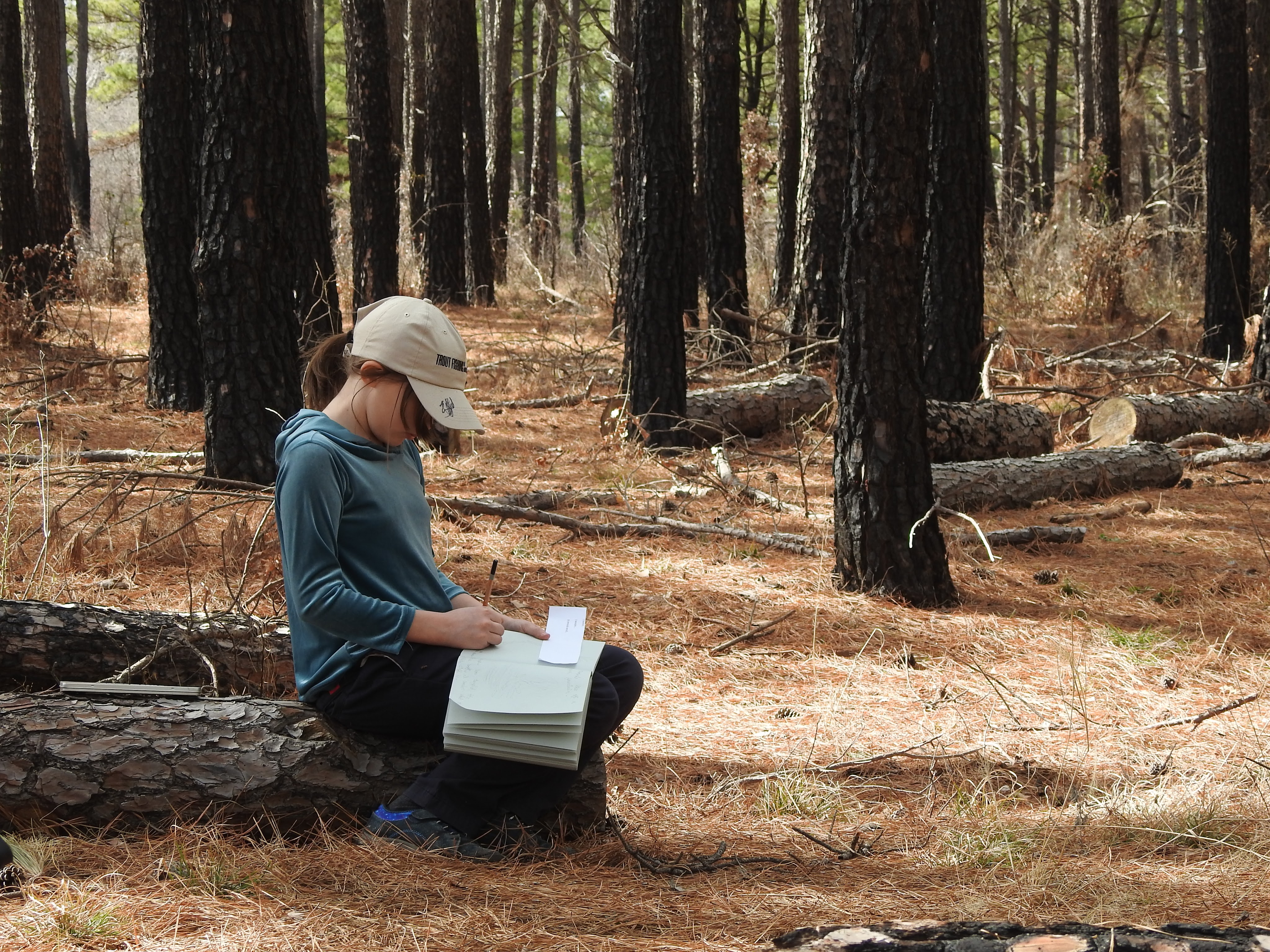
Even if the meaning of the grasslands is largely about a scientific list of species and their characteristics, I’d like to encourage you to write about it and draw things that catch your eye. I suggest carrying a notebook of some sort and stopping periodically to write and draw while you’re out there. This nature journaling will strengthen your memory of the day and give you a chance to reflect on what the place means to you.
Writing in a journal – in a session Kayla West and I taught at LBJNG
One way to write about your visit is to write a letter to the grasslands, as if the ponds, prairies and woodlands could read what you wrote. Maybe that sounds a little weird when you first consider it. However, when you write to somebody, you’re writing from within a relationship, and each person in the relationship has intentions and wishes to be considered. Kayla and I have led walks in which we suggested that participants write a “Dear Grasslands” letter, and the results were often personal and meaningful.
Taking Care of the Grasslands
All of us should take care that our visit does not harm the grasslands. We hope you’ll take a small bag with you to place any snack wrappers, disposable water bottles (get a non-disposable one!), or other trash so you can pack it out with you. And be very careful with fire, if you make a campfire. The Forest Service occasionally does prescribed burns to maintain the ecosystem, but the time and place of such burns are carefully planned. Clear the area around your fire and make sure there are no branches or shrubs close by – including above the fire. Then stay with the fire until every spark is out.
I hope you will leave things the way you found them. There is a role for legal hunting and fishing (especially for food) and scientific collection, and I think there’s no harm in taking a few samples of things like leaves, acorns, or empty mussel or snail shells.
Taking Care of Yourself
There are few dangers to worry about at LBJNG. Nevertheless, please pay careful attention to the following hazards:
Dehydration and heat illness. It is very easy to forget water at the start of a walk when you’re not thirsty. Please bring water with you, even on a winter walk. Additionally, in summer you can get overheated and dehydrated very easily. Read up on heat exhaustion, heat stroke and sunburn and bring water, a hat, and sunscreen.
Guns and archery equipment. People may be hunting in the area. For guns, the Forest Service rule is black powder hunting only, because buckshot is less likely than a bullet to travel far and injure someone at a greater distance. However, be aware that not everyone follows this rule (you occasionally find bullet casings). The Forest Service also forbids hunting in developed areas like campsites and within 150 yards of hiking/equestrian trails, but not all hunters know this. Hunters are, in most situations, required to wear fluorescent orange to make accidents less likely, and hikers are encouraged to do the same during hunting and archery season. Information from Texas Parks & Wildlife Department about hunting seasons can be found here.
Plants. Depending on the area, Prickly Pear and other cacti may be common. Greenbrier is a thorny vine that is common especially in the woodlands. The stiff, pointed leaves of Yucca can also cause a puncture if you stumble into one. In places you will find Texas Bull Nettle, a plant covered with small stinging hairs. Another plant to be careful around is Poison Ivy, especially in woodland areas.
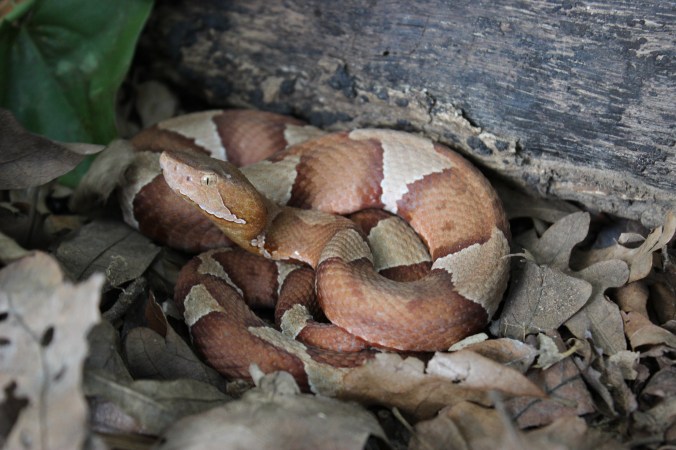
Wildlife. Most of the larger wildlife at LBJNG is no cause for fear. Coyotes live there, but you are more likely to hear them than to see them. If you see a coyote that stands its ground, especially in spring during pupping season, you should back away and leave the area. More information about interactions with coyotes can be found here. Feral pigs are seen in some areas, and while they usually run away, they are potentially dangerous. Avoid them, especially sows with young pigs. We should keep a respectful distance from wildlife, even deer. There are two species of venomous snakes that are common in suitable habitat within the grasslands. These are the Northern Cottonmouth (also called the water moccasin) and the Broad-banded Copperhead. Cottonmouths typically are seen near the bigger lakes and ponds. Through most of the year, copperheads are primarily active at night. If left alone both species will avoid interacting with people. Don’t put your hands under rocks or logs where one may be concealed, and watch your step. More information about these snakes can be found here.
Broad-banded Copperhead from the grasslands
I would love to hear your thoughts about this great place, especially if you visit after reading this article. After 25 years of visiting off-and-on, I believe there is always something to make each visit interesting and each walk a little gift of renewal of body and spirit.
It was July 19th last year when I sat and watched the prairie at LBJ National Grasslands as it shifted into darkness at sunset. The sky gradually changed, with the yellows and oranges, the darkening to rose and indigo, and clouds reflecting those changes. The quiet sounds as activity slows (or awakens), the appearance of the moon, the first call of Chuck-Will’s-Widow.
You’ll find the actual account of that evening in the June issue of “Letters From the Woods” which is posted on the Letters page. It’s a free download, so I hope you’ll have a look.
I also posted it over at “Rain Lilies” where I write at Substack. (I confess that I’m struggling about where to consider home base.) If you’d like to see it there, go over to Rain Lilies and read “Sitting With the Sunset.”
As I started on the trail this morning at Sheri Capehart Nature Preserve, I asked permission, so to speak. I said: “May I be here as one among many, neither greater nor less than. May I understand how I fit within this place and cause no harm.”
I expected no particular answer, but I did hear calls of Bewick’s Wren, Northern Cardinal, Red-bellied Woodpecker, Blue Jay, and Painted Bunting (identified by the Merlin app), and those calls felt welcoming. Low clouds covered most of the sky, and it was a little like being draped in a warm, wet blanket. Weather Underground said it was 81F and 76% humidity in the area.
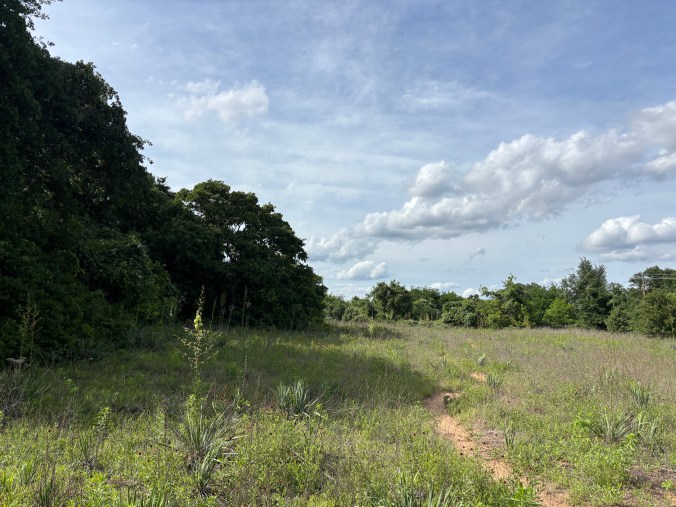
On the trail I was submerged beneath the green canopies of oak trees and then emerged at a little open hillside where the spring rains are helping the Little Bluestem grasses look like they might take back the slope that has suffered erosion and drought.
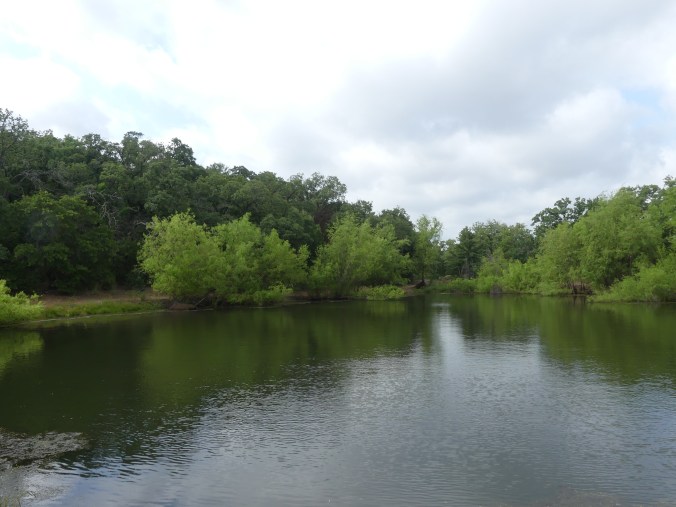
The north pond
At the pond, the roster of bird calls expanded to include White-eyed Vireo, Carolina Wren, and Carolina Chickadee. And while the Black Willows have taken over large sections of the bank, in one spot there was a beautiful patch of flowers. Chickory, Black-eyed Susan, and Bitterweed were scattered in different shades of yellow. And as I looked out over the water, a group of Blanchard’s Cricket Frogs set up a chorus of “grick-grick-grick” calls. Those calls are always surprisingly loud for a little frog that could easily sit on your thumb.
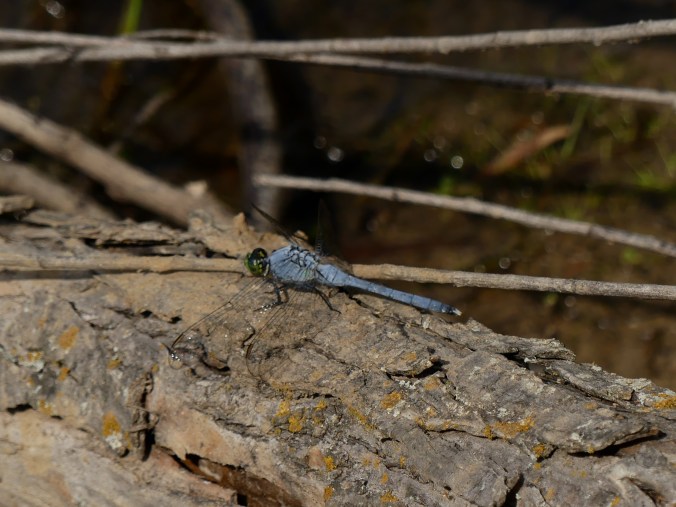
An Eastern Pondhawk. Females of this species are bright green while males are blue
I climbed uphill and away from the pond and walked upslope along the north prairie. Every part of this walk brought wonderful things into view, including Glen Rose Yuccas retaining some of their flowers, a few Indian Paintbrush among the grasses and Western Ragweed, Silverleaf Nightshade (a nettle with a beautiful name and lovely lavender flowers), and Texas Bull Nettle growing tall with their big leaves and white flowers.
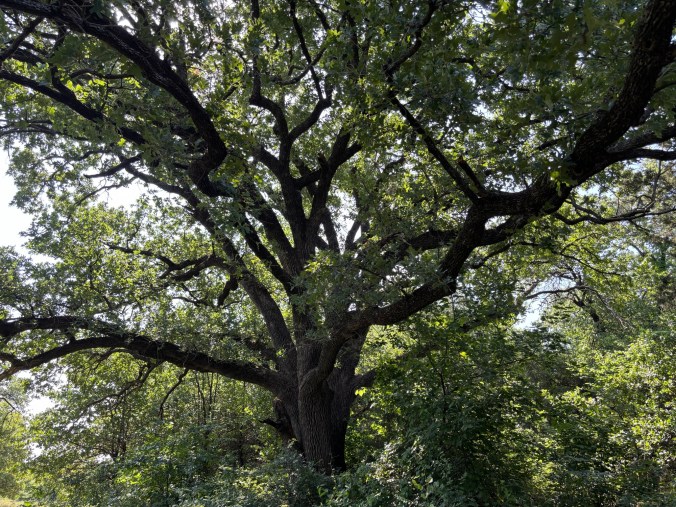
And that brought me to the Old Man (Old Woman, if you like) of the preserve, a huge Post Oak that the Texas Tree Coalition designated as a Historic Texas Tree in 2019. It is called the “Caddo Oak,” in honor of the Caddo People who once lived here. After more than 200 years it continues to stand, with a huge trunk and massive branches stretching out like arms to embrace the sky.
The “Caddo Oak“
This “Old Person” – oak trees have both male and female flowers so I shouldn’t assign them a gender – might give us a sense of a something ancient that presides over the place. There are a few other big oaks on the preserve, but probably none that were growing when Texas was part of Mexico, before independence or the battle at the Alamo. We are fortunate that it is still here, never in all those years cut down or burned.
From there I followed the trail as it turned south, taking me to where I could visit the yucca meadow, a big patch of deep, soft sand that supports Glen Rose Yucca, Lanceleaf Blanketflower, and other low plants. Some of the yuccas still had their flowers, though the cycle in which Yucca Moths pollinate the plant and lay eggs where the larvae will then eat some of the developing seeds (not too many) is probably winding down. That meadow is also home to the Comanche Harvester Ant, a species of what Texans call “big red ants” but this one requires deep sandy habitat with nearby oaks, and this limits where they may be found.
The yucca meadow (I took this photo on May 8th)
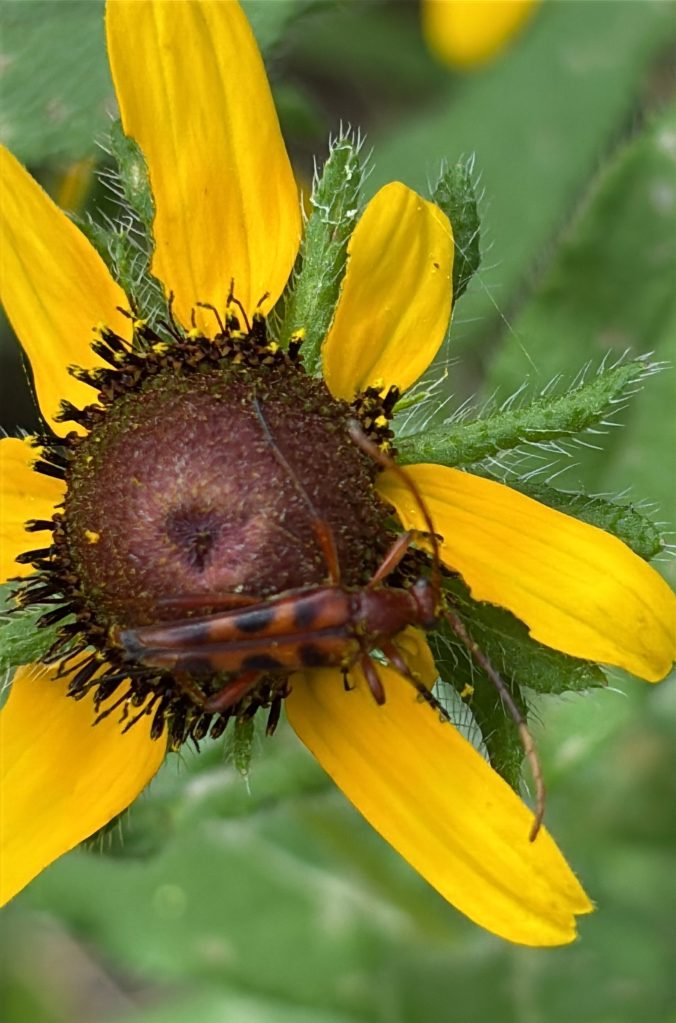
Continuing around the preserve, I found a tiny juvenile bush katydid with black-and-white banded antennae on the flower of a Lanceleaf Blanketflower, and then a Six-spotted Flower Longhorn Beetle crawling over a Black-eyed Susan flower. On a walk like this, the insects provide so many fascinating forms and colors.
Six-spotted Flower Longhorn Beetle
I arrived within the woodland at the crown of the hill, and the clouds had broken up so that there was bright sunshine and lower humidity. At 11:20am I lay on my back and watched the low fragments of cloud drifting swiftly to the north. At the ground there was a good breeze. A Tiger Swallowtail fluttered through the area, perhaps visiting the Standing Cypress that are scattered wherever there is a small opening in the oak woods.
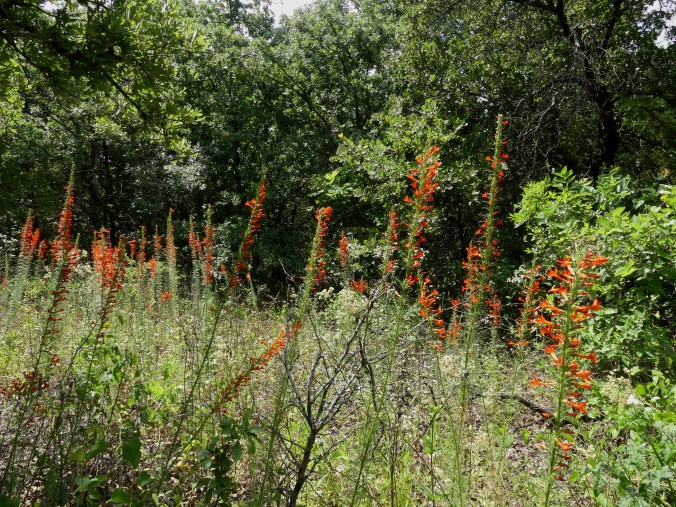
And the Standing Cypress is having such an amazing year at the preserve. You first see them in winter, growing as a delicate rosette of thin, fern-like leaves. But in spring the plant sends up a tall stem that can grow up to six feet, with a flower spike at the top that produces clusters of red, tubular flowers.
Standing Cypress
It was over two hours of delight, despite that warm blanket of humidity. After the first hour I was pretty well adapted anyway, or else all the wonderful stuff outweighed any discomfort. We are all lucky to be able to go and be part of this wild piece of Arlington.
I continue to think about bringing up kids with the skills and values that are needed. I see the world that kids are growing up in, how it is changing, and I wish for a better world. The way we make that better world is through compassion, integrity, and other qualities that are hard to hold onto with so much going on. I wrote about empathy last month, and I’d like to talk about truth this time. (I started this at Rain Lilies on Substack and reprint it here.)
“Did you finish your homework?” “Are you really friends with that person?” Those can be difficult questions. Sometimes being liked or staying out of trouble can make truth-telling hard, for adults and kids. Does it really hurt anything to “bend” the truth?
Little kids may automatically give the answer that the other person wants, the “right” answer, even if it’s not really what happened. “Did you hit your sister?” The right answer, the one that the questioner wants to hear, is “no.” For a very young child that may be the only answer that occurs to them.
In other words, in those first few years kids don’t necessarily sort things into categories like lying and telling the truth. It might not occur to them that the thing that really happened is different from the thing that the other person wants to hear. They simply give the desired right answer. Only later do they understand that they’re choosing to lie.
Teaching honesty usually begins early, before we can discuss things like building trust. Parents might say, “Thank you for admitting what you did; I know that was hard.” They might still get in some trouble, but hopefully they see themselves as a kid who made a mistake but handled it honorably. And that’s important to see yourself (and for others to see you) as a basically good person who made a mistake.
If the consequences of making mistakes are really harsh, then a kid may lie even when they know it’s a lie. They become so afraid of a parent’s or teacher’s anger that they will take a chance on lying. What does this child do? Tell the truth and let awful things happen, or lie and hope they don’t find out? The child may decide to make it a very convincing lie and hope for the best.
If this keeps on going, lying can become a habit. There can be other ways for habitual lying to develop, but this is one. Screwing up gets you in bad trouble, maybe scary trouble, so you just get good at making things up to stay out of trouble. You become good enough at lying that you often don’t get caught. It becomes second nature to make stuff up.
Is lying ever acceptable? It is possible that it could be okay to tell a lie in order to protect someone or save them from needless hurt? There is a wonderful story by Mark Twain that I hope you will read. It’s “Was It Heaven? Or Hell?” and it shows how compassion and caring sometimes outweigh truth-telling. It’s not long and it illustrates the point really well.
But there is that other kind of lying, done only to help ourselves regardless of who is hurt. The lie that is designed to harm someone, or intended to help us get away with something that is wrong. The bully who beats someone up but then claims to have been nowhere nearby when the beating happened. The person who calls folks up pretending to sell impossibly good insurance and tricks them into giving up their bank access and then steals their savings. The leader of a country who tells the citizens that he really won an election that he actually lost, claiming that immigrants voted illegally and bad people stole or dumped votes that were for him.
And when too many people easily tell lies like that, we might begin to feel like we are foolish to tell the truth. Especially when people who should be respectable go on TV and say things that aren’t true and say it easily (wanting us to think “of course, that’s obvious”) and become offended if someone challenges them. We begin to be not so sure what is truth and what is a lie, and to wonder if lying isn’t just what everyone does to get by in the world.
But if that’s who we become, how will we ever be able to trust anyone? Already too many people only trust folks in a small circle of friends and family. We should be able to talk with someone we don’t know and decide to give them at least a little trust. We could start off seeing them as trustworthy unless there is a reason to think they are not, while at the same time being careful not to trust them with too much.
In other words, we want to think that most people have integrity. Someone with integrity tells the truth and does not mislead people about who they are. They don’t pretend to be one kind of person for some people and act like a different sort of person for others. Think of it as “doing the right thing even when no one is looking.”
Being able to trust others and to believe that they have integrity is important. It allows us to live in a community where people are ready to accept each other as neighbors and maybe friends. I hope that more of us can live in such communities.
How do we remain ready to extend a little trust but at the same time protect ourselves against people who would use lies to hurt us? How do we maintain our own integrity when we see many others getting by through deception and lies? How do our kids manage it? I suppose part of it is finding trustworthy people as friends and acquaintances, reminding us what good, caring, honest relationships look like.
And we can develop the skill of being good observers of others, reflecting on what we see in them and listening to ourselves about what those observations mean. It’s a mistake to jump into things on a whim or listen too much to peer pressure or wishful thinking. Get to know people and think about what you’re learning about them.
All of that is easy to say and suggest to others. It can be harder for us to put all that thinking and reflecting and listening into practice in our own lives. But it really pays off.
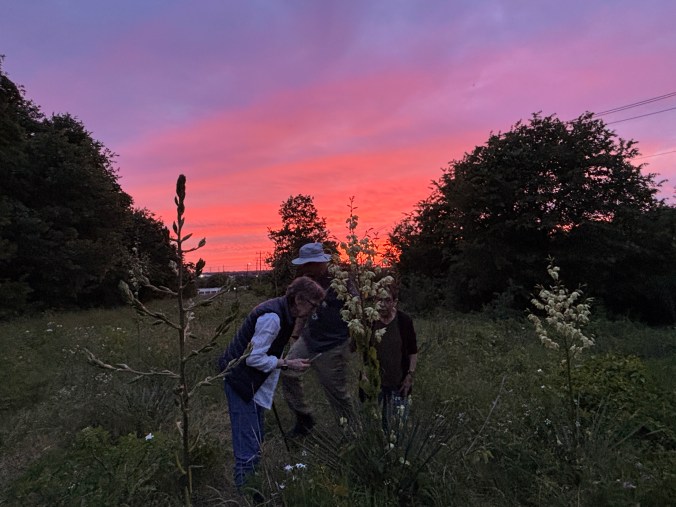
Saturday the 10th, a group of us took a walk at Sheri Capehart Nature Preserve to find moths at sunset. They are very special moths that pollinate and in turn are fed by the Glen Rose Yuccas that live there. It’s a great example of biological mutualism, and it’s the subject of my most recent “Letter to Nature Folks.”
I hope you’ll visit the page with “letters” to you and download that May issue of Letters to Nature Folks – the one marked as “Yuccas and Yucca Moths.” And if it sounds like a good walk (it was a very good walk), thank John and Grace Darling for leading it and telling us the story of how the yuccas and moths completely depend on each other. And thank the Friends of Sheri Capehart Nature Preserve for offering this and other great activities. (Disclosure: I’m on the board of that Friends group, but I’m not the one to thank for the walk.)
This week, take a moment to remember the frogs, toads, and salamanders of North America. It’s Amphibian Week, started in 2020 by the Partners in Amphibian and Reptile Conservation (PARC) and partners such as Save the Frogs! These animals are important to the ecosystems in which they live, partly because predator species depend on them being so numerous (in places their biomass – total mass of amphibians – makes them a significant source of food to support the community). One way that they are important to us is how the calls of frogs and toads bring the nighttime to life in many places. The famous herpetologist Archie Carr said, “Frogs do for the night what birds do for the day: They give it a voice.” And amphibians are important just because; like other species, they have intrinsic importance.
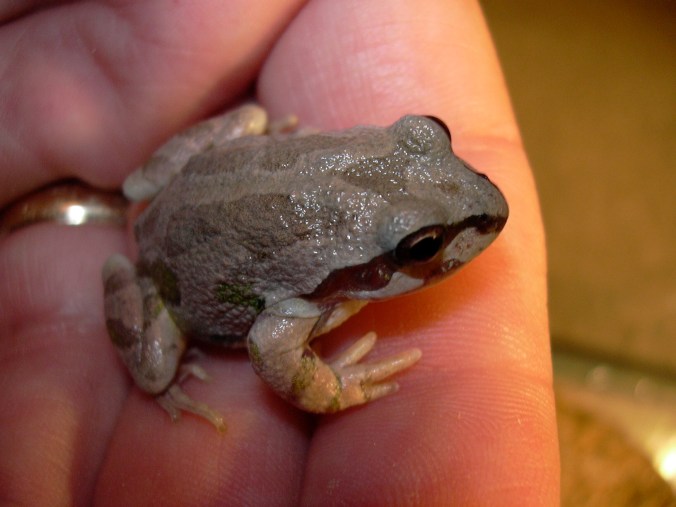
Strecker’s Chorus Frog
To celebrate, here is some information about Texas amphibians, adapted from the pdf file you can find right here on my “herpetology” page. Here in North Texas it is expected to be rainy for part of this week, and the amphibians will appreciate that. Maybe you can get out to a wetland in the evening and listen for some frog and toad calls.
Amphibians include frogs, toads, salamanders, and caecilians. All of them are vertebrates that cannot generate their own body heat – that is, they are “cold blooded” or ectothermic. Amphibians have smooth, slimy, or warty skin which allows them to “drink” through the skin but also makes it easy for them to lose water by evaporation. They lay eggs without shells and almost all species hatch into an aquatic larval stage. One of the exceptions to that rule is the Slimy Salamander, which lays eggs in moist soil and leaves, and embryos develop into miniature adults before hatching. For other species, after growing and developing in ponds and streams, tadpoles and most larval salamanders change from aquatic, gill-breathing animals to animals that breathe air with lungs.
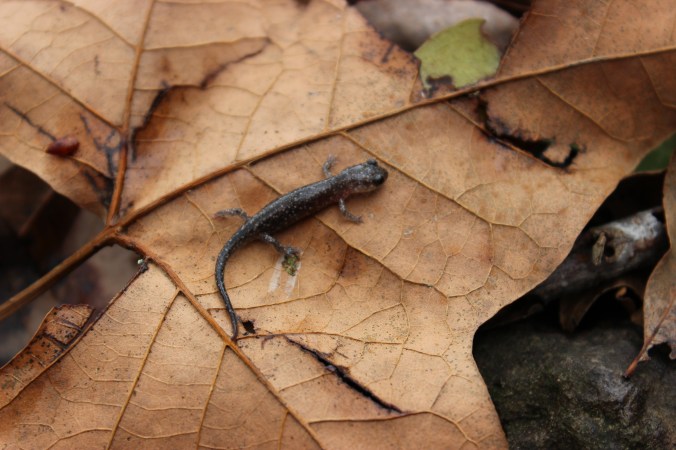
A very young Western Slimy Salamander from Williamson County
Frogs & Toads
Toads have relatively dry, warty skin, shorter back legs compared to most frogs, and often live further from water than frogs. Most frogs, on the other hand, have slimy and fairly smooth skin and longer back legs – they can leap where toads only hop. Both frogs and toads are dependent on water or moisture and often live near the water’s edge or in places where there are moist refuges. Toads may live in fairly dry habitats like prairies (a few live in the desert). Frogs don’t have to stay right beside the water; at night in some places we might see leopard frogs or bullfrogs wandering some distance from the nearest creek or pond.
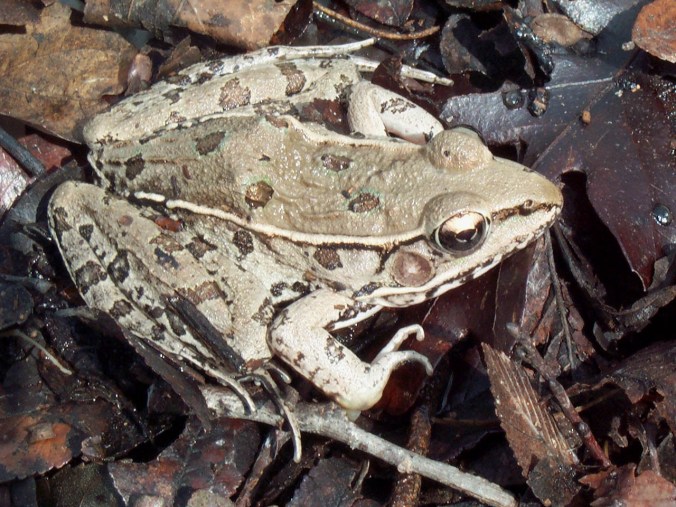
A leopard frog at Fort Worth Nature Center & Refuge
Frogs and toads have a “seat patch” of skin that easily absorbs water and that is how they drink! Many toxins can easily cross an amphibian’s skin, making many of them particularly sensitive to pollution. (Do not handle them if you have chemicals such as insect repellent on your hands.) On the other hand, frogs and toads secrete various toxins from their skin, which helps protect them from infections and in some cases may help protect against predators. Most frogs are completely safe to handle, and none will give you warts! However, do not rub your eyes or get your fingers in your mouth after handling them. The skin secretions of toads can result in a burning sensation if it gets in your eyes.
Woodhouse’s Toad
The males of the various species of frogs and toads “call” to females during breeding. This often takes place in the water of ponds and creeks, because when a female approaches a suitable male and they pair up, she will lay eggs in the water as the male fertilizes them. The calls of frogs and toads are a little like bird song, in that different species have different calls and an experienced listener can identify the species by listening to the call. A very good book with audio recordings of many calls, is The Frogs and Toads of North America, by Lang Elliott and others.
Many frog and toad species that used to be common have become harder to find or even disappeared. In many places, populations of frogs and toads are being monitored to see how they are doing.
Salamanders
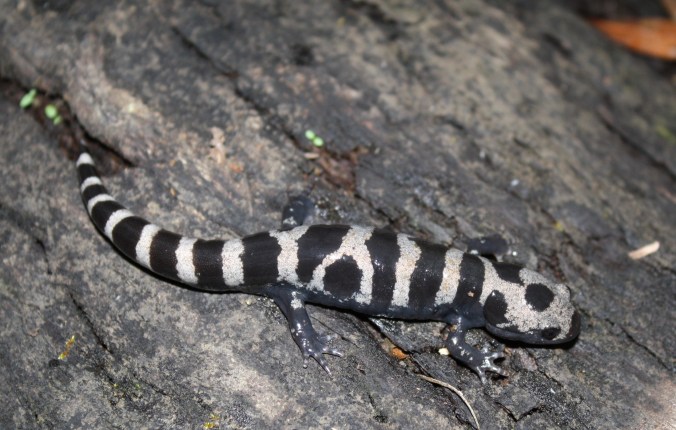
A Marbled Salamander from White Oak Creek WMA in northeast Texas
Many of them may look a little like lizards, but salamanders are not reptiles; they are amphibians. They have skin that may feel rubbery, slimy, or slightly rough, but they do not have scales and they can dry out easily. Like other amphibians, most of them start out as eggs laid in water. Instead of a shell, the egg has a clear membrane through which you can see the embryo developing. With a few exceptions like the slimy salamander mentioned above, here is what happens next: When the eggs hatch, the babies are not like adult salamanders, but are larvae that breathe in the water using gills. This is the salamander version of a tadpole. Later, most of them change into an air-breathing adult form (one group, the lungless salamanders, do not have lungs as adults). Some salamander species live entirely in the larval, aquatic form, and these are called “neotenic” salamanders. Neotenic salamanders are not a different kind of salamander, but the term “neotenic” simply describes the fact that the salamander did not change into an adult, air breathing form.
One group of salamanders, called “sirens,” always remain aquatic and do not develop hind limbs. They are long and eel-like. Another group that is always aquatic and whose members have a long body like an eel are the “amphiumas.” Some of these animals, like the “western lesser siren,” are relatively small. In contrast, some amphiumas can reach lengths of over three feet.
A Small-mouthed Salamander seen at Old Sabine Bottoms WMA in East Texas
Because they depend on healthy wetlands or other habitats that are shrinking because of things like development for human use or drought and climate change, salamanders are in trouble. Like frogs and toads, their skin is porous and they “drink” through their skin. This makes them particularly vulnerable to chemical pollutants in water. Overall, because of pollution, diseases, habitat loss and other reasons, amphibians are disappearing in many parts of the world. See organizations such as AmphibiaWeb for more information. You may also be interested in my book, The Wild Lives of Reptiles and Amphibians: A Young Herpetologist’s Guide, from Texas A&M University Press.
(I recently wrote this over at Substack – yes, I’m still struggling with where to land – but I felt the post ought to be here, too, because of its importance. I hope you will read and go to the Federal Register site and comment. Thanks.)
Suppose a group of people came to your house and stole the roof from over your head. “What??!” you might protest, but they tell you they needed the shingles. Shortly after, a crew plows up the easement in front of your house, and water shoots up from the broken pipes, then subsides to a trickle. Eventually you sit in your house, unharmed, but with no protection from the elements and no water. The police tell you that you have no recourse, because none of these people physically hurt you.
That is what the Trump regime plans to do to species protected under the Endangered Species Act. A proposed rule would re-define “harm” to only mean “taking” a protected plant or animal. Changing or degrading its habitat would not fall under the definition of harm. Only such things as trapping or killing the animal, or digging up an endangered plant, would qualify as “harm.”
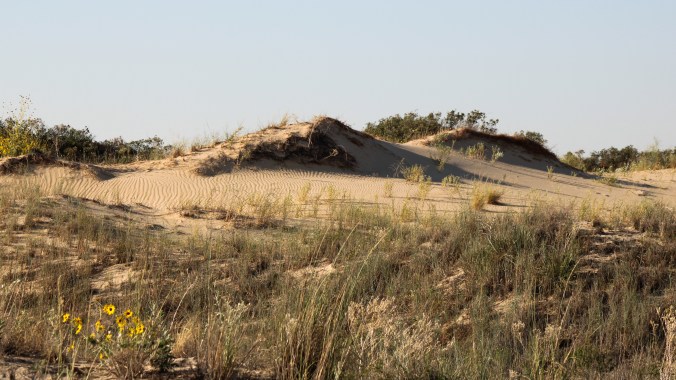
Sand dune/shinnery oak habitat in Monahans Sandhills State Park
The beneficiaries of this, of course, are extractive industries. Loggers can log and the spotted owls just have to deal with it, because if nobody is shooting owls out of the sky, no harm done. In the Permian Basin of Texas, industries can go on mining sand for fracking, and the Dunes Sagebrush Lizard will have to learn to live on caliche roads and patches of remaining bare sand. I visited the area last year, writing about the Dunes Sagebrush Lizard for Green Source DFW. Researchers have found that this lizard requires very specific habitat that includes sand dunes and a low, shrubby oak species called shinnery oak. If you remove that habitat, the species cannot survive.
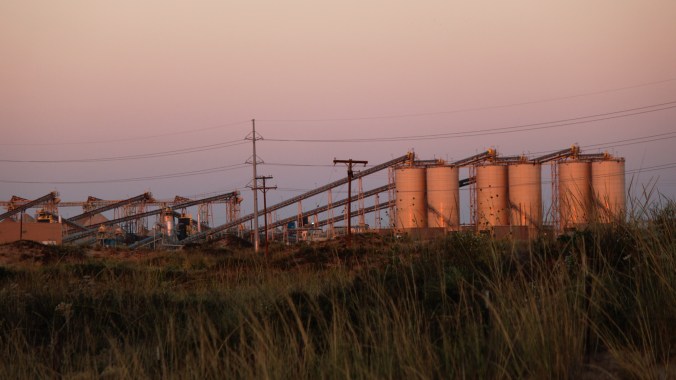
Over a year ago, the U.S. Fish and Wildlife Service listed the Dunes Sagebrush Lizard as endangered, but a loophole in the law allowed them to defer setting aside any habitat for it. (The Monahans Sandhills State Park provides some good habitat, but the whole park is only 3,840 acres.) The land in Texas west of Midland and Odessa is like a big outdoor industrial park crisscrossed with roads and sand trucks, sand mining sites in the spotty areas where dunes are found, drilling sites and the network of caliche roads connecting them. A lizard could look around in most places out there and see no direction home.
Sand mining operation near Kermit, TX
So, back to our analogy, if you were an endangered species, industry could come steal your roof, dig up your water pipes, and leave you with no food, water, or shelter, and according to the current regime you would be completely unharmed. To further quote Bob Dylan, “How does it feel?”
From a conservation biology perspective, it’s fair to say that all species depend on certain conditions to survive. The more they are habitat specialists, the narrower the range of conditions that they need in order to survive. That is, if they are adapted to very specialized diets or ways of living, they can’t just decide to be more flexible and live outside those requirements. The Dunes Sagebrush Lizard did not just decide it liked sand dunes and shinnery oak and would be annoyed if they couldn’t get them. Over a long span of time, generations of these lizards survived by making use of that habitat and only that one.
Regarding this proposed rule change, you can submit a public comment before May 19thhere. I really hope that you will. With the Musk-Trump regime, it is too easy to conclude that since they don’t care what we think, it’s a waste of time. But that’s not quite true. They don’t care unless we speak up in large numbers, signifying a big wave of opposition that they cannot ignore. Enough of us, acting together and persistently, might still have an impact.
Also, giving up on telling them what we think reminds me of the first of Timothy Snyder’s lessons for resisting tyranny: do not obey in advance. Staying quiet teaches them the extent of their power, and it is also a kind of signal to our neighbors and friends that there is no point in resisting.
There are over 1,300 species federally listed as threatened or endangered under the Endangered Species Act, and a number of them occur in Texas (including the Ocelot, Mexican Long-nosed Bat, Golden-cheeked Warbler, Red-cockaded Woodpecker, Louisiana Pinesnake, Salado Springs Salamander, Comal Springs Riffle Beetle, Hinckley’s oak, Neches River Rose-mallow, and many more). I hope we won’t leave them “on their own, like a complete unknown.”
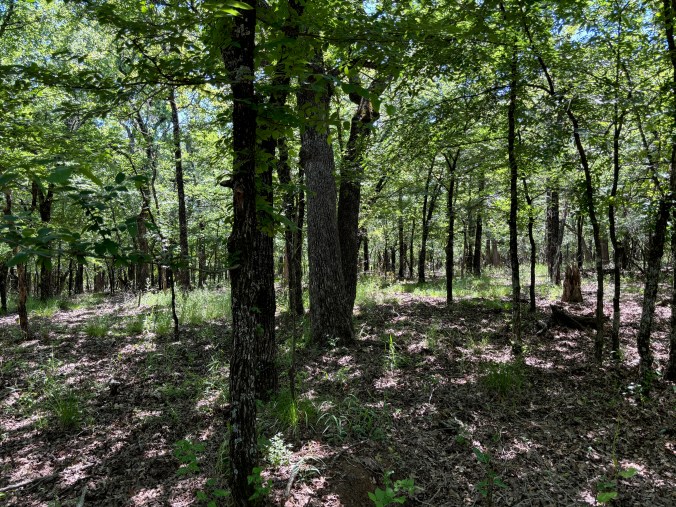
This new trail at Fort Worth Nature Center & Refuge is a favorite. I have walked it in winter with those bare tree limbs reaching up towards the sky and beautiful patterns of shed leaves on the ground. Now I have been there when it is greener and darker with all those new leaves shading the ground. The trail winds among the tree trunks and I can hear the quiet and the birds and the soft crunch of footsteps. That quiet and the new leaves as well as the carpet of old ones makes for a woodland sanctuary. A protected woods becomes a protective place for all who walk there.
I remember the 1939 film – “The Hunchback of Notre Dame” – in which Quasimodo rescues the wrongly condemned Esmeralda and flees to the cathedral, crying “Sanctuary! Sanctuary!” Notre Dame is a place of safety and protection from a corrupt French Chief Justice. Both the disfigured Quasimodo and the Romani girl Esmeralda are safe within its walls.
I respond to the prairies, woods, and wetlands as places of safety and protection, sanctuaries from thinking about the current regime and worrying about how it will play out. Extrajudicial abduction, defiance of courts, hate and scapegoating, wrecking the economy that sustains us, and on and on. We might imagine that, like Esmeralda, we all need to be taken to some place of safety, away from the worst of our fellow humans.
At the same time that such things are going on in human society, the sun keeps rising each morning, birds sing, water flows, plants give us oxygen and food, and there is quiet and peace in the woods and fields. I am very thankful that they are part of the world. As Robin Wall Kimmerer said, “Even a wounded world holds us, giving us moments of wonder and joy” (Braiding Sweetgrass, p. 327).
Sanctuary! I need to be in such places. I must do whatever good that I can in the world, and then for a time I need the shelter of nature.
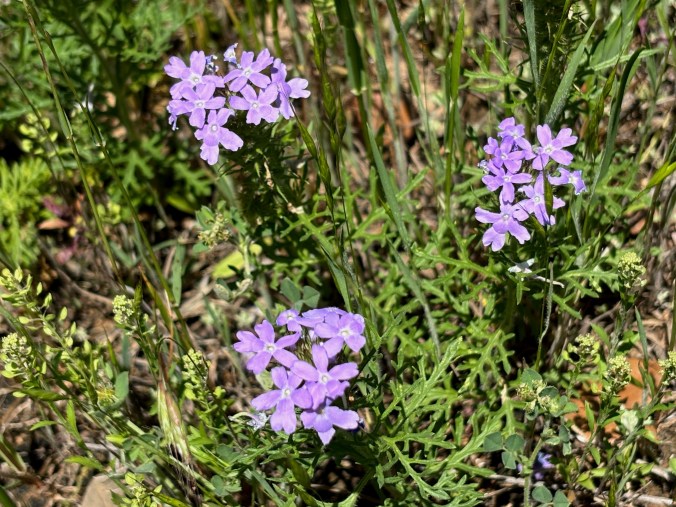
Flowers of Dakota Mock Vervain
And so I went to the nature center yesterday, the day before Earth Day. The sun was shining in a clear blue sky, and a Northern Cardinal’s call was joined with those of other birds in the patch of prairie where I started. The temperature was still in the 70s, but not for long.
In the meadow with butterflies and bird song
After a time in the trees, the trail entered a big meadow or prairie surrounded by trees. This, to me, is the heart of this trail. There were flowers visited by butterflies – a Common Buckeye, several Goatweed Leafwings, and over by the bench, a Painted Lady. Once I settled in, I saw some species of sulfur flying and fluttering a little above the tops of the grasses. Most of the time the nearby air traffic did not disturb the place, so I could hear the Northern Cardinals and also Carolina Wren, Carolina Chickadee, White-throated Sparrow, and Tufted Titmouse (much of the identifying was with the Merlin app, but even if they were not identified the songs in the meadow were beautiful).
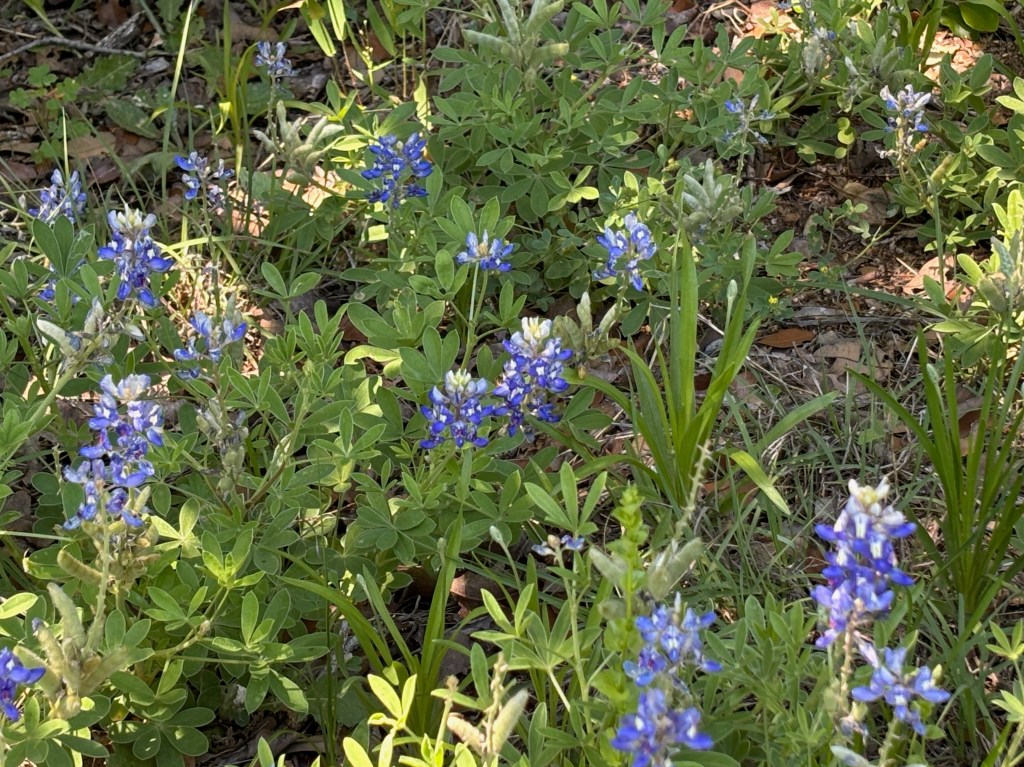
From there, the trail meandered through the woods some more. Sometimes I got on the ground to examine mushrooms; other times it was to see a small jumping spider. There were more flowers: Smallflower Desert-Chicory, Fraser’s Wild Onion, and at the end, a few patches of Texas Bluebonnet in clearings as the woods opened onto another prairie.
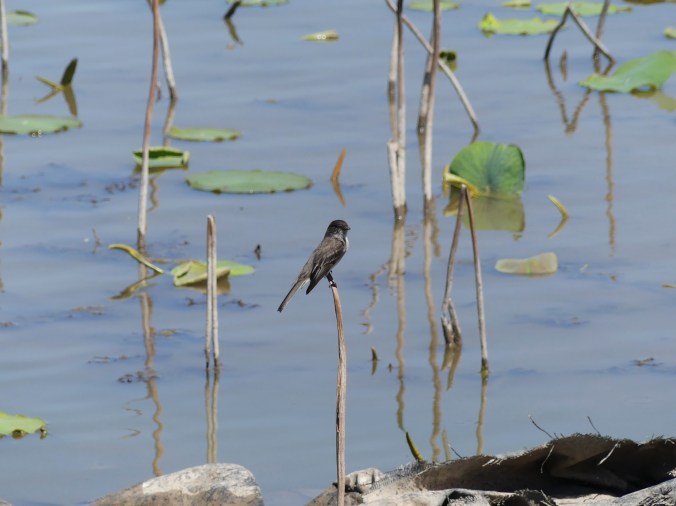
When I reached the end of the trail, the marsh boardwalk was a short walk away, and so I headed down to the marsh. Black Vultures were examining some exposed mud, a Great Egret flew by close to the boardwalk, and at some lotus stems in the shallow water an Eastern Phoebe perched. Then it flew to a nearby spot, disappeared, and returned. Once it dipped to the water’s surface, apparently to capture something. It is a busy life for a Phoebe on the hunt.
The Eastern Phoebe, scanning for insects
It was three hours well-spent. We all need this kind of sanctuary, and such places can be an important sort of self-care. I wish everyone could take an hour or so and be held in the peace and beauty of places like this. If you can, go and sit for a while in mindful stillness or walk the trails and notice the unending stream of wonderful things that you will find.
Our responses to losses and extinction of our fellow creatures should reflect our complete selves, not just what we make of the losses intellectually but also how they resonate in our hearts and souls. When a species is gone, it should pull from us something beyond what is measured in statistics. Birds do that, as you can hear in the magnificent elegy by Christopher Tin, called The Lost Birds. It’s a collection, a heartbreaking instrumental theme memorializing the Passenger Pigeon (“Flocks a Mile Wide”) and songs, some with original lyrics and some drawing on others’ poems such as “Hope is the Thing with Feathers.” Those lost birds, our distant relatives, deserve memorials such as this.
Of course, it’s not just birds. Many of our other animal relatives are disappearing, and some of them have eloquent advocates. Wolves have passionate defenders, and even the Monarch butterfly inspires legions of helpers planting milkweed for their caterpillars.
Amphibians and reptiles have captured my interest and affection all my life. A great many are declining, and the loss of many amphibians has been deemed an extinction “crisis.” At least, it’s a crisis as seen by herpetologists and some others. Turtles are disappearing, too, along with many reptile species.
You can see where I am headed. No elegies for the disappearing Louisiana Pine Snake or the Yangtze Giant Softshell Turtle. Our culture does not elevate them in that way. The flight of birds symbolizes freedom for us. Our cultural stories equate birds with hope; a dove with an olive branch signifies peace, and those feathered wings remind us of angels. The snake, in Western culture, brings up temptation, fall from grace, and being condemned to crawl on the belly. We have to look elsewhere, like Asia or Indigenous Americans to find some positive cultural meanings.
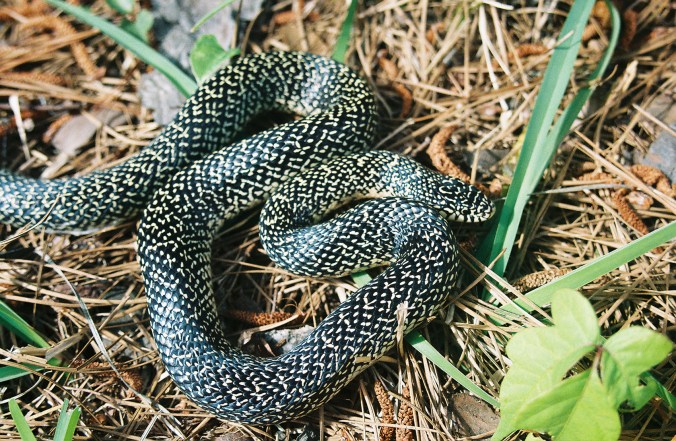
Speckled kingsnake
My point is not a resentment of birds, just a wish that we could do for other animals what we’ve done for birds. I wish we had stories and images in our culture that found more positive inspiration and affection for the animals without beautiful songs and wings, with no soft fur or expressive eyes. It would make it easier for us to find room for them in the family of living things. It might give a little boost to our willingness to go out of our way to conserve them, and maybe we would need fewer elegies.







 Our Lives In Nature

