June 30, 2026
I got started with my walk at the preserve just before 9:00am, with the bright sun climbing the sky and a group of painted buntings calling in nearby trees. Maybe I arrived toward the end of what the birds would consider prime time for hunting, gossiping, or coaching new fledges in the fine art of flying. The Merlin app detected red-winged blackbirds and a Carolina wren also singing, but soon the woods and ponds would be quiet as the day became brighter and warmer.
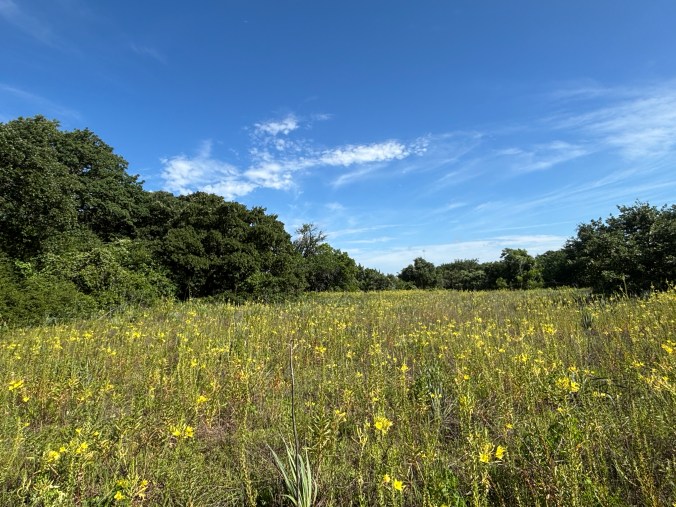
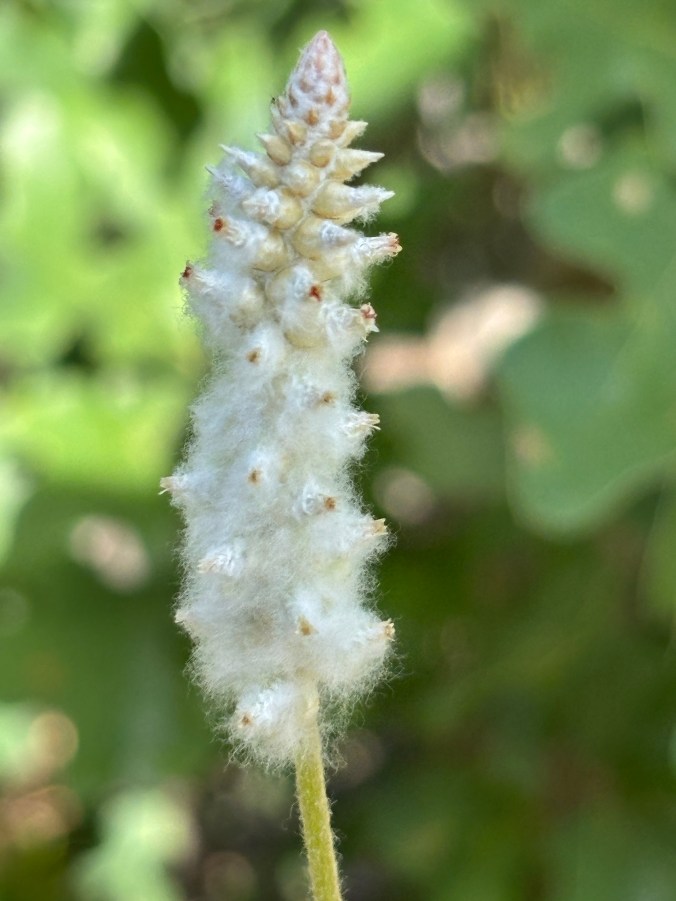
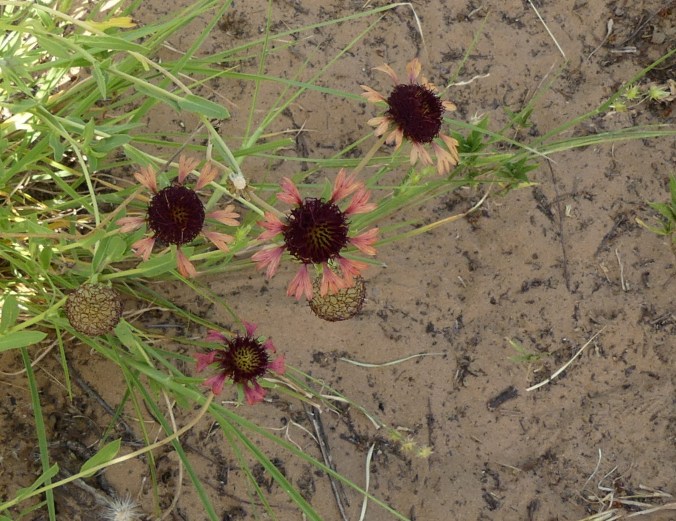
I followed the path through the oak woods and visited what we call the “yucca meadow,” which is a field of deep sand, Glen Rose yucca, various flowers, and colonies of the Comanche harvester ant. Not many days ago the meadow was filled with four-point evening primrose, many with clusters of yellow flowers at the tops of leafy stems standing two or three feet tall. Today I took a few photos of flowers like lanceleaf blanketflower and snakecotton (with flower stems covered with white cottony stuff), while I began to toast under the blazing sun.
In other places, far from North Texas, the heat was much worse. In the Midwest there was an “extreme heat warning” covering several states and then extending up into New England. Europe’s heat wave was called “unprecedented,” with 1,300 deaths in the last ten days blamed on the heat. The temperature has reached 107˚F in Germany. And heat-related deaths are climbing in the U.S. since 2020, corresponding to a warming climate. In the coverage of national weather, Al Roker talked about “dry storms” bringing lightning but no rain and aggravating the fires in Colorado and New Mexico. And look at us: we’re beginning to think of annual catastrophic western wildfires as normal things.
On my walk at the preserve, I began to think about the summers when I was 12 or 13 years old. Throughout the summer I would walk and wade a big creek, the white limestone reflecting the heat of the sun back up at me. I could wade into a deeper pool or find some shade, but I don’t recall the heat slowing me down much. There were watersnakes and ribbonsnakes cruising around the pools or hiding under some of that limestone, and earless lizards scampering over the rocks. At the end of summer, hatchling softshell turtles would sometimes turn up in the puddles. I remember a bullfrog that I nearly had to tackle in order to catch it. (Don’t let all my reptile and amphibian examples distract you – they were what I paid the most attention to back in 1964, but other things were more common, too.) There were fireflies in the backyards at night then, and the summer dark carried the soft scent of flowers and you could still see the band of stars that make up the Milky Way.
Today, on the last day of June, I thought about those things. In the journal entry for my walk I wrote, “I miss summer days when I could go all day in a place like this. Age is part of it but increasing temperatures are most of it.” The summers sixty years ago were hot but not like this, not with extreme heat warnings all the way to Canada. There were fires but the western states did not burn annually.
According to Axios, in 2023 the heat waves in Fort Worth lasted on average 4 days longer than they did in the 1960s. We are experiencing an increase not only in summer temperatures but also in humidity. Heat and humidity interact to produce the “heat index,” or what it feels like to us. When it is muggy – the humidity is higher and sweat is slow to evaporate and cool us – the heat index is greater. When the heat index is 90˚ to 103˚F, the National Weather Service recommends “extreme caution” because of the possibility of heat exhaustion or heat stroke. While I was out walking, the heat index was 93˚F.
Folks might say, “Oh, Texas has always been hot.” And a person growing up in the last 25 years might read what I’m writing and say, “he’s just getting old.” It’s true, that last part. But younger folks have grown up with a different baseline of what’s normal. It’s a shifting baseline in which each generation might believe the current warm winters and scorching summers in Texas are the same as they always have been.
Nature is something else that is not the same as it always has been. Fort Worth and Dallas have expanded and sprawled year by year, to the detriment of the oak woodlands and prairies that once covered North Texas. The 2025 U.S. State of the Birds report warns of continued widespread declines in birds. Loss of frog and toad species worldwide has been described as an extinction crisis, and reptiles hardly fare better. There are numerous reports of insects declining, and that represents decreases in pollination of beneficial plants, fewer insects to do the work of returning organic material to the soil, and a shrinking prey base for other wildlife.
And humans see these losses, even if shifting baseline syndrome skews our perception toward normalizing them. Our response to significant loss is grief, whether it is from the loss of a family member, the dog that has been our companion for a decade, loss of independence following an illness, or the loss of what constitutes our home. We may not be accustomed to or even recognize the grieving of environmental losses.
Is grief the expected response to the loss of that creek and much of the wildlife that lived there, the prairie that was a quick bike ride away, the bright but not unbearable summer sun, and the soft, dark nights? Is it still a loss if there are still prairies, just not that prairie, if birds still sing but in smaller numbers, and if not all summer days are dangerously hot? By contrast, the loss of a family member is sudden and complete; leaving only photos and memories. I have written before about the loss of nature, “There is no attending a funeral and going home; there is only sitting at the bedside of a patient whose condition slowly worsens.”
In her very thoughtful 2020 article, Lisa Sideris explored the topic of environmental grief. She noted that some people react to a damaged world with an upbeat approach that celebrates how we will adapt and use technology to address the degradation of earth. Or they shrug and say that the planet has been through worse and will still be here after whatever we do to it. We cannot destroy the Earth if the planet is reduced to a rock spinning through space. And if it is reduced in that way, there is hardly anything to mourn. However, when you spend time listening to birds where the woodland meets the savannah, or notice the many lives in a marsh or along a stream, you know what we live on is more than a rock. When we take a breath of air, listen to friends or family and hear their stories, or sit for a while under a tree, we know that our home is rich and alive. When part of that home dies or disappears, it should be remembered and honored.
Sideris wrote of grief and vulnerability as “potentially transformative, contemplative states that reconnect us with human and nonhuman others, and with our own painful history of losses and failures.” (p.2). If we make the living world around us nothing more than a backdrop for our entertainment, a storehouse of resources for our use, or a project for our technology, it is then just a thing, nothing we should mourn. That diminishes us as well as the Earth.
Where was the grief on my walk today? You know that moments of remembrance can be serious and thoughtful without obvious sadness. Part of my walk, the part where I sat and thought about the changes over the past sixty years, was like that. And part of it was celebration of what is here today, still a wonderful home, one that deserves our protection.
Discover more from Our Lives in Nature
Subscribe to get the latest posts sent to your email.

