There has never been a day without transitions. The deepest and darkest blue in the sky lightens toward dawn. Birds awaken and add their song to the pre-dawn quiet. Clouds become visible, gray and then pale orange and rose, and finally white. Night becomes day.
Somewhere in there, we awaken. Dreams give way to the waking world. Rest gives way to activity – stretching, making breakfast, and everything else. Preparing for another day that I hope contains possibilities for good things, though I know that for some, the preparation is touched with a little numbness or dread.
The world around us is full of transitions. Recently, cicadas have been emerging from the ground, crawling up the trees and walls, emerging from the outer skeletons that contained their earthbound forms and flying to a nearby tree canopy. During their short adult lives, the soundtrack of summer afternoons is their rattling buzz, sometimes rising to a continuous call for as many as thirty seconds or with a loud pulsing buzz. The nymph that lived for years underground is suddenly a winged adult that will die within a month.
Our human development never seems as sudden or strange. It doesn’t involve crawling out of our skin and flying away, as shocking as some teenage transitions might seem.
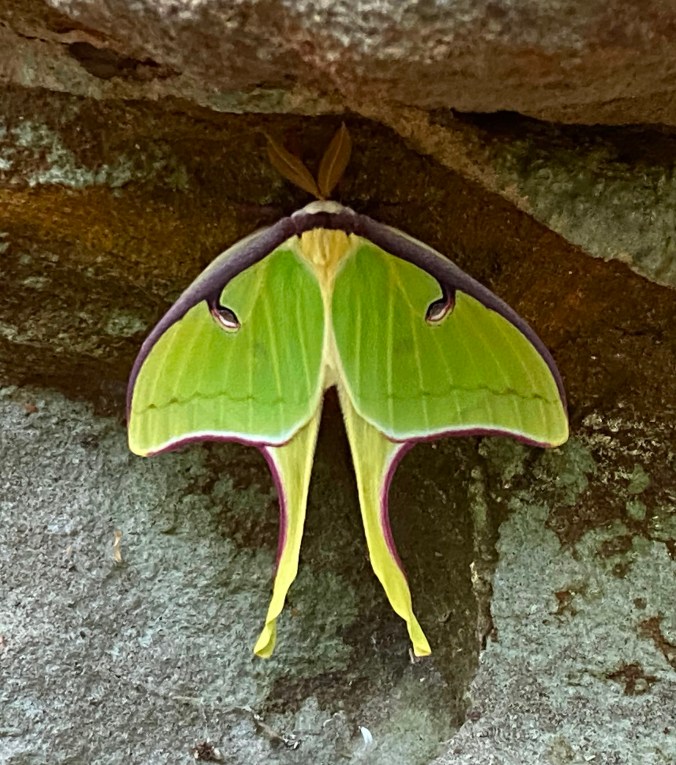
Transitions happen over time. Our perception of time feels to us like something universal, the same for a mountain or a mayfly. A minute is short, and a year is a very long time. We imagine that the week-long lifespan of the beautiful adult luna moth must seem, to the moth, to be over almost before it began. For that moth, maybe the few days spent flying, avoiding predators, finding a mate, and laying eggs seems like a full life. Just as we feel that living for 80 years is a chance at a full life.
Luna moth
And yet, to the 4,853-year-old bristlecone pine in California our lives might seem tragically short. We might want to consider that a minute is our own arbitrary unit of time, experienced very differently according to different lives. Do bristlecone pines have their own minutes?
So, transitions happen to every living and nonliving thing, quick or slow, welcome or resisted, overwhelming or able to be taken in stride. Experienced on a time scale that might be different from one life to another.
Does that perspective offer anything to us when the ground slips away and we have to adapt? I don’t know. Maybe it helps to know that the task of adapting to change is something we share with every other life in the world.
I got started with my walk at the preserve just before 9:00am, with the bright sun climbing the sky and a group of painted buntings calling in nearby trees. Maybe I arrived toward the end of what the birds would consider prime time for hunting, gossiping, or coaching new fledges in the fine art of flying. The Merlin app detected red-winged blackbirds and a Carolina wren also singing, but soon the woods and ponds would be quiet as the day became brighter and warmer.
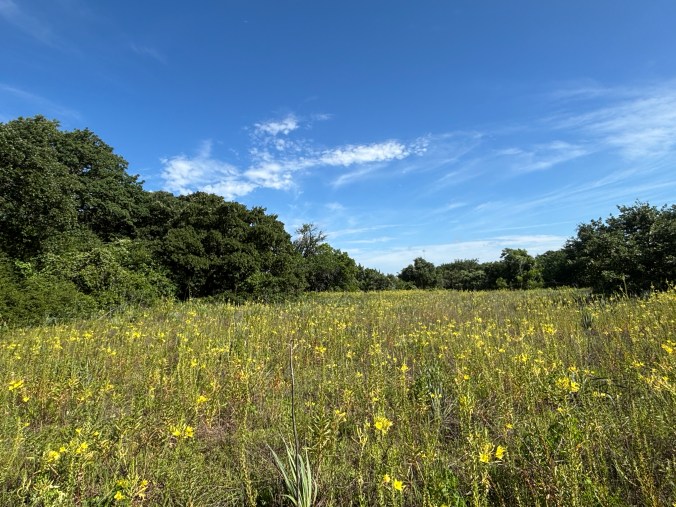
Yucca meadow, with four-point evening primrose
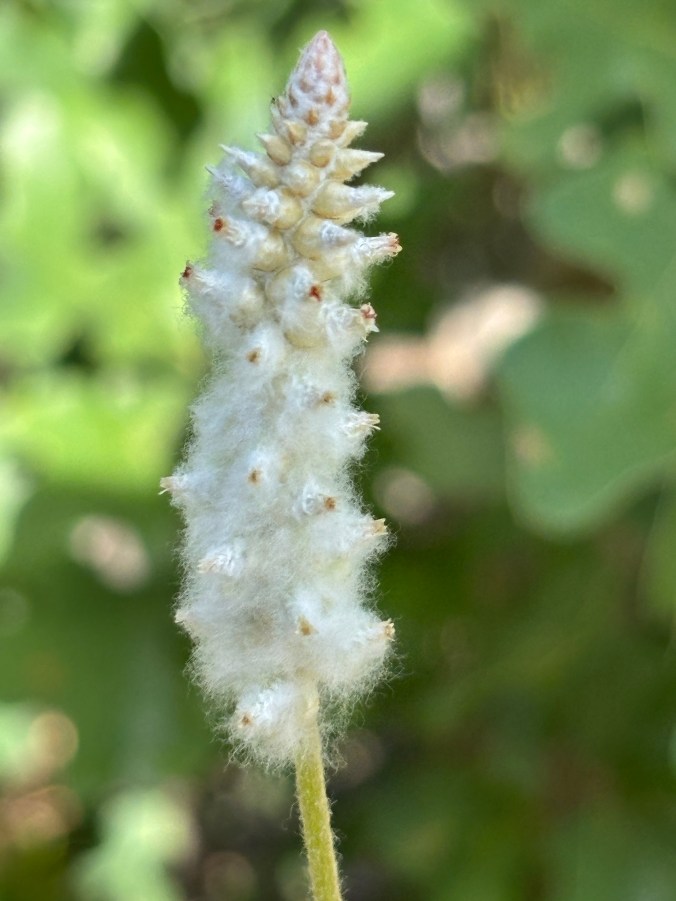
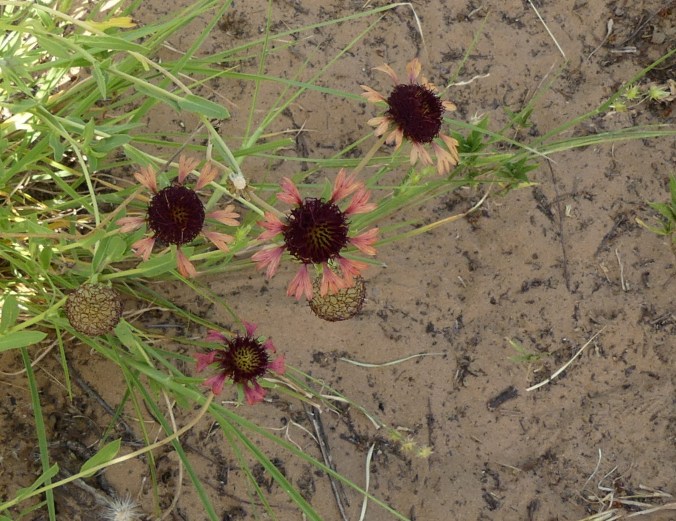
I followed the path through the oak woods and visited what we call the “yucca meadow,” which is a field of deep sand, Glen Rose yucca, various flowers, and colonies of the Comanche harvester ant. Not many days ago the meadow was filled with four-point evening primrose, many with clusters of yellow flowers at the tops of leafy stems standing two or three feet tall. Today I took a few photos of flowers like lanceleaf blanketflower and snakecotton (with flower stems covered with white cottony stuff), while I began to toast under the blazing sun.
Snakecotton
In other places, far from North Texas, the heat was much worse. In the Midwest there was an “extreme heat warning” covering several states and then extending up into New England. Europe’s heat wave was called “unprecedented,” with 1,300 deaths in the last ten days blamed on the heat. The temperature has reached 107˚F in Germany. And heat-related deaths are climbing in the U.S. since 2020, corresponding to a warming climate. In the coverage of national weather, Al Roker talked about “dry storms” bringing lightning but no rain and aggravating the fires in Colorado and New Mexico. And look at us: we’re beginning to think of annual catastrophic western wildfires as normal things.
On my walk at the preserve, I began to think about the summers when I was 12 or 13 years old. Throughout the summer I would walk and wade a big creek, the white limestone reflecting the heat of the sun back up at me. I could wade into a deeper pool or find some shade, but I don’t recall the heat slowing me down much. There were watersnakes and ribbonsnakes cruising around the pools or hiding under some of that limestone, and earless lizards scampering over the rocks. At the end of summer, hatchling softshell turtles would sometimes turn up in the puddles. I remember a bullfrog that I nearly had to tackle in order to catch it. (Don’t let all my reptile and amphibian examples distract you – they were what I paid the most attention to back in 1964, but other things were more common, too.) There were fireflies in the backyards at night then, and the summer dark carried the soft scent of flowers and you could still see the band of stars that make up the Milky Way.
Today, on the last day of June, I thought about those things. In the journal entry for my walk I wrote, “I miss summer days when I could go all day in a place like this. Age is part of it but increasing temperatures are most of it.” The summers sixty years ago were hot but not like this, not with extreme heat warnings all the way to Canada. There were fires but the western states did not burn annually.
According to Axios, in 2023 the heat waves in Fort Worth lasted on average 4 days longer than they did in the 1960s. We are experiencing an increase not only in summer temperatures but also in humidity. Heat and humidity interact to produce the “heat index,” or what it feels like to us. When it is muggy – the humidity is higher and sweat is slow to evaporate and cool us – the heat index is greater. When the heat index is 90˚ to 103˚F, the National Weather Service recommends “extreme caution” because of the possibility of heat exhaustion or heat stroke. While I was out walking, the heat index was 93˚F.
Folks might say, “Oh, Texas has always been hot.” And a person growing up in the last 25 years might read what I’m writing and say, “he’s just getting old.” It’s true, that last part. But younger folks have grown up with a different baseline of what’s normal. It’s a shifting baseline in which each generation might believe the current warm winters and scorching summers in Texas are the same as they always have been.
Nature is something else that is not the same as it always has been. Fort Worth and Dallas have expanded and sprawled year by year, to the detriment of the oak woodlands and prairies that once covered North Texas. The 2025 U.S. State of the Birds report warns of continued widespread declines in birds. Loss of frog and toad species worldwide has been described as an extinction crisis, and reptiles hardly fare better. There are numerous reports of insects declining, and that represents decreases in pollination of beneficial plants, fewer insects to do the work of returning organic material to the soil, and a shrinking prey base for other wildlife.
And humans see these losses, even if shifting baseline syndrome skews our perception toward normalizing them. Our response to significant loss is grief, whether it is from the loss of a family member, the dog that has been our companion for a decade, loss of independence following an illness, or the loss of what constitutes our home. We may not be accustomed to or even recognize the grieving of environmental losses.
Is grief the expected response to the loss of that creek and much of the wildlife that lived there, the prairie that was a quick bike ride away, the bright but not unbearable summer sun, and the soft, dark nights? Is it still a loss if there are still prairies, just not that prairie, if birds still sing but in smaller numbers, and if not all summer days are dangerously hot? By contrast, the loss of a family member is sudden and complete; leaving only photos and memories. I have written before about the loss of nature, “There is no attending a funeral and going home; there is only sitting at the bedside of a patient whose condition slowly worsens.”
Lanceleaf blanketflower
In her very thoughtful 2020 article, Lisa Sideris explored the topic of environmental grief. She noted that some people react to a damaged world with an upbeat approach that celebrates how we will adapt and use technology to address the degradation of earth. Or they shrug and say that the planet has been through worse and will still be here after whatever we do to it. We cannot destroy the Earth if the planet is reduced to a rock spinning through space. And if it is reduced in that way, there is hardly anything to mourn. However, when you spend time listening to birds where the woodland meets the savannah, or notice the many lives in a marsh or along a stream, you know what we live on is more than a rock. When we take a breath of air, listen to friends or family and hear their stories, or sit for a while under a tree, we know that our home is rich and alive. When part of that home dies or disappears, it should be remembered and honored.
Sideris wrote of grief and vulnerability as “potentially transformative, contemplative states that reconnect us with human and nonhuman others, and with our own painful history of losses and failures.” (p.2). If we make the living world around us nothing more than a backdrop for our entertainment, a storehouse of resources for our use, or a project for our technology, it is then just a thing, nothing we should mourn. That diminishes us as well as the Earth.
Where was the grief on my walk today? You know that moments of remembrance can be serious and thoughtful without obvious sadness. Part of my walk, the part where I sat and thought about the changes over the past sixty years, was like that. And part of it was celebration of what is here today, still a wonderful home, one that deserves our protection.
For many indigenous people in the northeast part of North America, Windigo is a monster whose greed and hunger are completely insatiable. A human might become a Windigo when lost, starving and freezing. Or when the response to starvation is cannibalism. Robin Wall Kimmerer writes very eloquently about it: “The more a Windigo eats, the more ravenous it becomes. It shrieks with its craving, its mind a torture of unmet want” (Braiding Sweetgrass, p. 305).
She also finds the lesson, the cultural meaning behind it: “Born of our fears and our failings, Windigo is the name for that within us which cares more for its own survival than for anything else.”
The answer to the danger from Windigo is to take care of each other and to tame our greed, to know when we have enough. We look around us and see a world where too often greed is the operating principle. We are told from some quarters that taking care of each other is weakness and empathy is a sinful flaw. And yet today is the Christian celebration of the resurrection of one who taught the very opposite. One who would tell us to sell what we have and give it to the poor. That theme, taking care of each other and sharing what we have, is taught as wisdom in places all over the world.
And yet we live in a system that celebrates those who accumulate riches and allows a tiny fraction of us to hold unimaginable wealth while most of us struggle and some of us starve. If only there was a way to help everyone become satisfied, to say “enough.” I wish all of us had a sense of when there is enough and could stop with our acquisitiveness when we reach that point.
That would mean not creating that never ending sense of want, making us crave more no matter how much we have, making ourselves a Windigo that cannot be satisfied. We are capable of knowing when we have enough, knowing how to share when there is plenty. We need stories about mutual flourishing and care, about gratitude for abundance and banding together to get through hard times. We need teachers and role models who can say, “enough.”
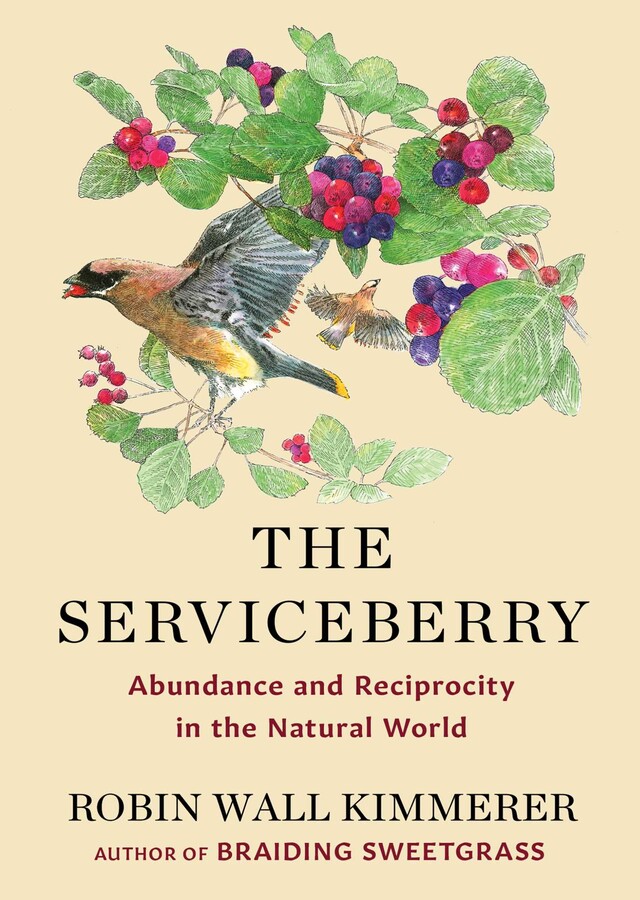
A short, readable book about living in this way, from one of the great teachers, is The Serviceberryby Robin Wall Kimmerer. I wish I could give a copy to everyone who hasn’t read it. Please get it and share it. It’s $20 from the publisher, or only about $10-11 at Amazon if you must.
Climbing to the top of the hill, I pass some friends I see often when I walk this trail. They aren’t people, they are other-than-human relatives like the bees in the bee tree. And the tree with the hole at the bottom like a window into a shelter where a woodland sprite might live. The blue jays hollering at each other like schoolboys, and on really warm days, the Texas spiny lizard hanging on to a tree trunk watching for an insect to eat.
Many Native American cultures see the rocks, waters, trees, and wildlife as our relatives, and many of the rest of us are beginning to understand that wisdom.
From year to year I can count on these friends. No matter how crazy the world gets, they are nearby, doing what they do. It is never boring. That is partly because each season is different. The winter woodland is full of bare branches and beautiful brown colors of the leaf litter on the ground, with the calls of crows and songs of cardinals. It’s the deep blue water of the pond, with sparkling ripples from the winter breeze.
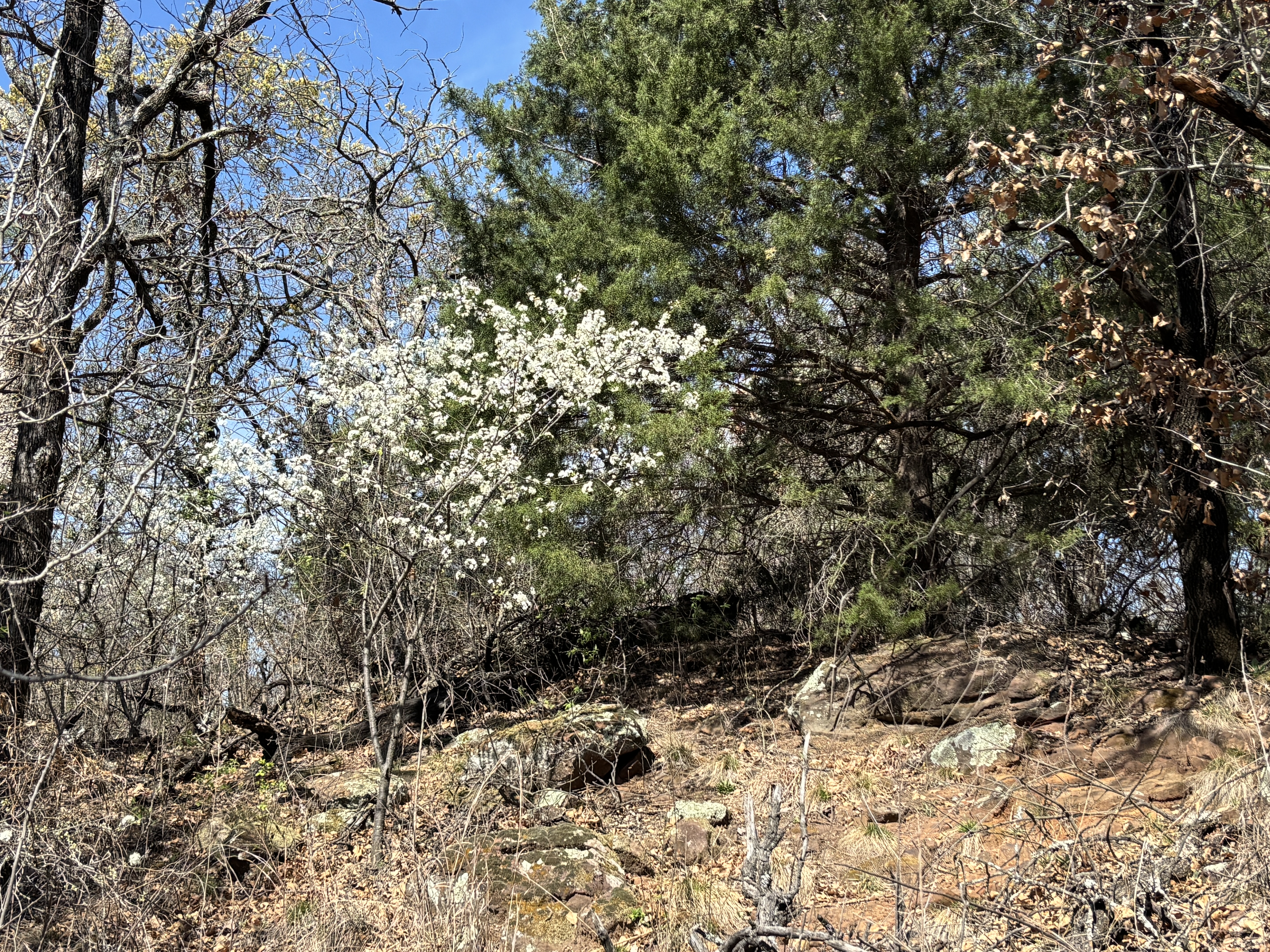
Flowering plum and juniper on a hillside
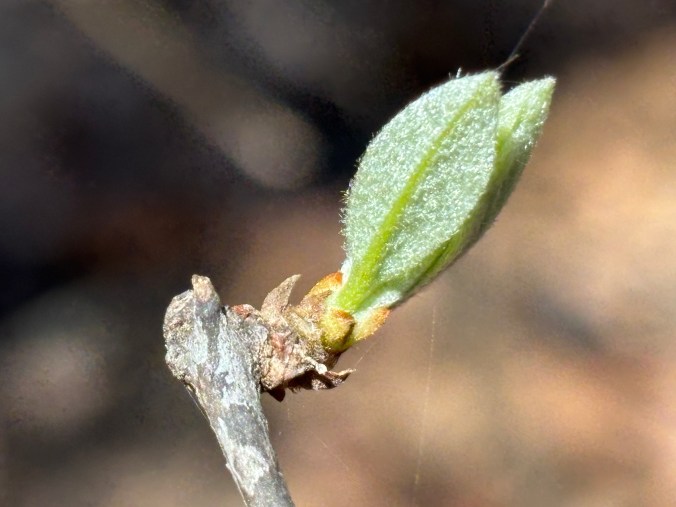
In spring, the angle of sunlight changes and the branches and twigs swell with leaf buds. Plum trees bloom and later, flowers like spiderwort, spotted beebalm, and toadflax cover the soft, sandy soil. The air is sweet, and the night comes alive with frog calls.
It keeps on like that in every season. The peak time for one thing ends, and a new thing begins, like a kaleidoscope in which each turn of the season brings a new pattern and new colors, and each one is beautiful.
The place is never boring, even after visiting it for twelve years. I walk past the same oak trees, say hello to the same Glen Rose yuccas, and I might see some of the same crows (I can’t tell individual crows, but they’re observant and smart, and they can recognize individual humans). It’s a comforting stability, with old friends and places that won’t disappear.
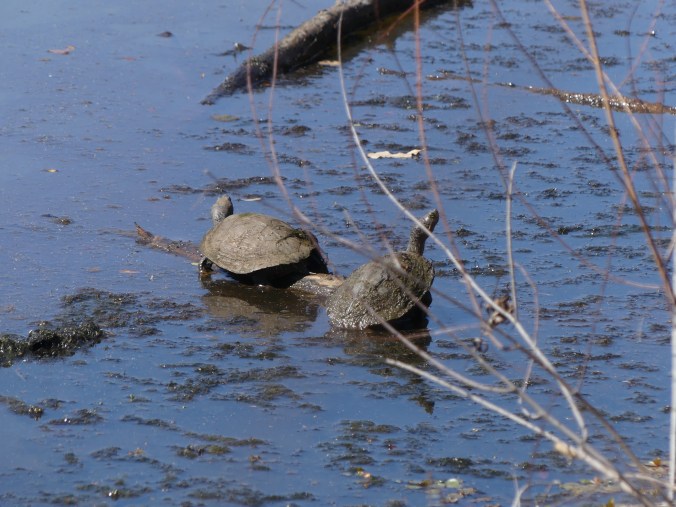
Red-eared sliders
I think that sometimes when we are restless and need some new diversion, some new thing happening or new stuff to buy, it’s because we are anxious or feeling low even if we are not aware of it. We want to maintain this distraction from our distress, and if we don’t get it, we call that boredom. It’s like we’re careening downhill in a moving vehicle trying to dodge random crises, and we want something to take our minds off the fear and not fall into despair.
Something that I think helps is to find islands and refuges of stability. That could be friends and family who provide companionship, steadiness, judgment, love, and support no matter what. It might be found in works of music. And I think places in nature can give us a sense that the world contains goodness and that some good things will not abandon us or be taken away.
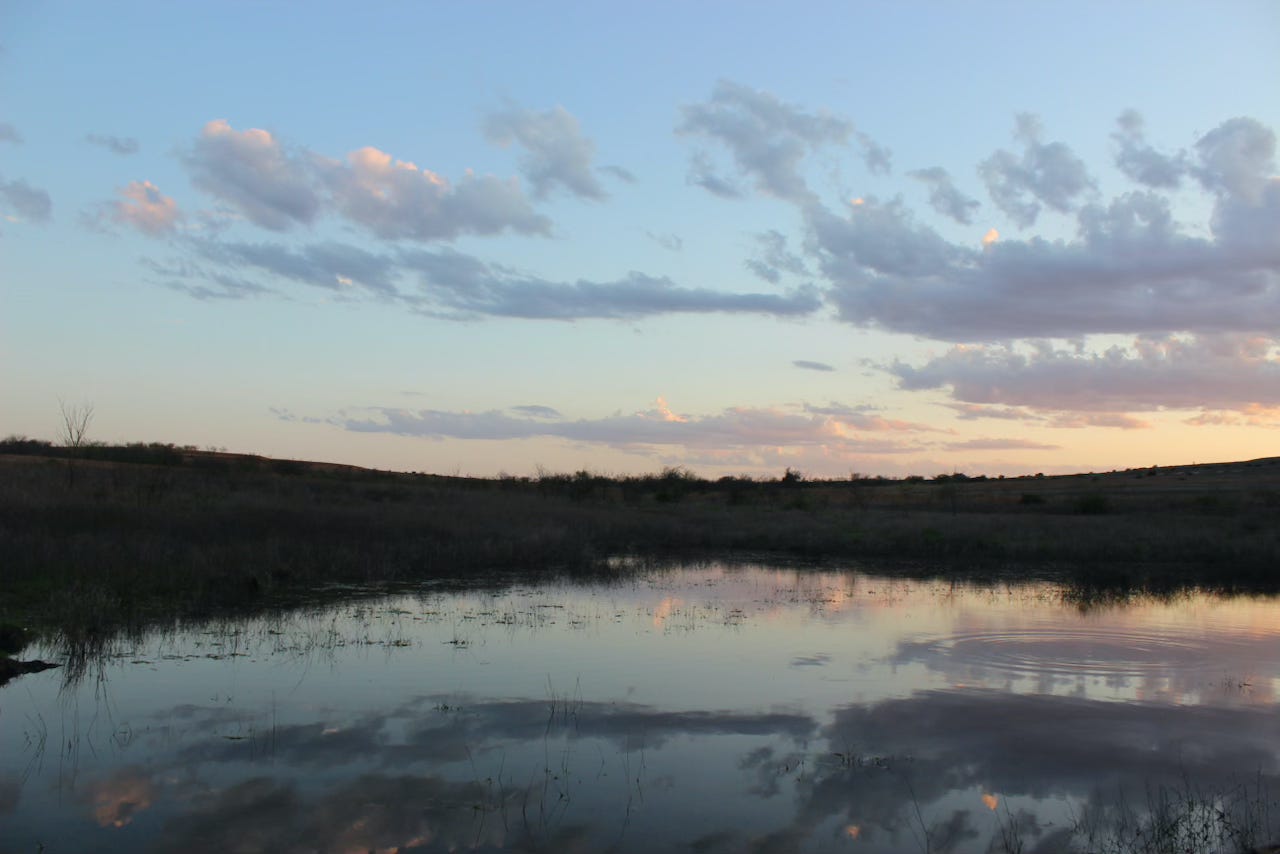
In nature there are many places we can get to know and count on. A creek does not pretend to be someone they are not, and a prairie will not “ghost” you. The woods will not assail you with news of conflict and violence, and the pond will gladly let you be still and watch the shimmering reflections of trees as the breeze kisses the water’s surface.
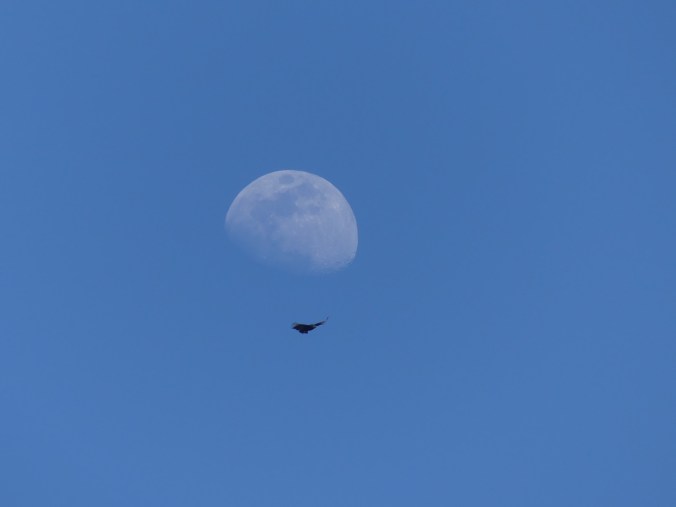
A black vulture and the moon
When you go there and stand among the trees or sit beside the water, it helps to be there fully, mind and body. If we can’t let go of the worries about tomorrow or the discomfort of something that happened in the past, we will barely be awake to the woods and ponds. That’s where mindfulness comes in. By paying attention to breathing, we bring ourselves into the present, and by noticing our thoughts and feelings, we can release them and not be caught up in them. And as we stay in the present, accepting whatever is happening without wanting to change it or add to it, those moments can be wonderful. They can be healing.
Some notes from my walk on March 3rd: “Walking around the crown of the hill, I got a look – from 30 or so feet away – at a roadrunner who looked at me warily and then ran on along the trail. There are butterflies, the bee tree is busy, and at least some oaks are starting to leaf out. Lying under bare oak branches and a blue sky with wispy clouds, at least twice I felt the tiniest sensation of a droplet on my face, and there is a very small drop, crystal clear, on my glasses. I suppose it might be rising sap released where buds are starting?”
Newest leaves in spring
Each season is a deepening relationship with this preserve and all that lives there. I hope that you have such a place, whether it’s a National Grassland with thousands of acres or a little patch of wildness in a city park. Get to know it, let it seep into your bones so that you’re like family to each other. Bring your human family, too, and get to know each other.
I read a post from Diana Butler Bass about the wilderness, saying she hated it. My impulse was to go on to something else, because someone who hates wilderness could not have anything meaningful to say to me, right? Bass is a Christian writer (I would say among the progressive Christians) and she was writing in part about the temptations of Jesus after spending 40 days in the desert. But she was particularly interested in the wilderness as a liminal space, an in-between transitional borderland that may feel so unfamiliar as to be disorienting or frightening.
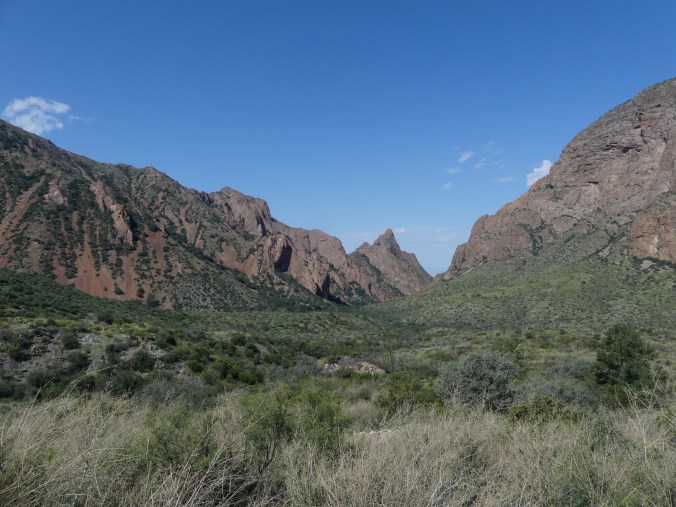
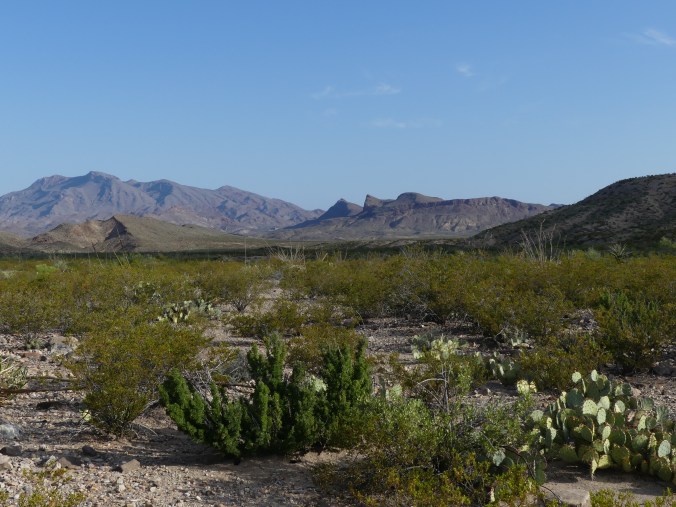
Most of my experience with the wilderness has been in the Big Bend region of Texas, with deserts and mountains relatively untamed by modern humans. Yes, there are roads and visitor centers, but not many. Yes, the Basin is a tourist destination with a resort and hiking trails up into the Chisos Mountains. But in the Big Bend it is easy to get to a place where you are unlikely to encounter anyone, it is quiet, and smartphones are mute and useless for a time. How can you hate it?
Big Bend National Park, the Basin
I admit that the prospect of spending 40 days there with no car and no easy source of water or food makes me uneasy. But in my mind those are just practical considerations; being in that wilderness is something that otherwise sounds wonderful. But I think I understand where Bass is coming from with her talk of it being a liminal place. She says,
The wilderness is an encounter with what is otherwise unknowable. We contend with that which the cozy and familiar obscures. … And there is no wilderness without danger. There is no liminal space without danger. This is the fearsome holy, the unsettling sacred. – Diana Butler Bass
The “fearsome holy” and “unsettling sacred” sound to me like ways of talking about awe. That emotion – awe – involves being taken out of that familiar perception of “having it together” and knowing what’s going on. We generally think of awe as a good experience when confronted with things like beauty or moral courage. The psychologist Dacher Keltner, in his wonderful book about awe, defines in this way:
Awe is the feeling of being in the presence of something vast that transcends your current understanding of the world. – Dacher Keltner, Awe, p. 7
Bass talks about the wilderness opening us up to whatever “the cozy and familiar obscures.” After you strip those things away, what then? She recalled sitting in Wyoming among petroglyphs and thinking about the people who, over a thousand years ago, went into the wilderness. Perhaps they had visions, or maybe, out there with only themselves, they had spiritual experiences that cut to the heart of who they were and what they would do if tempted to be someone they were not. Was their belief or their identity tested by an impulse to throw themselves down from the mountaintop? Was this a place of testing, discovering the strength or limit of who they were and what they believed?
I’ve been to the Big Bend plenty of times, and experienced awe frequently. Not necessarily a primal testing of who I am or what I believe, but the stripping away of the cozy and familiar so that you feel yourself in some more essential way, and you might reconsider how you fit within that vast, beautiful space.
In Mindfulness in Texas Nature, I wrote about places where we can look for miles without seeing houses and cars:
…places where, when we look around us, we do not see a mirror reflecting ourselves. I think there should be places where we are able to say, “This is what nature is like if we leave it alone.” When almost every place reflects back something about ourselves, does that foster an unhealthy self-preoccupation? We are estranged from, and many of us are a little afraid of, truly wild places. – p.123
I wish we could, all of us, come to love wilderness and vow to protect it for each other and for its own sake. Wilderness as a liminal space, a place that brings us back to our essential selves, where we can experience awe or even some dislocation as we get a perspective about who we are and maybe where we want to go with ourselves.
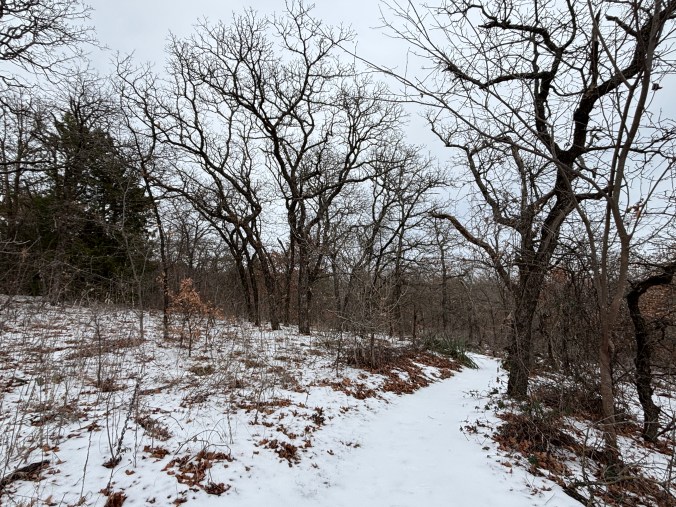
I wrote about ice at the local preserve and ICE as a source of fear for us all. I hope you will follow the link over to Substack and have a look. I wrote, “Yesterday I visited my old friend, the Sheri Capehart Nature Preserve. I do it all the time, but this was my first outing after several days with temperatures below freezing and several inches of sleet and some snow on the ground. That was outside; inside, my heart was buried under another sort of ice after weeks of abuse, murder, and lies in Minneapolis.”
It was beautiful at the preserve and I thought about how being there was like “looking away from the abyss.” I said, “I looked away and walked up that lovely hillside to the bluff at the top. When the ground is covered with snow (or in this case, fine sleet), the woods are opened up and the contours of the landscape made obvious. Against the white background, the trunks and branches of oaks form a sort of stark, jagged, and detailed calligraphy, the script of the woodland revealed.”
I hope you’ll give it a read and have a look at some of the photos.
I wrote this on Substack, before the murder of Alex Pretti in Minneapolis. That murder intensifies what I express below, but it also compels me to recall how important it is to hold on to each other. Faith in our government is broken, and we have to find ways to support each other while we also try to keep hold of who we are individually.
We each have an identity, a sense of who we are. It is made up of such things as what we value, what we love, what we choose to do and aspire to. My sense of myself is being inundated lately with outrage, loss, and worry. Our country is turning into something cruel, corrupt, and crazy, and it affects many of us profoundly. But I don’t want to lose myself in outrage and worry; that can’t become who I am, or who my community members are.
The answer cannot be to give up, to stop doing what we can to fight back. I have been a part of several public protests last year and the beginning of this one. I make comments in social media, because it may be a source of mutual support among my acquaintances and occasionally an actual exchange of ideas. I even still contact my political representatives – even if that is like writing a note and throwing it into the fireplace. None of these things feels like enough, nor do many of them feel effective, and that sense of near-helplessness probably affects a lot of us.
I know from my psychology training and from living more than 70 years what a pervasive sense of anxiety, helplessness, and anger will do, especially if they become chronic. Such things as depression, withdrawal, and retreat into distracting rituals, or worse than those may happen. And then what happens to my self, the part of me that cares for family and friends, loves nature and finds joy and rejuvenation there, finds essential truths in religion, literature, and music? These things could be overwhelmed and pushed away from the center toward the edges. That makes room for the worry, rumination, anger, helplessness and loss that cannot fully coexist with the rest of who I am.
And such things cannot really coexist with who you are. I’m thinking about the majority of us, I’m pretty sure, because polling data show tremendous dissatisfaction among most of us, and millions of us have taken the time to march and hold signs saying that the current situation is unacceptable. I worry for all of us, that we might lose a part of ourselves as this national emergency drags on, becoming a chronic trauma.
People at other times in history have borne trauma, and compared to some of them our situation might seem mild. We are not spending day after day in bomb shelters like the London blitzkrieg (or something similar in parts of Ukraine today). We are not suffering widespread famine like the Great Famine in Ireland in the 1800s (or in Gaza today). But we should understand that worse trauma elsewhere does not make ours negligible.
We are in this situation and we have to see it through. We cannot wish it away. And it will take a toll on us, especially for those in Minneapolis as communities try to take care of each other at substantial personal risk. And perhaps now in Maine, and tomorrow in other places as ICE swarms into other cities. Increasingly, people talk about the potential that the country might pull itself apart. And there is the dissolution of the world as we knew it, with allies pulling away from a rogue U.S. and the potential for war increasing. It was easier, a decade ago, to dismiss all this as naive and alarmist, but in the years that followed, much of what we warned about has come true.
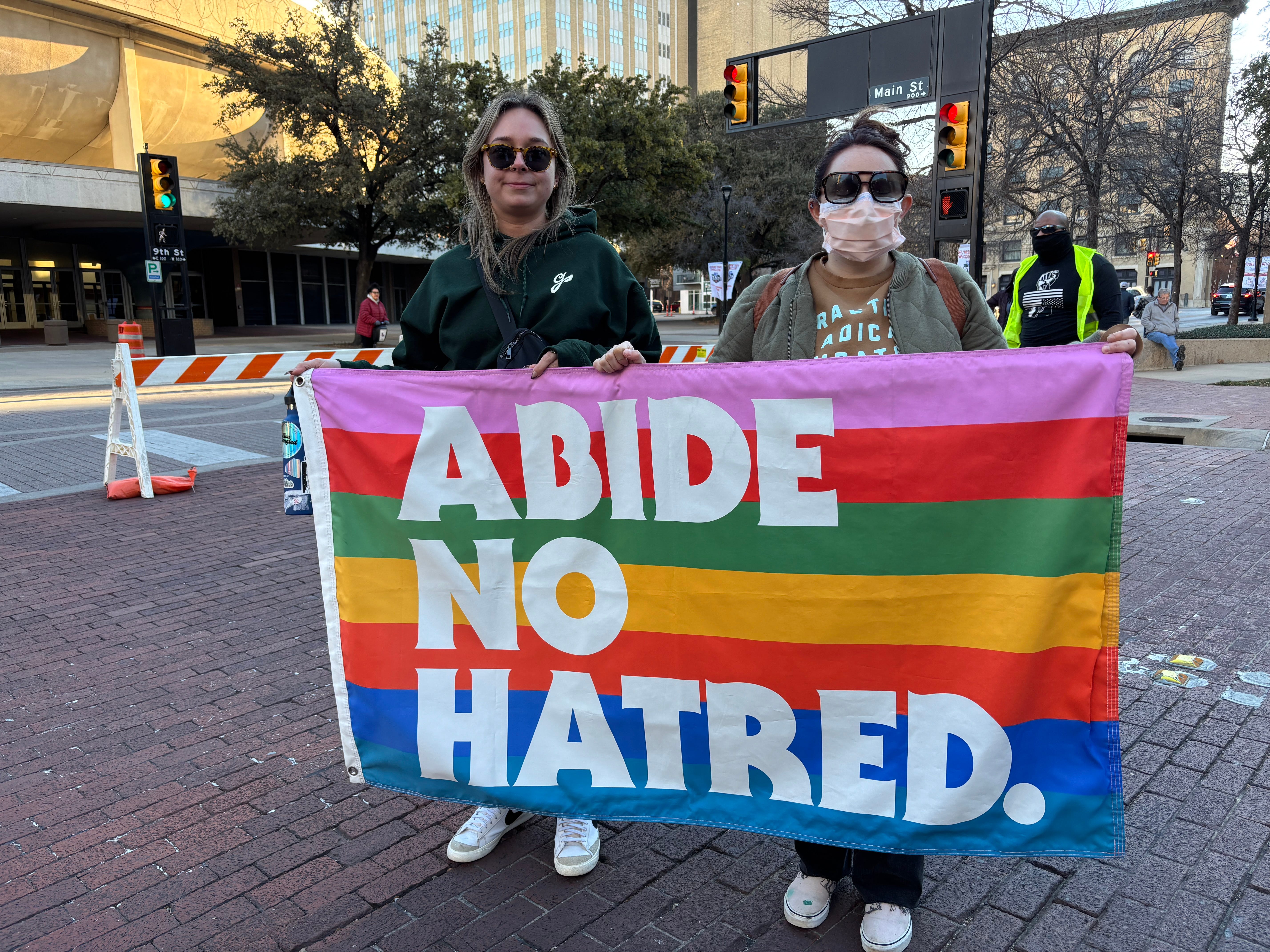
ICE Out of Fort Worth, 1/10/26 (participants agreed to be photographed)
Holding on to ourselves is important during an extended crisis like this. When doom scrolling or ruminating about these problems, I can work on coming back to the “center” of who I am. If I feel lost or numb, the thing to do is to come back to myself. Find a way to step out of what is pulling at me and remember who I am.
Wendell Berry describes this sort of thing in The Peace of Wild Things. He writes about what he does “when despair for the world grows in me.” He goes into nature, “where the wood drake rests in his beauty on the water.” He joins the birds, who are free from worrying about what will happen tomorrow, or in the next hour; they live in the present. And he is aware of the stars and their light, maybe not visible now, but their light will come. Such things free him.
Mindfulness offers a way to step away even if there is no physical refuge, no pond or tree or quiet room where we can go. The practice of mindfulness can give us an ability to let go of things and come back to the present moment with a greater acceptance, even when there is suffering in the present.
This is necessary in order for us to respond to the crisis in some sort of effective way. Taking care of ourselves – holding on to who we are – must happen in order for us to take care of each other the best we can and do whatever else will help. We know what happens when someone becomes saturated with fear or anger, or descends into numbness. That is not how we get through this.
When we feel lost, we work to bring ourselves back. That may be easier when we have a clearer picture of who we really are. Reading and reflecting on the items below might be helpful for that self-knowledge. I hope so.
How I spend my time in work, play, and with others
What I value and want to see happen in myself and for others
How I tend to understand others’ motives and reasons for what they do
How I cope with challenges, and how I recognize blessings
What gives purpose and meaning to the world – where I think it comes from
Who helps sustain me, and how I give back
Are there places that sustain me, and can they be re-visited
How are we doing? That’s a complicated, uncomfortable question. To a significant degree, we seem to be worried, dissatisfied, depressed, and isolated. A 2023 Surgeon General’s report notes that people feel “isolated, invisible, and insignificant.” People often remark that they “don’t have the bandwidth” to do something, meaning they don’t have the mental or emotional resources to think about something or take on a task. Such people are ordinarily capable and even resilient, but these days it’s all too much.
A Yale Medicine website talks about depression and suicidal thoughts among young people constituting a crisis, linking to a Centers for Disease Control report that has been removed by the Trump administration (the removal of trustworthy information being, in itself, emblematic of some of our troubles).
A Gallup poll early this year showed a continuing decline in the proportion of people in the U.S. who are very satisfied with how their personal lives are going. A recent American Psychiatric Association poll showed Americans anxious about current events, family safety, economics, their health, and other issues.
Why all this unhappiness? I cannot remember a time when we faced so many challenges. Even during the 1960s when the world seemed on the brink of nuclear war, I don’t remember things feeling like this. Maybe it’s because so many things seem to be falling apart in society and government, all at once. Maybe because grinding poverty and gold-inlaid greed have surpassed the Gilded Age in which people became obscenely wealthy at the expense of everyone else. Perhaps because we are continuing to wreck the climate while societies and governments struggle to even admit that it’s real.
“Polycrisis.” When you do a search for it, you find page after page of articles. There’s even a website devoted to understanding it. An article from a couple of years ago on the World Economic Forum describes it as multiple crises happening at once (like climate change, the Covid pandemic, loss of social cohesion, war in Ukraine and Russian expansionism, oligarchy, resurgent fascism) which can interact with each other producing an effect different from the sum of the separate crises.
What can we do? Each of us, individually, can make choices that will help, though the tasks seem overwhelming – beyond our “bandwidth.” What comes to my mind is a quote from Tolkien, an exchange between Gandalf and Frodo that (in the books, not the movies) occurs when Frodo is discovering that the fate of his world may hang on what he does with a supremely dangerous tool of the enemy:
“I wish it need not have happened in my time,” said Frodo.
“So do I,” said Gandalf, “and so do all who live to see such times. But that is not for them to decide. All we have to decide is what to do with the time that is given us.”
The Lord of the Rings: The Fellowship of the Ring, chapter 2
This is our time – the time that is given us. What can we do that might nudge us toward a better life and a better culture? Individually and as a society, what do we value and how do we show it in our lives? What ways of living do we choose, and does it align with our beliefs? I think we need to do more than vote people out (even that option seems to be in jeopardy) and get back to what we were doing. Instead, we need to think very purposefully about the kind of society we want to (re)build and the kinds of kids we want to raise. Can we relate to each other as thinking and feeling individuals worthy of the same dignity and compassion that we expect for ourselves? Does that extend to people of different genders, races, and other ways of sorting each other into “us” as opposed to “them”?
Can we relate to the Earth as more than a big-box store and a theme park? We insist on measuring economic health in terms of growth, so that we must pretend that we can never slow down in our extraction of material from the Earth in order to produce more “product” to sell. We pretend that growth can be unlimited, that if the trend line on the graph becomes flat, the economy is stagnant and the ponzi scheme might unravel. But we could dream of a sustainable way of making our living from each other and from the Earth. We could use the same creativity and intellect that we have expended on nuclear physics or computing technology. If we applied that effort to creating such an economy, surely something good would emerge.
But we could dream of such things only if we want to live more equitably, more in harmony with each other and with the planet. As long as we consider such things to be naive fantasies, nothing much will happen. If we are raised to believe that ruthless competition is the only way to survive, that other people are objects that can be useful or not, we will stay on our current path. If we have been taught that the land, water, air, and every living thing was divinely intended to be used and despoiled by us, we keep in motion a scheme that ultimately will run out, regardless of how we might use our technology to keep it going a while longer.
That seems to be the society we have created. Clear-eyed, remorseless competition and wealth creation because we cannot imagine an alternative in today’s world. More technology, machinery, and artificial intelligence as the only salvation from the messes we create. More of what Joanna Macy called the industrial growth society.
Joanna Macy was a teacher of Buddhism and Deep Ecology whose later writings describe what she called The Great Turning, in which we begin to turn away from the industrial growth society and build a culture that can sustain healthy societies and ecosystems. Her writing, and that of writers like Rebecca Solnit, offer a useful perspective on hope for us – what Macy called, in her book of the same name, Active Hope. It is not an optimism that says “it’s gonna be OK” and allows us to wait in passive expectation for things to get better. It is not something we have, but instead something we do. It is acknowledging the actions that are still possible and working to bring about change, even if it’s little by little. I strongly recommend her writings and her work that she called “The Work That Reconnects”.
This morning I walked at Sheri Capehart Nature Preserve for about 45 minutes, underneath a blue sky with the almost-full moon still floating up there, reminding us that we’re just objects in space. And so I remember; we’re on a big, round, blue planet, ever so gradually circling Brother Sun. And we can watch Sister Moon and almost detect her falling and rising as she circles us, mirroring some of the sunlight back to us in the middle of the night so that we won’t forget the day. Or in this case continuing to reflect the sun, framed in morning sunlight, because sometimes it’s better to shine than to go dark.
To shine seems easy and natural for Sister Moon, at least the way we understand it in terms of science. Does she sometimes struggle to do so, like we do? Maybe get up in the morning and say to herself, “I just can’t do this today.” If she is a barren sphere of rock and dust, then I suppose not. But we don’t have to reduce everything to such understanding. Native American wisdom recognizes the moon as a source of wisdom and guidance, and in the Haudenosaunee Thanksgiving Address she is the oldest grandmother, governing tides, watching over the arrival of children, and serving as a leader of women. In the Canticle of Brother Sun and Sister Moon of Saint Francis, the Earth and the heavens – all of nature – are precious gifts reflecting a wonderful Creator. And so in multiple wisdom traditions, the moon is more than what we can measure with instruments.
And she shines throughout the year. Even when our planet is so dark, when human hatred and fear threaten to extinguish every light, Sister Moon gives us light in the darkness. When masked, armed men kidnap the innocent and march zip-tied children into the cold, and when soldiers carry out genocide, she does what I often cannot do: continue to provide light, not be overwhelmed by the darkness.
I would like to be as constant as Sister Moon, but we are not made for such constancy. Being human means simultaneously holding on to the light, doing our best to shine, while also accepting how complicated and imperfect we are. There are times when climate catastrophe, cruelty, runaway greed – the various crises we are facing – temporarily rob us of light. Some days our faces do not reflect the light, even if we want to shine. The important thing is not to accept defeat, to let the light die. We still can imagine something better, we still recognize truth, and we still have within us compassion and empathy, even if some people have discarded it. Such things are our light, and we must let it illuminate us and all those around us.
The news is full of war, hatred, assassination, and cruelty. Right wing media, from what I can see, appears to be telling people that what we need is power, domination, and ruthlessness. Much of American Christianity is saying that empathy and compassion are weaknesses at a time when we need strength. Our neighbor, we might infer, is whoever is in our tribe and thinks like us. Everyone else is expendable or perhaps needs to be eliminated (by deportation or deadlier means).
The thing is that the world’s major religions disagree. Or – wait – the major teachings of major religions disagree, while the practices of their followers may not. The history of how religion has been expressed in different cultures contains plenty of hatred and murder, war, torture, and slavery. But what do you find in the teachings of Buddhism? You find compassion playing a major role, relief from suffering alongside not being held captive by possessions or attachment to the way things are. What do you find in Christianity, by which I mean the actual teachings of Jesus? Compassion, forgiveness, empathy, and love.
One of my heroes, the farmer, writer, and poet Wendell Berry, put together a small book on the subject of “Christ’s teachings about love, compassion, and forgiveness.” It is titled Blessed Are the Peacemakers, and it is in print and inexpensive. He wrote that in the U.S., Christianity seems to be fashionable, but “It seems to have remarkably little to do with the things that Jesus Christ actually taught.” He went on to write that “…I know of no Christian nation and no Christian leader from whose conduct the teachings of Christ could be inferred.” And so, he decided to put together this little book containing Gospel passages in which Jesus addressed issues of “human strife, forgiveness, compassion, and peacemaking.” It’s a good antidote for those politicians who paint a portrait of Jesus as a Proud Boy, storming the Capital and proclaiming white supremacy.
Similarly, the books of Thich Nhat Hanh spell out the wisdom of the Buddhist tradition. He was born in Vietnam and became a Buddhist monk, then went on to teach at Columbia and Princeton, to write numerous books, and work tirelessly for peace. In Peace is Every Step, he wrote that, “Real strength is not in power, money, or weapons, but in deep, inner peace.” In The Art of Living, he wrote about mindfulness, the ways we are connected with everything around us, and the importance of transforming pain and suffering.
What does science have to say about these things that I’m claiming are essential for our humanity? One place to look is in the work of Dr. Bruce Perry, a child psychiatrist who knows a thing or two about love and connection, and what damage trauma and neglect can do. Using neuroscience and our understanding of human attachment relationships, he writes (in The Boy Who Was Raised as a Dog) that humans “…could never have survived without deeply interconnected and interdependent human contact. The truth is, you cannot love yourself unless you have been loved and are loved. The capacity to love cannot be built in isolation.” He goes on to write about love and empathy in Born for Love: Why Empathy Is Essential-and Endangered. As a retired psychological associate, it troubles me to see popular culture asserting that empathy is a defect, and this book is an excellent answer to that claim. We need each other. The ideal of the tough guy who is entirely self-reliant is not a healthy model for raising children. It typically results in adults whose idea of love is more like transaction and manipulation.
Like many people, I look at what our popular culture and right-wing politics is promoting and I fear for how the future will go. Fear, but not despair – not yet. For my brothers and sisters who feel like they are bystanders to the world’s death spiral, I suggest reading Rebecca Solnit (titles like Hope in the Dark) as well as Joanna Macy (for example, Coming Back to Life, with Molly Brown).
What does all this have to do with Our Lives in Nature, the title and theme of this blog? It is all related; how we see ourselves shapes our relationship with the Earth, how we treat each other and how we treat nature are intimately related.