There has never been a day without transitions. The deepest and darkest blue in the sky lightens toward dawn. Birds awaken and add their song to the pre-dawn quiet. Clouds become visible, gray and then pale orange and rose, and finally white. Night becomes day.
Somewhere in there, we awaken. Dreams give way to the waking world. Rest gives way to activity – stretching, making breakfast, and everything else. Preparing for another day that I hope contains possibilities for good things, though I know that for some, the preparation is touched with a little numbness or dread.
The world around us is full of transitions. Recently, cicadas have been emerging from the ground, crawling up the trees and walls, emerging from the outer skeletons that contained their earthbound forms and flying to a nearby tree canopy. During their short adult lives, the soundtrack of summer afternoons is their rattling buzz, sometimes rising to a continuous call for as many as thirty seconds or with a loud pulsing buzz. The nymph that lived for years underground is suddenly a winged adult that will die within a month.
Our human development never seems as sudden or strange. It doesn’t involve crawling out of our skin and flying away, as shocking as some teenage transitions might seem.
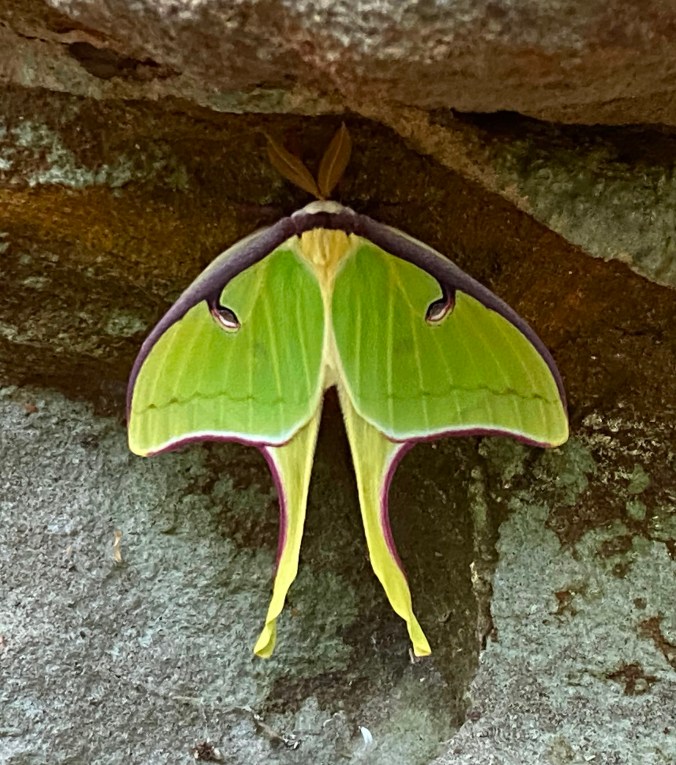
Transitions happen over time. Our perception of time feels to us like something universal, the same for a mountain or a mayfly. A minute is short, and a year is a very long time. We imagine that the week-long lifespan of the beautiful adult luna moth must seem, to the moth, to be over almost before it began. For that moth, maybe the few days spent flying, avoiding predators, finding a mate, and laying eggs seems like a full life. Just as we feel that living for 80 years is a chance at a full life.
And yet, to the 4,853-year-old bristlecone pine in California our lives might seem tragically short. We might want to consider that a minute is our own arbitrary unit of time, experienced very differently according to different lives. Do bristlecone pines have their own minutes?
So, transitions happen to every living and nonliving thing, quick or slow, welcome or resisted, overwhelming or able to be taken in stride. Experienced on a time scale that might be different from one life to another.
Does that perspective offer anything to us when the ground slips away and we have to adapt? I don’t know. Maybe it helps to know that the task of adapting to change is something we share with every other life in the world.
Discover more from Our Lives in Nature
Subscribe to get the latest posts sent to your email.

