Yesterday we found several golden orange jack o’ lanterns in the woods, though it’s been a month since Halloween. There were no carved faces, just smooth clumps of orange. My young friend was delighted to find all these mushrooms, just as he was with all the mosses growing in the woodlands. And I was, in turn, delighted to watch his excited discovery of these small wonders.

The “southern jack o’ lantern” is a large mushroom that grows from wood, often in clusters at a fallen tree limb or at the base of a tree. They’re common from summer through autumn at Sheri Capehart Nature Preserve, which is where we were. It has been very dry from late summer through much of autumn, but now that rains have come, orange mushrooms are popping up.
A Missouri Department of Conservation website says that the southern jack o’ lantern is bioluminescent, so that “the gills of fresh specimens may sometimes give off a faint greenish glow at night or in a darkened room.” It would be fun to return at night and see if we could observe that.
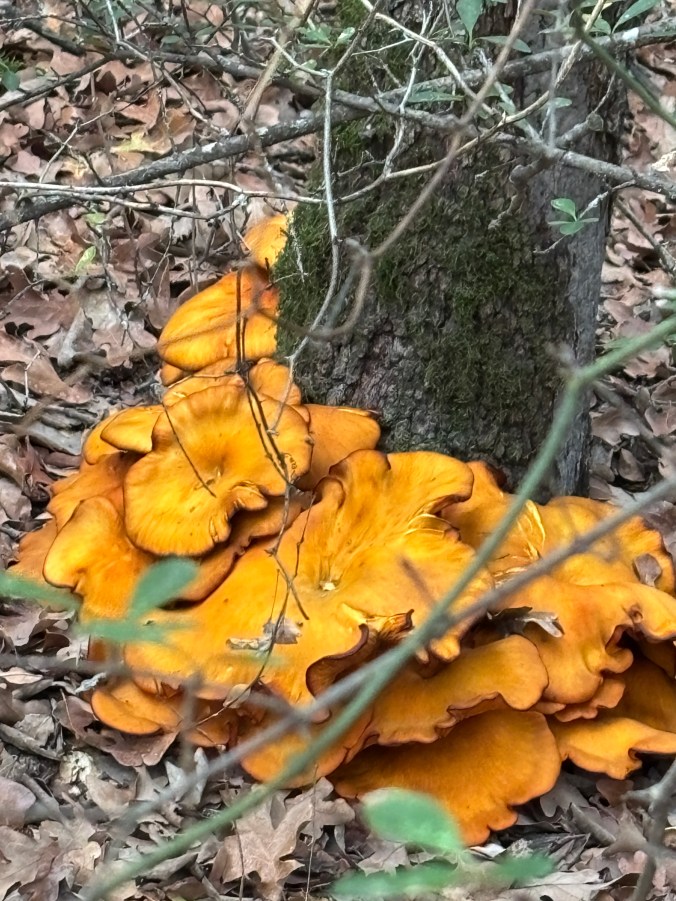
We are used to seeing a plant or animal that we can point to, whose body or structure is gathered together in one place as one “thing.” However, with fungi it’s more complicated. For much of the year, the jack o’ lantern is a network of tiny filaments and threads running through soil and decaying wood – the mycelium. If I said, “show me a jack o’ lantern,” you would have to dig in the soil or turn over a rotting log to find those little fungal threads and say, “well, there’s part of one.” The mushroom itself is just the reproductive structure, producing spores that are almost (not quite) like seeds that will grow tissues that will become a new fungus. So a mushroom is a little like a flower – the part that catches our attention but is only the reproductive part of a larger organism.
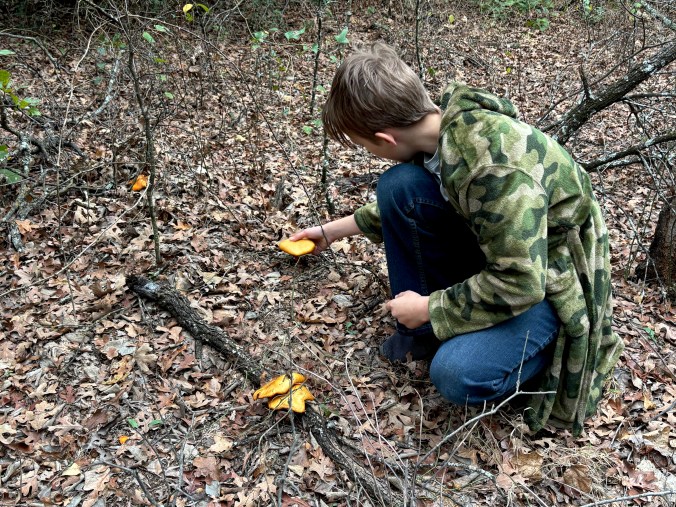
Logan wanted to know if it was edible, so I looked it up using iNaturalist and found that it is poisonous. Not like a death cap mushroom that might be fatal, but the jack o’ lantern would give you the sort of upset stomach that one website said might “make you wish you were dead.” Definitely a mushroom to admire just where it is.
The other thing that really captured Logan’s imagination were the mosses. These little soft, green mounds growing along the ground in protected places can bring many of us into miniature worlds, sitting beside a butterfly and drinking from an acorn cup. They are plants, but without true roots and without the little tubes (vascular tissue) that flowers and trees use to move fluid and sap around. And so they must grow in short, compact mats or mounds. In shady places, an oak tree may grow a garden of moss along one of its bigger branches or at the base of the trunk. At the preserve, the sandstone at the bluff can also provide good growing conditions. The porous rock can hold moisture and is easy for moss to anchor itself to.
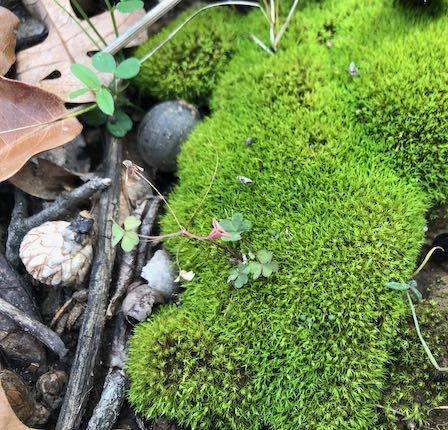
Mosses can survive periods of drought to an amazing degree, seeming to spring back to life after a rain. At the top of the preserve there are many partially-shaded places where mosses grow. In the heat of summer, especially when it is quite dry, they become dark green crusts along the rocks, waiting for rain. Then, the plant’s cells fill with fluid and they become green and springy.
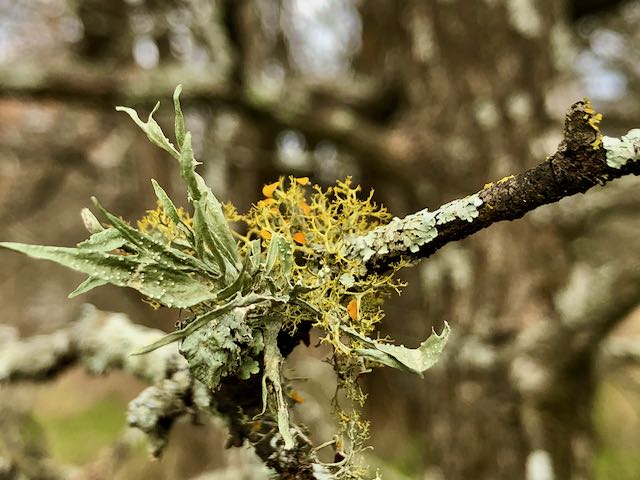
Another small growing thing that can produce a sort of miniature garden is lichen. Dead oak branches provide a great substrate for lichen to grow, either as the greenish- or bluish-gray foliose lichens that cover the surface in a ruffled coating, or else as little shrub-like fruticose lichens. One of the latter, the golden-eye lichen, is a favorite of mine.
Lichens are not plants. They are partnerships between two things. Not just a fungus, and not just an alga, but the two things fused together (or sometimes a fungus and a cyanobacterium). The fungus provides a structure and anchors the partners to a rock, a branch of wood, or other suitable place. The algae provide a means to manufacture food via photosynthesis. Together, they can survive sun, drought, freezing, and keep on going.
Regardless of the biological details, these living things add wonder to a walk in the woods. To pause and get on the same level as a moss or mushroom shifts our focus from the everyday world down to a small scale and we see everything in new ways. The details of leaves and the texture of moss, or drops of dew like tiny crystal orbs on the strands of a spider’s web, these things can transport our imagination to new places. It was wonderful to watch Logan find each new patch of moss and each new mushroom with that sense of delight. It was a little like what I see when I take my granddaughter to such places; the emotion and fascination isn’t tied to a particular age (you might see it in me if we took a walk together).
Experiencing nature in this way with children is just the best. It can be a window back into our own childhood, or the childhood we would wish for our younger selves or for others. It is also a hopeful sign for our future, that children can still find magic and connection in nature. And if they carry that forward, we might protect wild places and heal some of the Earth’s hurts.


 Our Lives In Nature