The morning of July 25 was very mild compared to the afternoon’s heat. It was a great morning for a group of about 14 kids and several adults to take a walk in the wildscape of a local Montessori school. I hoped that these mostly fourth through sixth-graders were ready to playfully explore the nature of their wildscape, and they were more than ready.
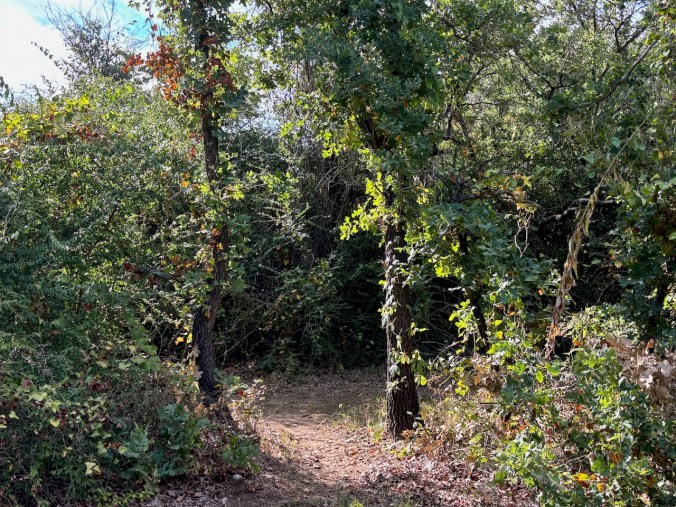
Like a gateway – to Terabithia?
They knew the place better than Marylee and me. We were nominally in charge of leading the group and teaching about nature, but these kids would have been happy to have led the get-acquainted walk. They, or their predecessors at the school, had named the places within it: the Dark Forest, the Ranger Circle, Maria’s Meadow, and other spots within this little fragment of Eastern Cross Timbers woodland and prairie.
It’s such good news that the kids had named it and made it their own, that their school had this delightful patch of wildness and let each new group of kids belong in it and get to know it. So our role would be to help them get more deeply familiar with it, more acquainted with the lives that live there.
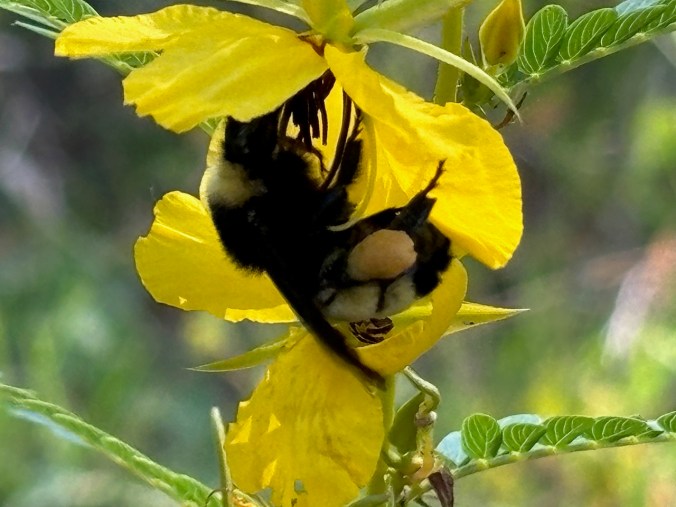
An American Bumblebee, feeding from a Partridge Pea
More acquainted with the bumblebees, for example. When everyone gathered in a circle around the old stump and we talked about likes and fears in nature, the dislikes were primarily spiders, snakes, and bees (which closely mirrors the things in nature that most nature fears are focused on). So when the group came to some flowering Partridge Pea that a bumblebee was feeding on, we didn’t pull back. We also, of course, did not swat at or otherwise make the bee feel that it was under attack. Any doubters might have seen that the bumblebee ignored us, even though I was pretty close.
This is an adult funnel-weaving spider, seen at Sheri Capehart Nature Preserve. They are all just as shy as the little one we found on our walk, and if one were to bite us, the bite is not medically significant.
Speaking of spiders, we came upon a small one in the low branches of a bush, within her web. One of the kids suggested that it was probably a wolf spider, and I agreed that the overall look was kind of like one of those. But, I commented, wolf spiders don’t trap prey with webs, they just chase down what they eat. This one’s body and web made me think of a young funnel-weaving spider, and just as I pointed toward where I thought her funnel was, she quickly scuttled down the hole made by her web.
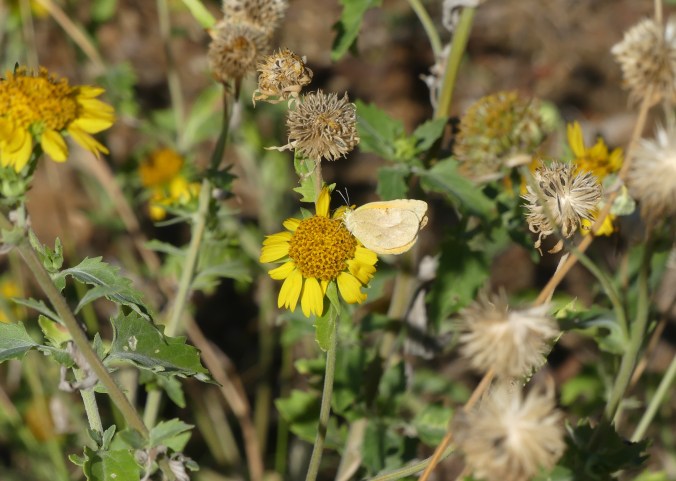
We found and heard a lot that everyone could appreciate without overcoming a fear or aversion that they had been carrying. Bird song – especially from Northern Cardinals – rang out through the woods, and plenty of plants were still flowering. We found a butterfly and one of the boys looked for the extension of the hindwing that would make it some kind of swallowtail. (I noted to myself, “they know about swallowtails, how wonderful!”) It was a Gulf Fritillary, and when I asked if butterflies like this benefit us in some way, the kids quickly answered, “they’re pollinators!”
Did I mention that it was a real treat to be with these kids?
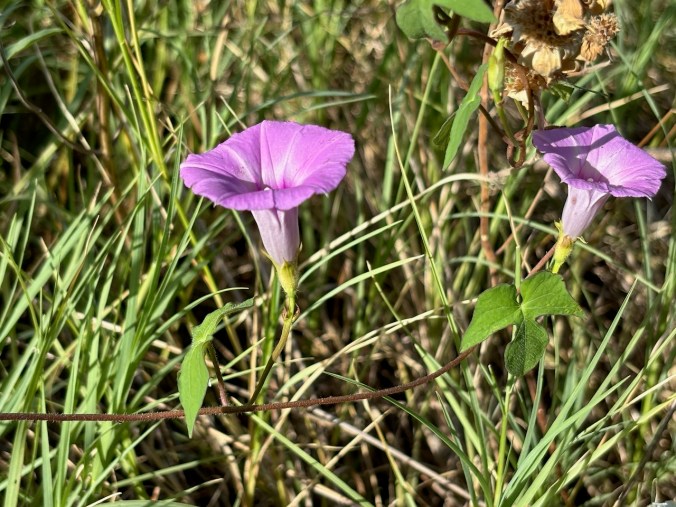
Flowers of Tievine, a type of Morning Glory, seen in the prairie patch
As we walked down the trail, I saw a telltale squiggle in the short grass at my feet. It was familiar enough that I dropped down immediately and tried to gently pin this little lizard so that we could have a look and then release him or her. It was a small Little Brown Skink. They already live up to the name – they are little and they are a coppery, two-tone brown, and this was a young one. I had it pinned briefly but could not get to where I could pick it up without risking breaking off the tail. And so it got away.
And that raises an interesting question: how much interference with nature is acceptable in a discovery walk such as this? It was important to me not to accidentally make the lizard lose its tail, but is it OK to catch wildlife? There is a kind of hierarchy of permissibility regarding what you can catch and handle. It runs up and down the phylogenetic ladder. We wouldn’t catch mammals, or birds like those Northern Cardinals. But starting with reptiles and amphibians and continuing through fish and then insects, it seems alright to most people. Catching frogs and bugs seems normal. And maybe that’s because many of them are harder to get a good look at unless we catch them. Frogs hop away, and so do grasshoppers. Also, briefly capturing them or scooping them up in a net can be pretty easy much of the time.
I wanted the kids to see the lizard I was talking about, but being captured is stressful. I make the assumption that briefly capturing such an animal for the sake of teaching, and then immediately releasing it unharmed, is completely fine. We want to teach kids compassion and respect for the lives they find out here (and anywhere), and so I’m open to revisiting and re-thinking this question.
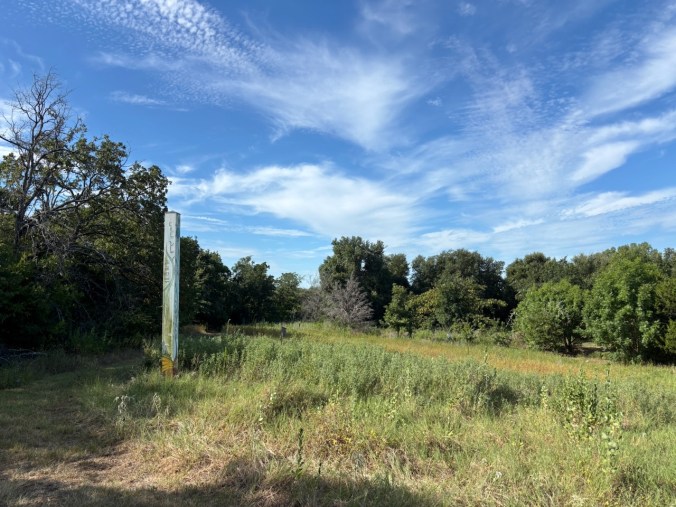
The Prairie
In a world in which most kids can recognize far more fast food logos than wildlife or plants, it was wonderful to be with these kids, who said at the end that they want to do more of it. It looks like Marylee and I will lead walks here about every four to eight weeks in the coming school year. We will get to know the wildscape through the seasons, and I look forward to all the discoveries we will make.
My interest in nature has been dominated by reptiles and amphibians (herps) starting when I was nine or ten and the girl across the street invited me to come along and find garter snakes in Colorado. I was active in herpetological societies twenty-five years ago and I’ve been teaching incoming Master Naturalists about these animals for some years. I’m interested in the “big picture” of ecology and natural history, but herps are still an important focus.
Herp conservation is very important to me. If you’d like to learn more and support some important work, please check out the Amphibian and Reptile Conservancy and the Orianne Society, among other organizations (such as Texas’ own Texas Turtles). I’ll be giving talks about reptile and amphibian conservation in Texas over the next few months, and while preparing, I’ve added some species profiles to the downloadable pdf files on my herpetology page.
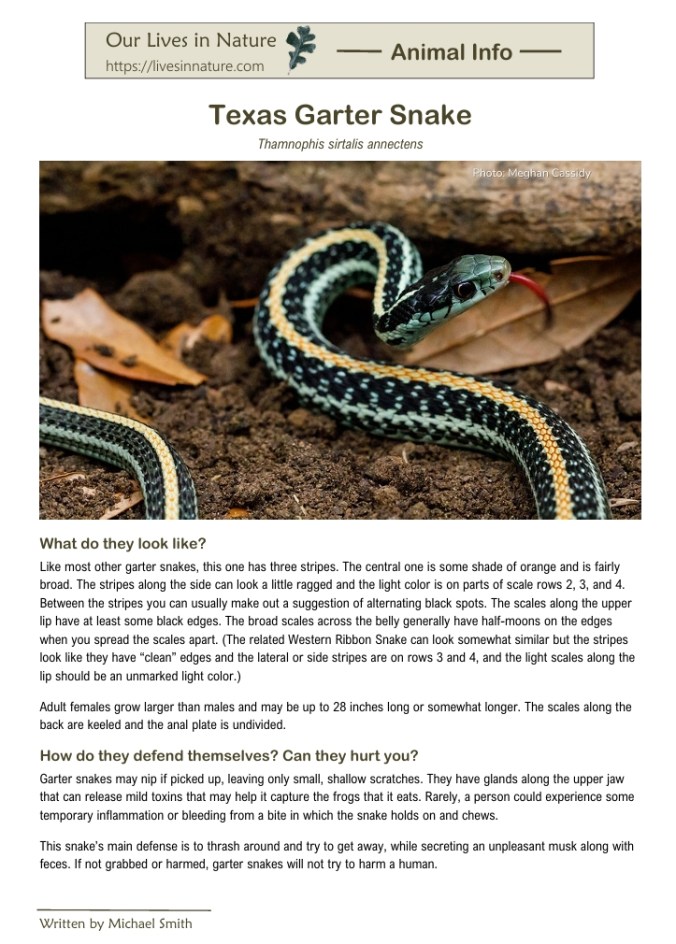
Among them is information about the Texas Garter Snake, a subspecies of the “Common” Garter Snake. Across the years, I have found a handful of Texas Garter Snakes, and they turn up occasionally on iNaturalist, but as far as I can tell they have never been common. There seemed to be particular spots or areas where they had viable populations, but even in those places a search for them was always hit-and-miss. That turned out to be the case in 2013 and 2014 when a group from UT Tyler started a project to investigate its genetics and preferred habitat. They did not find any, and had to rely on a few museum specimens in order to finish the project (published in The Southwestern Naturalist in 2019).
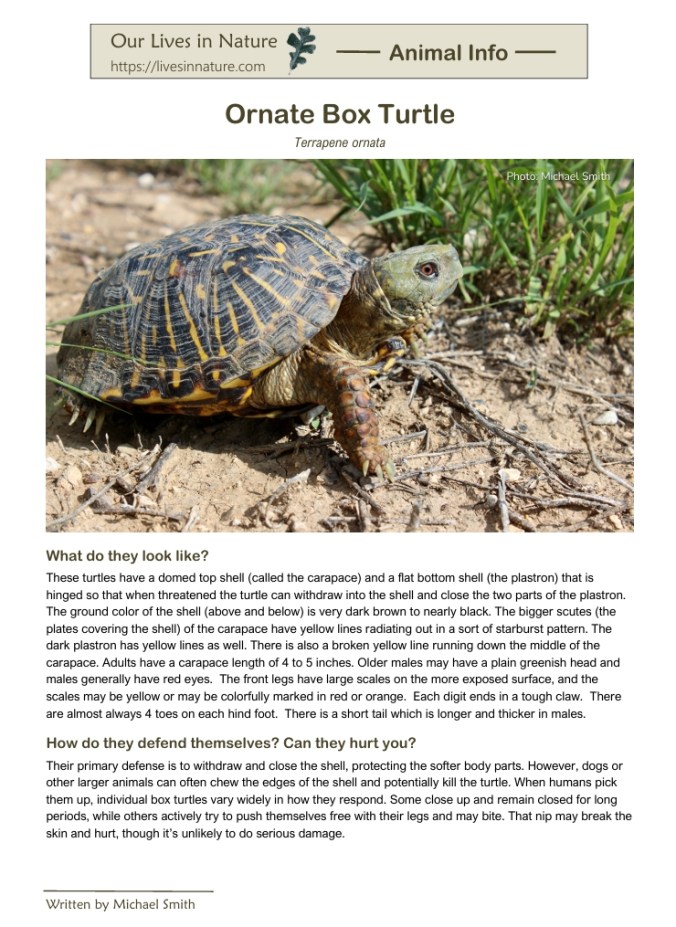
Another profile covers the Ornate Box Turtle. I have loved box turtles since I was a kid (and at least half of Texas would say the same thing, until they became uncommon enough that kids didn’t get many chances to see them). They have suffered from habitat loss and fragmentation, road mortality, and the unfortunate tendency of our species to want to collect and keep interesting and cute animals. In recent years, Texas protected box turtles from commercial collection. However, people still pick them up and take them home. Like turtles generally, their success depends on living long lives once they become adults. Collecting one is like running it over on the road – it is “dead” to the reproductive population of turtles.
And Texans of a certain age recall when the Texas Horned Lizard could be found in back yards and local parks. In the 1960s these places were often dotted with Harvester Ant colonies with a big bare circle of ground around the opening to the colony. These were the horned lizard’s food, and when people poisoned the ants (and later when the fire ants largely replaced them), there was nothing for horny toads to eat. Also in the 1960s, large numbers of these lizards were collected and shipped off to the pet trade where they inevitably died. But probably the biggest deal, according to Andy Gluesenkamp, was the loss and degradation of habitat. Native Texas prairies, with bunch grasses, open areas, ants, and the right combination of shelters and wildlife “neighbors,” were great for them. Monoculture pastures of non-native grasses, the increasing network of roads, the invasion of fire ants, and other factors have eliminated Texas Horned Lizards from many of the places where they used to be found. (Gluesenkamp led the San Antonio Zoo effort to captive breed and release young horned lizards in suitable habitat – an effort that is working.)
So far, the sole amphibian I’ve profiled is also one that biologists are concerned about. There is little real data concerning how Woodhouse’s Toad is doing, but it is the species that many of us used to see on spring and summer nights in North Texas. It has largely been replaced by the Gulf Coast Toad, but away from the cities there are places (like the LBJ National Grasslands) where Woodhouse’s Toad seems to be the predominate species. Overall, the species is considered secure, but are we sure? Wildlife agencies and universities have limited resources and cannot study everything. Everyday folks documenting what they see on iNaturalist help a great deal, but there are still enormous gaps in our knowledge of the status of most of our herps.
There are other species with these two-page downloadable pdf profiles, including the Texas (Western) Rat Snake, the Great Plains Rat Snake, the Long-nosed Snake, Rough Earth Snake, and Checkered Garter Snake. I hope you’ll use them to share with home schoolers, scout troops, or anyone else who would like them. I’d be happy if you’d like to leave a contribution, but if you can’t, that’s fine. And maybe leave me a note about anything else you’d like to see. Our venomous snakes are briefly summarized in my “Identification Guide to Venomous Snakes of North Central Texas,” found on the same page.
I enjoy writing to you, especially to kids who love nature or are curious about it. I’ve been writing these “Letters to Nature Kids” or “Letters to Nature Folks” for over three years. Sometimes I describe a particular walk or a kind of animal or plant I found, and always there’s some connection to something in nature.
As I sit in my back yard, there are birds in nearby trees, and their songs are complex and beautiful together. Repeated notes, rising and falling whistles and whirring trills. They seem to be in the Sweetgum and Pine trees here, as the branches gently sway in the morning sun.
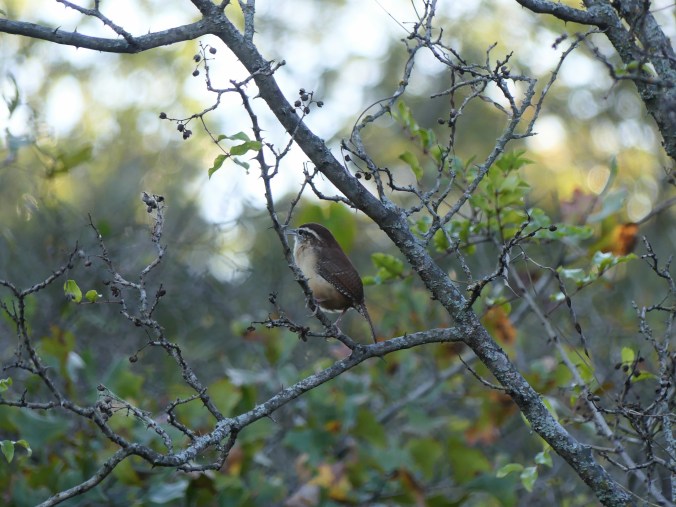
Merlin, the bird identification app, identified them as a Northern Cardinal and a Bewick’s and a Carolina Wren. Meanwhile somewhere there is a Carolina Chickadee and a Blue Jay. After a short time, the nearby birds have gone quiet. Was it just a brief stopover? Or have they finished saying what they had to say? What were they communicating, and to whom? Inviting someone in, or maybe telling someone to stay away?
A Wren at nearby Sheri Capehart Nature Preserve
We tend to think that birds sing from pure joy at being alive on a quiet sunny morning like this. People who study birds say that they’re mostly inviting a potential mate in or claiming some spot as theirs and telling others to stay away. But that doesn’t mean there’s no joy in it. Perhaps there’s a gratitude for being alive that feeds the impulse to find mates and claim their place in the woods and fields.
There’s also joy in my sharing what I find and what the Earth teaches me when I’m in wild places (and places that are just a little bit wild). If I can share that with you and encourage you to go see for yourself, I imagine that there would be smiles on both of our faces. And that’s the reason for these letters.
Two kids in particular have given lots of happiness and have played a part in these letters: Eli and Lilly. My granddaughter is too young to read letters, but maybe she will do so someday. She might read this letter about our visit to the Fort Worth Nature Center on November 5, 2024:
On a beautiful early November day, Lilly and I went to see bison and butterflies. When we climbed the ramp up onto the bison viewing deck, she noticed some bison that were eating grass and others that looked like they were napping. We had a snack in the shade of the oak trees up on that platform while the bison snacked on grasses below.
American Bison at Fort Worth Nature Center & Refuge
Is it “bison,” or “buffalo”? What some people call a buffalo in North America is really the American Bison. But if you call them buffalo, everyone will probably understand you. If you are interested, I wrote about bison and that viewing deck Lilly and I were standing on for Green Source DFW.
When we were back on the ground, Lilly loved seeing caterpillars making their way across the ground, “going home,” she figured. We watched small butterflies feeding on yellow wildflowers, and she gently touched one of them. Her delight in finding these small things made me feel some of the same delight.
Lilly, on the bison deck
She and I have gone on a number of these “adventure walks,” starting shortly after her second birthday. Now, with her fourth birthday coming up, we took this walk at Fort Worth Nature Center & Refuge (FWNCR). She has climbed onto boulders – small ones – at Sheri Capehart Nature Preserve and Oliver Nature Park and admired a harmless DeKay’s Brown Snake at FWNCR. She is fearless, curious, and gentle, three wonderful things to be.
Being together and sharing experiences of joy and discovery – those times are very important. You may have noticed that happiness grows even bigger when it is shared. What are some things that bring you joy? Maybe they are beautiful places, music, things that grab your attention, or put you at peace. Do you share those things with people that you love?
One of the butterflies that we saw
You and I both know that not everyone likes the same things, so we might offer to share something and the other person is not interested. That’s OK, you may find other things that you both like. But if you love nature, I hope you will find someone who is eager to go on an adventure walk with you.
In April of 2020 when he was six, I took Elijah (who is more family than friend) to my favorite creek. We waded in the clear water and noticed mosquitofish and shiners. The mosquitofish swam in little groups at the surface of the water, and shiners took off with a flash of silver scales. In later walks we have found turtles, cricket frogs, and many wonderful things (see the Letters to Nature Kids in January of 2022).
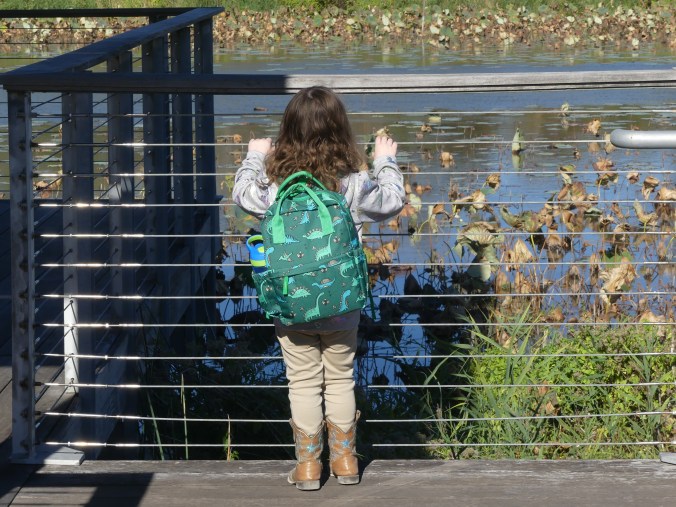
Lilly at the marsh boardwalk
After seeing the bison, Lilly and I went to the marsh boardwalk. A marsh is a place with fairly shallow water and plants that grow out of that water. This one is a lotus marsh, with many big round lotus leaves. It’s getting toward late autumn, and so lots of the leaves are turning brown.
That was a really wonderful walk. And at other times, I lead walks at Sheri Capehart Nature Preserve. Almost everyone on those walks is an adult and most are people I have just met, but sharing nature still brings joy. I suppose each one is an “adventure walk,” although adults don’t give them that name. But each of them is a kind of adventure, because we never know what we will see. And if we are lucky, we can see what we find as if it is a new discovery – even if it is a dragonfly we know well or a Carolina Chickadee we have heard many times before.
I hope you can go on a walk or two, somewhere a little bit wild. Find someone you can share some of those walks with!
An article at a UC Berkeley website reports that “We are currently losing species hundreds or thousands of times faster than normal background extinction rates. If this continues, Earth’s biodiversity will plummet.” And biodiversity is a big deal, supporting the healthy functioning of the Earth. Animals, plants, bacteria, fungi, bryophytes – all these lives are interrelated, creating complex systems that keep the Earth going. The way the survival of every species is related to the well-being of the rest makes ecosystems resemble very complicated jenga games. You can remove a few pieces and the structure still stands, but it gets progressively more unstable. It could reach a tipping point in which further species loss brings whole ecosystems down.
Slowing the rates of extinction and leaving ecosystems in greater health will depend on us. Among the things we can do is to recognize which species are in trouble and take actions to conserve them. How do we encourage those things? How do we get enough people to care what happens so that they help fund conservation efforts and agree to limit some of the extraction and development so that species can survive?
An important insight from Senegalese conservationist Baba Dioum is:
“In the end we will conserve only what we love, we will love only what we understand, and we will understand only what we are taught.”
We conserve what we love. And it is easier for us to love some species than others. Part of our biological inheritance is that we are drawn to such things as big, expressive eyes, soft sounds and soft touch. And so we want to pick up and cuddle babies, we make cooing noises back to them and describe them as cute. (I don’t want to reduce the love of babies and children solely to genetic wiring, but the wiring helps.) And that response is usually extended at least a little toward cute puppies and kittens. And to baby tigers and bears, wolves and other furry, expressive animals.
Animals with strange faces, fixed expressions, and unusual body forms don’t pull us in so much, unless they are beautiful to look at or hear. A Monarch butterfly doesn’t have a face a human mother would love, but its beautiful wings and flight win our affection. Bird faces are less expressive than those of puppies, but many of us associate wings and flight with such spiritually uplifting things as heaven and angels. And there’s the beauty of their feathers and songs as well.
Reptiles and amphibians are a harder sell. For most people, they are among the less-charismatic animals to worry about and go out of our way to protect. In a world of soft and furry animals like ocelots and wolves with their expressive faces, can turtles or frogs pull at our hearts? Could the handsome colors and patterns of a Louisiana Pinesnake have a place in our affections alongside the lovely feathers of a Golden-cheeked Warbler? Could the nighttime calls of a Gray Treefrog have a place alongside the songs of Bewick’s Wren? For me, the answers are all “yes.” Part of the wonder of the natural world, and a key to its magic, is the diversity of forms, sounds, colors, and lives. Everything belongs. It’s the natural world’s equivalent of the way some of us talk about human inclusion: “Y’all means all.”
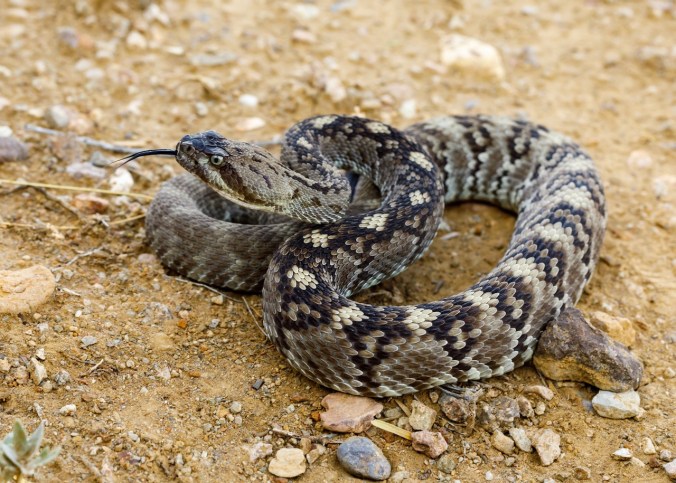
A black-tailed rattlesnake, whose very different face and body form, not to mention being venomous, might make it harder to see its beauty (photo by Meghan Cassidy)
It is important to consider why all of this matters, and why “y’all” should be interpreted so broadly. Everything matters because of that ecosystem jenga game mentioned earlier. And what about the tangible benefits that many species provide for us?
We are accustomed to environmentalists citing the many ecosystem services that various species provide, including cleansing the water and air, providing food, controlling agricultural pests and pollinating crops, breaking down the tissues of things after they die and returning nutrients to the soil, making new medicines possible, and so on. I’m grateful for all those ecosystem services – glad that the Earth and all those living things take care of us. The problem is when we take and do not give back, when we place ourselves at the center of everything. Believing that everything revolves around us is part of how the Earth got into so much trouble. We matter; humans are a part of all that glorious biodiversity, but the rest of the Earth matters, too, even when we don’t seem to get anything out of it.
The old story tells us that the Earth was given to us to use as we wish. That story led most of us into a relationship with the world in which we are the shopper and the Earth is the store as well as the sewer. We are the owners and the planet is our house, to be remade as we would like it. But there are other stories, other wisdom. We might find truth in the ones saying that all those other lives are our brothers and sisters, that we are all related such that when we treat others with respect and affection, we get a great deal in return. In that story, told by many Indigenous cultures, the world operates based on reciprocity and love, and when that breaks down, things fall apart. You can find a beautiful exploration of those ideas in Robin Wall Kimmerer’s recent book, The Serviceberry: Abundance and Reciprocity in the Natural World.
Those beloved, despised, ignored reptiles and amphibians provide beauty, pest control, medicines, and cultural meaning – and regardless of what they provide for us they have value. They are members and sometimes key players in communities of plants and animals. The great ecologist Aldo Leopold taught us that none of the members of ecosystems can be discarded:
“If the land mechanism as a whole is good, then every part is good, whether we understand it or not. If the biota, in the course of aeons, has built something we like but do not understand, then who but a fool would discard seemingly useless parts?” – Aldo Leopold, Round River
For those who see the world through a spiritual or religious lens, the quote carries the same wisdom. It changes only how we name the creator; substitute “God” or “Great Spirit” for “biota,” and discarding the parts still seems foolish and arrogant.
So if we conserve what we love, and we love what we understand, how do we bring about that understanding? It’s through experience and information, the teaching that Dioum mentioned. The more time I spend with rattlesnakes, for example, the more I am able to notice how they move through the world without malice (though their bite is dangerous if threatened), but rather with curiosity and skill. We increasingly read researchers’ accounts of problem-solving ability and maternal care. In Tracks and Shadows, herpetologist Harry Greene reports on observations of baby rattlesnakes staying with their mother, basking together, and retreating behind her if disturbed. Then, after their first shed skin, the babies disperse and mother finally has a chance to hunt for a meal (Pp.165-166). With information such as this together with my own field experience, I have plenty of respect for and caution around these animals, and also considerable affection.
It is not necessary to seek encounters with rattlesnakes or read extensively about them in order to support their continued existence. But some level of familiarity, some acquaintance with wildlife and nature is needed. The more we understand the lives around us and the places they depend on, perhaps the more we will understand the importance of the whole thing. We need to hear the stories and hopefully have firsthand experience with some of the hard-to-love, non-charismatic wildlife, showing us that they, too, have some of the qualities that stir our compassion and empathy.
Each generation of us takes a snapshot in time of the natural surroundings in which we live. What we experience is what is – for us – normal, and it feels like how things have always been. For those growing up in the last twenty years, road trips are not troubled to any great extent by bugs on the car windshield. You might assume that it has always been that way. Your grandpa has a picture from when he was a child, holding up a spikey little horny toad, the only one you’ve ever seen. Summers may involve outdoor fun some of the time, but for part of the summer the baking, searing heat is a gauntlet you run, from one air-conditioned place to the next. That’s just Texas, right? The night sky is hazy and yellowed, with a few stars, and the magic of fireflies twinkling on a summer night can be found in a child’s picture book, but not out your back door. The sound of airplanes, trucks, highways, and air conditioners is so ever-present that you barely notice, but if it all fell silent you might ask, “what’s wrong?” All of this is normal for twenty-year-old you.
If you have paid attention to conditions as you grew up, then when summers get hotter, nights lighter, every place noisier, and wildlife more missing in action, you will notice because it is “different from how it used to be.” Just like when those of us who grew up in the middle of the last century noticed how a quieter world got noisier, dark skies gray with stars less visible, summers became dangerously hot, and so on. Our world became the next generation’s world, and for that generation it was a new normal.
The way a changed world becomes the new normal for a new generation is described as “shifting baseline syndrome.” It was first described as it pertained to fisheries, where people with longer experience noticed declines while younger folks did not. As defined in a 2018 article in Frontiers in Ecology and the Environment, this is “a gradual change in the accepted norms for the condition of the natural environment due to a lack of human experience, memory and/or knowledge of its past condition.”
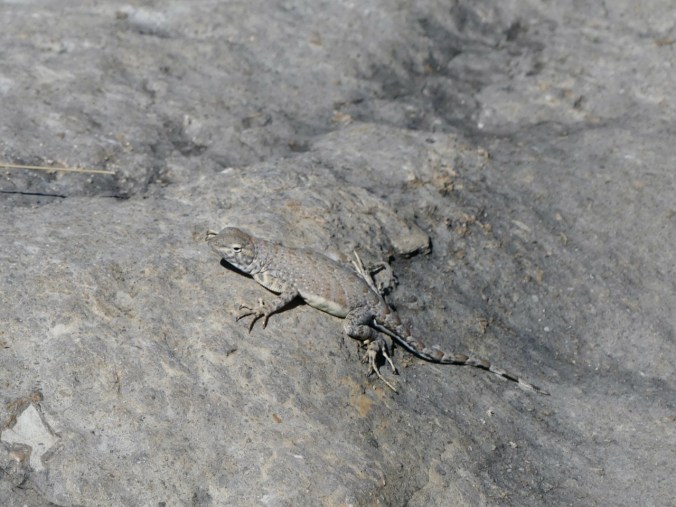
My baseline, what I considered normal in the 1950s-1960s, included lots of box turtles after summer rains and lots of small massasauga rattlesnakes at sunset on the road west of Benbrook. I explored a large creek throughout the summer, often feeling hot but never fearing heat stroke. Each visit to the creek included ribbon snakes, probably a couple of species of water snakes, and numerous other wildlife species. Spotted Whiptail lizards nervously poked around in exposed rocky areas. Baby softshell turtles turned up at the end of summer, and pale gray Greater Earless Lizards scampered over limestone rocks of the same color.
A Greater Earless Lizard, in a spot in Central Texas
I still visit that creek occasionally, and if eleven-year-old Elijah is with me, his perception of normal for Mary’s Creek will include almost none of these animals. His baseline perception of normal is mosquitofish and some shiners in the water, dragonflies here and there, a few spiders, and the occasional appearance of a cooter or slider turtle. That, for him, is the richness of Mary’s Creek.
That creek is a microcosm of the bigger world in which so much is getting lost. And losses in nature are among the many worries of the world. Our attention and energy can hardly keep up, and we are even more likely to be slowed in our conservation efforts if we don’t even know what we once had. If we could imagine the diversity and richness of an earlier time, clear water and air, the peace of a quiet day and the depth and mystery of a dark, starry night, perhaps we would fight twice as hard for those things. And that is a good reason for us to seek out the quiet places that remain, the places with dark skies, and locations that retain more wildness and richness, to know that more places in the world could (within the limits of a damaged climate) be that way once again. If we could rein in our development and extraction and be able to say, “enough, I don’t need more than this.” If we could walk humbly through the world and be members – not rulers – of it.
Shifting Baseline Syndrome is worsened by our retreat from nature. When children don’t play outside, when they, like their parents, spend their time indoors, and when birds and plants and wild places are strange and foreign to them. The child grows up and the young person matures with even less appreciation for what is lost over time.
Those who study this syndrome say that what is needed is more good data and more people involved in nature. Good data helps establish what we have, so we know when we are losing it. And when more people spend time in nature, learn to recognize various living things and more accurately see what we have around us, then future degradation will seem less normal and less acceptable. That is certainly a recommendation for community science and tools like iNaturalist that facilitate both of those things.
I’ll soon be planning to lead another “Know Your Nature Neighbors” walk at Sheri Capehart Nature Preserve in Arlington. Want to come along?
Yesterday I took a couple of friends to visit the LBJ National Grasslands (LBJNG). There was a little light rain as we walked around the pine trees and ponds, seeing a few frogs and toads. We wandered out onto the prairie at sunset, seeing some flowers that are a reminder, for a while, of the spring that has just passed. Some time ago, Kayla West and I led walks there regularly to introduce people to this amazing place, and we had a Facebook group for a while.
I’ve adapted some of what I wrote during that time, providing it here for those who may not have visited yet, to help you get acquainted and consider taking a walk there. You might also want to subscribe to Mary Curry’s blog, “Looking Out in North Texas,” in which she describes lots of ramblings in places like the National Grasslands and finding plants, fungi, mosses and lichens, and wildlife.
The LBJNG is located along the eastern edge of the Western Cross Timbers, which is an area where patches of prairie are mixed in with woodland (largely Post Oak and Blackjack Oak). You rarely walk very far in the oak woods without emerging into a little meadow or perhaps a large expanse of grassland. The grasses include Little Bluestem, Indiangrass, Switchgrass, and some other native species, some smaller ones like Sideoats Grama and big ones which, in some patches, stand above your head.
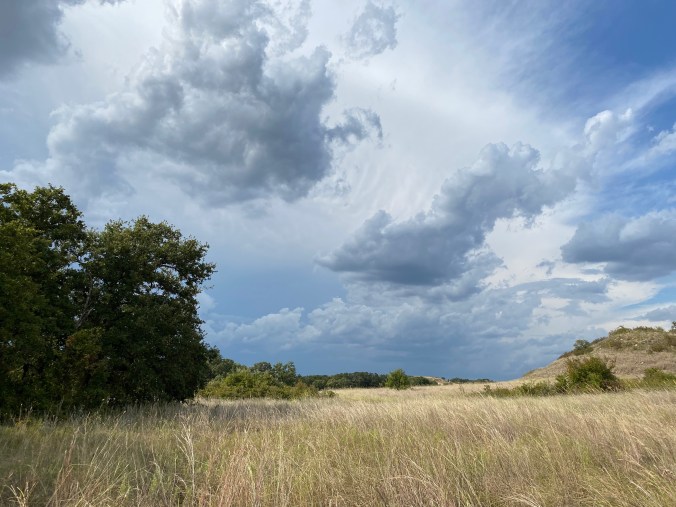
A prairie in Unit 71 with an oncoming afternoon storm
The soil and rock beneath it is largely Antlers Sand with some Walnut and Goodland formation limestone and clay (see “Geology of Wise County, Texas“). These geological features are from the Cretaceous period (roughly 145-65 million years ago). Walking the trails of LBJ National Grasslands, you come into contact with reddish sand and clay, or along ridges in southern units there is limestone filled with fossil oysters.
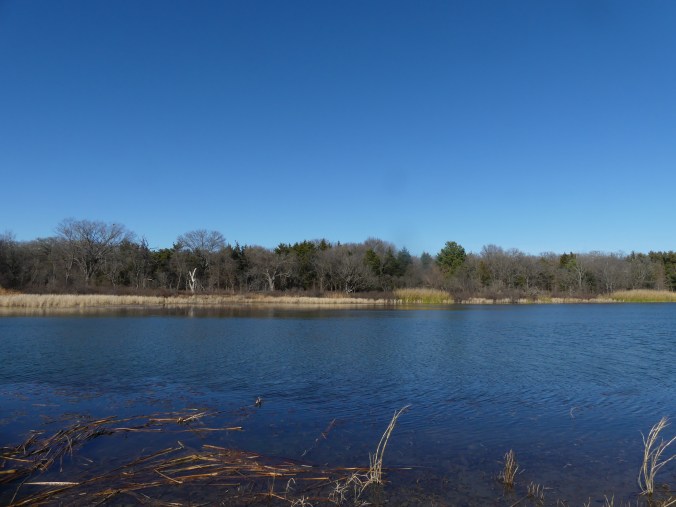
A winter view of Black Creek Lake
The grasslands are dotted with many small ponds, and many were created by people with the aim of reducing runoff and soil erosion as well as providing water for cattle. There are also several small lakes constructed for the same purpose as well as providing recreation. Those include Cottonwood Lake (about 40 acres in size), Black Creek Lake (about 30 acres), and Clear Lake (about 20 acres, with a small fishing pier).
In several spots within the grasslands there are areas dominated by Loblolly Pines. They are generally in areas of deep sand with one or more ponds and are popular with campers. Pine trees are not a typical part of the Cross Timbers plant communities, and we have been told by Forest Service staff that pine seedlings were brought to the area 40 or 50 years ago and planted. Today many of the trees have grown quite tall, and smaller trees and seedlings show that these pine groves are well-established and even expanding.
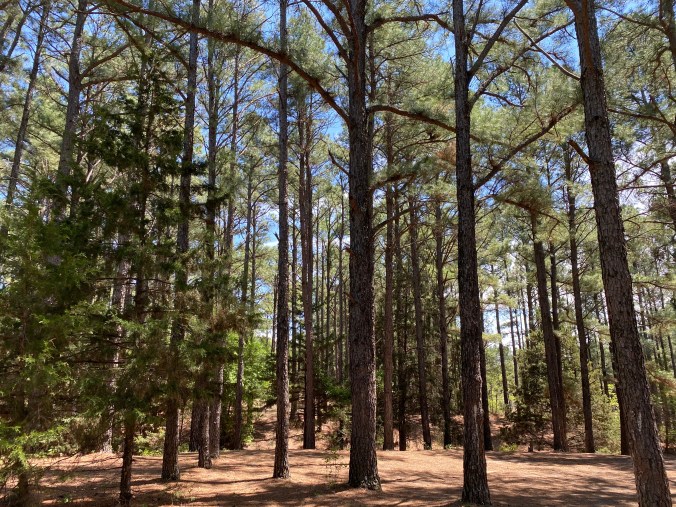
Pine grove in Unit 30
As delightful as the pine trees may be, there is nothing that compares with the prairies and their spring flowers or the native grasses in autumn, or the oak and juniper woodlands on a quiet autumn afternoon.
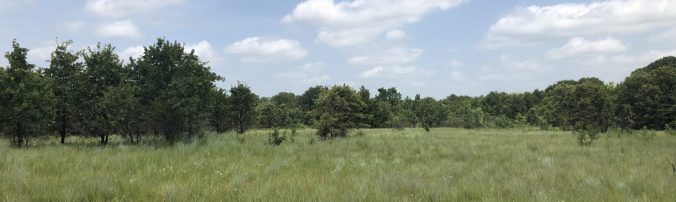
A spring meadow at LBJ National Grasslands
Visiting the Grasslands
From the Dallas-Fort Worth area, it’s a little drive to get there (somewhere in the neighborhood of 45 miles, depending). However, it’s one of the best nearby opportunities for some solitude and quiet that I know of, along with thousands of acres of oak woodlands, grasslands, and ponds.
Here is a basic map of the grasslands, showing the administrative units (in green), county roads, and many trails. A more detailed map of the major trails can be downloaded here.
Making Your Visit Great
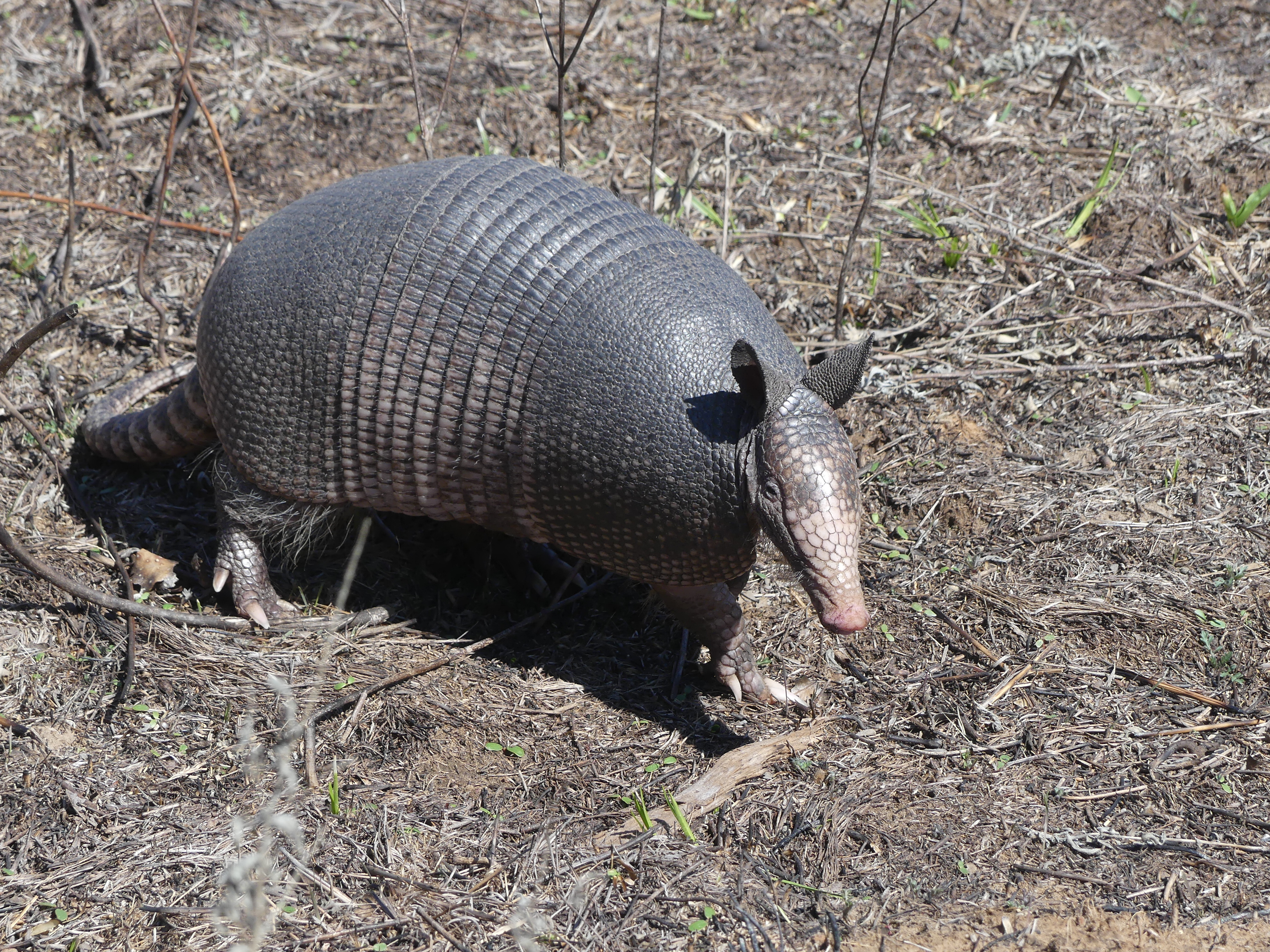
Before you walk the trails out there, ask yourself, “What do I want to get from this visit?” and also ask, “How can I be open to what the LBJNG offers?” Perhaps you are looking for beauty. You might want to see wildlife – birds or butterflies, Armadillos, Tiger Beetles, or a beautiful Rough Green Snake masquerading as a vine in the shrubs. You could sit in a pine grove and listen to breezes whispering in the treetops. You might keep walking to see the endless ways that prairie grasses, Post Oaks and Junipers can appear as you explore around the next bend of the trail.
An Armadillo seen during a winter walk
It also is helpful to be open to what a particular visit may offer. Things might be different than you expected, and if you can be flexible you might find that different can still be rewarding. Another way of being open is to widen your attention beyond what you expected or planned to receive. Become quiet and still for at least part of your visit. Be aware of everything around you, noticing sounds, smells, the feel of sunlight, water, and soil. As much as you can, let thoughts and worries go (you cannot stop your brain from coming up with thoughts, but you don’t have to hold onto them and let them take over). Such a practice of mindfulness can be a great way to visit any place in nature.
Leave some room to reflect on what the experience meant to you and, now that you have some connection with the grasslands, what that connection means. For some people, the opportunity to be away from the “built” world of cities, towns and crowds is like being rescued from chaos and recovering for a while. For others, the multitude of living things is some reassurance of life’s – or a creator’s – benevolence and creativity. Some of us see the grasslands as a sort of sanctuary we can share, and at the same time a place that needs our care and support in order to survive in the world.
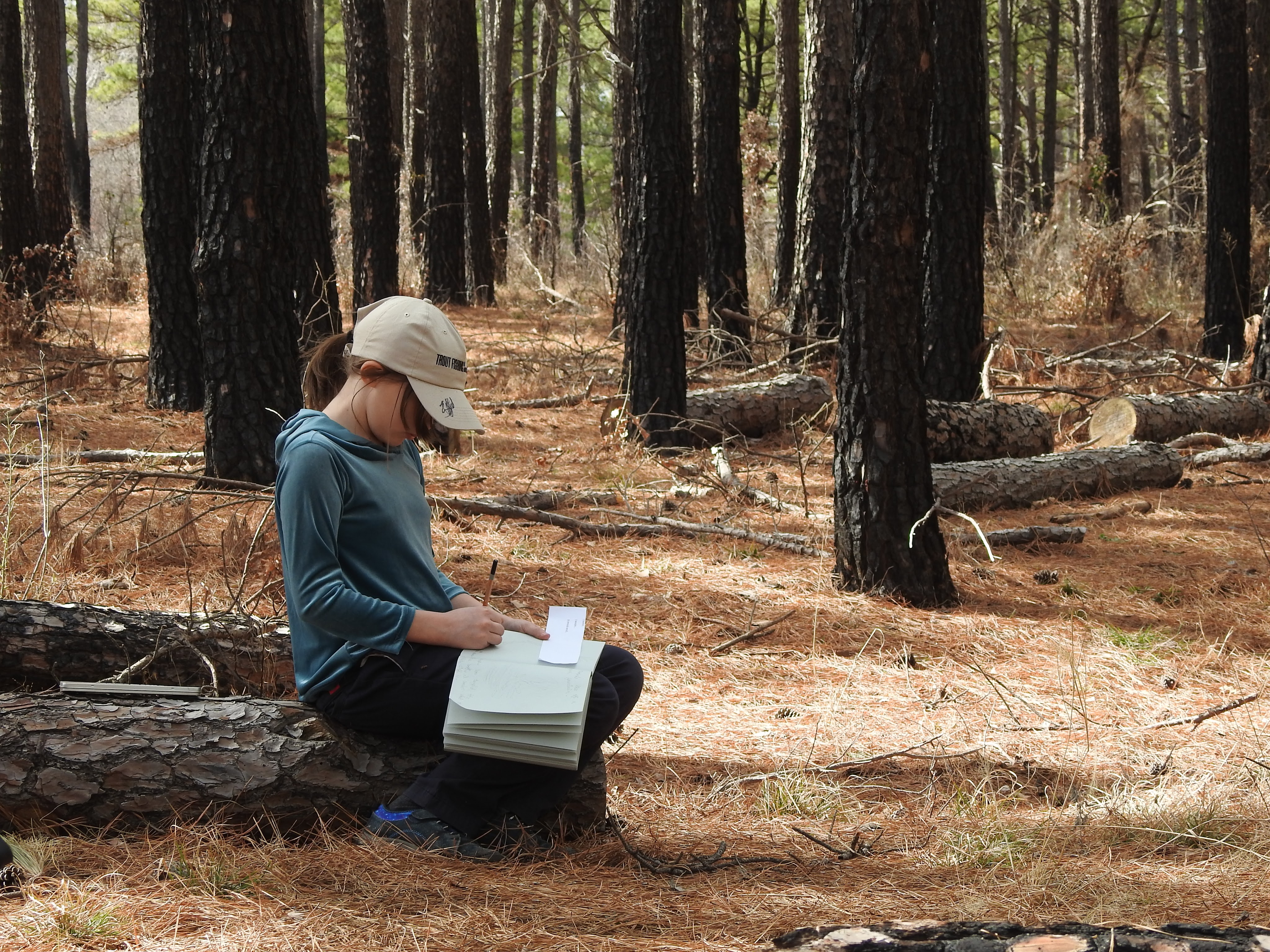
Even if the meaning of the grasslands is largely about a scientific list of species and their characteristics, I’d like to encourage you to write about it and draw things that catch your eye. I suggest carrying a notebook of some sort and stopping periodically to write and draw while you’re out there. This nature journaling will strengthen your memory of the day and give you a chance to reflect on what the place means to you.
Writing in a journal – in a session Kayla West and I taught at LBJNG
One way to write about your visit is to write a letter to the grasslands, as if the ponds, prairies and woodlands could read what you wrote. Maybe that sounds a little weird when you first consider it. However, when you write to somebody, you’re writing from within a relationship, and each person in the relationship has intentions and wishes to be considered. Kayla and I have led walks in which we suggested that participants write a “Dear Grasslands” letter, and the results were often personal and meaningful.
Taking Care of the Grasslands
All of us should take care that our visit does not harm the grasslands. We hope you’ll take a small bag with you to place any snack wrappers, disposable water bottles (get a non-disposable one!), or other trash so you can pack it out with you. And be very careful with fire, if you make a campfire. The Forest Service occasionally does prescribed burns to maintain the ecosystem, but the time and place of such burns are carefully planned. Clear the area around your fire and make sure there are no branches or shrubs close by – including above the fire. Then stay with the fire until every spark is out.
I hope you will leave things the way you found them. There is a role for legal hunting and fishing (especially for food) and scientific collection, and I think there’s no harm in taking a few samples of things like leaves, acorns, or empty mussel or snail shells.
Taking Care of Yourself
There are few dangers to worry about at LBJNG. Nevertheless, please pay careful attention to the following hazards:
Dehydration and heat illness. It is very easy to forget water at the start of a walk when you’re not thirsty. Please bring water with you, even on a winter walk. Additionally, in summer you can get overheated and dehydrated very easily. Read up on heat exhaustion, heat stroke and sunburn and bring water, a hat, and sunscreen.
Guns and archery equipment. People may be hunting in the area. For guns, the Forest Service rule is black powder hunting only, because buckshot is less likely than a bullet to travel far and injure someone at a greater distance. However, be aware that not everyone follows this rule (you occasionally find bullet casings). The Forest Service also forbids hunting in developed areas like campsites and within 150 yards of hiking/equestrian trails, but not all hunters know this. Hunters are, in most situations, required to wear fluorescent orange to make accidents less likely, and hikers are encouraged to do the same during hunting and archery season. Information from Texas Parks & Wildlife Department about hunting seasons can be found here.
Plants. Depending on the area, Prickly Pear and other cacti may be common. Greenbrier is a thorny vine that is common especially in the woodlands. The stiff, pointed leaves of Yucca can also cause a puncture if you stumble into one. In places you will find Texas Bull Nettle, a plant covered with small stinging hairs. Another plant to be careful around is Poison Ivy, especially in woodland areas.
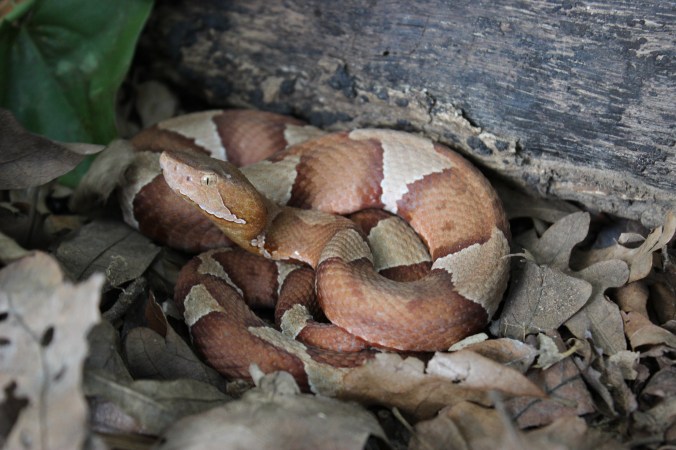
Wildlife. Most of the larger wildlife at LBJNG is no cause for fear. Coyotes live there, but you are more likely to hear them than to see them. If you see a coyote that stands its ground, especially in spring during pupping season, you should back away and leave the area. More information about interactions with coyotes can be found here. Feral pigs are seen in some areas, and while they usually run away, they are potentially dangerous. Avoid them, especially sows with young pigs. We should keep a respectful distance from wildlife, even deer. There are two species of venomous snakes that are common in suitable habitat within the grasslands. These are the Northern Cottonmouth (also called the water moccasin) and the Broad-banded Copperhead. Cottonmouths typically are seen near the bigger lakes and ponds. Through most of the year, copperheads are primarily active at night. If left alone both species will avoid interacting with people. Don’t put your hands under rocks or logs where one may be concealed, and watch your step. More information about these snakes can be found here.
Broad-banded Copperhead from the grasslands
I would love to hear your thoughts about this great place, especially if you visit after reading this article. After 25 years of visiting off-and-on, I believe there is always something to make each visit interesting and each walk a little gift of renewal of body and spirit.







 Our Lives In Nature

