Drenched In Humidity and Birdsong

As I started on the trail this morning at Sheri Capehart Nature Preserve, I asked permission, so to speak. I said: “May I be here as one among many, neither greater nor less than. May I understand how I fit within this place and cause no harm.”

I expected no particular answer, but I did hear calls of Bewick’s Wren, Northern Cardinal, Red-bellied Woodpecker, Blue Jay, and Painted Bunting (identified by the Merlin app), and those calls felt welcoming. Low clouds covered most of the sky, and it was a little like being draped in a warm, wet blanket. Weather Underground said it was 81F and 76% humidity in the area.

On the trail I was submerged beneath the green canopies of oak trees and then emerged at a little open hillside where the spring rains are helping the Little Bluestem grasses look like they might take back the slope that has suffered erosion and drought.
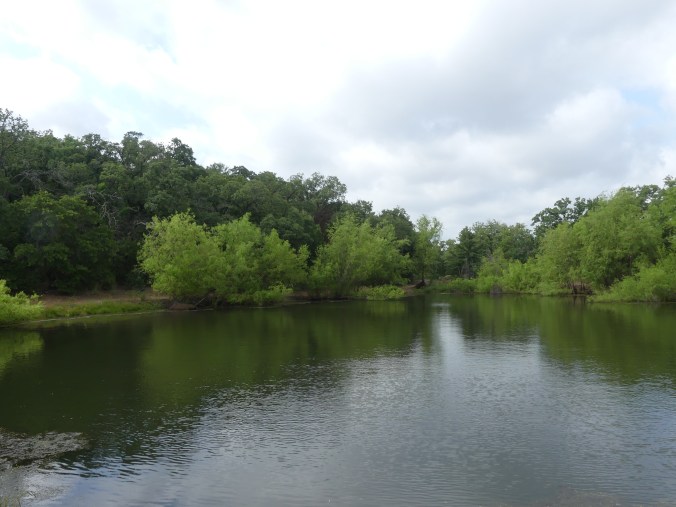
The north pond

At the pond, the roster of bird calls expanded to include White-eyed Vireo, Carolina Wren, and Carolina Chickadee. And while the Black Willows have taken over large sections of the bank, in one spot there was a beautiful patch of flowers. Chickory, Black-eyed Susan, and Bitterweed were scattered in different shades of yellow. And as I looked out over the water, a group of Blanchard’s Cricket Frogs set up a chorus of “grick-grick-grick” calls. Those calls are always surprisingly loud for a little frog that could easily sit on your thumb.
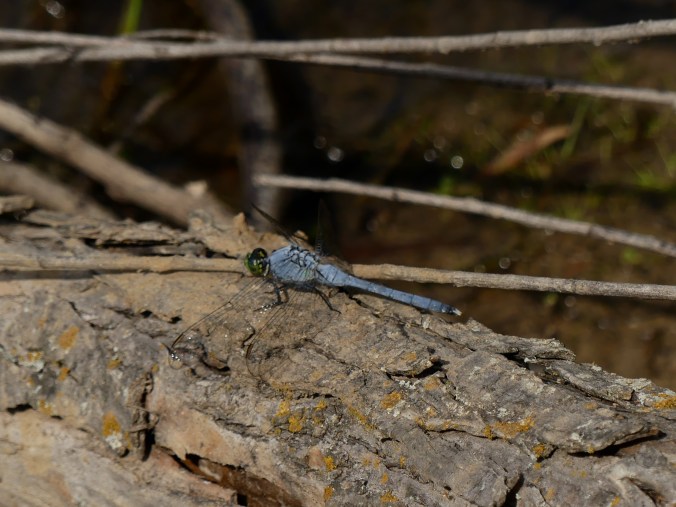
An Eastern Pondhawk. Females of this species are bright green while males are blue

I climbed uphill and away from the pond and walked upslope along the north prairie. Every part of this walk brought wonderful things into view, including Glen Rose Yuccas retaining some of their flowers, a few Indian Paintbrush among the grasses and Western Ragweed, Silverleaf Nightshade (a nettle with a beautiful name and lovely lavender flowers), and Texas Bull Nettle growing tall with their big leaves and white flowers.

And that brought me to the Old Man (Old Woman, if you like) of the preserve, a huge Post Oak that the Texas Tree Coalition designated as a Historic Texas Tree in 2019. It is called the “Caddo Oak,” in honor of the Caddo People who once lived here. After more than 200 years it continues to stand, with a huge trunk and massive branches stretching out like arms to embrace the sky.
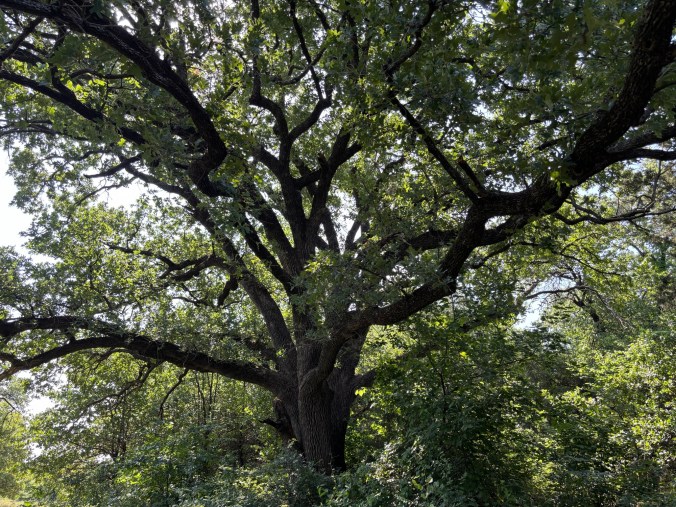
The “Caddo Oak

This “Old Person” – oak trees have both male and female flowers so I shouldn’t assign them a gender – might give us a sense of a something ancient that presides over the place. There are a few other big oaks on the preserve, but probably none that were growing when Texas was part of Mexico, before independence or the battle at the Alamo. We are fortunate that it is still here, never in all those years cut down or burned.

From there I followed the trail as it turned south, taking me to where I could visit the yucca meadow, a big patch of deep, soft sand that supports Glen Rose Yucca, Lanceleaf Blanketflower, and other low plants. Some of the yuccas still had their flowers, though the cycle in which Yucca Moths pollinate the plant and lay eggs where the larvae will then eat some of the developing seeds (not too many) is probably winding down. That meadow is also home to the Comanche Harvester Ant, a species of what Texans call “big red ants” but this one requires deep sandy habitat with nearby oaks, and this limits where they may be found.
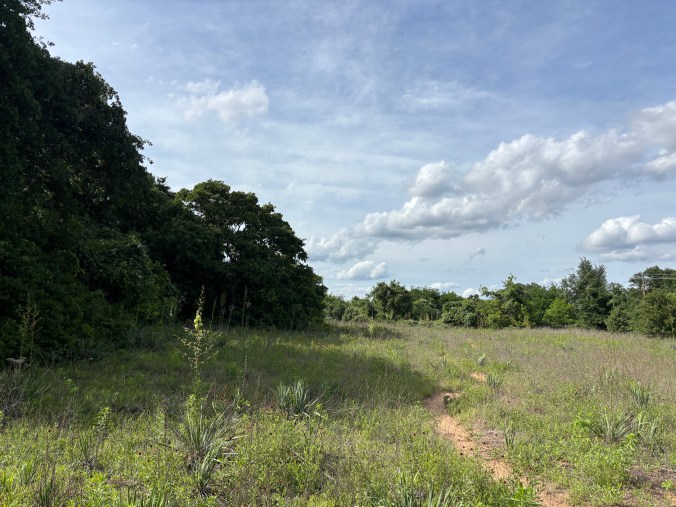
The yucca meadow (I took this photo on May 8th)

Continuing around the preserve, I found a tiny juvenile bush katydid with black-and-white banded antennae on the flower of a Lanceleaf Blanketflower, and then a Six-spotted Flower Longhorn Beetle crawling over a Black-eyed Susan flower. On a walk like this, the insects provide so many fascinating forms and colors.
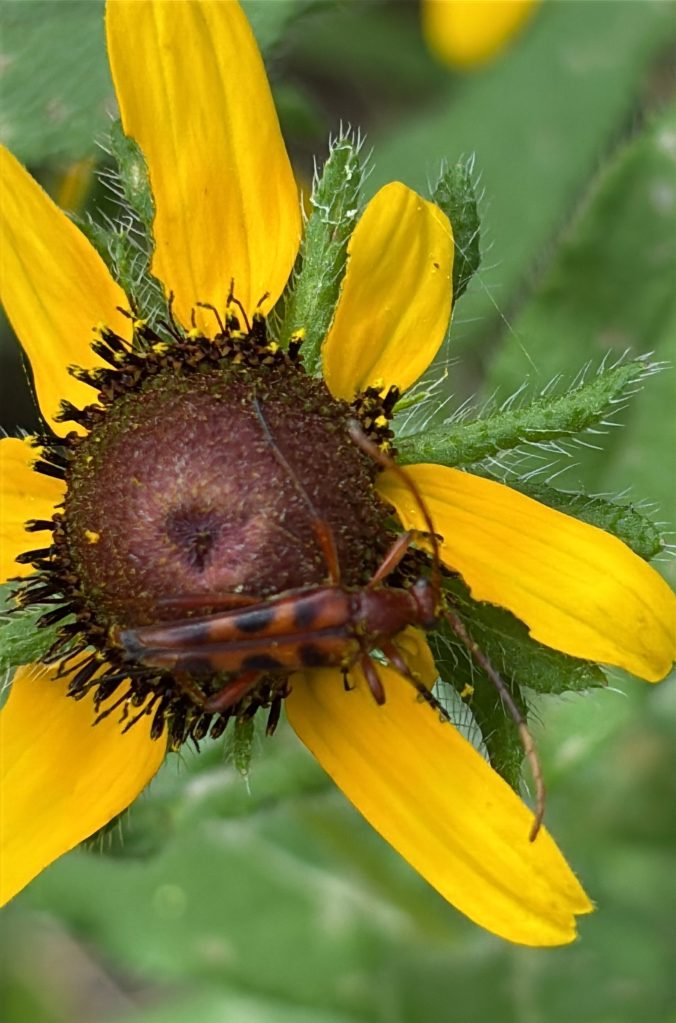
Six-spotted Flower Longhorn Beetle

I arrived within the woodland at the crown of the hill, and the clouds had broken up so that there was bright sunshine and lower humidity. At 11:20am I lay on my back and watched the low fragments of cloud drifting swiftly to the north. At the ground there was a good breeze. A Tiger Swallowtail fluttered through the area, perhaps visiting the Standing Cypress that are scattered wherever there is a small opening in the oak woods.

And the Standing Cypress is having such an amazing year at the preserve. You first see them in winter, growing as a delicate rosette of thin, fern-like leaves. But in spring the plant sends up a tall stem that can grow up to six feet, with a flower spike at the top that produces clusters of red, tubular flowers.
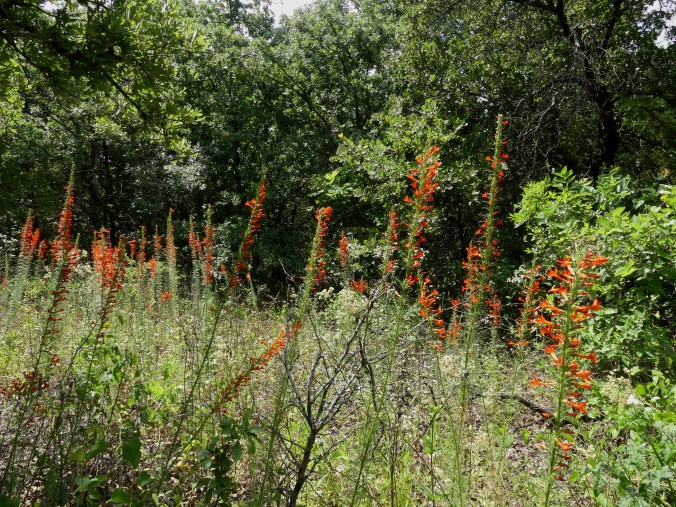
Standing Cypress

It was over two hours of delight, despite that warm blanket of humidity. After the first hour I was pretty well adapted anyway, or else all the wonderful stuff outweighed any discomfort. We are all lucky to be able to go and be part of this wild piece of Arlington.

About Truthfulness

I continue to think about bringing up kids with the skills and values that are needed. I see the world that kids are growing up in, how it is changing, and I wish for a better world. The way we make that better world is through compassion, integrity, and other qualities that are hard to hold onto with so much going on. I wrote about empathy last month, and I’d like to talk about truth this time. (I started this at Rain Lilies on Substack and reprint it here.)


“Did you finish your homework?” “Are you really friends with that person?” Those can be difficult questions. Sometimes being liked or staying out of trouble can make truth-telling hard, for adults and kids. Does it really hurt anything to “bend” the truth?

Little kids may automatically give the answer that the other person wants, the “right” answer, even if it’s not really what happened. “Did you hit your sister?” The right answer, the one that the questioner wants to hear, is “no.” For a very young child that may be the only answer that occurs to them.

In other words, in those first few years kids don’t necessarily sort things into categories like lying and telling the truth. It might not occur to them that the thing that really happened is different from the thing that the other person wants to hear. They simply give the desired right answer. Only later do they understand that they’re choosing to lie.

Teaching honesty usually begins early, before we can discuss things like building trust. Parents might say, “Thank you for admitting what you did; I know that was hard.” They might still get in some trouble, but hopefully they see themselves as a kid who made a mistake but handled it honorably. And that’s important to see yourself (and for others to see you) as a basically good person who made a mistake.

If the consequences of making mistakes are really harsh, then a kid may lie even when they know it’s a lie. They become so afraid of a parent’s or teacher’s anger that they will take a chance on lying. What does this child do? Tell the truth and let awful things happen, or lie and hope they don’t find out? The child may decide to make it a very convincing lie and hope for the best.

If this keeps on going, lying can become a habit. There can be other ways for habitual lying to develop, but this is one. Screwing up gets you in bad trouble, maybe scary trouble, so you just get good at making things up to stay out of trouble. You become good enough at lying that you often don’t get caught. It becomes second nature to make stuff up.

Is lying ever acceptable? It is possible that it could be okay to tell a lie in order to protect someone or save them from needless hurt? There is a wonderful story by Mark Twain that I hope you will read. It’s “Was It Heaven? Or Hell?” and it shows how compassion and caring sometimes outweigh truth-telling. It’s not long and it illustrates the point really well.

But there is that other kind of lying, done only to help ourselves regardless of who is hurt. The lie that is designed to harm someone, or intended to help us get away with something that is wrong. The bully who beats someone up but then claims to have been nowhere nearby when the beating happened. The person who calls folks up pretending to sell impossibly good insurance and tricks them into giving up their bank access and then steals their savings. The leader of a country who tells the citizens that he really won an election that he actually lost, claiming that immigrants voted illegally and bad people stole or dumped votes that were for him.

And when too many people easily tell lies like that, we might begin to feel like we are foolish to tell the truth. Especially when people who should be respectable go on TV and say things that aren’t true and say it easily (wanting us to think “of course, that’s obvious”) and become offended if someone challenges them. We begin to be not so sure what is truth and what is a lie, and to wonder if lying isn’t just what everyone does to get by in the world.

Photo by Gerzon Piu00f1ata on Pexels.com

But if that’s who we become, how will we ever be able to trust anyone? Already too many people only trust folks in a small circle of friends and family. We should be able to talk with someone we don’t know and decide to give them at least a little trust. We could start off seeing them as trustworthy unless there is a reason to think they are not, while at the same time being careful not to trust them with too much.

In other words, we want to think that most people have integrity. Someone with integrity tells the truth and does not mislead people about who they are. They don’t pretend to be one kind of person for some people and act like a different sort of person for others. Think of it as “doing the right thing even when no one is looking.”

Being able to trust others and to believe that they have integrity is important. It allows us to live in a community where people are ready to accept each other as neighbors and maybe friends. I hope that more of us can live in such communities.

How do we remain ready to extend a little trust but at the same time protect ourselves against people who would use lies to hurt us? How do we maintain our own integrity when we see many others getting by through deception and lies? How do our kids manage it? I suppose part of it is finding trustworthy people as friends and acquaintances, reminding us what good, caring, honest relationships look like.

And we can develop the skill of being good observers of others, reflecting on what we see in them and listening to ourselves about what those observations mean. It’s a mistake to jump into things on a whim or listen too much to peer pressure or wishful thinking. Get to know people and think about what you’re learning about them.

All of that is easy to say and suggest to others. It can be harder for us to put all that thinking and reflecting and listening into practice in our own lives. But it really pays off.

Yuccas and Moths Need Each Other

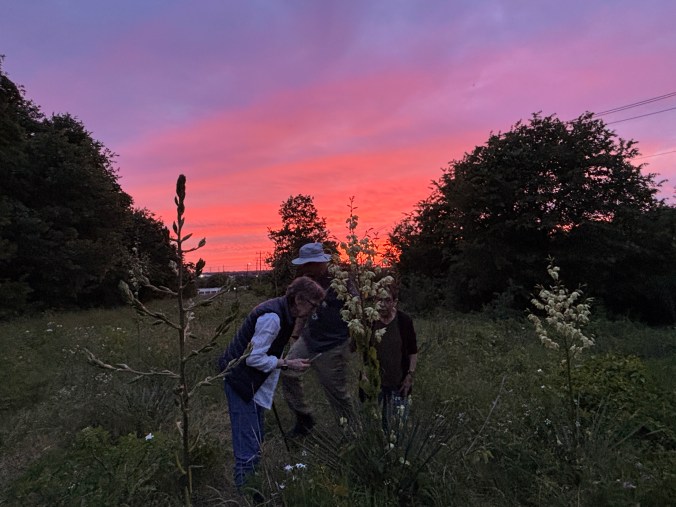
Saturday the 10th, a group of us took a walk at Sheri Capehart Nature Preserve to find moths at sunset. They are very special moths that pollinate and in turn are fed by the Glen Rose Yuccas that live there. It’s a great example of biological mutualism, and it’s the subject of my most recent “Letter to Nature Folks.”

I hope you’ll visit the page with “letters” to you and download that May issue of Letters to Nature Folks – the one marked as “Yuccas and Yucca Moths.” And if it sounds like a good walk (it was a very good walk), thank John and Grace Darling for leading it and telling us the story of how the yuccas and moths completely depend on each other. And thank the Friends of Sheri Capehart Nature Preserve for offering this and other great activities. (Disclosure: I’m on the board of that Friends group, but I’m not the one to thank for the walk.)

Celebrate – It’s Amphibian Week

This week, take a moment to remember the frogs, toads, and salamanders of North America. It’s Amphibian Week, started in 2020 by the Partners in Amphibian and Reptile Conservation (PARC) and partners such as Save the Frogs! These animals are important to the ecosystems in which they live, partly because predator species depend on them being so numerous (in places their biomass – total mass of amphibians – makes them a significant source of food to support the community). One way that they are important to us is how the calls of frogs and toads bring the nighttime to life in many places. The famous herpetologist Archie Carr said, “Frogs do for the night what birds do for the day: They give it a voice.” And amphibians are important just because; like other species, they have intrinsic importance.

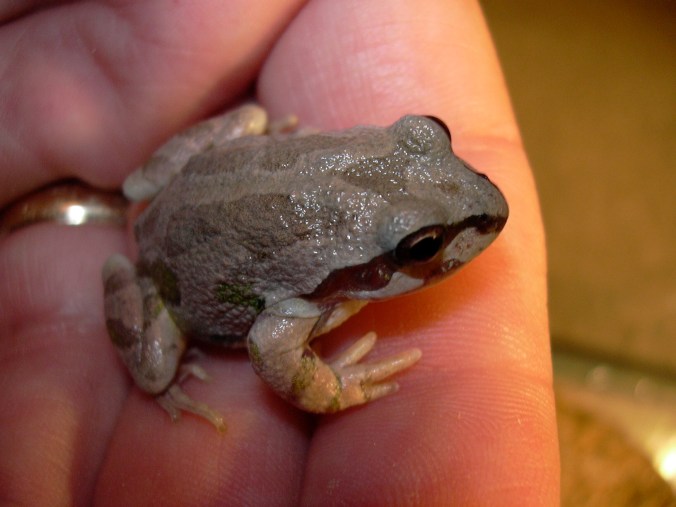
Strecker’s Chorus Frog

To celebrate, here is some information about Texas amphibians, adapted from the pdf file you can find right here on my “herpetology” page. Here in North Texas it is expected to be rainy for part of this week, and the amphibians will appreciate that. Maybe you can get out to a wetland in the evening and listen for some frog and toad calls.

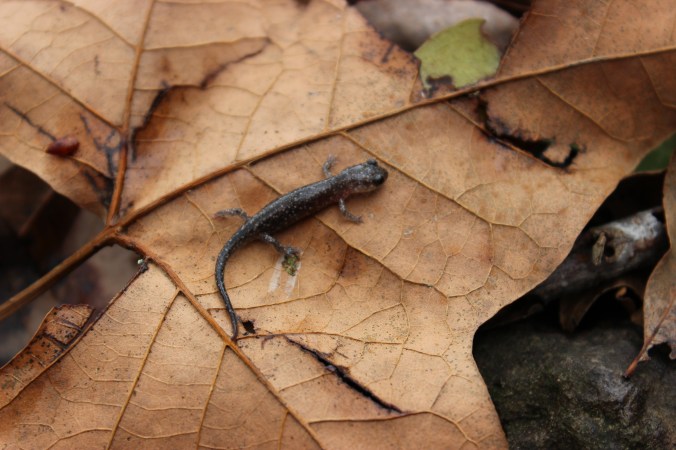
Amphibians include frogs, toads, salamanders, and caecilians. All of them are vertebrates that cannot generate their own body heat – that is, they are “cold blooded” or ectothermic. Amphibians have smooth, slimy, or warty skin which allows them to “drink” through the skin but also makes it easy for them to lose water by evaporation. They lay eggs without shells and almost all species hatch into an aquatic larval stage. One of the exceptions to that rule is the Slimy Salamander, which lays eggs in moist soil and leaves, and embryos develop into miniature adults before hatching. For other species, after growing and developing in ponds and streams, tadpoles and most larval salamanders change from aquatic, gill-breathing animals to animals that breathe air with lungs.

A very young Western Slimy Salamander from Williamson County

Frogs & Toads

Toads have relatively dry, warty skin, shorter back legs compared to most frogs, and often live further from water than frogs. Most frogs, on the other hand, have slimy and fairly smooth skin and longer back legs – they can leap where toads only hop. Both frogs and toads are dependent on water or moisture and often live near the water’s edge or in places where there are moist refuges. Toads may live in fairly dry habitats like prairies (a few live in the desert). Frogs don’t have to stay right beside the water; at night in some places we might see leopard frogs or bullfrogs wandering some distance from the nearest creek or pond.

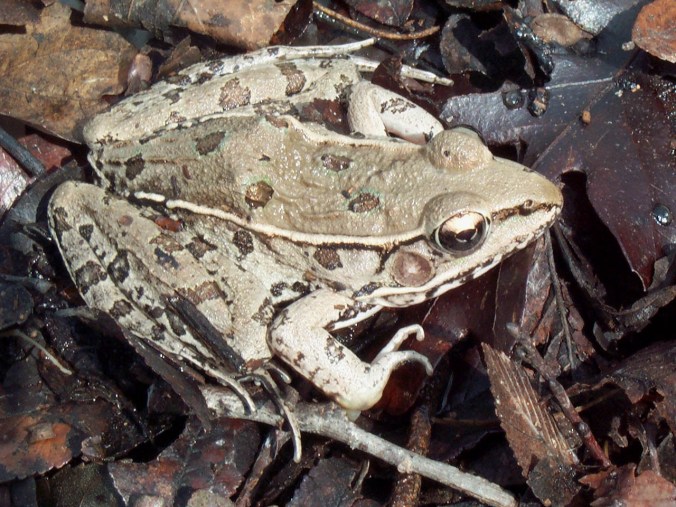
A leopard frog at Fort Worth Nature Center & Refuge

Frogs and toads have a “seat patch” of skin that easily absorbs water and that is how they drink! Many toxins can easily cross an amphibian’s skin, making many of them particularly sensitive to pollution. (Do not handle them if you have chemicals such as insect repellent on your hands.) On the other hand, frogs and toads secrete various toxins from their skin, which helps protect them from infections and in some cases may help protect against predators. Most frogs are completely safe to handle, and none will give you warts! However, do not rub your eyes or get your fingers in your mouth after handling them. The skin secretions of toads can result in a burning sensation if it gets in your eyes.

Woodhouse’s Toad

The males of the various species of frogs and toads “call” to females during breeding. This often takes place in the water of ponds and creeks, because when a female approaches a suitable male and they pair up, she will lay eggs in the water as the male fertilizes them. The calls of frogs and toads are a little like bird song, in that different species have different calls and an experienced listener can identify the species by listening to the call. A very good book with audio recordings of many calls, is The Frogs and Toads of North America, by Lang Elliott and others.

Many frog and toad species that used to be common have become harder to find or even disappeared. In many places, populations of frogs and toads are being monitored to see how they are doing.

Salamanders

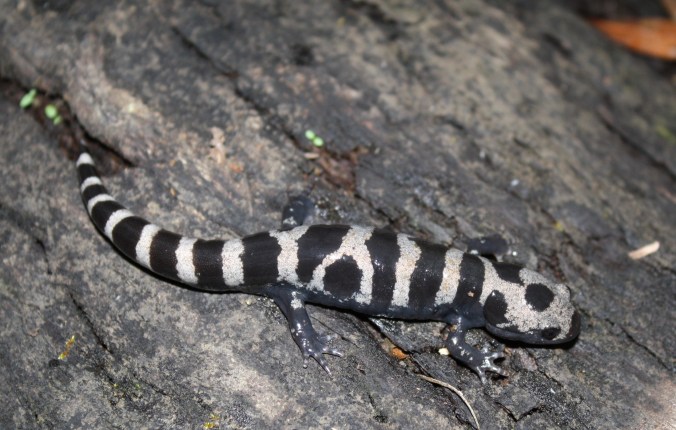
A Marbled Salamander from White Oak Creek WMA in northeast Texas

Many of them may look a little like lizards, but salamanders are not reptiles; they are amphibians. They have skin that may feel rubbery, slimy, or slightly rough, but they do not have scales and they can dry out easily. Like other amphibians, most of them start out as eggs laid in water. Instead of a shell, the egg has a clear membrane through which you can see the embryo developing. With a few exceptions like the slimy salamander mentioned above, here is what happens next: When the eggs hatch, the babies are not like adult salamanders, but are larvae that breathe in the water using gills. This is the salamander version of a tadpole. Later, most of them change into an air-breathing adult form (one group, the lungless salamanders, do not have lungs as adults). Some salamander species live entirely in the larval, aquatic form, and these are called “neotenic” salamanders. Neotenic salamanders are not a different kind of salamander, but the term “neotenic” simply describes the fact that the salamander did not change into an adult, air breathing form.

One group of salamanders, called “sirens,” always remain aquatic and do not develop hind limbs. They are long and eel-like. Another group that is always aquatic and whose members have a long body like an eel are the “amphiumas.” Some of these animals, like the “western lesser siren,” are relatively small. In contrast, some amphiumas can reach lengths of over three feet.

A Small-mouthed Salamander seen at Old Sabine Bottoms WMA in East Texas

Because they depend on healthy wetlands or other habitats that are shrinking because of things like development for human use or drought and climate change, salamanders are in trouble. Like frogs and toads, their skin is porous and they “drink” through their skin. This makes them particularly vulnerable to chemical pollutants in water. Overall, because of pollution, diseases, habitat loss and other reasons, amphibians are disappearing in many parts of the world. See organizations such as AmphibiaWeb for more information. You may also be interested in my book, The Wild Lives of Reptiles and Amphibians: A Young Herpetologist’s Guide, from Texas A&M University Press.