For the Kids in My Family

This is heartfelt but maybe preachy, so bear with me. And it’s particularly for Eli and Lilly, should they want to read it at some future time. I was thinking of boys in particular as I wrote it, but it’s for anyone. Especially for those raising boys or having influence in their lives, and for anyone whose life is woven together with the lives of boys.
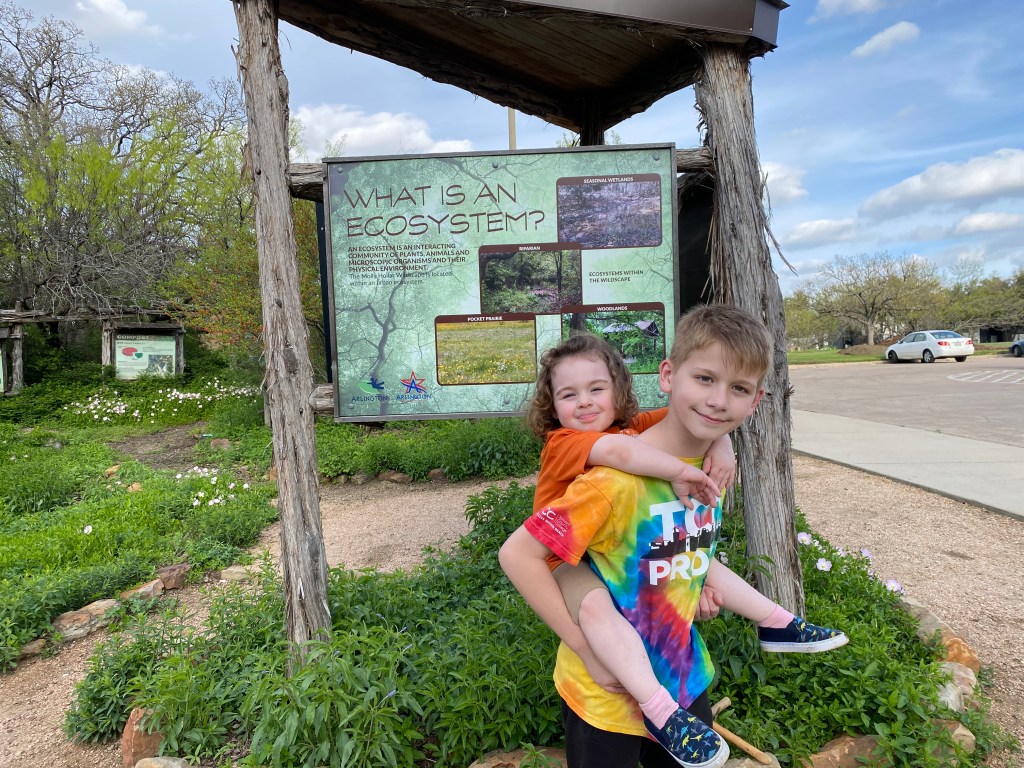
Lilly and Eli

I hope you will question what means to be a boy, and a man. Don’t just absorb what the culture teaches without some careful thought.

The culture (schools, places of worship, movies, social media, etc.) shapes what we expect of boys and men. But we don’t have to follow the culture when it holds up domination or aggression as ideals. We can turn away when it yells, “do it!” because stopping to think before acting is supposed to be weak. We don’t have to end up as men who are hardened, isolated, determined to win no matter who gets hurt. And we don’t have to raise our sons that way.

So … who do you want to be? I don’t mean work or a career, I mean what values could guide you as you make your way through the world?

Here are a few that are worth thinking carefully about: equality, empathy, truthfulness, integrity, compassion, kindness, and work as well as play.

Equality ought to be easy, right? People talk about it, even in our Declaration of Independence, the part about believing that “all men are created equal.” Nobody is above another person. It’s a great idea, and yet they wrote “men” and left out women. They left out people of color, too. Over the next couple of centuries, we began recognizing what we left out, and a lot of people have tried to correct that.

I hope you’ll think about equality on a very personal level, about you and the people around you. They way you are with girls, women, people of color, people with less money. Older people, like me, often used the right words about others being equal, but didn’t act like it. Our sisters and girlfriends were equal, but … boys and men needed to do things for them, speak for them, and make the important decisions. We said one thing but acted like it wasn’t true. Equality was mainly just a nice word. I think many younger people are doing better, but the problem is still here. In fact, some churches and politicians want to go back to the time when women were supposed to be quiet and obedient.

Women and girls should matter just the same as men and boys. Neither one should try to control the other, as if they were better. This especially includes the old problem of men and boys thinking they can control the bodies and the affection of women and girls. If we really mean it about being created equal, then we each make our own decisions about what to wear, who to hug, when it’s OK to touch or be touched. And of course that goes for any gender, gay, straight, transgender, or other way of recognizing who we are.

And being treated equally goes for any other person who is different in ways like race and skin color, or what country you are from, or how much money you have. I’m not better than a person who is different in those ways, and neither are you.

People who are opposed to these ideas may try to make it seem like we are saying that everybody has more rights than men or boys, like we are getting left out and these others are getting special rights. I guess what bothers them is that we men have less of a special privilege than before. We are used to having a special status, and so just being equal to everyone feels like we lost something. But the deal is, no one has more rights or is “more” equal than anyone else.

With equality, being female doesn’t give girls and women special rights, just the same rights.

And it doesn’t give Black people special rights over White ones, just the same rights.

And so on, with other kinds of differences.

So I hope you will think about the values that you want to guide your life, and I hope that equality is one of them.


I want to write more about these issues, maybe touch on those things like empathy, truthfulness, integrity, compassion, kindness, work, and play. What is happening in our country right now seems to challenge and distort those qualities, and some people are glorifying power and even violence. They would give special privileges to the rich and make women conform to mistaken ideas of what is required to be virtuous. They would re-define truth to be whatever is convenient at the moment. If we think such ideas are wrong, we have to speak up.
Mindfulness at Spring Creek

I think about what we are all going through right now, and I wonder what would help. I bet we could make a list, right? One of the things on such a list might be mindfulness. It offers a way of seeing things with fresh eyes and a deep way of experiencing the beauty and wonder around us. Also, it is a practice that involves letting go of our restless intensity and fostering patience and acceptance. It is associated with trust, compassion, empathy and kindness. Those are qualities that are not just in short supply but are being discouraged by some people in the mistaken idea that they are weak.

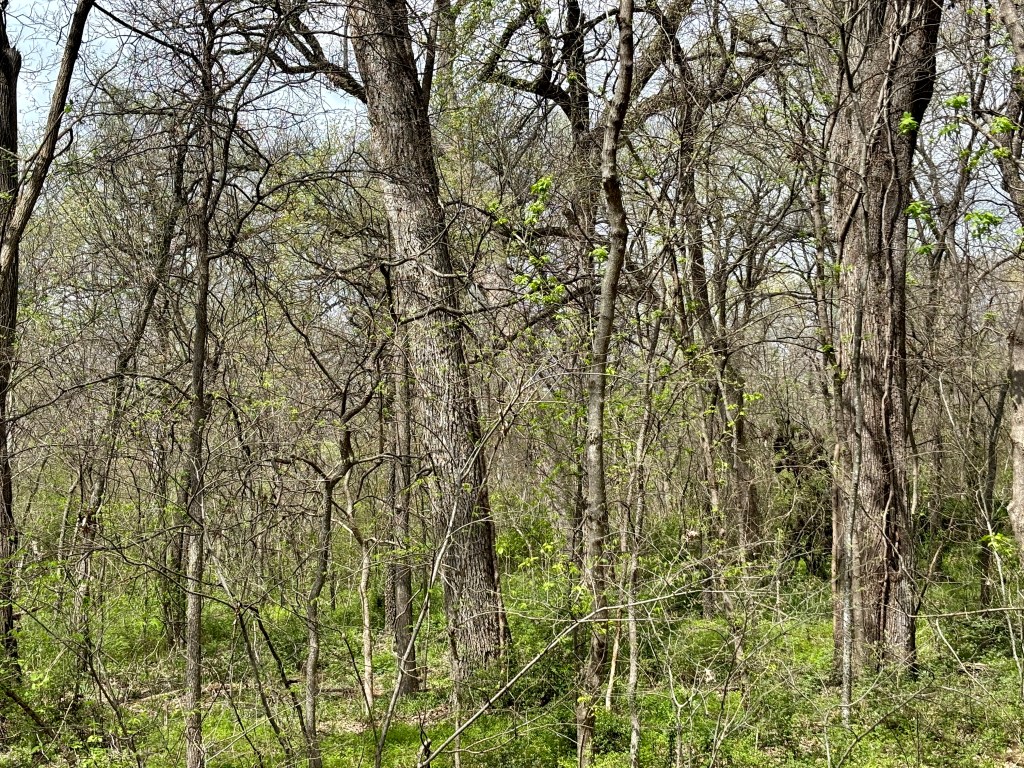
Sunday afternoon, March 23rd, I led a group in a mindfulness-based walk through part of the Spring Creek Forest Preserve in Garland. It was a good day to see things with fresh eyes and let go of some restlessness. The day was warm with low puffy clouds and that feeling – a sort of “softness” – that comes on more humid days in spring. The walk was a follow-up to a talk I had given for the Preservation Society for Spring Creek Forest about three weeks before, talking about mindfulness in nature.

The Spring Creek Forest

In the talk, I described mindfulness as a special way of paying attention to our experience in the present moment and accepting whatever that experience brings. I said that it is a meditation technique that can be practiced on a walk in the woods, informally. That’s what we would do on the 23rd. We would take a walk without our usual activities of taking photos and uploading them to iNaturalist or chatting, or being lost in thought.

At the beginning of the walk, the fifteen or so people gathered and I mentioned some of the basics of mindfulness, including some of the qualities and emotions that tend to emerge from the practice. One of those is stillness, which does not mean you would sit still all the time. Instead, it is a lack of restlessness, impatience, and wanting the next thing. It is a sense of quiet and calm, even while you are walking. And a related quality – patience, allowing things to come about in their own time and accepting that things take time. Not that we cannot or should not act to bring things about, but we don’t need to struggle against the timetable if it is different than we would prefer.

There are times when I am restless or impatient, but when I am able to have that sense of stillness and patience, it is very freeing. And it is not hard to imagine how our lives would be better if all of us experienced more of those things.

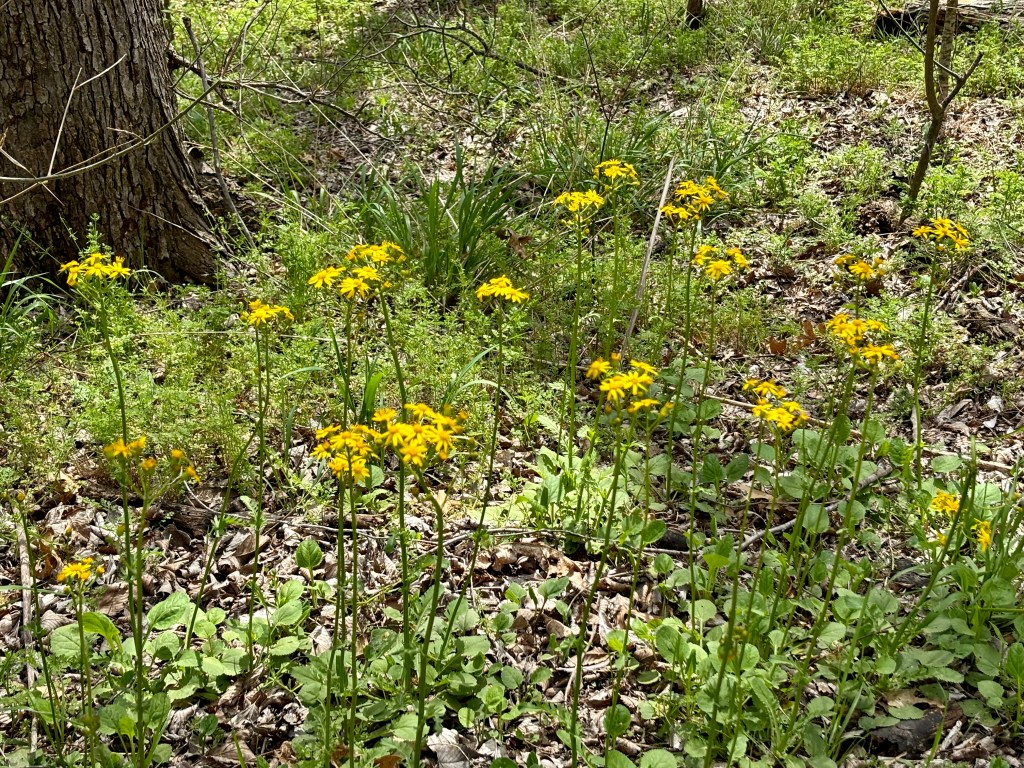
Instead of going first to names and categories, we can stay with the basal leaves, tall erect stems, and beautiful yellow flowers for a moment. Later we can consider if it should be called a groundsel.

During the walk we talked about “beginner’s mind,” when we experience something as if for the first time, with the vividness and newness that can happen at such times. The more we are in the present moment, the more we step away from past experiences and preconceptions about what is in front of us. We see something with the mind of a beginner.

Mindfulness is also associated with compassion and empathy. Imagine the compassion that would result if everyone put aside more of their judgment about bad or good, lazy, malicious, and so on. We quickly think of people in this context, but we’ll keep it in the realm of nature for a moment. Perhaps there is a copperhead in the woods, and we know that this snake is venomous and capable of sending us to the hospital. With that sense of stillness and patience, we watch it from several feet away, noticing the beautiful earth tones with shades of reddish-orange. The snake remains perfectly still in our presence (unless we get too close or step on it) and is non-aggressive. We might know that the snake’s venom is primarily an adaptation for subduing the animals it eats. I think we would see the copperhead as something to be respected and even appreciated, while being very careful around it. Our compassion would mean we would not want it to suffer by starving or being defenseless, just as we do not want to suffer if we accidentally touched it and were bitten.

At a place where the trail reached the creek, we stopped and spent a couple of minutes with eyes closed or looking down so that our other senses would be more prominent. People later commented about listening to the sound of water flowing in the creek and the songs of birds in the woods. There was also the feeling of sun and a light breeze on our skin. We talked about the smell of spring, even though our vocabularies struggle to describe what we are sensing, the new green growth and what one person labeled as “herbaceous” (like the small plants emerging from the woodland floor). Noticing such things, along with touch and the sensations coming from how we are supported by the earth as we sit, walk, or stand, made our time richer.

Crow poison with a native violet growing beneath it

There is a lot more, but you should go and experience it for yourself. Emerging from the woods into a pocket prairie with butterflies, the beehive in a hollow tree, the leaves of trout lilies with their speckled or spattered appearance, and the scattered expanse of the small, white flowers of crow poison dotting the forest floor. If you go, take a little time for stillness and for being in the present moment.

Letters to “Nature Folks”

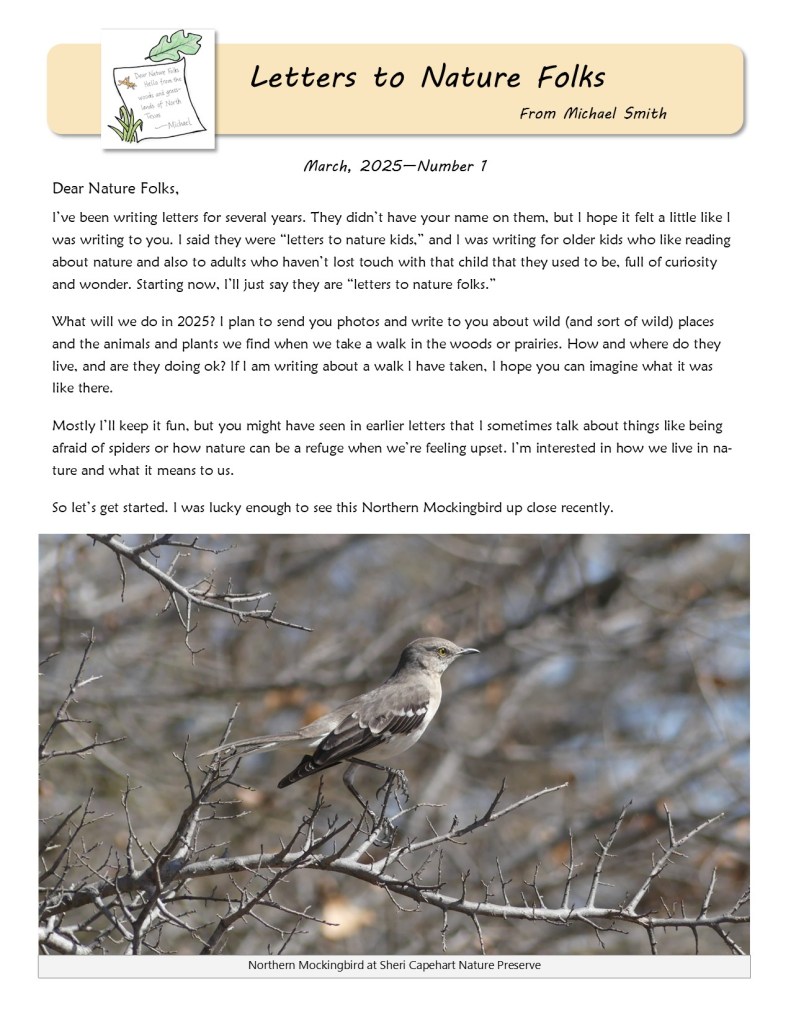
For about three years I’ve been publishing a short, free publication that is like a letter. At least that’s my intention – an informal, even personal style like a letter. My original idea was to write to older kids who like nature and like to read. I started out on a December day at Fort Worth Nature Center & Refuge, seeing wasps, turtles, egrets, and talking about leaves. I wrote:

Do you know what a hundred tons of leaves smells like, laying on the ground? (I’m not really sure if it was a hundred tons, or even a ton, but they covered the ground everywhere I looked.) In my walk, the smell was really strong in a spot between two little hills where the air stays still. Now sometimes when people say that a smell is “really strong,” it’s a polite way of saying it stinks. That’s not what I mean. I loved that smell, but I don’t have good words to describe it. The leaves fall and they break down and return to the soil. That smell is leaves turning into soil.

That was the first issue of Letters to Nature Kids, and I kept writing, at least several times a year. I tried to bring the reader along on my walks, or talk about nature journaling or coming to terms with things like fears of spiders. Another goal was to not talk down to kids, and while I don’t get technical or in-depth in the letter, I do think there’s an appeal for adults as well.

I’ve experimented with something called Letters From the Woods, something taken essentially from my nature journal so that it is a letter written “from” the woods or prairies. I hope to come back to that.

But the latest I’ve written is a letter not just to nature kids but to nature folks. I hope you will download this March, 2025 issue and give it a try. Pass it around if you know someone who might like it. And if you have any thoughts about it that you would like to share, please do send me an email. Writers often get little feedback; we send something out there, and hopefully some folks read it, and hopefully it lands in a good place for them. But how wonderful it would be to have a bit of dialogue about it! If you are inclined to reply, please do (use the email address at the end of the letter or the contact form from the Lives in Nature website). Thanks!

With Elijah – Creek Stuff and Stories

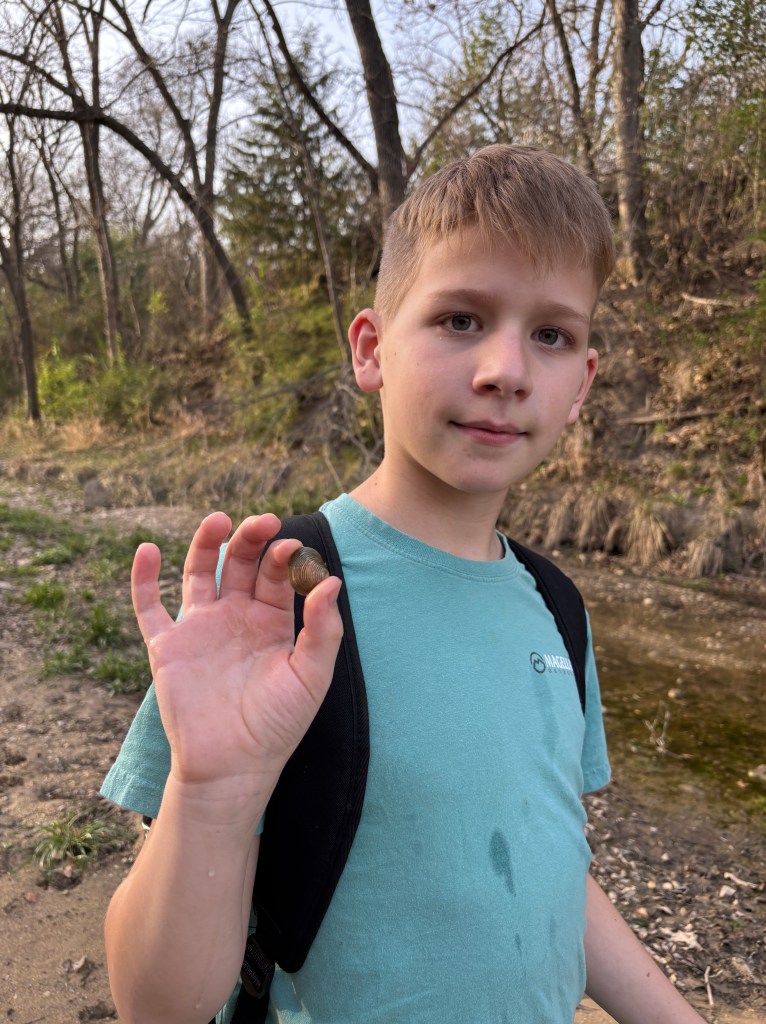
Yesterday afternoon there was water, fossils, clams, and Elijah’s creative mythology of tiny people living at the creek, riding mosquitofish, cultivating moss, and using leaves as currency. Elijah and I have a five year history – on and off – of discovery and play in this place.

I wrote about it on Rain Lilies (at Substack – the link should take you there), where I have been writing about children and nature.

A Small Restoration

I had to go to the woods today. Among my frequent visits to those places, some are for spiritual and psychological first aid. Today was a day like that.

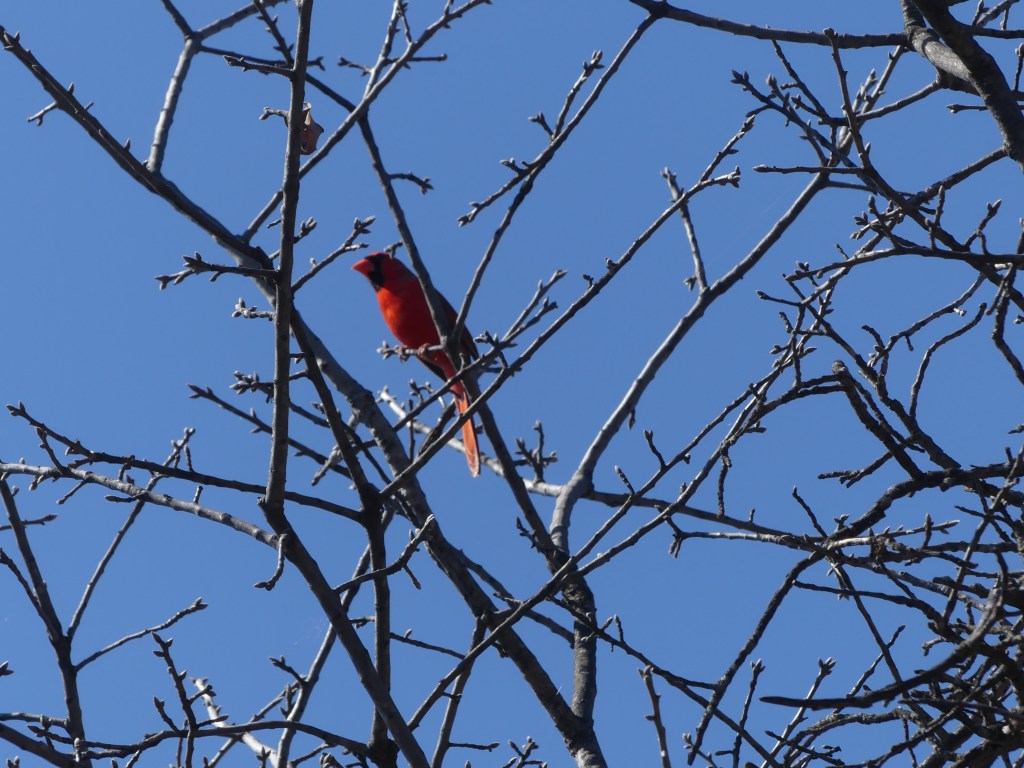
Cardinals like this male were singing throughout the preserve

Here at Sheri Capehart Nature Preserve, I can sit on the ridge and look down into the brown and gray woods, still in those colors for a while before the leaves appear. There are some glimpses of green, bits of juniper seen through oak branches, and patches of moss at the base of tree trunks. And there is a flash of reddish feathers from a female northern cardinal.

Yes, there is traffic noise and a barking dog somewhere, but it feels quiet and there is a stillness to the dormant woods, here at the edge of spring. I needed this respite. Not a respite from my home, except that home is where the news arrives. Home is where I get sucked into the Internet, with stories from the world: destruction, corruption, and bullying. Here, I don’t allow the news to appear on my phone, which is used only for photos or checking the Merlin app to identify some unseen bird.

The sun is at my back and a butterfly dances by. Mosses and lichens growing on the stones of the ridge provide endless color, life, and art. And there is the stillness that hardly seems able to be found in the city.

Butterflies agree that spring is ready to arrive. On the trail from the ridge to the boulders, a fritillary glides in toward me on rigid orange wings. It sails on past, wings now flapping to carry it up to the treetops. Nearby, a pair of butterflies suddenly appear and spiral up in their fluttering flight, above the crown of the nearest tree. When I reach the boulders, a pair of sulfurs chase each other down the path. The fluttering, erratic flight of butterflies might make us think they cannot control their flight very well, but have you noticed how often they can weave among obstacles without hitting them? That erratic flight seems to be a gift, an ability to make quick turns and maneuvers that help them escape predators.

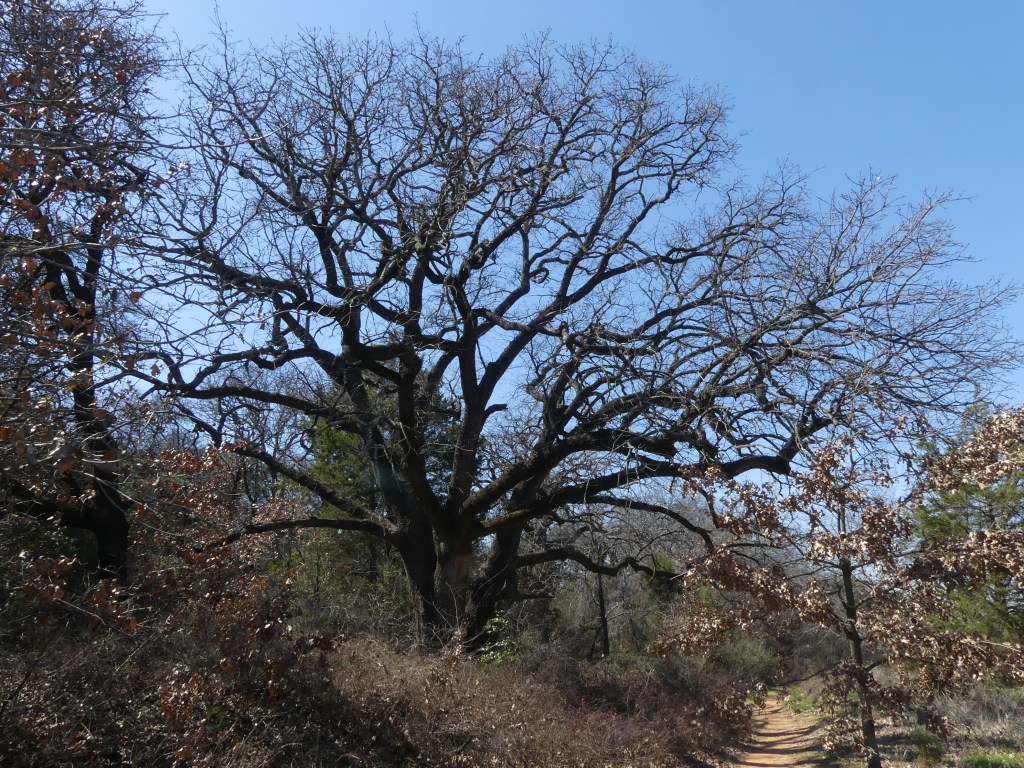
The historic 200-year-old post oak referred to as the Caddo oak

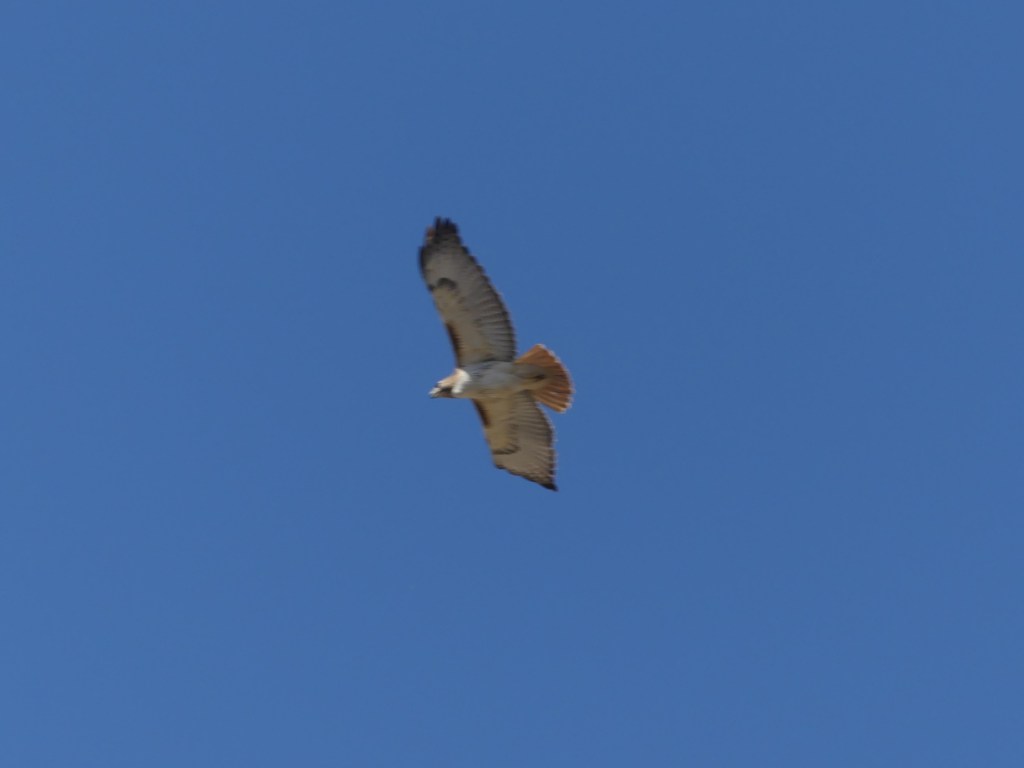
I walk around the preserve, past the historic Caddo oak, seeing many more butterflies and hearing a number of bird species: Carolina wrens, tufted titmice, a chickadee or two, an eastern phoebe, and many northern cardinals. I see a red-tailed hawk overhead, soaring and then turning on powerful wings.

A slightly fuzzy photo of the red-tailed hawk

Arriving near the north pond, I think about how much data we have about the benefits of mindfulness and time spent in nature. There is the reduction in stress, the cardiovascular benefits, an immunologic boost, reduction in depressive rumination, and increases in empathy among other gifts. Those things make time in the woods not some privileged escape or ignorance of the troubles of the world. It is a sort of refueling for the work that lies ahead. It is restorative – a little like sleep – and so it should not be undervalued.

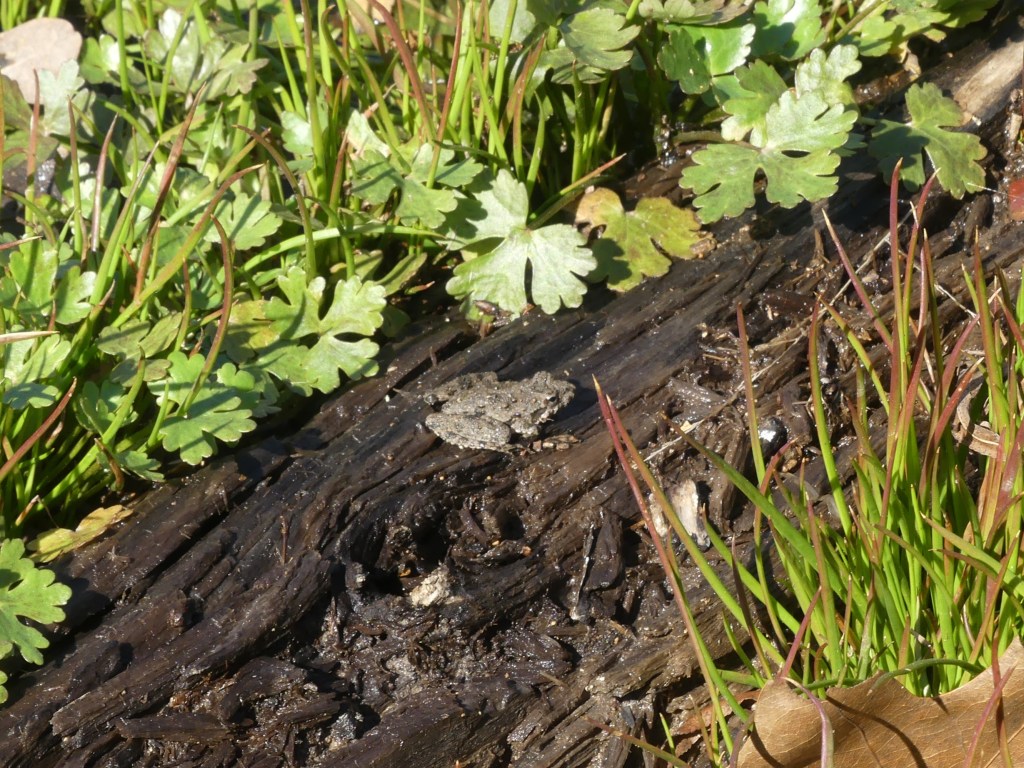
It is now 77F in the shade. Down at the north pond, life is in full swing. red-eared sliders swimming or pulling out and basking in sunshine. Cricket frogs jumping into the water as I get too close to them. All that is needed is the emergence of dragonflies, and the pond will seem complete. I walk back to the car after nearly two hours of walking, sitting, and noticing things in a world that seems so different from the big events of the wider world. It has been a small but important restoration.