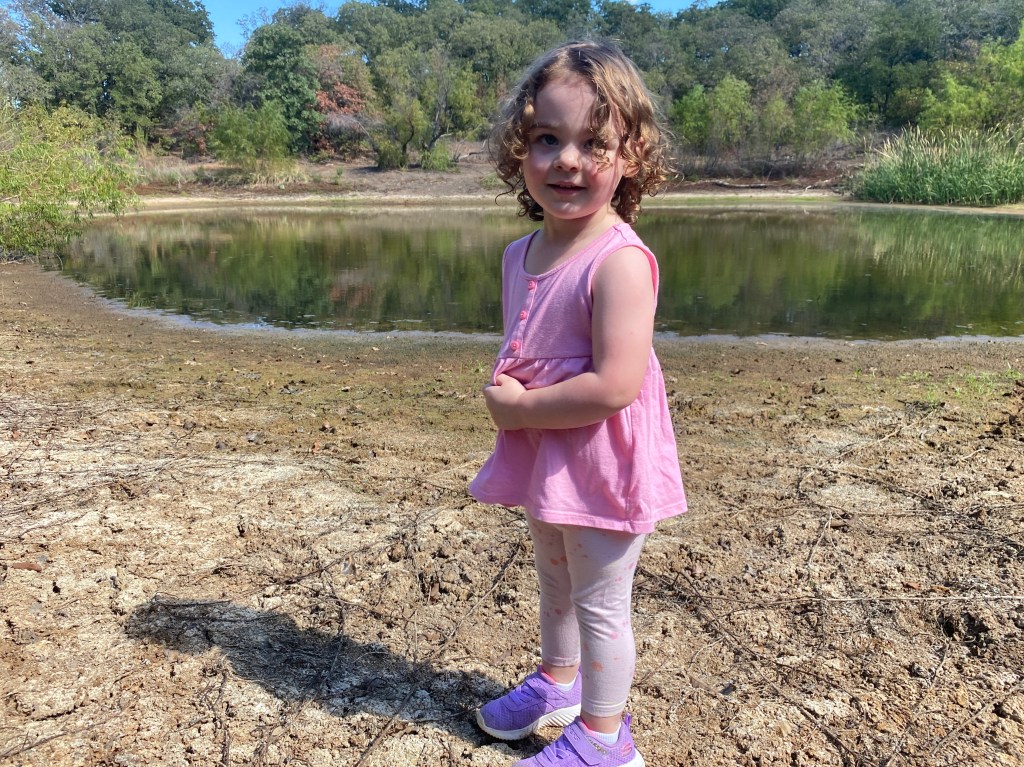
She held my hand at first, but without fear. Today was her third time to visit Sheri Capehart Nature Preserve and I’m sure it’s becoming familiar, with its ponds (where she always asks about turtles), oak woods and sandstone boulders. Lily likes to climb onto boulders and stand taller. Her third birthday is a little over two months away, and there is so much of the world to discover.
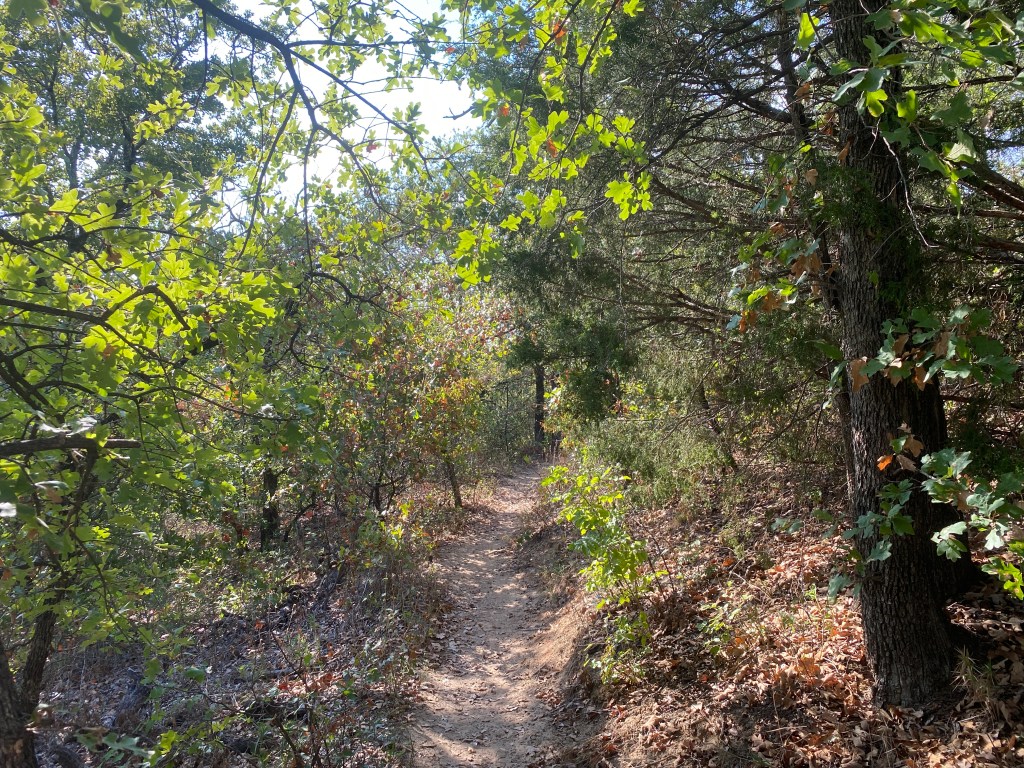
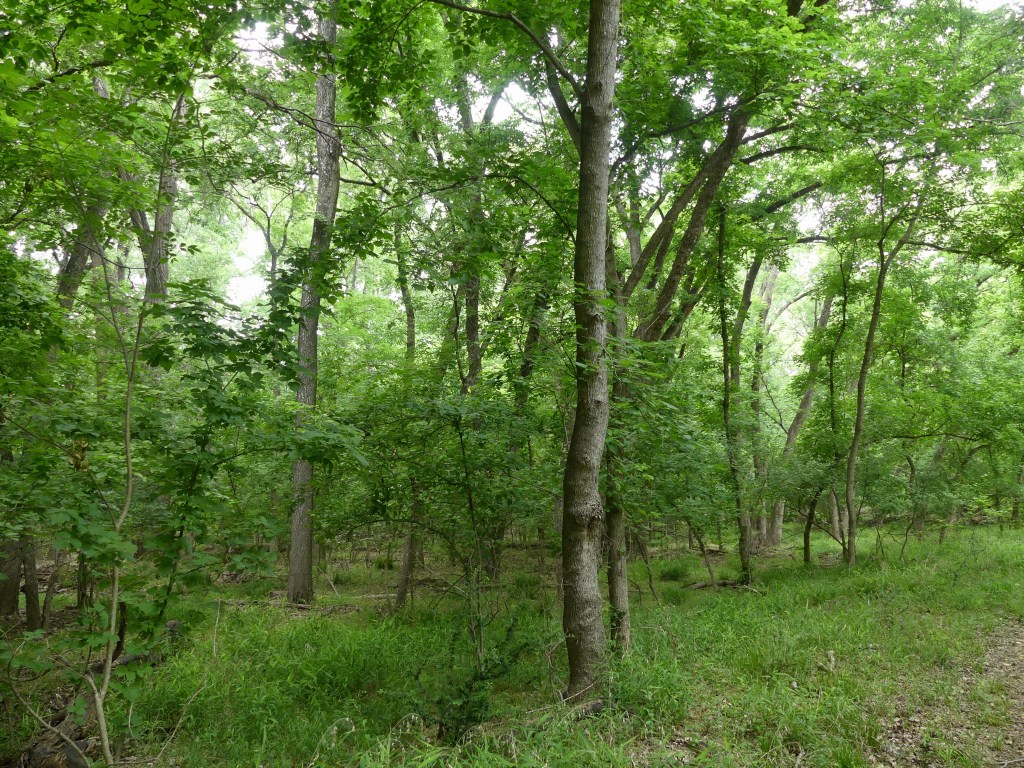
We made our way along the trail through the woodland, Lily in the lead, seeing everything. A cicada began its long, raspy call, and she stopped and listened. When we reached the pond I pointed out the dragonflies and the cricket frogs. She blew seeds off of flower heads and experimented with how it feels as dried leaves come off in your hand when you grab the dead brown stalk of a plant.
There is hardly any pleasure greater than watching a granddaughter getting to know the way seeds float in the air and how crispy leaves feel on your fingers, climbing on rocks and watching dragonflies. At one point she found a very small caterpillar like an inchworm on the trail, and watched its movement for a while. When I pointed out a grasshopper on the sidewalk, she crouched and observed it, and at my suggestion she gently but fearlessly touched it and watched it jump. She asked about “honeybees,” remembering how on our last visit we watched bumblebees and honeybees visiting flowers.
Along with love, watching Winnie the Pooh, and sitting together eating honeydew melon, this is what I can give her. This connection and love for the natural world that sustains us is among the most meaningful gifts I can give. What she does with that is, of course, up to her. But I hope it takes root, so to speak, and grows. I hope when she is fifteen she makes some time between hanging out with friends to take a walk in the woods, and when she is twenty-five I hope she spends some time birdwatching or fishing, or climbing the Lost Mine Trail in the Chisos Mountains. (Note to Lily: by the time you’re ten, I’m sure I will have offered to take you to the Big Bend to walk in those mountains, if I can still climb the trail.)
Where has “Lives in Nature” been? I tried moving to Substack and found it didn’t give the flexibility that I wanted. Creating documents with photos or graphics that I can put together myself (like the Letters to Nature Kids) is important to me. A return to this website lets me do that.
Some of you have followed Lives in Nature and then switched so that you followed what I wrote on Substack. A few of you contributed financially as well. I appreciate all of that a great deal, and I don’t want to keep changing platforms and make it more trouble than it’s worth.
So I plan to stick here and write here. There will be new issues of Letters to Nature Kids, new blog posts, and new information in the “Activities in Nature” page. Thanks for reading!
The story of this day has a connection to the story of climate change and the pandemics of Covid 19 and of violence. This was an afternoon of sanctuary that felt like freedom, and it was a paradoxical gift from our out-of-whack climate.
Yesterday’s high temperature for the Dallas-Fort Worth area, according to the National Weather Service, was 81F. With the usual caveat that it is hard to know if an individual weather event was caused by climate change, we all know (or should know) that our fossil fuels are harming the climate and bringing crazy weather. Occasionally that crazy weather is absolutely delightful for us humans, like the warm sunny day yesterday, December 5th.
At around 4:00pm I was back at the LBJ National Grasslands in Unit 76 (near Alvord, TX). Under a sprawling mesquite tree, it was 79F under a sunny blue sky. A nearly full moon was rising above a line of oak trees in soft colors of caramel, orange, and yellow-green. I sat in my t-shirt, listening for crows to exchange greetings and thinking how fortunate I was to be there.
Weird to love weather that is a consequence of something monstrous. Warm, sunny weather in late autumn and in winter is among my favorite things. The light is beautiful and in the woods and prairies the range of colors is subtle, lovely and inviting. The smell of leaves returning to soil is like the fermenting of nature’s wine, recycling the year that is ending and preparing for new life. There can be an emotional tone of quiet reflection with a little nostalgia in the peaceful woods. For me, a bright sun and warmth brings all of this out even more strongly. Even a day that is an aberration, with temperatures outside what is normal, can feel this way.
Where is my guilt for loving a gift from climate change? Nowhere. I would gladly give up very warm winter days in return for a climate more like the one I grew up with, if I had that control. I do what I can for a healthy climate and then I enjoy beautiful days, even the weird ones.
The best way to experience a day like this is away from the mechanical grinding and whining from leaf blowers, air conditioners, highways, the constant soundtrack of the world we have built. It becomes a background noise that we pay little attention to and may forget about, but our auditory nerves and our brains are in constant reverberation with it. Go to some place where you are free of it, where it is quiet and the sounds that emerge are birds, water, and breeze, and see if the world doesn’t seem less chaotic and more sensible.
I stood just inside a woodland of oaks and junipers, watching a few stray leaves fall. A wave of breeze whispered and the trees replied “shhh,” while more leaves floated down like snow.
The LBJ National Grasslands can also be a place for solitude. On this day, a group of three people on horseback passed me on the trail, but these were the only people I saw in nearly four hours. Perhaps it’s not that I’m a grumpy old man, a would-be hermit. I’ve shared walks out there with people who have a similar style of walking slowly, noticing things, being attentive to the nature around us, and those are great walks. But there is also great value in just being by yourself.
It’s hard not to see that people are growing more out-of-whack just like the climate, with increasing extremes that do a great deal of harm. I don’t think the pandemic caused it, but it certainly gave a considerable boost to the troubles that are all around us. News reports say that children are in a mental health crisis. The news also tells of a pandemic of violence toward women. Anyone who is a little different (people of color, gay, immigrant, Jewish) is at greater risk. Whatever was going on before, the pandemic pushed us into greater isolation, more job loss, fears of getting sick and dying, and lots of toxic thinking about what and who was causing all this pain.
In the midst of all this, an afternoon in the company of crows and cricket frogs, blackjack oaks and bluestem grasses is an ideal sanctuary. I like it that the origin of that word refers to a holy or sacred and protected space. I remain engaged in the world of people, but for a time I rest in a place that feels like a refuge.
One of the small ponds feels very sheltered, and as you climb down through some erosion there is a gently sloping, sandy bank. I stayed at that pond for a while, sitting and then lying on this bank with my attention captured by little things. A tiny bee mimic fly landed inches from my face where I could see its thin yellow and black banded abdomen. A honeybee buzzed around as if looking for something inches above the sand and finally flew off. A few feet away, a cricket frog took a small hop but was in no hurry. A small snout butterfly swept in, landing on the sand. Intermittently it shifted position until it had turned itself around 360 degrees, and then it flew away. I was happy with these small and interesting companions.
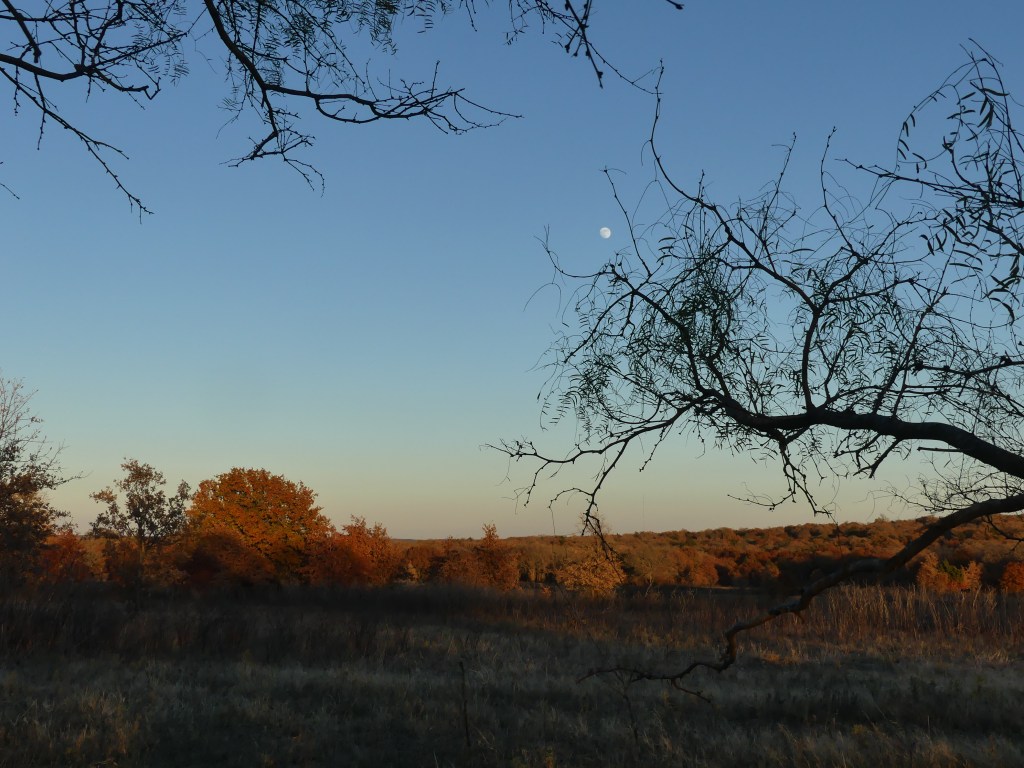
Late in the day, I walked in Unit 76 where there are big open areas of grassland and a few more mesquite trees in higher, well-drained places. The sun was getting lower and the shadows longer. I sat under a mesquite looking across a patch of prairie at a line of oak trees lit by the setting sun. The rest of the landscape was darkening, and the world was still. A nearly full moon was rising in the east, and I watched it climb in the sky framed by mesquite leaves.
On November 29th the LBJ National Grasslands had such a fine day that I spent four or five hours there and could have stayed longer. I came away filled with sensory impressions and not a lot of observations of animals (there were some butterflies, a dragonfly, a few vultures, and humans – one with a dog and a gun). It was a mostly quiet day, filled with sunlight, color, the feel of damp sandy soil, and periods of solitude.
I got to the gate at unit 75 (above Cottonwood Lake) about 11:15am, and started down the trail to the northeast. It was sunny and bright, with temperatures already in the 70s. I was passed by a couple, he on his bicycle and she on her horse, who I would see multiple times. They said “hello” with cheerful smiles, and should have taken nothing away from my walk. And yet, solitude is what I was after, so I looked for spots a little off the trail.
A track took me away from the trail and through an ungated and unmarked opening in a fence and out into a long meadow. This seemed to be the separation from society that I was looking for, until the couple crossed in front of me down a small trail. Their momentary presence was no problem, and I got back to sitting and taking some notes. It was 75 degrees and 49% relative humidity in the shade, and it would warm a few more degrees as the day progressed.
I kept following the trail, now headed east through oaks and past small ponds with a few cottonwoods. Scattered yellow cottonwood leaves made a beautiful pathway flecked with gold. When the land rose into a big open prairie, I sought out an old bois d’arc tree and underneath I found clumps of old rose bushes and some green grass like that which might have grown in someone’s yard long ago. Although I didn’t see the remains of any structures, I expect this was once a homestead. Perhaps those rose bushes were planted in a spirit of optimism that did not survive the Dust Bowl and Great Depression.
And then, the couple on the bicycle and horse rode by. Now, every place I went there was an anticipation of their coming and going. I began to feel truly like a curmudgeon. They had as much right to be there as I did, and they were doing nothing to disturb my day. Except for that anticipation that now sat alongside my sense of stillness and openness.
The quiet sound of breeze in the tree tops was joined by a constant mechanical drone. On my way in, I had passed someone mowing the road right of way with a heavy blade on an arm mounted to a tractor. He had now resumed, sounding like heavy road construction going on just over the rise. I walked out of unit 75 and headed north.
Up in unit 15 the “orange” trail snakes along near one of the camping areas and through several other units east of Alvord. I joined the trail at a spot beside Forest Service road 908 and walked westward through woods and little pocket prairies. Here, at 2:00pm, was all the quiet and solitude I could wish for (making allowances for the occasional airplane going to or from DFW). I stretched out on the cool, sandy ground, shaded the sun with my hat and just listened to the sounds of leaves and breeze.
Like most introverts, I have relationships with some people I could not do without, and casual friendships that are important to me. But social gatherings are not a natural habitat for me, and frequently I need to retreat somewhere in nature and spend quiet time. This warm autumn day was so needed, and now the curmudgeon’s heart beats with a little more peace and well-being.
On 11/11/22, four of us met at 9:00am in “Unit 30” of the LBJ National Grasslands. It was, ironically, a walk that had been rescheduled from November 4th because of bad weather. The past few days had been unseasonably warm and then, in the hours prior to the walk, the temperature crashed and it rained. I drove up from the metroplex through a light rain and cold wind, wondering if anyone would show up.
At LBJ National Grasslands
However, by the time I got through Decatur, the rain had ended and the clouds were thinner. Driving further north, I pulled off County Road 2560 and hung my thermometer from a nearby little plum tree, noting that the wind felt very cold. After a few minutes the temperature registered as 49 degrees, which is not exactly arctic. The relative humidity was 59% as a result of the morning’s rain.
The Facebook members of the LBJ Grasslands Project include people who are undaunted by an autumn cold front, and soon Debbie pulled in, followed by Sandy and Gary. Soon we were walking through the grasses and talking about little bluestem, Indiangrass, and how fire enables the prairie to survive.
It’s a fairly short walk down to the woodland with its oaks and junipers. We stopped just inside the trees and I recalled another quiet November day when I was here with Meghan, listening as waves of breeze moved through the woods. The movement dislodged a few leaves and we could hear them impact the branches, so deep was the quiet.
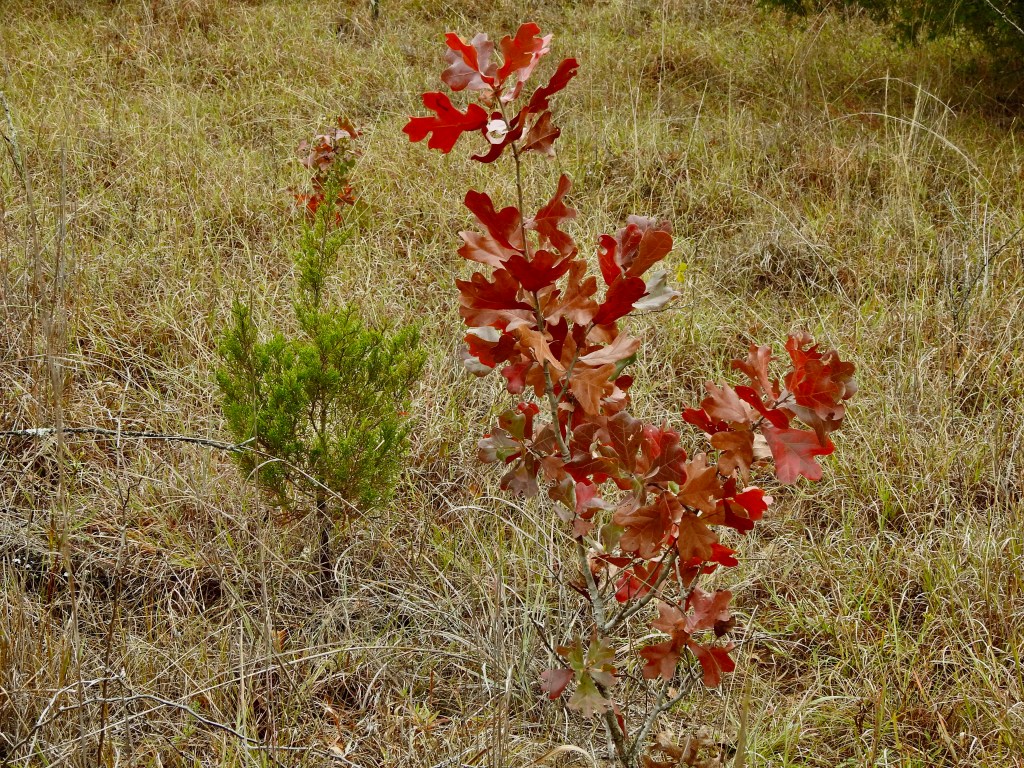
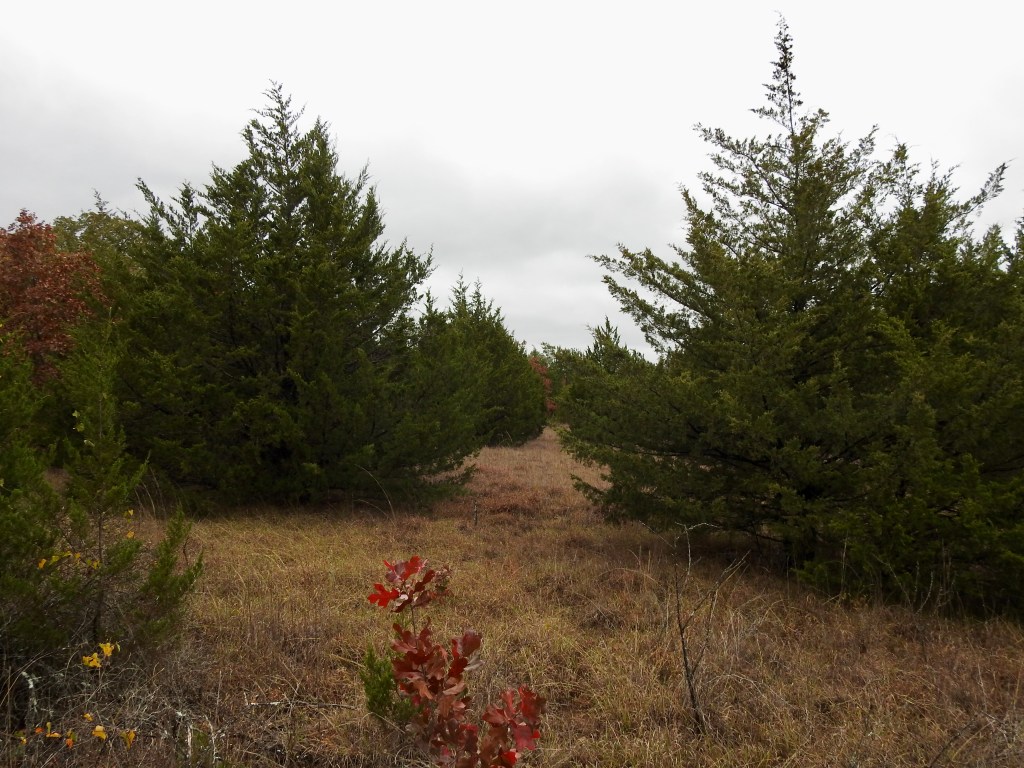
Some oak leaves were changing color, and it seems that along this trail it is smaller oaks, seedlings and saplings, that are most likely to turn. We followed the trail through yellow grasses, deep green junipers, and a few oaks with splashes of color.
A young blackjack oak with a lipstick smear of red
Further along, through the reddish sand and mud of the trail, we reached a spot where a short detour from the trail brought us to a little pond. Like the earlier place on the trail, this was a spot with memories attached to it. A couple of years ago I watched the late afternoon sun reflected off ripples in the pond, creating ribbons of light on the opposite bank in the dark shade of junipers and other trees. I wrote about those few minutes of small-scale wonder in the book on mindfulness in Texas nature that is now in the publication process.
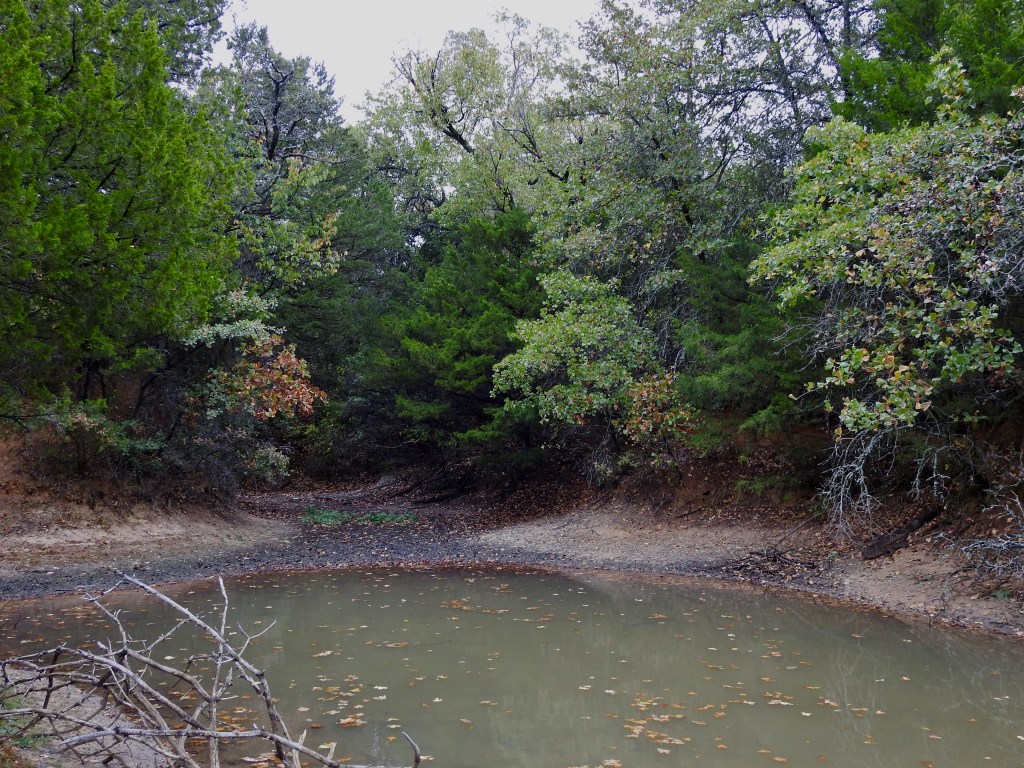
The little pond, even smaller now due to the ongoing drought
Mindfulness is one of the things we touch on in walks for the LBJ Grasslands Project. People can visit the grasslands in a lot of ways including mindful attention and also a science-based intellectual analysis. My earliest visits were focused on finding and observing reptiles and amphibians, with thoughts and discussion with companions about where they might be, how species interact with each other, looking for characteristics that allow us to identify species and subspecies, and judgments about whether we were successful in the field. Birders, botanists, and other specialists can be caught up in much the same kinds of intellectual activities. A lot of good can come from such observing and questioning.
However, I found that it was important for me to set aside time to experience the grasslands directly, without filtering it through the lens of intellectual understanding or the success of my searching. I spent more time practicing mindfulness – being more quiet inside and out, not letting thoughts snag me away from what was happening right here and right now. Maintaining my attention on sights, sounds, and even smells and touch would make a walk more vivid and detailed.
In LBJ Grasslands Project walks, we make time for several ways to experience the prairies and woods, including some discussion and nature interpretation, and some time for mindfulness (especially when participants say they would like to spend some time on mindfulness practice). And we encourage participants to express themselves about what they have experienced. Nature journaling is an opportunity to reflect on our time in nature, often making that time more meaningful and consolidating memories. Sometimes people write a letter to the grasslands, and that often brings out expressions of gratitude and a sense of relationship to the place.
Junipers surrounding a little oak
Today’s walk was cold, yes, but also beautiful. When the grasses and trees are wet from rain or fog, their colors are often deepened. It was quiet and we seemed to have the place to ourselves (not that it is ever crowded), bundled up and delighted with the world around us.
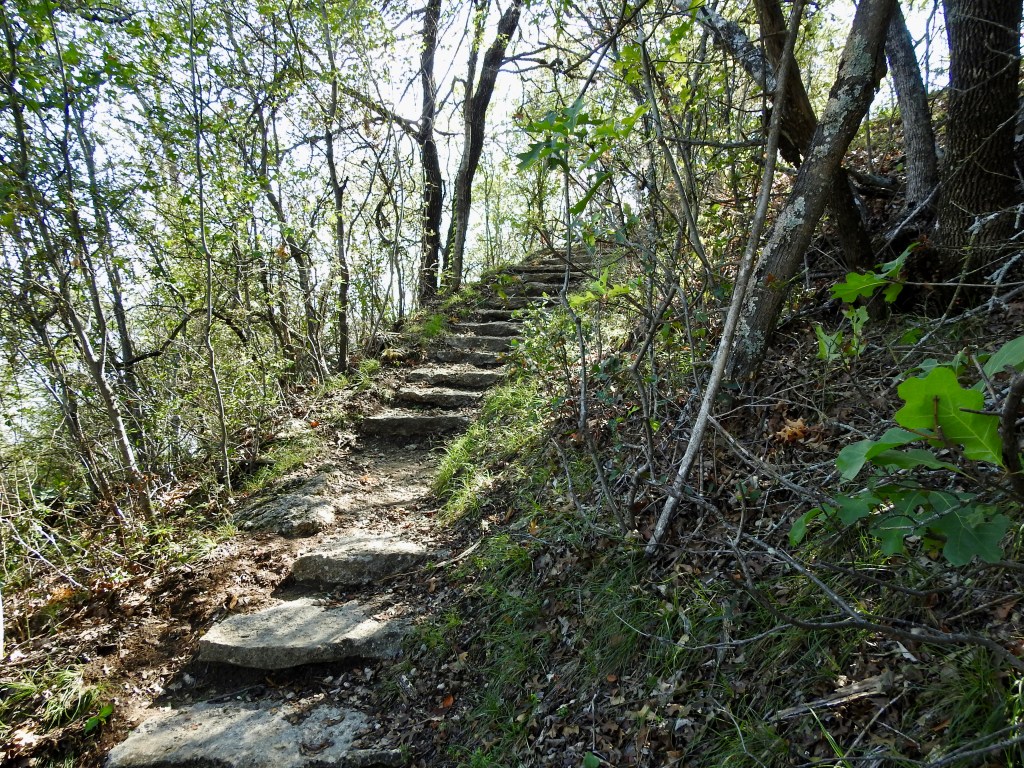
It was a sunny mild autumn day and impossible to stay inside, and so I climbed up to the ridge at the Fort Worth Nature Center & Refuge to visit Lone Point Shelter. The narrow path hugs the ridge, and on the last part you climb a series of stone steps.
Lone Point, when built by the Civilian Conservation Corps in 1935, offered a wooden roof as shelter, but now all that remains is the rock framework. Still you can sit on the inside rock ledges like benches, perfect for having a snack or writing in a nature journal.
Historic photo, from a sign at FW Nature Center & Refuge
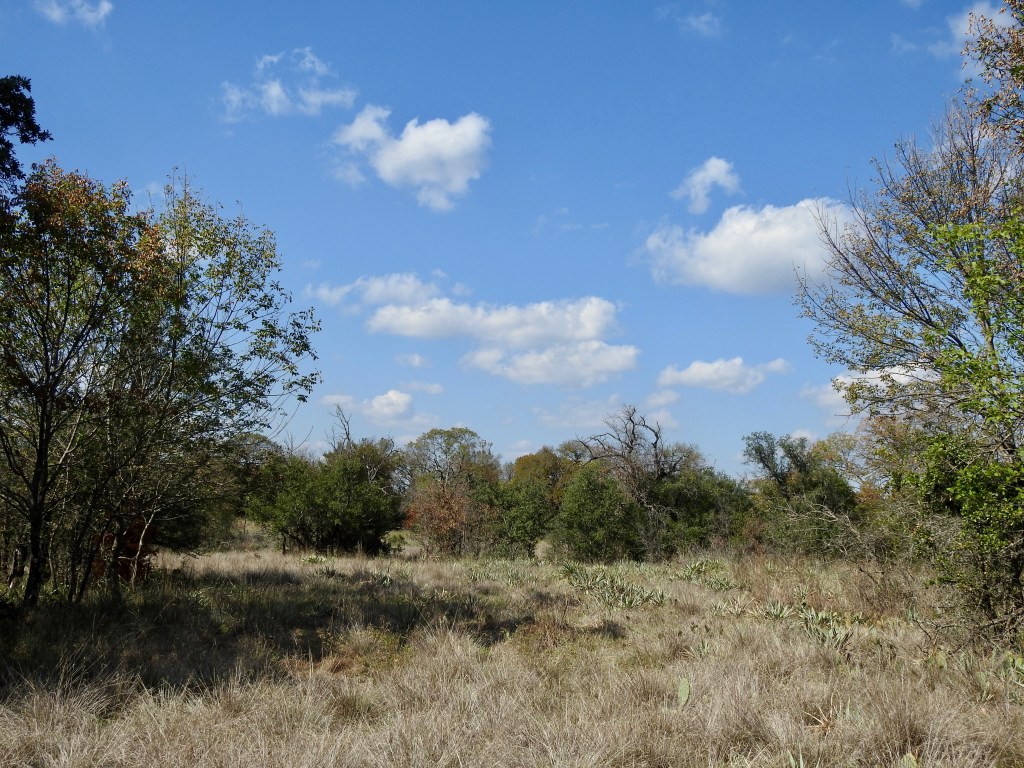
I sat on the rock bench at 2:22pm, and it was sunny with scattered puffy clouds and a slight cool breeze. It was 74 degrees (and 46% relative humidity, according to the thermometer/hygrometer that I carry with me). Back to the northwest and away from Lake Worth, the trail circles a beautiful savannah with live oak, cedar elm, and open areas with grasses, prickly pear cactus, and Arkansas yucca.
Butterflies were everywhere – small yellow ones flying along the ground, bigger ones with pale yellow or brilliant yellow-orange bouncing among the yucca and cacti, American snouts, a red admiral, a hackberry emperor, and a big swallowtail (probably a tiger swallowtail from my glimpse of the yellow and black pattern before it disappeared around a possumhaw bush.
An American snout (lower center), camouflaged among the fallen brown leaves
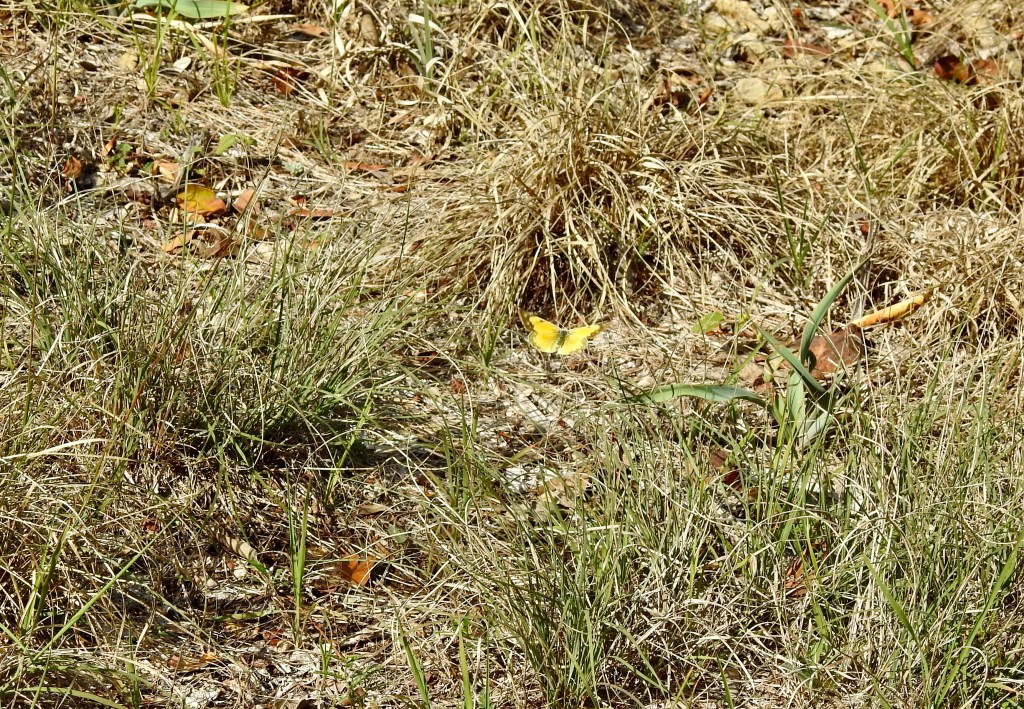
A clouded yellow butterfly caught in flight
I chewed a few juniper berries, which I think were not fully ripe but they did have a little of that wonderful aromatic taste. It was warm (79 degrees) but still very comfortable, and the sky was a clear and fairly deep blue. I walked back to the Lone Point structure thinking that today was really remarkable and feeling very grateful.
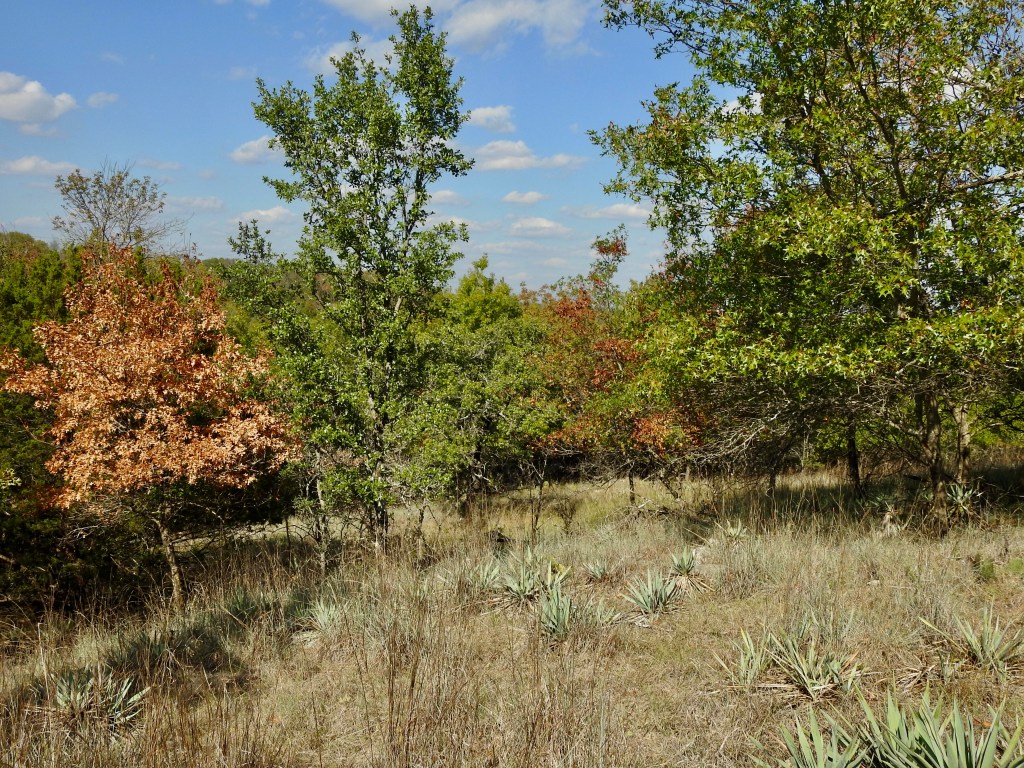
Here the savannah slopes down toward woodland
A common buckeye
I would gladly have stayed, watched the shadows lengthen and seen the sunset, but the refuge was going to close. I looked around and this beautiful place a little more, got a glimpse of Lake Worth below the ridge, and headed back down toward home.
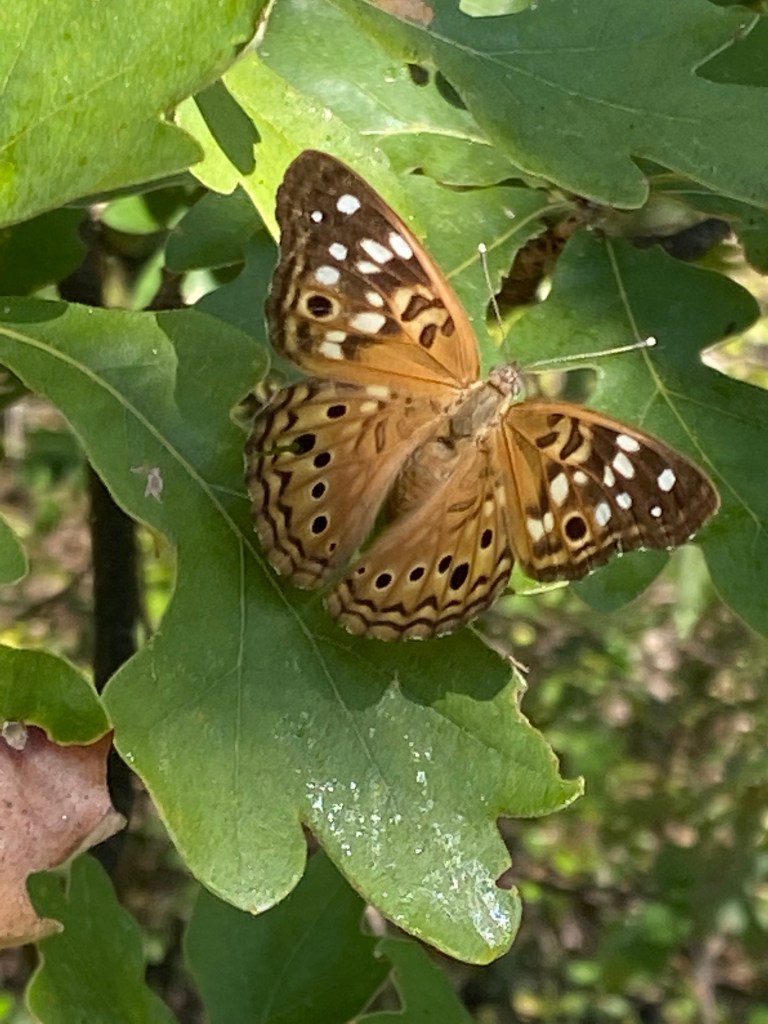
Sounds strange, right? What exactly is running around trying to be ruler of the woods? Butterfly folks know that the hackberry emperor is a butterfly whose earth-toned wings are beautifully spotted, not bright and showy like monarchs or fritillaries, but really lovely nonetheless. They are called hackberry emperors because the hackberry tree is the host plant that feeds the caterpillars of this species.
A hackberry emperor
Anyway, today the woods were alive with butterflies, mostly hackberry emperors but also snouts and others. There were small yellow butterflies and little gray-white ones flying near the ground. It was one more sign of autumn, as butterfly activity ramps up.
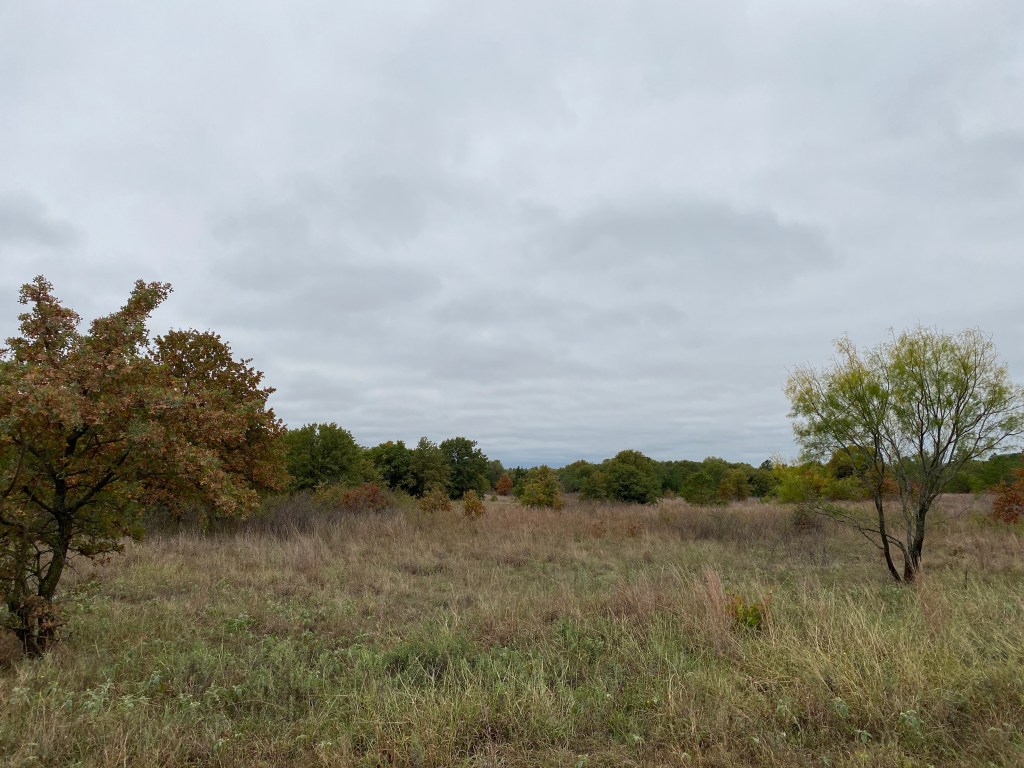
This afternoon I was at Sheri Capehart Nature Preserve, the wonderful little remnant of Eastern Cross Timbers in Arlington and an oasis for butterflies and many other things. It has been a difficult year at the preserve, full of drought and record high temperatures. Then, briefly, there was drenching rain, and a return to drought.
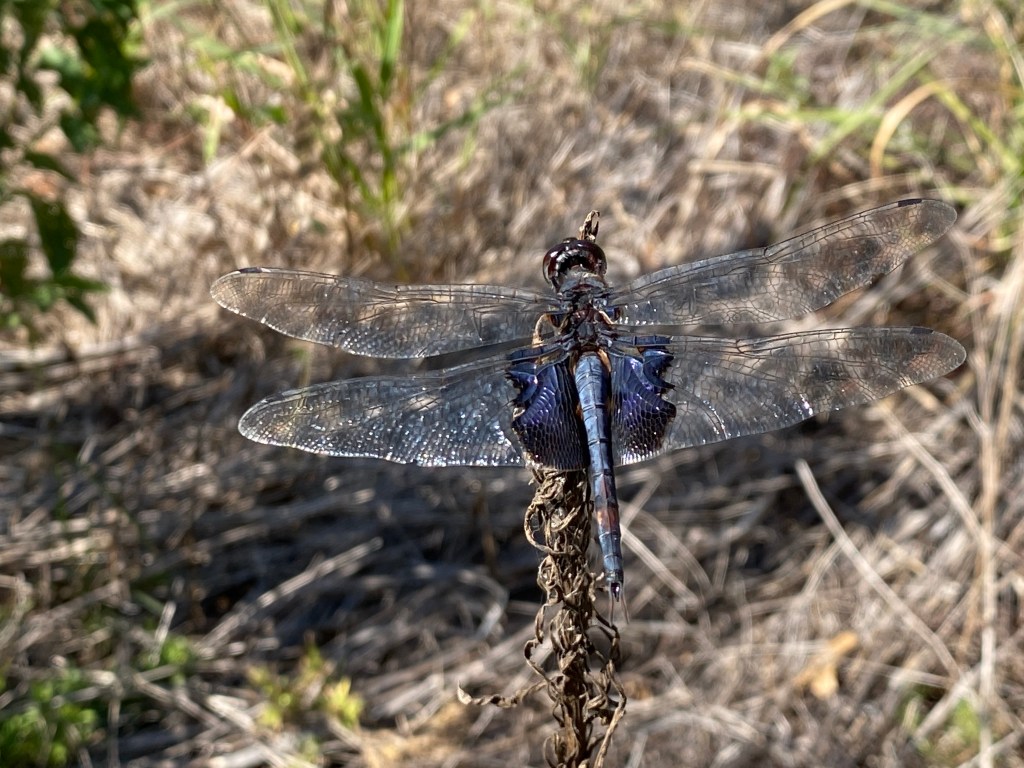
The water level in the north pond was low today, lower than I have seen it in quite a while. I could see the bottom, or at least could see the ragged layer of reddish algae growing along the bottom. Above the water were dozens of dragonflies darting and dipping, floating on the air and perching on twigs and reeds. They brought to the pond what the butterflies brought to the woods: a sort of dancing, whirling energy.
A black saddlebags, a species of dragonfly (note the dark “saddlebag” patches on the wings)
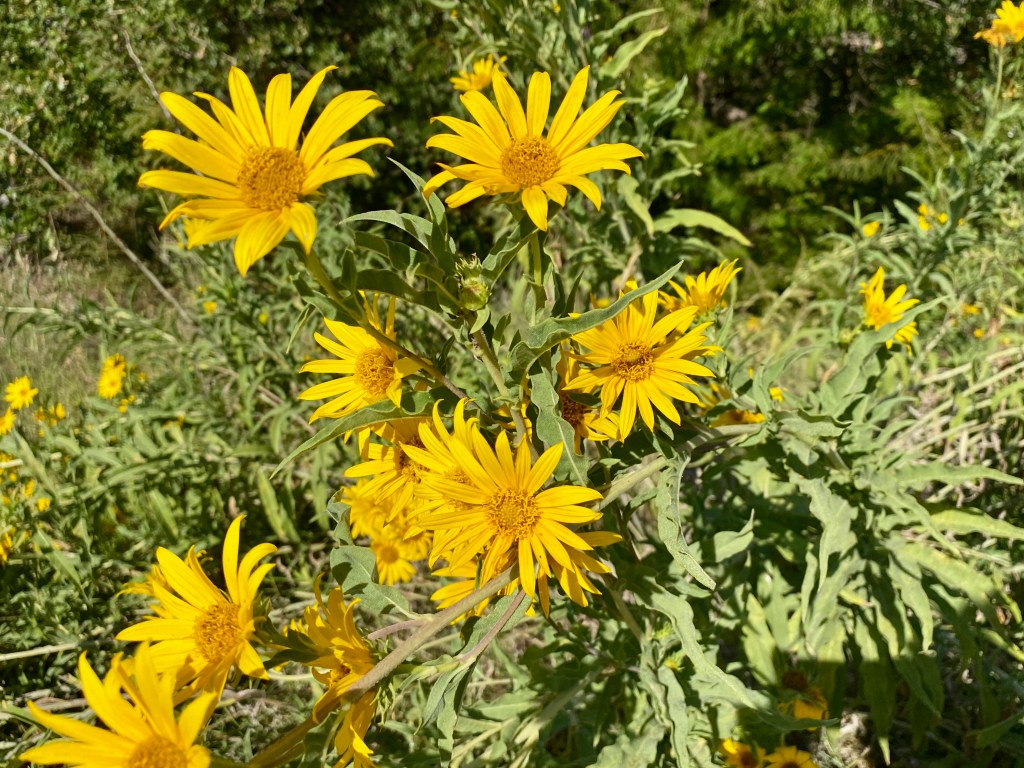
There was one last bit of autumn, adding just a little more charm to this afternoon with the sun at a low angle and cool breezes moderating the warm sun. Maximilian sunflower, a native prairie plant that blooms at the end of summer through the fall, was blooming at the preserve. Those clusters of big yellow flowers are a beautiful sight every year.
The change of seasons can be imperceptible when one day is mostly like the last one. Sometimes, though, there is a day that feels like change has come. September 11, this year, felt that way, and the LBJ National Grasslands was a great place to greet the new season. I drove toward Decatur in early morning, with the nearly full moon watching over me and the sun rising as an orange disk on the other side of the sky. But to the northwest, a blue-gray deck of clouds inched toward me. I reached the edge of the clouds at Decatur and left the moon and sun behind.
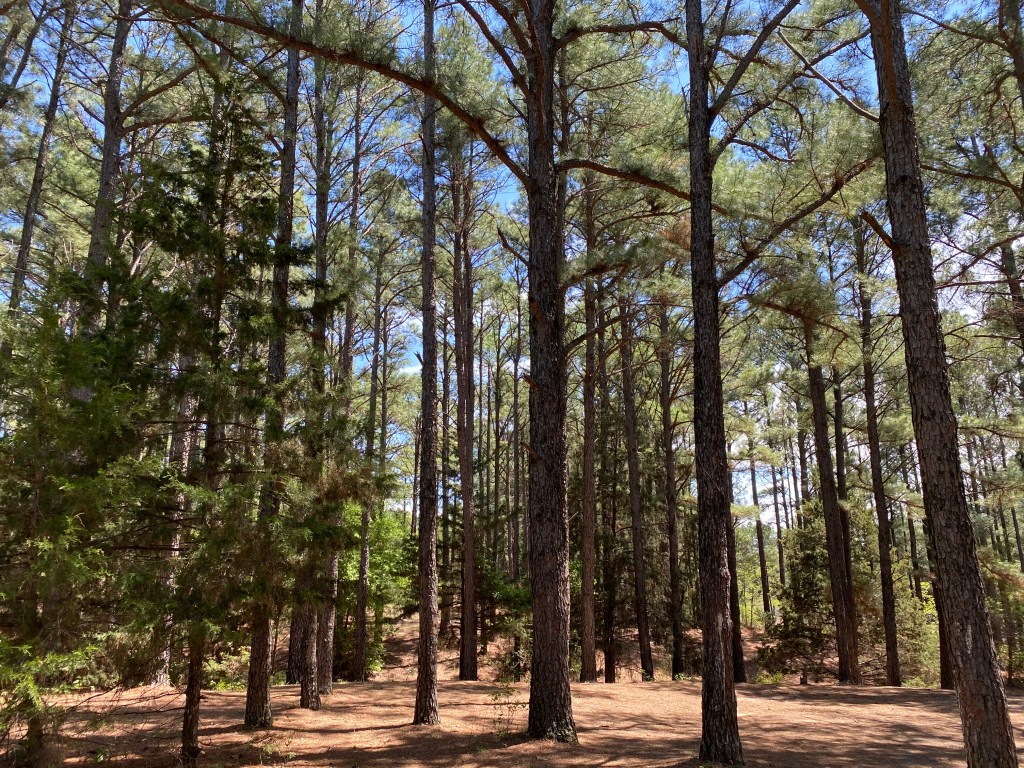
In a small pine grove east of Alvord, the pine trees swayed in a cool breeze. They made a beautiful sound like water rushing as each wave of air poured through the pine needles. My thermometer registered 66 degrees, and we stood under the trees with one of us commenting that she was glad to have a jacket.
There was Dana, Erika, Carol, Carla, Kayla and me, most of them Master Naturalists and all of us naturalists in the sense of people who study the natural world and who return time and again to be lovingly, gratefully immersed in it. Kayla and I have started a community we refer to as the LBJ Grasslands Project in which we can be immersed in the grasslands, online and in small group visits there. The walk in the grasslands on September 11 was one of those visits.
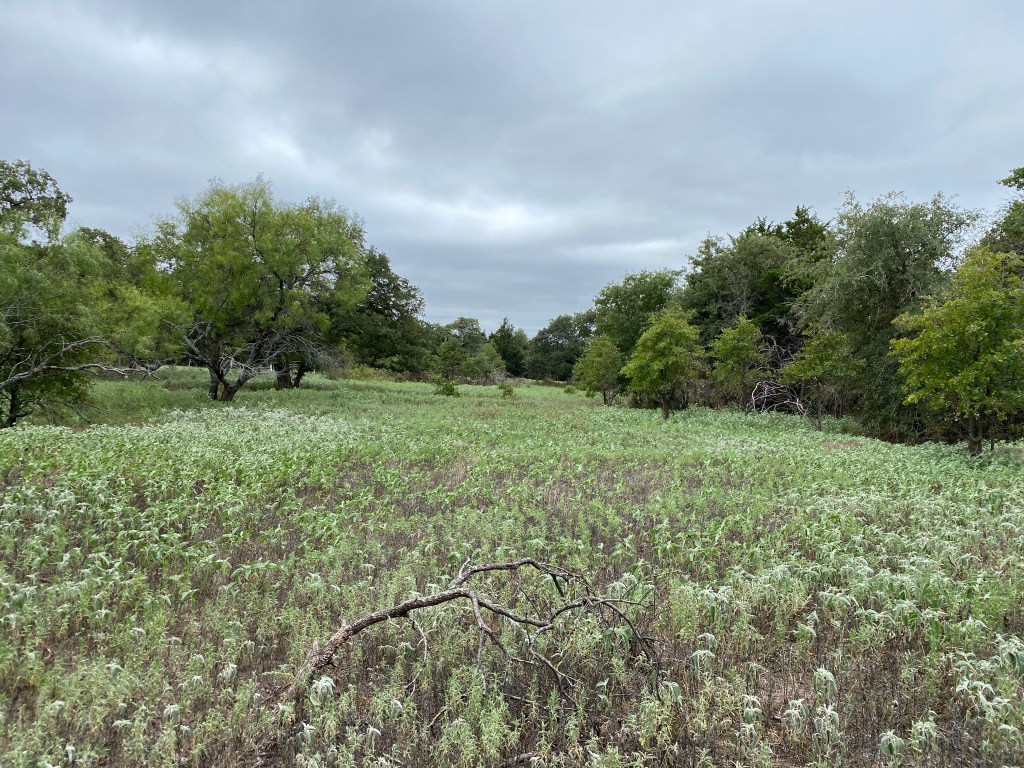
A field with lots of croton
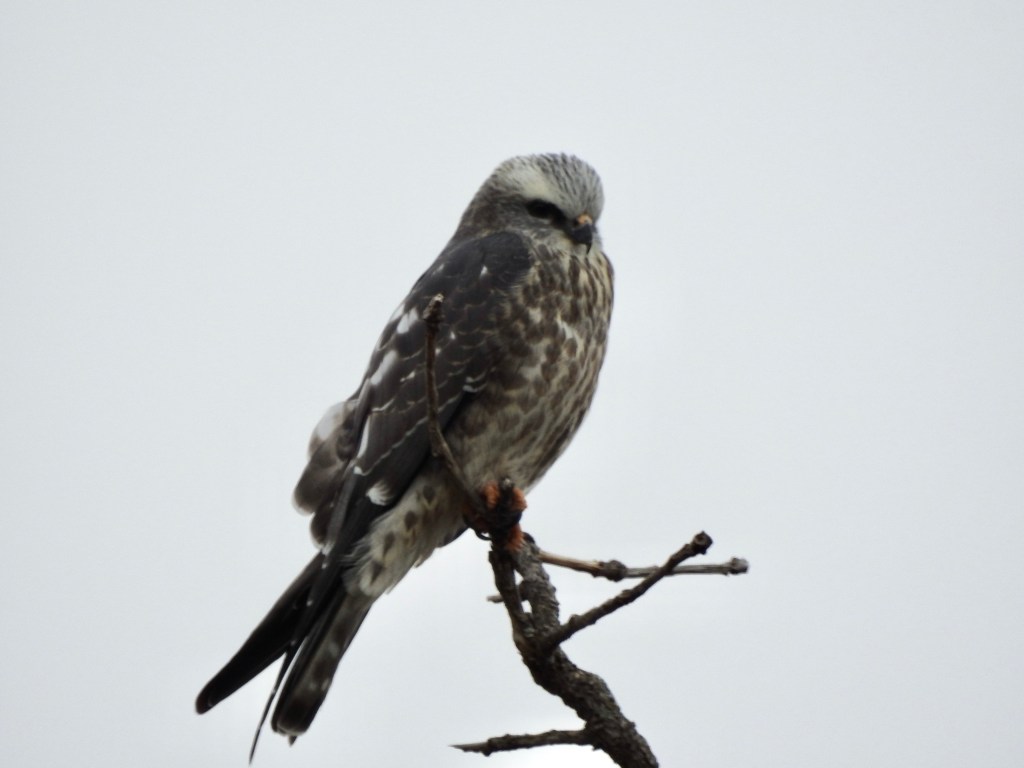
Under the deck of gray clouds we began walking across open prairie patches and through areas of oak and juniper woodland, looking at the green growth after the prescribed fires from some months ago. Very soon after the fire the new growth had appeared, but the grasslands then had to endure months of heat and drought. The recent rains triggered something like a second spring, with lots of new green vegetation and beautiful flowers. Some of the meadows were full of croton, also known as “dove weed” or “goat weed,” and those fields had the different texture and color of those grayish green leaves. Kayla examined branches for lichen and found several beautiful varieties. Then we looked up in a dead tree to see a young Mississippi kite perched there, watching us with little apparent concern. We took photos and wondered if that brown-streaked bird was really a kite. As we did so, I noticed that the clouds were beginning to break up and the sky beyond was a beautiful blue.
A juvenile Mississippi kite
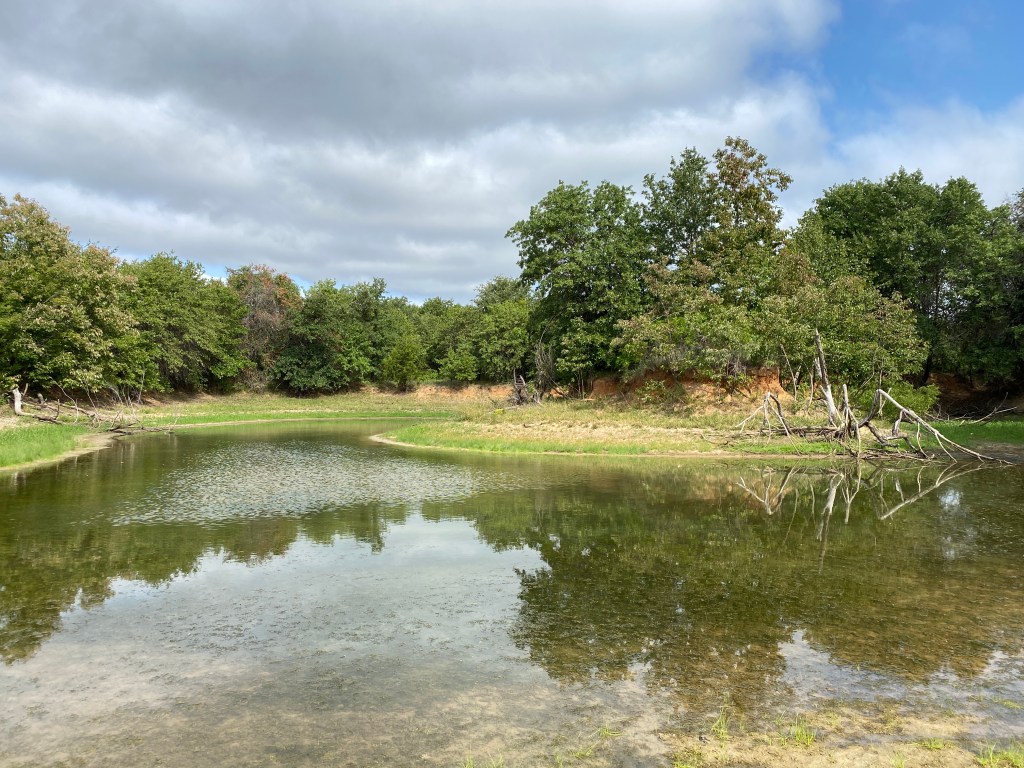
We came to a couple of small ponds within an area where the sandy soil was eroded and scooped out. One of the ponds had what was nearly an island, a steep mound on which several trees grew, including some persimmons. Most of the developing fruits were green, but I found a ripe one and ate part of it. The texture was a little like plum and the taste was vaguely peachy. What a wonderful place this was!
The boundary of this little place was a low eroded embankment where the woodland gave way to the basin that held the pond. My companions were scattered near the pond, sitting quietly to write something about what we were experiencing. A breeze came down and stirred a patch of ripples in the water. Above the embankment, some sumac was starting to turn red, and the oak trees moved with each current of air. Those trees sheltered so much life in feathers, scales, chitin and fur. Above the tree line, soft clouds drifted and the sky behind them was deep blue shading to pastel toward the horizon. In the distance, a group of crows fussed at something.
This is the part I love the most – quiet, wordless moments just taking everything in or reflecting on where we had been. A member of our group wrote about the quiet, the rippling water and “sense of separation from today’s world.” This is a place of refuge from cities and never-sleeping machinery. This is a sanctuary in which we can be still, feel the sun’s warmth and the soft breezes, and listen to birds. I didn’t want to leave. I wanted to sit among the bitterweed and sedges and talk with the cricket frogs.
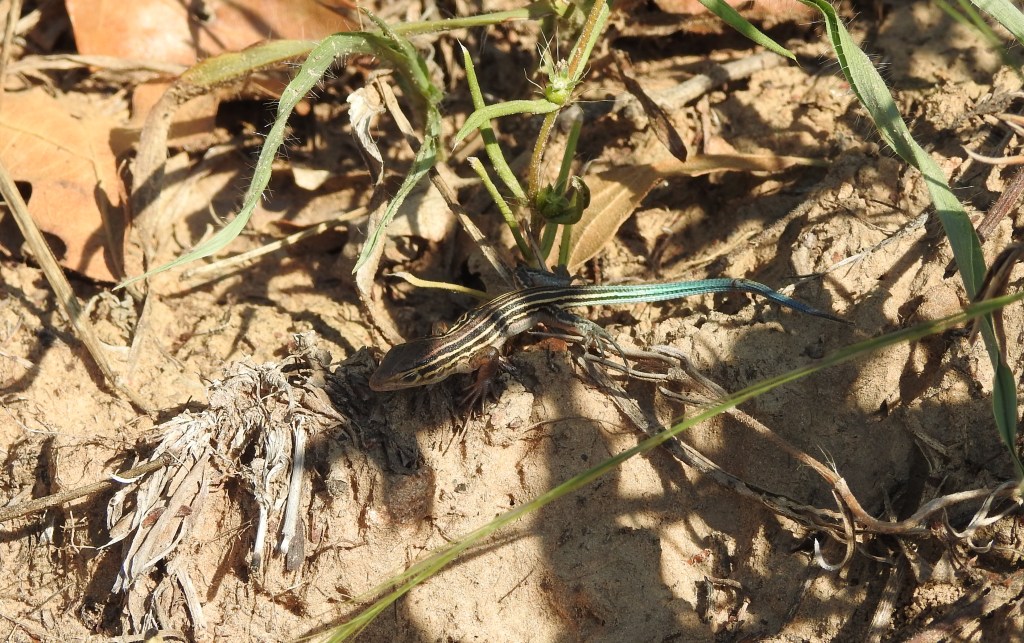
A hatchling whiptail lizard, either a prairie racerunner or spotted whiptail
The time came to an end, however, and we started back. Somewhere we noticed some movement in the leaf litter and I was enthralled with a tiny striped lizard with the most beautiful blue-green tail. Stripes and blue tail send my mind immediately to the thought that it was a baby skink, but the details of body form and pattern made clear that this was a newly hatched whiptail lizard. A couple of us watched as this tiny reptile hunted invertebrates under the leaves, biting and shaking and then chasing the ant-sized insect again. I was grateful that he or she decided to ignore us and continue hunting as we watched. Just another moment of fascination and beauty within these woods and prairies.
More summer-like days will come, but the sun is lower in the sky now and the heat of the day is nothing like July. There will be more walks as we slip into autumn. I look forward to joining friends for another day at the grasslands.
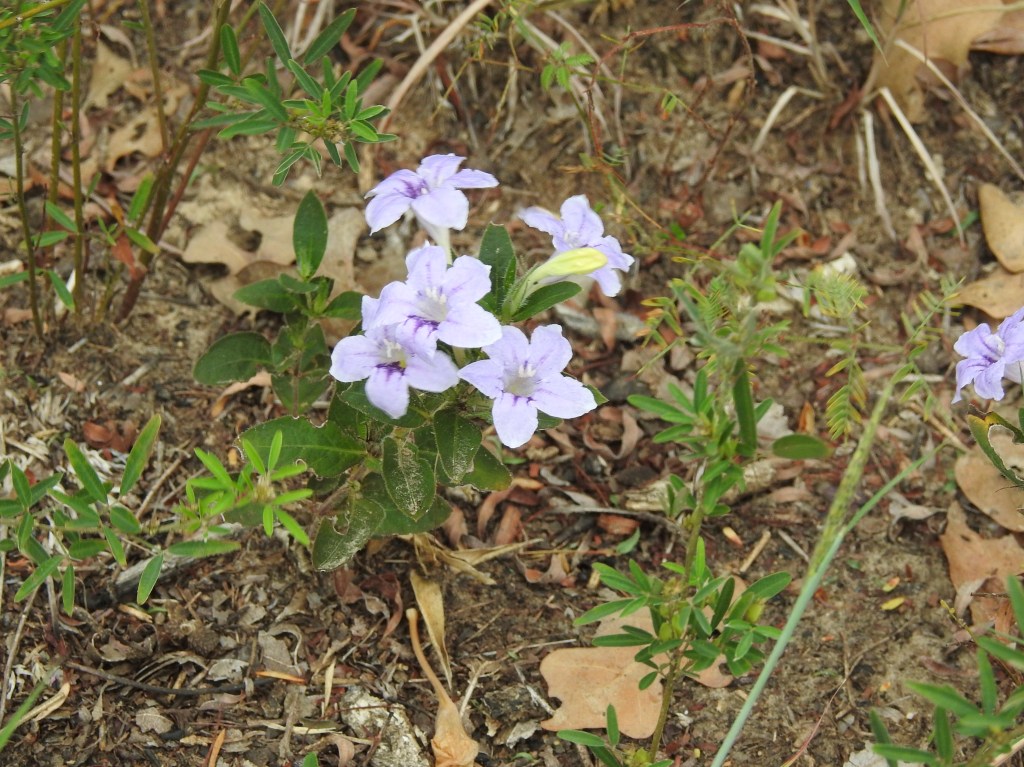
Hairy ruellia, a kind of petunia, grew here and there in woodland openings
Yesterday, August 20th, several of us took a walk in “Unit 30” of the LBJ National Grasslands, and afterward I wrote this letter to the grasslands. Writing to the grasslands might seem odd. We often think of it as an inanimate “thing.” Why write words to something that has no comprehension? And yet, we speak or write to those with whom we have a relationship, and writing to the grasslands acknowledges that relationship. It affirms the feeling and connection that is present when I visit there.
The pine grove, a beautiful, non-native oddity within the grasslands
Dear Grasslands,
I came to see you today, a little unsure of what I would find. After a brutal summer of heat and drought, could your oaks and greenbriers still be green, and could most of the lives you support still fly, jump and swim in something like the abundance and beauty that I’ve seen in all the previous years that I have known you? All of that wonderful, amazing life, and the breezes that come to the ridges and hills, and the bright sparkling ripples on the winter ponds, those are your gifts. Like a generous friend, like a nurturing mother, you offer those gifts to anyone who comes to visit.
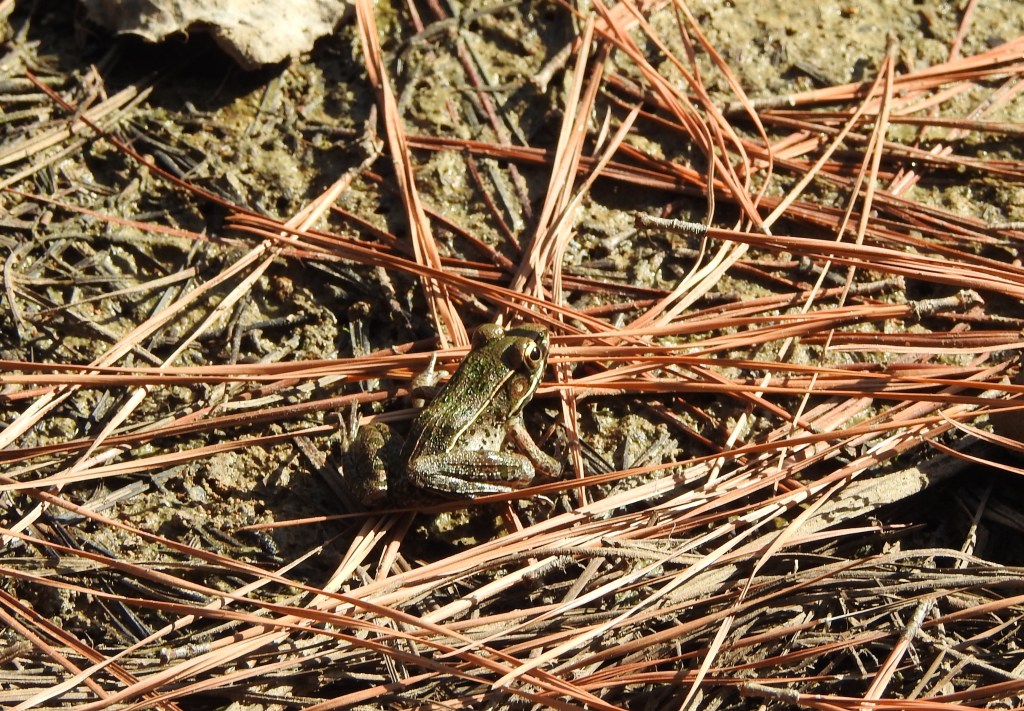
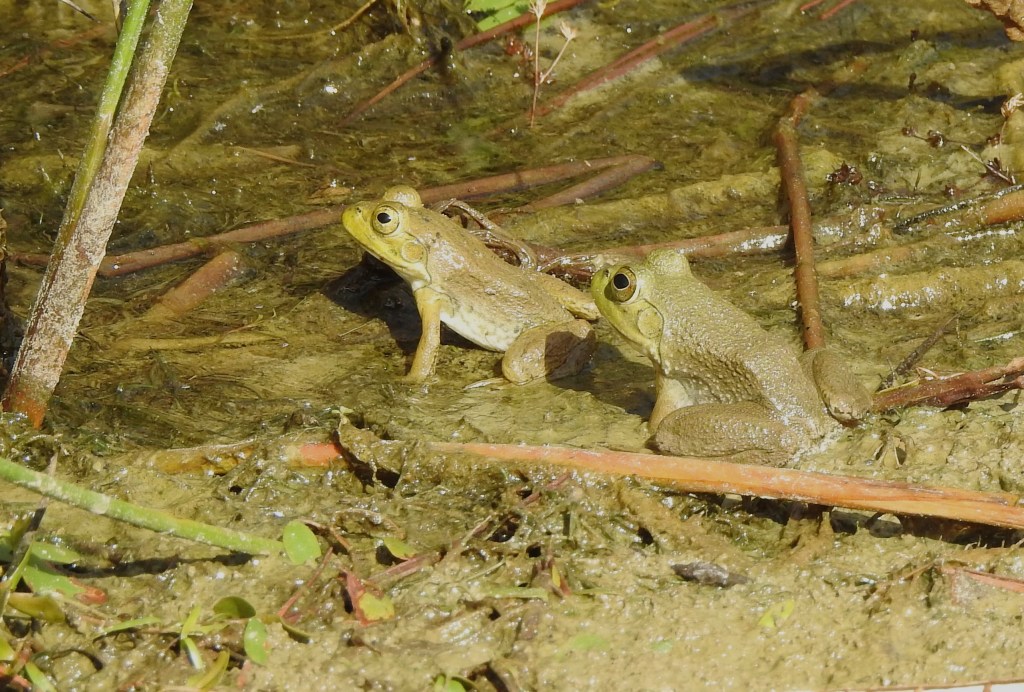
Several others came with me to get acquainted with you and experience some of those gifts. Gale, Cecily and Jim walked under those pine trees and investigated your ponds, reduced to smaller versions of themselves by summer’s drought but still home to so many frogs. As always, they break out of their camouflage and bounce frantically into the water when we come close, only occasionally giving us a glimpse of spotted skin, or pale green shading into a brighter color, or a mud-gray bumpy little cricket frog. These frogs were showing us that you were still full of life, and never more obviously than at your ponds.
Leopard frogAmerican bullfrogs
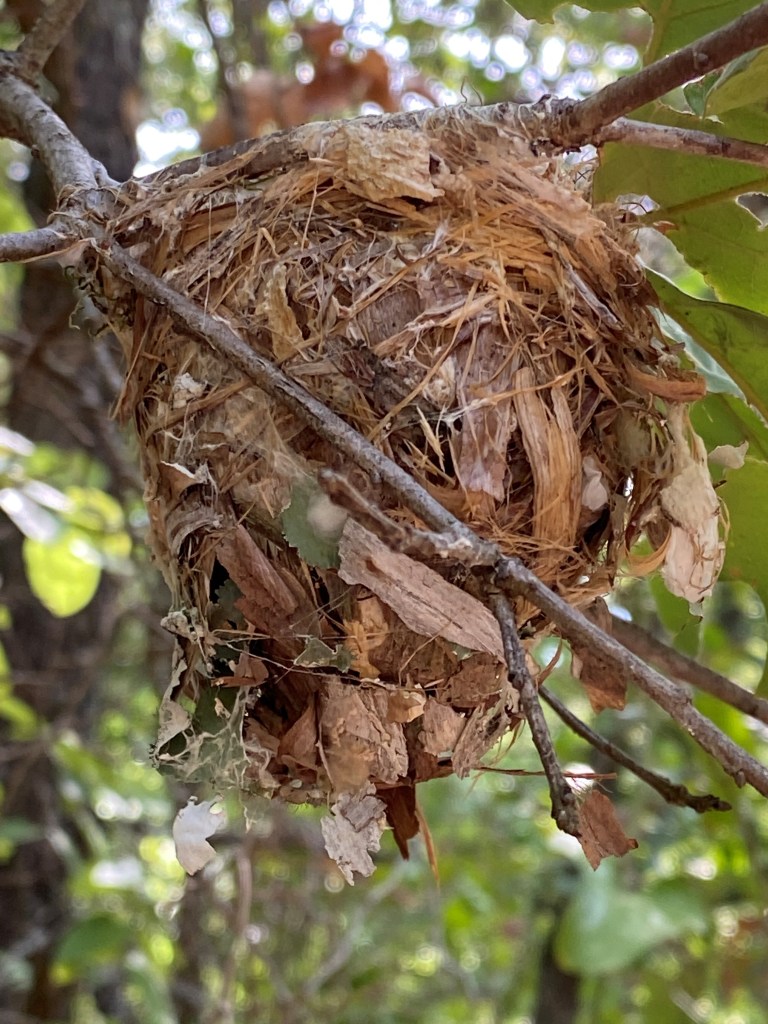
We followed one of the trails leading away from the ponds and into oaks, junipers, and pocket prairies. Jim found a small pouch of a bird nest hanging from the delicate ends of tree branches. We spent some time appreciating all the different materials that had been gathered and woven into this little cup. There were bits of leaf, lichen and grass creating a sturdy little shelter for a delicate egg and a tiny bird who embodied both engineering skill and attentive nurturing of new life.
Bird nest
The nest was, as I see you, a sort of fractal of who you are. Each part repeats the overall pattern of the whole grasslands. Here, you are warm feathered life with skill and determination to keep life going. There, you are cool aquatic life with jeweled eyes and an entrancing nighttime voice, re-creating life through egg, tadpole, and adult frog. Everywhere you look – and listen – there are individual lives doing fascinating and beautiful things to keep life going.
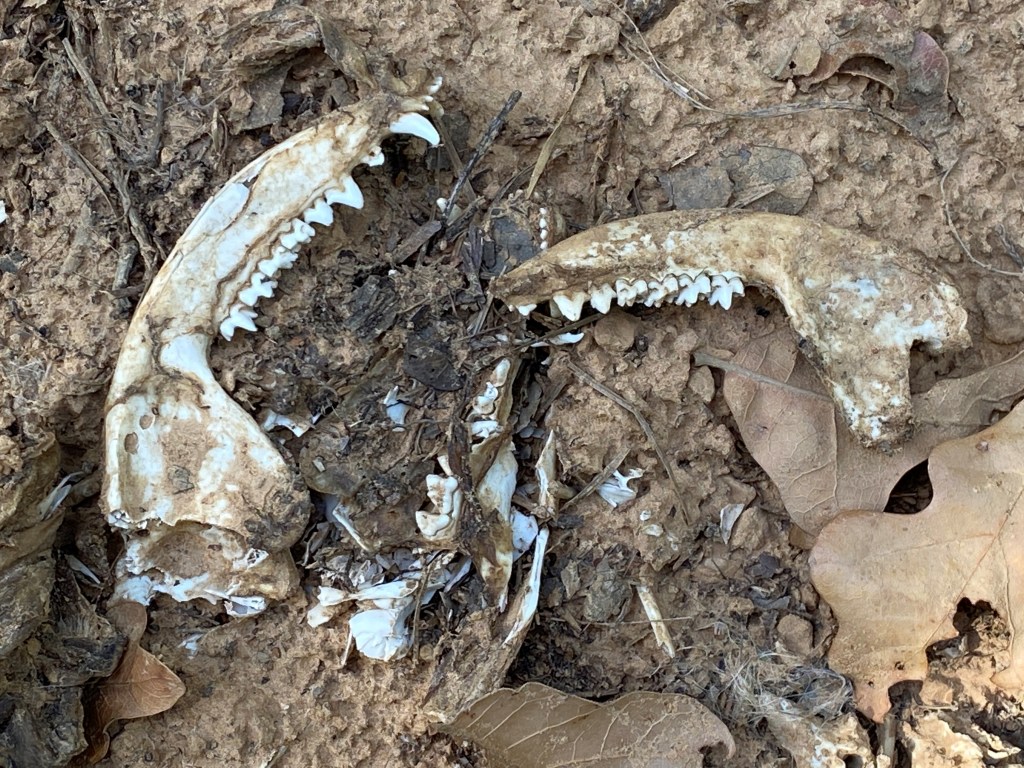
And we look at any part of you from another angle and we see the other part of life’s story. This time, it is life surrendered, either to feed another life or when an individual life runs its course. We discovered parts of a skeleton on the trail, including two nearly complete lower mandibles of some small mammal with the teeth of a predator. A part of you, living and hunting and contributing to new life for a time, and then feeding others after his or her own life ended.
Bones and teeth
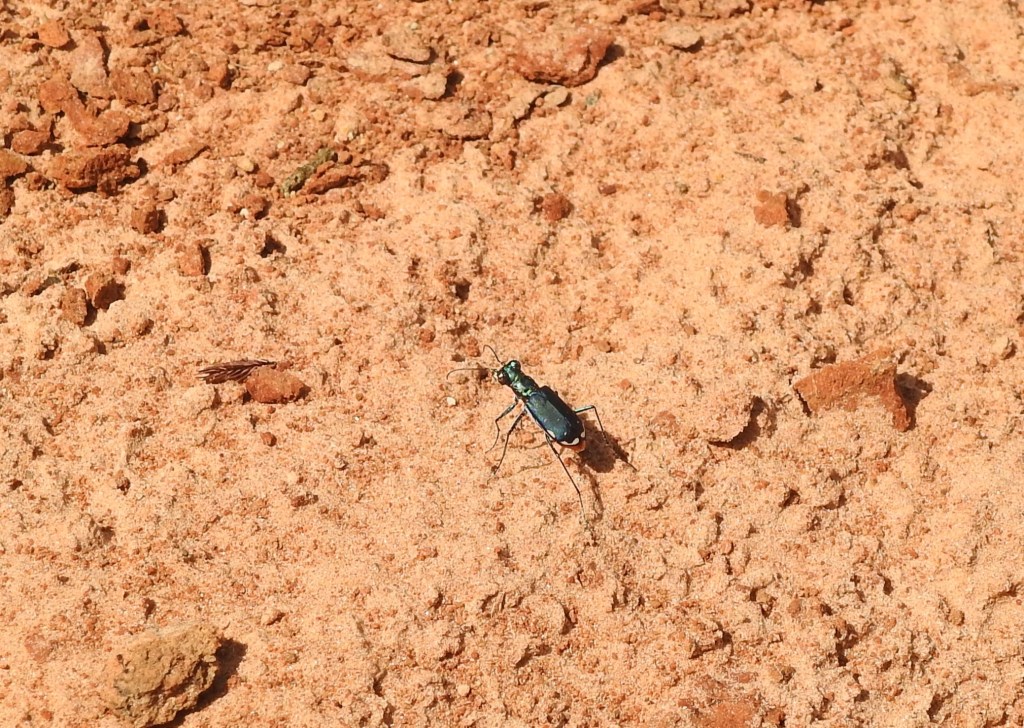
All along the prairie openings, grasshoppers jumped out of the way. They were a welcome sight after the prolonged drought that might have reduced their numbers and left so many animals without food. And we saw tiger beetles foraging along the sandy trail. Evidently there were enough smaller insects to keep those fierce little predators fed, too.
A tiger beetle
It was a privilege to visit you today and experience these things. It is encouraging to find resilience in a time when some things are falling apart. We might lose faith in the old, familiar patterns of the world, the continuing gifts of the world, without coming here and finding your generosity and predictability. Thank you.
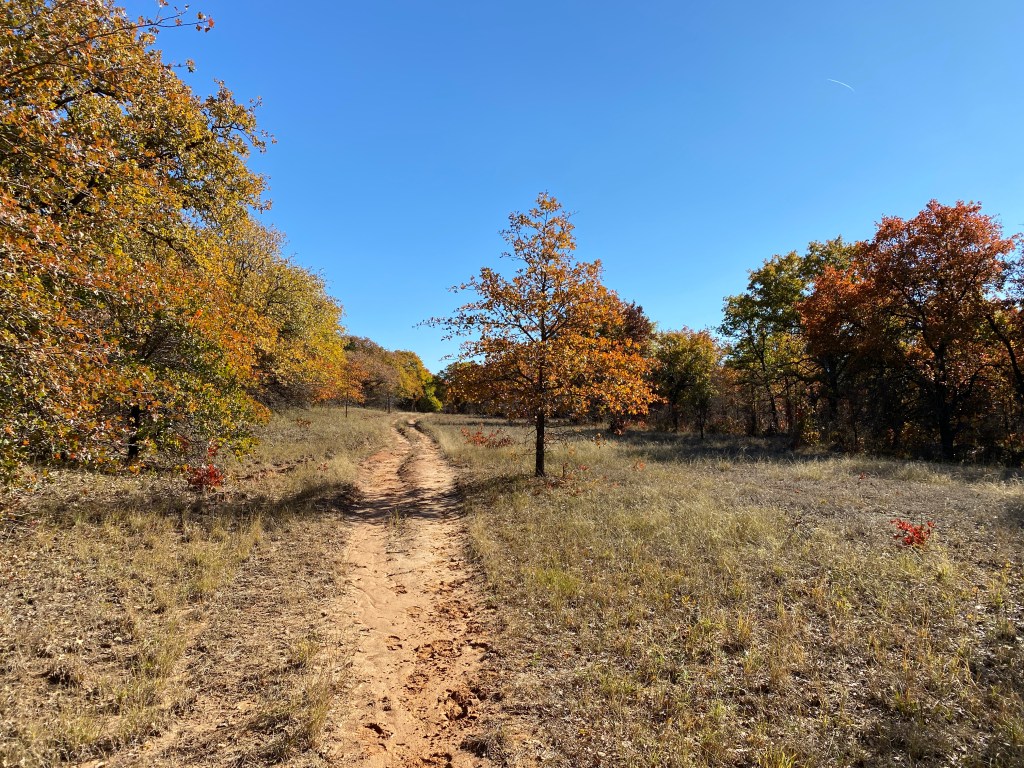
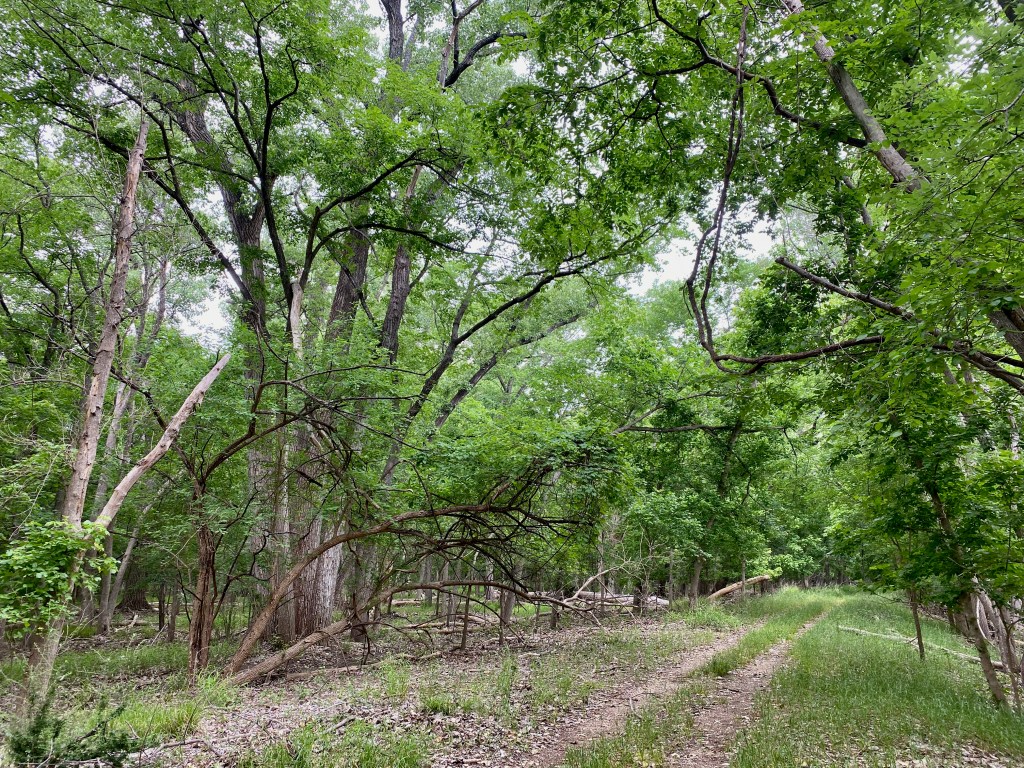
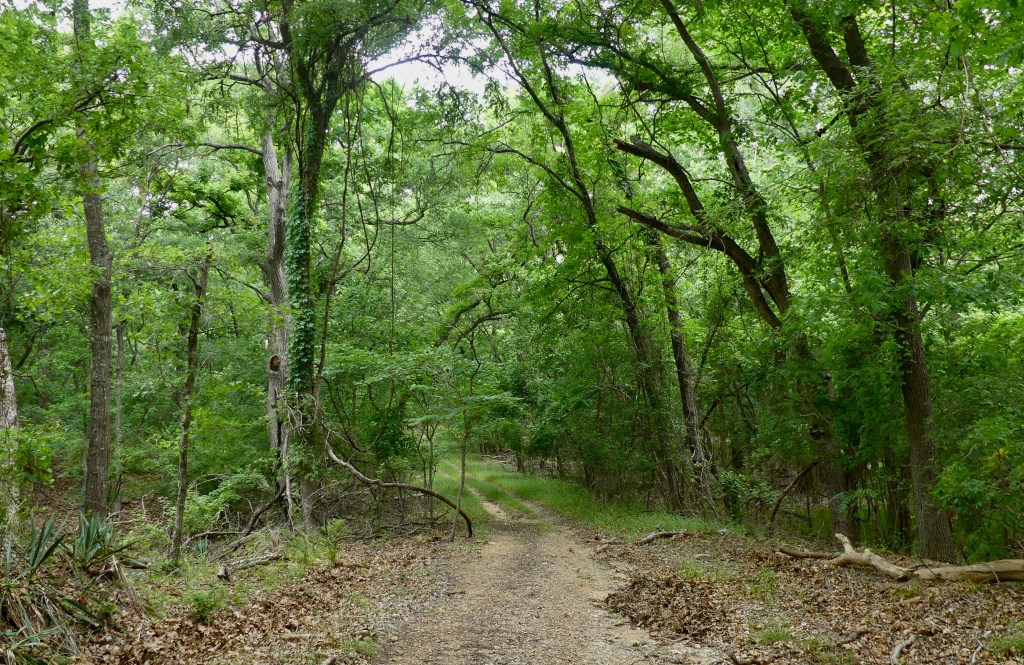
The road meanders ahead,
Slips easily through trees and dappled light.
Twin tracks through soil and grass
Disappear at the edge of sight.
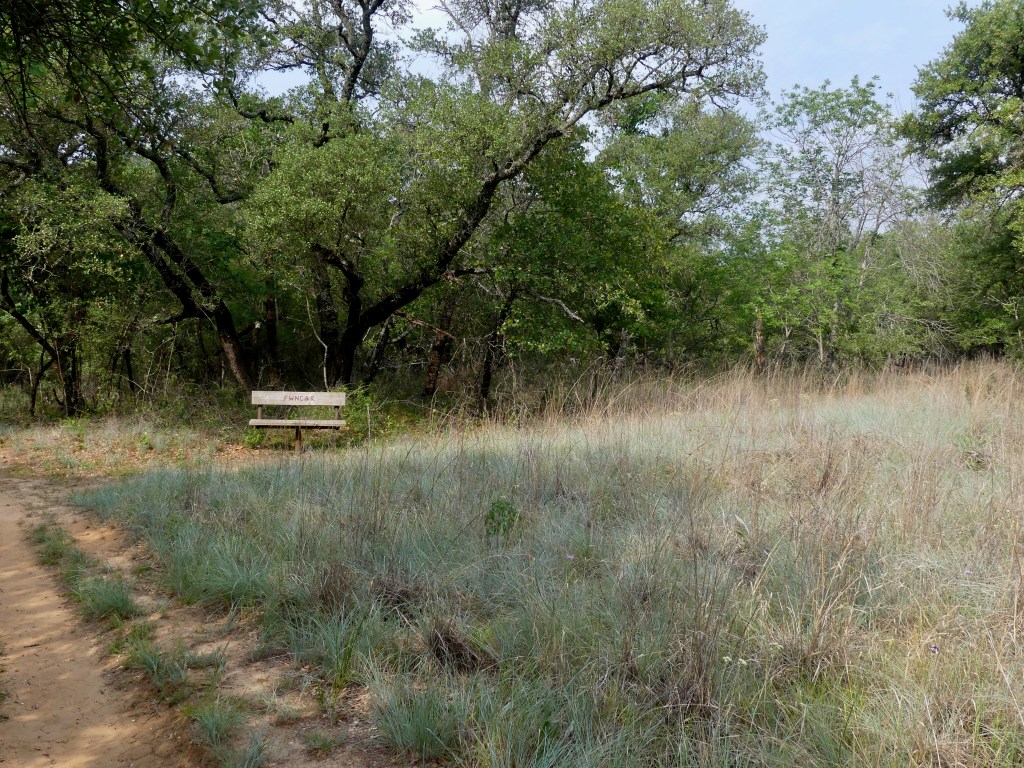
Today I followed some trails and roads at Fort Worth Nature Center & Refuge. I needed some time to sit at “my” bench, located in a little patch of live oak and bluestem savannah. Under a live oak, the bench faces a little patch of little bluestem and a nice community of other plants.
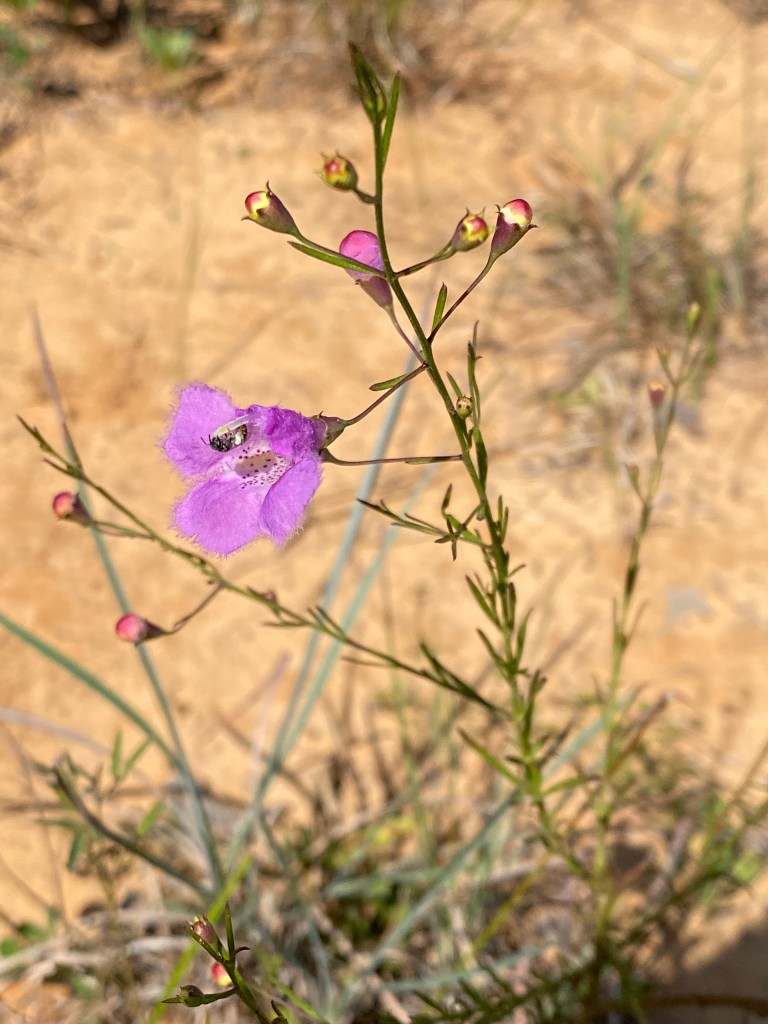
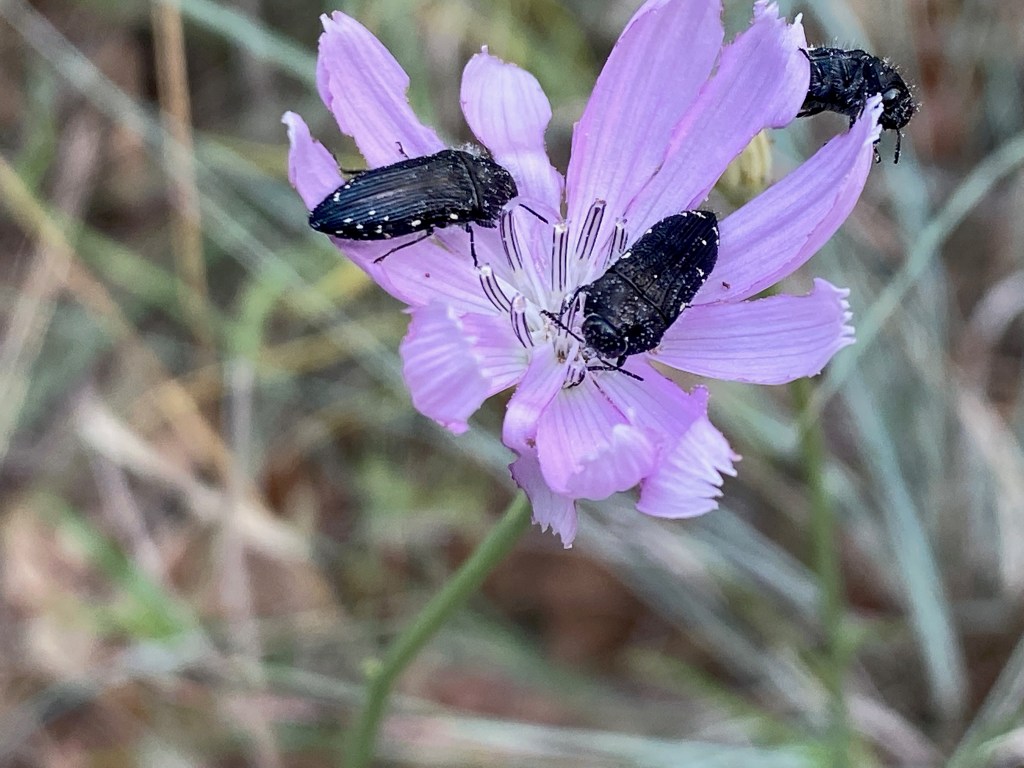
The first thing I noticed were a few scattered slightly purple-pink flowers on slender stalks; Texas skeleton plant, according to iNaturalist. Each of these flowers had several small beetles rummaging around within it. They appear to be a species of metallic wood-boring beetle (the larvae may be wood-boring but the adults seem to love flowers). This place is very familiar from my winter visits but it was delightful to find out how spring changes it. There were other plants – tall wooly whites with their clusters of flowers and a plant with clusters of long, oval leaves with red stems extending up into the central leaf vein.
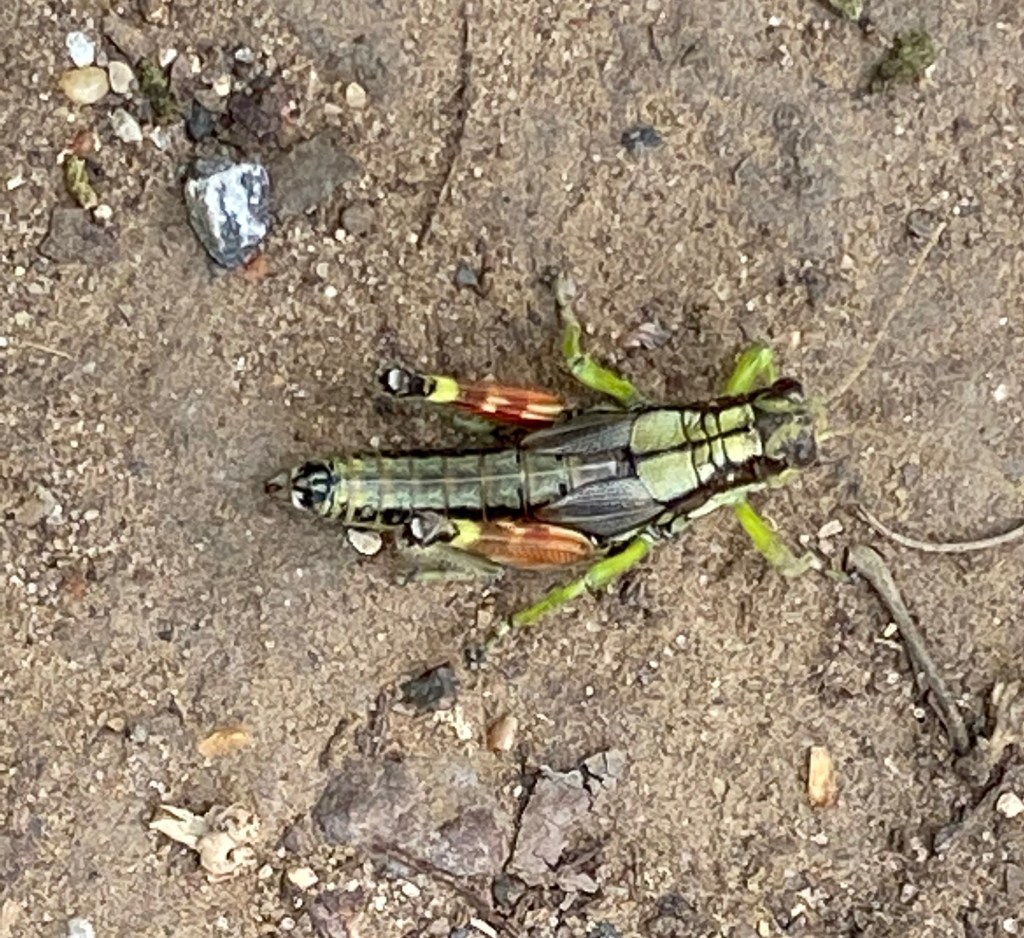
I also found a new grasshopper, identified by iNaturalist as a post oak grasshopper (and there were certainly post oaks nearby). Green and black striped bodies with orange and yellow back legs – wow, what a beautiful insect!
Birds were calling all around. There were northern cardinals singing, “cheer! cheer! cheer!” and one that sounded like “cheater-cheater-cheater!” I liked the first version best.
This road might bring us
To some new place full of mystery,
Or perhaps to a familiar spot
With bees and songbirds for company.
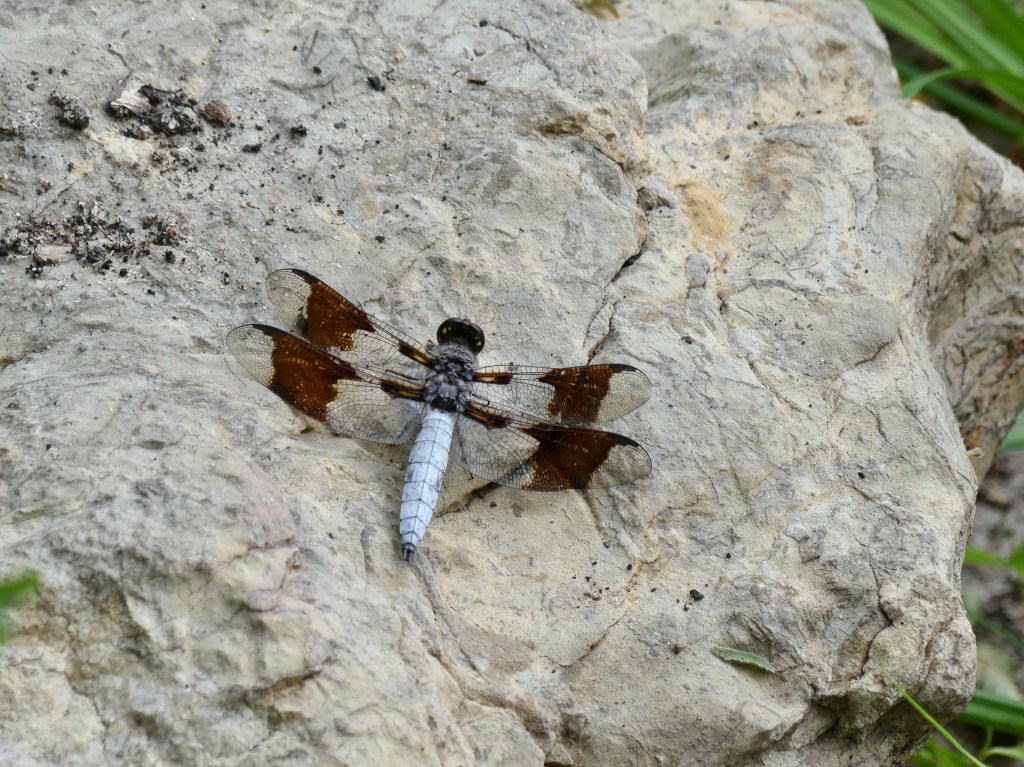
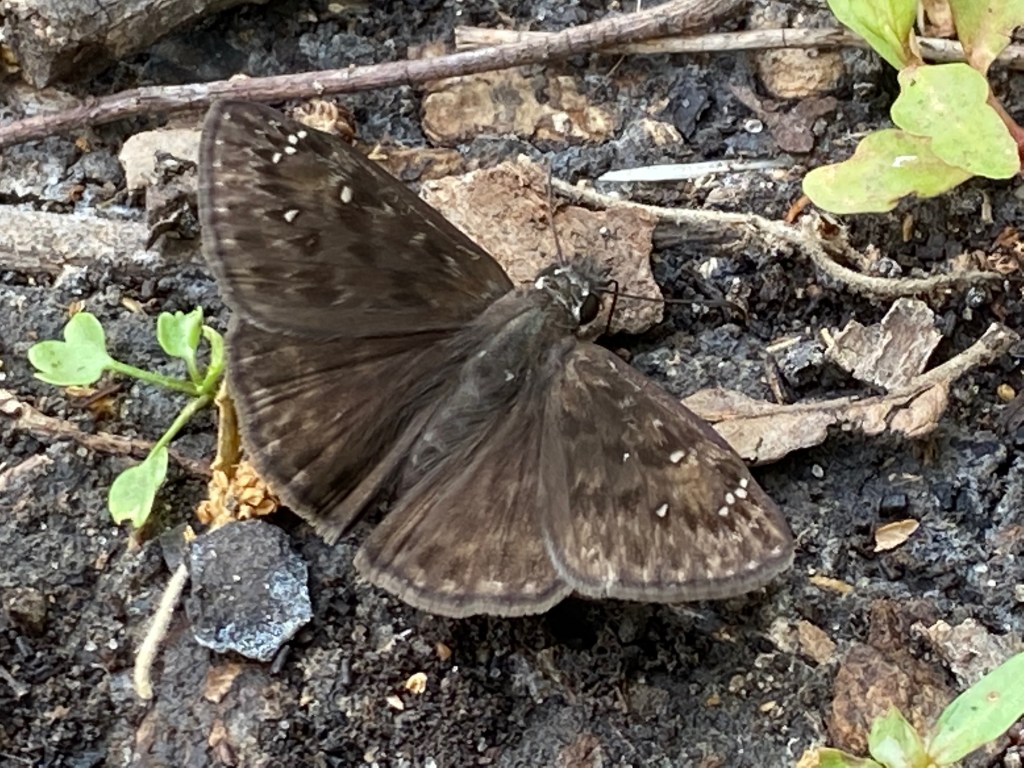
I followed the trail to the edge of the marsh, past a twenty foot tall dead tree whose bark had the appearance of being twisted, as though earlier in its life something grabbed it and gradually twisted it as it grew. There was also a hole, very much suggesting a woodpecker’s cavity nest, but it was only about seven feet off the ground. At the water’s edge there were dragonflies and a handsome brown duskywing skipper to see.
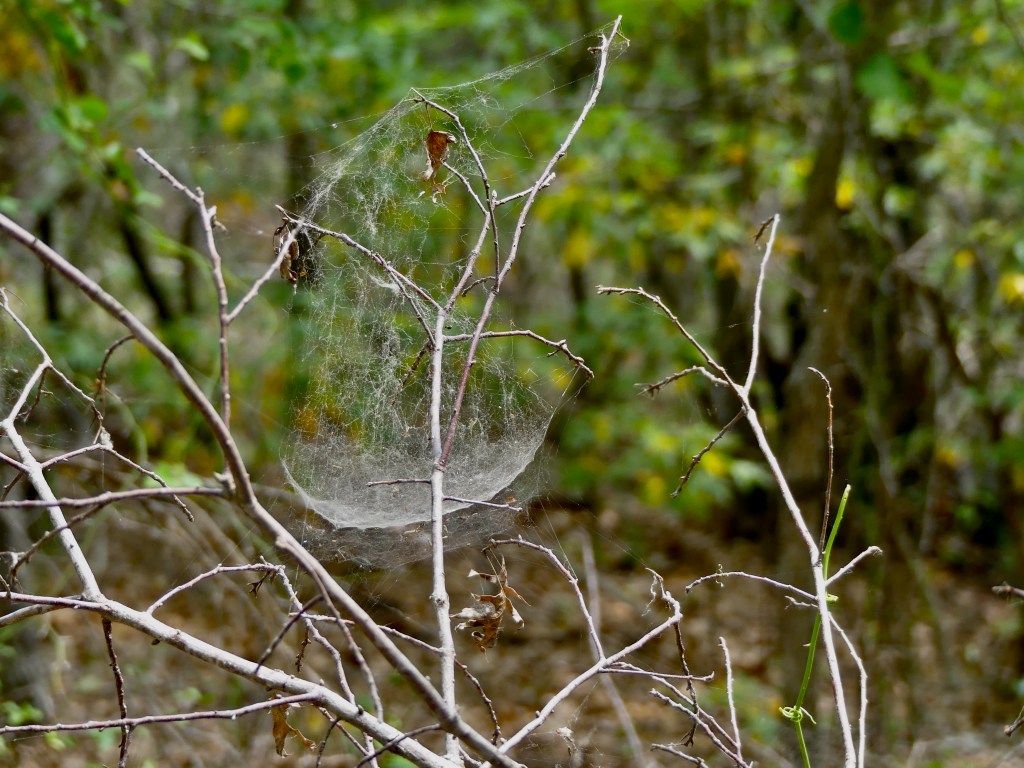
There was another road to walk, the familiar old path down into the bottomlands. The giant cottonwoods and other trees were like the pillars of a giant cathedral, and the place was full of life. One of the things I noticed was a bowl-and-doily spider, a small woodland spider whose web looks like a bowl suspended over a flat, old-fashioned doily.
I’m glad for this place – these trees – and all the other living things here. Fort Worth Nature Center & Refuge lives up to that part of its name, “refuge,” as we can escape deeply enough into the woods and prairies to reach a place of sanctuary and safety.
The road continues on and on
To quiet places where, with feathers and trust,
We soar above grief and fracture
And continue the journey as we must.











 Our Lives in Nature