Frogs (And More) Among the Palmettos

My friend Ruthann Panipinto was sure that Palmetto State Park, east of San Antonio in Gonzales County, would be a great place to visit. She really wanted to see if we could find a cottonmouth there, which involved neither bravado nor fear on her part. It was simple curiosity and love for those misunderstood pit-vipers. Ruthann has answered many snake relocation calls from fearful homeowners. She has captured and moved many venomous snakes and freed some that were stuck in glue traps, too. We both would welcome whatever reptiles and amphibians we might see. And so, we decided on March 29 as a good day for a road trip.
And if we didn’t see reptiles and amphibians (herps), Ruthann would be delighted with the plants that would now be flowering there. She remembered from a previous visit that there were lots of red buckeye with deep green compound leaves and upright clusters of red flowers. In addition to buckeyes, a couple of flowers – baby blue eyes and blue-eyed grasses – were blooming among the palmettos.
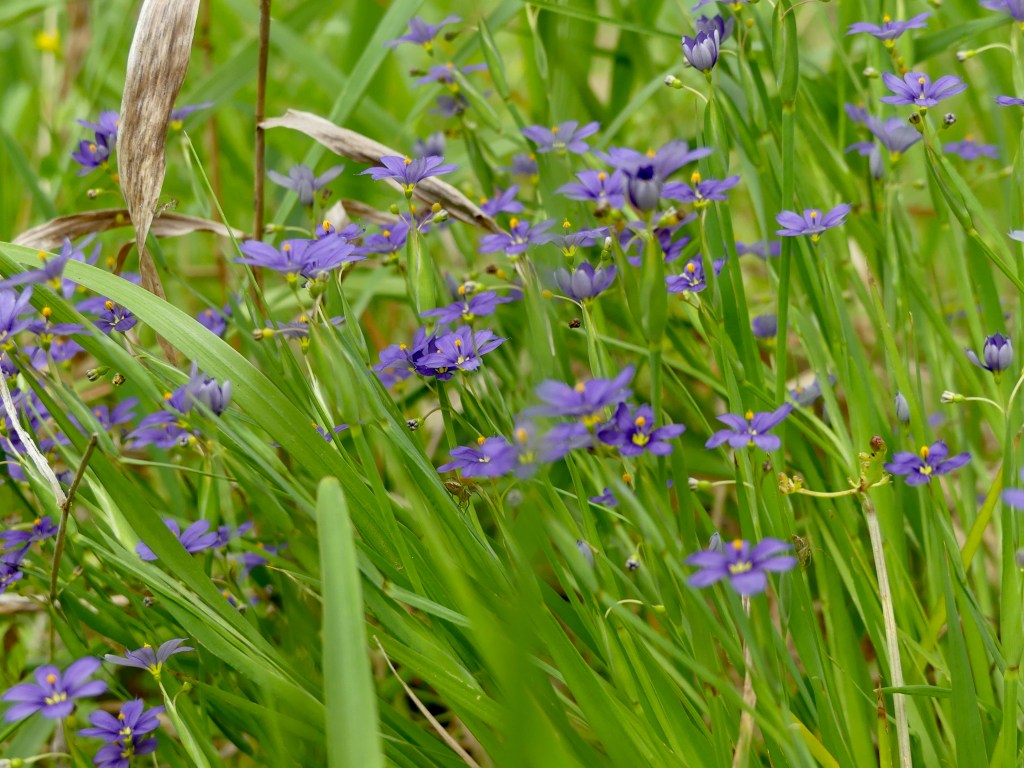
Blue-eyed grass

We started our walk at 2:30pm and within minutes we heard a gray tree frog (Hyla versicolor) calling. That call is what allowed me to identify it, because the trill of one species (versicolor) is slower and musical, like a bird call. The other gray treefrog species (Cope’s gray treefrog, Hyla chrysoscelis) has a faster raspy-sounding trill. If you see a gray treefrog without hearing the call, you won’t know which of those species you are looking at, because their appearance is nearly identical. Either one of them is a lichen-gray frog about 1.5 inches long. To add to the confusion, they can change color so that the gray has a little green in it, or the upper part of the frog may change to completely green.

We heard the frog, but finding it was something else entirely. Ruthann looked in nearby branches – it is a treefrog after all, and we usually find them hugging a branch or the trunk of a mid-story tree. The frog called again and Ruthann resumed her search, but these treefrogs are masters of ventriloquism. It seemed to be close and everywhere at once. Finally she found the frog, a little lump on a branch about eight feet above the ground.
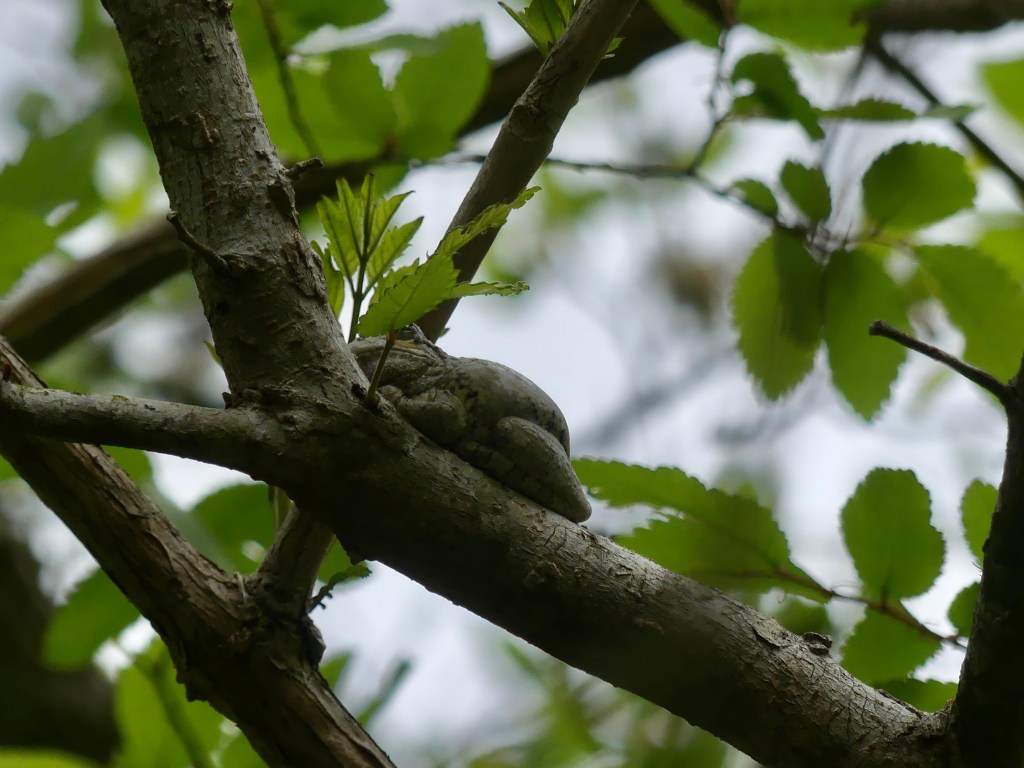
Gray treefrog, hidden in the branches

We moved on, imagining that at nightfall, when frog breeding really ramps up, the choruses of frog calls might be pretty impressive. And within a couple of minutes, Ruthann spotted a green anole. Another critter capable of shifting color and blending in beautifully with the green palmetto fronds. At the moment he was mostly green, with what Ruthann aptly described as a little “blue mascara.” The anole’s eyes are partly covered with a little turret of powder-blue skin that shifts position with the lizard’s line of sight.
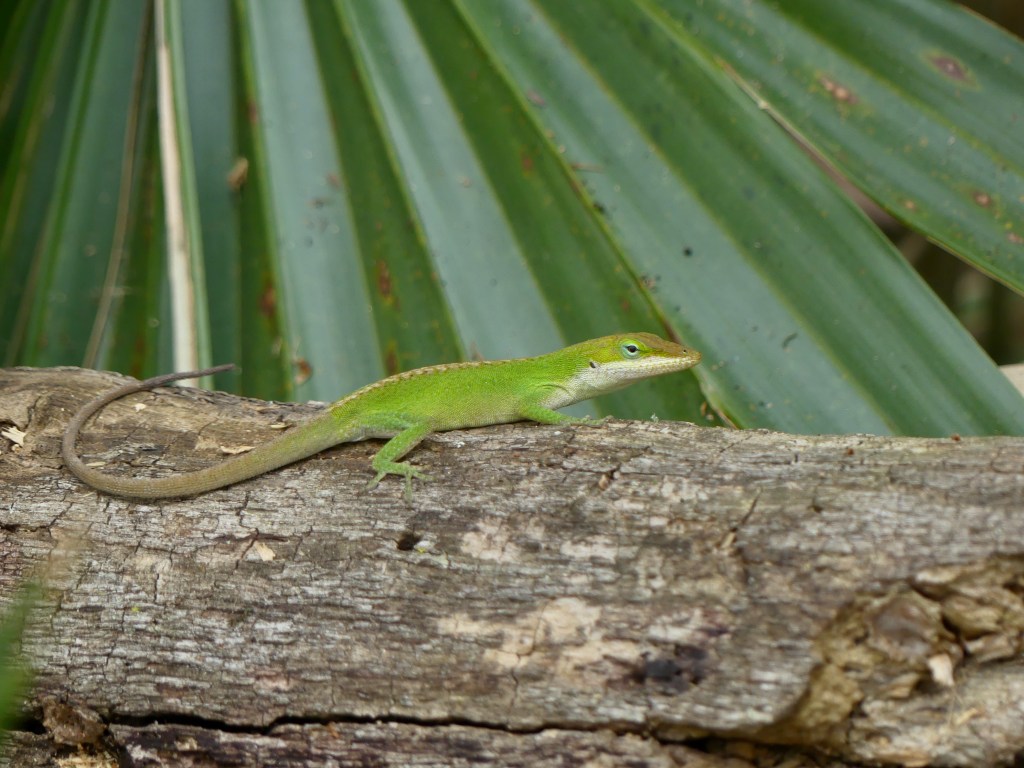
Green anole

We saw dozens of green treefrogs hugging the palmetto fronds, trying to get a little rest before night fell. These were not gray treefrogs that had shifted to green, they were a different species, a little less toad-like in form and with the most beautiful lime-green skin. A dark-bordered white stripe begins on the upper jaw and extends down the side of the body. Their beautiful golden Kermit-like eyes have pupils in a horizontally-flattened shape, like those of most frogs and toads.
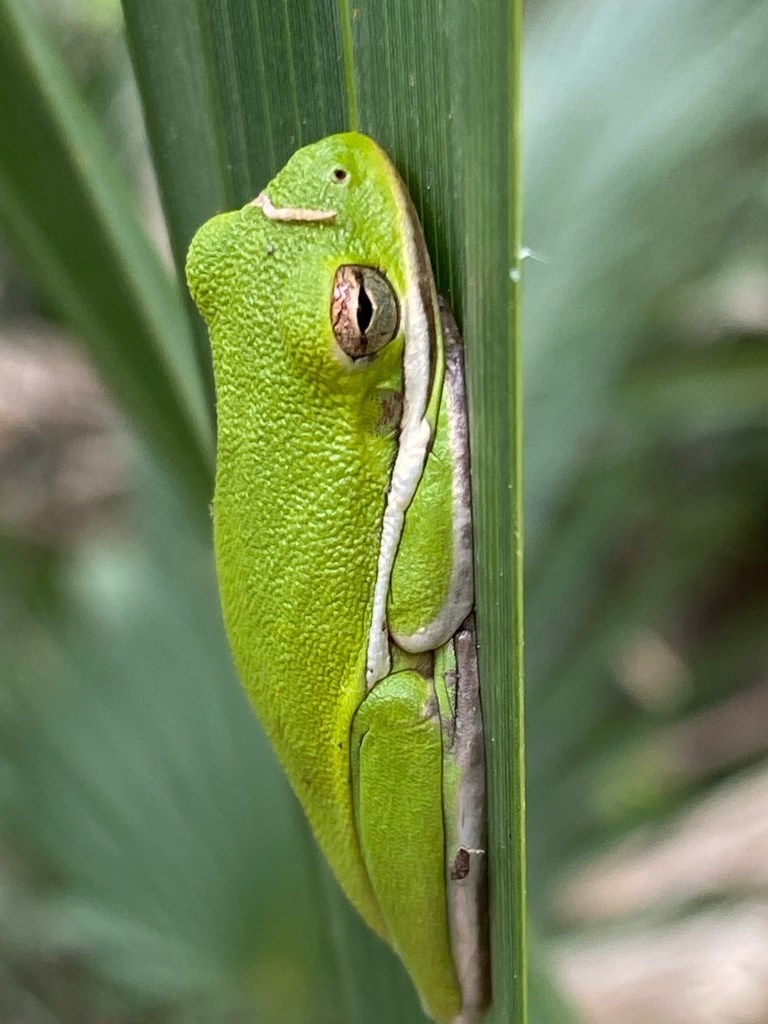
Green treefrog

There was plenty of bird life above us. Ruthann was hearing parula warblers in the treetops, and we saw a red-shouldered hawk and at least one crested caracara. Wrens, northern cardinals and other birds were calling from within the forest above and the expanse of dwarf palmetto that stretched out around us.

As we walked along one of the trails, a couple of park staff approached on a Gator. They stopped ahead of us, intently focused on something at the edge of the trail, a sure sign of something Ruthann and I would want to see. It was a young cottonmouth, no doubt surprised to be surrounded by admiring humans. We were happy to see that the park guys were very protective of the little snake, and we took a few photos while explaining that we would never harm the cottonmouth. We watched the pretty little reptile turn back and slip under the palmetto fronds.
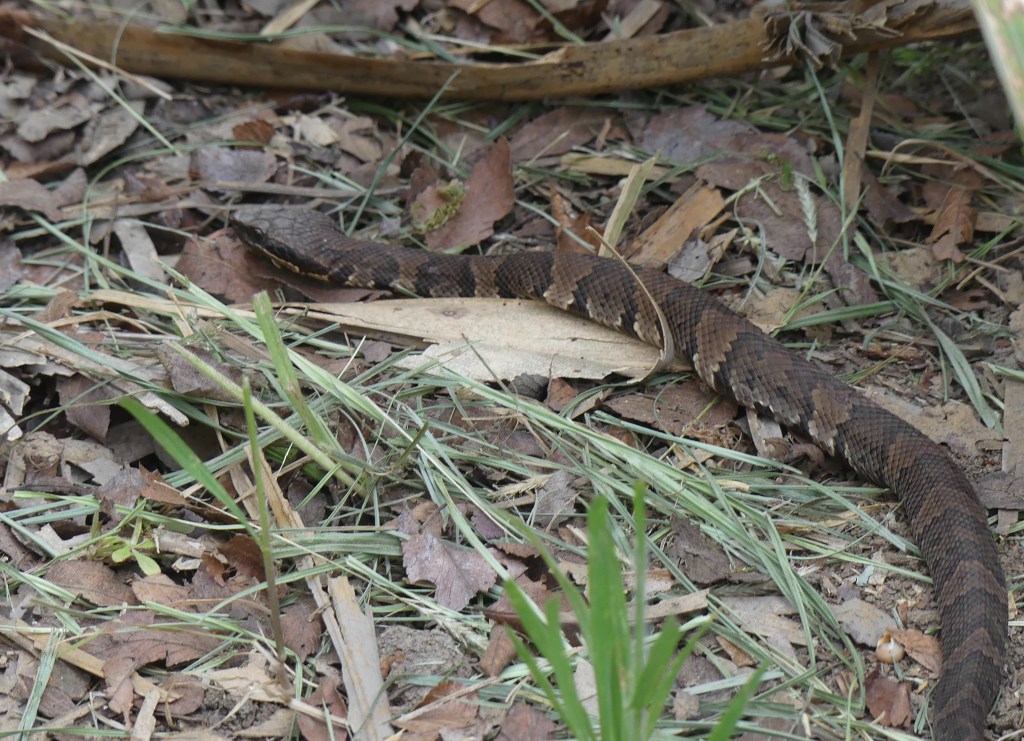
Juvenile northern cottonmouth

We talked with the park staff for a while about the local ecosystem and wildlife, and they said that they do sometimes see timber (aka “canebrake”) rattlesnakes in the park. That would be a wonderful thing to see, though we did not forget that we were already privileged to see some beautiful and fascinating species.

As the afternoon progressed, our discoveries included a Texas ironclad beetle. It looks like a cream-colored beetle that was splattered with black paint, and its claim to fame is that its exoskeleton is really, really hard, justifying the name “ironclad.” Internet sources such as the Field Station of the University of Wisconsin say that you would not kill it by stepping on it. Please don’t try that out in the field – this is a harmless, attractive beetle that just wants to go on its way munching on lichens as it roams around tree trunks or fallen branches.
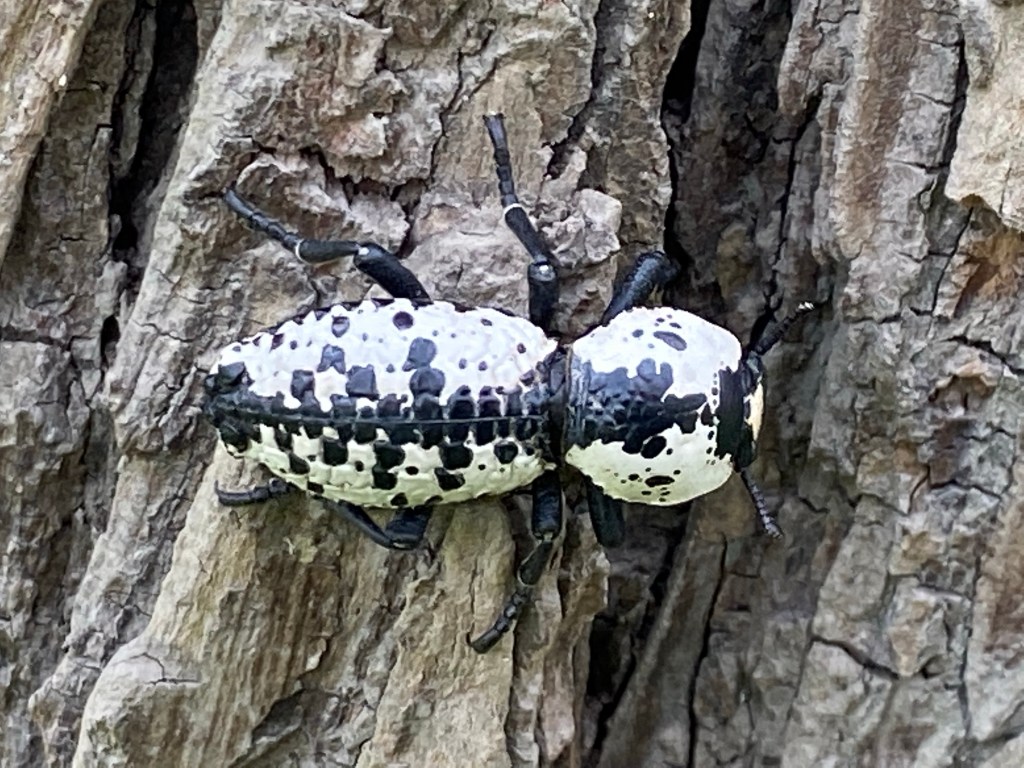
Ironclad beetle

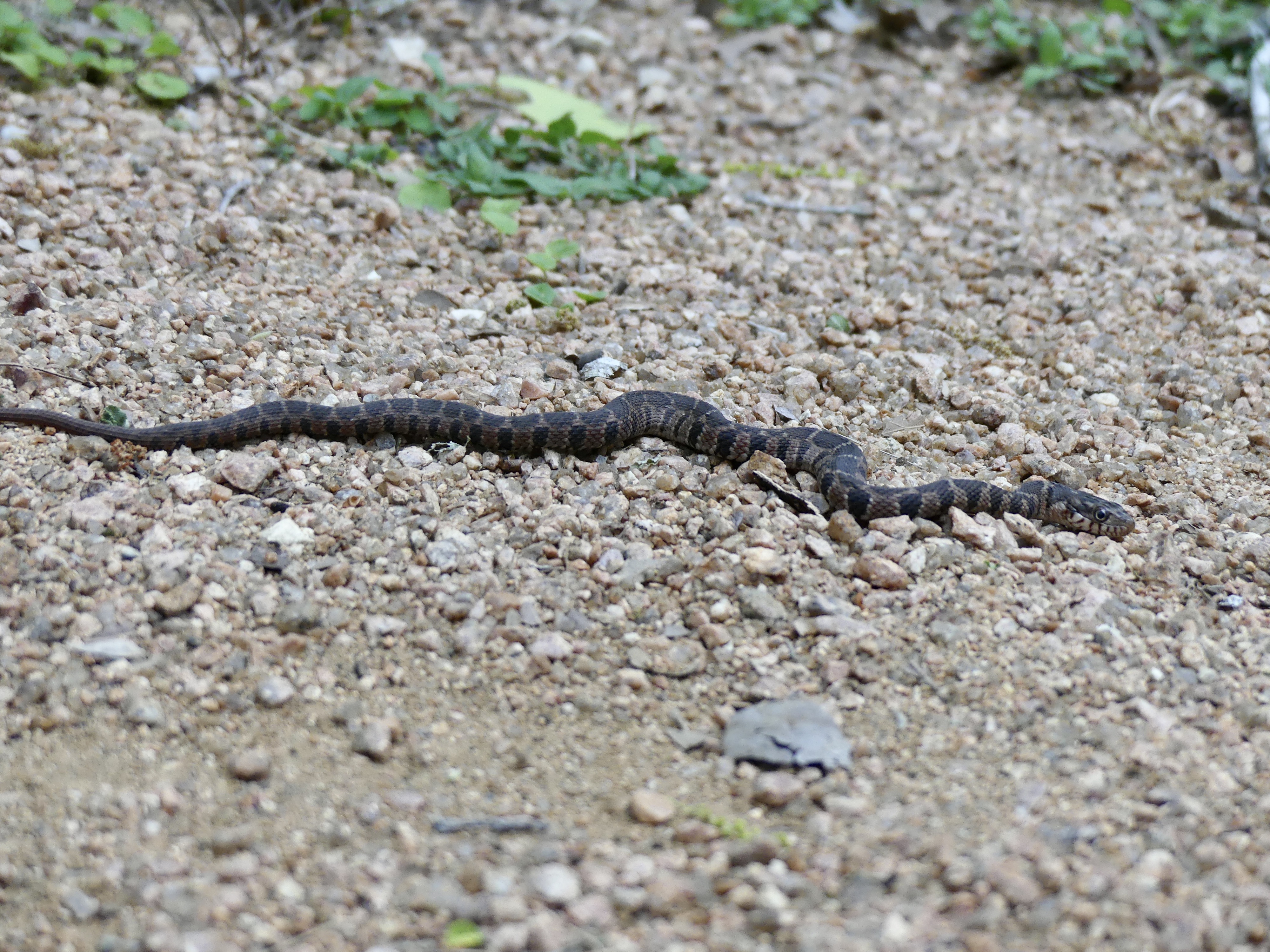
After a break, we returned to the trails as evening approached. One small squiggle caught our eyes, motionless on the crushed granite trail. A baby plain-bellied watersnake, born just last year, hoped that we would not notice a squiggly “twig” lying on the ground, even though the twig had scales and a somewhat banded pattern. I took a photo or two of this “twig” and then Ruthann scooped him up, now a fully animated snakeling struggling to get away. Nothing doing! Ruthann had to examine and talk to the scaly bundle of cuteness before releasing him to go on his way.
Along the Palmetto Interpretive Trail there is a water tower built nearly 100 years ago by the Civilian Conservation Corp; its pump still pulls water out of the ground to help supply the swampland. A little after 7:00pm we found a luna moth sheltering under the stones at the base of the water tower. I can remember a time or two when I have found luna moths, and each time the beauty and form of this large moth have been irresistible.

Most of the luna moth’s life is spent as a green caterpillar. When it emerges from the pupal stage as a mature moth, it will complete its life in a very short time, so short that it does not even have a functioning mouth to eat. Females release a pheromone to attract males; they take flight in the darkness and some time after midnight they find each other and mate. During flight, the long trailing hindwings are said to interfere with bats’ ability to find them by echolocation.
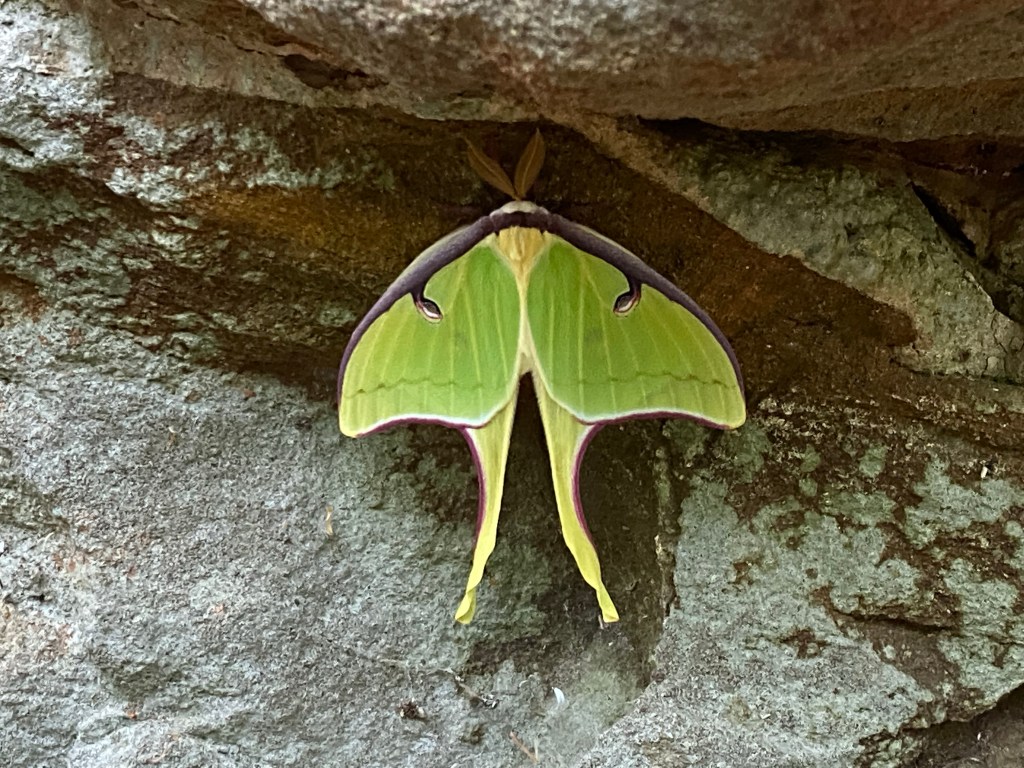
Luna moth

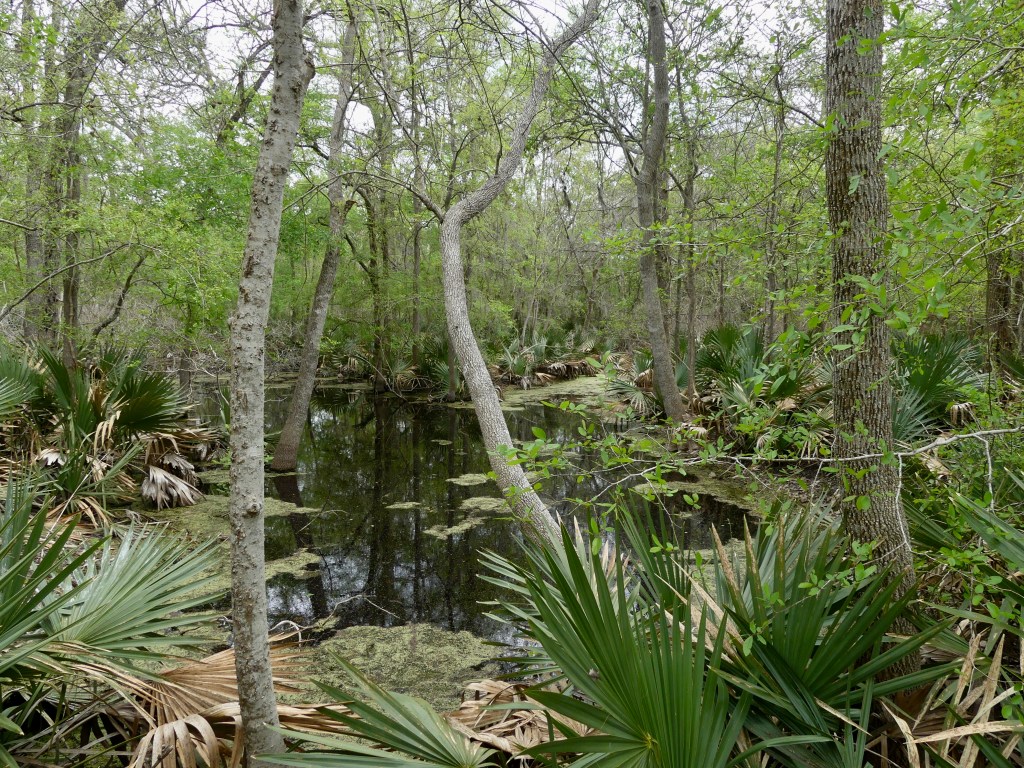
This might be a difficult night for flying. As sunset approached, the breezes became strong winds, making the tops of the trees sway drunkenly back and forth. Gusts sometimes carried dust and grit through the woodland, and it occurred to me that we might wind up dodging falling branches. The sky became rosy and golden, giving this palmetto swamp a magical sort of glow.
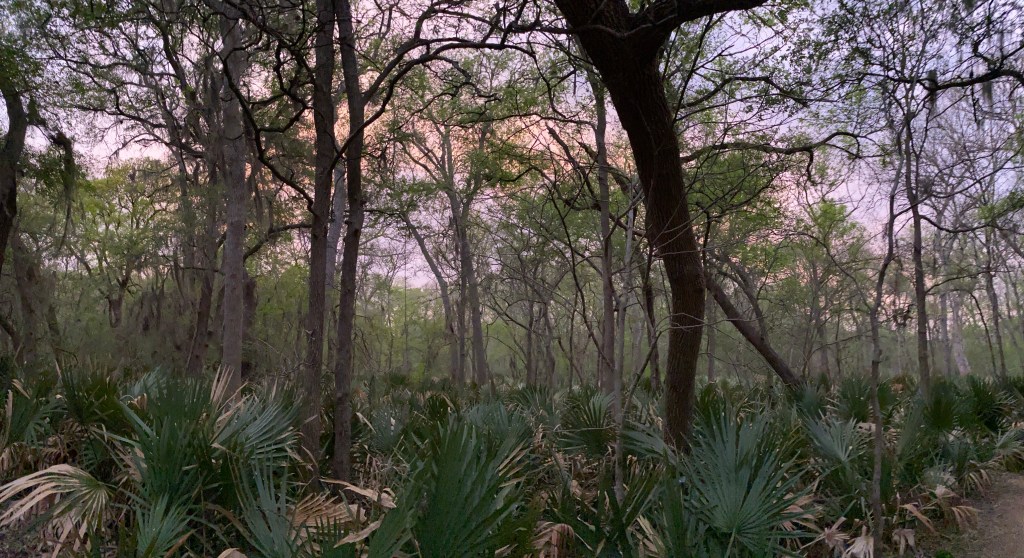
The Palmetto Interpretive Trail at sunset

As the swamp was enveloped in darkness, we put our headlamps on and continued walking. The winds subsided for a time, and then periodically swept through the woods again. When the trees and palmettos quieted, the frogs began calling.

Frog calls represent males advertising themselves to females for breeding. When a female approaches a male, he gets on her back in a piggy-back sort of position known as amplexus. Then, as the female lays eggs, the male fertilizes them. Different frog and toad species have different calls, so that often the call allows us to identify the amphibian, much as bird calls help us identify birds.

Against a background of the accelerating “grick-grick-grick-grick” of cricket frogs, the gray treefrogs began to call. I mentioned that it is hard to locate the frog (though it must be easier for female frogs, since that’s the point of the call). Their voices seemed loud in the close darkness.

Cricket frogs and gray treefrogs

Then the green treefrogs began to call, with overlapping sounds a little like the honking of ducks. Sometimes it was almost as if they took turns, a few minutes for gray treefrogs and then some time for green treefrogs to be heard. Sometimes they overlapped.

Green treefrogs and cricket frogs, with the occasional gray treefrog

I usually describe it as “magical” to stand in the midst of these frog choruses in the darkness. Sometimes it comes near to being overwhelming if you are right in the middle of it, or at least the word “immersive” would apply. If you get the chance, give it a try, and although you may want to search for the frogs, you owe it to yourself to try turning off flashlights and headlamps and simply letting all that frog communication wash over you.
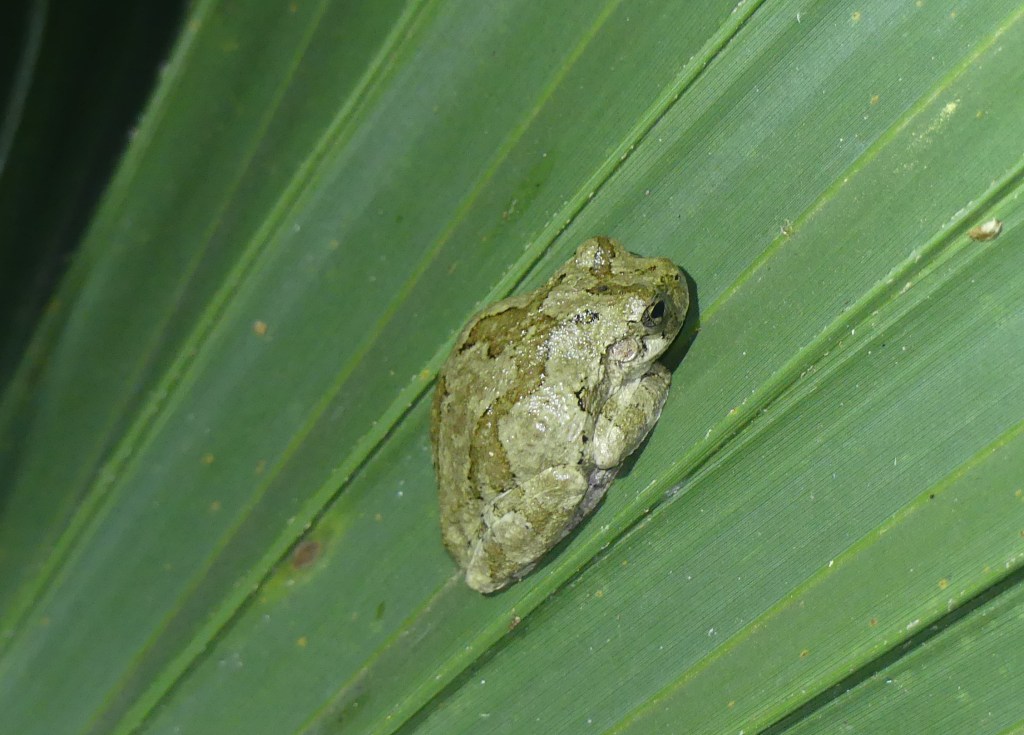
A gray treefrog located during the night chorus

As it turned out, Ruthann was right. Palmetto State Park had been a wonderful place to visit, a beautiful and unique pocket of wetlands next to the San Marcos River. The reptiles and amphibians we saw were species that we can easily see in other places, but if you look and listen as if doing so for the first time, they are amazing. And experiencing them in this palmetto swamp made it even better.
Hunting and the “Honorable Harvest”

(I wrote the following as I was working on a book on mindfulness in nature that is now in the editorial process at Texas A&M University Press. I wound up not using it, but I do think it has some useful things to say.)

Before there was agriculture there was hunting and fishing, and there are still communities whose food primarily comes from the fish they can catch and animals they hunt. For many other people, hunting and fishing are not necessary for subsistence but are activities that provide a break from everyday life and an opportunity to spend time in nature. While the number of sport hunters may be falling, in Texas there were 1.25 million hunting licenses issued in 2017,1 and ranchers still make money off deer leases. Fishing and hunting can reflect a very wide range of motivations, attitudes, and relationships with the natural world. As a result, hunting in particular elicits a polarized range of views. A 2014 nationwide survey of U.S. residents found that 87% of respondents agreed with hunting as a way of obtaining food, but only 37% agreed that trophy hunting was acceptable.2

Catching fish and hunting game can be done sustainably and honorably, according to a set of informal guidelines drawn from Native American beliefs and practices. Robin Wall Kimmerer describes the Honorable Harvest as guidelines that are not written down but are simply acted upon in daily life. Her listing of the guidelines is as follows:

“Know the ways of the ones who take care of you, so that you may take care of them. Introduce yourself. Be accountable as the one who comes asking for life. Ask permission before taking. Abide by the answer. Never take the first. Never take the last. Take only what you need. Take only that which is given. Never take more than half. Leave some for others. Harvest in a way that minimizes harm. Use it respectfully. Never waste what you have taken. Share. Give thanks for what you have been given. Give a gift, in reciprocity for what you have taken. Sustain the ones who sustain you and the earth will last forever.”

Robin Wall Kimmerer, 2013, Braiding Sweetgrass, P. 183

Imagine if these ideas of the Honorable Harvest were printed within each year’s Outdoor Annual, published by Texas Parks & Wildlife Department, to promote a sustainable and respectful harvest in which each angler or hunter comes into the field as a member of a community, rather than as a stranger with neither kinship nor responsibility to that community.

Many already approach these activities with a strong emphasis on respect and sustainability, including many middle-aged and older hunters. An example is Brad Chambers, a friend who is a naturalist and a hunter who only shoots what he plans to eat. He told me about the intensity of his attention and focus when he is hunting, saying that at those times he notices much more than when he is just walking in the woods. While in a blind with his binoculars he’s watching all the wildlife, not just game species. Brad, who shares my interest in reptiles, remembered a time he was sitting very quietly on a log while hunting. A brightly-ringed coralsnake emerged from that very log and foraged for food while Brad no doubt sat in amazement and delight. Coralsnakes are secretive and shy, and an opportunity to watch one in this way is a rare treat.

Harry Greene is another hunter, also a retired professor and acclaimed author and researcher, who thoughtfully explores the implications of being a “born-again predator” in a chapter of his book, Tracks and Shadows: Field Biology as Art (2013, University of California Press) He came to subsistence hunting during retirement after studying rattlesnakes and other predators during a long career in the field. Spending hours in a blind near a pond in central Texas, carefully waiting for an opportunity for a shot that will kill a deer quickly and with minimal suffering, he thought of the ambush predators he has studied. “Can I be as effective as the natural-born killers who have long held my interest, let alone carry out the task with equal grace?” (Pp.106-107). To be an omnivore – to eat meat at least sometimes – involves either subsidizing an industrial meat production that Greene finds repulsive or else taking on the role of predator. 

Now we have a younger generation of hunters who may not have grown up in hunting families and might at first have had no interest in hunting. Like Harry Greene, many of them are deeply concerned about industrial meat production, with its antibiotics, crowding of livestock, pollution of nearby land and water, and the energy required to transport animals for processing and then shipping of products.3 For them, it is more environmentally friendly and healthier to eat what they hunt. And these hunters, like some in the older generation, are likely to have a close connection to the land, appreciating and caring for the whole community of plants and animals, not just the game that they hope to bring home. Perhaps they will be among those who carry on the tradition of the Honorable Harvest.


1 Thompkins, S. There’s Safety in Numbers for Texas’ Hunters. San Antonio Express-News. https://www.expressnews.com/sports/outdoors/article/There-s-safety-in-numbers-for-Texas-hunters-12738710.php (accessed 10/29/20)

2 Byrd, E., Lee, J.G., & N.J.O. Widmar. 2017. Perceptions of Hunting and Hunters by U.S. Respondents. Animals, 7(11), 83.

3 Kuipers, D. 2020. Field to Fork. Orion, Vol.39 No.3, Pp. 30-35.

Goodbye, Winter

At LBJ National Grasslands yesterday, new green growth emerged from the soil everywhere. In this ecotone, this blended margin between prairie and woodland, what had been the sandy brown floor was now turning green. In some places it was hidden beneath last year’s grasses, and in other places around trees and shrubs the scattered green was unmistakable. In areas that were recently burned, where the soil now had the most contact with the bright, warming sun, the new growth was strong. 

It was March 19, the last day of winter. Tomorrow the Northern Hemisphere would be angled toward the sun just a bit more, reaching the vernal equinox. It would be the first day of spring. I spent most of the day at LBJ National Grasslands to say goodbye to winter in the biggest, quietest place I could wander through.  
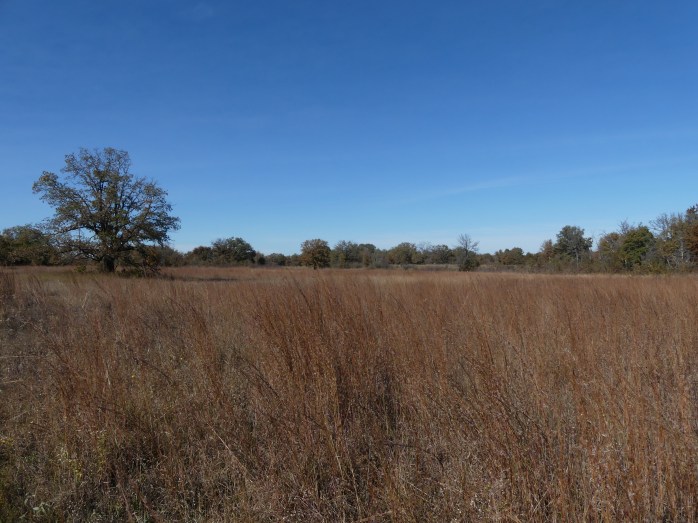
It was bright and sunny, as if the weather had already passed the equinox and was intent on spring. I soon shed the hoodie I started my walk with, as the breeze warmed a little and the sun was higher in the sky. By the end of the day I would have a mild sunburn and no regrets for having walked and sat in so much sunshine. 

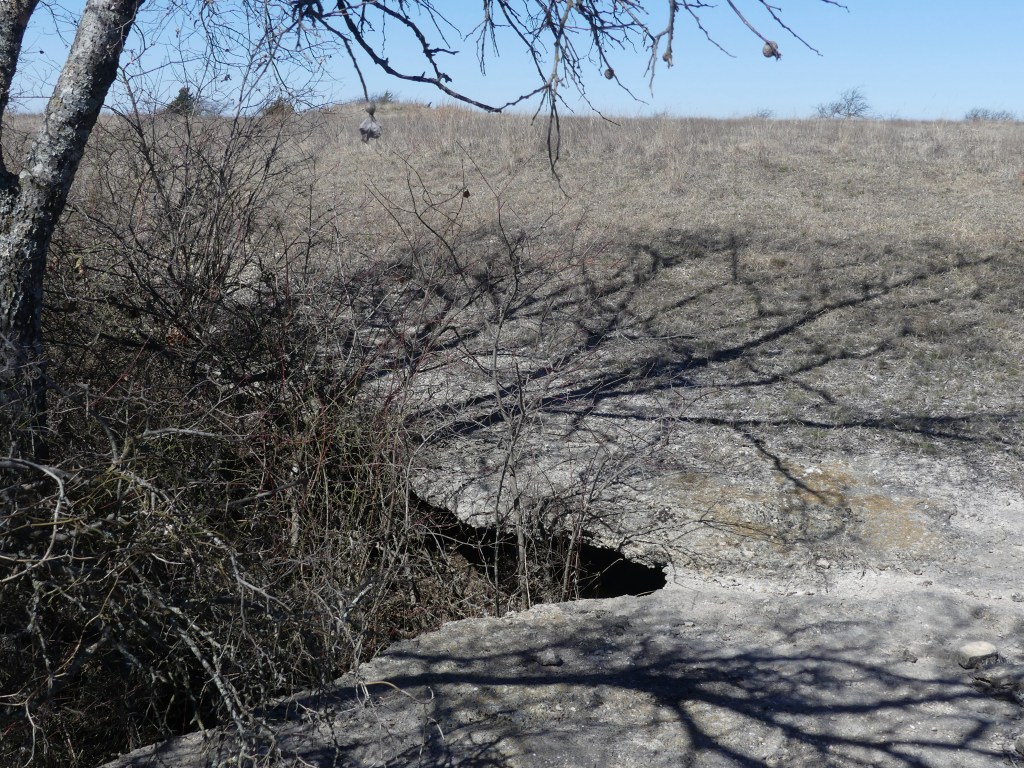
Limestone shelf at the top of an arroyo

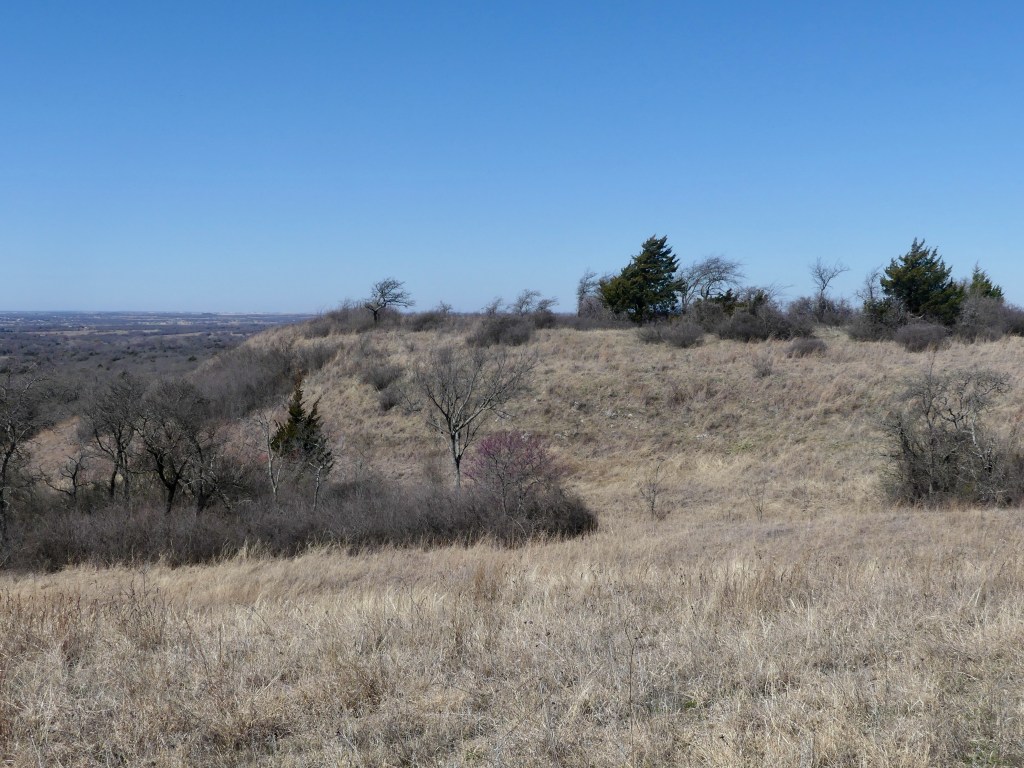
I started up on a ridge where limestone lies beneath shallow soil. In places, erosion exposes the limestone from an ancient sea bed filled with small oysters. I walked around one spot where water had exposed a small limestone shelf and eroded back under it. This was at the top of one of those places where the land drops away from the top of the cuesta or ridge and forms a long arroyo down the hillside. Big junipers, hackberries, and woody shrubs fill these places where the land concentrates rainfall.  

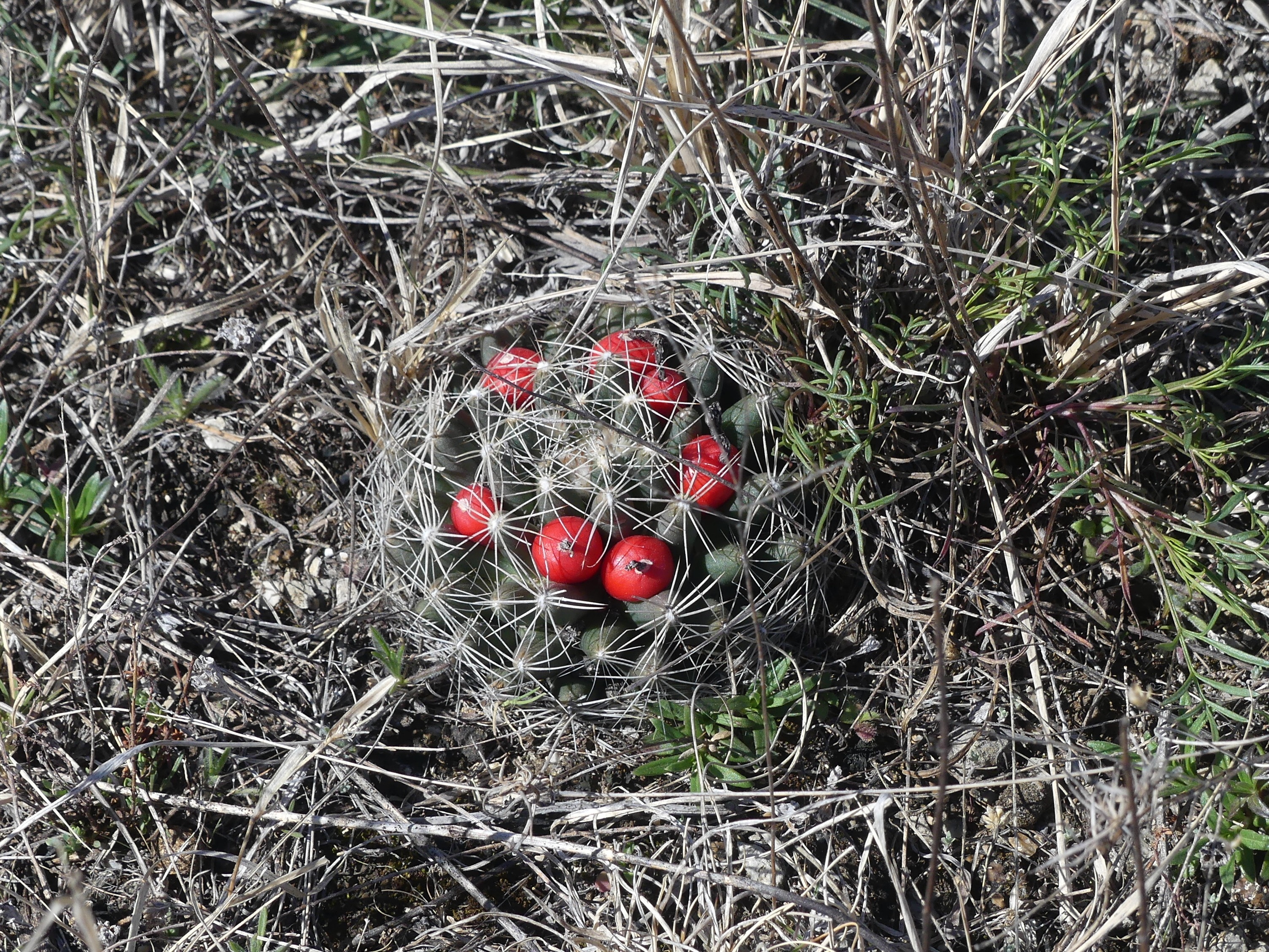
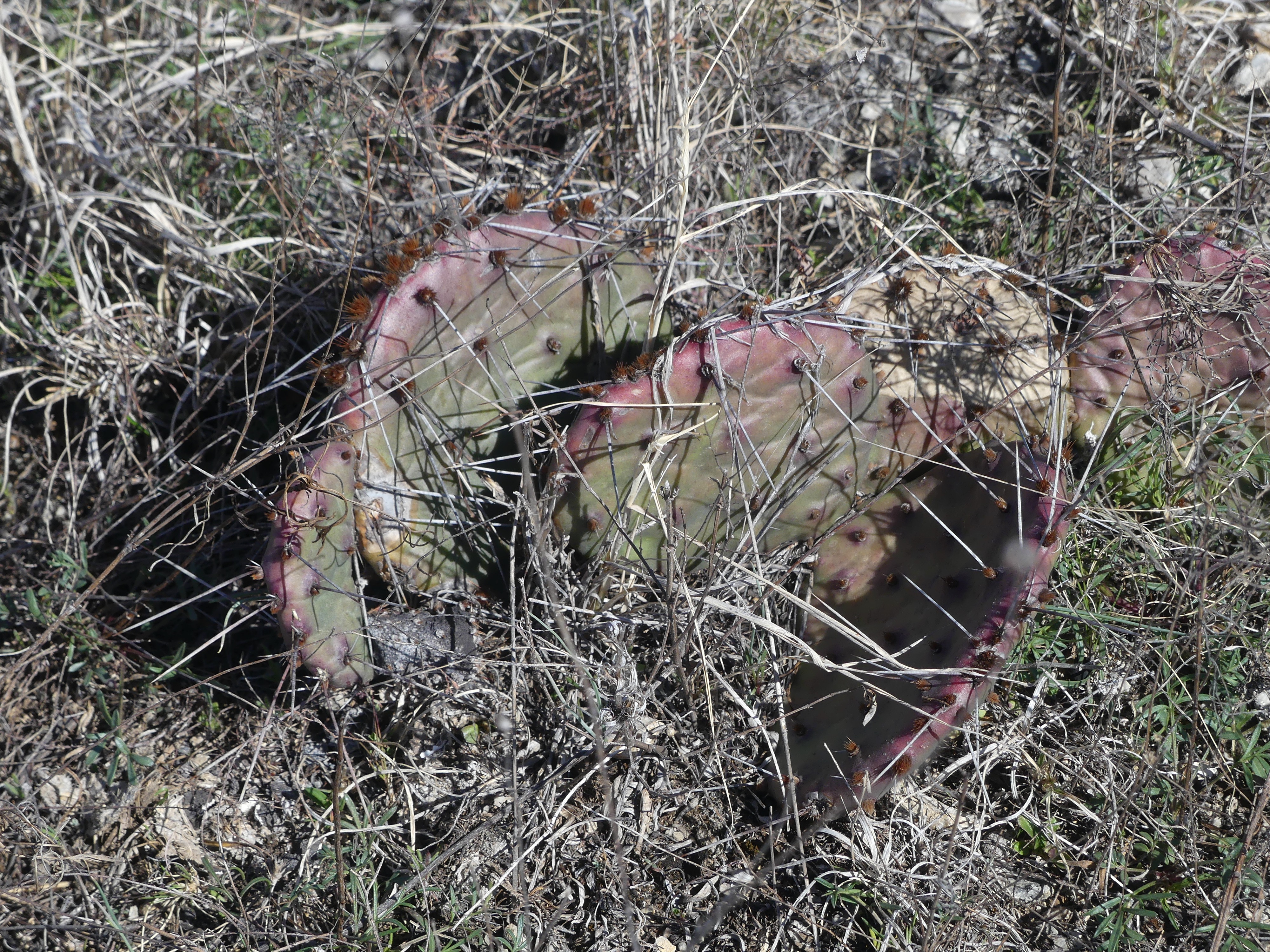
On the top of the cuesta, prairie grasses grow where the soil is deep enough. In shallow soil, even in areas with bare limestone, you can find clumps of cacti such as the grooved nipple cactus with stems like rounded domes covered with spines. There are also prickly pear cacti whose pads in winter are colored in shades of faded brick red and pink. Elsewhere up on the ridge there are clumps of compass plant. I love those long deeply notched leaves that feel as if they were cut from stiff sheets of sandpaper.  
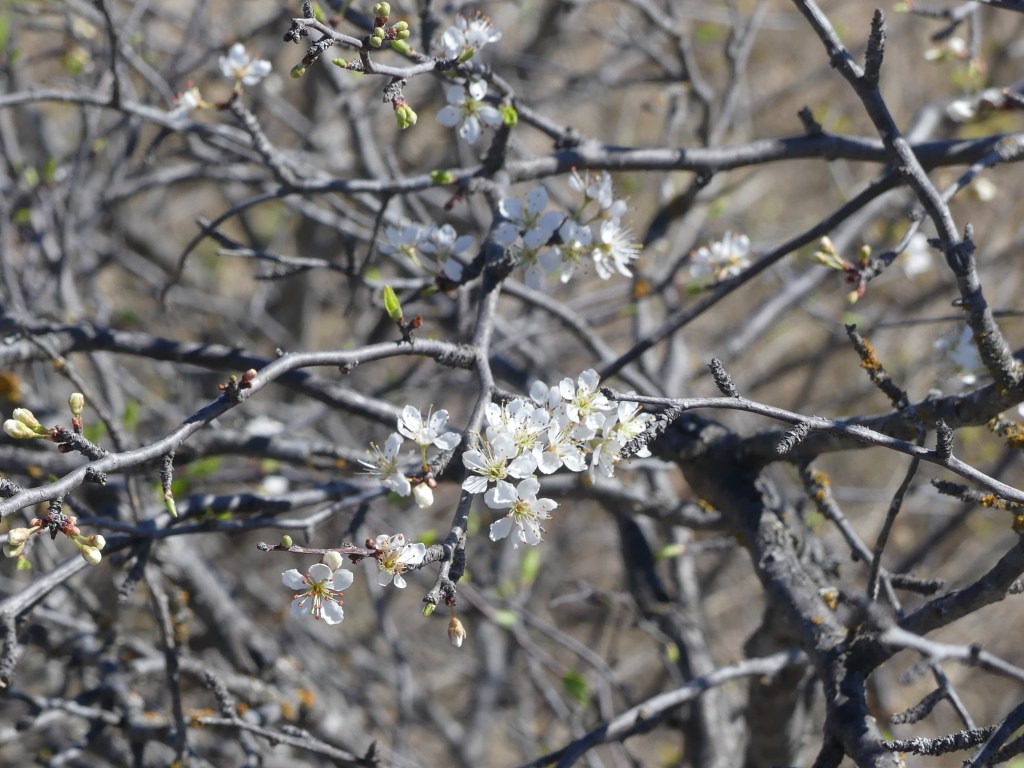
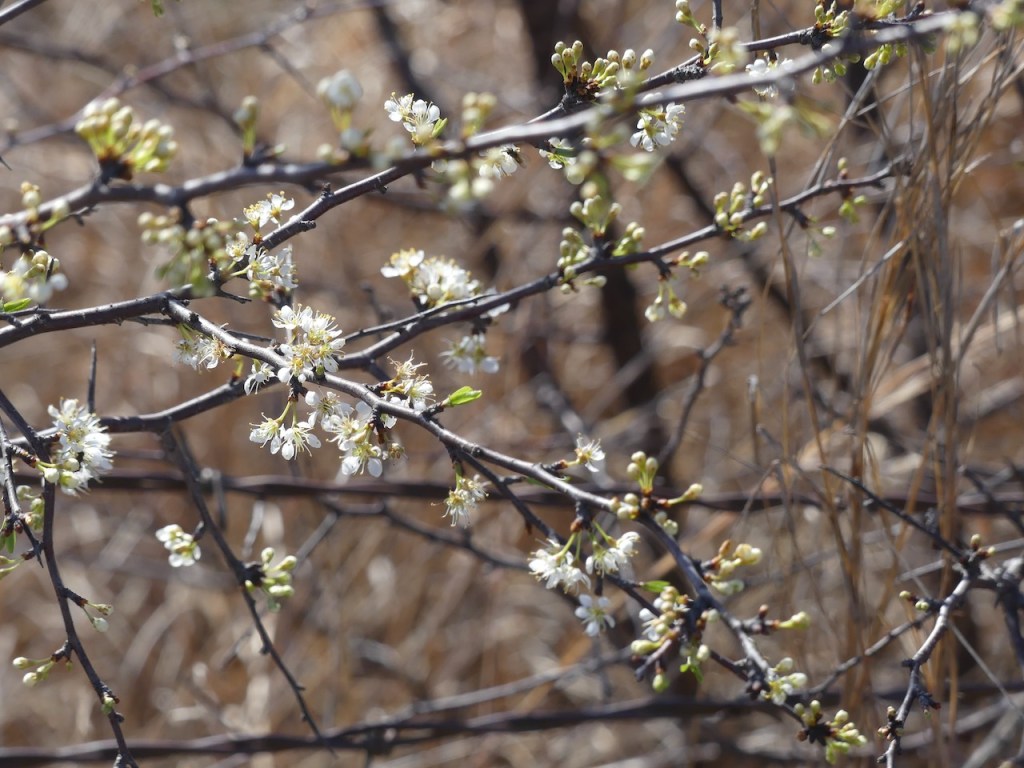
Mexican plum

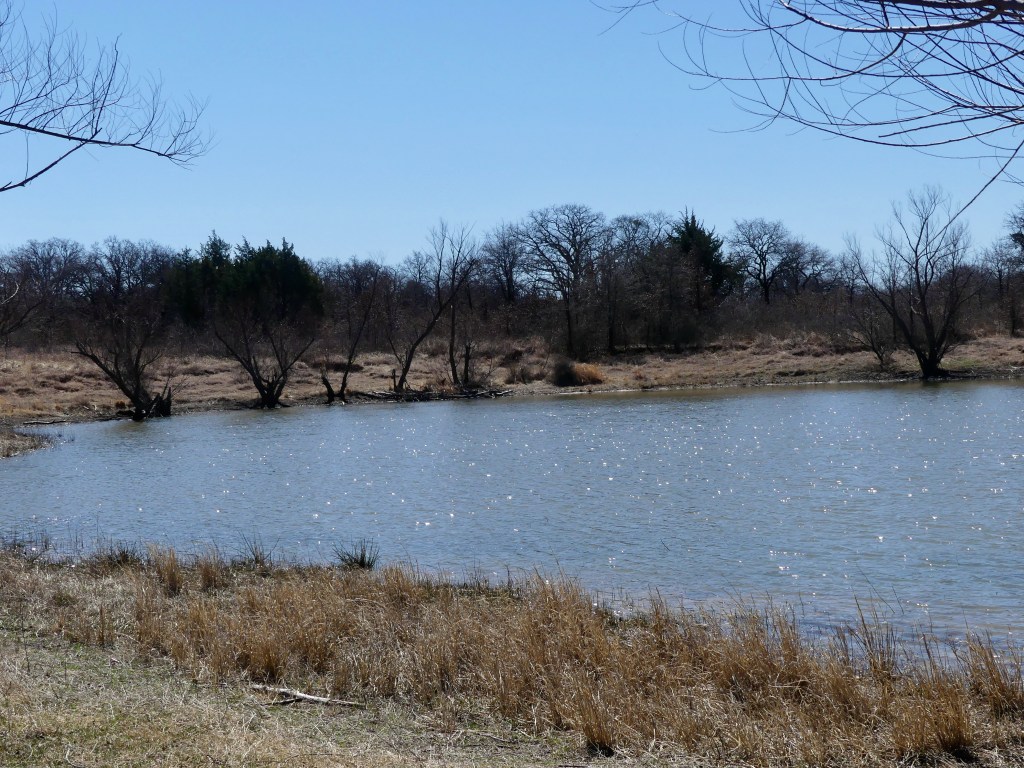
A couple of hours later I was in the Cross Timbers woodland below the ridge, visiting a small pond. The breeze stirred ripples on its surface. The sunlight glittered brightly from the tops of those ripples, so that the pond’s entire surface seemed covered in sparkling jewels. When I let my focus soften, it was like a very fast twinkling of a field of stars. Even in simple places like this, the rest of the world drops away and there is only the pleasure of this moment in this spot. How we all long for such a refuge, and here it was. 

The stars in the water, only poorly represented in the photo

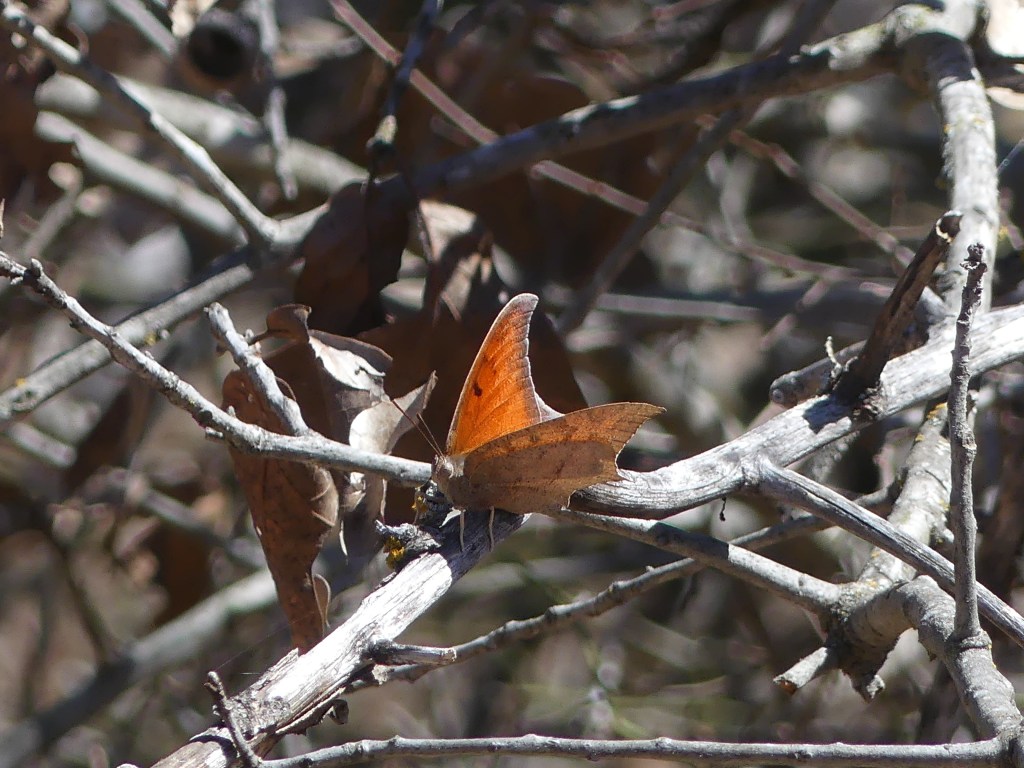
Throughout the winter the sulphur butterflies persist and dance across dormant prairies and sunny glades, but today more insect life was awakening. In one spot I began to see orange butterflies. At the edge of a clearing, two of them encircled each other and seemed to catch an updraft, swirling straight up to the crowns of the surrounding trees. When one landed, I saw that it was a goatweed leafwing. Their deep orange wings are scalloped, edged in ashen gray and the forewing and hindwing come to points. Their interesting name is based on description and natural history. The host for their caterpillars is “goatweed” or croton, and when closed the wings look just like a dead leaf.  

A goatweed leafwing

Finishing in this part of the grasslands, the practical but unimaginatively named unit 71, I drove to a couple of units near Alvord, including one of the beautiful and fragrant pine groves, and ended up in unit 30, one of my favorites. I let myself in through one of the green Forest Service gates and looked across the prairie and savannah toward the oak-juniper woodland. 

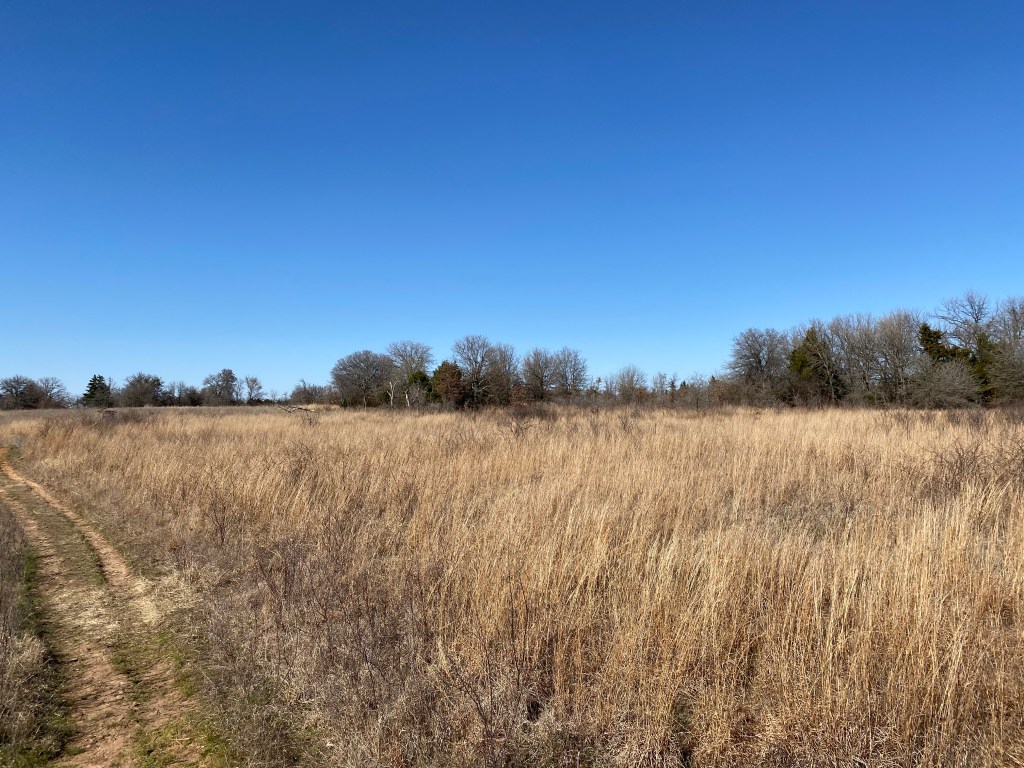
The prairie in “unit 30,” looking upslope

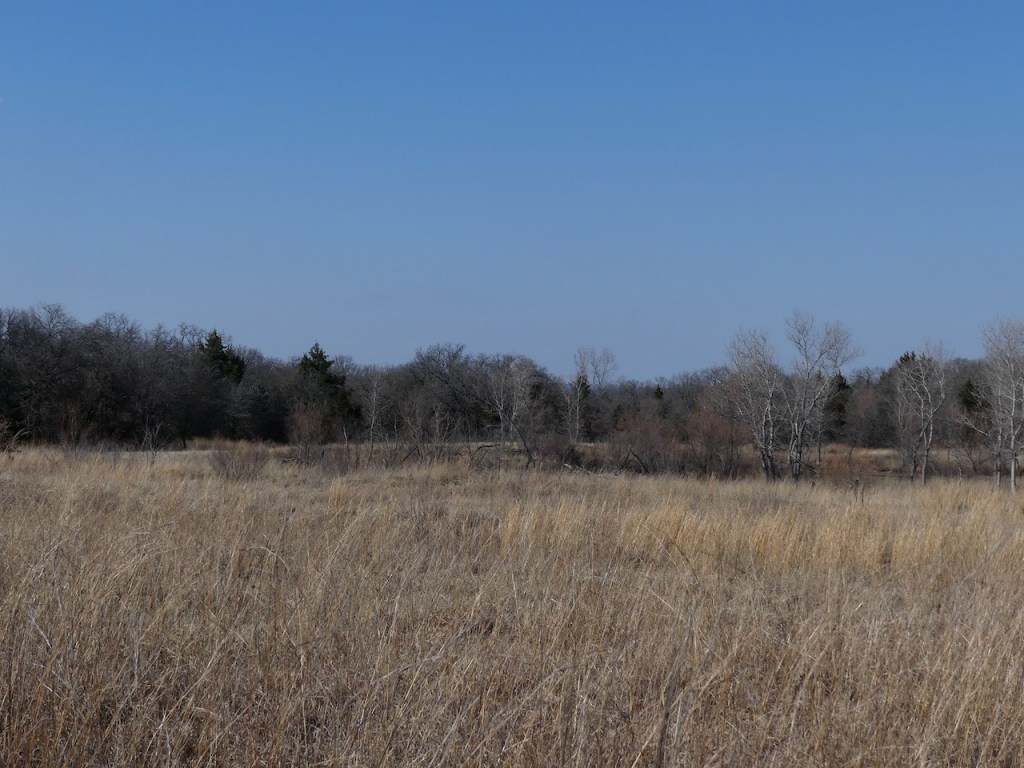
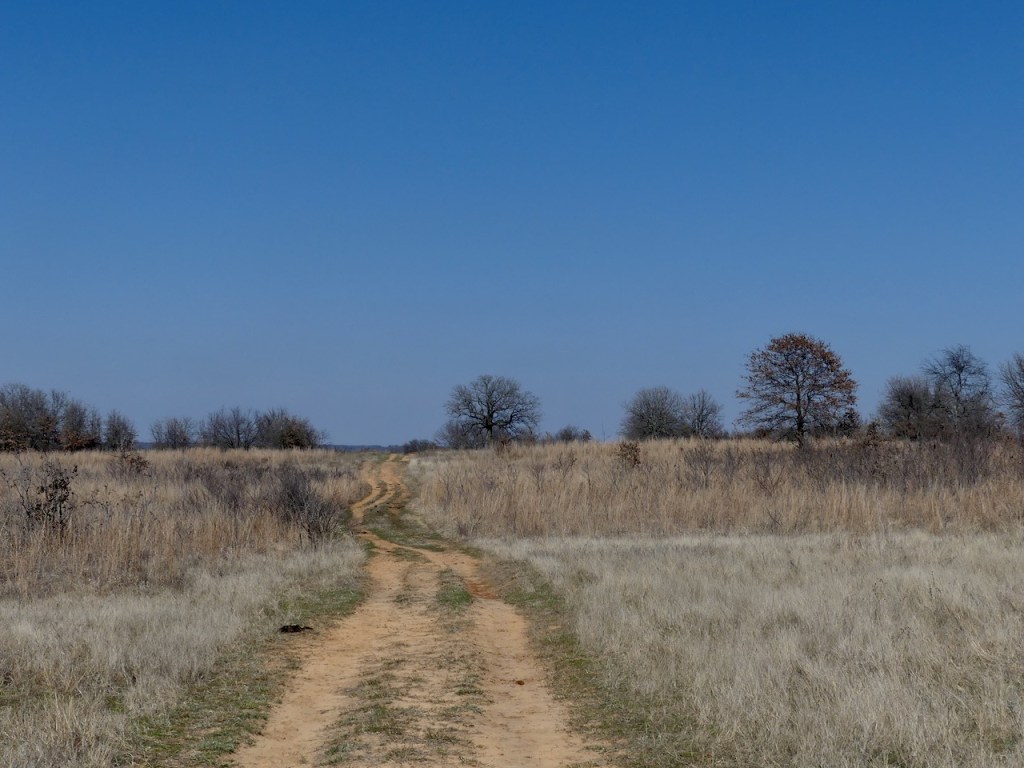
Here was that wonderful down-sloping prairie with little bluestem, Indiangrass, and flowering plants scattered throughout. Then the trail reaches the trees and turns sharply, losing itself in junipers, post oaks and other trees. The woods frequently open into little prairie patches as well as a few little ponds. I know the features of this part of the trail and I enjoy each walk there. I thought about why the places within LBJ National Grasslands have such an attraction for me, these “same old” trails. But the affection for the place holds. Walking here is visiting old friends, so why would I tire of it? And when I walk through spots in the grasslands that are new to me I usually see familiar landscapes, just arranged differently. Some of the appeal for me is the sense of being able to spread out, to be unconfined in grasslands and woods that keep on going. 

A nine-banded armadillo, oblivious to my nearby presence

So goodbye to winter, and welcome spring! I’m ready for frog calls and purple coneflower, and those spring evenings with distant thunder. And eventually I’ll come to miss the earth tones of dormant vegetation and quiet winter afternoons. In time I will welcome winter back again. 
Ready for Spring

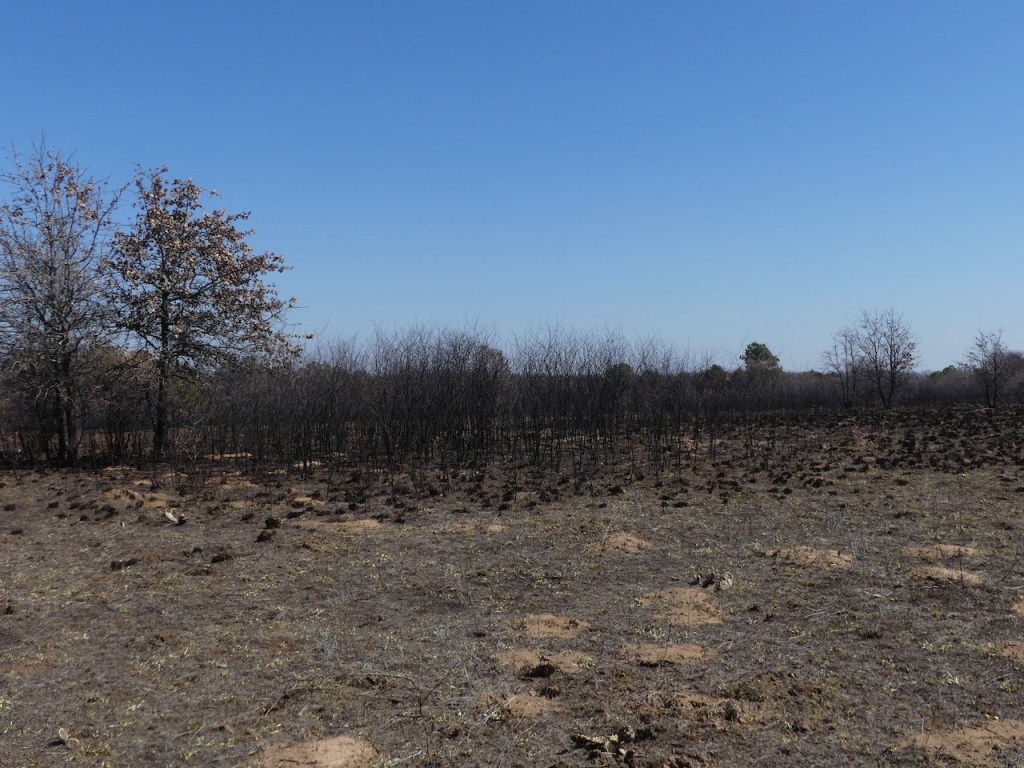
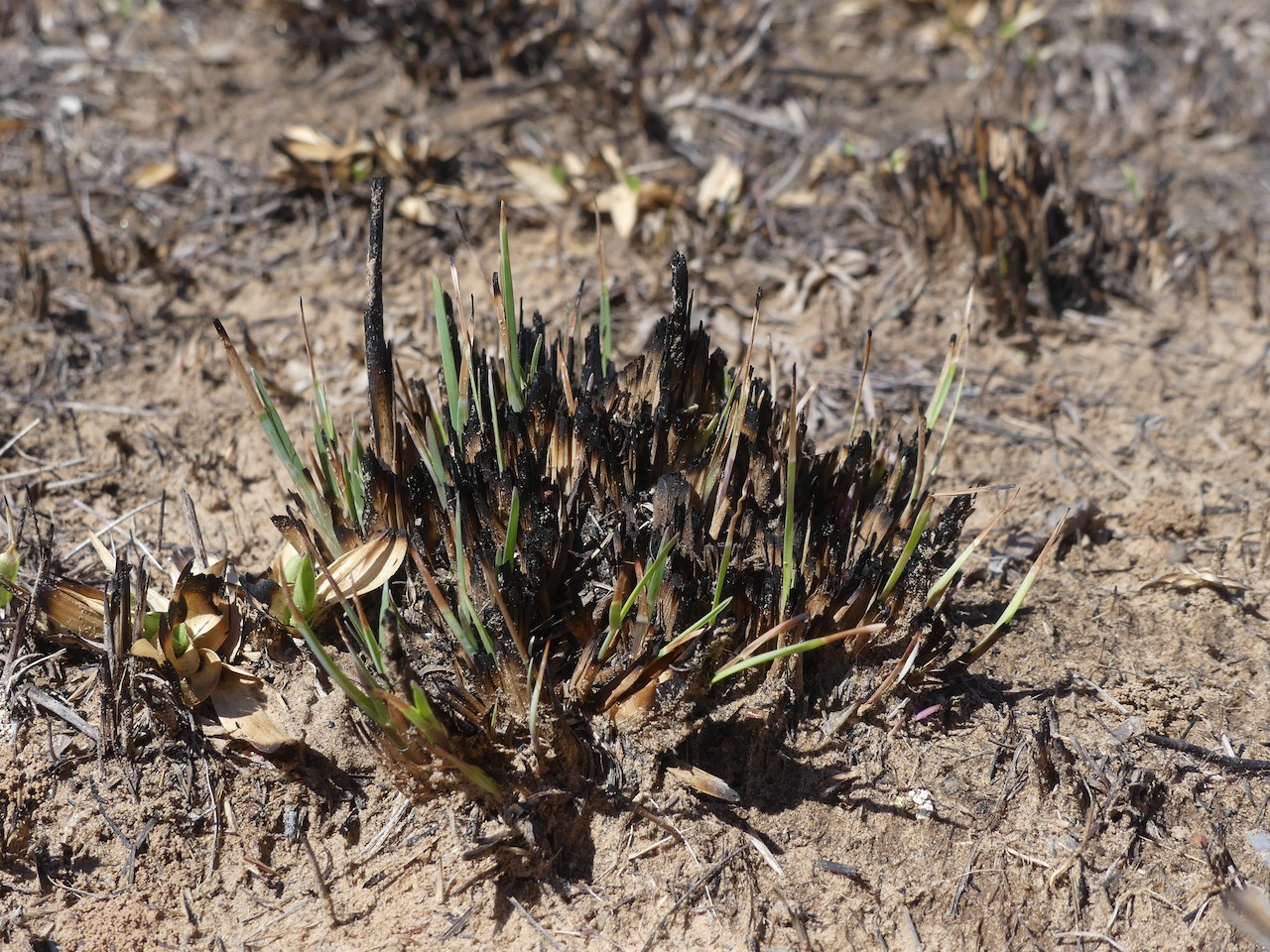
As I drove through a northern part of LBJ National Grasslands, last year’s grasses were burned off along with some of the low growing brush. At the ground, some tree trunks were blackened, but the bark of the bigger trees protected the living tissue underneath. The trees will be fine. So will the grasses. The living roots below ground were already starting to send green shoots up within the charred clumps of little bluestem and Indiangrass. After all, what burned was just the dead stems and leaves of last year’s growth. What was pushed back was, hopefully, the growth of woody shrubs and tree seedlings. These ecosystems were built with periodic fire as an important ingredient. Without it, the shrubs and seedlings would grow into thickets, closing off open areas and replacing the meadows and pockets of prairie in this place.

The Forest Service had done well, lighting fires that would move across the land quickly so that it did its job with little real damage. Larger wildlife would move out of the way and most smaller animals would shelter in burrows or climb higher in trees. They would plan the burn when fuel loads would not be too high and wind conditions were right, keeping the fire within certain boundaries. With a well-planned burn, the fire would not linger long enough to become very big or hot. 

I walked a trail northeast of Alvord through areas cleared out by fire and looked at the green shoots beginning to emerge here and there where fire had burned last year’s growth to black stubs. Not only were grasses re-growing, along the surface of the soil – much more exposed than usual – new green growth was beginning everywhere. Spring is just days away (or already started, by meteorological reckoning).

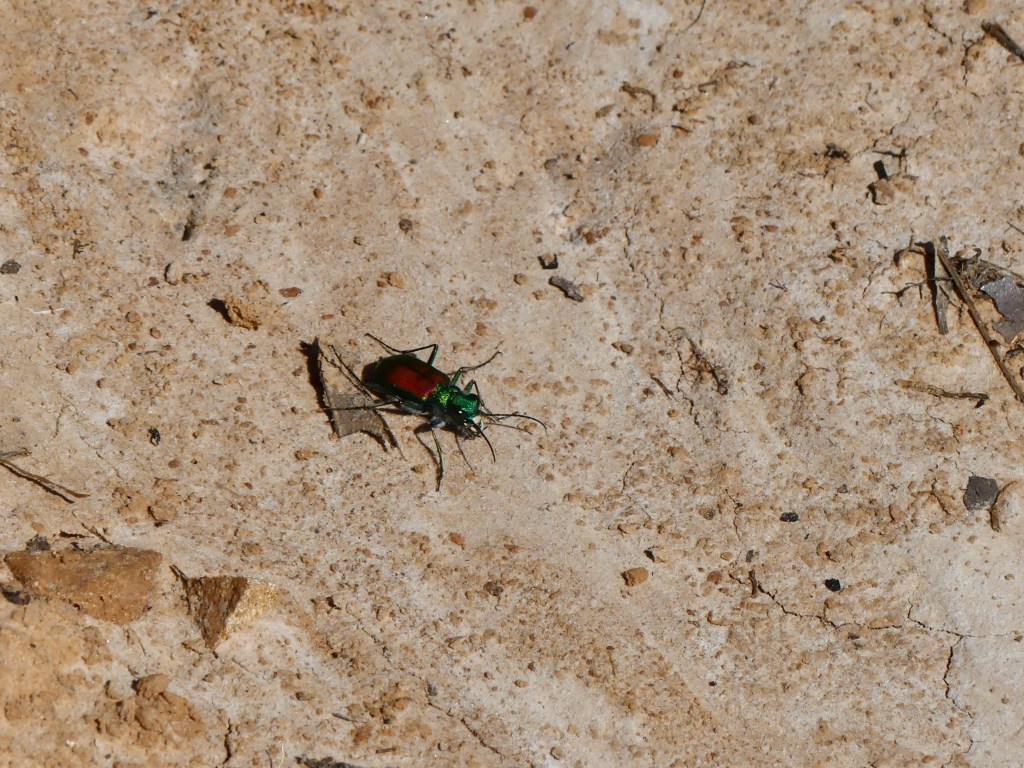
Tiger beetle

A little movement caught my eye. A small wolf spider was scampering over soil and bits of wood on the trail. “Welcome, little survivor,” I thought. A fluttering spot of yellow bounded along the ground. The little butterfly, perhaps a clouded sulphur, had also made it through the fire or the wind had carried her in from nearby fields. Altogether in my walks in two areas of the grasslands today I saw sulphurs, variegated fritillaries, and a very dark swallowtail. At another point on the trail a small insect flew ahead of me, always landing back on the bare sandy soil of the trail. Sure enough, it was a tiger beetle with a metallic green head and thorax and a brushstroke of iridescent red on the wing covers (the elytra). It appeared that the invertebrates were doing pretty well after the burn.

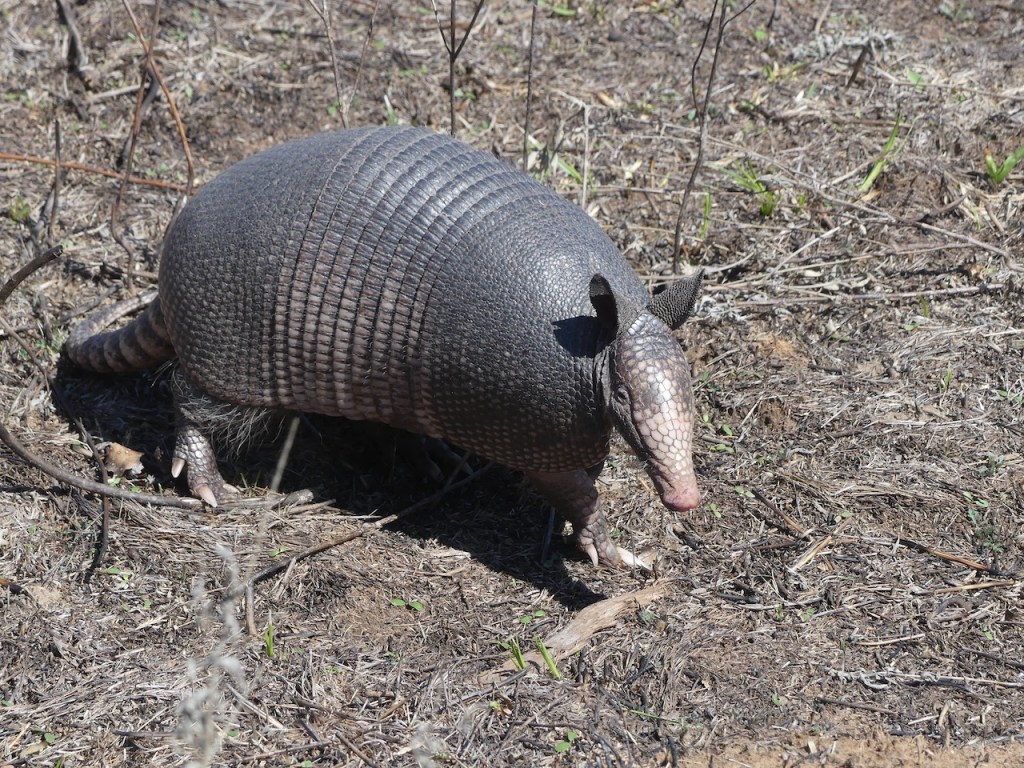
Nine-banded armadillo

Somebody else may have noticed how well the invertebrates were doing. As I came around on the trail, I saw an armadillo about thirty feet away, busily rooting into the soil looking for anything edible. These tough, chunky mammals have a sort of leathery armor over their hips and shoulders, connected in the middle by nine bands of the same stuff (thus their name, “nine-banded armadillo”). Bony deposits are embedded in this modified skin, even on their foreheads and tails. They are very strong, as anyone who has tried to pick one up can attest. 

Armadillos need these attributes, because they are not gifted with strong eyesight or attentiveness to their surroundings. I approached the little beast quietly and downwind, moving mostly when he had his snout in the ground. Periodically he stopped to look around and sniff the air and then returned to the search for insects and grubs. I got within six feet or so, with no intention of doing anything more than taking a photo. At some point he figured out that I was present and ran off, sometimes bounding into the air with all four legs like a deer. It might seem like a parody of gracefulness, but he was fast and had a sort of armadillo-style agility.

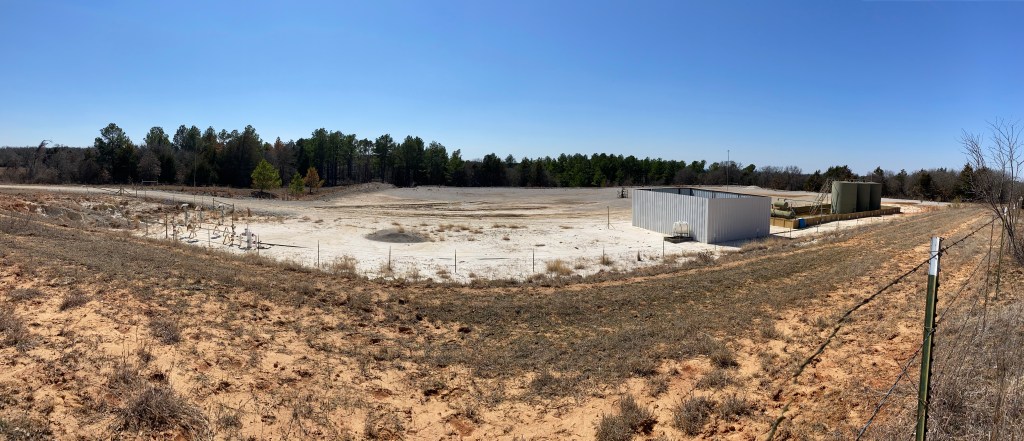
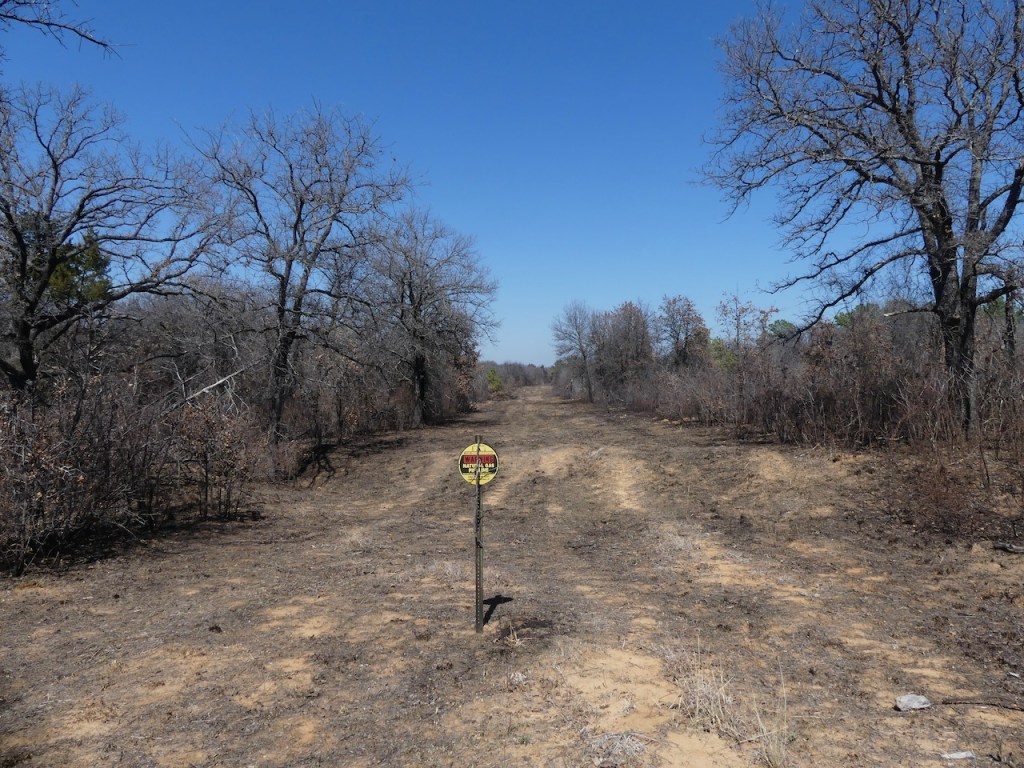
Like Texas’ national forests, the national grasslands in our state are maintained in the belief that many different uses of the land are appropriate. These uses include mineral extraction along with recreation, hunting and fishing. We can walk and study nature on what’s left. I got my first reminder that this is a “multi-use” area when the path opened on a big cleared area with gas storage tanks and some sort of building. Nearby, a wide, bulldozed corridor led into the distance with signs saying, “Warning, natural gas pipeline.” Oil and gas extraction sometimes seems like the pre-eminent use of this place.

The other reminder of the multiple uses of the grasslands happened as I finished the walk back to my car. From the pine grove camping area came several loud shotgun blasts. Hunting is allowed on the grasslands, although what I was hearing seemed unlikely to represent hunting in any competent sense, as the shotgun was discharged sometimes four to six times in rapid succession. After a pause, more shots. I wondered if it was safe to get to my car. I decided that I must be hearing some sort of target practice and chose to believe the target was not in my vicinity. I have not had this experience before, but I have passed hunters with shotguns on the trail. When visiting, we should all keep in mind that hunters (and I suppose wild target shooters) may be present.

My last hour in the grasslands on this day was spent a little distance away, in a unit that had not been burned. I wrote this in my journal:

“I’m sitting at the top of a big rise, under a blue sky with a half-moon above and to my right. There is a light breeze, a little cool and a perfect balance to the warm sun behind me. It’s such a nice spring warmth that it’s hard to believe that in twelve hours it will be blustery, cold and raining. In my shade it is 68.9ºF and 59% relative humidity. 

“It’s quiet and peaceful – a sunny refuge with post oaks, butterflies and cardinals for companions. There’s a post oak in front of me with a trunk so thick that I was reminded of the baobab tree. A cardinal flew into it and is in the high branches – “cheer, cheer, cheer” – and when he faces me there is a bright crimson dot in the branches. 

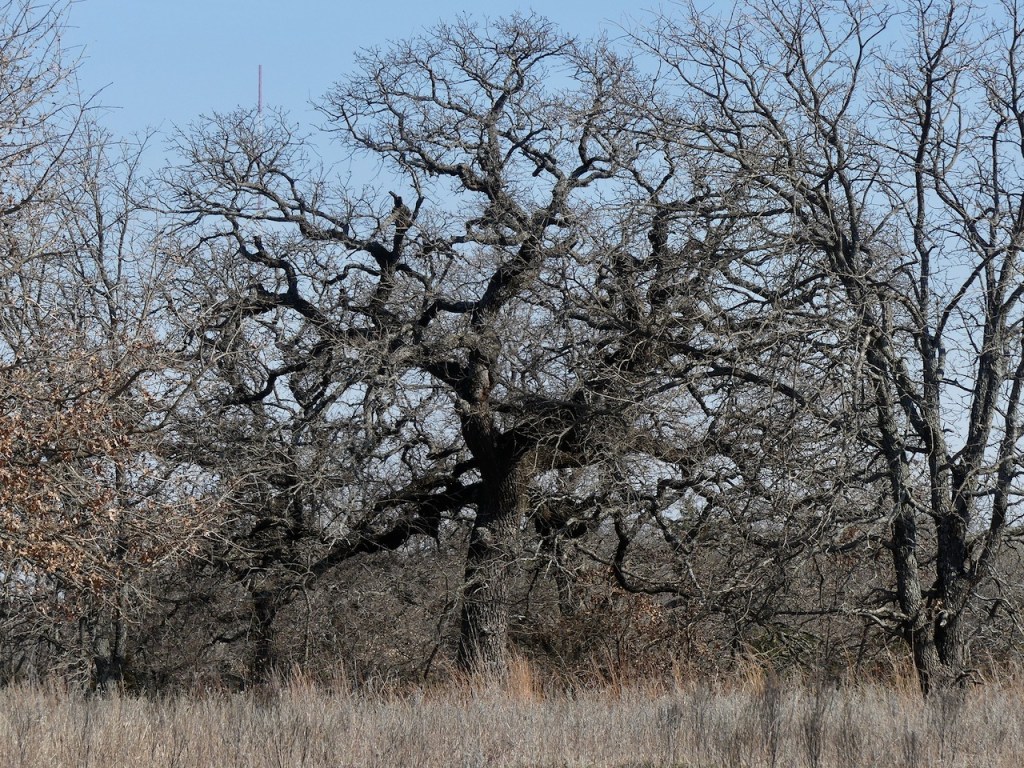
“To my right is a huge oak with twisted arms, right out of a scary story. Along the trail a pair of small sulphurs, swirling together in figure-eights nonstop across the ground.”

The twisted branches of a post oak

I’ll be back soon, watchful for armadillos and butterflies and curious about the new spring growth of grasses and flowers after the burn. Frogs will be calling soon, especially if we get some rain. There’s a lot to look forward to.

Crows and Compass Plants at Tandy Hills

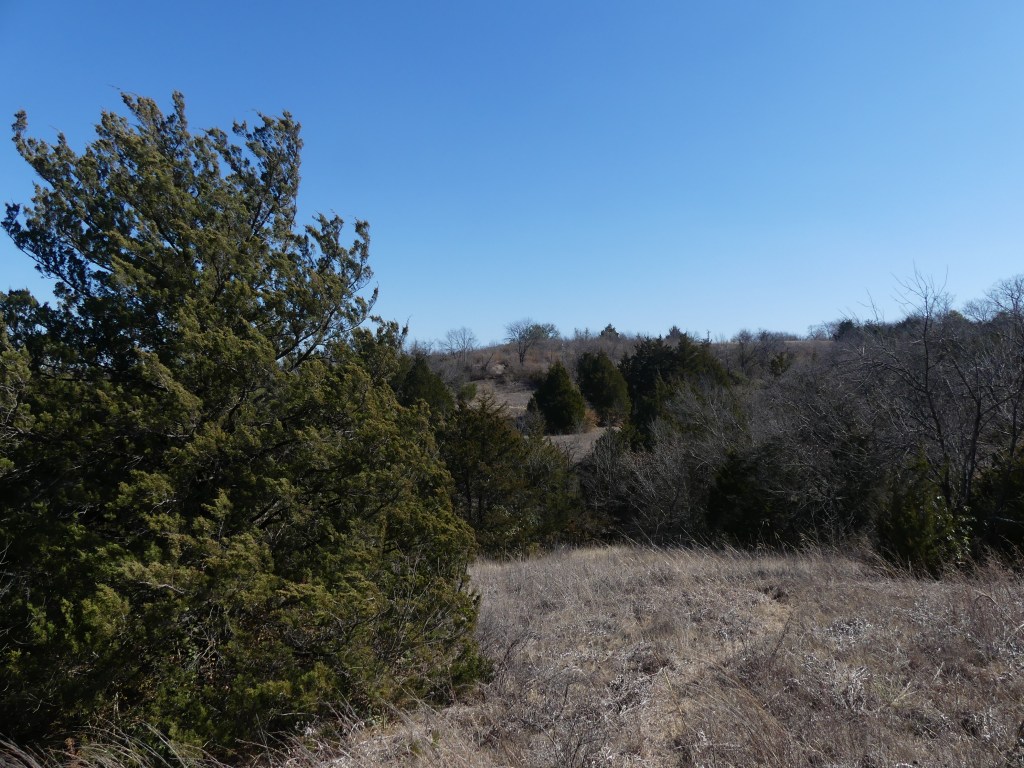
On a bright February afternoon, Tandy Hills Natural Area was a great place to walk through the prairie. A couple of hours of mindful awareness of limestone ridges, junipers, crows and compass plants was just what I needed. I put my phone away and, when my mind strayed, I brought it back to this moment with these grasses and these junipers. The afternoon here was valuable; it deserved my full attention.

Really, any afternoon (and morning, too) deserves our full attention. That is one of the messages of the practice of mindfulness, a discipline that can help us go through our days awake to what is happening around us and within us. In contrast, if I walked through the prairie while looking at my phone or thinking about something coming up tomorrow, I would be on a sort of autopilot and would hardly notice what happened on my walk.

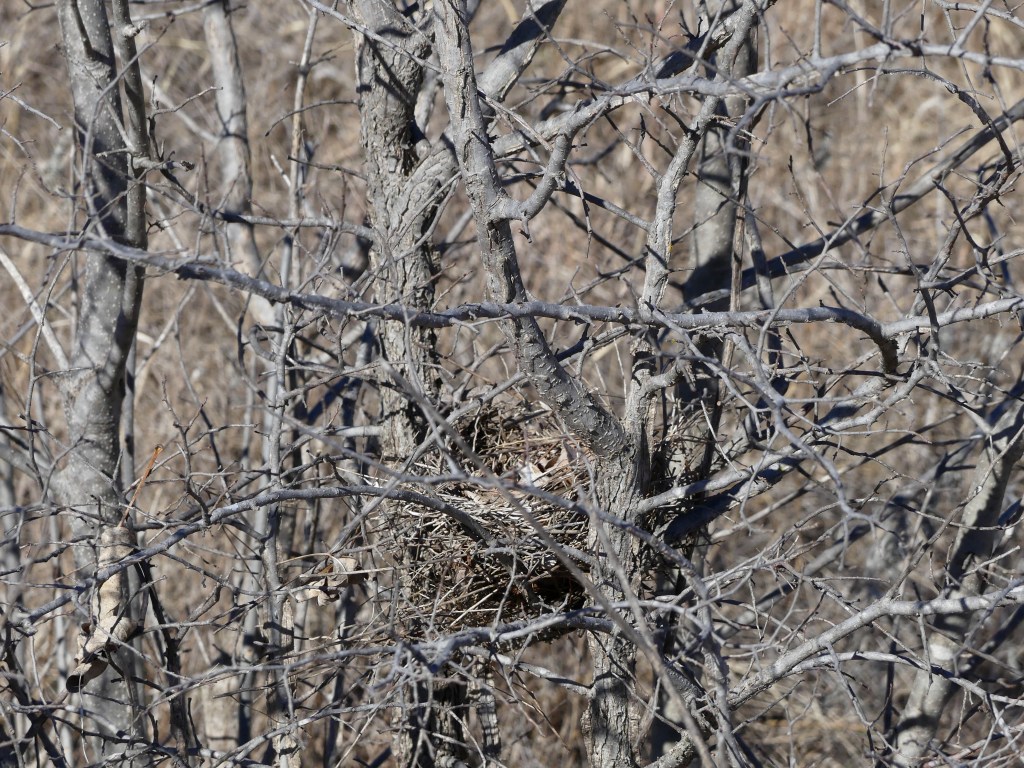
There was a lot to notice in the more than 200 acres of prairie and savannah in east Fort Worth. Wandering along the trail, I noticed a small bird nest in a young tree, only a couple of feet off the ground. Last year, a little bird chose this tangle of branches as the safest spot for her family. I thought of the amazing ability of that avian brain and nimble wings to coordinate a landing within those branches. Routinely coming and going from the nest would have required an Olympian athletic ability.

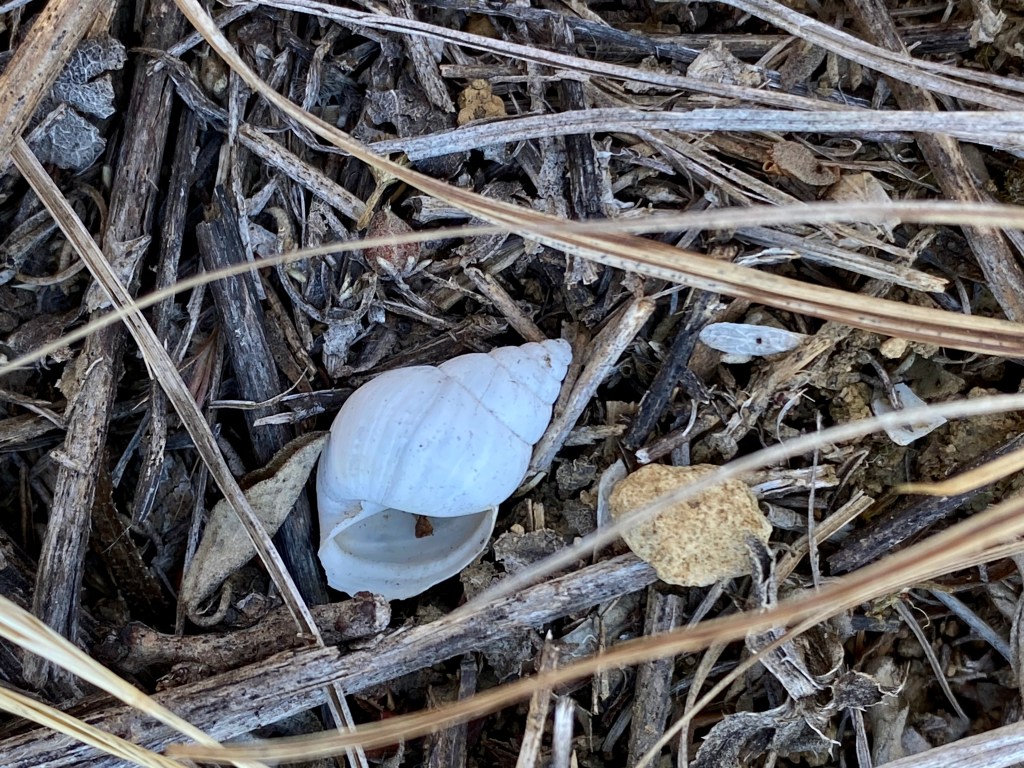
The shell of a Rabdotus snail

Sometimes my pace resembles what Suzanne Tuttle calls “walking at the speed of botany.” Being unhurried and shifting between the wide view of the landscape and the narrow view of small patches of ground, you find wonders hidden in plain view. For example, there were the small gleaming white shells tucked away in the thatch of last year’s grass. The land snail called Rabdotus generates a beautiful spiral shell, growing bigger as the curve expands below its conical tip. 

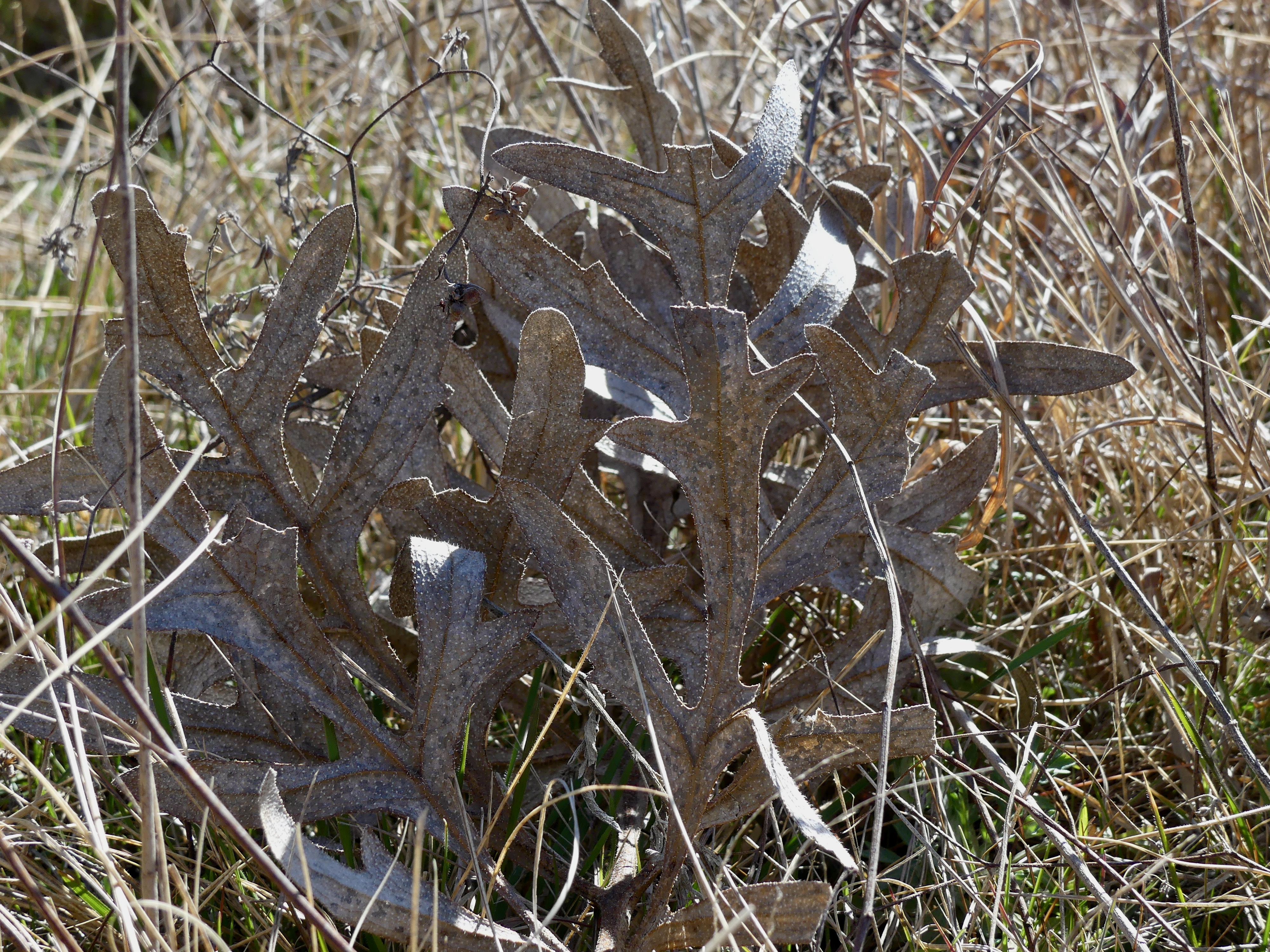
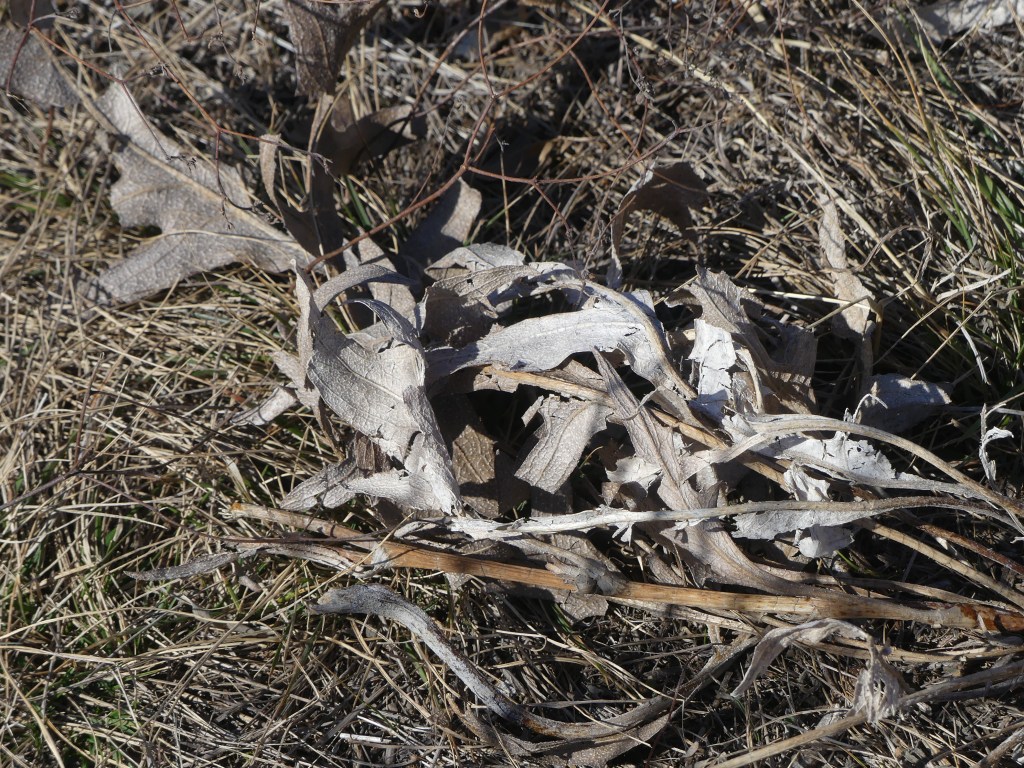
There are some spots within open patches of prairie where the sun exposure, drainage, and surrounding community of species is just right for the compass plant. Its name reflects the tendency for the leaves to grow facing north and south. Not that the plant cares much for cartography, but when the leaves grow in this way, they do not absorb so much of the sun’s heat in summer. And what leaves! Compass plant leaves are big and deeply cut into lobes, and the leaf is very stiff and sandpapery. Even in winter when the plant is dormant, the dead leaves persist on the ground as pale ghosts of their summer selves. They are brittle but still stiff and gritty.

One of last year’s compass plants

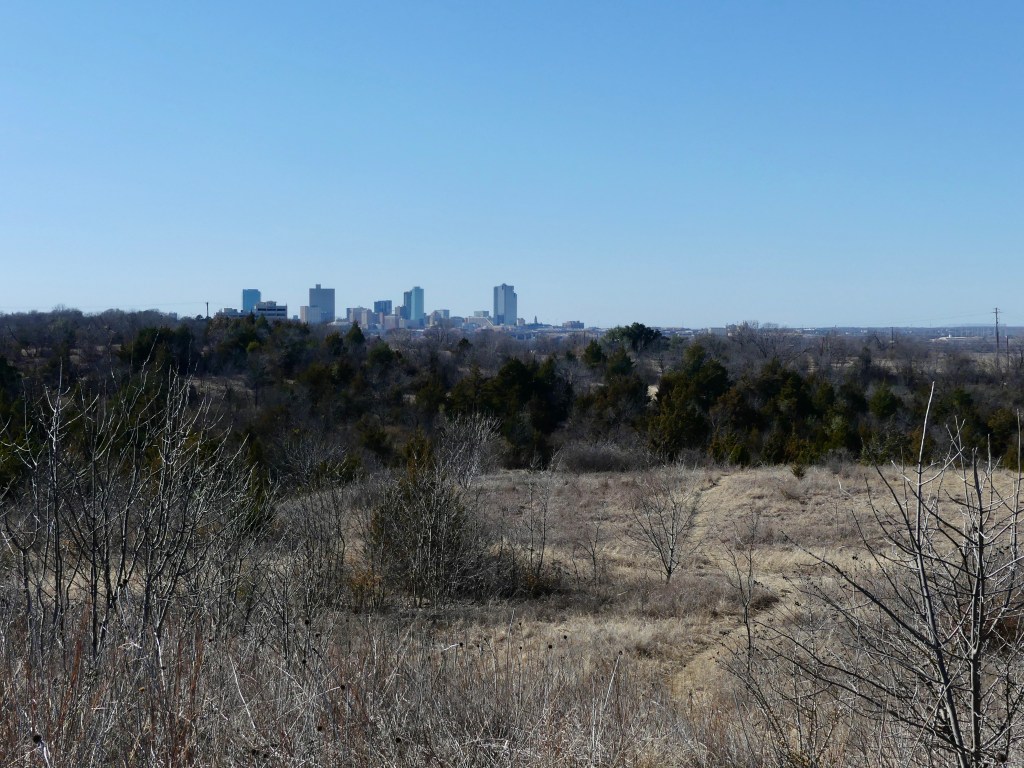
I walked the trails down to the boundary of the place, just south of I-30. At that point, the traffic noise is pretty distracting to me, and I am ready to head for quieter places. To the east is Broadcast Hill with more rolling prairie added to Tandy Hills in 2020, and beside it is a tall broadcast tower. Looking around, it is clear that this remnant prairie is an island of nature surrounded by the “built world” of freeways, technology, and houses. It is all the more a treasure because outside of its boundaries, all the grasslands, meadows full of flowers, and woodlands are gone. 

Tandy Hills without the “built world’

The challenge for me is to fully accept all the wonders together with the freeways, the 1500-plus species of plants growing on beautiful limestone ridges along with the views of houses and streets. My camera is a snitch that blurts out my denial of the full reality of the place. I focus on some grasslands with a stand of juniper in the background and I shift the camera so that the broadcast tower is not in the view. I frame a photo so that the buildings beyond the preserve are not visible. 

I will be better off when I can accept that Tandy Hills lives here, among the freeways and houses, a stubborn, wonderful survivor where children can learn about the beautiful spiral shells of land snails and the amazing leaves and beautiful white flowers of compass plants. Perhaps I will progress past the denial phase of my grief at the loss of so much that is wild and natural in Texas. 

Beyond the boundaries

Mindfulness will help with this because it depends on an attitude of acceptance. To practice mindfulness is to work on being open to what we experience, non-judgmentally. That does not mean that I should not work to support conservation of what is left, or to encourage rules that keep off-road vehicles from tearing up the place. However, on a walk like this one, this afternoon, the full appreciation of the place needs me to accept the sound of trucks and the view of the city just past the nearby hills.

Butterflies appear to accept Tandy Hills just as it is. As I looked over a patch of dormant prairie grasses, a small yellow butterfly bounced across the field. This little sulphur had survived the recent temperatures in the teens and emerged with boundless energy, flying among the little bluestem and Indiangrass and disappearing over the ridge.

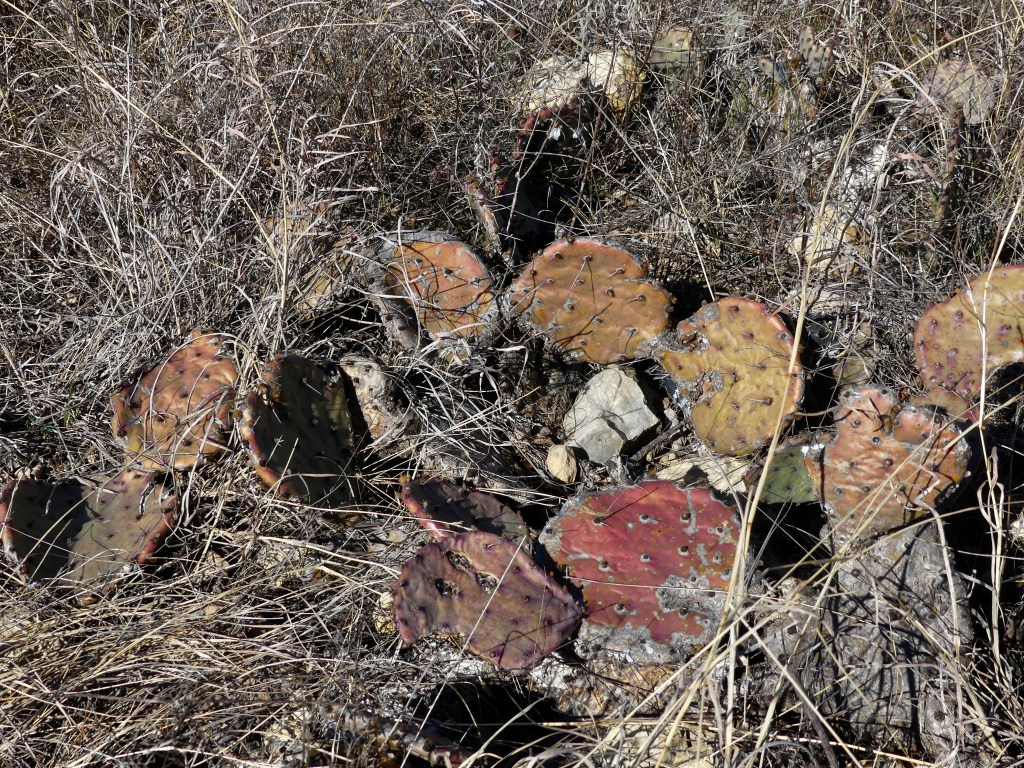
Prickly pear in an array of soft colors

Somewhere along the way was a clump of prickly pear cactus, its pads weakly standing up to the winter and the lack of rainfall. But those pads were the loveliest shades of terra cotta and pale green shading into gold. Walking at the speed of botany brings so many beautiful things into view.

Eventually I sat on a bench on one side of a ridge and looked across junipers and oaks to a small tree or shrub around a hundred yards away. It had a smear of reddish color, perhaps leftover autumn leaves or a possumhaw with clusters of red berries. I wanted to focus my awareness on my breathing and on this one spot in the distance. Bringing attention to each breath is a way, in mindfulness practice, to let go of distractions and focus on moment-to-moment experience.

In my greater stillness and openness, I was more aware of the depth and distance to the next ridge and the green and reddish-gold junipers swaying in the breeze. The hills seemed a little quieter; cars were still moving and somewhere there was an airplane, but they seemed more in the background, more distant. 

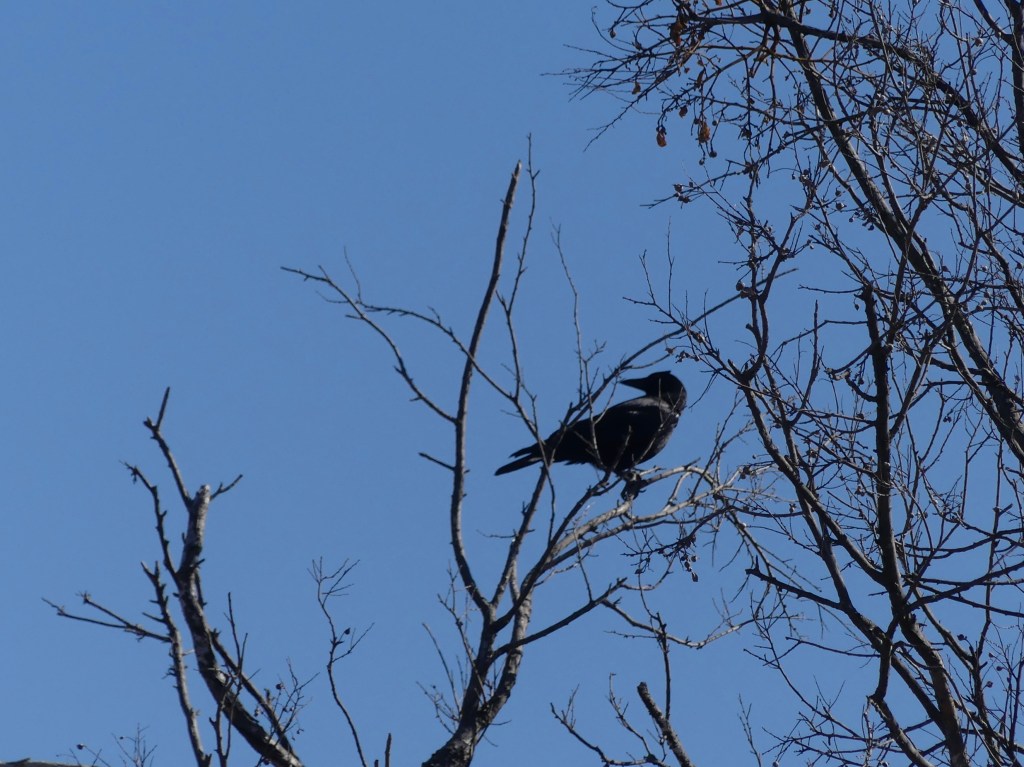
A crow flew between the ridges on broad black wings, pulling up to rest on the branches of a skeletal oak tree. Then two more crows flew in from another direction, perching in nearby trees. After a minute of silence there were a couple of rounds of crow-talk, “caw-caw-caw-caw.” The afternoon deepened and the shadows grew longer as I listened to the comings and goings of crows. There was a sense of peace and belonging here with the crows and butterflies and everything else that lives at Tandy Hills. We are all fortunate to be able to spend some time in this patch of prairie.

An American crow

Introducing You to the Grasslands

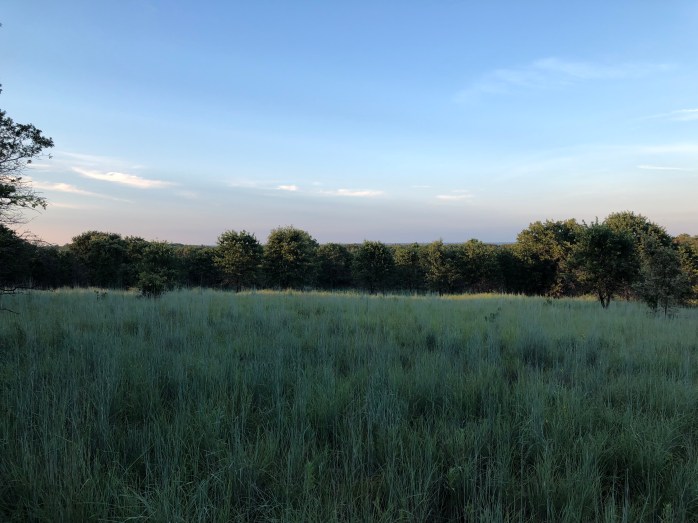
LBJ National Grasslands at sunset

We want you to spend time in nature and come away in love with the place. We want your kids to love the grasses, ponds and woods. “We” are the LBJ Grasslands Project, and so far that is Michael Smith and Kayla West. We think time spent in nature is important, and we’ll meet you out there and show you around. 

Why is it important? We value your experiences of wonder and fascination, as well as the sense of relatedness, empathy and peace that can come from time spent in nature. In addition, our world needs as many people as possible who have a strong connection with nature. Without that connection, we do not care for the earth around us, and the land, water, and all living things suffer as a result.

The suffering of the earth – the climate, the loss of species, the oceans choking on plastic and carbon, and other issues – is a moral challenge to us and ultimately it threatens human survival. The only answer to it is for us to live in a healthy relationship with all the lives around us. What would such a relationship look like? It would not require us to return to a primitive existence, but it would ask us to weigh our priorities differently. Taking less and giving back are things we do only when we truly care about someone or something.

Meeting people somewhere in nature, introducing them to the community of animals and plants, and finding ways to make the visit playful, memorable, inspiring – that might be a gift to you, but it is surely a gift to ourselves. Sharing places like the LBJ National Grasslands brings considerable joy. It was especially fulfilling to read what Jessica wrote in a letter to the grasslands: “I don’t think any of us play outside enough, and your beauty and diversity inspired such curiosity and creativity in my kids yesterday. I’m grateful.” 

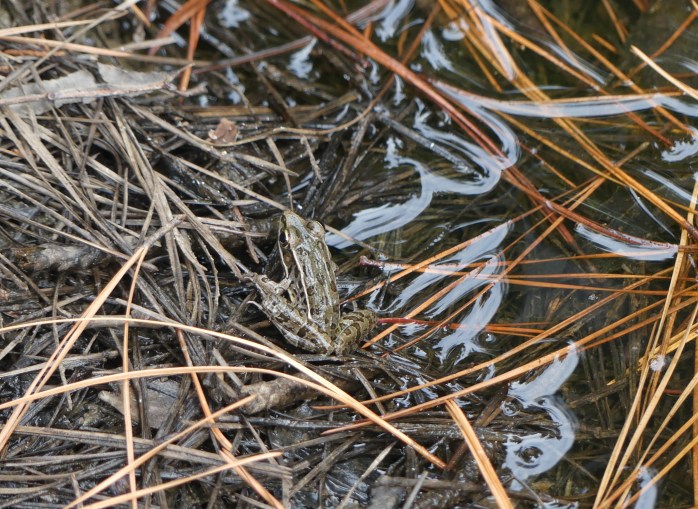
Leopard frog

Let me spell out a little more about what we are doing. The two of us are naturalists, and that means we know something about living things and places like grasslands and woodlands. We are also really interested in how people benefit from nature and how they can spend time “soaking in” all the details of a wild place, paying attention to sights, sounds, smells, even the touch of the land and water. Some folks get outside because it is a pleasant setting for a picnic or outdoor sports, but when we walk in these places we are focused on any or all of the thousands of things we find – trees, birds, mosses and ferns growing on a shady embankment, clouds, a spider tucked away in tree branches, and so on.

Kayla and I have specialized interests in some species, and you’ll find us documenting some of what we see on the iNaturalist app. However, adding to a big list of species that we have seen is not the main point. You don’t have to have any special knowledge of things like geology or botany to walk with us. The walks we want to lead in the LBJ Grasslands Project are for spending time in the prairies and woodlands and following our curiosity wherever it leads us. Sometimes the emphasis might be on understanding the plants and animals and how they live. At other times we might be interested in practicing mindfulness, with little talking and an emphasis on the direct experience of being present.

Our walks are fairly slow and pretty quiet, with the goal of taking time to really see and hear the place, think about what is going on around us, and cause as little disturbance as possible. A big group would scare the birds, frogs, and other wildlife off, and we might not get much individual interaction with you. Instead of bringing a class with a bunch of people, we go in very small groups, maybe just two to five people. (In the pandemic that we are still struggling with, small groups allow for more distance between participants, too.)

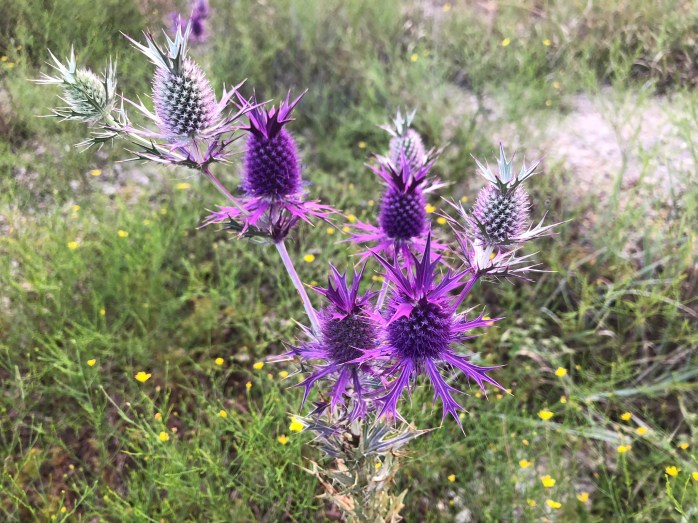
Leavenworth’s eryngo

Kids are welcome, as long as they are a pretty good match for the kind of walks I just described. That means that children nine or ten and older are the best fit. Fourteen-year-old Abbey wrote, “I loved the hike, I learned so many things that I wouldn’t learn in school.” If you are interested in bringing younger children, please talk with us and perhaps we can arrange something that will engage them and be meaningful for everyone. 

I should also mention that we do not charge for these walks, which we do just because they needed doing and because we get intangible rewards for doing them. If this interests you, please join the Facebook group for the LBJ Grasslands Project, https://www.facebook.com/groups/lbjgrasslandsproject, where we talk about these things and plan future outings. If you don’t do Facebook, I would be happy to hear from you if you email livesinnature@outlook.com

In the November Woods

Hardly anything is finer than a green Forest Service gate opening onto trails that lead through the grasslands and oak woodlands of LBJ National Grasslands. Those meadows and woods change throughout the seasons, and each of those changes is beautiful. If I had to pick a favorite, it would be autumn (but ask me again in the spring). The low-angled sun highlights details of light and shadow, the colors of leaves and grasses are wonderful, and afternoons can be sun-warmed but cool at the same time.

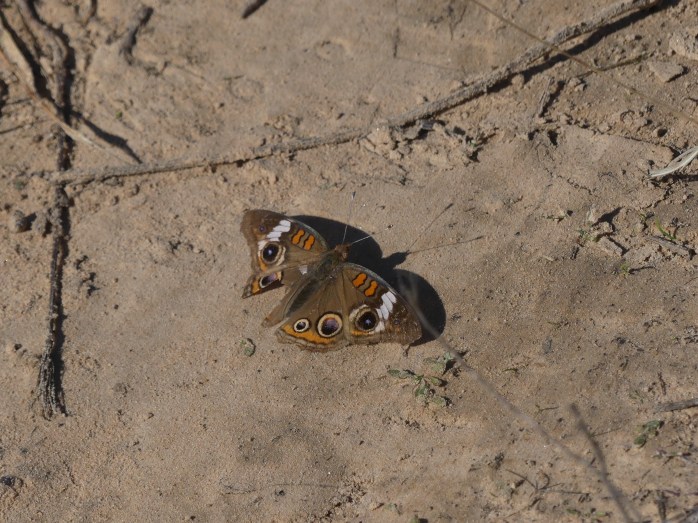
A common buckeye

Yesterday I opened one of those green gates that was new to me and walked a trail back through rust-colored little bluestem grasses and oaks with leaves now tinged with yellow and caramel, and a little red here and there. Much of it was familiar, like the way the sun makes little bluestem sparkle when it shines through the little tufted seeds tucked away along the stems. What made it wonderful was that it was more of the things that are always on the verge of being lost. Ranches are sold and turned into houses and lawns, and so a walk through a new patch of Cross Timbers felt reassuring. 

Croton and bitterweed along the trail
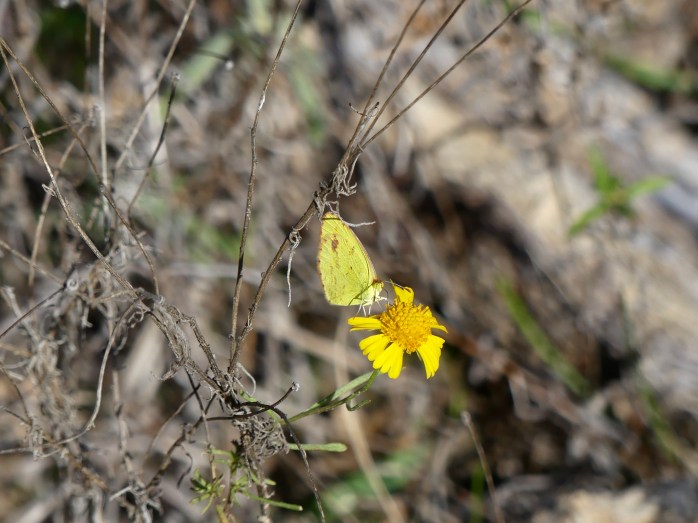
A sulphur visiting a bitterweed flower
A small pond

Along with the taller prairie grasses were areas with lots of croton (“prairie tea” for some folks), western ragweed, and bitterweed. I love this last plant, whose yellow flowers bloom so late in the year. Clusters of yellow bitterweed blooms were visited by bees and butterflies. Grasshoppers jumped in front of every step I took, taking advantage of these last warm days to nibble at the remaining vegetation. 

A skipper visiting the bitterweed
A variegated fritillary
Sunlight through bluestem seeds
“Me and my shadow.” A harvestman (daddy longlegs) and its shadow, wandering the prairie

After about an hour, I went down the road to another of those green gates, this one opening onto a trail that Meghan Cassidy and I walked a year and one week ago. After crossing a nice patch of prairie that very gradually slopes down to a line of trees, the trail turns and traces its way through oaks, junipers, and prairie openings. 

I stopped at the same post oak where we had stood and watched leaves drop, the air so quiet that I could sometimes hear a leaf bump into a branch on the way down. And then we would hear a wave of breeze approach through the treetops, stirring the top branches and releasing a few more leaves to pinwheel down to the growing carpet of leaves on the ground. Although not many leaves were falling from that tree yesterday, there was some of that sense of solitude and peace in the quiet of the woodlands.

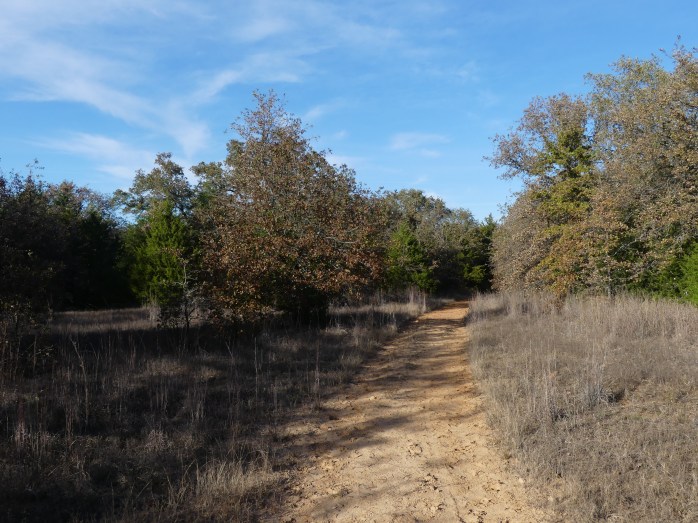
Further down the deep sandy trail some of the same young oaks were turning, with leaves glowing scarlet when backlit by the sun. The woods were full of shade behind the trees which really had yet to lose many leaves. In other places the low mid-afternoon sun struck grasses and leaves with bright, warm light. The sunlight seemed that much brighter for the contrast with the shaded and darkened places deep among the trees.

The pond

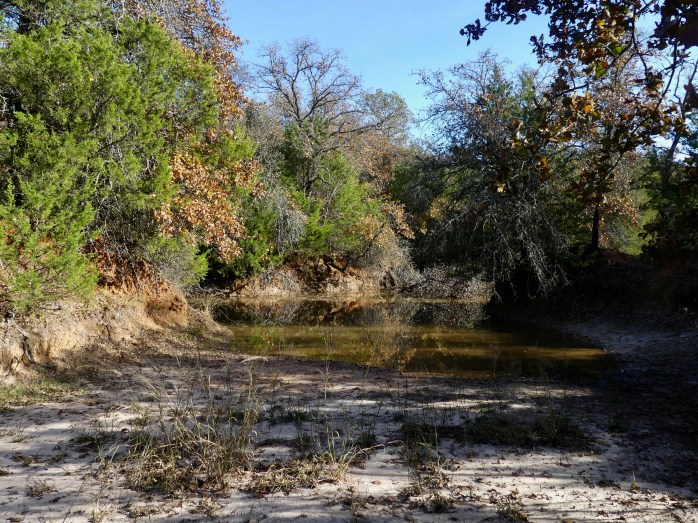
I reached a place where the soil is cut by erosion and drops, exposing red and pale sandy soil in an irregular set of steps and furrows down to a small pond. Meghan and I sat here a year ago on a stretch of slightly damp sand tilting down to the water. I was entranced by a play of the light in which the late afternoon sun was reflected by ripples, sending squiggles of light up onto a shaded bank under a juniper. The very same thing was happening yesterday, with a tiny light show playing on the shaded bank of the pond. It was a very small thing, and also an example of something that seems important to me: Nature is so often a consistent, stable presence in a world that can seem chaotic. Places in nature can be anchors in our lives to which we can return over and over for reassurance that some good things persist in spite of all the changes around us. 

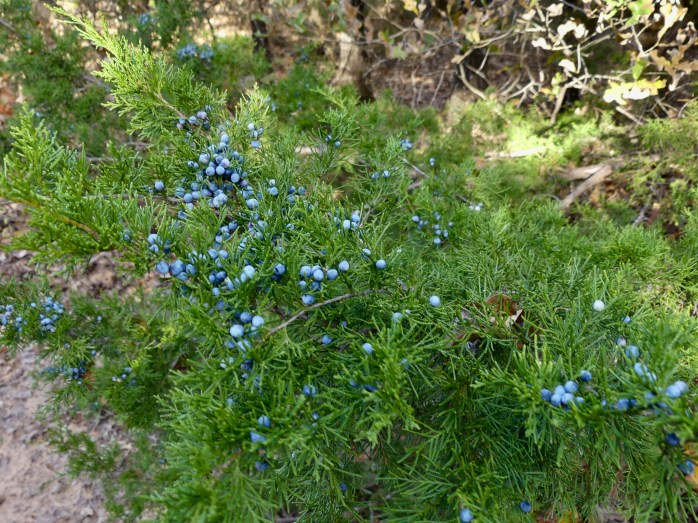
Juniper berries!

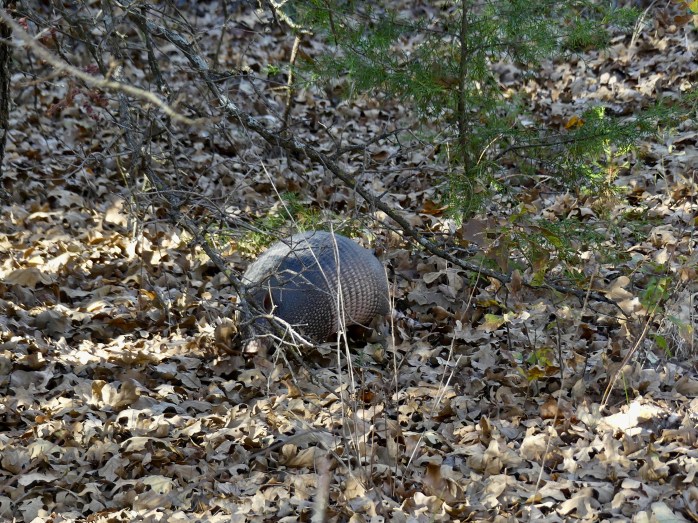
On the way back there was movement in the leaf litter a small distance off the trail. It was a nine-banded armadillo, snuffling along the woodland floor, oblivious to the human standing nearby. Once again last autumn’s walk was being repeated, as we saw an armadillo on the return walk on that day, too. This one kept searching for insects and grubs to eat while I took a couple of photos. I shifted and made a little noise and the little armored one stood up to look around and sniff the air. I coughed, and he crashed off through the brush. 

The armadillo
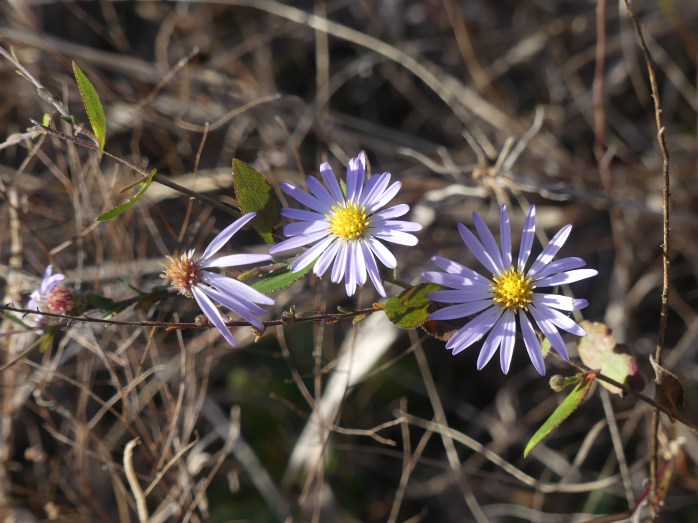
Tiny asters blooming along the trail
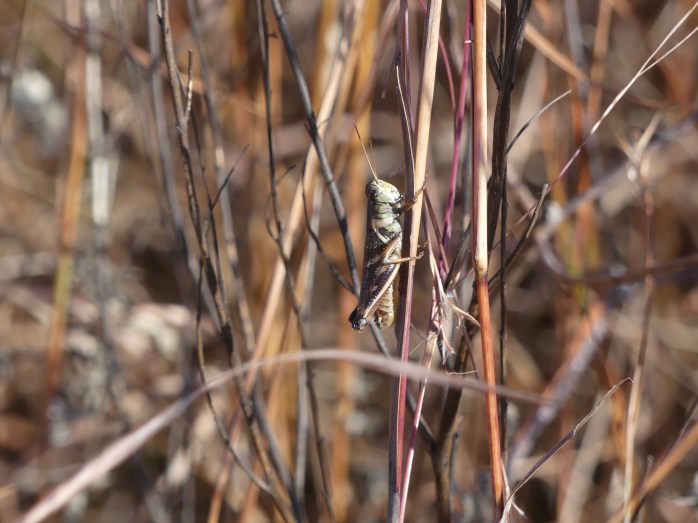
Grasshoppers were everywhere
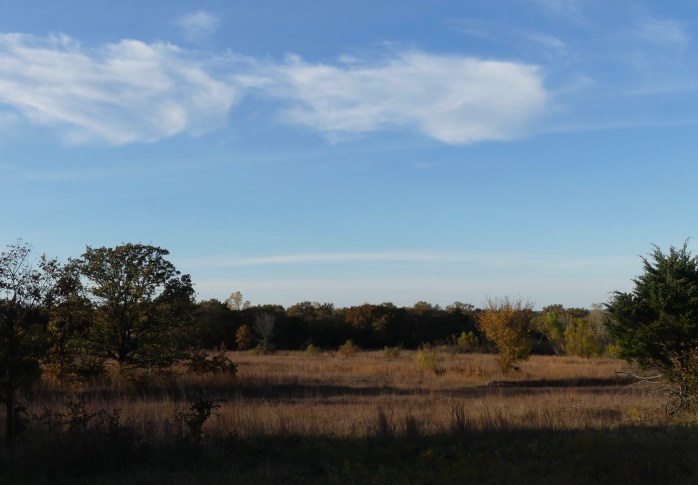
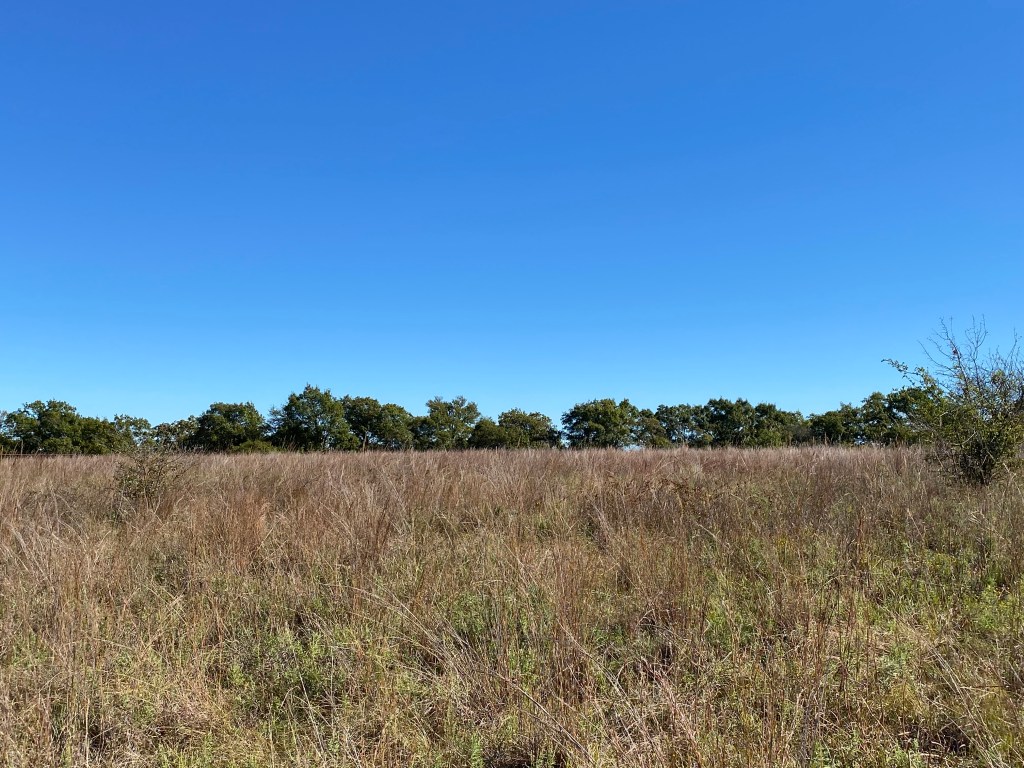
More prairie

It was getting near sunset, and my walk was done. It is hard to put into words just what this time of year, this quality of light, this quiet woodland feels like to me. In the “Autumn” section of the book Meghan and I have been working on, I wrote this: Things come to an end / Be still in the golden autumn light / And consider how to make a good end of the year / With affection and acceptance. This season does feel like an ending of the year, and it seems like a good idea to spend some time being still and quietly reflecting on all that the year contained. This November walk at the LBJ National Grasslands had been perfect for that.

Falling Deeper into Prairie Magic

Fields of grasses and flowers stretching into the distance pull me into some sort of enchantment. In late autumn and winter their colors and textures could keep me wandering for hours, with the sun glinting through the tufted seeds of little bluestem and the inflorescences of Indiangrass waving at the tops of tall and slender stalks. 

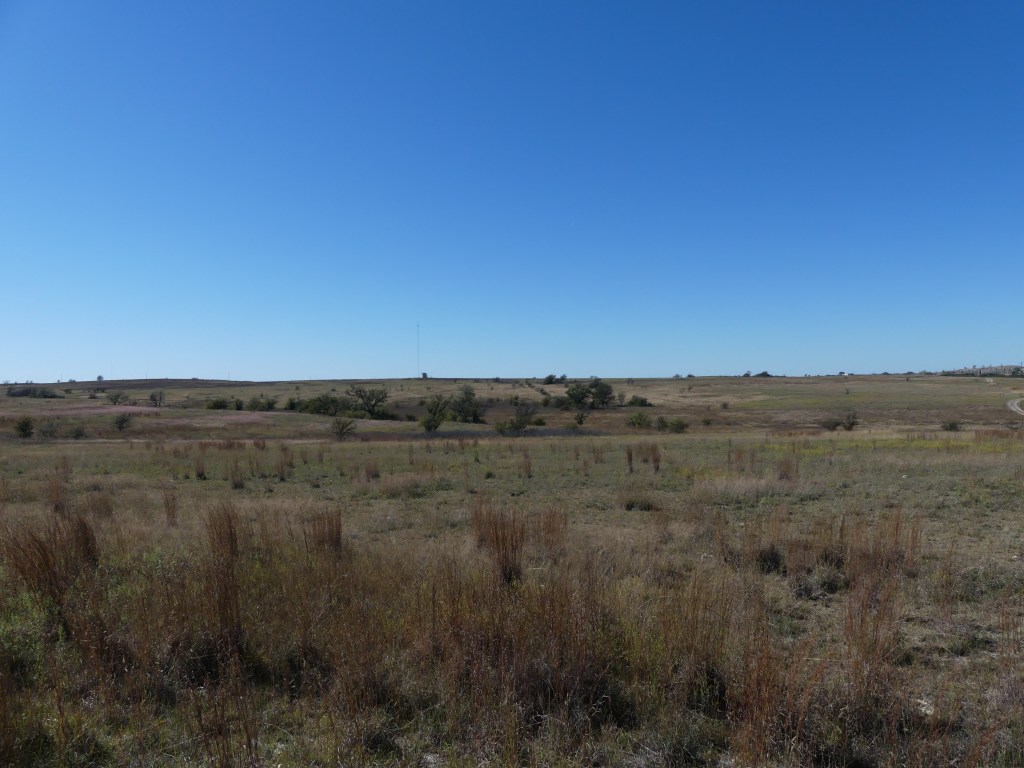
On October 30th, I had the opportunity to learn more about prairies and how they work, by attending the Prairie Seekers training provided by the Native Prairies Association of Texas (NPAT), in conjunction with the Dixon Water Foundation. The group of us met at the Dixon Water Foundation’s Leo Ranch, located northeast of Decatur in a portion of the Grand Prairie (the ecoregion, not the city). It is an area where grasses and forbs (flowering plants that are not grasses and not woody) grow in fairly shallow soil with limestone below it. Because of the limestone near the surface, the trees around creek corridors often include escarpment live oak. 

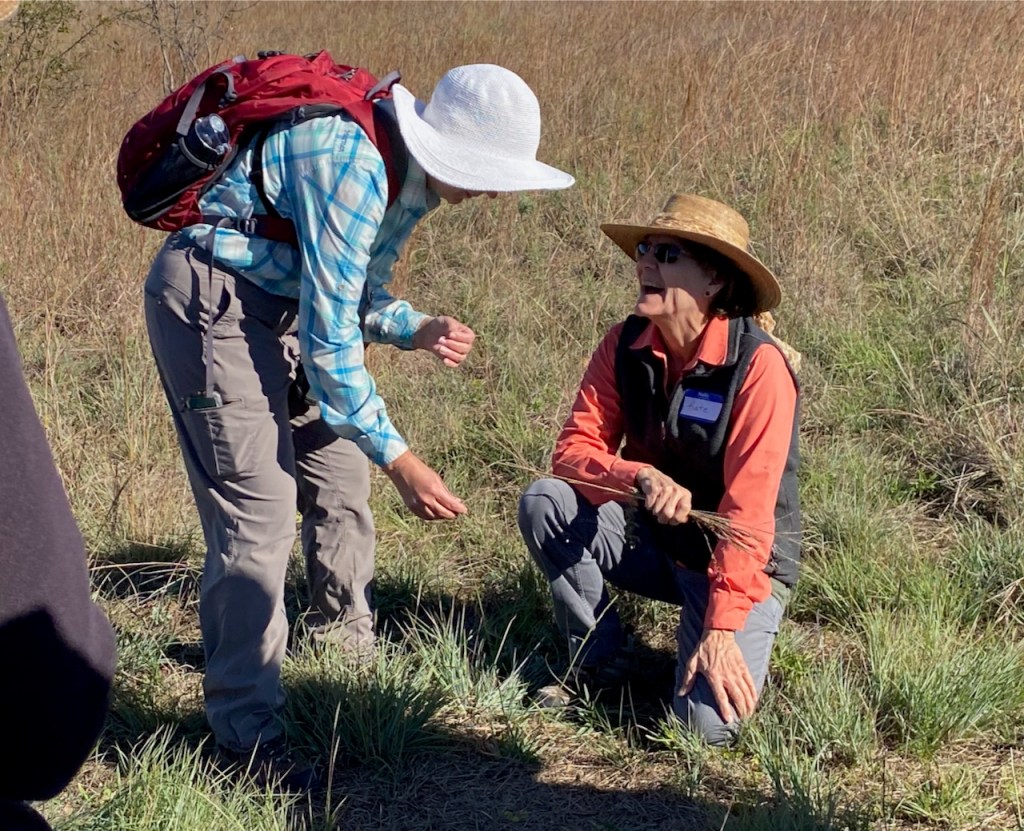
Suzanne Tuttle (L) and Kate Morgan (R) share a laugh

Many thanks to Dr. Carly Aulicky, North Texas Outreach and Stewardship Director of NPAT, for her role in organizing the event and helping teach us. Others who taught us on walks through the prairie included Suzanne Tuttle, Kate Morgan, Michelle Villafranca, Mary Curry and others. Each of them is a priceless source of prairie wisdom. We were lucky to be able to spend the day with them.

A prairie is a constantly shifting community of plants and animals, changing or renewing in response to things like rainfall, the grazing of animals like bison, and occasional fires. Shrubs and trees are constantly looking for an opportunity to get started, and without grazing and/or periodic fire, woody plants will gradually take over and the prairie will disappear. 

A healthy prairie has many different species of grasses and forbs living together. There is diversity in any square yard of prairie, but prairies may also have patches where different plants predominate. This may be the result of dips in the land or swales that are wetter because they collect more rainfall, areas of shallower or deeper soil, and so on. That mosaic of different plants makes the prairie stronger and more resilient.

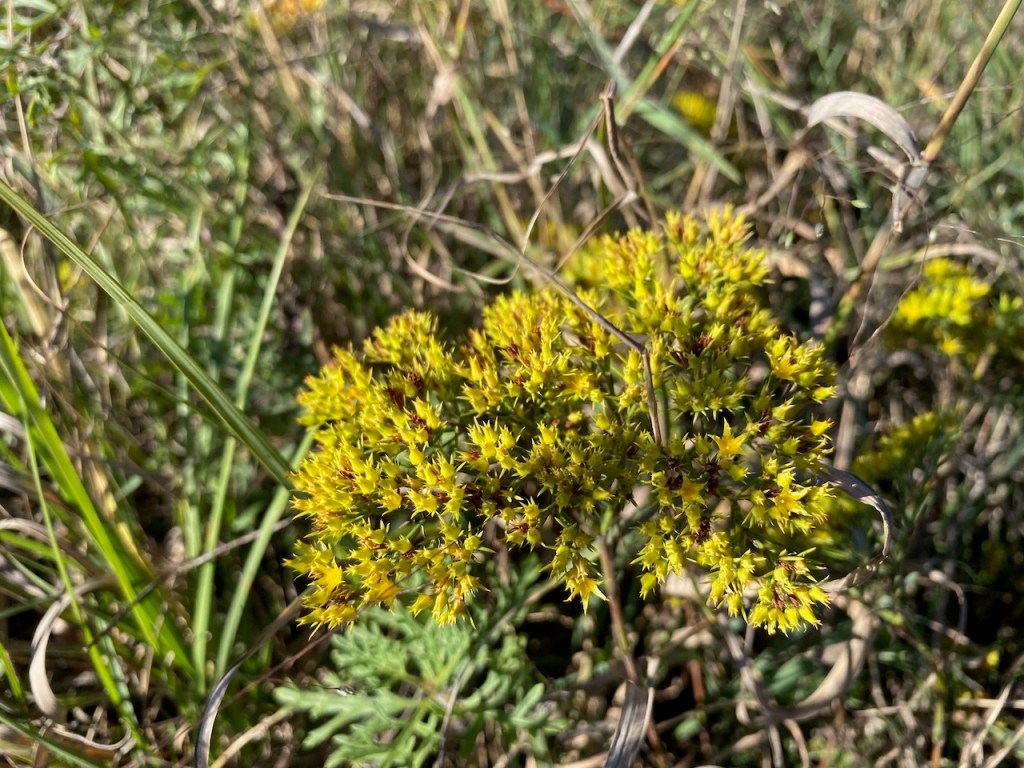
Whitlow-wort

We started the walk with examples of big bluestem and Indiangrass, two grasses characteristic of north Texas and among the tallest. Soon we came across a low-growing plant with mats of yellow flowers, identified as Whitlow-wort. Our prairie experts considered it a great plant, associated with healthy prairies. 

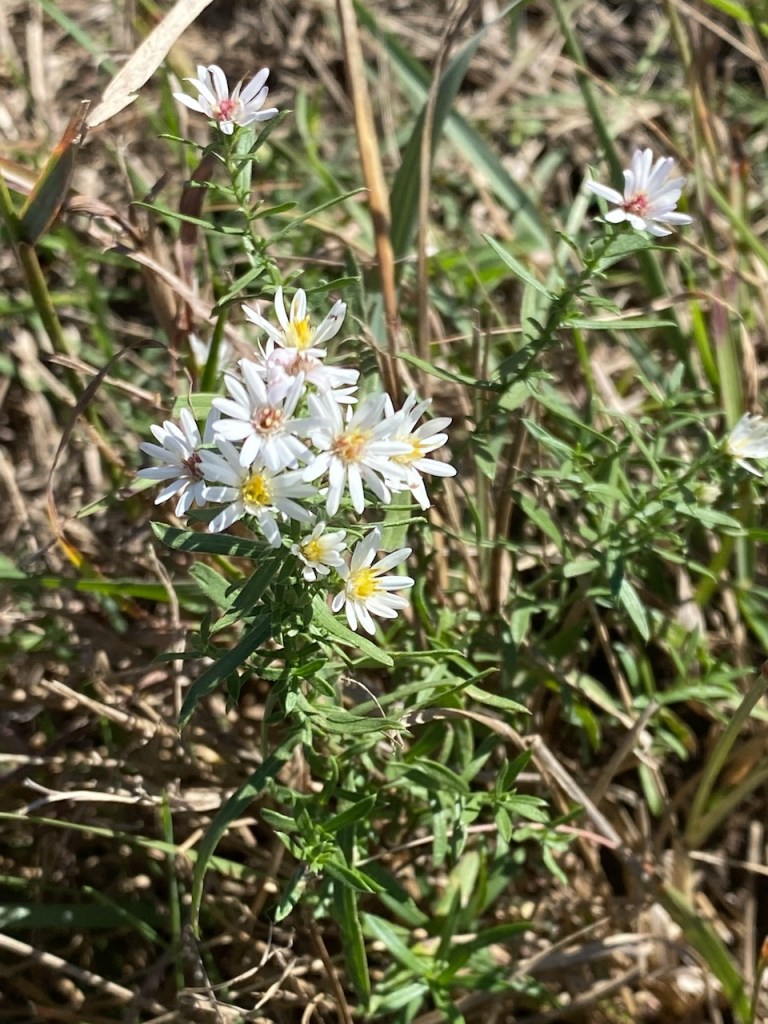
There were many other grasses pointed out: little bluestem (a favorite of mine), and side-oats grama, the state grass of Texas, with seeds hanging off one side of the stem like little flags. There were low-growing clumps of heath aster with beautiful white flowers. And there was the invasive KR (King Ranch) bluestem and a bit of Johnson grass in a few places. Exotic grasses such as these have been imported to Texas from time to time and promoted as being good forage for cattle. It generally does not end well, with the imported grass tending to crowd out the native species.

Heath aster

Many other topics were covered, such as how a disturbed area or bare soil is colonized by species that can grow quickly and prepare the way for later plants, which eventually give way to later ones, in what is known as succession. We visited other places, including a small grotto where an intermittent stream has created a cool, wet place where maidenhair ferns grow beneath a limestone shelf. There was a lot to see and learn.

And all of that brought me more deeply under the spell of prairie magic, which does include natural history facts but beyond that it involves being drawn to the beauty and complexity of prairies. The experience of being in a prairie seems to nurture some part of me that needs to walk through a sea of flowers and waving grasses. All those Prairie Seekers at the NPAT/Dixon Water Foundation event are like the extended family members who will help keep that magic alive.

At Pedernales Falls

The Texas Hill Country is a beautiful region, and Meghan Cassidy and I finally got around to visiting it in mid-October. In our work on a forthcoming book on mindfulness in Texas’ nature, we have been to a lot of places around the “edges” of Texas but not the central region, dominated by the massive uplift known as the Edwards Plateau. We were never going to leave it out, though, because that would mean missing out on lovely and important places.

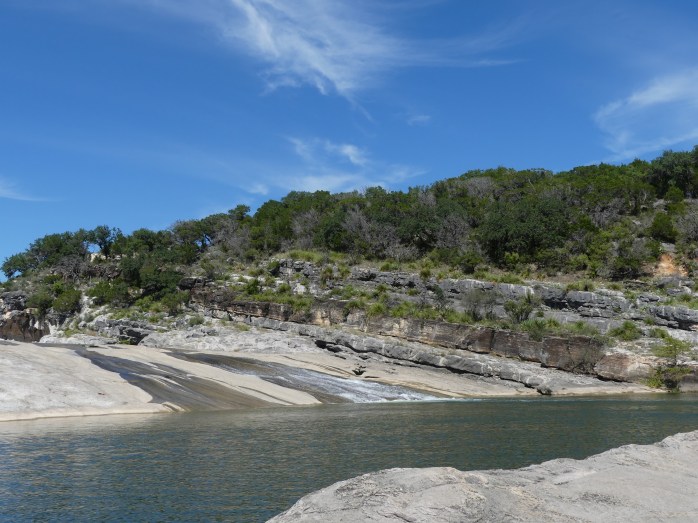
Water slides over rock and into a pool

The eastern part of that plateau has limestone ridges and canyons formed when water dissolved the rock and created caves and underground waters that emerge in springs and grottos. Such places may be ringed by maidenhair fern and lush vegetation, with crystal clear pools and streams flowing over stone. This is the Hill Country, with rocky hillsides covered with Ashe juniper, small prairies and pockets of grassland, and beautiful rivers.

Our friend Ruthann Panipinto nominated Pedernales Falls State Park as the right place to spend the limited time we had. I’ve known Ruthann for years as someone whose knowledge and interest has, like mine, expanded from herpetology into an even broader love of natural history. Her choice of Pedernales Falls was perfect.

Traveling to Pedernales Falls, one of the first questions that occurred to me was how Texans came to pronounce it as “Purdenales.” Spelling and ways of speaking are sometimes out of sync, and English-speakers don’t always have a good track record when dealing with some Spanish words. As it turns out, the Spanish word “pedernal” means “flint,” and the Pedernales River got its name from the flinty stone in its riverbed. Much of the Edwards Plateau rests on layers of limestone, some of which is Cretaceous (66-144 million years ago). Some of the rocks exposed by the Pedernales go back unimaginably earlier, to the Ordovician (438-505 million years ago)[i].

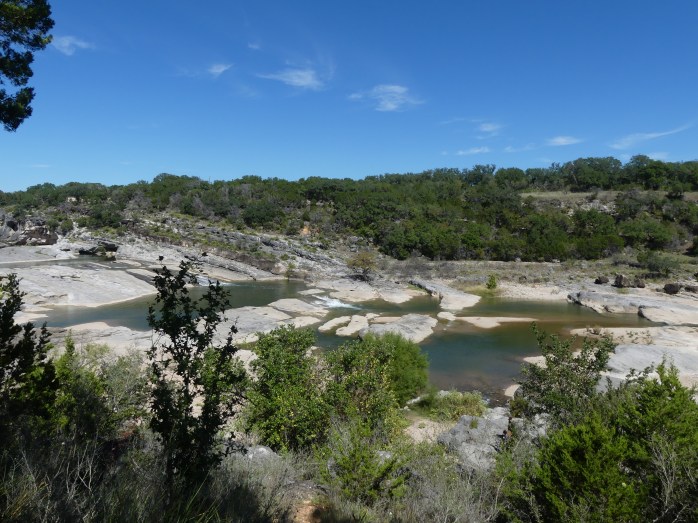
Pedernales Falls

We arrived and walked down to an overlook from which we could see a beautiful river cascading over the top of a huge apron of gray rock into a pool, and then pouring over a small gap into lower pools. The water then worked its way through a line of boulders and on downstream. We followed a long series of stone stairs down to the river and sat down to watch and listen. 

It was a surround-sound experience of flowing water. From a small tributary on one side was the sound of riffles, shallow water tumbling over small stones and gravel. Behind us was the upper falls, with the main part of the river sliding down a long expanse of stone. In the middle was the spot where the water pours several feet from one pool to the next, with a deep, thunderous sound reminding me of surf breaking at the seashore. 

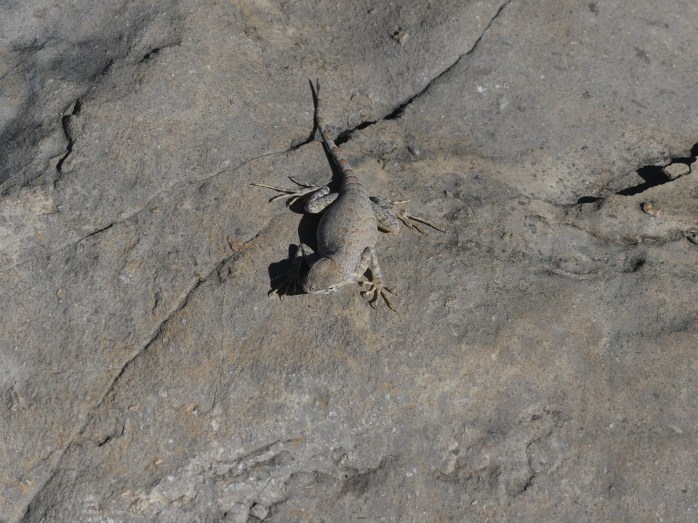
Above us there were long wisps of clouds as if the upper winds stretched water vapor across the sky in white calligraphy. The sun was warm and intense but the air was cool in just the way you would expect on a mid-October day. Texas earless lizards basked in the sunshine, taking notice if we got too close and scampering away to wave their tails in the air, exposing the black-and-white bars underneath. 

Texas earless lizard

It was fairly busy, but did not really feel crowded, as couples and families and even a geology class made their way down to the river to walk, sit, and sometimes wade. The voices of people were masked by the falls and (thankfully) no one brought a boom box. Visitors came and went, and there were times when you could look across a substantial area without seeing people. And in the next part of the visit, we had the river to ourselves.

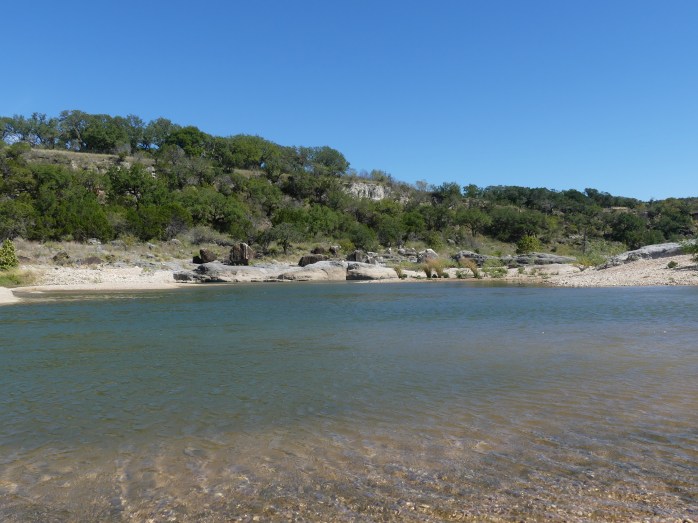
Ruthann led us further downstream, over boulders and across gravel bars to a place where a huge cypress tree stands like a sentinel, roots wound around the rocks to create something like a tiny peninsula or island in the river. The almost-clear water passed over large rocks, heaved up in places and then falling into small troughs. It flowed among the boulders and between grassy banks and broke into noisy whitewater in shallower places. 

Along the course of the river were more cypress trees, their feathery leaves beginning to show a bit of rusty yellow in the low afternoon sun. Autumn might be slow to take hold, but it was beginning.


[i] Spearing, D. 1991. Roadside Geology of Texas. Missoula, MT: Mountain Press Publishing Co.

Ruthann on “Cypress Island”

Mindfulness, Mountains & Snakes in the Big Bend

A few weeks ago, it was back to the Big Bend region with Meghan Cassidy for one of the last trips for the book on mindfulness in nature. I’ve made a number of trips there during the past twenty years, and my attachment to and fascination with that region keeps growing. I felt really fortunate to introduce Meghan to the Chihuahuan Desert and the mountains out there.

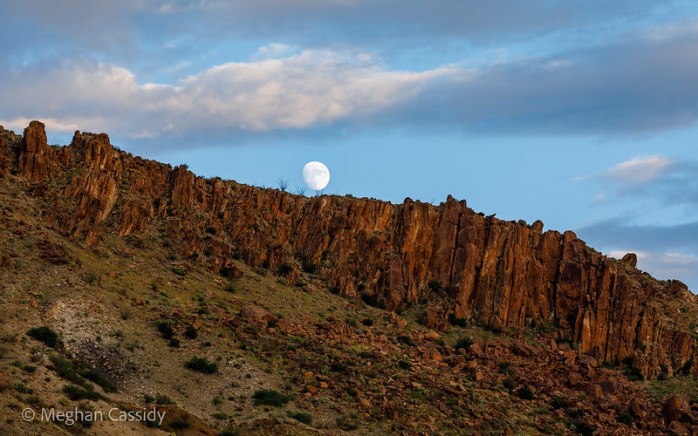
We stayed in a cabin at Wild Horse Station, just a little bit north of Study Butte near the Christmas Mountains. There are extruded columns of lava and thin soil where scattered desert plants grow. It is a strange and beautiful place, and that cabin on the hillside has a broad porch that looks out toward more hills and mountains to the west. This trip included some times for sitting on that porch, watching rainstorms or sunsets, and writing. I’m very grateful for that porch and for those moments.

A ridge just behind our cabin, at moonrise. Photo by Meghan Cassidy

In the early years, my visits to this region were very focused on finding snakes and other reptiles, although my companions and I always knew this was a place to be savored and soaked in. We rarely took much time to do it, and whatever we gained in total snakes seen, we lost in really getting to know the region. Each year has brought a broader interest in the ecoregion and a willingness to slow down and pay attention to more of it. This trip was a combination of mindful attention to the mountains and desert and some very fine observations of snakes.

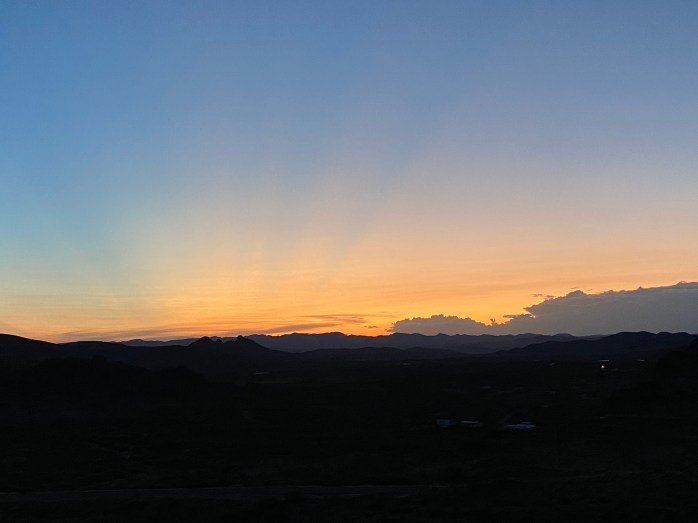
Sunset (photo by M.Smith)

Our arrival at the cabin was interesting. Darkness had just fallen when we walked across the porch to find the front door open and, inside the dark cabin, the television was on. We did the ‘police knock’ standing to the side of the open doorway, and when there was no response – human, javelina, or otherwise, we turned on the inside light and began to check the rooms. I glanced to the side to see Meghan holding a knife, and I knew I had a capable partner out here where there is little phone service and self-reliance is important. Everything was fine; I like to think that a coyote – not the human trafficker but Canis latrans, the trickster of Native American legends – had let himself in, watched a show, and left the place open for us.

In the morning there was coffee, the shadows of nearby mountains with rosy light growing overhead, and that wonderful porch overlooking it all. After a beautiful sunrise, we got ready and headed into Big Bend National Park.

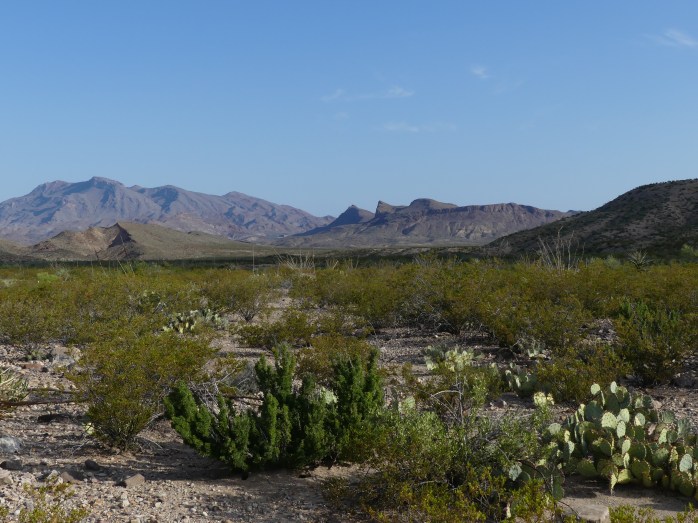
Chihuahuan Desert within Big Bend National Park (photo by M.Smith)

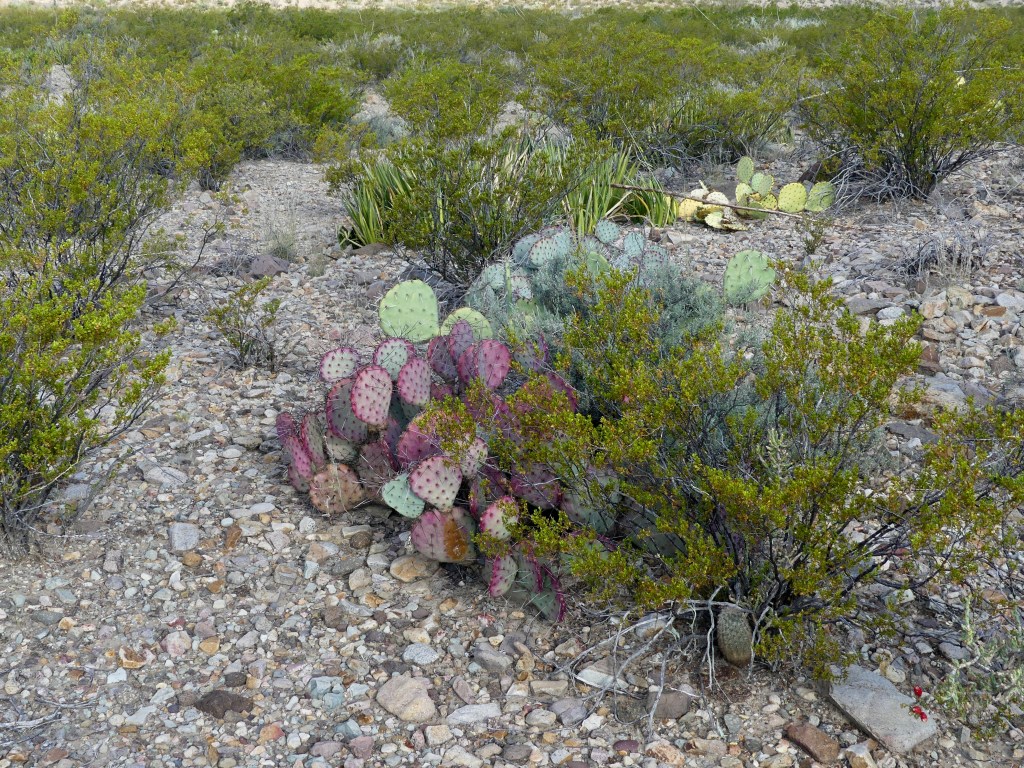
We walked around on the hot, gravelly desert floor, around prickly pear, creosote bush, and other characteristic desert plants. Lechuguilla, an indicator plant of the Chihuahuan Desert, grew in patches of upright succulent leaves. Many had remnants of the tall stalk they send up in late summer with clusters of flowers. The leaves are often described as like an upside-down bunch of green bananas, partly because they often curve inward a little. However, no bananas ever dreamed of having two rows of sharp recurved hooks on leaves tapering to a hard, sharp spine that can even puncture a car tire!

Creosote bush and prickly pear (including the purplish variety) in the foreground, with a patch of lechuguilla behind them (photo by M.Smith)

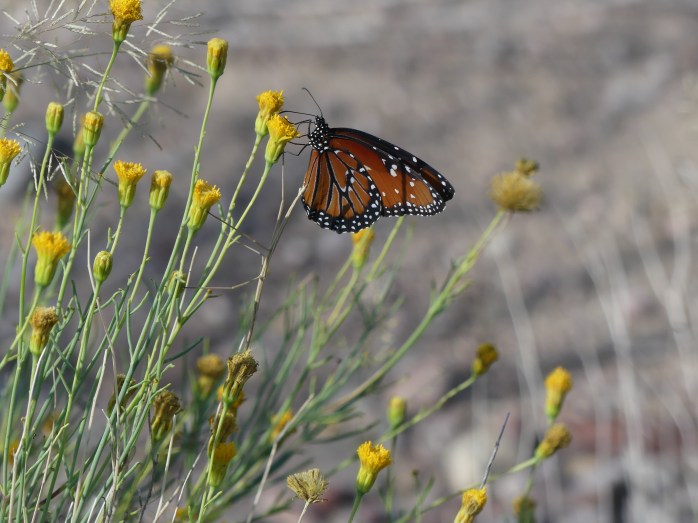
We walked a small dry arroyo as a couple of big black birds flew past. We weren’t experienced enough to call them as Chihuahuan ravens, but from the overall size and chunkier neck, they seemed more likely to be ravens than crows. There were a few places in the arroyo where the sandy soil had piled up and grew a small garden of flowers. Those flowers attracted butterflies. Perhaps they would seem out of place in the desert, particularly if we made the mistake of thinking of the desert as barren. The desert is a harsh place, by our standards, and it requires adaptation to extremes of heat and limited rainfall – but it is full of life.

Queen butterfly in a desert arroyo (photo by M.Smith)

We came back to the cabin during the hottest part of the day, and the shade of the porch and the breeze at the top of our hill made the perfect place for reflecting on our morning and writing about the desert plants, butterflies, and the value of long vistas in which nature has free reign.

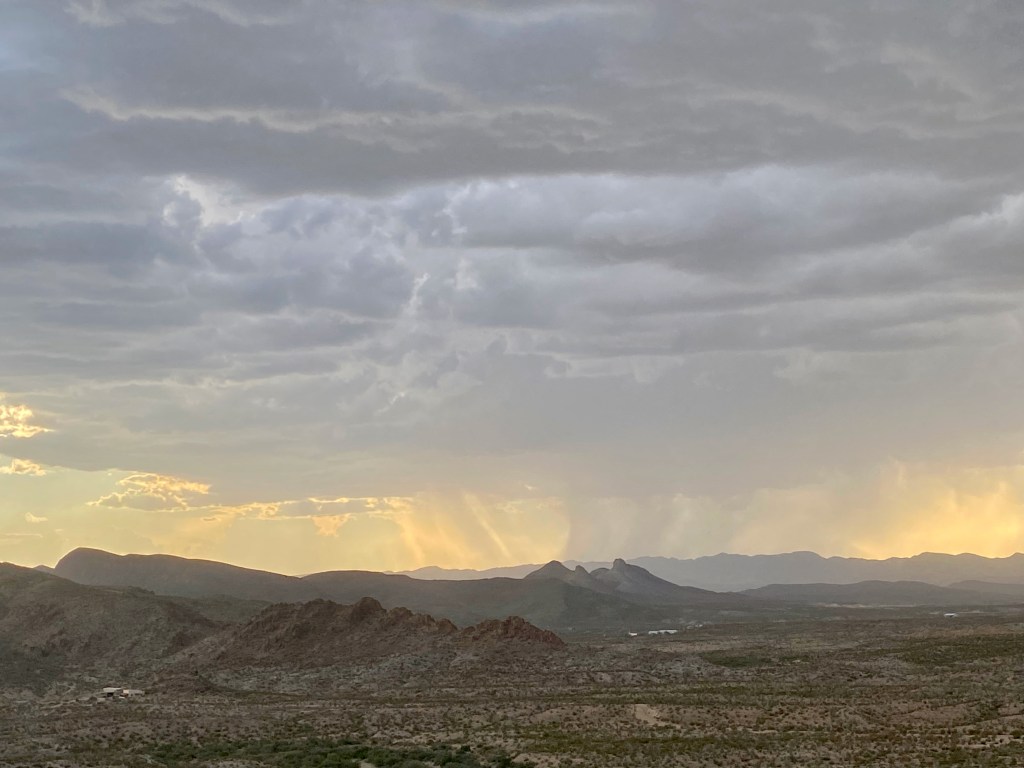
The clouds were building in the west, and under dark clouds were blurs of falling rain. The low rumble of thunder rolled in, and as the system marched toward us, bright lightning was visible as the power of the storm reached down to touch the earth. Announcing the storm’s arrival, the outflow winds were strong and I had to stop for a moment and think how many times this little cabin perched on the edge of the hill had withstood storms just like this. I needed that reassurance as raindrops began to slam into the porch and torrents of rain blew by outside our windows. This is how the monsoon season works in the Trans-Pecos: It’s hot and sunny, then clouds build into storms, the thunderstorms dump a lot of rain (and maybe hail) in a short time, and then they move on and it’s done.

The storm approaching (Photo by M.Smith)

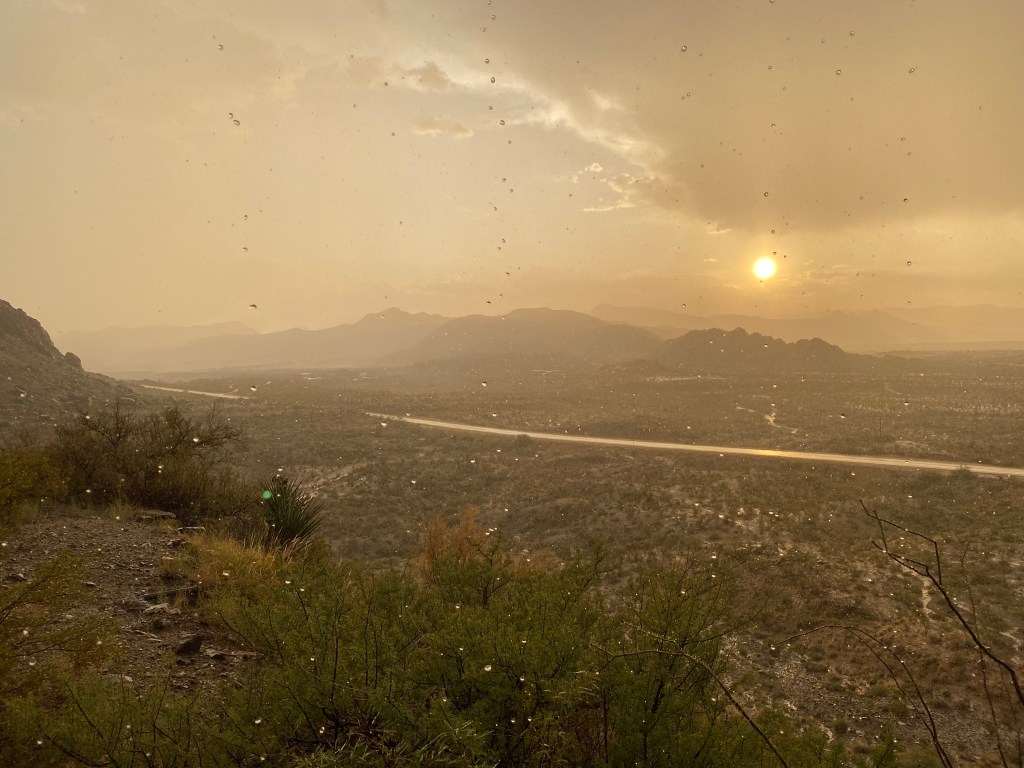
When we walked out onto the porch, the cool air was laden with the smell of rain and creosote. The desert here is full of creosote bush, a shrub with very small green leaves with an aromatic resin and waxy coating that helps protect the plant from drying out. If you crush the leaves, the resin has the familiar, vaguely tar-like smell of treated railroad ties or telephone poles. After a heavy rain, the resin is released into the air and the aroma is strong, fresh and wonderful.

At the end of the storm (Photo by M.Smith)

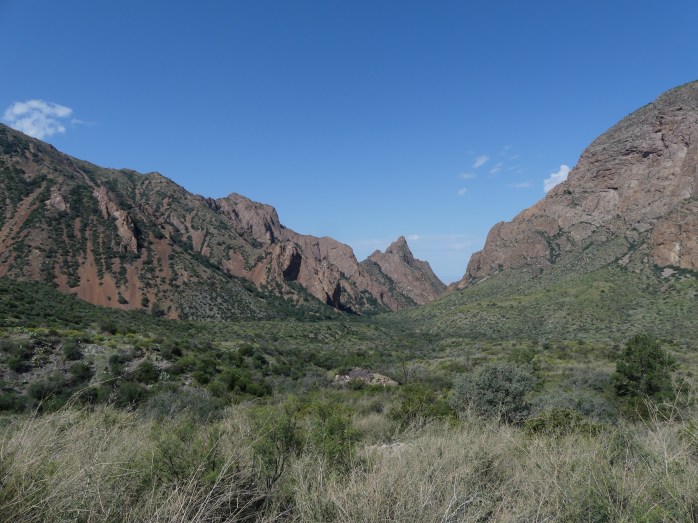
The next day, September 17, was our day to be in the Chisos Mountains. The Chisos is the only mountain range entirely contained within one national park. Driving up into “The Basin” within the mountains, the vegetation changes, reflecting slightly cooler temperatures and a little more rainfall. As you begin the climb into the mountains, you enter a woodland of small oak trees, junipers and pinyon pine. Tall slabs and columns of reddish igneous rock stretch toward the sky.

In The Basin (Photo by M.Smith)

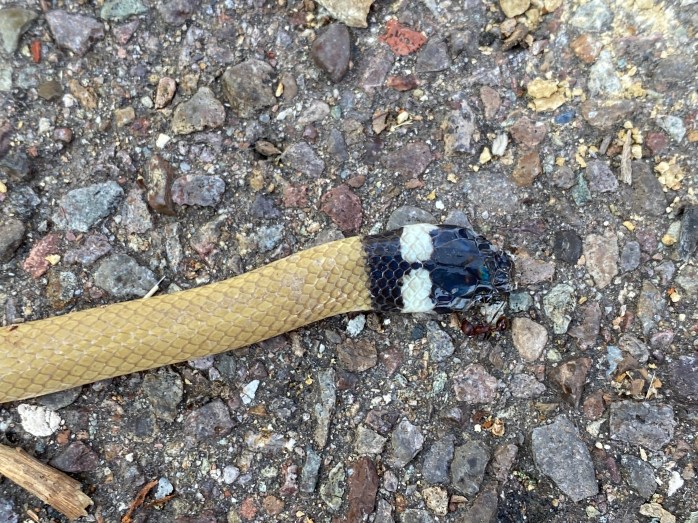
The previous day, driving around the Chisos Mountains Lodge, in The Basin, we had come across a sad, significant find. There was a small snake on the pavement that had been run over some time earlier that morning. There was a dark head with an interrupted white collar behind it, and the body of the snake was a pale tan. This was the first Trans-Pecos black-headed snake that I had come across, and it was a real shame that it was dead. It belongs to a group of snakes with enlarged rear teeth and a salivary toxin to help subdue its prey (but is harmless to humans), and it is the largest species within that genus, Tantilla. It’s still a small snake, often growing no longer than about a foot. It is listed by Texas as a threatened species, but neither that nor its presence in a national park had kept it from being run over.

Trans-Pecos black-headed snake, Tantilla cucullata (Photo by Meghan Cassidy)

Now it was time to climb the Lost Mine Trail up past the Casa Grande peak, to a point where the view opens to the south. The climb is fairly gentle, through mountain woodlands and small grassy openings dotted with beargrass, sotol, and Havard agave. This latter species, also known as “century plant,” sends up a fast-growing stalk at the end of its life with short branches bearing clusters of yellow flowers. The base of the plant is a rosette of thick, stiff, bluish leaves with sharp hooks along the leaf edges and a hard black spine at the leaf tip.

At this elevation it is cooler and there is greater rainfall. In the shade of the mountain there are ferns and beautiful flowers including mountain sage, the red starburst blooms of mountain catchfly, goldenrod, and penstemon. It is easy to stop along the way, on a bench or a boulder, and be still for a while, taking it all in.

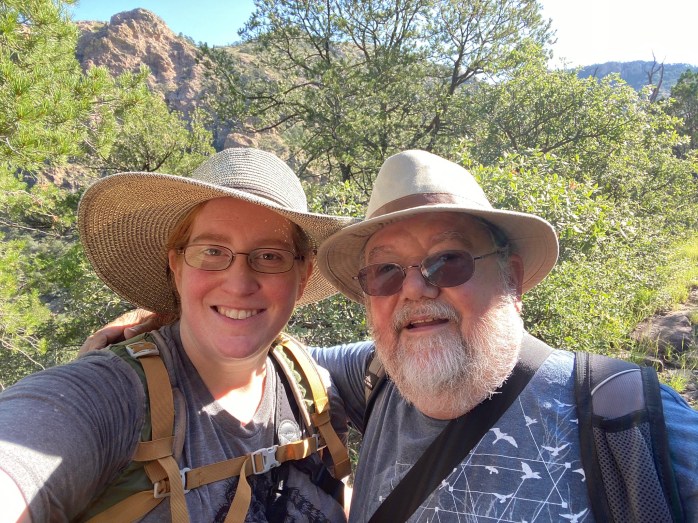
Meghan and Michael on the Lost Mine Trail

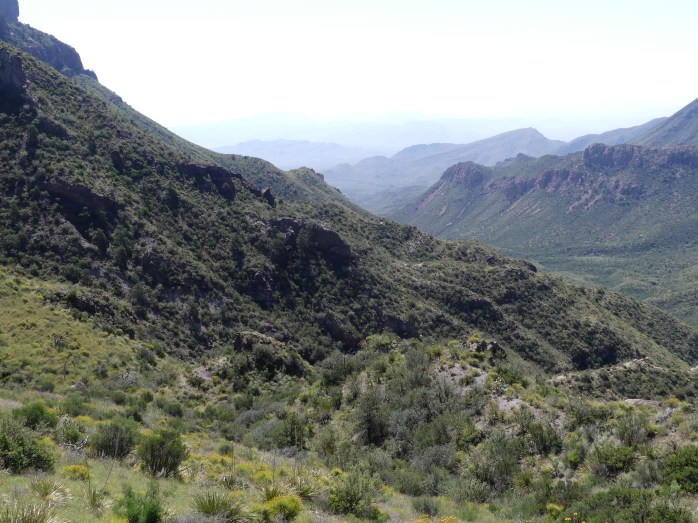
This trail in these mountains means a great deal to me, and I’ve written before about what it is like to be here in its quiet and beauty. And when we reached the place where we could look far away to the south, I spent a while under a pinyon pine looking at what I think is one of the great places within Big Bend.

On the Lost Mine Trail, looking south (Photo by M.Smith)

That night, our thoughts shifted away from the book and toward the variety of wonderful snakes that can be found in this area. We stayed along Highway 118 north of Study Butte up through the Christmas Mountains and along the desert flats. Our first snake was a black-tailed rattlesnake that, as I walked up to it, seemed to be ‘periscoping’ up to look around. It turned out to be blind in one eye, and was trying its best to figure out what was going on as we approached on its blind side. Like many black-tailed rattlesnakes, it was slow to get frightened or aroused, and it never rattled or threatened us in any way as we used snake hooks to move it away from the road so that it would not be run over.

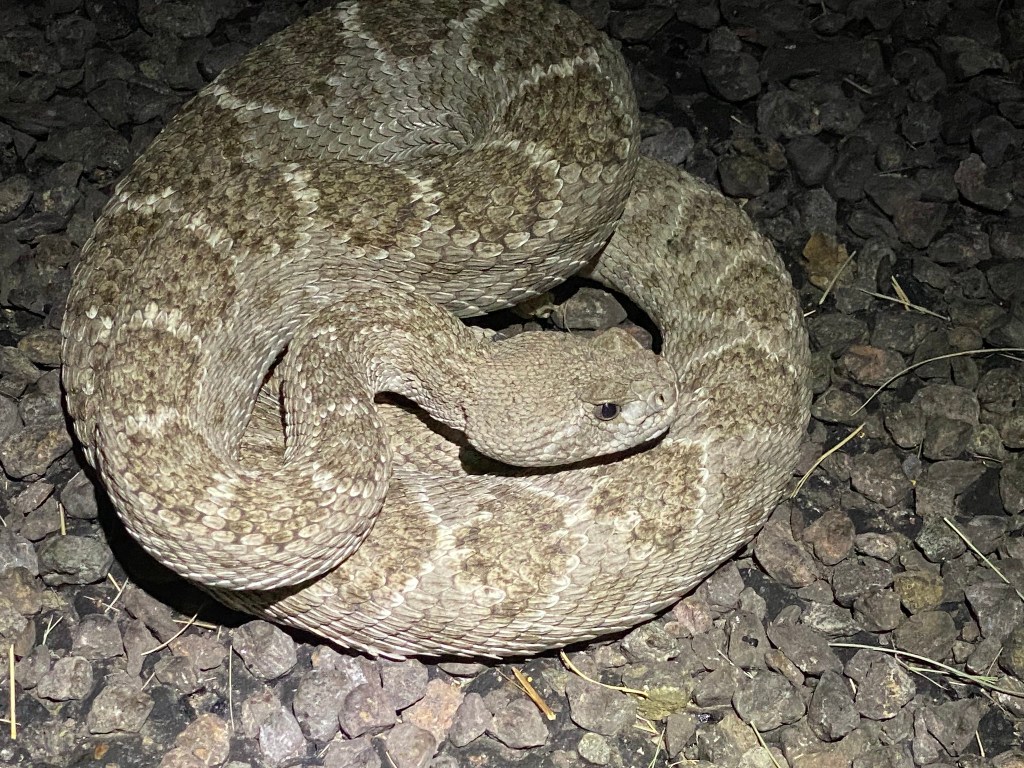
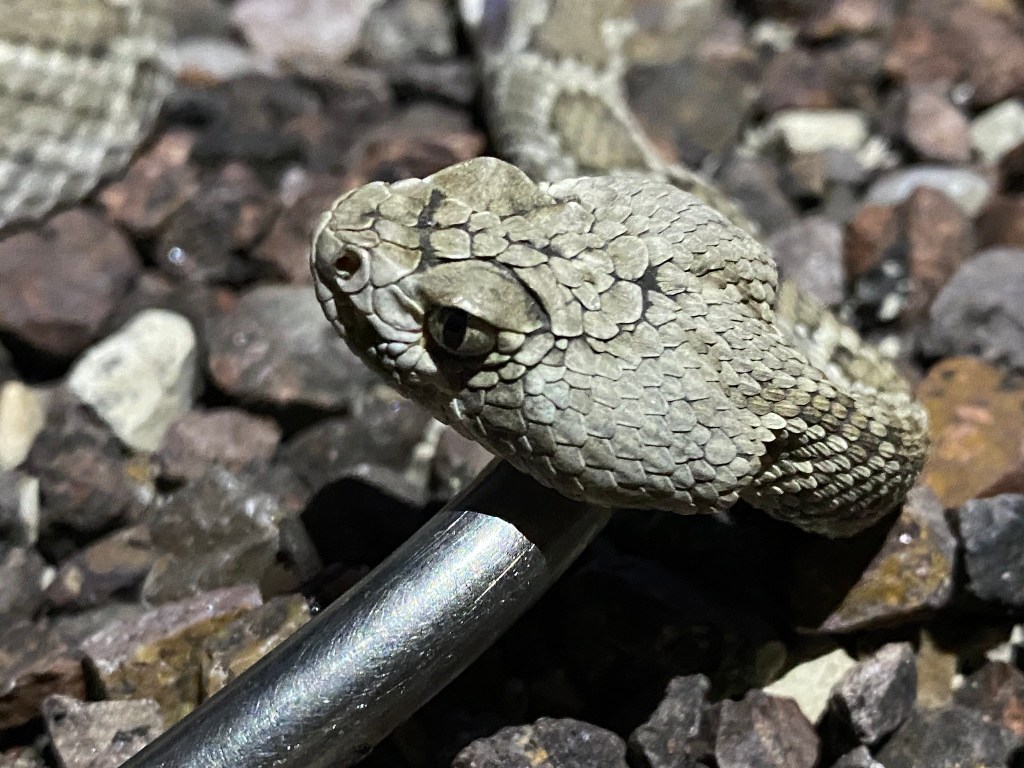
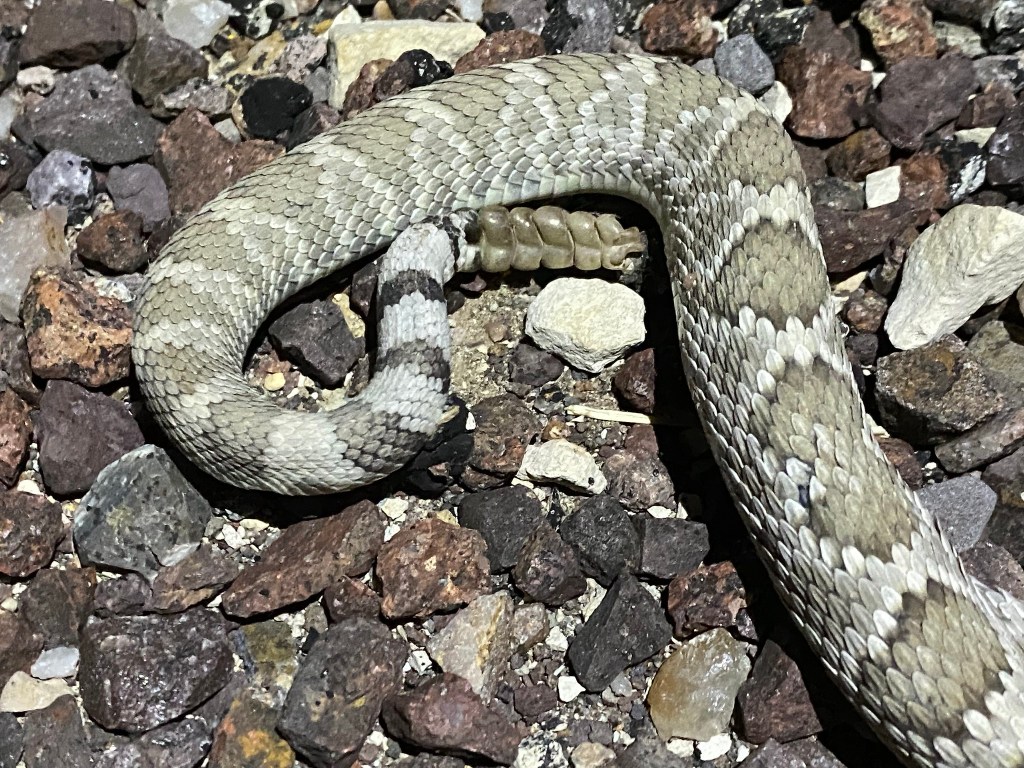
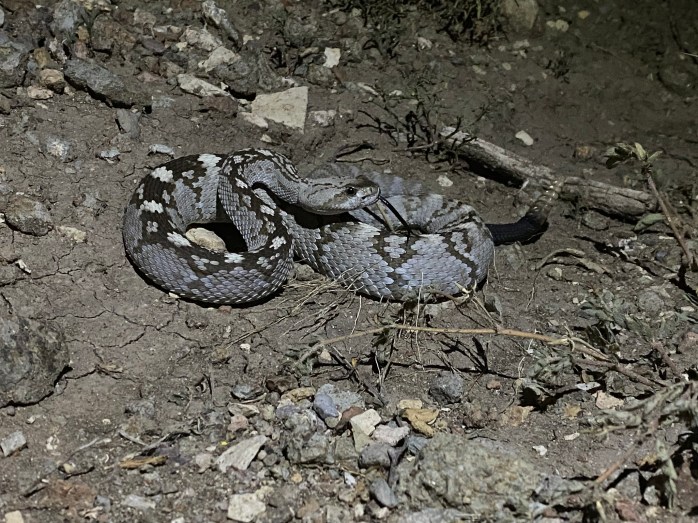
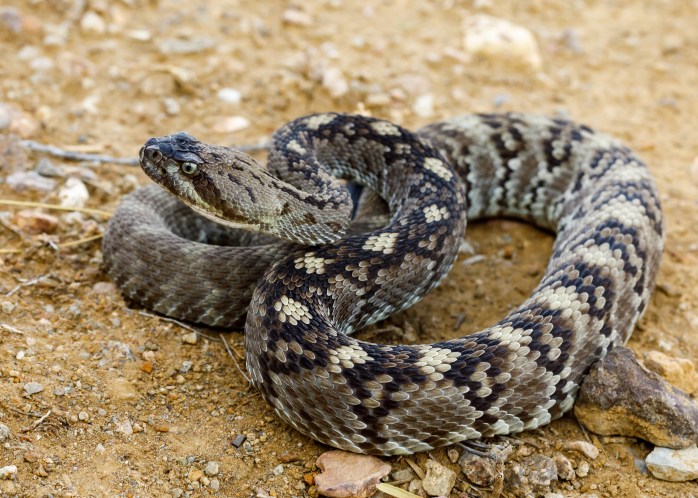
We were on the lookout for Mojave rattlesnakes (Crotalus scutulatus). Meghan wanted to see up close the distinction between this species and the similar-looking western diamond-backed rattlesnake (Crotalus atrox). The immediate visual differences have to do with the width of the black-and-white bands on the tail, the pattern on individual scales, the light diagonal marks on the face, and the size of the scales on top of the head. The rings on the tail of the western diamondback are of roughly equal width, while those of the Mojave emphasize white, with black rings spaced more widely. Both snakes have roughly diamond-shaped blotches down the back, but each scale on the Mojave rattlesnake tends to be mostly one color (resulting in a crisp pattern almost like a mosaic), whereas the colors may transition and almost smear on the diamondback’s scales. The two diagonal lines on the western diamondback’s face both end at the mouth. In contrast, the diagonal stripe behind the Mojave’s eye bends and continues back behind the jaw line. Finally, the scales on the top of the western diamondback’s head (between the eyes and toward the snout) are small. A Mojave rattlesnake has larger scales on top of the head.

Western diamond-backed rattlesnake (Photo by Meghan Cassidy)
Mojave rattlesnake, showing larger head scales (Photo by Meghan Cassidy)
Mojave rattlesnake, roughly the last third of the body showing the pattern of the scales and the wide white areas on the tail (Photo by Meghan Cassidy)

The one Mojave rattlesnake that we found had been run over, unfortunately. We positioned the head and tail for photos to illustrate these differences. This is the snake that folks in the Big Bend may be most concerned about, because populations of this species in Texas and elsewhere have venom with high neurotoxic activity. A bite might produce less swelling and bruising but more systemic effects, including respiratory problems. My experience with living Mojave rattlesnakes is that their temperament varies and, like other rattlesnakes, they would prefer to be left alone and are not especially aggressive.

That sort of peaceable behavior was true for every living snake we found that night. Every live western diamondback or black-tail greeted us with inquisitive tongue-flicks or attempts to get away, but none attempted to bite. One snake rattled, but the rest did not even become nervous enough to do that. Meghan is good at using a hook to move a venomous snake, and we both do so gently and without presenting a threatening target to the snake, and this may have contributed to their laid-back behavior. However, Meghan was looking for more examples of hooking defensive (or even irate) rattlesnakes, and she wasn’t getting to see any of that. (She did, at least a little bit, the following evening near Black Gap Wildlife Management Area, where the diamondbacks quickly rattled even if they did not strike at us.)

One of the black-tailed rattlesnakes at night (Photo by Meghan Cassidy)

It was getting late. As we drove back up the hillside to our cabin, there was one more black-tailed rattlesnake for us, a beautiful adult. We decided to ‘bucket’ her for good photos in the morning. Once again, this snake was simply curious about what we were doing, and tolerated Meghan’s hooking her and placing her in the snake bucket with little reaction.

(A couple of side-notes. First, the ‘snake bucket’ is a five-gallon bucket with a screw-on lid with air holes drilled in such a way that a venomous snake could not get close enough from the inside to get a fang through the hole. It is essentially snake-proof, so that we could sleep comfortably with a rattlesnake in the front room of the cabin. Second, part of being a safe, competent herper is constantly maintaining awareness of yourself and your surroundings when interacting with venomous snakes, even those who are being complete sweethearts. Neither Meghan nor I took these snakes’ temperaments for granted, because a moment’s slip-up with a “sweet” rattlesnake – especially in the isolation of the Big Bend at night – can be incredibly serious.)

Morning photo of the black-tailed rattlesnake (Photo by Meghan Cassidy)

The next morning, Meghan took a series of photographs of this black-tailed rattlesnake, and we released her. We were happy to have her as a neighbor during our stay!

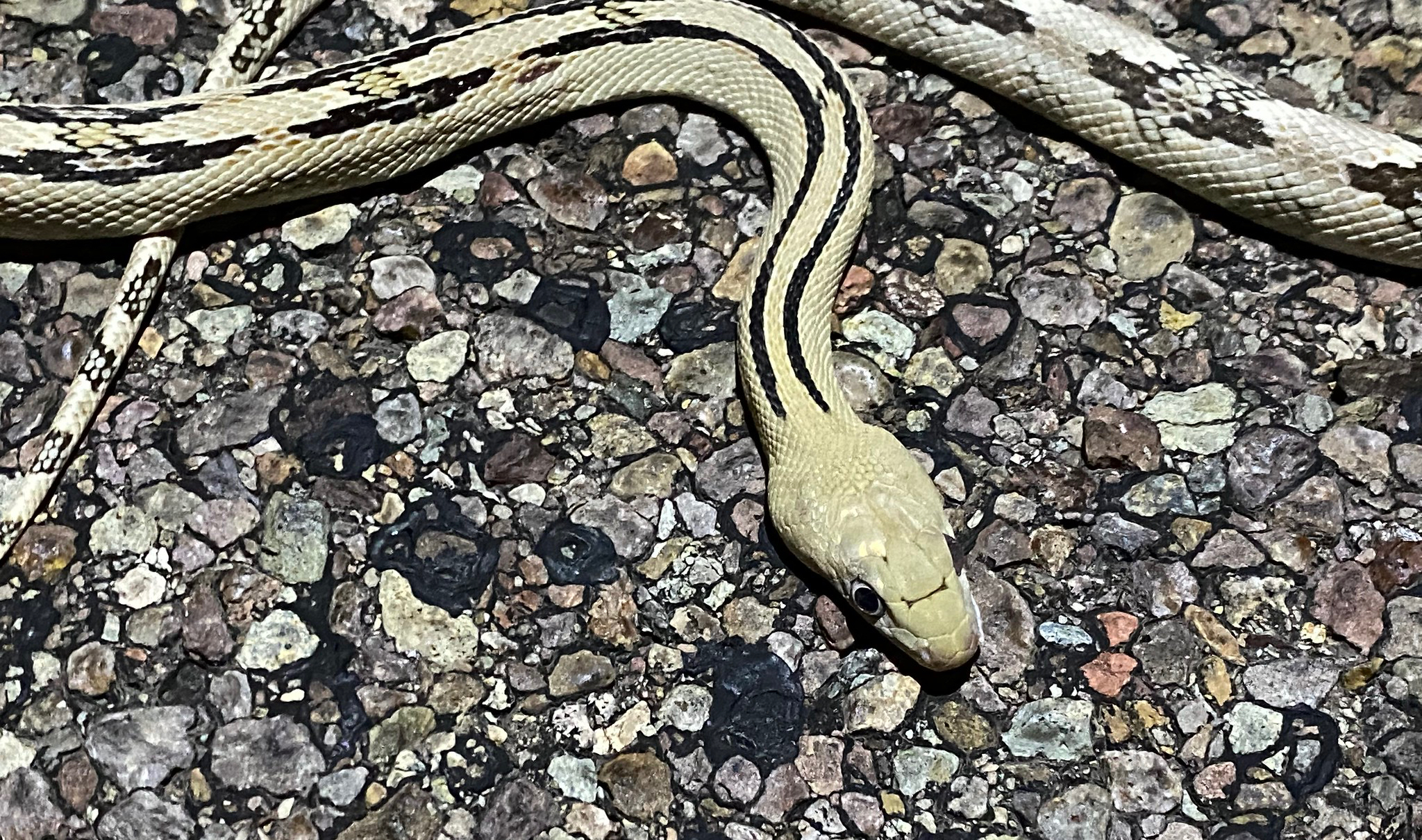
The following night, we were able to see a couple of Trans-Pecos ratsnakes, a favorite for both of us. One had been hit, but the second was wonderfully alive and gentle as we got it off the road so that it would not be run over. These slender, harmless snakes are pale yellowish (almost like the inside of a banana, leading Meghan to playfully call it a ‘banana snake’) or straw color with black markings. Two lines down the neck separate into something like blotches connected across the back in an “H” shape. They are nocturnal wanderers with big eyes to gather as much light as possible.

Trans-Pecos ratsnake (Bogertophis subocularis) – Photo by Meghan Cassidy

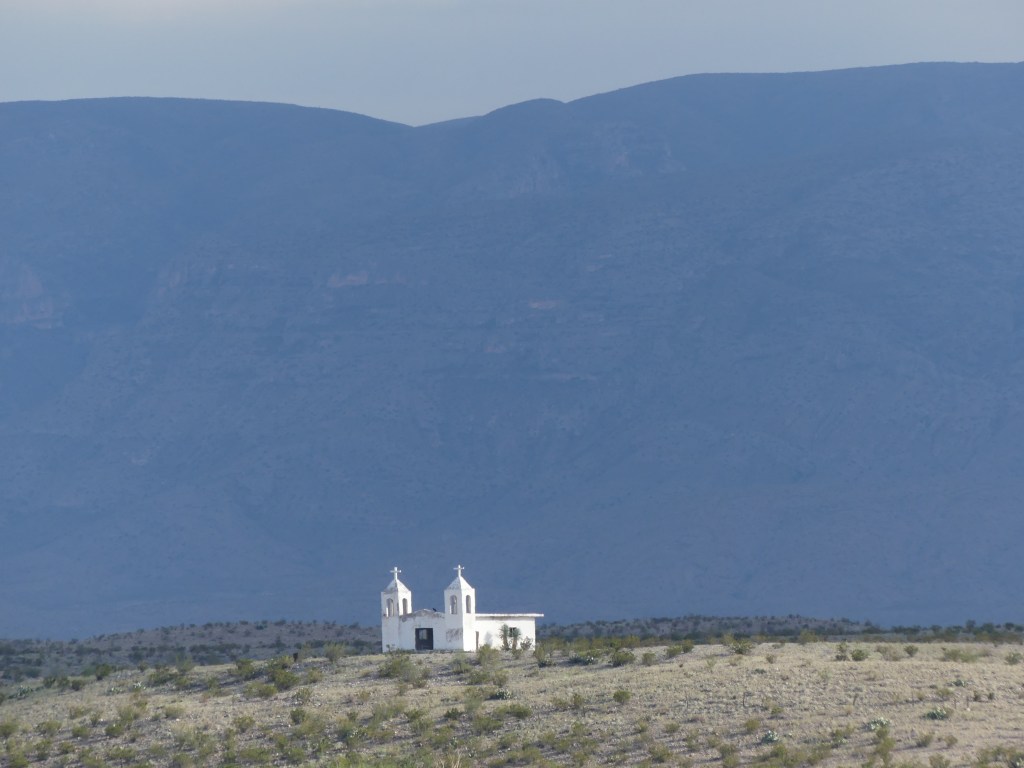
The final day in the Big Bend included a drive down FM 2627 past Black Gap WMA to the La Linda international crossing into Mexico (the bridge is barricaded, though crossing the Rio Grande at that point looked like it would not be difficult). The landscape and nearby mountains were beautiful, but it was virtually all private property and so we could not walk around and explore.

A church, looking across into Mexico at La Linda (Photo by M.Smith)
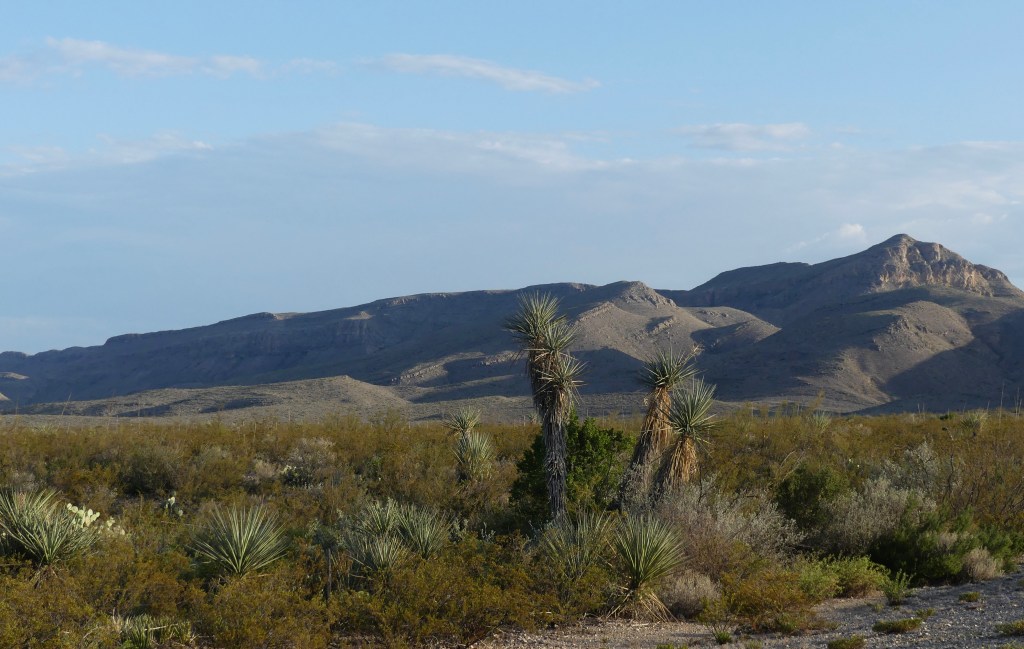
Near FM 2627 (Photo by M.Smith)

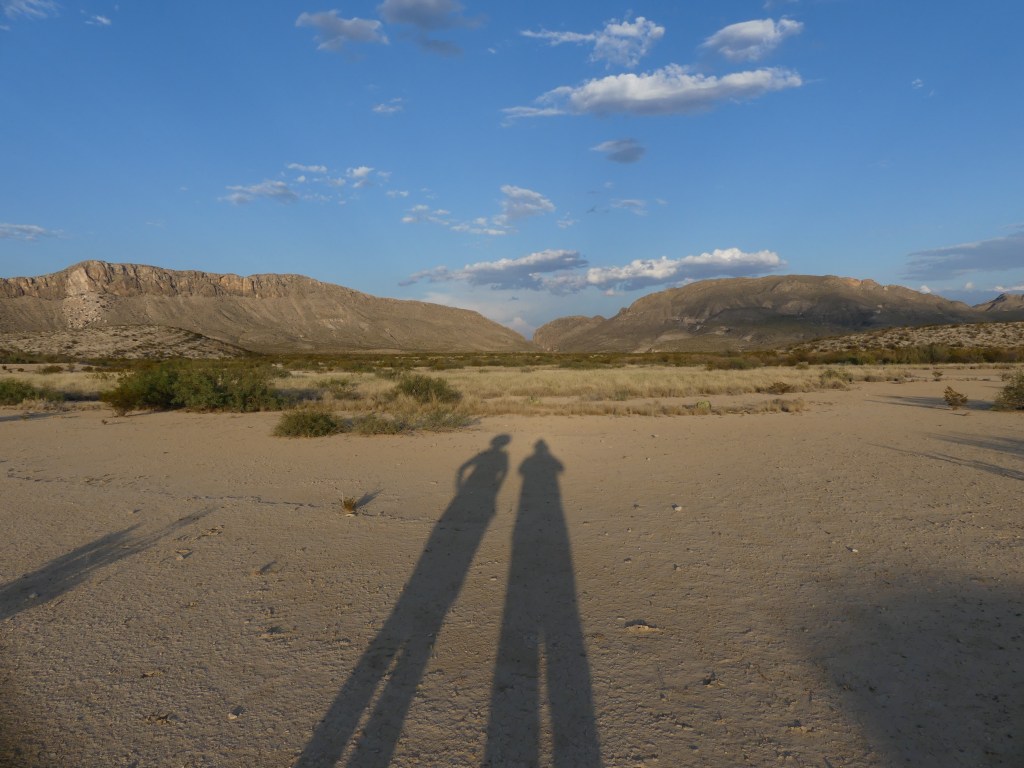
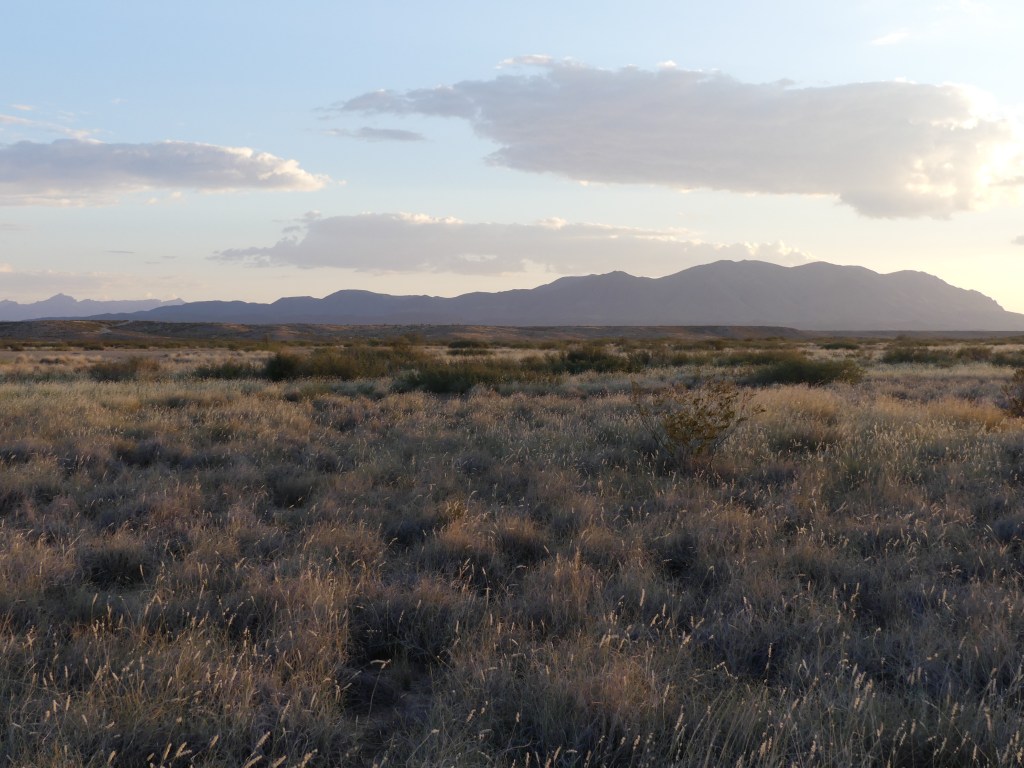
Back within the park we walked part of the trail leading to Dog Canyon, in the Dead Horse Mountains, and also westward in some sparse grasslands looking toward the Rosillas Mountains. I wrote about this later, about the long shadows toward sunset and the sense of solitude and even isolation there, as the sun was setting.

Long shadows, looking toward the Dead Horse Mountains (Photo by M.Smith)
Sparse grasslands and the Rosillas Mountains (Photo by M.Smith)
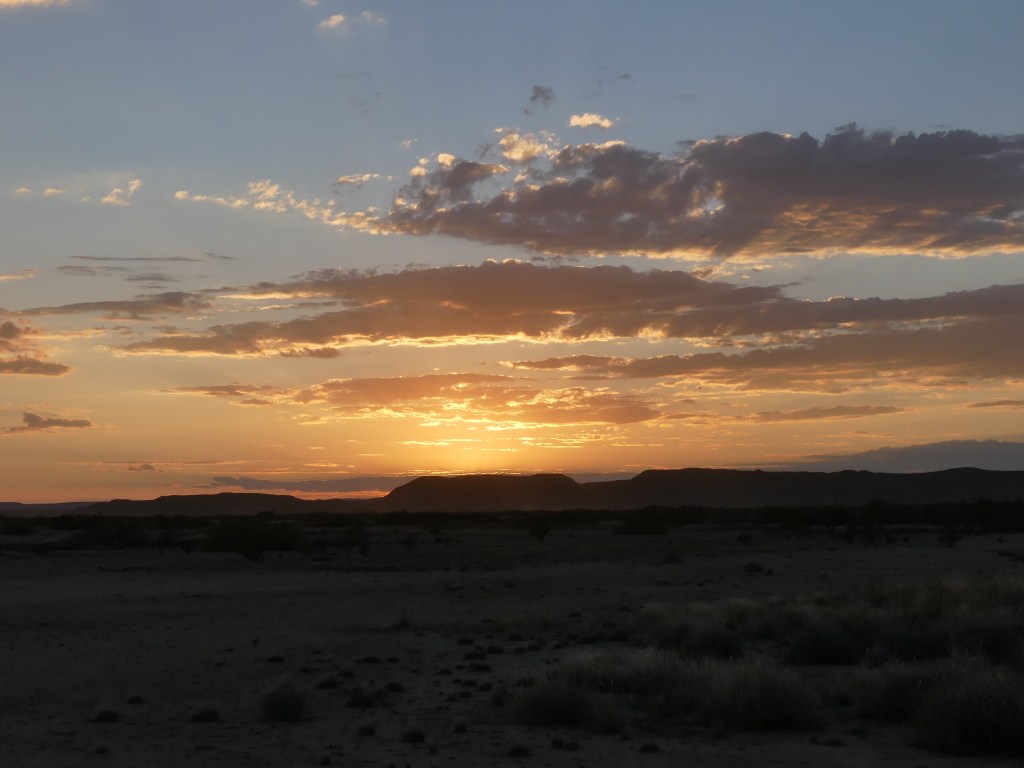
Sunset on our last day (Photo by M.Smith)