Did I mean that life was a destructive force, an enemy to be resisted? Is it our fate to fight and ultimately lose? Life cannot be an enemy, because what would be left if we defeated it?
“Time will wear you down,” was my revised thought.
Things change. To be present on earth is to see gravity, erosion, and the cycles of seasons take their toll. It is to experience developmental growth but also decline, the arrival of every good thing that comes to our doorstep and, eventually, its departure.
“Life will change you,” I decided. “It will raise you up from the ground and clothe you in fragrant woodlands, but sometimes strip you bare. The rains will soften your features, or give them a newly grooved and wrinkled expression. Birds will sing in your hair, and then the music ends until a new season renews the song.” Always a new season is arriving.
(A fragment from my notebook in September of 2021 when Meghan and I were in the Big Bend working on the mindfulness book.)
On Monday morning, November 4th I felt the uncertainty of the storms that were on the horizon. How soon, and how severe would they be? But that was the future, and beyond my doing anything about. A good alternative was to be in the present, and also in the presence of trees, soil, and other living things. What could be as trustworthy and reassuring as nature? There are some people in my life like that, and they are essential. There are also places like that, and I’m grateful for them.
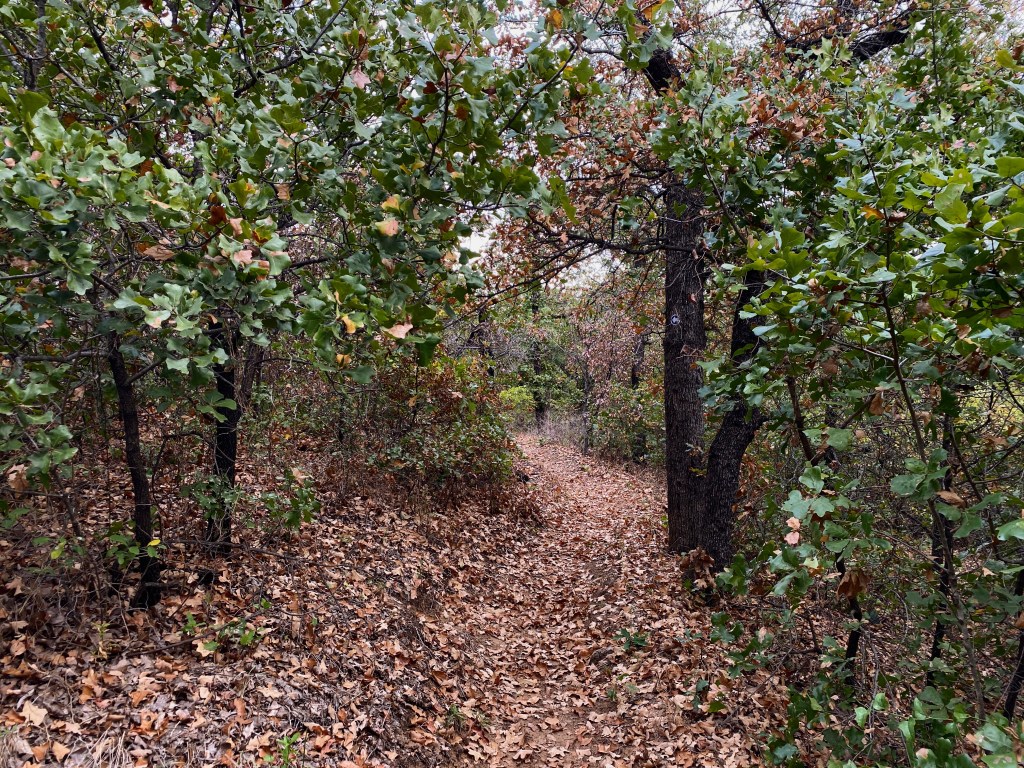
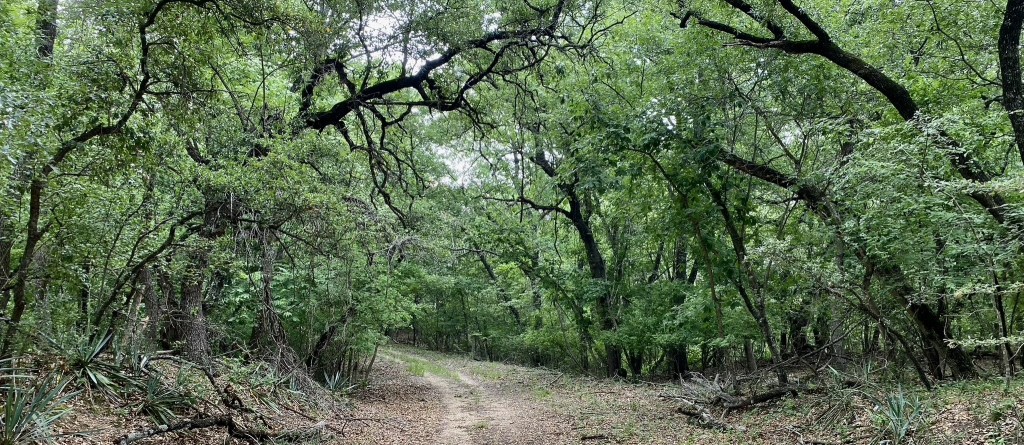
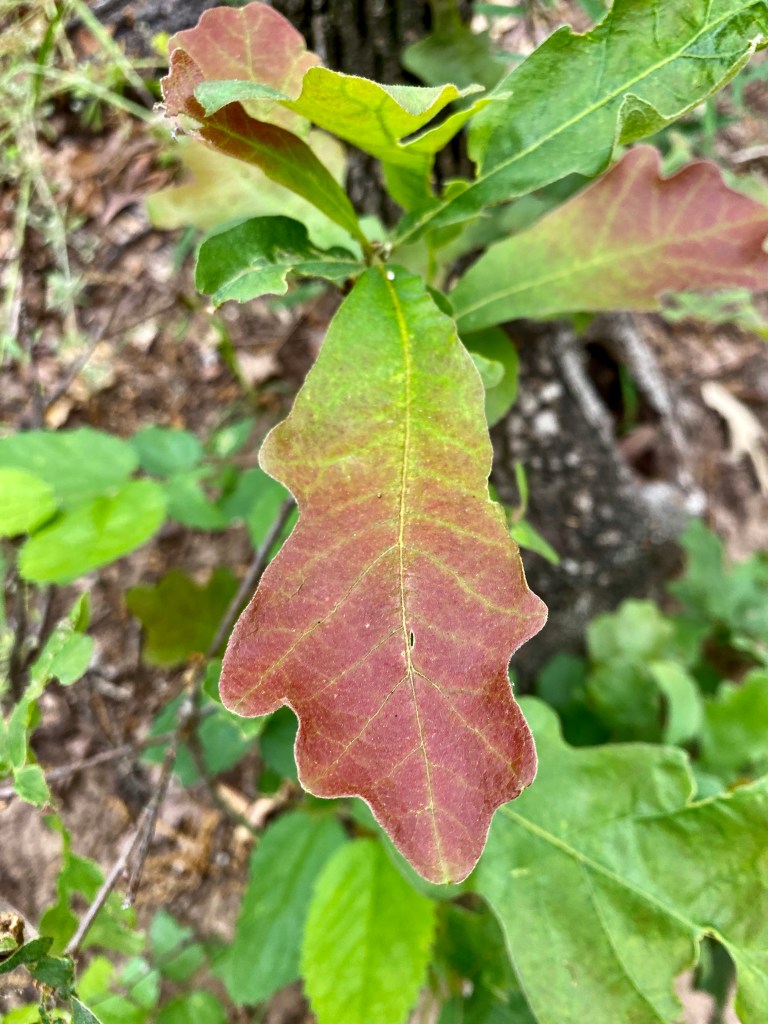
Oak leaves covering the trail – the oaks are dropping leaves without showing much autumn color
So, with storms still to the west, I took a walk at Sheri Capehart Nature Preserve. It was cloudy, with low cumulus clouds racing to the north and the occasional glimpse of blue sky between them. A couple of black vultures were overhead, careening back and forth in the wind with acrobatic turns and adjustments of flight feathers. From my camp stool near the bluff, it was 75.3F, continuing the above-average warmth that is becoming our new normal.
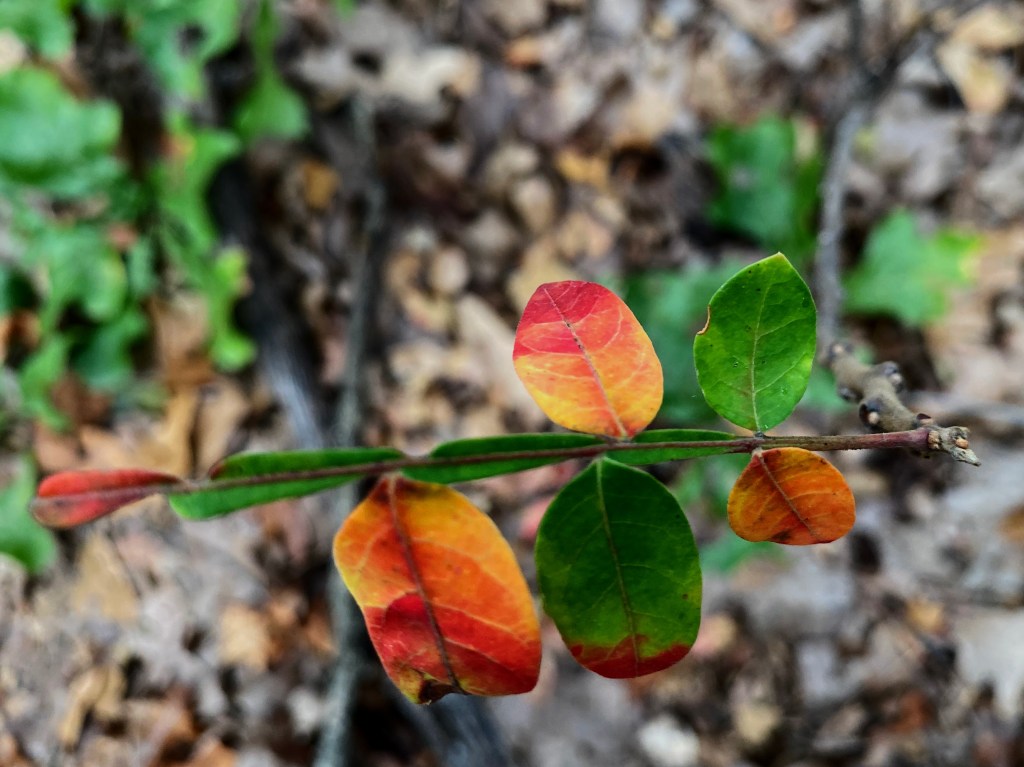
The “official” autumn colors: crimson and orange, yellow and green
At 9:20am I sat near the top of “Kennedale Mountain,” that hill that overlooks the lowland through which Village Creek drains. From the sandstone escarpment you can glimpse downtown Fort Worth through the oak branches, if you want to. I’d rather keep in the company of the blackjack oaks and sandstone, watching clouds or butterflies. Away from the bluff, on the back side of the hill is a place a bit more protected from traffic noise, where fewer visitors walk, and so it is a favorite with me.
A place a little quieter, maybe a little wilder than other locations
As I sat, a crow flew past, cawing loudly, and clouds continued streaming to the north. The wind moved through the trees, and when stronger pulses of air came through the sound was like a rushing river. Downslope toward the east I heard a northern cardinal and a Carolina wren.
Some of us need natural sounds like these, and relief from the unremitting mechanical noises that so often mask them. The noises of human activity are certainly present at the preserve, as it is located a little south of the third-busiest airport in the world and sits right beside major highway construction. But some days, when we let go of the noise and focus on birds, breeze moving the trees, or the occasional frog calls, we get a little of the peace that natural sounds bring.
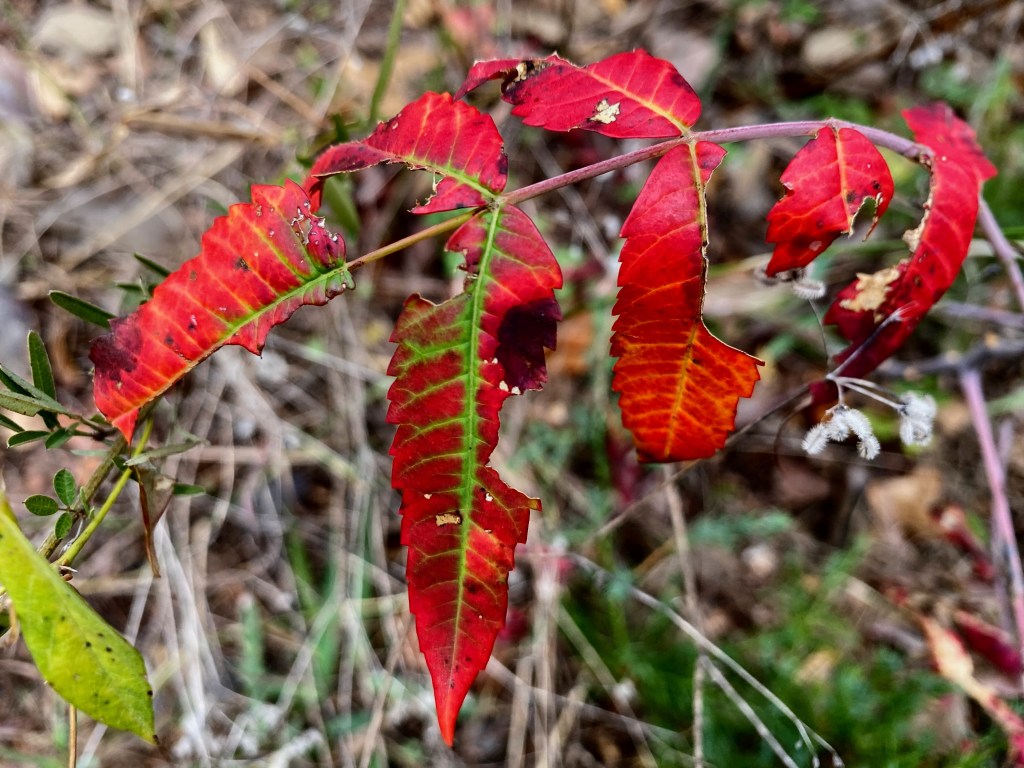
A tracing of green in the crimson leaves of a ragged sumac
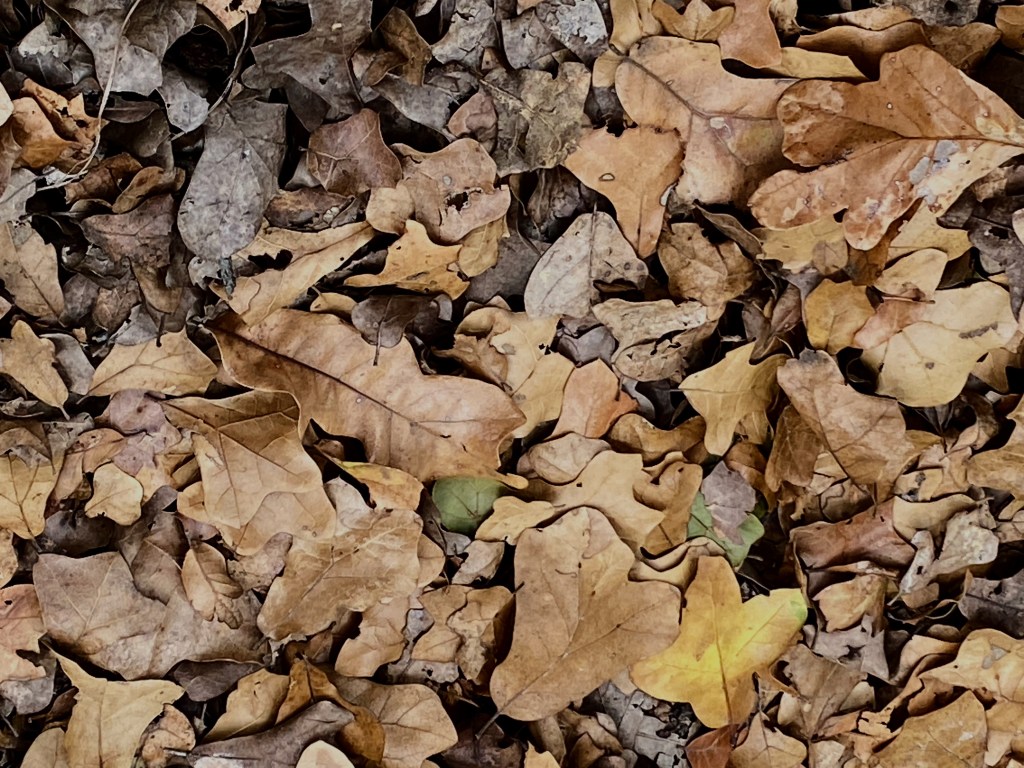
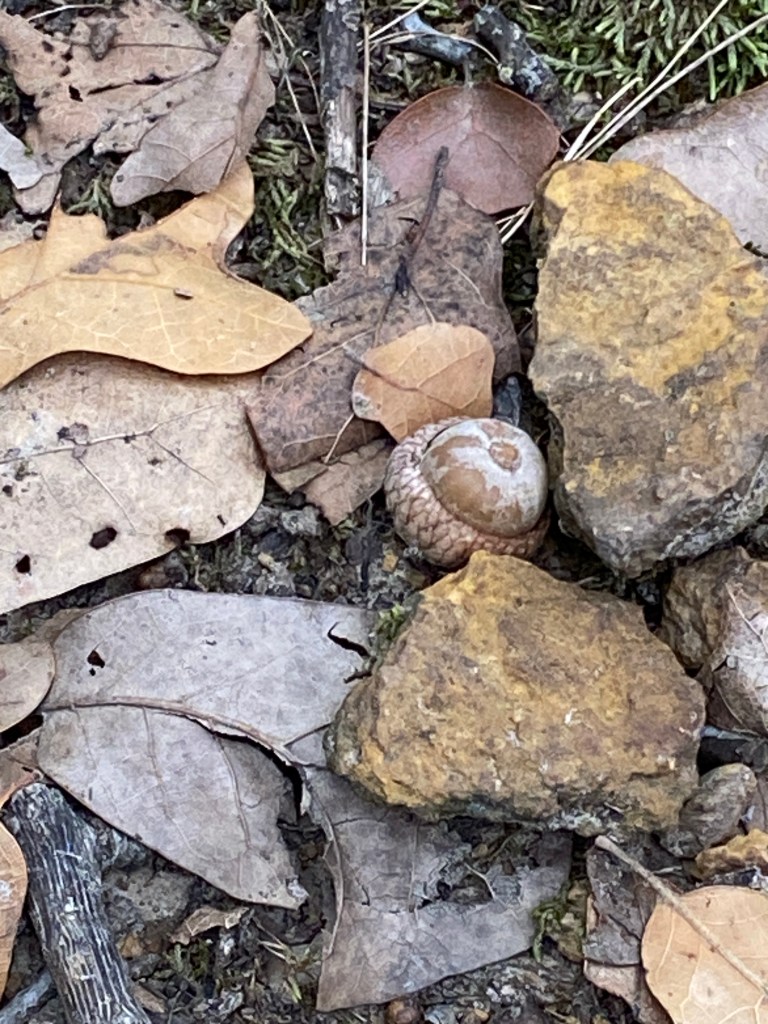
By 9:50am, back over on the bluff, the clouds seemed thicker and the sky a little darker. Here and there I noticed the pattern of fallen leaves on the ground; the variation in color and shape and things like acorns or moss always pull me in. It is art on a tiny scale, for those who are pulled toward such things.
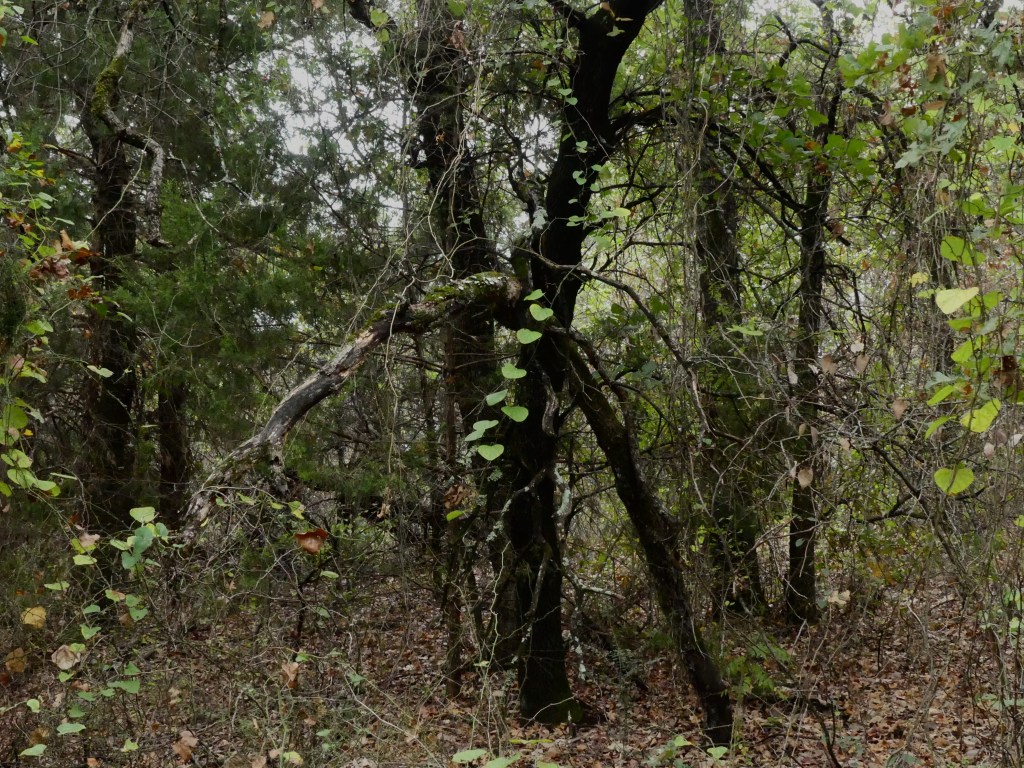
A carpet of leavesAn acorn nestled among the rocksSome oak leaves were this odd colorVines with leaves ascending like a ladder; moss and fungi on the dead branch
The storms held off until after I left at 10:13am, and we can hope that they bring only the rain we need. A little thunder is always good – one of those natural sounds I like so much. Just under two hours at the preserve had brought some of the peace and wonder that are part of that place.
I’ve lived in North Texas for a long time, and the Nature Center and I go back many years. In the opening pages of Mindfulness in Texas Nature, the very first words are, “I went home on Christmas Eve 2019 to the Fort Worth Nature Center and Refuge.” I meant that those prairies and woodlands have shared so many days with me over the years that it feels like home. And so, sitting on a bench there on Christmas Eve was like visiting an old friend.
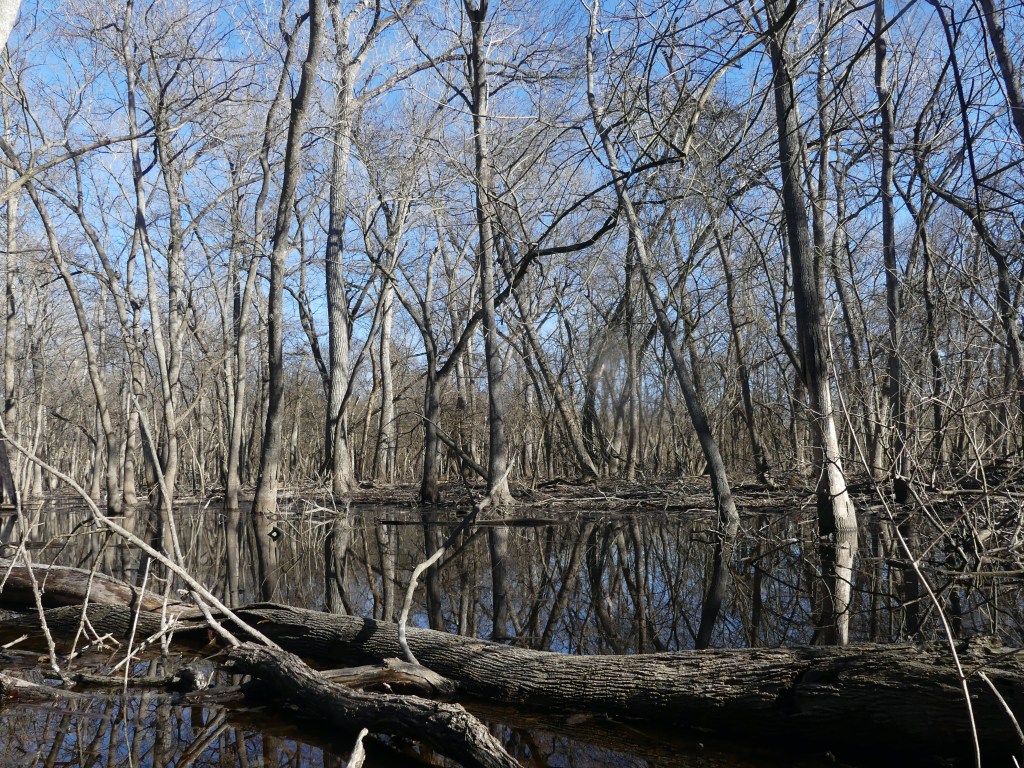
And the very first words in Herping Texas (published 2018) bring back a memory of surveying the reptiles and amphibians there: “Toward the end of March a few years back, a group of us took a walk through a bottomland forest at the Fort Worth Nature Center and Refuge.” I described the group of us walking through that forest and one member of the group accidentally discovering a rat snake making its way down the tree trunk where she was about to lean.
Flooded bottomland
In recent years I have written about the place many times for the online publication Green Source DFW. As a reporter I’ve covered the re-building of the marsh boardwalk, the bison deck overlooking bison pastures, the recognition of some of its woodland as an old growth forest, the statue honoring the work of the Civilian Conservation Corps on refuge property, and the re-introduction of prairie dogs there.
Now the City of Fort Worth is considering handing over the management of the Nature Center to the Botanical Research Institute of Texas (BRIT). The city would still own it, but BRIT would be in charge of some – or all – of its management and direction. I wrote about the issue in an article for Green Source DFW, which I hope you will read – “Should BRIT Take Over the Fort Worth Nature Center?“
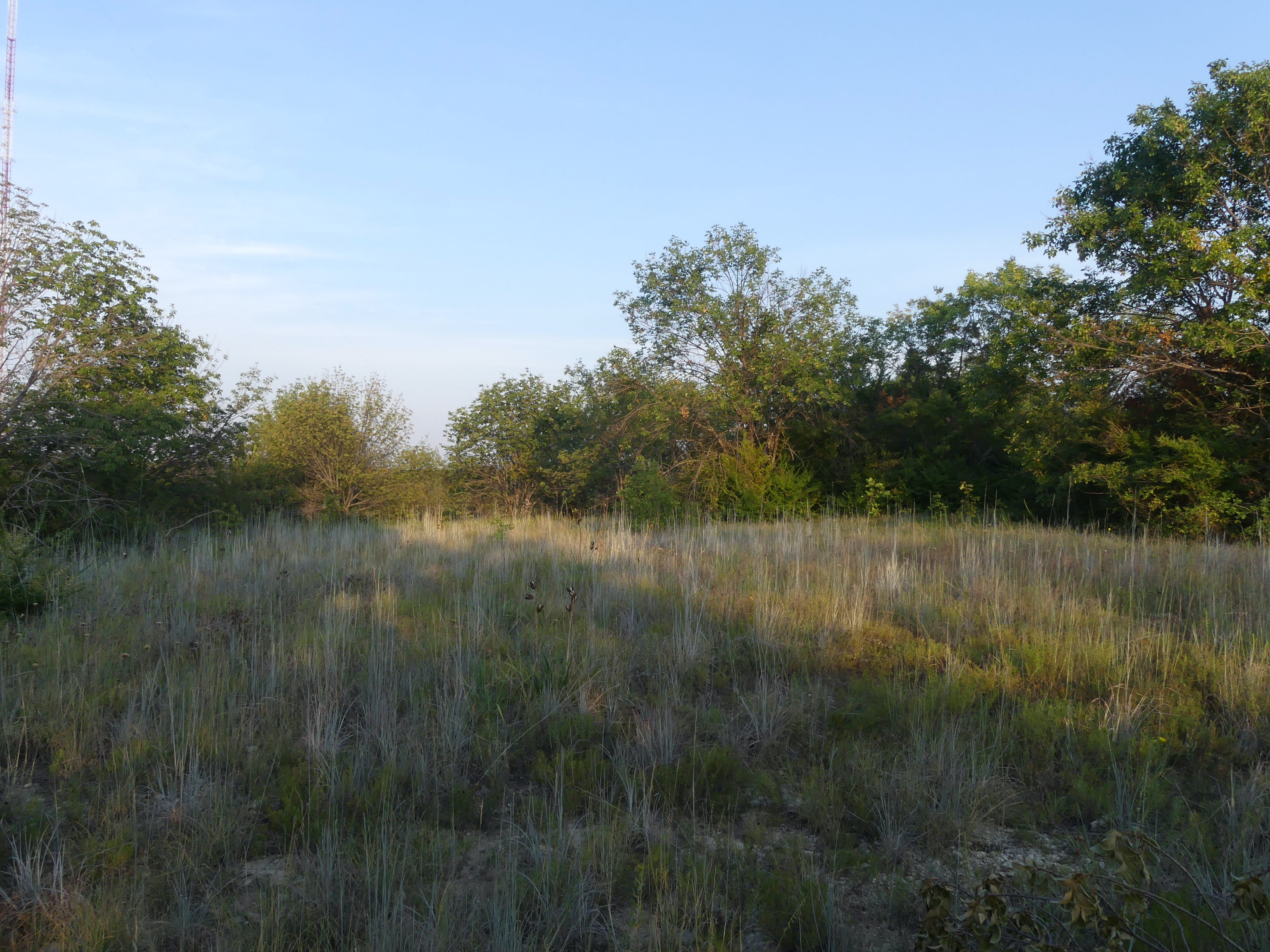
A November hillside at FWNCR
The Fort Worth Nature Center & Refuge (FWNCR) has been managed by a series of dedicated, smart, and creative individuals. At its inception it had the guidance of my friend Rick Pratt, and in later years there have been people like Wayne Clark, Suzanne Tuttle, Rob Denkhaus, and now Acting Manager Jared Wood. Those are big boots to fill, and I hope that any management changes leave such people in charge. They are people whose first commitment is to the integrity of the refuge as a relatively wild remnant of the Cross Timbers and prairies that were here before White settlers.
As I see it, the FWNCR connects us to the wildlife, woods, and prairies that are like our extended family. That family includes the trees and other plants that give us oxygen, pull carbon dioxide out of the air and sink it into the soil, the wetlands that filter our water, the insects that pollinate our crops. The land, water, and all the living things provide a spark of wonder that adds joy to our lives.
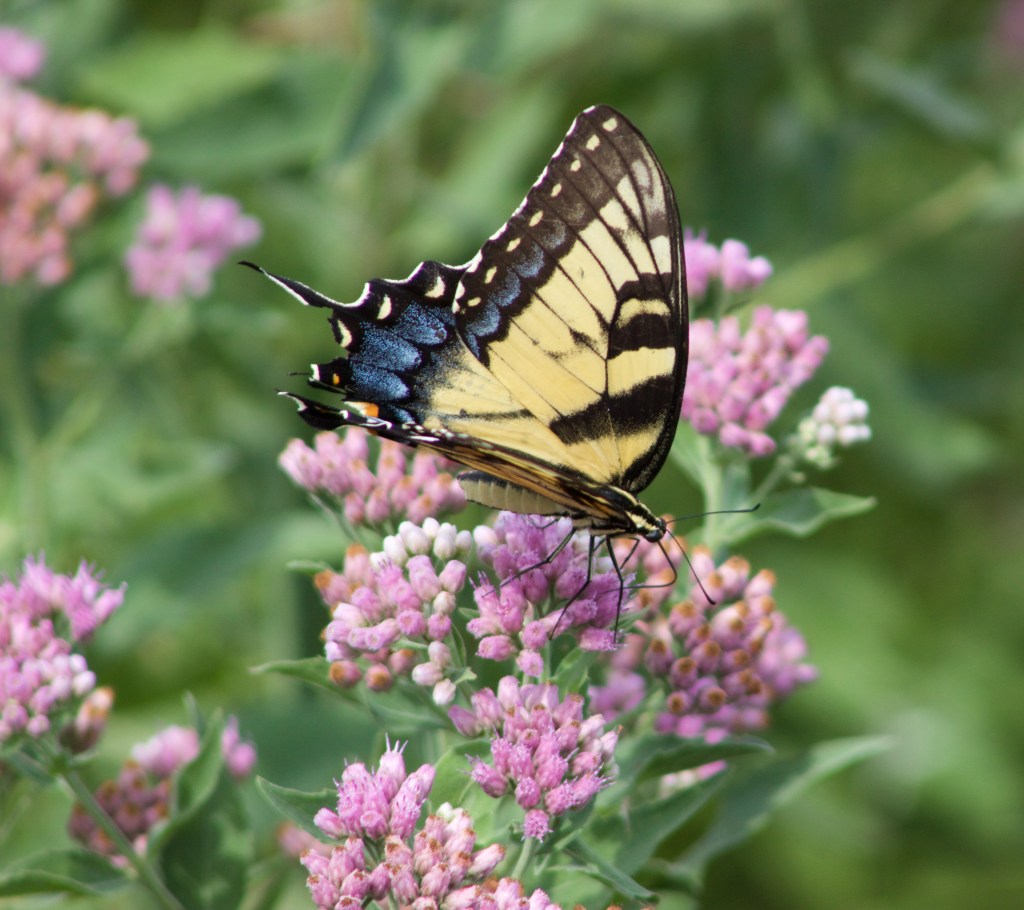
A swallowtail at the edge of the lotus marsh
When we walk through the preserve, we become part of the land for a little bit, sharing a kinship with the rest of nature. We might even come to see our separation from nature as an illusion that we create, while the woods and prairies are the authentic reality.
What does the future hold? Can that authentic reality of the refuge hold its own against the urge to build more and more attractions, drawing in so many paying customers that the wildness is gone? We want everyone to share the refuge, learn from it, and fall in love with it. But not everyone all at once, and not by offering so many built attractions that people miss the point, which is the wildness.
I hope you will read my story at Green Source DFW and keep track of plans for what direction the city will take with FWNCR. Please step up and offer comments when the time comes, if you feel that your input is needed (and input from those who love nature is always needed!).
As Fort Worth grew, with buildings and highways proliferating, a little patch of the east side remained in a natural state. Much of it is dominated by hills and ridges, making it less attractive to developers. Over the years it was sometimes treated as a dump and also as a playground for recreational vehicles, but the native grasses, flowers, juniper, and lots of other life persisted. Finally, it was recognized and protected as a Fort Worth treasure, Tandy Hills Natural Area.
Yesterday, at the end of a hot August day, I took a walk there with my friend Kat as the sun sank toward the city skyline. We followed those beautiful limestone trails through native grasses and the stalks of the past spring’s basketflower, over patches of prairie and along the ridge.
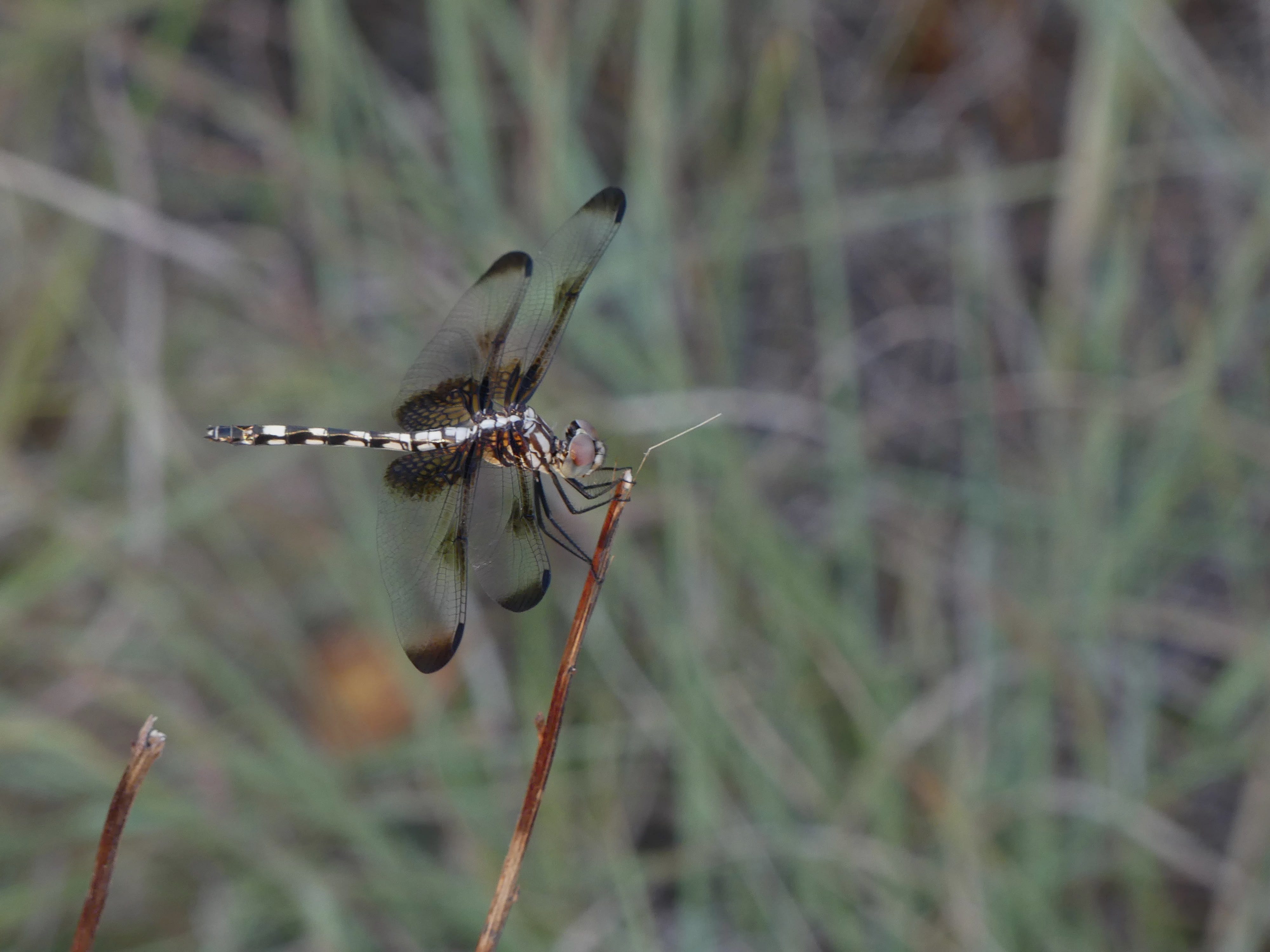
A checkered setwing
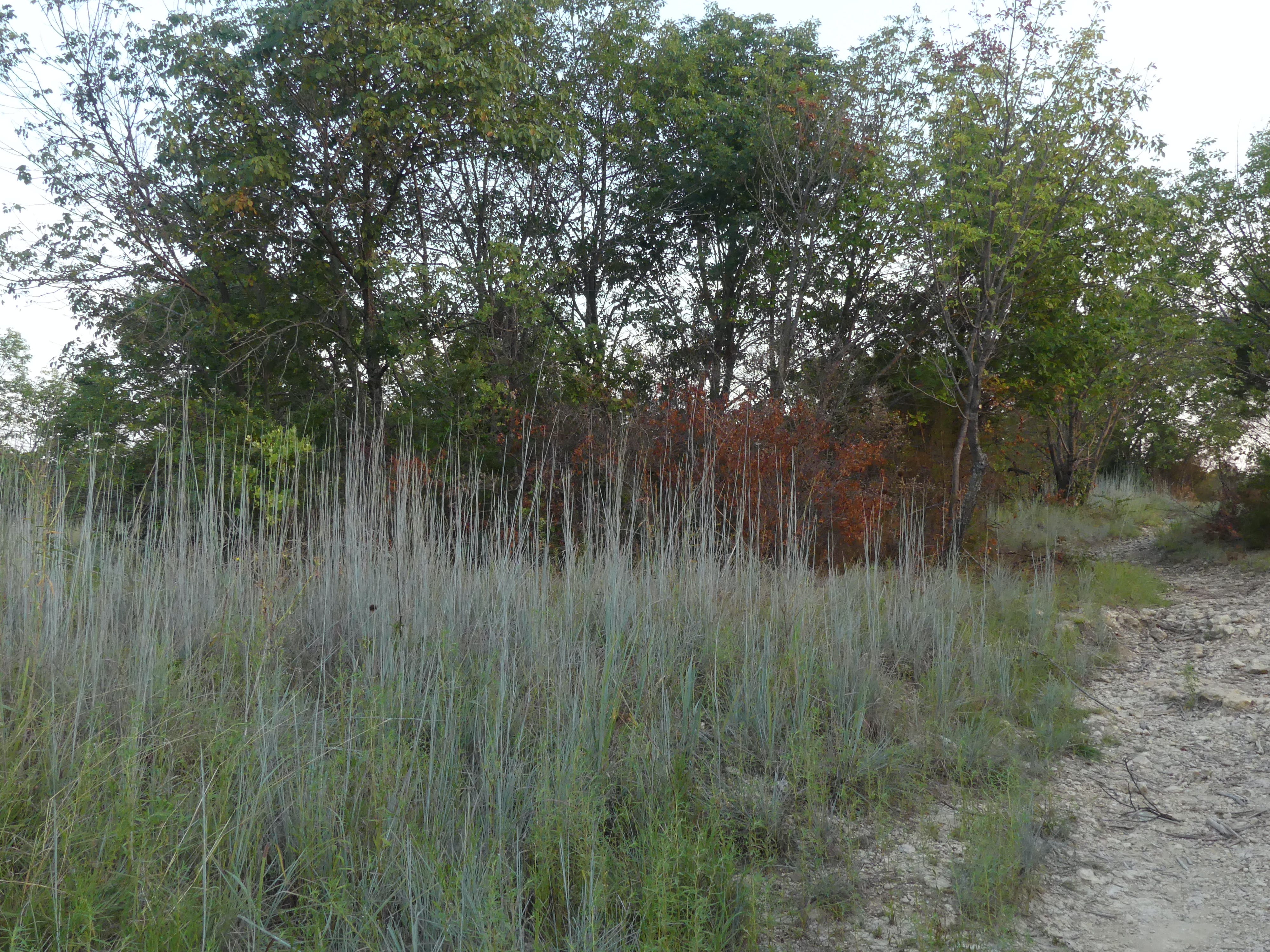
Kat is an ideal person to take a walk with, to share these hills with. We talked about absent friends and missing their presence, and we talked about the dragonflies and the succession of prairie plants around us. Snow on the prairie is starting to make its late summer appearance, and the little bluestem is beautiful as always. Kat and I discussed how we look for the myriad subtle colors of this grass, pastel blue-green with a few scattered suggestions of almost-violet. On a previous walk I told her that I’ve described those tall thin stems as “vertical brush strokes” on the prairie’s canvas and complained that I had no other way of describing little bluestem. She immediately suggested, “icicles,” and yes, they are like upside-down thin icicles!
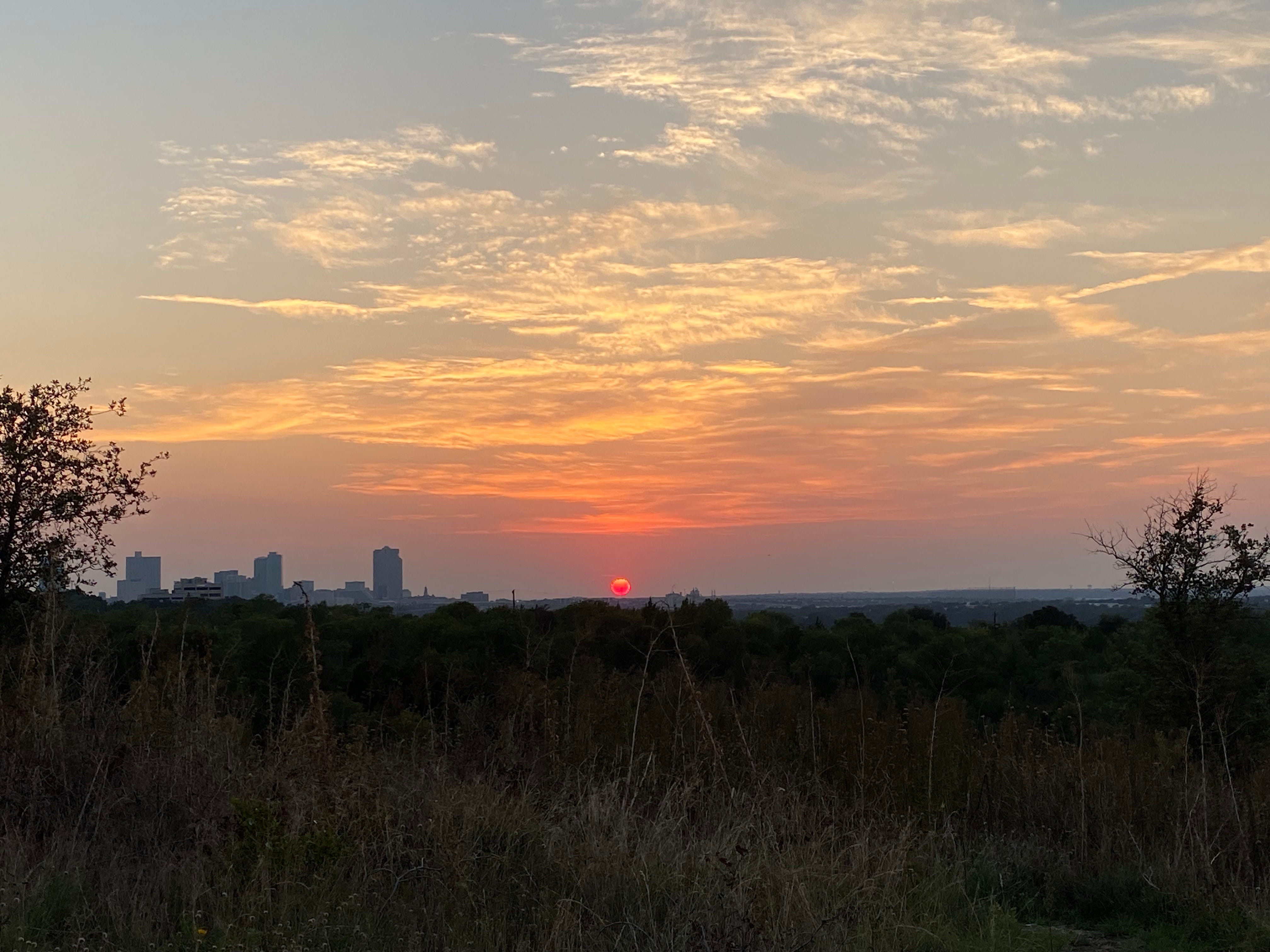
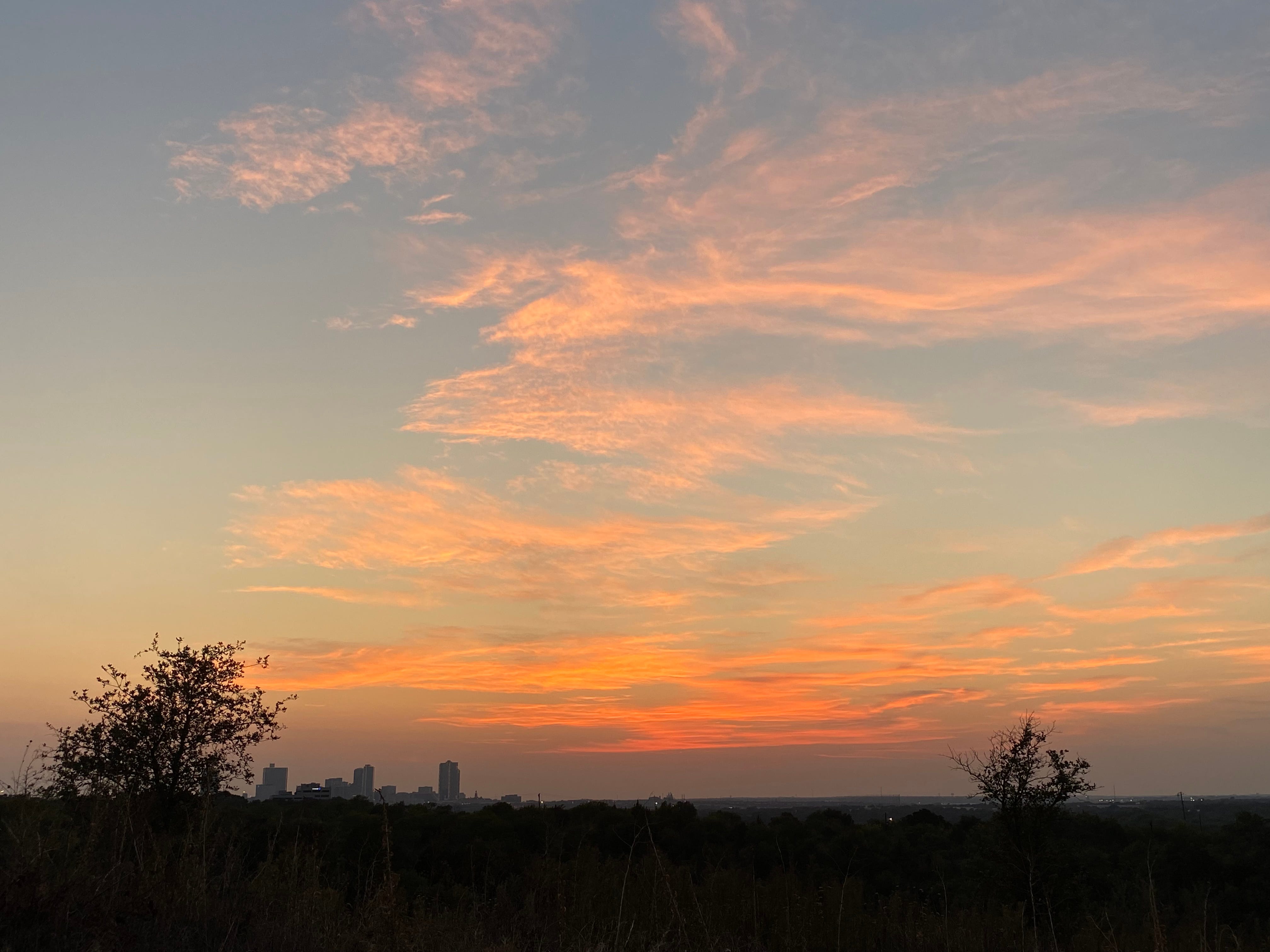
Hardly anything allows a person to unwind and become content and restored like a walk at the end of the day in a place like this, with a friend like this. The shadows lengthened and the heat diminished, and there was always something wonderful to pull us around the next bend of the trail. However, our plan for the evening brought us back to the top of the ridge just at 8:10pm as the orange disk of the sun touched the horizon. Having found a quiet place to sit, we wordlessly watched what unfolded.
It took five minutes for the sun to disappear beyond the horizon, and it continued to illuminate the streaks of cloud in red, orange, and pale yellow. A good, fairly steady breeze blew across the ridge as we sat. The pale, almost pastel blue sky shaded deeper blue to the south, where the half-moon shone in the sky.
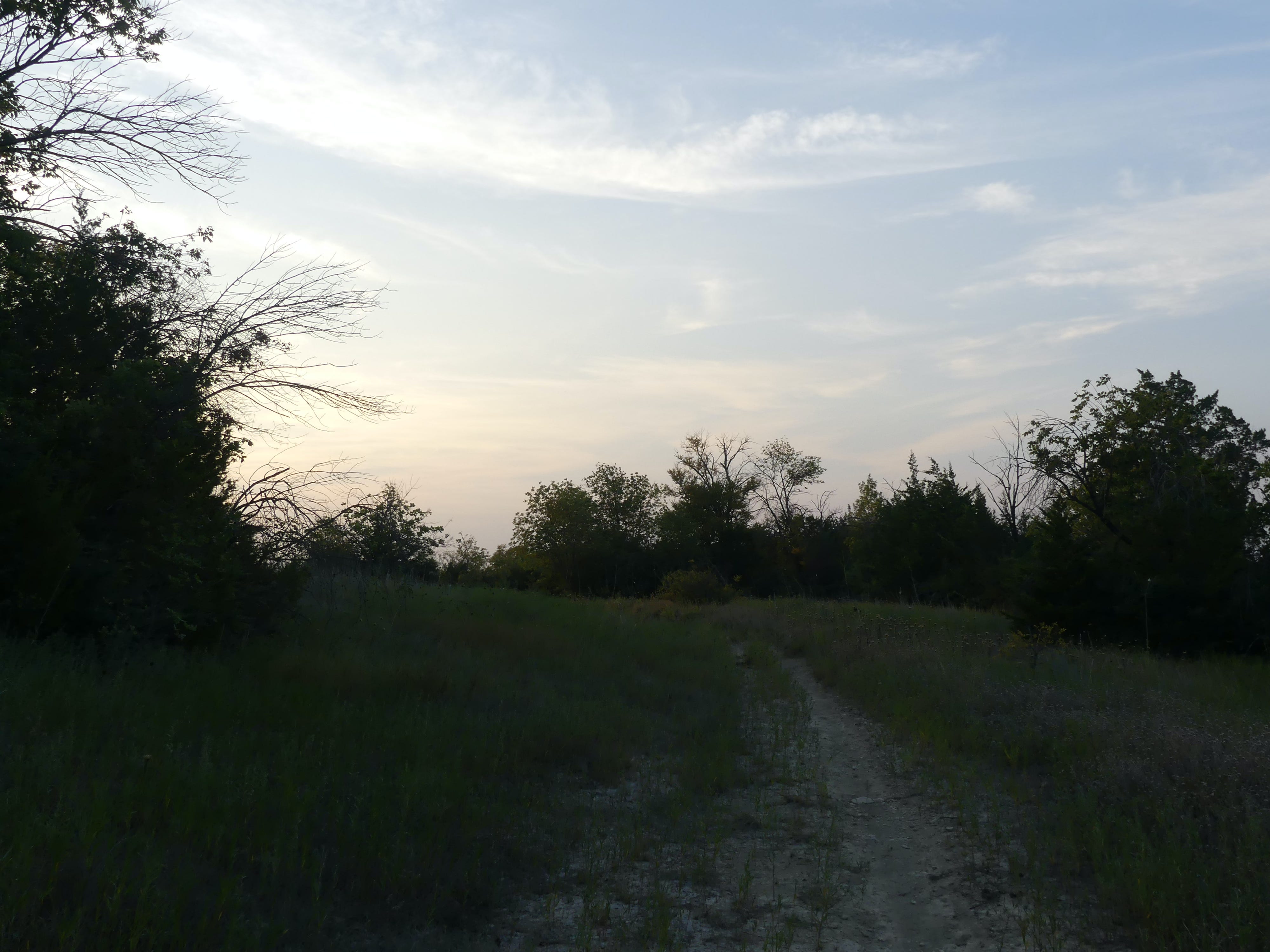
As light faded, we could see the rocky limestone path in front of us bend and disappear behind the taller dried plant stalks and the green growth near the ground. The ground dropped away and there was a dark sea of green tree tops beyond, stretching out toward the city.
It struck me that the clouds near the horizon rippled and waved in bright sunset colors like waves on water somewhere. And then the angle of the sun hit the clouds in a particular way for one more bright moment, and those clouds were bright streaks of orange against a turquoise sky. Even the hazy clouds above us were rose pink.
At 8:27pm the drone of insects began from nearby trees, and after a short time they just as abruptly stopped. We were left wondering if some disturbance, maybe people leaving the area, caused this, but I don’t know.
Sitting and maintaining our attention on the sky, there were several subtle shifts. Color faded from parts of the sky in a couple of places, probably when some irregularity of the land to the west blocked the sun. Where the color drained away, the clouds were left like patches of ash in the wake of the fiery sunset. Above us, the traces of cloud were white again. The western sky became more pale, no longer turquoise, while behind us the blue was deepening.
By 8:35pm the steady breeze carried less warmth – the heat of the day was fading along with the twilight. And even with the surrounding city lights and nearby highway, it felt quieter and calmer with the oncoming darkness. We heard a few dogs bark in the distance. When we finally spoke, Kat agreed that it seemed quieter, and yet we wondered if sound levels had actually decreased. Maybe the enveloping darkness brings a perception of quiet that is not about measured sound levels.
At 8:50pm we picked up our stuff and walked out, in silence or else speaking in quiet voices as if not wanting to disturb the tranquility of the night. Kat said that I could expect a different sort of sunset when there are more clouds, and she wondered what the winter sunset will be like on the ridge where we sat. I look forward to finding out.
(This article first appeared 8/13/24 at Rain Lilies on Substack)
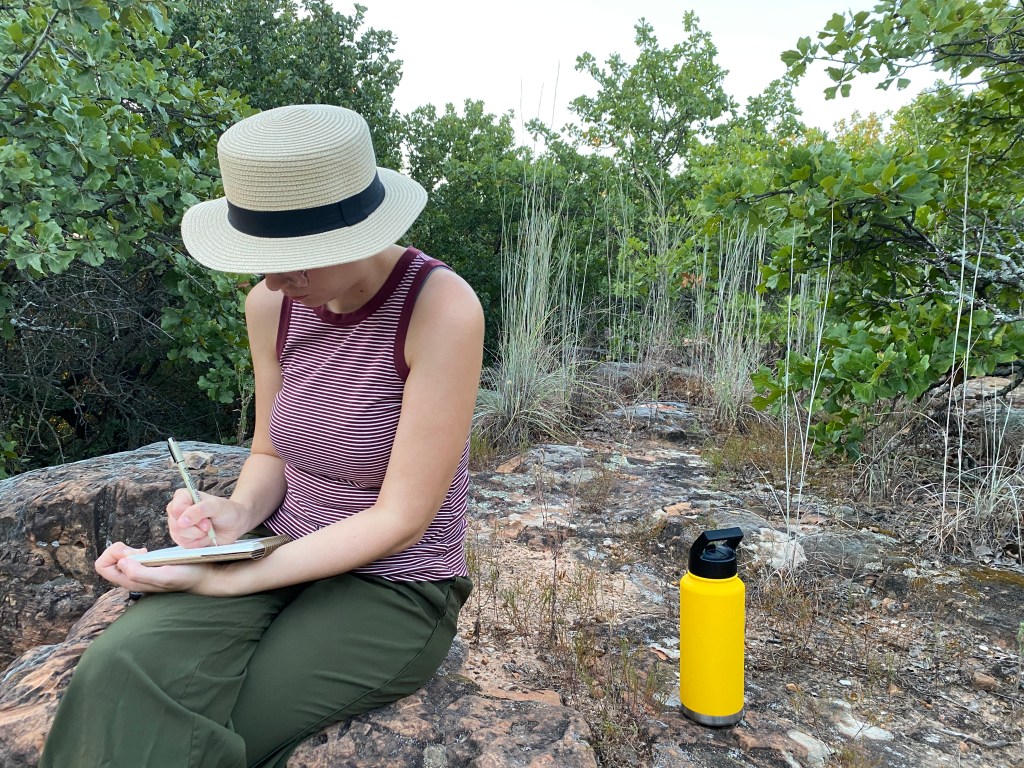
A recent mid-August Sunday was the hottest so far in 2024, with a high of 104F. When Kat and I walked up the trail at Sheri Capehart Nature Preserve to the sandstone ridge, the stone was quite warm to the touch. Regardless of the day’s heat, we wanted to experience a summer sunset there, and we arrived at the ridge about 8:00pm with the sun still glaring yellow through the leaves of oaks. Those trees grow immediately below the sandstone ridge, a curtain that hides the Fort Worth skyline and offers some shade.
Kat, making a few notes in her journal
We sat on the stone ledge with water bottles and notebooks at our sides. Looking behind where Kat was sitting, there were tall stems of little bluestem reaching above our heads, and with each little breeze they waved as if they were the tops of trees. The breeze was welcome, of course, but for the most part the air was still and with the humidity at 50%, it felt sticky. Turning back to the west, the disk of the sun peeked through branches and leaves in yellow-orange sparkles, as if coming from the facets of a jewel.
The constant nearby traffic sounds dominated, but at 8:10pm a wave of insect calls moved through the area and then stopped. Although at some point the Merlin app picked up the call of a northern cardinal, I could hear no birds. After a few minutes another wave of insect sounds lasted several seconds and then abruptly stopped.
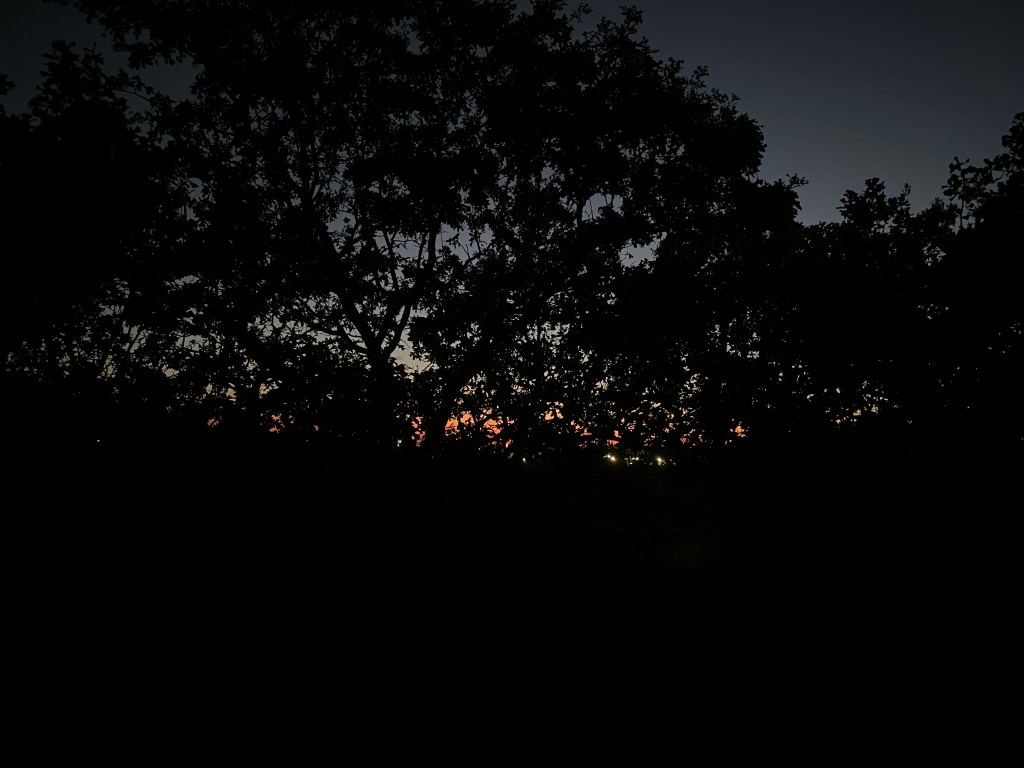
Meanwhile, a pastel yellow sky at the horizon filtered through the trees, silhouetting leaves and branches. I reclined on the still-warm rocks to be able to see the whole field of the pale blue sky, watching for birds or insects and hoping to see the first star become visible. I saw none of those. At 8:26pm the temperature at the ridge was still 92F, with humidity dropping a little. The western horizon was a deeper orange.
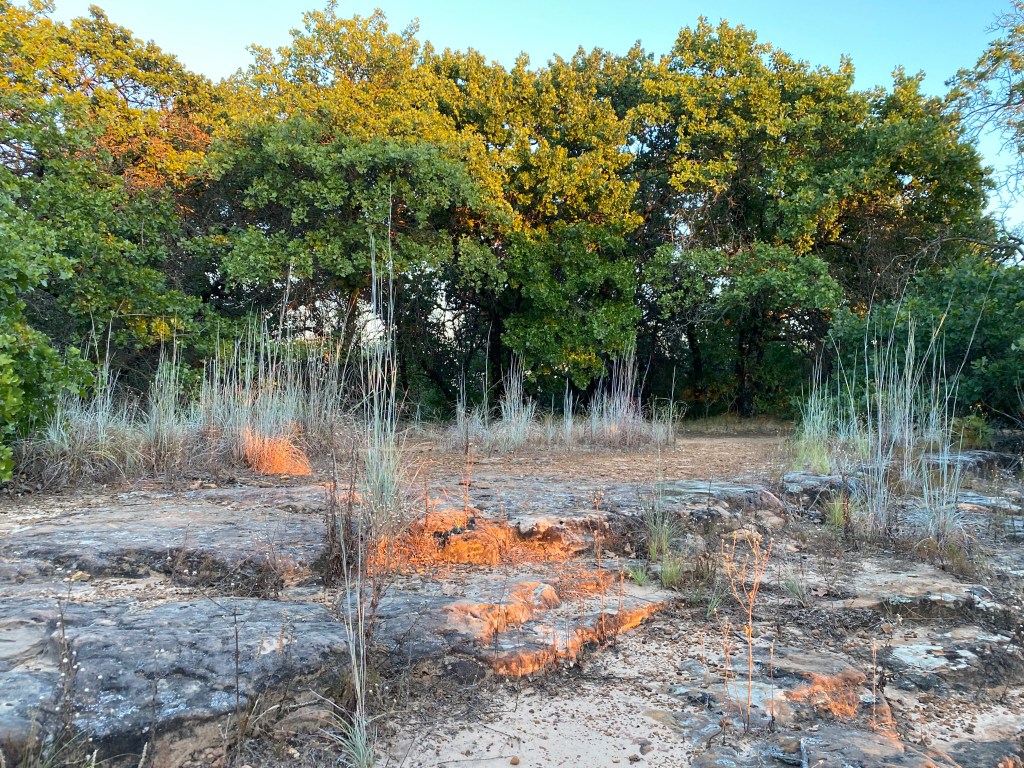
Sandstone, little bluestem, and sunlight in the blackjack oak
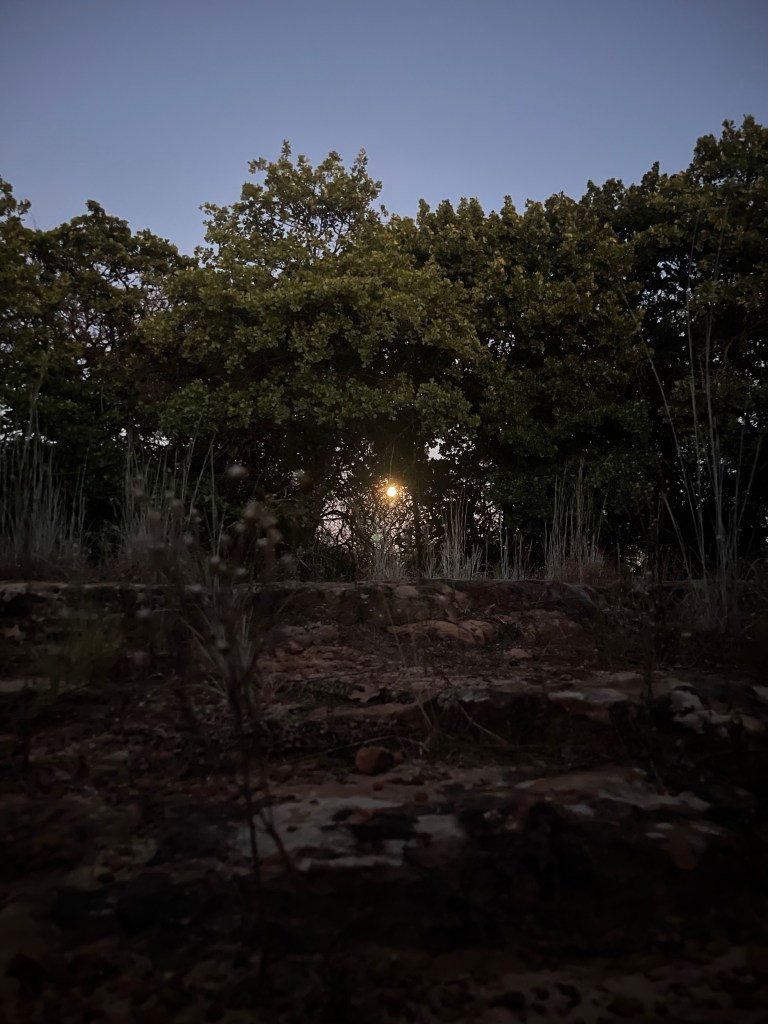
Behind us, the canopies of blackjack oak were dimly lit by the remaining light from the western horizon, almost glowing with a yellow tint that contrasted a little with the surrounding vegetation. And when we looked lower down in those blackjacks, through bare branches we could see the bright, round full moon rising.
It was about ten minutes later that we could see the first glimmers of a couple of stars. “Star light, star bright, first star I see tonight,” but these tiny bright pinholes in the not-yet-dark heavens did not seem bright. Kat’s younger and more perceptive eyes could soon make out four stars.
Moonrise through the trees (photo by Kat Oliver)
Shortly after that, we started walking back in the relative darkness, much darker under the trees. But in open areas, the full moon had risen higher and provided enough light for walking. When the moon is bright enough to light your way, and you walk along a path just visible, it may bring to mind childhood adventures in back yards or campgrounds. Something about it makes it seem special, a moonlit faery world much different from the bright daylight colors.
And what is the attraction of sitting with the sunset, riding that transition between day and night? The world rides along with us as we notice the settling of birds, the emergence of insects or frogs, the way any clouds transform the last light of the sun. Most days we declare our independence from the rhythm of the Earth, turning on our lights and continuing whatever we are doing while the sun disappears and gives the night to the moon and stars. Sitting outside with the sunset is a way of reconnecting with that rhythm. Through such a connection, perhaps we synchronize ourselves with something important.
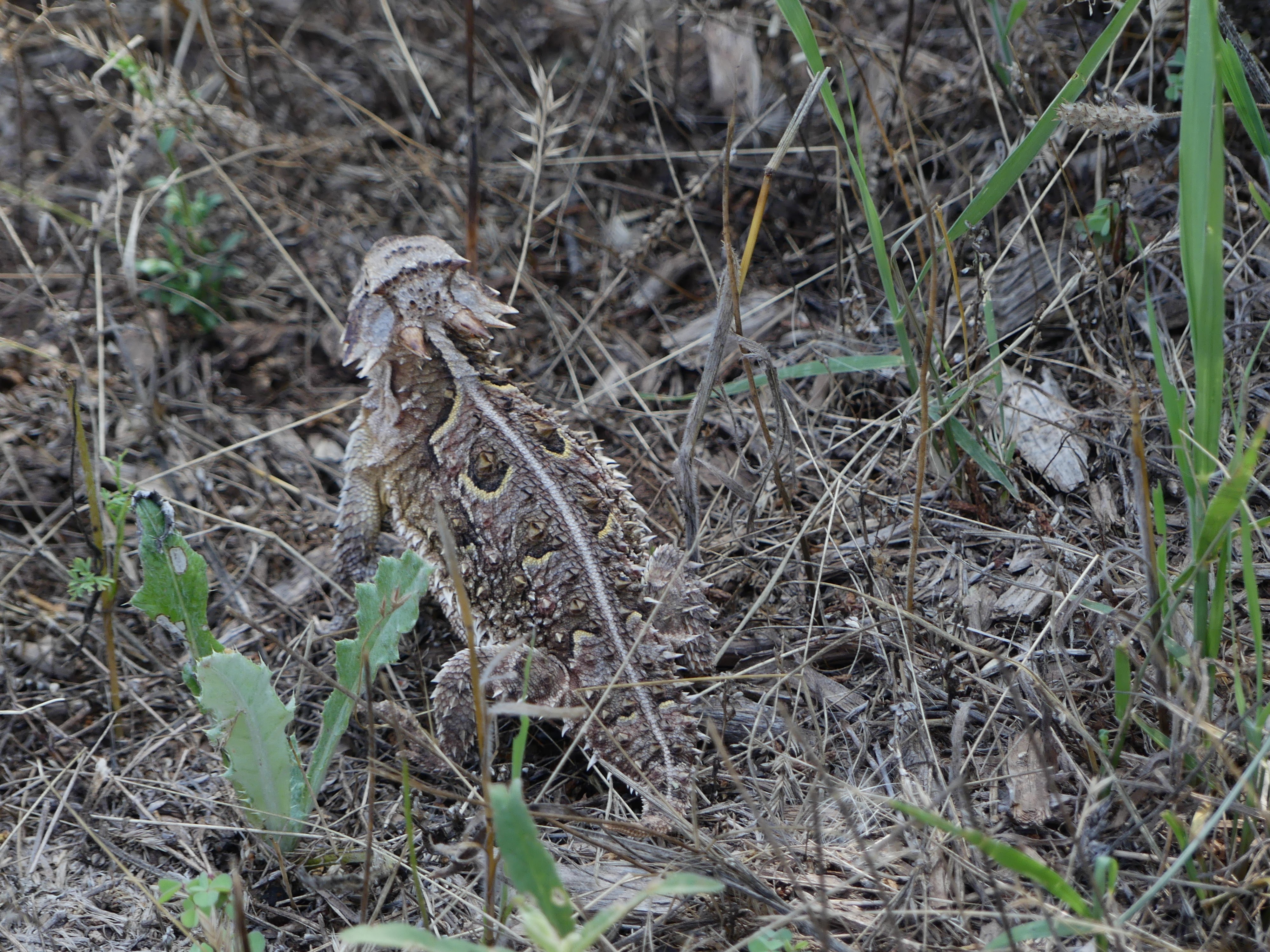
I just got back from a couple of days in the Rolling Plains with three wonderful friends. We saw Texas horned lizards, snakes, and a beautiful springtime landscape out there past the city of Vernon. This note is a “heads up” that my friends and I plan to collaborate on the story of our visits to Copper Breaks State Park and Matador Wildlife Management Area. Stay tuned and consider subscribing to Rain Lilies on Substack.
Texas horned lizard
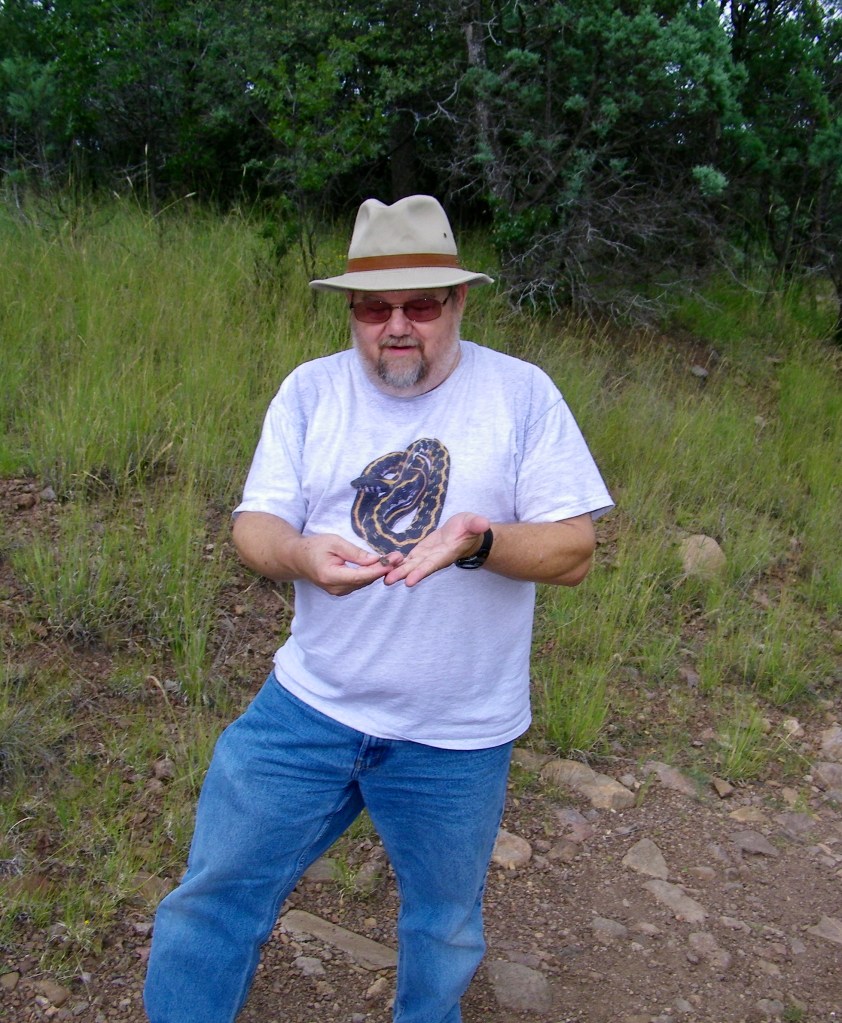
Road trips alone are OK, and there can be a wonderful quality to solitude out in some natural place. For me, going with like-minded friends is probably the best. There were times when we were the eyes and ears for each other. If I’m more focused on the ground where lizards skitter off the trail and Kat is attentive to a more distant view where Mississippi kites soar and buntings perch, we complement each other. Alaina is particularly attuned to the insect and spider life, and Sheryl takes in the birds but also those miniature worlds of flowers, fungi, and insects. One of us commented that together we’re like one organism, because we are closely attuned to each other while focusing on different aspects of our surroundings.
Where we went, the Texas horned lizard is doing well, and we saw six or seven of them. At night, we found three massasauga rattlesnakes along with other snake species. The landscape is thick with blooming thistles and basketflowers as well as (in places) skeleton plant, lemon beebalm, firewheel, and other flowers. It was a beautiful trip, and we’ll have more of the story – and lots of photos – at Rain Lilies soon.
Last September, after flipping over to Substack for a while, I came back here as the home base for my writing. I did not want to get too caught up in trying to get paid subscriptions, which is Substack’s business model. Anyway, there were several factors which I won’t bore you with. Now, embarrassingly, I find myself flopping back. Again, there are several factors in the decision, but I guess the bottom line is that I’m a flip-flopper.
I have created a Substack newsletter and called it Rain Lilies, with a focus not so different from this blog. I wrote, “I hope that what you will read here will be like those beautiful flowers that suddenly emerge after a rain, offering what might be a moment of unexpected wonder. Maybe it could offer a bit of insight into how we are a part of the natural world around us. Rain Lilies also takes a bit of inspiration from our wonderful granddaughter’s name.”
At Rain Lilies I plan to keep writing about nature and our place in it. I also have in mind a continuation of the “Letters to Nature Kids” idea, as well as news or comments about my books and related activities.
I do hope you will give Rain Lilies a try. You’ll have the opportunity to be a paid subscriber, and I’ll offer some things to make that worthwhile. However, most of my stuff will be available to free subscribers. This site will continue for now with the pages of information and downloadable materials, particularly in the area of herpetology.
So far this year, Tarrant County rainfall is about 3 inches above normal according to drought.gov. At Sheri Capehart Nature Preserve, the plants have responded with an explosion of growth and flowers.
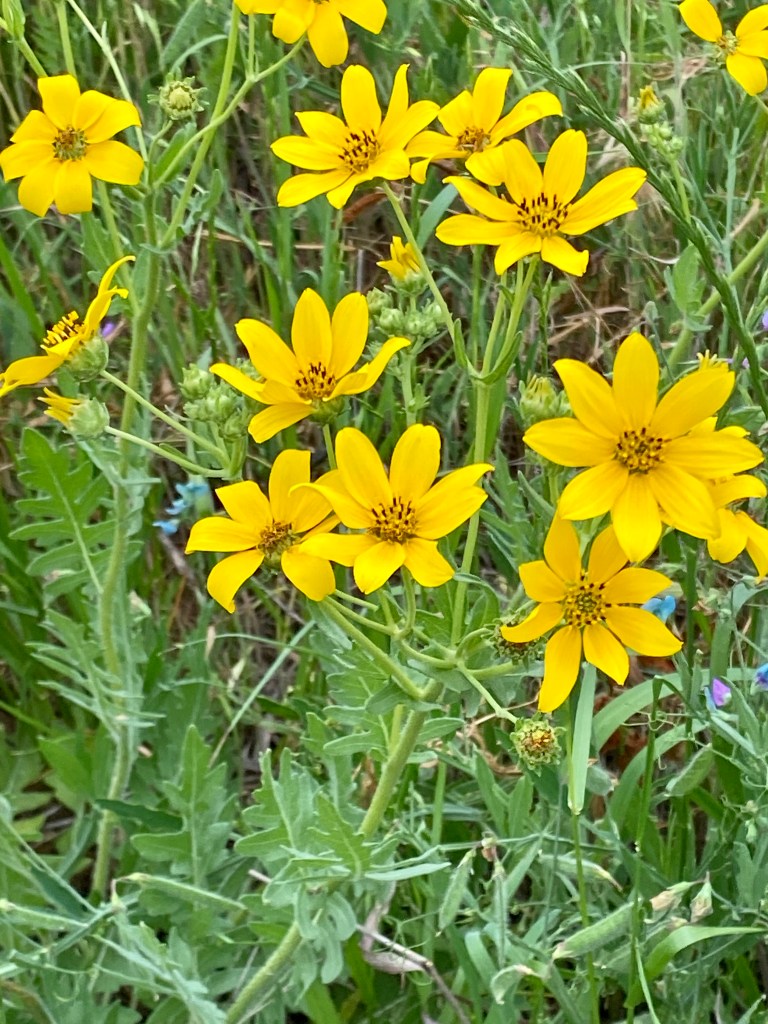
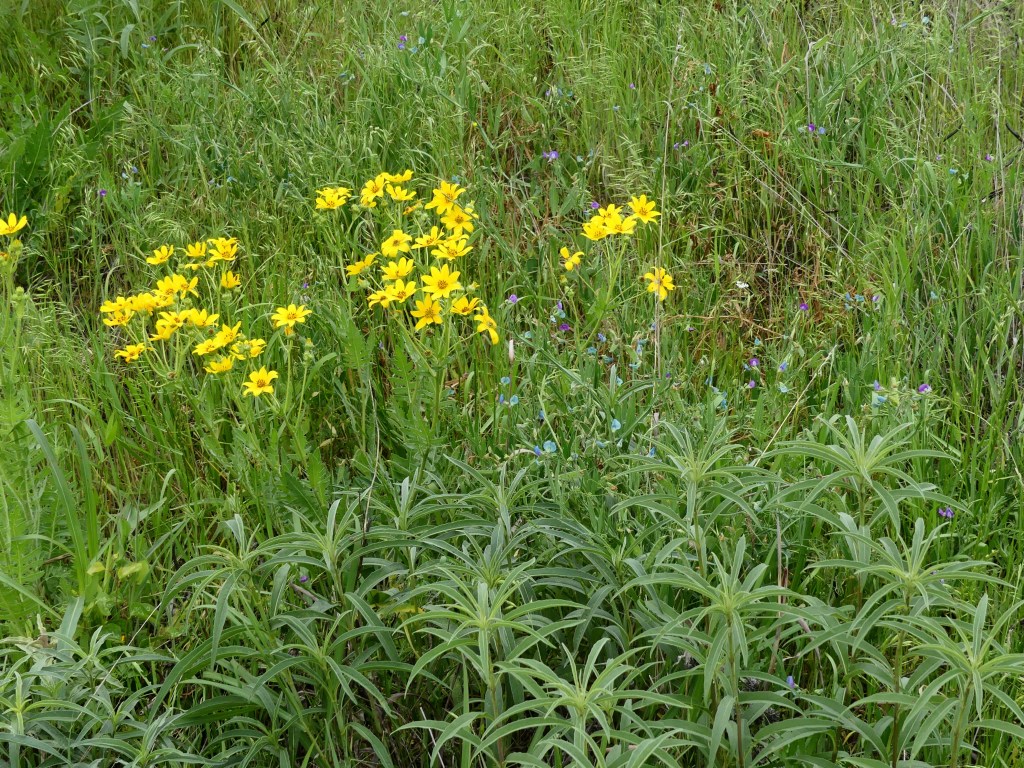
Walking up the switchback trail to the bluff, I have never seen so many spiderworts, their blue-purple flowers dotting the trail’s edge and the openings in the woodlands. Engelmann’s daisies grew in a few of the sunny spots, and the brighter yellows of chickory were common.
It was cloudy, and an Arlington weather source said that it was 61 degrees. The next day was predicted to be full of rain; I could imagine tomorrow’s shining raindrops on the leaves and the water soaking into the sandy places and forming pools where there is clay. But during my walk it was cool and dry.
Firewheel
At the boulders the green stems and leaves of vetch are overflowing and the bees and butterflies are feasting on clusters of purple flowers. And there were a couple of patches of firewheel (Indian blanket).
Question mark butterfly
The butterflies scattered up from the trail as I walked, including sulphurs, red admirals, and question marks. This last butterfly has a small mark on the underside of the hind wing that is said to look like a question mark, but for the most part with wings folded it looks like a dead leaf and the opened wings are a beautiful study in smudged and burnt orange.
It’s remarkable how different plant species have their time and then move on. The year progresses in a “kaleidoscope of color” as each one has its appointed time. There was no sign of toadflax blooms, even though only recently they seemed like the prominent flowers of the hillside. Near the trailhead, Maximilian sunflower was getting started, although we won’t see their blooms for some time.
Change is constant; nothing stays the same. The woods, prairie openings, and ponds change from season to season, and even within a season everything is in motion. And yet it’s the same place, a constant familiar presence even as it constantly shifts. How wonderful is that!
Engelmann daisy behind new growth of Maximilian sunflowerRipening dewberries
In her book, Wild DFW, Amy Martin says that people like her and me are “creek kids.” Each of us spent some formative years wandering nearby creeks. In my case the creek was my second home from about age 12 until high school, sometimes going with a friend or two and sometimes spending most of the day there by myself. For Amy and for me, the creek played a part in creating a lifelong love of nature. What would have happened, had we not had a creek, or a woods, or a prairie? I strongly suspect that if childhood slips away before we have had a close acquaintance with some place in nature, it might be too late. If there had been no creek, maybe I would have an intellectual or aesthetic interest in nature, but I don’t see how it could ever feel like home. For a creek kid, the attachment to places in nature and the things that live there is visceral. It’s like a beloved sibling, not a casual acquaintance.
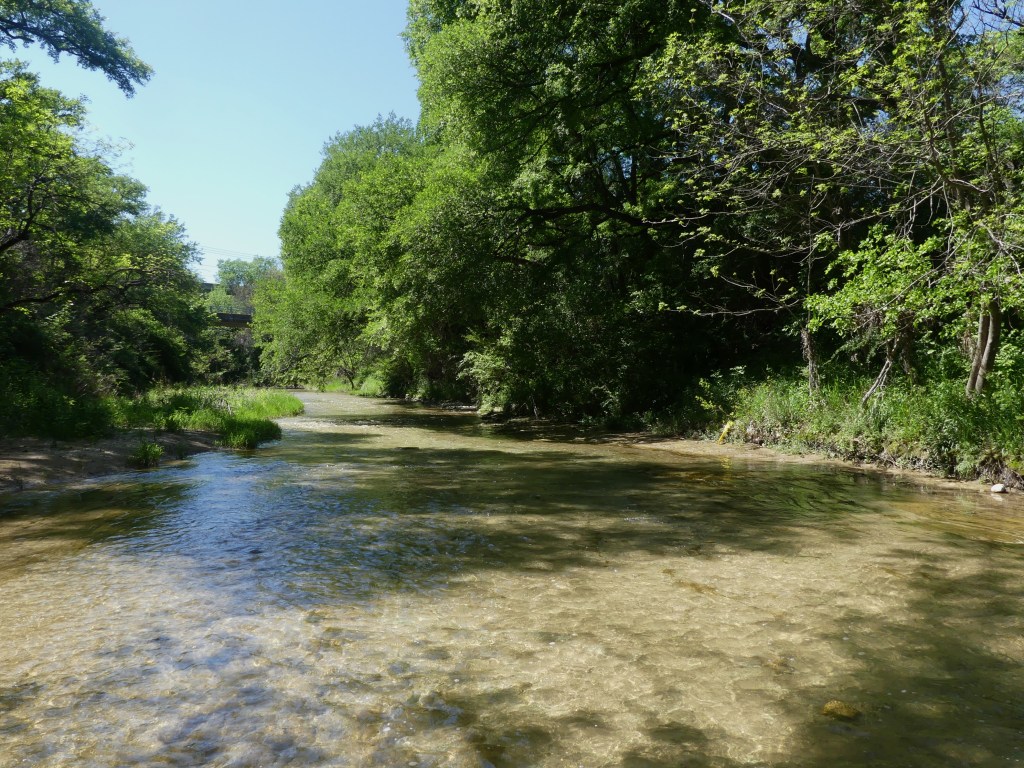
The creek in early April of this year
My creek was and is in western Tarrant County in what originally was prairie with black soil above white limestone. It sometimes filled up and ran like a raging river, but mostly it flowed quietly in a small stream from one pool to the next over that limestone. Under overhanging tree branches the water was sometimes crystal clear and cool, and mostly I had sense enough not to drink it. It was, in the early 1960s, full of wildlife, enough to keep me coming back day after day during the summer. My passionate interest was herpetology, but I was learning to love the armadillos, herons, and sunfish along with the reptiles and amphibians.
The creek is still there, but much has been lost in the 60 years since I first walked and waded it. The spaces between pools, those broad gravel bars and broken slabs of limestone, were inhabited by greater earless lizards in colors of pale gray and chalk white. They would run ahead and stop, waving their tails to expose black bars underneath (perhaps meant to confuse or disorient a predator). I haven’t seen one at the creek in many years. Ribbonsnakes used to thread their way through stream side vegetation, hunting for cricket frogs. When spooked, these slender harmless snakes would swim across the pools with bright orange and cream-colored stripes glistening in the sunlight. They seem mostly to be gone as well, at least at my creek. As populations of wildlife disappear here and there, younger generations know of them only through the memories of us older naturalists, or they may never know what is missing (see the article on shifting baseline syndrome).
I keep coming back, though the city’s development has forced me to find access points further upstream. Occasionally I will bring someone, but it’s a little like in Mary Oliver’s poem, “How I Go to the Woods” – those who smile and talk too much are kind of unsuitable, and if I do take someone, it is a person with whom I feel comfortable and close.
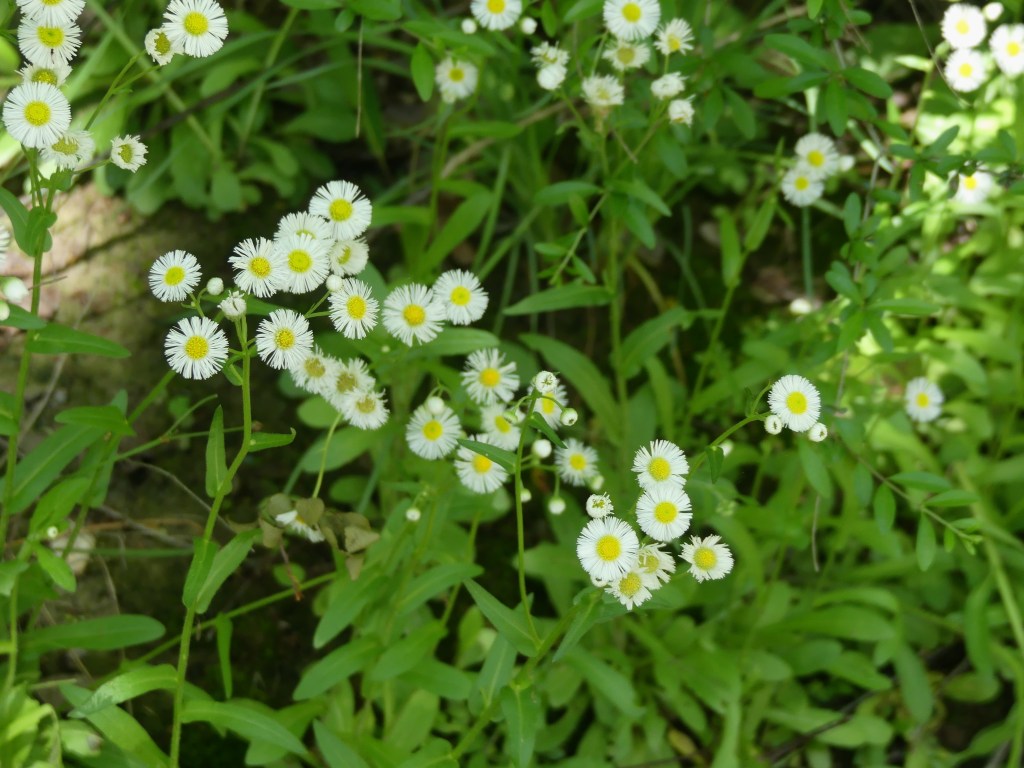
Fleabane growing on the banks of the creek
In particular, my visits there with Elijah have been important to me and, I think, to him. He is not quite a grandson but I’ve known him since he was born, so he’s family. I first took him to see the creek when he was six, and we’ve visited on and off since then. I described one such visit in an issue of “Letters to Nature Kids.” Giving kids time in nature, introducing them to the turtles and fish and other things that set the engines of curiosity and wonder in motion, that feels like part privilege and part responsibility. Taking my granddaughter for a walk to see birds and draw in the sand on the path through the woods is a great pleasure, and I think it is more than that. It is planting seeds that might, if she chooses, grow into a source of joy and connection with the world around her.
Blackstripe topminnows at my creek
So my creek is still there and has not been swallowed up by the city. I imagine kids playing in that creek and exploring it as I once did. I imagine it, but I do not see it. I have not seen anyone who appeared to be playing or learning about the life of that creek in a long time. Is this part of the cultural trend that Richard Louv wrote about in Last Child in the Woods? He documented the increasing tendency for children to play inside, to spend their time in front of screens, with little time in woods and fields. As parents, we may worry that no place out of our sight is safe. For a child to be outdoors for an extended time away from contact with a parent seems neglectful to many people. Yet I survived and thrived at the creek with no cell phone, just a watch and a rendezvous time for mom to pick me up.
I hope you have a creek, and that you take your kids or somebody’s kids there. I know that it might not be a creek; it could be a woods or a pond or some other place in nature. I would love to hear about it in the comments – either a place in your memory or some place you can visit right now. And I hope that you can visit it, for an hour or a day.
A near-perfectly camouflaged cricket frog, hoping that I’ll walk on byBlue water-speedwell, according to iNaturalist, growing along the creek
Spring is fully underway and it’s not yet April. Things are green and growing, and the insects – the beetles, flies, dragonflies, damselflies, skippers, and butterflies – are busy. On March 27 I wandered the trails at Sheri Capehart Nature Preserve, up the hill to the bluff and over to the boulders. There were filmy high clouds but it felt sunny and the breeze was cool. A nearby weather station reported that it was 65 degrees and felt like 74.
Spiderwort
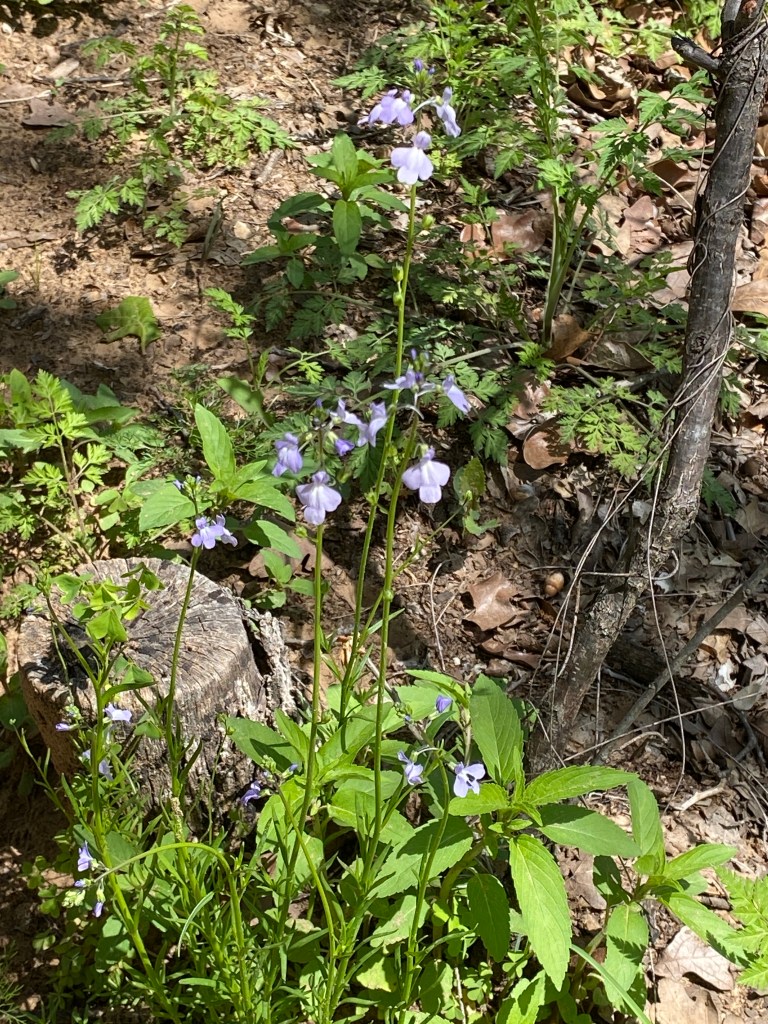
Many of the oaks were leafed out and a few stragglers were still putting out small leaves tinged in red. Along the trail’s edge there were some spiderworts with their deep blue flowers, three petals surrounding a cluster of yellow anthers. And everywhere I looked in the sandy soil of the hillside, it seemed that I saw Texas toadflax. I’ve really looked forward to this!
Texas toadflax
Last year, toadflax really captured my imagination. I wrote:
“To tell the truth, part of the reason I’ve focused on them … is that name – “toadflax” – which immediately made me think of The Wind in the Willows. A plant with such a name surely belongs in an old children’s tale centered on the English countryside with animals such as the toad.”
Even if it had a completely unimaginative name, I would think this delicate-looking plant was worth paying attention to with its tall stems and pale violet flowers.
Near the top of the hill there is an area with plenty of southern dewberries, and on one of the flowers was a pretty black-and-white moth called the “mournful thyris.” That’s just the kind of name that gets me wondering about how it was named, and an internet search or two did not yield much. Thyris is part of the name of the family – the group of moths – to which this one belongs. The word is said to be a Greek reference to “window,” and they have a spot on the wing that is translucent, like a sort of window. But why is this one mournful? I looked for a window into its grief but could find nothing. If any readers know the origin of the name, please share with us in the comments.
Mournful thyris moth on southern dewberry
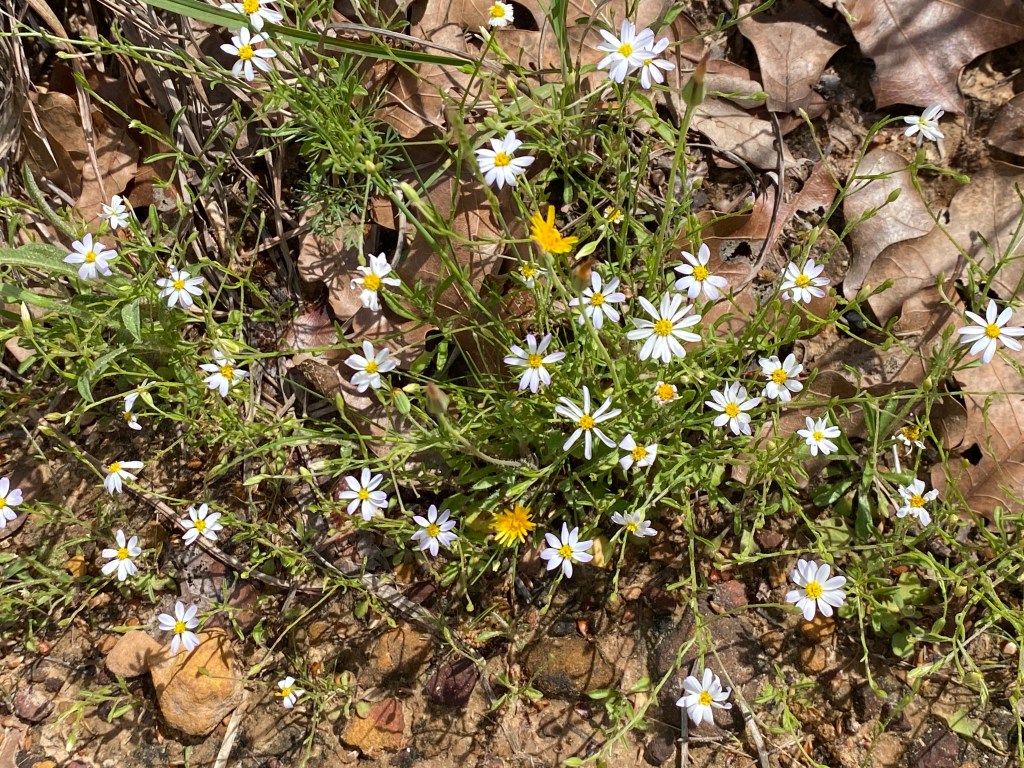
I walked the rest of the way to the bluff, along the way seeing beautiful yellow woodsorrel in a few places, with leaves reminding me of clover. Up on the bluff there were places with groups of what appeared to be leastdaisy, with tiny white flowers. It can be so rewarding to pay attention to little things like this, just stopping and maybe getting on hands and knees to get to know something small and magical.
Some leastdaisies at the bluff
There were plenty of butterflies – skippers, sulphurs, and a couple of beautiful tiger swallowtails. And the soundtrack to this lovely spring day was provided by a Carolina wren’s calling, with a blue jay heard in the distance. There were cardinals, too, and it sounded like an ideal spring day. I’m waiting for that first Texas spiny lizard on a tree trunk, which will add that perfect touch to a delightful day. I’m sure I’ll see one soon.











 Our Lives in Nature