I’m updating the website, and I hope you’ll find the changes useful. The primary change is the addition of a page for my “online book,” Naturalists and Nature Kids in North Texas. I want to write about what naturalists do, how to observe, practice mindfulness, keep a nature journal, and how to encourage and guide kids toward a love for and an interest in nature. I also wanted to include sections that describe these things in practice, experiencing the woods and prairies of North Texas. I hope you will have a look at this work in progress at the Online Book page.
It really is a work in progress, and if you read some of the chapters or journal entries, I would be very grateful if you would share any comments about them. Could Naturalists and Nature Kids join my other in-print books? I don’t know at this point, but for now I offer the completed sections and hope that you will like them.
From our house to your house, we hope this is the kind of day when it’s easy to reflect on blessings, when good food and good people inspire gratitude. May it be a day when challenges and troubles quietly recede to the background for a while.
Autumn color a few years ago at Sheri Capehart Nature Preserve
And beyond today, of course. A regular practice of gratitude, acknowledging even the little stuff, is good for us. I hope that we all have plenty of reason for gratitude every day.
Among my reasons to be thankful are those of you who read what I write here (or at Green Source Texas, or my books). After retiring from my work as a Psychological Associate nearly six years ago, I have been able to do more with my writing than I would have guessed. I’m very glad for anyone who has read an article or book of mine and got something worthwhile from it.
So today, don’t let those turkeys, sweet potatoes, or pumpkins have died in vain – enjoy it all and remember all the little things that we can be thankful for.
All the things I write about here are on the line. Our lives, in nature and in society. All aspects of our lives.
This is a time when speaking up is essential. As individuals, our choices nudge the society a little bit in one direction or another, and sometimes our collective choices make a profound difference. That choice has now arrived. If my voice as a writer and blogger can reach a little past my front door, then there is a moral need for me to speak up. All of us should.
In a little over a month, our collective choice is between someone profoundly unfit to lead anyone and a person with the knowledge, experience, and wisdom to preserve democracy and the rule of law. And there’s more than just a vote for Kamala Harris, there is the need for a Senate and House not owned by the wealthy and populated with opportunists and wild-eyed autocrats.
It was never my intention to write about politics, and this is not so much about politics as it is a plea for sanity. This is the first time a major candidate has been a con man, a habitual liar, a sexual predator, a fascist, and a person credibly described as a malignant narcissist. My psychology background and common sense tell me that to live (in a household or in a nation) under the control of a malignant narcissist is to be in extraordinary danger. It is to be manipulated, used, harmed, and tossed aside. Those victims are all of us, individually and collectively as a nation, not just hypothetical players on the evening news.
Many of his followers are clamoring for civil war, and some of them attempted a coup when Trump lost the last election. Some of his followers are overt Nazis, and others unquestioningly believe any lie and support any suggestion he makes.
If there was a need for this to tie in with our lives in nature, there is his promise to “drill, baby, drill,” his rejection of the science of climate change and his call for “raking and cleaning and doing things” as a way to prevent California fires (the environmental equivalent of his lunatic suggestion of injecting bleach as a treatment for COVID), his history of – and future plan for – rolling back environmental regulations and hollowing out the EPA, his offer of a bribe to oil executives if they would give him a billion dollars, and on and on.
The documentation is out there, easily available, and there is no point in my posting it all here and making this a long essay. My plea is for all of us to do what we can to, frankly, elect Democrats in November, not because I’m such a fan of that party but because in this election, they are the party in support of facts, reason, truth, and some commitment to respect the rights of all of us, however imperfectly.
Part of the authoritarian playbook is to make us all exhausted and unsure of what’s really true or if the facts really matter. If you’re tired of it all, want to push it aside as “just politics,” and you’re ready to skip the election, please don’t. Don’t make this a national suicide. The other side is not just an opposition party, it is an abyss.
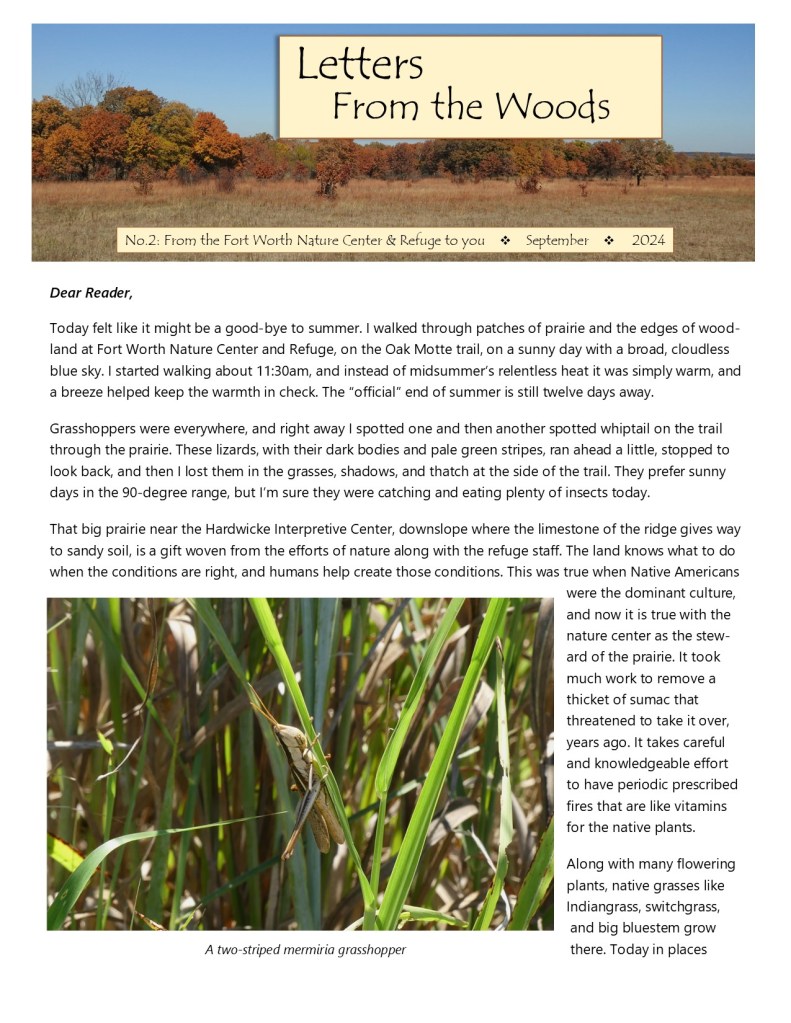
On Tuesday I took a walk at Fort Worth Nature Center & Refuge, and wrote about it as a “Letter From the Woods.” I took the trail across the demonstration prairie and up the Oak Motte trail a ways, seeing lots of insects, a couple of spotted whiptail lizards, and an eastern phoebe that appeared to divide its time between dropping down and catching insects and moving ahead of me.
I hope you’ll have a look (it’s the September letter that you can download here). And I’d love to hear any thoughts you might have, including whether you’d rather see it as a blog post. There’s just a little about the importance of insects, and E.O. Wilson’s great phrase, “the little things that run the world.” And there’s the dung beetle, whose name might be Sisyphus.
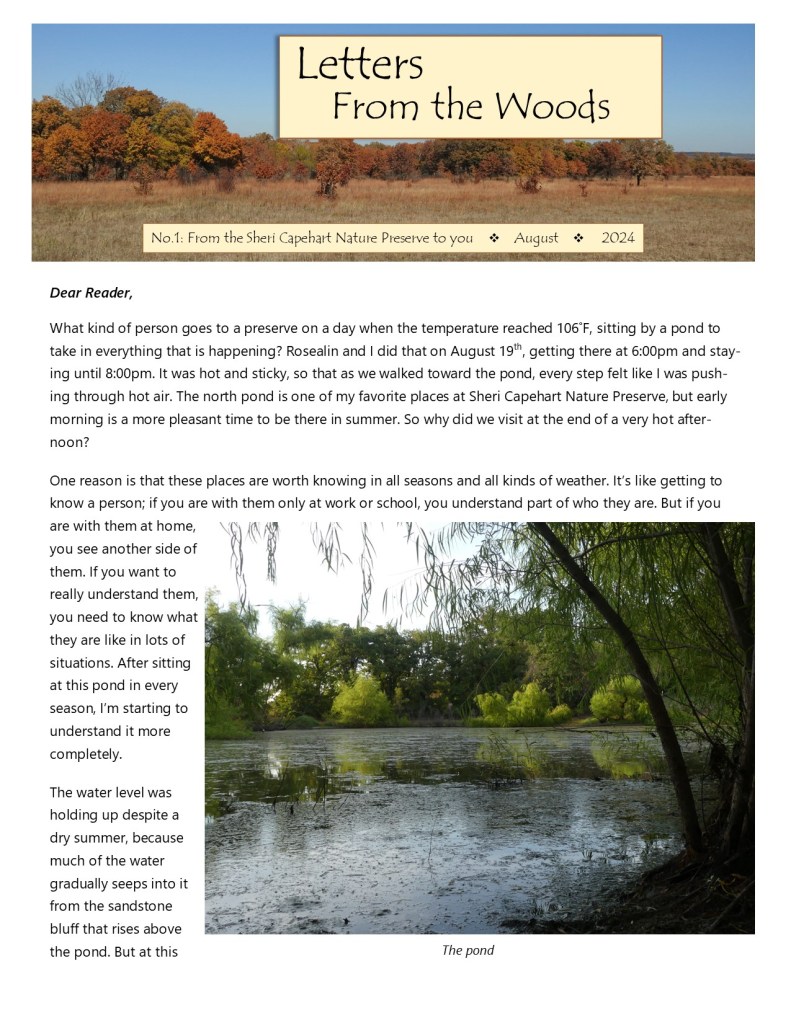
I have begun writing something that starts with what I experience somewhere in a prairie or the woods, and ends up in front of you, like a letter. I’ll write to tell you what I saw and experienced (and if you write back, that would be great!). I’m drawn to the idea of letters, a throwback to a time when we wrote to each other on paper, to be delivered to our houses and held in our hands as we read them. Now when we send something, we use the Internet and the delivery is more foolproof and quicker. I guess we don’t so much mind reading on screens.
I’ve been doing something similar when I write “Letters to Nature Kids,” nineteen of them so far in the past couple of years. They are written with older elementary school kids and teens in mind, exploring such topics as seeing horned lizards, writing in a nature journal, venomous snakes and safety, thankfulness (on Thanksgiving), and so on. Each one is a free download from the Letters to You page of this website.
And now I’ve written the first of what might be many “Letters From the Woods,” also downloadable as a pdf document at this website. I can design and format it more flexibly than I could a blog post, and you could easily hang onto it or share it if you wanted. I can post a link to each new one here on the blog, and you could click the link or go to the Letters to You page.
It’s kind of an experiment – would you let me know what you think? I’d truly be grateful for any feedback, either as a comment on this post or an email to me (livesinnature@outlook.com). Here is the first one:
I’ve just uploaded a “Letters to Nature Kids” issue. These are free, short pdf documents written for young people and anyone else who is still a little bit in touch with that kid they used to be. Most of them focus on some place or some species worth learning about, and some of them have a bit of a holiday theme. This one touches on Groundhog Day, National Send a Card to a Friend Day (obscure, but we should try it!), and of course Valentine’s Day and the various ways that love graces our relationships with friends, spouses, or even nature. I hope you’ll go have a look at it here.
Some of you download and read the Letters to Nature Kids that I write periodically. They’re available within the “Publications” page. I may not post about each one, so they may be overlooked by some who might want to read them. (Parents or teachers might download them and pass them along to kids, but adults read them at least sometimes.) This time I thought I’d put in a word for the Halloween issue.
The first thing I thought about was, of course, how we hijack things in nature, presenting them in ways that make them fearful. Bats, spiders, owls and such. On the one hand, I don’t want to get on my high horse and spoil the fun. I even tried to join in the fun a little by saying: “Bats live in the opposite of the bright daytime world in which we see and hear birds. When people think of angels, they give them feathered wings, but images of demons often have bat wings.”
On the other hand, after Halloween is over, kids should not be left with fears of these things. So I said, “People make up stories, either for fun or as a way to try to explain what they don’t really understand.”
The issue I feel most strongly about is kids (or anyone, for that matter) who take it too far. Halloween should not be an excuse to badly scare some child. I said, “It can be fun to be scared just a little, when we’re with friends and we know the scary thing isn’t real. … Sadly, some people enjoy scaring others because it makes them feel more powerful or stronger than the person that they scared. I’m not talking about kids having fun with each other, I’m talking about a person who enjoys seeing someone really afraid in a way that’s not fun. That’s bullying and it is not OK. Stay away from someone like that.”
If you know someone who might enjoy this Halloween issue, download it and pass it along. And have a safe, fun Halloween!
(For Halloween, I’m sharing a story I wrote some years back, based on a favorite place, a crazy legend of the ‘goat man,’ and those who may get a little too caught up in such stories, crouching over a fire and gibbering to themselves.)
The car windows were down as I crossed the bridge back over Lake Worth, and the Allman Brothers were on the CD player. After all this time, still putting out high-energy rock and roll, with the new release taking me back to 1969 when “Eat a Peach” came out. The wind whipped by as I exited for the Nature Center.
After an autumn day looking for reptiles and amphibians, a group of us had called it quits and headed home. However, once on the road I realized we had not picked up some minnow traps we put out at Greer Island. A minnow trap is a sort of wire mesh bucket with a wire funnel leading in from each end. In the hands of herpetologists, minnow traps don’t catch minnows so much as frogs and snakes. We placed several of them in shallow water along the island’s shore, partly exposed so that anything that got in could breathe. However, I could not leave any animals trapped, and so I was headed back into the Fort Worth Nature Center and Refuge.
As I drove along the road at the edge of the lake, Greg Allman sang:
“Can’t you feel a cold wind is howlin’ down, blowin’ my song?
Well I ain’t an old man, but you know my time ain’t long.”
I thought about the cold wind that would soon be blowing on the refuge as fall changed to winter. Oh well, I was ready for a change. The end of summer had been unusually humid, and cool weather would feel good.
The sunset glow still provided some light as I walked the causeway to Greer Island. The wind picked up, scattering yellow cottonwood leaves to drift down through the remaining light. I felt a slight shiver. The thought of walking around alone on Greer Island in the gathering dark did not bother me, did it? I’ve been on the island many times, and it is as peaceful as any other part of the refuge. Maybe that Allman Brothers line about a cold wind howling down had gotten to me.
On the island, I pulled the first minnow trap up from where it had been nestled beside a fallen tree branch at the water’s edge. Inside was a water snake, its chocolate brown scales glistening as it frantically tried to find a way out. I put on the gloves, unfastened the trap and reached inside. The snake writhed and bit at the glove, with the small needle-sharp teeth barely penetrating to my skin. Although nonvenomous, water snakes defend themselves by repeatedly biting and by expelling a nasty-smelling musk. I wanted to get this done as soon as I could. Just before I released him, up came a small leopard frog the snake had eaten earlier in the day. “More data for the survey,” I thought, as I recorded the details of both snake and frog.
I searched for the next minnow trap with my flashlight, as it had now gotten dark. Pushing through buttonbush and stepping carefully among the deadfall, I squished through the saturated ground to the next trap. When I found it, it was open. This was very puzzling, because the two halves of the trap fasten pretty securely. I looked around, certainly not expecting to see something. No one else should be on the island at night, and besides, it was ridiculous to think that just because the trap was open, someone had opened it.
More wind whispered and sighed through the treetops, and the flashlight’s beam caught the flicker of a few more leaves fluttering to the forest floor. I reached the site of the third trap, but did not see it in the water. I moved the light around and caught a flash of metal. There! Hanging from a tree branch was a tangle of smashed wire dripping in the flashlight beam – the minnow trap! My hands felt numb and the two other traps dropped from my fingers to the ground. Not bothering to pick them up, I turned and walked quickly back toward the trail. I wanted out of there in a hurry. I pushed through underbrush and spider web, resisting the urge to run and trying to keep my bearings. The flashlight illuminated a narrow section of woods, and everywhere else the darkness seemed menacing. Some of the fear dissipated as I walked, and I emerged into an upland area where the woodland was less thick and the image of the mangled minnow trap was less immediate.
Finding the trail, I set out toward the causeway. Just a little bit now, I reassured myself, and I would be walking on that narrow strip of dirt and gravel under the stars toward the safety of the car. The path re-entered thicker forest and I concentrated on the circle of light from the flashlight. I kept it on the trail, unwilling to risk a glance to either side. The dirt path narrowed, understory shrubs and then tree trunks increasingly closing in. The trail ended! I must have gotten turned around, I told myself, but there were no trails on the island that simply ended. I turned, backtracked, and shone the light around. Nothing but oak and understory shrubs around me. Finally it occurred to me to get into the backpack for the GPS. It constantly plotted my path on its screen, like an electronic version of the trail of bread crumbs in “Hansel & Gretel.” I had used it on more than one occasion to help me backtrack through the forest. As I felt inside the pack for the GPS, I heard something some distance away. It was something like the wail of a large animal, rising in misery and then strangled in a series of barking or coughing sounds. I was frozen for a moment, staring stupidly at the flashlight beam shining where I had set it down, illuminating a tangle of greenbrier and Virginia creeper. Another wail pierced the forest, greater in intensity and ending in several guttural cries like shouts of rage.
Snatching up the flashlight, I ran back along the trail and then cut through a small clearing in the direction I thought I should go. My mind raced back to another memory from 1969 – what was it? The Lake Worth monster? A goat-man that had been seen numerous times but never found? The memory was cut short as I tripped over a downed branch and fell. I picked myself up and tried to run again, but a snare of entangling greenbrier brought me down like a staked dog reaching the end of its tether. I made a bleeding mess of my hands trying to pull the tough, thorny vines away and then finally yanked free. Back on my feet, I set off in a blind panic, the GPS lying useless in the dirt somewhere behind me.
I’m not sure how far I ran, and I’m even less sure of the direction. As I staggered breathlessly up to a higher elevation, the roof of a small pavilion came into view. My heart sank. This structure, with its concrete slab and two protective walls, was far from where I wanted to be. I took a few more steps up the slope, and saw the glow of a small fire burning on the concrete floor. The fire itself was obscured by someone or something sitting with its back to me.
I hesitated. The figure poked the small fire in front of it, without turning toward me.
“Ain’t no gittin away, try as y’might.” The high, thin voice spoke as if we were in mid-conversation. It had some of the hard edge of a threat, but the unsteady quality of a man barely containing his excitement, or maybe fear. Still I stood immobile, wary of doing anything.
“Sit right still, he’ll come,” he added, while drawing distractedly on the concrete with his stick.
I turned and ran, and after me came his high, unsteady shout: “Ain’t no gittin away!” And as if in answer, over to my left came another screeching cry, clipped off and followed by two short bellows of fury. I heard a large branch snap, up in the treetops. I turned and focused the light to see a large figure in the trees, eyeshine reflecting back at me. And then it dropped straight out of the treetops and out of sight. Running away from it would take me away from the causeway. My way out was blocked.
I crouched by a log in dense brush, waiting and trying to think. Bits and pieces of old news accounts returned to me. In 1969 there had been a series of frightening encounters with residents describing something half-man, half-goat covered with light gray fur and scales. Once it was said to have jumped out of a tree and onto a car parked at Greer Island. On another occasion, several bystanders at Lake Worth watched it until it supposedly hurled a car wheel (tire, rim and all) 500 feet in their direction. The mystery had never been solved.
My thoughts were shattered by a voice right beside me – “Ain’t no gittin away, told ye.” I jumped and fell backward in leaf litter and twigs, and when I was able to sit up I saw the old man from the pavilion. His eyes were too wide open and they darted around, not really connecting with mine. He had a desperate look about him, and he was covered with filth. As I started to say something, he swung a bag with something heavy in it, like gravel, and clubbed me.
In my next moment of awareness, I was slung over his shoulder watching the ground go by as he carried me. My wrists were bound. My captor was muttering crazily, “Billy brekkist, Billy lunch, he’ll come, oh yes.” We reached the pavilion and he put me down, and then set busily to work tying me to a support pole. Here and there he paused to look at me with a sick grin that exposed broken teeth and receding gums.
He sat down beside the flickering little fire and looked at me expectantly, as if waiting for some sort of performance. Away and to the side, I saw lightning flash on the horizon.
“Billy! He’ll come – oh yes oh yes. You’ll see.”
In the nearby woods, another wail – chopped, at the end, into staccato yells. The old man became agitated, gibbering “Billy, Billy, Billy, no gittin – no!” He backed away and stumbled into the darkness, eyes as big as saucers.
Why did he keep repeating that name? And suddenly it hit me! It was the children’s story about the goats who try to cross the bridge where the troll lives. I was the bait, and he was going to catch his billy goat.
I exhaled as far as I could, rolled my shoulders forward, and dropped down. The first loop of rope slipped, and I started working out of the bonds that held me. My captor flew into a rage, squealing “No gittin, no gittin!” as he jumped back up onto the concrete. As he got close enough, I kicked him away. I slid further down, escaping more of the rope and then was able to get free. My tormentor made another run at me, screeching “No gittin! No – no!”
Just then, an enormous form jumped in front of me, hitting the old man with such force that they both rolled ten feet away. There was a sickening sound of snapping bones. I looked toward them and in the dim firelight I got a glimpse of fur and horn – and a head turned and stared at me for an instant with the horizontal slitted eyes of a goat.
I leapt away from this horror and ran through the woods, branches and vines slapping me as I went. Somewhere I found the trail and was able to go faster. Behind me a long wail arose, riding on a gust of wind. Lightning flashed. I was aware of noise in the treetops, but could not tell if the trees were disturbed by wind or by some terror pursuing me. The trail widened and big raindrops began to spatter down among the leaves. I followed the bend in the road and emerged onto the causeway.
The rain came down in sheets as I reached the car and got in. As the cold wind blew through the treetops, I made my way out of the refuge. I could not get the old man’s shrill voice out of my head as I drove along Shoreline Drive. I had not gone very far through the heavy rain when a gust of wind blew something onto the road in front of me. I stopped the car and leaned over the steering wheel to look. It was a minnow trap.
In a talk about ways of being in nature, someone asked me if writing in a nature journal might make the experience too much about him. I hadn’t considered that question before and struggled to answer. On one level, the answer was clear to me: No, what he writes about the time he spent in nature would not be self-centered. But his question deserves more thought, as it helps clarify what a nature journal is for. It might help us decide whether and how to keep a journal.
I had mentioned that I started out keeping field notes as I had been taught by biologists. County and state, date and time, species, age class, sex – a very terse style of recording data that might accompany a specimen as it was catalogued into a scientific collection. We, the observers, had no place in those notes beyond the listing of our names. Years later, looking back at such notes might give information about where and under what conditions I found a particular kind of lizard, but it would convey little or nothing about what it was like for us to walk across a rocky ridge in a particular place in Texas.
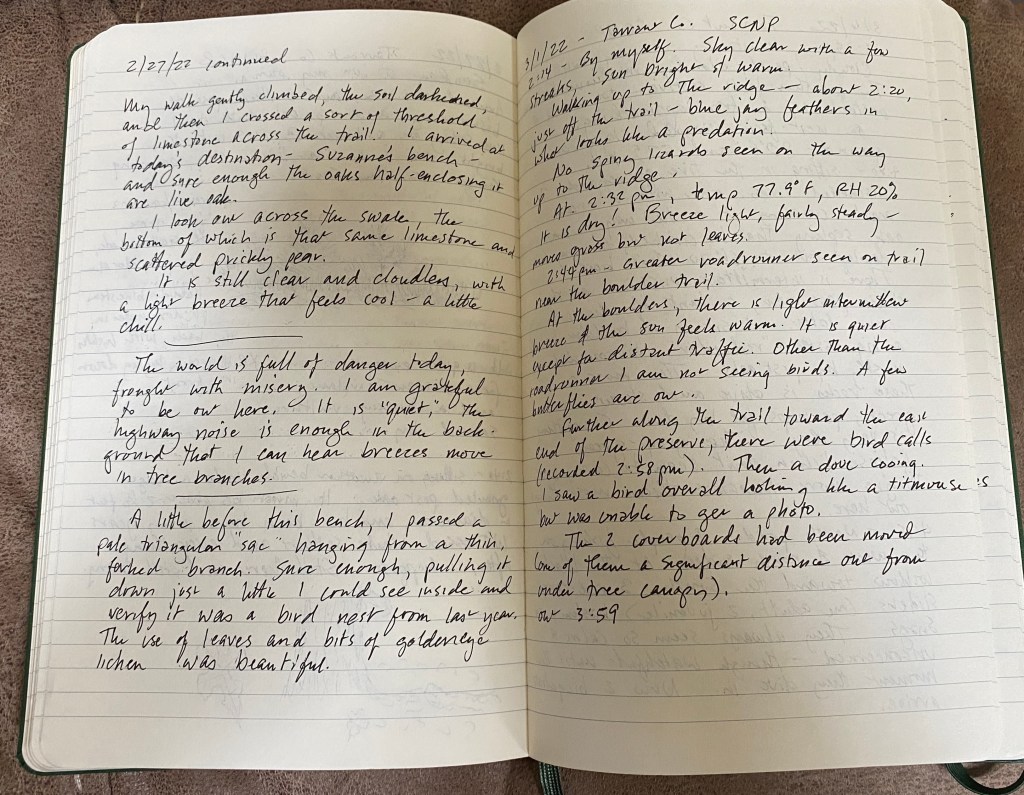
Journaling, as most of us understand it, involves a more personal account of time spent in some place. There are more incidental and subjective details of how the sunshine felt, or the yipping and howling of coyotes as the last of a sunset faded to darkness. Subjective impressions are welcome, perhaps exploring a sense of solitude and what it means for us.
In the talk I had also emphasized that journaling makes it more likely that we will recall our day in nature in more detail. As we write (or draw), we think about and visualize again what we saw. It’s the same sort of thing we would do if we wanted to commit something to memory. Bringing sounds and sensations back to awareness, telling ourselves the story of what we have just experienced, weaves together a pattern of brain activity that can become part of our long-term memory. Even if we never looked at the page again, chances are we would remember the day with greater richness.
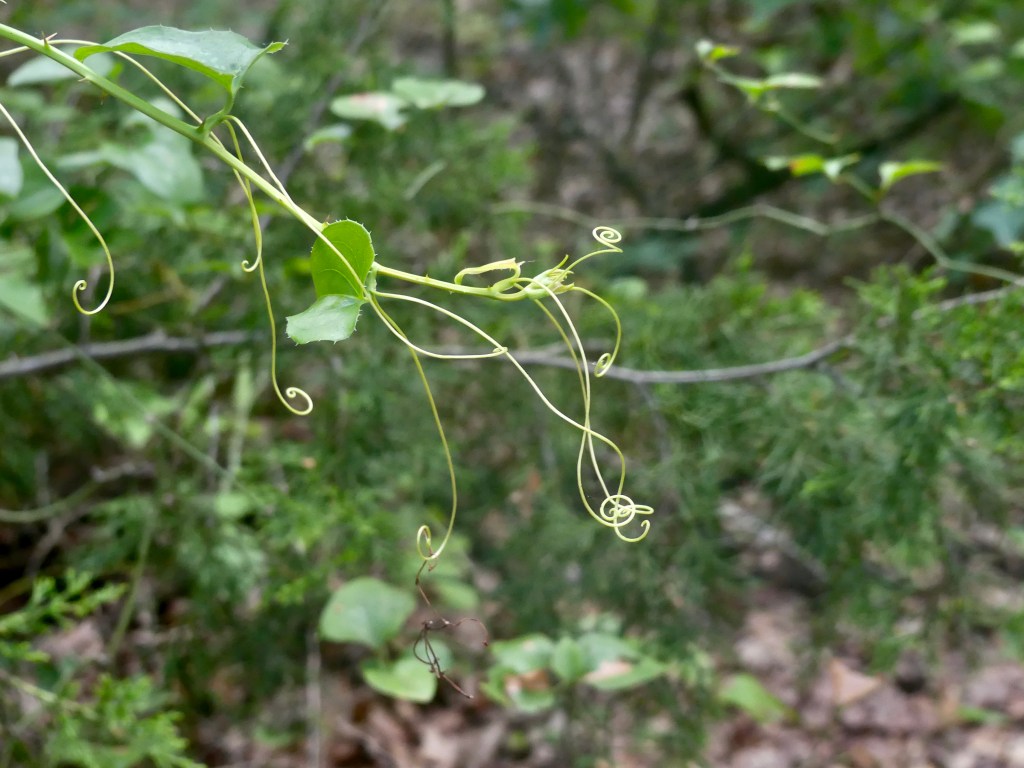
So with that in mind, maybe the journal is, in part, something we do for ourselves right then, while we are still in the woods or on some rocky bluff. It’s not a way to look back years from now, but a way to process the experience for ourselves while it is in front of us. By “process” it, I mean to reflect on it, sort out what happened, and sift through its meanings. Even a short walk may bring up meanings for us to consider. Walking through a small preserve, I was struck by how the delicate curling tendrils of a greenbrier reminded me of some elvish scripts in Tolkien’s work. Another time in the same place, I thought about my dissatisfaction with the nearby highway noise and how it contrasted with a mindful acceptance of my walk just as it was. Such issues may be small, but sometimes they add worthwhile perspectives to our understanding of the world and how we live in it.
I said that in one respect, writing in a journal is something we do for ourselves, so we return to the issue of whether it would make the experience “all about me.” Would it? I don’t think so, if that means a self-centered focus with no room in the story for anything but us. I think the question I was asked was really about the opposite: whether, in an account of trees, grasses, insects and clouds, there is room for us. Do we belong in the story of our walk in the woods?
When we go for a walk in the woods, what is created is a relationship between ourselves, the trees, the ground beneath us, birds and butterflies around us, and the whole community of life in that place. We are, for a while anyway, a member of that community. We may have little physical impact, but we are not a disembodied presence there. We leave the imprint of our feet, perhaps eat a few berries, and send a few animals into hiding or draw them out in curiosity. We exchange with the plants the gasses we each need for respiration. We receive experiences of beauty and wonder, water in which to wade or swim, paths to explore and places to rest. And this is just part of a wider relationship in which the earth nurtures us and we take care of the earth (or not).
What I’m saying is that we do belong in the story of our walk or our backpacking trip. We are at least temporary members of that community. We might seem like alien gawkers, we who live in the “built” world and arrive clothed in the products of that world. The longer we are estranged from nature, the more it might seem like we are visiting a foreign world, but in some sense what we are doing is coming home. So why wouldn’t we have a part in the story of that reunion?
If we’re fortunate enough to watch a heron stalking a fish or a coachwhip snake effortlessly climb a tree, we would be eager to write about it in our journal. Why not write about our own behavior as we explore or wait patiently for something to emerge? Why not put down an account of how we felt about something, or how it reminded us of some other thing? This might initially make us self-conscious because it isn’t a familiar way of taking notes in the field, and maybe it would seem too self-focused. I think that including ourselves gives helpful context to what we are writing about and helps us reflect on and sort out our experience in a more complete way. It’s a way of telling the whole narrative of our day.
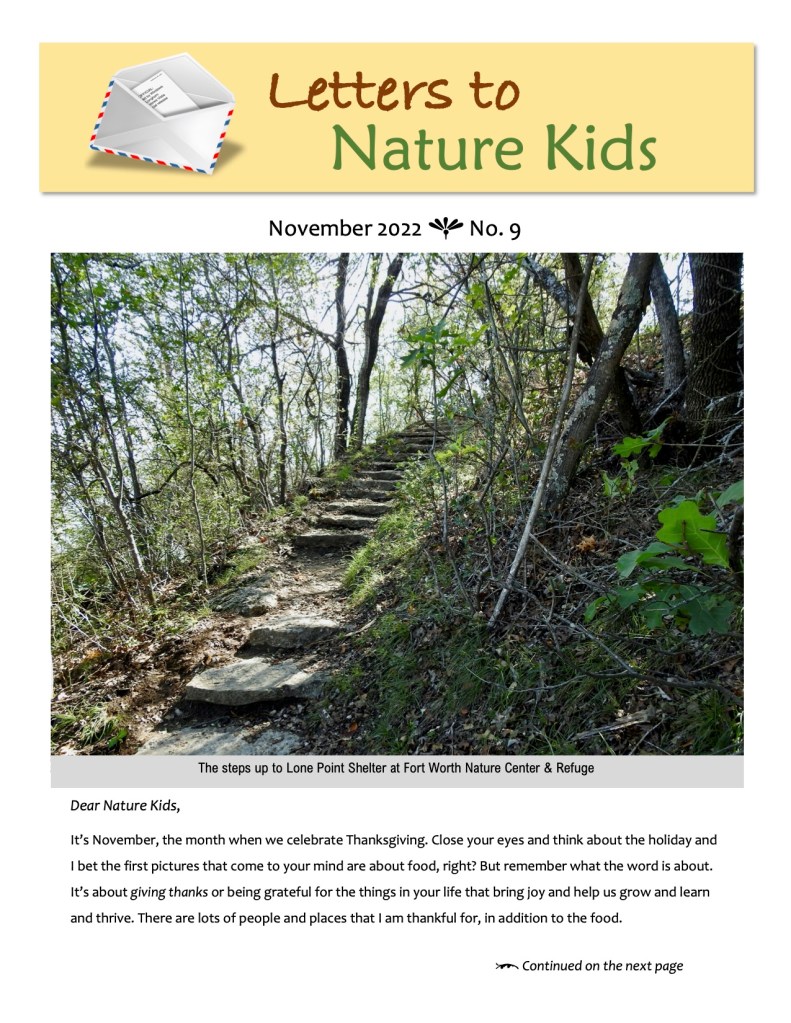
“Nature kids” are those children and young people who appreciate nature and understand its magic. I enjoy writing “Letters to Nature Kids” and offering them to nature kids and their families, and to some adults who may enjoy them as well. This month I wanted to write about gratitude (it will soon be Thanksgiving, and it ought to be Thanksgiving every month). I hope you will download this free issue and share it with anyone who might want to read the letter and see some photos from the Fort Worth Nature Center & Refuge.



 Our Lives In Nature