I had to go to the woods today. Among my frequent visits to those places, some are for spiritual and psychological first aid. Today was a day like that.
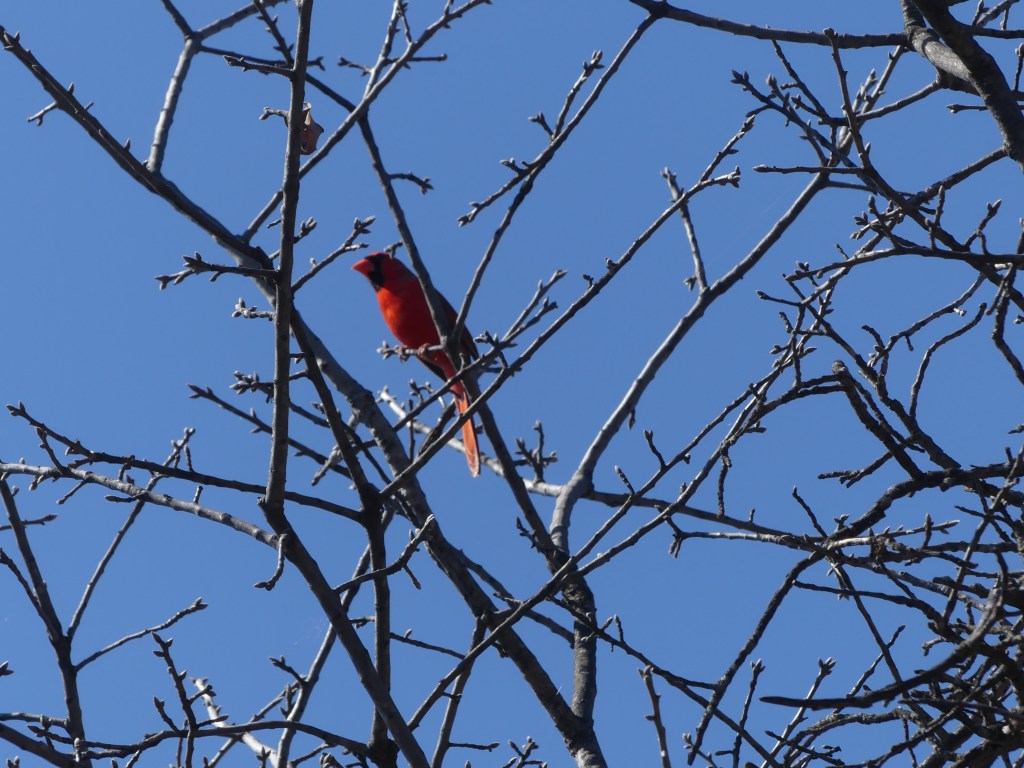
Cardinals like this male were singing throughout the preserve
Here at Sheri Capehart Nature Preserve, I can sit on the ridge and look down into the brown and gray woods, still in those colors for a while before the leaves appear. There are some glimpses of green, bits of juniper seen through oak branches, and patches of moss at the base of tree trunks. And there is a flash of reddish feathers from a female northern cardinal.
Yes, there is traffic noise and a barking dog somewhere, but it feels quiet and there is a stillness to the dormant woods, here at the edge of spring. I needed this respite. Not a respite from my home, except that home is where the news arrives. Home is where I get sucked into the Internet, with stories from the world: destruction, corruption, and bullying. Here, I don’t allow the news to appear on my phone, which is used only for photos or checking the Merlin app to identify some unseen bird.
The sun is at my back and a butterfly dances by. Mosses and lichens growing on the stones of the ridge provide endless color, life, and art. And there is the stillness that hardly seems able to be found in the city.
Butterflies agree that spring is ready to arrive. On the trail from the ridge to the boulders, a fritillary glides in toward me on rigid orange wings. It sails on past, wings now flapping to carry it up to the treetops. Nearby, a pair of butterflies suddenly appear and spiral up in their fluttering flight, above the crown of the nearest tree. When I reach the boulders, a pair of sulfurs chase each other down the path. The fluttering, erratic flight of butterflies might make us think they cannot control their flight very well, but have you noticed how often they can weave among obstacles without hitting them? That erratic flight seems to be a gift, an ability to make quick turns and maneuvers that help them escape predators.
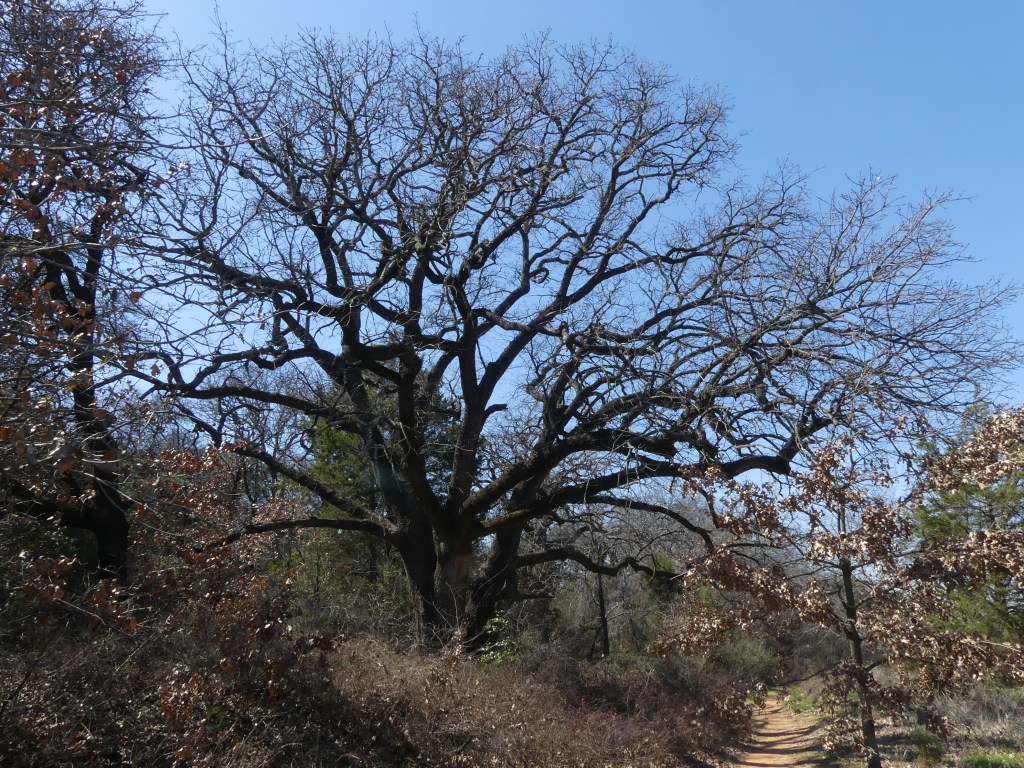
The historic 200-year-old post oak referred to as the Caddo oak
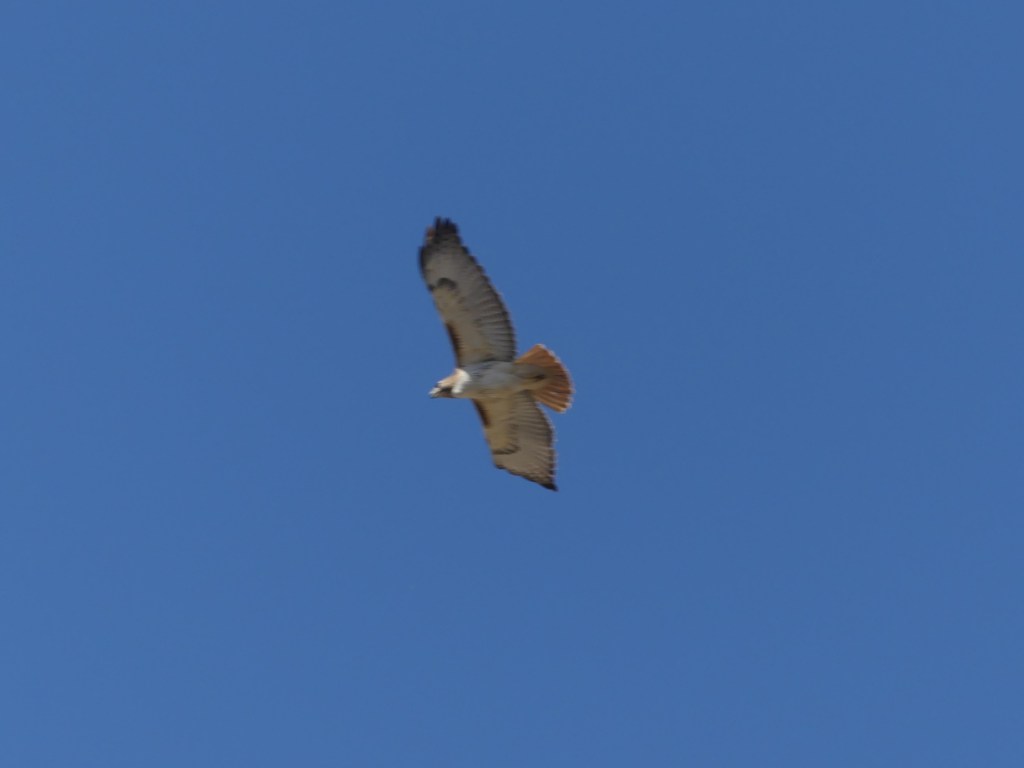
I walk around the preserve, past the historic Caddo oak, seeing many more butterflies and hearing a number of bird species: Carolina wrens, tufted titmice, a chickadee or two, an eastern phoebe, and many northern cardinals. I see a red-tailed hawk overhead, soaring and then turning on powerful wings.
A slightly fuzzy photo of the red-tailed hawk
Arriving near the north pond, I think about how much data we have about the benefits of mindfulness and time spent in nature. There is the reduction in stress, the cardiovascular benefits, an immunologic boost, reduction in depressive rumination, and increases in empathy among other gifts. Those things make time in the woods not some privileged escape or ignorance of the troubles of the world. It is a sort of refueling for the work that lies ahead. It is restorative – a little like sleep – and so it should not be undervalued.
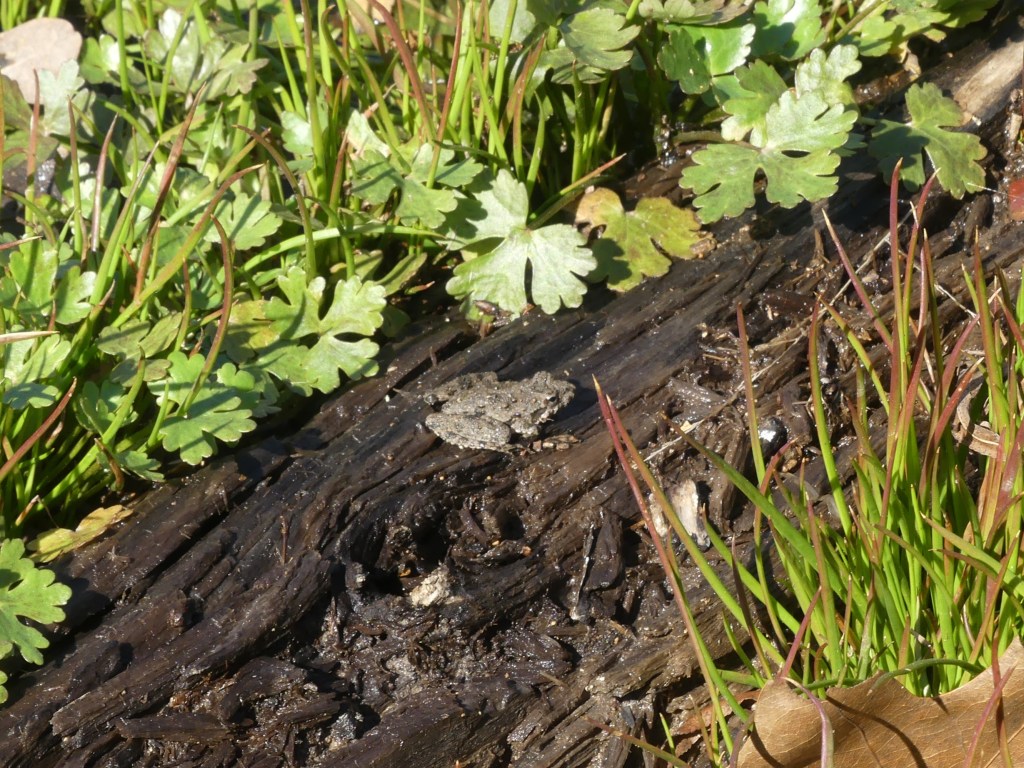
Blanchard’s cricket frog at the pond’s edgeA young red-eared slider, basking
It is now 77F in the shade. Down at the north pond, life is in full swing. red-eared sliders swimming or pulling out and basking in sunshine. Cricket frogs jumping into the water as I get too close to them. All that is needed is the emergence of dragonflies, and the pond will seem complete. I walk back to the car after nearly two hours of walking, sitting, and noticing things in a world that seems so different from the big events of the wider world. It has been a small but important restoration.
A lot of parents hope that their kids will enjoy being outside and maybe even become “nature kids” – the kids that love the trees, water, grasses, bugs or birds, and may have familiar and beloved places in nature. Some other parents have kids who, on their own, have become interested in nature and love getting out. Such parents may be willing to support their child’s interest. I screwed up my first attempts, but have better ideas now that I’d like to tell you about.
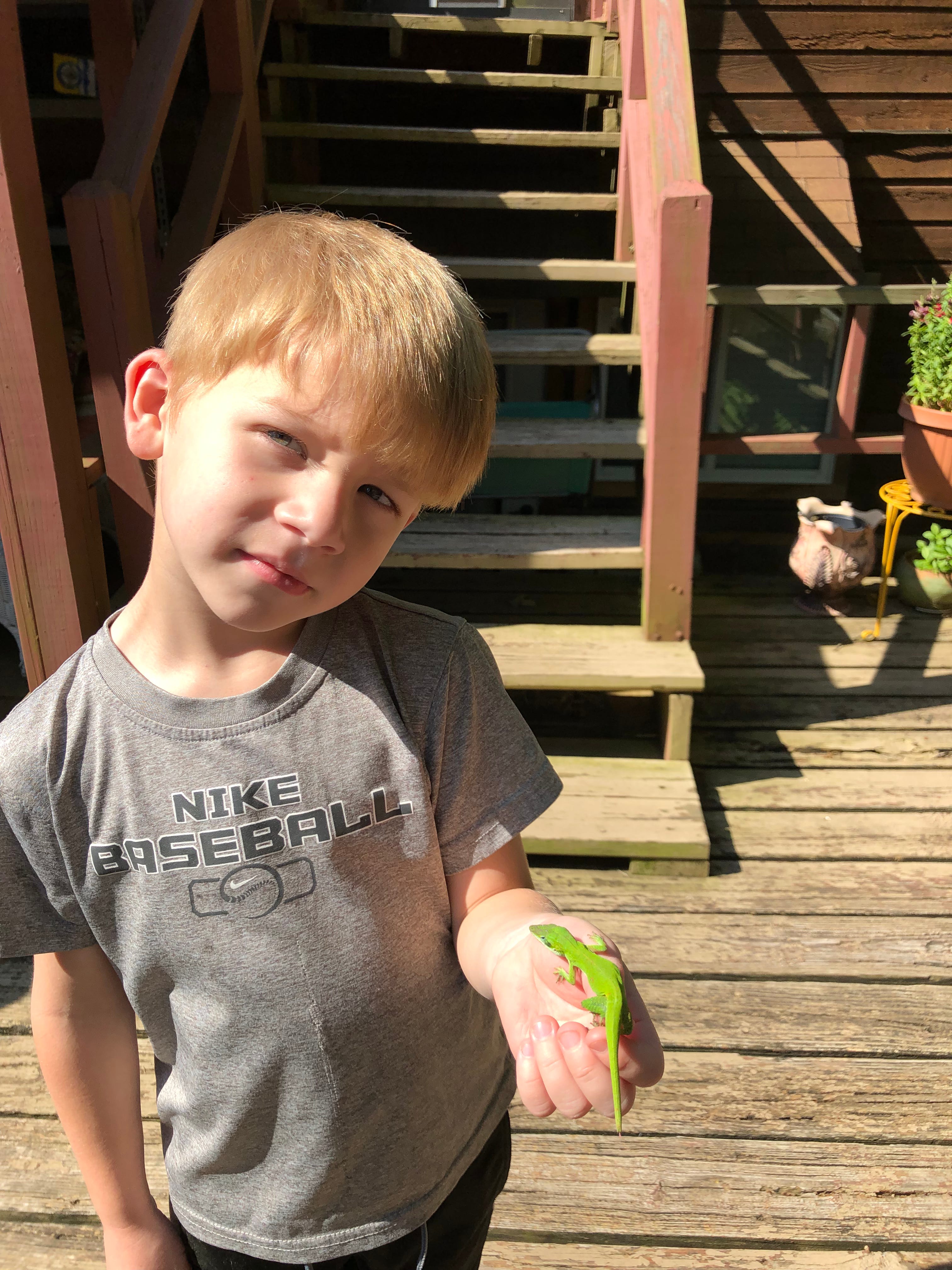
Elijah, holding a green anole
Like many other parents, I hoped my son would enjoy being in nature and even be a partner with me in exploring the woods and creeks. All these years later, I understand some things better than I did then. What is wonderful to me may not be attractive or interesting to someone else. To share an experience or a place with someone, it is important to be tuned in to how they will experience it. These ideas will seem obvious to you, and thirty years ago those ideas – put into those words – would have been obvious to me, too. But sometimes I was blind to their meaning.
So here’s what I did that may have sunk any chances of my raising a nature kid. When he was five, I took my son to the creek that meant so much to me when I was growing up. He rode on my shoulders through the tall grass, and then we walked the limestone creek bed where water trickled and gathered in pools. I turned over a piece of wood to find a couple of plain-bellied water snakes hiding beneath. They are harmless, so I grabbed for them and caught one.
For someone with a serious interest in field herpetology, “harmless” means “this snake is going to bite you if you pick it up, but there is no venom and it only leaves scratches.” Others might not necessarily agree that “harmless” is the right word, but there it is. Geoffrey was not thinking the snake was harmless as it repeatedly bit my arm and drew blood. I got control of the snake’s movement and it stopped thrashing, and Geoff’s eyes were wide with fear. I was clueless enough to offer to let him touch the snake somewhere away from its head.
“No-o-o-o-o-o,” was the answer.
I hadn’t bothered to ask if he wanted to find a snake, and then had not paid attention to how he was responding when I did find one. I was very mis-attuned to my son and too focused on what was a wonderful experience for me and thus I thought surely would be for him. Geoff tells me that he would not have become a nature kid regardless, but I’m sure this experience did not help.
Maybe if I had talked with him before our walk to see what he would like to get out of it, or at least prepared him for how it might go if we found a snake. And maybe if he shrank back as I discussed it, I would know that it’s better to just walk around the creek and not look for snakes this time. You would think that my Master’s degree in psychology would have told me this.
At a later point in my career, I was trained in parent-child attachment relationships and a program called the “Circle of Security,” a way for parents to pursue attuned, secure attachment with their children. The “circle” is a graphic that shows us as the secure base from which the child goes out to explore and grow but also comes back in for reconnection and help.
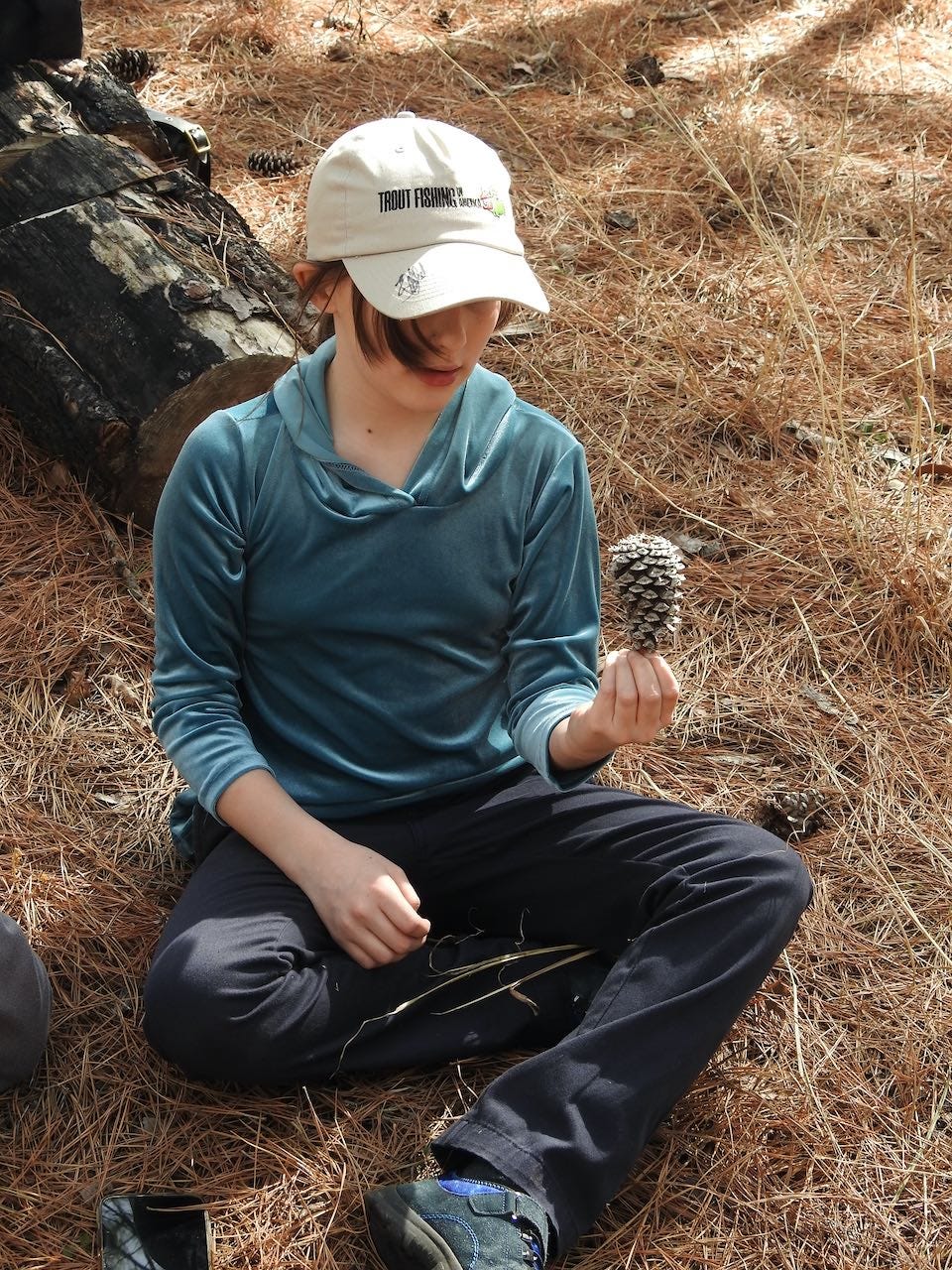
Sarah, examining a pine cone at LBJ National Grasslands
Having a secure relationship with someone means we work to be reliable partners for each other, whether we’re a parent with a child, two close friends, or a married couple. We try to respond to each other’s emotional cues and act in the other person’s best interest, and when we screw up, we try to fix it. We can take delight in each other without being overly controlling, but we can also step in and be protective when needed. We wish we could succeed at this all of the time but we never perfect it. There are mistakes in the relationship from time to time, and what counts is how we repair it. The cycle of rupture and repair can strengthen relationships in ways that perfection probably could not.
Early research on attachment involved mothers and babies or very young children, but the themes follow us into adulthood. Our relationships, how we trust others, how we maintain (or don’t maintain) boundaries with others, and how we handle conflicts, tend to reflect to one degree or another how those early relationships worked. And so these ideas are very relevant to our parenting of school-aged children and beyond.
Much of the Circle of Security approach seems relevant to encouraging children to spend time in nature. We surely don’t want to make it a battle, as if to say, “You’re going to march right out there and hang out with the birds, or you’re grounded!” I don’t think it works out well to make it a chore, a sort of outdoor homework in which we say, “Stop having fun, it’s time for nature; and remember, there will be a quiz afterward.” No one would really say that, but you know what I mean.
So what can happen when we take children to the prairies and woodlands? We can support their exploration while watching over them, staying closer when they’re younger and giving them more independence and space when they are older. We can give help when it is needed and genuinely wanted, and also enjoy the experience with them. With Lilly’s earliest walks in the woods, I stayed very close but I generally followed her lead. When she stopped to play in the sand of the trail, I stopped with her. I’ve taken older kids who also wanted to play in soft sand, and I’m happy to stay nearby and watch that happen. Once I joined an elementary school-age girl who was throwing a few small branches and sticks into a pond and describing the results, in one case creating a small wave in the water “like an angel’s wing.”
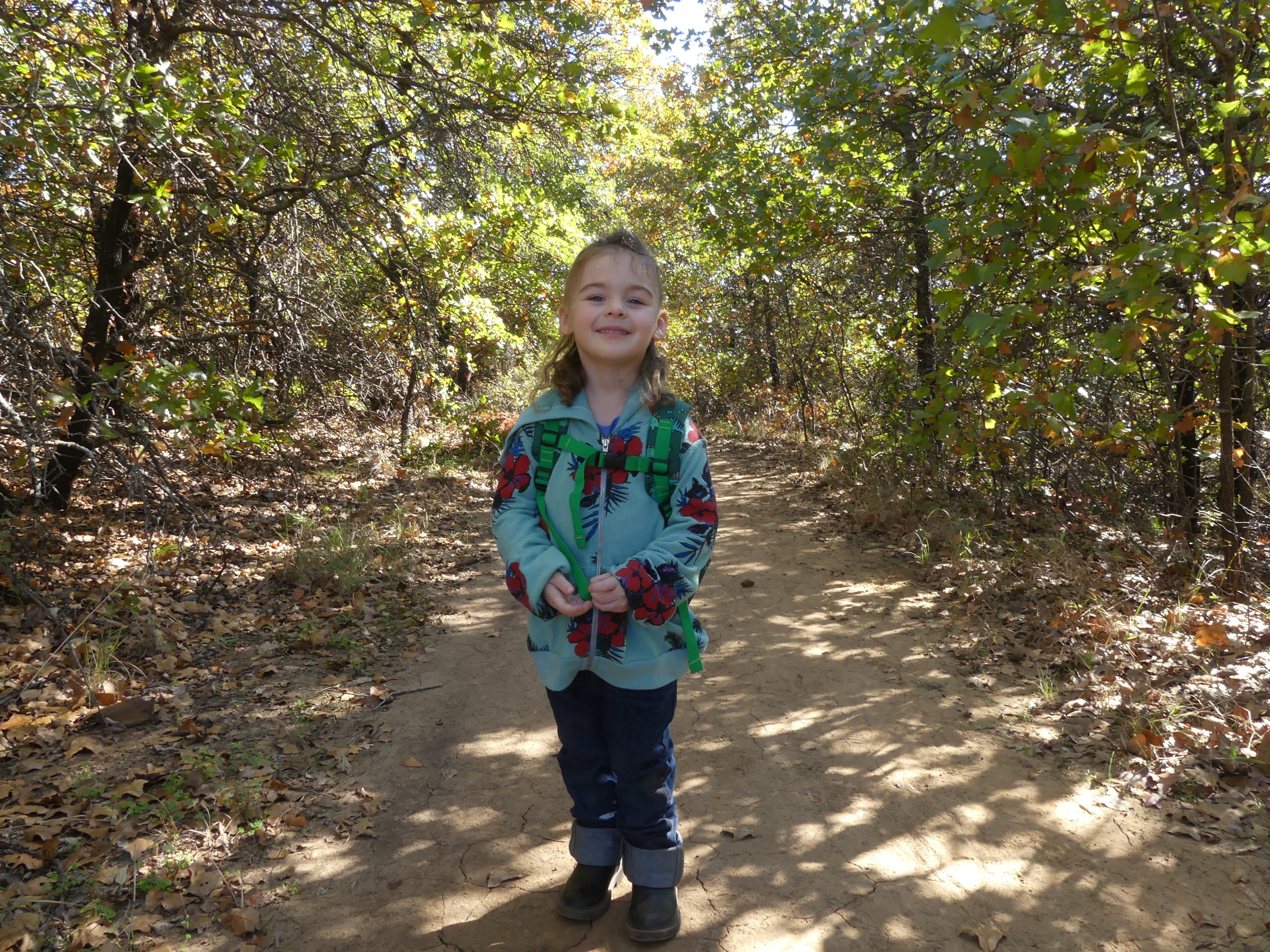
Lilly on a walk in the woods
In Circle of Security terms, these are things that happen on the top half of the circle, when the child is playing under our watchful eye and sometimes needing us to delight in what they are doing. It doesn’t all have to be free play; we can and should offer ideas and help. We can engage kids in some structured activities or games while in nature. But it helps if some of that time in nature involves following the child’s lead, and if our time in nature feels like something that we create together.
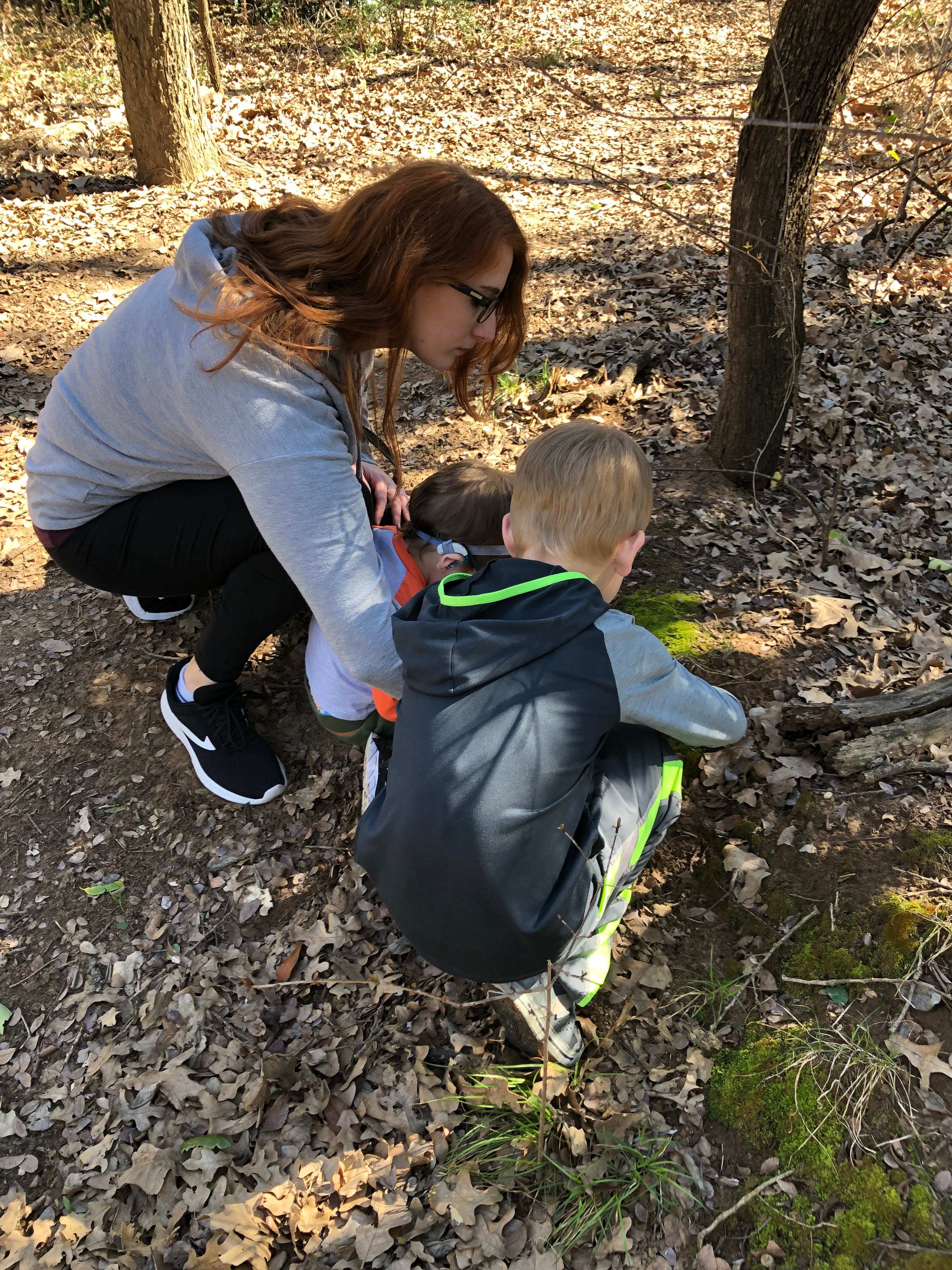
Kelby shares a moment of discovery with her kids
What about the bottom half of the Circle of Security? That’s when the child needs to return to you for support, to take out that splinter or reassure them that the bee that’s buzzing around isn’t trying to attack. Or maybe when the younger child falls apart in frustration or the older child has a conflict with another child. It might be when she or he is getting near some place that could be dangerous, and we have to step in and set limits. In Circle of Security terms, it’s when the child needs us to welcome them, protect them or comfort them, and help them manage overwhelming feelings.
There are always hazards of some sort. Not long ago I stopped Lilly just before she walked into a patch of cactus. I took a group of people on a walk at sunset at LBJ National Grasslands (no young children on that walk). Copperheads are fairly common there, and I prepare folks accordingly and would set limits on risky things like walking around barefoot at such times. Coyotes began to yip and howl in the darkness, and a little reassurance was needed for one of the participants. These are all moments that occur on the bottom half of that circle, in which the other person wants to reconnect or needs help or limit-setting.
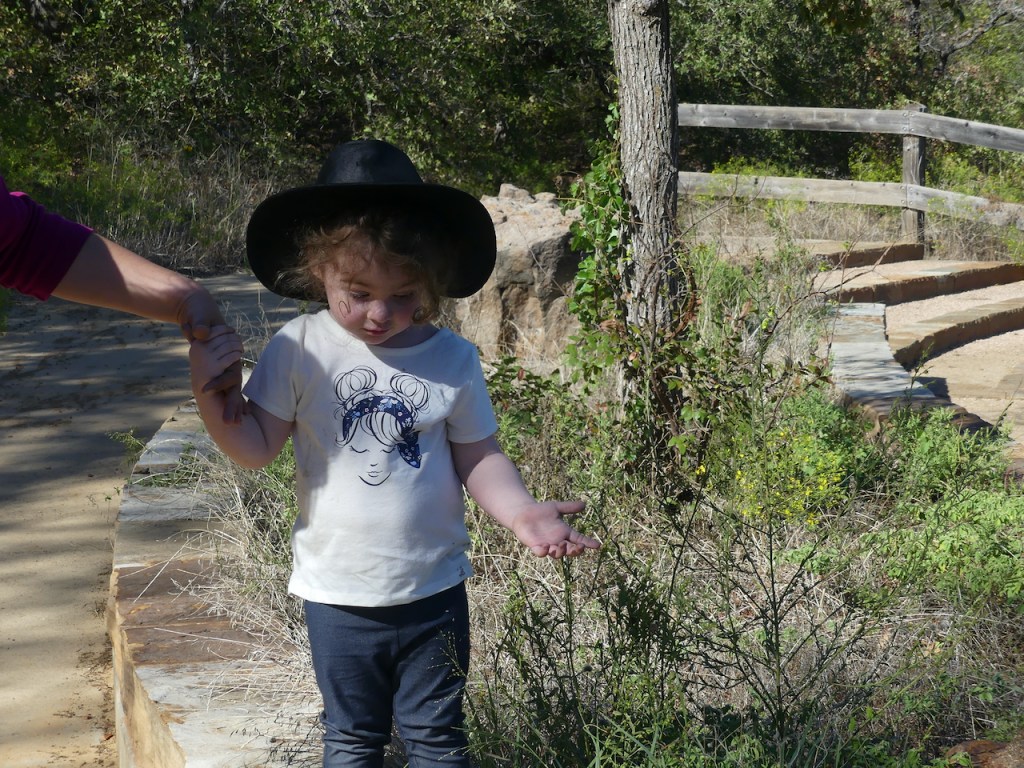
The helpful phrase that the program taught us was, “Always be bigger, stronger, wiser, and kind.” We are bigger and stronger in the protective sense – with four-year-old Lilly I will hold her hand as we cross an elevated walkway and would not let her fall. With young children it is also protective when, if necessary, we pick them up and move to a safer or quieter area in the middle of a tantrum. We also aim to be wiser in the sense that we decide when we can follow their lead and when it is necessary to step in and assume control. It takes wisdom and self-awareness to avoid using our strength just to “show them who’s boss.” And kindness is that crucial ingredient that can make the bigger and stronger part not frightening and (at least sometimes) not escalate emotions into a fight.
Taking kids out into nature needs the right blend of following the child’s lead, offering ideas, and making the outing a working partnership between adult and child. It also requires judgment and protectiveness on our part. If we can be a secure base for children, as described in the Circle of Security, and remember to be bigger, stronger, wiser, and kind, we will all benefit.
Our lives have taken a dark turn, bringing a foreboding that cannot be wished away with reassuring words. Our physical safety, health, economic security, community integrity, and the already unstable environment are threatened. As we work on the practical issues of taking care of ourselves and resisting what is coming, we may want to reach beyond ourselves for some sort of transcendence, to be part of something bigger and better than the mess we find ourselves in.
I’m not recommending that we check out and abandon the work that must be done to resist the oligarchy and the bullies and enablers that now constitute most of our government. I hope we will stand up against that which is wrong, support organizations and communities that remain committed to truth and democracy, and embody what we want to see around us (such as compassion, humility, and integrity). I will still visit the woods and prairies and try to be open to experiences of transcendence and spiritual renewal, but I also hope to do those other things.
How do we find strength and keep from getting swallowed up by what we are facing? One honest answer is “I don’t know,” but I’m thinking that it will involve reaching beyond our worries and things we use for distraction. And if we reach into the part of life that we refer to as “spiritual,” would we find strength or would we struggle too much with all the baggage that the word carries? Hopefully we could resolve the issues about religion and control that many of us think of first when that word comes up. Various religions have hijacked spirituality and confined it to the “right” beliefs, orthodoxy in our practices, and condemnation of others. A great deal of cruelty and killing have resulted, and many of us want no part in that.
But some do. For example, we hear about Christian Nationalism and those who want to rule in the name of Christianity. I’ll single out Christianity, knowing that the other Abrahamic religions could be part of this discussion, too. I have been dismayed to hear reports of self-identified “Christians” disavowing the Sermon on the Mount (including “blessed are the merciful” and “blessed are the peacemakers”) as being irrelevant now and too weak. It is revolting that the “Rod of Iron Ministries” venerates the AR-15 and has a compound in Texas preparing for war with the rest of us.
At the opposite end of the spectrum is the Episcopal Diocese of Washington (DC), where Bishop Mariann Budde spoke directly to Trump at a prayer service yesterday, saying:
“I ask you to have mercy upon the people in our country who are scared. There are gay, lesbian, transgender children, Democratic, Republican, independent families — some who fear for their lives” … “I ask you to have mercy, Mr. President, on those in our communities whose children fear that their parents will be taken away.”
Trump later asserted that she was “nasty” (another “nasty woman”) and should apologize. Given his penchant for revenge, I would say she was courageous. And her words were consistent with the teachings of Jesus – for anyone interested in exploring what he actually taught about love and compassion, I highly recommend Wendell Berry’s Blessed Are the Peacemakers, in which he pulled together the New Testament statements attributed to Jesus concerning these topics. In the Introduction, Berry said that Christianity was fashionable in the U.S., but “It seems to have remarkably little to do with the things that Jesus Christ actually taught.”
But back to the broader topic of spirituality. Definitions of “spirituality” include references to the sacred, to transcendence, reverence, awe, and seeking meaning and purpose, and being in the right relationship with everything that is. My source for these can be found at a webpage at the National Center for Cultural Competence.
If I look for experiences and activities that go beyond me as an individual human, that connect with something meaningful and enduring, perhaps I will be shielded a little bit from the hurts of the world even while staying engaged with that world. It might be finding and sharing beauty and harmony, responding to the needs of others, or participating in religious beliefs that are not a mask for power and greed. It might be understanding that I can be a part of a love that is bigger than individual people and even inclusive of all lives. Such spirituality might provide a sort of sanctuary, in the sense of a place of refuge and safety.
I’ve given a number of talks to groups of kids after being asked to help with their fear of snakes. Even when addressing fear was not the primary reason for the talk, the adults may reason that knowledge and experience will inoculate the kids against fear and will feed the experience of curiosity and wonder in place of fear. Those are wonderful reasons for me to pack up some snakes and a few pictures and go talk with the kids and the adults. Knowledge will help counteract fear, but experience is what works the real magic, and that’s true for any of the phobias of critters in nature and for the general fear of nature that some people have.
We live almost all our days surrounded by our own stuff, our technology and built structures, and our lives become more and more separate from nature. Food and water are treated more like commodities, and even the air is conditioned and filtered. And so, wild places may feel dangerous or unappealing and wildlife may seem more frightening. Fears of various things in nature (collectively referred to as biophobia) become more prevalent. A vicious cycle sets in. As nature becomes more unfamiliar and threatening, our fear or disgust makes us avoid the experiences which might counteract the fears. The “extinction of experience” robs us of the sense of being at home among our non-human kin.
I’m not naive; I recognize that there are dangers in nature just like there are dangers in our homes, neighborhoods and on our freeways. Some of the snakes that I love to observe or photograph are dangerously venomous, especially when we accidentally get too close or try to show off with them. But most people are not bitten, especially when equipped with a little knowledge and common sense.
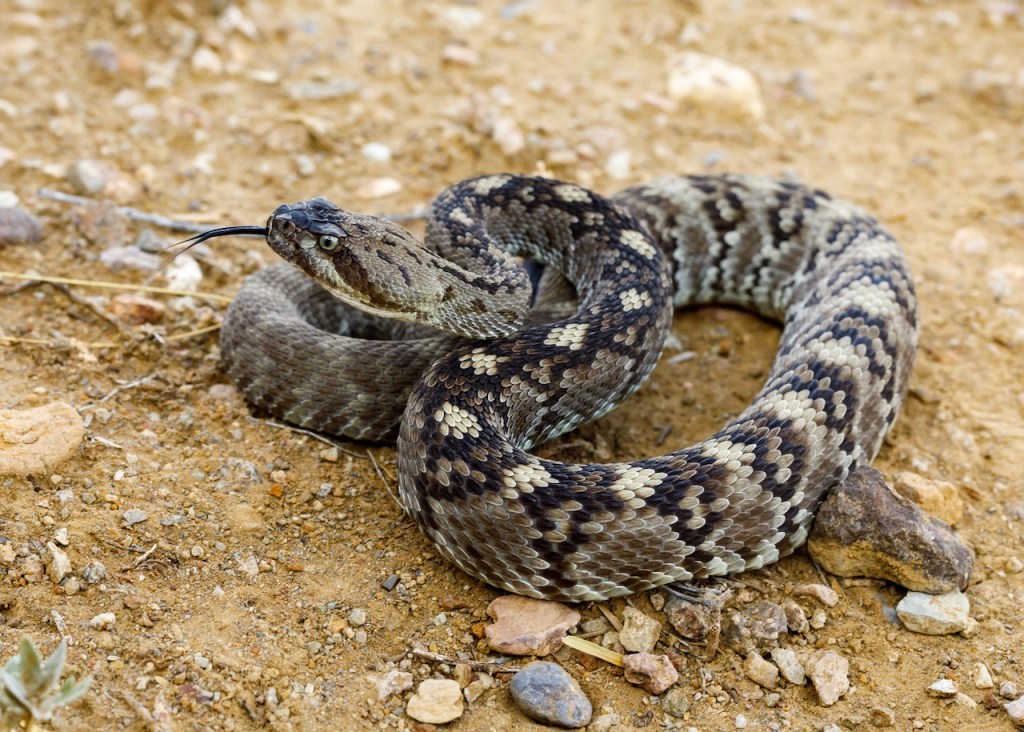
A black-tailed rattlesnake photographed by Meghan Cassidy during our trip to the Big Bend while working on a book on mindfulness in nature. The snake is venomous but we negotiated our encounter with each other well, and the snake never attempted to bite.
Coyotes are among the wildlife that people tend to assume are dangerous. A 2009 study searched for reports across the U.S. over a 46 year period and found 142 attacks during that time (with attacks defined as encounters in which a person was bitten). Very few of those occurred here in Texas. Some (30%) were related to coyotes that had been fed by people, accidentally or intentionally. Steps for staying safe around coyotes include not feeding them, limiting the outdoor activity of pets like small dogs, and not running from them (triggering a built-in tendency to chase). To keep it in perspective, the reported dog bite fatalities (not just attacks) from 2020-2022 ranged from 47 to 56 per year. We are in much greater danger from dogs than we are from coyotes.
The idea that we are in greater danger from the things most familiar to us, like our cars (one reportable car crash every 57 seconds in Texas in 2021) or our dogs, is a hard sell for most folks. That is because we are around them all the time, and our experience is usually safe and rewarding. We adults understand intellectually that cars, dogs, household chemicals, electricity, and so on can be dangerous. We do what we can to make the risk manageable and continue to enjoy the benefits. Being careful does not mean that accidents are impossible, but even though there is some chance of accidents, we are not afraid.
Here are some reasons why so many of us are afraid of things in nature:
Limited contact
We are comfortable with what is familiar. A strange place in nature, or certain things in natural spaces, may feel foreign and unpredictable. We don’t know what that bug might do, nor do we know if the coyote howls and yelps might mean they are hunting us down, and so we keep away from contact with those things, thus guaranteeing that we will not have experiences that might teach us what is realistic. Additionally, many people live in cities with no nearby natural spaces and limited transportation, and so they miss out on walks in the woods and encounters with wild things.
Not knowing what to do
Many people would not know what to do in a wetland, prairie, or woods. If they visit, they may bring with them the things they know from everyday life, like listening on headphones, chatting on the phone, riding bicycles or off-road vehicles. I do realize that some people know their way around the woods and still enjoy listening to music or bicycling, but I imagine that there are others who would be bored and lost in nature without gadgets and vehicles. Many people do not know the names of plants or animals and what they do, and would be uncomfortable finding their way through the woods or across a creek.
The culture often teaches fear
Our minds are wired to look for danger, and sometimes we enjoy the thrill of finding it or hearing about it. And so we tell each other stories of the time an uncle killed a big snake or we went camping and were frightened by sounds in the night. We watch movies about bear attacks, snakes loose on an airplane, werewolves, bats that want to suck our blood, and on and on. We warn each other or see overblown news reports of killer spiders or murder hornets. Our culture portrays nature as full of danger, and unless we get out there and discover that nature is mostly safe, we become fearful.
Actual negative experiences in nature
Sometimes we become afraid of something in nature because we actually did have something bad happen there, like a near-drowning incident or being stung by a jellyfish on the beach. At other times, being startled or surprised will trigger fear. As an eight-year-old child, I reached into a hole and felt something soft. Cupping my hand around it, I slowly removed it and discovered a tarantula, triggering a phobia that was pretty severe for the next couple of years (despite the fact that the tarantula kindly refrained from biting the invader to its home). Only after I developed other interests in nature and as a result began to have safe, incidental encounters with spiders and their webs did the fear gradually subside.
Possibly inherited predisposition
Could it be that some of us are just put together that way? It is true that some of us have a greater general predisposition to being fearful, and part of that appears to be genetic. And do we inherit fears of snakes and spiders? There are some studies that give at least a guarded answer of “yes,” such as one in which babies (too young for culture or experience to be a factor) were shown pictures of various animals and their pupillary reactions revealed that they react to spiders – and to some extent snakes – in a more anxiety-related way than their reactions to other pictures.
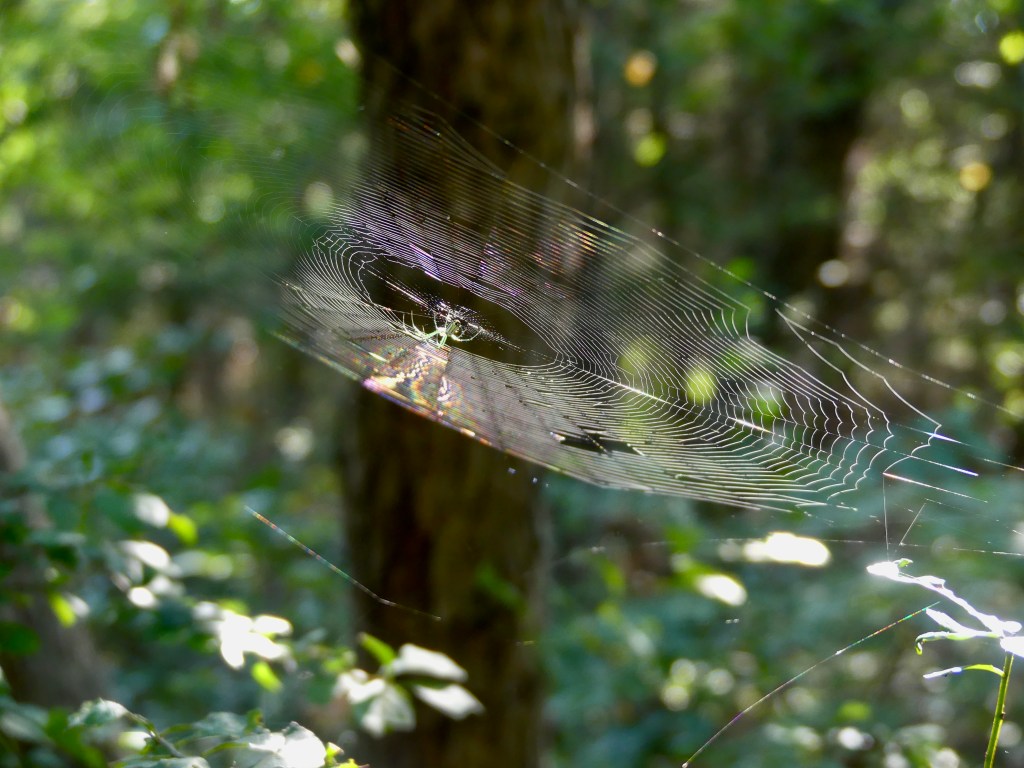
An orb-weaving spider at Dogwood Canyon Audubon Center
Since time spent in nature provides us a great deal of benefit (here is a review that sorts some of these benefits based on our senses: vision, hearing, smell, etc.), giving people the tools to decrease fears of nature would be a very helpful thing. We can do something about several of the issues I listed above. What if we helped people – particularly children – have more contact with nature in enjoyable ways that could contribute to exploration, safety, discovery, and wonder? I plan to write more about that in this space, so I hope you’ll check back or subscribe so that new posts are emailed to you.
Sitting in a preserve writing in my notebook, I wondered about the point of “all this wandering and writing, taking small groups out to learn about or experience nature. While much of the world is falling apart, I hold myself to an expectation of doing something.” What actions are needed? What might contribute something worthwhile? What can I do, and what should I do? How can we work together to sustain the good in society and in nature?
The goals of the incoming administration appear to be to instill fear and division, seek out loyalty and punish perceived enemies, dismantle the rule of law (and the assumption that it applies equally to all) and consolidate unrestrained power and wealth. The plan is evidently to take a wrecking ball to anything in the government and society that interferes with achieving those goals, and collateral damage is perfectly fine.
With that context, what good is finding places in nature for immersion in prairies, woodlands, water, “brother sun and sister moon,” other than an escape? Can my response to our troubles be to keep on living a relatively privileged life, looking for beauty and a connection to creation, keeping my distance from the losses taking place around me? If we want to have meaningful lives that reflect our values, this is certainly a time for self-examination.
We need each other
As individuals we figure out who we are and what we will do, but much of what we can do is in the context of partnerships, teams, and groups. One strategy for the coming years should be to take care of those connections with others. They keep us sane and healthy, and they help us accomplish things.
It was once easier to be more connected to other people, sustaining real face-to-face relationships as part of neighborhoods or networks of friends. Some of the social institutions were deeply flawed, but one way or another we kept getting together with each other. Increasingly, we spend our time in the bubbles that surround our smart phones, and social institutions are being supplanted by social media.
The importance of actually being present with each other is hard to ignore. So much of human connection and communication involves responding to each other’s posture, facial expression, voice volume and inflection, the flow and timing of our words and bodies. It is intricate, marvelous, and much of it happens out of our awareness. And not much of it can happen in the lines of a text message or Facebook post. You can look at some of the research and professional opinions here and here.
We are more powerless when we are isolated and mistrustful
When is the last time you were in a group of people with a common purpose or intention? Maybe it was a small gathering, or perhaps it was a big group, either listening to each other, celebrating, or something else. There may have been some sense of coming together as one, perhaps a feeling of the group being more than just the sum of the parts. There is an important Surgeon General report on the need for social connection and the epidemic of loneliness we are experiencing that is worth reading, even for us introverts. Our society is ever more fragmented and isolated, leading to real risks for our physical and mental health.
And so I think that taking care of our connections with other humans is as important as the care we give to our connection with the rest of nature. It is together with each other that we have the best shot at defending our favorite woodland, our friends, marginalized neighbors, and a society in which justice and empathy can still be found. When we cannot be together physically, I’m grateful for tools like Zoom and FaceTime that allow the next best thing.
And we need to pay attention to important teachers. Among the first people I think of is Robin Wall Kimmerer, a botanist and professor as well as a member of the Potawatomi Nation. Her new book, The Serviceberry, revisits and extends her thoughts about how relationships work in nature and how that is a useful model for humans. Serviceberries, corn, trout, cedar waxwings – living things in nature provide their gifts and receive benefits in return. Relationships are reciprocal, and, as she writes, “all flourishing is mutual.”
In The Serviceberry, she compares capitalism based on exploitation and scarcity with the gift economy that is prevalent in nature and in some indigenous societies and small communities. “I share what I have with you, and there will come a time when you share with me.” In such ways are relationships of trust and care built, and we all can flourish. It’s a good way of being human, and good business, too. Kimmerer talks about Native American communities in which prestige is based on giving gifts to community members, rather than hoarding wealth.
It is challenging – but important – to be an advocate for and an example of generosity, gratitude, and reciprocity. I’m willing to bet that those qualities, applied to ourselves and our social and natural communities, are the best way forward. Kimmerer teaches us that in nature the energy that drives the system comes from the sun, warming everything, driving the weather, and powering the photosynthesis through which plants make food. She suggests that love is the analogous source of energy that empowers human interactions and communities.
So if there is a reason to be less isolated, this is it. The contribution that I can offer is mostly to try, as I wrote on that day in the preserve, to “bring people more into a relationship with nature,” and hopefully “strengthen a sense of belonging or a sense of being part of a community of life. Perhaps less self-focused, less likely to use the world rapaciously, maybe. We need ways of being less acquisitive, more a part of something.” Maybe there is more; my self-examination is not over, but here is what I know best.
I want to participate in a community of people attuned to each other and to nature. I think such a community would pay attention to the lessons Kimmerer describes. It would seek ways to live that are not centered on power, dominance, and wealth. I think that’s essential to trying to defend democracy and a just society, along with protecting the natural world that makes such things possible.
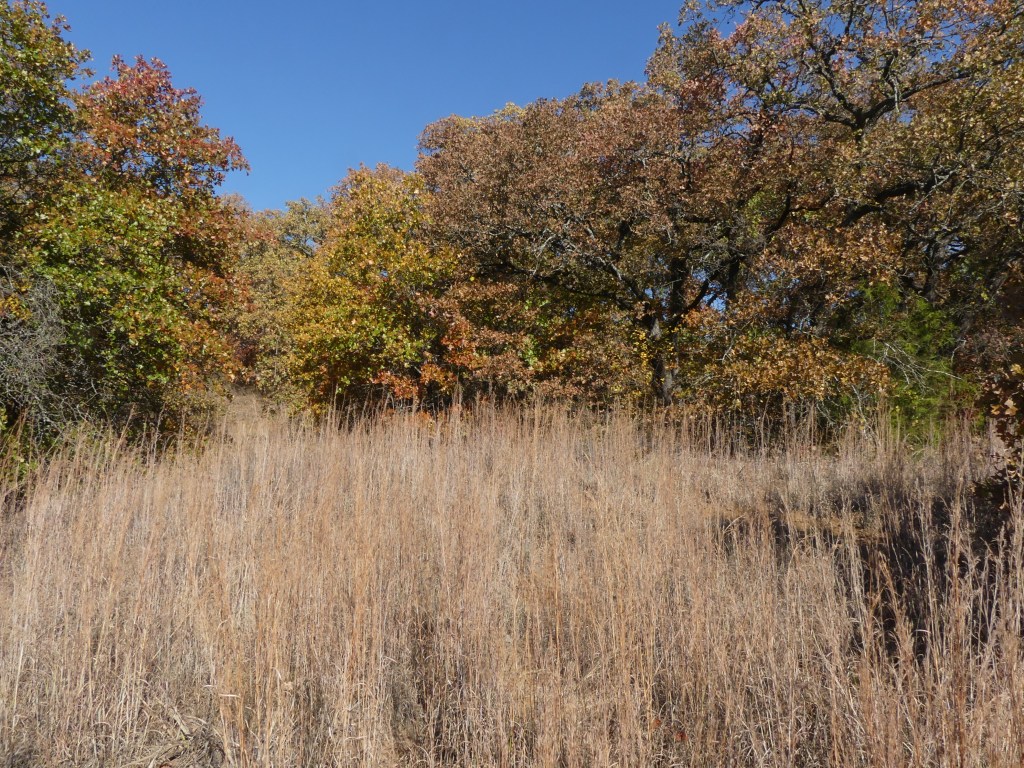
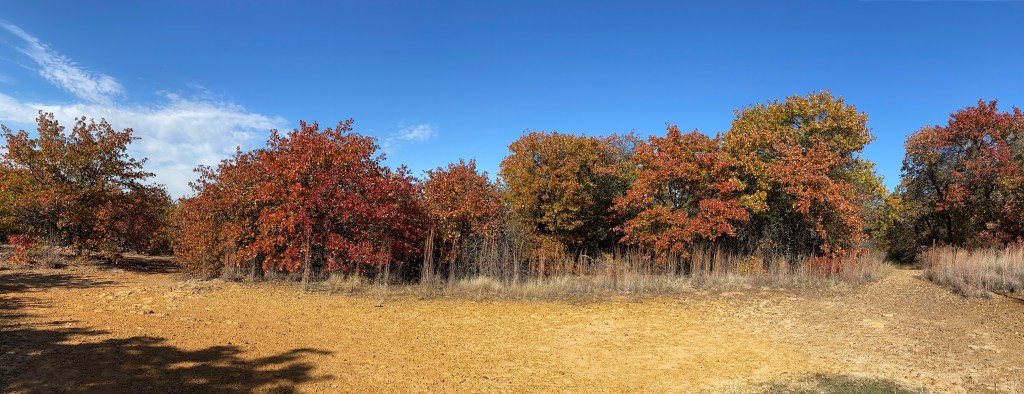
I sat beside the pond, looking at the line of trees outlined by a pure blue sky. The glossy green blackjack oak leaves were turning a mixture of caramel and ruddy red. In front of the trees was a stand of little bluestem, a native grass with subtle beauty. Each starts with a little clump of narrow, curled leaves at ground level, sending several tall stems to reach chest high. The tiny seeds along those stems are feathery, and in autumn sunlight they are like a constellation of stars scattered among the grasses. Altogether a lovely little spot on a fine late autumn day.
You might say that this preserve has been kissed by creation, filled with a beauty that it wears in one form or another throughout the seasons. Before long I was thinking of “Wear Your Love Like Heaven,” a song by Donovan Leitch that most of us – of a certain age – have some memory of.
When it was released in 1967 I heard the song many times, but never listened to it well. I assumed it was a hippie love song (“kiss me once more”), the opening of the double album “A Gift From a Flower to a Garden.” But Donovan, with his soft Scottish voice, is often deeper than that. It is more like a prayer than a love song.
The verses suggest an artist with a beautiful palette of colors, or someone experiencing such a range of hues in nature. “Color in sky Prussian blue,” but the colors change with sunset as the “crimson ball sinks from view.” There are shifts to “rose carmethene” and “alizarin crimson.” It is easy to imagine being in a place where the land and sky overwhelm one with beauty, where any of us might ask for more such experiences of awe. Such a plea could easily be a prayer:
“Lord, kiss me once more Fill me with song Allah, kiss me once more That I may, that I may Wear my love like heaven”
What might it mean to wear your love like heaven? I suppose wearing it would be to let it show, not hide it, and offer it freely to anyone. And a state of bliss and love freely shared with everyone is one way to imagine heaven.
Within such a state, Donovan experiences an extraordinary vision:
“Cannot believe what I see All I have wished for will be All our race proud and free”
Perhaps he is seeing what follows from wearing our love like heaven. Generous and open-hearted, not trapped in greed or the desire for domination, free of self-destructive impulses and all the things that bind and restrict us. Wearing a transcendental love would make us proud and free.
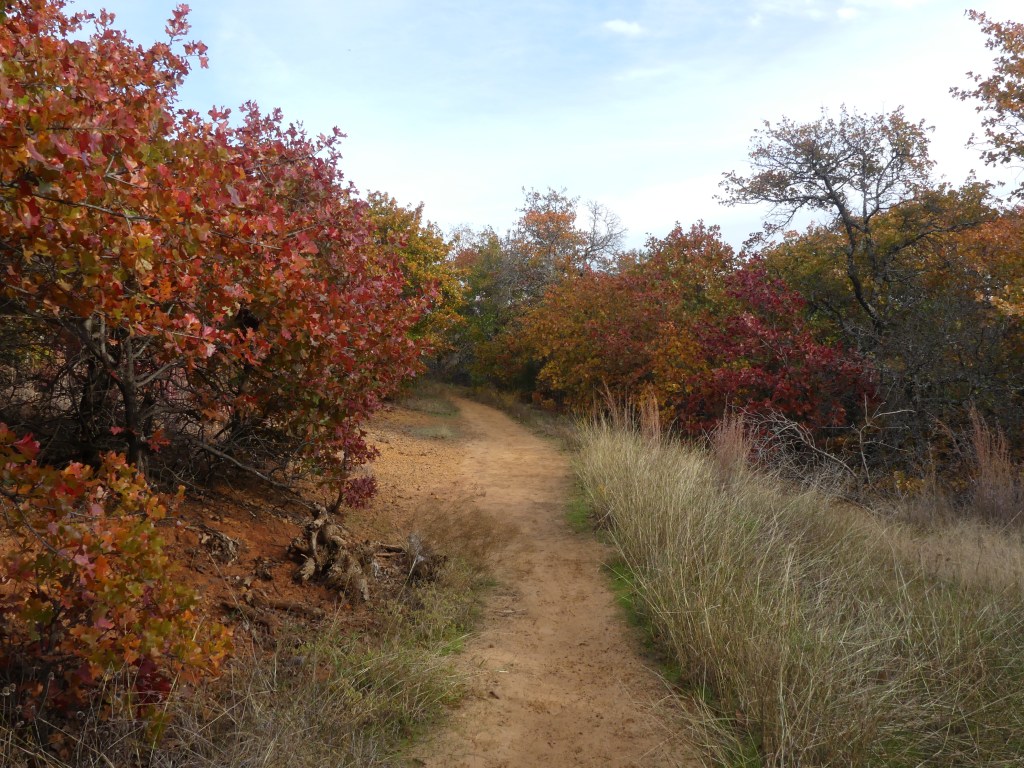
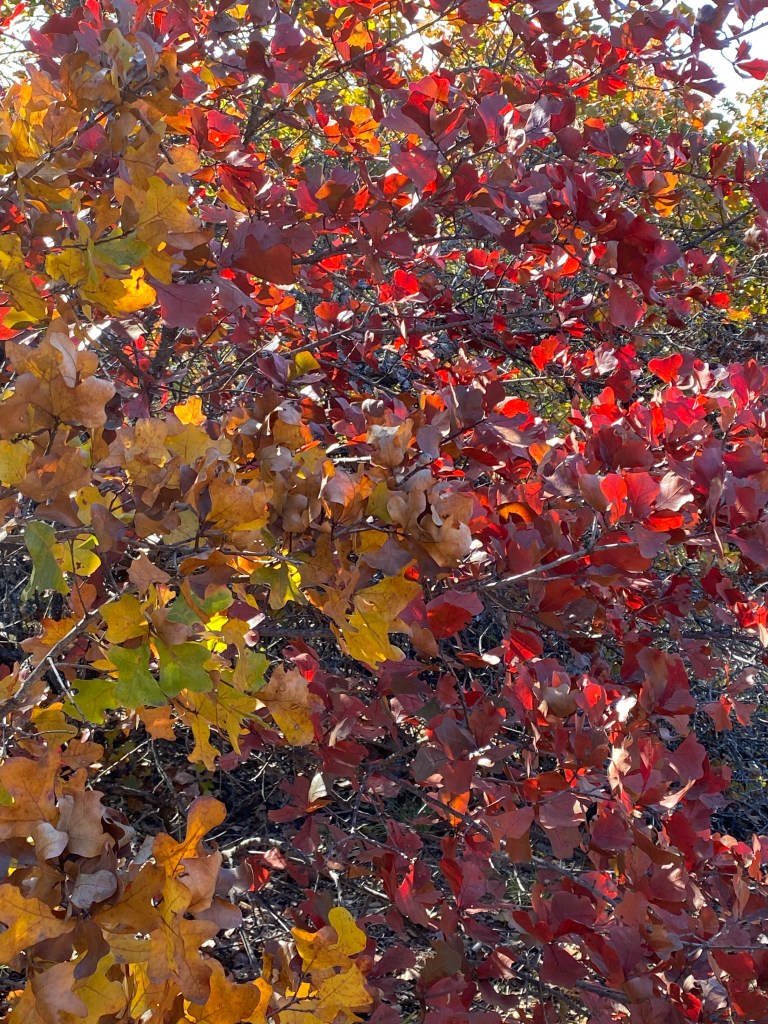
It was a beautiful vision to carry with me as I walked through oak woodlands and on trails along patches of prairie that are lovingly being restored. Some of the blackjack oak leaves have taken on a shade of alizarin crimson, and tonight, if the sky is clear enough, we might look up to see Prussian blue.
To connect with and be blessed by the divine, filled with song, and to live in beauty and love. That’s a lot of message to be carried by a two-and-a-half minute pop song from 1967, but we are allowed our interpretations of the meaning of art and this is how I hear it. The song has been covered over the years by people I think of as serious artists. Ritchie Havens recorded it in 1969 and Sarah McLachlan covered it in her 1991 album, “Solace.”
I write about nature, about the experience of nature and the cost of losing our connection to it. What could I have to say about this new world we are about to step into and what we can do about it? This space is about “our lives” in nature, and those lives – really all lives in nature – will change with the incoming administration.
Our country and the world is enduring a time of breaking, of desecration, when the worst impulses of many people are enabled and encouraged. And yet, there are a lot of us who know better, were raised to be better, and maybe we can lessen the damage. We have to try. We’re allowed to grieve the better world that is postponed or maybe lost, but our love for this world and for each other calls us out to do what we can.
The first thing we can do is to support ourselves and each other. Think about what the airlines say to do first if the cabin loses oxygen: grab the mask and make sure you have the oxygen that will let you function to rescue your child or your neighbor. We can do no good if we spiral into despair or exhaustion.
We cannot support each other if we’re isolated, and we need to work on this. Our Surgeon General called loneliness a public health epidemic, and a poll from the American Psychiatric Association said that 10% of Americans report being lonely every day. An NPR report stated that, across two decades, young people aged 15-24 now had 70% less social interaction with friends. As communities, we are often fragmented and isolated, and that might be a significant factor in our sense that we are falling apart. We increasingly keep to ourselves, and sometimes that results in thinking which becomes rather paranoid, and we become less patient, understanding, and skillful when dealing with fellow humans. The phone becomes our social partner and our way of interacting with the world, but social media is no substitute for face-to-face communication. And I say that as an introvert who hates parties and large social events. Find people with whom you can really talk as well as listen. Don’t forget their importance.
Nature, of course, can play a role in our self-care. In times to come we have to remember how the woods can be a refuge and wetlands can help wash away anxiety, trauma, and anger. Just as we need connection with allies, friends, and relatives, we need connection with trees, prairies, wetlands, and wildlife.
Such places will be more threatened than ever. The incoming administration has pledged to “drill, baby, drill,” and is also interested in selling off federal land to developers for housing. Project 2025, which (despite early denials) seems to be the blueprint for the incoming administration, intends to dismantle much of the Environmental Protection Agency (EPA), reverse what it considered the Biden administration’s “climate fanaticism,” forbid any scientific investigations by the EPA that are not explicitly authorized by Congress, and undo any progress toward clean energy. We know that climate scientists have said that much damage has already been done and we see the fires, floods, droughts, and hurricanes all over the news. Every year without significant climate progress will result in worse damage. How bad and how soon is hard to predict, but after the election, things look much less hopeful.
The new administration wants to convert civil service positions into political appointees. People working in civil service mostly have the independence and professional expertise needed to guide the implementation of environmental (and other) regulations. You can call them “bureaucrats,” but we probably want independent professionals helping determine the safety of our water or what sort of protection is needed to save a species from extinction. That may work out better than promoting opportunists willing to say anything to show their loyalty.
There are other threats, of course, like the stated intention of rounding up millions of our neighbors and deporting them, of giving up on real equality and justice, and marginalizing and harming our LGBTQ+ friends and loved ones. All this is interconnected. A government that treats some of its citizens with contempt will treat the land with comparable contempt.
We are going to need to try to stay informed about these things and know how to speak up. Perhaps we can choose an organization or two that we trust and channel some of our support and our advocacy through them. Perhaps it’s the Center for Biological Diversity, Earthjustice, or 350.org. Or it might be some other organization.
Here in Texas, the old-fashioned way of writing to elected representatives now seems a little … quaint. They do not represent us and are willing to harm us to get what they want. The head of Project 2025 wants a right-wing revolution which will be bloodless only “if the left allows it to be,” presumably meaning that they use violence if we don’t go along with what they want. The incoming President wants to be able to use the military against the “enemy within.” Significant portions of our own government are aligned with this view of us as the enemy (or are subservient to those who do). Somehow “please, sir, would you consider voting for this” does not seem like it will be effective with such people.
That is not to say we should not write to, say, Ted Cruz or Dan Crenshaw so that they know what their constituents think and maybe feel some pressure that might restrain them. We might share such letters publicly, in social media or a letter to the editor that says, “here’s what I wrote to Senator Cruz.” Normalize resistance, and let others know they are not alone.
But there is something else. How has it happened that more of our population shifted to the right? How have Proud Boys, bullies, and fascists become OK? How do Christians come to disavow Jesus’ teaching in the Sermon on the Mount as “too weak” and embrace hatred and exclusion? What drives the love of violence and responding to disagreement or differences with bullying? How did so many of us (very often men) define their personal adequacy by their ability to humiliate or harm others?
I hope that we can be examples of a different way. We can be models of empathy, respect, and a recognition that how others are doing is important to our own well being. I hope we teach our children, and particularly our boys, that we can be both strong and gentle, and we should always look for non-violent ways to protect what we love. These things should not be confused with weakness and passivity. Sometimes physical strength is needed, but the most important strength is moral strength and the courage to stand up for principles without being a bully. Too many of us, particularly boys, have not seen examples of this or have watched those around them treat such qualities with contempt. That needs to change.
Don’t let the ugliness blind you to the beauty that is also around us. Take time for that beauty; let it in.
Meet on the ledge, we’re gonna to meet on the ledge If you really mean it, it all comes ‘round again
Richard Thompson, “Meet on the Ledge”
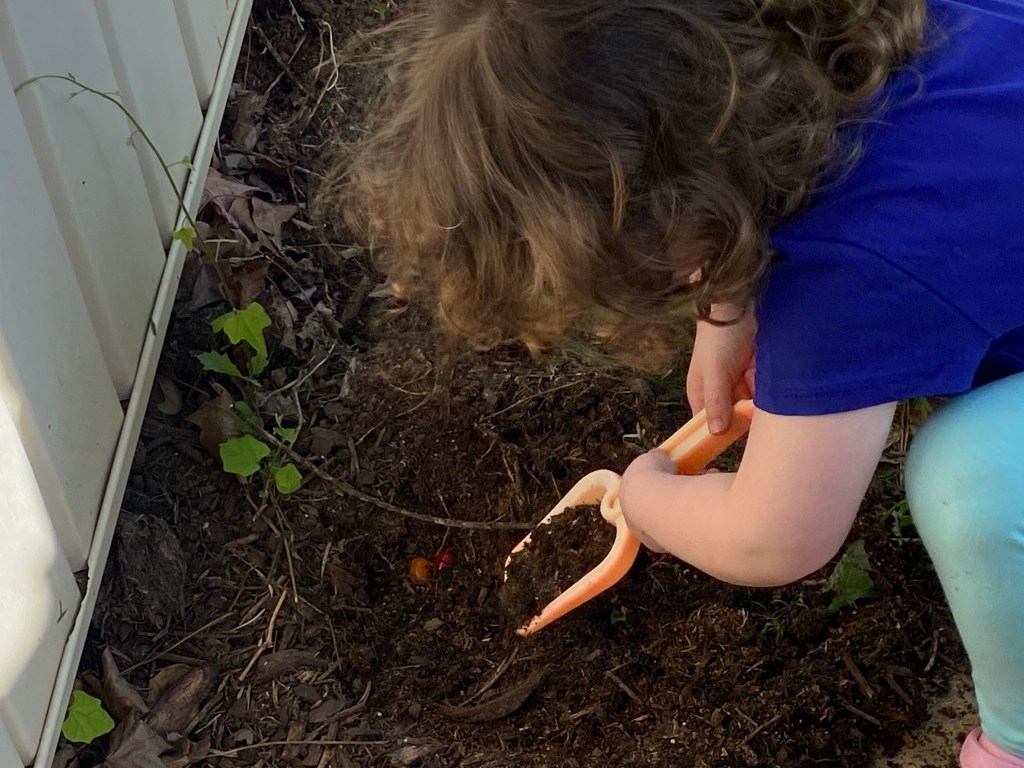
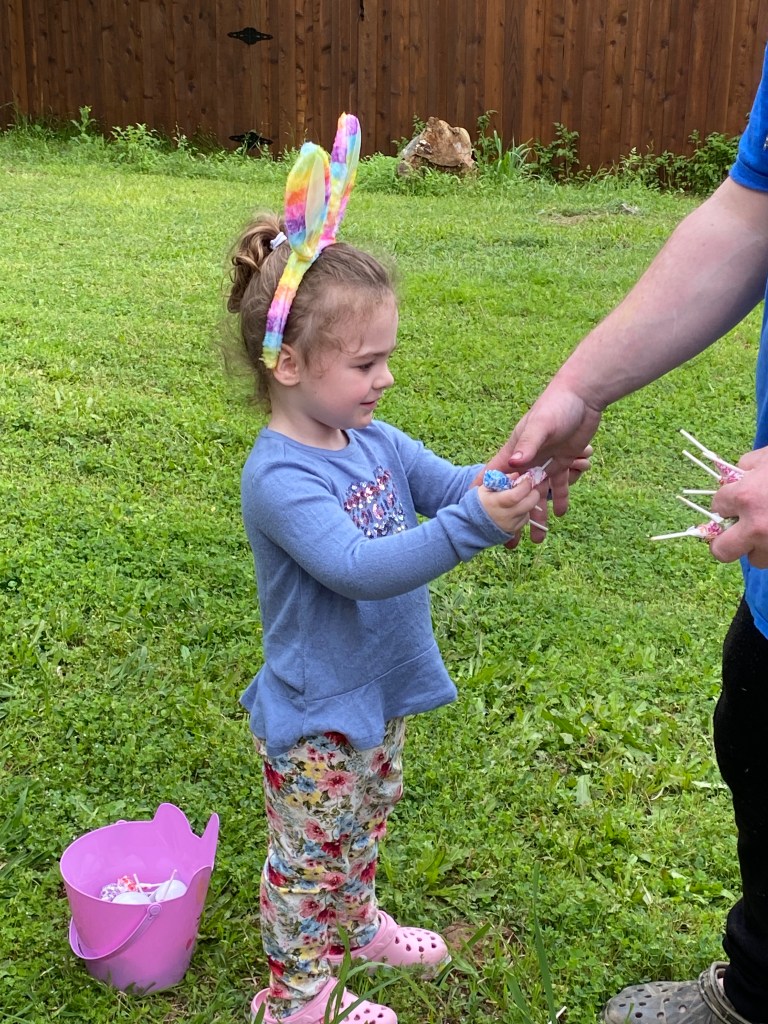
It is Easter, and spring is returning. The woodland in the nearby preserve is dotted with flowers, and oaks are leafing out. Days are getting longer and warmer. Additionally, the jelly beans that Lilly planted yesterday have sprouted into candies that she harvested today. She’s found all the bunny’s eggs, too. Easter is the most profound holiday in the Christian calendar, and its themes touch on renewal and resurrection. We are encouraged to believe that what is important does not die forever, instead “it all comes around again.” For children, we find simple ways to celebrate renewal and new life in ways they can enjoy.
In childhood rituals of colorful eggs, maybe we’re re-creating a little bit of Ostara, the pagan holiday that pre-dates Easter and celebrates the spring equinox and renewal of life and fertility. Celebrations often involved eggs and planting seeds. We may not be thinking of Ostara when our kids hunt for Easter eggs, but there is a connection (if you are interested in the origins of the Easter bunny story, have a look at this).
I’m not trying to recruit new pagan or Christian believers, just pointing out how strong is the undercurrent of our belief in this idea: that which is truly important, truly good, cannot be lost forever but finds a way to return. Perhaps some things are so fundamental to who we are, so much a part of us, that our faith and our need for them brings them back. “If you really mean it, it all comes ‘round again.”
I don’t mean to wring too much meaning out of that lovely Fairport Convention song, written by Richard Thompson when he was still a teen. I’ve read that “Meet on the Ledge” is sometimes played at funerals, when people very much want to believe in things coming ‘round again (and there’s that line, “When my time is up I’m gonna see all my friends”). He has been quoted saying that he was not intentionally writing a very deep song, but it seems that some very meaningful words wrapped themselves around him as he wrote.
I would love for our granddaughter to find her way of marking the seasons and transitions of this world and celebrating ideas and values like standing up for love and compassion no matter the cost. Today the ritual was about the sweet taste of spring and things that grow again as the season begins, and spending time delighting in things you find in the grass and the soil. There are so many things to learn about and celebrate in the coming seasons and years.
“To sharpen our gaze is to behold not only the passing beauty of this world, but also its deep suffering, and I’m afraid of the pain and purgation such vision will entail, that it will break my heart open in ways I’ve only begun to fathom.”
– Fred Bahnson
We know the trouble we are in, and we feel the stress of it. The Sixth Assessment Report of the Intergovernmental Panel on Climate Change (IPCC) tells us that human-induced climate change has caused widespread damage to nature and people. This does not just represent normal weather variability. Over 3 billion people live in situations that make them very vulnerable to climate change, and a “high proportion” of species is vulnerable. Further, “current unsustainable development patterns” are increasing our danger.
The danger includes more wildfires in various parts of the world, “100-year” floods now happening every few years, glaciers melting, stronger and more frequent hurricanes, drought, and extreme heat. Warmer climates allow mosquitoes and other pests to thrive, leading to disease for humans and trees (milder winters let bark beetle populations expand).
Our sense of safety erodes and the world feels less familiar as we watch world leaders make excuses and see too many fellow humans who are unconcerned or too preoccupied with their immediate challenges to take action. That can lead to helplessness and despair if we’re not careful.
How did we get here?
How did we get to a point where things are so crazy? Who is to blame? We elect leaders, we use fossil fuels and buy all kinds of stuff – are we to blame? I’ve been on the planet for over seventy years, surely there’s more that I should have done. On the other hand, we were born into a culture of growth and consumption. Many of the world’s cultures see nature as a sort of big-box store where it’s all for sale and the more you buy, the higher your status. Western culture enshrines unending economic growth as the only possible path to a satisfying life. It’s hard to swim against those cultural currents. And no matter how much I recycle or try to live “off the grid,” the fracking wells keep getting drilled and Congress keeps giving about $20 billion a year to the fossil fuel industry.
We can’t wait for the culture to change. The culture is us, even if each individual is a drop in the ocean. But we do what we can, even if it’s just for our own sense of integrity. And we reach out to others, pulling drops together until we fill a bucket, and buckets become waves, until we can get something done. Our actions can be guided by what is good for more than just “me,” we can place the well-being of living things above the acquisition of more things, and we can be satisfied with what we have.
The toll it takes
The damage to the planet takes a heavy toll on us, whether we’re watching from the sidelines or working hard in climate activism. A report from the American Psychological Association and others discussed the impact of the anxiety and loss that people are experiencing. There can be trauma from climate-worsened disasters such as tornadoes, floods, and fires. Sometimes the images and fear of future harm can lead to pre-traumatic stress.
There can be a loss of a physical place (a home, a favorite creek, a glacier, etc.), and a person may experience pain and longing when such a place is gone. Such an experience has been termed “solastalgia.” In the opening chapter of Richard Louv’s Last Child in the Woods, there is a fifth-grade girl whose loss of an important place sounds like solastalgia. The girl loved being out in nature:
“I had a place. There was a big waterfall and a creek on one side of it. I’d dug a hole there, and sometimes I’d take a tent back there, or a blanket, and just lie down in the hole, and look up at the trees and sky. Sometimes I’d fall asleep back in there. I just felt free; it was like my place, ….
“And then they just cut the woods down. It was like they cut down part of me.”
– Last Child in the Woods, p.14
Some environmental losses may be very significant, even when they are on a smaller scale than melting glaciers or burned forests.
Many people are experiencing anxiety and other emotions. A survey of 10,000 teenagers and young adults in various countries found that 59% of them were very or extremely worried about climate change. Most had feelings such as sadness, anxiety, anger, helplessness, and guilt.
It’s not just the kids. Many of us – whatever our age – are grieving for the loss of a healthy and familiar climate. This past summer reminded us how much has already changed, and how we took for granted summer days when you could take a walk or work in the garden without risking heat stroke. We might not have thought about how good it was to live in the old climate. With the new climate, we watch the sense of normal and safe begin to slip, and it’s slipping on a planet-wide basis.
Is it too late?
In some places, especially among young people, you hear considerable hopelessness about climate. We have missed many opportunities to act, and the further we go, the harder it will be to slow down that enormous freight train of climate warming. The question that keeps coming up is, “are we doomed?”
A recent book by Rebecca Solnit, Thelma Young Lutunatabua and other contributors has the title “Not Too Late.” It is certainly not an optimistic book, if optimism is believing everything will be OK, don’t worry. Solnit writes that “to hope is to accept despair as an emotion but not as an analysis.” She makes the case that there are still possibilities for action and she reminds us of all the times that something looked impossible until it actually happened. Public opinion has shifted, over $40 trillion has been divested from fossil fuels, and renewable energy is becoming more feasible and affordable. The outcomes are still uncertain; the authors’ point is not that everything will be fine. Maybe it won’t. But uncertainty means that things could turn out better than our fears suggest.
Taking care of ourselves
Even if we accept that things are not hopeless, we are still left with more frequent, climate-driven catastrophes and losses. What do we do about the resulting grief and anxiety? We can share grief – including grief for losses we see coming – with trusted others. We can put anxieties into words and make them more manageable. We can figure out ways to keep from being overwhelmed and actions that reduce our sense of helplessness.
There are already some avenues for doing this, such as the “Climate Cafés” provided through the Climate Psychology Alliance. These are online gatherings where people can discuss climate fears and anxieties, led by the Alliance’s facilitators. There is also the Good Grief Network, “a peer-to-peer support group for people overwhelmed by eco-anxiety, climate grief, and other experiences of eco-distress” (quoting from their website). At least in Texas, all such events are available online only.
I recently started a small face to face discussion group where we can talk about environmental anxieties and grief. There are real advantages to talking with a few trusted others in a situation where we feel heard and understood. The group is for adults – people 18 years old or older. Children’s understanding of these issues and ways of coping with them and expressing feelings about them are somewhat different, so the group does not include children.
My professional career and training has been in psychology and I am a licensed Psychological Associate. That does not mean that this is group therapy, and participants are not clients. I simply support and facilitate our discussion and gently keep us within the boundaries of supporting each other and encouraging self-expression. There is no charge for the group.
One of the central issues for the group will likely be what we can do to take care of ourselves. I recently wrote about coping with the record-breaking heat this summer and I outlined the following ways to help cope with the anxiety and loss:
Express yourself – talking, journaling, drawing, etc. Most things are easier to carry when we share them with people who listen with empathy. Writing in a journal or drawing are other helpful modes of self-expression.
Practice mindfulness and acknowledge beauty. When in natural settings, paying attention to the present moment, with an attitude of acceptance, is a helpful way to let go of persistent thoughts and emotions. The beauty we find in flowers, a woodland, or a sunset reminds us of the good that still exists.
Accept uncertainty. Mindfulness is a good way to work on this one. It is hard to live with uncertainty, but letting go helps more than trying to control what is not controllable. We can still take helpful action (see below) but with less struggle.
Engage and act. We can easily feel helpless with a problem this big and complex. It helps to find something to do (as noted above, drops come together to fill buckets and buckets become waves). We can be part of something bigger, such as Arlington Conservation Council, 350.org, or other groups.
Find a therapist. If things become too heavy, we can seek out a counselor or therapist. Climate Psychology Alliance-North America maintains a climate-aware therapist directory.
It’s easy to be anxious or sad in an uncertain climate future, with painfully slow progress in fighting climate disruption. If those are your feelings, you’re not alone. A recent poll by the American Psychiatric Association found that more than two-thirds of Americans are “somewhat” or “extremely” anxious about climate change. Do what you can, find a community of people who understand, and take care of yourself.
(The epigraph at the beginning of this article is from Fred Bahnson’s “The Ecology of Prayer” (2017) in Orion, v.36 No.4. More information about my climate grief/anxiety group can be found on the climate anxiety & grief page of this website. This article was also published in the November issue of The Post Oak, newsletter of the Arlington Conservation Council)
Sharing the adventure, being a partner in discovering the world,
feeling the excitement when the fish stirs beneath the water –
the joy and wonder are mine, too, because we are connected.
We are connected by experience together, the shared looks and little acts of attunement.
I step up to help or protect and she answers with confidence, love, or protest,
and the dialogue continues.
She is on the ground observing an inchworm and I sit with her.
Afterward, she climbs the boulders while holding my hand, and so
I am the scaffolding that keeps her upright, her partner again.
Fearlessly pushing her coordination and balance to the limit,
she has that smile that says, “I got this,” and she does for a while.
When she falls, I comfort her, safe harbor and a little repair and back out again.
Words and roles change, the scaffolding takes other forms at different ages.
But shared looks, partnership, those little acts of attunement, with
understanding and empathy – that’s always how love works.





 Our Lives In Nature