A Meditation at Sunset

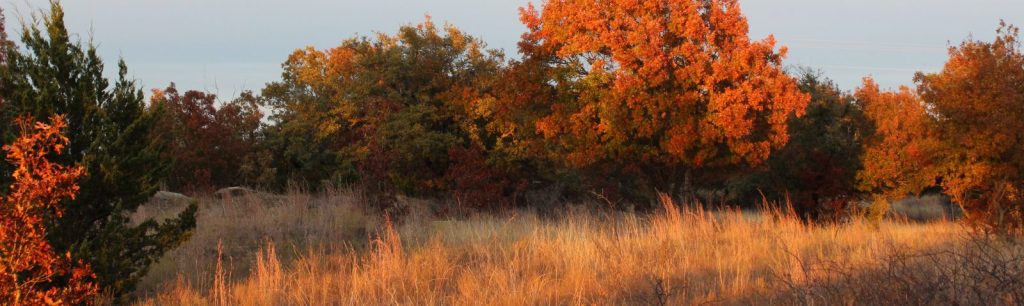
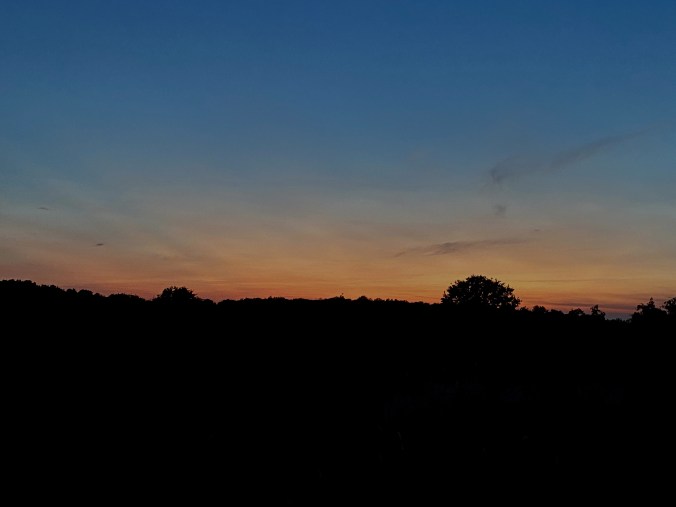
It was July 19th last year when I sat and watched the prairie at LBJ National Grasslands as it shifted into darkness at sunset. The sky gradually changed, with the yellows and oranges, the darkening to rose and indigo, and clouds reflecting those changes. The quiet sounds as activity slows (or awakens), the appearance of the moon, the first call of Chuck-Will’s-Widow.

You’ll find the actual account of that evening in the June issue of “Letters From the Woods” which is posted on the Letters page. It’s a free download, so I hope you’ll have a look.

I also posted it over at “Rain Lilies” where I write at Substack. (I confess that I’m struggling about where to consider home base.) If you’d like to see it there, go over to Rain Lilies and read “Sitting With the Sunset.”

Mindfulness at Spring Creek

I think about what we are all going through right now, and I wonder what would help. I bet we could make a list, right? One of the things on such a list might be mindfulness. It offers a way of seeing things with fresh eyes and a deep way of experiencing the beauty and wonder around us. Also, it is a practice that involves letting go of our restless intensity and fostering patience and acceptance. It is associated with trust, compassion, empathy and kindness. Those are qualities that are not just in short supply but are being discouraged by some people in the mistaken idea that they are weak.

Sunday afternoon, March 23rd, I led a group in a mindfulness-based walk through part of the Spring Creek Forest Preserve in Garland. It was a good day to see things with fresh eyes and let go of some restlessness. The day was warm with low puffy clouds and that feeling – a sort of “softness” – that comes on more humid days in spring. The walk was a follow-up to a talk I had given for the Preservation Society for Spring Creek Forest about three weeks before, talking about mindfulness in nature.

The Spring Creek Forest

In the talk, I described mindfulness as a special way of paying attention to our experience in the present moment and accepting whatever that experience brings. I said that it is a meditation technique that can be practiced on a walk in the woods, informally. That’s what we would do on the 23rd. We would take a walk without our usual activities of taking photos and uploading them to iNaturalist or chatting, or being lost in thought.

At the beginning of the walk, the fifteen or so people gathered and I mentioned some of the basics of mindfulness, including some of the qualities and emotions that tend to emerge from the practice. One of those is stillness, which does not mean you would sit still all the time. Instead, it is a lack of restlessness, impatience, and wanting the next thing. It is a sense of quiet and calm, even while you are walking. And a related quality – patience, allowing things to come about in their own time and accepting that things take time. Not that we cannot or should not act to bring things about, but we don’t need to struggle against the timetable if it is different than we would prefer.

There are times when I am restless or impatient, but when I am able to have that sense of stillness and patience, it is very freeing. And it is not hard to imagine how our lives would be better if all of us experienced more of those things.

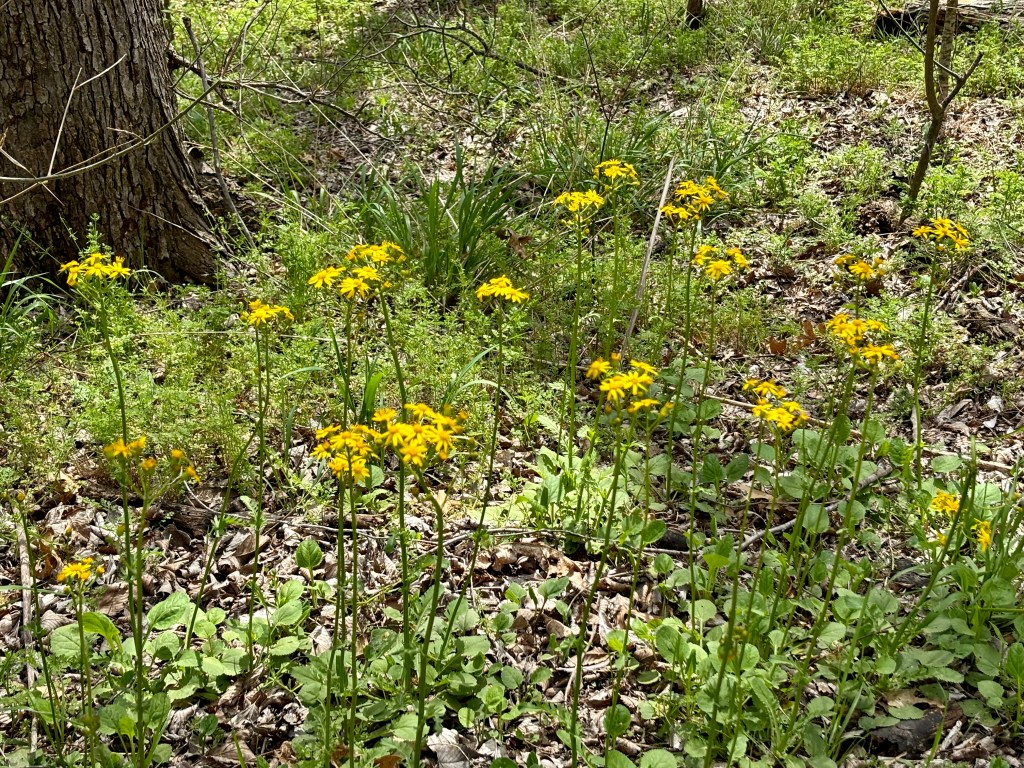
Instead of going first to names and categories, we can stay with the basal leaves, tall erect stems, and beautiful yellow flowers for a moment. Later we can consider if it should be called a groundsel.

During the walk we talked about “beginner’s mind,” when we experience something as if for the first time, with the vividness and newness that can happen at such times. The more we are in the present moment, the more we step away from past experiences and preconceptions about what is in front of us. We see something with the mind of a beginner.

Mindfulness is also associated with compassion and empathy. Imagine the compassion that would result if everyone put aside more of their judgment about bad or good, lazy, malicious, and so on. We quickly think of people in this context, but we’ll keep it in the realm of nature for a moment. Perhaps there is a copperhead in the woods, and we know that this snake is venomous and capable of sending us to the hospital. With that sense of stillness and patience, we watch it from several feet away, noticing the beautiful earth tones with shades of reddish-orange. The snake remains perfectly still in our presence (unless we get too close or step on it) and is non-aggressive. We might know that the snake’s venom is primarily an adaptation for subduing the animals it eats. I think we would see the copperhead as something to be respected and even appreciated, while being very careful around it. Our compassion would mean we would not want it to suffer by starving or being defenseless, just as we do not want to suffer if we accidentally touched it and were bitten.

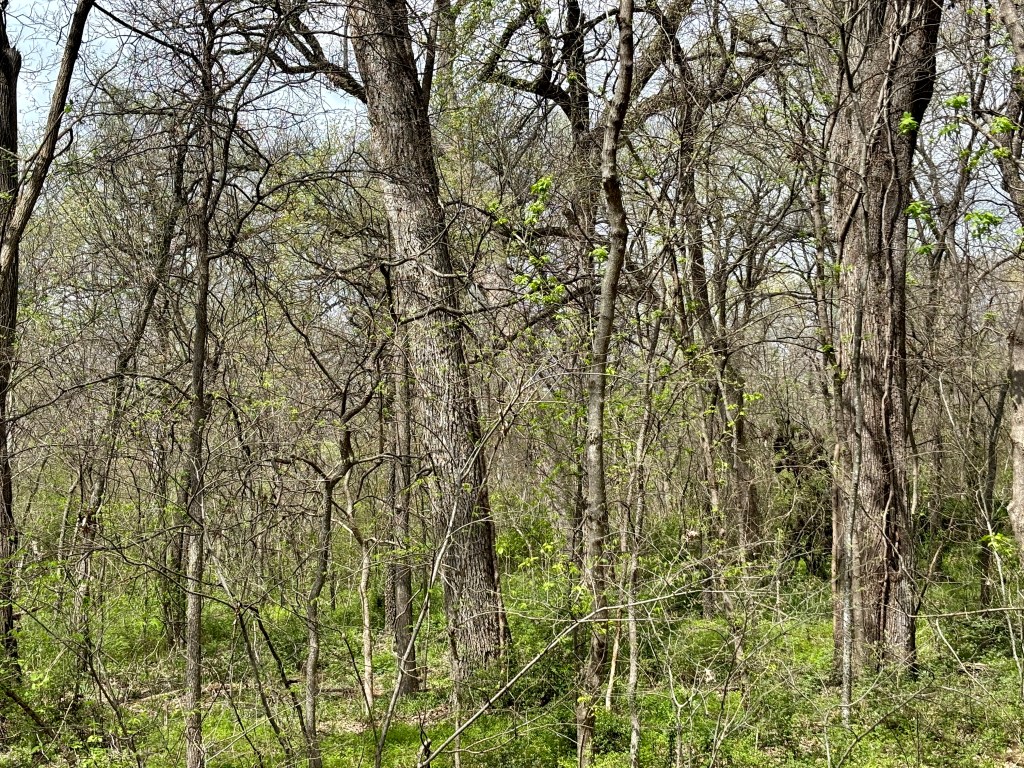
At a place where the trail reached the creek, we stopped and spent a couple of minutes with eyes closed or looking down so that our other senses would be more prominent. People later commented about listening to the sound of water flowing in the creek and the songs of birds in the woods. There was also the feeling of sun and a light breeze on our skin. We talked about the smell of spring, even though our vocabularies struggle to describe what we are sensing, the new green growth and what one person labeled as “herbaceous” (like the small plants emerging from the woodland floor). Noticing such things, along with touch and the sensations coming from how we are supported by the earth as we sit, walk, or stand, made our time richer.

Crow poison with a native violet growing beneath it

There is a lot more, but you should go and experience it for yourself. Emerging from the woods into a pocket prairie with butterflies, the beehive in a hollow tree, the leaves of trout lilies with their speckled or spattered appearance, and the scattered expanse of the small, white flowers of crow poison dotting the forest floor. If you go, take a little time for stillness and for being in the present moment.

Noticing “What’s Not Wrong”

What do we do when we take a walk in the woods? On a winter walk, seeing the nearly black, rough bark on the trunk of a blackjack oak and the paler, warty trunks of hackberries? Crossing a creek and looking at sudden tiny swirls at the water’s surface, where groups of mosquitofish dart away from our shadow. On sunny days when we stop and look upward toward the songs of small birds – titmice and chickadees flitting from one tree limb to the next. What we do is notice what is around us. Chances are that we pause for a little and soak in the experience, trying to get a good look and a good listen.

What should we call that kind of noticing? Being tuned in to the land and sky, the animals we find, the plants and trees, is the sort of thing that naturalists do. A naturalist is someone who pays attention to all those things and wants to understand how it all works together. So if you are doing that, we might say you’re using a naturalist’s attention.

We don’t always use our attention that way. Sometimes we could jog along the trail with ear buds in, listening to music or a podcast. Or we could walk through trees and grasses with a friend, talking about each other’s lives and getting “lost” in conversation. That’s a different experience. It can be great, but it is different than what we experience with a naturalist’s attention to our surroundings.

I think I learned to use a naturalist’s attention long ago as I looked for reptiles and amphibians and learned about how things work in nature, predators and prey, and also species that return used up bodies to the soil, the choreography of the seasons, and so on. As the years have passed, my preferred way of being in nature emphasizes quiet and stillness. I don’t necessarily mean lack of movement; for me, stillness is a quality of mind. I could be sitting or I might be walking along, but with luck I can have that quality of stillness as I move.

Mindfulness

I began to learn more about mindfulness and then to practice and write about it (for example, in Mindfulness in Texas Nature). When practiced in nature, mindfulness is very similar to what I’ve described as a naturalist’s attention. Mindfulness involves being aware of and paying attention to whatever is happening here and now, and doing so without judgment. We do not try to push anything out of awareness or notice only what we consider good; instead of trying to control our experience, we accept it as it is.

This attention to what we are experiencing includes both external and internal experience. What happens internally includes, of course, thoughts and emotions, and we cannot “empty our minds” of all thoughts. The human brain generates lots of thoughts, and during mindfulness practice we notice and then let them go. We stay in the present moment by not letting them take hold of us and lead us into distraction. If I’m sitting in the woods and something occurs to me about an appointment tomorrow, I can notice that I’m having a thought and then bring myself back to where I am sitting among the trees. I will probably need to do that multiple times. When a person is just beginning mindfulness practice, they do this over and over again, and that is normal. With more experience, those thoughts may be less persistent. 

People often think of mindfulness meditation as something that occurs while seated on a cushion in some quiet room. That is one way to practice mindfulness, but it also can be practiced while sitting in nature or while moving about – with that quality of stillness I mentioned earlier. The important things include staying in the present, aware of our experience. We try not to wind up spending our time on autopilot, lost in thoughts (or conversation).

An important strategy in mindfulness practice is paying attention to our breathing. The breath is always there, always available as a part of our experience in this moment. Focusing our awareness on each breath in and each breath out is a way of anchoring ourselves in the present. If we begin in this way for a few minutes, then we can shift our attention to everything else, such as clouds, water, the feel of the ground under our feet, and so on. When our minds begin to wander, we can bring our attention back to our breathing which anchors us in the present moment.

Typically, this breath awareness meditation involves breathing in a natural and comfortable way, noticing every sensation of air in our nostrils and throat, the expansion of our chest and abdomen. The in-breath fills our awareness with a cool rush of air through our nostrils and the expansion of our lungs. We might let our attention center on how our abdomen expands or any of the other sensations. Then with the out-breath we feel our abdomen and chest contract and the slightly warmed air leaving our nostrils. And every time our mind brings up other things, we take note of it with patience and the understanding that this is perfectly normal, and return our attention to our breath.

When we do this during an outing in nature, after focusing on breathing for a short time, we can move the focus of our attention outside ourselves to what is nearby. We notice sounds, smells and sights around us and then see what we notice further away. When our mind wanders, we gently bring it back to what is happening right now. If it will help, we can return to focusing on our breathing for a while.

The significance of this in a world in crisis

Most of us look around and we see a society in crisis. We look for what we can do to resist the destruction that threatens us, and our days can be full of watching, waiting, and worrying. I believe that we should remain engaged and informed and try to make things better, and yet if we become overwhelmed, we cannot do much good. It will help if we find time to be immersed in good things – people and places we love.

In his book, Peace is Every Step, the Zen master and mindfulness teacher Thich Nhat Hanh says that we should learn to ask, “What’s not wrong?”

There are so many elements in the world and within our bodies, feelings, perceptions, and consciousness that are wholesome, refreshing, and healing. If we block ourselves, if we stay in the prison of our sorrow, we will not be in touch with these healing elements. (p. 77)

We need these healing elements, even as we stay engaged in a world that needs our voices right now. We must not forget to visit what is not wrong, what we love, and what gives our lives meaning. We need each other, and that includes the other than human lives we find in nature. For me, being absorbed in the sound, sight, smell, and feel of the world around me, with attention focused on a spider’s web, sunlight filtered through leaves, the call and answer of nearby crows, and the color of a small cluster of mushrooms, is a lifeline. I think such things are lifelines for many of us.  

Trinity River Book Festival

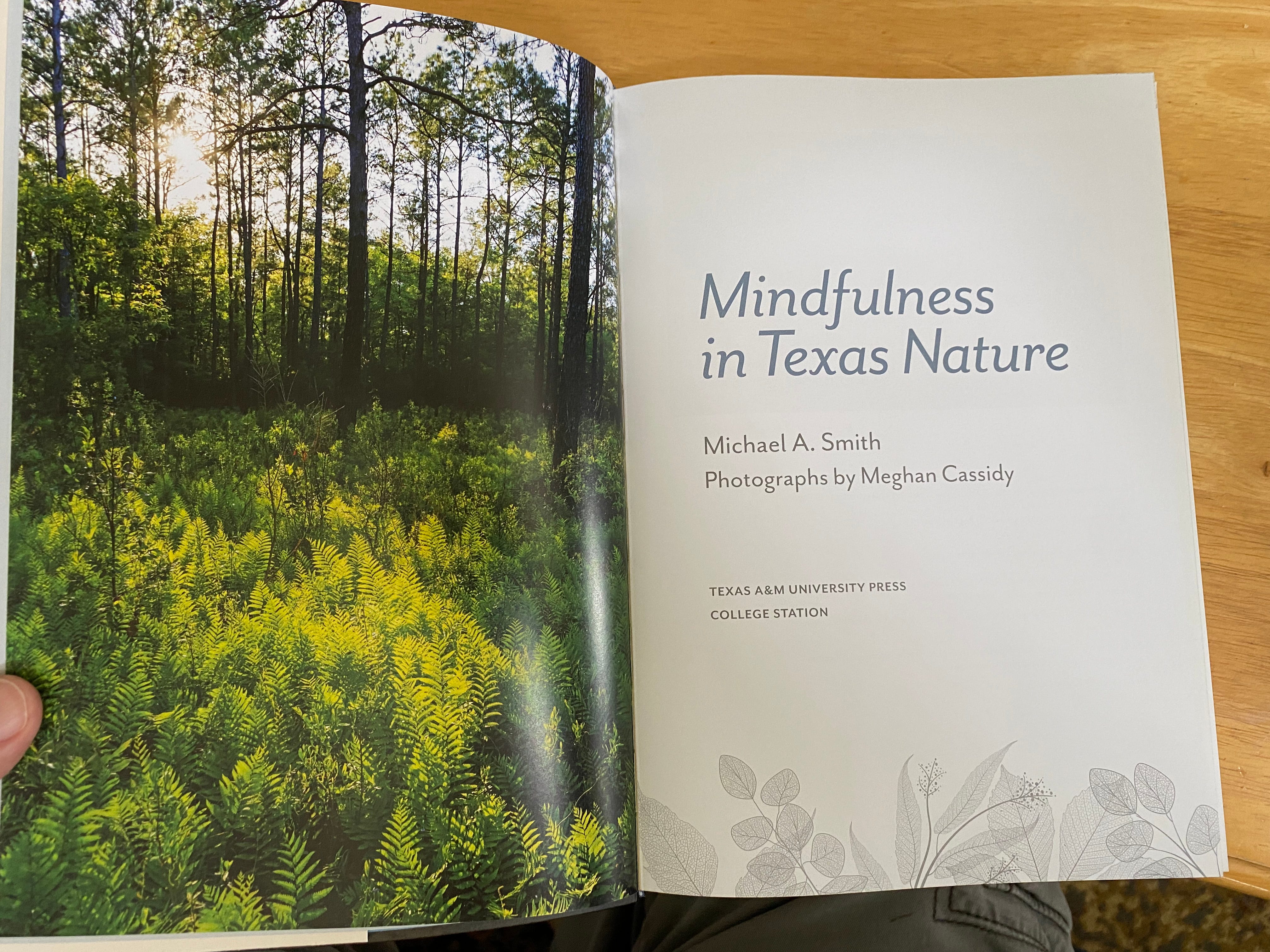
My recent book, with photos by Meghan Cassidy, has been the focus of some recent events, including the upcoming Trinity River Book Festival. The book describes the benefits of spending time in nature, in particular when practicing mindfulness in the woods, prairies, wetlands, and so on. The second half of the book is about Meghan’s and my travels to various places in Texas, what it was like to experience those places mindfully, and a little of the natural history of the places and some of their wildlife.

I will be at Trinity River Book Festival this Saturday, September 14, from about 11am to 1pm. There will be a panel at 12:00 noon featuring me, Amy Martin (author of Wild DFW) and T.D. Motley (author of The Art of Farming), and moderated by Dana Austin.

The panel is titled “Discovering the Hidden Wonders of Texas Wildlife,” and I think the way that works is that Amy will talk about places around the metroplex where you can see hidden wildlife and I will talk about being there mindfully so that you might really notice the wildlife and experience it more fully. Motley’s book is a novel, “a hopeful tale about stewardship of the land, the animals, and of each other,” according to Texas A&M University Press.

The panel length is short, but I’ll be around and The Dock Bookshop, the official bookseller for the event, will have some copies you can buy. I’ll be glad to sign it, if you like. Come say “hi”!

The Festival is held in Trinity Park, 2301 West Seventh Street, Fort Worth.

The Arrival of the Mindfulness Book

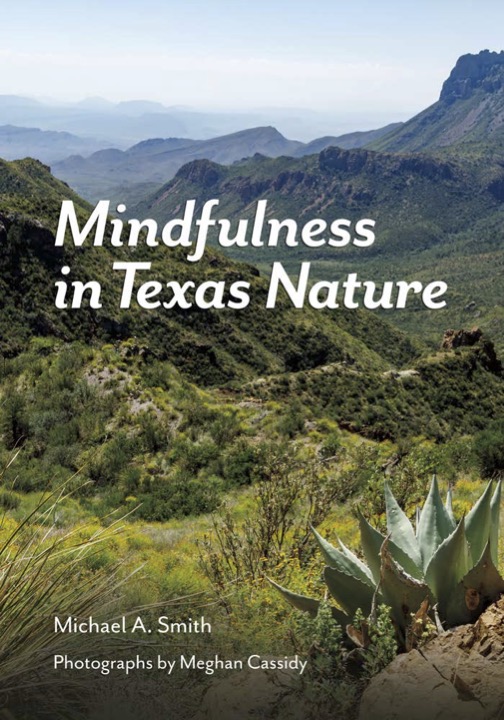
Yesterday my copies of Mindfulness in Texas Nature arrived. It’s now available through the publisher, Amazon, as well as bookstores. If you can join me tomorrow at Interabang bookstore in Dallas, I will be there at 6pm for discussion and book signing.

Meghan and I have looked forward to this day for a long time. It was the very end of 2019 when I got the go-ahead to write this book, with Meghan on board to be the photographer, and we got started just before the pandemic arrived in 2020. But we began with Muleshoe National Wildlife Refuge and kept on traveling as much as we could. Each of those trips was magical as I look back on them. We visited Big Bend, Caddo Lake, LBJ National Grasslands, The Big Thicket, and multiple other places. 

Photo from the Big Thicket

Meanwhile, I wrote about mindfulness in nature and how a person might go about practicing it. I discussed the documented benefits of time spent in nature along with the benefits of mindfulness and the related practice of Shinrin-Yoku or “forest bathing.” The lower blood pressure and stress hormones, the boosted immune functioning, the decreases in anxiety and ruminative thinking, and other good things that happen. 

Mostly the book consists of narratives of all those trips, the adventures and quiet moments without gadgets or agendas, just being there among all the grasses, woodlands, and wildlife in those wonderful places. What I wrote brings those days back, and Meghan’s photos make them even more vivid. 

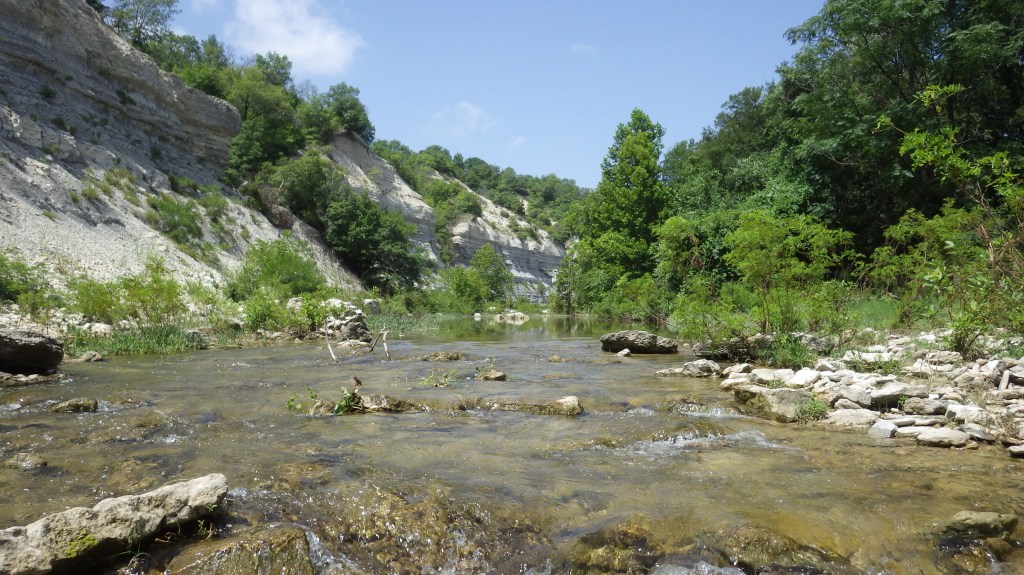
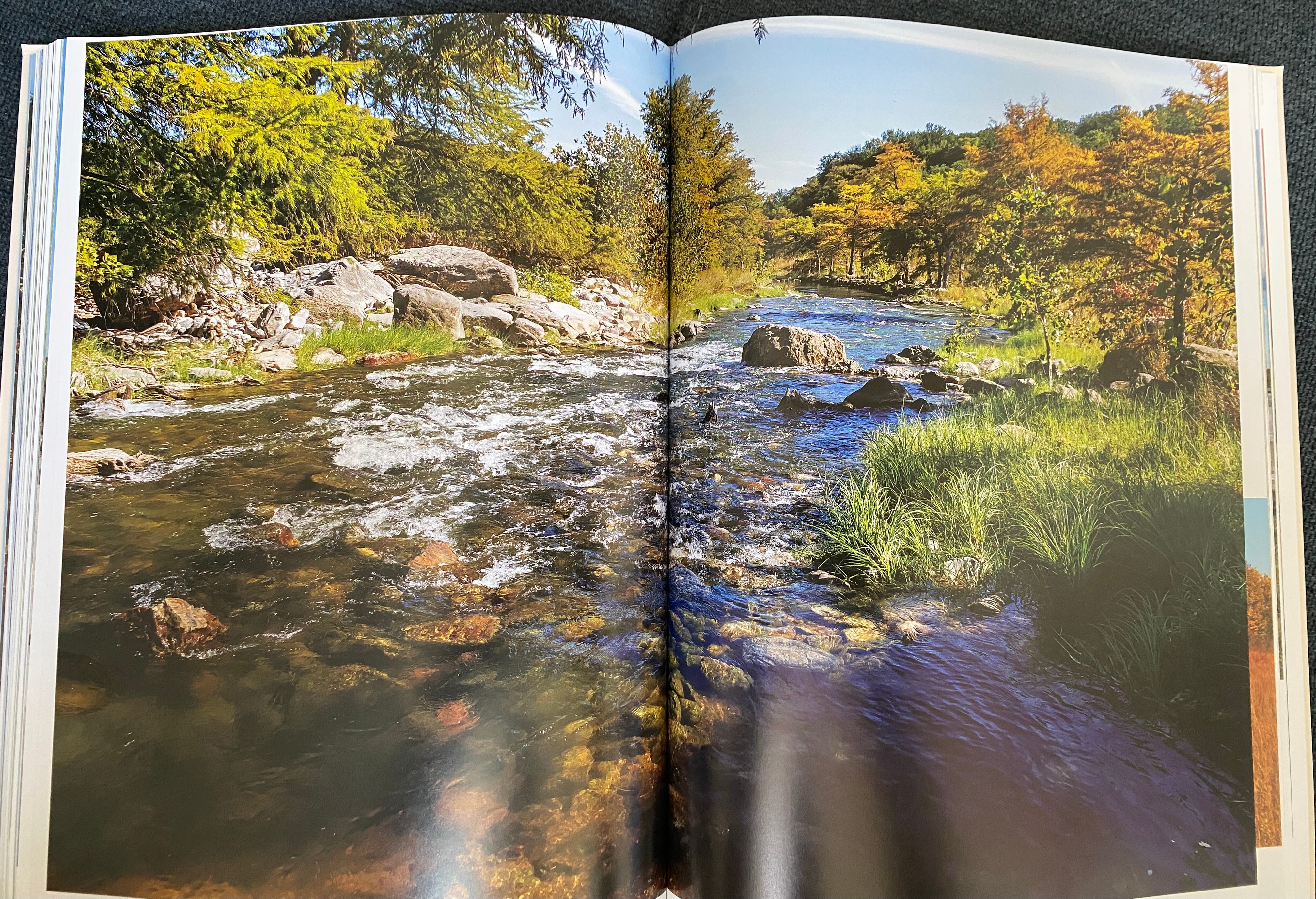
Pedernales River

Our trips were done and the manuscript completed by late 2021, and now the book is here. I think readers will feel some of what we felt in those trips and get ideas about “ways to be fully present … freed from the distractions and restlessness that can let the sights, sounds, smells, and other sensations slip past us before we really notice” (Introduction, p. 1).


Mindfulness in Texas Nature, 2024, Texas A&M University Press

Kids in Nature – Mindfully

I will be focusing more time on inviting others to some semi-wild place and experiencing it mindfully, doing some nature journaling, and learning a little about the plants and animals that live there. I’ve led nature walks before (with the LBJ Grasslands Project, for example), but these outings will more explicitly focus on mindfulness and nature journaling. If you are reading this in the North Texas area and would like to join me, please use the Contact page to send me an inquiry. At this point there is no fee, but I’ll check the status of the “tip jar” at this website in case anyone would like to contribute! Some of these outings may be more for adults, but some will be for families with kids at least ten years old or older.

Getting children out to experience nature mindfully involves their being less “somewhere else” and more “right here, now.” Somewhere else is thinking about something that happened this morning or hoping you can do something tonight, wishing your friend was here with you, and imagining how Batman could knock that tree down. Being right here is noticing the shapes of clouds, feeling how the ground feels under your feet, listening to a frog call, and recognizing prickly pear cactus and walking around rather than through it. Mindfulness involves paying attention to the present moment, without judging it as good or bad and without wishing it was different. 

Some kids may like the idea of taking a walk in which we will see everything more clearly, hear more things, notice smells, and touch a few things to see how they feel. I might explain to them that we will “turn down the background noise” of our thinking and talking while on the walk, so that we can experience the walk more fully. I will mention that this is not always easy for any of us. Our brain wants to turn the volume back up, and that’s normal, it’s what brains do. So when we notice that we’re thinking about something else, we just let the thought go, let it float away, and bring our attention back to what is happening now. We may have to do that over and over, and that’s OK.

Some kids may be used to blasting through a nature walk while talking to friends. If a nature walk seems unfamiliar or boring, they may be escaping by thinking of other things and going through the walk on autopilot. The job of a teacher or parent is to invite them in and make it seem worth a try. One way to do that is with nature games that provide a little structure for paying attention to the things around them. Or it might add interest to offer some natural history information (“That bird over there is getting ready to fly to South America!” “That rock is the silt and seashells from a beach where dinosaurs walked”). We may want to alternate periods of quiet attention with times when kids talk with each other and with us.

A nature journal is your own personal story, in words and pictures, of places you visited and things you experienced. You write a little and maybe draw a few pictures in a blank book or notebook – nothing fancy is needed. The idea is to stop and think about what you’re experiencing and preserve a little bit of it on paper. For some people, an entry might be mostly contain information about the place, the weather that day, and seeing a kingfisher fly over the pond. Someone else might write a poem about sun reflected on the water and the flight of that kingfisher, or maybe they would just draw the bird with a few notes about seeing it. There’s more than one way to keep a nature journal.

The only way I know to do this with kids is to have a responsible adult (family member or family friend) who brings the child and stays with us. It really cannot be a drop-off, but we would be happy for the adults to join in the activities. The ideal group, with kids or adults, is small – perhaps five or six. A small group just seems quieter, more focused, and better able to get to know each other, and so I will limit the group size.

What is my background for doing this? I have been licensed as a Psychological Associate for over 38 years and have led walks in nature for adults and kids. I’ve written two books about reptiles and amphibians and, most recently, a book about mindfulness in nature.

We’ll plan a walk when we are edging toward spring and have some sunny, warm-ish days. I will either use urban preserves and parks like Fort Worth Nature Center & Refuge, Tandy Hills Natural Area, or Sheri Capehart Nature Preserve, or places that are a little bigger and away from the city like LBJ National Grasslands. I hope you can join us!

Words and Experience

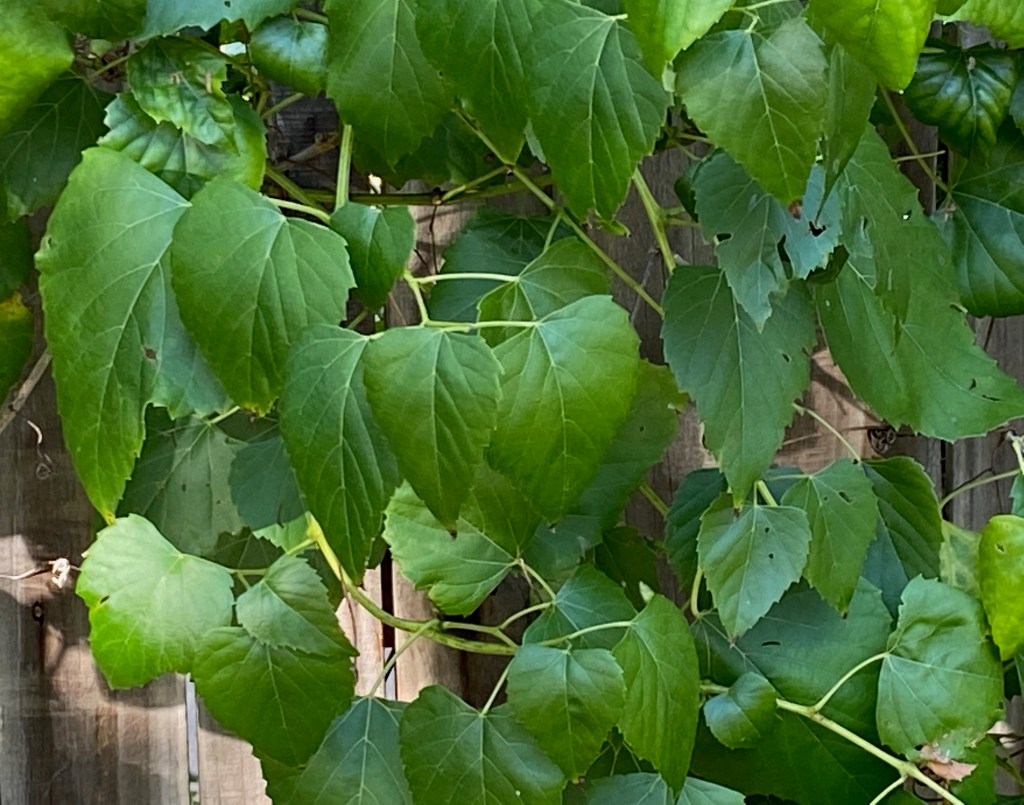
On my back fence a vine grows, with fairly large heart-shaped leaves, light green in the sunlight and a deeper shade in the shadows. The leaves are spaced alternately along the stems, and each one has a serrated edge or margin. A central vein grows to the tip of the leaf and smaller veins branch off and extend to the margins. The veins make a delicately embossed pattern on the plain green leaf. 

At least for today, I don’t care what the vine is called or to what category of plants it belongs. It is enough to see the green of the leaves and see the vein-embossed, saw-toothed little hearts that they make. If I knew the name, would I have walked over to look closely at the details? Maybe. But I might have thought, “Oh, that’s what it is,” and my curiosity could have ended with the name. I could have remembered that the leaves are alternate and have serrated edges and bypassed a few moments of beauty and symmetry.

After a lifetime of nature study, I’m not likely to swear off an interest in the names and classification of species. I’m just trying to guard against a preoccupation with names and concepts that can pull me away from directly experiencing the living thing itself. I’m trying to remember that the words are no substitute for seeing form and color, feeling texture and thickness, and smelling the sweet, musky, or other aromas of nature. The words and the experience are two different things, each of them valuable, and neither one a substitute for the other. 

I’m not one of those who dismiss “book-learning” in favor of real-world experience. I really value the verbal concepts we use to understand the world and I love books (and have even written a few). When it comes to the natural world, the people I know whose intellectual understanding is the most thorough are also people who have spent countless hours immersed in nature. They embody the idea that both intellect and experience are of great value.

What I really mean is that we should be able to fully experience nature, opening ourselves directly to it in its raw form before chopping it into fragments that fit within conceptual boxes and covering it with a verbal interface so that we can only contact it through concepts like “turtles of the family Emydidae” or “saprophyte.” In my own wandering outside, I don’t want trees, butterflies, wetlands and sunsets to be less vivid because they are filtered through my intellectual understanding of them.

The Power of the Everyday World

I get up. The kitchen becomes light when I flip the switch. The day starts with some small reassurance of the world’s predictability.

The coffee beans grind with a satisfying aroma, and the coffee tastes good. Things work. Things are OK. 

The car starts. Another data point stacks up in favor of a beneficent world. 

Against these meager but welcome signs that the world makes sense, there is the news. I don’t want to watch the news, but I am drawn to watch it anyway, the way a traumatized child’s play is drawn toward re-enactment of the trauma. This “trauma play” can crowd out the child’s ordinary, creative, fun play, just as the televised discussion and reporting of bad news can crowd out time that might be better spent elsewhere. But we want to be able to predict what may happen, to know what’s coming. The obsession with knowing “what happened” is a way of trying to make sense of the world and what might happen next. 

Oh, good, the trash was picked up, and the recyclables, too. Things are working as they are supposed to.

I think about the health of the people I care about. If there is trouble, I can prepare myself for how to be supportive, and maybe predict how events might play out and what we could do in each situation. Our brains are wired to anticipate the future and try to prepare, in every area of our lives. 

Part of our brain can be something like a “situation room,” a place where the experts and leaders gather to try to work their way through a crisis. And if the situation room is always running hot, problems occur. After a while, someone yells, “Turn off the damn alarm,” as the jangling autonomic nervous system keeps us in a panic, but the bell keeps ringing. Everyone sits around the table, exhausted, reviewing the information for the fiftieth time. The more we ruminate, the more dysfunctional the situation room becomes. Exhausted, irritable people do not solve problems well. Neither do chronically stressed or traumatized brains.

I grew up in a world that seemed safer and more predictable. 

Stepping back from what I just wrote, it sounds ridiculous, impossible. When I grew up, White State Troopers were beating Black civil rights protesters nearly to death in Selma. Boys were being drafted to go die in the war in Vietnam. We had nuclear attack drills in school, practicing how we would get under our desks to survive hydrogen bombs that seemed likely to fall on us any day. The world would end. How could such a world ever seem safer and more predictable than it does today?

It seemed safer, but it was not. Why did it seem safer – why did the world make more sense in my childhood?

My parents could not take away the threat of nuclear war but they could help support an everyday world in which things happened sensibly, often with happiness and wonder. There was carefree backyard play. There was the sound of waves, the smell of the Gulf, and a young child’s fascination with lightning whelk seashells. And then there were lightning bugs on summer nights, dragonflies in a scrubby vacant lot, and camping in the mountains. The immediate, direct experiences of the day. Having parents to share those gifts and cushion the disappointments and challenges made the day-to-day world a place that seemed mostly safe and predictable. In the fourth grade, if the everyday world is in good shape then nuclear attack drills can be just something that you do, with little connection to the cataclysmic threat and the absurd idea of surviving underneath that desk.

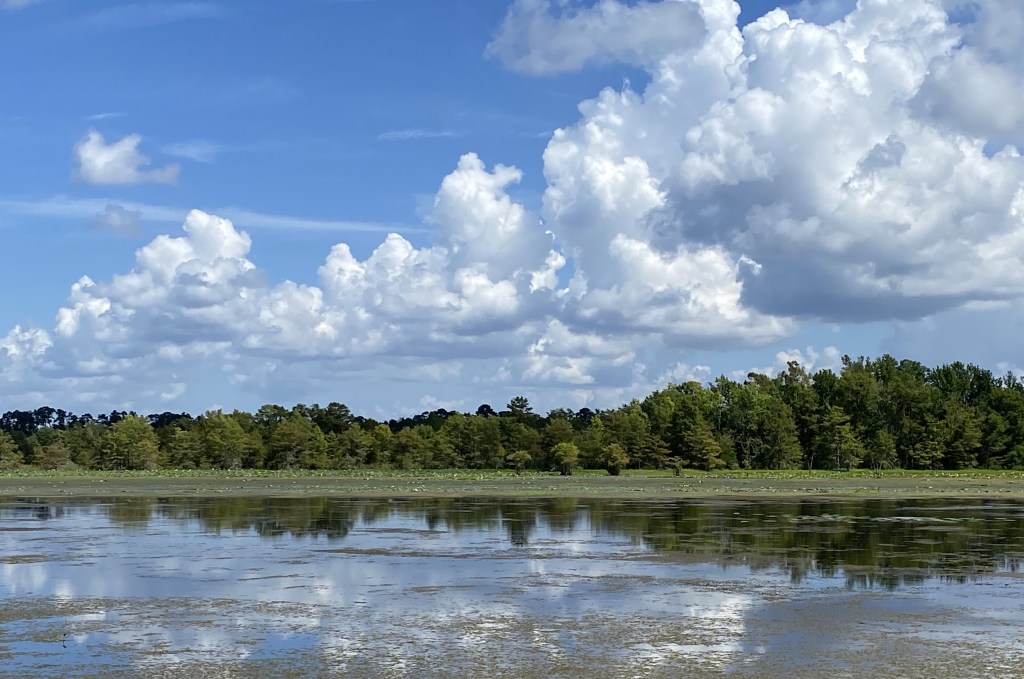
In the everyday world, I watch clouds slide to the north, piling up to great heights with edges lit brilliant white by the sun. They cross the pale blue sky slowly and peacefully. This world, at this moment, is a good place.

Regardless of what the world presents us with, we want it to be sensible, predictable, and safe. Even thrill-seekers want that security after the thrill is over. After the free-fall, after the parachute opens, we want gravity to give us a landing we can walk away from, ready to do something else.

With pandemics, insurrections, and a climate spinning out of control, it is easy to doubt that we can walk away from our landing. Road-rage killings, people assaulting others on airplanes, neighbors stockpiling weapons of war. People gathering to scream utter nonsense opposing a vaccine that could save us. For many of us, the world appears to be less predictable, sensible and safe with each passing year. What do we do with that?

One way of coping with the world’s trouble is to purposefully set aside time for living in the present, the world that we are in contact with each day. We cannot let the world’s troubles make us numb to the little gifts of our everyday lives. Those are the moments in which we visit a friend, listen to a bird, or write a letter (or an email). They are moments of contact with what we see and hear around us, what we touch with our fingers. 

My grand-daughter’s beautiful smile draws me into more play. I think what a gift this is, something that makes the everyday world a good place to live.

I know that our everyday lives can be difficult at times. Things break down, a loved one gets sick, we have loss and sorrow at times. But in between those times are the moments when the world offers its most precious gifts of beauty, sustenance, love and joy. 

Living in the present is not shirking responsibility or escaping from the world. There are times when we do need to think about the bigger world and contribute what we can to try to bring about change. And when we have done what we can, then it is good to let all that go and spend time living in the everyday reality that we have been given. 

I sit and listen to Beethoven’s String Quartet No. 14, completely absorbed in those four interwoven melodies.


(My life as a naturalist and conservationist is balanced by my career as a Psychological Associate. As I wrote a while back, “our lives” is as important a part of this blog as “in nature.” I know that my focus here is our lives in nature – the interrelated ways that humans and other species make their way through the days and years. I will try to stay focused, but sometimes an article will tilt toward the “‘our lives” part of the blog.)
“Mindfulness and Other Ways to Be in Texas Nature”

I’d like to invite anyone who is interested in mindfulness in nature to join me this coming Monday, August 15 at 7pm, when I will be talking about the practice of mindfulness in nature, the benefits of time spent in nature as well as the benefits of mindfulness. I’ll include a bit about my upcoming book about mindfulness in various places across Texas, with some photos by Meghan Cassidy, the photographer for the book. Additionally, I’ll touch on Kayla West’s and my LBJ Grasslands Project, an effort to document the natural and human history of the LBJ National Grasslands and take people out to introduce them to this wonderful place.

Guests of the Master Naturalist chapter are welcome, meaning that you do not have to be a member to attend. Details on my Calendar page and below.

Register in advance for this meeting: https://agrilife.zoom.us/meeting/register/tJUvfuqvrz0pHdED-vcXGPtLx74CJLTUXtvz

Experiencing Awe

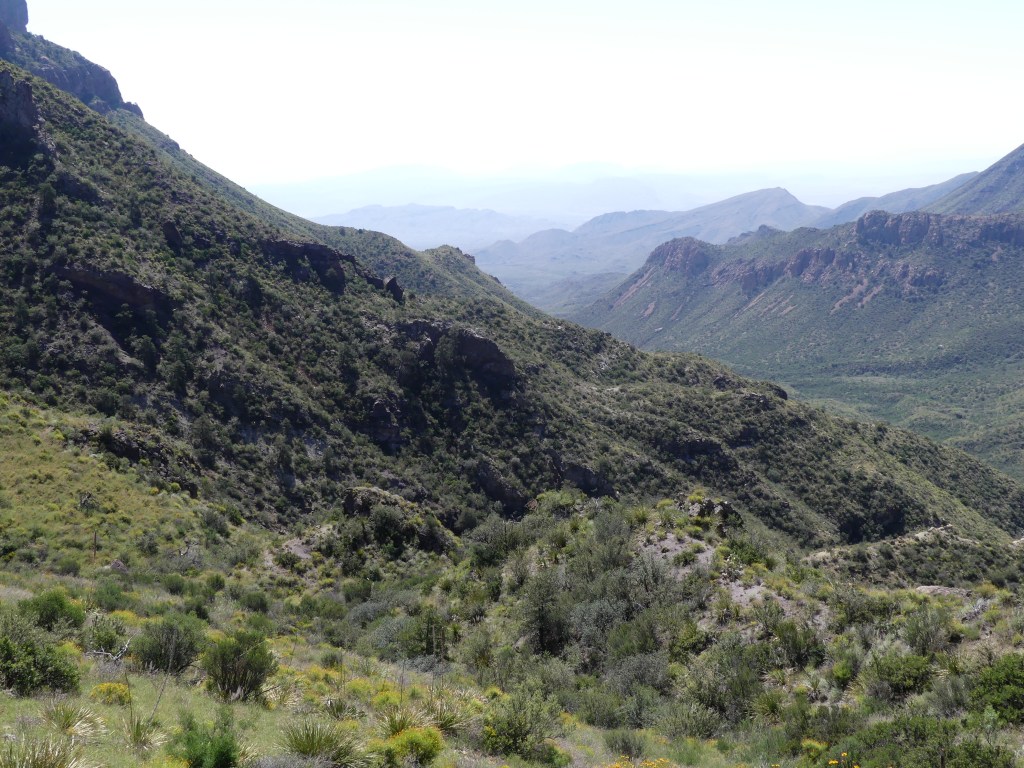
Halfway up into the Chisos Mountains, we reached a spot where the view opened beautifully. From where we stood, framed by pinyon pines, the mountainside sloped downward, dotted with yellow flowers, green clumps of sotol and shrubs. On either side the mountains rose up above us. To our right were the smooth granite towers of Casa Grande Peak, and to the left was the way upward along the Lost Mine Trail. The view south showed a series of mountain ridges, overlapping each other as they receded into the hazy distance. I sat under a pinyon pine, in awe of what was around me.

The word “awe,” in the form of the adjective “awesome,” is overused today to express, usually in an offhanded way, that something is good. French fries that manage to be both hot and crispy are “awesome.” The sense of confronting something mysterious and powerful has been wrung out of it, so that it fails to convey any suggestion of the meaning of “awe.” As defined by Merriam-Webster, awe is

an emotion variously combining dread, veneration, and wonder that is inspired by authority or by the sacred or sublime

The word’s origins nearly a thousand years ago emphasize terror or fright along with great reverence. Perhaps these emotions come from the religious connotation of being helpless and vulnerable in the presence of a God who could turn a person into a pillar of salt. In a more general way, we can experience fear in the presence of something powerful that we do not understand. As our species came of age in prehistory, a thing that seemed overwhelming and beyond our understanding might inspire dread and terror. Perhaps our survival depended on those emotions and the caution or shelter-seeking that would follow. Maybe a residual hint of fear adds to the emotional power of awe.

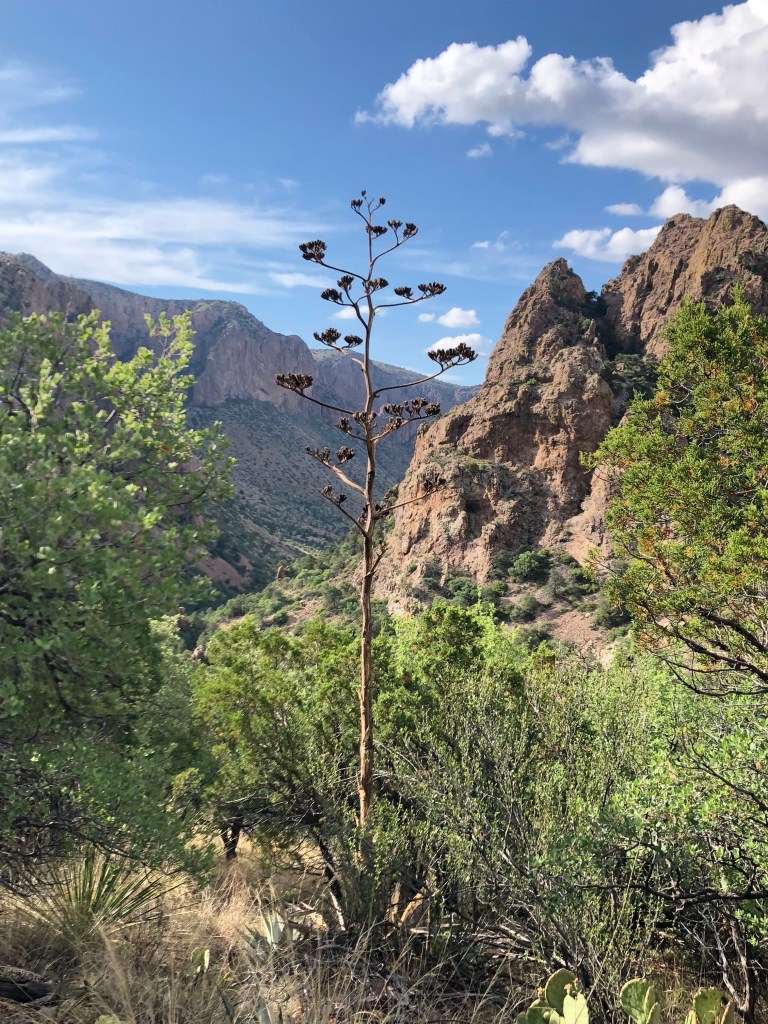
Standing in the Chisos Mountains, I was not aware of any terror or dread. There certainly was wonder and reverence, a deep respect for this place and all that it contained. The mountains, the Mexican jays and butterflies, the century plants that send up tall stalks ending in bunches of yellow flowers, all these things inspired fascination and gratitude. I was thankful for the privilege of being a great many miles from places where the experience of awe is shriveled to the size of an order of French fries.

I think we need the experience of awe, of being in the presence of the sacred or sublime and feeling moved by participation in something grand and wonderful. That might happen if we are in the audience as an orchestra plays the Shostakovich tenth symphony. It could happen as a jazz group plays Miles Davis’ “Blue in Green” so that musicians and audience together resonate with emotion. Or we could be standing on a mountain or in a prairie, shedding our self-awareness for a time and becoming absorbed in the life around us. The result might be shattering, in the case of the second movement of Shostakovich’s tenth symphony, described as a musical portrait of Stalin. Or, it could be transcendent and joyful, in the example of time spent in nature. In a variety of ways, we can join with something bigger than ourselves and sit with emotions and perceptions raw and real as we look out at the world from this different vantage point.

Where are the opportunities for awe in modern life, goaded by capitalism and breathless in the need for multitasking, relying on Facebook and French fries for moments of joy? Not only do the demands of modern life crowd out the space for reflection and wonder, the stresses and catastrophes of the last few years have pushed us to the limit. In the face of pandemic, isolation, mutual suspicion and insurrection, and now war in Europe, the desire to escape can be strong. Looking for that escape, some people put their shoulder to the wheel all the more, and some lose themselves in anesthetic good times. The rest of us – all of us – grow more numb from waves of trauma. When too much pain and stress come flooding in, the self-protective circuitry of our minds may keep us from being overwhelmed. One way to do that is to put up a firewall between us and our emotions, leaving us shut down and numb. If it is used very much, this shutting down is a very expensive strategy. In addition to protecting us from trauma, it also cuts us off from much of our emotional life, including those vulnerable experiences of joy and wonder.

What can we do to create space in which awe might come to us and find us open to the experience? We can look for – and plan for – times when we can slow down. I am thinking primarily of slowing our minds, taking things one thing at a time, having time to pay attention in a purposeful way. We could “slow down” while running or paddling a kayak, so long as we are not preoccupied, multitasking, and mentally running on autopilot. In order to be open to what is happening right now we have to be present, here and now. We cannot be somewhere else and fully experience our lives.

The trick is to slow down during the time that we have, not spend it in things that keep the mind revved up and distant, such as on smartphones or TV. Why do we constantly distract ourselves? Some of it is because we’ve trained our brains to expect constant stimulation and we are bored when it becomes quiet. Also, when our minds are quiet and receptive and worries or unpleasant thoughts come crowding in, we use distraction to keep them at arm’s length for a while. A capacity to be more quiet, present, and open might not come easy, but we can practice it and gradually find it easier to sit in stillness and be open to whatever we experience.