At LBJ Grasslands, the Evening of May 27

(A writing experiment, with country cemeteries, beautiful prairie, a copperhead, and distant storms. On this visit to the grasslands, I did not take a camera. I intended to experience it without trying to “capture” it in images, although I did have my phone so I suppose I did have a camera. I also did not take a field notebook, but today I wrote some notes. It seemed like the sort of thing that would have, once upon a time, been sent back home as a letter, and so I offer my notes as a sort of letter from the grasslands, with no photos to augment whatever mental images and stories the words might manage to convey.)

I traveled to Wise County to see how all the rain has affected the prairies at LBJ Grasslands, and I also hoped to sit in the quiet darkness and watch lightning from the line of storms coming in from Oklahoma. In between those things, perhaps I would see a few snakes or frogs crossing the roads after sunset.

On the initial drive through the oak woodlands and patches of prairie, I looped around Ball Knob, a little hilltop and ridge. Tucked away among the oaks, prairie grasses, and wildflowers is a quiet little cemetery, a resting place for people who lived there in the 1700s and later. It is a beautiful place, dotted with oaks and a couple of junipers, with some of the headstones weathered beyond reading. It is comforting to think that they have rested here for hundreds of years in the peace of the cycling seasons. Who knows what it might mean to those who have passed, but for those who remain it is a reassuring reminder of eternal rest. For those who are buried here, each spring sees the return of Texas paintbrush and purple coneflower and each autumn their graves are kissed with a scattering of golden and scarlet oak leaves. The place is circled with an unassuming chain link fence, and there is a small, modest pavilion for anyone who wants to sit for a while. There is a historical marker, but no signs and nothing to disturb the peace. It is perfect.

I drove on, past the historical site of the settlement of Audubon and past the pine grove with its campsites and little ponds. From that pine grove, the road drops down to a broad, mostly open prairie that I walk year after year, following trails across fields of prairie grass and flowers and through post oak and blackjack woodland. Today, after the extended rains that have fallen, the fields were green and dotted with flowers. Red-orange Texas paintbrush pushed up through the green, and meadow pink flowers were tucked away near the ground. Big flower heads of antelope horn milkweed dotted the meadows. 

Butterflies and bumblebees visited these and other flowers. The first ones I saw were sulphur-yellow butterflies that fluttered near the ground, stopping at the yellow coreopsis and nervously moving on if I stepped closer. The buzz of the bees is very pleasant to me; I associate it with flowering and the expansion of life, and not at all with pain since these bees will gladly coexist and work around us if we just leave them alone. Everywhere the calls of northern cardinals and other birds made these meadows and woods all the more exquisite. To walk through the grasses and among the flowers, surrounded by bird song and the occasional bee, brings a peace and contentment that I find in few other places. 

I wandered for some time, soaking it all in. White-tailed deer peeked at me attentively from below a rise, bolted back a short distance as I continued walking and looked back at me again. Crows scolded me from a nearby line of trees. On a milkweed plant, a monarch butterfly moved among the flowers, took off when I got too close, and then circled back to the plant. The air was laden with moisture and felt warm and close, and the sky was hazy with thin clouds. Cricket frogs began to call, a soft and distant ‘grick-grick-grick’ from a pond somewhere.

Eventually I returned to my car, just prior to sunset. I started to get in and was interrupted by the graceful and acrobatic flight of a couple of birds very close to where I was. They had narrow wings that suggested a swallow, made for maneuvering rather than soaring. The tail feathers were cut into a fork rather than a broad fan, but these birds were too big to be swallows. They swooped and climbed, then one would rapidly pivot, diving down to catch an insect and then pull up and shoot across the meadow, flying out of range only to re-emerge a few moments later. Others joined, until there were five or six birds, each one putting on an athletic show for the earthbound human below. My friend Carly identified these as nighthawks based on their size and the big white spot under each wing. 

I drove the little back roads nearby, and at some point came upon a fairly large broad-banded copperhead. I always stop, both because they are beautiful and because they cruise very slowly across the road, very vulnerable to being run over. The glare of my flashlight showed the broad dark and light bands that give the snake its name, dark cinnamon alternating with sandy shade of tan. The finely-sculpted, wedge-shaped head had some of that cinnamon color in the back, divided from the lighter color of the face by a fine diagonal border. Like virtually all copperheads, this one held his head angled up, motionless for the moment, waiting to see what I would do. At such times they are balanced on the edge of a knife, between utter stillness (which would serve them well when camouflaged in dead leaves and grasses) and exploding into frantic attempts to escape. When I slid the snake hook under this one’s head and neck, he bunched up a little, maybe surprised and unsure what to do with this unexplained touching. He then decided it was time to leave, crawling quickly but not frantically off the road. 

That was an exciting encounter, despite my having found and interacted with a great many copperheads. I drove down the road with the satisfaction of seeing this beautiful snake and moving it so that it would survive this night. A few miles further, and another snake came into view. This one was a plain-bellied watersnake, dark and sullen but nonvenomous. I took a couple of photos with my phone but did not pick it up. At my approach, the snake pulled itself into a protective coil and lashed out with a quick jab. Watersnakes have no venom but usually do not hesitate to bite if they feel threatened. They leave small scratches, briefly painful and perhaps startling enough to make a coyote, a raccoon, or a human let it go. I nudged him off the road with my shoe and wished him well.

Soon, lightning could be seen along the northern horizon. An oncoming storm front and barometric pressure drop often sets the stage for snake activity, and that was a plus. However, when the clouds get close enough to watch the flashes of light and hear rumbling in the distance, I’m ready to stop and enjoy the experience. Maybe it is a contradiction that I respond to distant storms as gentle and soothing while at the same time representing immense power. Which part appeals to me, or is it the idea of such a powerful thing being capable of soothing? In any case, the faraway thunder is a lullabye and the flashes of lightning no more threatening than the moon or a shooting star. I pulled off onto a Forest Service road and stopped the car so that I could stand in the quiet darkness and watch.

It was very dark behind the tree line and then a flash appeared from within the clouds and rolled from one to the next. Then it was dark again until nearby clouds were briefly lit by what seemed like an internal fire, outlining the clouds in front of it for an instant or two. It was completely quiet. Radar showed the front still had not crossed the Red River; it was too far distant for thunder to be audible. Earlier, the air had felt warm and saturated, but now some cooler breezes were stirring. I stood in the darkness for a while longer, watching the random flowering of distant lightning and enjoying the quiet. 

Be well and happy. Visit the grasslands when you can.

Michael Smith

World Turtle Day at LLELA

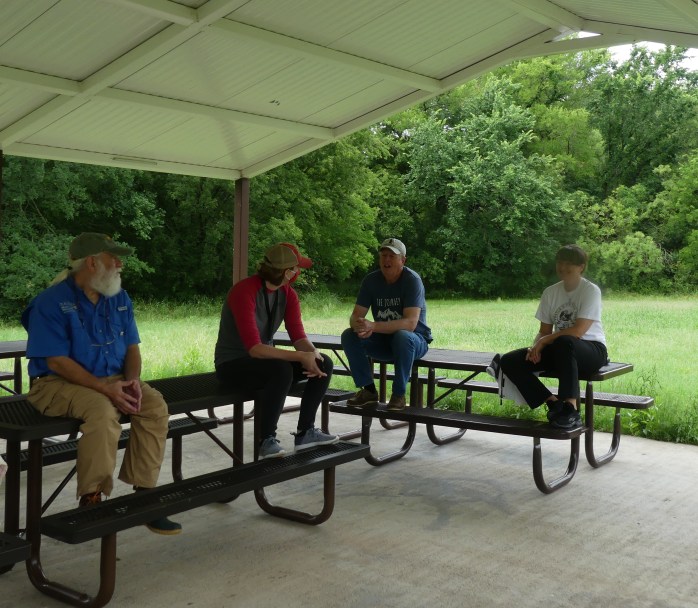
May 23rd is World Turtle Day, an opportunity to celebrate those animals that found a good plan and stuck with it for over 200 million years. The earliest turtles developed a protective shell and then rearranged their bodies to be able to swim, walk, and even run while encased in that shell. It’s a remarkably effective evolutionary feat, which is why they kept that basic body plan for millenia. The DFW Turtle and Tortoise Club celebrated the day at the Lewisville Lake Environmental Learning Area (LLELA) hearing from box turtle researcher Sara van der Leek and her colleagues. 
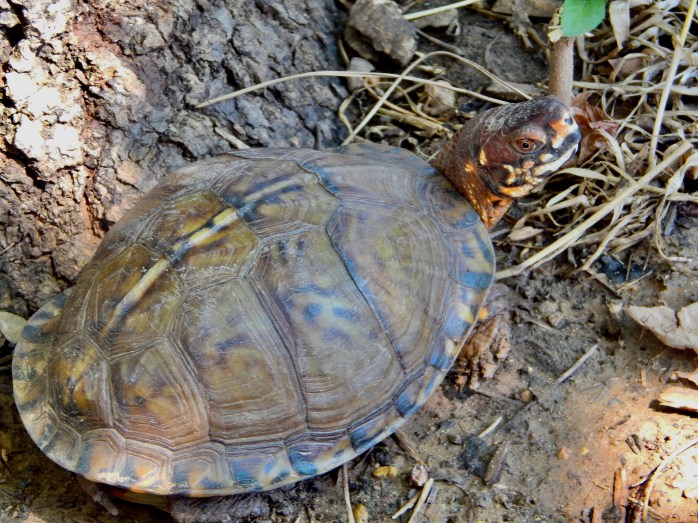
Three-toed box turtles are found at LLELA

For me, there could hardly be a better choice, and I’ll freely admit my bias since these are my favorite turtles. They are beautiful, interesting, and everybody likes them. They also need help – wild populations of box turtles are in decline in lots of places in the U.S. Not many babies make it to adulthood, and then the adults are often run over on the highway or collected as pets. There are other threats, too, and so box turtles are in trouble. 

As the LLELA folks described it, they started out with a small population of box turtles. In order for the turtles to find each other and breed, there must be reasonably high numbers of adults. If the numbers are too low, the population is sometimes described as “reproductively dead,” meaning that the long-lived adults are still seen at times but there are too few of them to produce enough babies for survival. To keep box turtles as a healthy part of LLELA’s wildlife, staff and volunteers worked along with Sara to do a couple of things. First, they attach a miniature radio transmitter to each box turtle above a certain size, so they can track the turtle down periodically and check on how it is doing and study its movements. Second, they raise and head-start baby box turtles that are released on the property when they grow to a certain size. If they were released as soon as they hatched, most of them would be eaten by predators, but if raised until their shells are harder and more protective, they have a better chance.
Sara van der Leek

This all sounds like great fun, and when you hear Sara talk, you get the impression that it is very rewarding. However, it also involves pushing your way through the greenbrier and poison ivy and sometimes crawling through the woodland in search of a turtle’s radio signal. It’s a lot of work, and Sara and her team have earned our admiration and respect for the work that they do. 

The LLELA and DFWTTC crews – from L: Hugh Franks, Sara, Scott Kiester, and Barbara Dillard

This relaxed and enjoyable conversation among Turtle & Tortoise Club members and LLELA folks happened as a result of planning and coordination by Barbara Dillard, who leads the club. Turtle people and “herp people” (those interested in reptiles and amphibians) used to form clubs and societies to share stories, organize activities, and provide information to each other. That has largely shifted from in-person groups to Internet social media, and the DFW Turtle and Tortoise Club made that shift, too. Barbara deserves credit for the fact that the club continues to function. The get-together on World Turtle Day was an opening invitation for turtle fans to be, at least sometimes, an in-person community. The pandemic made it too risky to be with each other face-to-face, but those risks are receding and now it’s time to remember how good it is to see and hear each other in real life. If we do it carefully, there is a lot to be gained. Being with each other, physically present, is the glue that holds human connections together. We have been a fragmented collection of individuals, holding some semblance of community together by staring at pixelated images and listening to computer audio. That’s how we got through the last fifteen months or so, but now if we can safely and carefully come together, we will be happier for it.

Scott Kiester, President of Friends of LLELA
Hugh Franks, Master Naturalist and turtle-whisperer

The meeting on the 23rd also shows how much the interests of turtle folks can include the science and natural history of wild turtles and the keeping (and sometimes breeding) of captive turtles. In the professional world, there is the study of turtle populations living in forests and savannas, prairies and wetlands, as well as zoo collections and conservation programs as well as the assurance colonies maintained by the Turtle Survival Alliance. In the hobbyist and amateur world there are days spent photographing wild turtles and posting observations on iNaturalist, and also people who keep red-footed tortoises in the back yard or mud turtles in indoor tanks. The discussion with LLELA folks helps keep the turtle hobby grounded in the fact that turtles are wild animals and that we all have a stake in the continued existence of healthy populations in wild places.

Male three-toed box turtles often have colorful heads and forelegs

To help with that balance of interests, Meghan Cassidy worked with Barbara to create the DFW Turtle and Tortoise Club project on iNaturalist. “Projects” are collections of observations, either focusing on particular groups of species in certain geographic areas (like “Insects of Texas”) or the observations of an organization. This will be a great way for club members to share what they see in the wild with fellow members and with the scientific community.

One of the questions that came up was, “How can the average person help out with the box turtle work at LLELA?” It will not help (and oddly enough, would hurt) if we bring box turtles to LLELA and let them go. Volunteers can help out if they get the proper training from Sara. Mostly, we all need to remember that if we find a turtle somewhere, in most situations we should not pick it up and take it anywhere. When we see a native turtle, unless it is in a situation that is obviously not survivable, we should assume that it belongs where it is and knows where it is going. (It is good to help turtles when they are found crossing the road – more about that in another post.)

Hugh Franks shows us a box turtle in the outdoor pen in which turtles reach maturity before release

Thank you, Barbara and Meghan, and thanks Sara van der Leek, Hugh Franks (who raises the baby box turtles), and Scott Kiester with Friends of LLELA. Together, you made possible a beautiful World Turtle Day for a small, lucky group of people.

Back to the Thicket

For some time I have been focused on travel and writing for the planned book on mindfulness in Texas nature. Part of those plans involved visiting the Big Thicket, and that was a highlight on my calendar. Meghan and I spent a weekend in late April wandering through some of the forests, wetlands, and pine savannas of that incredible place. I have visited the Thicket on and off for nearly twenty years, and each visit is a treasure.

On a map of southeast Texas, if you drew a triangle between Livingston, Jasper, and Beaumont you would capture much of the region traditionally known as the Big Thicket. Originally it was a big, wild place with old growth forest and a tangle of vines and understory plants that could be nearly inaccessible. There were also open savannas with ferns and pitcher plants growing in the spaces between pine trees, as well as ponds and sloughs. The settlers came, and later the timber industry cut down big swaths of forest. Then the discovery of large deposits of oil in 1901, with the Spindletop gusher near Beaumont, initiated the oil boom. The Big Thicket could easily have disappeared, but environmentalists and a few politicians fought to save as much of it as they could. The Big Thicket National Preserve was established in 1974 and in 1993 additional land was added to it. The “units” of the Preserve are scattered patches of forest, wetland, and other habitat with protected corridors along creeks, bayous, and the Neches River connecting many of the larger units.

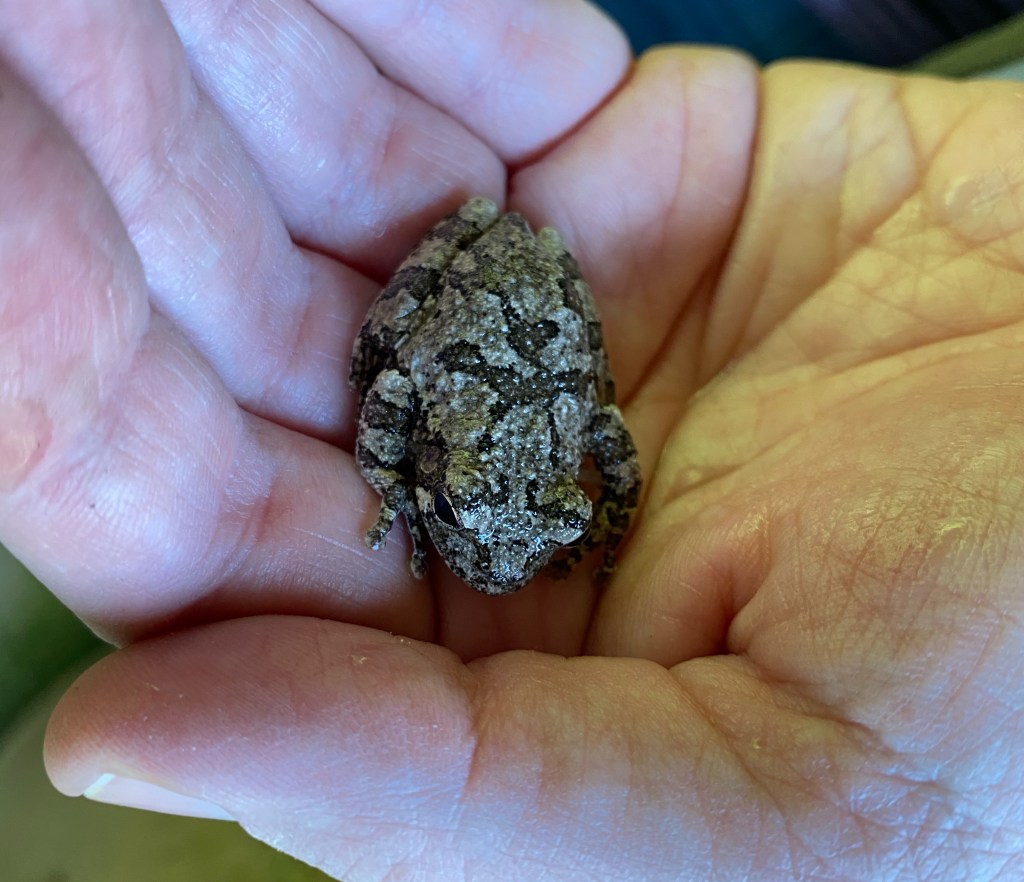
We arrived following a big rainstorm, and treefrogs and a few other frog species were calling. It is otherworldly to stand in the darkness next to a thicket full of chorusing frogs, listening to a wall of amphibian voices competing to attract females. The first night was dominated by gray treefrogs with fluttering, fairly musical trills loudly filling the dripping woodlands and seeming to come from everywhere. It is nearly disorienting, but in a good way!

A gray treefrog – a member of that big chorus we heard the first night

After about six hours’ sleep, we were ready to walk the Kirby Nature Trail. The trailhead is near the visitor’s center at the south end of the Turkey Creek Unit, an ecologically very diverse area between Kountze and Woodville. When I think of the American beech-southern magnolia-loblolly pine ecosystem that I associate with the Big Thicket, I picture this unit (although it contains multiple ecosystems, not just this one). We walked among tall trees and thick understory, with bird song echoing through the forest. Leaves were still wet with the previous night’s rain, making the woodland bright and fragrant.

A southern magnolia along the Kirby Nature Trail
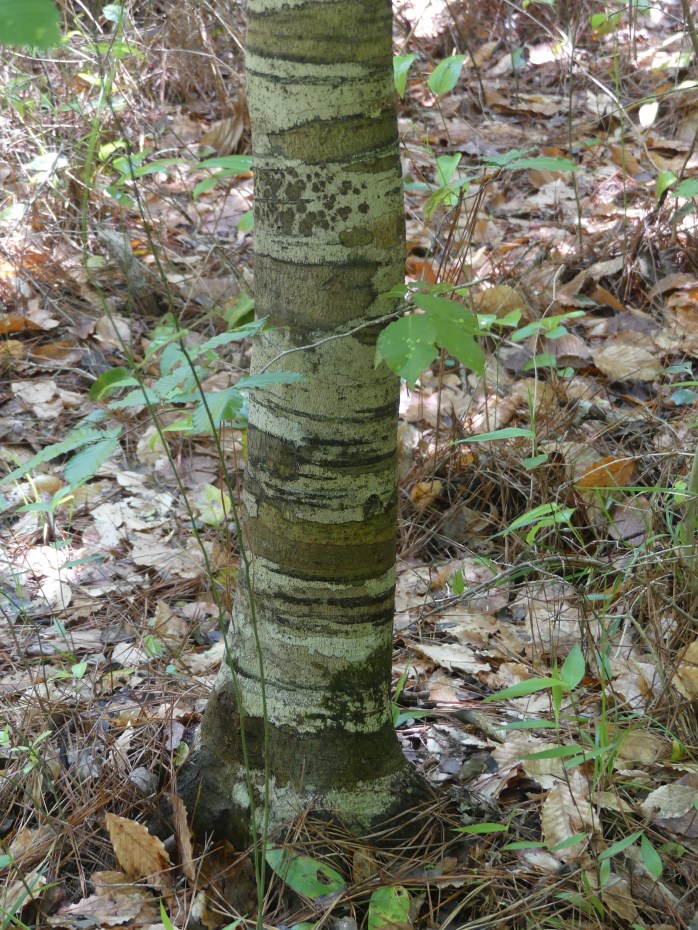
Trunk of an American Beech, like a banded work of art

I sat on a bench looking around at the trees, including the occasional fallen tree whose trunk can stretch for a considerable distance through the forest. I listened to the breezes in the crowns of those trees and the birds calling back and forth. Sometimes I could empty my head and focus mindfully on these experiences, noticing them almost as if for the first time, without commentary or comparison with other years. At other times I did reflect on the span of time during which I’ve been able to come here, and how fortunate we all are that this place persists over the decades and will not be cut and cleared for a store or to plant a monoculture of slash pine for harvesting.

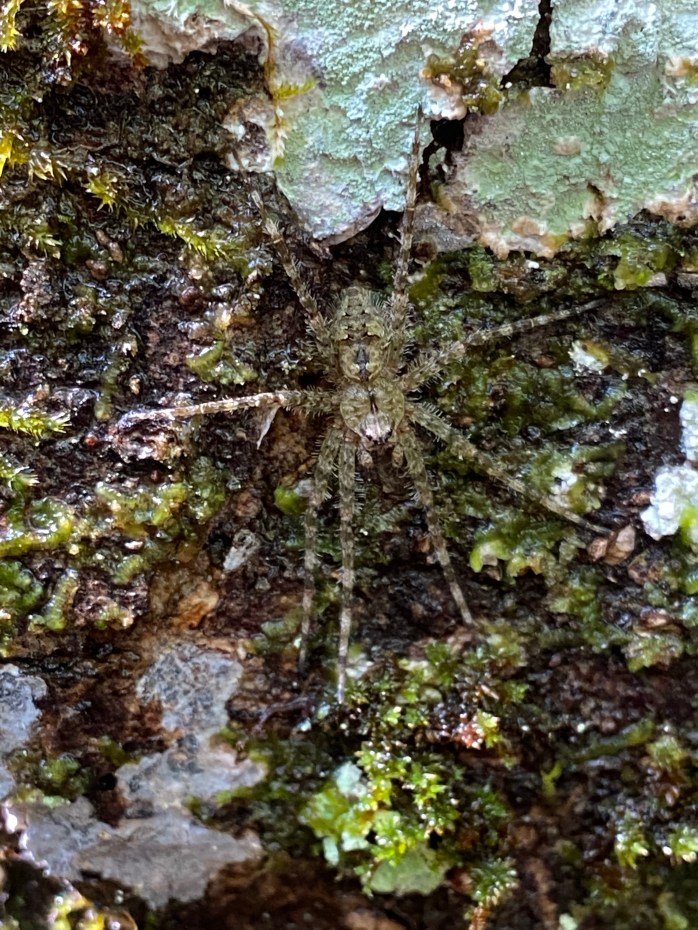
Fishing spider (Dolomedes sp.) on a tree trunk

Meghan and I also wandered along the trail, taking in everything around us from big trees to invertebrates like a fishing spider who remained motionless, tucked back into the bark, lichen, and tiny mosses growing on a tree trunk. It is best to go slow, give yourself plenty of time to discover these things by wandering a little and then stopping. I agree with Meghan’s assessment: it’s good to really see what’s in front of you, “and if it takes all day, it takes all day.”

We came to a bridge that crossed a slough, a sort of swampy little wetland flowing toward Village Creek. Sitting on the edge of the bridge, we could take photos from between the rails or just lean on them and imagine floating on this lazy stream through the forest. We spent a while lost in the sights and sounds of the slough. Much of the surface reflected the tree trunks and leaves like a mirror. I focused on an area of this reflection and was completely absorbed in how the occasional dropping of a leaf or small insect would set up ripples through the beautiful reflected image of the woodland. After a time, I decided to lie on the bridge between the water and the sky. Clouds passed overhead, and there was a sense of floating, a sort of suspension between the slow current of water below and a flowing stream of air above.

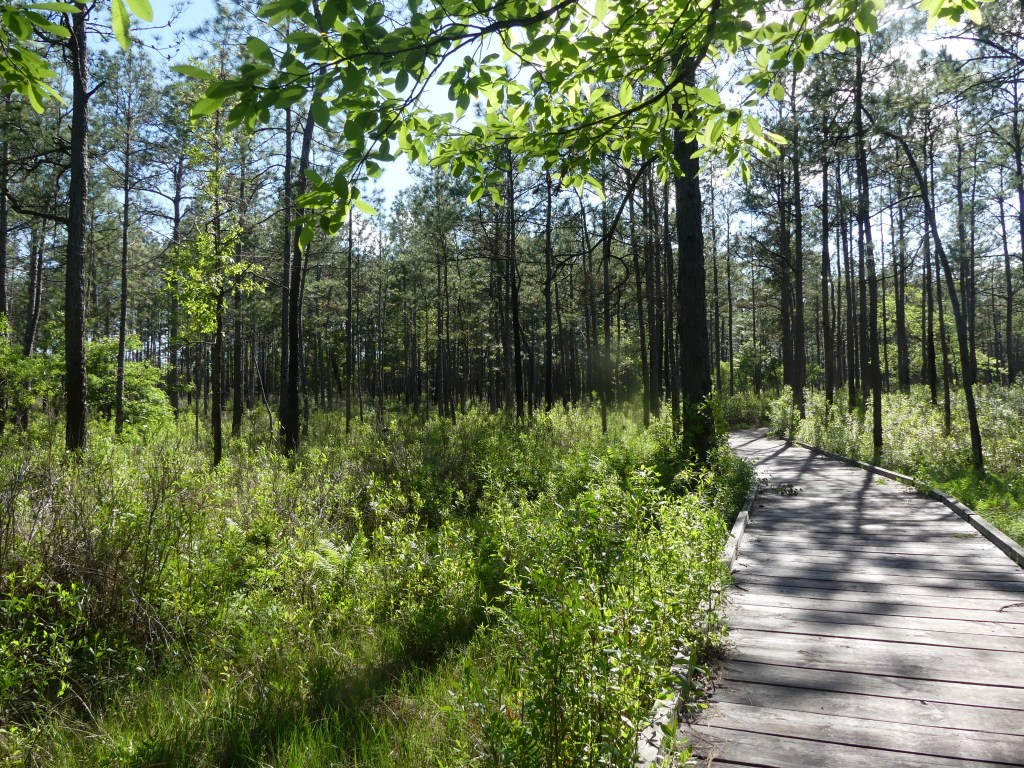
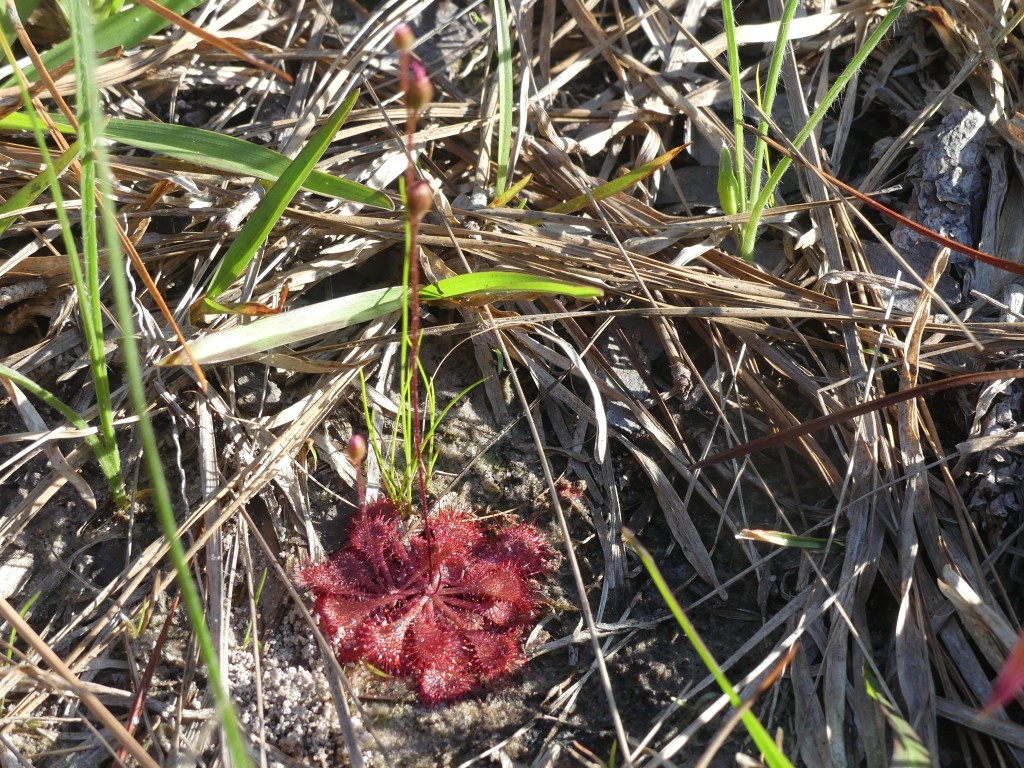
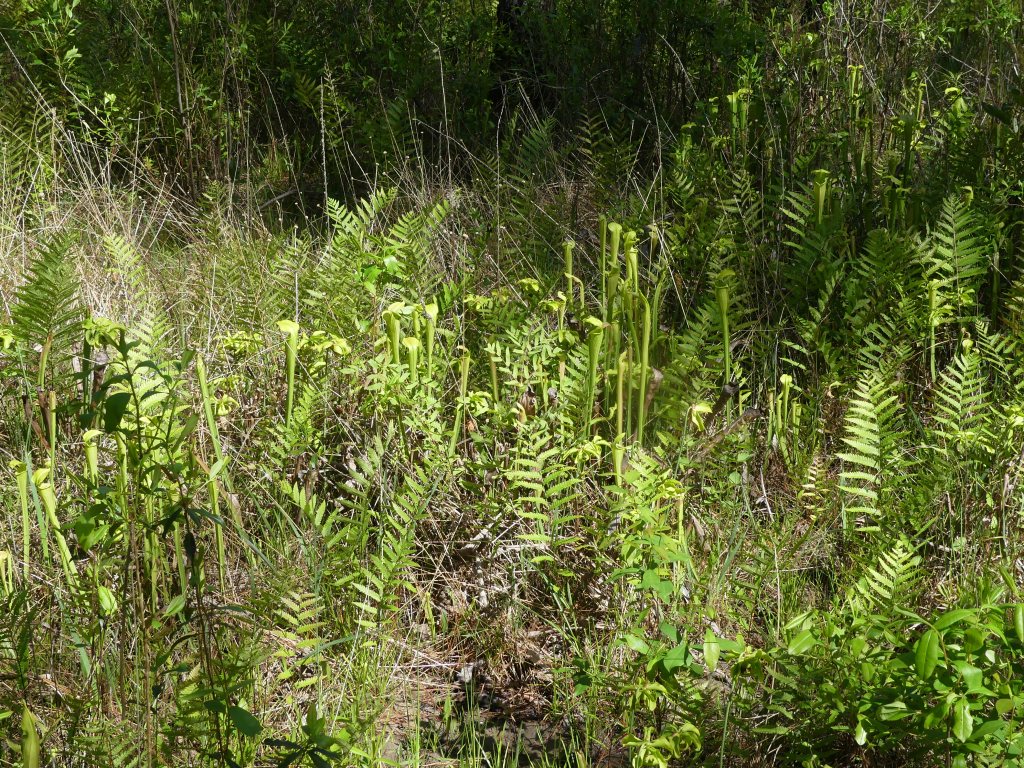
In the afternoon we visited the Hickory Creek Savannah Unit so that we could walk the Sundew Trail. This is a short trail through ecosystems such as the Pine Savannah Wetlands where scattered pine trees tower over several species of ferns as well as pale pitcher plants and sundews. In other areas, water seeps through thickets of azalea and other shrubs. The sundews are miniature ground-hugging plants with flat, reddish leaves covered in sticky hairs. When a small insect touches those hairs, each of which ends in a dab of glistening, dew-like goo, it is stuck and ultimately digested.

Sundew
The tubes of pitcher plants rising up from among the ferns

We walked along the boardwalk and stopped for a while in one of the more open areas to sit quietly and watch the floating, darting flight of dragonflies among the scattered pine trees. There was barely any noise from nearby roads, and so we enjoyed the quiet space within which bird song and breezes in pines sound so incredibly sweet.


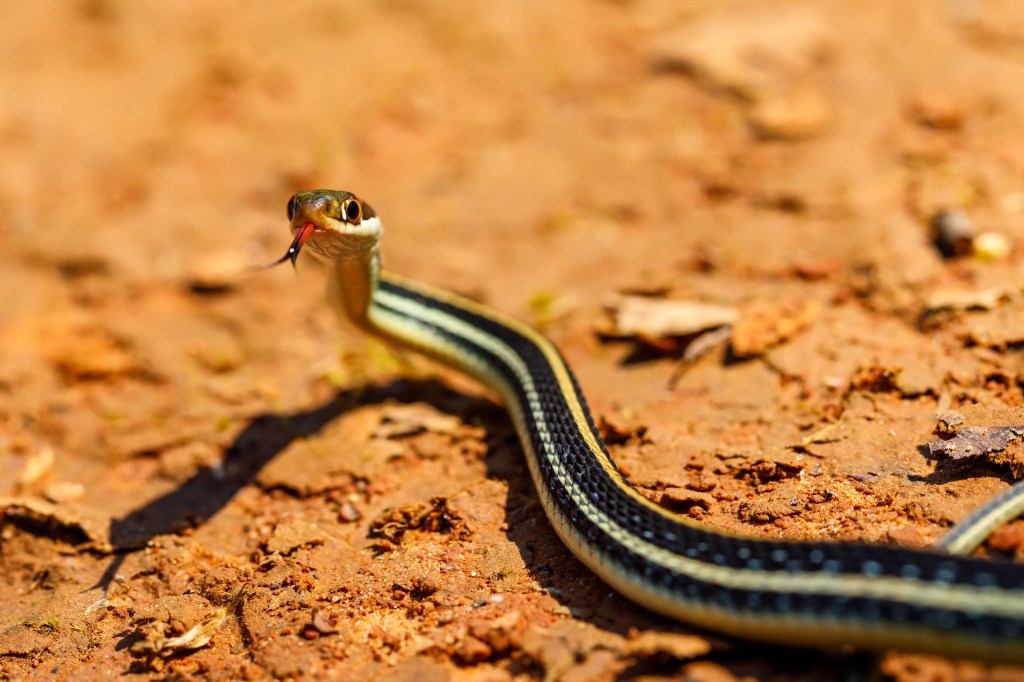
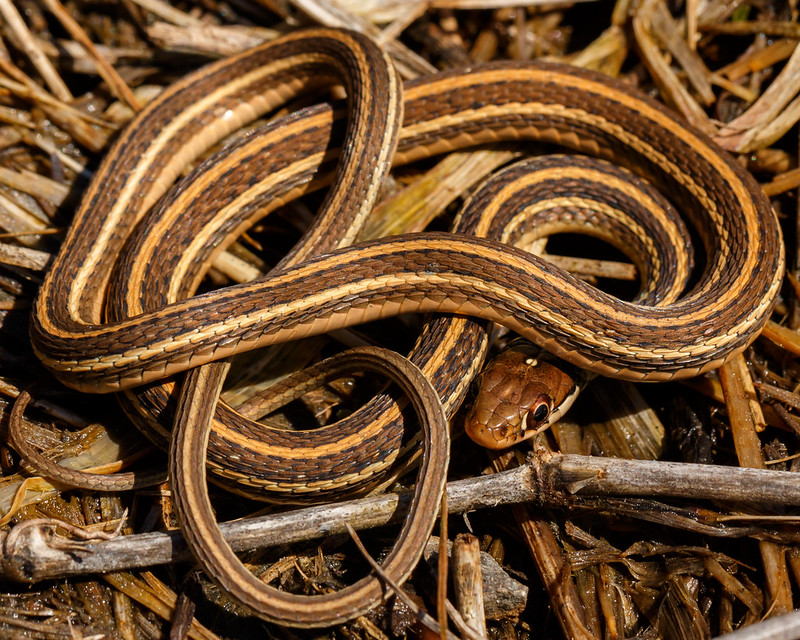
At the end of the day we wanted to see what reptiles and amphibians might venture out. Right away we found a young ribbonsnake, a common and beautiful species. Despite the cool night and nearly full moon, it was going to be a good night.

Western ribbonsnake (photo by Meghan Cassidy)

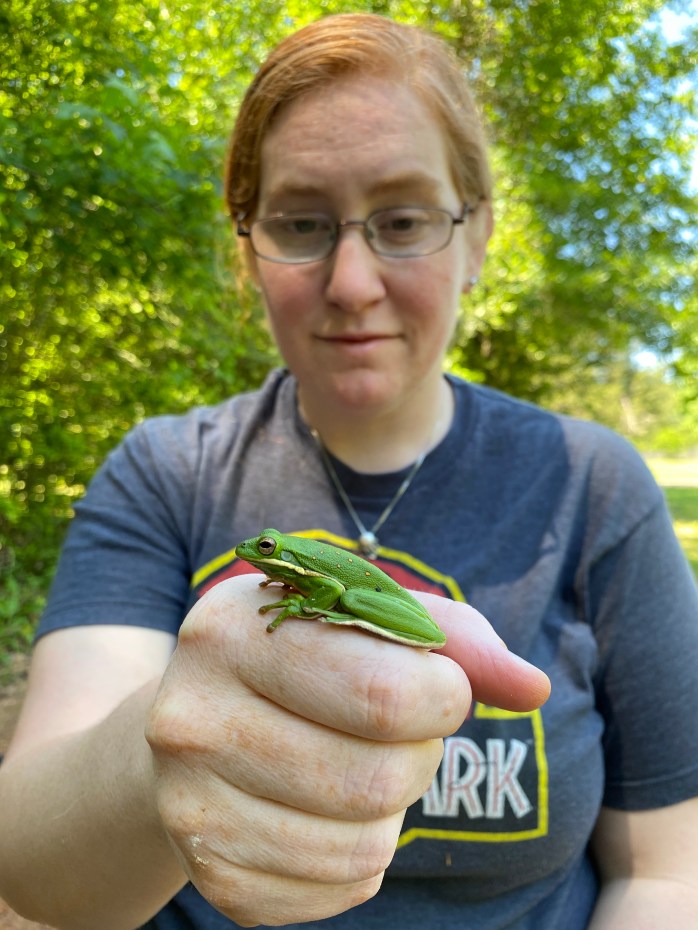
Frogs were calling again as we made our way along the sandy and muddy back road, east of the Preserve. We could have mapped the wetlands in the dark just by noticing where we found big choruses of frogs. Some of them were dominated by gray treefrogs, but in other places the dominant voice was that of the green treefrog. While the former is a slightly flute-like trill, the latter is a sort of repeated quacking. It seemed to me that it resembled a big, intense gathering of space alien ducks whose quacking was a little too metallic and nasal to come from a real duck. Never mind all that, it was once again mesmerizing to stand in the dark and let all that amphibian energy surround you.

An alien quacker (the green treefrog on Meghan’s hand, that is!)

Roadside ditches were filled with water from the previous night’s rain, and in places the water contained juvenile bowfin from nearby flooded creeks. These little fishes may have been part of the reason that snakes were out hunting the ditches. We found a young broad-banded watersnake and a juvenile plain-bellied watersnake swimming in the narrow waterway at the edge of the road. Then Meghan found a baby cottonmouth, reddish and banded in its juvenile coloration. They are often confused with copperheads (to which they are related) because of those wavy bands. Meghan aptly described the young cottonmouth’s bands as looking more “pixelated” than those of the copperhead, and they are somewhat more ragged-looking.

Juvenile cottonmouth (photo by Meghan Cassidy)

The last snake of the evening was a beautiful DeKay’s brownsnake, paler than we usually see in north Texas. This one was another reminder of how the more common snakes, even those without bright patterns, can be interesting and attractive.

DeKay’s brownsnake

Next morning, we re-visited the road to release animals we had held overnight for photos. We did not see more herps on the road, but did get to see some of the wetlands where frog choruses had been focused.

End of Winter, at the Coast

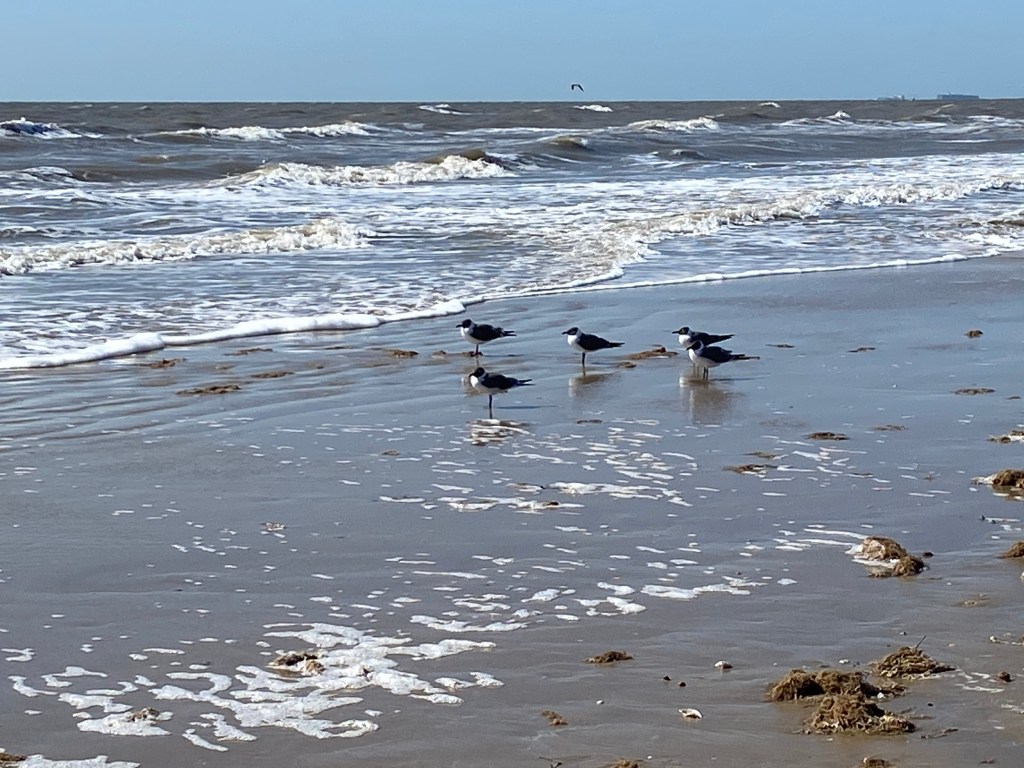
A cold morning beach on the Bolivar Peninsula (photo by M. Smith)

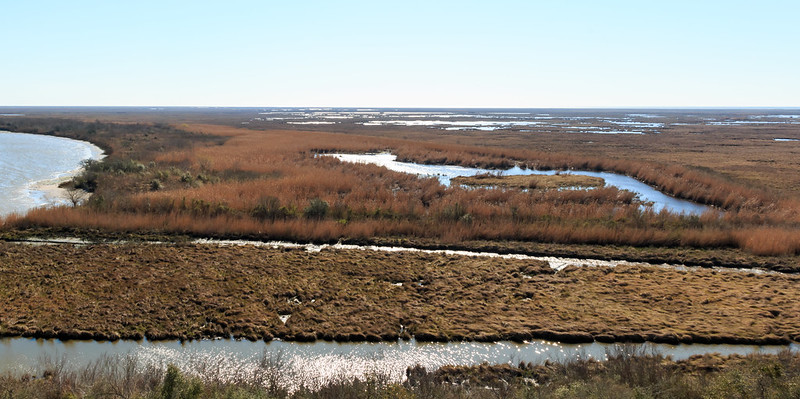
Meghan Cassidy and I traveled to the upper Texas coast the weekend of March 6, working on the book project about mindfulness in nature in Texas. I am posting a few preview photos and a little description of what Anahuac National Wildlife Refuge and Sea Rim State Park were like, here at the end of winter. Most of the photos here are mine (they won’t be in the book; I snap pictures but Meghan takes photographs on a whole other level!) and a few are Meghan’s.

From the High Island Bridge (photo by M. Cassidy)

It’s the end of winter if you count the seasons according to equinoxes and solstices. By that reckoning, we’re still in winter until March 20th, but that first weekend in March felt like the cusp of spring. The smallest wildflowers were beginning to bloom, and the sun was higher and stronger, to the delight of all the wildlife.

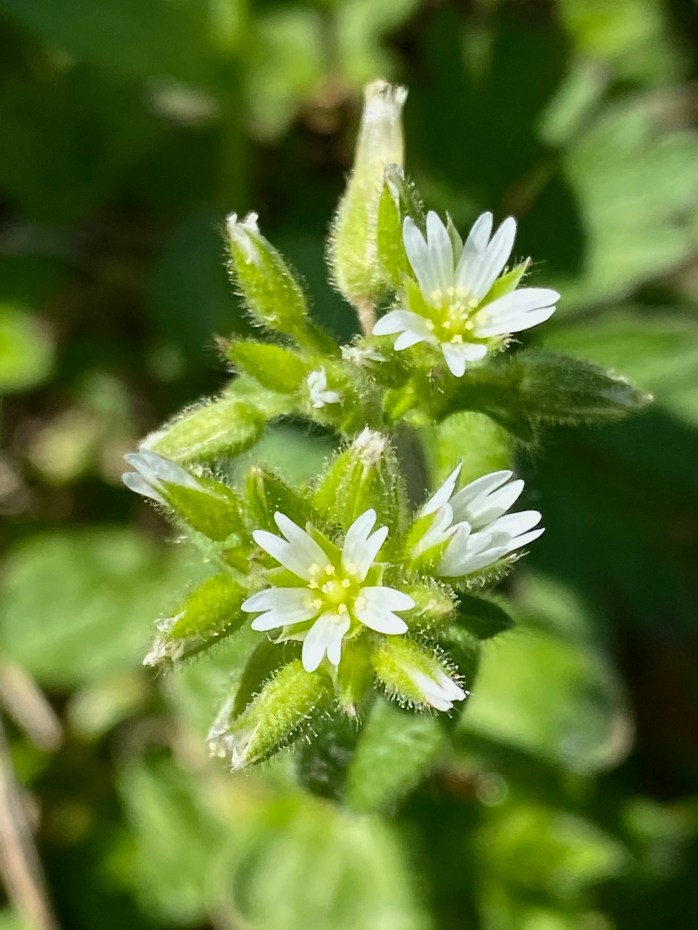
A humble plant with a fantastic name: Sticky Mouse-ear Chickweed (photo by M. Smith)

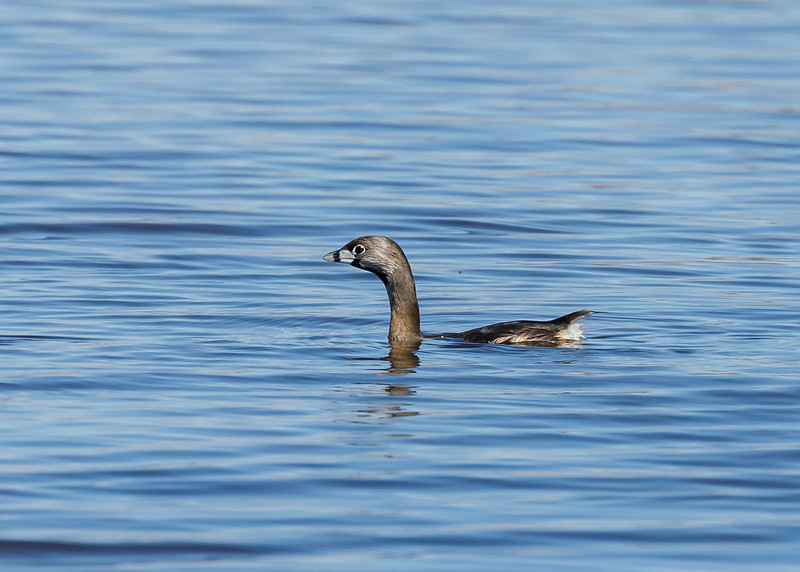
The bird population was busy and diverse. We saw White Ibis, American Coots, shovelers and other ducks and the occasional Pied-billed Grebe like the one below.

Pied-billed Grebe (photo by M. Cassidy)

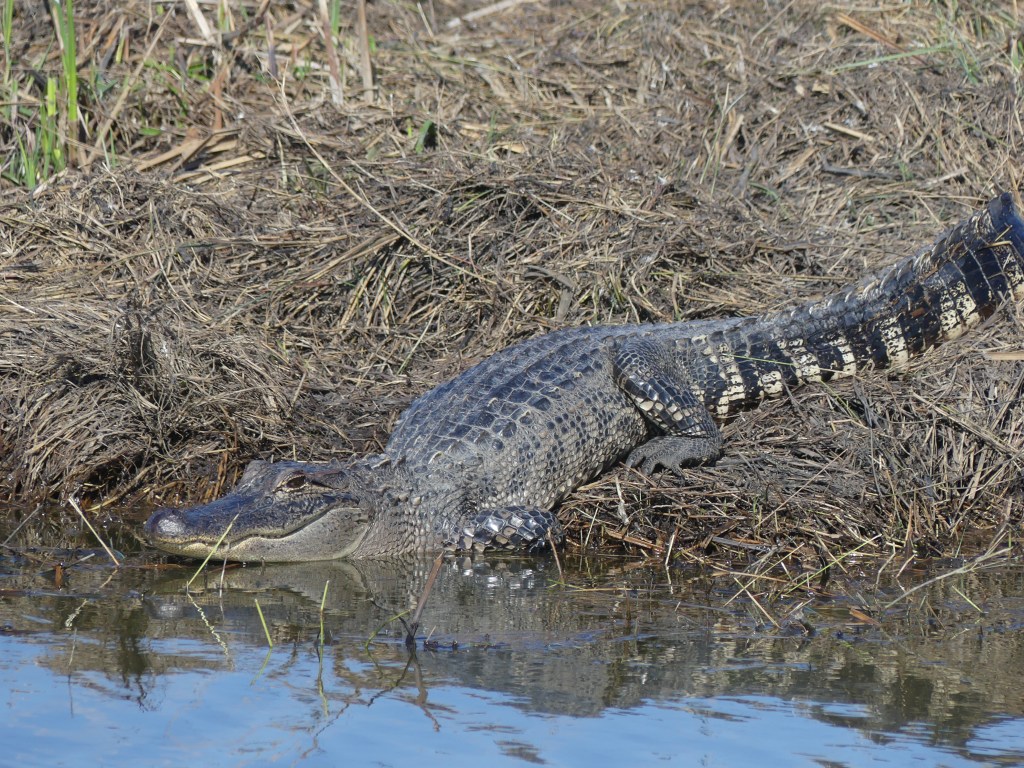
Anahuac is the first place where I saw American Alligators in large numbers, years ago on another early March weekend. They were out basking in the sun then and they were doing the same thing now, resting on the banks of waterways like inert statues. The alligators here seem to be accustomed to the many birders and naturalists who pass through without getting too close. Make no mistake, if disturbed they are capable of instantly plunging into the water to get away, or even charging a person if they harassed a ‘gator. And for short distances, they can move faster than we can.

American Alligator (photo by M. Smith)
Another alligator, re-entering the water (photo by M. Smith)

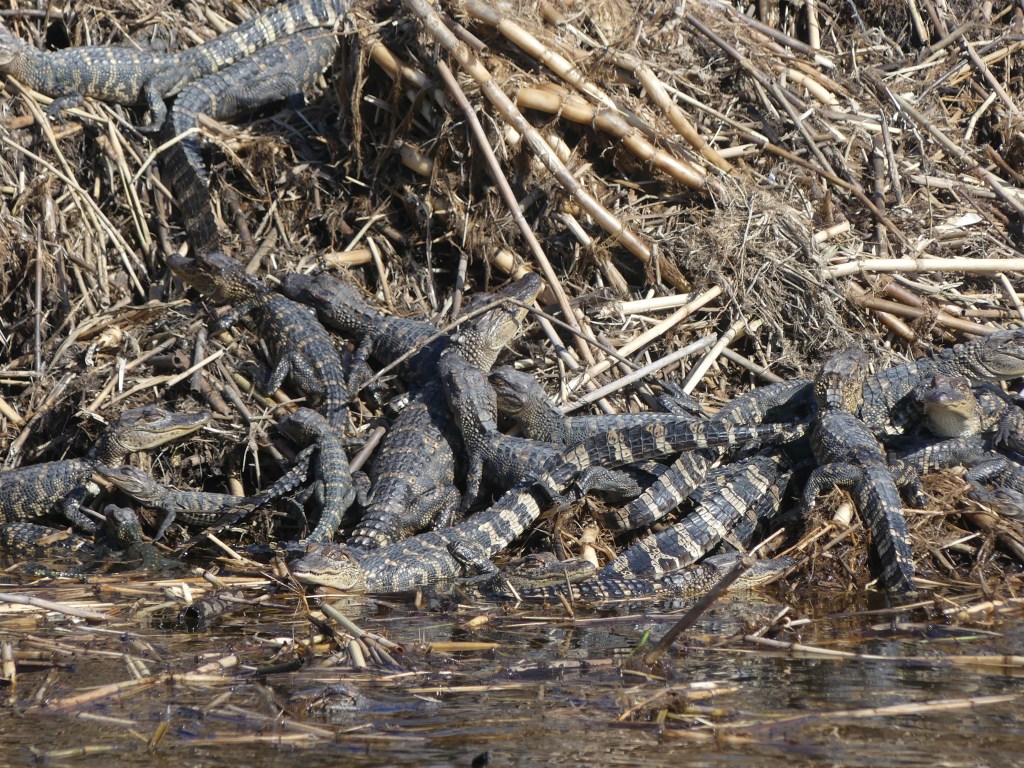
We came to a place where over forty young alligators were basking, piled on top of each other in many cases. Some were adolescents and some appeared to be last season’s hatchlings, so they were not one nest of alligators. I have described for the book what happened when a little water snake came cruising by and decided, through the worst decision making ever, to swim over to the edge right where the greatest concentration of little alligators lay.

The World Conference of Young Alligators, or so it seemed (photo by M. Smith)

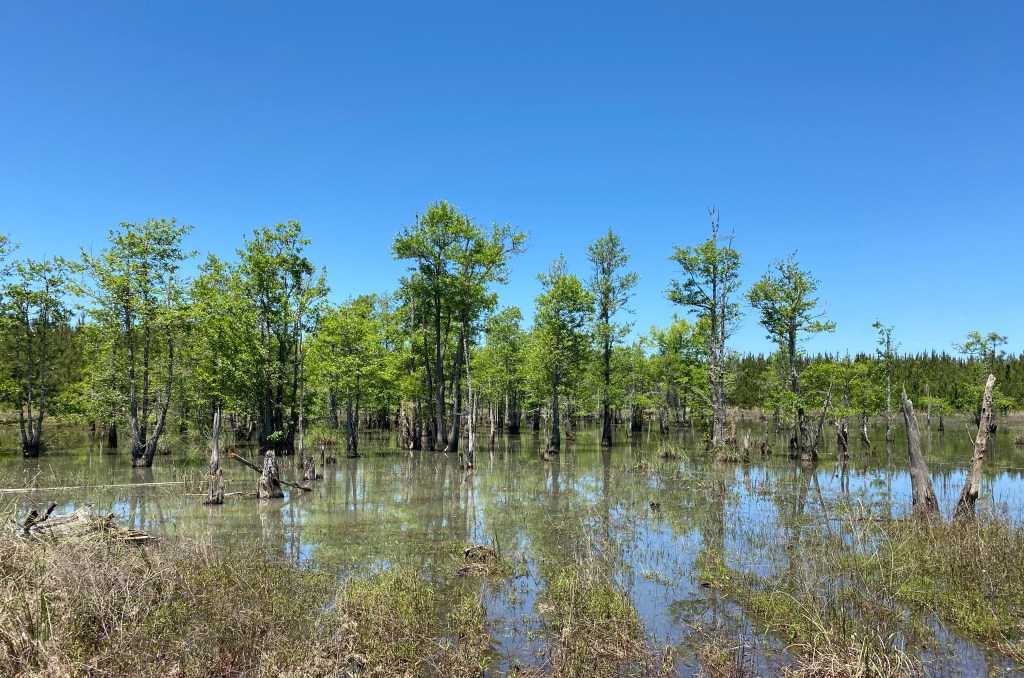
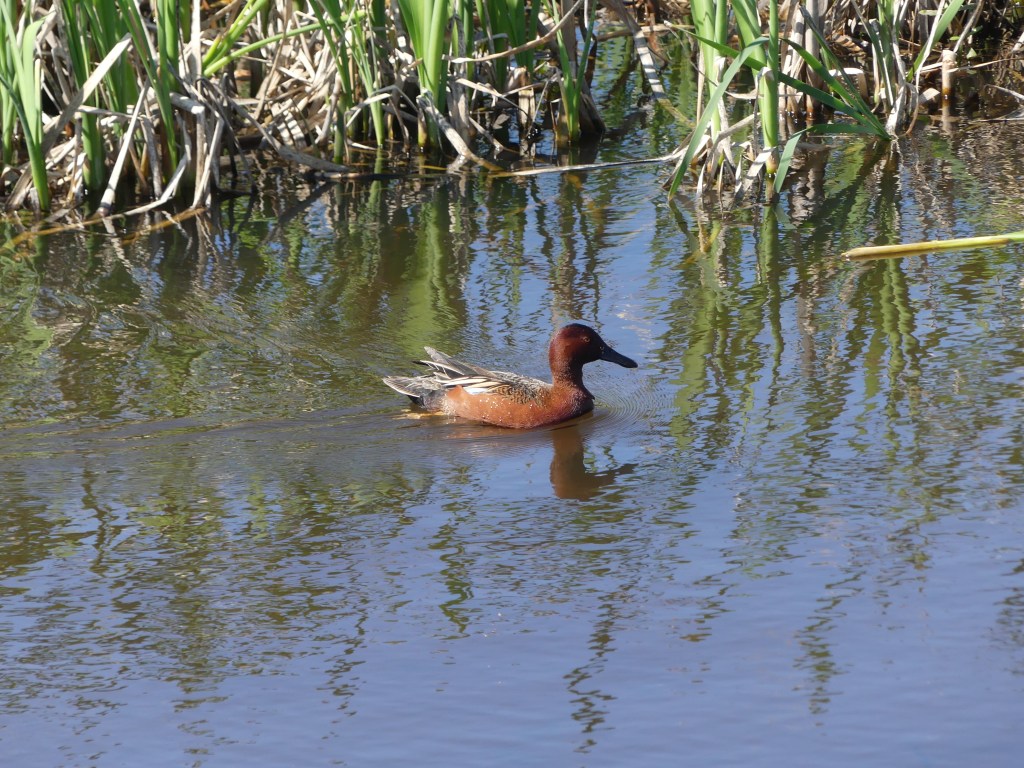
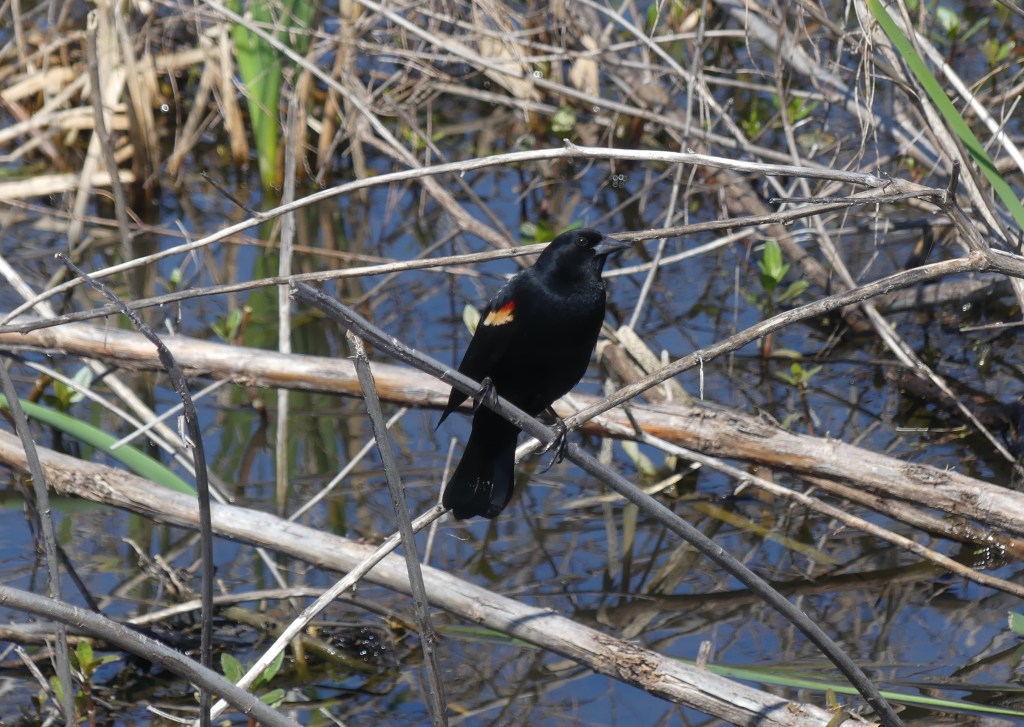
The boardwalk on the Shoveler Pond at Anahuac NWR is a wonderful place, extending over a marsh and ending with an observation deck. There was an amazing variety of bird life, including a Cinnamon Teal that swam near the deck for a while. Turtles were basking, Red-winged Blackbirds were busy among the reeds, and a couple of Mississippi Green Watersnakes basked very close to the boardwalk. Those were life-listers for me, as I’ve seen almost all of Texas’ watersnakes but not this one until now.

Cinnamon Teal (photo by M. Smith)
Red-winged Blackbird (photo by M. Smith)
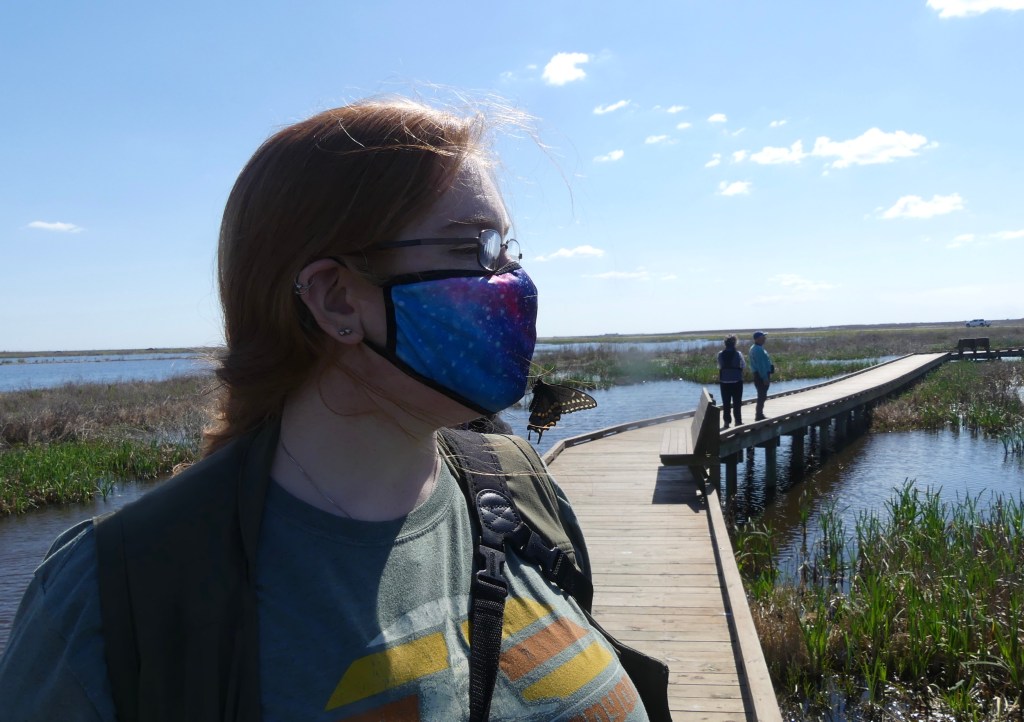
A swallowtail greets Meghan on the deck (photo by M. Smith)
A gar waiting in the shallows (photo by M. Smith)
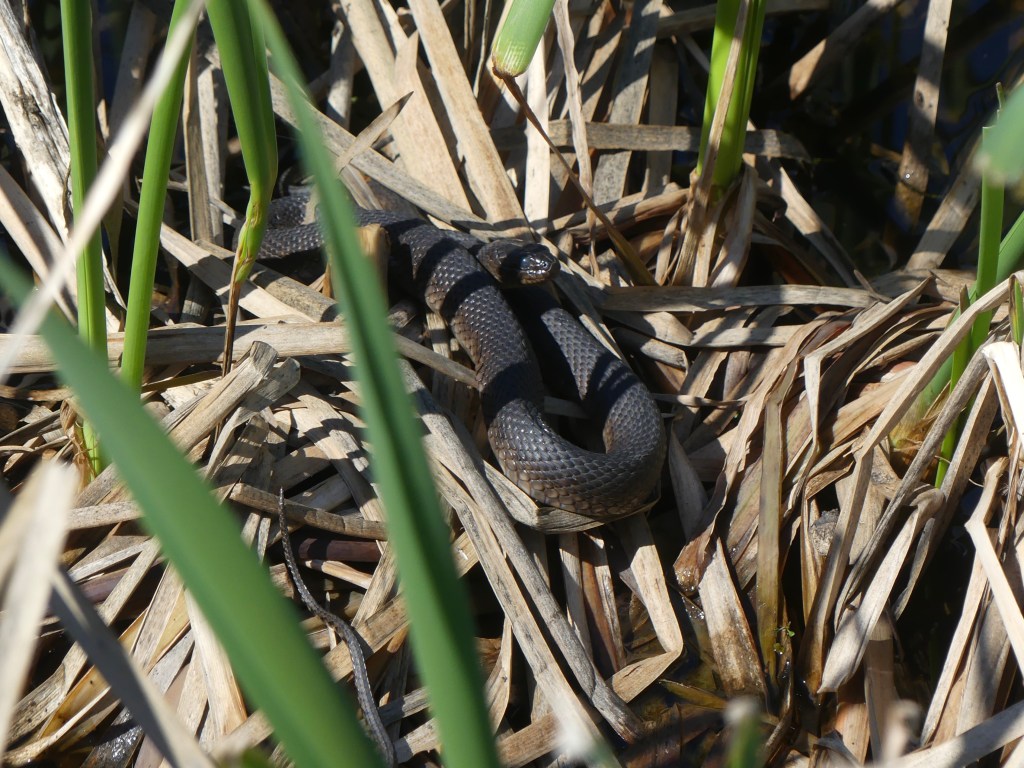
Mississippi Green Watersnakes – the tail of the second one extends up from the bottom of the photo (photo by M. Smith)

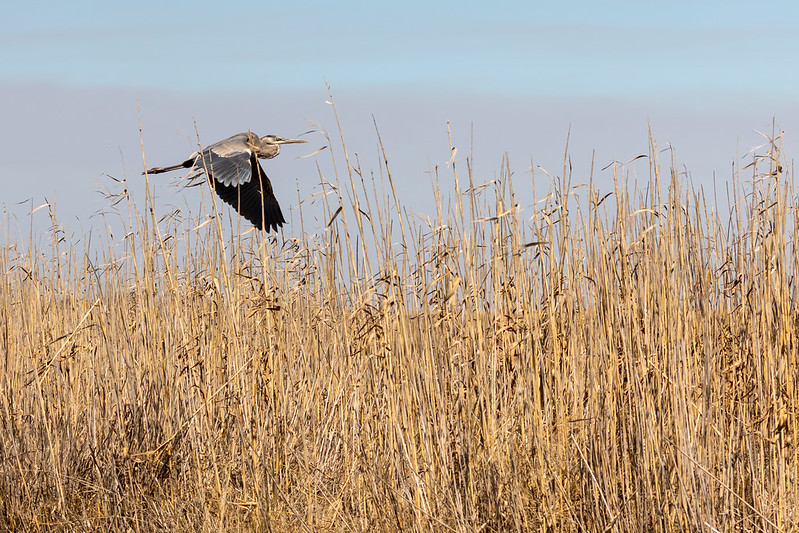
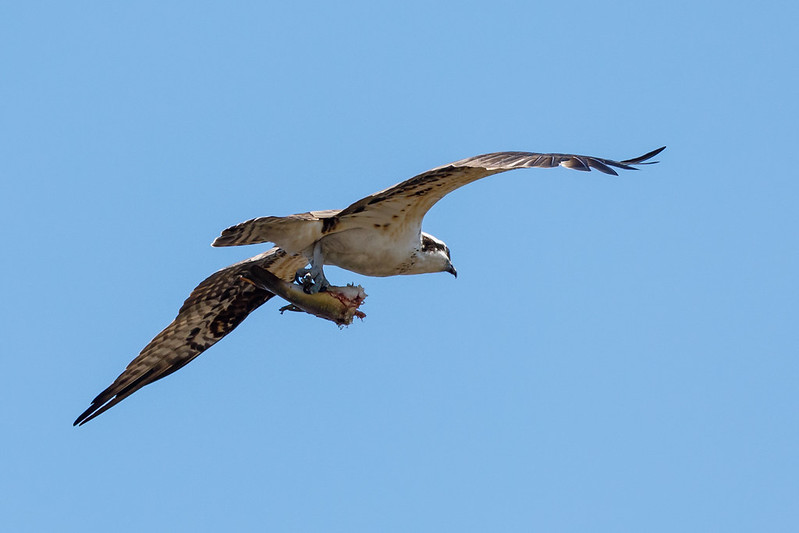
The Great Blue Herons were very common, and we spotted one that had just captured one of the local snakes. Meghan did get a couple of photos as it lifted off ponderously and flew away (that shot should be in the book). There were other larger birds such as an Osprey we saw in McFaddin NWR.

Great Blue Heron (photo by M. Cassidy)
Osprey with a half-eaten fish (photo by M. Cassidy)

There was a mindful component to all of this, staying in the moment and fully attentive to the experience. In the car (on the Shoveler Pond Auto Loop, for example) we weren’t driving around with the radio on and chatting about various things. There were periods of silence along with times when one might get the other and say, “look at that!” We spent the time absorbed in the experience of the sunshine, bird calls, wildlife, and the various textures and colors of the water and vegetation.

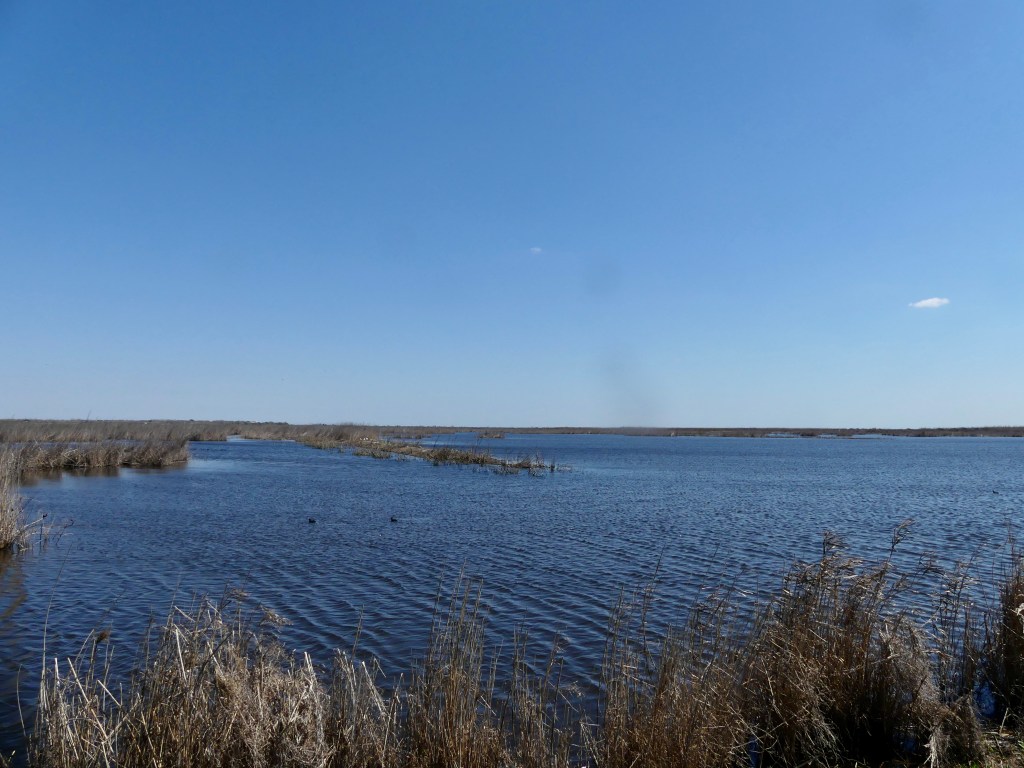
The varieties of blue in the water and sky at Shoveler Pond (photo by M. Smith)

One a drive near the beach, going to McFaddin NWR, Meghan spotted a juvenile Gulf Coast Ribbonsnake, and we were able to get some photos. Ribbonsnakes are always elegant and graceful, and I am a big fan of the brown and golden colors in the Gulf coast subspecies.

Gulf Coast Ribbonsnake (photo by M. Cassidy)

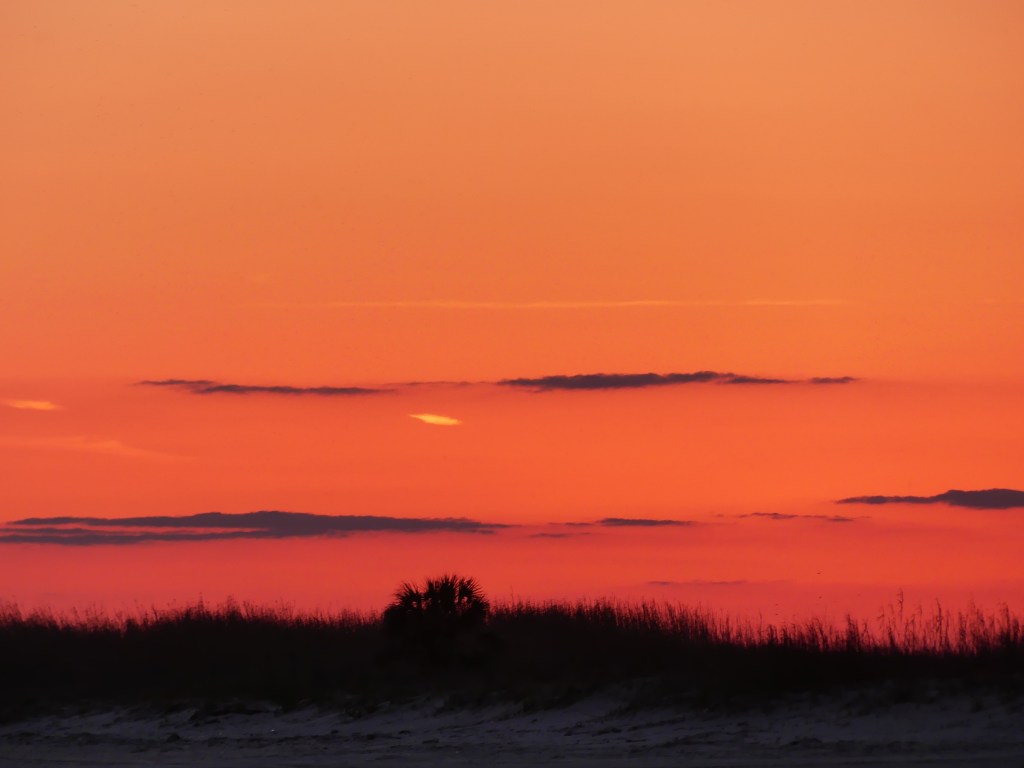
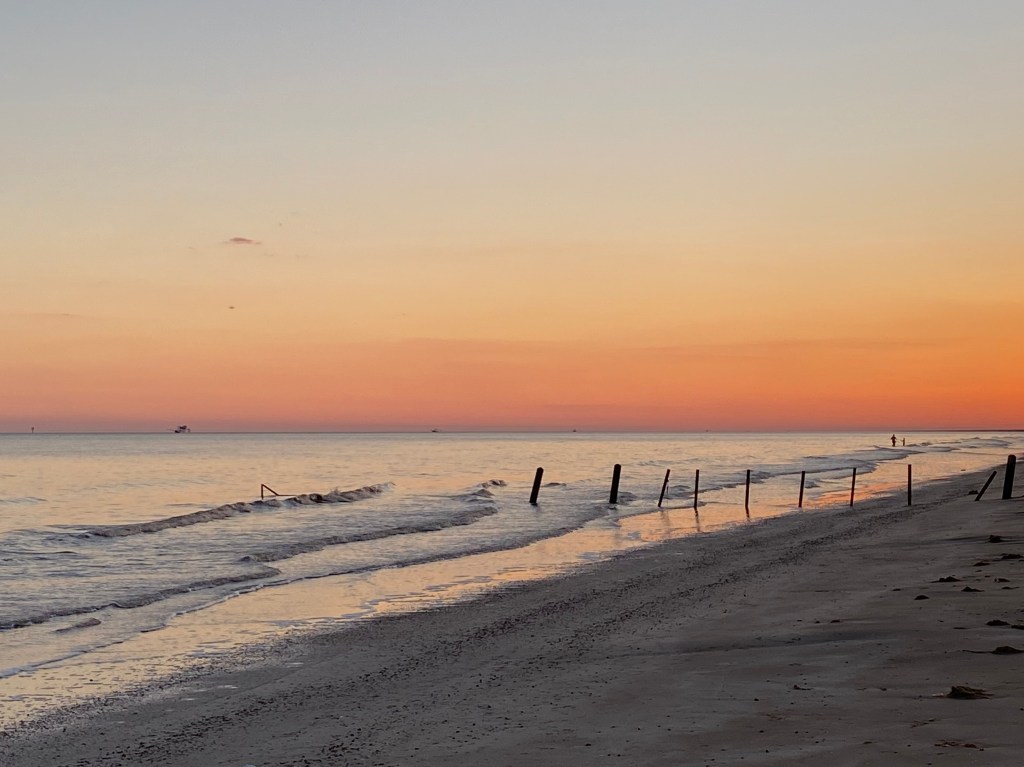
The beach at Sea Rim State Park, when sunset came on the first day, was memorable. The beach was nearly deserted, which is a gift in itself for someone who wants to experience the waves and sand in their full depth and breadth, without the cars, radio, and chatter. As the sun went down we saw a child far away, standing in the waves fishing. I began to think about the possibilities – what a child like that might carry with him or her from that day. A beautiful sky, the wild Gulf of Mexico, imagining some amazing creature that might appear at any moment on the fishing line. I hope that the adult who was there with the child provides many other days and nights when such magical experiences can occur.

The Undertaker’s Community Picnic

It was Monday afternoon, February 8th. The hours of broken clouds and sunshine were ticking away, and I made it to Fort Worth Nature Center & Refuge around 3:00pm. Faced with an array of good spots to choose from, I decided to walk the Cross Timbers Trail, which initially tracks the Trinity River before breaking away back into the woodland. I crossed the little bridge where the marsh reaches the river and kept going north. 

Bottomland at the refuge

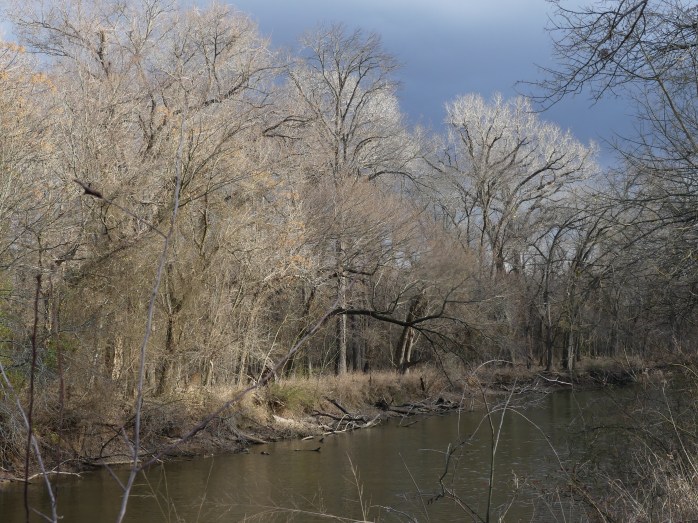
Along this stretch of river, the trail is at the top of a small levee, with some bottomland habitat to the west. Some of the huge Cottonwood and other trees are wrapped in climbing vines as big as your arm, crisscrossing the trunk and reaching high into the tree canopy to claim their share of sunlight. On the other side of the trail is the river, with forest beyond it. 

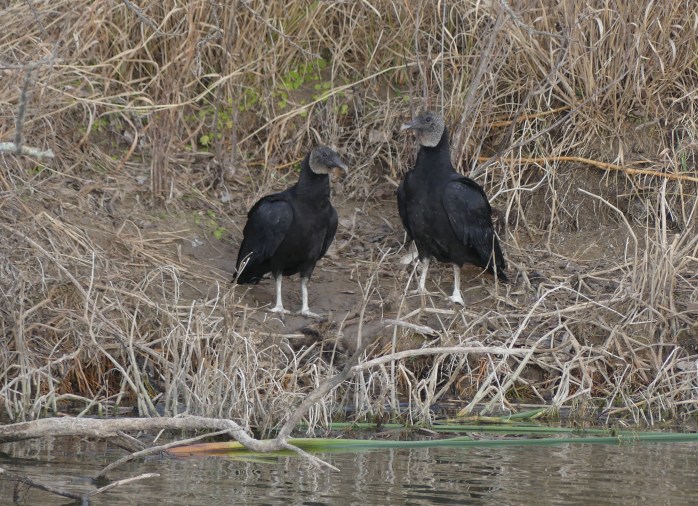
The east bank of the river was the site of a community picnic. Some of the participants watched from up in the trees while others shared the bounty on the ground. All were arrayed in black, a solemn picnic resembling a funeral gathering. Two of the black figures on the ground were focused on a small patch of two-toned fur that might have been the last earthly remains of a raccoon. This was a gathering in which the undertakers eat the dead. 

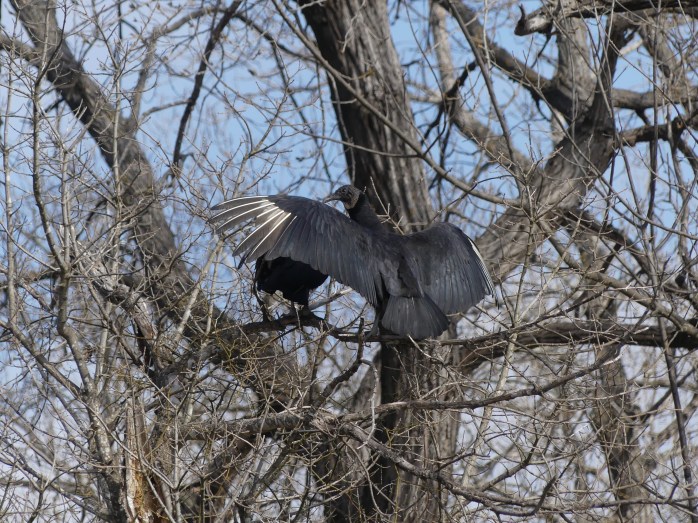
Black Vulture, warming its wings in the sun

These were Black Vultures, and they almost completely live up to their name. Even their bare heads are black, unlike the red heads of the slightly larger Turkey Vultures. A couple of the birds in today’s gathering stretched their wings to their full three- or four-foot reach, gathering the sun’s warmth. Those outstretched wings revealed six slightly dark-edged white feathers at the end of each wing, those first primary feathers like pale fingertips on a black bird. You can see them in flight, like a vague white spot on each black wing.

These are said to be very social birds, staying with mates for years and taking care of young for months after they fledge. They roost in community groups and those who have not found food can follow roost mates back to carrion. To quote Bruce Springsteen, “We take care of our own.” It’s family values with an aggressive tribal streak, as groups of Black Vultures are said to descend on a carcass and drive the Turkey Vultures back while they eat their fill. 

I walked on down the trail, seeing plenty of other birds. American Robins were searching for food on the woodland floor and flying up to low perches as I walked through. I could hear calls of Northern Cardinals periodically as males gear up for the coming spring. 

More bottomland

As the trail turned away from the river, it bordered a low area where water can drain toward the river, although at present it is all but dry. On the other side the land rises into Cross Timbers woodland. At the edge of the trail, two trees grew together in what looked like an embrace, one a Hackberry and the other a different kind of tree. They were entwined and seemed to be physically connected, two joined into one. 

The trees’ embrace

I soon had to turn around in order to get back before the refuge closed, and the clouds seemed a little heavier. Along the river, the late afternoon sun was shining so as to light up the bigger trees from a low angle. At one magical point, the sunlight made the top branches of the tallest trees glow, and against the darker blue-gray of the clouds behind them, those small curving branches were like silver filigree against the sky. The clouds shifted, obscuring the sun and the moment was gone. The experience stuck with me, one of thousands of such moments at this wonderful place.

A moment of sunshine

As I passed the site of the picnic, a few of the undertakers remained. I suppose virtually all of the banquet was gone, or at least I could see little of it. The vultures had done their job well, helping to return the dead back to the soil from which they came. 

the Acrobatic Flight of “Butter-Butts”

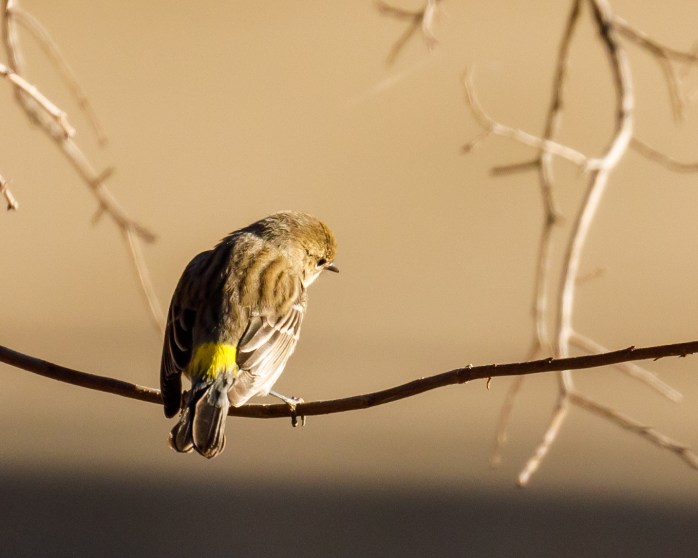
Yellow-rumped Warbler in Dallas County (photo by Meghan Cassidy)

Yesterday was sunny and clear, and Southwest Nature Preserve was the right place to take a walk. Its 52 acres are hemmed in by a major freeway and suburban development, and many visitors walk its trails and drop fishing lines into its waters. Despite all that, it’s a pretty resilient little remainder of the oak woodlands and sandstone that are the calling cards of the Eastern Cross Timbers.

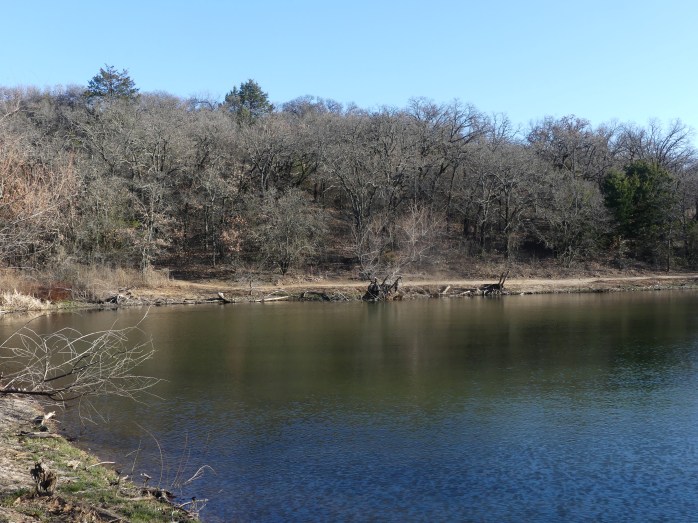
There’s something about winter-bare oak woodlands, with the sun shining through branches and lighting up the layer of leaves on the ground. And ponds, with clear water shading into a deeper gloom with aquatic plants and the waterlogged wood of fallen branches, hidden in the dark. Depending on where you stand, the pond’s surface may be a sapphire reflection of sunlight, and the surface may have shifting rough patches where cold winter breezes blow across it. Southwest Nature Preserve has those things. 

The north pond

It also has birds, and this winter there have been a lot of them. I have paid better attention, or this has been a season with good bird numbers and diversity, or both. And as a result, I’ve learned more about them this year, although I’m no expert. I’m also better able to put aside the old herpetologist’s habit of active searching. Instead of staying on the move, I can sit and blend in with the habitat for a while. Mindfulness and advancing age have helped with that.

I visited the smallest pond, expecting a little dried mud bowl because of the very dry conditions. Instead, it had several inches of clear water. As I watched, several small nondescript birds took turns flying out over the water. Often one of them would fly into the breeze and momentarily be held there, fifteen feet above the water, until it turned and in a ball of wind-splayed feathers it was pushed back to a nearby tree. 

I sat on the banks of the pond for a while, watching these birds and listening to their calls back and forth: a single “cheet” repeated frequently. In my binoculars I would see gray-brown on the head and wings, with white and dark wing bars, and then that little patch of yellow on the side of the body. When one perched on a nearby twig, the binoculars showed a highlighter-yellow patch of feathers on the rump, more than justifying the name “butter-butt” that some birders give them. More properly, they are Yellow-rumped Warblers.

Yellow-rumped Warbler half-hidden in vegetation

As I watched, my naturalist’s reasoning suspected that they were catching insects too small for me to see. I imagined them to be having fun, as if their forays out over the water might start with a call to their neighbor to “watch this!” Sometimes they found a place to perch very close to the surface of the pond, but mostly they flew out above the water and returned to the winter-dry stalks of vegetation or up into the branches of an oak. A later check with some birding sources, including Cornell’s All About Birds site, seemed to confirm that their flight would have been in pursuit of insects. I don’t think this negates my suspicion that they were enjoying themselves.

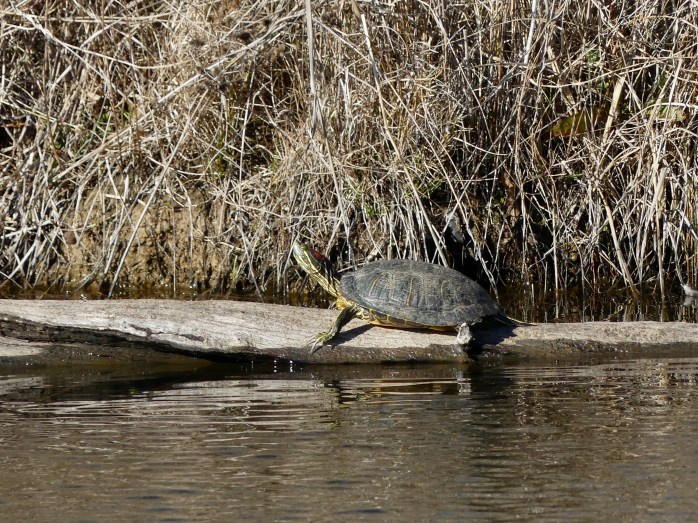
Red-eared Slider, basking at one of the ponds

There were other things to see on this sunny afternoon. In an adjacent pond, a male Red-eared Slider was basking on a log at the water’s edge, across from the fishing pier that extends out over part of the pond. He was unconcerned about my photographing him. In warmer circumstances, these turtles are shy and quick to drop into the water, but this guy was unwilling to give up the bright sunshine of a cool winter day.

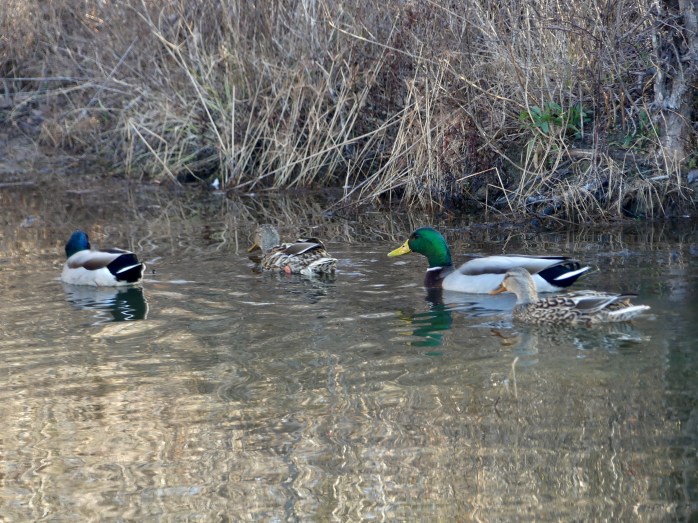
Mallards

Nearby, a couple of pairs of Mallards were cruising across the surface of a small pool, periodically going “tail-up” to dabble through the material along the bottom and extract whatever was good to eat. In contrast, there was no activity on the surface of the north pond, which often has its share of ducks and turtles. Today not even the cricket frogs were out, despite plenty of sunshine along the northeast banks of the pond.

It was a good day to wander along the ponds of the preserve and up over the ridge and through the woods. I learned more about its birds today and got to visit with the willows and oaks and pay my respects to the boulders and grasses. 

Late afternoon on the trail

Winter at the Refuge, with Birds

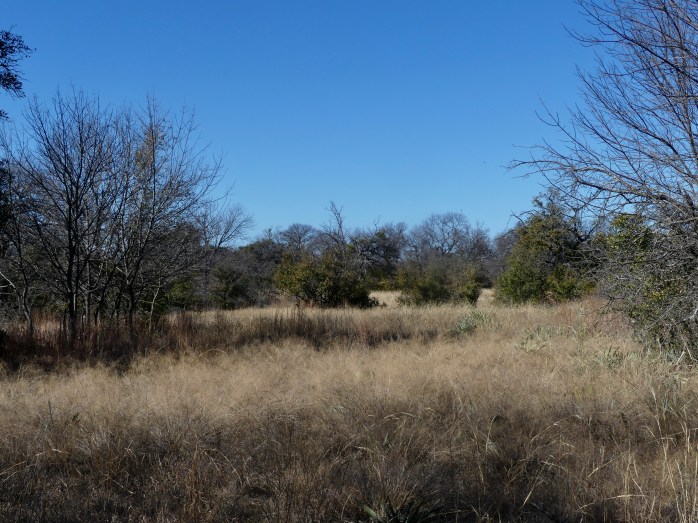
A savannah along the Canyon Ridge Trail

On a beautiful December 24th last year, I sat on a bench in a little pocket of prairie at Fort Worth Nature Center & Refuge, and wrote about it in this blog. This year the refuge seemed the perfect place to spend part of the winter solstice. With Barbara and her kids, I spent the afternoon up on the ridge overlooking the lake, and then at the marsh boardwalk just before sunset. Today, the day after Christmas, was a clear and warm day and I had to go back to that same bench that charmed me last year. And so, here are some notes and some photos of the refuge and some of the birds we saw there.

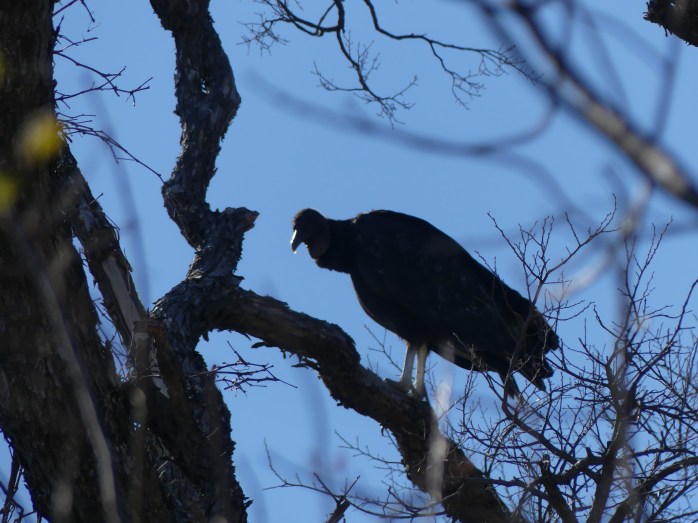
On the 21st, the first thing I saw was a group of vultures, apparently riding rising thermal air currents. My field notes included the following: 11:55am – There were numerous black vultures flying low through the area (the lake shore) and they converged over the water, were joined by a few turkey vultures – and 20 became 30 as they flew in a tight circle and gained altitude, working their way past Greer Island, high in the sky.

Black vulture

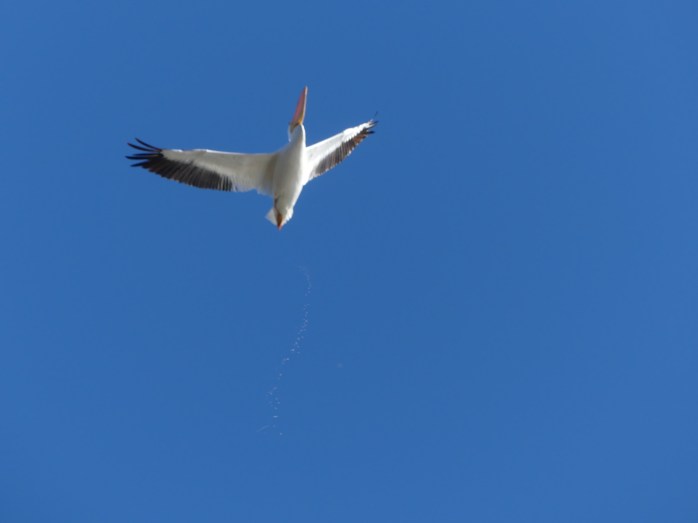
When the others arrived, we started our visit at Lone Point, the stone shell of a shelter built long ago by the Civilian Conservation Corps. It overlooks Lake Worth, and on this day it was a popular vantage point for more vultures. Below us on the water, and above us in the sky, there were American white pelicans with their black-edged wings and big pouched bills.

American white pelican
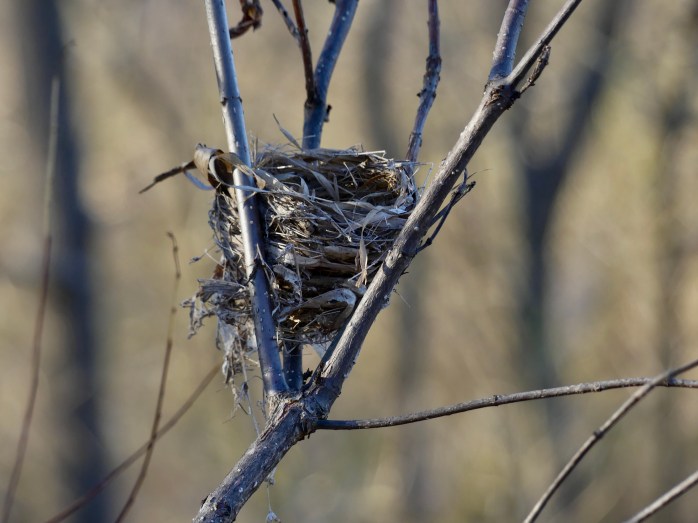
A nest from earlier this year, at the marsh boardwalk

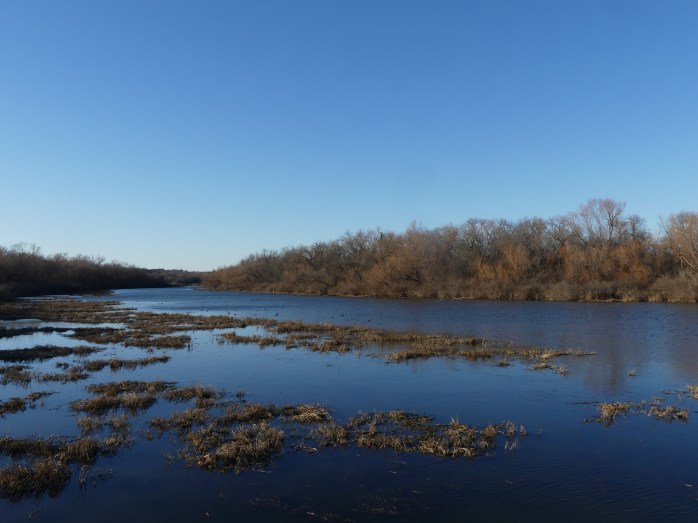
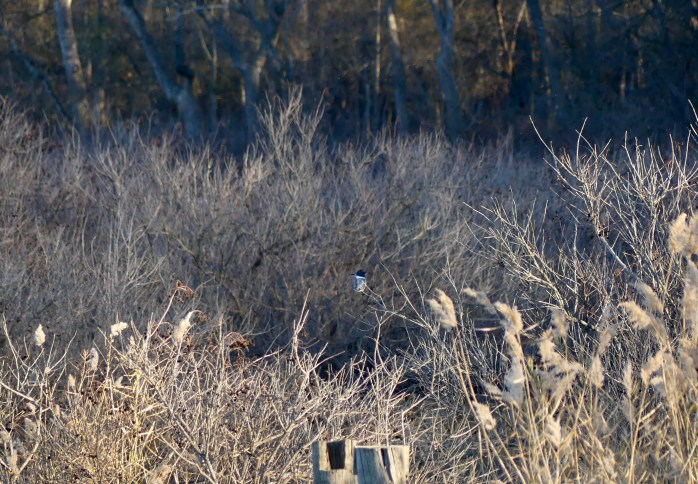
At the end of the day, the boardwalk and surrounding marsh were alive with many bird species. On the water there were American coots, mallards, American wigeons, great egrets, and a belted kingfisher that soared over the marsh and landed not far off, then flew further away before I could get a photo.

The marsh
A belted kingfisher in the distance

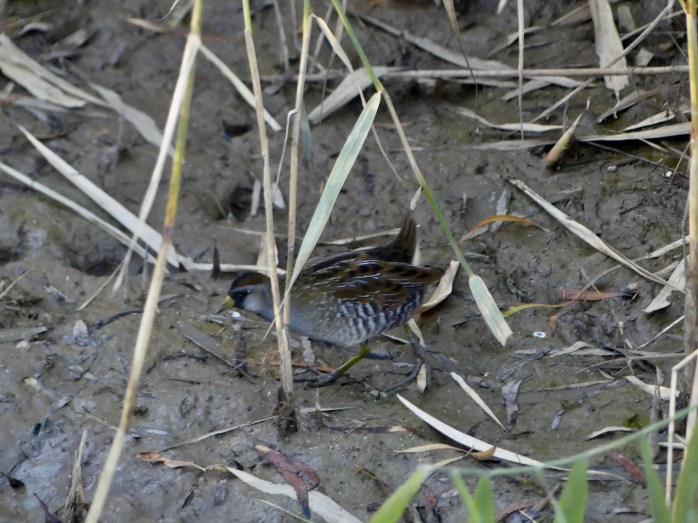
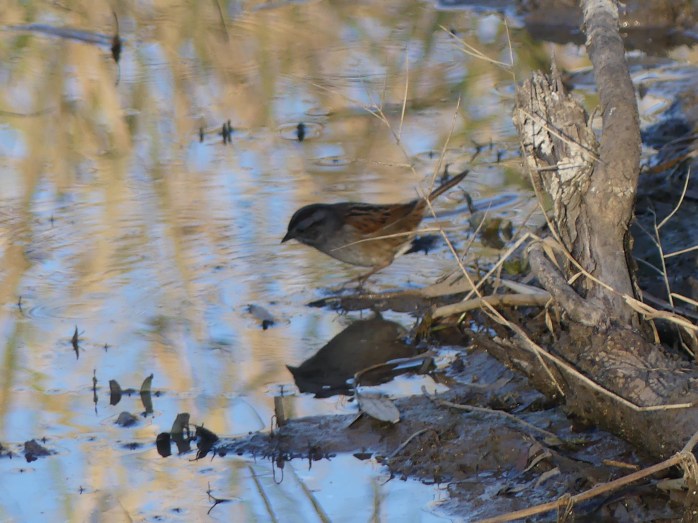
Closer to us, at the muddy margins of the marsh, we were amazed at the birds that kept popping up in front of us or down below the boardwalk. One species entirely new to Barbara and me was a sora, a secretive marsh bird that tends to stay among grasses and reeds looking for seeds and aquatic invertebrates to eat. There was also a swamp sparrow hopping around the water’s edge, and a common yellowthroat.

A sora
Swamp sparrow

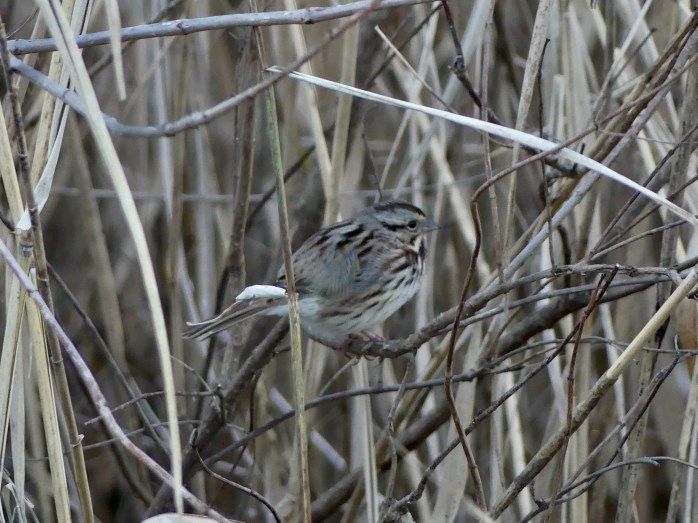
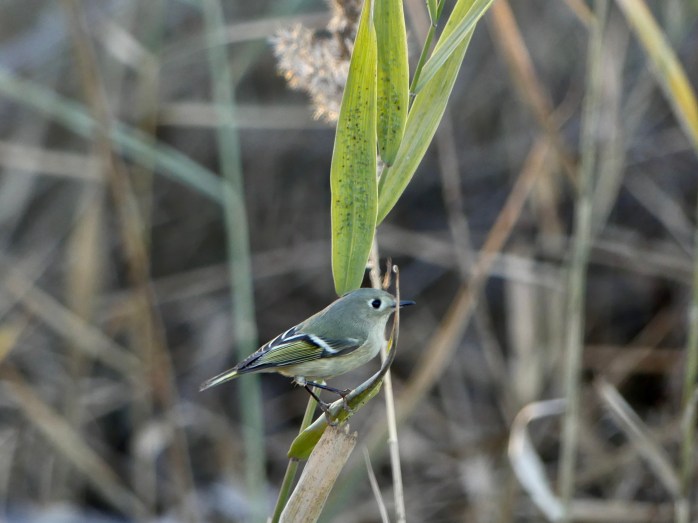
Higher up in the Phragmites stems was a handsome song sparrow, although the photo I was able to get hardly did it justice. And higher up, flitting among tree branches and the tops of the reeds, was a ruby-crowned kinglet. These are gorgeous little birds who don’t sit still long, although they’ll spend long enough at my suet feeder for me to get a good look, sometimes even seeing the little red patch of feathers on the crown of the head that gives them their name.

Song sparrow in the reeds
Ruby-crowned kinglet

When I returned after Christmas and four days into winter, once again it was clear and warm. I walked the trail up through woodlands to that spot where a live oak overhangs a bench that looks over a little patch of little bluestem grasses. It is one of several places I am strongly drawn to at the refuge. I got there a little after 2:00pm, and my field notes included these entries: It is breezy – even windy enough to shake the treetops in a sort of slow motion way. The bare tops of oaks and other trees stiffly swayed as if nodding greetings all around.

From the bench, looking north

It was still and the sun at my back warmed my shirt. And then the breeze would come, slightly cool, and making a rushing sound especially through the live oaks with their leaves intact. I could hear the breeze rolling through this part of the woods like a wave of moving air. It was otherwise as peaceful and quiet as I have found it to be before.

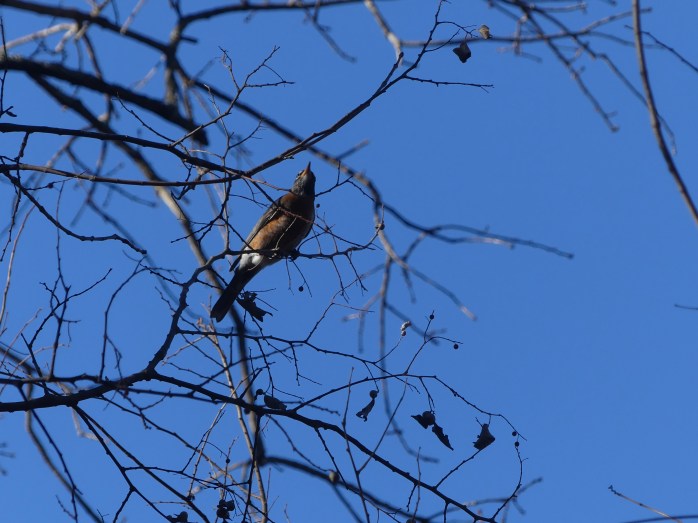
I walked back through some woodland to get a look at a favorite patch of savannah. As I walked through the woods, I saw the only substantial bird life of this day – birds that mostly included the American Robin, moving from place to place eating berries from vines and mistletoe.

American robin

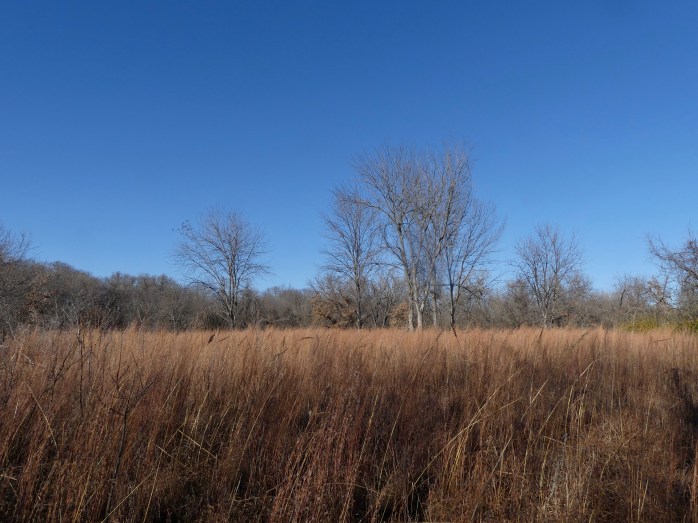
The savannah was beautiful, with waist-high prairie grasses such as little bluestem and split-beard bluestem.

Savannah

Wading a Winter Creek

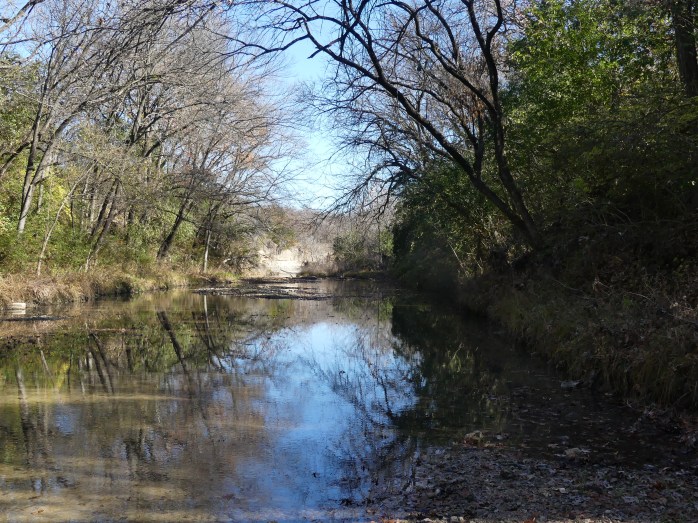
On a day when the temperatures reached the upper 70s, under bright sunshine, we took a walk and a wade through a cold creek, ten days into winter (using the December 1st meteorological beginning). It was delightful.

It probably seemed ridiculous to Barbara’s kids when we arrived at the creek bed and found much more water flowing than I had predicted. They followed me upstream a short distance until I reached a broad pool that would require serious wading. I volunteered to go ahead and see how deep it would be, and when it became thigh deep, frigid and numbing, I glanced back toward them. Barbara was gamely ready to give it a shot; Nicholas stood with his infectious grin as if to say, “you gotta be crazy.” Dani looked like she was figuring out how she could quietly slip back to the car. 

“OK, well how about downstream?” I asked, and everyone quickly assented. By the time we got back to our entry point, I could not feel my feet. Above the water was a different story. There could hardly be a more comfortable, sunny day as we made our way downstream over dry limestone rock and water only an inch or two deep. 

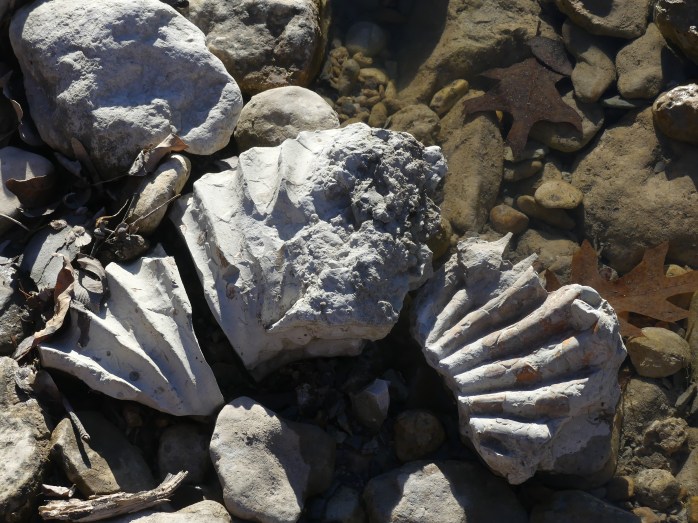
Fragments of ammonite (the piece on the right is a cast, not a piece of the ammonite itself)

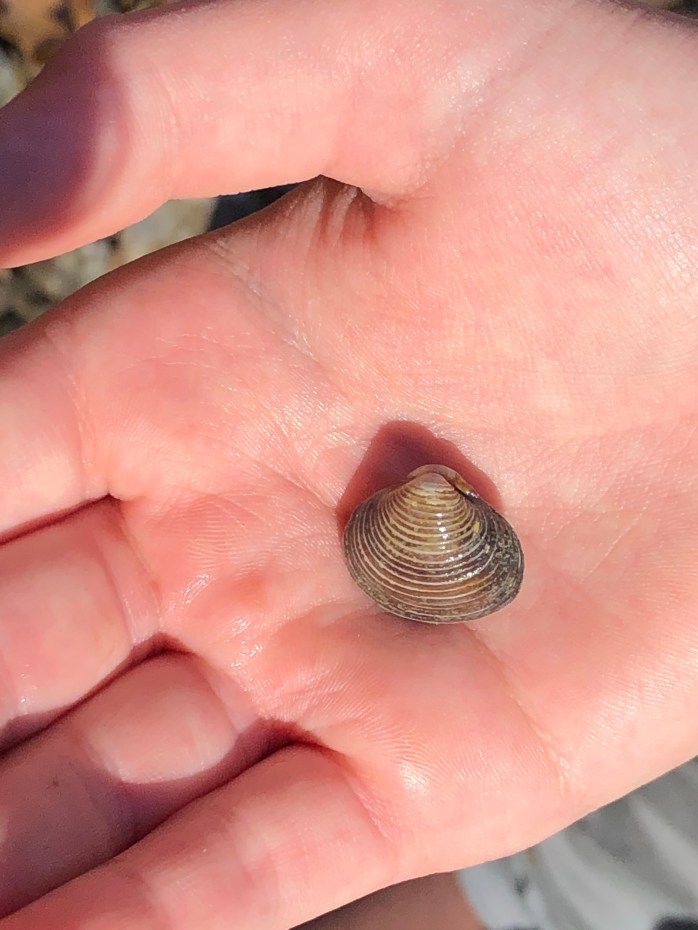
I talked about finding fossils in this white Cretaceous limestone, including echinoids (like sea urchins), conical snails, and ammonites. The most dramatic fossils are the ammonites with their ribbed, coiled shells resembling today’s nautilus and related to the squid or octopus. I rarely find intact ammonites but it is exciting to find even a portion of one. We soon found a fragment or two, along with some fossil oysters and other bivalves. Nicholas soon found a living modern bivalve, that is, a freshwater clam that a friend identified as a species originally brought here from Asia. 

The water got deeper, and that give me a chance to net up some fish for us to examine. What I netted were mosquitofish, a sort of minnow that often swims in groups searching for something edible on the surface of the water. I showed the others the little ones among the wet leaves in the net and mentioned one of the things that charms me about these fish. While they are basically colorless, when seen in the right light a blue color is evident. It might be a sort of iridescence, though it seems to come from within the fish. I noticed it when I first caught and kept them as a teenager – mosquitofish and I go back a long way – and it is still one of the first things I think of when I see them.

Throughout autumn the leaves fall, spinning and sailing down to the water’s surface where they become saturated and sink to the bottom. Bur oaks, beeches, red oaks and sycamores all contribute to a beautiful collection resting under the clear water. The pale silt from limestone and shale lightly dusts these leaves, making them the creek equivalent of a sepia-toned photo.

We found a place where the creek has cut straight down through sand and shale, forming a sort of wall. Some layers and spots erode more easily, so during floods the current has carved a shallow pocket into the wall, leaving a bench of gravelly soil that we sat on for a while. I wrote notes while Barbara sketched sections of ammonite and leaves. Dani found a comfortable place in the sun. 

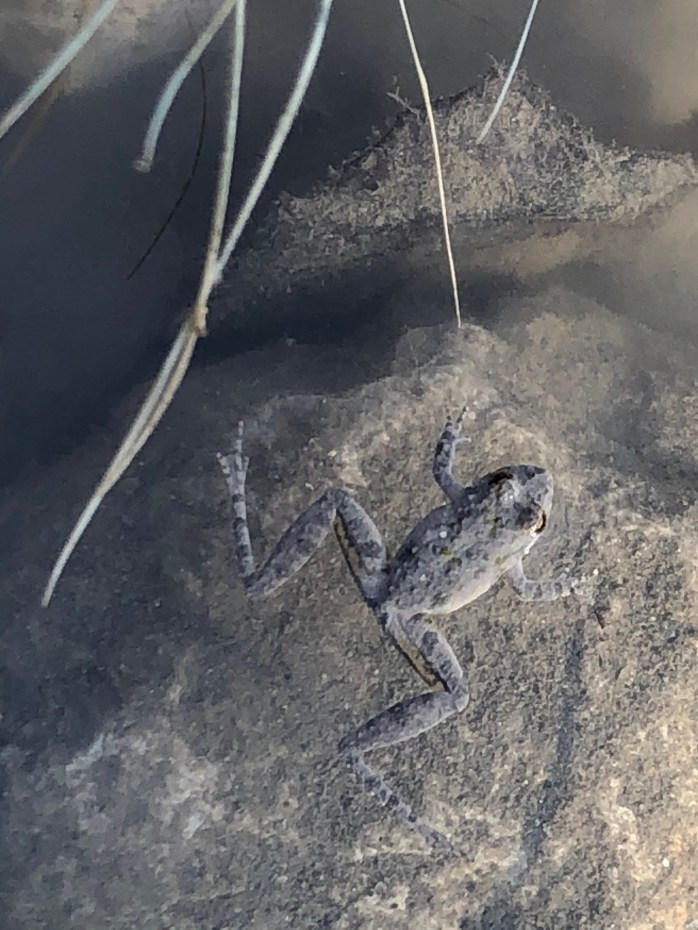
As Dani enjoyed the sunshine, the rest of us waded further downstream. Because it was sunny, the cricket frogs were sitting at the water’s edge, waiting to ambush tiny invertebrates to eat. These thumbnail-sized frogs may seek shelter when it’s truly cold and when it’s overcast or raining, but otherwise they are active year-round in our area. In summer they seem impossibly fast, jumping into the water and swimming to some place of concealment almost faster than your eyes can follow. Today their “cold-blooded” metabolisms could not generate that kind of energy. 

A Blanchard’s cricket frog floating in the water

Nicholas caught a couple of cricket frogs by hand, a pretty cool trick in summer but much easier today. When one slipped away and jumped into the creek, it hung in that clear, numbing cold water and floated over the rocks and leaves of the creek bottom. A few minutes later it would be sunning on the creek bank and hoping for a little hunting success.

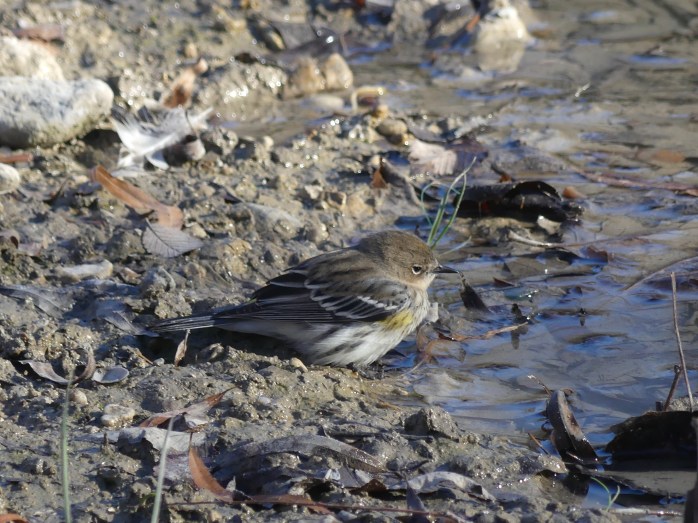
Further down the creek, Nicholas spotted a small bird getting a drink at the water’s edge. It dipped it’s slender beak into the water a couple of times and soon flew away. I got a good photo but struggled to know this bird’s identity, but with the help if iNaturalist I found that it was a yellow-rumped warbler. The narrow beak, a bit of a white ring around the eye, and the wing bars helped, but there was only a suggestion of a yellow patch on its breast. It turns out that in its winter plumage, there’s not a lot of yellow to be seen, and this bird’s position obscured whatever yellow may have been evident on its rump. 

Yellow-rumped warbler

There were no clouds in the sky, and in shallow riffles the sun and water created the most beautiful patterns of light. Each ripple in the water focused sunlight onto the pale limestone creek bottom in a shimmering, dancing line. Sometimes they moved in the direction of the current and they swirled when the water was disturbed as it passed through troughs and over stones. At times through some trick of the light they seemed to move back against the current. It might be a small and ordinary thing to watch what the bright sunlight creates in clear, moving water, but it was a wonderful gift today.

And then it was time to head back. This creek has been such a treasure over the fifty-plus years that I have visited it, and I look forward to seeing another spring there when the new green growth and spring rains transform it into one more wonderful version of itself. 

Embracing the Cold, Looking for Solitude

Today was cold and cloudy. Not bitterly cold, but there was a sort of damp chill underneath the deck of gray clouds that made you pull your jacket close around you. I wanted to get out for a while to somewhere pretty close by and so I chose Oliver Nature Park in Mansfield. It is 80 acres situated alongside Walnut Creek a little distance upstream from Joe Pool Lake, much of it oak and juniper woodland, a little island of nature within the city of Mansfield. And Mansfield is just one of several varieties of sprawl; Arlington, Kennedale, Grand Prairie, and Cedar Hill, spreading southward from the Dallas-Fort Worth metroplex. There are a few islands of nature embedded within those cities, all of them much needed and all of them too small.

From the observation platform

I climbed up the hill to an observation platform overlooking Walnut Creek, passing a jogger or two along the way. Once on the platform, you look down through oaks, cedar elm and other trees to the creek as it winds along past a few slabs of rock. It could be a good birding overlook or just a peaceful place to sit as if perched in the tree canopy, but it also places you within mostly unobstructed earshot of a nearby street. On that street, someone was doing their best to get noticed, loud and powerful. A motorcycle engine wound up higher and louder, speeding in one direction and then coming back. It was time to move on. 

I waited for a family to pass by before starting down the path, and was approached by a very nice woman who told me I looked like I might be a birder. I did my best to speculate about what kind of bird she may have seen, and told her about iNaturalist, which will be much more helpful than I was able to be. I was awfully glad she talked with me. Isn’t that the sort of community that I believe is ideal, people interacting face to face to share and learn about the natural world? But everywhere I turned, there were people. I stepped around a photographer taking a photo of a girl on the boardwalk, and hurried along to stay ahead of a group of people headed my way. Solitude was definitely escaping me today. 

Honey locust

Further along the boardwalk, there was the roar of a big plane on approach to DFW airport to our north. Right, I remembered, we are just about due south of the airport, on the southern approach to the runways. It’s just the way it is. There is no quiet place in the metroplex. But there were still treasures to see, like a big honey locust tree whose curled and twisted seed pods had mostly fallen. The trunk with those clusters of spikes, and dark reddish-brown spiral pods still clinging here and there, attracted me. And in places there were clusters of oak leaves turning beautiful bright red.

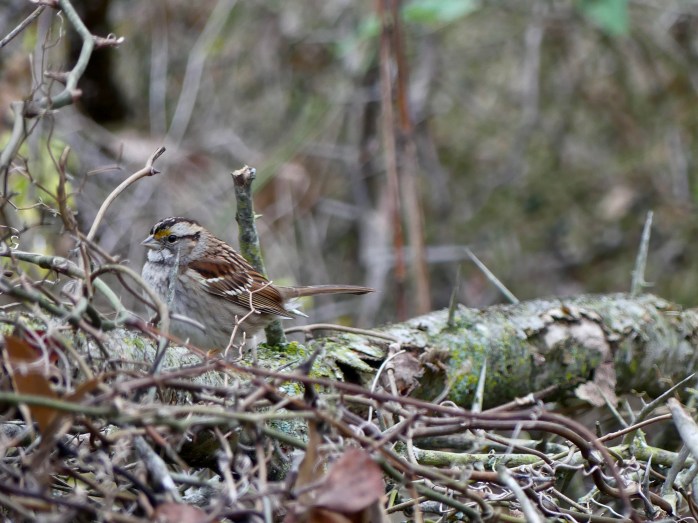
The farthest section of the park had the fewest visitors. Near a couple of bird blinds a group of sparrows was flitting from ground to low branches in a tangle of vines and understory. That woman who approached me earlier was right – today I was a birder. No self-respecting spiny lizard or ratsnake would be prowling around on this chilly 50-degree day, but crows had been calling to each other and now these little sparrows where challenging my naturalist skills. I got the best photo that I could of what turned out to be white-throated sparrows.

White-throated sparrow

This group appears to have behaved quite typically, foraging near the ground in a brushy area, with one positioned higher in a tree sounding the alarm as I walked up on them. They eat seeds as well as small fruits and insects. According to the Cornell Lab’s All About Birds site, white-throated sparrows are abundant but have declined over the past fifty years or so. 

My walk continued, among the many others using the park. At one point as I was engrossed with a group of doves in a nearby tree, about to take flight, I was startled by crunching on the trail and turned to see a jogger pass me. I had to hurry to stay ahead of a family group in which a child was repeatedly screaming (in annoyance rather than distress, apparently). The situation in the park today is one likely to trigger in me a good bit of cognitive dissonance. I write, give talks, and lead interpretive walks with the goal of sparking a love of the natural world. Most of these people were presumably there out of some sort of love of nature, not in my nerdy and introverted manner perhaps, but they wanted to get outside at a nature park on this cold autumn day. That ought to be worth celebrating.

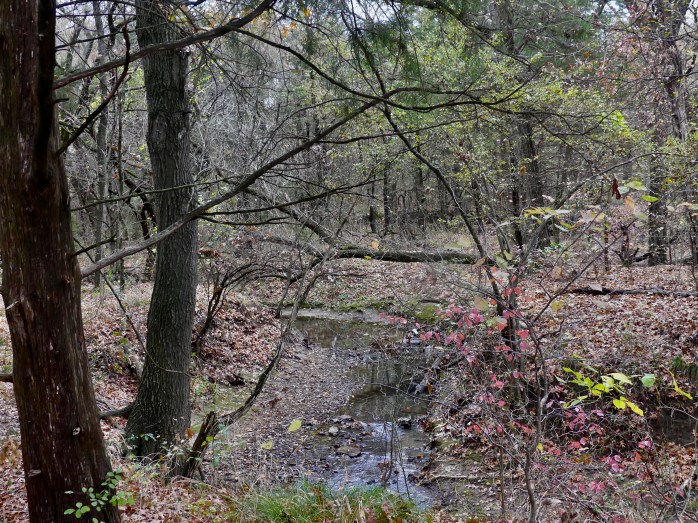
A tributary stream within the woodland

We need more and bigger places. Urban preserves and parks are full, especially during this past year of pandemic, to the point where it can be hard to stay socially-distanced. People blaze networks of unauthorized trails, contributing to erosion and leaving hardly any refuge in which wildlife can feel safe. What if this park and other small urban preserves were at least twice as big? Visitors would not be bumping into each other and the birding and wildlife watching would surely be better. And for people like me, who want to get lost somewhere with no one else to be seen or heard, to experience solitude and quiet, it would be heaven.

Autumn at Eagle Mountain Park

Today I walked a rolling patch of Cross Timbers woodland at Eagle Mountain Park, to the Ridge Loop Trail. The numerous other walkers and joggers reminded me that this was no unusual accomplishment, but the 3.8 miles I walked and climbed today is a sort of extension of my cardiac rehabilitation. In fact, I went to rehab this morning, doing exercise that was much less demanding than the afternoon’s walk. A month ago I was grateful to take a short walk at Southwest Nature Preserve, so today is progress.

Some of my motivation was provided by my companions, Barbara and her kids, Dani and Nicky (see Orb Weavers and Quiet Conversation). When the two of them took a short cut up a steep hillside, I figured it was do-able and charged up after them. I needed to catch my breath at the top, but did OK. And they’re bright and curious, giving me a chance to pass along some of what I know about nature. Both found some red fruit on a prickly pear cactus and wanted to try eating them. Nicky managed to pick up one of these tunas, and I told him how I’ve wanted to skin one and eat it, but instead I always manage to get those glochids, the tiny spines, stuck in my skin and feel them for days afterward. Maybe I helped him avoid that experience.

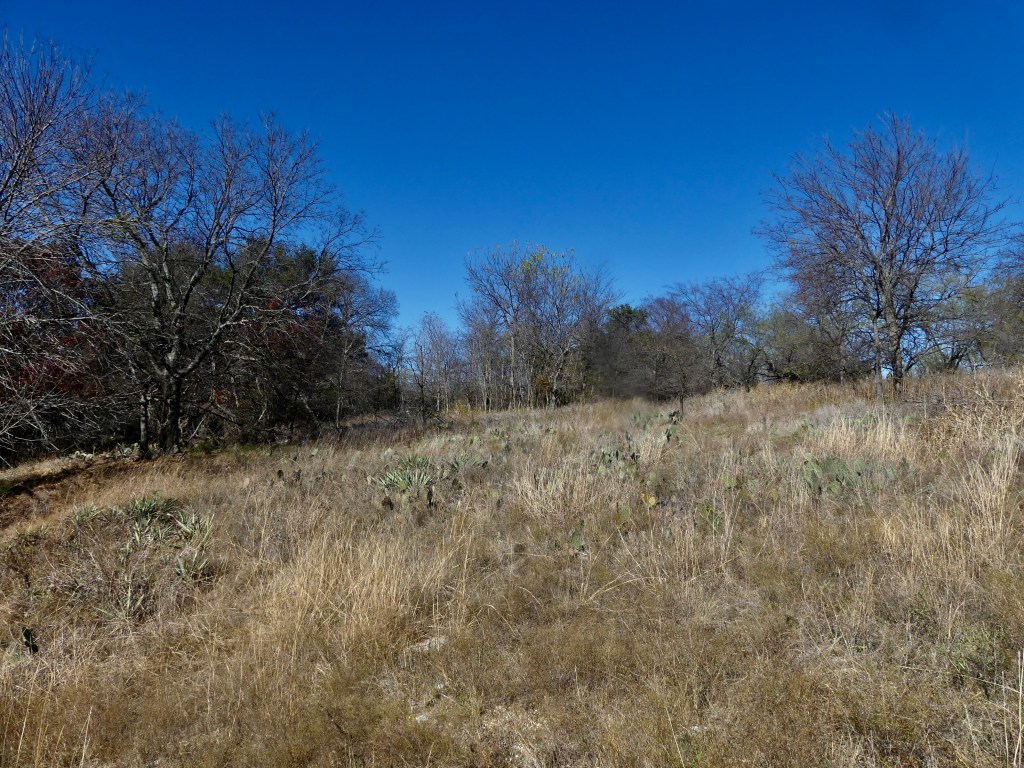
Yucca and prickly pear in a prairie opening in the woods

We also compared notes about eating juniper berries, and then we discussed how the berries are really modified cones. Noticing that only some trees had berries, I said that these junipers exist separately as male trees (their pollen making them look like they’ve been dusted in gold this time of year) and female trees.

Trying not to subject them to too much natural history and just have fun, I still could not resist pointing out how the tiny tufted seeds on little bluestem grass shine in the sunlight. I have an unnatural attraction to native prairie grasses, even though I have only modest knowledge of them. Regardless, walking through a patch of these grasses is powerful medicine, and it’s medicine that I’m always eager to take.

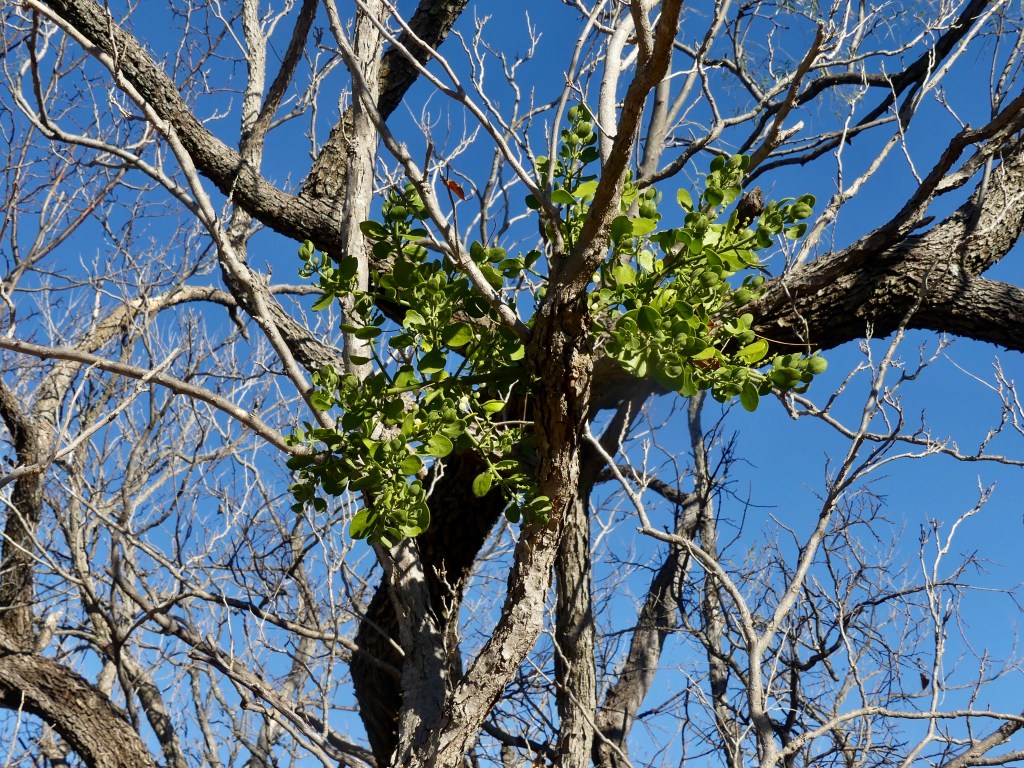
We found mistletoe, and we did talk a little about how this plant is a parasite, although most of the trees we see do not appear to be harmed much unless the tree is covered with many of the plants. The woods were beautiful, with the signature post oak and blackjack, and at least one species of the red oak group. In some places, especially in spots with more limestone emerging from the soil, there were live oaks.

Mistletoe

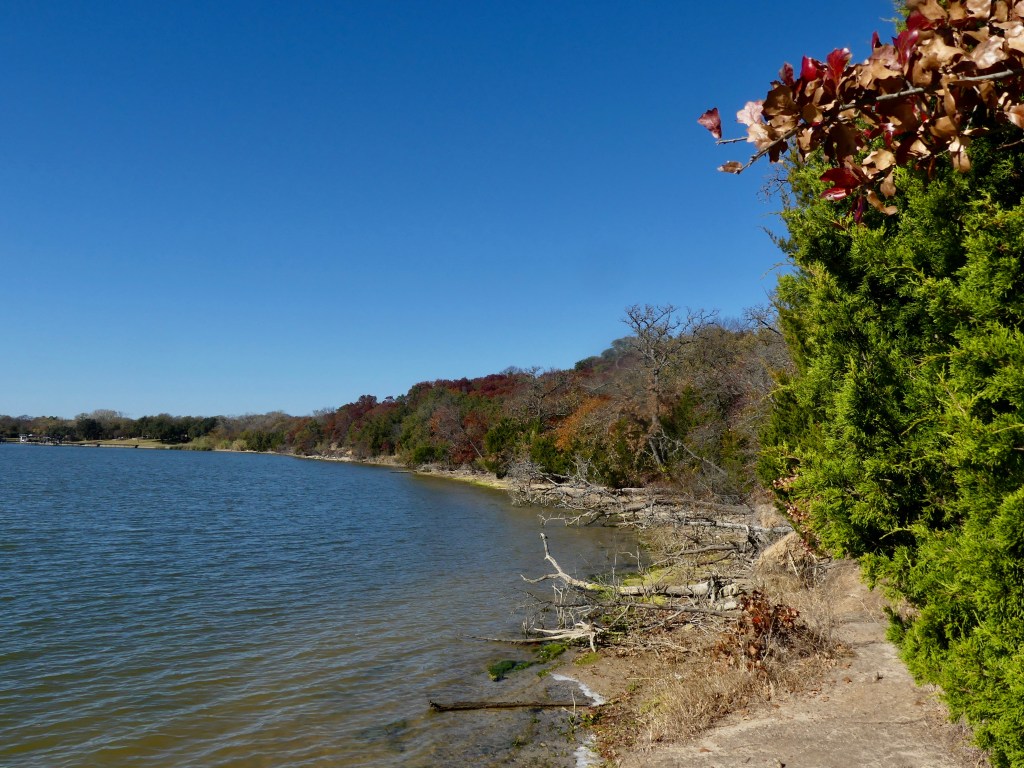
We reached a point where we emerged at the shore of Eagle Mountain Lake, and stood watching a few gulls flying and a group of American coots paddling on the lake surface. Nicky found a branch with a pretty fair resemblance to Gandalf’s staff in the Lord of the Rings movies, and he traced a number of runes into the trail surface. “Ash nazg gimbatul!” There’s much fun to be found on a walk like this.

The shore of Eagle Mountain Lake

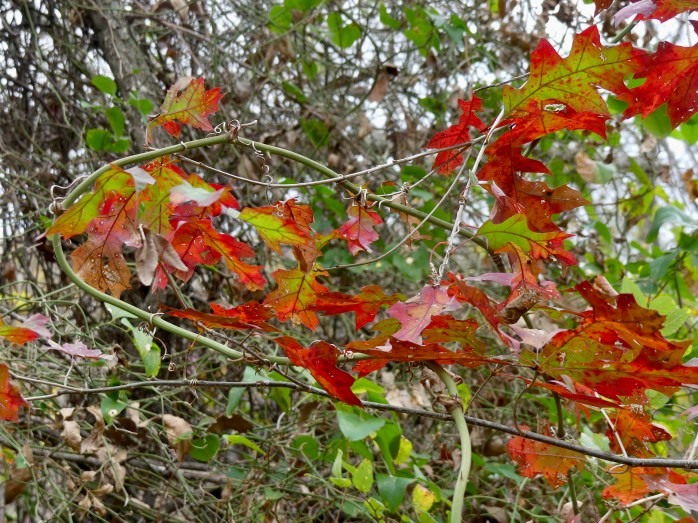
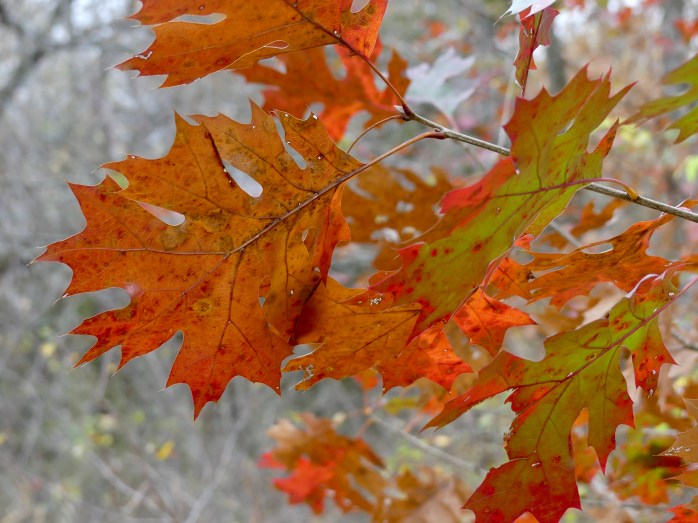
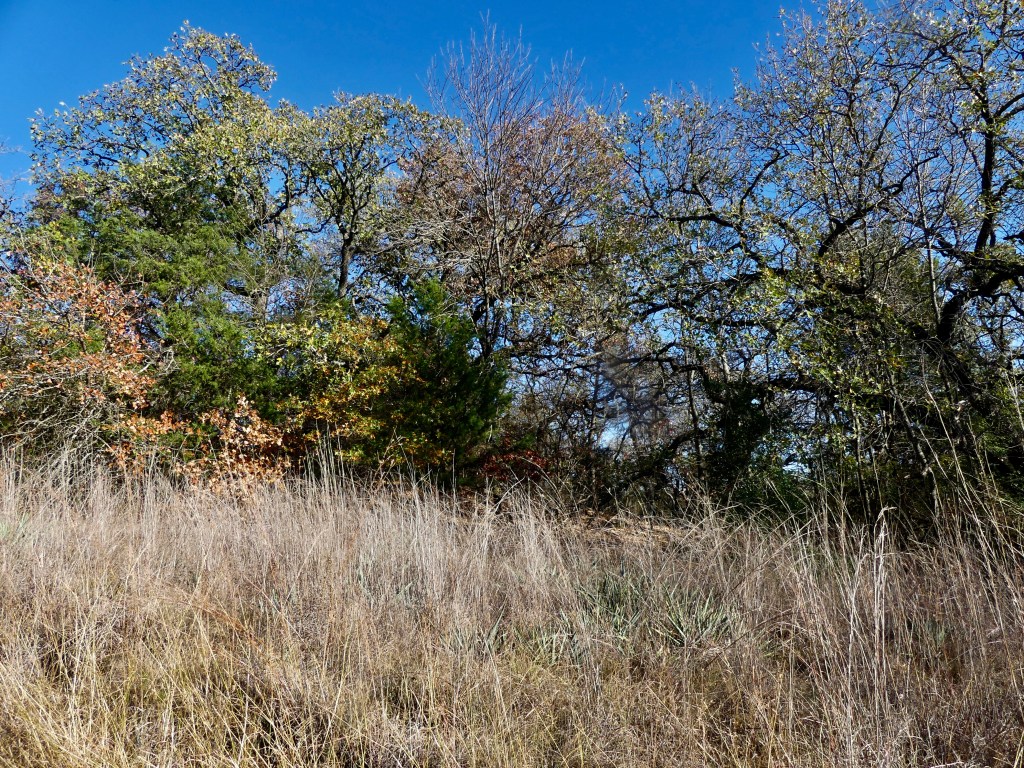
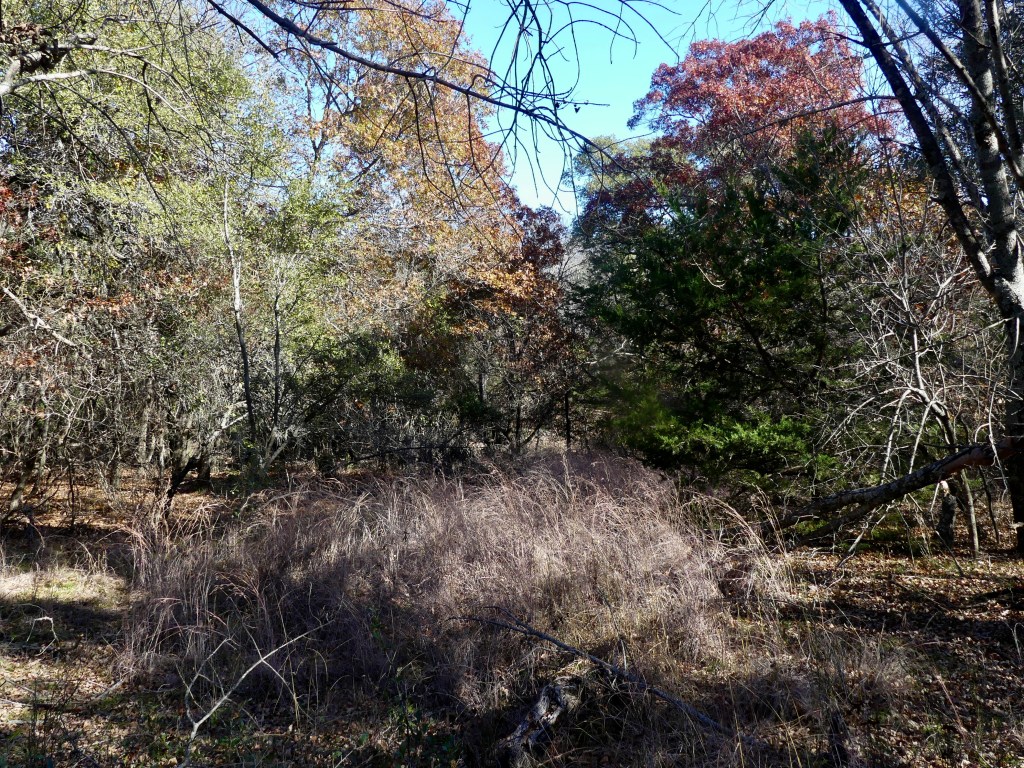
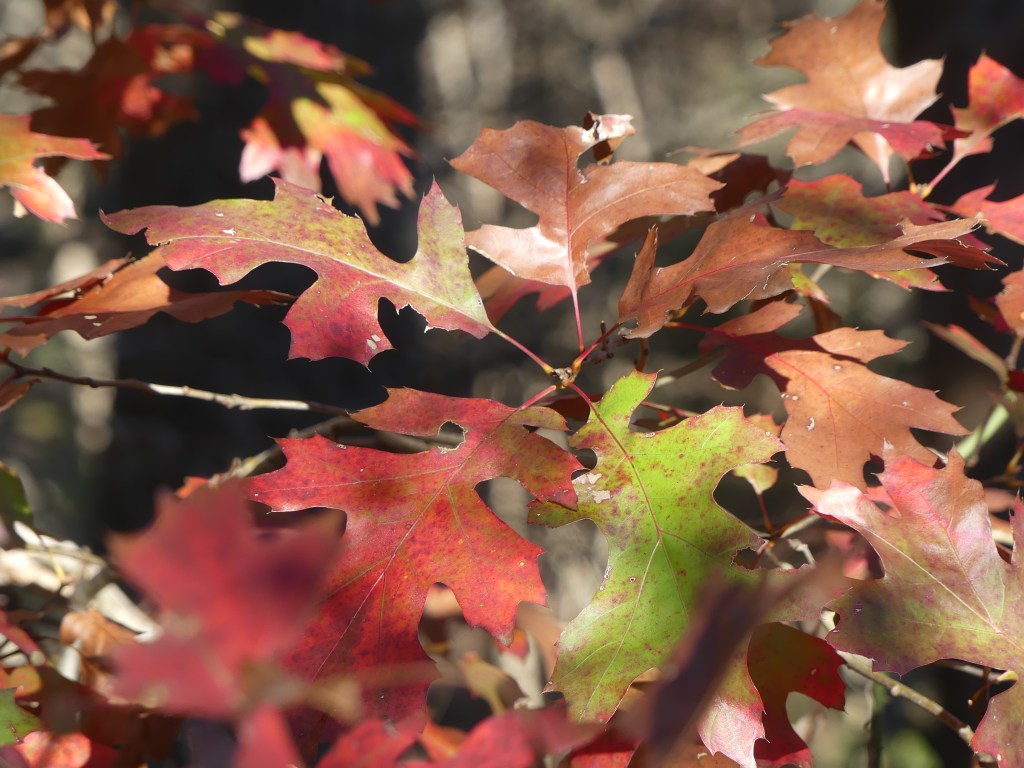
It seems to me that the Cross Timbers is not usually a place with spectacular fall foliage on a grand scale. Most years, you appreciate the more subtle loveliness of the woods, and you find small patches of colorful leaves. That is what we found today. The woods were beautiful in shades of brown, rust, and straw, and in places the leaves were bright red and green.

I’m grateful to have been in the company of these socially-distanced friends today, and grateful to have been able to walk and climb through these woods. May everyone have a safe and healthy Thanksgiving tomorrow.