With Elijah – Creek Stuff and Stories

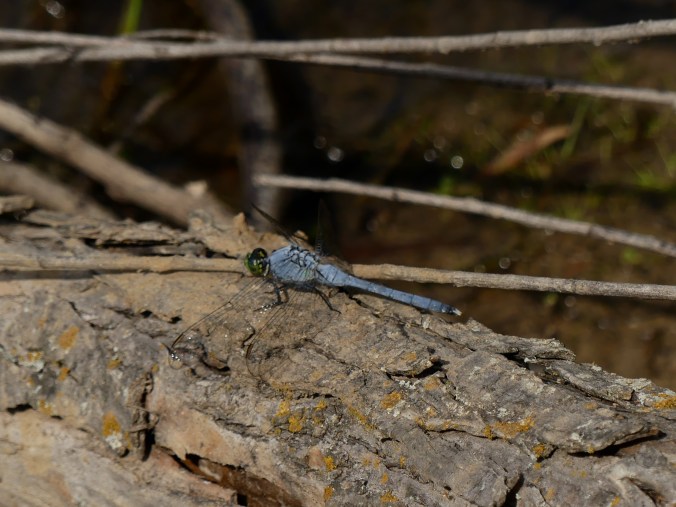
Yesterday afternoon there was water, fossils, clams, and Elijah’s creative mythology of tiny people living at the creek, riding mosquitofish, cultivating moss, and using leaves as currency. Elijah and I have a five year history – on and off – of discovery and play in this place.

I wrote about it on Rain Lilies (at Substack – the link should take you there), where I have been writing about children and nature.

A Winter Walk, January 12th

An hour’s walk at Sheri Capehart Nature Preserve provided a few impressions of winter here in North Texas. We had sleet and snow three days ago. We laugh at ourselves about how we overreact to snow and ice although occasionally, like in February of 2021, it becomes deadly serious. Mostly we get a brief taste of snow and it seems to us that we’ve had a brush with glaciers and blizzards and we know the depths of winter.

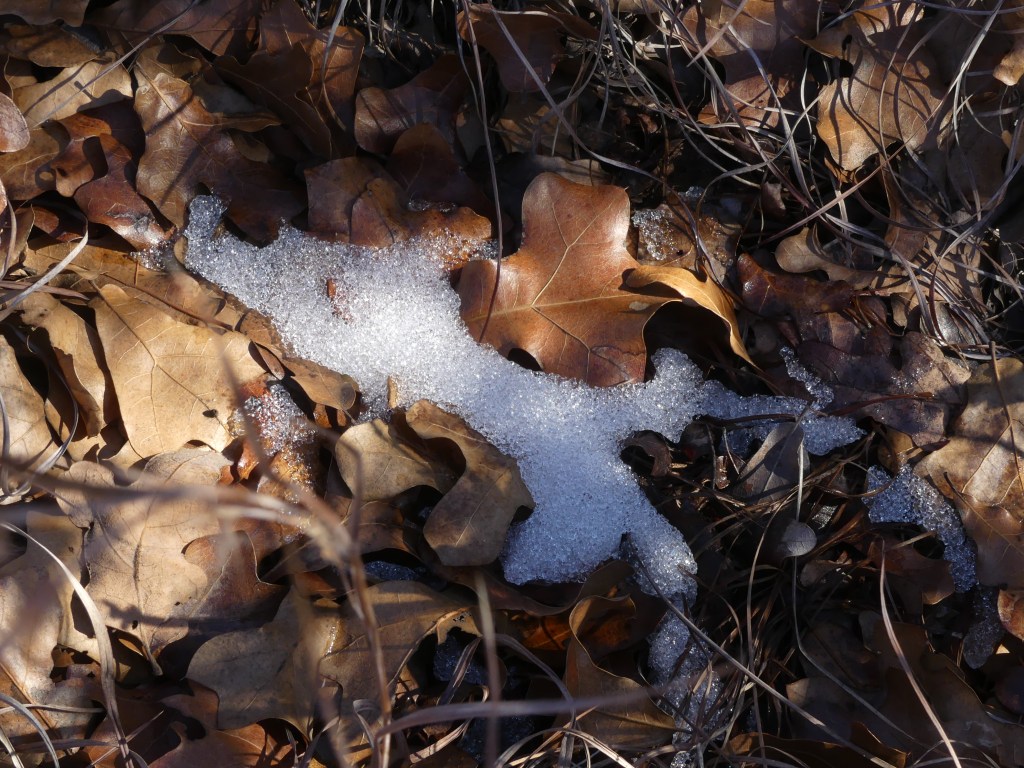
A remnant of snow up on the bluff

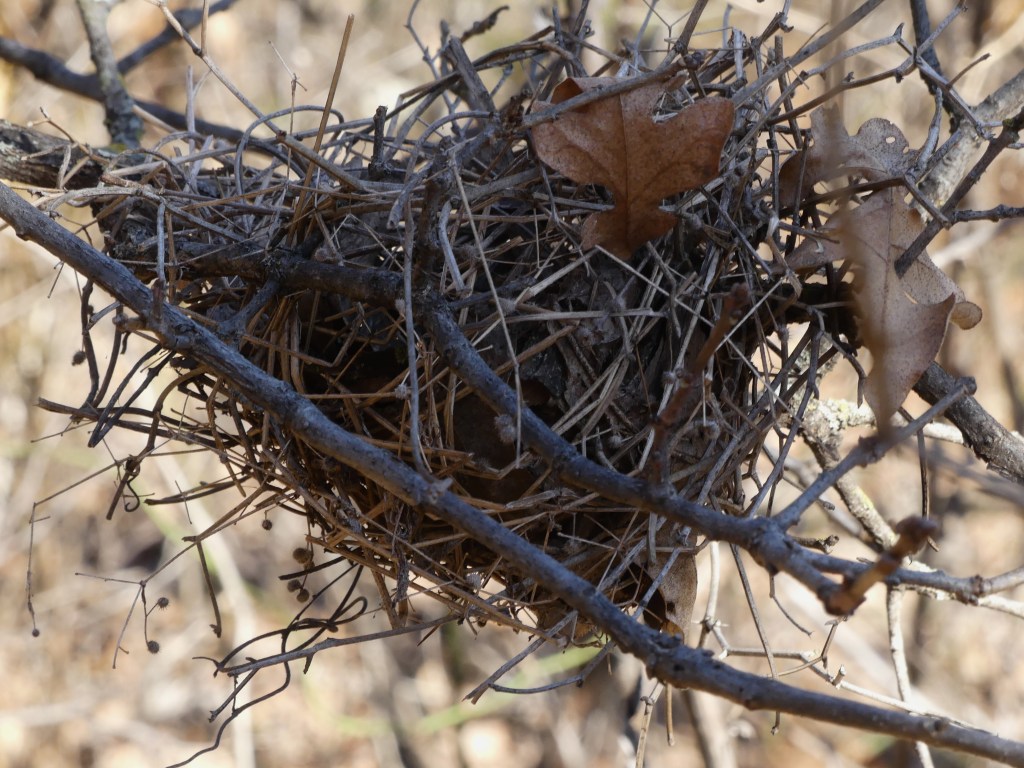
It is always a delight to find a bird’s nest, even the loose arrangement of twigs and grasses I found today. When winter leaves the trees mostly bare, old bird nests are sometimes exposed even very close to the trail. Some time last year this would have been a concealed refuge where eggs could hatch and baby birds grow and, after a while, fledge. I’m drawn to these relics of avian architecture. The birds weave and knit with such skill, and find ways to incorporate so many materials – lichen, moss, hair – so that I’m reminded of woodland faeries. And yet I don’t know why I should go to myths and stories when the birds are miracle enough.

Maybe another reason to be drawn to birds’ nests is how they resonate with our own efforts to bring a new generation into the world. The birds prepare and so do we; once the young hatch they are constantly busy feeding them, and we can relate to that. The young of both species go through an ungainly adolescence, partly feathered and awkward. And learning to fly is stressful, but our hopes are pinned on that day when they fledge and fly off into the world successfully. I hope that the ragged nest I saw today has such a story attached to it.

Wherever those birds are now, apparently it was not at the preserve, or maybe an hour in mid afternoon wasn’t the best time to see and hear them. The sounds today came from the surrounding traffic. Neither my ears (with high mileage and wear, not the most sensitive instruments) nor the Merlin app detected any.

My eyes saw the remnant ice and my skin felt the cold, not that friends and family in Minnesota, Illinois, and Colorado would agree that it was really cold. My thermometer, placed in the shade while I wrote in my journal, dropped degree by gradual degree until reaching 55.5F. Not exactly the arctic.

But at some point during the walk through bright sunshine and shadow, past little patches of remnant snow, I had a momentary recollection of being a kid outside in a Colorado winter, with a cold breeze stinging my skin a little. Up there, at the end of the 1950s I remember two- and three-foot snowfall and I also remember how bright a winter day can be, especially when reflected off of all that snow.

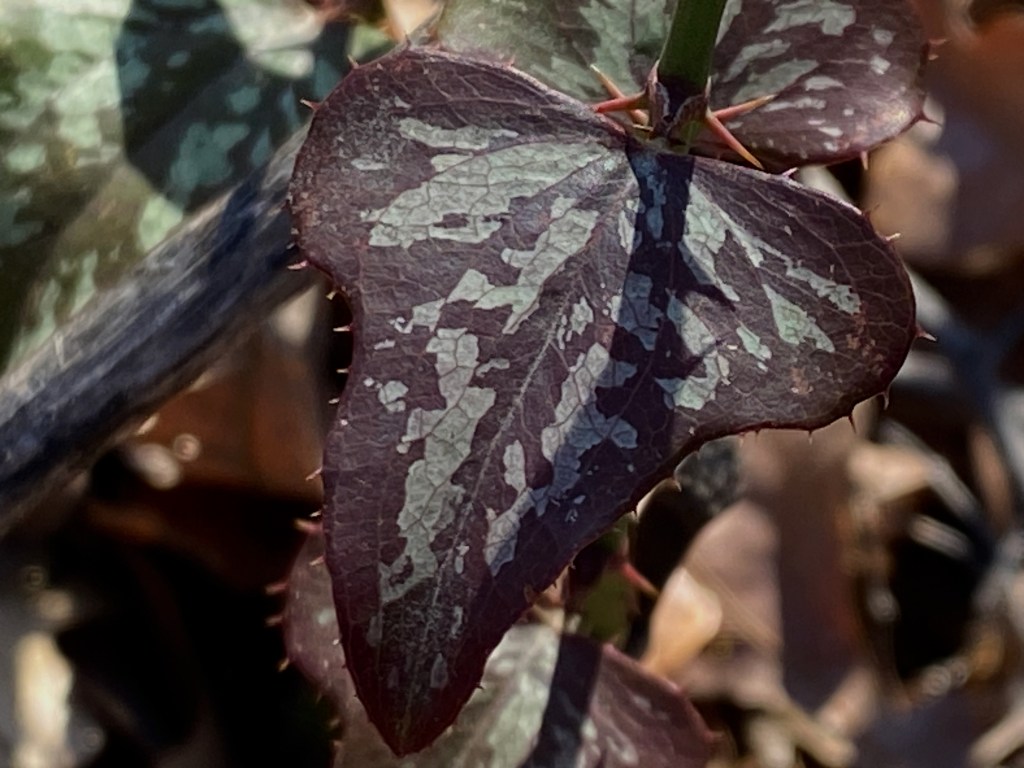
The darkened, mottled leaf of saw greenbrier rimmed with those little spines along the edge

There was one more small thing. Greenbrier is a thorny vine that grows commonly on the preserve, and the name I’ve heard for this one is “saw greenbrier.” While I haven’t seen an explanation, I’ve thought that the name might refer to the little spines all along the leaf edges, like a saw blade (but perhaps it’s something else).

Greenbrier leaves are usually mottled, and in winter the leaf may become dark and purplish while the mottled areas remain green. It occurred to me that each leaf was a small bit of abstract art, and that we could let our imaginations go and see if the patterns suggest something, sort of like Rorschach ink blots. Go ahead, see what comes to you when you look at the pattern. I love the way it splatters out from the central vein.

Just an hour in a place that offers wonder after wonder, in all seasons.

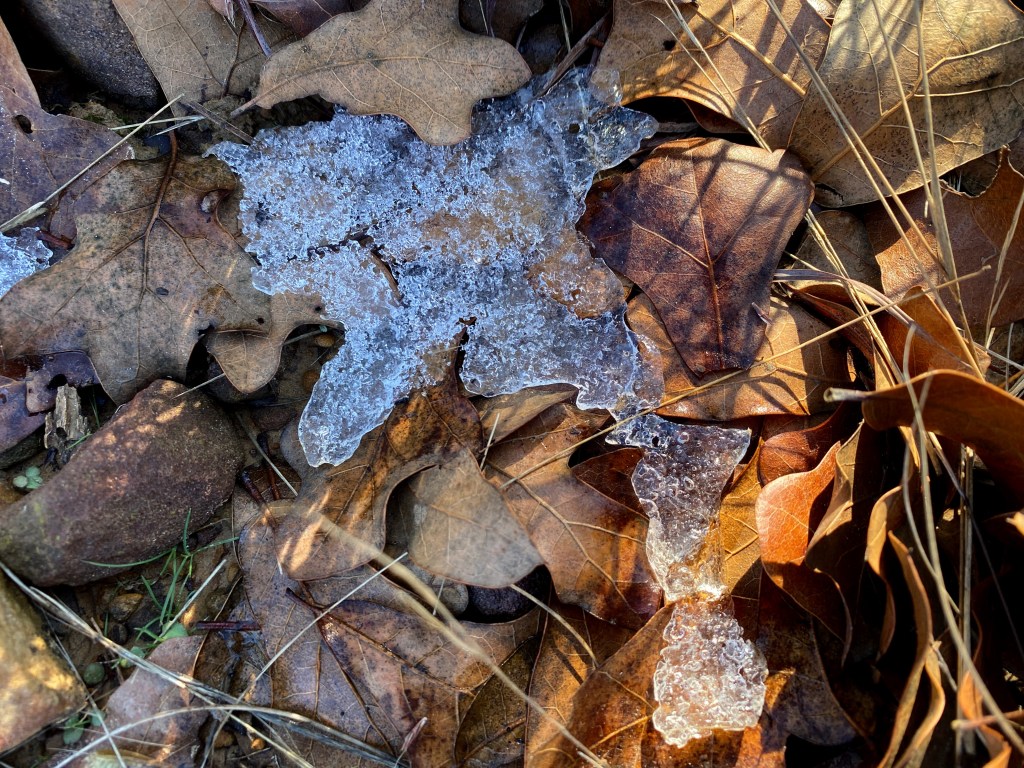
A little remnant ice among the oak leaves

Safe (But Not Too Safe)

I recently wrote about our fears of nature, whether it involves spiders, snakes, or whatever. I mentioned that sometimes a fear gets triggered by an actual negative experience in nature, like being stung or spraining an ankle (or more uncommon events like venomous snakebite). Before discussing what to do about fears, we need to discuss actually staying safe.

As I put ideas together into a list, I was thinking of children exploring in the woods or at a creek, and the sort of guardrails that would keep them safe. But really, the ideas pertain to adults, too. Some items – like taking an adult along – are more obviously for children. Even there, the general idea of not going alone and letting someone know where you will be applies to all of us.

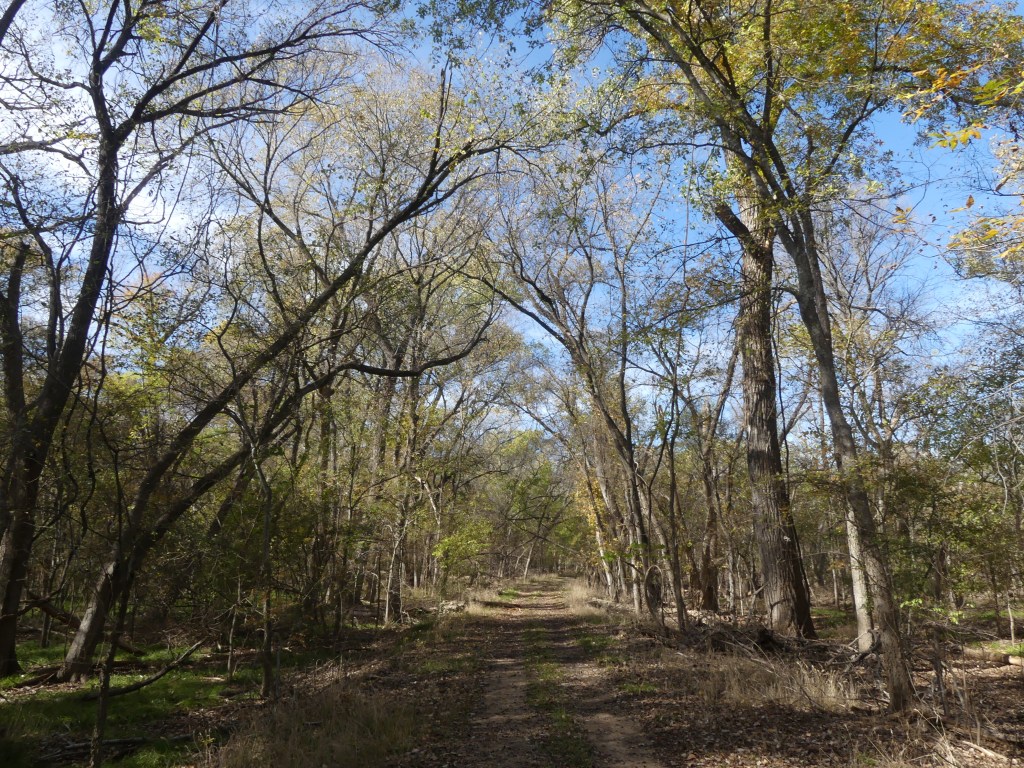
Following the road further into nature

I go out on my own quite often to nearby nature centers and to the LBJ National Grasslands (about an hour away), so am I being hypocritical when I suggest “not going alone”? Would some things on my list involve hovering and overprotecting children? There has been a lot of commentary about how overprotecting our kids deprives them of self-reliance and makes them anxious. A couple of sources to check out are here and here. In Last Child in the Woods, Richard Louv writes about how our concern for children’s safety can get the better of us (see the chapter titled, “The Bogeyman Syndrome Redux”).

As always, we have to weigh the issues and consider the needs of the particular person when thinking about safety. What I’ve done is to list some guidelines and then add a couple of “on the other hand…” comments.

Go together, not alone

If children want to walk to a nearby pond or nature preserve, they should talk it over with a parent or other responsible adult. The adult might say that they have to accompany the children or might set some boundaries concerning how far or how long. It is also good for two or three children to go together rather than one alone. An adult who is going on an outing has much more discretion, but it’s still a good idea to let someone know where we will be and when we plan to return, and maybe go with a partner. The wilder or further away the destination, the stronger my recommendation.
On the other hand, we can all benefit from opportunities for solitude, and being by ourselves in nature can be wonderful, even for a short time. Among those benefits are self-confidence and self-reliance. Parents should always consider the age and abilities of any child and might want to start with just a little independence while out in nature.

Don’t show off or be a daredevil

That is, don’t focus on how impressed others will be or how you can get a laugh, focus on doing something well and safely. Find a better reason to stand out in a crowd. For example, a great many venomous snake bites occur because someone was doing something foolhardy (out in the field, on YouTube videos, or at rattlesnake roundups).

On the other hand … well, there’s not much “other hand” here, just don’t. You can find safe ways to challenge your abilities and do exciting things. Climbing a rocky hillside or wading a creek with a strong current are examples of putting your abilities to the test. Such skills can be built gradually and carefully.

Pay attention to your surroundings

This could be a plug for mindfulness, for being in the present and not walking along on autopilot or while distracted. If we’re not paying attention we might miss a drop off ahead, poison ivy growing at the edge of the trail, a strange dog sizing us up, or a wasp nest where we were about to reach. Not only that, we would miss interesting and beautiful things along the way. Being “lost” in conversation is not a great way to spend time in the woods.

On the other hand, who but a Grinch would tell you that you can’t talk with a friend on a walk? Or check the weather on your phone? As much as I love practicing mindfulness in nature, we should also be able to do other things. I suggest that we practice shifting attention back and forth, between the path and our friend, the trees and our phone. Think of it like driving and keep an eye on the road.

Don’t put your hands (or feet) where you cannot see

A centipede under a log

If you see something you want to examine on the woodland floor, or you would like to look for mushrooms, insects, or other things under a log, watch where you put your hands. In the last post, I talked about a time when I was a child and reached down a hole and brought up a tarantula. That’s a good example of why you should not put your hands (or feet) in some hidden spot. Walking barefoot at night, unable to see where you are stepping, occasionally results in a snake bite. Use a flashlight, and don’t reach under that log with your fingers.

On the other hand, find ways to explore safely and have fun. Probe under things with a stick or position yourself where you can see, and then take a look at what’s under the log.
Don’t touch wildlife or approach too close

A person who is learning about snakes and finds a pretty one out in the field may be tempted to assume it is harmless and pick it up. Most snakes are not venomous, but the cost of a mistake can be high. People who think of deer as cute (not saying they aren’t!) might approach one too close if it doesn’t run off. Aggressive behavior from white-tailed deer happens from time to time, so give Bambi some distance. I should add here that we should have at least as much caution around strange dogs. We can still observe wildlife, learn about them and enjoy them, from a safe distance. Knowing what that distance is depends on the kind of animal, how it is behaving, and the surroundings we are in. Expert guidance is needed here.

On the other hand, catching grasshoppers and frogs is one way to feed a child’s (and our) sense of wonder and curiosity. My own journey as a naturalist and nature writer was launched when I was about ten years old and we caught dragonflies and garter snakes. It seems silly to argue that no kid should ever catch a crayfish or pick up and examine a toad, but I believe a knowledgeable parent or nature educator should provide guidance and set limits.

Bring water and dress appropriately outside

Here in Texas, everyone hears warnings about the weather. In the spring we watch for storm fronts with the risk of tornados, lightning, and hail. In the summer we make sure to drink water and avoid heat exhaustion or heat stroke. Even walking a nature preserve for an hour or so, I encourage people to bring water, especially in summer. With kids we have to remember that smaller bodies overheat or lose heat more quickly than big bodies, so taking breaks and getting into shade is important in summer and extra protective clothing may be needed in winter. We also need to think about clothes that help protect from thorns and rocky terrain. Hiking boots or sturdy shoes are recommended.

On the other hand, depending on what we’re doing and whether we are using sunscreen, shorts can feel great on a walk outside. Just avoid the poison ivy and bull nettle in places where they are common. Flip-flops or barefoot ought to be OK sometimes, too, if we do a scan for cacti, stickers, and half-buried trash like broken bottles.


One additional thing: The more we know (like recognizing kinds of plants and animals and knowing the behavior of local wildlife), the safer we will be. And the more rewarding our time in nature will be. That’s not to say that we have to be experts to enjoy nature, but it is good to have some level of “nature literacy.” If we visited another country, it makes sense that being somewhat literate in the culture, language and geography of that country would be an advantage. We need to be able to read a few signs, understand what someone says to us, and know the places where we might run into trouble. In the same way, basic knowledge about wild places will help us know what to expect and how to interact with the lives we will encounter in those places.

More Thinking About (And Photos From) FW Nature Center

I’ve walked trails and sat on benches at the Fort Worth Nature Center & Refuge (FWNCR) a couple of times in the last week or so and cannot get it out of my mind. I’m happy to let the marsh, the woodlands, prairies, and bottomland forests take up space in my brain. It’s the worries on their behalf that I’d like to shake off.

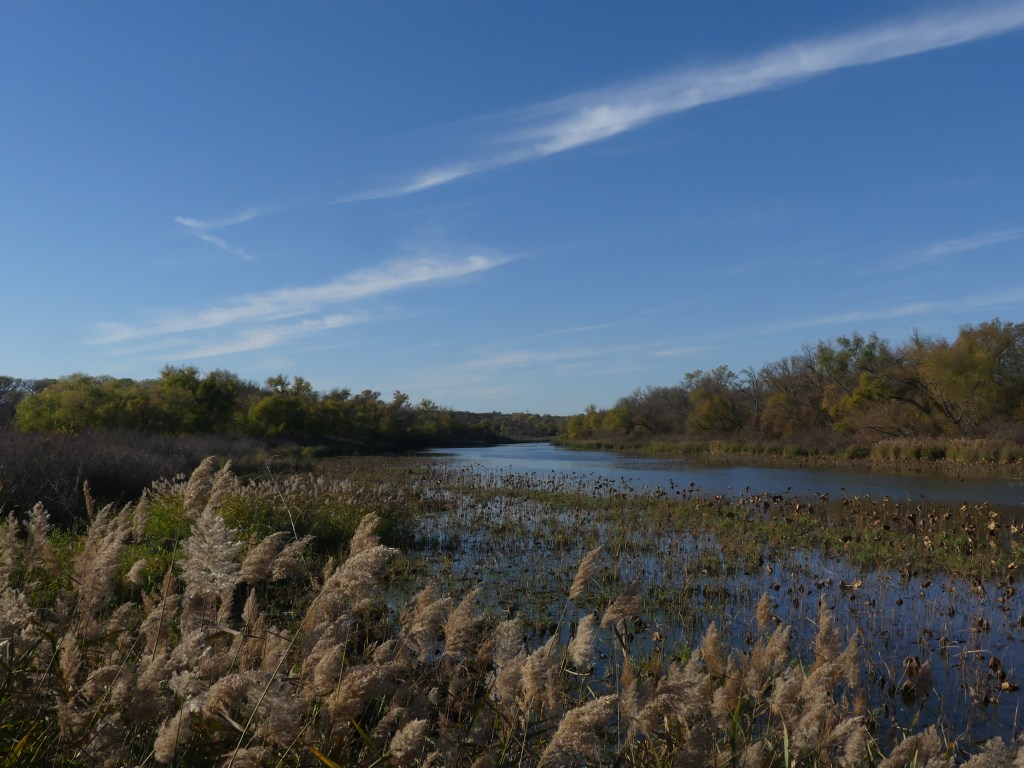
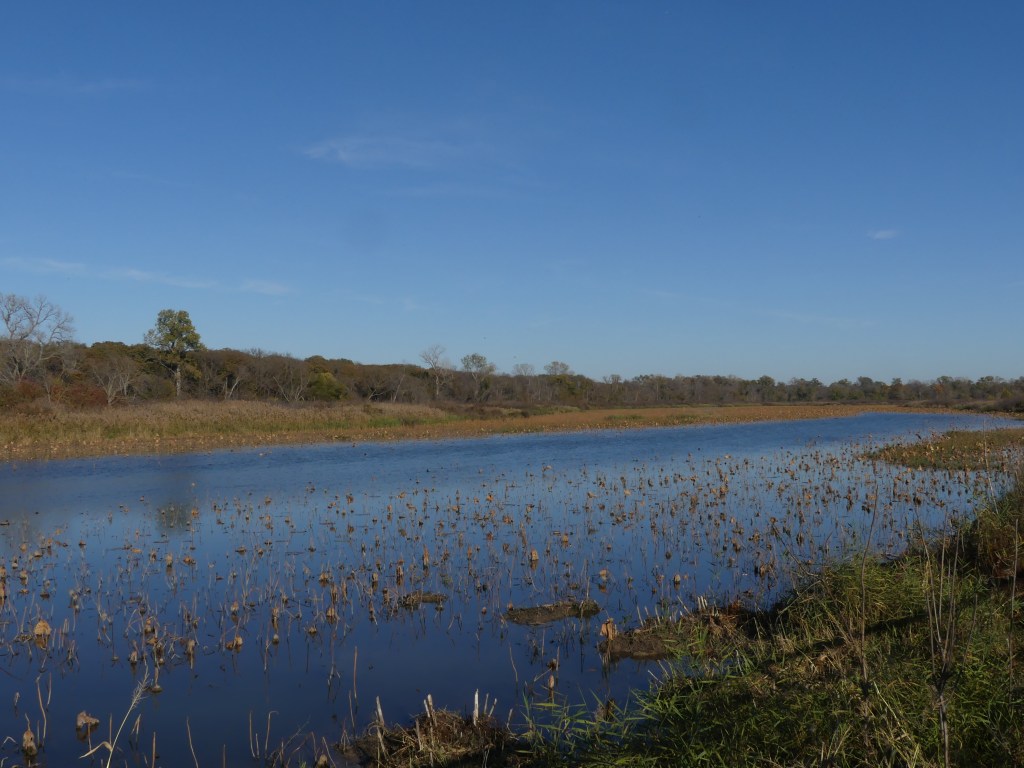
The marsh at FWNCR

I recently wrote about the FWNCR and its 3,650 acres where a substantial bit of North Texas wildness lives on. Green Source DFW had just published my article about discussions between the City of Fort Worth, the Botanical Research Institute of Texas (BRIT), and the Friends of Fort Worth Nature Center & Refuge about the future of the nature center. BRIT now manages the Botanic Gardens and is now eyeing the nature center.

The City of Fort Worth website quotes BRIT CEO Patrick Newman saying, “The biodiversity crisis is affecting plants that are our food and possible cures for diseases. As we try to identify these plants, we want to link arms with the Nature Center and continue their great work as we move towards and create this possible partnership.” Does this mean BRIT wants to study the biodiversity crisis? Medicinal plants? Wouldn’t the easiest thing, the thing that would call for them to “link arms,” be to work together with the nature center through a research partnership? Without either one taking over the other, that is.

But the stated goals for the nature center, again quoting the city website, are, “increasing attendance and use of the center, membership, educational programs, and private support for research, conservation and investment.” One of the three issues being considered is, “Economic benefits for the City and BRIT.” In my Green Source article, I noted that the city’s Mark McDaniel said the plan was for attracting more visitors, ramping up marketing, and enabling more facilities and capital improvements. 

You can see how I might worry about whether the nature center and refuge would stay wild. It’s not that we shouldn’t let more people know about FWNCR and invite them to visit. As I said a month ago, “We want everyone to share the refuge, learn from it, and fall in love with it. But not everyone all at once, and not by offering so many built attractions that people miss the point, which is the wildness.”

A pocket prairie along the Deer Mouse trail

Please do not let this issue be buried in all the other news that we are preoccupied with. Let the City of Fort Worth Park & Recreation Department know what you think. Speak up for the nature center.

The gallery of photos below is from my recent visits to FWNCR. If you click the photo you can see it full-size.

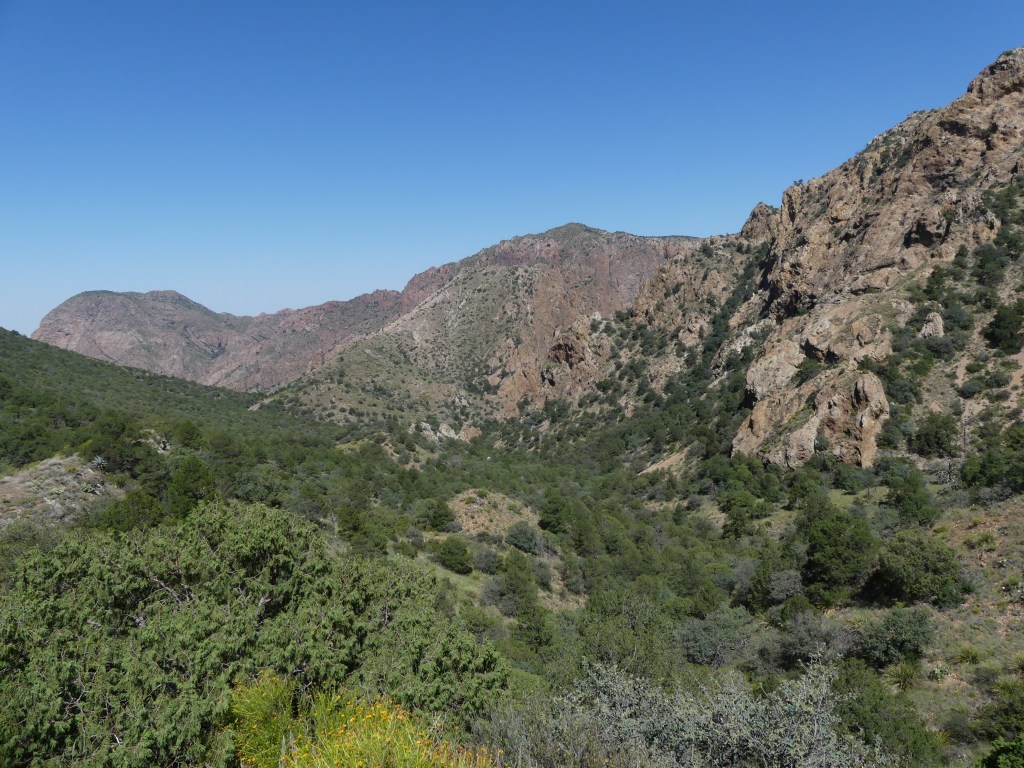
In the Chisos Mountains, 9/17/21

“Life will wear you down,” I said.

Did I mean that life was a destructive force, an enemy to be resisted? Is it our fate to fight and ultimately lose? Life cannot be an enemy, because what would be left if we defeated it?

“Time will wear you down,” was my revised thought.

Things change. To be present on earth is to see gravity, erosion, and the cycles of seasons take their toll. It is to experience developmental growth but also decline, the arrival of every good thing that comes to our doorstep and, eventually, its departure.

“Life will change you,” I decided. “It will raise you up from the ground and clothe you in fragrant woodlands, but sometimes strip you bare. The rains will soften your features, or give them a newly grooved and wrinkled expression. Birds will sing in your hair, and then the music ends until a new season renews the song.” Always a new season is arriving.

(A fragment from my notebook in September of 2021 when Meghan and I were in the Big Bend working on the mindfulness book.)

Before the Storm

On Monday morning, November 4th I felt the uncertainty of the storms that were on the horizon. How soon, and how severe would they be? But that was the future, and beyond my doing anything about. A good alternative was to be in the present, and also in the presence of trees, soil, and other living things. What could be as trustworthy and reassuring as nature? There are some people in my life like that, and they are essential. There are also places like that, and I’m grateful for them.

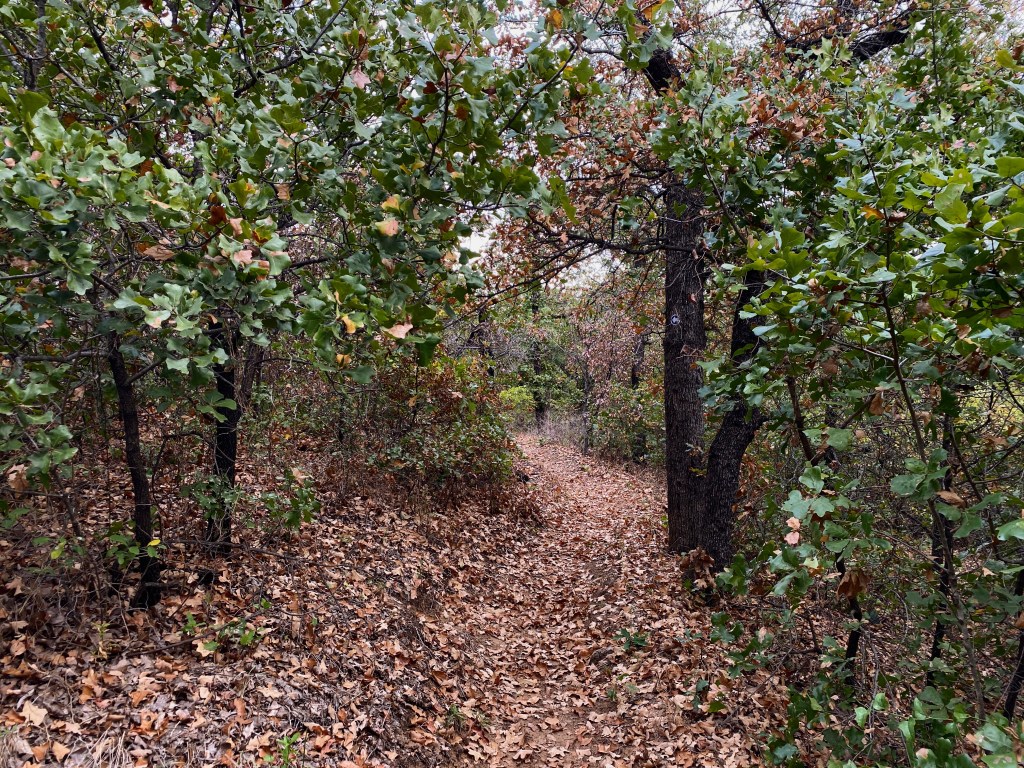
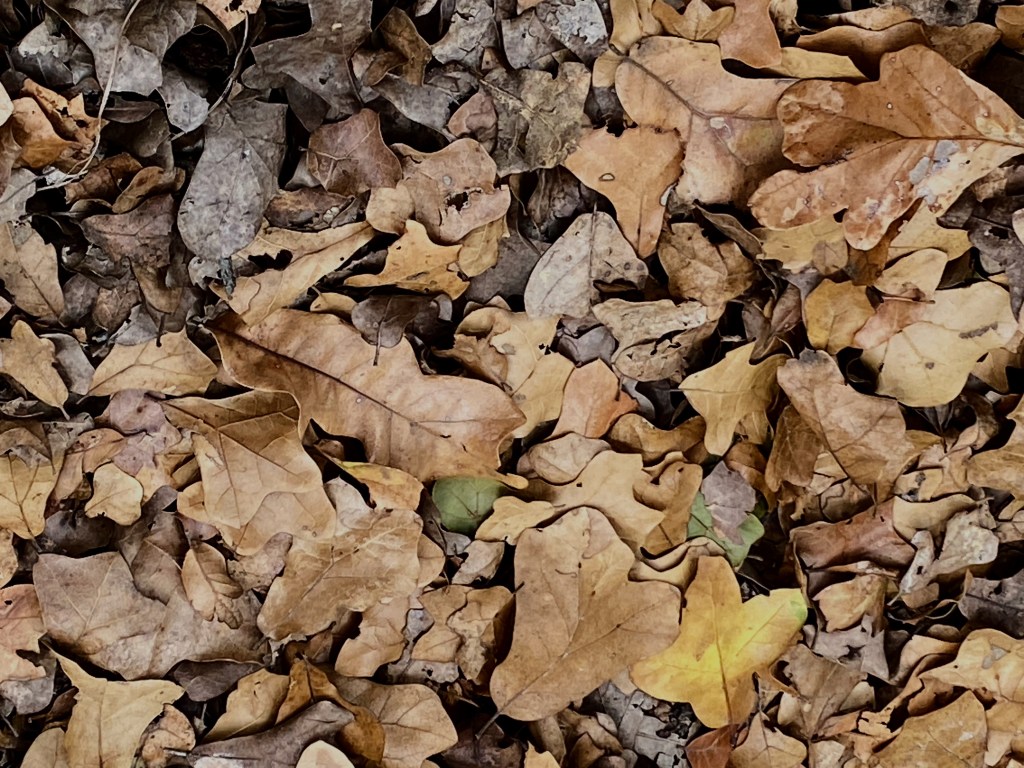
Oak leaves covering the trail – the oaks are dropping leaves without showing much autumn color

So, with storms still to the west, I took a walk at Sheri Capehart Nature Preserve. It was cloudy, with low cumulus clouds racing to the north and the occasional glimpse of blue sky between them. A couple of black vultures were overhead, careening back and forth in the wind with acrobatic turns and adjustments of flight feathers. From my camp stool near the bluff, it was 75.3F, continuing the above-average warmth that is becoming our new normal.

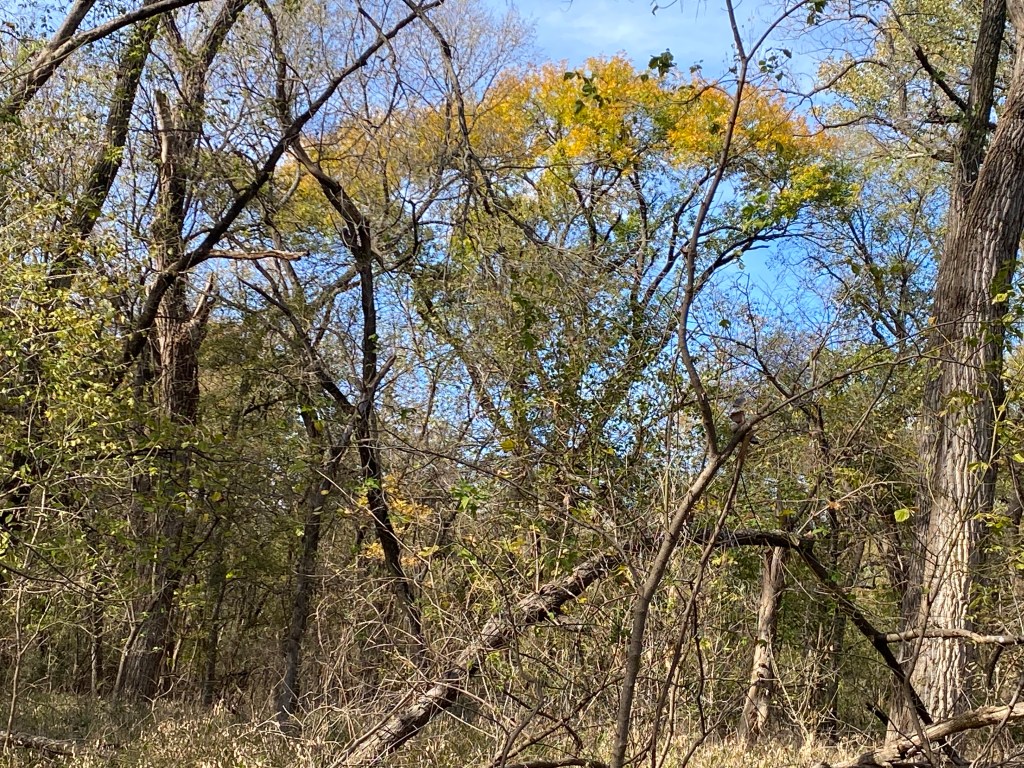
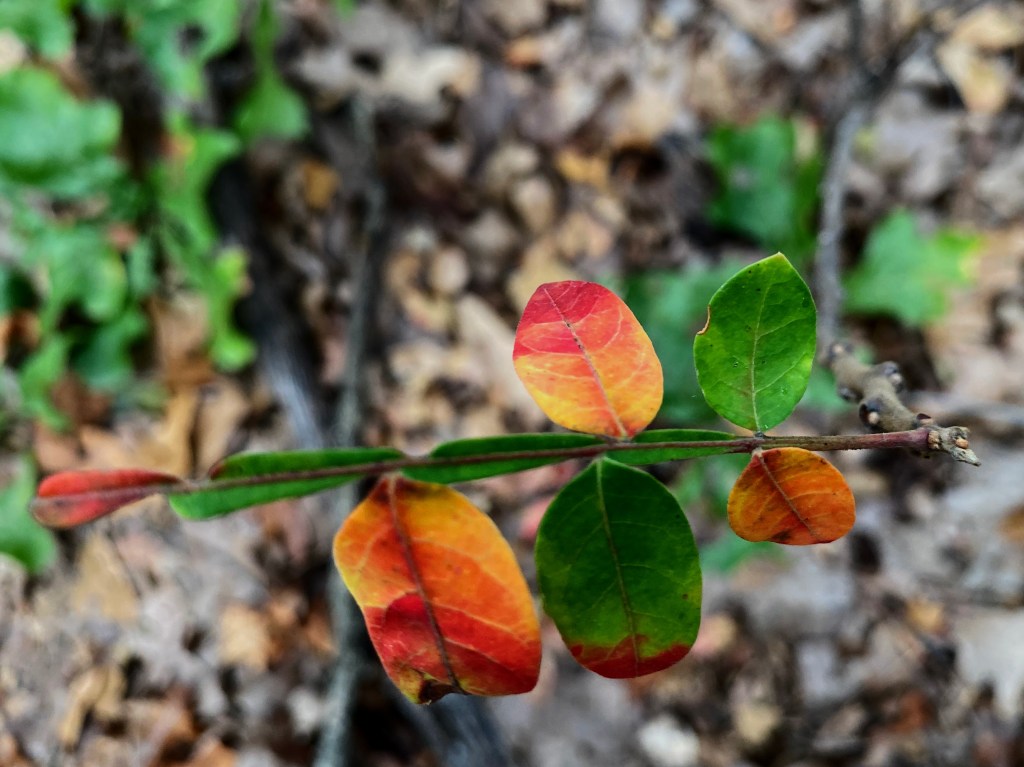
The “official” autumn colors: crimson and orange, yellow and green

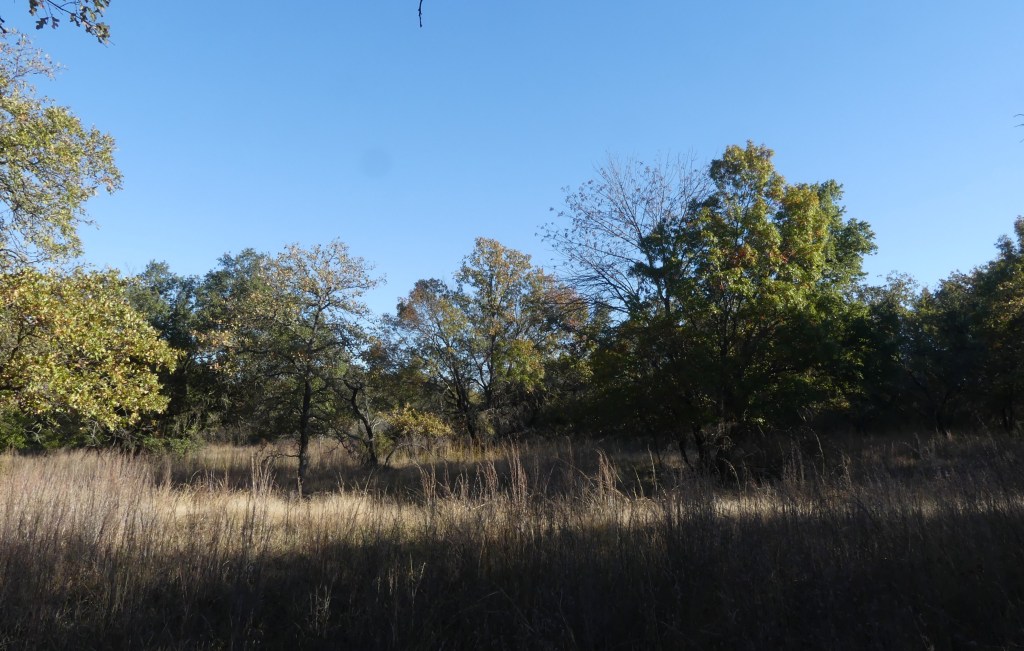
At 9:20am I sat near the top of “Kennedale Mountain,” that hill that overlooks the lowland through which Village Creek drains. From the sandstone escarpment you can glimpse downtown Fort Worth through the oak branches, if you want to. I’d rather keep in the company of the blackjack oaks and sandstone, watching clouds or butterflies. Away from the bluff, on the back side of the hill is a place a bit more protected from traffic noise, where fewer visitors walk, and so it is a favorite with me.

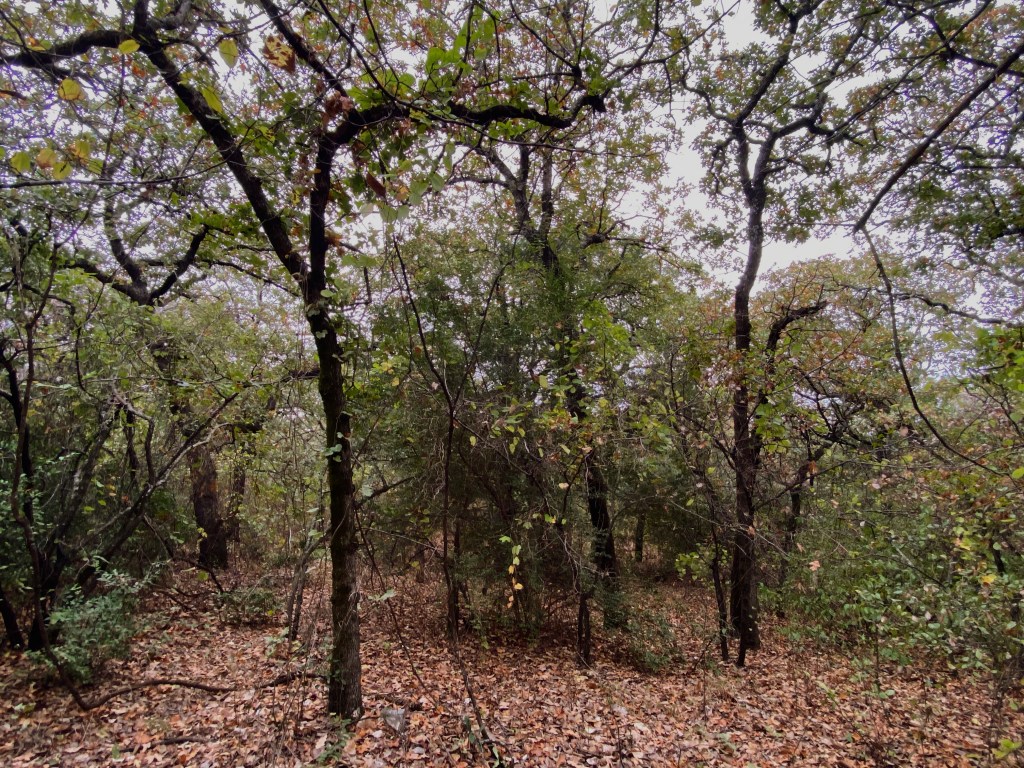
A place a little quieter, maybe a little wilder than other locations

As I sat, a crow flew past, cawing loudly, and clouds continued streaming to the north. The wind moved through the trees, and when stronger pulses of air came through the sound was like a rushing river. Downslope toward the east I heard a northern cardinal and a Carolina wren.

Some of us need natural sounds like these, and relief from the unremitting mechanical noises that so often mask them. The noises of human activity are certainly present at the preserve, as it is located a little south of the third-busiest airport in the world and sits right beside major highway construction. But some days, when we let go of the noise and focus on birds, breeze moving the trees, or the occasional frog calls, we get a little of the peace that natural sounds bring.

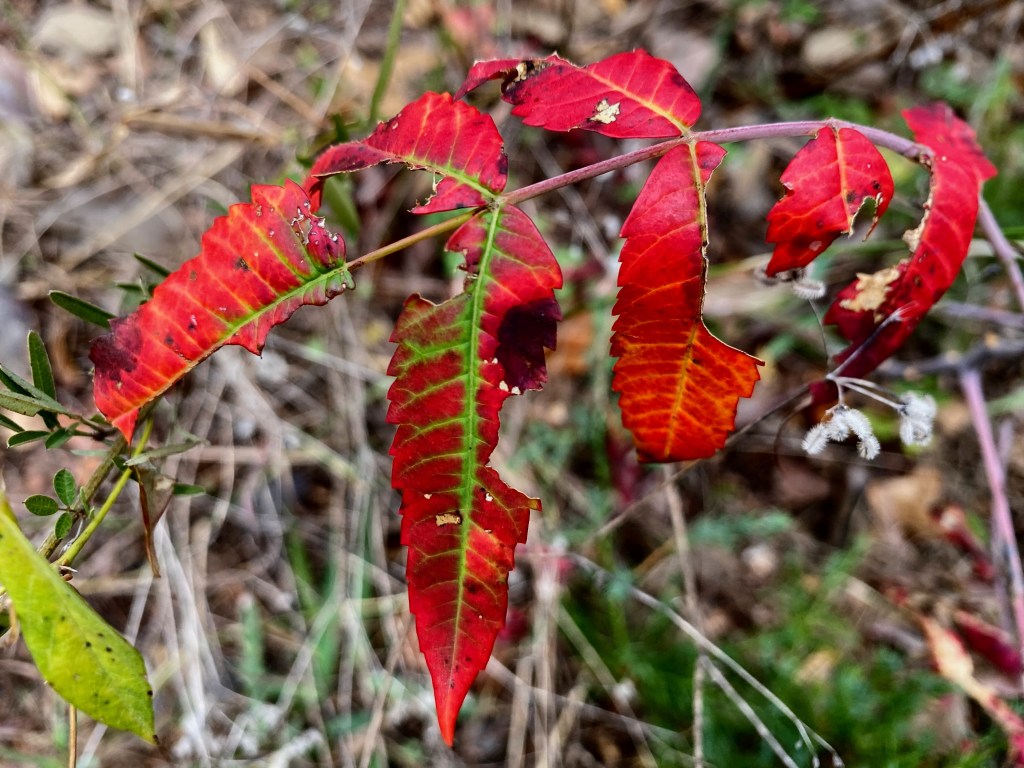
A tracing of green in the crimson leaves of a ragged sumac

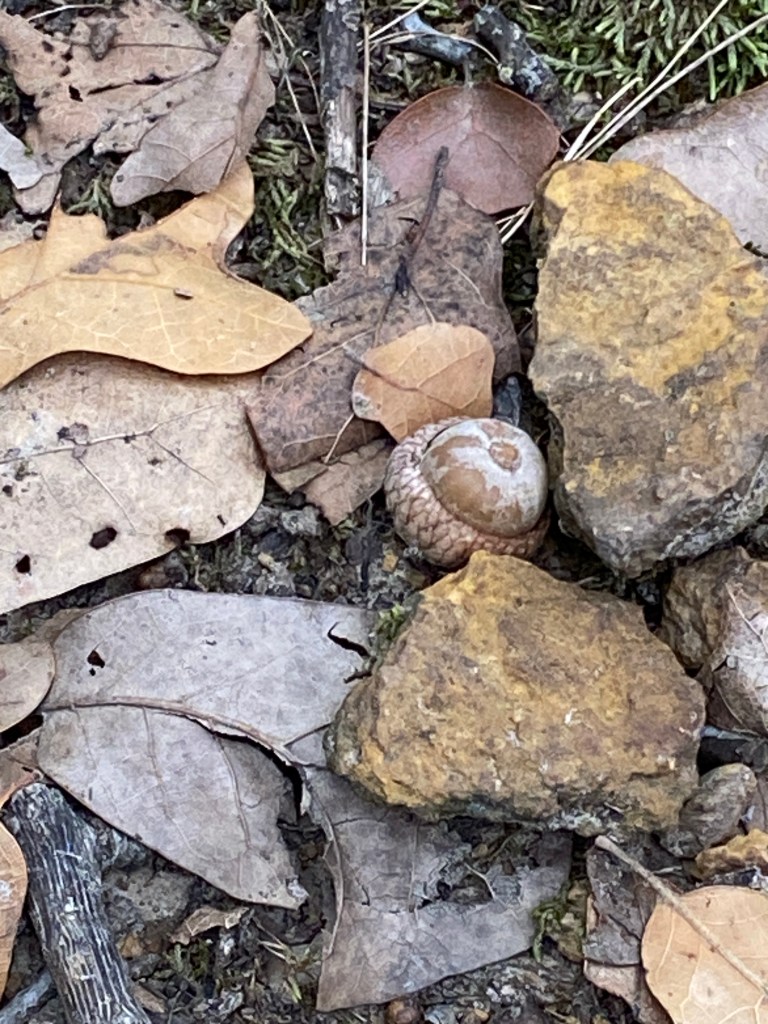
By 9:50am, back over on the bluff, the clouds seemed thicker and the sky a little darker. Here and there I noticed the pattern of fallen leaves on the ground; the variation in color and shape and things like acorns or moss always pull me in. It is art on a tiny scale, for those who are pulled toward such things.

The storms held off until after I left at 10:13am, and we can hope that they bring only the rain we need. A little thunder is always good – one of those natural sounds I like so much. Just under two hours at the preserve had brought some of the peace and wonder that are part of that place.

Preserving the FW Nature Center and Refuge

I’ve lived in North Texas for a long time, and the Nature Center and I go back many years. In the opening pages of Mindfulness in Texas Nature, the very first words are, “I went home on Christmas Eve 2019 to the Fort Worth Nature Center and Refuge.” I meant that those prairies and woodlands have shared so many days with me over the years that it feels like home. And so, sitting on a bench there on Christmas Eve was like visiting an old friend.

And the very first words in Herping Texas (published 2018) bring back a memory of surveying the reptiles and amphibians there: “Toward the end of March a few years back, a group of us took a walk through a bottomland forest at the Fort Worth Nature Center and Refuge.” I described the group of us walking through that forest and one member of the group accidentally discovering a rat snake making its way down the tree trunk where she was about to lean.

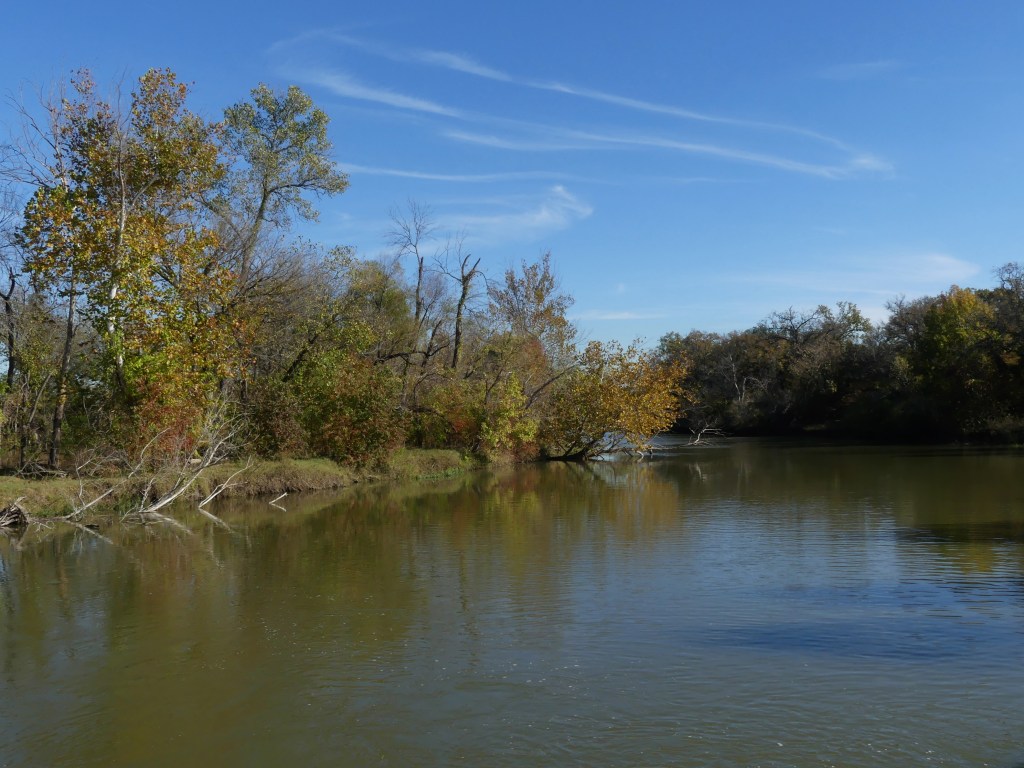
Flooded bottomland

In recent years I have written about the place many times for the online publication Green Source DFW. As a reporter I’ve covered the re-building of the marsh boardwalk, the bison deck overlooking bison pastures, the recognition of some of its woodland as an old growth forest, the statue honoring the work of the Civilian Conservation Corps on refuge property, and the re-introduction of prairie dogs there.

Now the City of Fort Worth is considering handing over the management of the Nature Center to the Botanical Research Institute of Texas (BRIT). The city would still own it, but BRIT would be in charge of some – or all – of its management and direction. I wrote about the issue in an article for Green Source DFW, which I hope you will read – “Should BRIT Take Over the Fort Worth Nature Center?

A November hillside at FWNCR

The Fort Worth Nature Center & Refuge (FWNCR) has been managed by a series of dedicated, smart, and creative individuals. At its inception it had the guidance of my friend Rick Pratt, and in later years there have been people like Wayne Clark, Suzanne Tuttle, Rob Denkhaus, and now Acting Manager Jared Wood. Those are big boots to fill, and I hope that any management changes leave such people in charge. They are people whose first commitment is to the integrity of the refuge as a relatively wild remnant of the Cross Timbers and prairies that were here before White settlers.

As I see it, the FWNCR connects us to the wildlife, woods, and prairies that are like our extended family. That family includes the trees and other plants that give us oxygen, pull carbon dioxide out of the air and sink it into the soil, the wetlands that filter our water, the insects that pollinate our crops. The land, water, and all the living things provide a spark of wonder that adds joy to our lives. 

A swallowtail at the edge of the lotus marsh

When we walk through the preserve, we become part of the land for a little bit, sharing a kinship with the rest of nature. We might even come to see our separation from nature as an illusion that we create, while the woods and prairies are the authentic reality.

What does the future hold? Can that authentic reality of the refuge hold its own against the urge to build more and more attractions, drawing in so many paying customers that the wildness is gone? We want everyone to share the refuge, learn from it, and fall in love with it. But not everyone all at once, and not by offering so many built attractions that people miss the point, which is the wildness.

I hope you will read my story at Green Source DFW and keep track of plans for what direction the city will take with FWNCR. Please step up and offer comments when the time comes, if you feel that your input is needed (and input from those who love nature is always needed!).

Sunset in an Urban Oasis

As Fort Worth grew, with buildings and highways proliferating, a little patch of the east side remained in a natural state. Much of it is dominated by hills and ridges, making it less attractive to developers. Over the years it was sometimes treated as a dump and also as a playground for recreational vehicles, but the native grasses, flowers, juniper, and lots of other life persisted. Finally, it was recognized and protected as a Fort Worth treasure, Tandy Hills Natural Area.

Yesterday, at the end of a hot August day, I took a walk there with my friend Kat as the sun sank toward the city skyline. We followed those beautiful limestone trails through native grasses and the stalks of the past spring’s basketflower, over patches of prairie and along the ridge.

A checkered setwing

Kat is an ideal person to take a walk with, to share these hills with. We talked about absent friends and missing their presence, and we talked about the dragonflies and the succession of prairie plants around us. Snow on the prairie is starting to make its late summer appearance, and the little bluestem is beautiful as always. Kat and I discussed how we look for the myriad subtle colors of this grass, pastel blue-green with a few scattered suggestions of almost-violet. On a previous walk I told her that I’ve described those tall thin stems as “vertical brush strokes” on the prairie’s canvas and complained that I had no other way of describing little bluestem. She immediately suggested, “icicles,” and yes, they are like upside-down thin icicles!

Hardly anything allows a person to unwind and become content and restored like a walk at the end of the day in a place like this, with a friend like this. The shadows lengthened and the heat diminished, and there was always something wonderful to pull us around the next bend of the trail. However, our plan for the evening brought us back to the top of the ridge just at 8:10pm as the orange disk of the sun touched the horizon. Having found a quiet place to sit, we wordlessly watched what unfolded.

It took five minutes for the sun to disappear beyond the horizon, and it continued to illuminate the streaks of cloud in red, orange, and pale yellow. A good, fairly steady breeze blew across the ridge as we sat. The pale, almost pastel blue sky shaded deeper blue to the south, where the half-moon shone in the sky.

As light faded, we could see the rocky limestone path in front of us bend and disappear behind the taller dried plant stalks and the green growth near the ground. The ground dropped away and there was a dark sea of green tree tops beyond, stretching out toward the city.

It struck me that the clouds near the horizon rippled and waved in bright sunset colors like waves on water somewhere. And then the angle of the sun hit the clouds in a particular way for one more bright moment, and those clouds were bright streaks of orange against a turquoise sky. Even the hazy clouds above us were rose pink.

At 8:27pm the drone of insects began from nearby trees, and after a short time they just as abruptly stopped. We were left wondering if some disturbance, maybe people leaving the area, caused this, but I don’t know.

Sitting and maintaining our attention on the sky, there were several subtle shifts. Color faded from parts of the sky in a couple of places, probably when some irregularity of the land to the west blocked the sun. Where the color drained away, the clouds were left like patches of ash in the wake of the fiery sunset. Above us, the traces of cloud were white again. The western sky became more pale, no longer turquoise, while behind us the blue was deepening.

By 8:35pm the steady breeze carried less warmth – the heat of the day was fading along with the twilight. And even with the surrounding city lights and nearby highway, it felt quieter and calmer with the oncoming darkness. We heard a few dogs bark in the distance. When we finally spoke, Kat agreed that it seemed quieter, and yet we wondered if sound levels had actually decreased. Maybe the enveloping darkness brings a perception of quiet that is not about measured sound levels.

At 8:50pm we picked up our stuff and walked out, in silence or else speaking in quiet voices as if not wanting to disturb the tranquility of the night. Kat said that I could expect a different sort of sunset when there are more clouds, and she wondered what the winter sunset will be like on the ridge where we sat. I look forward to finding out.


(This article first appeared 8/13/24 at Rain Lilies on Substack)

A Sunset at the Ridge

A recent mid-August Sunday was the hottest so far in 2024, with a high of 104F. When Kat and I walked up the trail at Sheri Capehart Nature Preserve to the sandstone ridge, the stone was quite warm to the touch. Regardless of the day’s heat, we wanted to experience a summer sunset there, and we arrived at the ridge about 8:00pm with the sun still glaring yellow through the leaves of oaks. Those trees grow immediately below the sandstone ridge, a curtain that hides the Fort Worth skyline and offers some shade. 

Kat, making a few notes in her journal

We sat on the stone ledge with water bottles and notebooks at our sides. Looking behind where Kat was sitting, there were tall stems of little bluestem reaching above our heads, and with each little breeze they waved as if they were the tops of trees. The breeze was welcome, of course, but for the most part the air was still and with the humidity at 50%, it felt sticky. Turning back to the west, the disk of the sun peeked through branches and leaves in yellow-orange sparkles, as if coming from the facets of a jewel.

The constant nearby traffic sounds dominated, but at 8:10pm a wave of insect calls moved through the area and then stopped. Although at some point the Merlin app picked up the call of a northern cardinal, I could hear no birds. After a few minutes another wave of insect sounds lasted several seconds and then abruptly stopped.

Meanwhile, a pastel yellow sky at the horizon filtered through the trees, silhouetting leaves and branches. I reclined on the still-warm rocks to be able to see the whole field of the pale blue sky, watching for birds or insects and hoping to see the first star become visible. I saw none of those. At 8:26pm the temperature at the ridge was still 92F, with humidity dropping a little. The western horizon was a deeper orange. 

Sandstone, little bluestem, and sunlight in the blackjack oak

Behind us, the canopies of blackjack oak were dimly lit by the remaining light from the western horizon, almost glowing with a yellow tint that contrasted a little with the surrounding vegetation. And when we looked lower down in those blackjacks, through bare branches we could see the bright, round full moon rising.

It was about ten minutes later that we could see the first glimmers of a couple of stars. “Star light, star bright, first star I see tonight,” but these tiny bright pinholes in the not-yet-dark heavens did not seem bright. Kat’s younger and more perceptive eyes could soon make out four stars. 

Moonrise through the trees (photo by Kat Oliver)

Shortly after that, we started walking back in the relative darkness, much darker under the trees. But in open areas, the full moon had risen higher and provided enough light for walking. When the moon is bright enough to light your way, and you walk along a path just visible, it may bring to mind childhood adventures in back yards or campgrounds. Something about it makes it seem special, a moonlit faery world much different from the bright daylight colors. 

And what is the attraction of sitting with the sunset, riding that transition between day and night? The world rides along with us as we notice the settling of birds, the emergence of insects or frogs, the way any clouds transform the last light of the sun. Most days we declare our independence from the rhythm of the Earth, turning on our lights and continuing whatever we are doing while the sun disappears and gives the night to the moon and stars. Sitting outside with the sunset is a way of reconnecting with that rhythm. Through such a connection, perhaps we synchronize ourselves with something important. 

The end of sunset

Seeing Horned Lizards Again

I just got back from a couple of days in the Rolling Plains with three wonderful friends. We saw Texas horned lizards, snakes, and a beautiful springtime landscape out there past the city of Vernon. This note is a “heads up” that my friends and I plan to collaborate on the story of our visits to Copper Breaks State Park and Matador Wildlife Management Area. Stay tuned and consider subscribing to Rain Lilies on Substack.

Texas horned lizard

Road trips alone are OK, and there can be a wonderful quality to solitude out in some natural place. For me, going with like-minded friends is probably the best. There were times when we were the eyes and ears for each other. If I’m more focused on the ground where lizards skitter off the trail and Kat is attentive to a more distant view where Mississippi kites soar and buntings perch, we complement each other. Alaina is particularly attuned to the insect and spider life, and Sheryl takes in the birds but also those miniature worlds of flowers, fungi, and insects. One of us commented that together we’re like one organism, because we are closely attuned to each other while focusing on different aspects of our surroundings.

Where we went, the Texas horned lizard is doing well, and we saw six or seven of them. At night, we found three massasauga rattlesnakes along with other snake species. The landscape is thick with blooming thistles and basketflowers as well as (in places) skeleton plant, lemon beebalm, firewheel, and other flowers. It was a beautiful trip, and we’ll have more of the story – and lots of photos – at Rain Lilies soon.