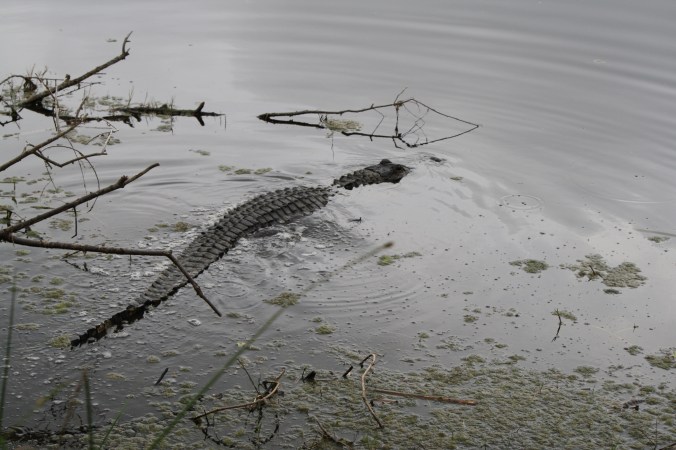
If you know me, or if you have looked around at the website at my books or found the herpetology sub-page, you know that reptiles and amphibians are a nearly lifelong passion for me. And I am in the middle of a series of talks I’m offering on this subject. This Thursday, May 28, is the next one, covering the American alligator and the turtles of North Texas. The talks are free and offered via Zoom; you can register here.
These presentations came about after I taught incoming groups of Master Naturalists for a number of years and I always wished I had just a little more time to cover more of the story of these remarkable animals. The participants often seemed to feel the same way, and so I put this series together. The topics are:
Part One: Getting Started (past session)
We will discuss what these animals are and introduce the topic of herpetology and things like scientific names and community science. We will also try to answer the question, “what good are they?” We’ll also cover some essential skills in the field, skills that can help participants find the animals safely. There are photos of a poison ivy, bull nettle, and our local venomous snakes.
Part Two: Amphibians (past session)
We’ll start with what makes a species an amphibian, and the frogs, toads, and salamanders that represent this group in the U.S. The presentation offers photos of most of the species encountered in North Texas along with the calls of frogs and toads. We will talk about amphibian extinctions and the threats to their survival.
Part Three: Crocodilians and Turtles – this week
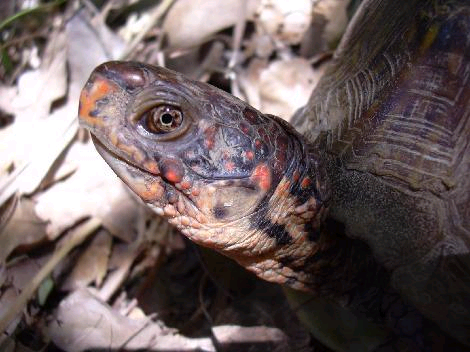
These are the oldest reptiles in terms of evolution and paleontology. We will talk about our American alligator and its adaptation for aquatic life and get into the strange but successful structure of turtles and their shells. There are plenty of photos of most of our North Texas turtle species. We will discuss turtle conservation issues.
Part Four: Lizards and Snakes (two hours)
We will talk about the natural history of these species (why do some lizards’ tails break off, and how do snakes move and swallow big food items?). Photos will illustrate representative species from each family, including each of our venomous snakes. We also will discuss venomous snake bite. This presentation will be longer than the others.
Part Five: Herp Conservation Challenges
These animals are facing severe conservation challenges. We will talk about how conservation scientists keep track of various species, how federal and Texas state laws and policies may help protect them, and we’ll take a good look at several representative Texas species. We will also take a look at how we, as citizens and naturalists, can help.
Our local Master Naturalist chapter considers these sessions to be advanced training, and perhaps other chapters will as well. If you have some familiarity with reptiles and amphibians and wonder if the sessions will offer some depth, I believe that they do. On the other hand, if you are concerned that they will be too technical, I think that the answer is no.
If you are not on Facebook (the link above is to a Facebook page) and you want to attend, please send an email to events@friendsofscnp.org.
Discover more from Our Lives in Nature
Subscribe to get the latest posts sent to your email.

