As I started on the trail this morning at Sheri Capehart Nature Preserve, I asked permission, so to speak. I said: “May I be here as one among many, neither greater nor less than. May I understand how I fit within this place and cause no harm.”
I expected no particular answer, but I did hear calls of Bewick’s Wren, Northern Cardinal, Red-bellied Woodpecker, Blue Jay, and Painted Bunting (identified by the Merlin app), and those calls felt welcoming. Low clouds covered most of the sky, and it was a little like being draped in a warm, wet blanket. Weather Underground said it was 81F and 76% humidity in the area.
On the trail I was submerged beneath the green canopies of oak trees and then emerged at a little open hillside where the spring rains are helping the Little Bluestem grasses look like they might take back the slope that has suffered erosion and drought.
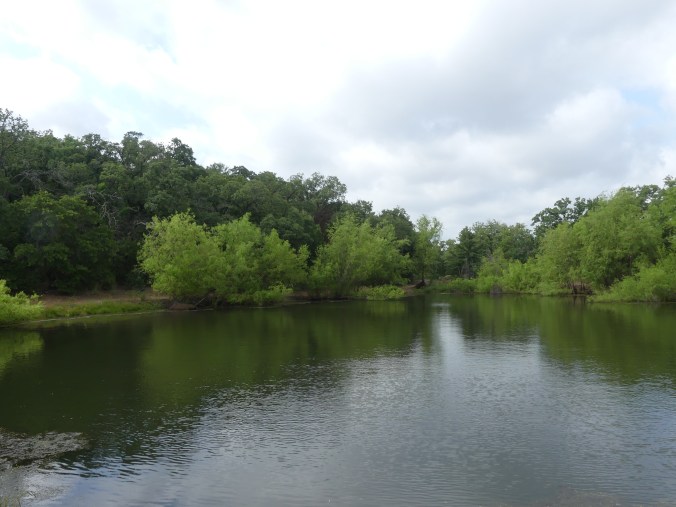
At the pond, the roster of bird calls expanded to include White-eyed Vireo, Carolina Wren, and Carolina Chickadee. And while the Black Willows have taken over large sections of the bank, in one spot there was a beautiful patch of flowers. Chickory, Black-eyed Susan, and Bitterweed were scattered in different shades of yellow. And as I looked out over the water, a group of Blanchard’s Cricket Frogs set up a chorus of “grick-grick-grick” calls. Those calls are always surprisingly loud for a little frog that could easily sit on your thumb.
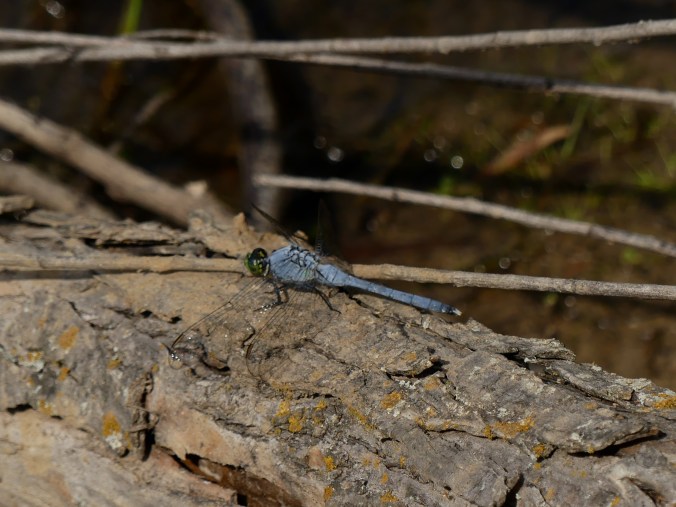
I climbed uphill and away from the pond and walked upslope along the north prairie. Every part of this walk brought wonderful things into view, including Glen Rose Yuccas retaining some of their flowers, a few Indian Paintbrush among the grasses and Western Ragweed, Silverleaf Nightshade (a nettle with a beautiful name and lovely lavender flowers), and Texas Bull Nettle growing tall with their big leaves and white flowers.
And that brought me to the Old Man (Old Woman, if you like) of the preserve, a huge Post Oak that the Texas Tree Coalition designated as a Historic Texas Tree in 2019. It is called the “Caddo Oak,” in honor of the Caddo People who once lived here. After more than 200 years it continues to stand, with a huge trunk and massive branches stretching out like arms to embrace the sky.
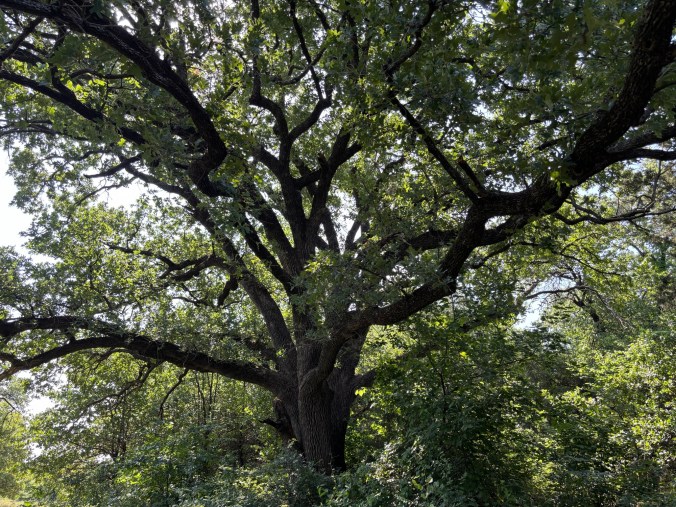
This “Old Person” – oak trees have both male and female flowers so I shouldn’t assign them a gender – might give us a sense of a something ancient that presides over the place. There are a few other big oaks on the preserve, but probably none that were growing when Texas was part of Mexico, before independence or the battle at the Alamo. We are fortunate that it is still here, never in all those years cut down or burned.
From there I followed the trail as it turned south, taking me to where I could visit the yucca meadow, a big patch of deep, soft sand that supports Glen Rose Yucca, Lanceleaf Blanketflower, and other low plants. Some of the yuccas still had their flowers, though the cycle in which Yucca Moths pollinate the plant and lay eggs where the larvae will then eat some of the developing seeds (not too many) is probably winding down. That meadow is also home to the Comanche Harvester Ant, a species of what Texans call “big red ants” but this one requires deep sandy habitat with nearby oaks, and this limits where they may be found.
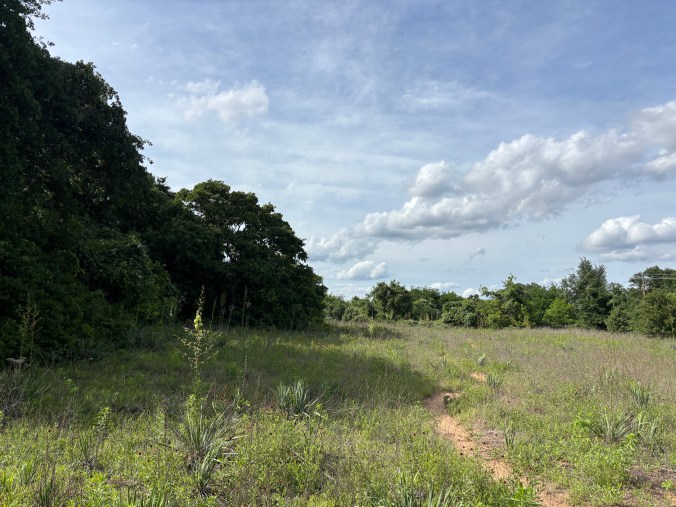
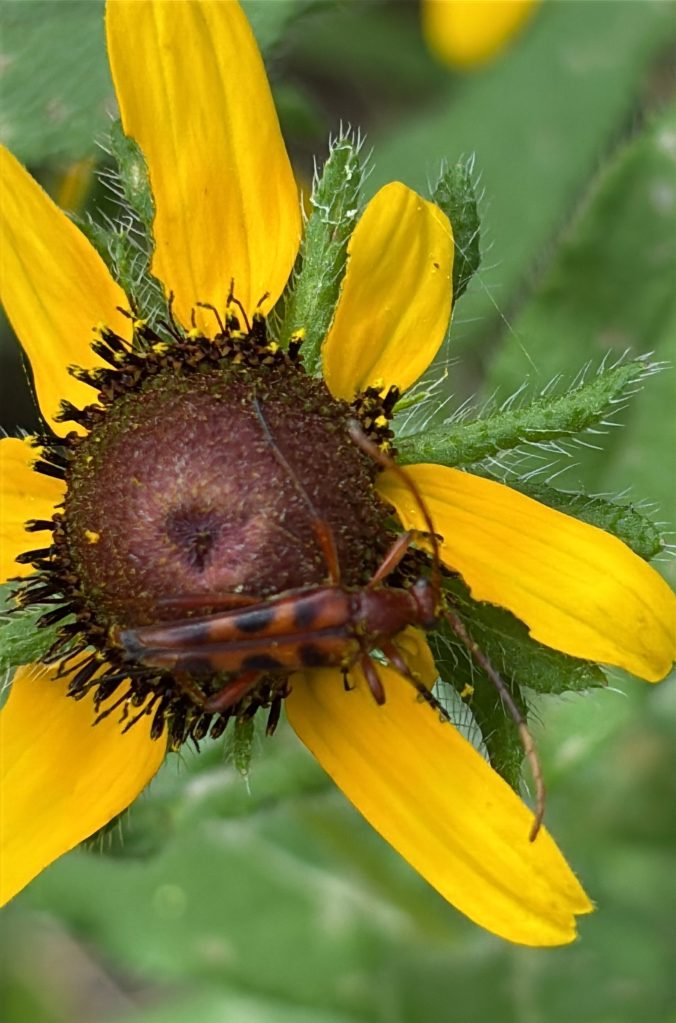
Continuing around the preserve, I found a tiny juvenile bush katydid with black-and-white banded antennae on the flower of a Lanceleaf Blanketflower, and then a Six-spotted Flower Longhorn Beetle crawling over a Black-eyed Susan flower. On a walk like this, the insects provide so many fascinating forms and colors.
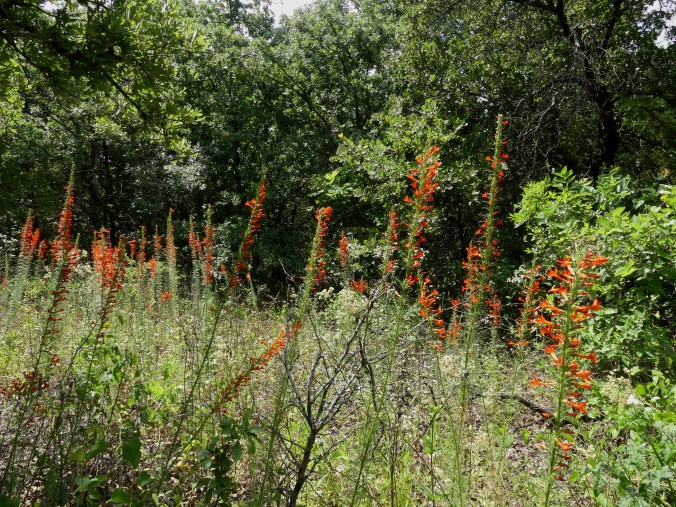
I arrived within the woodland at the crown of the hill, and the clouds had broken up so that there was bright sunshine and lower humidity. At 11:20am I lay on my back and watched the low fragments of cloud drifting swiftly to the north. At the ground there was a good breeze. A Tiger Swallowtail fluttered through the area, perhaps visiting the Standing Cypress that are scattered wherever there is a small opening in the oak woods.
And the Standing Cypress is having such an amazing year at the preserve. You first see them in winter, growing as a delicate rosette of thin, fern-like leaves. But in spring the plant sends up a tall stem that can grow up to six feet, with a flower spike at the top that produces clusters of red, tubular flowers.
It was over two hours of delight, despite that warm blanket of humidity. After the first hour I was pretty well adapted anyway, or else all the wonderful stuff outweighed any discomfort. We are all lucky to be able to go and be part of this wild piece of Arlington.
 Our Lives In Nature