A Winter Walk, January 12th

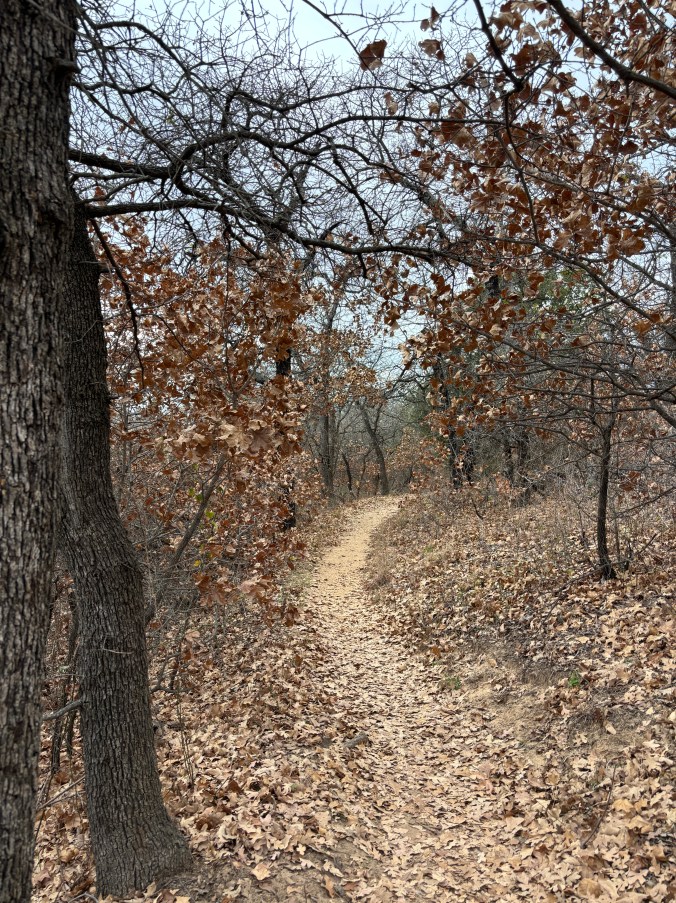
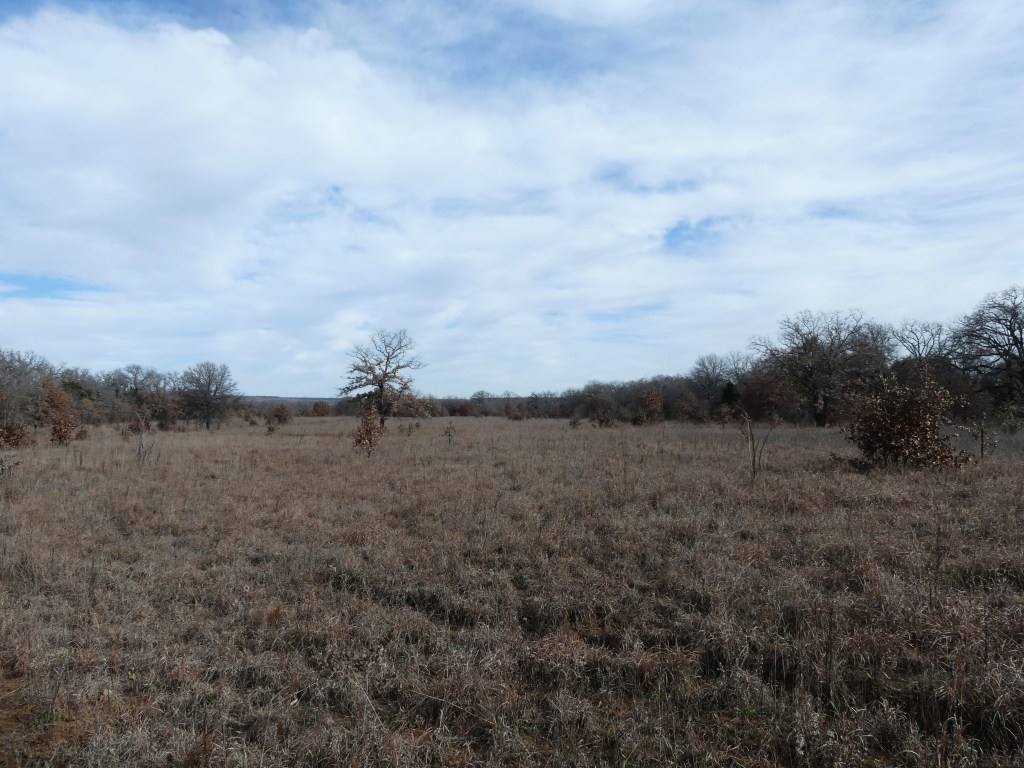
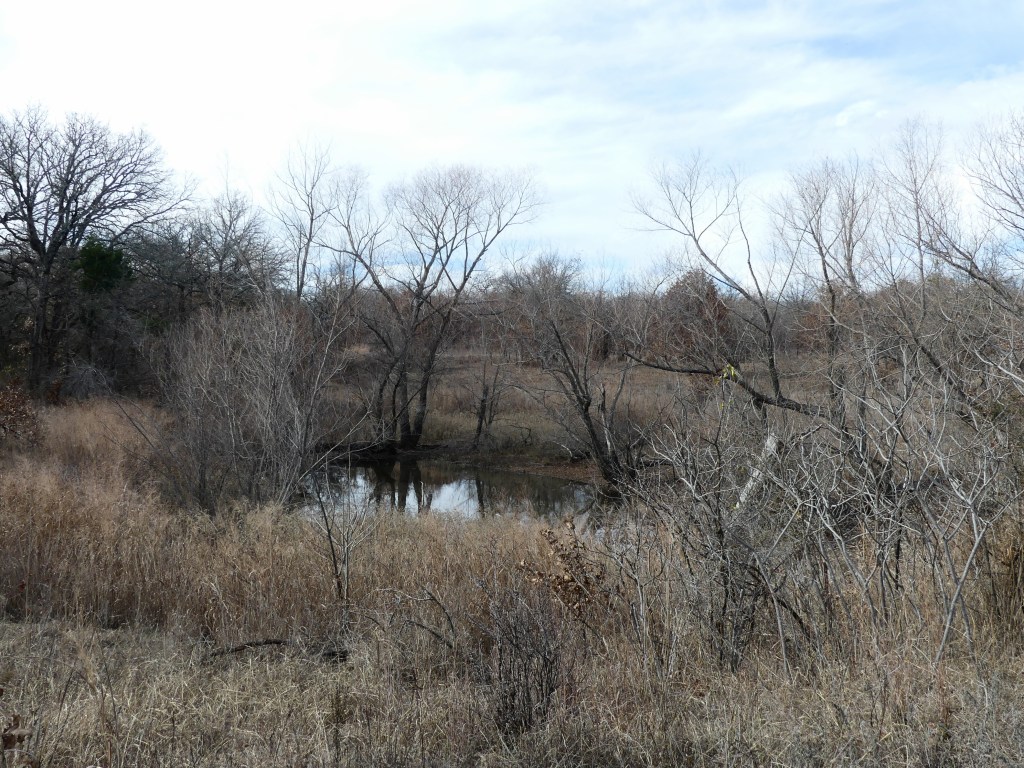
An hour’s walk at Sheri Capehart Nature Preserve provided a few impressions of winter here in North Texas. We had sleet and snow three days ago. We laugh at ourselves about how we overreact to snow and ice although occasionally, like in February of 2021, it becomes deadly serious. Mostly we get a brief taste of snow and it seems to us that we’ve had a brush with glaciers and blizzards and we know the depths of winter.

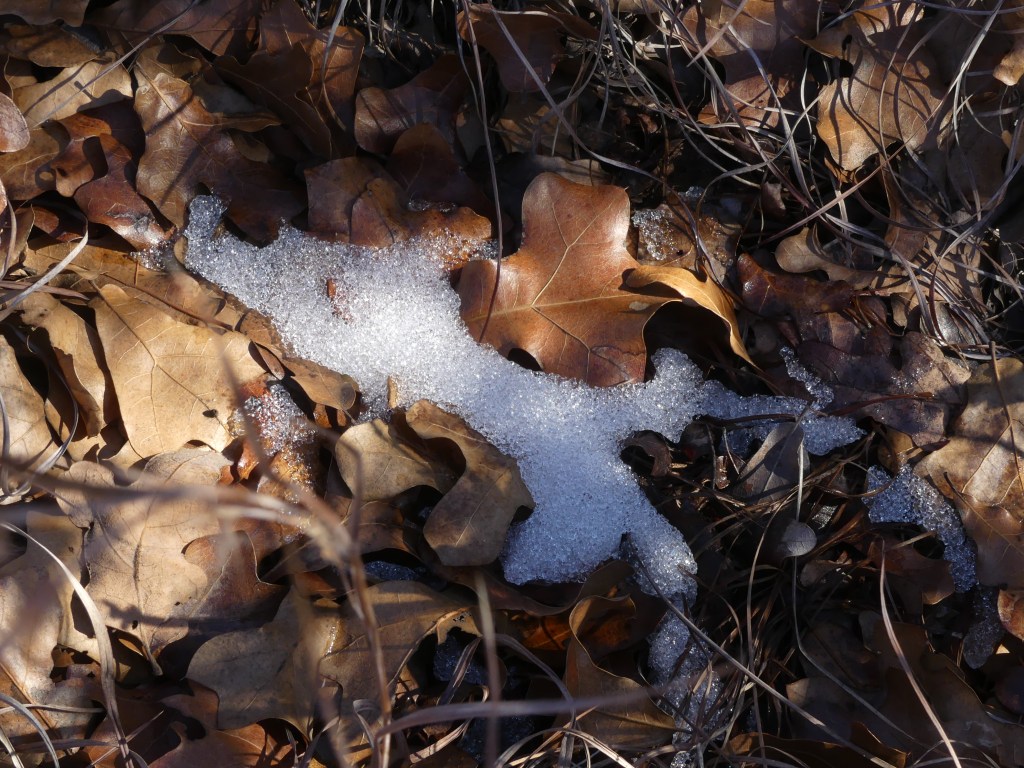
A remnant of snow up on the bluff

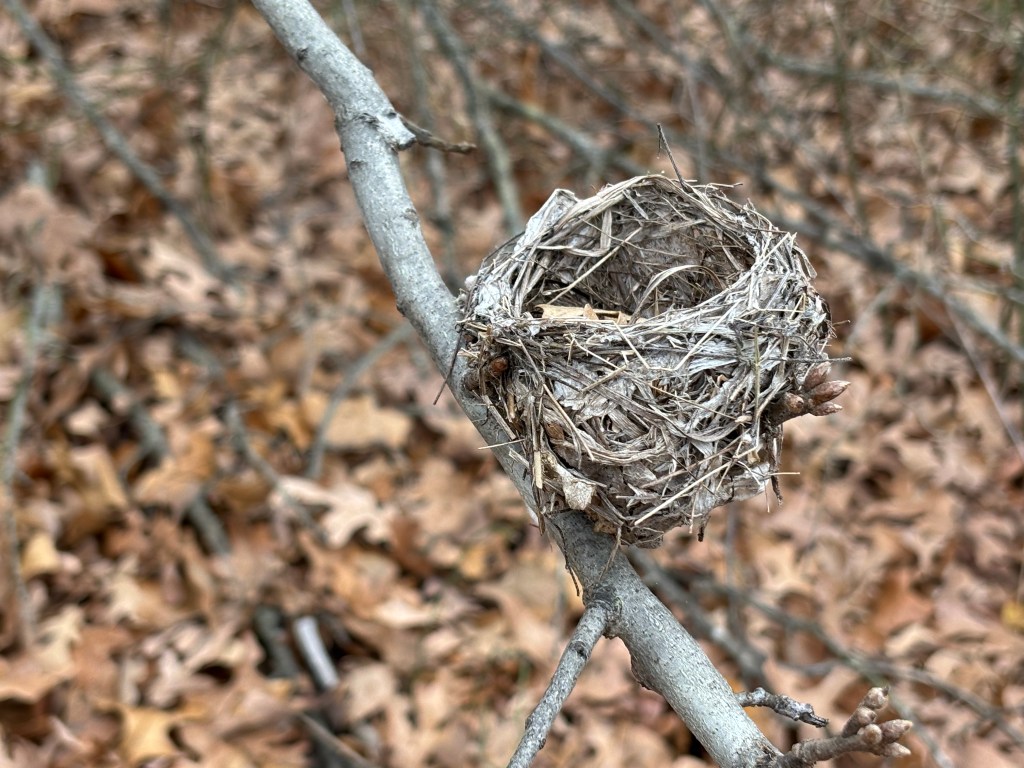
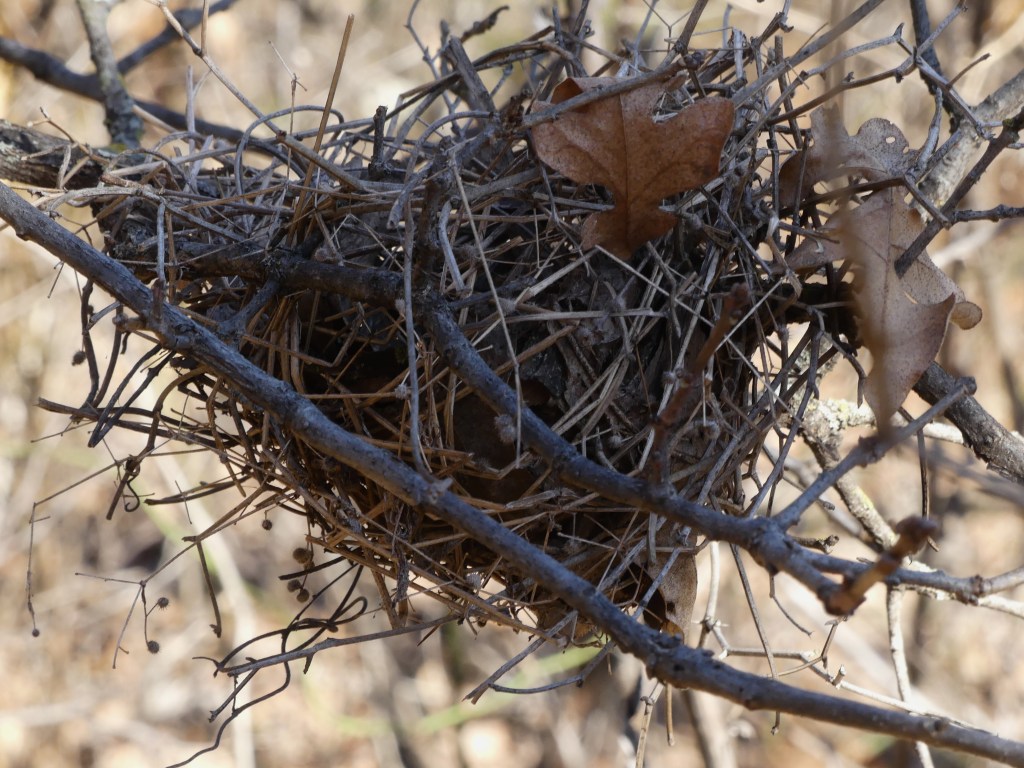
It is always a delight to find a bird’s nest, even the loose arrangement of twigs and grasses I found today. When winter leaves the trees mostly bare, old bird nests are sometimes exposed even very close to the trail. Some time last year this would have been a concealed refuge where eggs could hatch and baby birds grow and, after a while, fledge. I’m drawn to these relics of avian architecture. The birds weave and knit with such skill, and find ways to incorporate so many materials – lichen, moss, hair – so that I’m reminded of woodland faeries. And yet I don’t know why I should go to myths and stories when the birds are miracle enough.

Maybe another reason to be drawn to birds’ nests is how they resonate with our own efforts to bring a new generation into the world. The birds prepare and so do we; once the young hatch they are constantly busy feeding them, and we can relate to that. The young of both species go through an ungainly adolescence, partly feathered and awkward. And learning to fly is stressful, but our hopes are pinned on that day when they fledge and fly off into the world successfully. I hope that the ragged nest I saw today has such a story attached to it.

Wherever those birds are now, apparently it was not at the preserve, or maybe an hour in mid afternoon wasn’t the best time to see and hear them. The sounds today came from the surrounding traffic. Neither my ears (with high mileage and wear, not the most sensitive instruments) nor the Merlin app detected any.

My eyes saw the remnant ice and my skin felt the cold, not that friends and family in Minnesota, Illinois, and Colorado would agree that it was really cold. My thermometer, placed in the shade while I wrote in my journal, dropped degree by gradual degree until reaching 55.5F. Not exactly the arctic.

But at some point during the walk through bright sunshine and shadow, past little patches of remnant snow, I had a momentary recollection of being a kid outside in a Colorado winter, with a cold breeze stinging my skin a little. Up there, at the end of the 1950s I remember two- and three-foot snowfall and I also remember how bright a winter day can be, especially when reflected off of all that snow.

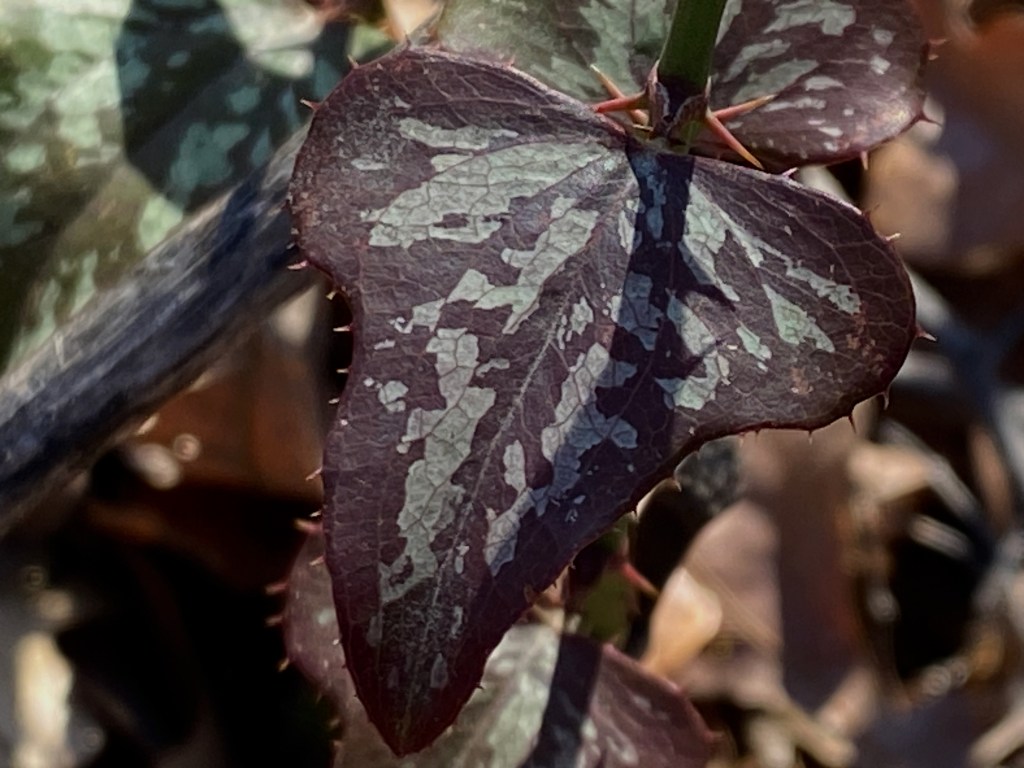
The darkened, mottled leaf of saw greenbrier rimmed with those little spines along the edge

There was one more small thing. Greenbrier is a thorny vine that grows commonly on the preserve, and the name I’ve heard for this one is “saw greenbrier.” While I haven’t seen an explanation, I’ve thought that the name might refer to the little spines all along the leaf edges, like a saw blade (but perhaps it’s something else).

Greenbrier leaves are usually mottled, and in winter the leaf may become dark and purplish while the mottled areas remain green. It occurred to me that each leaf was a small bit of abstract art, and that we could let our imaginations go and see if the patterns suggest something, sort of like Rorschach ink blots. Go ahead, see what comes to you when you look at the pattern. I love the way it splatters out from the central vein.

Just an hour in a place that offers wonder after wonder, in all seasons.

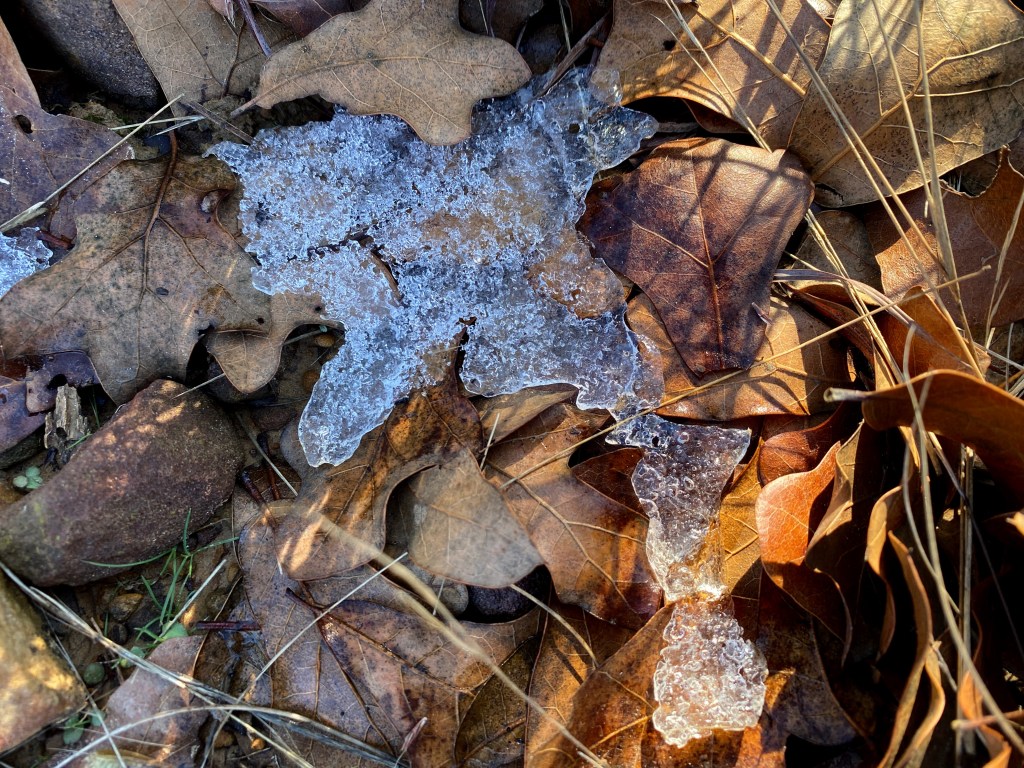
A little remnant ice among the oak leaves

On Mild Winter Days

Mild winter days are a gift, one that can make us uneasy and yet grateful for the soft warmth of sunshine in midwinter woods. The uneasiness comes when we recognize that the gift often comes from climate change. A recent Texas Monthly article reported that this past December was 4 to 5 degrees warmer than average, and that January of last year was the sixth warmest ever seen in Texas. In winter, our off-the-rails warming climate can feel good, but it is still brought to us by the worsening climate catastrophe.

Let’s get to the gratefulness part; while some days I try to wrap my head around climate issues and see what I can do, on other days I want to accept the wonder and joy that nature gives. On those days I’ll live in today, not next year or last year. Even as I sit under a blue sky, surrounded by the sheltering oaks, some part of me knows where the gift comes from, but that will not spoil the day. And so here are a couple of slightly edited entries from my journal, reflecting solitude and time in the woods at my favorite preserve.

On February 1st I made my way to the top of the hill under a sunny sky with no clouds. The local weather service said that it was 73F. I was on a little-used trail and the traffic noise was in the background. There was a sense of quiet because the noise seemed distant and subdued. I noticed a little chatter of crows. Nearby it was quiet and peaceful, warmed by the afternoon sun and surrounded by oaks reaching their bare branches up into the blue sky.

It was as if I had a distant memory of sleeping outside on such a day, in a peaceful place with all noise far away. Being lulled to the edge of sleep with a warm sun and soft breeze, in the close company of trees. Or perhaps it just seemed like a perfect place to drift away.

And then a strong breeze blew through, dislodging a remaining leaf or two. “Rock-a-bye baby, in the tree-tops…” Will the bough break? The cradle fall? What a strange lullaby.

A fungus in delicate and beautiful concentric rings

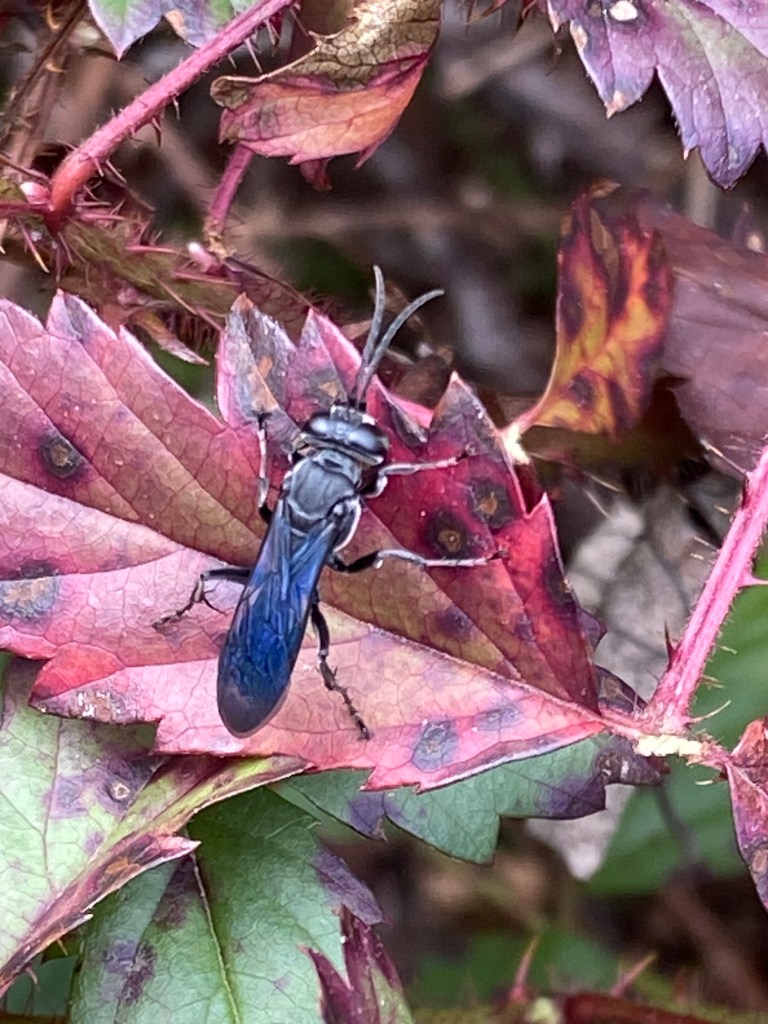
On February 4th it was partly cloudy and a little less warm (61F, reportedly) but at the start of the walk it was mostly sunny. The clouds that moved through were low, thick and heavy, slipping eastward and sometimes hiding the sun. After making my way up to the boulders, I wandered down the trail past lots of small sulphur butterflies and found a small wasp in a tangle of dewberries. Nearby, a Carolina chickadee called from low branches. Blue jays fussed somewhere as the breeze came and went, blowing a few loose leaves.

A small wasp that survived the recent freeze

I came back to the sandstone bluff, and the movement of clouds was putting on a delightful show. Using my shoes as a pillow I lay on the rocks and watched those clouds. Sometimes the thicker gray clouds obscured the sun, and I was glad for my jacket, and then the sun re-emerged with wonderful radiant heat.

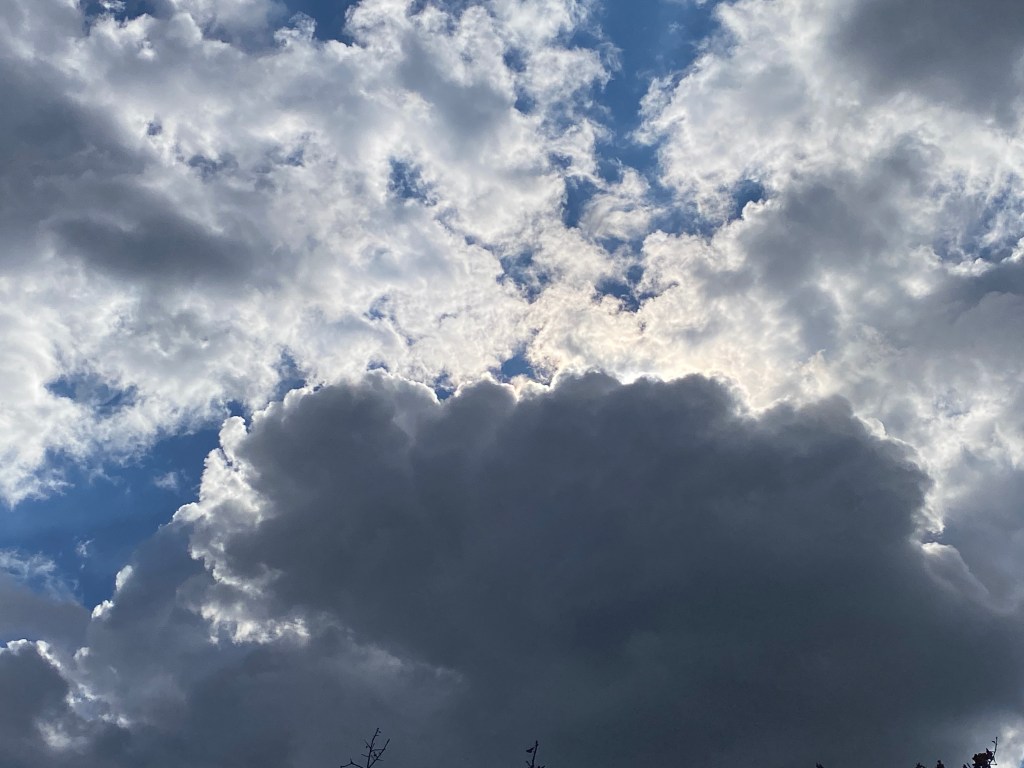
Looking up at clouds

There were low clouds still sliding to the east, sometimes wispy and light, and other times wet and gray. High above those, a layer of clouds slowly crept in from the north. Some of those were thin and feathered in intricate bands, but others were ropy and white. The edges of the low, gray clouds were rimmed in bright white from sunlight and almost too bright to look at. As always, the slow graceful movement of clouds was mesmerizing.

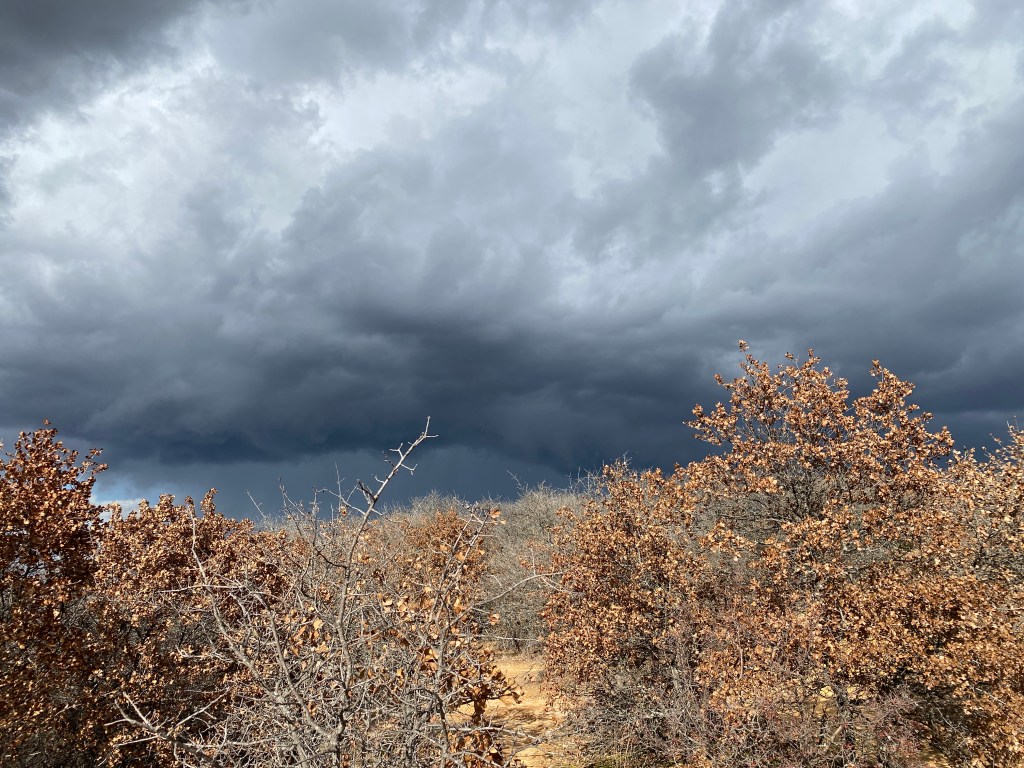
Darker clouds were massing nearby, and I started my walk down the hillside. Somewhere along the way I heard thunder, and rain began to fall as I reached the car.

Rain clouds visible from the bluff

I hope you are able to get outside sometimes on days like this. I’d love to hear in the comments whether you feel the same as I do about these warmer winter days, or if you prefer days when winter has a little bite and maybe brings some snow.

A New Year: Needing Nature’s Continuity

We have this urge to mark the end of the old year and welcome the new one, so we gather to wish each other a happy New Year. We think about the coming year as a new beginning. Sometimes we want to try for a new beginning for ourselves, with new year’s resolutions to start doing this or to do less of that. Midnight on December 31 marks a change, for good or ill (mostly for good; it feels like a bad omen to even consider that it could be a change for the worse). Another year older, another chance, another spring.

LBJ National Grasslands, in Unit 29, on the last day of 2023

But spring is months away and our transition to 2024 is completely arbitrary, unless you consider that it’s pretty close to the winter solstice when everything really does begin to change, in ever so gradual degrees toward greater light and warmth. Nevertheless, yesterday was the end of 2023, and among some members of my nature tribe the right way to mark the occasion was to walk the woods and prairies one last time.

Alaina, Sheryl, and Jake met me at LBJ National Grasslands under a warming sun with scattered clouds. It is a familiar and welcoming place, and if we needed reassurance that some good things can be counted on to stay consistent despite the turning of the year, this was it. We did not talk about it, but I expect that this dependability of nature is part of the appeal of a walk here on New Year’s Eve. Many of us are ambivalent about change, considering what we have been through in recent years. The pandemic, a worsening climate crisis, the creep toward fascism in many places across the world; these things make the woodlands and prairies more precious than ever. The cycles of growth, flowering, the shedding of leaves and winter dormancy make up a background of dependability. That, and the love that truly close friends and family have for each other, keep us going when everything else seems to be falling apart.

Alaina and Sheryl

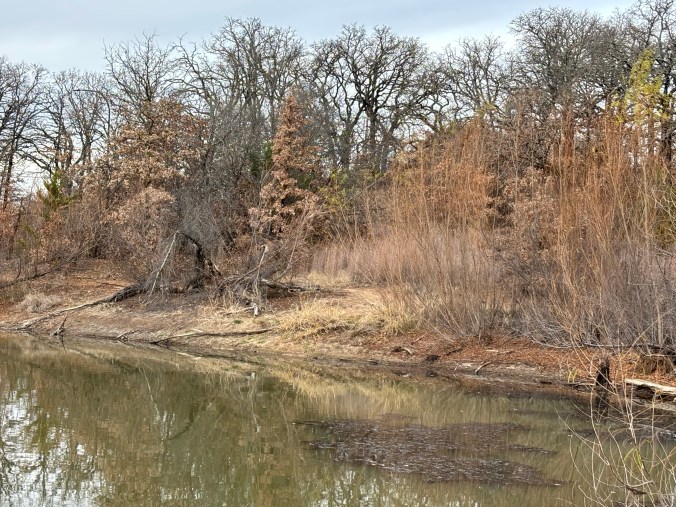
The earth tones of the prairies have become quite “earthy” and the straw and sienna colors have faded, but there was still some warm brown in the woods. And the liberal scattering of junipers adds some touches of green, so it was hardly a colorless winter scene. When you add the ponds with reflective water and surrounding bare trees, the grasslands in winter have a visual beauty beyond compare. Spring and summer are also lovely, just in a different way. The Western Cross Timbers is an amazing gift that every season makes into something new and wonderful.

There is life in every season. We saw a few dragonflies, and I mentioned to my friends that I believe seeing a dragonfly on the last day of the year should be a sign of good luck. Spread the word – let’s make a “lucky dragonfly” tradition and invite urban folks into a new little connection to the natural world. These insects are already associated with good luck in some Asian and Native American traditions, so it shouldn’t be a stretch.

A common buckeye

We also saw some butterflies. We often see them deep into the winter if the day is sunny and has some warmth. They flutter along and bring extra movement and color to the day. One of them was a buckeye, a species with colorful round “eye spots” on their orange, brown, and white wings.

Our walk helped end 2023 in a good way, and we are ready to carry that through into the new year. Here’s to everyone having a year with beauty and wonder, surrounded by those you love (even if from a long distance*) and filled with empathy, compassion – and healing whenever that may be needed. Happy New Year!


* Looking at you, Meghan and Carly!