
Sitting beside the Trinity River, on the Crosstimbers Trail, I wrote, “The place is so big that it makes the voices of the occasional human visitors seem small.” On a warm Friday in February, there were quite a few people at the Fort Worth Nature Center and Refuge, making bigness an important quality if the trail was going to live up to the name “refuge.”
This is a big place, as nature centers go. Its 3,621 acres are loved by many, and that is partly because it is big enough for a little solitude. The Crosstimbers trail borders the river for the first half-mile or so, and that’s a popular walk for people who want to see the water and maybe hope to see a ‘gator. Once the trail bends back into the woods, there are fewer people, and once you get pretty far back on that loop trail, you might be on your own for a good while.
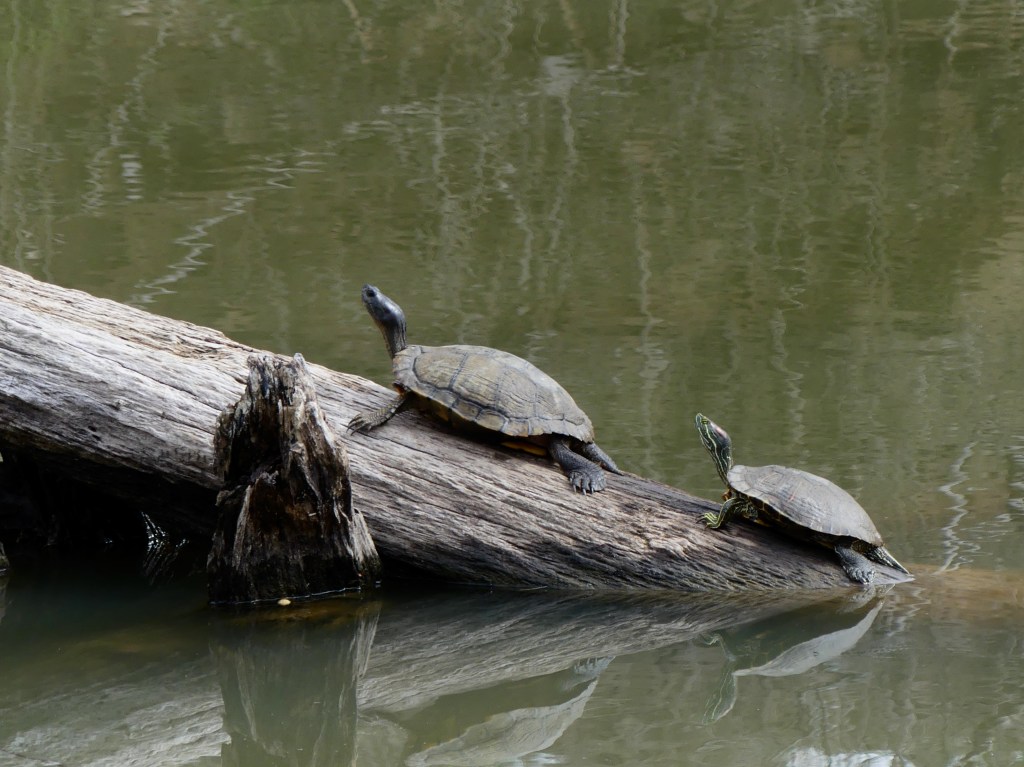
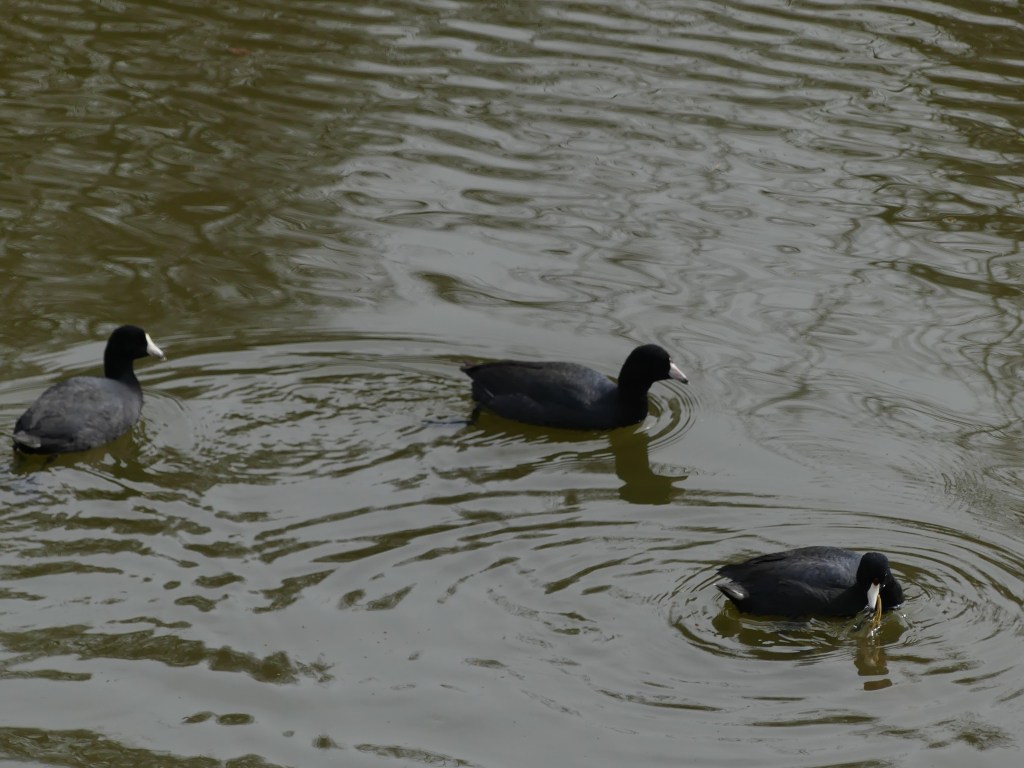
I got started at 10:40am on a day when thin clouds could not hide the sun and you could walk comfortably in a t-shirt. I watched a great blue heron fly over the nearby marsh and said hello to the cooters and sliders basking on fallen logs and branches in the water. There were plenty of American coots swimming nearby.
The bottomland forests beside the river were full of stately old trees – cottonwoods and other species – and they are often entwined with one or another climbing vine including poison ivy. One old cottonwood tree has huge vines braiding around its trunk.
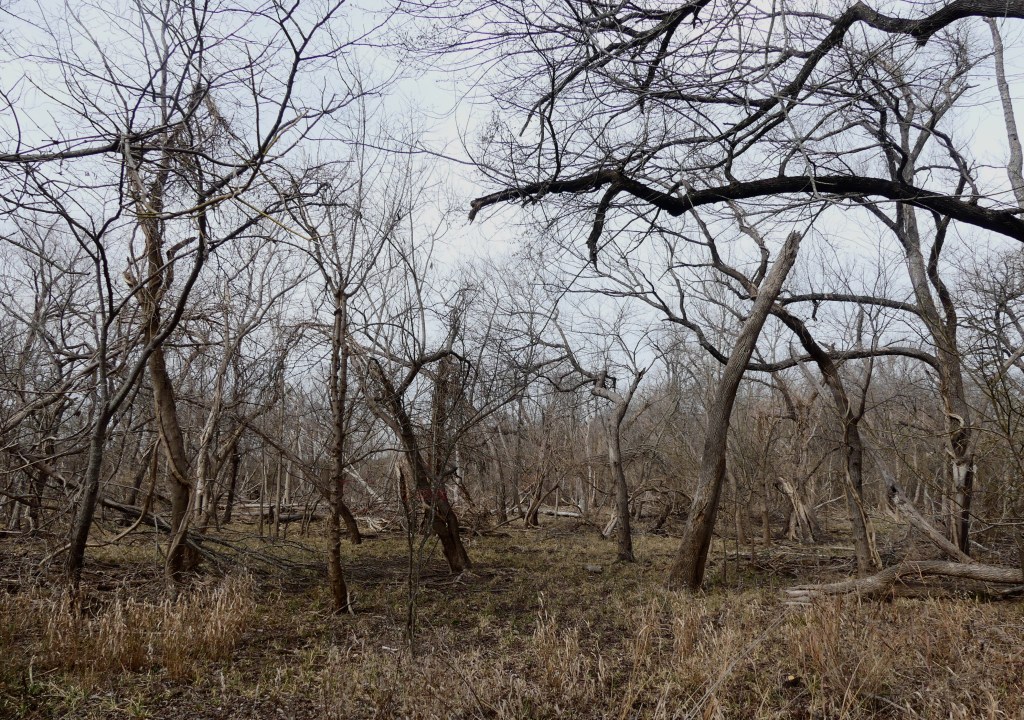


Bare woody branches of shrubs frequently contained a spray of bright red berries where a kind of holly called possumhaw grows. And around me in the woods were the calls of many birds, including Carolina chickadee, tufted titmouse, and northern cardinal (identified by the Merlin bird ID app). My thermometer showed that it was 71.8F at 11:25am.
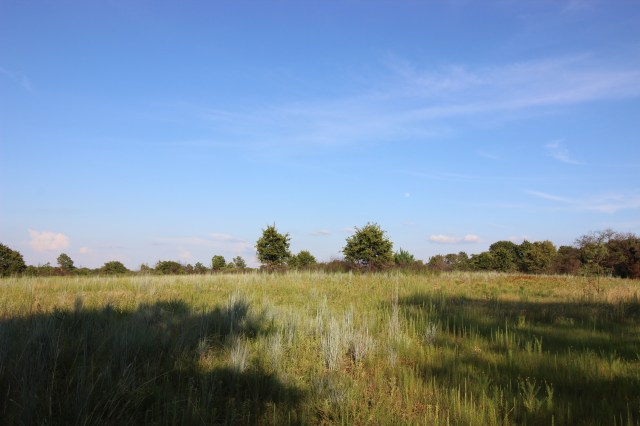
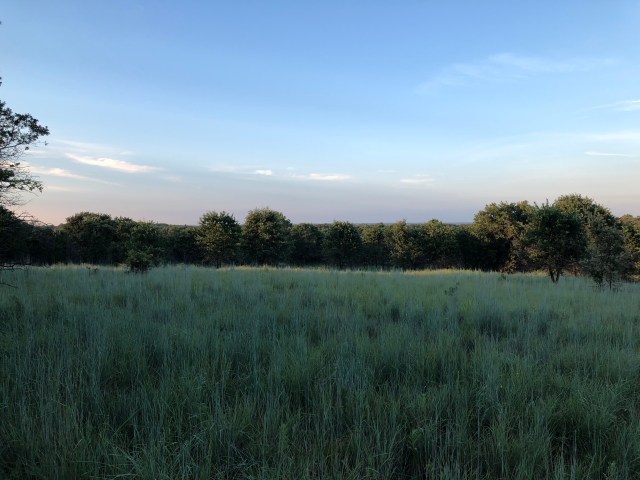
Then it was time to follow the trail back into the woods. There are plenty of oaks; big bur oaks with big notched leaves and the post oaks that are a signature species of the Cross Timbers region. There is ash, cedar elm, and some hackberry trees. Here and there the woodland opens up to a little glade or pocket prairie with native grasses. I took a few photos on the “pano” setting because today the place seemed so big that only a very wide photo might do it justice.

The trail leads through galleries of old trees and the land slopes away to the north toward a wetland. On the other side, the woodlands and open grassy patches gently climb toward a high place. On my walk, the winds seemed to shift around 11:35am and become cooler.
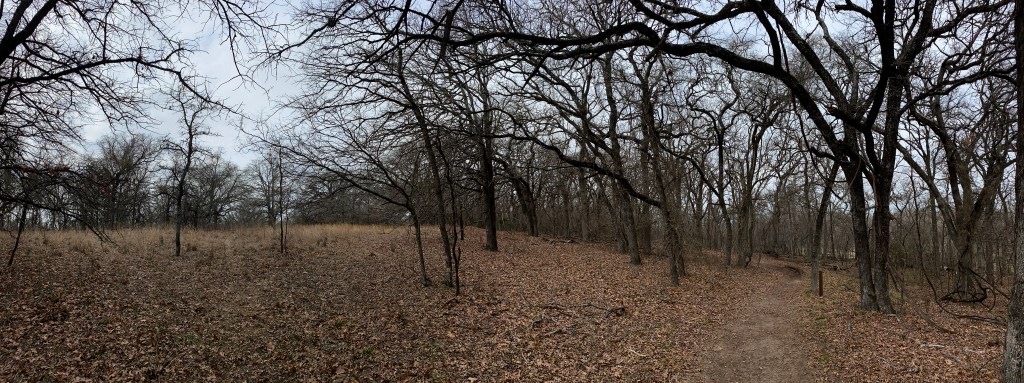
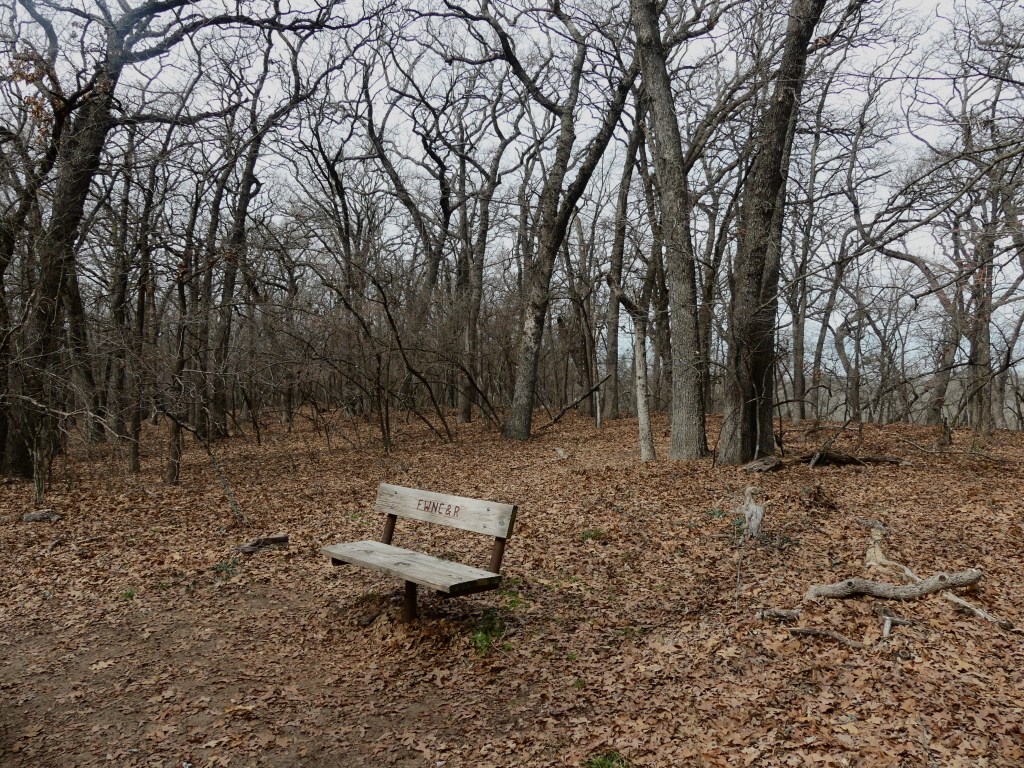
At what seems to be the highest point, there is a bench, perfect for sitting and taking in the wonderful forms of the trees, the carpet of dropped leaves, and the birds. Today it was very quiet and peaceful.
I started back, and as I walked the breeze scattered leaves ahead of me on the trail. That breeze was strengthening and making its voice heard through the tangle of trees. The branches shredded the current of air. Sometimes it was a whoosh and sometimes a soft roar, falling away to silence.


As I got further along, at one point I looked down the trail to see two deer looking back at me. They were silent and still as statues, sizing me up and deciding if I was a source of trouble. After a moment, the group took off, with those white tails flashing a warning to the rest of the group.

When I reached the river and sat on a bench, there was the chatter of a belted kingfisher somewhere nearby (though I could not see it). Merlin also identified the call of a northern flicker. The thin clouds were pulling apart, and when the sun shone down it felt warm. The temperature had fallen a little to 67.6F, but in the little nook where I sat on my bench, the sunshine felt good.
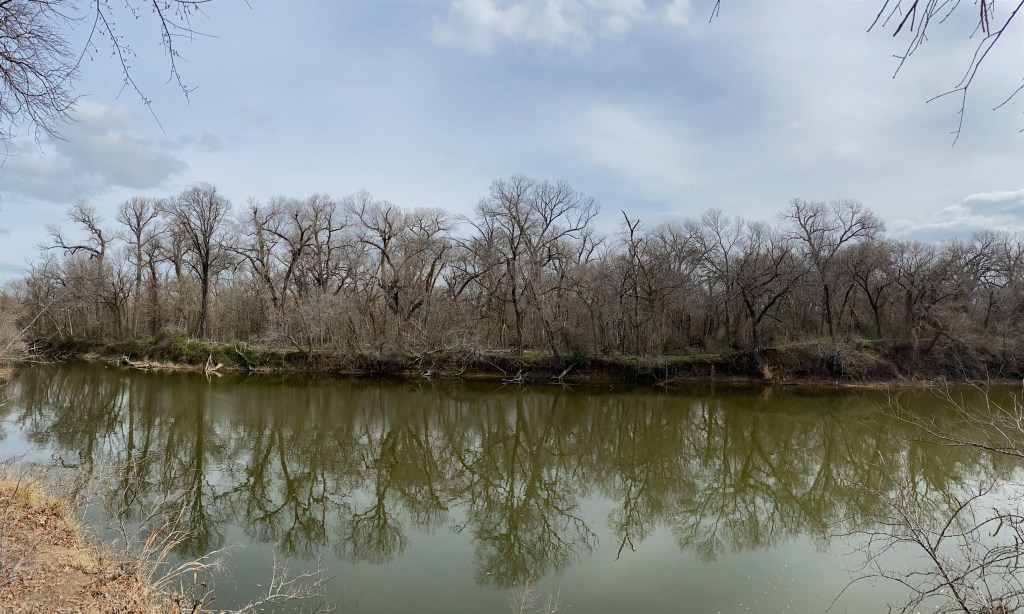
The kingfisher clattered persistently. Another bird came in for a dramatic fast landing, wingbeats skimming the surface of the river. The bird then paddled around as if nothing had happened, sometimes diving down into the water. With the lens on my camera I got a good enough look to see that it was a pied-billed grebe.

The relatively thick bill with a dark ring around it was a giveaway. The Cornell website gave more information about what I observed about its diving: it was hunting. This bird likes crayfish and also eats small fish, dragonfly larvae, and it would not mind a leech or a small frog.
In that last hour I was grateful to have seen no one along the trail, and was happy to be by myself. I do like walking with others, but on some days like today, the solitude was peaceful. I am so thankful that Fort Worth has one of the biggest urban preserves in the country – and that it “feels” big.


 Our Lives In Nature