Getting to Know Some Reptiles

… and at least one amphibian

My interest in nature has been dominated by reptiles and amphibians (herps) starting when I was nine or ten and the girl across the street invited me to come along and find garter snakes in Colorado. I was active in herpetological societies twenty-five years ago and I’ve been teaching incoming Master Naturalists about these animals for some years. I’m interested in the “big picture” of ecology and natural history, but herps are still an important focus.
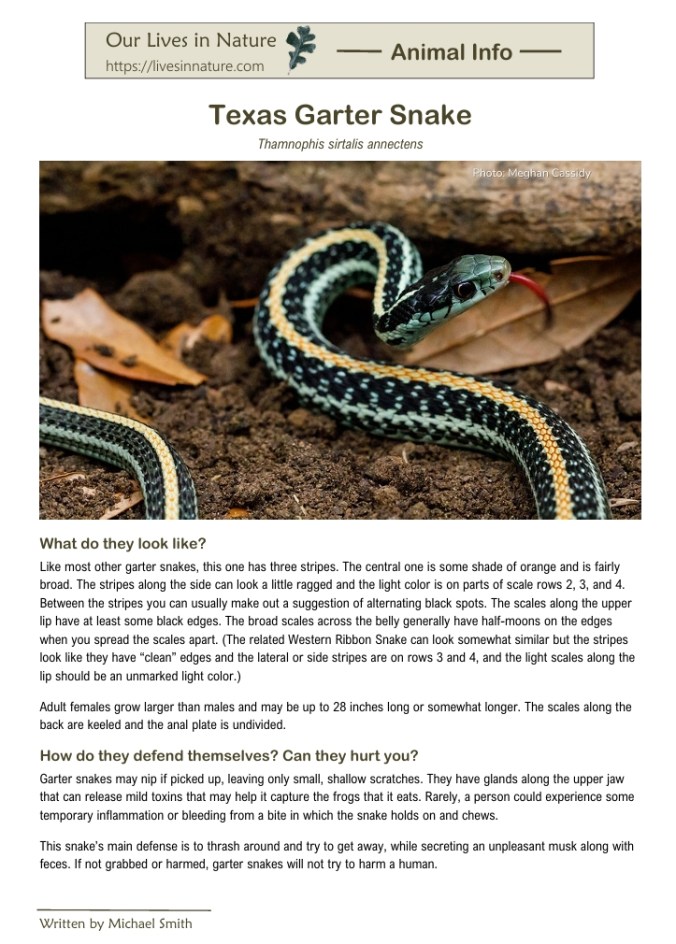
Herp conservation is very important to me. If you’d like to learn more and support some important work, please check out the Amphibian and Reptile Conservancy and the Orianne Society, among other organizations (such as Texas’ own Texas Turtles). I’ll be giving talks about reptile and amphibian conservation in Texas over the next few months, and while preparing, I’ve added some species profiles to the downloadable pdf files on my herpetology page.

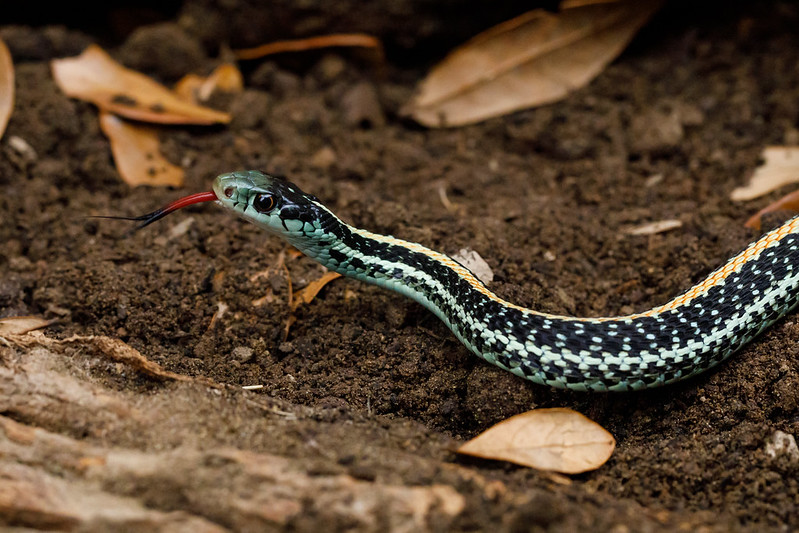
Among them is information about the Texas Garter Snake, a subspecies of the “Common” Garter Snake. Across the years, I have found a handful of Texas Garter Snakes, and they turn up occasionally on iNaturalist, but as far as I can tell they have never been common. There seemed to be particular spots or areas where they had viable populations, but even in those places a search for them was always hit-and-miss. That turned out to be the case in 2013 and 2014 when a group from UT Tyler started a project to investigate its genetics and preferred habitat. They did not find any, and had to rely on a few museum specimens in order to finish the project (published in The Southwestern Naturalist in 2019).
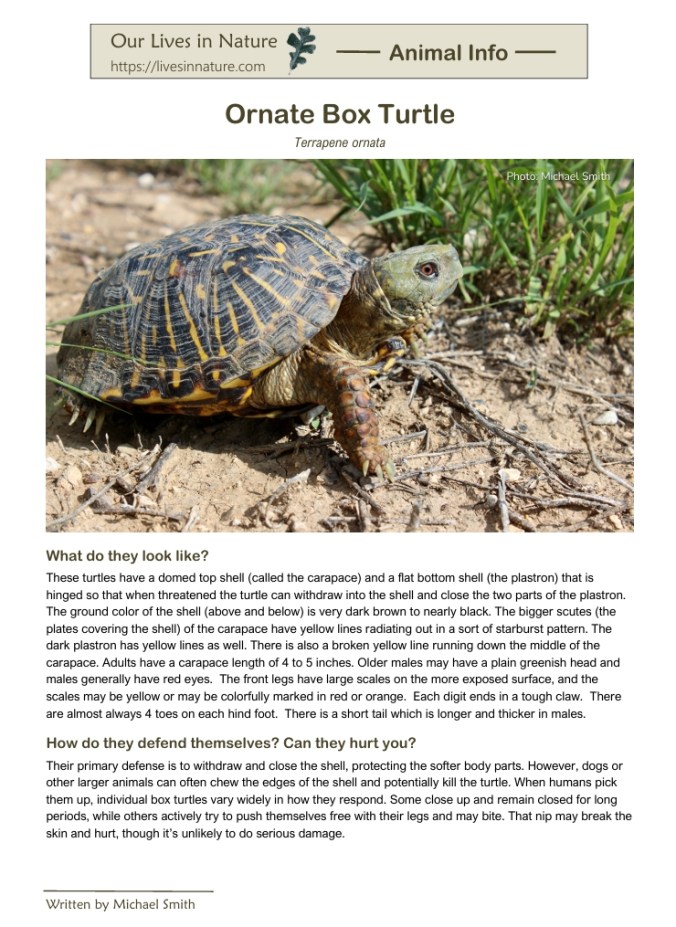
Another profile covers the Ornate Box Turtle. I have loved box turtles since I was a kid (and at least half of Texas would say the same thing, until they became uncommon enough that kids didn’t get many chances to see them). They have suffered from habitat loss and fragmentation, road mortality, and the unfortunate tendency of our species to want to collect and keep interesting and cute animals. In recent years, Texas protected box turtles from commercial collection. However, people still pick them up and take them home. Like turtles generally, their success depends on living long lives once they become adults. Collecting one is like running it over on the road – it is “dead” to the reproductive population of turtles.

And Texans of a certain age recall when the Texas Horned Lizard could be found in back yards and local parks. In the 1960s these places were often dotted with Harvester Ant colonies with a big bare circle of ground around the opening to the colony. These were the horned lizard’s food, and when people poisoned the ants (and later when the fire ants largely replaced them), there was nothing for horny toads to eat. Also in the 1960s, large numbers of these lizards were collected and shipped off to the pet trade where they inevitably died. But probably the biggest deal, according to Andy Gluesenkamp, was the loss and degradation of habitat. Native Texas prairies, with bunch grasses, open areas, ants, and the right combination of shelters and wildlife “neighbors,” were great for them. Monoculture pastures of non-native grasses, the increasing network of roads, the invasion of fire ants, and other factors have eliminated Texas Horned Lizards from many of the places where they used to be found. (Gluesenkamp led the San Antonio Zoo effort to captive breed and release young horned lizards in suitable habitat – an effort that is working.)

So far, the sole amphibian I’ve profiled is also one that biologists are concerned about. There is little real data concerning how Woodhouse’s Toad is doing, but it is the species that many of us used to see on spring and summer nights in North Texas. It has largely been replaced by the Gulf Coast Toad, but away from the cities there are places (like the LBJ National Grasslands) where Woodhouse’s Toad seems to be the predominate species. Overall, the species is considered secure, but are we sure? Wildlife agencies and universities have limited resources and cannot study everything. Everyday folks documenting what they see on iNaturalist help a great deal, but there are still enormous gaps in our knowledge of the status of most of our herps.

There are other species with these two-page downloadable pdf profiles, including the Texas (Western) Rat Snake, the Great Plains Rat Snake, the Long-nosed Snake, Rough Earth Snake, and Checkered Garter Snake. I hope you’ll use them to share with home schoolers, scout troops, or anyone else who would like them. I’d be happy if you’d like to leave a contribution, but if you can’t, that’s fine. And maybe leave me a note about anything else you’d like to see. Our venomous snakes are briefly summarized in my “Identification Guide to Venomous Snakes of North Central Texas,” found on the same page.
RIP, Tex

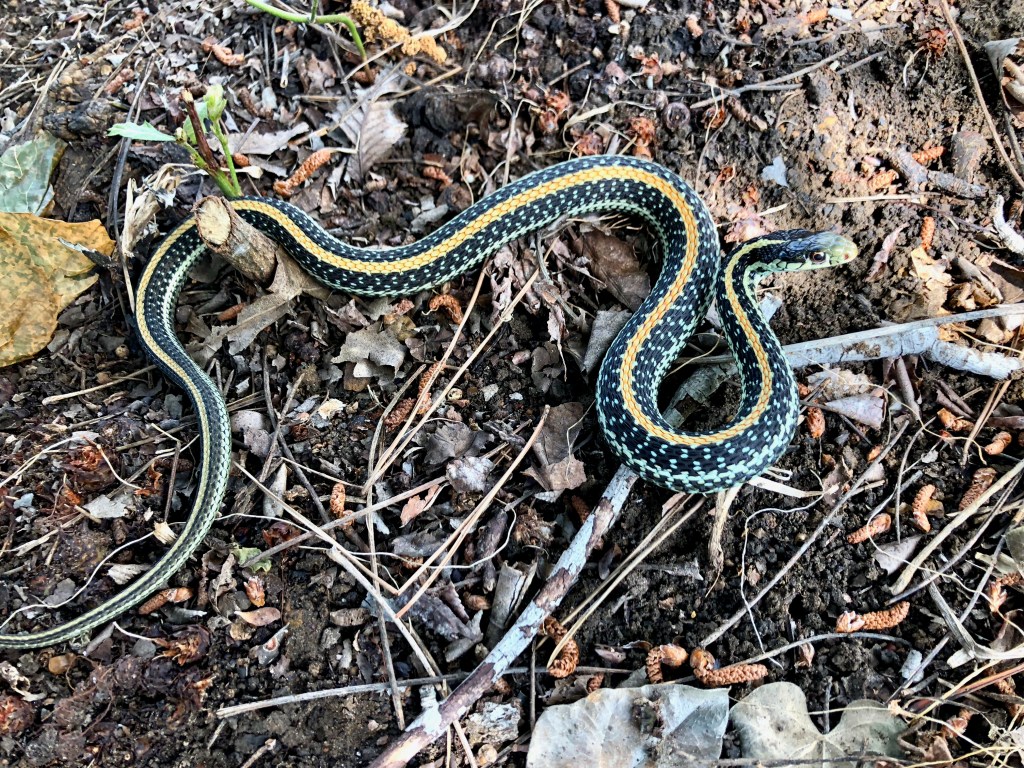
Nearly ten years ago, I was given a young Texas garter snake. A landowner in North Texas had picked him up on his land (where he reported seeing that subspecies regularly) and wanted verification of which kind he was seeing. I drove there with a friend and was delighted to hear that this farm seemed to be one of those little pockets where the Texas garter snake was doing OK. They have always been pretty hard to find, but some places are better than others. Texas Parks & Wildlife Department considers them to be “critically imperiled.”

Tex, back in 2018

I accepted this young one because it evidently would not be a noteworthy loss for that local population, and because he could be an ambassador for threatened Texas snakes. I’ve taken him to quite a few talks and presentations to new groups of Master Naturalists and to school or summer camp groups. Seeing Tex was a good way for people to learn how being a striped snake helps you escape by giving the appearance of being stationary – the stripe doesn’t seem to move – while you are slipping away. And of course he was a living example of an animal I said was in serious trouble and might disappear, for reasons that no one is sure about. It could involve things like habitat loss, habitats fragmented by roads, fire ants, and maybe other things.

In a study in the 2019 issue of Southwestern Naturalist, researchers looked at the genetic status of The Texas garter snake (Thamnophis sirtalis annectens) and two other related garter snakes that occur in Texas. They also looked at suitable habitat, finding that in Texas, where T. s. annectens does better than the other subspecies is in the area of the Cross Timbers, parts of the Blackland Prairie, and some of the Post Oak Savannah and down toward the coast. The study did not look at why it is imperiled.

I wrote about one of the times I took Tex to meet some kids at River Legacy Nature Center, when a girl had commented that she hoped one day they would be protected. On days like that I felt like Tex living in captivity (rather than living out his life on that farm) was worth it. Tex, of course, was silent on the matter.

But he was happy to nap under a piece of bark, cruise around the cage and eat the occasional mouse. His siblings and cousins in the wild were probably snacking on small frogs and earthworms, but most garter snakes can be convinced to eat thawed mice from the store. He grew and seemed to thrive, and living about ten years is not bad for a garter snake. (Their life span in the wild is assumed to be less than that, and sometimes in captivity they may live longer than ten years, but the evidence about their longevity is fairly spotty.)

And now he has died, I presume from something akin to “old age.” RIP, Tex. You charmed a lot of kids; a lot of Master Naturalists around here know your kind based on getting a look at you. I’ll miss you.

“I Hope One Day They Will Be Protected”

Today I talked with a great group of kids at River Legacy Nature Center in Arlington. The twenty or so children were in a week-long “Hands-On Herpetology” class, having fun and learning about native reptiles and amphibians. I brought a few snakes and we talked about things like how they live as well as being safe when around them.

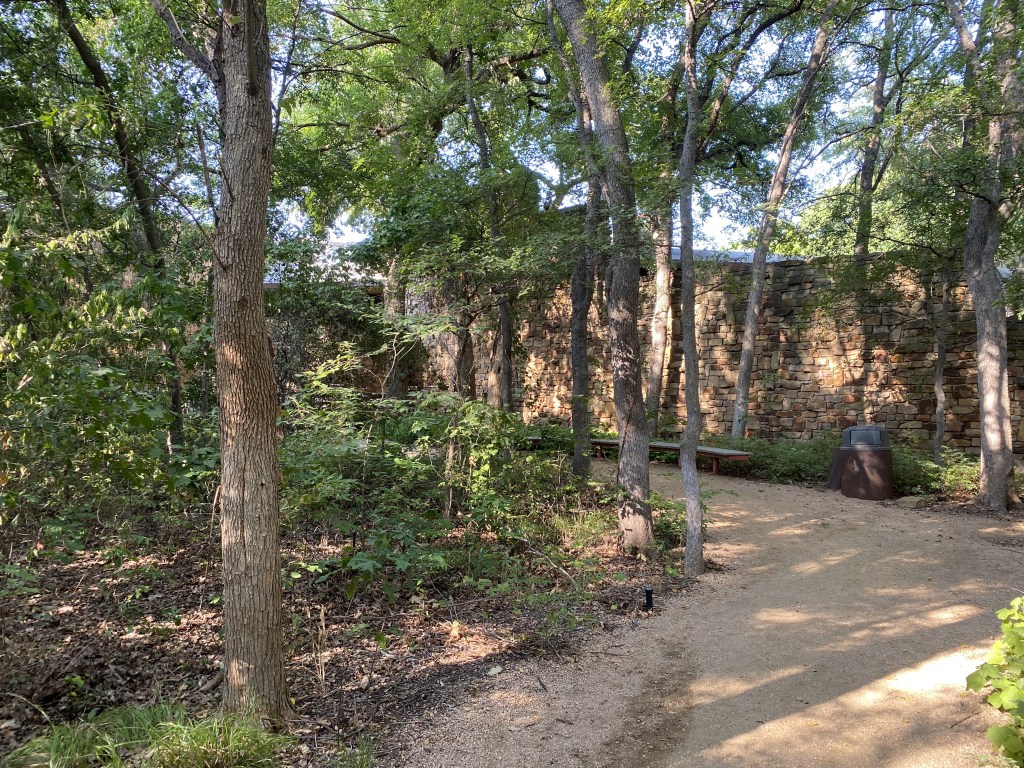
The trail approaching the River Legacy Living Science Center

One of the snakes I brought is a Texas garter snake. He has a dark background color and three light stripes, big inquisitive eyes and an active, athletic build. We talked about how snakes with stripes generally rely on speed – and a sort of optical illusion – to get away from predators. The thing is that when “Tex” or other striped snakes move, it’s hard to see their motion. If they had spots, it would be easy to see the spots move as the snake’s body slipped away. The stripes, however, seem to stay where they are, until the stripes converge on the narrowing tail and then the snake is gone. The predator may be left empty-handed.

There’s a tendency for people to think of garter snakes as common “garden snakes,” but in the case of Tex it just ain’t so. He’s a member of an uncommon subspecies of garter snake whose fate is not well understood. The Texas Parks & Wildlife Department considers the Texas garter snake to be critically imperiled. It appears never to have been actually common, but there were places here and there (particularly within prairie habitat) in which they might be found at times. A recent study noted that despite trying to find these snakes in the field in 2013 and 2014, researchers were not able to find any. Tex is a long-term captive donated to me years ago by a landowner in Hill County so that more people might see and understand Texas garter snakes.

The Texas garter snake (“Tex”) – photo by Meghan Cassidy

My discussion about this was much more brief with the kids, but they got it that this is a snake that may be disappearing. When I mentioned that they are not legally protected, a girl commented, “I hope one day they will be protected.” Me too. I hope one day we will understand the reasons for the snake’s decline in more specific ways that allow us to protect it. And I hope we continue to have children who, when they learn about a species that is in trouble, want to protect it.

We talked about being safe when out in the field where there could be venomous snakes, and I showed the kids a prairie kingsnake and the young bullsnake that was a big hit with kids in Dallas earlier this week. The kids asked good questions and they already knew a number of things from their week at River Legacy. But nothing quite equalled that girl’s comment. It was an offhand remark that revealed her empathy or her capacity to care about a unique, lovely little member of the natural community. It made my day.