Sanctuary!

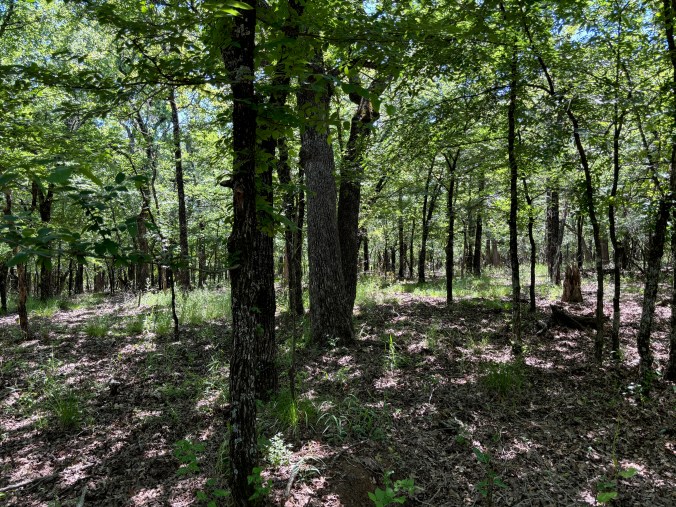
This new trail at Fort Worth Nature Center & Refuge is a favorite. I have walked it in winter with those bare tree limbs reaching up towards the sky and beautiful patterns of shed leaves on the ground. Now I have been there when it is greener and darker with all those new leaves shading the ground. The trail winds among the tree trunks and I can hear the quiet and the birds and the soft crunch of footsteps. That quiet and the new leaves as well as the carpet of old ones makes for a woodland sanctuary. A protected woods becomes a protective place for all who walk there.
I remember the 1939 film – “The Hunchback of Notre Dame” – in which Quasimodo rescues the wrongly condemned Esmeralda and flees to the cathedral, crying “Sanctuary! Sanctuary!” Notre Dame is a place of safety and protection from a corrupt French Chief Justice. Both the disfigured Quasimodo and the Romani girl Esmeralda are safe within its walls.

I respond to the prairies, woods, and wetlands as places of safety and protection, sanctuaries from thinking about the current regime and worrying about how it will play out. Extrajudicial abduction, defiance of courts, hate and scapegoating, wrecking the economy that sustains us, and on and on. We might imagine that, like Esmeralda, we all need to be taken to some place of safety, away from the worst of our fellow humans.

At the same time that such things are going on in human society, the sun keeps rising each morning, birds sing, water flows, plants give us oxygen and food, and there is quiet and peace in the woods and fields. I am very thankful that they are part of the world. As Robin Wall Kimmerer said, “Even a wounded world holds us, giving us moments of wonder and joy” (Braiding Sweetgrass, p. 327).

Sanctuary! I need to be in such places. I must do whatever good that I can in the world, and then for a time I need the shelter of nature.
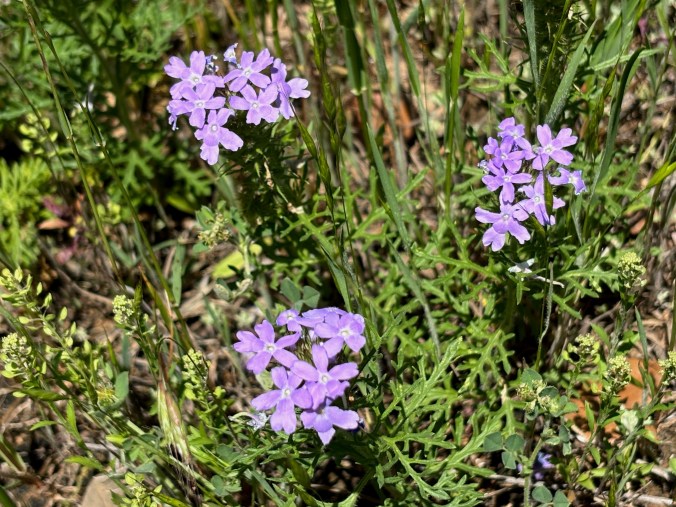
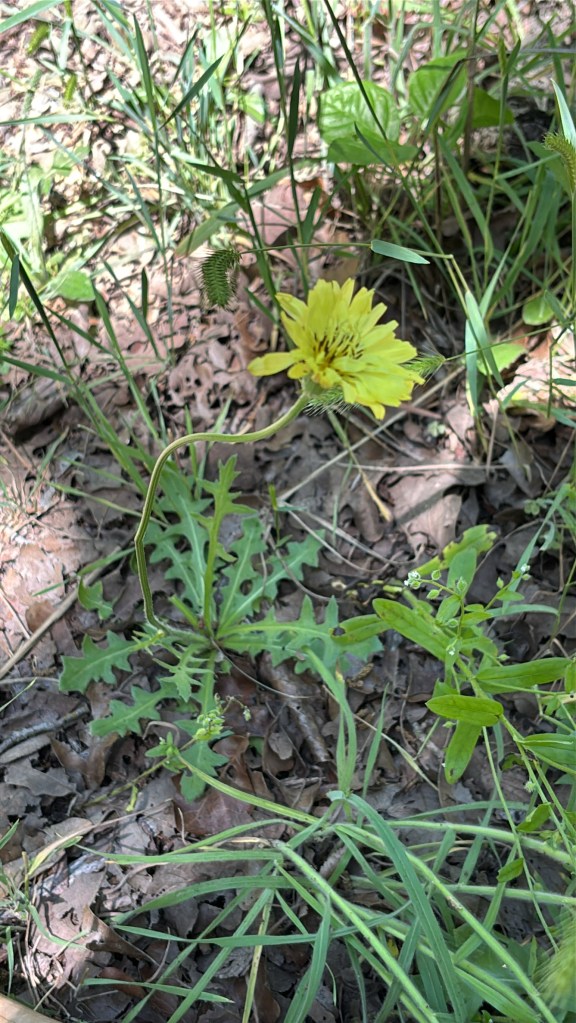
Flowers of Dakota Mock Vervain

And so I went to the nature center yesterday, the day before Earth Day. The sun was shining in a clear blue sky, and a Northern Cardinal’s call was joined with those of other birds in the patch of prairie where I started. The temperature was still in the 70s, but not for long.
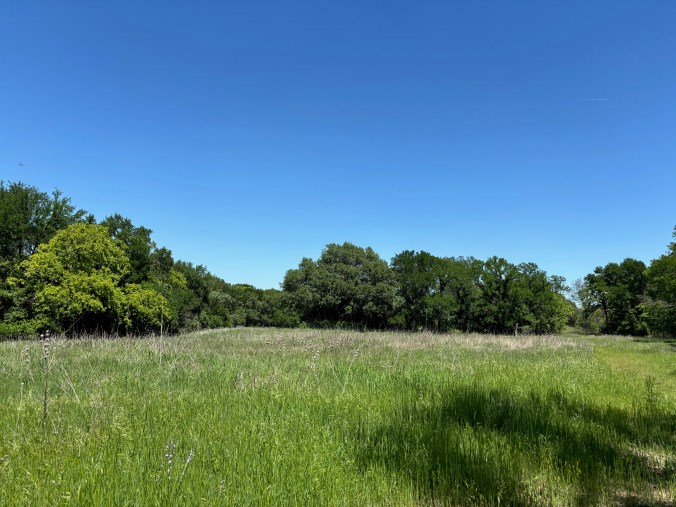
In the meadow with butterflies and bird song

After a time in the trees, the trail entered a big meadow or prairie surrounded by trees. This, to me, is the heart of this trail. There were flowers visited by butterflies – a Common Buckeye, several Goatweed Leafwings, and over by the bench, a Painted Lady. Once I settled in, I saw some species of sulfur flying and fluttering a little above the tops of the grasses. Most of the time the nearby air traffic did not disturb the place, so I could hear the Northern Cardinals and also Carolina Wren, Carolina Chickadee, White-throated Sparrow, and Tufted Titmouse (much of the identifying was with the Merlin app, but even if they were not identified the songs in the meadow were beautiful).

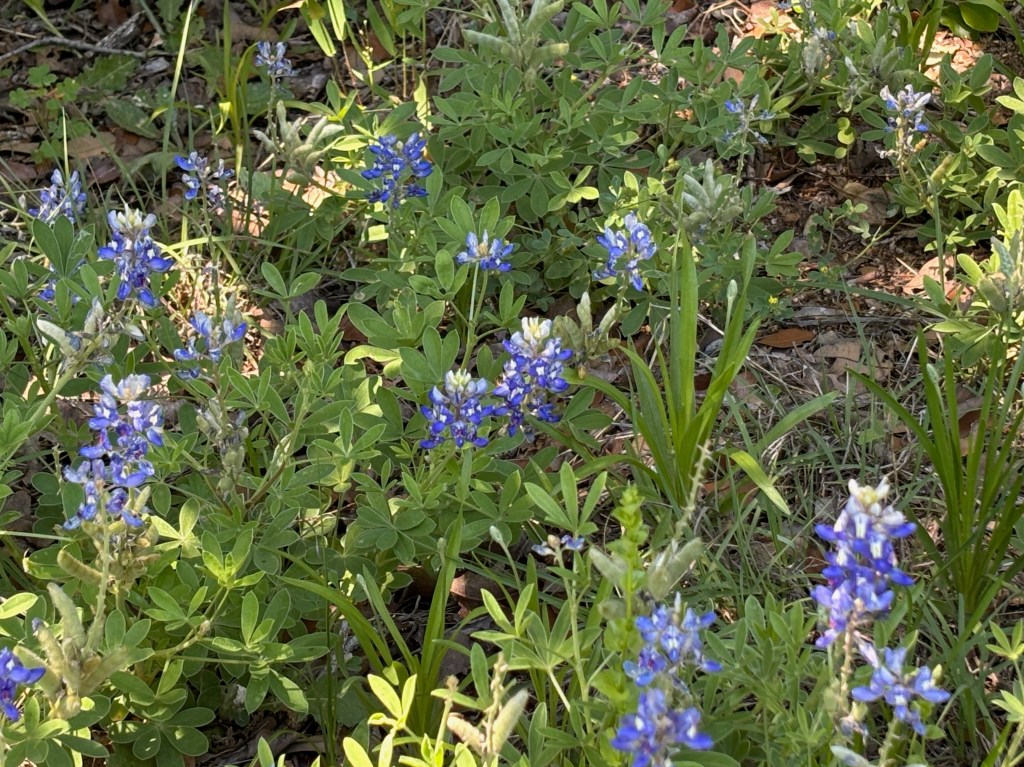
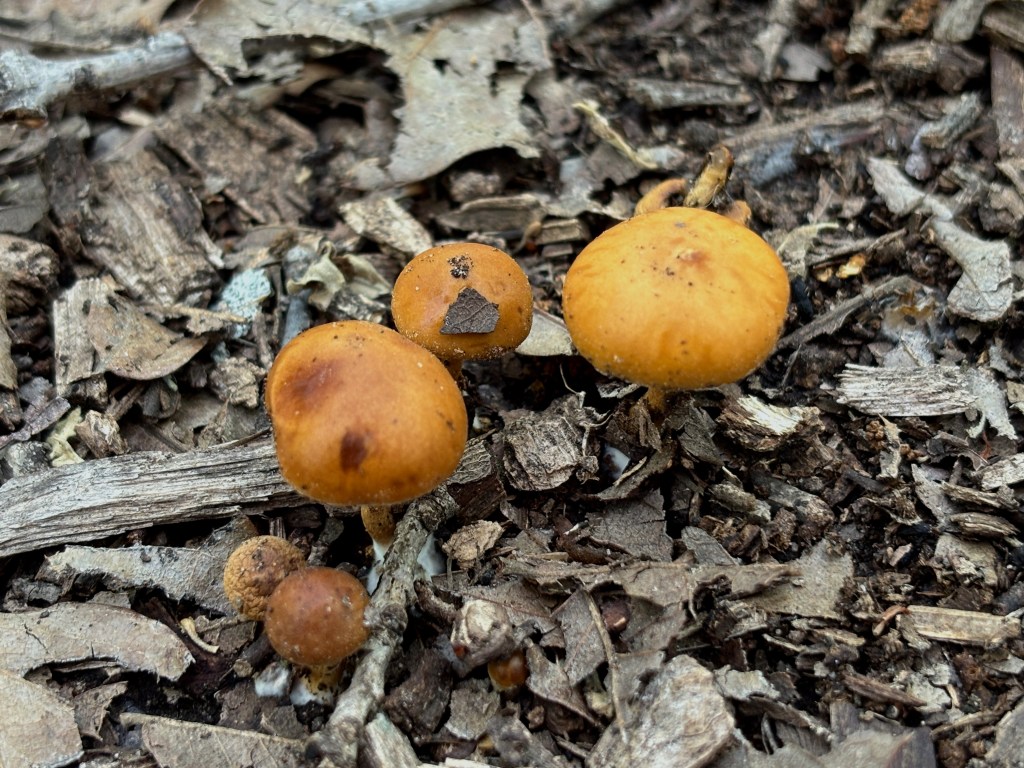
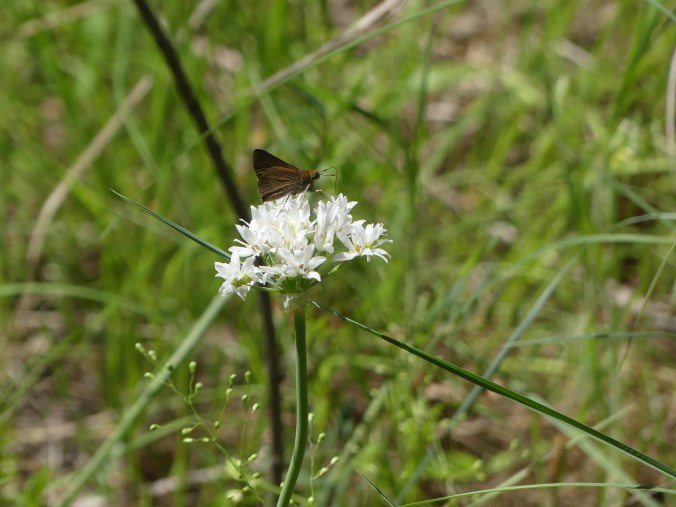
From there, the trail meandered through the woods some more. Sometimes I got on the ground to examine mushrooms; other times it was to see a small jumping spider. There were more flowers: Smallflower Desert-Chicory, Fraser’s Wild Onion, and at the end, a few patches of Texas Bluebonnet in clearings as the woods opened onto another prairie.
When I reached the end of the trail, the marsh boardwalk was a short walk away, and so I headed down to the marsh. Black Vultures were examining some exposed mud, a Great Egret flew by close to the boardwalk, and at some lotus stems in the shallow water an Eastern Phoebe perched. Then it flew to a nearby spot, disappeared, and returned. Once it dipped to the water’s surface, apparently to capture something. It is a busy life for a Phoebe on the hunt.
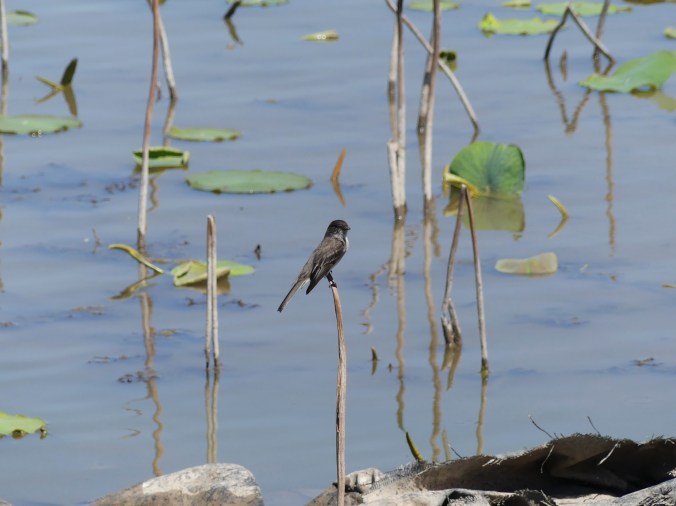
The Eastern Phoebe, scanning for insects

It was three hours well-spent. We all need this kind of sanctuary, and such places can be an important sort of self-care. I wish everyone could take an hour or so and be held in the peace and beauty of places like this. If you can, go and sit for a while in mindful stillness or walk the trails and notice the unending stream of wonderful things that you will find.
Experiencing Awe

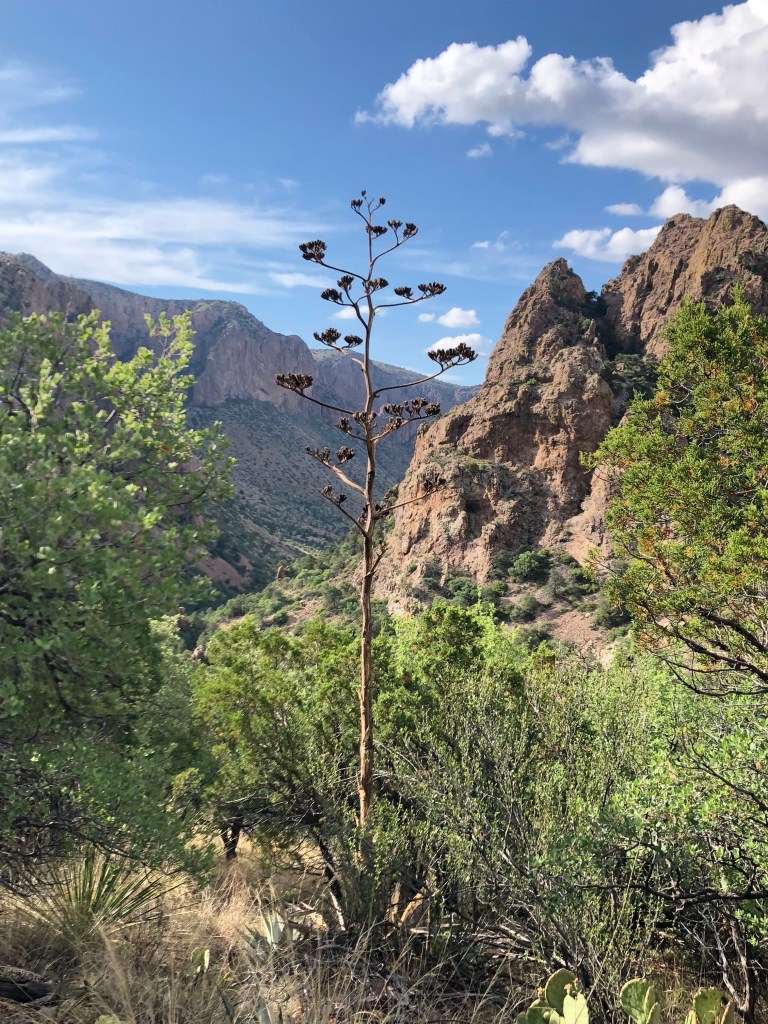
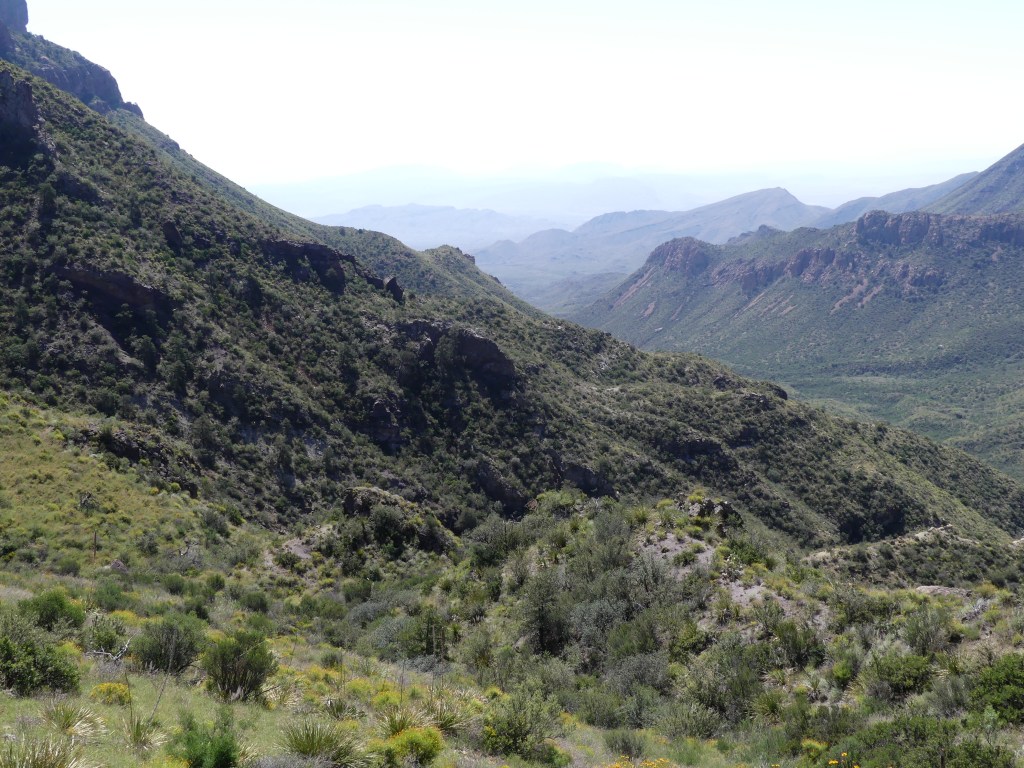
Halfway up into the Chisos Mountains, we reached a spot where the view opened beautifully. From where we stood, framed by pinyon pines, the mountainside sloped downward, dotted with yellow flowers, green clumps of sotol and shrubs. On either side the mountains rose up above us. To our right were the smooth granite towers of Casa Grande Peak, and to the left was the way upward along the Lost Mine Trail. The view south showed a series of mountain ridges, overlapping each other as they receded into the hazy distance. I sat under a pinyon pine, in awe of what was around me.

The word “awe,” in the form of the adjective “awesome,” is overused today to express, usually in an offhanded way, that something is good. French fries that manage to be both hot and crispy are “awesome.” The sense of confronting something mysterious and powerful has been wrung out of it, so that it fails to convey any suggestion of the meaning of “awe.” As defined by Merriam-Webster, awe is

an emotion variously combining dread, veneration, and wonder that is inspired by authority or by the sacred or sublime

The word’s origins nearly a thousand years ago emphasize terror or fright along with great reverence. Perhaps these emotions come from the religious connotation of being helpless and vulnerable in the presence of a God who could turn a person into a pillar of salt. In a more general way, we can experience fear in the presence of something powerful that we do not understand. As our species came of age in prehistory, a thing that seemed overwhelming and beyond our understanding might inspire dread and terror. Perhaps our survival depended on those emotions and the caution or shelter-seeking that would follow. Maybe a residual hint of fear adds to the emotional power of awe.

Standing in the Chisos Mountains, I was not aware of any terror or dread. There certainly was wonder and reverence, a deep respect for this place and all that it contained. The mountains, the Mexican jays and butterflies, the century plants that send up tall stalks ending in bunches of yellow flowers, all these things inspired fascination and gratitude. I was thankful for the privilege of being a great many miles from places where the experience of awe is shriveled to the size of an order of French fries.

I think we need the experience of awe, of being in the presence of the sacred or sublime and feeling moved by participation in something grand and wonderful. That might happen if we are in the audience as an orchestra plays the Shostakovich tenth symphony. It could happen as a jazz group plays Miles Davis’ “Blue in Green” so that musicians and audience together resonate with emotion. Or we could be standing on a mountain or in a prairie, shedding our self-awareness for a time and becoming absorbed in the life around us. The result might be shattering, in the case of the second movement of Shostakovich’s tenth symphony, described as a musical portrait of Stalin. Or, it could be transcendent and joyful, in the example of time spent in nature. In a variety of ways, we can join with something bigger than ourselves and sit with emotions and perceptions raw and real as we look out at the world from this different vantage point.

Where are the opportunities for awe in modern life, goaded by capitalism and breathless in the need for multitasking, relying on Facebook and French fries for moments of joy? Not only do the demands of modern life crowd out the space for reflection and wonder, the stresses and catastrophes of the last few years have pushed us to the limit. In the face of pandemic, isolation, mutual suspicion and insurrection, and now war in Europe, the desire to escape can be strong. Looking for that escape, some people put their shoulder to the wheel all the more, and some lose themselves in anesthetic good times. The rest of us – all of us – grow more numb from waves of trauma. When too much pain and stress come flooding in, the self-protective circuitry of our minds may keep us from being overwhelmed. One way to do that is to put up a firewall between us and our emotions, leaving us shut down and numb. If it is used very much, this shutting down is a very expensive strategy. In addition to protecting us from trauma, it also cuts us off from much of our emotional life, including those vulnerable experiences of joy and wonder.

What can we do to create space in which awe might come to us and find us open to the experience? We can look for – and plan for – times when we can slow down. I am thinking primarily of slowing our minds, taking things one thing at a time, having time to pay attention in a purposeful way. We could “slow down” while running or paddling a kayak, so long as we are not preoccupied, multitasking, and mentally running on autopilot. In order to be open to what is happening right now we have to be present, here and now. We cannot be somewhere else and fully experience our lives.

The trick is to slow down during the time that we have, not spend it in things that keep the mind revved up and distant, such as on smartphones or TV. Why do we constantly distract ourselves? Some of it is because we’ve trained our brains to expect constant stimulation and we are bored when it becomes quiet. Also, when our minds are quiet and receptive and worries or unpleasant thoughts come crowding in, we use distraction to keep them at arm’s length for a while. A capacity to be more quiet, present, and open might not come easy, but we can practice it and gradually find it easier to sit in stillness and be open to whatever we experience.