18 March 2026 – Fort Worth Nature Center & Refuge 12:10-2:16pm
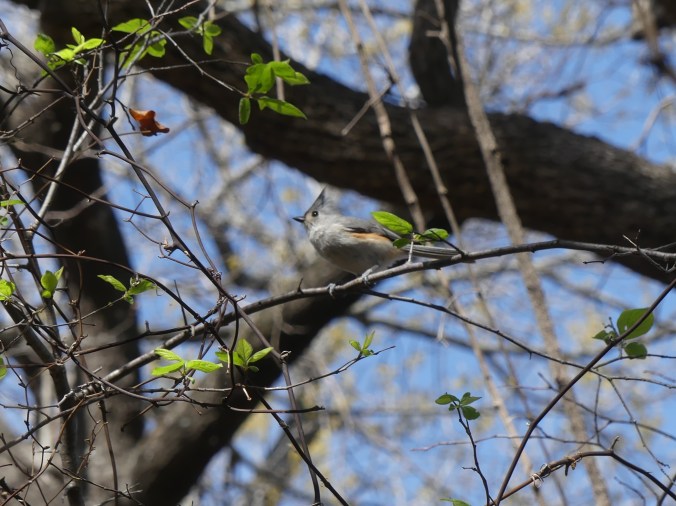
Along the Canyon Ridge Trail, Lone Point and the surrounding area is a favorite. The rocky remains of the old CCC structure are atop the ridge with limestone, yucca, and live oak. Today I started my walk from below the ridge, near the lakeshore, where a pair of tufted titmice were hopping around in understory and low tree branches.
Tufted titmouse
On the way up to the ridge, there were lots of bird calls in the woodland. Merlin identified the calls of red-shouldered hawk, tufted titmouse, white-eyed vireo, Carolina wren, red-bellied woodpecker, and northern cardinal. Once I reached the ridge, there was also blue jay, red-winged blackbird, and ruby-crowned kinglet.
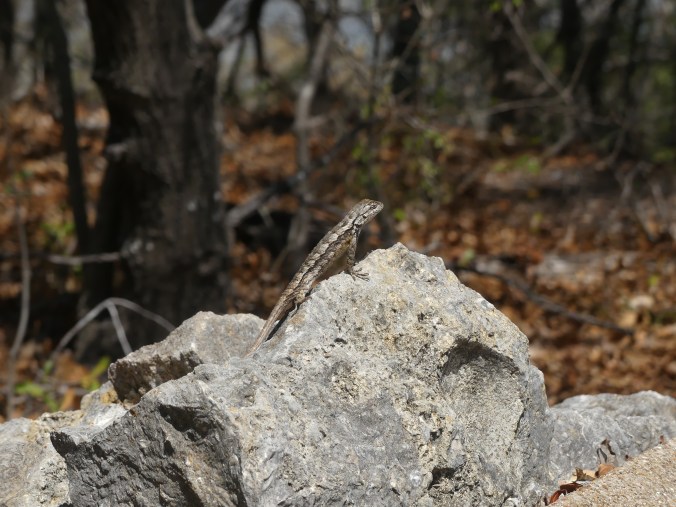
Right away I saw a young Texas spiny lizard who ducked under the old concrete picnic table. I would see the same lizard on my way out, and a couple of others elsewhere on the ridge. Just one more way in which spring seems already to be going strong.
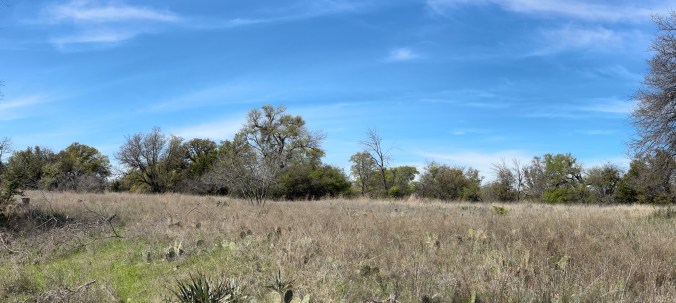
The ridge top
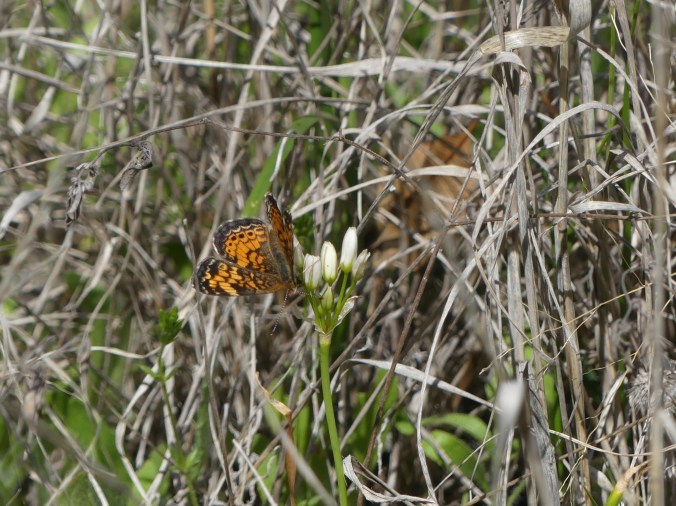
The top of the ridge is a limestone-based savanna with live oak, pale leaf yucca, and prickly pear. Butterflies were active, including sulphurs, goatweed leafwings, and a little crescent visiting what appeared to be crow poison beginning to flower.
Crescent butterfly
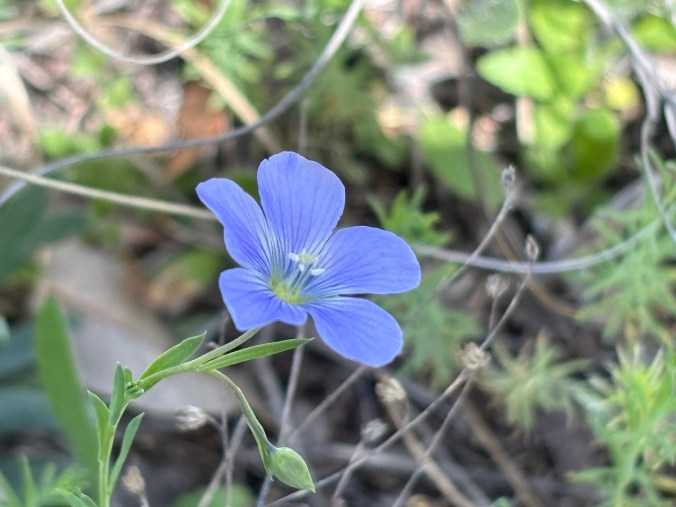
There are not a lot of flowers yet, but a small blue flower caught my eye along the trail. It was meadow flax, according to iNaturalist, an annual with either white or blue flowers. It’s new to me, but with my limited knowledge that’s not saying much.
Meadow flax
Back at the Lone Point structure, I sat for a while and noticed that Texas spiny lizard I had seen earlier. She or he was back at the top of the toppled stone picnic table, basking and reminding me just a little bit of the collared lizards I’ve seen playing king-of-the-hill on boulders at Palo Duro Canyon. Very impressive, little lizard – and thanks for sharing a bit of your afternoon with me.
Meet on the ledge, we’re gonna to meet on the ledge If you really mean it, it all comes ‘round again
Richard Thompson, “Meet on the Ledge”
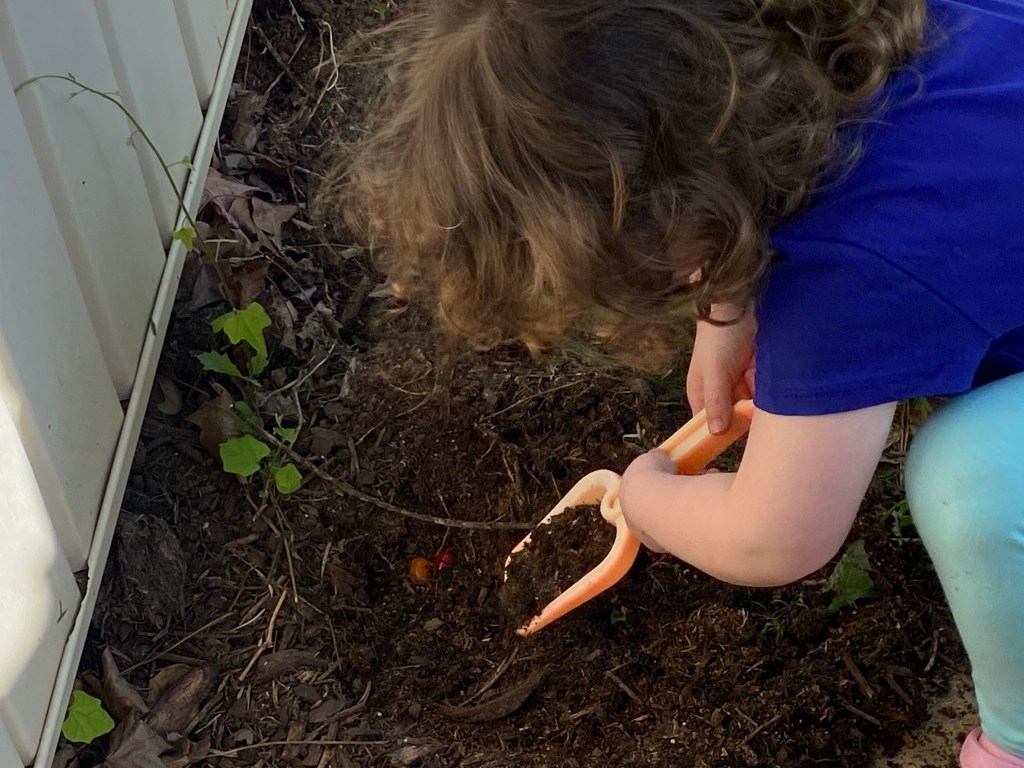
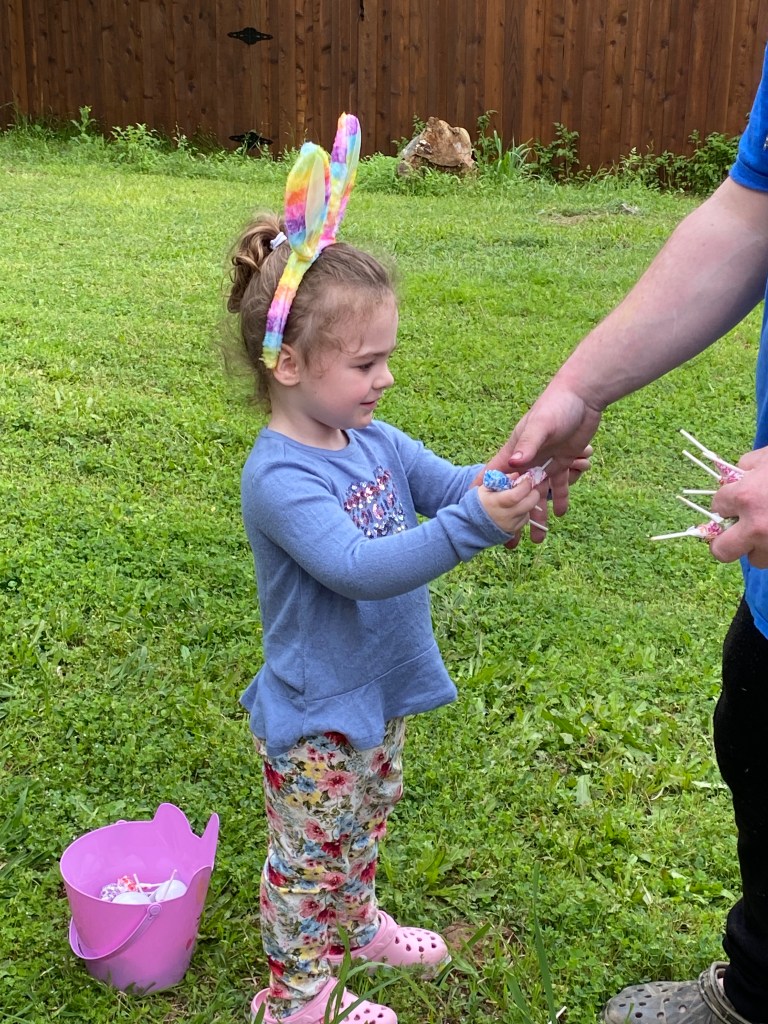
It is Easter, and spring is returning. The woodland in the nearby preserve is dotted with flowers, and oaks are leafing out. Days are getting longer and warmer. Additionally, the jelly beans that Lilly planted yesterday have sprouted into candies that she harvested today. She’s found all the bunny’s eggs, too. Easter is the most profound holiday in the Christian calendar, and its themes touch on renewal and resurrection. We are encouraged to believe that what is important does not die forever, instead “it all comes around again.” For children, we find simple ways to celebrate renewal and new life in ways they can enjoy.
In childhood rituals of colorful eggs, maybe we’re re-creating a little bit of Ostara, the pagan holiday that pre-dates Easter and celebrates the spring equinox and renewal of life and fertility. Celebrations often involved eggs and planting seeds. We may not be thinking of Ostara when our kids hunt for Easter eggs, but there is a connection (if you are interested in the origins of the Easter bunny story, have a look at this).
I’m not trying to recruit new pagan or Christian believers, just pointing out how strong is the undercurrent of our belief in this idea: that which is truly important, truly good, cannot be lost forever but finds a way to return. Perhaps some things are so fundamental to who we are, so much a part of us, that our faith and our need for them brings them back. “If you really mean it, it all comes ‘round again.”
I don’t mean to wring too much meaning out of that lovely Fairport Convention song, written by Richard Thompson when he was still a teen. I’ve read that “Meet on the Ledge” is sometimes played at funerals, when people very much want to believe in things coming ‘round again (and there’s that line, “When my time is up I’m gonna see all my friends”). He has been quoted saying that he was not intentionally writing a very deep song, but it seems that some very meaningful words wrapped themselves around him as he wrote.
I would love for our granddaughter to find her way of marking the seasons and transitions of this world and celebrating ideas and values like standing up for love and compassion no matter the cost. Today the ritual was about the sweet taste of spring and things that grow again as the season begins, and spending time delighting in things you find in the grass and the soil. There are so many things to learn about and celebrate in the coming seasons and years.
I have been walking a lot at Sheri Capehart Nature Preserve lately, and maybe it is still winter, but everything that is alive seems to know that it is spring. Some count the beginning of spring according to months, starting with March. Others mark the start of spring when the length of days and nights becomes equal (the “vernal equinox,” March 19th). For wild things that grow and breathe, spring is about temperatures and the length of daylight, and it is also about everything else around them. Spring is a team effort, so that new plant growth and flowering, the awakening of insects, the migration of birds, and lots of other things need to happen together for everything to work right.
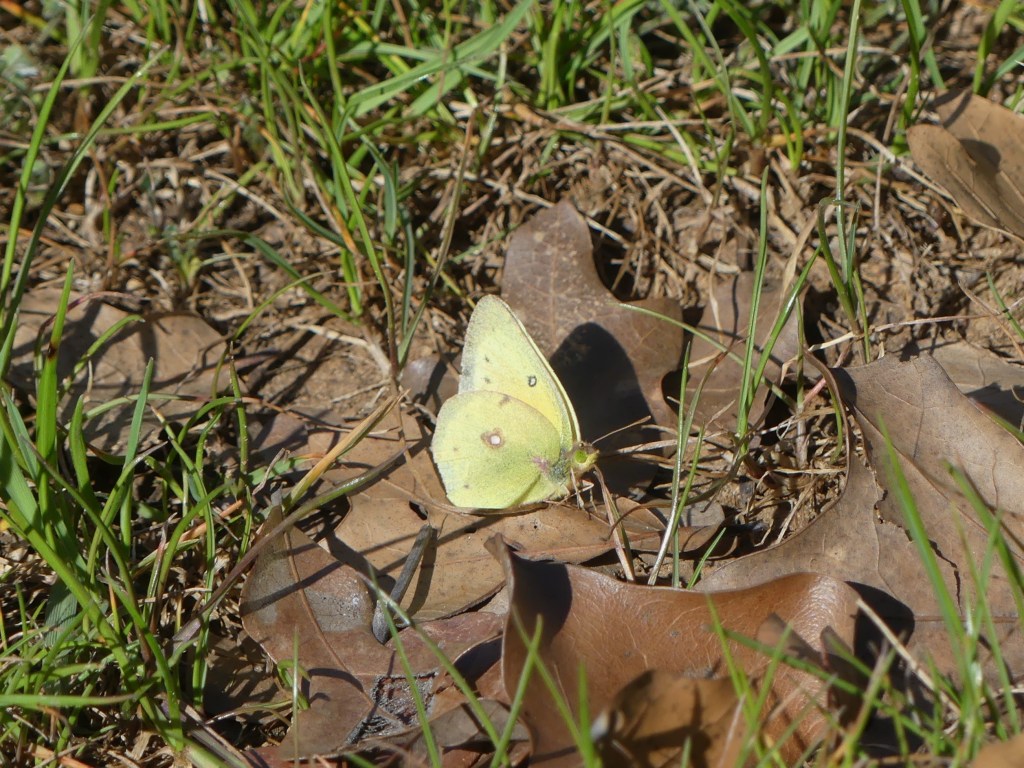
A sulphur, probably the clouded sulphur
In the middle of the day on February 20th at the preserve, it was 81.1F in the shade, and insects were on the move, including grasshoppers, wasps, and butterflies. As I walked down the trail, a small sulphur butterfly flew ahead of me to a new place to land among the emerging green plants. It found another sulphur and together they rose, circling each other, and flew away above the treetops. Along the boulder trail I could see six or eight of them at any one time. One would encounter another and they would briefly chase each other in a twirling pattern before separating.
The white flowers of crowpoison, also called “false garlic.” It may be toxic to people, and maybe to crows as well?
On the 26th at midday it was 92.8F in the shade near the north pond, and I heard a few cricket frogs calling for the first time in months. Turtles basked in the sun. High above me, altocumulus clouds were arranged like balls of cotton in a patch of sky. Birds called from nearby trees – Carolina wrens, northern cardinals, Carolina chickadees, and a white-throated sparrow. Further along the trail was a spot with scattered white flowers of crowpoison and the yellow blooms of a plant called golden corydalis. Sometimes people call it “scrambled eggs.”
Golden Corydalis, sometimes called “scrambled eggs”
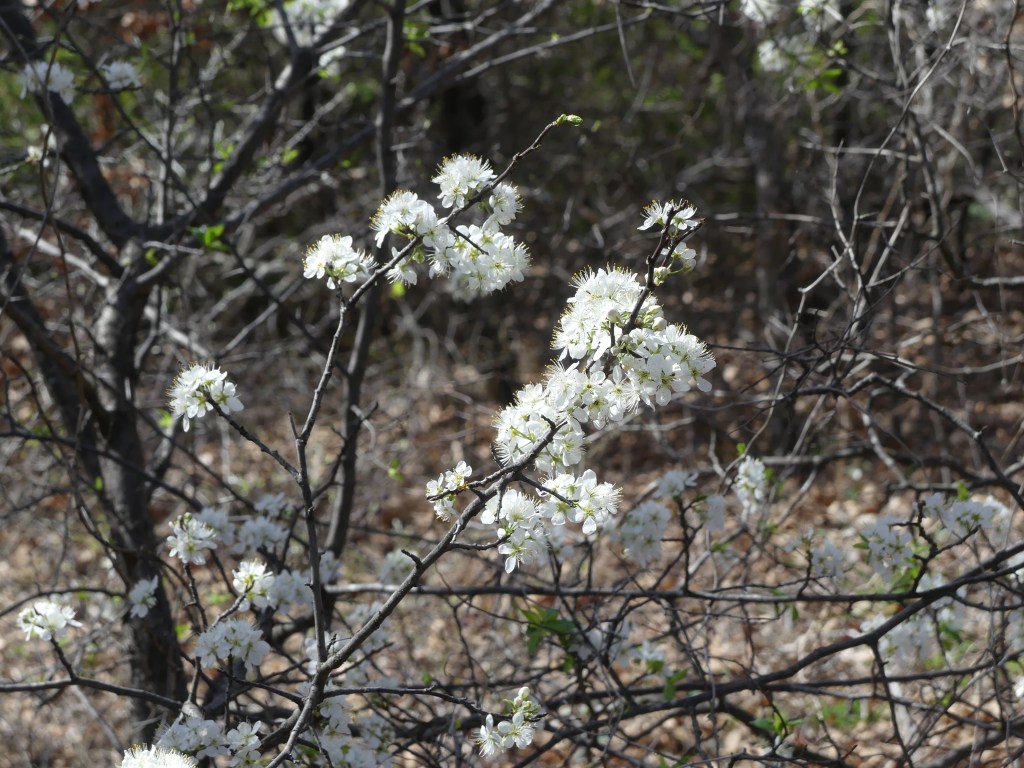
And then March arrived, and suddenly the plum trees were covered in clusters of white flowers. From a distance, other tree branches mostly looked gray and bare, but here and there you could see a slight green haze of budding leaves. Elbowbush was flowering. On the way to the north pond, when I looked closely I could see that most of the trees and shrubs were budding.
Clustered flowers on a plum tree at the preserve
On March the 2nd according to the calendar it could barely be spring, could it? I sat in my back yard and made a few notes:
Here in this false spring, the tree blossoms are bright white. The winter sun, still low in the sky, makes the day look like perpetual morning. The sun-warmed air moves and is a soft breeze against the skin. It is the morning of the year, the beginning. The flowers and bees know it, and the birds announce it in the trees. What does the chickadee and the cardinal know that the calendar does not?
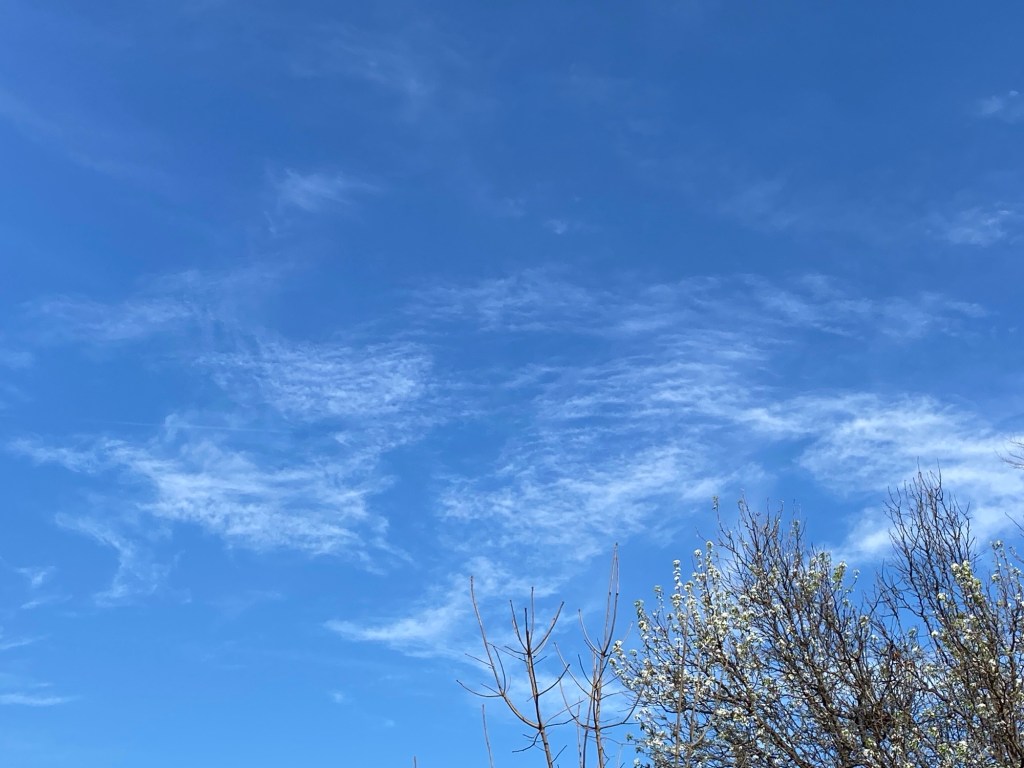
I sit and look at the sky, the blue canvas where wind, sun, and water scribble and paint. There are dabs, streaks, and lines, white images and symbols in a language familiar but still a bit mysterious. Thin brush strokes make a big heart with a few lines of text, maybe wishing us peace and well being. And then the wind moves it to the east and the canvas is cleared.
In my yard, when I looked down, I found a forest of little blue flowers among leaves of various shapes. In the midst of this two- to four-inch “forest,” the yellow sun of a dandelion shone. A honeybee visited the flower; dandelions are among the first flowers to feed the hive.
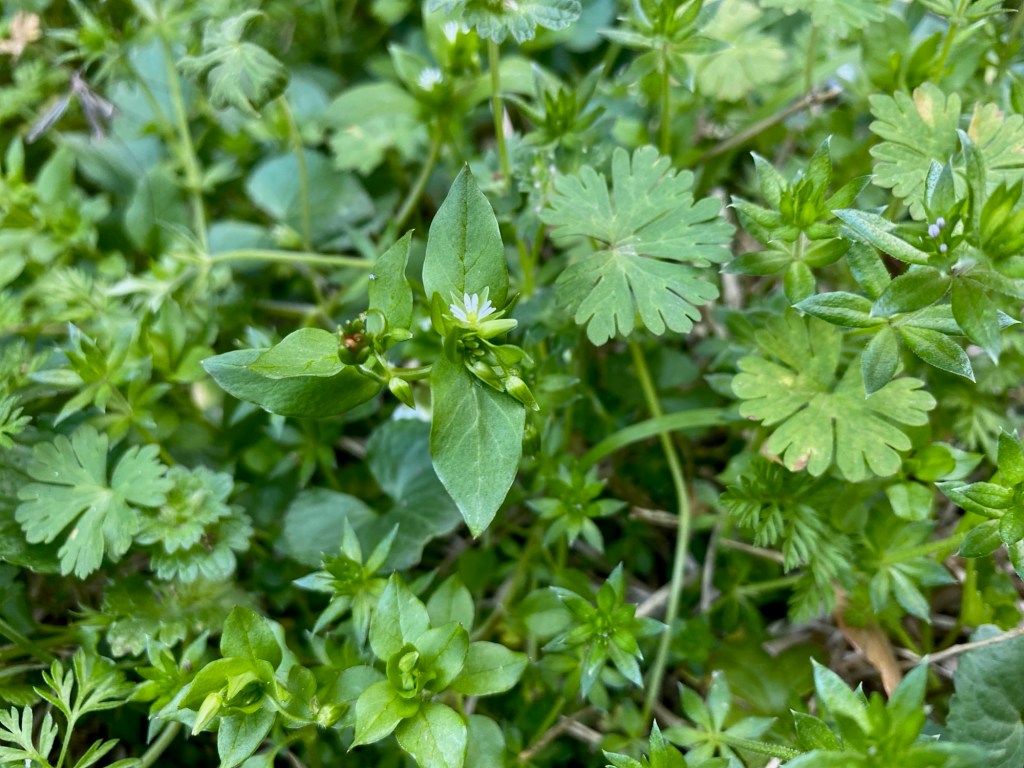
The ground was filled with such a beautiful jumble of green shapes. There were bigger, taller ones with leaves like umbrellas with notches and fingers. The appeared to be clusters of about four frilly leaves right at the top of the stem. There was chickweed with long, branching stems and arrow-shaped leaves. Nearby were plants with delicate stems with leaflets off to each side, in the way we think of ferns.
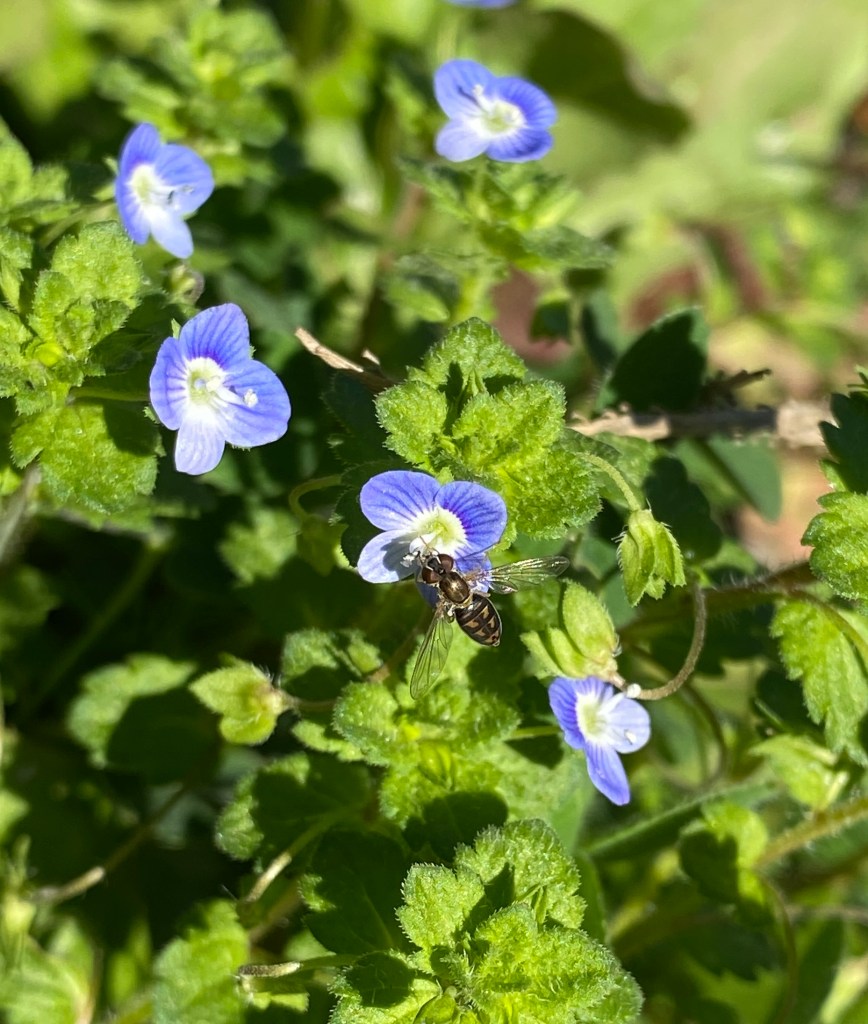
Bird’s eye speedwell
Scattered among these was bird’s eye speedwell, a beautiful little flower that some say was considered a lucky charm, speeding travelers on their way. The flowers are white in the center and have four baby-blue lobes with tiny darker blue pinstripes. Another little plant is called “henbit deadnettle,” with tubular purple flowers. Some of these plants have amazing names, don’t they?
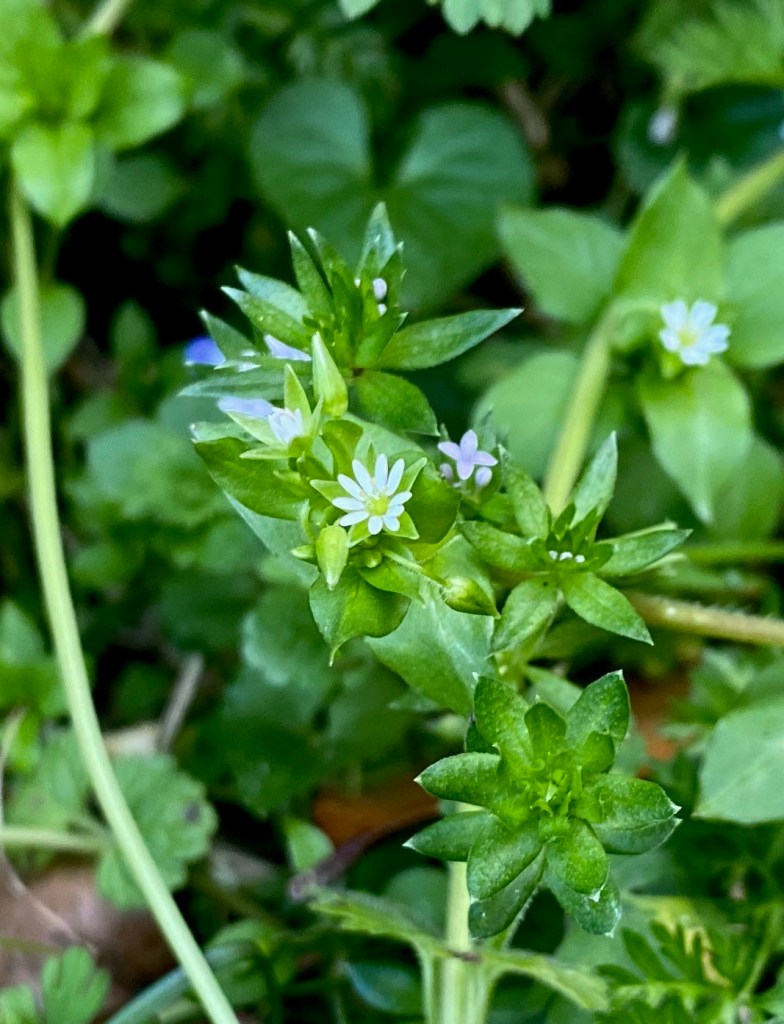
HenbitCommon chickweed in the center, with a four-lobed flower of field madder just to the right
All these leaves and flowers made a tiny jungle inviting us to lie in their softness and explore smells and colors as if it was a tiny world all of its own, separate from streets and sidewalks and the things we normally notice.
And so, never mind the calendar – it is spring. Good morning! May the year treat us well.





 Our Lives In Nature