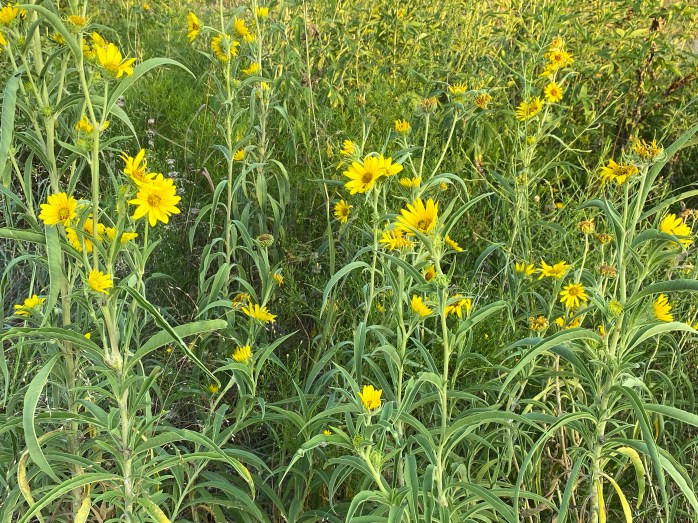
A patch of Maximilian sunflower is a reminder of summer
I climbed the switchback trail up to the ridge at Southwest Nature Preserve yesterday, and it felt a little different. The high temperature was still in the 90s and there were no clouds to deflect a little of the sun’s radiant warmth, but there was a barely perceptible difference. Through much of the summer, the humid air has wrapped us in a blanket of heat, but not so much today. The slight breeze that previously could not penetrate that sticky blanket was refreshing this time. I wondered if this was the first hint of autumn.
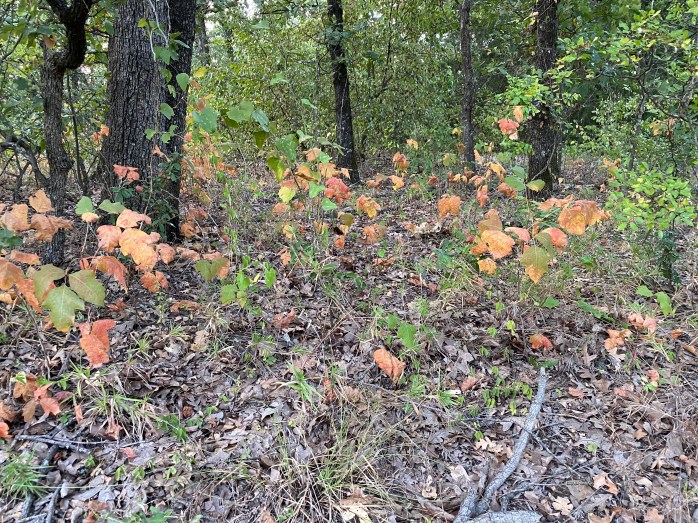
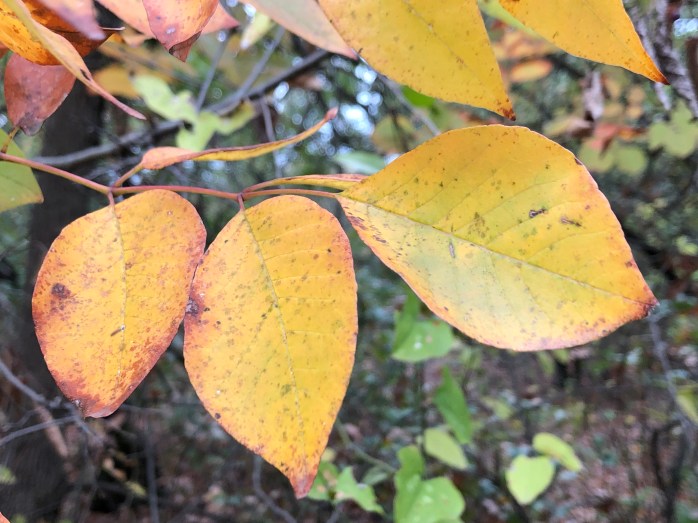
The orange tones of poison ivy leaves
Autumn has a distinct personality. The sensory world of autumn is one of cool breezes, even a little chill, and in the fields there is the faint smell of ripening and even decay as leaves come to the end of their usefulness and fall from trees and shrubs. It’s a good sort of decay; it’s the soil-creating process, the vintage bouquet of oak and ash leaves, with notes of hackberry and possumhaw. I look forward to bright, cool days in woods and prairies and the chance to smell that legacy of what grew in the summer.
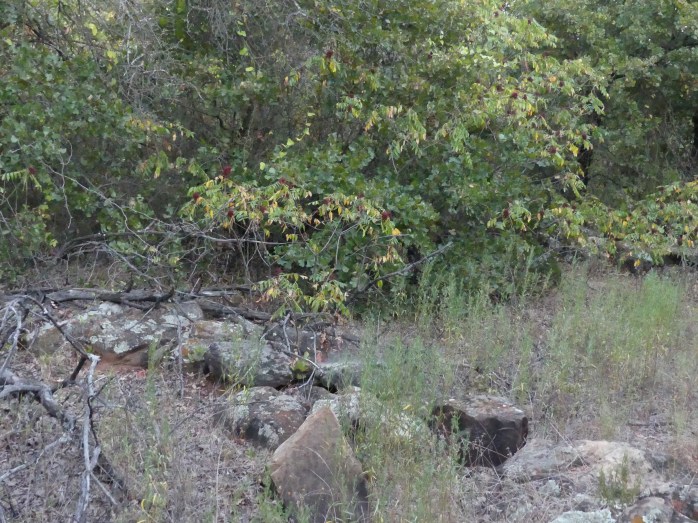
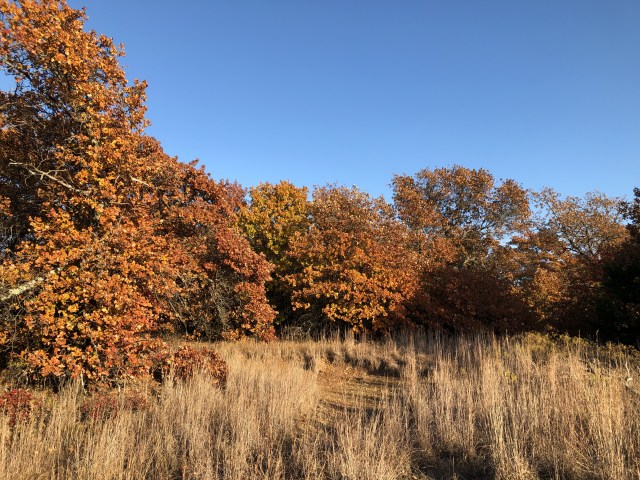
Where I live, autumn’s sensory world includes leaves turning color, gradually and in varying degrees. There are the brilliant colors of sumac (one species of which is “flameleaf sumac,” which gives a clue as to its contribution to autumn color) as well as the varied colors of poison ivy. The oak leaves sometimes become very colorful, but only sometimes. And then when the leaves have fallen, we get a look into woodlands where before there were curtains of green. On through the coming winter, sunny days flood the ground around the tree trunks with light.
The quality of that light is an important part of autumn’s personality. Our part of the earth is tilting away from the sun, and light reaches us from a slanting angle. In a trick of physics, it is more golden, with an end-of-the-day feel, a suggestion of sunset all day long. In a verse that introduces autumn in a forthcoming book, I said, “Things come to an end / Be still in the golden autumn light.” The sense of the year coming to an end suggests a time for contemplation, to “consider how to make a good end of the year / With affection and acceptance.”
Is it autumn yet? One way of defining the seasons says that autumn begins with the first of September. The other way, based on the position of the sun, says that autumn begins when the shortening days and lengthening nights are of equal lengths. The equinox, typically on September 23, marks the beginning of autumn.
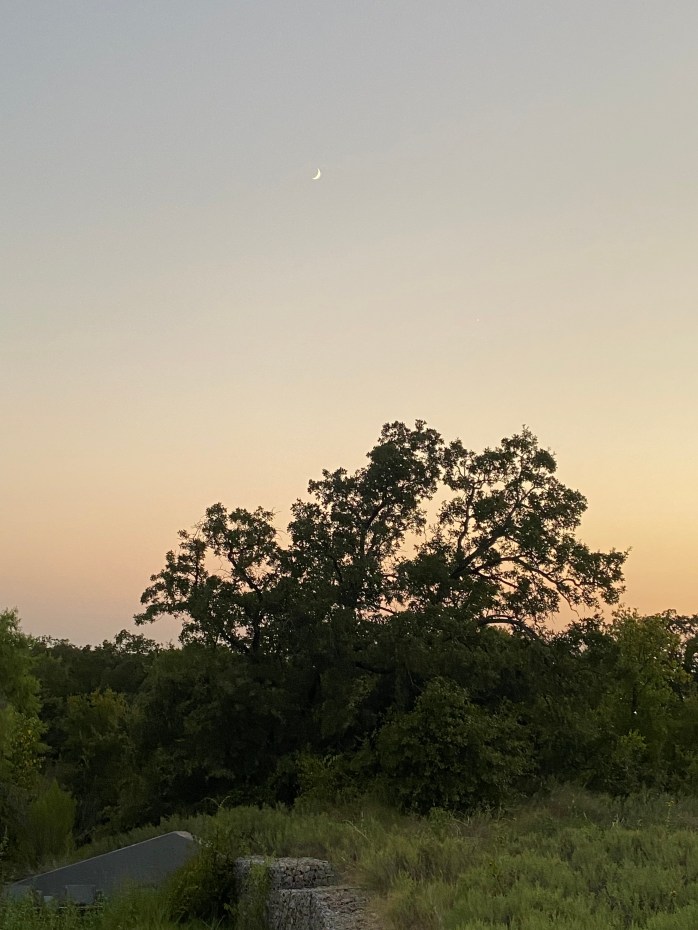
Sunset at the preserve, with a crescent moon riding high
That day is less than two weeks away. I look forward to that day and to every little sign that autumn is coming.
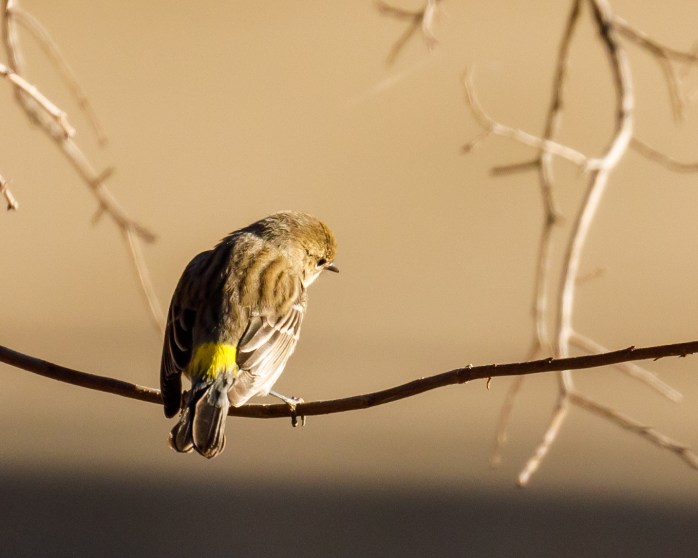
Yellow-rumped Warbler in Dallas County (photo by Meghan Cassidy)
Yesterday was sunny and clear, and Southwest Nature Preserve was the right place to take a walk. Its 52 acres are hemmed in by a major freeway and suburban development, and many visitors walk its trails and drop fishing lines into its waters. Despite all that, it’s a pretty resilient little remainder of the oak woodlands and sandstone that are the calling cards of the Eastern Cross Timbers.
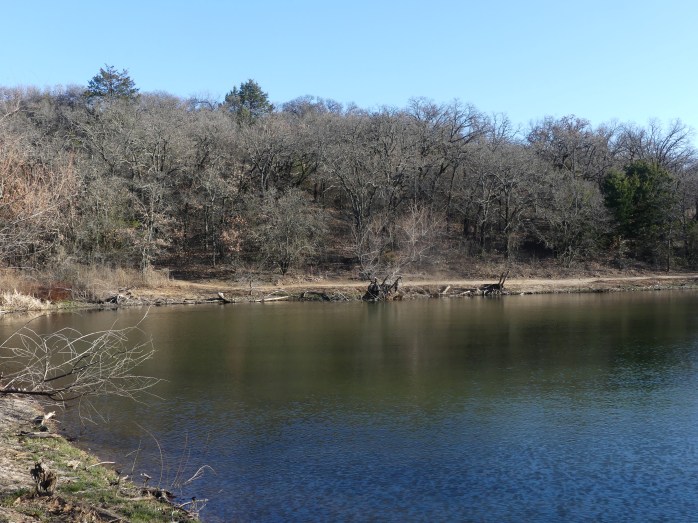
There’s something about winter-bare oak woodlands, with the sun shining through branches and lighting up the layer of leaves on the ground. And ponds, with clear water shading into a deeper gloom with aquatic plants and the waterlogged wood of fallen branches, hidden in the dark. Depending on where you stand, the pond’s surface may be a sapphire reflection of sunlight, and the surface may have shifting rough patches where cold winter breezes blow across it. Southwest Nature Preserve has those things.
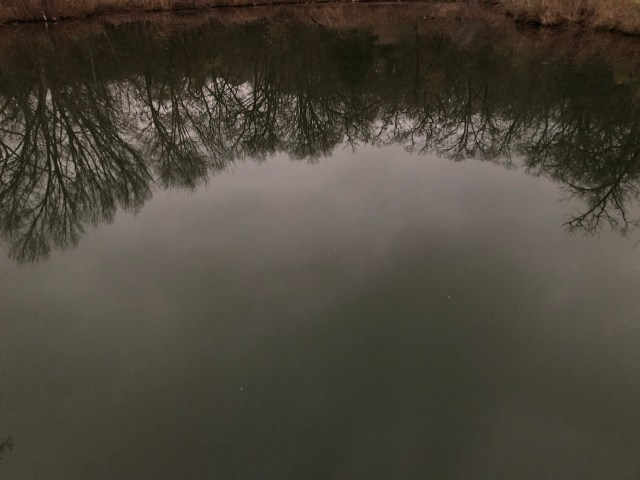
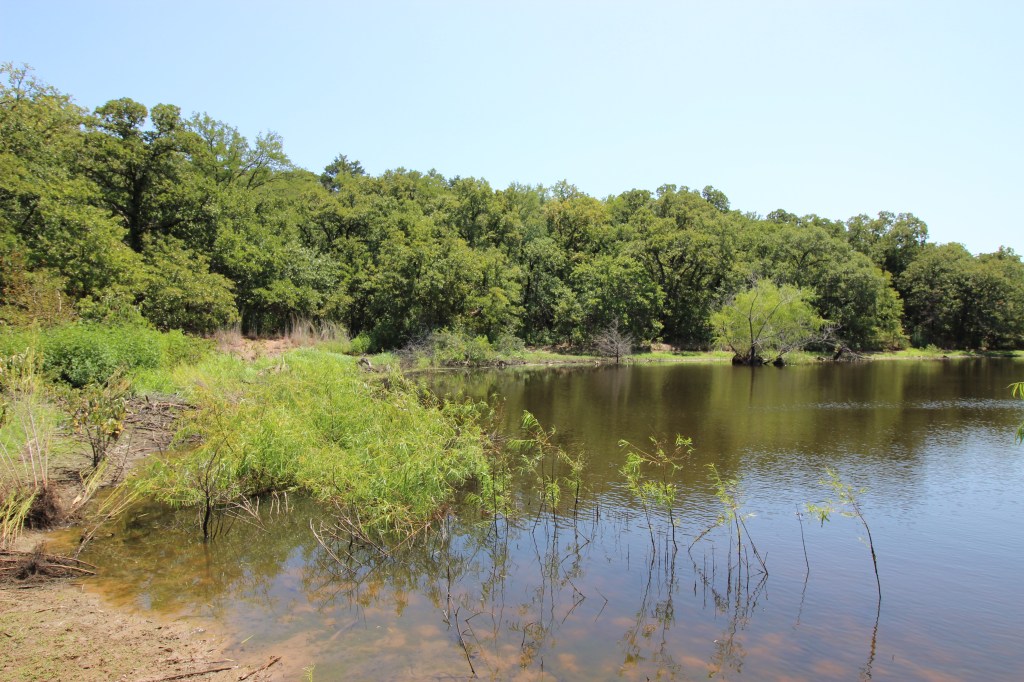
The north pond
It also has birds, and this winter there have been a lot of them. I have paid better attention, or this has been a season with good bird numbers and diversity, or both. And as a result, I’ve learned more about them this year, although I’m no expert. I’m also better able to put aside the old herpetologist’s habit of active searching. Instead of staying on the move, I can sit and blend in with the habitat for a while. Mindfulness and advancing age have helped with that.
I visited the smallest pond, expecting a little dried mud bowl because of the very dry conditions. Instead, it had several inches of clear water. As I watched, several small nondescript birds took turns flying out over the water. Often one of them would fly into the breeze and momentarily be held there, fifteen feet above the water, until it turned and in a ball of wind-splayed feathers it was pushed back to a nearby tree.
I sat on the banks of the pond for a while, watching these birds and listening to their calls back and forth: a single “cheet” repeated frequently. In my binoculars I would see gray-brown on the head and wings, with white and dark wing bars, and then that little patch of yellow on the side of the body. When one perched on a nearby twig, the binoculars showed a highlighter-yellow patch of feathers on the rump, more than justifying the name “butter-butt” that some birders give them. More properly, they are Yellow-rumped Warblers.
Yellow-rumped Warbler half-hidden in vegetation
As I watched, my naturalist’s reasoning suspected that they were catching insects too small for me to see. I imagined them to be having fun, as if their forays out over the water might start with a call to their neighbor to “watch this!” Sometimes they found a place to perch very close to the surface of the pond, but mostly they flew out above the water and returned to the winter-dry stalks of vegetation or up into the branches of an oak. A later check with some birding sources, including Cornell’s All About Birds site, seemed to confirm that their flight would have been in pursuit of insects. I don’t think this negates my suspicion that they were enjoying themselves.
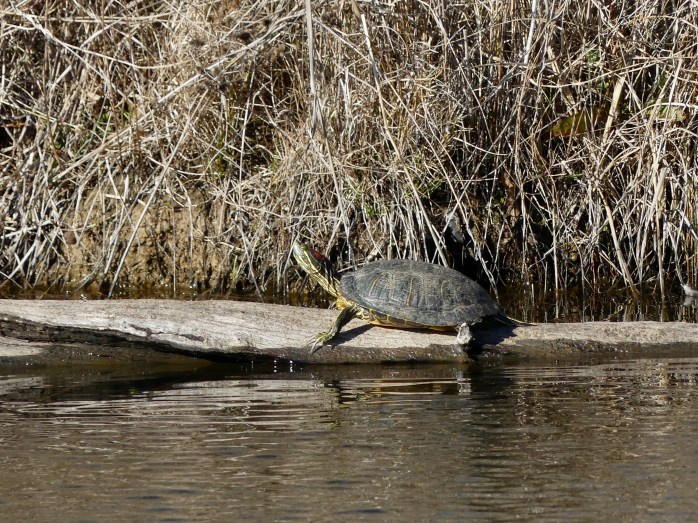
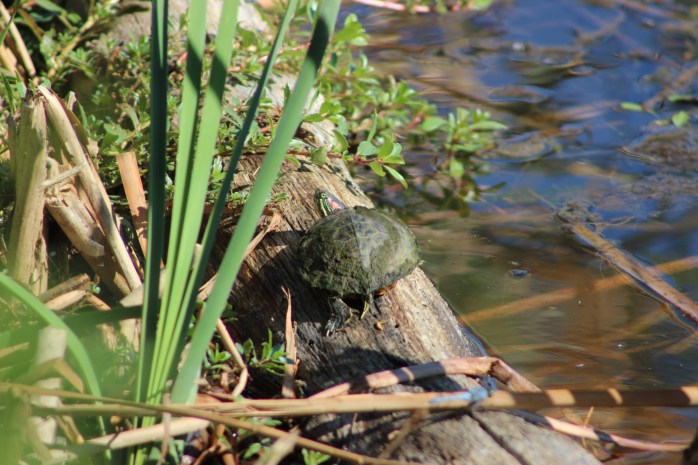
Red-eared Slider, basking at one of the ponds
There were other things to see on this sunny afternoon. In an adjacent pond, a male Red-eared Slider was basking on a log at the water’s edge, across from the fishing pier that extends out over part of the pond. He was unconcerned about my photographing him. In warmer circumstances, these turtles are shy and quick to drop into the water, but this guy was unwilling to give up the bright sunshine of a cool winter day.
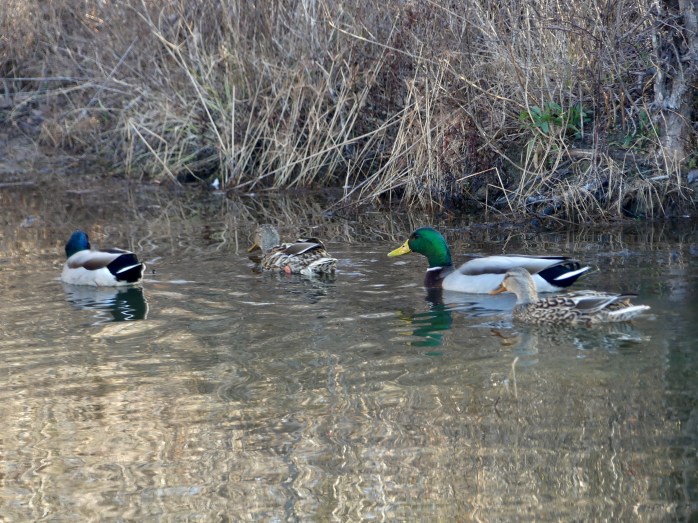
Mallards
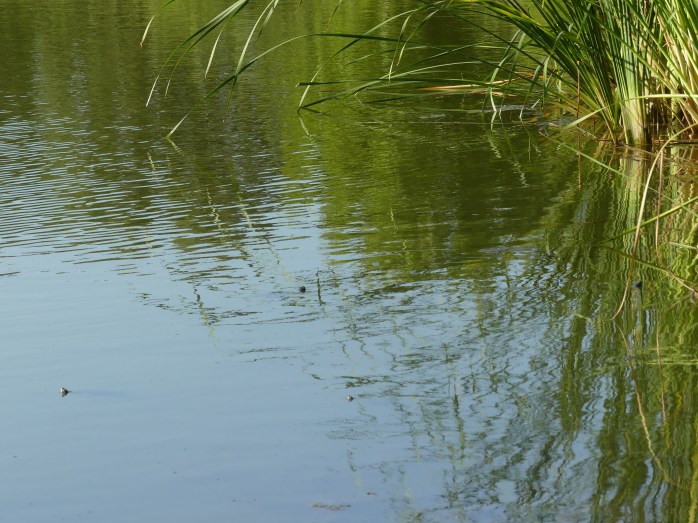
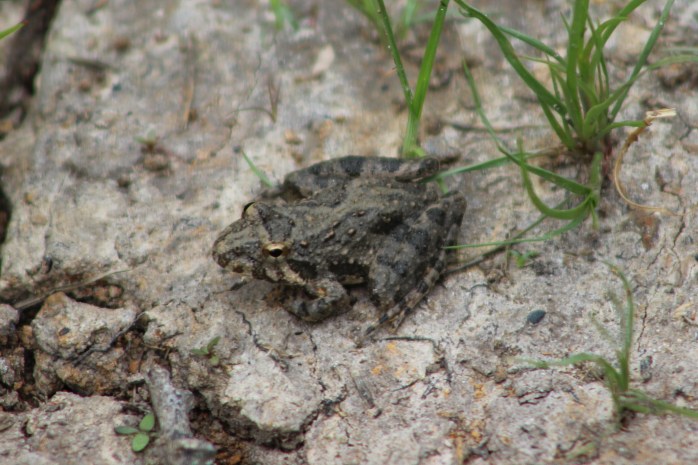
Nearby, a couple of pairs of Mallards were cruising across the surface of a small pool, periodically going “tail-up” to dabble through the material along the bottom and extract whatever was good to eat. In contrast, there was no activity on the surface of the north pond, which often has its share of ducks and turtles. Today not even the cricket frogs were out, despite plenty of sunshine along the northeast banks of the pond.
It was a good day to wander along the ponds of the preserve and up over the ridge and through the woods. I learned more about its birds today and got to visit with the willows and oaks and pay my respects to the boulders and grasses.
Today’s walk at Southwest Nature Preserve was especially rewarding for me. A week ago last Sunday, I got prompt, excellent medical care for a heart attack and I seem to be recovering well. As a result, I had the chance to take a very routine short hike today, and even though it was routine, it was one that I felt very privileged to take. It could have been very different.
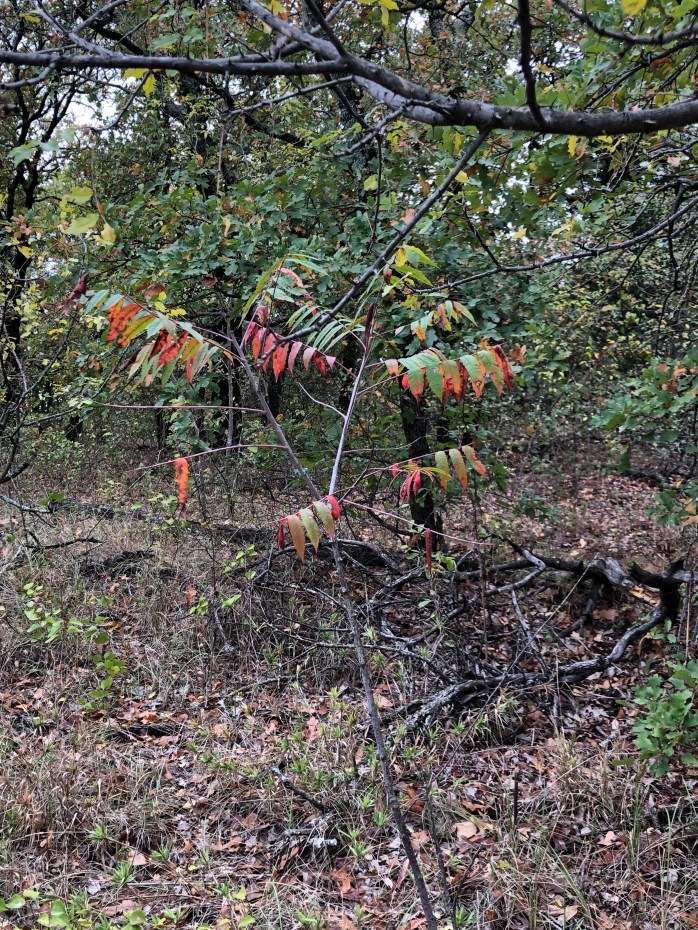
Sumac leaves changing color
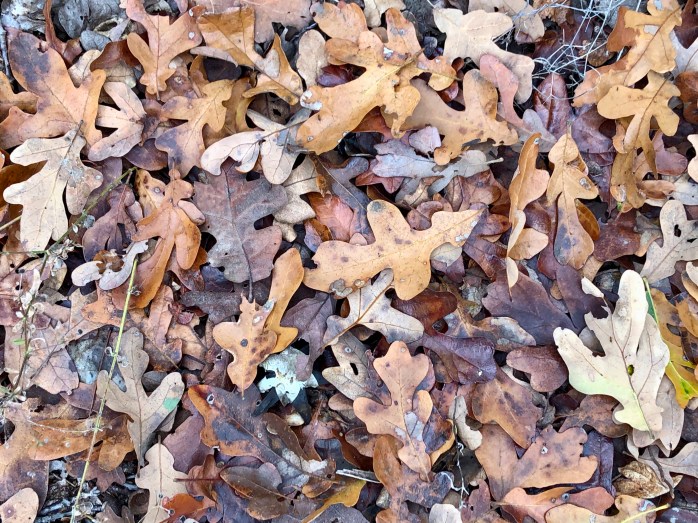
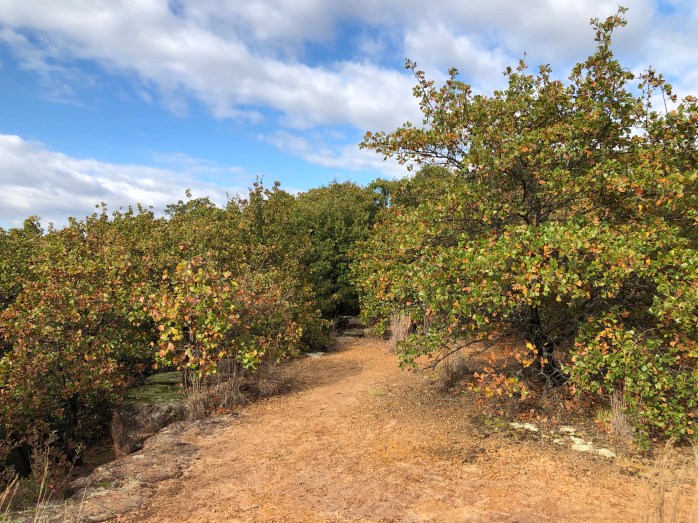
The past few days have been cold and wet, and today started out cold – by north Texas standards – and cloudy. It has been autumn for a month now, but today it really felt like autumn. Leaves are dropping and you can see further through the woods as a result. The carpet of leaves is an intricate study in shapes and earthy colors which always captures my imagination.
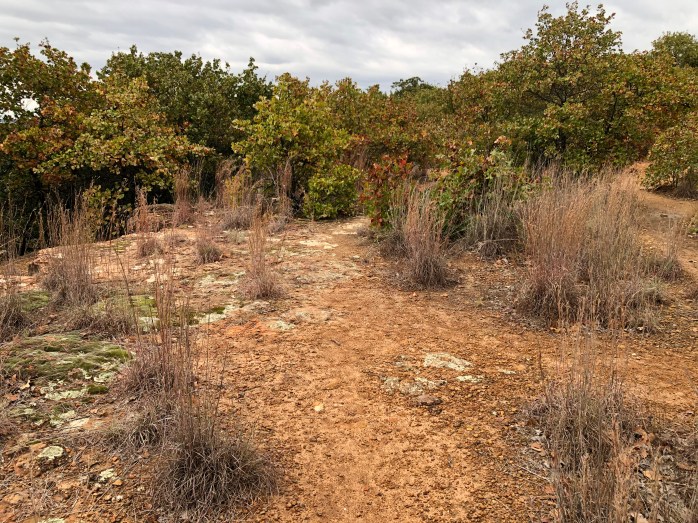
The path up the hillside opens onto a shelf of sandstone that falls off toward the northwest, forming a ridge. Lately it has been so dry that you wondered how the clumps of little bluestem grasses didn’t dry up and blow away, but a little rain over the past few days left the thin soil a little muddy and the colors a little brighter. Or perhaps it was my frame of mind that was brighter, being able to walk along this ridge again.
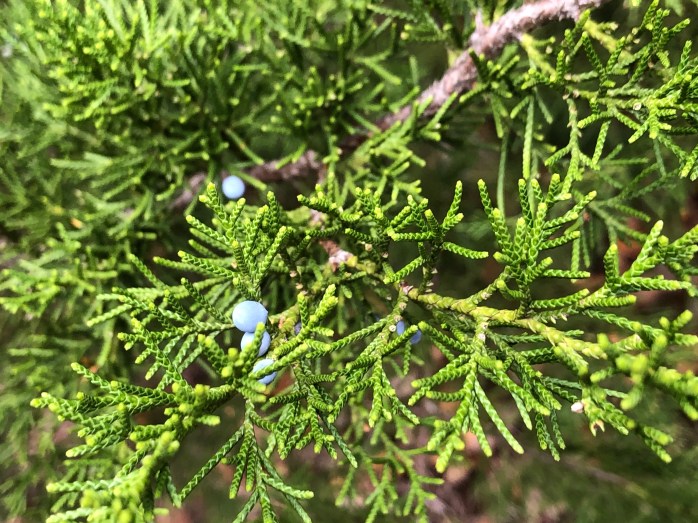
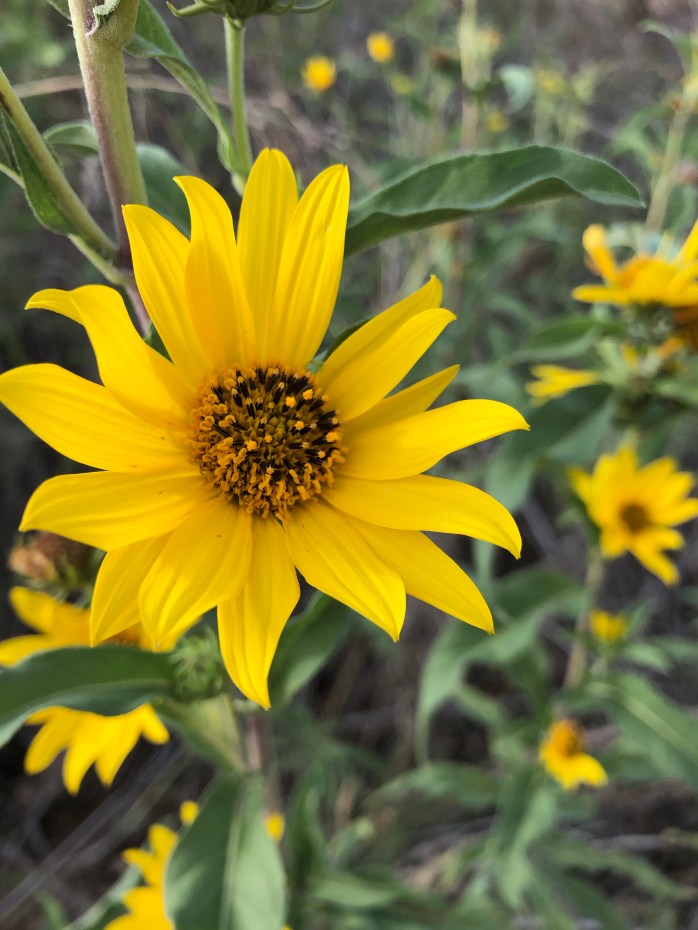
Some tiny yellow flowers mixed in with a patch of native grasses pulled my attention toward a little path around the crown of the hill. I paused at a juniper to chew a couple of the small “berries” to get that little bit of sweetness along with the delightful botanical aroma. By the time I returned to the ridge, the clouds were finally breaking up and the sun lit up the preserve in a bright, beautiful afternoon that seemed especially lovely today.
I knew that having Jim Frisinger join us would be a harbinger of good birding. Jim teaches birding at Southwest Nature Preserve and is the first one we think of when we think about birds at the preserve. And sure enough, even though this morning’s walk was part of a survey of reptiles and amphibians, it turned into a pretty good birding walk as well.
We got started just after 7:00am, meaning that I had to get up before sunrise, but that’s OK, we needed to get there before the day heated up. It is now mid-August, with serious summer heat, and it climbed to 102°F later in the day, with the heat index feeling like 107°F. The survey plan is to walk in one of three habitats, either in the morning, mid-day, or evening, and we rotate among those options. Last week, Jim Domke and I did a mid-day walk, trying to avoid heat exhaustion and clearly demonstrating what Jim figured any idiot would know – the blistering mid-day heat of an August day is not the best time to see wildlife. This morning was much better.
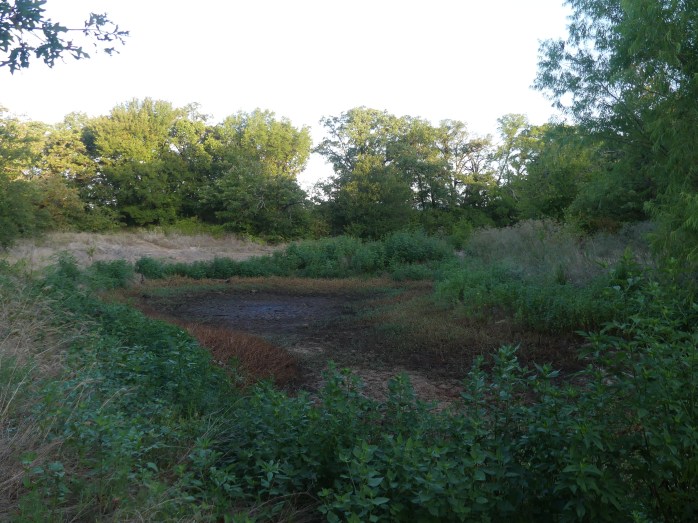
What remained of the smallest middle pond
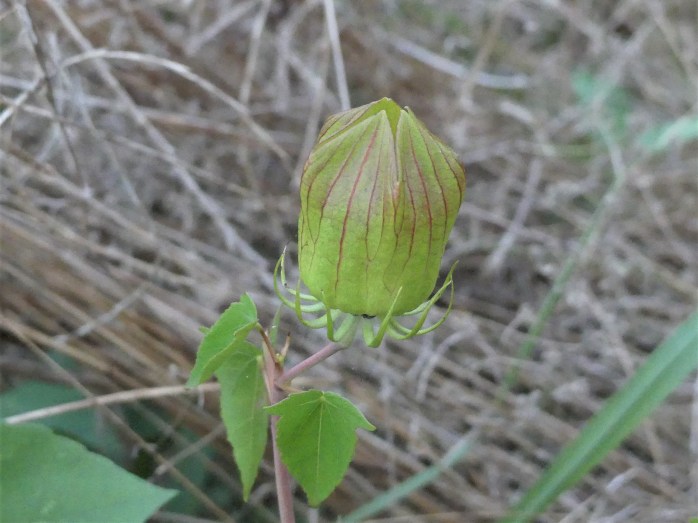
One of our destinations, the smallest pond at the preserve, was a casualty of summer. The water had completely evaporated, leaving concentric rings – an outer one of drying Water Primrose, surrounding an area of cracked, dry mud, with a bulls-eye center of wet mud. The temperature was 74°F and the humidity a steamy 89%. I walked through some of the vegetation and around the circle of dried mud, scaring up grasshoppers but no Blanchard’s Cricket Frogs. The two Jim’s (Domke and Frisinger) and I talked about where the frogs and turtles would have gone. Maybe the frogs dug under the mud, expecting to estivate during a period of drought. In a pond this small, I said I thought that the turtles may have migrated the short distance to the nearest pond with water. I did notice that several seed pods of Halberd-leaf Rosemallow (see the July 18 entry) had dried and cracked open.
Halberd-leaf Rosemallow
Next, we walked to the north pond, whose water level has dropped but not by much. A group of about six young anglers were fishing, and Jim Domke extracted a promise that they would clean up before leaving. Domke carries a bag in each visit and picks up the litter left by visitors to the preserve. He is an unsung hero for this and deserves appreciation from all of us, because people leave a surprising amount of trash around the preserve. The kids did indeed pick up their stuff!
On the trail a few feet from the water, we saw two Little Brown Skinks. They were roughly two-inch juveniles, little even as Little Brown Skinks go. These lizards did not slow down for photographs, and quickly disappeared into leaf litter and cracks in the mud. And as always, there were Blanchard’s Cricket Frogs hopping around at the water’s edge, and at least one amorous boy was calling, trying to attract females. His episodic “grick-grick-grick” calls were a Call Index of one in frog monitoring jargon, an isolated call not overlapping with other Cricket Frog calls.
Various turtle heads popped up in the water and using binoculars I could see on many of them the tell-tale red patch behind the eye that defines the Red-eared Slider. River Cooters are sometimes seen at the preserve, so it is important to try to observe the head pattern.
At this point the tops of the trees were bright from the rising sun, though the ground was still in shadow. The temperature was 79°F and the relative humidity 76%. Walking back, at the same spot where we saw skinks a few minutes before, we saw a large Little Brown Skink and a couple of juveniles. As before, they spotted us and were in frantic flight back across the trail to the trees by the time we saw them. I tried to capture one of them for a photo, but as soon as I tried to gently pin one down with my hand, it slipped into the cracks in the mud and was gone. These little lizards have very smooth, glossy scales and small legs, so that they shimmy across the ground almost like little snakes.
We wondered why we were seeing skinks in groups, and Jim Domke raised the possibility of a mama herding her babies to safety. I am less quick than I used to be to dismiss such ideas, though I doubt this is what we were seeing here. Researchers are increasingly documenting maternal care among pit-vipers (a group of venomous snakes that are pretty advanced among reptiles, in terms of their evolutionary status). Rattlesnake mothers have been documented to keep their young with her after they are born for a brief time until they shed their skin the first time. They may gather in rookeries to give birth and seem to have some ability to recognize kin. Clearly, some reptiles are capable of much more advanced social behavior than we typically expect. Were we seeing a family group of skinks on the trail? A possibility that seems more likely to me is that as the woodland floor becomes quite dry, these lizards come to the pond’s edge to drink and/or hunt the tiny invertebrates that congregate there. However, there is not much cover at the pond’s edge and when confronted with a predator (or lumbering human observers) they run for the cover of the leaf litter and cracks down into the soil. This is just speculation. My best answer is: “I don’t know.”
Turtle heads in the big pond
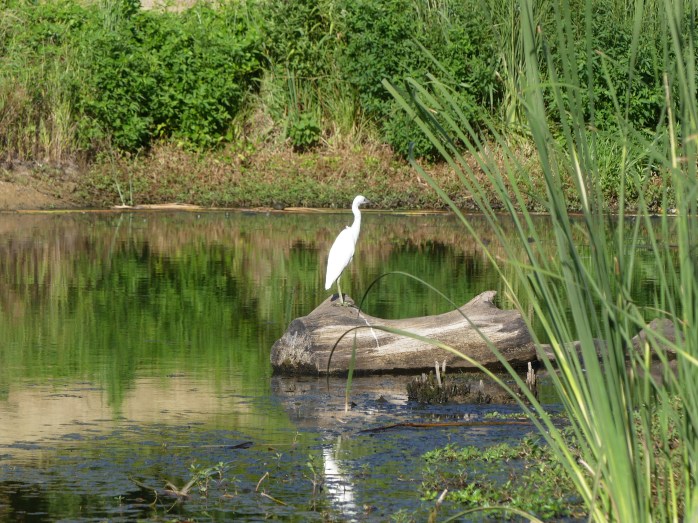
Our final destination was the north shore of the biggest pond, where the preserve has the north and west shores and residential housing has the east and south shores. As we arrived, a Great Egret took off with slow, powerful strokes of its snow-white wings. Turtle heads emerged from the water and looked around, a group of eight or so curious reptiles that watched the egret fly off as the humans arrived.
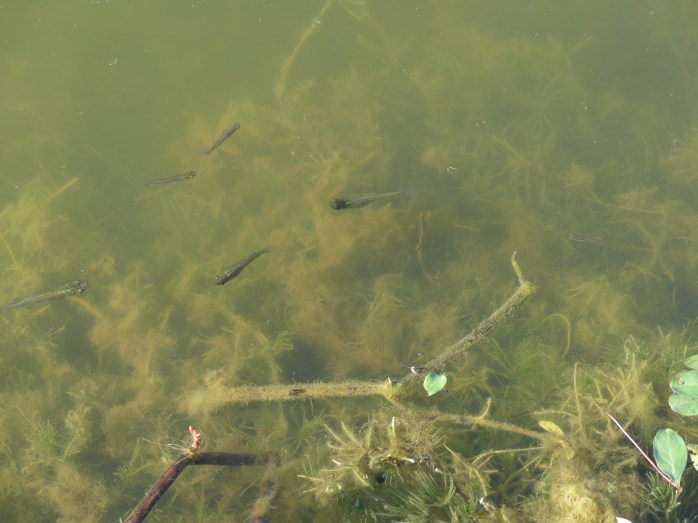
Western Mosquitofish
Along the water’s edge, a group of small fish foraged along the surface and among the submerged stems of Water Primrose. These were surely Western Mosquitofish, though I did not net any to confirm it. Their size, shape, and movements all indicated that they were mosquitofish, those surface-feeding fish that feed voraciously on zooplankton and invertebrates, including mosquito larvae. Females grow much larger and bulkier than males and may have a black spot at the back of the body cavity where the ovaries are located. They are not particularly colorful, though there is a bluish iridescence you can see in the right light.
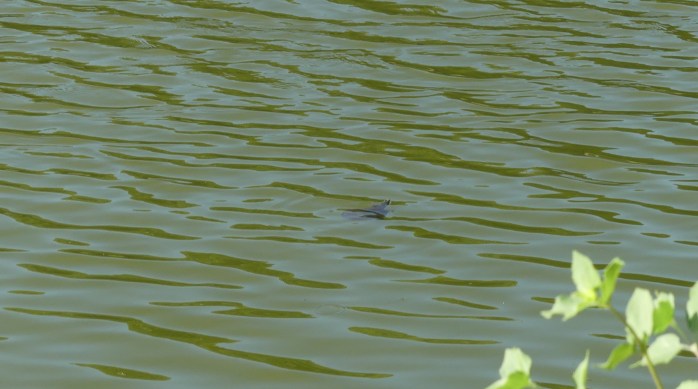
A glimpse at a Spiny Softshell
Further along the shore, a turtle in the water just offshore caught my eye. It was that round shell and a curious head shape that grabbed my attention, and it did not hang around for a photo. It must have been a softshell! I was sure I’d seen a snorkel nose and a pancake-shaped shell – and then it returned to the surface to breathe, staying just long enough for me to take a quick and rather poor photo. It was fairly small, either immature or a young male (females grow quite a bit larger). There is only one other iNaturalist record of the Spiny Softshell at the preserve, and this was another!
Great EgretOn his way to the concert?
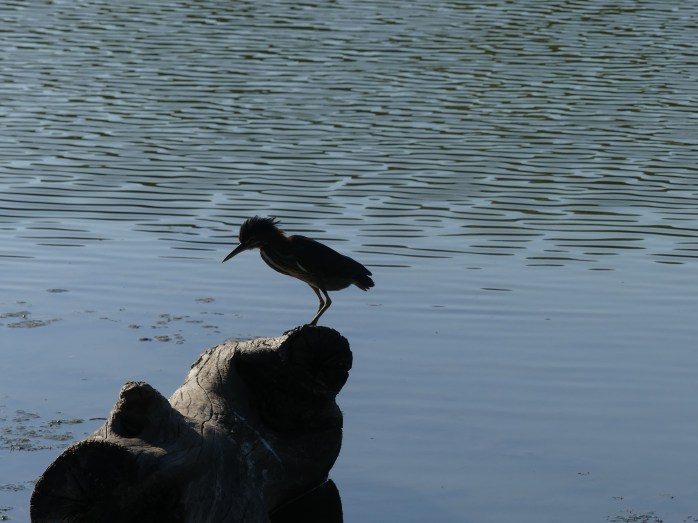
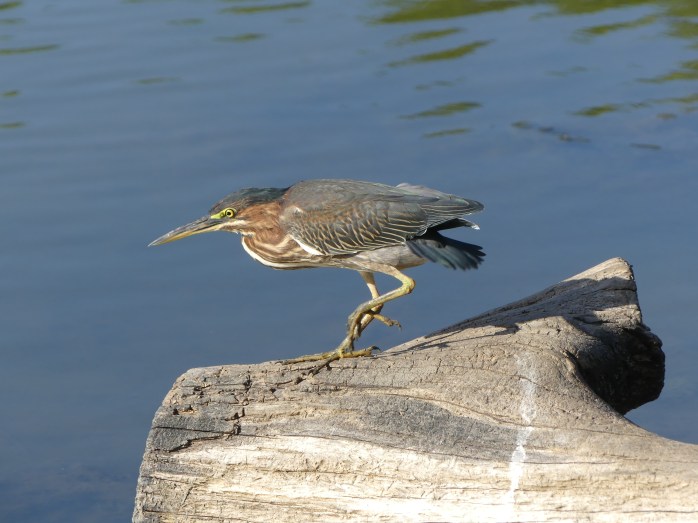
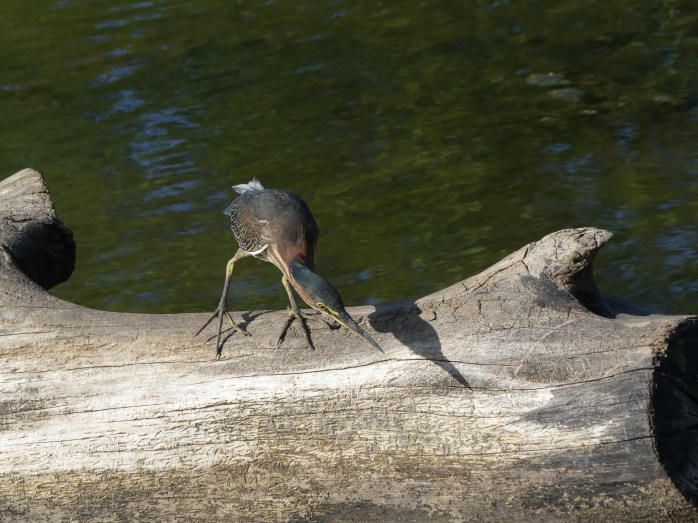
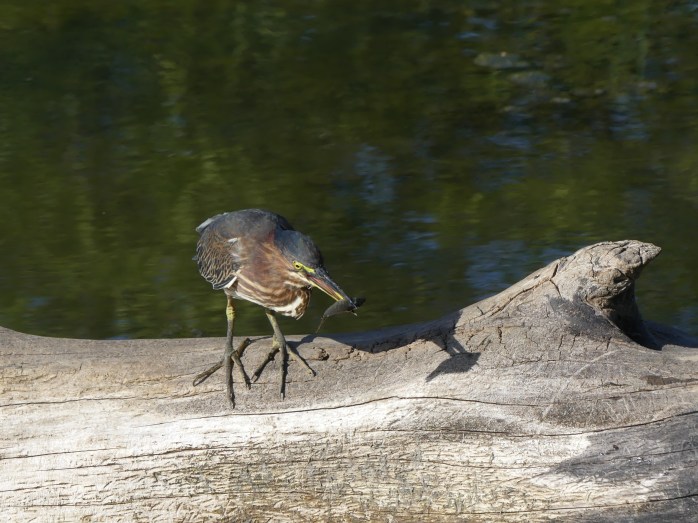
That observation made this a really successful survey walk – what could be better? Well, a really fine bird observation would not make it better, but it would sure round out our walk in a beautiful way. On the walk back, we saw a couple of Great Egrets again, standing in their tall, bright white elegance along the shore. And then, after they had flown, a smaller bird flew in to take the place of the one who had been standing on a log in the water. His crest of feathers suggested a young man with a Mohawk on his way to see Green Day perform Jesus of Suburbia, as he landed on his log and eyed us with suspicion. His Mohawk flattened and he began to look at the water around him, periodically glancing up at us just to make sure he wasn’t going to have any trouble from us. He (or she) was a Green Heron, maybe a young bird whose brown and white streaked chest had not filled in from the sides with the reddish-chestnut brown of an adult.
Green Heron
This heron was surprisingly tolerant of three old guys hanging around, two of them taking photos. While we watched, he hopped down as low as he could get on the log and watched the water intently. We waited – he waited, and then there was a quick stab of his long bill into the water, bringing back a juvenile sunfish. Was there a hint of a self-satisfied smile on that long beak, and a glint in his eye as he looked up at us? Probably not, but his skillfulness was impressive. In fact, the Cornell Lab of Ornithology tells us that these birds sometimes even drop bits of bread or insects on the water to lure a fish in close enough to be caught.
A talented fisherman
The temperature had risen to 84°F and 74% humidity and it was time to leave before it became really hot. This had been a great walk, with the thought-provoking observations of Little Brown Skinks, finding a Spiny Softshell, and then the chance to share a few minutes with the Green Heron. I knew Jim Frisinger would be some kind of good luck charm!
The long, hot day was surrendering to darkness at the preserve. The trees and shrubs around the edge of the pond were black silhouettes and the sunset was fading. Shades of gold and rose would soon slip into the dusty gray-black that passes for night sky in a big city whose lights perpetually fight the darkness. We had listened to frog calls and scanned the pond margin with flashlights to look for frogs or a watersnake beginning its nightly hunt. In that last rosy light above the pond, things were dipping and flying, feeding on the insects that buzz around the water. Some of the acrobats had the strong, angular wings of swallows, birds whose flying maneuvers are amazing. But then we noticed that others had stubbier outlines with more flapping. Bats! It was not surprising to find them, but since I rarely get a chance to actually observe them, it was a wonderful treat!
The pond in daylight
This walk was part of what is becoming a survey of the reptiles and amphibians (“herps”) of the 59-acre preserve, with incidental observations of whatever else we find. I plan to visit the place every week, with walks that include trails through primarily wetland, woodland, and open or “edge” habitat where meadows or glades open up in the Cross Timbers forest. We will note the time of day as well as temperature, humidity, and sky conditions. Over time, we will have looked for herps in each of these habitats at least once a month, as the seasons change and hopefully as the years roll by. Could we glean some information about whether things are changing? I hope we can offer some educated guesses. The survey is a citizen-science effort by people who are not trained researchers, but what we record can be valuable.
On this particular evening, “we” were Jim Domke, Annabelle Corboy, and me. Jim is a newspaper guy, and now a freelance writer and photographer. He writes about nature and cares a lot about the preserve; Jim is the guy who always brings a trash bag to help clean the place up while hanging out with nature nerds. Annabelle is a retired IT person who is now part of Friends of Southwest Nature Preserve. She is a curator for the preserve’s project at iNaturalist and is a great advocate for the citizen science efforts that help document the plants and animals at the preserve.
Blanchard’s Cricket Frog
We started our survey visit on the trails at the edge of the big pond. The shoreline is dotted with cattails, the occasional willow, and plenty of water primrose along the edge of the water. In that tangle of primrose and other low plants, Blanchard’s Cricket Frogs hopped and then disappeared against the dark mud or dove under the water and tangled plant matter. As I watched for a chance to take a photo, a disturbance in the water caught my eye. An adult common Snapping Turtle had come up for air but pulled back down upon seeing me. There was no time for a photo, but that face was unmistakable – the chunky head, the almost-smiling jaws, and those yellow-green eyes with the dark dashes radiating out from the pupil to break up the pattern. In a moment, it was gone, but I was delighted since this was the first common snapper I had seen at the preserve.
That illustrates one reason for doing this kind of survey – to confirm observations of infrequently-seen species. People have reported sightings of the Snapping Turtle at the preserve three times in three separate years. It is very plausible that Snapping Turtles keep to themselves under the water and simply are not seen very often. More observations of them would help to confirm whether a stable population of this species is living in the ponds at the preserve.
Red-eared Slider
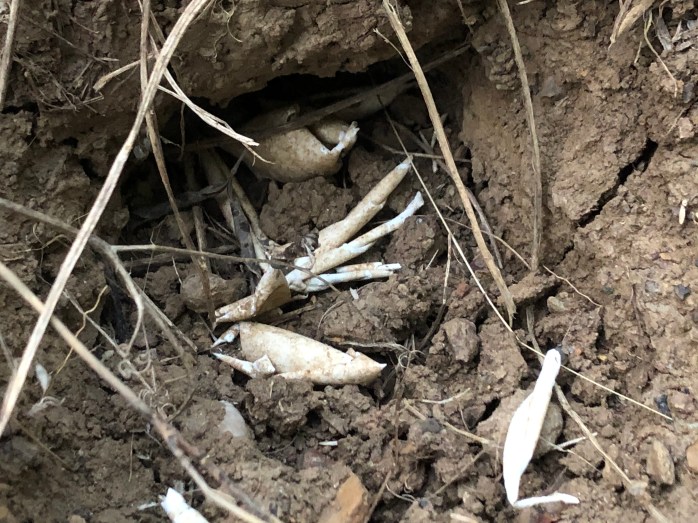
Other turtles such as the Red-eared Slider are common in those ponds, and we observed a big female being pursued by several smaller turtles, presumably males courting her. The frequency with which this species is documented, including individuals of different ages (I recently photographed a baby at one of the ponds, and we see half-grown individuals as well as big females and old melanistic males) strongly suggests a healthy reproducing population. And they manage this despite heavy predation on their nests. At the next pond we visited, we saw three excavated turtle nests with broken, dried eggshells. Chances are good that female sliders wandered away from the water until they found a suitable spot, dug nests and deposited eggs, and then covered them with soil and a wish for good luck. Nevertheless, predators such as raccoons are avid nest-raiders and help themselves to turtle eggs, over-easy. I don’t know what the odds are for a turtle nest to successfully incubate and hatch at the preserve, but clearly it is a roll of the dice.
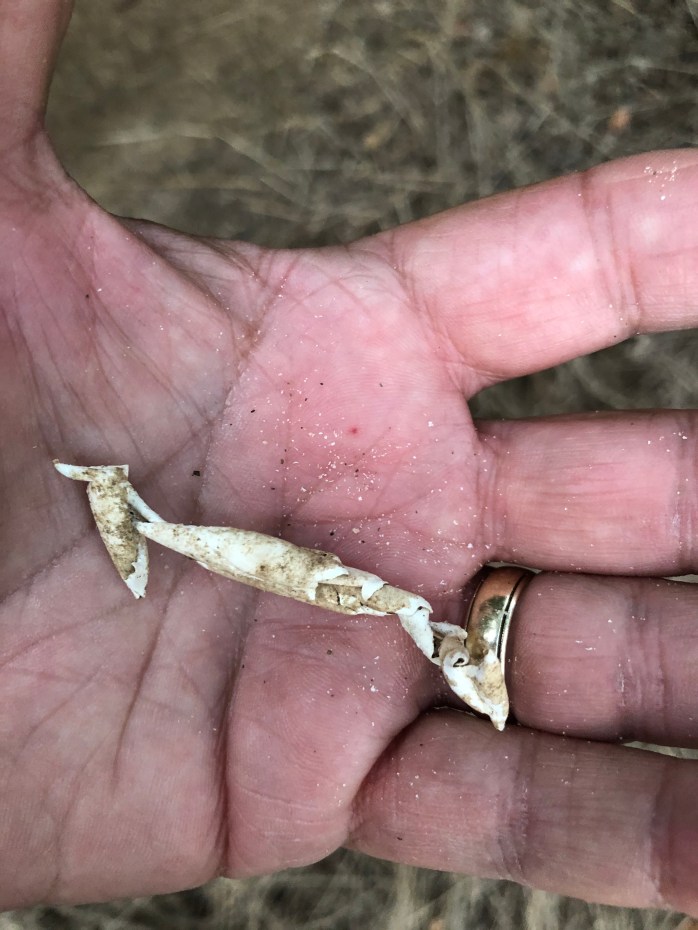
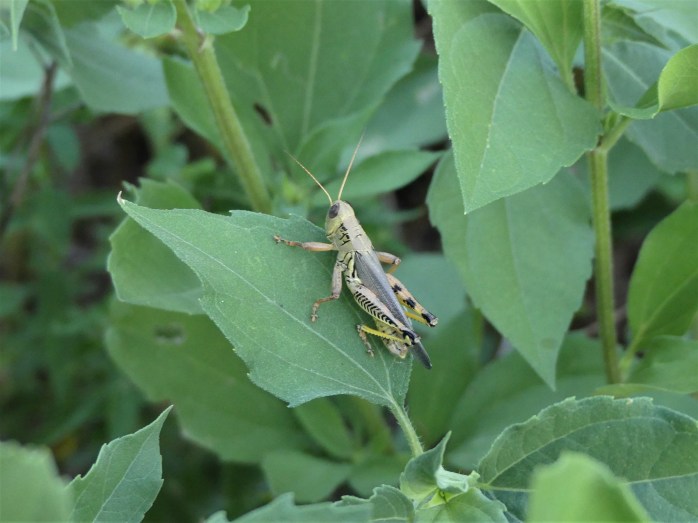
An excavated turtle nestBroken and dried turtle eggDifferential Grasshopper
Along the way, there are many other species to see. I photographed a number of grasshoppers such as the big Differential Grasshopper in vegetation around the first pond. That and the delicate little Forktail Damselfly and the orb-weaving spider whose web shone brightly in the flashlight beam all made our walk richer, but none of us are invertebrate experts, and so we added them as incidental observations. The same is true with plants, although Annabelle and I were delighted by the Halberd-leaf Rosemallow that we photographed at the smallest pond. Annabelle knows a good bit about plants, but it would take a dedicated team to systematically survey the plants at the preserve.
Halberd-leaf Rosemallow
We ended up walking most of the way around the pond at the north end of the preserve, and as I mentioned, it was rapidly becoming dark. We spent five minutes monitoring any frog calls, standing quietly with flashlights off. Blanchard’s Cricket Frogs began calling with their quick little “clicks,” sounding like two pebbles being hit against each other. There is a system for grading how many frogs of a given species are calling. This evening, the “call index” for these cricket frogs was a “2,” meaning that multiple individuals were calling and their calls overlapped some, but it was still possible to count how many frogs were calling.
It had been an interesting two hours, with the exciting observation of the Snapping Turtle, then finding the raided turtle nests, and that last leg of our visit with bats, swallows, and frog calls. We heard a Chuck Will’s Widow with its high, whistling call in the distance. I can’t wait to come back for another visit!
Point the way to better days we can share with you.
-Jethro Tull, “Weathercock,” from Heavy Horses
The sun has set on the shortest day of the year; the sun is as far away from us as it will get. Although it is now winter, from here on out each day will have more daylight. The days will start getting longer, and perhaps the weathercock will point the way to better days.
It is now winter, by astronomical reckoning, although the climatologists count winter according to the three months with the coldest temperatures. By that reckoning, winter started on December 1.
It has felt more like winter today, but I wanted to take at least a short walk on this shortest day of the year, and so I was at Southwest Nature Preserve (my home away from home) at sunset. It was a moody, dark sunset with clouds obscuring the actual setting of the sun, but I have no complaints. Taking a walk at the pond and the woods is good regardless of weather, and that includes cool, cloudy, misty days like this one.
“It’s a dangerous business, Frodo, going out your door. You step onto the road, and if you don’t keep your feet, there’s no knowing where you might be swept off to.”
– Bilbo Baggins
The road goes ever on and on
My favorite way to dodge weekend chores and recharge for the coming week is to wander around in the woods somewhere, often at Southwest Nature Preserve. And autumn is my favorite time to disappear into the woods, being swept off (as Bilbo would put it) to some place where leaves are falling, the sun sneaks in at low angles and feels warm, and the air might be just a little chill.
Today was a day like that. For a little over an hour I walked trails that circle around the preserve, considering how some things come to an end – or seem to do so – at this time of year. The oak leaves fall, grasses are dry and dormant, and the sun looks like it might be leaving us as it rises for shorter times each day and stays low in the sky. No wonder ancient people feared the loss of the sun and had such celebrations when it started a little higher arc across the sky and the days began to lengthen a little.
The giant “Caddo” oak has nearly lost its leaves
Autumn can seem like a time to slow down, to take stock of the year that is ending. The days are shorter, and many of the plants and some animals prepare for the long sleep through winter. Could it be that nature’s transition reminds us that all things end, that everything has its time and then passes into memory? Sometimes one of those memories seems near, like being brushed by the ghost of something that had its summer in full bloom and is now gone.
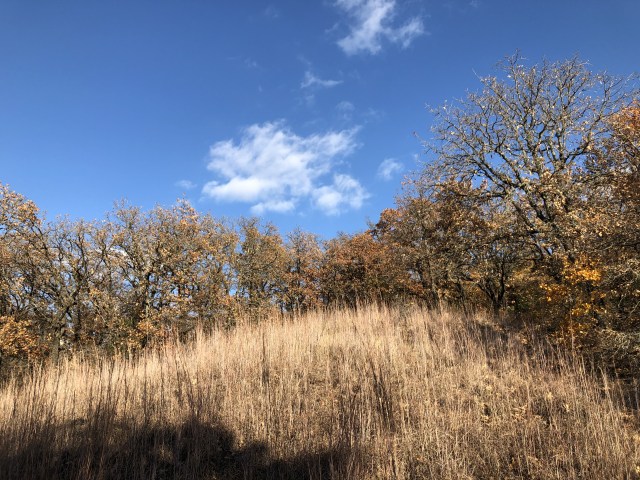
The sun warms a hillside with dormant Little Bluestem grass surrounded by oaks
What is happening on these hillsides of oak and Little Bluestem is not death, but dormancy and preparation for new life. Beneath the husks of grass stems, the rest of the plant is alive and waiting for spring. The bare trunks and branches of the trees are alive and have merely shed leaves that would not make it through winter. Those thin, broad leaves are great for exchanging gases and making food during the warm season, but they become damaged and would not do well in winter. As autumn arrives, the trees break down the green chlorophyll and reabsorb the nutrients in the leaves, and the yellow or red colors are what remains.
The green chlorophyll is nearly gone from these Post Oak leaves
I took a good look at some of those leaves today. Many were ragged and insect-chewed. But they have done their work well, and they end their time on this earth with a beautiful flourish. If I were a leaf, I would want my final days to shine like this.
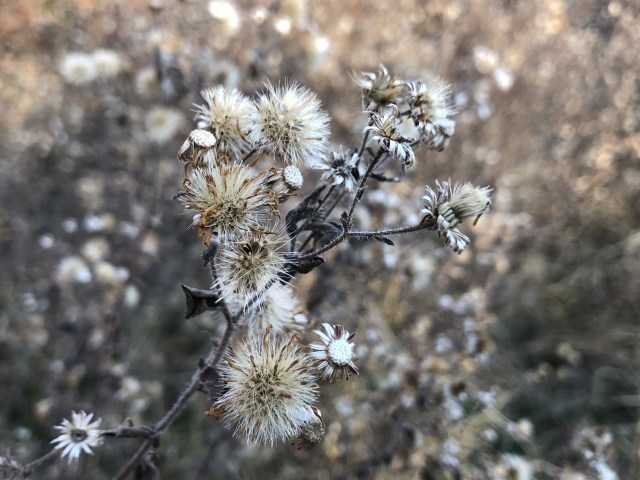
Further around the preserve, I came to a spot where a small field of weedy flowers, perhaps Camphorweed, had finished the season, gone to seed, and what was left was dry and dead. The little globes that looked like seed heads were light-colored and scattered around like a field of fuzzy stars above the soil. Dried flowers and seeds often have detailed shapes and textures that reward a few minutes spent examining them closely.
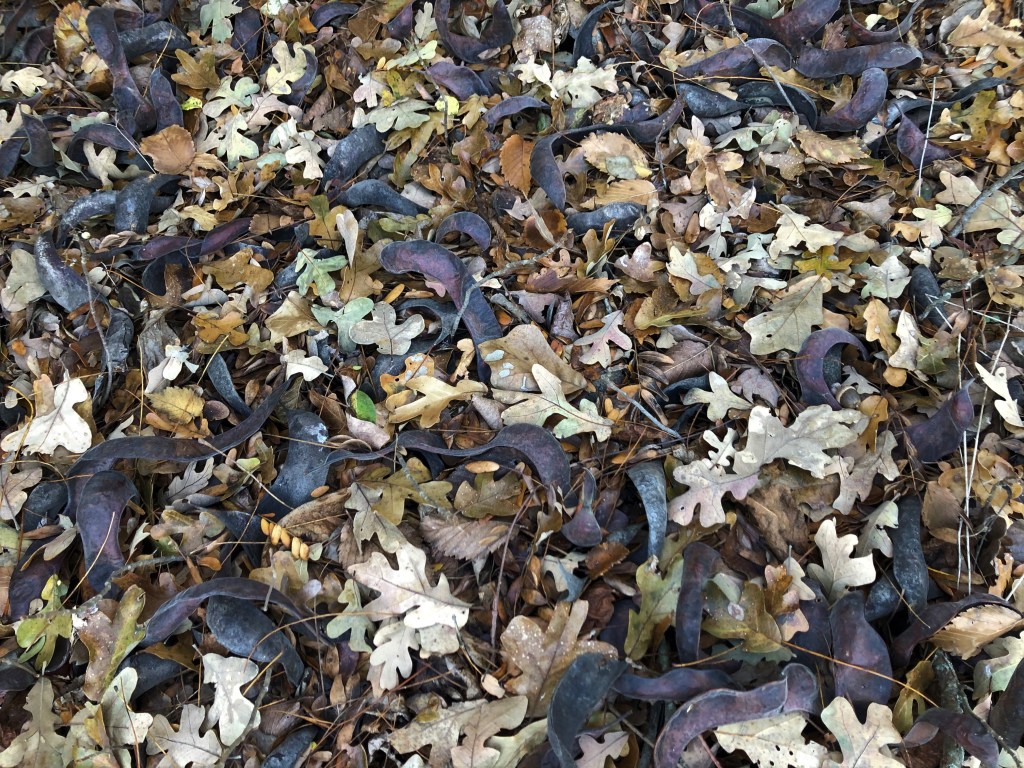
In another place there was an intricate and lovely mosaic of leaves and the flattened and curving seed pods of Honey Locust. A few remained on the tree, dangling like purplish-brown ornaments, but most had fallen. The pulp of those seed pods is said to be edible (but if you try it, be sure that it is a Honey Locust, not the Black Locust, which is toxic).
Honey Locust seed pods among the oak leaves
On one tree, two sinuously-curving seed pods remained side-by-side. Their twisting forms were well-matched, like dancers, like smoke curling as it rises, or like the twin snakes of a caduceus, signifying that this is a healing place.
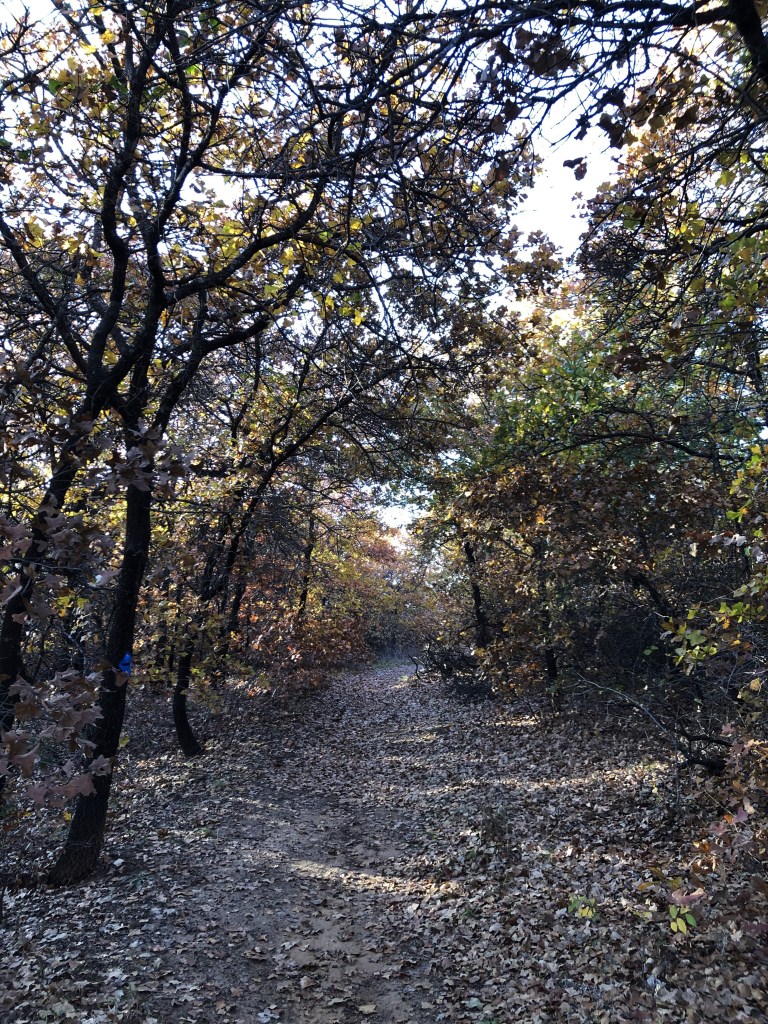
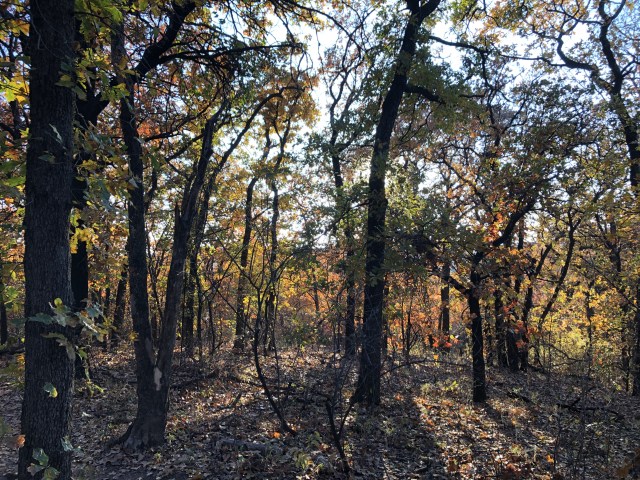
The afternoon sun behind the leaves made the woodland luminous
The preserve is not big in acreage, but it offers moments of loveliness and imagination on a grand scale. For those who really get to know it, each season brings new and wonderful experiences. Leaves fall and flowers die, but the woods and pockets of prairie are always alive and renewing themselves, which brings hope enough to see us through to spring.
It was almost two weeks into autumn, and summer’s heat held on. On October 6th, when the high temperature in Arlington reached 97ºF, a cold front was scheduled to roll through late in the day. It would be an interesting time to be at the Southwest Nature Preserve. Would the change take the form of a whisper of cool air, or a line of storms? A good friend, Shelsea Sanchez, came with me to witness what might be the end of summer heat and drought. We got there a little after 5:00pm and stayed for a couple of hours.
Juvenile Texas Spiny Lizard
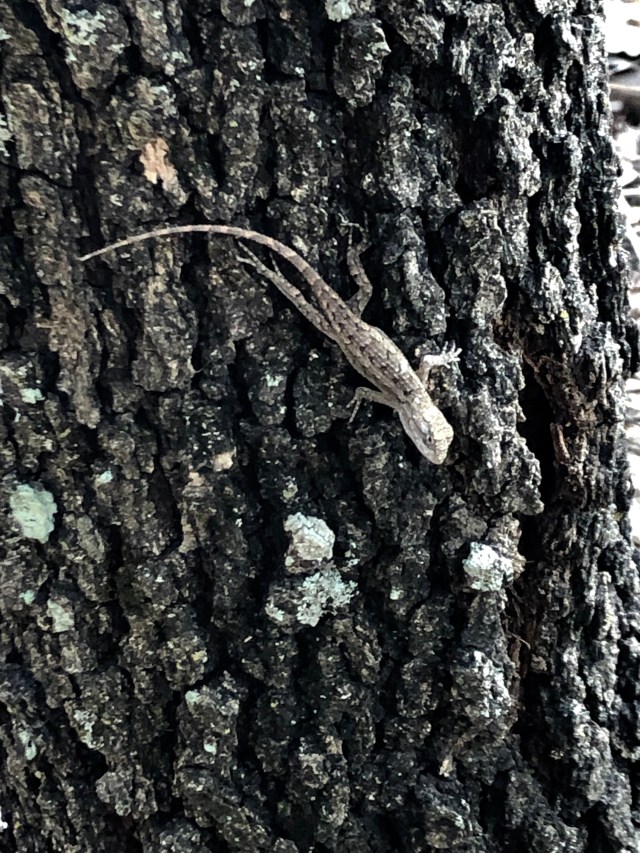
The initial walk around the north pond felt like a late afternoon in summer. We passed a little Texas Spiny Lizard positioned on a tree trunk, stalking insects in the hot sunshine as if it was back in August. Actually, two months ago this very young lizard might not yet have hatched from the egg, but now he or she was feeding and growing as it if was endless summer.
We followed
the path up the gentle climb on the back side of the preserve, to pay a visit
to a Post Oak that will be proclaimed as a Texas “historic tree” later this
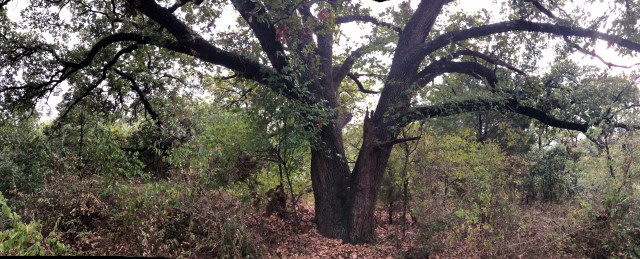
month. It is estimated to be over two hundred years old, with huge twin trunks
and massive limbs that stretch out over the surrounding vegetation. It is being
called the “Caddo Oak,” recognizing that it would have been an adult tree when
the people who lived on this land were Caddo hunters and farmers.
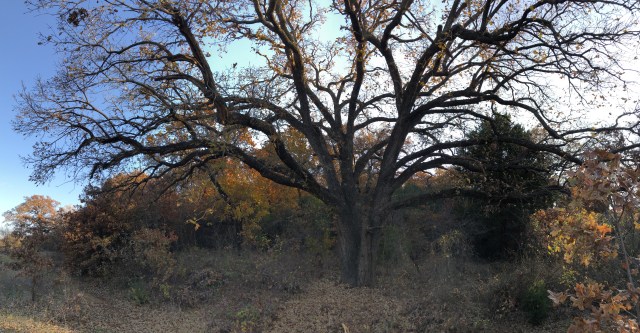
The Caddo Oak, a very old Post Oak
A good way to
spend time in a place like this is to clear our minds of the mental traffic
that pulls us to past worries or future plans, so that we can simply be open to
the present experience. A good strategy for this is to notice our breathing,
how the body expands and relaxes with each breath. From this focus on present
experience, we can connect more deeply with our surroundings – in this case a
massive old tree with deeply furrowed bark and a giant canopy of leaves. There
is a lot to notice and appreciate when practicing mindfulness in nature, simply
opening oneself to the present experience without judging it or being tugged
away from the moment by the internal “chatter” that often captures our lives.
We stood for a
while, taking in the tree, the sky, and all the surroundings. Later we talked
about what we had noticed: Shelsea’s perception was that those big limbs would
just go on reaching out to the woods and sky, ever wider. It impressed her as a
“wise” tree, something that had lived a long time and experienced a great deal.
The branching limbs of our oak trees often suggest to me a parallel with blood
vessels, extending into the surrounding air, supporting life in the process.
Following the trail as it turned and skirted a yucca meadow with deep sand, beyond a thicket of sumac and past a big juniper, we talked about how trees are linked together below the soil. A fine network of fungal threads, called mycorrhizae, connects with the roots and helps provide water and minerals. In exchange, the fungus gets nutrients from plant roots. It is a mutually beneficial relationship, and it is thought that mycorrhizae make possible a sort of communication between trees. For example, a tree that is attacked by insects may respond by releasing volatile organic compounds, and the surrounding trees connected by the fungal network respond in a similar way.
We spent some time in stillness and quiet, looking to the west toward some oaks in the background, and a scrubby open area with prickly pear cactus and a thicket of greenbriar. The front was coming, and darker blue-gray clouds were massing, and the distant thunder was a welcome and soothing sound. A couple of doves flew overhead, as we continued to absorb what we were experiencing. Afterward, Shelsea commented about how a nearby greenbriar was overtaking and pressing a shrub closer to the ground. Greenbriar is a strong, tough vine that I’ve described as like botanical barbed-wire, and this particular one was attempting to climb a shrub that could not support the vine’s weight. However, the main thing that we had both noticed in the last few minutes was the occasional low rumble from the advancing clouds.
You hear distant thunder when it is quiet – when there are no airplanes, no car engines, no roar of freeway traffic, no loud humming air conditioners. At an urban preserve, some of those things are inescapable, but if those noises are muffled – or if you are in a wild natural place away from mechanized sounds – you can hear breezes, birds, insects, and distant thunder. Through most of our history as humans, those sounds have usually been audible to us. We could hear coyotes howling on a nearby ridge, or a chorus of frogs a quarter-mile away. In a quiet glade we could hear water moving in a creek, and bees buzzing in nearby flowers. The sigh of wind in tree leaves was familiar. It makes you wonder if the loss of all those “quiet sounds” leaves an important gap in our lives, and if constant mechanized sounds and the ever-present TV and video sounds might be a source of low-level stress for us. The answer is yes, it is a source of stress, based on studies showing poorer concentration, increased anxiety and depression, and disrupted sleep because of noise pollution. Even low-level noise tends to increase the body’s levels of the stress hormone cortisol, and chronically elevated levels of cortisol interfere with the brain’s ability to focus and plan, as well as putting us at risk of digestive and cardiac problems, weight gain, headache, and other problems. And so I place a very high value on those experiences of quiet, when a bird’s song or a breeze stirring leaves in a tree can be heard.
Southwest Nature Preserve, October 6, 2019
Looking up the
trail toward the west at 6:30pm, we saw a hawk rise above the tree line,
soaring in the turbulent air below the oncoming clouds. A second hawk emerged
near the first one. As they flew, the sun shone through a break in the clouds
and highlighted the wings of these birds. Another couple of birds joined the
group, which flew higher and stayed visible above the tree line. The aerial
dance continued and rose higher, with other hawks coming into view. Shelsea and
I needed a real birder with us; I did not see rusty reddish tail feathers that
would have identified a bird as a Red-tailed Hawk, and so I was at a loss. I
could tell that the underparts were light-colored, but my eyes and brain could
not follow the movement well enough to remember their color patterns as they
rode the fast-moving air currents.
A kettle of hawks
As the number
of hawks grew and they spiraled higher, Shelsea pulled out her phone and began
recording video. I began doing the same thing, framing the swirling “kettle” of
hawks. The Cornell Lab of Ornithology reminds us that hawks sometimes gather in
“kettles,” using rising air currents to gain altitude, especially when
migrating. In his book, The Birds of Texas, John Tveten notes that in
early fall, Broad-winged Hawks begin their migration south into tropical
America, rising on air currents and forming large swirling flocks. I do not
know if these were Broad-winged Hawks, but it seems quite plausible.
We stood for a
moment, taking all this in. Life at the preserve was in sudden motion, as the
cold front came through with distant thunder and the promise of rain, and this
seemed to have spurred the soaring, wheeling kettle of birds to rise into the
sky.
And then, raindrops began to fall. After the heat and drought, it was delightful, and we stood there enjoying the feel of a few cool drops of water on our skin. In our state of fascination with every detail of experience, I noticed that every drop created a little dimpled medallion of mud as it struck the fine red sand of the trail. If the rain continued, those little mud-craters would join and the preserve would get the water it needed. In the meantime, we walked through these sprinkles and enjoyed the feel of the rain.
We spent two
hours there, but we had little awareness of the passage of time. It didn’t seem
to go quickly or last a long time, because we tried to let go of the past and
future so that we could fully experience the present. Although we didn’t pay
attention to the passage of time, we had a great time!
After the long reprieve from Texas heat, with the rains of spring and early summer, we’re back to a more typical August. With temperatures climbing and the sun beating down, I decided it was time to take a walk at Southwest Nature Preserve. I was there from about 1:45-3:15pm.
The North Pond
Cricket frogs and turtles were busy at the North Pond, and dragonflies busily and silently did their dance, swooping and hovering. The Common Whitetail more than justified its name as the commonest of the dragonflies I saw.
A Common Whitetail, perched on a branch
I watched all this for a while, but the sun was merciless and I wanted a shadier place to roost. Up the red sandy trail and under some oaks, I turned to see a Texas Spiny Lizard on a Post Oak trunk, her body making an arc as she hung upside-down there, head pulled up to look at me and tail drooping a little away from the tree trunk. Like all such lizards who survive to adulthood, she was wary, and disappeared around the trunk as I moved in to ask for a photo.
Texas Spiny Lizards have had a heck of a year, with rain and runaway plant growth supporting a bumper crop of bugs. I hope they persist (as they always do, in some numbers) during the dry periods that may come. I never get tired of seeing these cute little reptiles that sometimes tolerate you coming close but always at some point scamper away, up and around the trunk, too fast for your eyes to follow.
I followed the trail at the back of the preserve and climbed up to the ridge where there could be more breeze. Around the little loop trail at the crown of the preserve, there is an old concrete pad left over from when it was a working farm, and I sat there for a while, enjoying the quiet. There is almost always some airplane noise, but the spot is on the other side of the ridge from most traffic and so you can escape much of the mechanized soundtrack of modern life, for a little bit.
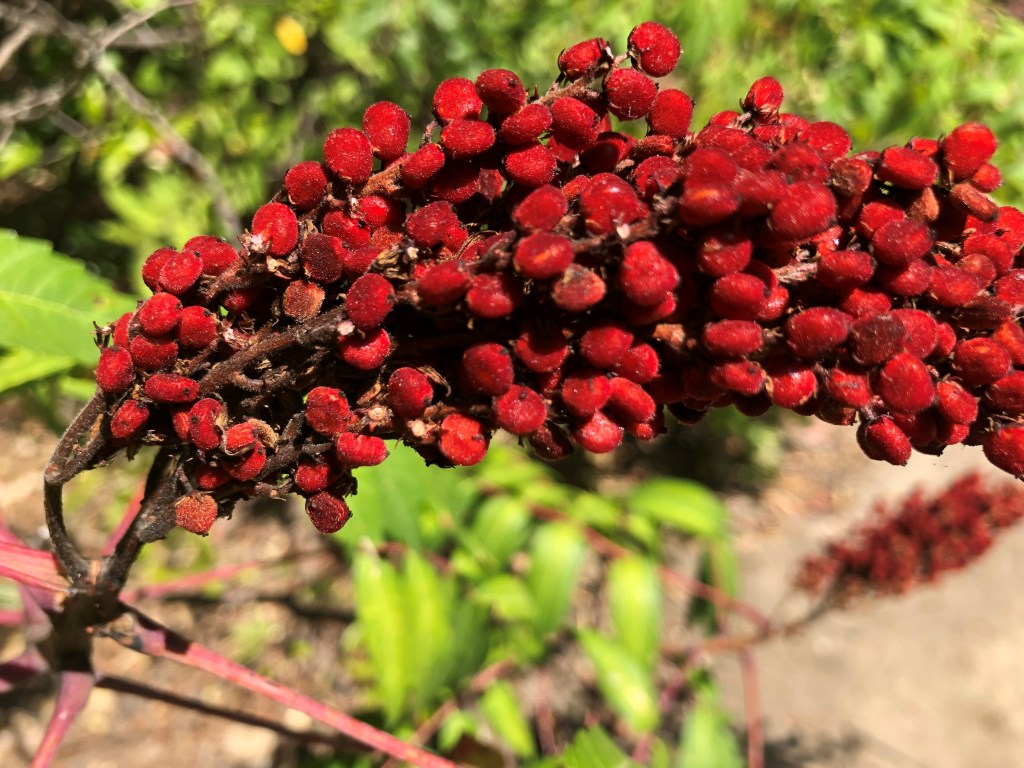
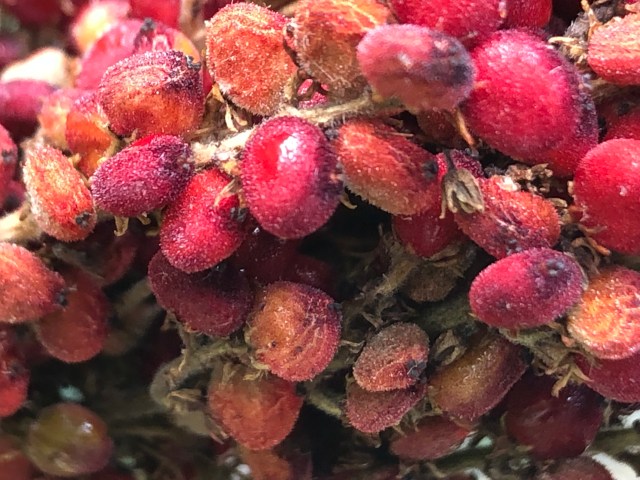
A Sumac seed head
Sumac is common in places at the preserve, and their seed heads can be a bright, velvety red before drying and darkening into the color of dried blood. Rob Denkhaus tells me I could make a tea out of it, and I’d like to find some growing somewhere that I could harvest a seed head or two and try it!
Looking down from the ridge onto the trail below
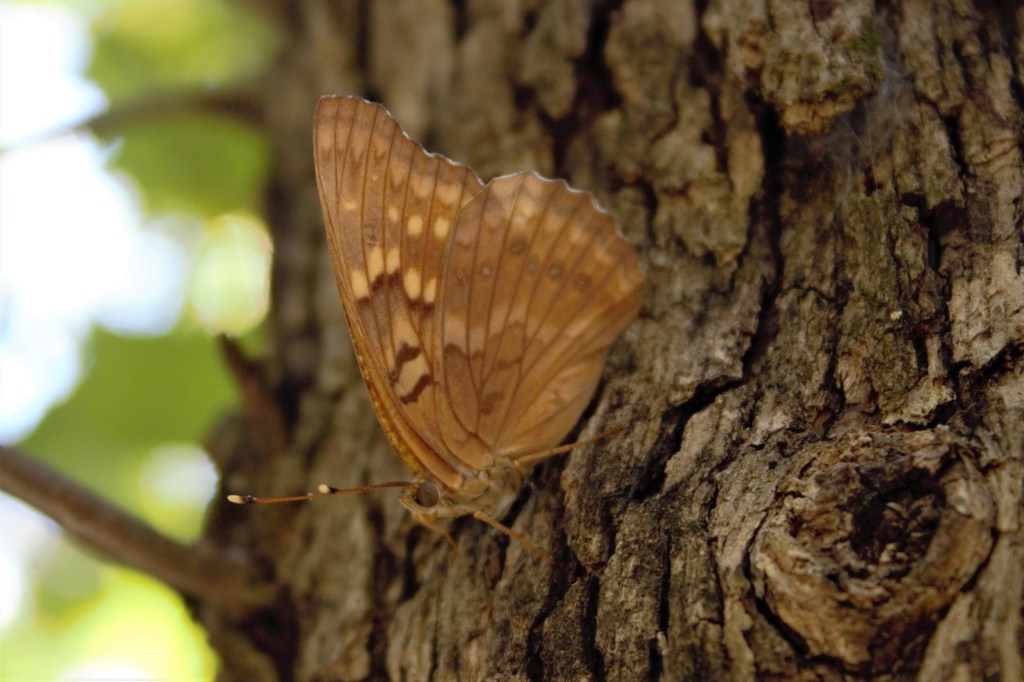
On the walk back to the trailhead, I saw one more of a kind of butterfly that seemed familiar – was it a Hackberry Butterfly like one I’d seen on a previous walk? I got a photo, and it appears that I was right. (Thanks, iNaturalist!)
A Hackberry Butterfly, according to iNaturalist
At the end, Weather Underground was reporting that the temperature in Arlington was 101ºF, with a heat index making feel like 117ºF. So it got pretty hot today, though the lizards and insects didn’t seem to care. It’s a little more troublesome for those of us whose bodies only operate in a narrow range around 98.6ºF, but a little shade and a little breeze got me through.
I climbed up “Kennedale Mountain” today, an old-ish man with pulmonary disease scaling the summit easily. Kennedale Mountain is a ridge at the Southwest Nature Preserve. A primitive trail gently climbs to a sandstone ridge at the top via a series of switchbacks. On the lower slopes there is a section of plastic netting that urges people to stay on the trail and not climb straight up the hillside, where they would damage vegetation, churn up the sandy soil and make erosion likely.
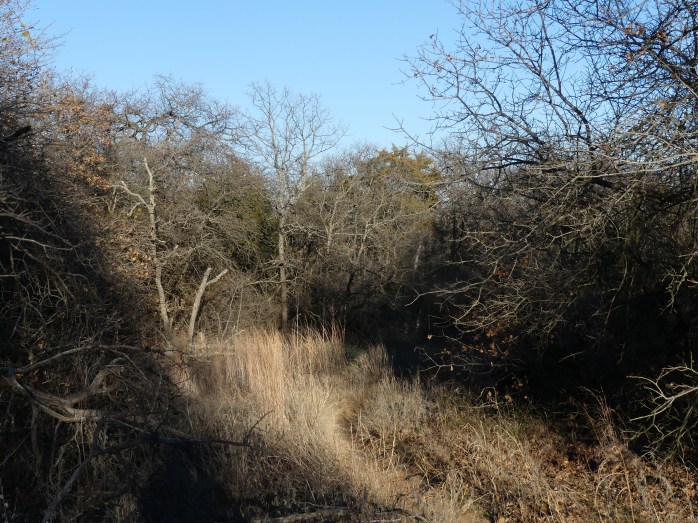
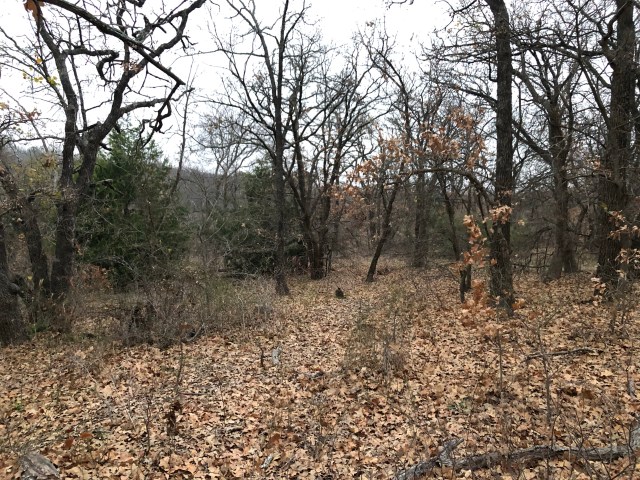
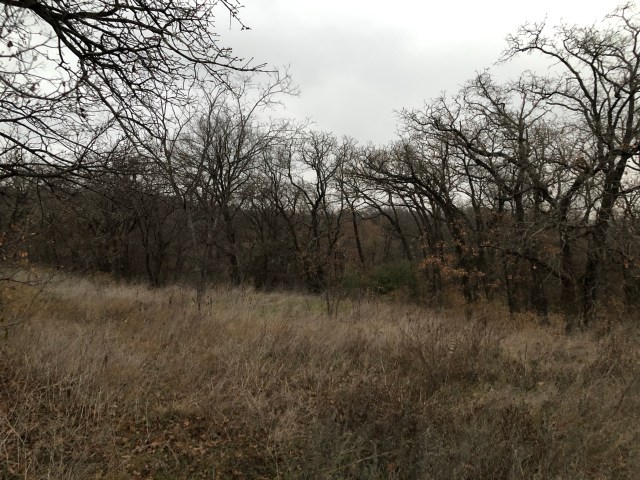
Eastern Cross Timbers woodland at the preserve
I wish that unsightly barrier did not need to be there. Why would people take the short cut to the top? Is there a race? Frankly, I’d much rather take that slow, meandering path and see all the little wonders that can be seen on the way up. If you’re not in a hurry, there is a lot to see.
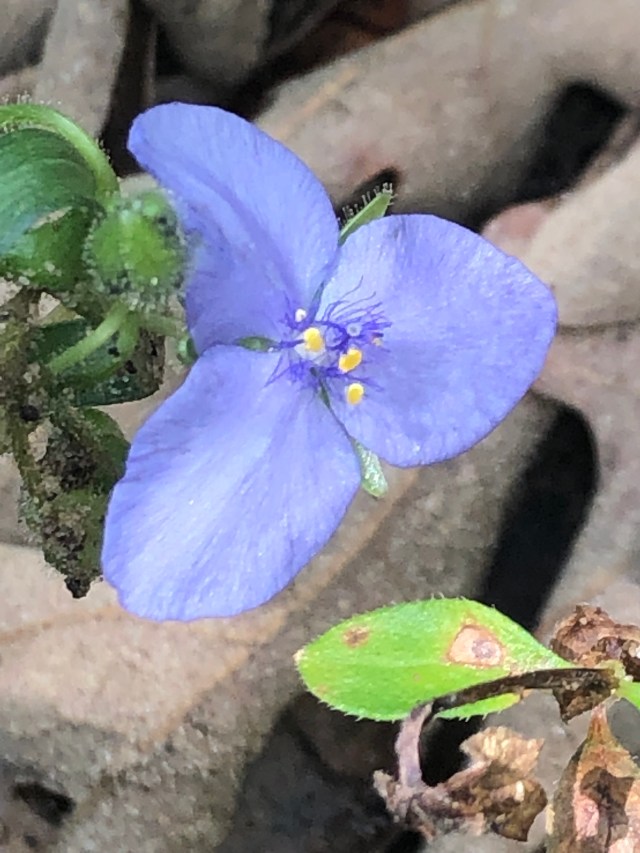
iNaturalist tells me that this is Bluejacket, a type of spiderwort
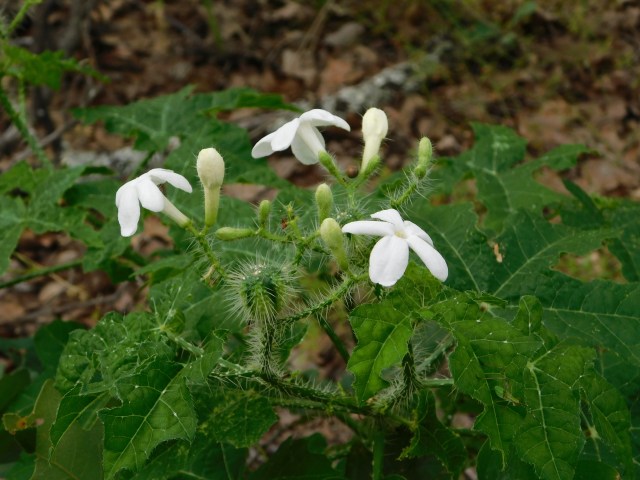
Even the plants that some would consider a nuisance can be pretty spectacular. It seems that sunny openings where there is adequate moisture and sandy soil are just great for Texas bull nettle, a plant that I carefully avoid brushing up against. Its hairy, spiny branches and leaves and the pure white blossoms are a real treat, though.
Texas bull nettle
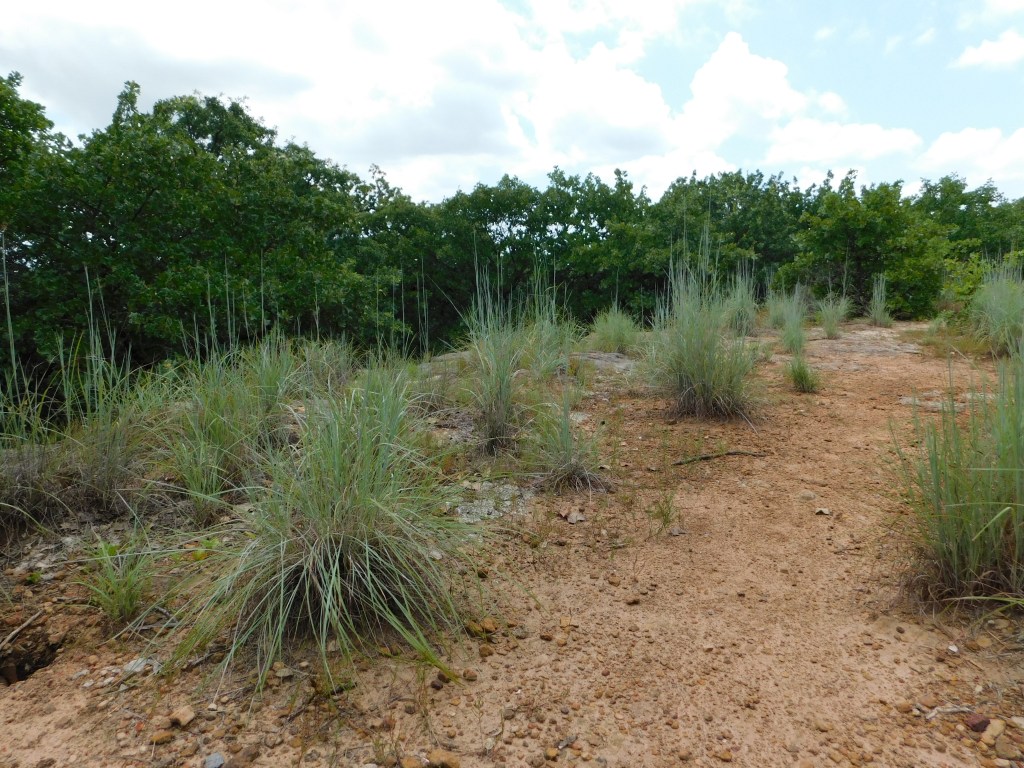
The ridge at the top has a flat, open area where Little Bluestem grows between scattered Blackjack Oak, and the shelf of iron-rich sandstone looks great, if you avoid places where people have carved initials.
Clumps of Little Bluestem, in little vertical brush-strokes of blue-green.
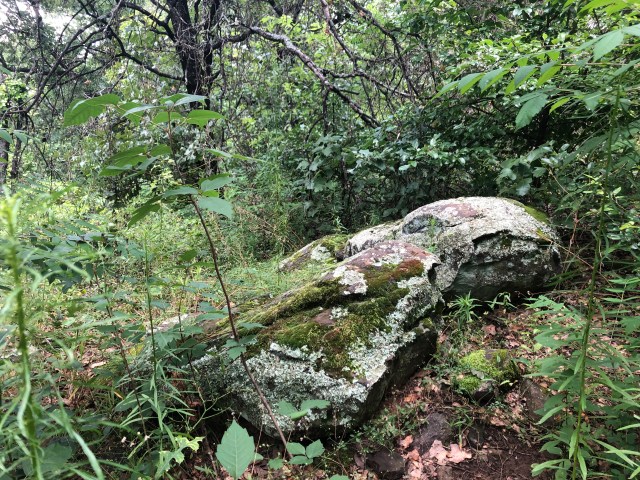
Elsewhere within the oak woods, which are a remnant of the Eastern Cross Timbers ecoregion, lichen-covered boulders are scattered among Blackjack and Post Oak, Sumac, and a wide diversity of other plants. Dragonflies hover and swallowtail butterflies flutter among the trees. There is really a fine diversity of butterflies and skippers to be found there.
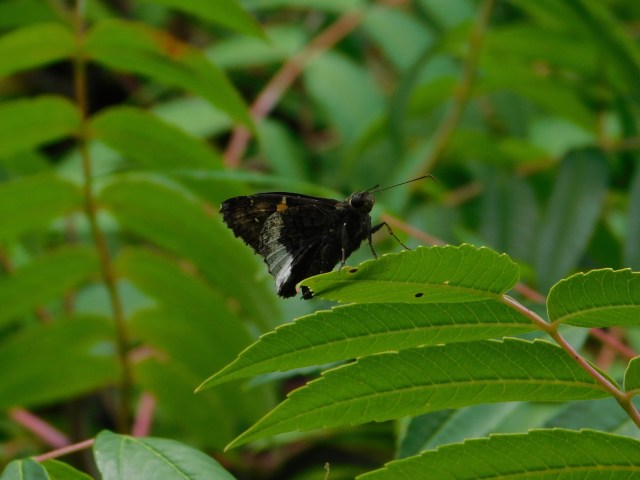
The understory is like a beautiful jungle under the oaksA skipper
The beautiful dark skipper was resting on sumac, a shrub which can easily get out of control but is a beautiful plant. Today the seed heads where brilliant red; in the fall the leaves will be even redder.
Seeds maturing on a sumac bush
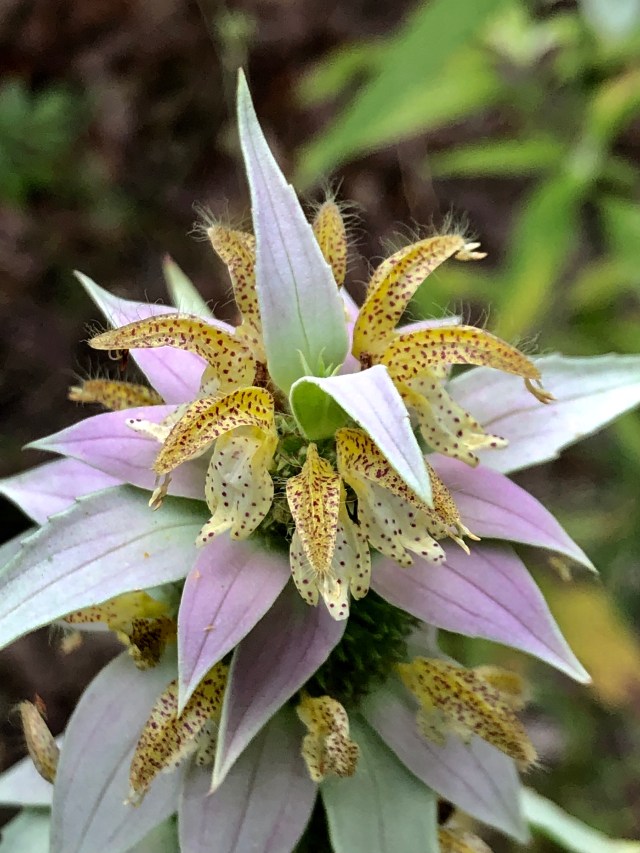
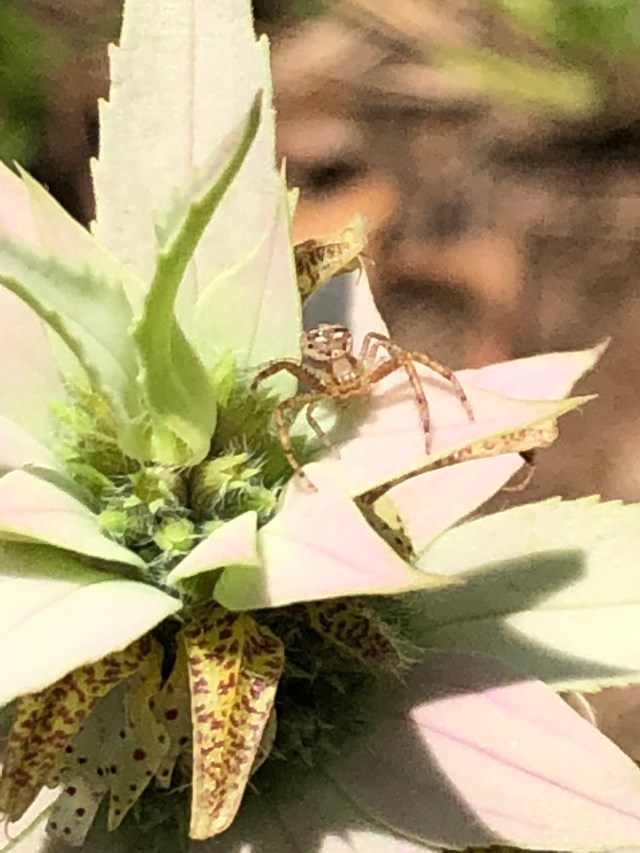
This season, horse mint is growing like crazy in places; in lower areas the purple Lemon Bee Balm is common, and in other areas the Spotted Horse Mint grows in profusion. It’s a nice-looking plant, but if you look closely, it’s a spectacular plant!
Spotted Horse MintA crab spider waiting in ambush on a Spotted Horse Mint
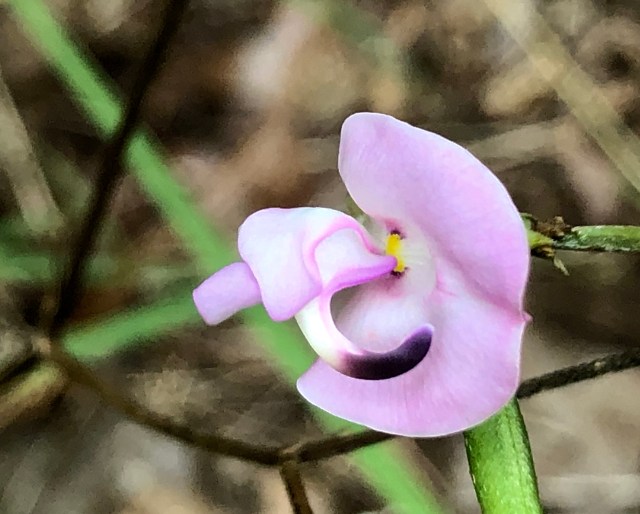
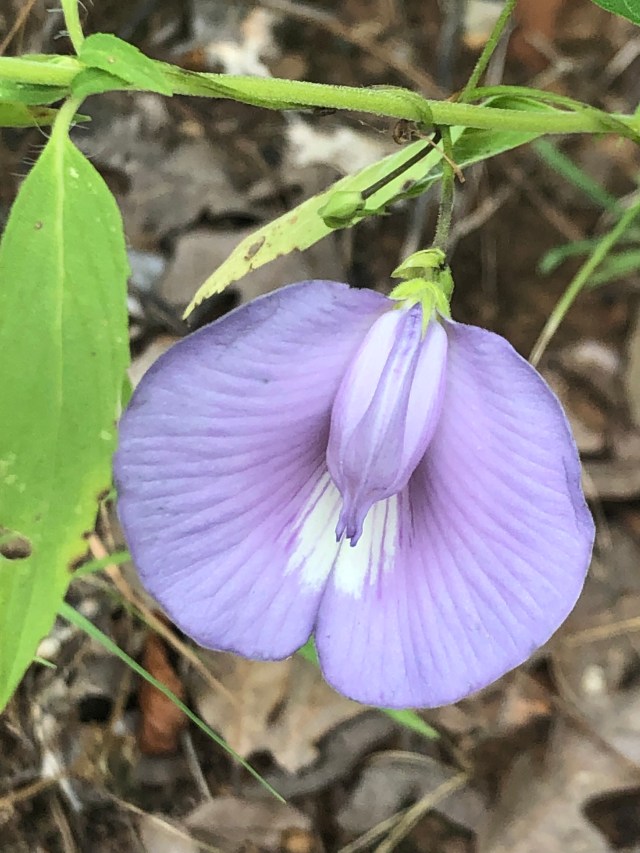
Speaking of looking closely, there was a gorgeous little bloom growing low to the ground here and there in the woods, and you have to stop and really look to appreciate it. Bend down, spend a little time, and notice that it grows on a sort of trailing vine and that some narrow green seed pods are developing. According to iNaturalist, it’s “Fuzzybean,” which sounds like a Sesame Street character but is actually a legume.
iNaturalist tells me that this is a Fuzzybean
Looking closely and taking your time pays off richly at the preserve. There are all kinds of flowers that you could lose yourself in. I stood in the steaming sunlight, admiring and trying not to drip on my camera. (Most of the close-ups were taken with an iPhone, and while I don’t claim that they’re anything special, I think that phone may be my best close-up camera.)
(I have no clue)Butterfly Pea, according to iNaturalist
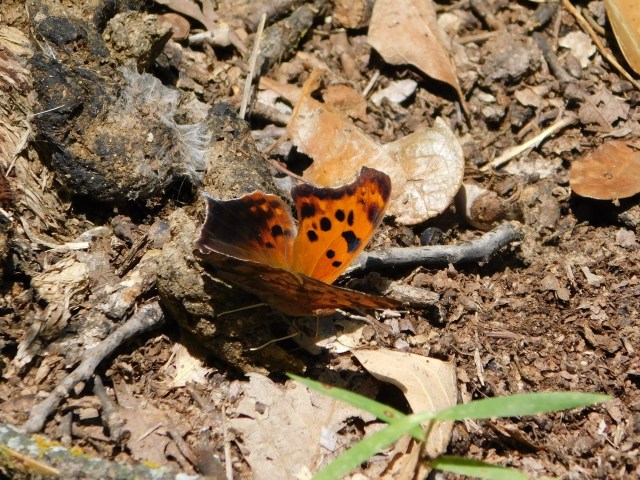
On the way back, there were more butterflies, including a beautiful Question Mark, a kind of butterfly that is utterly camouflaged with wings closed but is a beautiful study in orange and dark brown when it opens those strangely-curved wings. It was doing what butterflies do, sipping on a clump of scat. We don’t like to think about such beautiful insects getting nutrition from feces, but there you are.
Question Mark
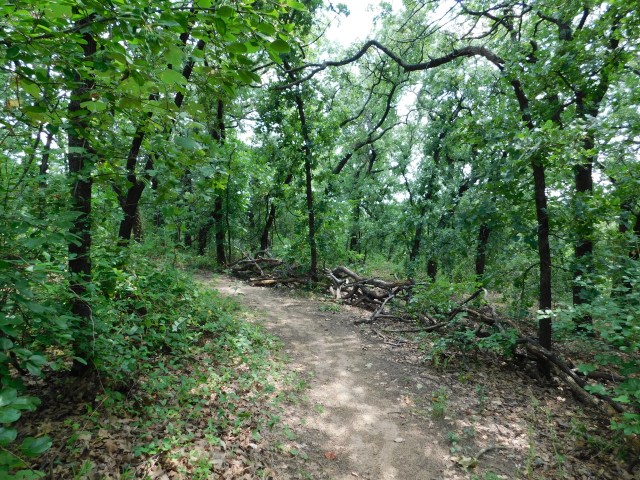
On the way back, I passed the place where that rogue trail joins the “official” trail near the top. Stacks of tree branches were piled there to discourage the cut-through down the slope. I still cannot imagine why anyone would come to this amazing place and want to take the short cut. I hope that they at least stopped somewhere, took a good look at something, in their race to do whatever they were doing.
Branches piled along the trail, suggesting, “no short cut; take your time”
(You probably noticed a lot of references to iNaturalist. I use it pretty regularly and it’s a wonderful way to get suggested identification of what you’re seeing and also to share your observations with other naturalists and with the scientific community. I’m pretty well-versed in reptiles and amphibians and have learned as much as I can about the bigger picture, but there’s an incredible amount that I don’t know. The iNaturalist app helps a lot.)












 Our Lives In Nature