Holding On … To Ourselves and To Each Other

I wrote this on Substack, before the murder of Alex Pretti in Minneapolis. That murder intensifies what I express below, but it also compels me to recall how important it is to hold on to each other. Faith in our government is broken, and we have to find ways to support each other while we also try to keep hold of who we are individually.

We each have an identity, a sense of who we are. It is made up of such things as what we value, what we love, what we choose to do and aspire to. My sense of myself is being inundated lately with outrage, loss, and worry. Our country is turning into something cruel, corrupt, and crazy, and it affects many of us profoundly. But I don’t want to lose myself in outrage and worry; that can’t become who I am, or who my community members are.
The answer cannot be to give up, to stop doing what we can to fight back. I have been a part of several public protests last year and the beginning of this one. I make comments in social media, because it may be a source of mutual support among my acquaintances and occasionally an actual exchange of ideas. I even still contact my political representatives – even if that is like writing a note and throwing it into the fireplace. None of these things feels like enough, nor do many of them feel effective, and that sense of near-helplessness probably affects a lot of us.

I know from my psychology training and from living more than 70 years what a pervasive sense of anxiety, helplessness, and anger will do, especially if they become chronic. Such things as depression, withdrawal, and retreat into distracting rituals, or worse than those may happen. And then what happens to my self, the part of me that cares for family and friends, loves nature and finds joy and rejuvenation there, finds essential truths in religion, literature, and music? These things could be overwhelmed and pushed away from the center toward the edges. That makes room for the worry, rumination, anger, helplessness and loss that cannot fully coexist with the rest of who I am.

And such things cannot really coexist with who you are. I’m thinking about the majority of us, I’m pretty sure, because polling data show tremendous dissatisfaction among most of us, and millions of us have taken the time to march and hold signs saying that the current situation is unacceptable. I worry for all of us, that we might lose a part of ourselves as this national emergency drags on, becoming a chronic trauma.

People at other times in history have borne trauma, and compared to some of them our situation might seem mild. We are not spending day after day in bomb shelters like the London blitzkrieg (or something similar in parts of Ukraine today). We are not suffering widespread famine like the Great Famine in Ireland in the 1800s (or in Gaza today). But we should understand that worse trauma elsewhere does not make ours negligible.

We are in this situation and we have to see it through. We cannot wish it away. And it will take a toll on us, especially for those in Minneapolis as communities try to take care of each other at substantial personal risk. And perhaps now in Maine, and tomorrow in other places as ICE swarms into other cities. Increasingly, people talk about the potential that the country might pull itself apart. And there is the dissolution of the world as we knew it, with allies pulling away from a rogue U.S. and the potential for war increasing. It was easier, a decade ago, to dismiss all this as naive and alarmist, but in the years that followed, much of what we warned about has come true.
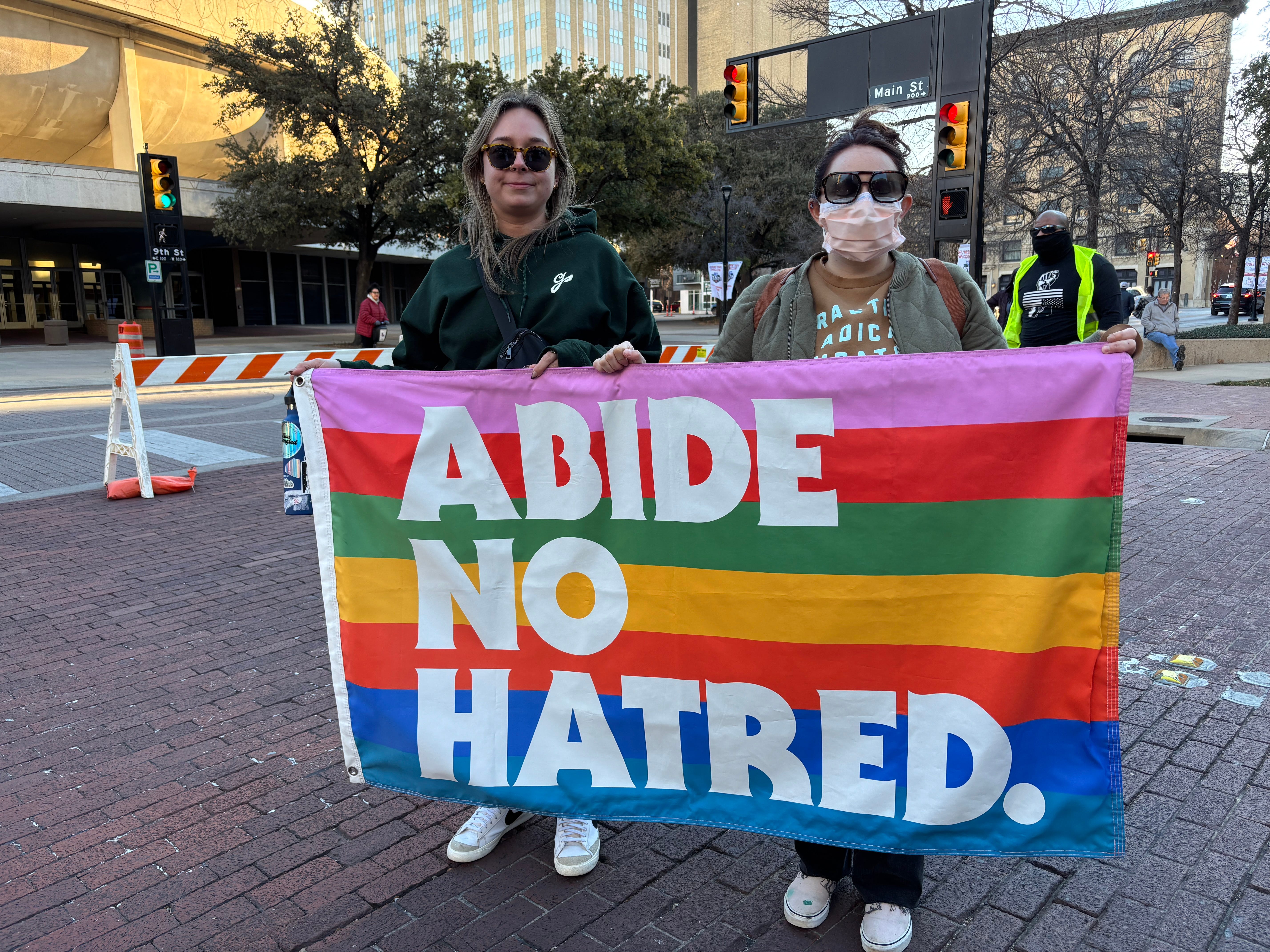
ICE Out of Fort Worth, 1/10/26 (participants agreed to be photographed)

Holding on to ourselves is important during an extended crisis like this. When doom scrolling or ruminating about these problems, I can work on coming back to the “center” of who I am. If I feel lost or numb, the thing to do is to come back to myself. Find a way to step out of what is pulling at me and remember who I am.

Wendell Berry describes this sort of thing in The Peace of Wild Things. He writes about what he does “when despair for the world grows in me.” He goes into nature, “where the wood drake rests in his beauty on the water.” He joins the birds, who are free from worrying about what will happen tomorrow, or in the next hour; they live in the present. And he is aware of the stars and their light, maybe not visible now, but their light will come. Such things free him.

Mindfulness offers a way to step away even if there is no physical refuge, no pond or tree or quiet room where we can go. The practice of mindfulness can give us an ability to let go of things and come back to the present moment with a greater acceptance, even when there is suffering in the present.

This is necessary in order for us to respond to the crisis in some sort of effective way. Taking care of ourselves – holding on to who we are – must happen in order for us to take care of each other the best we can and do whatever else will help. We know what happens when someone becomes saturated with fear or anger, or descends into numbness. That is not how we get through this.

When we feel lost, we work to bring ourselves back. That may be easier when we have a clearer picture of who we really are. Reading and reflecting on the items below might be helpful for that self-knowledge. I hope so.

  • How I spend my time in work, play, and with others
  • What I value and want to see happen in myself and for others
  • How I tend to understand others’ motives and reasons for what they do
  • How I cope with challenges, and how I recognize blessings
  • What gives purpose and meaning to the world – where I think it comes from
  • Who helps sustain me, and how I give back
  • Are there places that sustain me, and can they be re-visited
What Will We Do Now?

I write about nature, about the experience of nature and the cost of losing our connection to it. What could I have to say about this new world we are about to step into and what we can do about it? This space is about “our lives” in nature, and those lives – really all lives in nature – will change with the incoming administration.

Our country and the world is enduring a time of breaking, of desecration, when the worst impulses of many people are enabled and encouraged. And yet, there are a lot of us who know better, were raised to be better, and maybe we can lessen the damage. We have to try. We’re allowed to grieve the better world that is postponed or maybe lost, but our love for this world and for each other calls us out to do what we can.

Photo by Anugrah Lohiya on Pexels.com

The first thing we can do is to support ourselves and each other. Think about what the airlines say to do first if the cabin loses oxygen: grab the mask and make sure you have the oxygen that will let you function to rescue your child or your neighbor. We can do no good if we spiral into despair or exhaustion.

We cannot support each other if we’re isolated, and we need to work on this. Our Surgeon General called loneliness a public health epidemic, and a poll from the American Psychiatric Association said that 10% of Americans report being lonely every day. An NPR report stated that, across two decades, young people aged 15-24 now had 70% less social interaction with friends. As communities, we are often fragmented and isolated, and that might be a significant factor in our sense that we are falling apart. We increasingly keep to ourselves, and sometimes that results in thinking which becomes rather paranoid, and we become less patient, understanding, and skillful when dealing with fellow humans. The phone becomes our social partner and our way of interacting with the world, but social media is no substitute for face-to-face communication. And I say that as an introvert who hates parties and large social events. Find people with whom you can really talk as well as listen. Don’t forget their importance.

Nature, of course, can play a role in our self-care. In times to come we have to remember how the woods can be a refuge and wetlands can help wash away anxiety, trauma, and anger. Just as we need connection with allies, friends, and relatives, we need connection with trees, prairies, wetlands, and wildlife.

Such places will be more threatened than ever. The incoming administration has pledged to “drill, baby, drill,” and is also interested in selling off federal land to developers for housing. Project 2025, which (despite early denials) seems to be the blueprint for the incoming administration, intends to dismantle much of the Environmental Protection Agency (EPA), reverse what it considered the Biden administration’s “climate fanaticism,” forbid any scientific investigations by the EPA that are not explicitly authorized by Congress, and undo any progress toward clean energy. We know that climate scientists have said that much damage has already been done and we see the fires, floods, droughts, and hurricanes all over the news. Every year without significant climate progress will result in worse damage. How bad and how soon is hard to predict, but after the election, things look much less hopeful.

The new administration wants to convert civil service positions into political appointees. People working in civil service mostly have the independence and professional expertise needed to guide the implementation of environmental (and other) regulations. You can call them “bureaucrats,” but we probably want independent professionals helping determine the safety of our water or what sort of protection is needed to save a species from extinction. That may work out better than promoting opportunists willing to say anything to show their loyalty.

There are other threats, of course, like the stated intention of rounding up millions of our neighbors and deporting them, of giving up on real equality and justice, and marginalizing and harming our LGBTQ+ friends and loved ones. All this is interconnected. A government that treats some of its citizens with contempt will treat the land with comparable contempt.

We are going to need to try to stay informed about these things and know how to speak up. Perhaps we can choose an organization or two that we trust and channel some of our support and our advocacy through them. Perhaps it’s the Center for Biological Diversity, Earthjustice, or 350.org. Or it might be some other organization.

Here in Texas, the old-fashioned way of writing to elected representatives now seems a little … quaint. They do not represent us and are willing to harm us to get what they want. The head of Project 2025 wants a right-wing revolution which will be bloodless only “if the left allows it to be,” presumably meaning that they use violence if we don’t go along with what they want. The incoming President wants to be able to use the military against the “enemy within.” Significant portions of our own government are aligned with this view of us as the enemy (or are subservient to those who do). Somehow “please, sir, would you consider voting for this” does not seem like it will be effective with such people.

That is not to say we should not write to, say, Ted Cruz or Dan Crenshaw so that they know what their constituents think and maybe feel some pressure that might restrain them. We might share such letters publicly, in social media or a letter to the editor that says, “here’s what I wrote to Senator Cruz.” Normalize resistance, and let others know they are not alone.

But there is something else. How has it happened that more of our population shifted to the right? How have Proud Boys, bullies, and fascists become OK? How do Christians come to disavow Jesus’ teaching in the Sermon on the Mount as “too weak” and embrace hatred and exclusion? What drives the love of violence and responding to disagreement or differences with bullying? How did so many of us (very often men) define their personal adequacy by their ability to humiliate or harm others?

I hope that we can be examples of a different way. We can be models of empathy, respect, and a recognition that how others are doing is important to our own well being. I hope we teach our children, and particularly our boys, that we can be both strong and gentle, and we should always look for non-violent ways to protect what we love. These things should not be confused with weakness and passivity. Sometimes physical strength is needed, but the most important strength is moral strength and the courage to stand up for principles without being a bully. Too many of us, particularly boys, have not seen examples of this or have watched those around them treat such qualities with contempt. That needs to change.

Don’t let the ugliness blind you to the beauty that is also around us. Take time for that beauty; let it in.

It All Depends on Us

All the things I write about here are on the line. Our lives, in nature and in society. All aspects of our lives.

This is a time when speaking up is essential. As individuals, our choices nudge the society a little bit in one direction or another, and sometimes our collective choices make a profound difference. That choice has now arrived. If my voice as a writer and blogger can reach a little past my front door, then there is a moral need for me to speak up. All of us should. 

In a little over a month, our collective choice is between someone profoundly unfit to lead anyone and a person with the knowledge, experience, and wisdom to preserve democracy and the rule of law. And there’s more than just a vote for Kamala Harris, there is the need for a Senate and House not owned by the wealthy and populated with opportunists and wild-eyed autocrats.

It was never my intention to write about politics, and this is not so much about politics as it is a plea for sanity. This is the first time a major candidate has been a con man, a habitual liar, a sexual predator, a fascist, and a person credibly described as a malignant narcissist. My psychology background and common sense tell me that to live (in a household or in a nation) under the control of a malignant narcissist is to be in extraordinary danger. It is to be manipulated, used, harmed, and tossed aside. Those victims are all of us, individually and collectively as a nation, not just hypothetical players on the evening news.

Many of his followers are clamoring for civil war, and some of them attempted a coup when Trump lost the last election. Some of his followers are overt Nazis, and others unquestioningly believe any lie and support any suggestion he makes. 

If there was a need for this to tie in with our lives in nature, there is his promise to “drill, baby, drill,” his rejection of the science of climate change and his call for “raking and cleaning and doing things” as a way to prevent California fires (the environmental equivalent of his lunatic suggestion of injecting bleach as a treatment for COVID), his history of – and future plan for – rolling back environmental regulations and hollowing out the EPA, his offer of a bribe to oil executives if they would give him a billion dollars, and on and on.

The documentation is out there, easily available, and there is no point in my posting it all here and making this a long essay. My plea is for all of us to do what we can to, frankly, elect Democrats in November, not because I’m such a fan of that party but because in this election, they are the party in support of facts, reason, truth, and some commitment to respect the rights of all of us, however imperfectly. 

Part of the authoritarian playbook is to make us all exhausted and unsure of what’s really true or if the facts really matter. If you’re tired of it all, want to push it aside as “just politics,” and you’re ready to skip the election, please don’t. Don’t make this a national suicide. The other side is not just an opposition party, it is an abyss.

Our Lives in Nature … and in Society

There are no trees, birds, or mysterious nighttime choruses of frog calls in this post. There are only thoughts about how crucial it is to preserve the “our lives” portion of this blog’s theme – “our lives in nature.” Our lives are embedded in nature, and they are also embedded in societies and cultures. Whatever threatens our lives also threatens our role in understanding, protecting, and being with nature. When groups of people threaten our health and well-being, our ability to fully function as individuals, and our very existence, we begin to break down. And then our relationships with other people and with nature suffer.

So much is happening right now that is frightening. So much that threatens us and those we love. Against a backdrop of insurrection, there are calls for people to be murdered just because they are gay or politically progressive. Much of our government consists of people who insist that anyone should be easily able to get (and carry) a weapon of war. When anyone can carry a weapon of war, some of them will bring war to our communities. Americans own 20 million AR15-style weapons and when one of those owners murders school children, the power and danger of that weapon of war holds law enforcement at bay. To whom will we turn for protection when those who should protect us are out-gunned?

And now a Supreme Court that many consider to be at the lowest point in its history has decided that states, not women, have control over women’s bodies when it comes to abortion. The most extreme of the justices has announced that the court should go after the rights to use contraceptives, to privacy between sexual partners, and the right of people to marry who they love, regardless of gender. Some rights, like privacy and making our own medical and personal decisions, are not spelled out in the Constitution but previous Supreme Court justices protected them. The idea was that these important rights are implied by other parts of the Constitution, and government cannot interfere in such matters without a compelling reason. People talk about this as “substantive due process,” and the majority of the current Supreme Court is not a fan of substantive due process.

What can be done to protect our lives in society and in nature? What can I do to protect my own ability to be a meaningful part of society and nature, and not succumb to apathy, rage, or despair? Those things harm us personally and can destroy our ability to bring about change. I need to stay engaged with people and issues and feel emotions without being overwhelmed by them.

The work toward a more just and inclusive society is never really done. Social and economic pressures constantly shift, there are setbacks, and new generations bring new ideas and different perspectives. It is easy to become apathetic, especially for people who are working extra hard just to keep a roof over their heads and take care of their kids. People get tired. We sometimes feel the need to disengage with these problems, let someone else deal with it. The other side, people who want to impose their vision of how society should work, want us to be apathetic. They also want us to question whether we’re being reasonable because that’s one route to apathy. They suggest that we should calm down, but they have no such doubts about their own reasonableness.

When I feel the tug of apathy and the urge to disengage, I’m going to:

  • Be understanding of my need for rest and diversions
  • Recall how hard others have worked for issues that are too important to set aside
  • If necessary, re-evaluate what I do and choose tasks and roles that are a good fit for me
  • Visit the people and places that rejuvenate me
  • Re-engage – soon!

We also must avoid rage. I’m not talking about anger which is a thoroughly appropriate response to what is happening. Anger is almost unavoidable if what is happening truly matters to us. However, if I am consumed by constant anger, my energy may be wasted in attacks on others or a kind of simmering, unthinking rage. We can use the energy of anger, but we need to figure out how to use it effectively. This means I want to:

  • Attack problems, bad ideas, stupid arguments, cruelty, authoritarian political campaigns and the like; attacking the people associated with those things won’t help
  • Remember that rage comes from fear and helplessness, so when anger becomes overwhelming I will examine its sources and try to address them

That first commitment is difficult. I can think of one ex-President and several people in Congress who, in my view, deserve whatever ad hominem attack might come their way. It would feel good, but it wouldn’t really help. When I do it, my sense of identity is fractured between “we win through the ability to hurt others” and “we win through our ideas and through nonviolent resistance.” It’s difficult because giving a boot to the backside sure would feel good.

Another challenge is avoiding despair, that awful hopelessness where nothing seems possible. Despair paralyzes us. It’s akin to that protective response in the autonomic nervous system that shuts us down when nothing more can be done. That can happen when fighting is useless and all that the nervous system can do to get us through it is to make us immobile and numb. And I think that despair is its close cousin, a sort of surrender that sets in when nothing seems to work. 

When we are at the point of despair, it is essential to swim back to the surface, to take care of ourselves for a little and get ready to try something else. Here’s what I hope I can do:

  • Connect with someone who understands – they could sit with me and listen, and I would not be as alone with the problem; the point is to not be isolated
  • Like in the case of apathy, visit people and places that rejuvenate me
  • Examine the situation and look for good news, even if it’s small and seems dwarfed by the size of the problem; remind myself that something is possible
  • Find ways to contribute, to do something because doing something feels like I have at least a little bit of control, a way of making a difference; fight the sense of helplessness
  • Establish a sense of safety – physical safety if need be, as well as psychological safety

That last one, about psychological safety, is a little tricky. If I’m going to take a stand about something, I can expect that some will disagree and disapprove. I have to figure out what is tolerable. Name-calling by strangers might be no big deal but death threats may not be something I can let roll off my back. I need to figure out what adds to my psychological safety and what erodes it past what I can tolerate. Each person’s tolerance for risk is different, and that’s ok. 

If you want to work towards a just and inclusive society, thank you and I wish you great good luck in navigating the challenges I’m thinking about in these pages. We need healthy systems in nature as well as healthy societies. Our lives in one area depend on what happens to us in the other.