I’ve given a number of talks to groups of kids after being asked to help with their fear of snakes. Even when addressing fear was not the primary reason for the talk, the adults may reason that knowledge and experience will inoculate the kids against fear and will feed the experience of curiosity and wonder in place of fear. Those are wonderful reasons for me to pack up some snakes and a few pictures and go talk with the kids and the adults. Knowledge will help counteract fear, but experience is what works the real magic, and that’s true for any of the phobias of critters in nature and for the general fear of nature that some people have.
We live almost all our days surrounded by our own stuff, our technology and built structures, and our lives become more and more separate from nature. Food and water are treated more like commodities, and even the air is conditioned and filtered. And so, wild places may feel dangerous or unappealing and wildlife may seem more frightening. Fears of various things in nature (collectively referred to as biophobia) become more prevalent. A vicious cycle sets in. As nature becomes more unfamiliar and threatening, our fear or disgust makes us avoid the experiences which might counteract the fears. The “extinction of experience” robs us of the sense of being at home among our non-human kin.
I’m not naive; I recognize that there are dangers in nature just like there are dangers in our homes, neighborhoods and on our freeways. Some of the snakes that I love to observe or photograph are dangerously venomous, especially when we accidentally get too close or try to show off with them. But most people are not bitten, especially when equipped with a little knowledge and common sense.
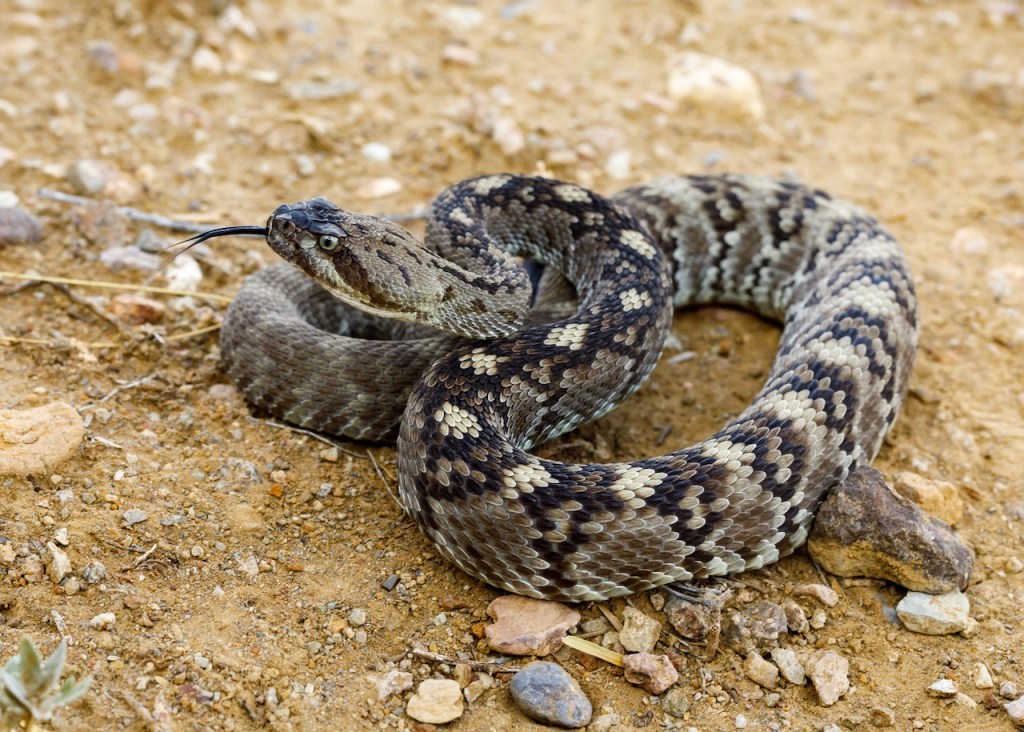
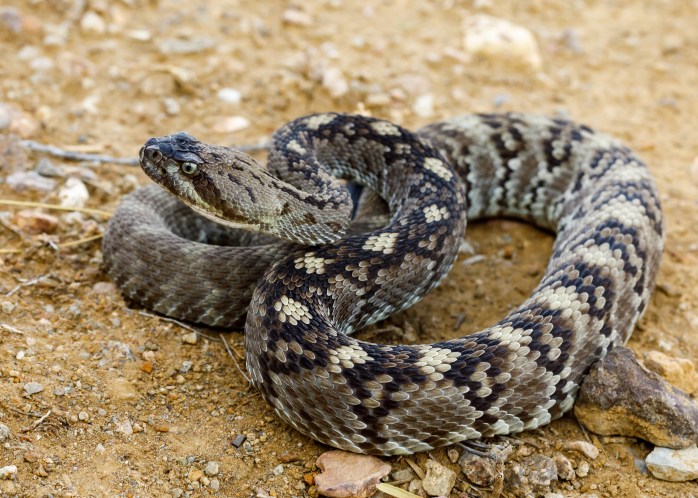
A black-tailed rattlesnake photographed by Meghan Cassidy during our trip to the Big Bend while working on a book on mindfulness in nature. The snake is venomous but we negotiated our encounter with each other well, and the snake never attempted to bite.
Coyotes are among the wildlife that people tend to assume are dangerous. A 2009 study searched for reports across the U.S. over a 46 year period and found 142 attacks during that time (with attacks defined as encounters in which a person was bitten). Very few of those occurred here in Texas. Some (30%) were related to coyotes that had been fed by people, accidentally or intentionally. Steps for staying safe around coyotes include not feeding them, limiting the outdoor activity of pets like small dogs, and not running from them (triggering a built-in tendency to chase). To keep it in perspective, the reported dog bite fatalities (not just attacks) from 2020-2022 ranged from 47 to 56 per year. We are in much greater danger from dogs than we are from coyotes.
The idea that we are in greater danger from the things most familiar to us, like our cars (one reportable car crash every 57 seconds in Texas in 2021) or our dogs, is a hard sell for most folks. That is because we are around them all the time, and our experience is usually safe and rewarding. We adults understand intellectually that cars, dogs, household chemicals, electricity, and so on can be dangerous. We do what we can to make the risk manageable and continue to enjoy the benefits. Being careful does not mean that accidents are impossible, but even though there is some chance of accidents, we are not afraid.
Here are some reasons why so many of us are afraid of things in nature:
Limited contact
We are comfortable with what is familiar. A strange place in nature, or certain things in natural spaces, may feel foreign and unpredictable. We don’t know what that bug might do, nor do we know if the coyote howls and yelps might mean they are hunting us down, and so we keep away from contact with those things, thus guaranteeing that we will not have experiences that might teach us what is realistic. Additionally, many people live in cities with no nearby natural spaces and limited transportation, and so they miss out on walks in the woods and encounters with wild things.
Not knowing what to do
Many people would not know what to do in a wetland, prairie, or woods. If they visit, they may bring with them the things they know from everyday life, like listening on headphones, chatting on the phone, riding bicycles or off-road vehicles. I do realize that some people know their way around the woods and still enjoy listening to music or bicycling, but I imagine that there are others who would be bored and lost in nature without gadgets and vehicles. Many people do not know the names of plants or animals and what they do, and would be uncomfortable finding their way through the woods or across a creek.
The culture often teaches fear
Our minds are wired to look for danger, and sometimes we enjoy the thrill of finding it or hearing about it. And so we tell each other stories of the time an uncle killed a big snake or we went camping and were frightened by sounds in the night. We watch movies about bear attacks, snakes loose on an airplane, werewolves, bats that want to suck our blood, and on and on. We warn each other or see overblown news reports of killer spiders or murder hornets. Our culture portrays nature as full of danger, and unless we get out there and discover that nature is mostly safe, we become fearful.
Actual negative experiences in nature
Sometimes we become afraid of something in nature because we actually did have something bad happen there, like a near-drowning incident or being stung by a jellyfish on the beach. At other times, being startled or surprised will trigger fear. As an eight-year-old child, I reached into a hole and felt something soft. Cupping my hand around it, I slowly removed it and discovered a tarantula, triggering a phobia that was pretty severe for the next couple of years (despite the fact that the tarantula kindly refrained from biting the invader to its home). Only after I developed other interests in nature and as a result began to have safe, incidental encounters with spiders and their webs did the fear gradually subside.
Possibly inherited predisposition
Could it be that some of us are just put together that way? It is true that some of us have a greater general predisposition to being fearful, and part of that appears to be genetic. And do we inherit fears of snakes and spiders? There are some studies that give at least a guarded answer of “yes,” such as one in which babies (too young for culture or experience to be a factor) were shown pictures of various animals and their pupillary reactions revealed that they react to spiders – and to some extent snakes – in a more anxiety-related way than their reactions to other pictures.
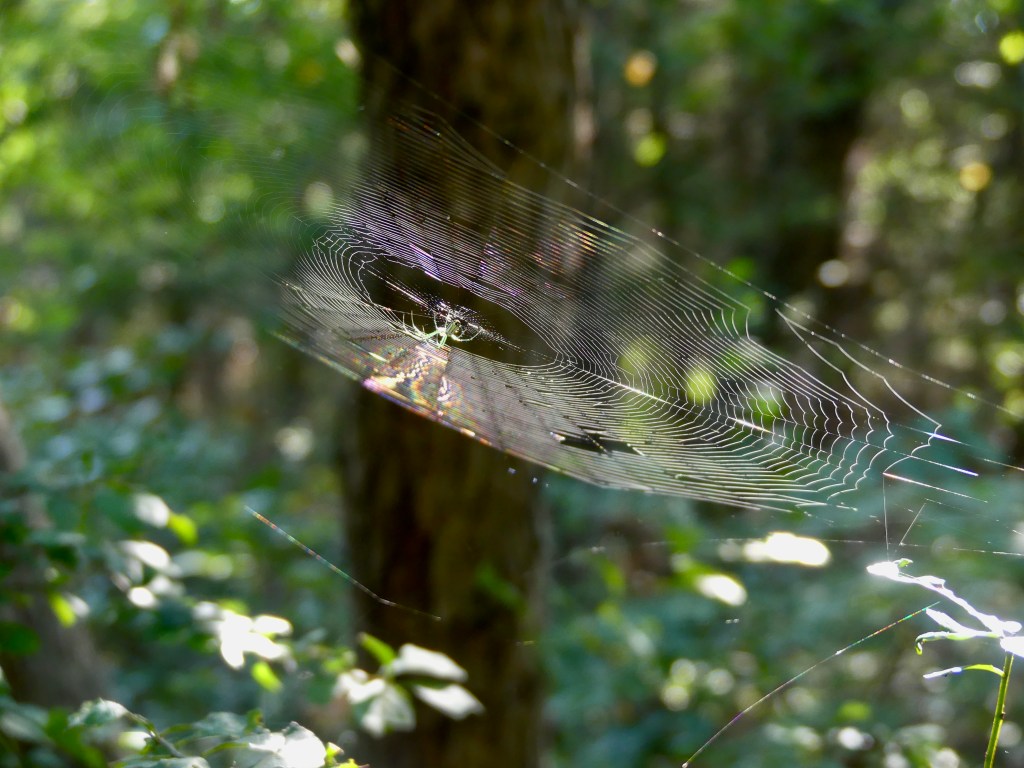
An orb-weaving spider at Dogwood Canyon Audubon Center
Since time spent in nature provides us a great deal of benefit (here is a review that sorts some of these benefits based on our senses: vision, hearing, smell, etc.), giving people the tools to decrease fears of nature would be a very helpful thing. We can do something about several of the issues I listed above. What if we helped people – particularly children – have more contact with nature in enjoyable ways that could contribute to exploration, safety, discovery, and wonder? I plan to write more about that in this space, so I hope you’ll check back or subscribe so that new posts are emailed to you.
It has happened several times – driving out in the grasslands or desert, I pull up on a long, slender snake that sees me before I see it. Perhaps its head and neck periscope up a foot or more for a better look at me. If I get out and creep slowly toward it, the snake keeps a careful watch on my distance and speed. At some point I cross a line in the snake’s calculation of risk, and decides it is time to go. It bursts into agile and athletic motion that carries it unerringly around rocks and through brush piles. In my younger years I sometimes chased but rarely caught them. The only realistic opportunity to catch one was to surprise it, lifting a log or discarded piece of plywood and finding the snake hesitating for a moment.
The western coachwhip seen in 2006 at LBJ National Grasslands
Occasionally I caught a coachwhip when it believed itself to be concealed or camouflaged. I once surprised one on a gravel road in the LBJ National Grasslands, and it quickly slipped off the road. I pulled over and investigated a grassy area where I last saw it and found four feet or so of tan scales blending very well in the dappled sunlight along the ground. I grabbed the snake and then worked to calm its thrashing body so that I could take a photograph. After a short time the snake was calm enough for me to put it on the ground, covering its head and restraining its body just enough so that it did not struggle.
Then it tried a different strategy that suggested some form of death-feigning. Coachwhips have occasionally been described as feigning death to discourage an attacker from continuing whatever it is doing. After all, there is no need to attack a dead snake. This one went limp but turned its head and neck to the side. A hog-nosed snake will flip over in death-feigning, as if the only way to be properly dead is upside-down, and this snake seemed to be doing a much less dramatic version of “playing dead.”
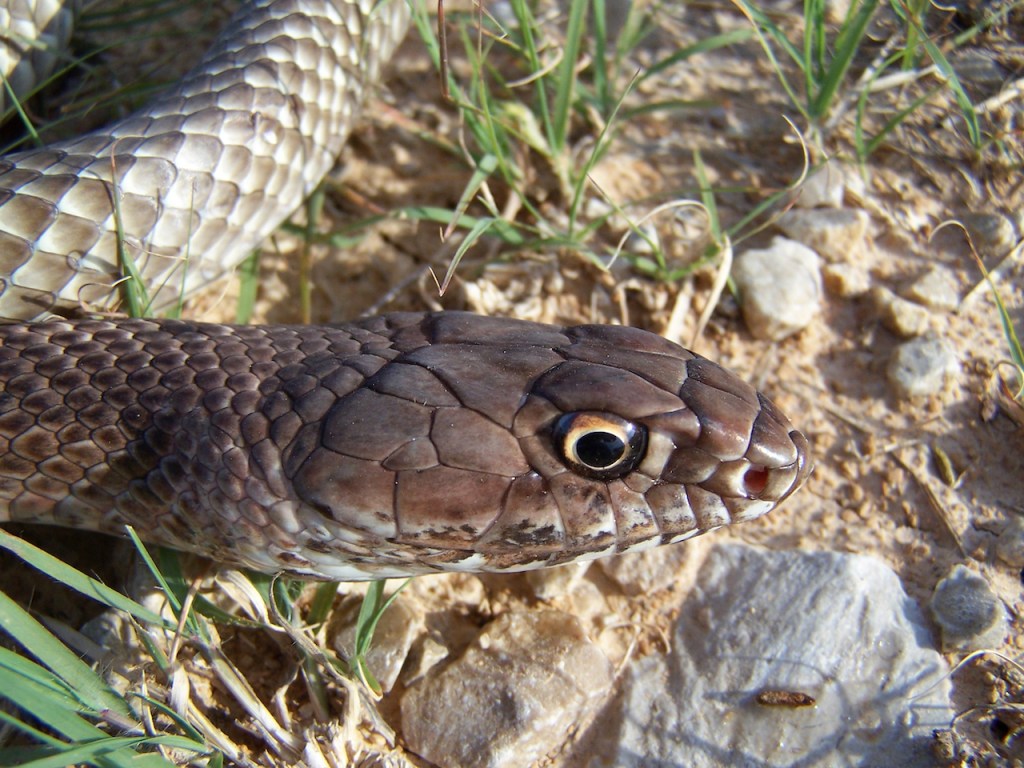
The coachwhip’s headWhen released
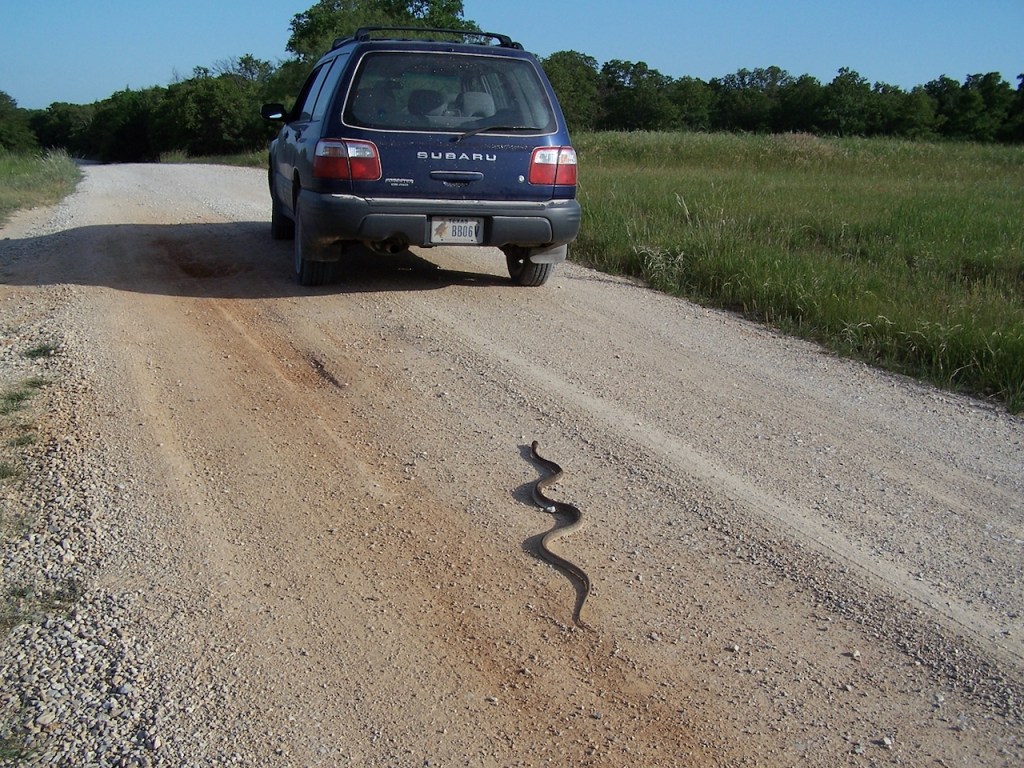
I posed the snake in a more normal position, took a couple of photos, and then encouraged it to be on its way. I positioned the snake in something closer to a straight line and backed away. In a moment it came back to itself and took off, crossing back across the road at typical coachwhip speed.
What are coachwhips?
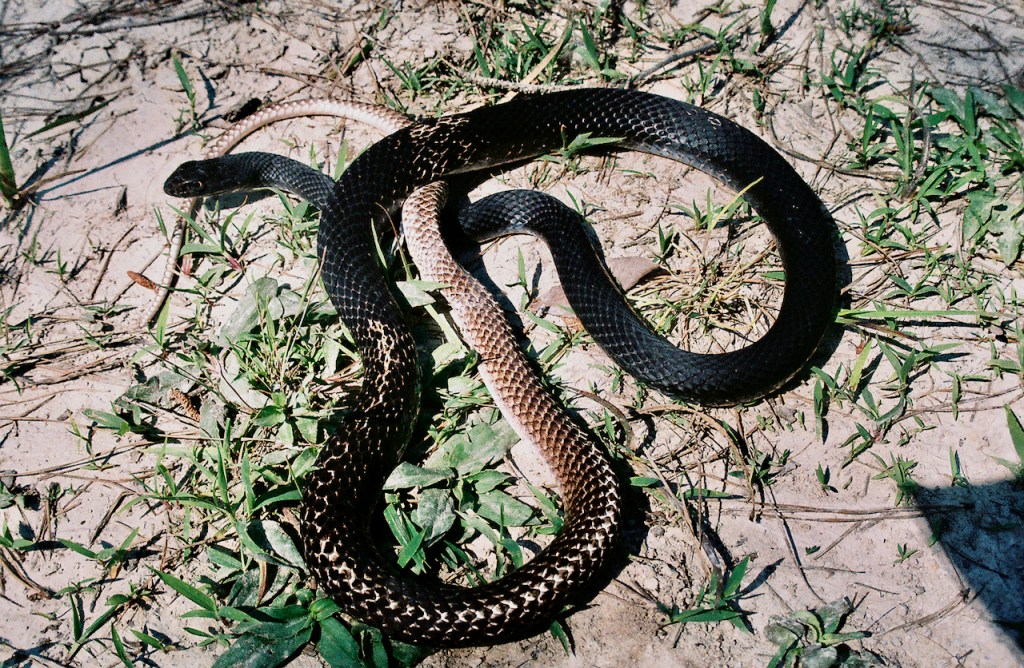
One or another species or subspecies of coachwhip is found all across the southern U.S. In the east, including in parts of east Texas, much or all of the eastern coachwhip’s body may be velvety black. In central and west Texas the subspecies is the western coachwhip, with light brown or tan colors, often with a darker head and neck that may be rusty brown. In parts of their range, some of these coachwhips may have a banded appearance, with long, broad bands of a little darker color alternating with broad lighter bands. In the Trans-Pecos region, some of the western coachwhips are pink or reddish. Traveling with friends, we found one in Big Bend National Park that propelled itself off the road nearly in a blur, and I described it as looking like a snake with the world’s worst sunburn. (We stopped, but never found the snake.) Western coachwhips usually reach four to five-and-a-half feet, sometimes longer. Coachwhips are related to racers and whipsnakes, all of which are active by day, visually alert, and very fast.
Eastern coachwhip seen in the Big Thicket region
The name “coachwhip” comes from the color of the dorsal scales. Each one is light-edged as it emerges from under the previous scale, then becomes darker until it is dark brown along its trailing edge. This highlights the edges of scales, and toward the tail it gives the appearance of a braided whip.
Where do they live and what do they eat?
Coachwhips are, even in East Texas, snakes you expect to see in patches of prairie, openings in woodlands, or rocky hillsides. In the rest of Texas, they are well-adapted to open arid or semi-arid regions where they take advantage of openings beneath rocks, rodent burrows, and such refuges. They are able climbers and may take refuge in shrubs or lower tree branches when escaping predators. Within the Chihuahuan Desert they are seen in dry arroyos and desert flats, with desert shrubs and clumps of cactus offering shelter, along with mammal burrows.
As witnessed recently by my friend Rosealin Delgado, they are able climbers and may take refuge in shrubs or lower tree branches when escaping predators. She was at the edge of a pond at Sheri Capehart Nature Preserve and saw one emerge from the water’s edge (where the snake may have been getting a drink), periscope up and take note of her, and then climb up in low trees. The snake watched her for the better part of ten minutes before she left.
The coachwhip’s diet can be quite varied, depending on the prey available where they live. They readily eat lizards, spotting them and chasing them down. In some places they are reported to sit at the base of plants such as mesquite and wait for prey such as a lizard to dart into the shade to cool down. Coachwhips will eat smaller snakes, and they may poke around in crevices or burrows where they may find and eat mice. Around bat caves, coachwhips sometimes find and eat bats that are injured or stranded on the ground. They eat large insects such as lubber grasshoppers.
Having no venom to subdue prey, and not using constriction to kill the mouse or lizard before eating it, the coachwhip relies on strong jaws and a strategy of pinning prey against the ground. After catching a lizard and holding onto it with sharp little recurved teeth and a powerful bite, the snake points its snout toward the ground and pushes its prey against rocks or soil to help prevent escape and then begin swallowing. In our book, Herping Texas, co-author Clint King described watching a western coachwhip catch a Great Plains skink and beat the lizard repeatedly against the ground. Some of this might have been to dislodge the lizard’s biting the snake in a counter-attack, but it also appeared to be to stun or disable the lizard before swallowing it.
Reproduction
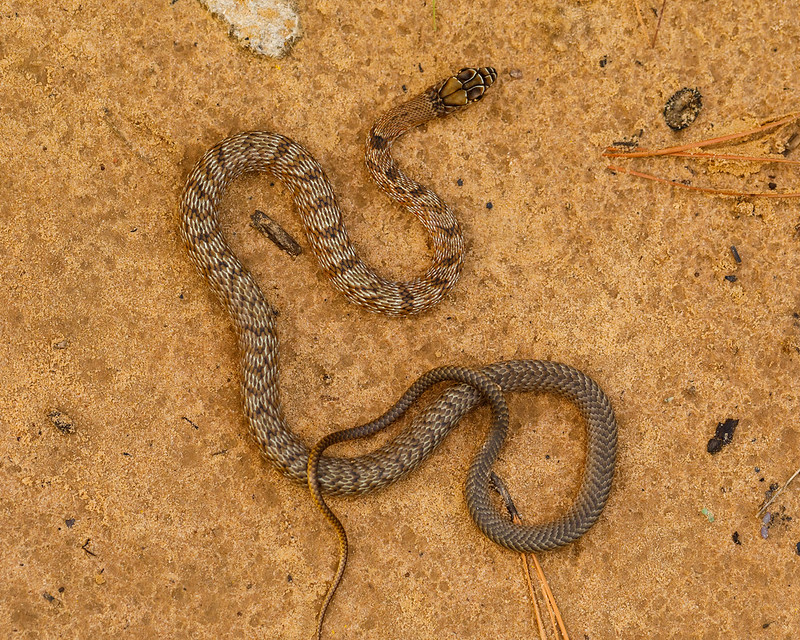
Coachwhips mate in the spring, typically in April or May. Within a month, the female lays a clutch of eggs in some place where they will be protected from drying out or overheating, and hopefully where predators will not find them. Such a place might be an abandoned burrow or under a rotting log. By August or September, the brightly marked babies hatch, measuring 12 to 14 inches long according to Werler & Dixon (2000).
Juvenile western coachwhip found by Meghan (photo by Meghan Cassidy)
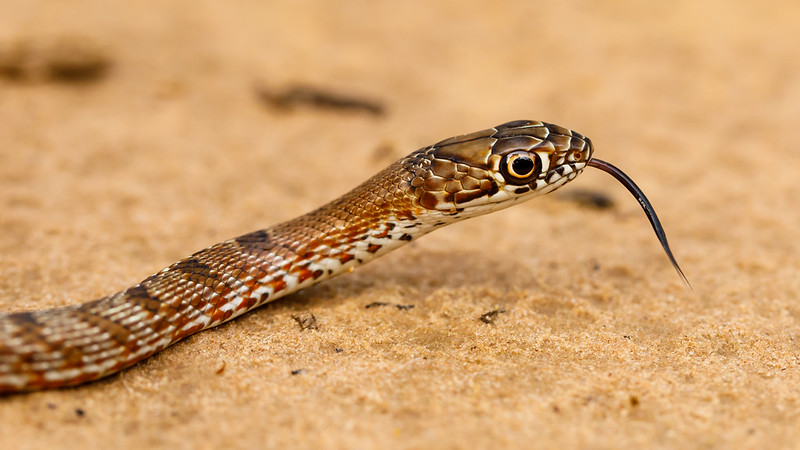
On a walk at LBJ National Grasslands in September of 2020, my friend Meghan Cassidy found a hatchling coachwhip and she took a number of beautiful photos of this little reptile. As is typical, its eyes were large (as befits an active, visual snake such as this) and it was slender and fast. Its coloration was bright, verging on orange along its neck. There were a number of thin crossbars of darker scales that would likely fade as the snake grew. I described our encounter with this snake in Mindfulness in Texas Nature.
The head and neck of the juvenile coachwhip (photo by Meghan Cassidy)
Human perspectives and tales
No matter what your grandpa told you, a coachwhip is not going to wrap around you and whip you, regardless of its name and appearance. It seems likely that those old stories might have begun when someone caught a coachwhip and its long body wrapped around the person’s arm and, as it thrashed and tried to escape, whipped its tail against its captor.
Fewer people seem to have heard such stories, and we usually think of that as a good thing. After all, we don’t want people believing misinformation such as hoop snakes that roll down a hill and sting you, or milk snakes that will suck the milk from cows in a barn. But I worry that the disappearance of tall tales is not because people today are more savvy, but instead that they have so little contact with nature that there is no experience that would give birth to the tales. Stories about writhing balls or nests of cottonmouths arise when people see something and struggle to understand it, and they fill in missing details with fanciful explanations.
So I hope that you and your friends and family will be out in the field enough that you notice coachwhips and other things in nature, and come up with stories to account for what you saw. Read and listen and learn what you can so that your stories are mostly based on accurate understanding. But I would gladly live in a culture that is connected to nature enough so that we have stories and legends about the natural world, such as the coyote as a mythical trickster or the snake that will whip you.
Smith, M. 2024. Mindfulness in Texas Nature. College Station: Texas A&M University Press.
Smith, M. & C. King. 2018. Herping Texas: The Quest for Reptiles and Amphibians. College Station: Texas A&M University Press.
Werler, J.E. & J.R. Dixon. 2000. Texas Snakes: Identification, Distribution, and Natural History. Austin: University of Texas Press.
— “Crawling Kingsnake,” John Lee Hooker (and The Doors & others)
Speckled kingsnake from southeast Texas
Even among people who don’t like snakes, kingsnakes get a certain respect and even liking. They are able to eat rattlesnakes and have considerable immunity to the venom, and some people assume that the kingsnake prefers to hunt them down. Most people recognize that the kingsnake is not venomous, and so they may grudgingly call it a “good” snake.
Kingsnakes constitute a big group, found across the U.S. from coast to coast. They are medium-sized to fairly big snakes with muscular bodies and relatively small heads. Here in Texas you can find the speckled kingsnake, the desert kingsnake, and the prairie kingsnake.
A fully grown speckled kingsnake may be three or four feet in length, but a few individuals reach greater lengths. Speckled kingsnakes are black or very dark brown with yellow to cream-colored speckles down their backs. As you travel across Texas from east to west, the speckled pattern gradually shades into the desert kingsnake’s pattern in which a series of dark blotches runs down the snake’s back. Those blotches interrupt the otherwise speckled pattern of the desert kingsnake. The scales are smooth and often give the snake a glossy appearance.
On the belly, the scales of speckled and desert kingsnakes may be yellow with black blotches or (especially in desert kingsnakes) mostly black with some areas of yellow.
Where are they found?
Speckled kingsnakes often choose habitat that is near water and has plenty of low vegetation and ground cover. Along the upper Texas coast, speckled kingsnakes may live in coastal prairie and on barrier islands near marshes, according to Werler & Dixon. In other parts of east and central Texas, they may be found in woodlands, prairies, and old fields as well as in the vicinity of marshes and other wetlands. In Arkansas, Plummer studied a population in an area that included irrigation ditches and levees, bottomland forest, and agricultural fields. The snakes mostly used shrubby areas on the levees and did not make use of agricultural areas. The kingsnakes were radio-tracked and when found they were usually concealed or underground (such as in an old mammal burrow).
What do they eat?
Speckled kingsnakes make use of a wide variety of prey, including small mammals, lizards and other snakes, frogs, reptile eggs, and the occasional bird. The kingsnake bites the prey to get hold of it and then wraps several coils around the animal’s body. Kingsnakes are powerful constrictors, and the pressure of those coils kills not just by making breathing impossible but apparently also by stopping circulation. Researchers studying boa constrictors found that constriction quickly and dramatically reduced blood flow and heart rate.
In at least one study, mice were the principal prey, but these kingsnakes are able to subdue and eat our native venomous snakes as well as nonvenomous ones. A snake that is as long as the kingsnake is swallowed and becomes kinked or folded in order to fit in the kingsnake’s lengthy stomach.
Other reports show that kingsnakes in this group are very fond of turtle eggs and have even been observed watching and waiting while a female turtle laid eggs (reported in Werler & Dixon).
How do they defend themselves?
These snakes cannot make an especially fast escape and they have no venom and only small, recurved teeth. Their best defense is to avoid being seen, and most of their time in spent concealed in low vegetation and leaf litter, under tree stumps or flat rocks, or underground. These places not only offer concealment, they are great places for them to look for prey. As temperature increases, speckled kingsnakes become more nocturnal.
If confronted or captured, however, speckled kingsnakes often pull back in a striking position and will bite, often hanging on and chewing with strong jaws. If grabbed, the snake thrashes and expels feces as well as a bad-smelling musk, making it an unpleasant experience for a human captor and maybe taking away from the appeal of the snake as a meal for a raccoon or coyote. It must be emphasized that for a human who discovers a speckled kingsnake and simply observes it, there is no danger whatsoever.
How are they related to other kingsnakes?
For years, speckled kingsnakes were part of a group called “common kingsnakes” that ranged across the southern U.S. from coast to coast. They are generally dark snakes with some sort of pattern – for example, black and white bands or stripes in California, the speckles of the desert and speckled kingsnakes, and a light chain-like pattern along the east coast. The snake was scientifically known as Lampropeltis getula, with different subspecies. The speckled subspecies was (or is) Lampropeltis getula holbrooki.
In recent years, researchers using genetic analysis proposed that these snakes are not all one species, and only the most eastern form is the species getula. The speckled kingsnake was said to be its own species, Lampropeltis holbrooki. The desert kingsnake is L. splendida.
Most readers will not want to go into the biology and genetics of these decisions, but let’s just say that not all biologists agree, and have pointed out flaws in the methodology used to split these snakes into their own species (such as relying too much on mitochondrial DNA rather than nuclear DNA and failing to consider how they are not reproductively distinct – where their ranges meet, they breed and produce intermediate forms). If you are interested, read the 2020 paper by David Hillis.
Speckled kingsnake seen at Anahuac National Wildlife Refuge on the Texas coast
How do they reproduce?
When male speckled kingsnakes search for females in the spring, they may engage in combat with other males. It is termed “combat” but it really does not result in harm to either snake; it is more like wrestling in which the dominant snake forces his opponent’s upper body to the ground. Kingsnakes mate in spring and females lay a clutch of eggs in early summer. Werler & Dixon report that there may be 2 to 17 eggs, laid in a moist location such as within rotting vegetation or in an abandoned burrow. Within 2 to 2.5 months, the eggs hatch. The babies are a little under a foot long and the speckles are initially fused across the back into squiggly crossbars.
What conservation problems do they face?
NatureServe rates the speckled kingsnake as “secure” in Texas. While habitat loss may reduce some populations, overall there are no major threats listed.
It is worth adding that as a group, our reptiles and amphibians are in serious trouble, with some species in greater decline than others. Several factors are serious threats to both reptiles and amphibians: habitat loss, pollution, climate change, invasive species, overcollection, and disease or parasitism, as described by Gibbons, et al.
Plummer, M.V. 2010. Habitat Use and Movements of Kingsnakes (Lampropeltis getula holbrooki) in a Partially Abandoned and Reforested Agricultural Landscape. Herpetological Conservation and Biology 5(2), 214-222.
Werler, J.E. & J.R. Dixon. 2000. Texas Snakes: Identification, Distribution, and Natural History. Austin: University of Texas Press.
Today I talked with a great group of kids at River Legacy Nature Center in Arlington. The twenty or so children were in a week-long “Hands-On Herpetology” class, having fun and learning about native reptiles and amphibians. I brought a few snakes and we talked about things like how they live as well as being safe when around them.
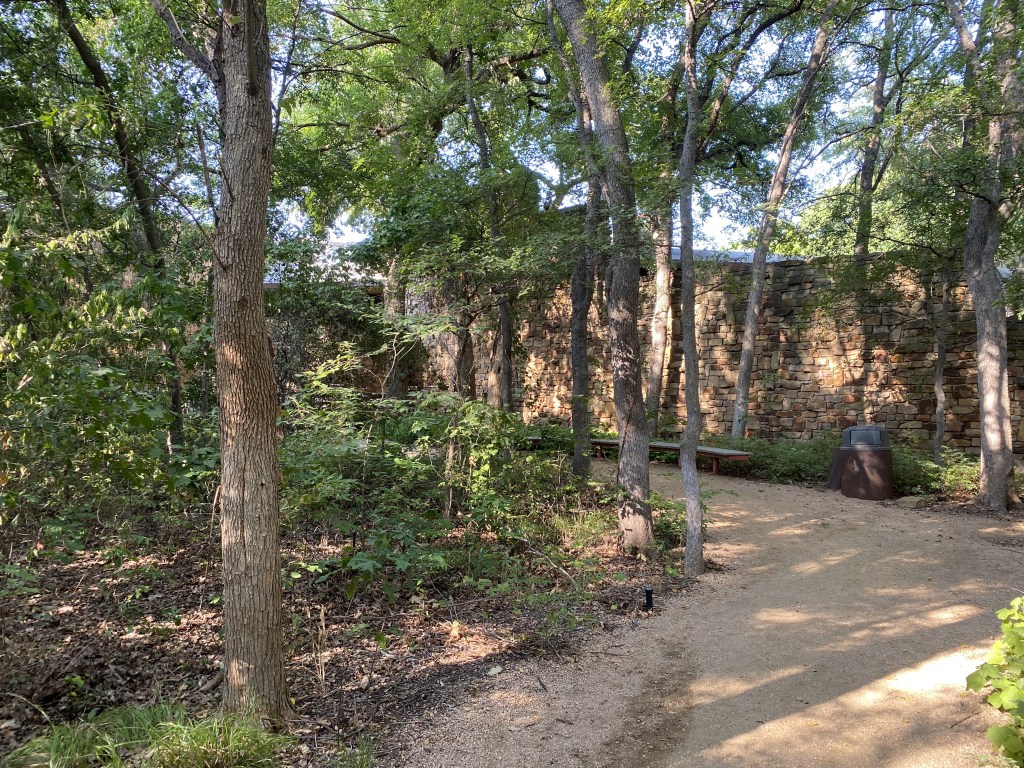
The trail approaching the River Legacy Living Science Center
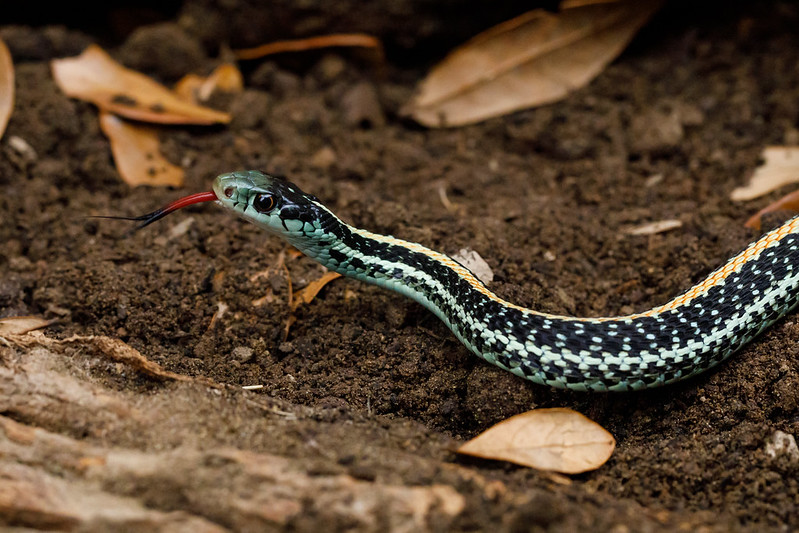
One of the snakes I brought is a Texas garter snake. He has a dark background color and three light stripes, big inquisitive eyes and an active, athletic build. We talked about how snakes with stripes generally rely on speed – and a sort of optical illusion – to get away from predators. The thing is that when “Tex” or other striped snakes move, it’s hard to see their motion. If they had spots, it would be easy to see the spots move as the snake’s body slipped away. The stripes, however, seem to stay where they are, until the stripes converge on the narrowing tail and then the snake is gone. The predator may be left empty-handed.
There’s a tendency for people to think of garter snakes as common “garden snakes,” but in the case of Tex it just ain’t so. He’s a member of an uncommon subspecies of garter snake whose fate is not well understood. The Texas Parks & Wildlife Department considers the Texas garter snake to be critically imperiled. It appears never to have been actually common, but there were places here and there (particularly within prairie habitat) in which they might be found at times. A recent study noted that despite trying to find these snakes in the field in 2013 and 2014, researchers were not able to find any. Tex is a long-term captive donated to me years ago by a landowner in Hill County so that more people might see and understand Texas garter snakes.
The Texas garter snake (“Tex”) – photo by Meghan Cassidy
My discussion about this was much more brief with the kids, but they got it that this is a snake that may be disappearing. When I mentioned that they are not legally protected, a girl commented, “I hope one day they will be protected.” Me too. I hope one day we will understand the reasons for the snake’s decline in more specific ways that allow us to protect it. And I hope we continue to have children who, when they learn about a species that is in trouble, want to protect it.
We talked about being safe when out in the field where there could be venomous snakes, and I showed the kids a prairie kingsnake and the young bullsnake that was a big hit with kids in Dallas earlier this week. The kids asked good questions and they already knew a number of things from their week at River Legacy. But nothing quite equalled that girl’s comment. It was an offhand remark that revealed her empathy or her capacity to care about a unique, lovely little member of the natural community. It made my day.
A few weeks ago, it was back to the Big Bend region with Meghan Cassidy for one of the last trips for the book on mindfulness in nature. I’ve made a number of trips there during the past twenty years, and my attachment to and fascination with that region keeps growing. I felt really fortunate to introduce Meghan to the Chihuahuan Desert and the mountains out there.
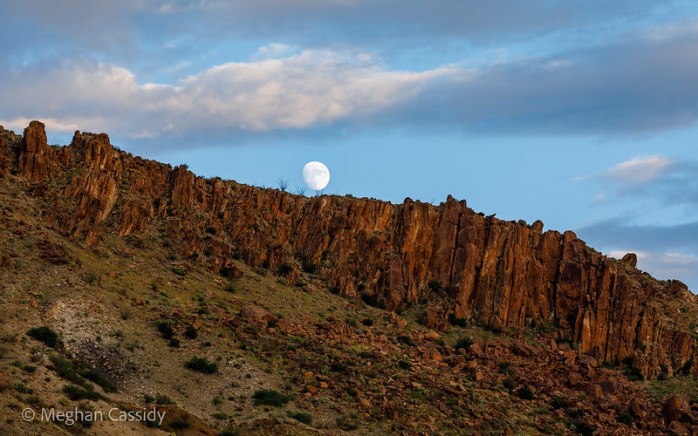
We stayed in a cabin at Wild Horse Station, just a little bit north of Study Butte near the Christmas Mountains. There are extruded columns of lava and thin soil where scattered desert plants grow. It is a strange and beautiful place, and that cabin on the hillside has a broad porch that looks out toward more hills and mountains to the west. This trip included some times for sitting on that porch, watching rainstorms or sunsets, and writing. I’m very grateful for that porch and for those moments.
A ridge just behind our cabin, at moonrise. Photo by Meghan Cassidy
In the early years, my visits to this region were very focused on finding snakes and other reptiles, although my companions and I always knew this was a place to be savored and soaked in. We rarely took much time to do it, and whatever we gained in total snakes seen, we lost in really getting to know the region. Each year has brought a broader interest in the ecoregion and a willingness to slow down and pay attention to more of it. This trip was a combination of mindful attention to the mountains and desert and some very fine observations of snakes.
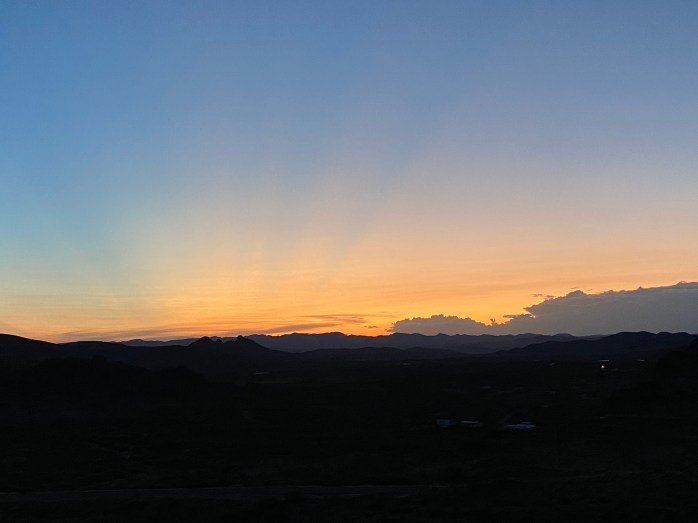
Sunset (photo by M.Smith)
Our arrival at the cabin was interesting. Darkness had just fallen when we walked across the porch to find the front door open and, inside the dark cabin, the television was on. We did the ‘police knock’ standing to the side of the open doorway, and when there was no response – human, javelina, or otherwise, we turned on the inside light and began to check the rooms. I glanced to the side to see Meghan holding a knife, and I knew I had a capable partner out here where there is little phone service and self-reliance is important. Everything was fine; I like to think that a coyote – not the human trafficker but Canis latrans, the trickster of Native American legends – had let himself in, watched a show, and left the place open for us.
In the morning there was coffee, the shadows of nearby mountains with rosy light growing overhead, and that wonderful porch overlooking it all. After a beautiful sunrise, we got ready and headed into Big Bend National Park.
Chihuahuan Desert within Big Bend National Park (photo by M.Smith)
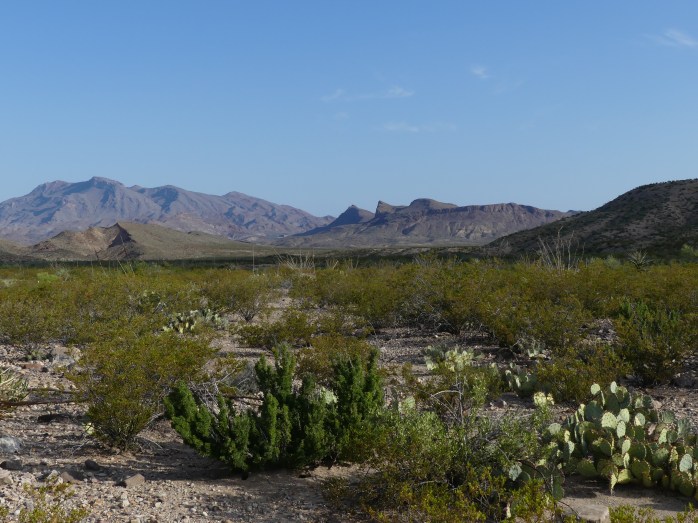
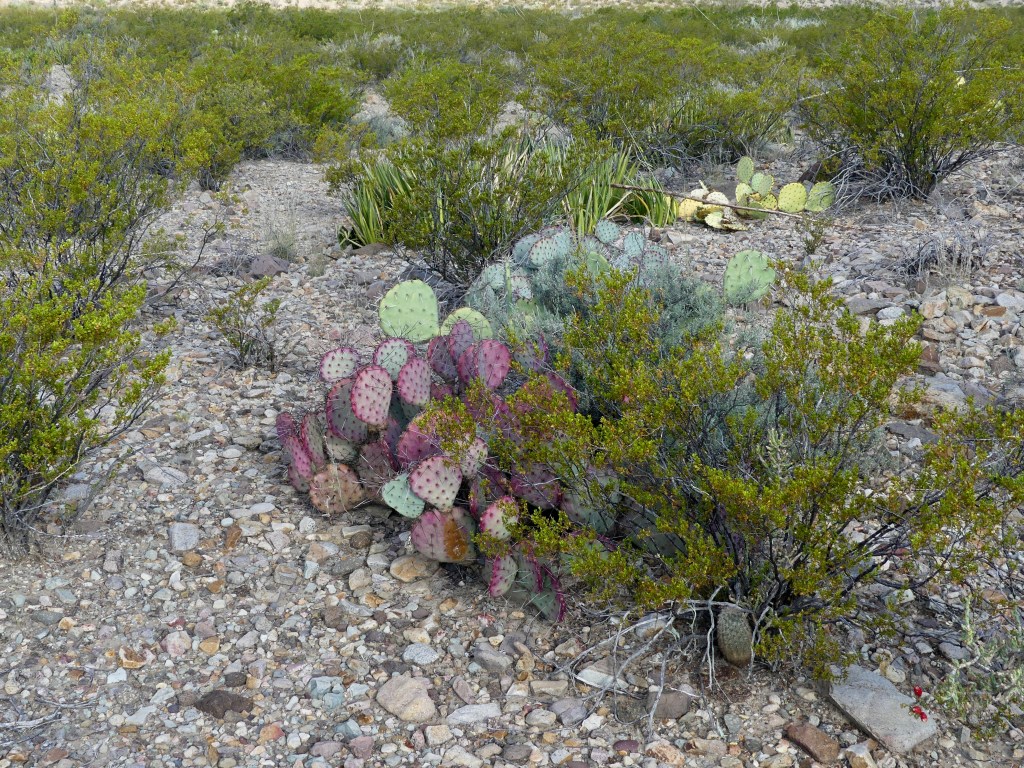
We walked around on the hot, gravelly desert floor, around prickly pear, creosote bush, and other characteristic desert plants. Lechuguilla, an indicator plant of the Chihuahuan Desert, grew in patches of upright succulent leaves. Many had remnants of the tall stalk they send up in late summer with clusters of flowers. The leaves are often described as like an upside-down bunch of green bananas, partly because they often curve inward a little. However, no bananas ever dreamed of having two rows of sharp recurved hooks on leaves tapering to a hard, sharp spine that can even puncture a car tire!
Creosote bush and prickly pear (including the purplish variety) in the foreground, with a patch of lechuguilla behind them (photo by M.Smith)
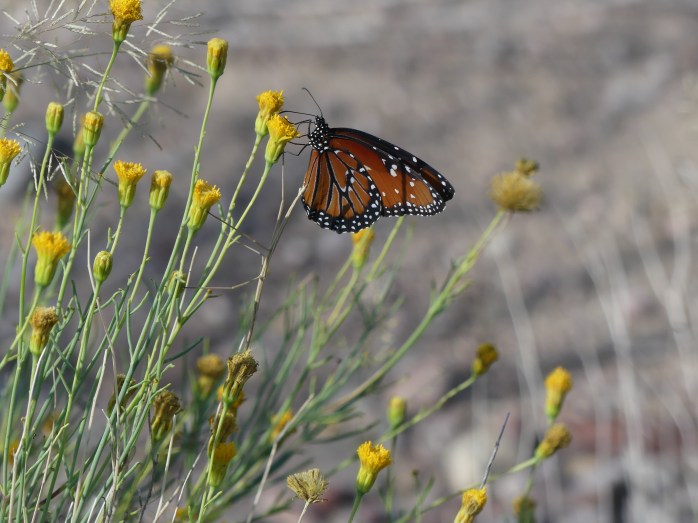
We walked a small dry arroyo as a couple of big black birds flew past. We weren’t experienced enough to call them as Chihuahuan ravens, but from the overall size and chunkier neck, they seemed more likely to be ravens than crows. There were a few places in the arroyo where the sandy soil had piled up and grew a small garden of flowers. Those flowers attracted butterflies. Perhaps they would seem out of place in the desert, particularly if we made the mistake of thinking of the desert as barren. The desert is a harsh place, by our standards, and it requires adaptation to extremes of heat and limited rainfall – but it is full of life.
Queen butterfly in a desert arroyo (photo by M.Smith)
We came back to the cabin during the hottest part of the day, and the shade of the porch and the breeze at the top of our hill made the perfect place for reflecting on our morning and writing about the desert plants, butterflies, and the value of long vistas in which nature has free reign.
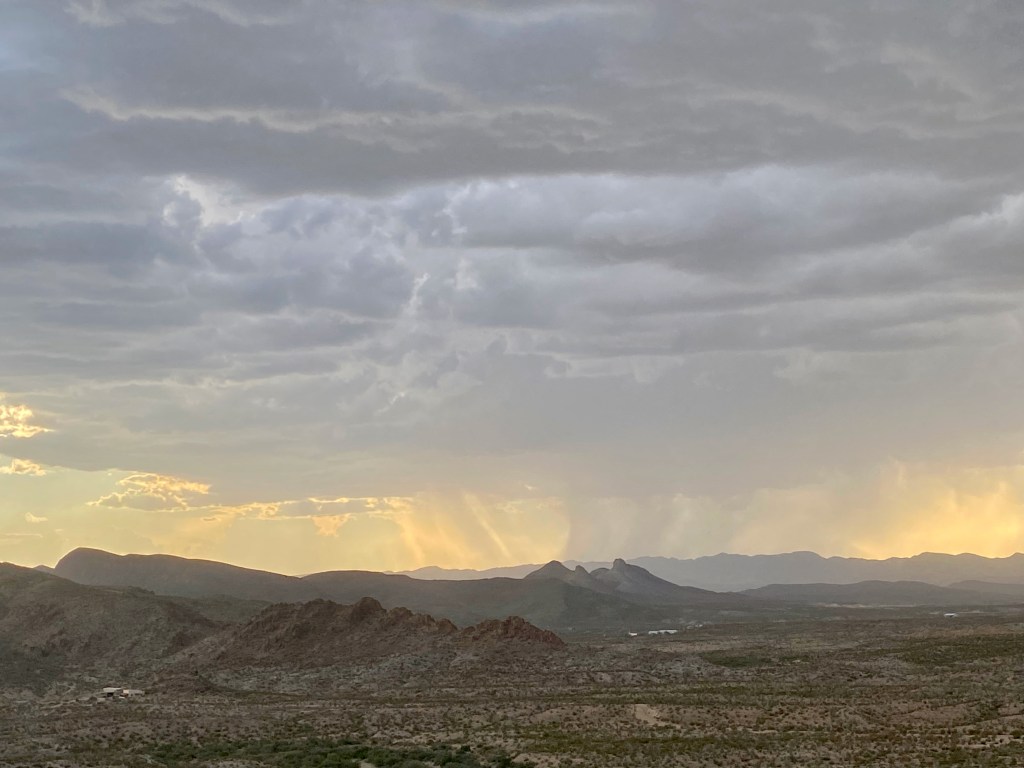
The clouds were building in the west, and under dark clouds were blurs of falling rain. The low rumble of thunder rolled in, and as the system marched toward us, bright lightning was visible as the power of the storm reached down to touch the earth. Announcing the storm’s arrival, the outflow winds were strong and I had to stop for a moment and think how many times this little cabin perched on the edge of the hill had withstood storms just like this. I needed that reassurance as raindrops began to slam into the porch and torrents of rain blew by outside our windows. This is how the monsoon season works in the Trans-Pecos: It’s hot and sunny, then clouds build into storms, the thunderstorms dump a lot of rain (and maybe hail) in a short time, and then they move on and it’s done.
The storm approaching (Photo by M.Smith)
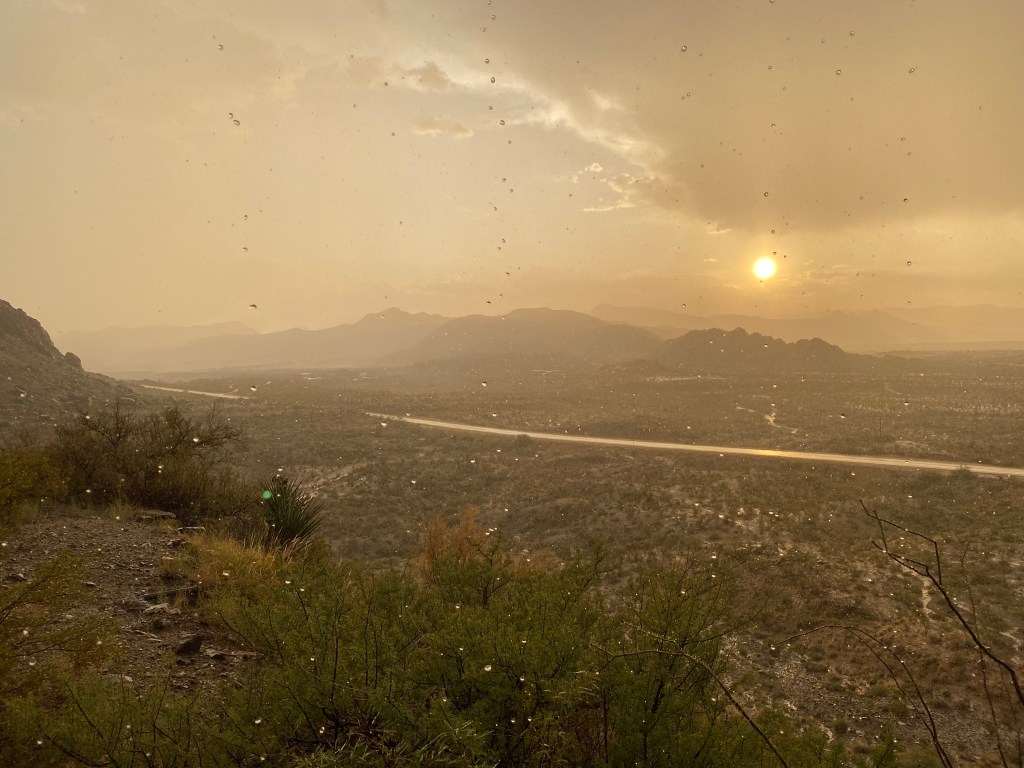
When we walked out onto the porch, the cool air was laden with the smell of rain and creosote. The desert here is full of creosote bush, a shrub with very small green leaves with an aromatic resin and waxy coating that helps protect the plant from drying out. If you crush the leaves, the resin has the familiar, vaguely tar-like smell of treated railroad ties or telephone poles. After a heavy rain, the resin is released into the air and the aroma is strong, fresh and wonderful.
At the end of the storm (Photo by M.Smith)
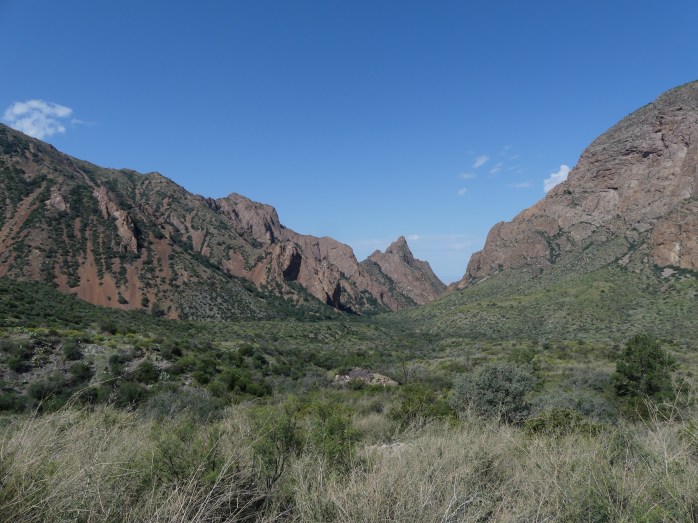
The next day, September 17, was our day to be in the Chisos Mountains. The Chisos is the only mountain range entirely contained within one national park. Driving up into “The Basin” within the mountains, the vegetation changes, reflecting slightly cooler temperatures and a little more rainfall. As you begin the climb into the mountains, you enter a woodland of small oak trees, junipers and pinyon pine. Tall slabs and columns of reddish igneous rock stretch toward the sky.
In The Basin (Photo by M.Smith)
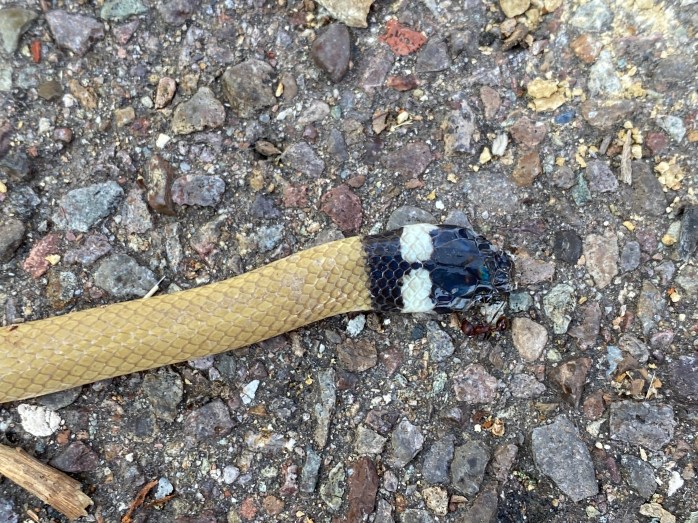
The previous day, driving around the Chisos Mountains Lodge, in The Basin, we had come across a sad, significant find. There was a small snake on the pavement that had been run over some time earlier that morning. There was a dark head with an interrupted white collar behind it, and the body of the snake was a pale tan. This was the first Trans-Pecos black-headed snake that I had come across, and it was a real shame that it was dead. It belongs to a group of snakes with enlarged rear teeth and a salivary toxin to help subdue its prey (but is harmless to humans), and it is the largest species within that genus, Tantilla. It’s still a small snake, often growing no longer than about a foot. It is listed by Texas as a threatened species, but neither that nor its presence in a national park had kept it from being run over.
Trans-Pecos black-headed snake, Tantilla cucullata (Photo by Meghan Cassidy)
Now it was time to climb the Lost Mine Trail up past the Casa Grande peak, to a point where the view opens to the south. The climb is fairly gentle, through mountain woodlands and small grassy openings dotted with beargrass, sotol, and Havard agave. This latter species, also known as “century plant,” sends up a fast-growing stalk at the end of its life with short branches bearing clusters of yellow flowers. The base of the plant is a rosette of thick, stiff, bluish leaves with sharp hooks along the leaf edges and a hard black spine at the leaf tip.
At this elevation it is cooler and there is greater rainfall. In the shade of the mountain there are ferns and beautiful flowers including mountain sage, the red starburst blooms of mountain catchfly, goldenrod, and penstemon. It is easy to stop along the way, on a bench or a boulder, and be still for a while, taking it all in.
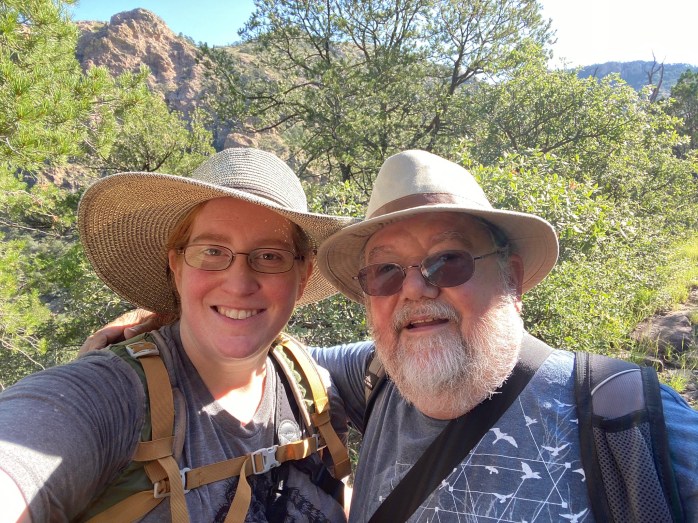
Meghan and Michael on the Lost Mine Trail
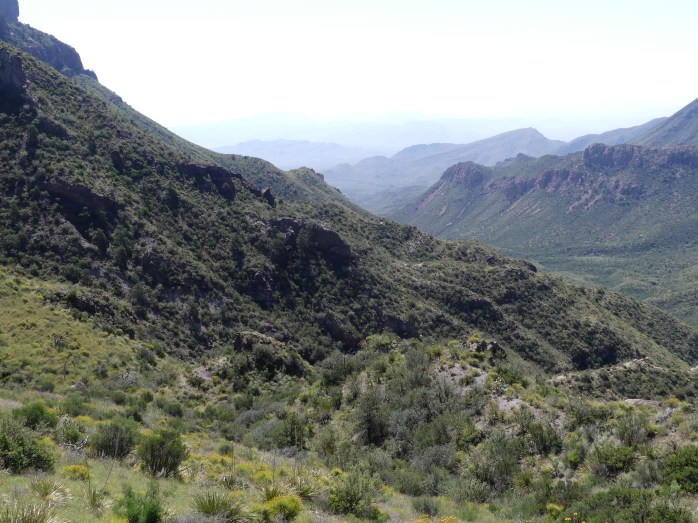
This trail in these mountains means a great deal to me, and I’ve written before about what it is like to be here in its quiet and beauty. And when we reached the place where we could look far away to the south, I spent a while under a pinyon pine looking at what I think is one of the great places within Big Bend.
On the Lost Mine Trail, looking south (Photo by M.Smith)
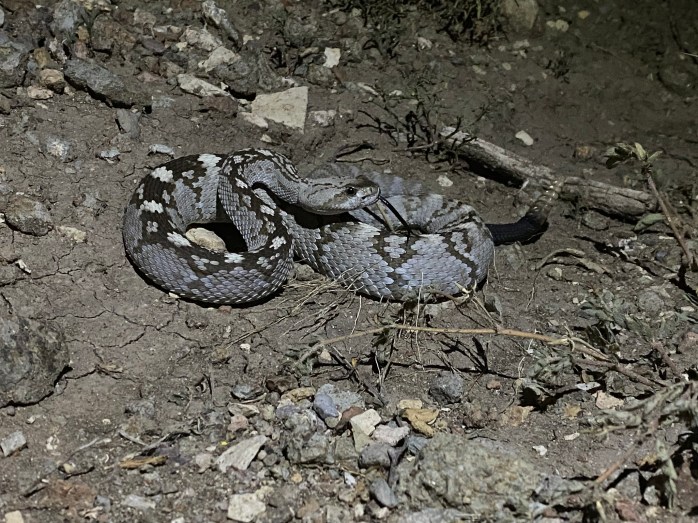
That night, our thoughts shifted away from the book and toward the variety of wonderful snakes that can be found in this area. We stayed along Highway 118 north of Study Butte up through the Christmas Mountains and along the desert flats. Our first snake was a black-tailed rattlesnake that, as I walked up to it, seemed to be ‘periscoping’ up to look around. It turned out to be blind in one eye, and was trying its best to figure out what was going on as we approached on its blind side. Like many black-tailed rattlesnakes, it was slow to get frightened or aroused, and it never rattled or threatened us in any way as we used snake hooks to move it away from the road so that it would not be run over.
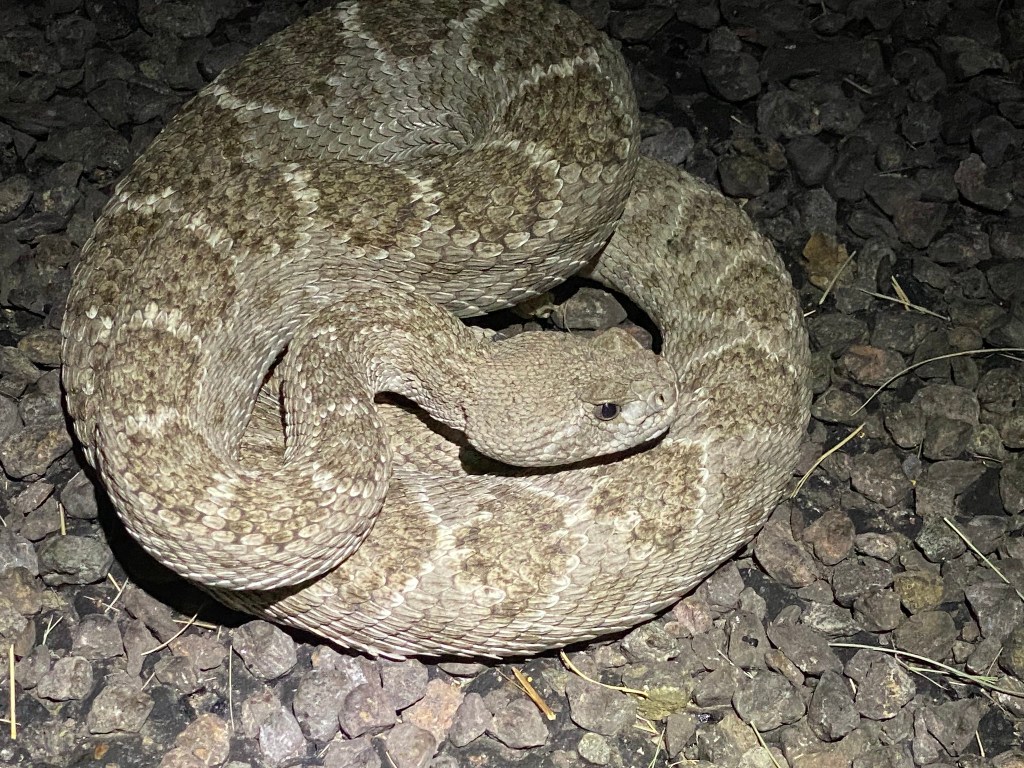
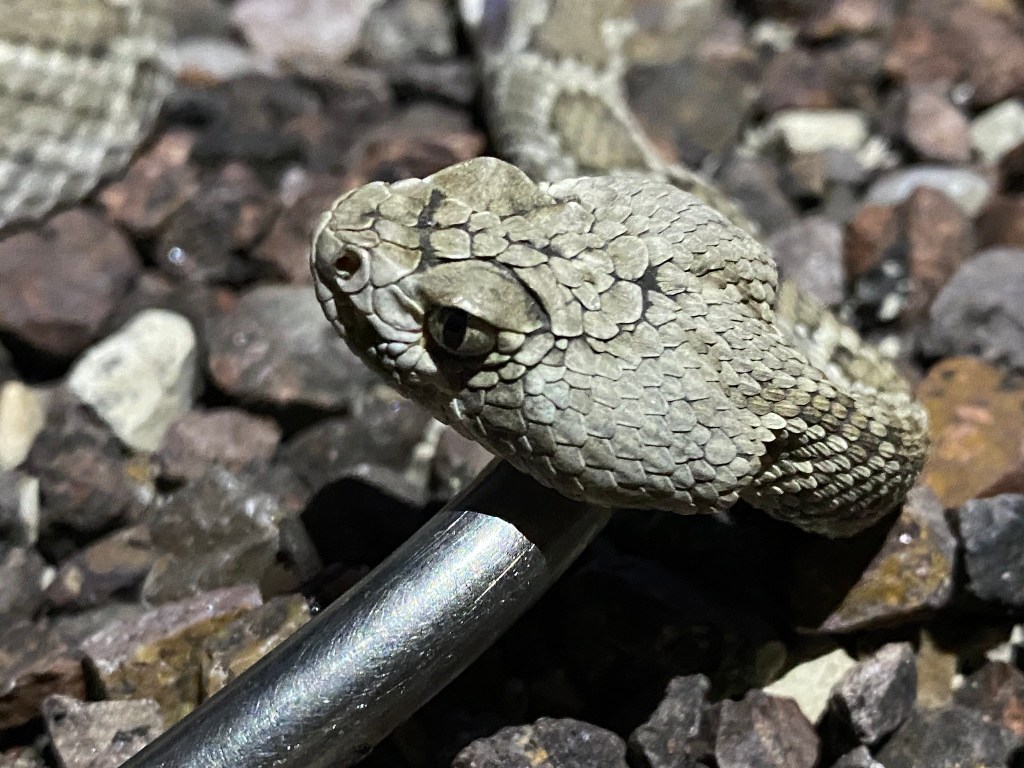
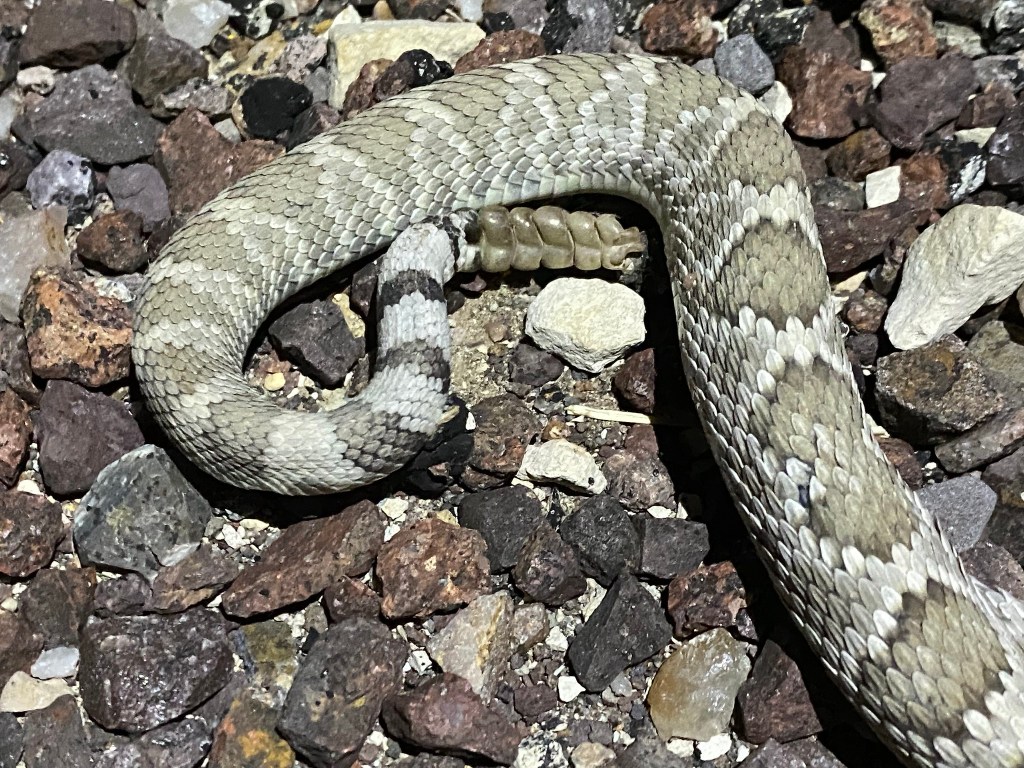
We were on the lookout for Mojave rattlesnakes (Crotalus scutulatus). Meghan wanted to see up close the distinction between this species and the similar-looking western diamond-backed rattlesnake (Crotalus atrox). The immediate visual differences have to do with the width of the black-and-white bands on the tail, the pattern on individual scales, the light diagonal marks on the face, and the size of the scales on top of the head. The rings on the tail of the western diamondback are of roughly equal width, while those of the Mojave emphasize white, with black rings spaced more widely. Both snakes have roughly diamond-shaped blotches down the back, but each scale on the Mojave rattlesnake tends to be mostly one color (resulting in a crisp pattern almost like a mosaic), whereas the colors may transition and almost smear on the diamondback’s scales. The two diagonal lines on the western diamondback’s face both end at the mouth. In contrast, the diagonal stripe behind the Mojave’s eye bends and continues back behind the jaw line. Finally, the scales on the top of the western diamondback’s head (between the eyes and toward the snout) are small. A Mojave rattlesnake has larger scales on top of the head.
Western diamond-backed rattlesnake (Photo by Meghan Cassidy)Mojave rattlesnake, showing larger head scales (Photo by Meghan Cassidy)Mojave rattlesnake, roughly the last third of the body showing the pattern of the scales and the wide white areas on the tail (Photo by Meghan Cassidy)
The one Mojave rattlesnake that we found had been run over, unfortunately. We positioned the head and tail for photos to illustrate these differences. This is the snake that folks in the Big Bend may be most concerned about, because populations of this species in Texas and elsewhere have venom with high neurotoxic activity. A bite might produce less swelling and bruising but more systemic effects, including respiratory problems. My experience with living Mojave rattlesnakes is that their temperament varies and, like other rattlesnakes, they would prefer to be left alone and are not especially aggressive.
That sort of peaceable behavior was true for every living snake we found that night. Every live western diamondback or black-tail greeted us with inquisitive tongue-flicks or attempts to get away, but none attempted to bite. One snake rattled, but the rest did not even become nervous enough to do that. Meghan is good at using a hook to move a venomous snake, and we both do so gently and without presenting a threatening target to the snake, and this may have contributed to their laid-back behavior. However, Meghan was looking for more examples of hooking defensive (or even irate) rattlesnakes, and she wasn’t getting to see any of that. (She did, at least a little bit, the following evening near Black Gap Wildlife Management Area, where the diamondbacks quickly rattled even if they did not strike at us.)
One of the black-tailed rattlesnakes at night (Photo by Meghan Cassidy)
It was getting late. As we drove back up the hillside to our cabin, there was one more black-tailed rattlesnake for us, a beautiful adult. We decided to ‘bucket’ her for good photos in the morning. Once again, this snake was simply curious about what we were doing, and tolerated Meghan’s hooking her and placing her in the snake bucket with little reaction.
(A couple of side-notes. First, the ‘snake bucket’ is a five-gallon bucket with a screw-on lid with air holes drilled in such a way that a venomous snake could not get close enough from the inside to get a fang through the hole. It is essentially snake-proof, so that we could sleep comfortably with a rattlesnake in the front room of the cabin. Second, part of being a safe, competent herper is constantly maintaining awareness of yourself and your surroundings when interacting with venomous snakes, even those who are being complete sweethearts. Neither Meghan nor I took these snakes’ temperaments for granted, because a moment’s slip-up with a “sweet” rattlesnake – especially in the isolation of the Big Bend at night – can be incredibly serious.)
Morning photo of the black-tailed rattlesnake (Photo by Meghan Cassidy)
The next morning, Meghan took a series of photographs of this black-tailed rattlesnake, and we released her. We were happy to have her as a neighbor during our stay!
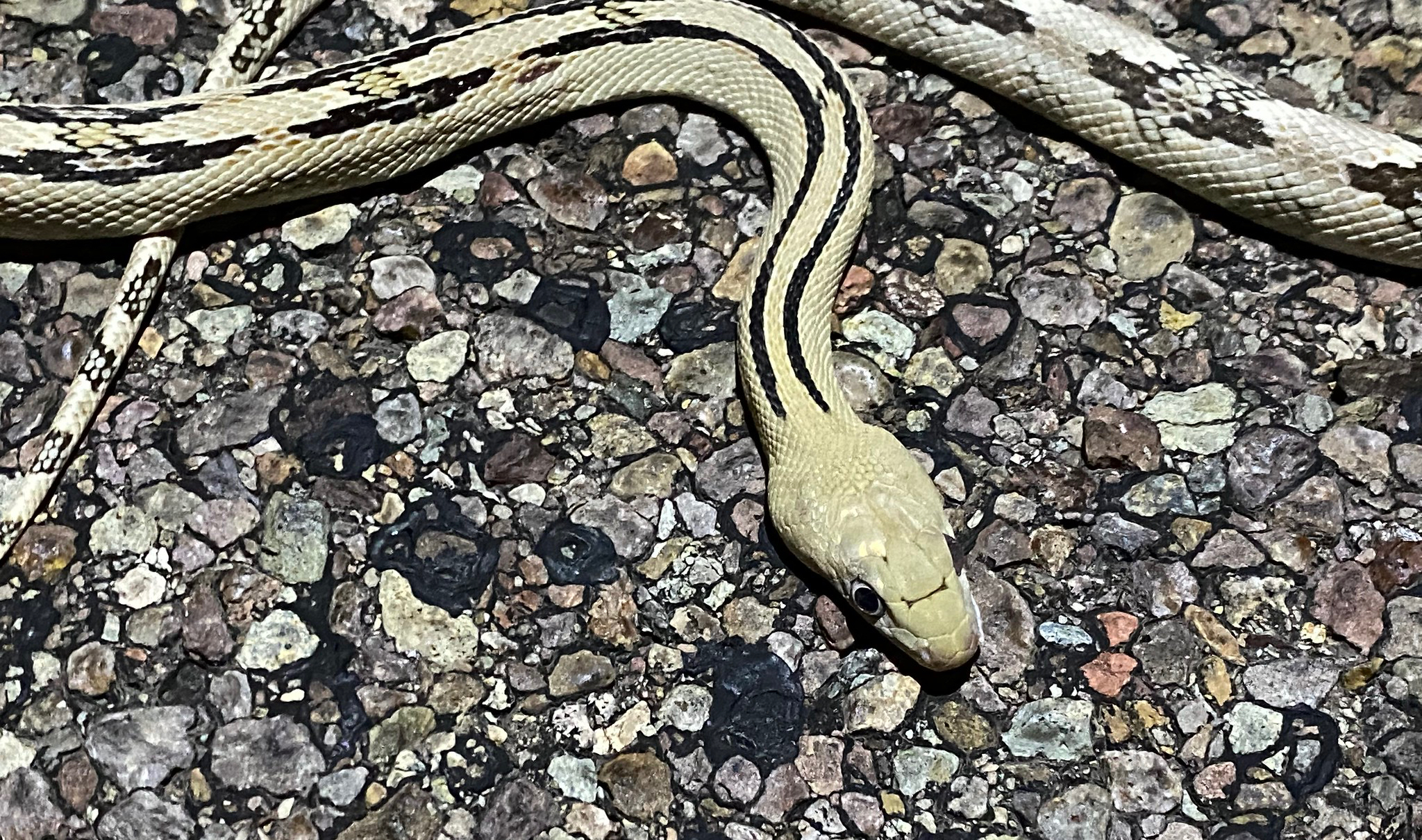
The following night, we were able to see a couple of Trans-Pecos ratsnakes, a favorite for both of us. One had been hit, but the second was wonderfully alive and gentle as we got it off the road so that it would not be run over. These slender, harmless snakes are pale yellowish (almost like the inside of a banana, leading Meghan to playfully call it a ‘banana snake’) or straw color with black markings. Two lines down the neck separate into something like blotches connected across the back in an “H” shape. They are nocturnal wanderers with big eyes to gather as much light as possible.
Trans-Pecos ratsnake (Bogertophis subocularis) – Photo by Meghan Cassidy
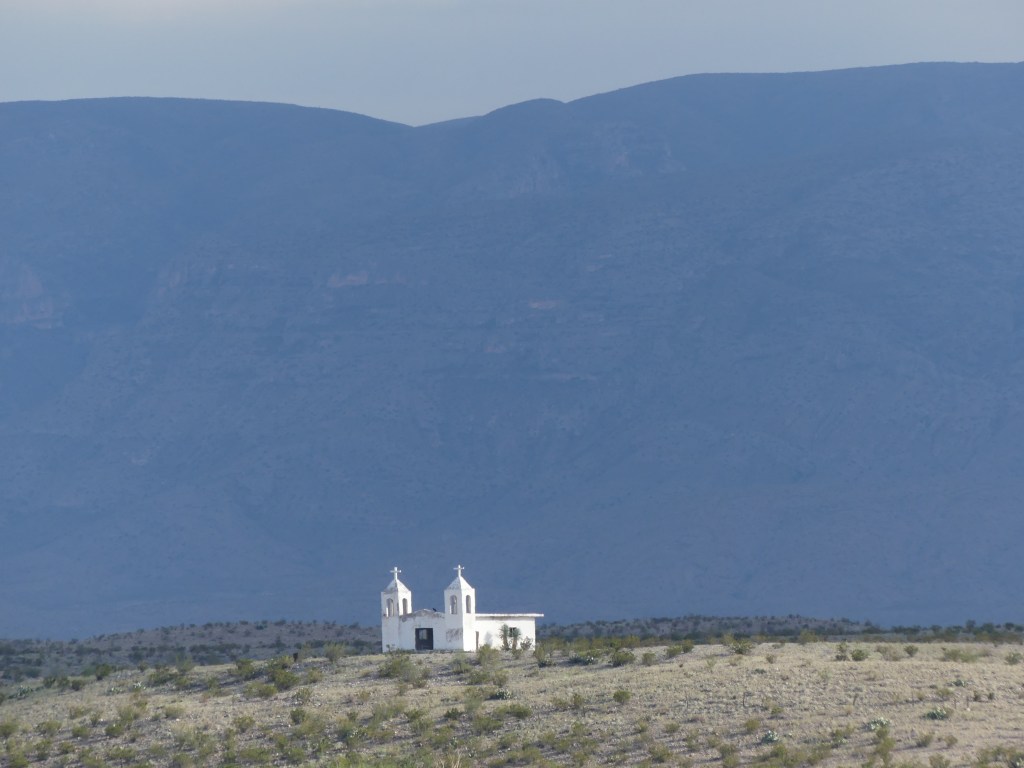
The final day in the Big Bend included a drive down FM 2627 past Black Gap WMA to the La Linda international crossing into Mexico (the bridge is barricaded, though crossing the Rio Grande at that point looked like it would not be difficult). The landscape and nearby mountains were beautiful, but it was virtually all private property and so we could not walk around and explore.
A church, looking across into Mexico at La Linda (Photo by M.Smith)Near FM 2627 (Photo by M.Smith)
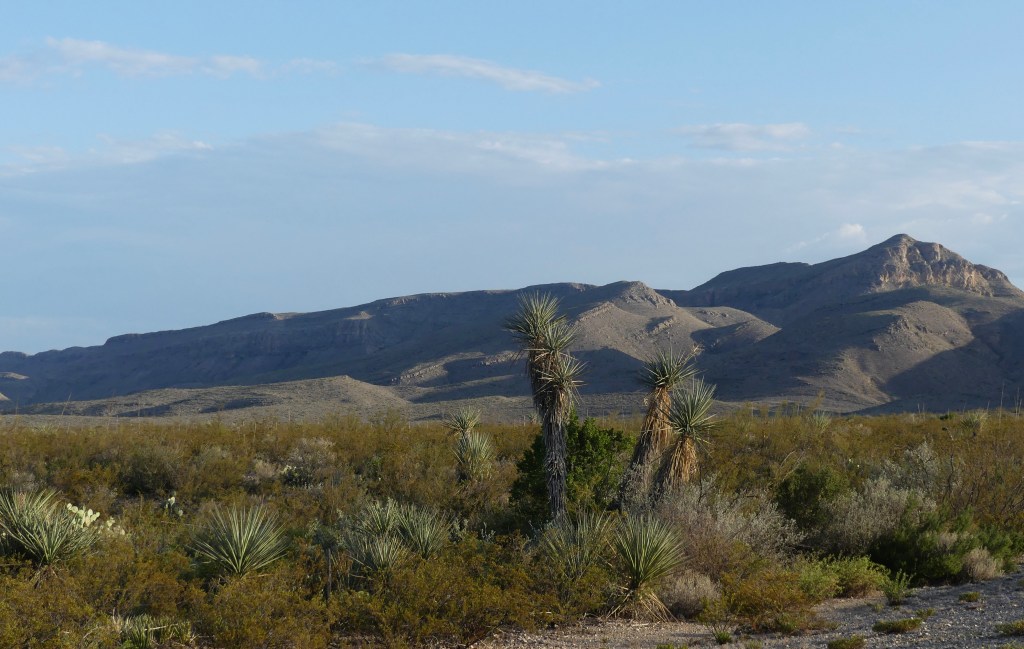
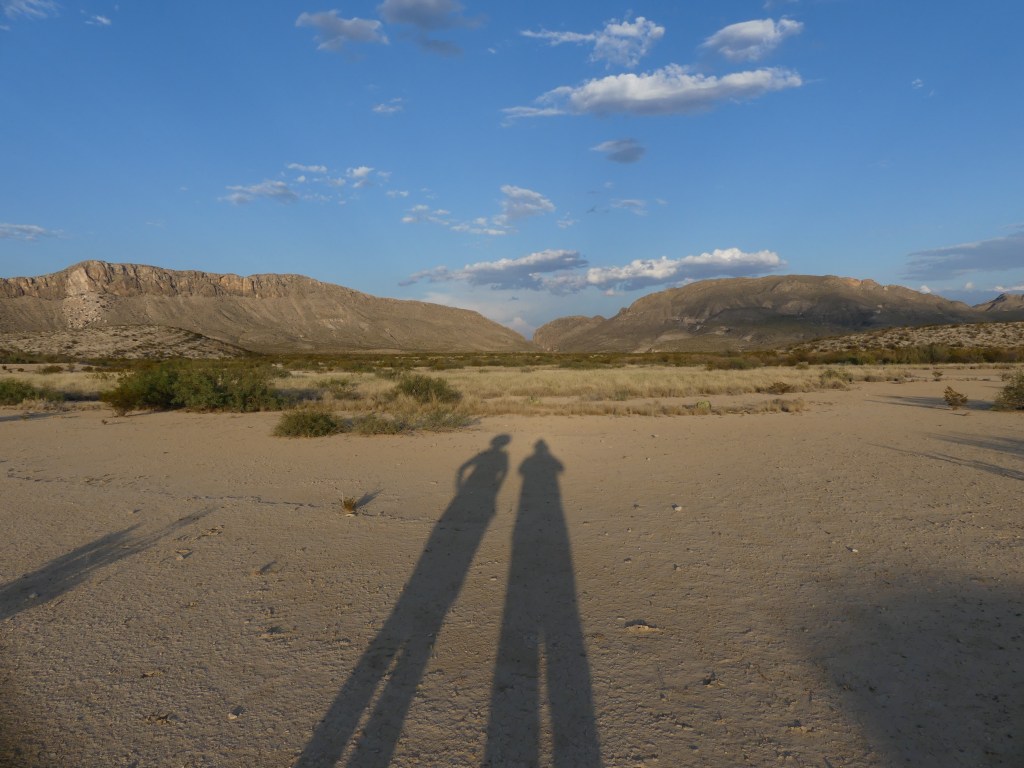
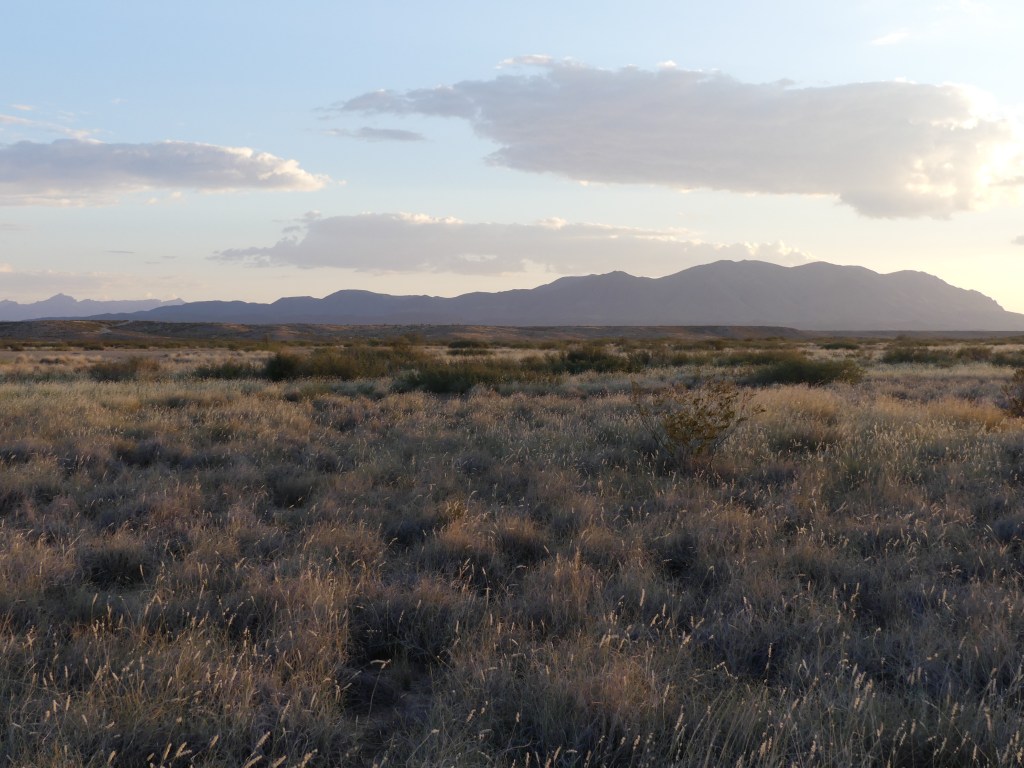
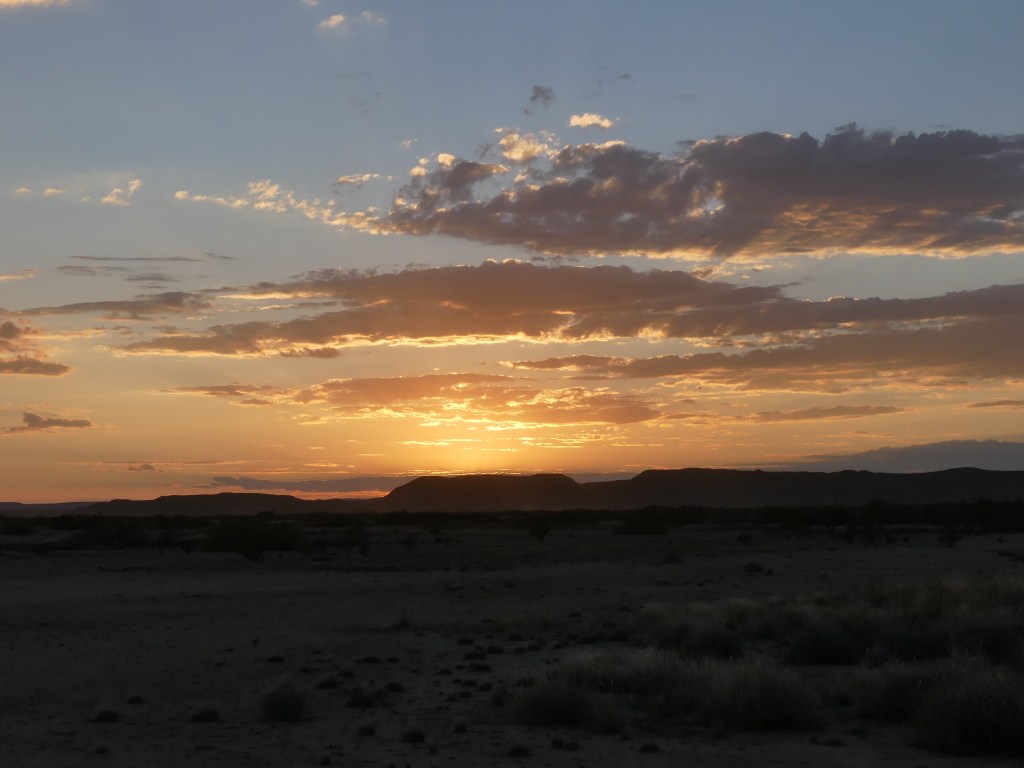
Back within the park we walked part of the trail leading to Dog Canyon, in the Dead Horse Mountains, and also westward in some sparse grasslands looking toward the Rosillas Mountains. I wrote about this later, about the long shadows toward sunset and the sense of solitude and even isolation there, as the sun was setting.
Long shadows, looking toward the Dead Horse Mountains (Photo by M.Smith)Sparse grasslands and the Rosillas Mountains (Photo by M.Smith)Sunset on our last day (Photo by M.Smith)
It was September12, with ten days of summer left to us before the autumn equinox, and so we decided that the last outing of summer ought to be spent at the LBJ National Grasslands, in Wise County. It was some combination of work on this book I’m writing about spending time in nature, and just enjoying one more day of summer.
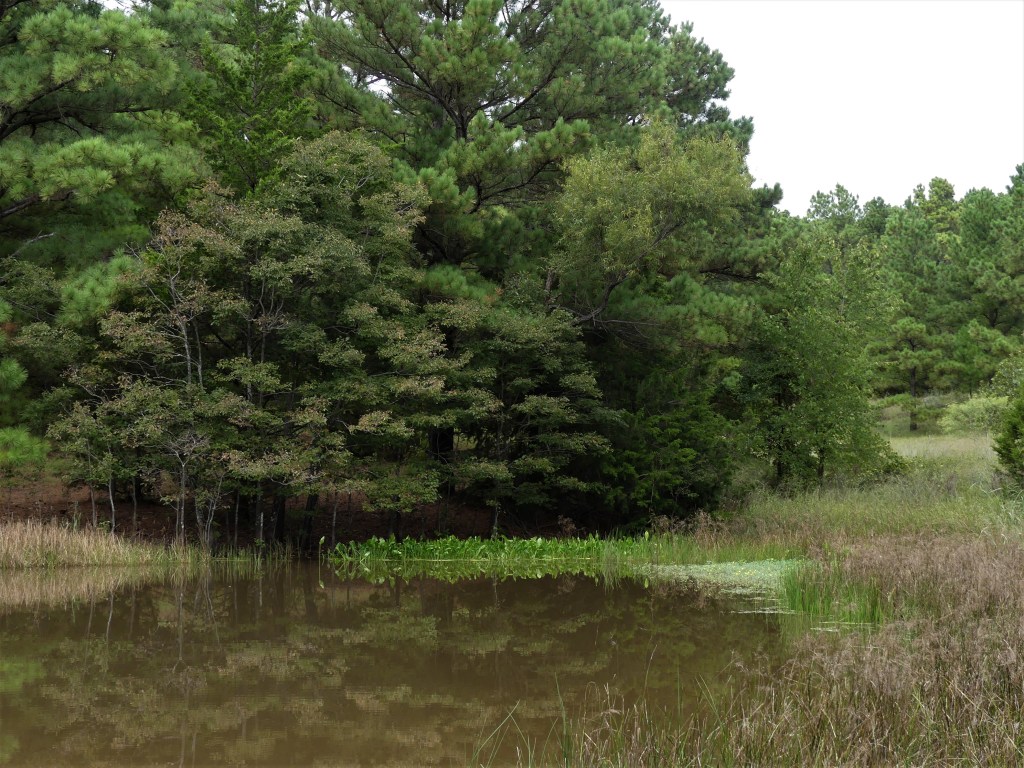
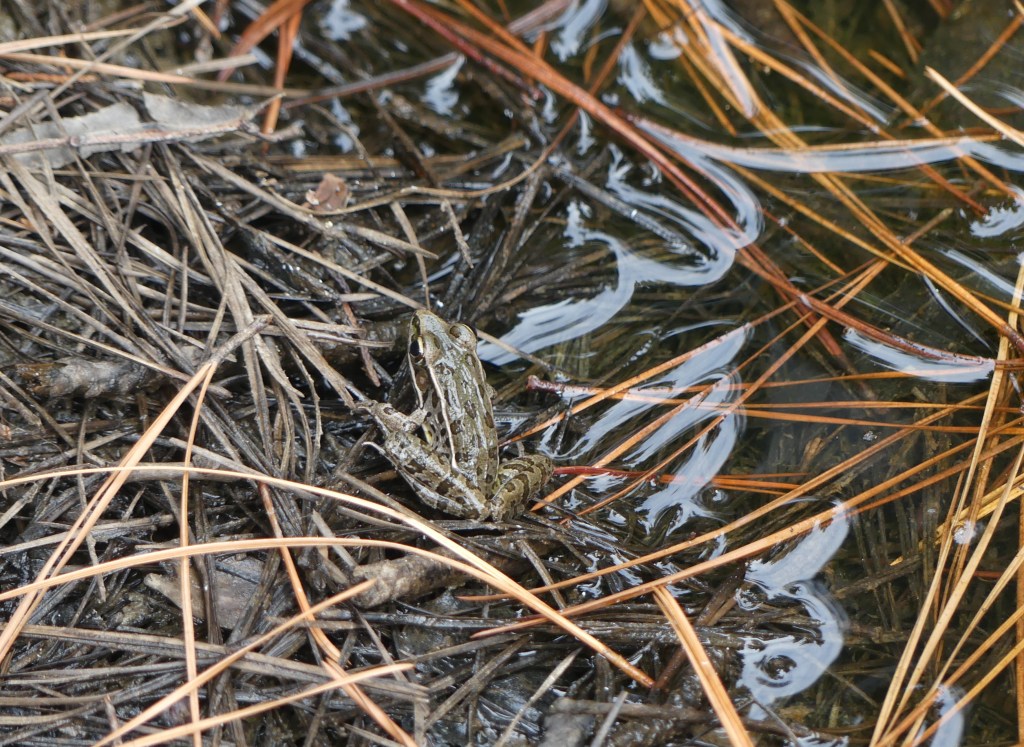
Meghan, Paul and I started at one of the pine groves, those patches of ponderosa pine brought in by the Forest Service long ago and planted here in the Cross Timbers. The series of ponds beneath this grove support huge numbers of cricket frogs, leopard frogs, and a couple of other species. In turn, the frogs help support a community of snakes, both the harmless watersnake and the venomous cottonmouth. We walked along, hearing frogs plunk into the water and seeing a few frogs that did not disappear fast enough.
A juvenile leopard frog
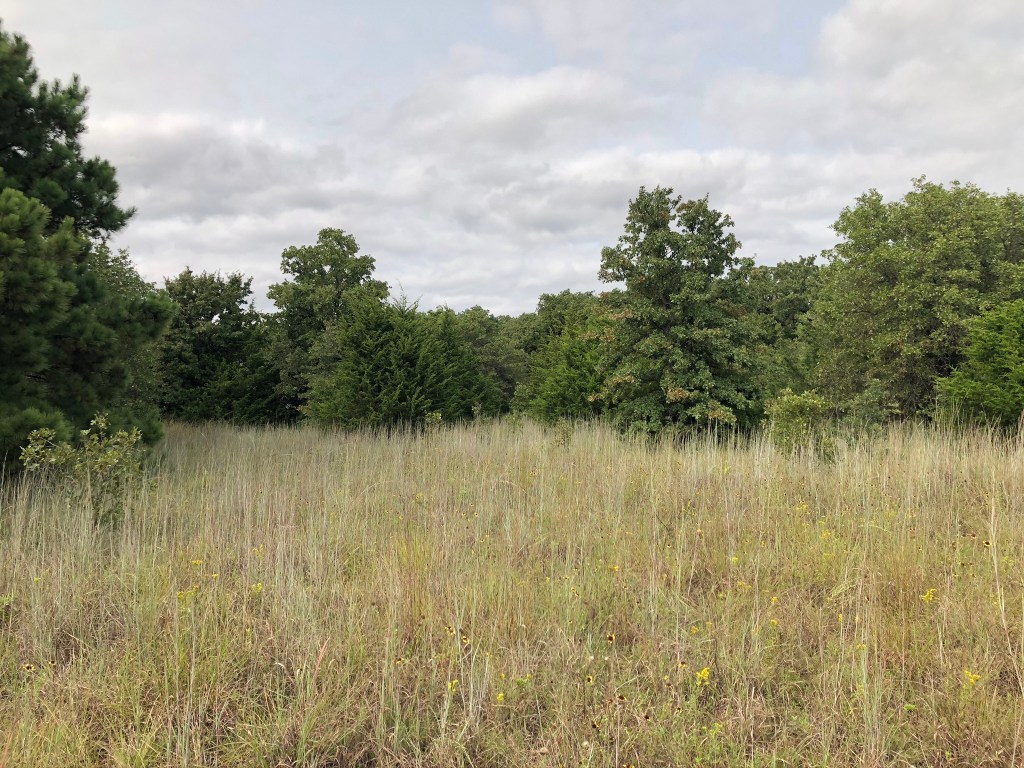
Beyond the pine grove is a gently rolling landscape of prairie patches and oak woodland dotted with small ponds. Among my prairie favorites are little bluestem and Indiangrass, creating a fine vertical texture of straight stems reaching waist-high or even head-high. The flowering tops and seed heads of Indiangrass remind me of candle flames on impossibly skinny candles. And while the Cross Timbers is dominated by oak trees, there are plenty of junipers scattered through the clumps and belts of woodland. Late summer flowers – goldenrod and various asters – add beautiful colors to the mix.
A green layer of mostly western ragweed beneath layers of little bluestem and Indiangrass
Something scaley was spotted – a snake of some kind – around a big fallen tree branch. We searched intensively for a few minutes, but the tall grasses and the tangle of other plants and tree branches concealed the serpent well. My guess is that it found a deeper place of concealment such as a burrow underneath the vegetation, or else made a quick unseen getaway while we were looking elsewhere.
On the walk back, I spotted something stretched across the damp sandy trail. It could have been a stick or an irregular ripple of soil, but that didn’t look right to me. As I approached, twenty feet away or so, it seemed to draw up into some kinks. I walked up on a fairly dark spotted snake that turned out to be a prairie kingsnake.
A prairie kingsnake
I gently picked it up, anticipating some thrashing or even a bite, which would have been briefly uncomfortable but of no consequence. Our nonvenomous snakes mostly have small, very sharp needle-like teeth that make small punctures or scratches but need no special treatment. This kingsnake, however, never thrashed, just moved her body as if trying to crawl away. She never offered to bite. We spent several minutes admiring her (judged to be a “her” because the tail tapered fairly quickly, as opposed to the thicker and longer tails of male snakes, whose reproductive organs are kept inverted inside the first part of the tail), and then released her.
When placed on the trail, she immediately moved to the edge of the leaf litter, nosed down just beneath the thin layer of leaves and vines, and began to disappear under it. The amazing thing was how she gradually disappeared under the leaves without moving them in the slightest or making any sounds. The snake simply dissolved into the prairie!
A little further down the trail, Meghan was determined to find another snake, and her attention was drawn to an area beside the trail with some old fallen branches that offered some cover. Sure enough, she spotted a small snake, fast and agile and therefore hard to get a good look at to verify that it was harmless. I hurried to where she was, and she wanted me to identify whether it was safe for her to pick up. I got a glimpse of scales and said “yes.” Together we lifted a piece of wood and as the snake took off in her direction, she restrained it and picked it up.
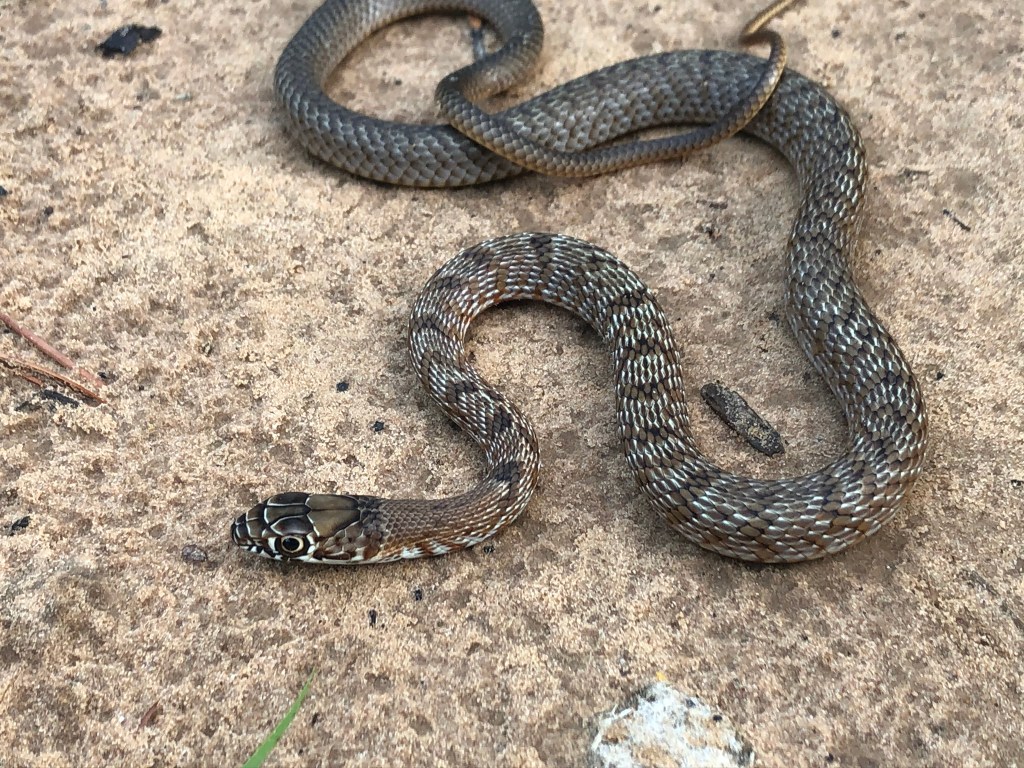
A baby western coachwhip
This was a baby western coachwhip, a snake that can grow to around six feet in length, although most are not quite that long. Babies are born in late summer and measure a little over a foot long. Based on time of year and length, this little snake had not been out of the egg very long. A coachwhip’s big, piercing eyes hint at its daytime hunting strategy, visually locating lizards or even big grasshoppers and chasing them down. It is hard to imagine winning a race with a determined coachwhip, not because they are so fast in miles per hour but because of their agility in weaving through branches and around rocks.
On the final part of our walk, back through the pine grove, we spotted a watersnake slipping over the banks of one of the ponds and into the water. I got enough of a look at its body shape and especially its movement to know that it was a harmless watersnake. While cottonmouths can move quickly, they never seem to have the grace and speed of a watersnake. While this one immediately slipped beneath the water, a cottonmouth would typically (not always!) ride along the water’s surface, more focused on looking around it or simply sitting still. A watersnake fleeing danger usually swims at high speed, along the bottom, until it finds a place of concealment where it can wait for danger to pass.
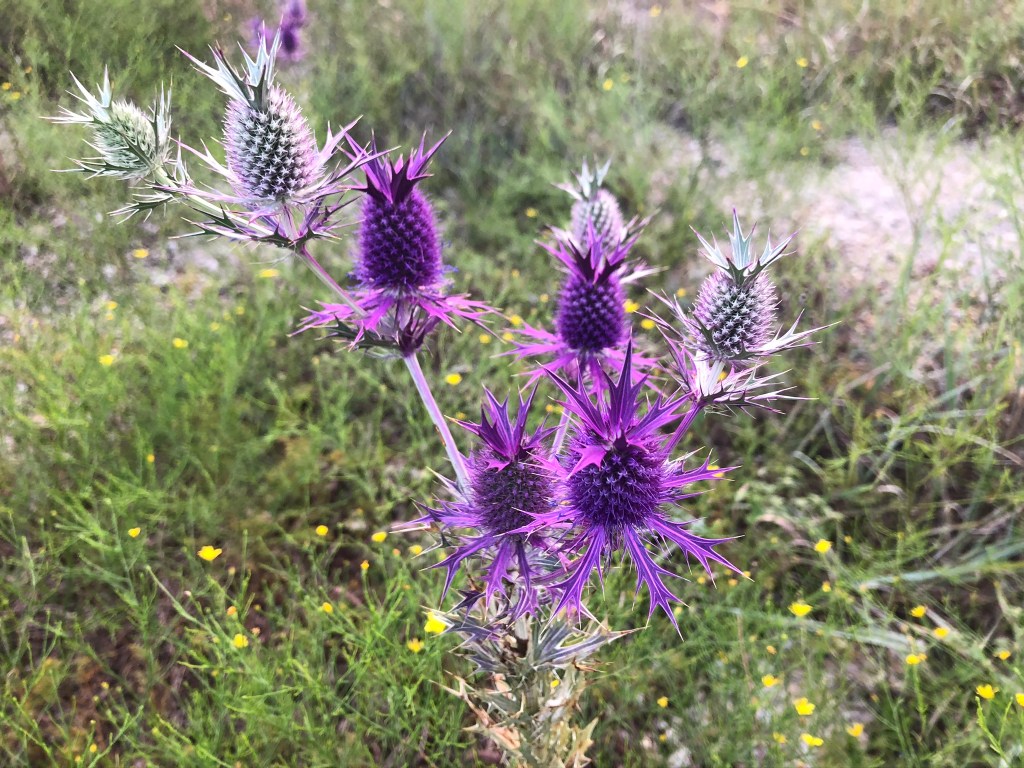
Eryngo
We visited other places and stayed until sunset, admiring things like eryngo, that beautiful, prickly purple plant found at the end of the summer. Sunset was subtle but beautiful, offering a wonderful way to say goodbye to summer.
This article originally appeared in The Great Rattlesnake Highway blog.
There was once a time when I could chase down an Eastern Yellow-bellied Racer. Well, if it was on a flat surface … maybe if I had a head start. Probably not now, unless my head start was that I was allowed to grab it before it saw me. These snakes are not called “racers” for nothing.
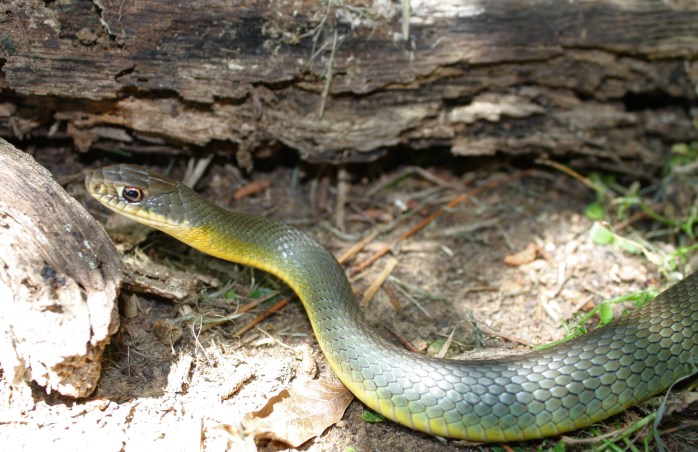
Eastern Yellow-bellied Racer
They can cruise around on a hot summer day, their big eyes alert to any movement, watching for a grasshopper or lizard to spring into action, and ready to give chase. When they do flush some unfortunate prey animal, they are unrelenting in pursuit. When a big grasshopper lands and freezes, the snake may have to search until it again makes the insect jump, and at that point the chase resumes. Having no venom and no ability to wrap and constrict, the racer simply swallows its prey or maybe pins it on the ground with a section of its body while swallowing. Racers can eat animals as large as a mouse or medium-sized frog, relying on the rows of sharp, recurved teeth and strong jaws to overcome the struggles of its prey.
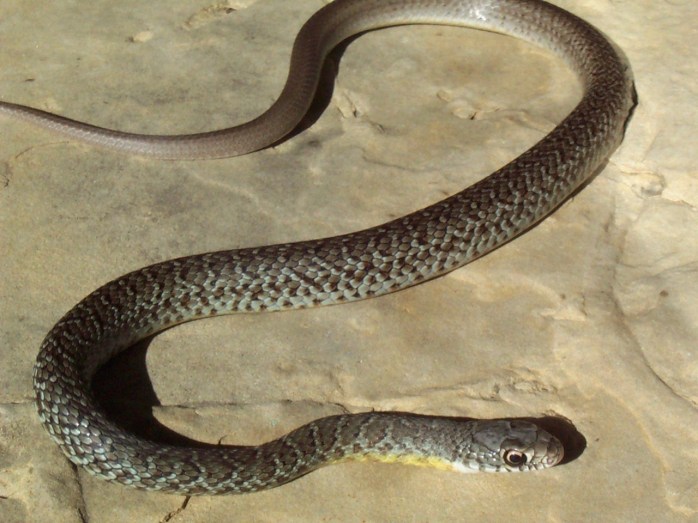
Many years ago, my family moved to Fort Worth and my knowledge of reptiles and amphibians expanded from days spent hanging out with museum staff and reading books. At the end of the summer, I would occasionally find a little spotted snake around the yard. Their pretty yellow bellies were speckled with rust-colored spots, and as I held them their large eyes looked alert, and their jet-black tongues tested the air. Around the same time, a group of us kids found a medium-sized snake stretched along a branch within a shrub in a neighbor’s yard. It sat motionless, watching us, and I recall it being a sort of olive greenish color. I was puzzled about this snake’s identity but later figured out that it was what some people called a “blue racer,” but down here in Texas it was a different form called the Eastern Yellow-bellied Racer. With further study, I discovered that the little spotted snakes I sometimes found at the end of summer were actually hatchlings of that same species. Over the course of a couple of years, the spots would fade and the snake would be brownish or olive or grayish-blue on top, and yellow underneath.
E yellow-bellied racer, juvenile
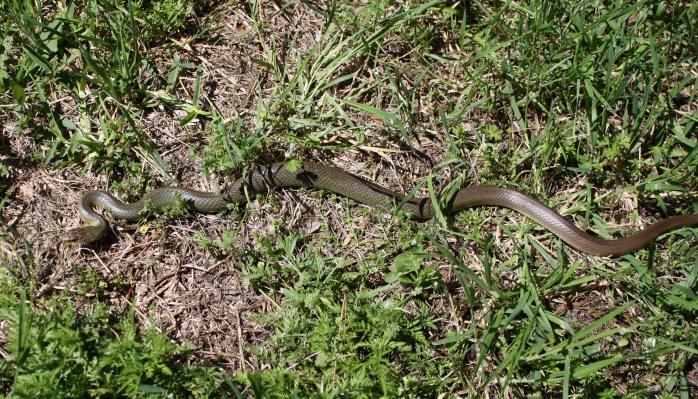
Occasionally I would find one in the field, sometimes as a serpentine blur disappearing in the grass. Other times I might find one under a board or a rock, and if I grabbed quickly, I might get a close look at this muscular coil of pure energy. When grabbed, that same energy is directed toward thrashing and biting, and the poor snake may injure itself if not supported properly. The bites are annoying but not particularly painful, and they seem to come out of nowhere as the snake thrashes around to a new vantage point. However, when gently supported and not harmed, the snake may settle down, after a fashion, continually testing the air with that black tongue and watching its captor like a hawk. Drawing the animal closer, for a detailed look, often results in a strike aimed at the person’s face. Loosening the grip a little too much results in a sudden attempt to break free, as if the racer was waiting for just this opportunity.
Part of the racer’s reputation as a snake that can make the jump to “light speed” is its ability to navigate through brush and around rocks without slowing. Its top speed is actually a little slower that a person could run on a track, but when seen, these snakes are often around rocky outcrops, fallen logs, or tangles of undergrowth, none of which cause the snake to slow down. Imagine the speed with which this reptile processes the visual images coming at it, like a fighter pilot flying low over the landscape, dodging left and right but keeping right on going!
Eastern Yellow-bellied Racers make use of a fairly large “home range,” or area within which it hunts, rests, finds water, and so on. In their book, Texas Snakes, Werler & Dixon cite research done in Kansas showing that racers may use about 25 acres as a home range. Within that area, the individual snake may be familiar with refuges such as a particular abandoned burrow or crevice under the rocks, and where the best pools in a little creek may be. These racers prefer open areas such as patches of prairie or savannah, and they may hang around near the edge of a woodland.
Texas has a four other forms or subspecies of racer. The Buttermilk Racer lives in parts of east Texas, and has the same overall bluish-gray to olive coloration but is speckled here and there with small globs and specks of white. The Tan Racer, found around the Big Thicket, uses forest habitat much more than the other racers, and is a uniform tan color above and pale whitish below. Along the southern Texas coast, the Mexican Racer zips along through the thorn scrub. And at the northeastern corner of the state, the Southern Black Racer is found in several counties.
On a cool, overcast day in March, 2012, I found a young Eastern Yellow-bellied Racer under a big rock in Wise County. I was out with Clint and his wife, and we thought we might get an early start on field herping that year. Sure enough, we did find several things, but everything was under cover, since March in north Texas may turn unpredictably from sunny and fairly warm to rainy and cool. When I turned the rock over, the young racer was too cool to dart off. Oh, the disadvantages of being an ectotherm! Being cold-blooded means that if you hang out in a cold place, you are cold, too. The engines that drive all that nervous, alert activity depend on warmth, and if you’re a reptile you cannot generate your own heat. The little snake sat while I recorded it on video, tongue-flicking and moving slowly. It even flattened its neck vertically a little at one point, in a threatening display meant to make it look bigger.
In the summer, being an ectotherm would be a big advantage for the reptile. Us endotherms have to take in lots of nutrients so that our metabolic engines can constantly generate heat. Snakes are “solar-powered,” directly or indirectly, making use of sunlight or a sun-warmed environment to get up to speed. As a result, they do not have to eat as often. But on this day, at the end of winter, the little racer was slow-moving and vulnerable. After I got all the photos I wanted, I let her return to the shelter of the rock and wait for a warmer day.
If you find one, admire whatever glimpse you get of this snake and let it go. That three-feet or so of nimble hyperactivity will just make you sprain your ankle or get a face full of cactus if you chase it. Or maybe, if you’re lucky, you will find one under sheets of tin, or boards, or under a rock on a cool day when light speed is not an option. They are beautiful, graceful animals!





 Our Lives In Nature