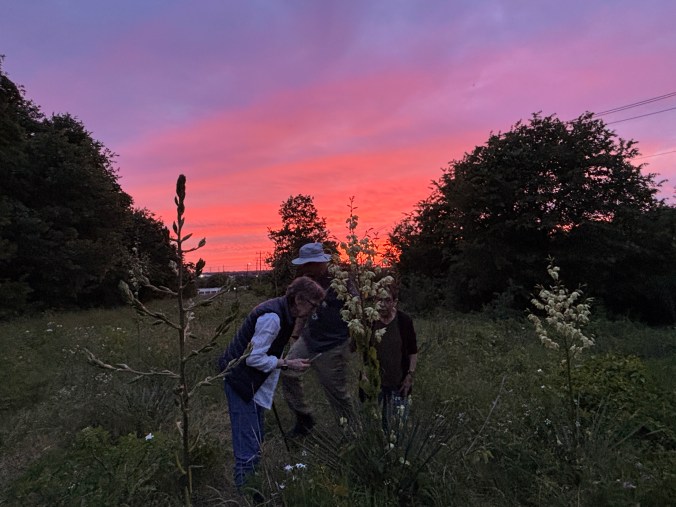
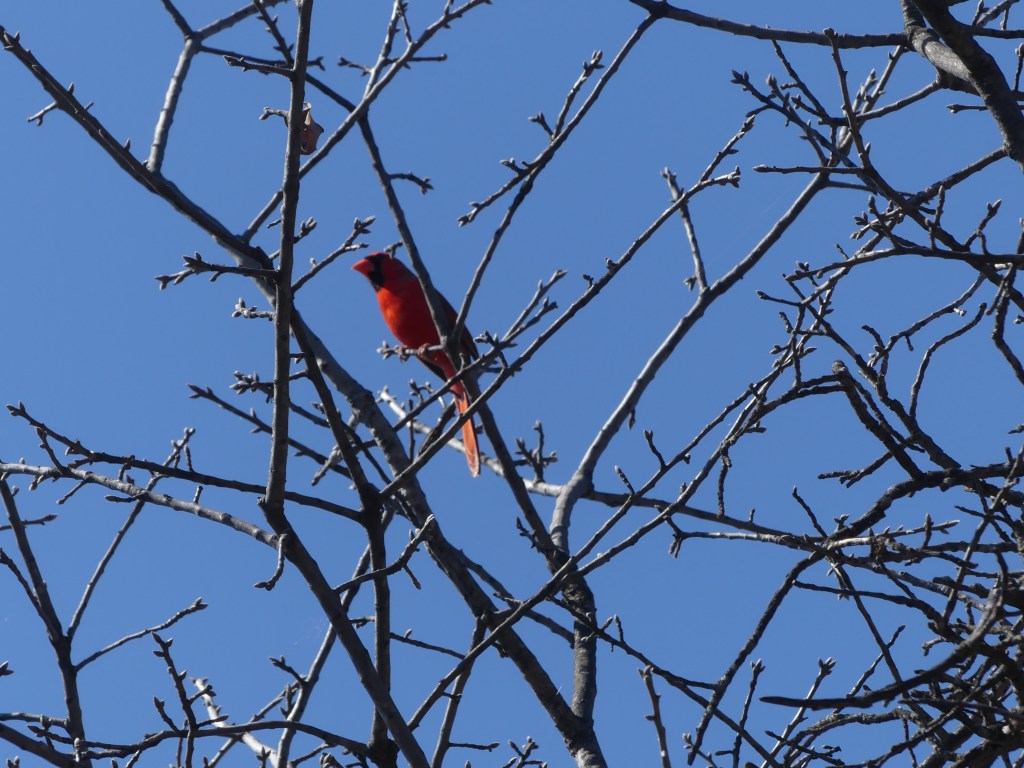
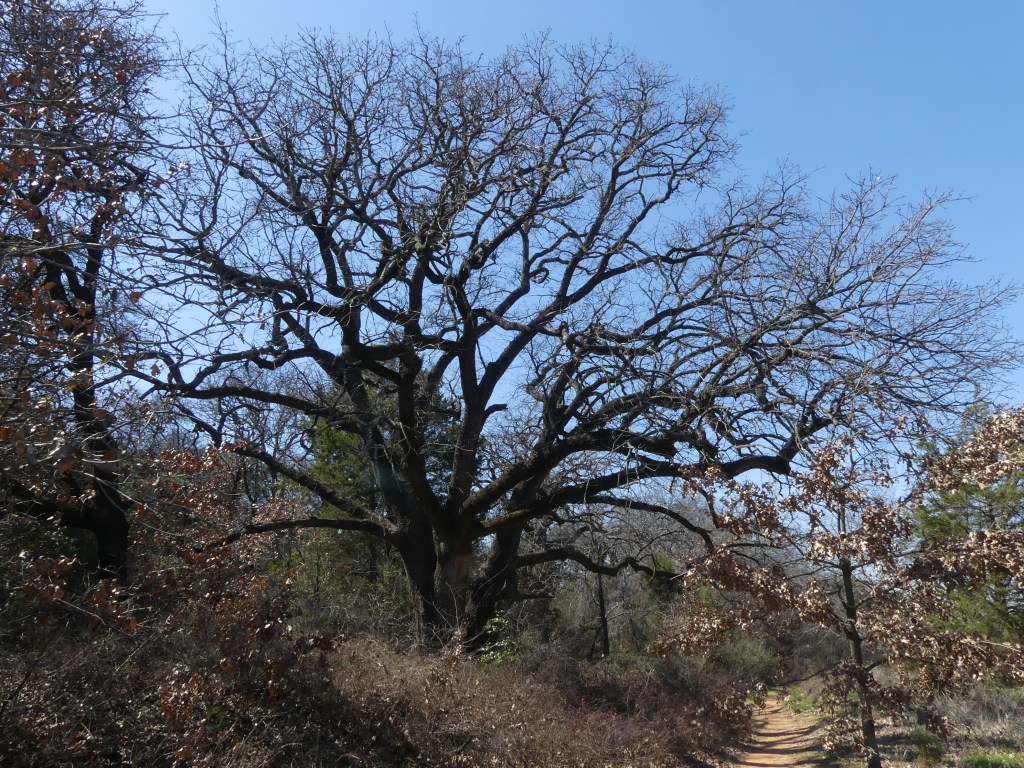
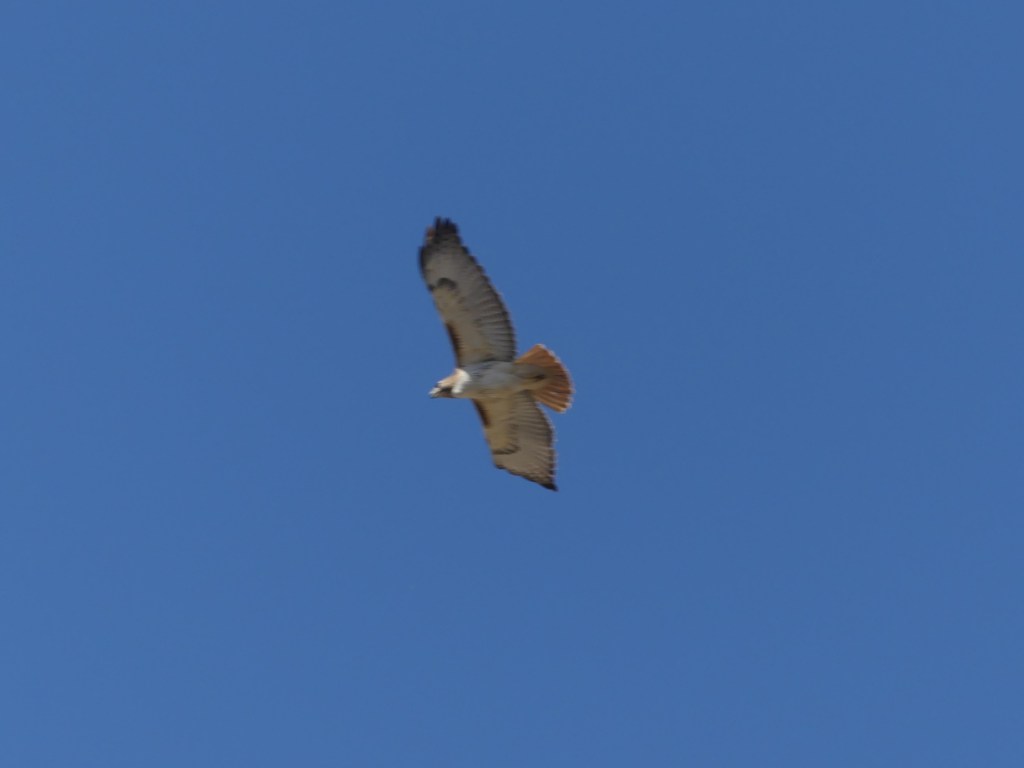
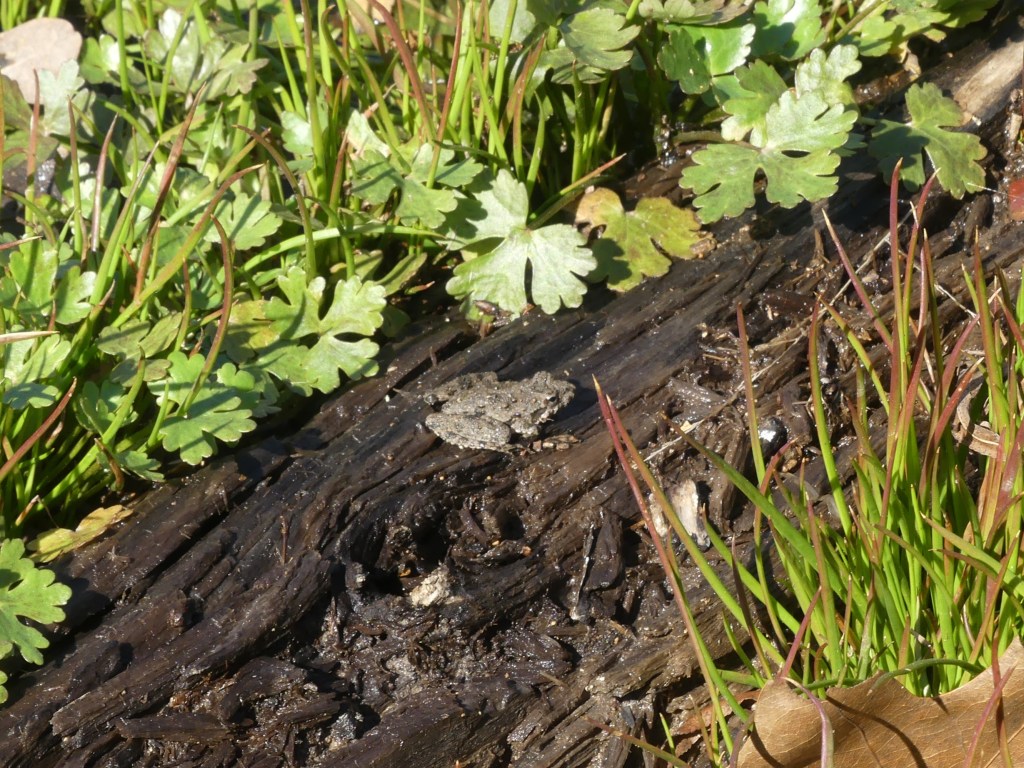
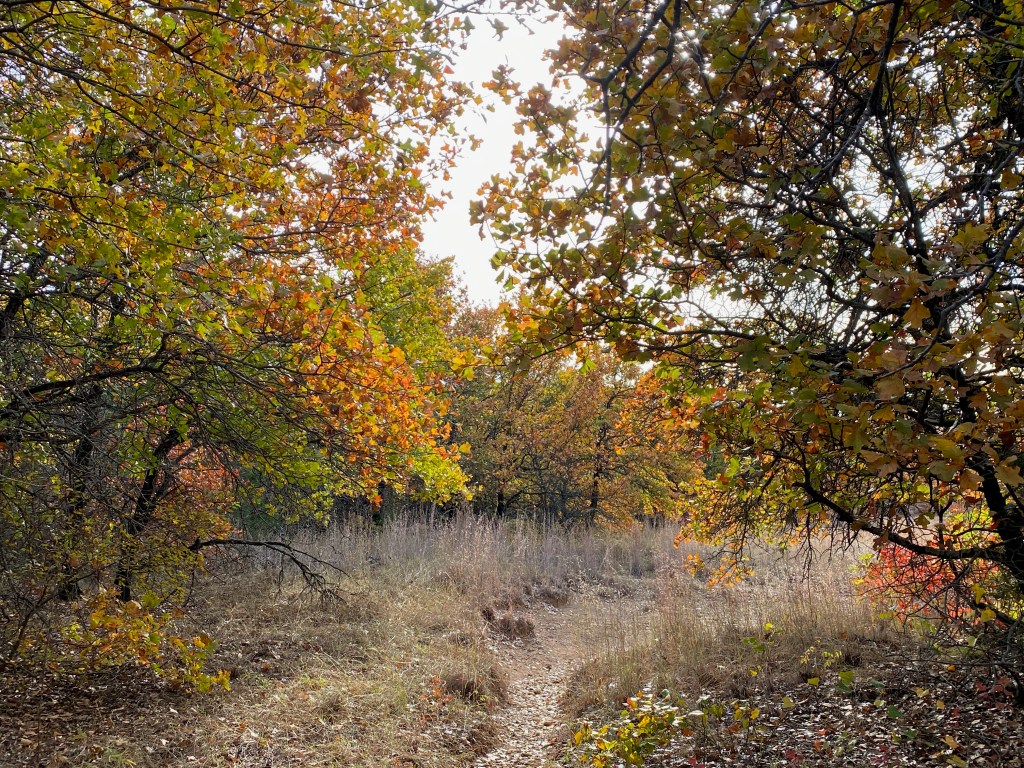
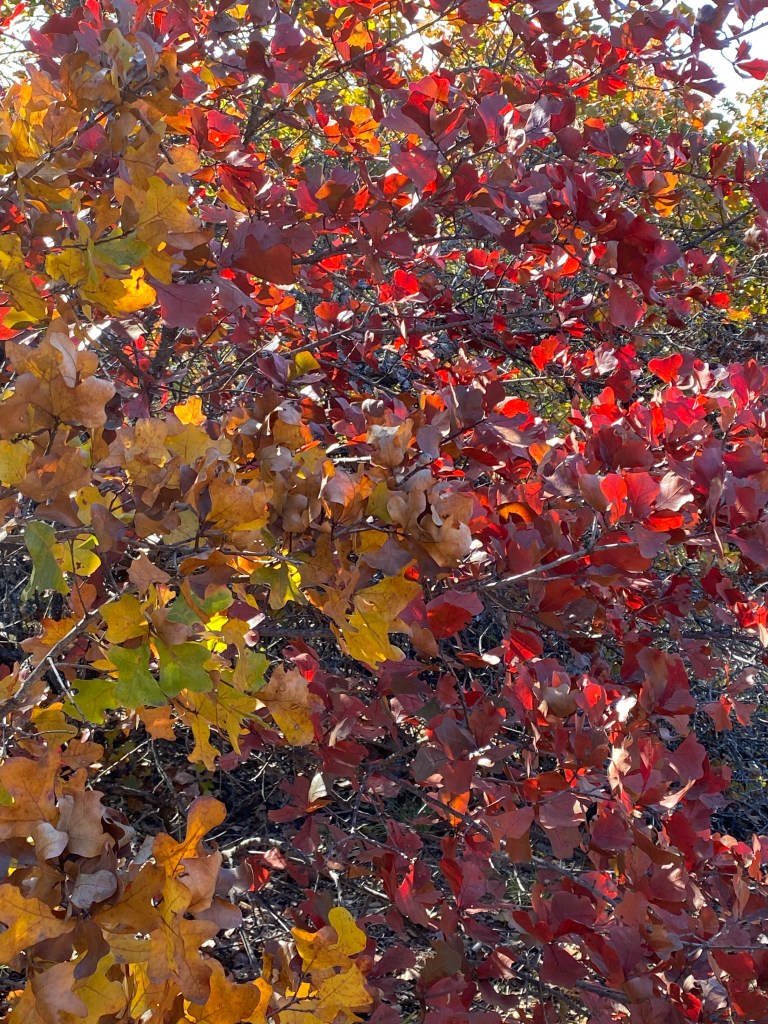
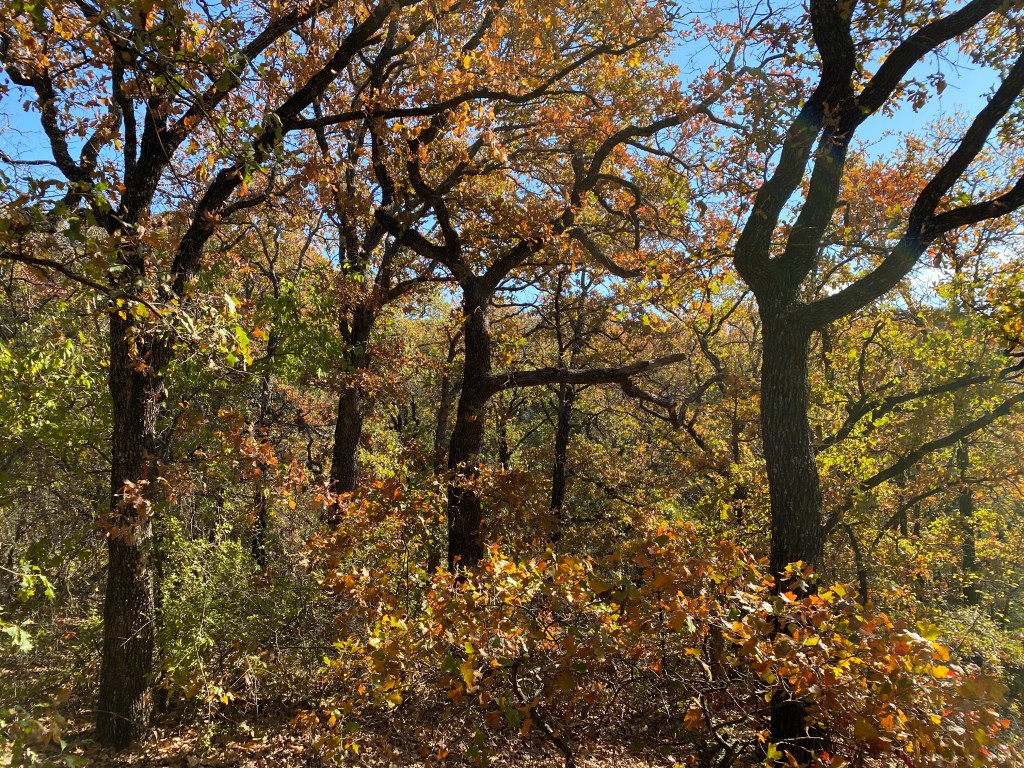
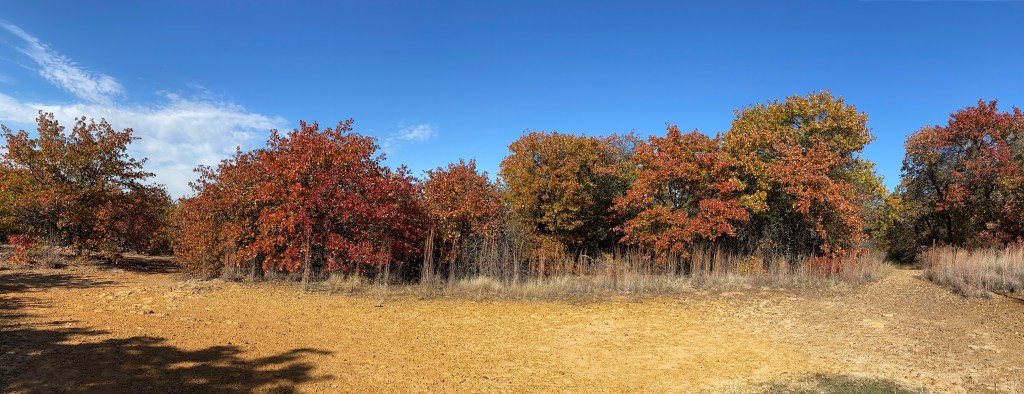
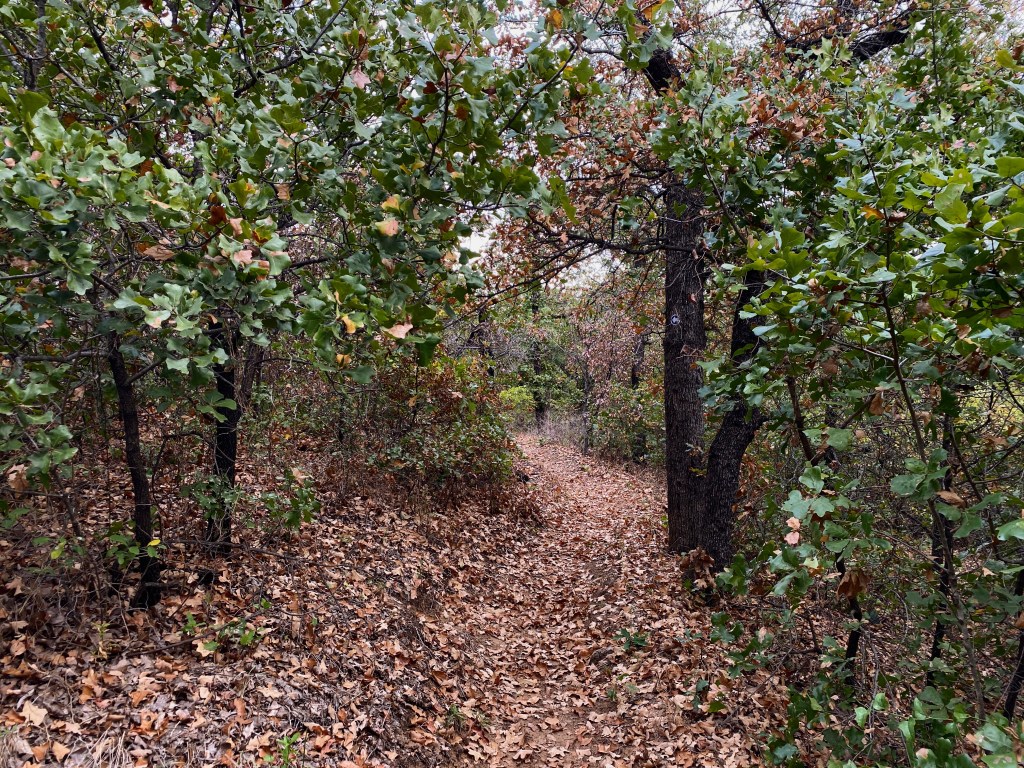
An hour’s walk at Sheri Capehart Nature Preserve provided a few impressions of winter here in North Texas. We had sleet and snow three days ago. We laugh at ourselves about how we overreact to snow and ice although occasionally, like in February of 2021, it becomes deadly serious. Mostly we get a brief taste of snow and it seems to us that we’ve had a brush with glaciers and blizzards and we know the depths of winter.
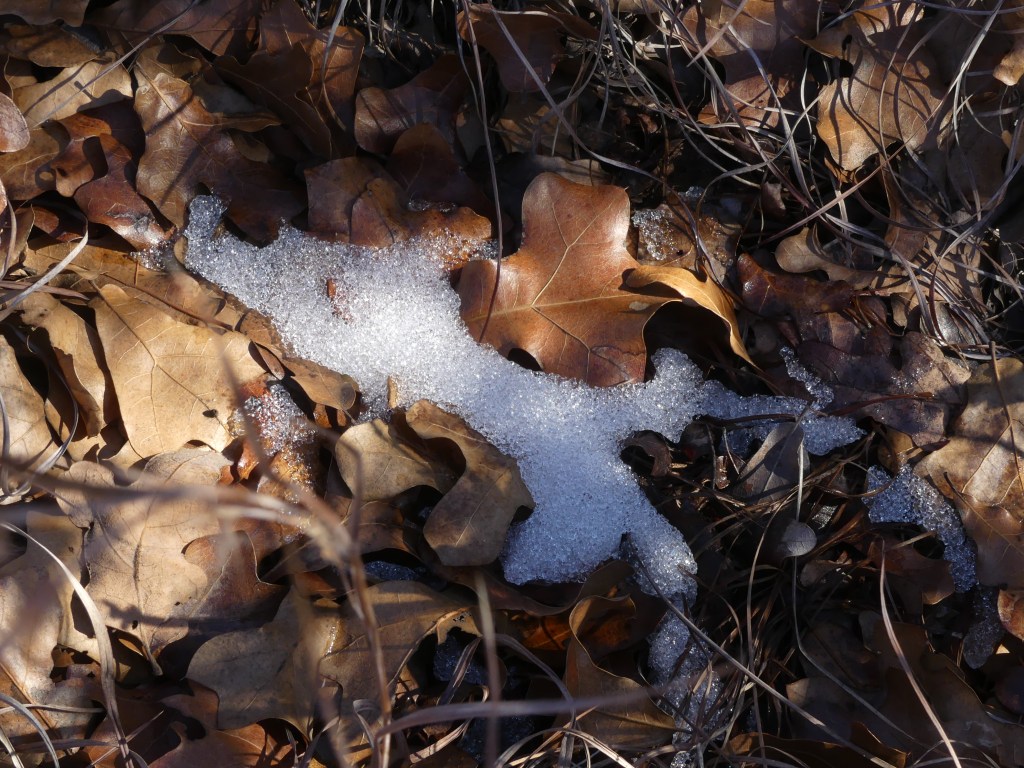
A remnant of snow up on the bluff
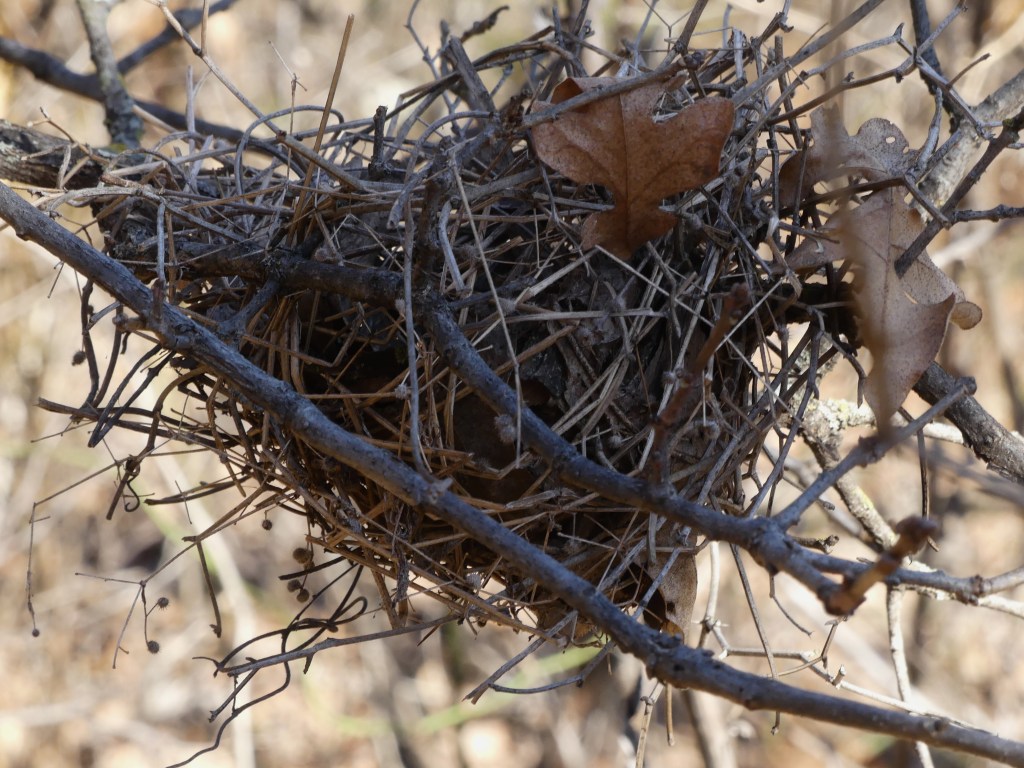
It is always a delight to find a bird’s nest, even the loose arrangement of twigs and grasses I found today. When winter leaves the trees mostly bare, old bird nests are sometimes exposed even very close to the trail. Some time last year this would have been a concealed refuge where eggs could hatch and baby birds grow and, after a while, fledge. I’m drawn to these relics of avian architecture. The birds weave and knit with such skill, and find ways to incorporate so many materials – lichen, moss, hair – so that I’m reminded of woodland faeries. And yet I don’t know why I should go to myths and stories when the birds are miracle enough.
Maybe another reason to be drawn to birds’ nests is how they resonate with our own efforts to bring a new generation into the world. The birds prepare and so do we; once the young hatch they are constantly busy feeding them, and we can relate to that. The young of both species go through an ungainly adolescence, partly feathered and awkward. And learning to fly is stressful, but our hopes are pinned on that day when they fledge and fly off into the world successfully. I hope that the ragged nest I saw today has such a story attached to it.
Wherever those birds are now, apparently it was not at the preserve, or maybe an hour in mid afternoon wasn’t the best time to see and hear them. The sounds today came from the surrounding traffic. Neither my ears (with high mileage and wear, not the most sensitive instruments) nor the Merlin app detected any.
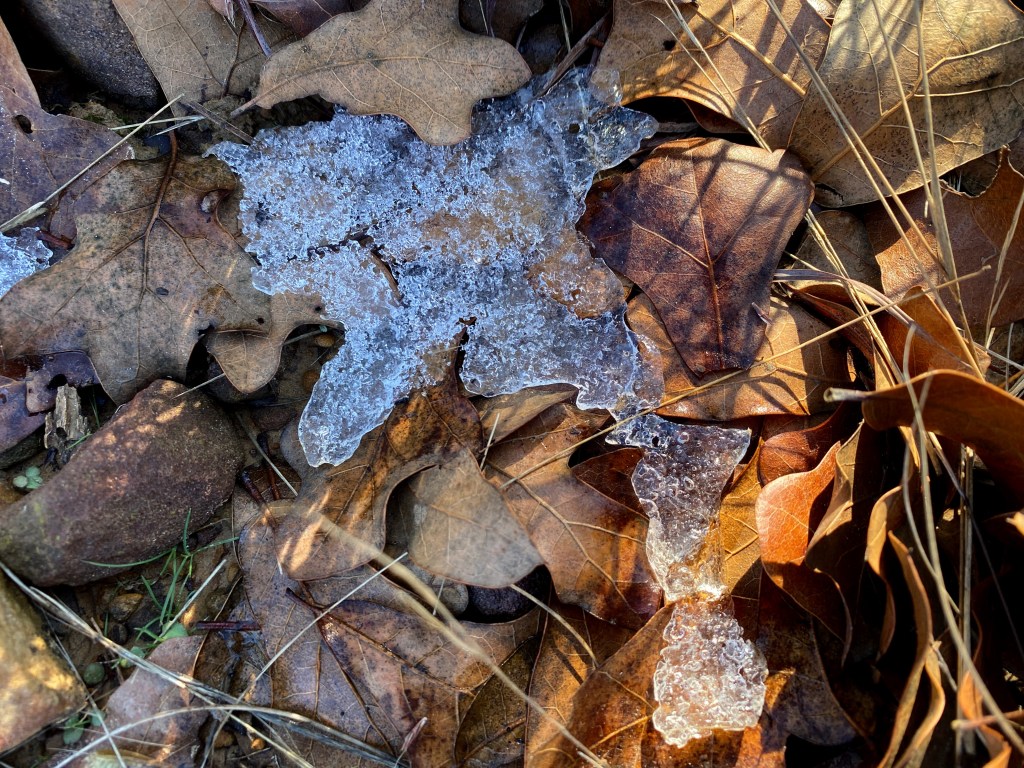
My eyes saw the remnant ice and my skin felt the cold, not that friends and family in Minnesota, Illinois, and Colorado would agree that it was really cold. My thermometer, placed in the shade while I wrote in my journal, dropped degree by gradual degree until reaching 55.5F. Not exactly the arctic.
But at some point during the walk through bright sunshine and shadow, past little patches of remnant snow, I had a momentary recollection of being a kid outside in a Colorado winter, with a cold breeze stinging my skin a little. Up there, at the end of the 1950s I remember two- and three-foot snowfall and I also remember how bright a winter day can be, especially when reflected off of all that snow.
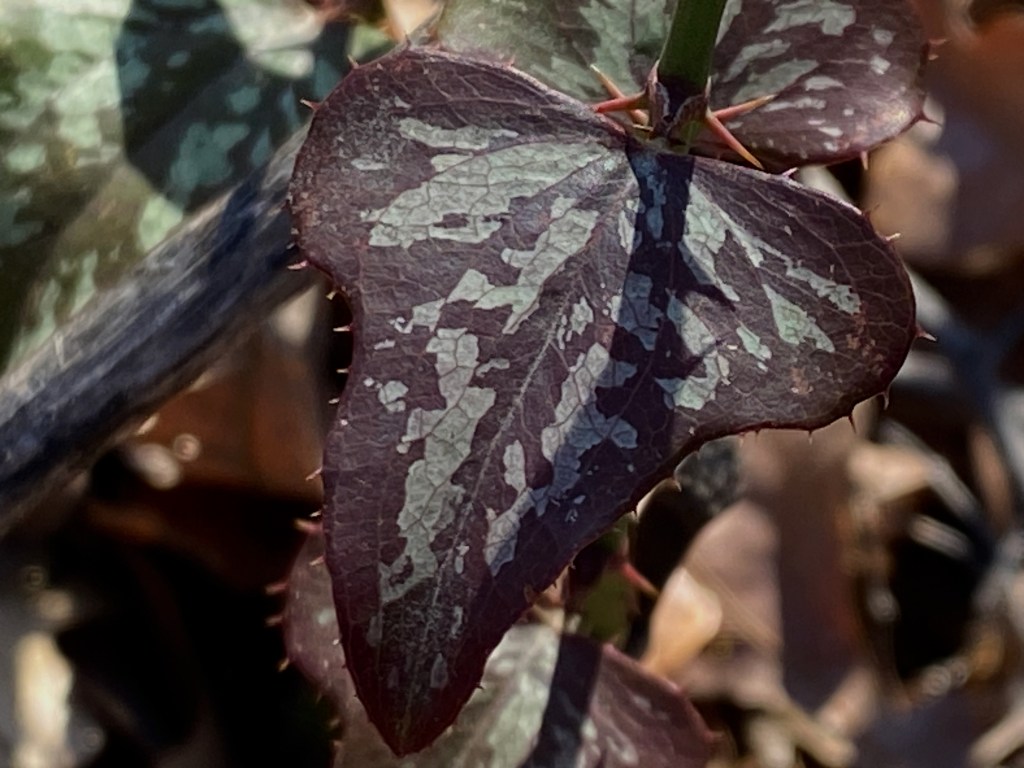
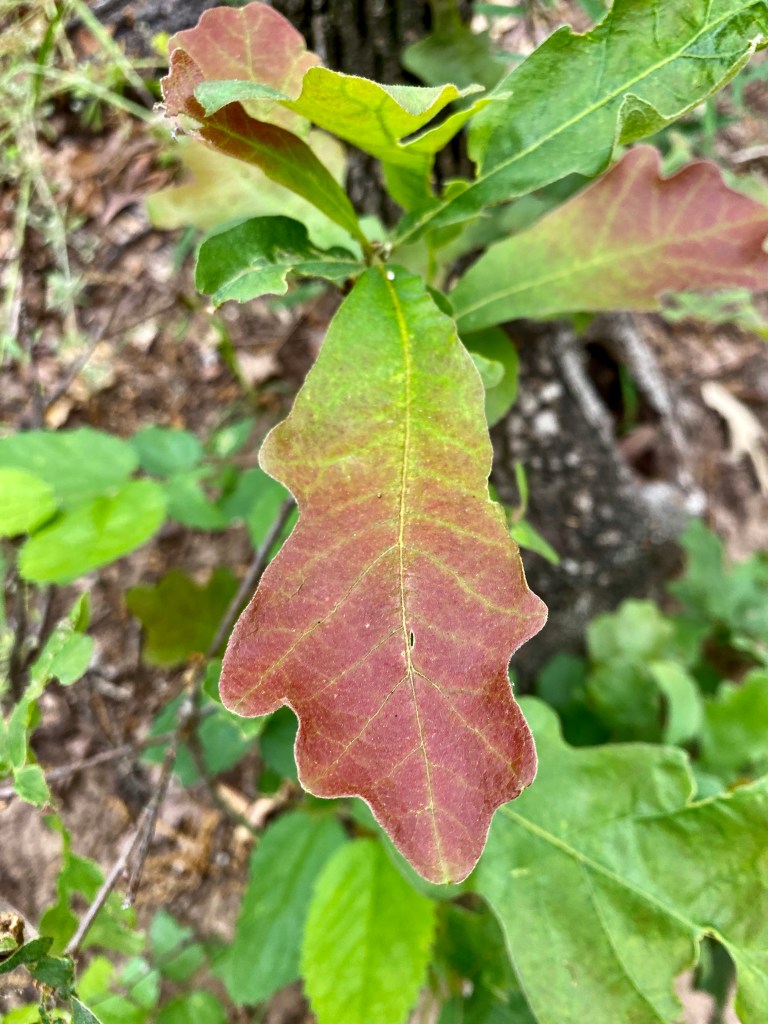
The darkened, mottled leaf of saw greenbrier rimmed with those little spines along the edge
There was one more small thing. Greenbrier is a thorny vine that grows commonly on the preserve, and the name I’ve heard for this one is “saw greenbrier.” While I haven’t seen an explanation, I’ve thought that the name might refer to the little spines all along the leaf edges, like a saw blade (but perhaps it’s something else).
Greenbrier leaves are usually mottled, and in winter the leaf may become dark and purplish while the mottled areas remain green. It occurred to me that each leaf was a small bit of abstract art, and that we could let our imaginations go and see if the patterns suggest something, sort of like Rorschach ink blots. Go ahead, see what comes to you when you look at the pattern. I love the way it splatters out from the central vein.
Just an hour in a place that offers wonder after wonder, in all seasons.
I hope everyone has a wonderful holiday, however you celebrate it. We’ll be sticking close, avoiding traffic, and getting together with family. I’ve recently been walking at Sheri Capehart Nature Preserve and Fort Worth Nature Center & Refuge (FWNCR), and wrote a “Letter to Nature Kids” (See December, 2024 End of Autumn) about those walks and some of the birds and other wonders I saw.
If you can, I hope you can take a walk that is as wonderful as mine yesterday at FWNCR. “It was a day at the edge of winter, getting late in the afternoon. A crow’s call echoed through the woods and a few dragonflies flew low around the edge of the grasslands. Other than that, this place felt like it could be sleeping – still, quiet and peaceful. We all need to sit quietly in a place like that sometimes, don’t we?”
I sat beside the pond, looking at the line of trees outlined by a pure blue sky. The glossy green blackjack oak leaves were turning a mixture of caramel and ruddy red. In front of the trees was a stand of little bluestem, a native grass with subtle beauty. Each starts with a little clump of narrow, curled leaves at ground level, sending several tall stems to reach chest high. The tiny seeds along those stems are feathery, and in autumn sunlight they are like a constellation of stars scattered among the grasses. Altogether a lovely little spot on a fine late autumn day.
You might say that this preserve has been kissed by creation, filled with a beauty that it wears in one form or another throughout the seasons. Before long I was thinking of “Wear Your Love Like Heaven,” a song by Donovan Leitch that most of us – of a certain age – have some memory of.
When it was released in 1967 I heard the song many times, but never listened to it well. I assumed it was a hippie love song (“kiss me once more”), the opening of the double album “A Gift From a Flower to a Garden.” But Donovan, with his soft Scottish voice, is often deeper than that. It is more like a prayer than a love song.
The verses suggest an artist with a beautiful palette of colors, or someone experiencing such a range of hues in nature. “Color in sky Prussian blue,” but the colors change with sunset as the “crimson ball sinks from view.” There are shifts to “rose carmethene” and “alizarin crimson.” It is easy to imagine being in a place where the land and sky overwhelm one with beauty, where any of us might ask for more such experiences of awe. Such a plea could easily be a prayer:
“Lord, kiss me once more Fill me with song Allah, kiss me once more That I may, that I may Wear my love like heaven”
What might it mean to wear your love like heaven? I suppose wearing it would be to let it show, not hide it, and offer it freely to anyone. And a state of bliss and love freely shared with everyone is one way to imagine heaven.
Within such a state, Donovan experiences an extraordinary vision:
“Cannot believe what I see All I have wished for will be All our race proud and free”
Perhaps he is seeing what follows from wearing our love like heaven. Generous and open-hearted, not trapped in greed or the desire for domination, free of self-destructive impulses and all the things that bind and restrict us. Wearing a transcendental love would make us proud and free.
It was a beautiful vision to carry with me as I walked through oak woodlands and on trails along patches of prairie that are lovingly being restored. Some of the blackjack oak leaves have taken on a shade of alizarin crimson, and tonight, if the sky is clear enough, we might look up to see Prussian blue.
To connect with and be blessed by the divine, filled with song, and to live in beauty and love. That’s a lot of message to be carried by a two-and-a-half minute pop song from 1967, but we are allowed our interpretations of the meaning of art and this is how I hear it. The song has been covered over the years by people I think of as serious artists. Ritchie Havens recorded it in 1969 and Sarah McLachlan covered it in her 1991 album, “Solace.”
On Monday morning, November 4th I felt the uncertainty of the storms that were on the horizon. How soon, and how severe would they be? But that was the future, and beyond my doing anything about. A good alternative was to be in the present, and also in the presence of trees, soil, and other living things. What could be as trustworthy and reassuring as nature? There are some people in my life like that, and they are essential. There are also places like that, and I’m grateful for them.
Oak leaves covering the trail – the oaks are dropping leaves without showing much autumn color
So, with storms still to the west, I took a walk at Sheri Capehart Nature Preserve. It was cloudy, with low cumulus clouds racing to the north and the occasional glimpse of blue sky between them. A couple of black vultures were overhead, careening back and forth in the wind with acrobatic turns and adjustments of flight feathers. From my camp stool near the bluff, it was 75.3F, continuing the above-average warmth that is becoming our new normal.
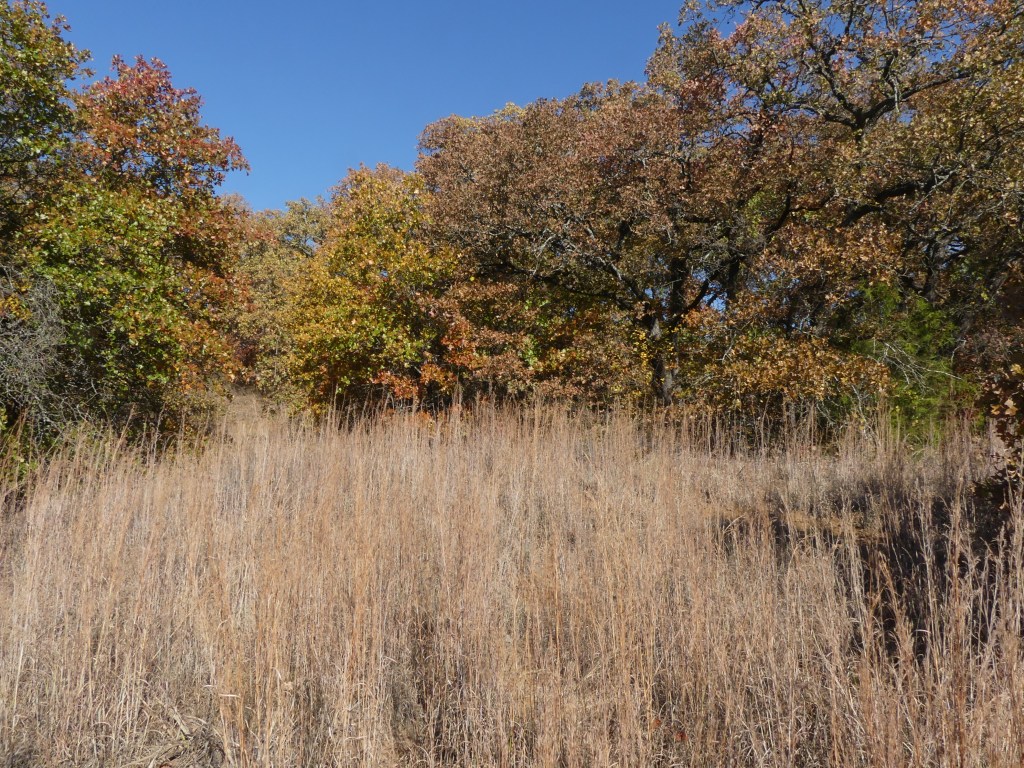
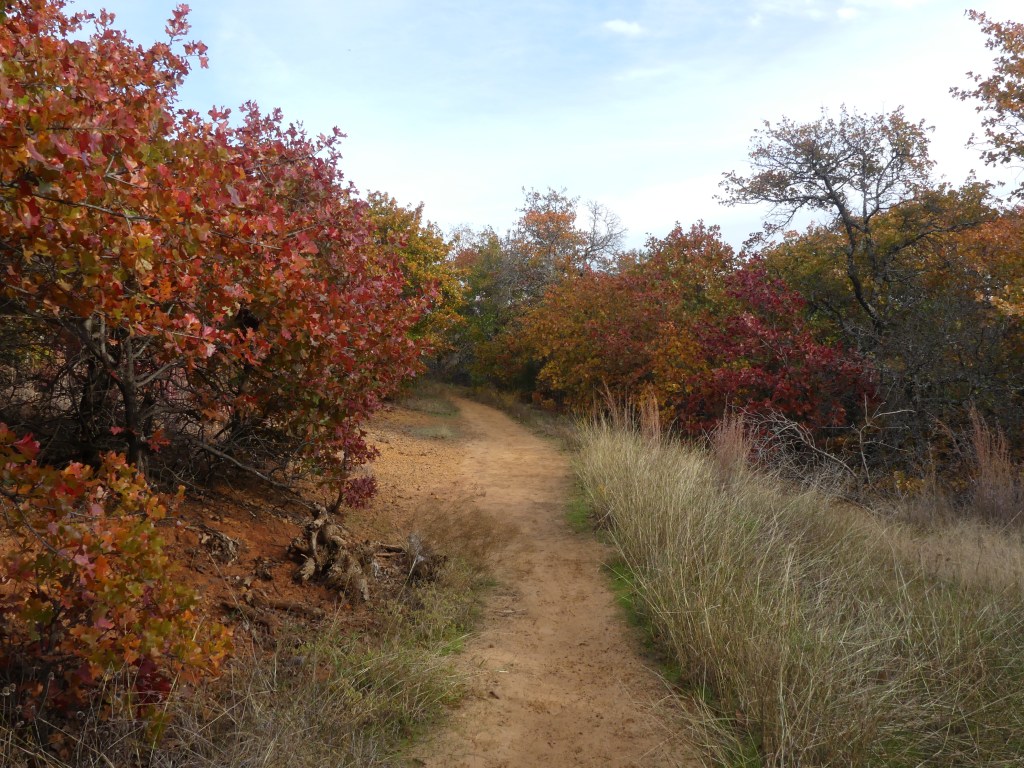
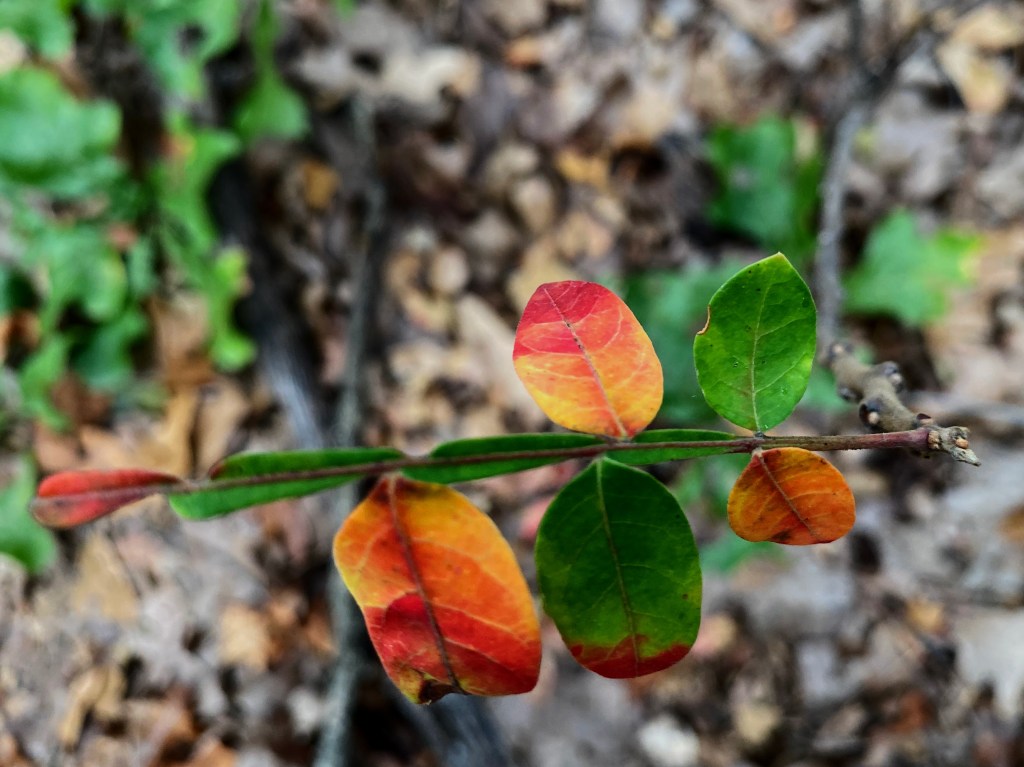
The “official” autumn colors: crimson and orange, yellow and green
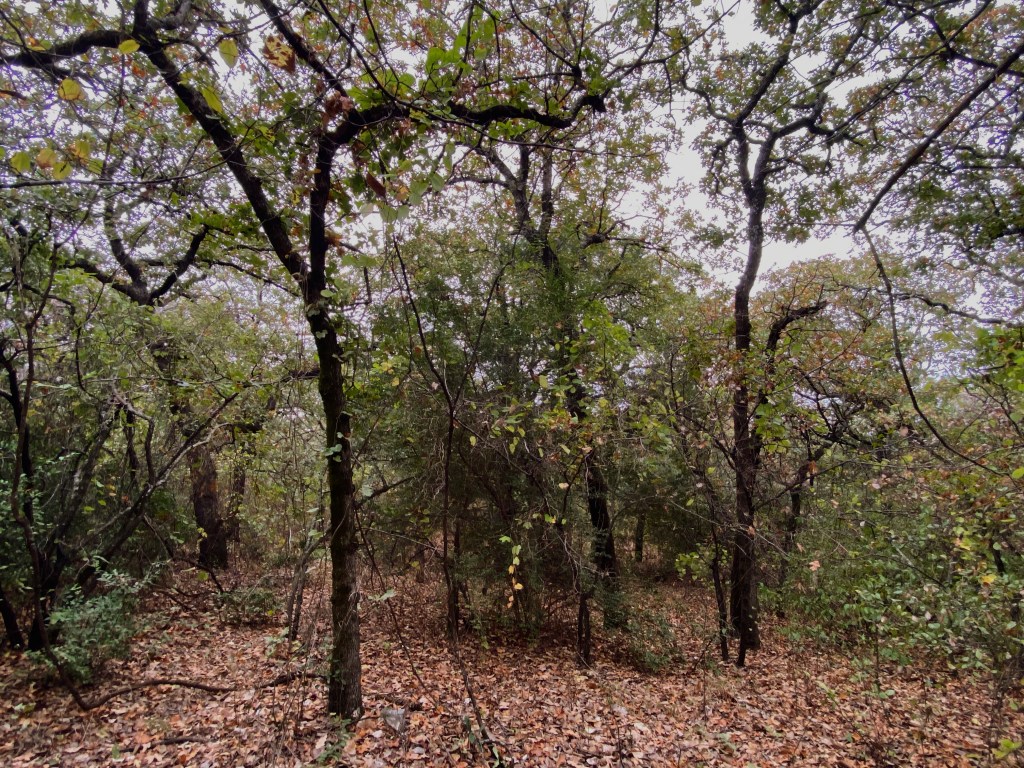
At 9:20am I sat near the top of “Kennedale Mountain,” that hill that overlooks the lowland through which Village Creek drains. From the sandstone escarpment you can glimpse downtown Fort Worth through the oak branches, if you want to. I’d rather keep in the company of the blackjack oaks and sandstone, watching clouds or butterflies. Away from the bluff, on the back side of the hill is a place a bit more protected from traffic noise, where fewer visitors walk, and so it is a favorite with me.
A place a little quieter, maybe a little wilder than other locations
As I sat, a crow flew past, cawing loudly, and clouds continued streaming to the north. The wind moved through the trees, and when stronger pulses of air came through the sound was like a rushing river. Downslope toward the east I heard a northern cardinal and a Carolina wren.
Some of us need natural sounds like these, and relief from the unremitting mechanical noises that so often mask them. The noises of human activity are certainly present at the preserve, as it is located a little south of the third-busiest airport in the world and sits right beside major highway construction. But some days, when we let go of the noise and focus on birds, breeze moving the trees, or the occasional frog calls, we get a little of the peace that natural sounds bring.
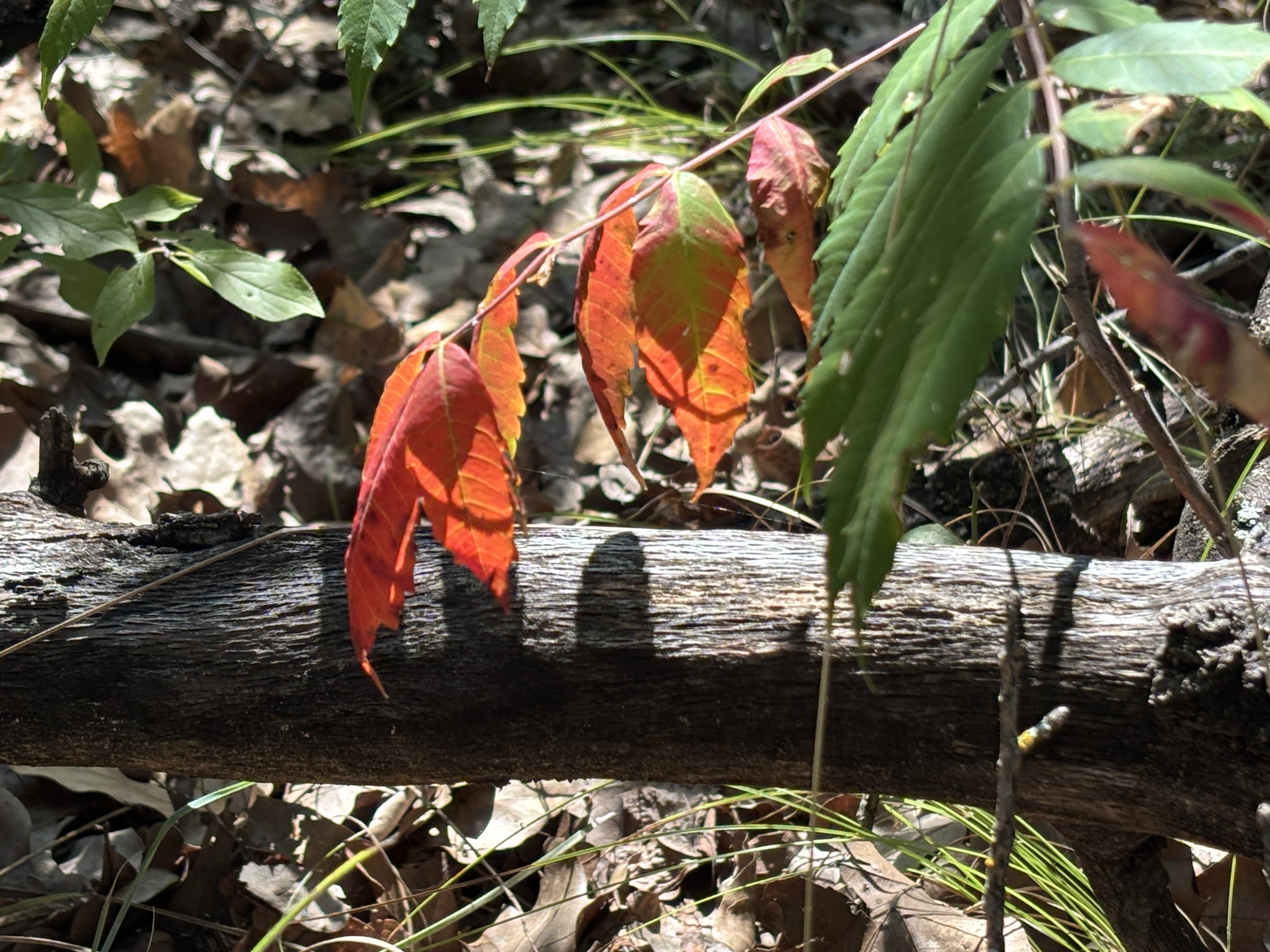
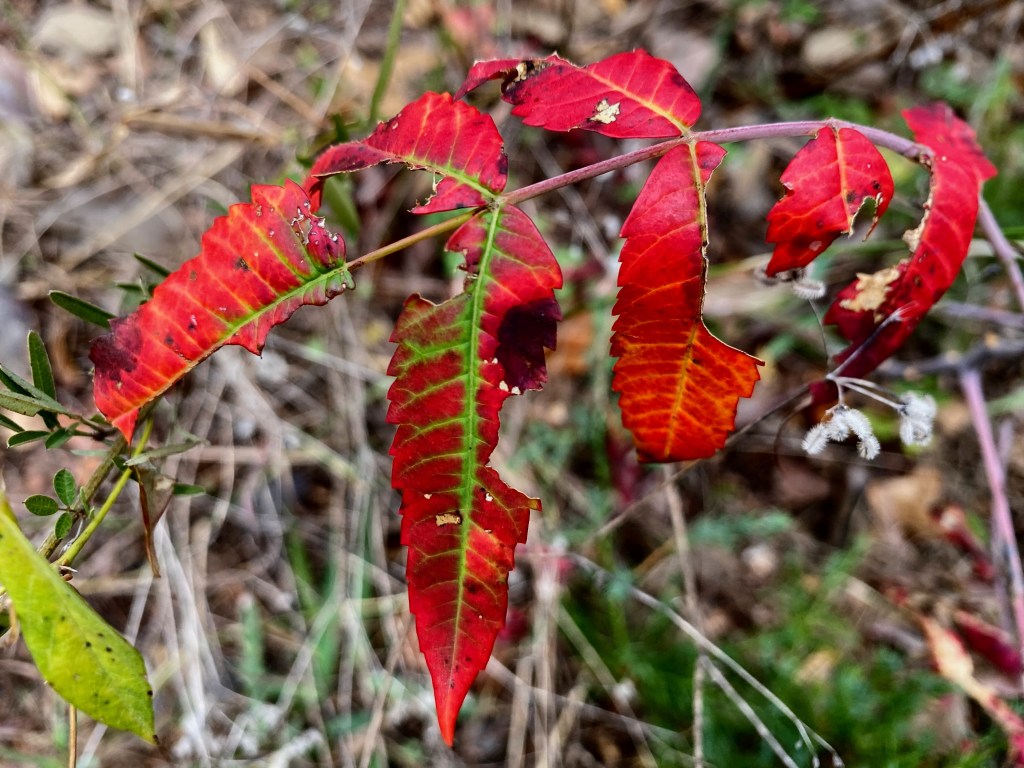
A tracing of green in the crimson leaves of a ragged sumac
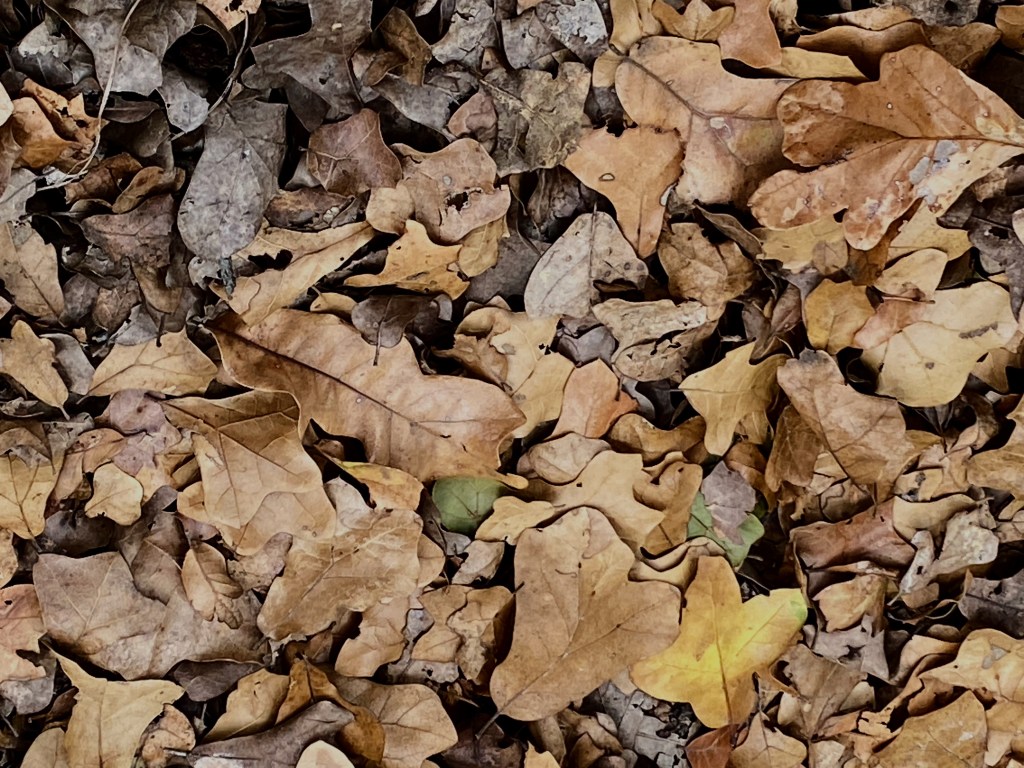
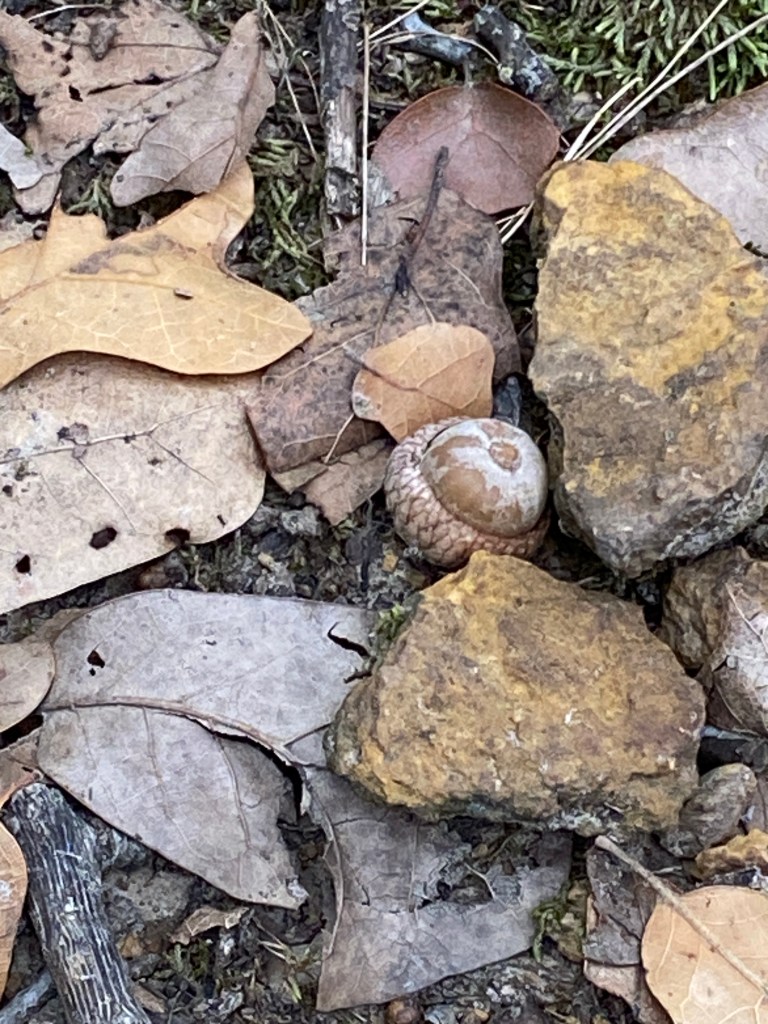
By 9:50am, back over on the bluff, the clouds seemed thicker and the sky a little darker. Here and there I noticed the pattern of fallen leaves on the ground; the variation in color and shape and things like acorns or moss always pull me in. It is art on a tiny scale, for those who are pulled toward such things.
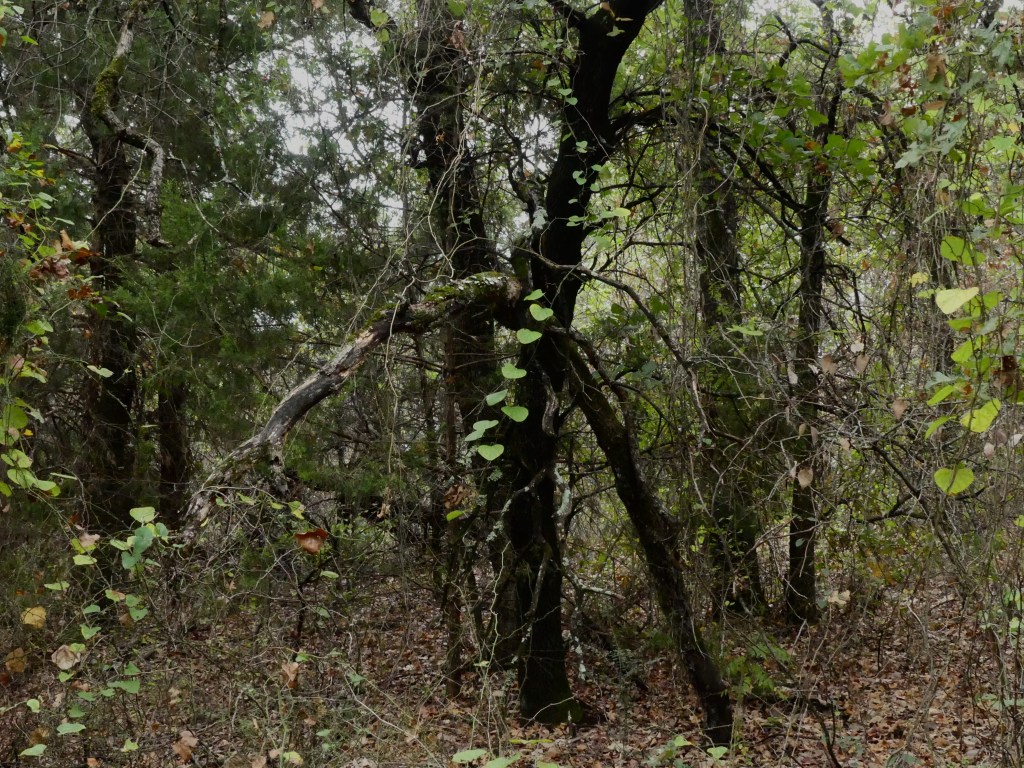
A carpet of leavesAn acorn nestled among the rocksSome oak leaves were this odd colorVines with leaves ascending like a ladder; moss and fungi on the dead branch
The storms held off until after I left at 10:13am, and we can hope that they bring only the rain we need. A little thunder is always good – one of those natural sounds I like so much. Just under two hours at the preserve had brought some of the peace and wonder that are part of that place.
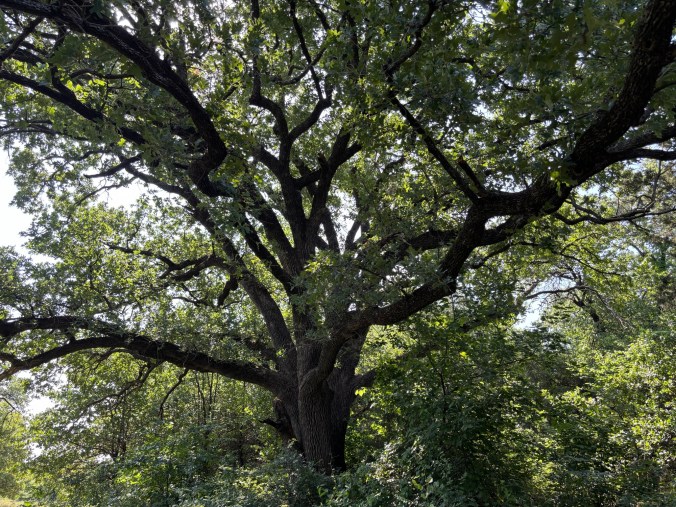
A recent mid-August Sunday was the hottest so far in 2024, with a high of 104F. When Kat and I walked up the trail at Sheri Capehart Nature Preserve to the sandstone ridge, the stone was quite warm to the touch. Regardless of the day’s heat, we wanted to experience a summer sunset there, and we arrived at the ridge about 8:00pm with the sun still glaring yellow through the leaves of oaks. Those trees grow immediately below the sandstone ridge, a curtain that hides the Fort Worth skyline and offers some shade.
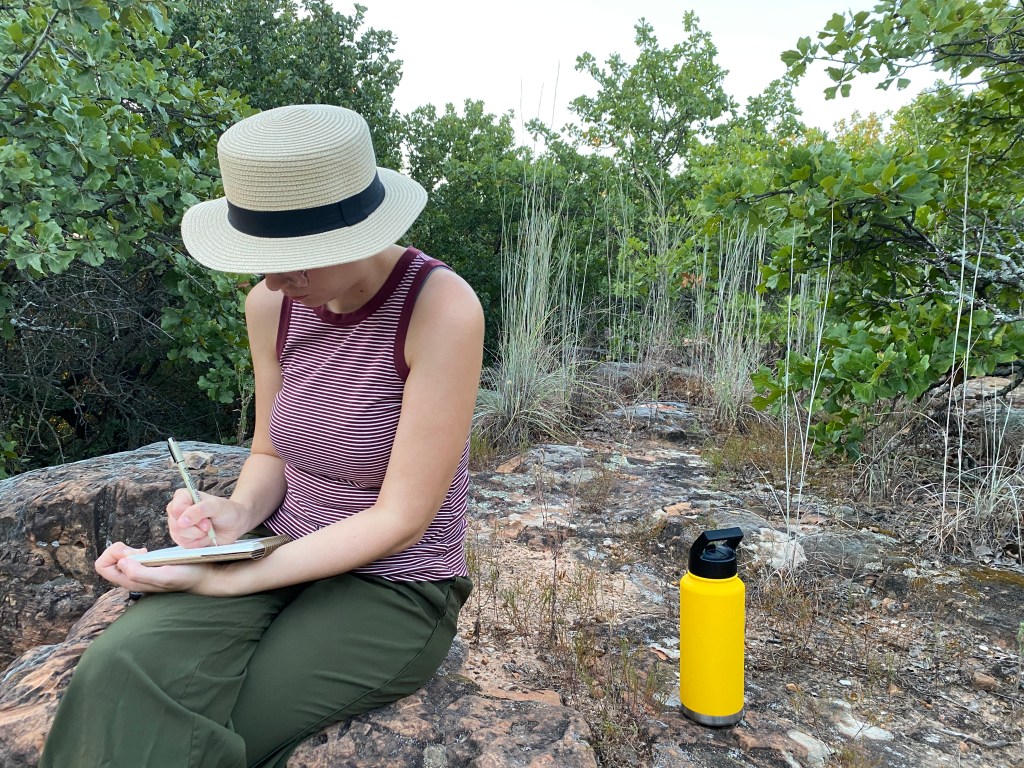
Kat, making a few notes in her journal
We sat on the stone ledge with water bottles and notebooks at our sides. Looking behind where Kat was sitting, there were tall stems of little bluestem reaching above our heads, and with each little breeze they waved as if they were the tops of trees. The breeze was welcome, of course, but for the most part the air was still and with the humidity at 50%, it felt sticky. Turning back to the west, the disk of the sun peeked through branches and leaves in yellow-orange sparkles, as if coming from the facets of a jewel.
The constant nearby traffic sounds dominated, but at 8:10pm a wave of insect calls moved through the area and then stopped. Although at some point the Merlin app picked up the call of a northern cardinal, I could hear no birds. After a few minutes another wave of insect sounds lasted several seconds and then abruptly stopped.
Meanwhile, a pastel yellow sky at the horizon filtered through the trees, silhouetting leaves and branches. I reclined on the still-warm rocks to be able to see the whole field of the pale blue sky, watching for birds or insects and hoping to see the first star become visible. I saw none of those. At 8:26pm the temperature at the ridge was still 92F, with humidity dropping a little. The western horizon was a deeper orange.
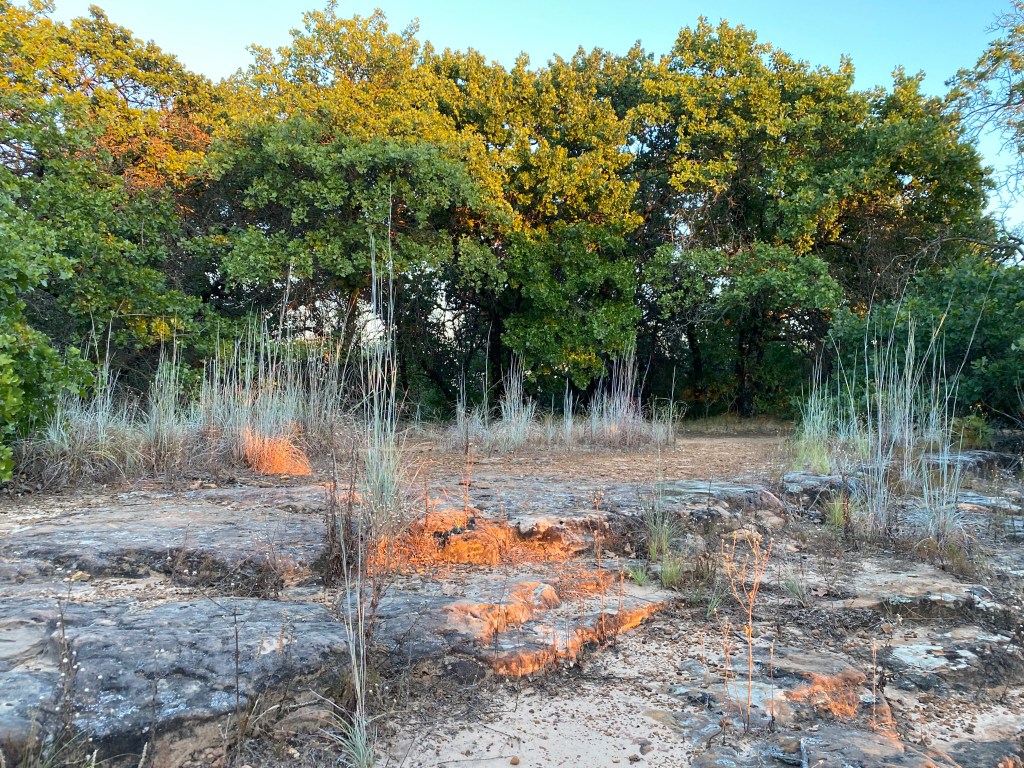
Sandstone, little bluestem, and sunlight in the blackjack oak
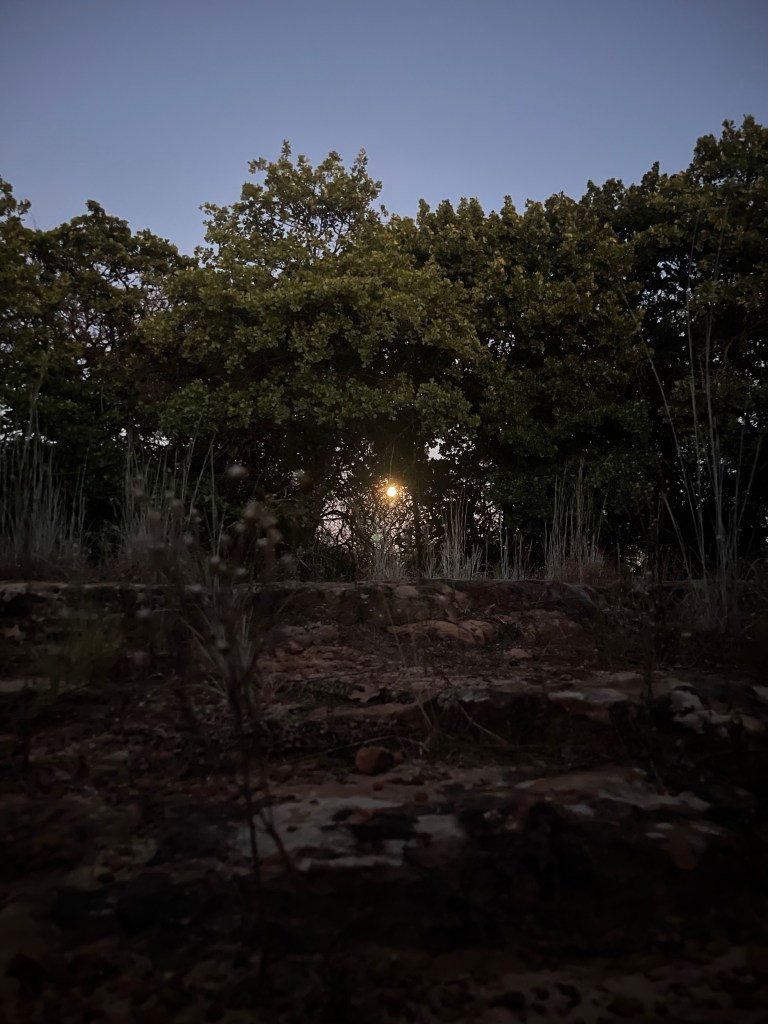
Behind us, the canopies of blackjack oak were dimly lit by the remaining light from the western horizon, almost glowing with a yellow tint that contrasted a little with the surrounding vegetation. And when we looked lower down in those blackjacks, through bare branches we could see the bright, round full moon rising.
It was about ten minutes later that we could see the first glimmers of a couple of stars. “Star light, star bright, first star I see tonight,” but these tiny bright pinholes in the not-yet-dark heavens did not seem bright. Kat’s younger and more perceptive eyes could soon make out four stars.
Moonrise through the trees (photo by Kat Oliver)
Shortly after that, we started walking back in the relative darkness, much darker under the trees. But in open areas, the full moon had risen higher and provided enough light for walking. When the moon is bright enough to light your way, and you walk along a path just visible, it may bring to mind childhood adventures in back yards or campgrounds. Something about it makes it seem special, a moonlit faery world much different from the bright daylight colors.
And what is the attraction of sitting with the sunset, riding that transition between day and night? The world rides along with us as we notice the settling of birds, the emergence of insects or frogs, the way any clouds transform the last light of the sun. Most days we declare our independence from the rhythm of the Earth, turning on our lights and continuing whatever we are doing while the sun disappears and gives the night to the moon and stars. Sitting outside with the sunset is a way of reconnecting with that rhythm. Through such a connection, perhaps we synchronize ourselves with something important.
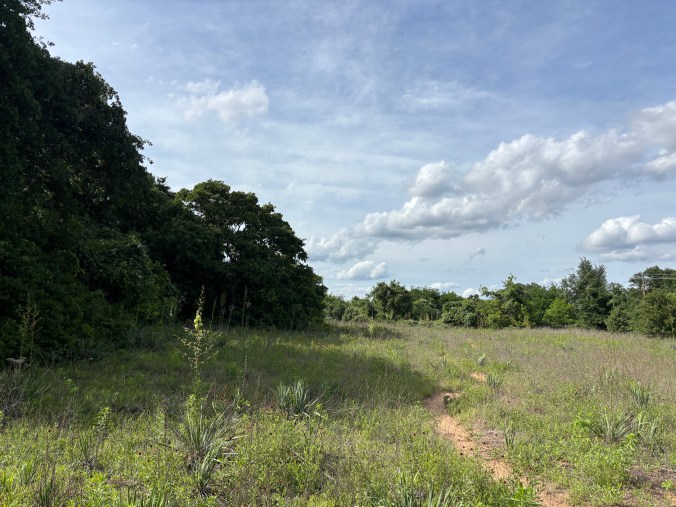
So far this year, Tarrant County rainfall is about 3 inches above normal according to drought.gov. At Sheri Capehart Nature Preserve, the plants have responded with an explosion of growth and flowers.
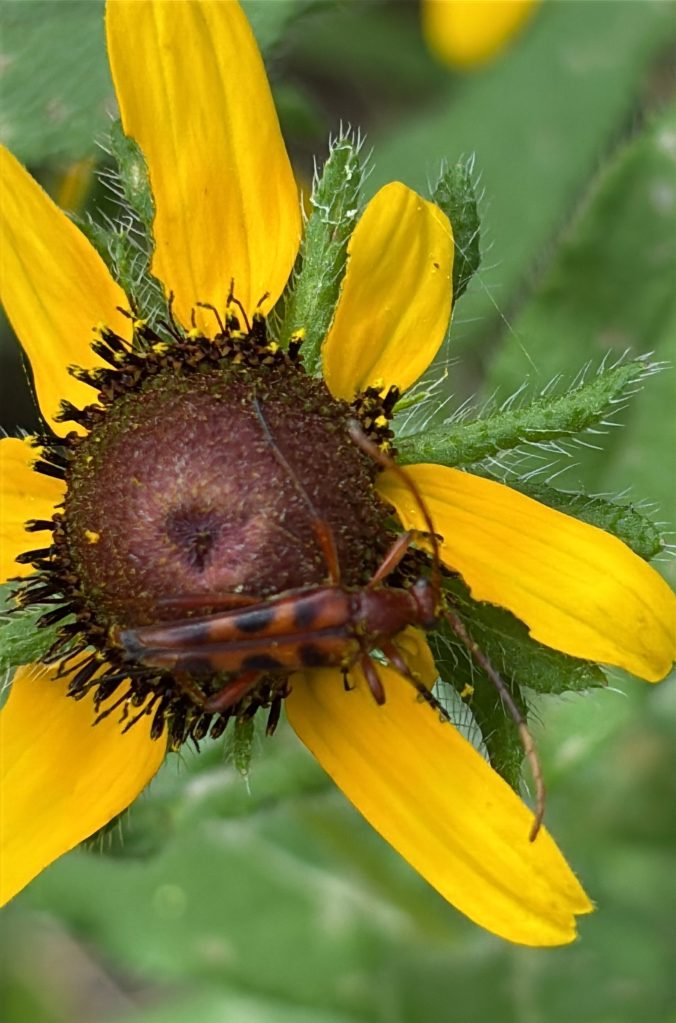
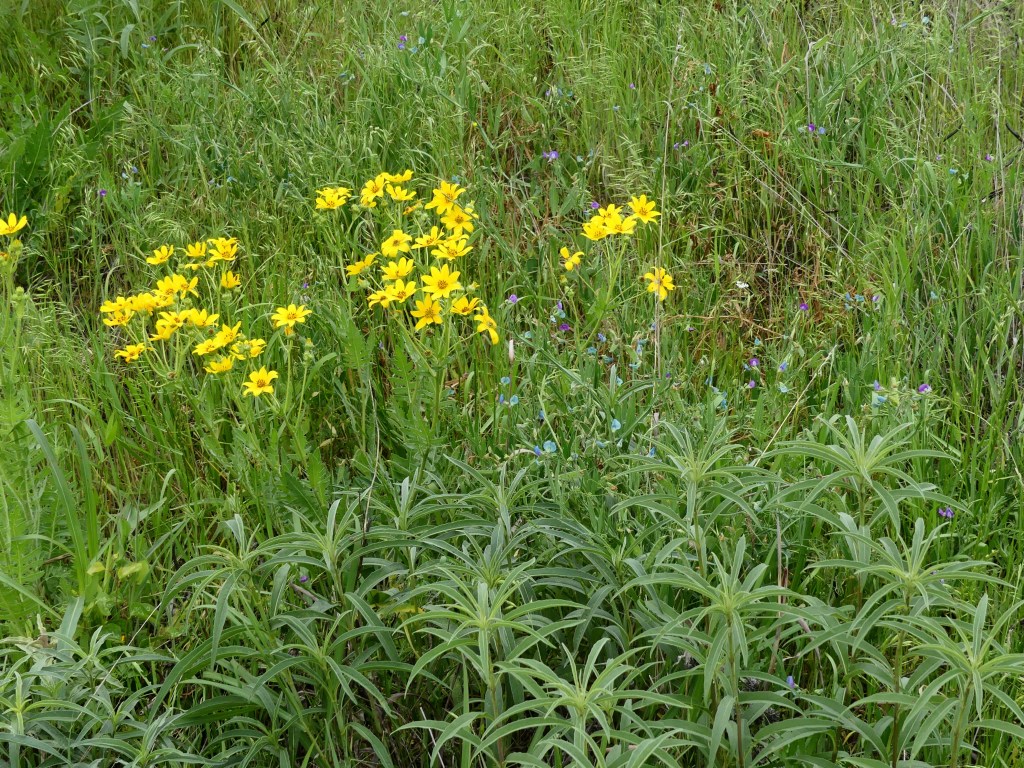
Walking up the switchback trail to the bluff, I have never seen so many spiderworts, their blue-purple flowers dotting the trail’s edge and the openings in the woodlands. Engelmann’s daisies grew in a few of the sunny spots, and the brighter yellows of chickory were common.
It was cloudy, and an Arlington weather source said that it was 61 degrees. The next day was predicted to be full of rain; I could imagine tomorrow’s shining raindrops on the leaves and the water soaking into the sandy places and forming pools where there is clay. But during my walk it was cool and dry.
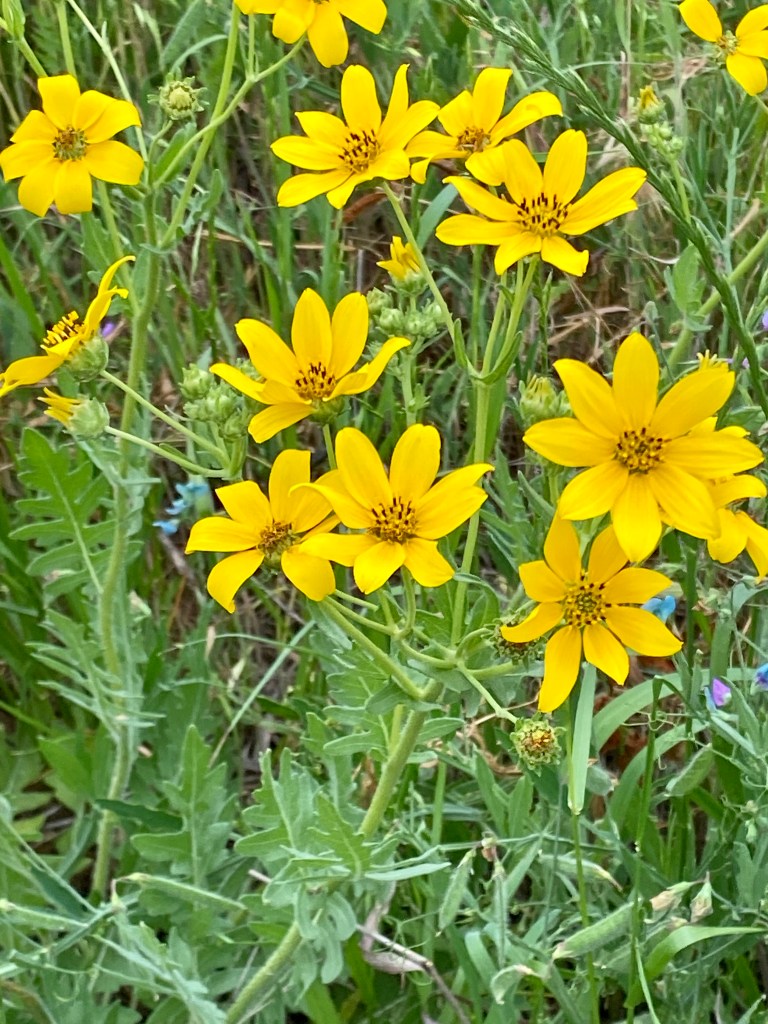
Firewheel
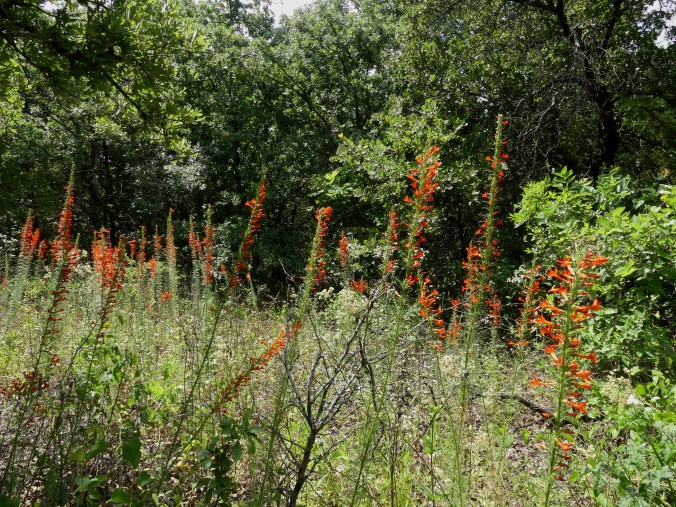
At the boulders the green stems and leaves of vetch are overflowing and the bees and butterflies are feasting on clusters of purple flowers. And there were a couple of patches of firewheel (Indian blanket).
Question mark butterfly
The butterflies scattered up from the trail as I walked, including sulphurs, red admirals, and question marks. This last butterfly has a small mark on the underside of the hind wing that is said to look like a question mark, but for the most part with wings folded it looks like a dead leaf and the opened wings are a beautiful study in smudged and burnt orange.
It’s remarkable how different plant species have their time and then move on. The year progresses in a “kaleidoscope of color” as each one has its appointed time. There was no sign of toadflax blooms, even though only recently they seemed like the prominent flowers of the hillside. Near the trailhead, Maximilian sunflower was getting started, although we won’t see their blooms for some time.
Change is constant; nothing stays the same. The woods, prairie openings, and ponds change from season to season, and even within a season everything is in motion. And yet it’s the same place, a constant familiar presence even as it constantly shifts. How wonderful is that!
Engelmann daisy behind new growth of Maximilian sunflowerRipening dewberries
Spring is fully underway and it’s not yet April. Things are green and growing, and the insects – the beetles, flies, dragonflies, damselflies, skippers, and butterflies – are busy. On March 27 I wandered the trails at Sheri Capehart Nature Preserve, up the hill to the bluff and over to the boulders. There were filmy high clouds but it felt sunny and the breeze was cool. A nearby weather station reported that it was 65 degrees and felt like 74.
Spiderwort
Many of the oaks were leafed out and a few stragglers were still putting out small leaves tinged in red. Along the trail’s edge there were some spiderworts with their deep blue flowers, three petals surrounding a cluster of yellow anthers. And everywhere I looked in the sandy soil of the hillside, it seemed that I saw Texas toadflax. I’ve really looked forward to this!
Texas toadflax
Last year, toadflax really captured my imagination. I wrote:
“To tell the truth, part of the reason I’ve focused on them … is that name – “toadflax” – which immediately made me think of The Wind in the Willows. A plant with such a name surely belongs in an old children’s tale centered on the English countryside with animals such as the toad.”
Even if it had a completely unimaginative name, I would think this delicate-looking plant was worth paying attention to with its tall stems and pale violet flowers.
Near the top of the hill there is an area with plenty of southern dewberries, and on one of the flowers was a pretty black-and-white moth called the “mournful thyris.” That’s just the kind of name that gets me wondering about how it was named, and an internet search or two did not yield much. Thyris is part of the name of the family – the group of moths – to which this one belongs. The word is said to be a Greek reference to “window,” and they have a spot on the wing that is translucent, like a sort of window. But why is this one mournful? I looked for a window into its grief but could find nothing. If any readers know the origin of the name, please share with us in the comments.
Mournful thyris moth on southern dewberry
I walked the rest of the way to the bluff, along the way seeing beautiful yellow woodsorrel in a few places, with leaves reminding me of clover. Up on the bluff there were places with groups of what appeared to be leastdaisy, with tiny white flowers. It can be so rewarding to pay attention to little things like this, just stopping and maybe getting on hands and knees to get to know something small and magical.
Some leastdaisies at the bluff
There were plenty of butterflies – skippers, sulphurs, and a couple of beautiful tiger swallowtails. And the soundtrack to this lovely spring day was provided by a Carolina wren’s calling, with a blue jay heard in the distance. There were cardinals, too, and it sounded like an ideal spring day. I’m waiting for that first Texas spiny lizard on a tree trunk, which will add that perfect touch to a delightful day. I’m sure I’ll see one soon.
I have been walking a lot at Sheri Capehart Nature Preserve lately, and maybe it is still winter, but everything that is alive seems to know that it is spring. Some count the beginning of spring according to months, starting with March. Others mark the start of spring when the length of days and nights becomes equal (the “vernal equinox,” March 19th). For wild things that grow and breathe, spring is about temperatures and the length of daylight, and it is also about everything else around them. Spring is a team effort, so that new plant growth and flowering, the awakening of insects, the migration of birds, and lots of other things need to happen together for everything to work right.
A sulphur, probably the clouded sulphur
In the middle of the day on February 20th at the preserve, it was 81.1F in the shade, and insects were on the move, including grasshoppers, wasps, and butterflies. As I walked down the trail, a small sulphur butterfly flew ahead of me to a new place to land among the emerging green plants. It found another sulphur and together they rose, circling each other, and flew away above the treetops. Along the boulder trail I could see six or eight of them at any one time. One would encounter another and they would briefly chase each other in a twirling pattern before separating.
The white flowers of crowpoison, also called “false garlic.” It may be toxic to people, and maybe to crows as well?
On the 26th at midday it was 92.8F in the shade near the north pond, and I heard a few cricket frogs calling for the first time in months. Turtles basked in the sun. High above me, altocumulus clouds were arranged like balls of cotton in a patch of sky. Birds called from nearby trees – Carolina wrens, northern cardinals, Carolina chickadees, and a white-throated sparrow. Further along the trail was a spot with scattered white flowers of crowpoison and the yellow blooms of a plant called golden corydalis. Sometimes people call it “scrambled eggs.”
Golden Corydalis, sometimes called “scrambled eggs”
And then March arrived, and suddenly the plum trees were covered in clusters of white flowers. From a distance, other tree branches mostly looked gray and bare, but here and there you could see a slight green haze of budding leaves. Elbowbush was flowering. On the way to the north pond, when I looked closely I could see that most of the trees and shrubs were budding.
Clustered flowers on a plum tree at the preserve
On March the 2nd according to the calendar it could barely be spring, could it? I sat in my back yard and made a few notes:
Here in this false spring, the tree blossoms are bright white. The winter sun, still low in the sky, makes the day look like perpetual morning. The sun-warmed air moves and is a soft breeze against the skin. It is the morning of the year, the beginning. The flowers and bees know it, and the birds announce it in the trees. What does the chickadee and the cardinal know that the calendar does not?
I sit and look at the sky, the blue canvas where wind, sun, and water scribble and paint. There are dabs, streaks, and lines, white images and symbols in a language familiar but still a bit mysterious. Thin brush strokes make a big heart with a few lines of text, maybe wishing us peace and well being. And then the wind moves it to the east and the canvas is cleared.
In my yard, when I looked down, I found a forest of little blue flowers among leaves of various shapes. In the midst of this two- to four-inch “forest,” the yellow sun of a dandelion shone. A honeybee visited the flower; dandelions are among the first flowers to feed the hive.
The ground was filled with such a beautiful jumble of green shapes. There were bigger, taller ones with leaves like umbrellas with notches and fingers. The appeared to be clusters of about four frilly leaves right at the top of the stem. There was chickweed with long, branching stems and arrow-shaped leaves. Nearby were plants with delicate stems with leaflets off to each side, in the way we think of ferns.
Bird’s eye speedwell
Scattered among these was bird’s eye speedwell, a beautiful little flower that some say was considered a lucky charm, speeding travelers on their way. The flowers are white in the center and have four baby-blue lobes with tiny darker blue pinstripes. Another little plant is called “henbit deadnettle,” with tubular purple flowers. Some of these plants have amazing names, don’t they?
HenbitCommon chickweed in the center, with a four-lobed flower of field madder just to the right
All these leaves and flowers made a tiny jungle inviting us to lie in their softness and explore smells and colors as if it was a tiny world all of its own, separate from streets and sidewalks and the things we normally notice.
And so, never mind the calendar – it is spring. Good morning! May the year treat us well.
Mild winter days are a gift, one that can make us uneasy and yet grateful for the soft warmth of sunshine in midwinter woods. The uneasiness comes when we recognize that the gift often comes from climate change. A recent Texas Monthly article reported that this past December was 4 to 5 degrees warmer than average, and that January of last year was the sixth warmest ever seen in Texas. In winter, our off-the-rails warming climate can feel good, but it is still brought to us by the worsening climate catastrophe.
Let’s get to the gratefulness part; while some days I try to wrap my head around climate issues and see what I can do, on other days I want to accept the wonder and joy that nature gives. On those days I’ll live in today, not next year or last year. Even as I sit under a blue sky, surrounded by the sheltering oaks, some part of me knows where the gift comes from, but that will not spoil the day. And so here are a couple of slightly edited entries from my journal, reflecting solitude and time in the woods at my favorite preserve.
On February 1st I made my way to the top of the hill under a sunny sky with no clouds. The local weather service said that it was 73F. I was on a little-used trail and the traffic noise was in the background. There was a sense of quiet because the noise seemed distant and subdued. I noticed a little chatter of crows. Nearby it was quiet and peaceful, warmed by the afternoon sun and surrounded by oaks reaching their bare branches up into the blue sky.
It was as if I had a distant memory of sleeping outside on such a day, in a peaceful place with all noise far away. Being lulled to the edge of sleep with a warm sun and soft breeze, in the close company of trees. Or perhaps it just seemed like a perfect place to drift away.
And then a strong breeze blew through, dislodging a remaining leaf or two. “Rock-a-bye baby, in the tree-tops…” Will the bough break? The cradle fall? What a strange lullaby.
A fungus in delicate and beautiful concentric rings
On February 4th it was partly cloudy and a little less warm (61F, reportedly) but at the start of the walk it was mostly sunny. The clouds that moved through were low, thick and heavy, slipping eastward and sometimes hiding the sun. After making my way up to the boulders, I wandered down the trail past lots of small sulphur butterflies and found a small wasp in a tangle of dewberries. Nearby, a Carolina chickadee called from low branches. Blue jays fussed somewhere as the breeze came and went, blowing a few loose leaves.
A small wasp that survived the recent freeze
I came back to the sandstone bluff, and the movement of clouds was putting on a delightful show. Using my shoes as a pillow I lay on the rocks and watched those clouds. Sometimes the thicker gray clouds obscured the sun, and I was glad for my jacket, and then the sun re-emerged with wonderful radiant heat.
Looking up at clouds
There were low clouds still sliding to the east, sometimes wispy and light, and other times wet and gray. High above those, a layer of clouds slowly crept in from the north. Some of those were thin and feathered in intricate bands, but others were ropy and white. The edges of the low, gray clouds were rimmed in bright white from sunlight and almost too bright to look at. As always, the slow graceful movement of clouds was mesmerizing.
Darker clouds were massing nearby, and I started my walk down the hillside. Somewhere along the way I heard thunder, and rain began to fall as I reached the car.
Rain clouds visible from the bluff
I hope you are able to get outside sometimes on days like this. I’d love to hear in the comments whether you feel the same as I do about these warmer winter days, or if you prefer days when winter has a little bite and maybe brings some snow.
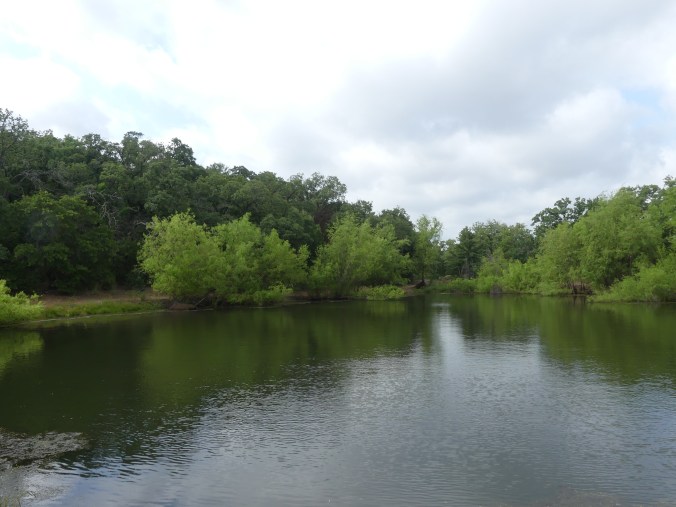
A pond at Sheri Capehart Nature Preserve, Arlington, TX
In recent years, many articles have appeared with titles saying that we are “loving nature to death.” Most of the ones I have read pertain to national parks and wilderness, but the issue applies equally to small preserves and urban parks. During the first year or so of the Covid pandemic, people lost jobs or worked from home and had extra time on their hands with fewer things to do because we were trying to practice social distancing. Many discovered – or rediscovered – getting outside.
For those of us who recognize the benefits of time spent in nature and hope for a reconnection between people and nature, more people outside is good news. But the amount of public space available for wildlife refuges, preserves, and nature parks did not increase. Neither did the budgets for taking care of such places. As a result, public natural areas have to contend with more traffic and the accompanying litter and the impact of our camping spaces, fires, new “rogue” trails, and other wear and tear.
There’s a little preserve in Arlington where I volunteer. (And my comments here are my own and do not necessarily reflect the thoughts of the group that I am affiliated with.) I spend a lot of time there because it is near my house. I have walked its trails, sat watching and listening, and become very familiar with its ponds, woods, and meadows. It is a resilient place, but these days it is contending with lots of traffic. That results in rogue trails, soil compaction and erosion wherever people walk off-trail, litter, issues with dogs and horses, dirt bikes and mountain bikes (which are not allowed), discarded or lost fishing tackle, and the occasional improvised shelter although no camping is allowed.
Green heron seen at Sheri Capehart Nature Preserve
Urban nature preserves and urban parks share some similarities, but they are also fundamentally different. The preserve is land set aside and protected in a nearly natural state, so that people can see how the surrounding land once was and can enjoy some of the communities of flowers, trees, and wildlife that are part of our heritage. You can see it as a living museum of natural history, letting us experience the place like it once was, at least to a degree. At the same time, you can see it as our wild neighbors, the plants and animals that are our companions who deserve a chance to live alongside us at least somewhere.
Urban parks, lovely as they may be, are usually modified for human use so that little of the original nature remains. There may be lawns, sidewalks and soccer fields, jungle gyms and ponds with domestic ducks. We need such parks, but they are not nature preserves. We might be urged not to leave litter, but hardly anyone feels the need to say, “leave no trace” of our visit there.
By contrast, many of us would urge each other to leave no trace when we visit wild places and nature preserves. There is an important movement that promotes this idea, and one organization, Leave No Trace, promotes seven principles that will help us. “Leave no trace” is a plea for us to visit nature in the spirit of cooperatively and respectfully sharing a space where many of our wild neighbors live and where other humans will visit. Yes, it is there for our enjoyment and learning, but it is not ours alone, and its purpose is not really entertainment.
The first Leave No Trace principle is to Plan Ahead and Prepare. In a small urban preserve that might mean taking the time to review the preserve’s rules, seeing when it opens and closes, and getting a copy of a trail map. Many preserves allow your dog to come if they are on a leash. Almost all prohibit motorized vehicles.
Another principle is to Travel (and camp, if allowed) on Durable Surfaces. In small preserves this translates to “stay on the trail.” Wandering off-trail means trampling plants, compacting soil, and creating conditions where rainfall will erode the soil away. When a place gets trampled, others assume it is a trail, and soon there is a “rogue” trail. When a small preserve gets criss-crossed by lots of such trails, serious damage is done. From wildlife’s perspective, there is no safe place away from people. The habitat that these animals use is of much lower quality, and when rain comes, there will be much more erosion.
Next is Dispose of Waste Properly, and simply put, it means everything you pack in should be packed out. It’s easy to bring a small bag in your backpack or even your back pocket so that you don’t leave litter. Snack wrappers, water bottles, fishing gear, even Kleenex should be bagged and taken with you. I know that when fishing line snags and breaks, it can be difficult to retrieve it. However, hooks, lines, and lead sinkers are responsible for many wildlife injuries , and hooks can cause human injuries. And here’s another difficult but important thing: use the bags provided to pick up your dog’s waste. If it is left in the preserve, not only is it unpleasant, it is potentially a source of new parasites for wildlife. (The waste from the resident wildlife contains stuff that’s already found in the preserve, things the residents are already adapted to.)
Trash near a pond’s edgeFishing tackle abandoned at the pond
The Leave What You Find principle means leaving the living things how you found them, and don’t introduce non-native species. It also means not collecting artifacts like arrowheads and not “tagging” or carving initials into rocks and trees. We all have a tendency to think, “It’s just this one little thing, it won’t hurt anything.” But if you dig up a few plants, you won’t be the only one, and the losses add up. It’s the same with animals. That lizard might look cute, but don’t catch it! And please do not add things that did not come from the preserve. We’ve seen raccoons relocated and dumped at our preserve, and once at one of our national grasslands I found someone had released goldfish into a pond. They probably thought they were doing the fish a favor. When we add things or take things away from a natural community, the negative consequences might not be easy to foresee.
A boulder with graffiti at the preserve
Minimize Campfire Impacts, in small urban preserves, really means “don’t,” because making a fire is almost certainly prohibited. There is the risk of a fire spreading and also the gathering of firewood and tinder removes homes and hiding places for small wildlife.
The next principle is to Respect Wildlife. Every time we see a photo of someone taking a selfie with a bison, we are reminded of how much people misunderstand wildlife. In general, if we are far enough away they may ignore us but if we get too close they may respond in self-defense and we (or they) may be hurt. Or our getting too close may disturb nesting, courtship, hunting, or other important activity. We should not only be aware of how we may affect wildlife, but also how our pets may do so. One reason our dogs should remain on-leash is to keep them from running ahead and investigating the nooks and crannies that small wildlife shelter in.
“Admire me from a distance and please don’t take me home”
Finally there is Be Considerate of Others. People have different ways of enjoying a small preserve, and we can try to see to it that everyone has a good experience. Some of this involves little courtesies such as stepping a little off the trail to let people pass and minimizing noises (ear buds will let you listen to music without others having to do so). If dogs are allowed in small preserves, it is crucial to keep them on-leash and do not let them threaten other dogs or people.
When you think about it, all this follows pretty naturally when we visit a small preserve with respect for what it represents and gratitude for what it provides us. I hope if you visit one of our small, urban preserves, you will keep these principles in mind. That way, those living museums of natural history can continue to thrive.