15 March 2026 – Sheri Capehart Nature Preserve 1:55-3:10pm.
A quick walk on a windy day, as the mid-80s warmth prepared to tumble back into winter for brief reminder that winter has a few more things to say. It was constantly breezy, and then the wind would gust and send the crowns of trees into a spasm of bend-and-rebound. Up close, the upper trunks and branches moved and yet were rigid, a contest between strength and pliability. From further away, the crowns of trees seemed to dance and bow to each other.
Once or twice, strength and rigidity failed and branches snapped or trunks fractured. I did not witness this and did not want to, especially not while standing below the tree. I kept an eye out for crowns that had not sprouted leaves, trees that might be dead or weakened, without the flexibility to remain standing.
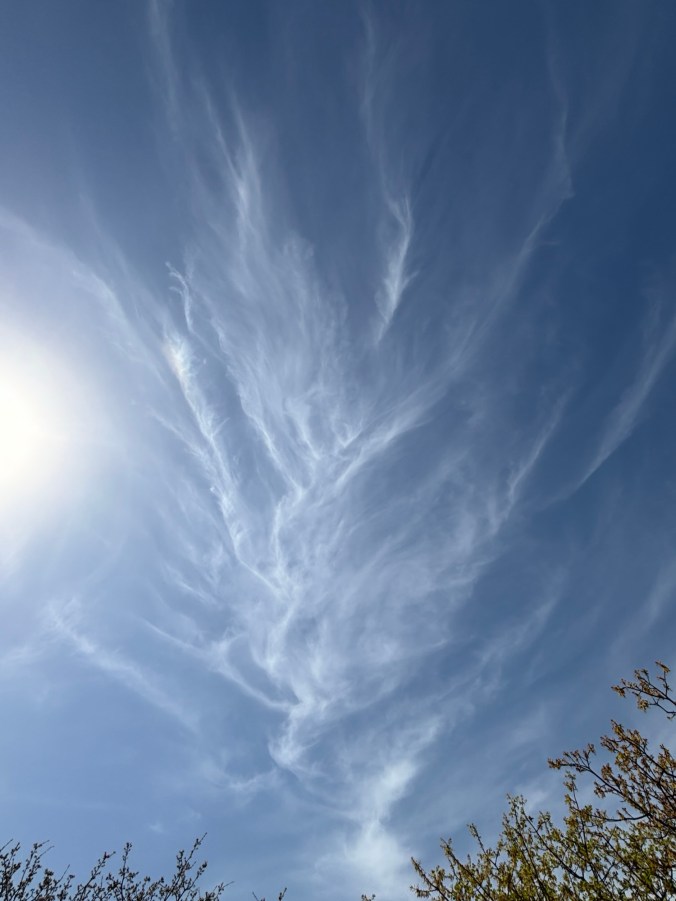
Fingers of wispy cloud
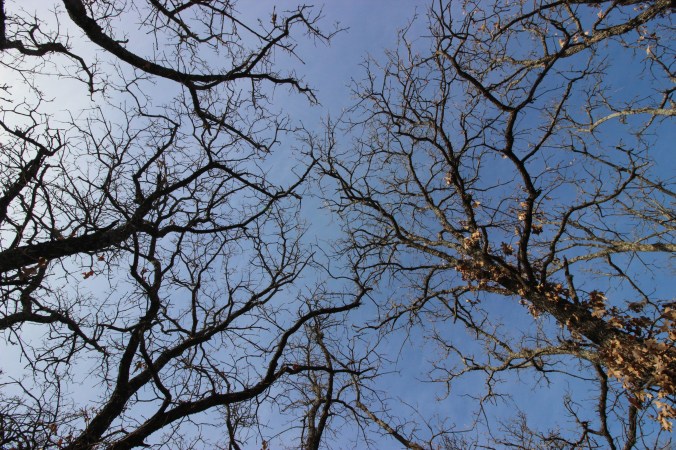
At the bluff, I lay back and looked at the blue sky whose currents above me were invisible. When we cannot see the torrents of wind or the languid movement of air on a calm day, we may forget that the atmosphere above is like the water below us. It may slide overhead like a big, lazy river or it may rush along like a mountain stream, shoving and rearranging whatever it touches. As I lay there, streaks of wispy cloud were blown in from the west, looking like fingers reaching toward us. Soon the whole hand was above us, and so I imagined the upper winds were speeding along like those at ground level.
As I walked down the south face of the hill I thought about how little activity I had seen. Even the dragonflies’ flight was no match for this wind, and the couple of birds I saw in flight were really struggling. When the wind is blowing like this, the butterflies are grounded. Even the honeybees barely ventured out of their tree.
Wind dance
For a human, it was a good time to take a walk and feel the power of the air when it is really moving. In some places those wind currents are causing trouble and damage to other people, and I wish that was not happening. Where I walked, it was no more than what the woodlands are adapted to (mostly) withstand every spring.
Yesterday I spent an hour and a half at Sheri Capehart Nature Preserve on a spring afternoon full of wonderful things. I wrote the following at the Friends of Sheri Capehart Nature Preserve blog, and I hope you’ll go visit there. But meanwhile I have reproduced it below.
March 13, 2026 – Clear sky, breezy, and temperature in the mid-70s at 3:00pm.
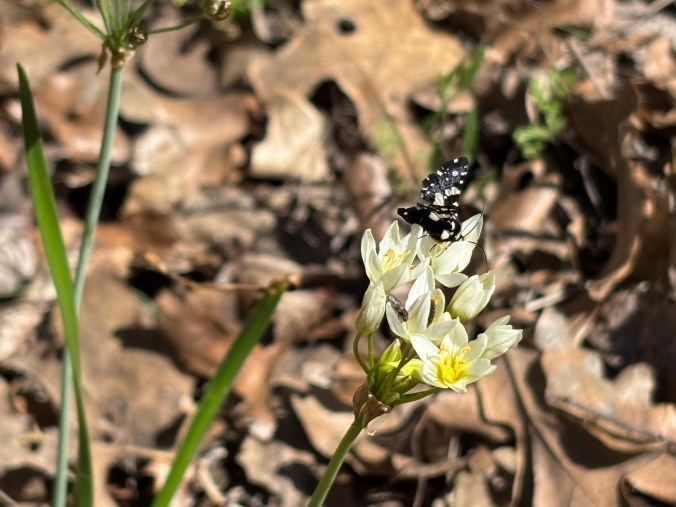
I’m starting to think of spring as beginning when March arrives, as opposed to the more official date of March 20th. Trees are leafing out and flowers are popping up like the delightful crowpoison, which grows from a bulb and looks a little like wild onion but is not. The Lady Bird Johnson Wildflower Center says, “Some references list this species as poisonous to humans. The jury is still out about its toxicity to crows.” That part about toxicity to crows sounds a little tongue-in-cheek, but it makes for a fascinating name for the plant.
A mournful thyris visiting a cluster of crowpoison flowers
The flowers were visited by several small mournful thyris moths. These are black-and-white moths that fly during the day early in the year and reportedly just for a few weeks. It’s another species with a name that makes me want to find the story, but so far I have not found a reason for it to be mournful. Even its species name makes me curious (Pseudothyris sepulchralis, where “sepulchralis” seems to refer to a sepulchre, that is, a tomb carved in rock).
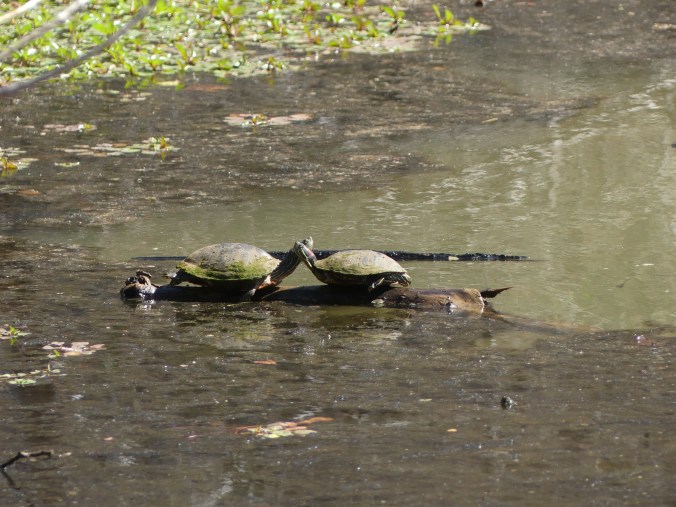
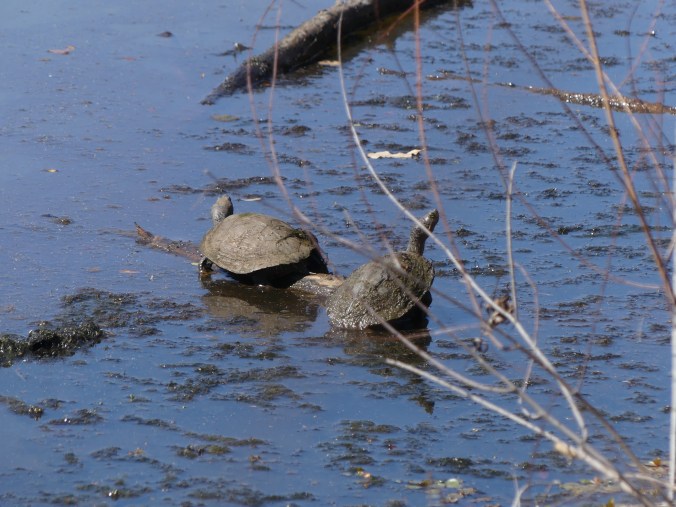
Two red-eared sliders sharing a log
Meanwhile at the north pond, dragonflies were flying and turtles were basking in sunshine, including a pair of red-eared-sliders sharing a small branch of wood at the water’s surface. Those pond turtles are active even on warmer winter days, but spring sunshine makes them seem very content – though that is a perception from a human point of view that could be completely off-base.
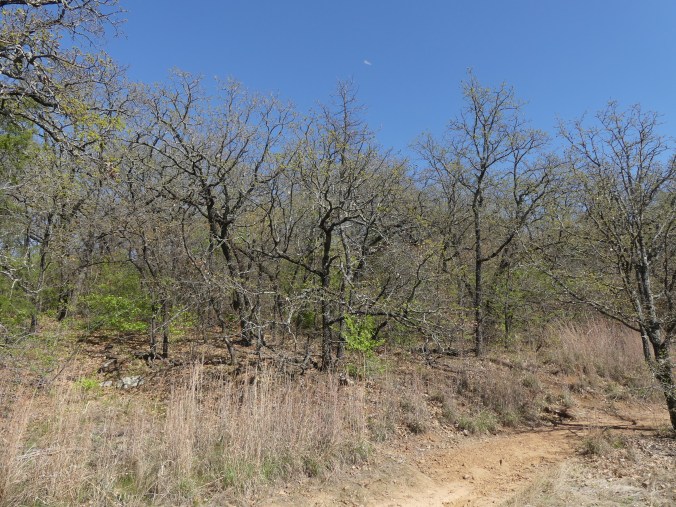
Trees with new leaves growing
I tried to capture the overall look of the woodland in a photo that, seen on a phone’s little screen, is probably very plain. But the crowns of trees are covered in a sort of mist of pale green, the budding of new leaves and the catkins of the oaks. I checked to be sure of the details because I’m not a botanist or even a knowledgeable plant person, but catkins are the dangling strings of the male flowers of oaks. They will be releasing the yellow pollen that coats your windshields, sidewalks, and noses in the coming weeks. And with any luck, they find their way to the female flowers on the oak trees, which are much less conspicuous.
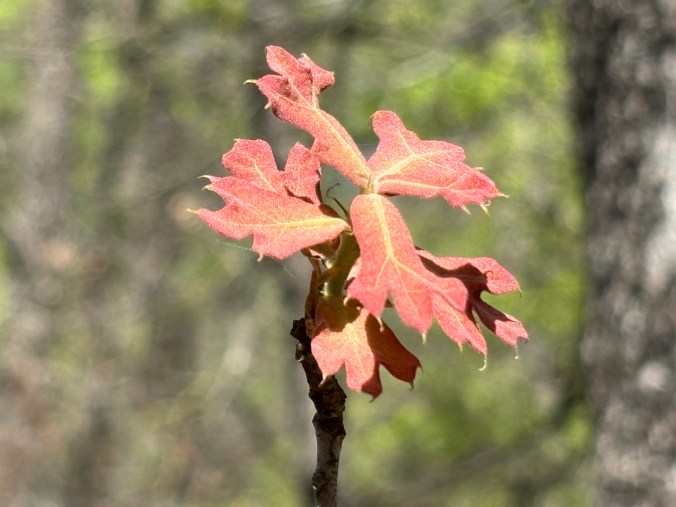
New blackjack leaves – notice the spines at the end of each leaf lobe
The other thing that always seems wonderful to me is how the blackjack oak leaves come in as little red leaves, then turn such a wonderful deep green later on, and next autumn may once again be red – or yellow or some combination – before dropping to the ground.
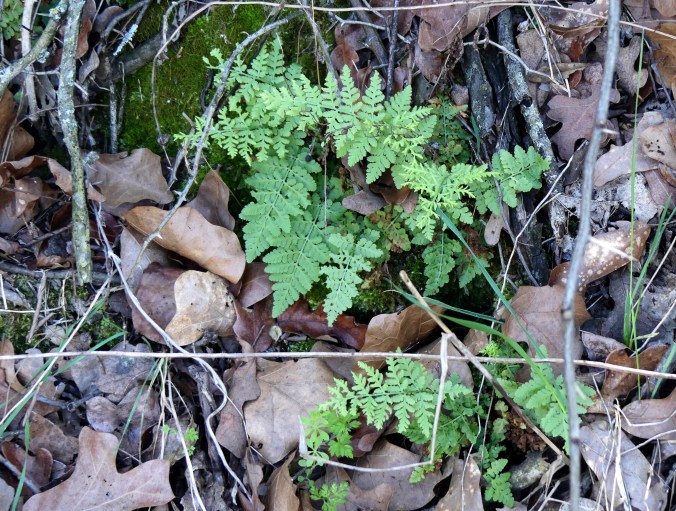
Blunt woodsia growing in a protected spot along with some moss
Along the north side of the woodland, where it meets the patch of prairie, there are shaded spots and little embankments where the land moves up toward the top of the hill. In one of those shaded places I saw a fern that you can find around the hillside and up toward the bluff. It is the blunt woodsia, also called by a couple of other common names like blunt-lobed woodsia. Finding these little ferns, or the various mosses or even liverworts, brings you to a different perspective, like looking at tiny worlds existing in the shaded places in the preserve where moisture is not too scarce.
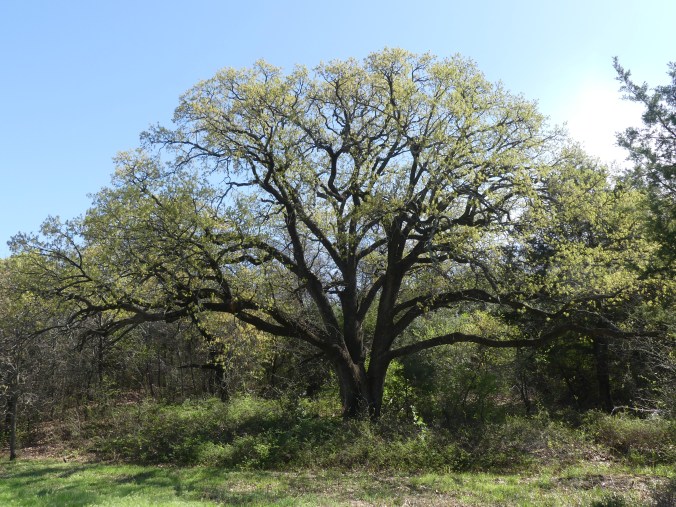
The grand old post oak designated as the Caddo oak, after the Caddo people who once lived in the area
I walked by the Caddo oak, a huge post oak designated as a historic tree by the Texas Historic Tree Coalition, and its crown is speckled with new green leaves, just as it has done every year for roughly 200 years.
Nearby, I watched a medium to large bird sail through trees and across a part of the north prairie, disappearing into understory and trees to the west. I immediately thought of the northern harrier, a graceful hawk that tends to hunt on the wing, flying low and listening for rodent movement. This bird had the right shape and the kind of flight I would expect with a harrier, and I saw that this brownish bird had some white markings but I could not spot the white band that should go across the base of the tail. So I just don’t know. I noticed that Brent Franklin saw one here at the preserve in 2018, which helps make it plausible, but of course doesn’t confirm my observation today.
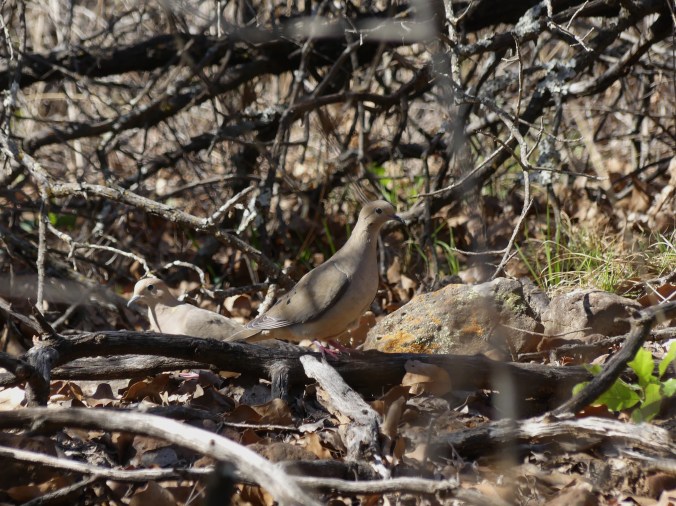
Mourning doves
Walking around the blue loop, I saw a couple of mourning doves near the boulder trail. They were behind a sort of thicket and did not seem perturbed by me and my camera about twenty feet away. They were probably foraging for seeds along the ground.
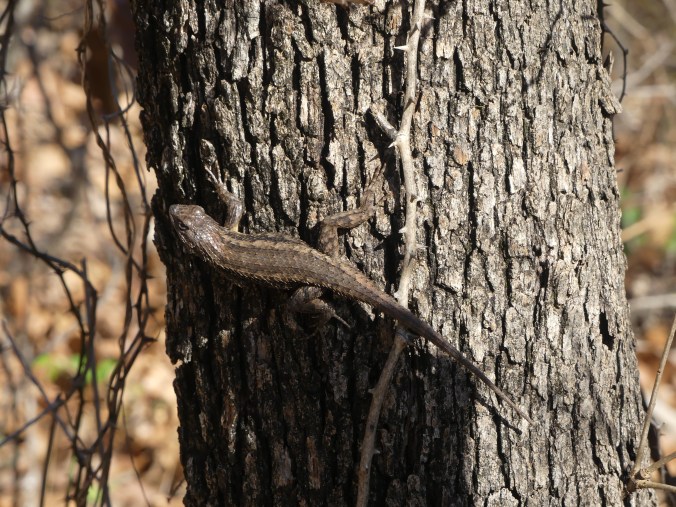
Texas spiny lizard, watching me carefully
On the way down the south-facing hill, glint of reflected sunlight caught my eye. It turned out to be reflected off the back of a male Texas spiny lizard clinging to a small tree trunk. He eyed me in that way that these common lizards do, making his best guess about whether to remain motionless and hopefully unseen, or quickly scurry around to the other side of the trunk. After I took a photo as I moved around him slowly and hoped not to scare him, he quickly scooted around the trunk and out of sight.
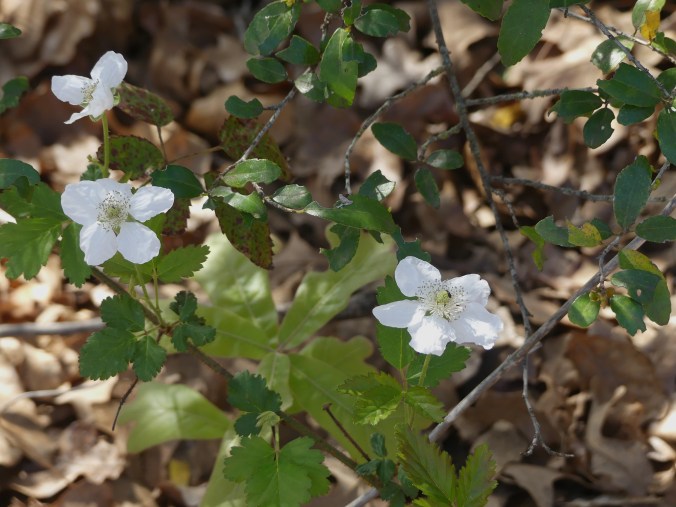
It was certainly a walk full of wonderful things today. Everywhere I went there was butterfly and moth activity, either more of the mournful thyris moths or else goatweed leafwings, sulphurs, or a swallowtail or two. And the southern dewberries are blooming with those beautiful white flowers.
Southern dewberry, which will feed birds and other wildlife later in the year
Climbing to the top of the hill, I pass some friends I see often when I walk this trail. They aren’t people, they are other-than-human relatives like the bees in the bee tree. And the tree with the hole at the bottom like a window into a shelter where a woodland sprite might live. The blue jays hollering at each other like schoolboys, and on really warm days, the Texas spiny lizard hanging on to a tree trunk watching for an insect to eat.
Many Native American cultures see the rocks, waters, trees, and wildlife as our relatives, and many of the rest of us are beginning to understand that wisdom.
From year to year I can count on these friends. No matter how crazy the world gets, they are nearby, doing what they do. It is never boring. That is partly because each season is different. The winter woodland is full of bare branches and beautiful brown colors of the leaf litter on the ground, with the calls of crows and songs of cardinals. It’s the deep blue water of the pond, with sparkling ripples from the winter breeze.
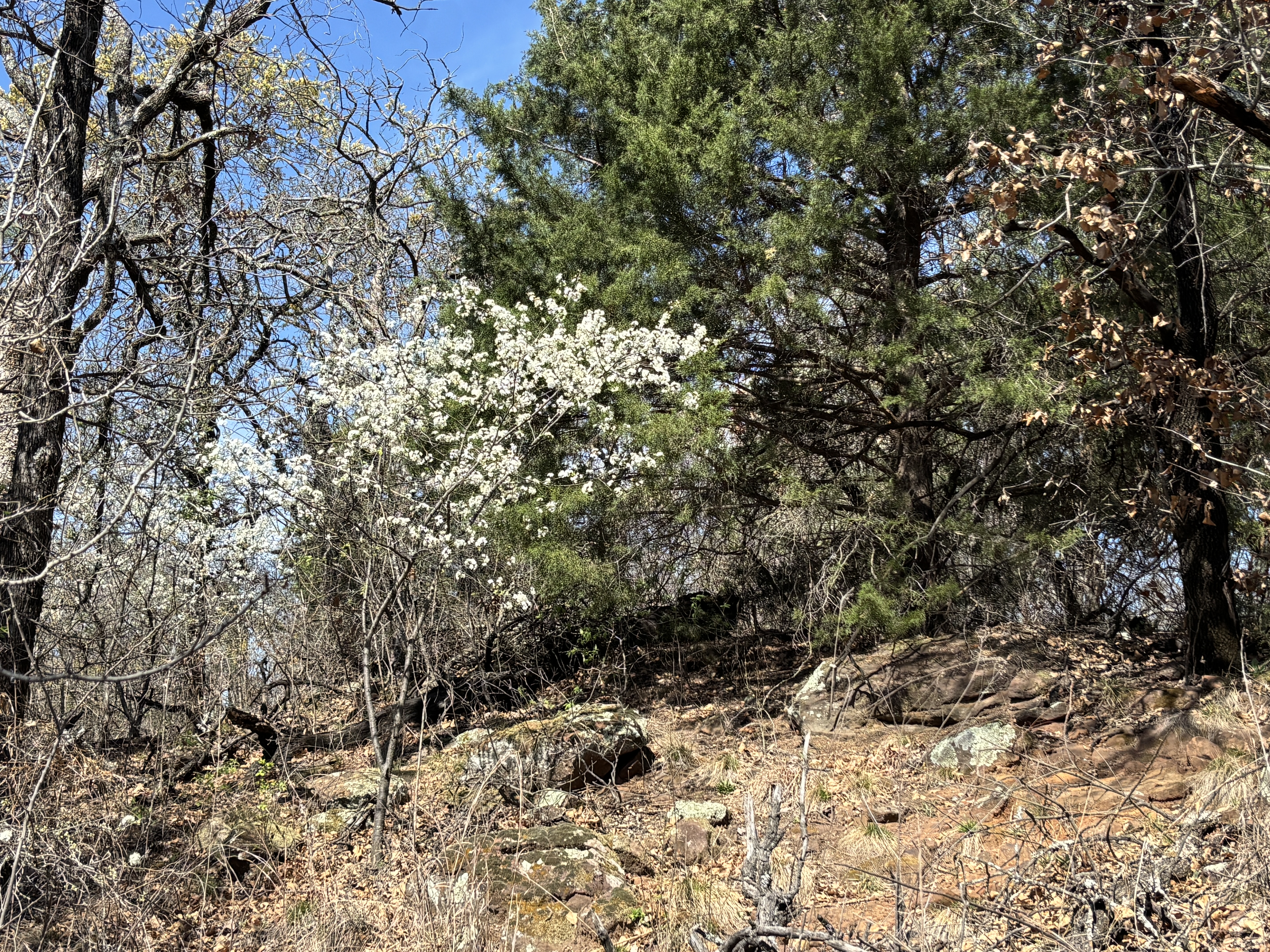
Flowering plum and juniper on a hillside
In spring, the angle of sunlight changes and the branches and twigs swell with leaf buds. Plum trees bloom and later, flowers like spiderwort, spotted beebalm, and toadflax cover the soft, sandy soil. The air is sweet, and the night comes alive with frog calls.
It keeps on like that in every season. The peak time for one thing ends, and a new thing begins, like a kaleidoscope in which each turn of the season brings a new pattern and new colors, and each one is beautiful.
The place is never boring, even after visiting it for twelve years. I walk past the same oak trees, say hello to the same Glen Rose yuccas, and I might see some of the same crows (I can’t tell individual crows, but they’re observant and smart, and they can recognize individual humans). It’s a comforting stability, with old friends and places that won’t disappear.
Red-eared sliders
I think that sometimes when we are restless and need some new diversion, some new thing happening or new stuff to buy, it’s because we are anxious or feeling low even if we are not aware of it. We want to maintain this distraction from our distress, and if we don’t get it, we call that boredom. It’s like we’re careening downhill in a moving vehicle trying to dodge random crises, and we want something to take our minds off the fear and not fall into despair.
Something that I think helps is to find islands and refuges of stability. That could be friends and family who provide companionship, steadiness, judgment, love, and support no matter what. It might be found in works of music. And I think places in nature can give us a sense that the world contains goodness and that some good things will not abandon us or be taken away.
In nature there are many places we can get to know and count on. A creek does not pretend to be someone they are not, and a prairie will not “ghost” you. The woods will not assail you with news of conflict and violence, and the pond will gladly let you be still and watch the shimmering reflections of trees as the breeze kisses the water’s surface.
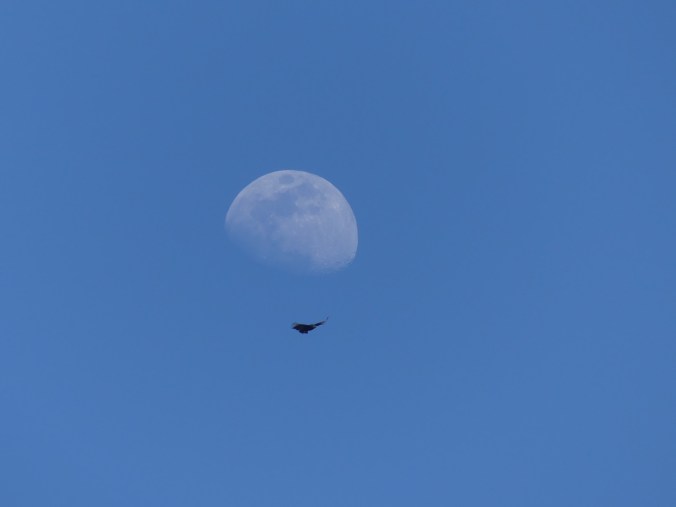
A black vulture and the moon
When you go there and stand among the trees or sit beside the water, it helps to be there fully, mind and body. If we can’t let go of the worries about tomorrow or the discomfort of something that happened in the past, we will barely be awake to the woods and ponds. That’s where mindfulness comes in. By paying attention to breathing, we bring ourselves into the present, and by noticing our thoughts and feelings, we can release them and not be caught up in them. And as we stay in the present, accepting whatever is happening without wanting to change it or add to it, those moments can be wonderful. They can be healing.
Some notes from my walk on March 3rd: “Walking around the crown of the hill, I got a look – from 30 or so feet away – at a roadrunner who looked at me warily and then ran on along the trail. There are butterflies, the bee tree is busy, and at least some oaks are starting to leaf out. Lying under bare oak branches and a blue sky with wispy clouds, at least twice I felt the tiniest sensation of a droplet on my face, and there is a very small drop, crystal clear, on my glasses. I suppose it might be rising sap released where buds are starting?”
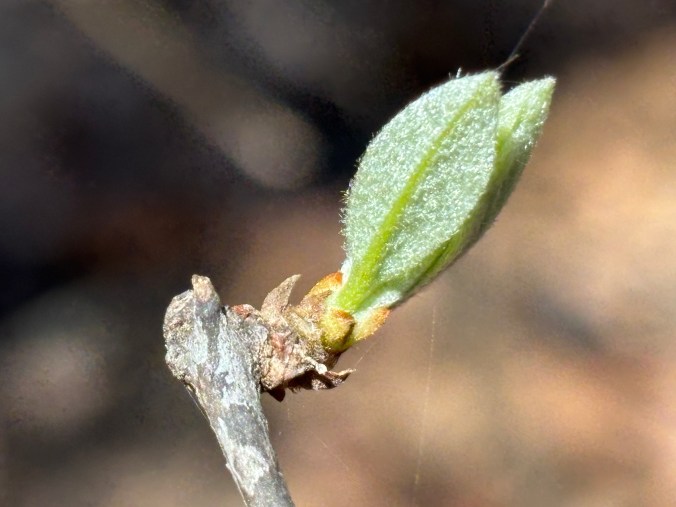
Newest leaves in spring
Each season is a deepening relationship with this preserve and all that lives there. I hope that you have such a place, whether it’s a National Grassland with thousands of acres or a little patch of wildness in a city park. Get to know it, let it seep into your bones so that you’re like family to each other. Bring your human family, too, and get to know each other.
I shared part of a weirdly warm winter afternoon at Sheri Capehart Nature Preserve with a wading bird who was hunting fish in the pond. As usual, on the way to the pond I found strange and beautiful shapes in the winter grasses and forbs*.
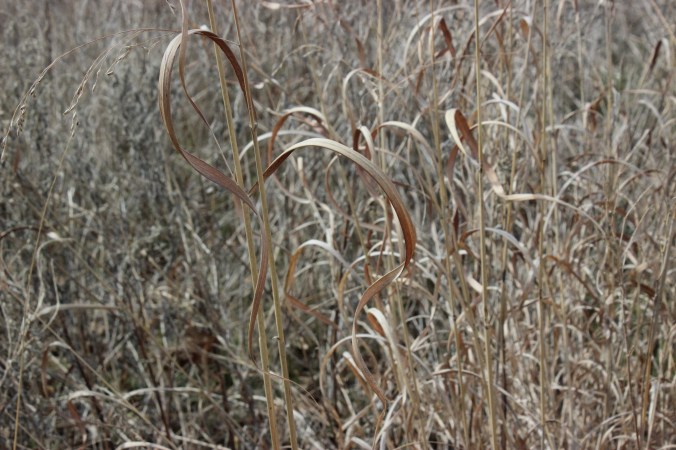
Winter highlights some of the graceful and interesting shapes that we can find in plants. For example, the leaves of switchgrass remind me of curled ribbons. Many of them arc downward in graceful twists. The Lady Bird Johnson Wildflower Center describes switchgrass as one of the primary native grasses of the tallgrass prairie, growing an amazing three to ten feet. You can get a sense of that at Fort Worth Nature Center and Refuge. There are places within the demonstration prairie where the fine, slender seedheads of switchgrass tower overhead.
Curling leaves of switchgrass
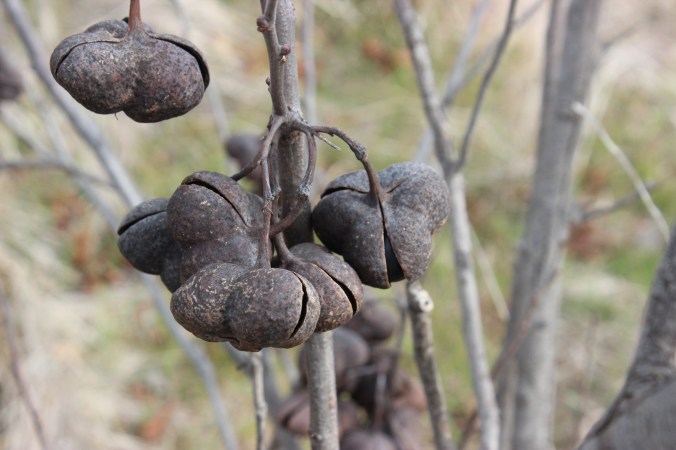
I also saw one of the Mexican buckeyes that grows on the preserve. The trees are typically small and are recognizable in winter by their clusters of big, three-lobed seed pods. By now the pods have cracked and the toxic seeds the size of small marbles are still inside. Parts of the plant may be toxic, but the clusters of pink flowers that will emerge in a month or so are beautiful.
Seed pods of Mexican buckeye
It is a short walk to the south pond, but these things hijack my attention and so the walk takes some time – and it is time well-spent.
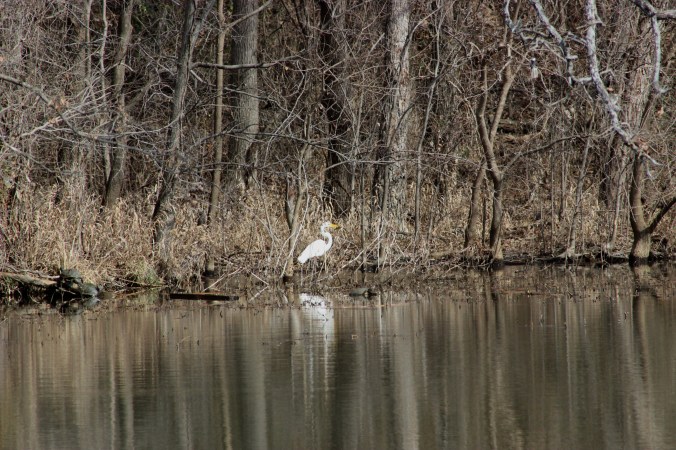
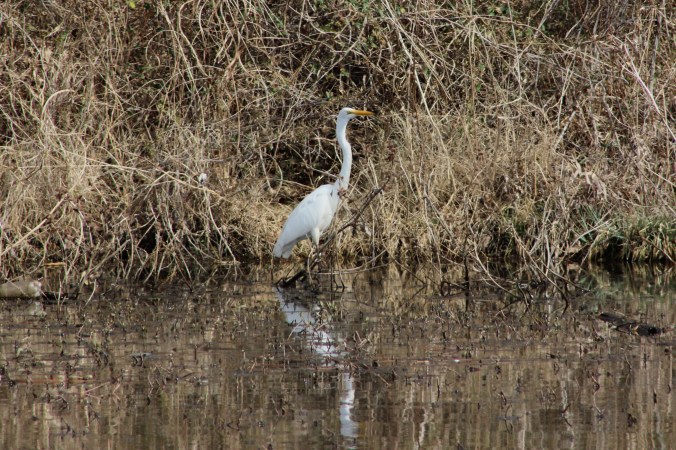
The great egret was wading the pond when I arrived, searching in the water for small fish or the bigger invertebrates that live there. Spotting me, he (or she) flew a little further away and continued his fishing. What an amazing bird! The great egret spends time in shallow water, mud, and algae while remaining white as snow. The bird moves forward in the most deliberate, stealthy way, with those yellow eyes watching and a bill like a long, yellow dagger ready to stab into the water, propelled by an impossibly long neck.
Great egret with a sunfish held in its bill
Sometimes the egret was motionless, a bright white ghost seen through dried yellow and brown reeds and brush. And then he moved like an apparition, lifting one black leg and taking a step, and then the other, soundlessly gliding across the shallows. Without warning the yellow dagger stabbed into the water and brought out a small sunfish.
If you have noticed sunfish, you have seen that there is a dorsal fin on top of the fish, and that fin starts with a series of tough, sharp spines. When caught, that fin is pulled forward so that it is erect, hard and sharp. The fish itself is tall, not bullet-shaped, so that it is painful to imagine swallowing one. But that is what great egrets do.
There was a minute or so in which the bird’s neck twitched, perhaps as the fish struggled going down or as that long neck tried to shift the fish to a more comfortable position. I figured that the egret had been able to get the fish into a head-first position in its mouth, because any other way seemed so much more difficult.
The great egret
And then the egret resumed that patient, slow strategy of fishing, moving like a ghost into some emergent vegetation and remaining motionless.
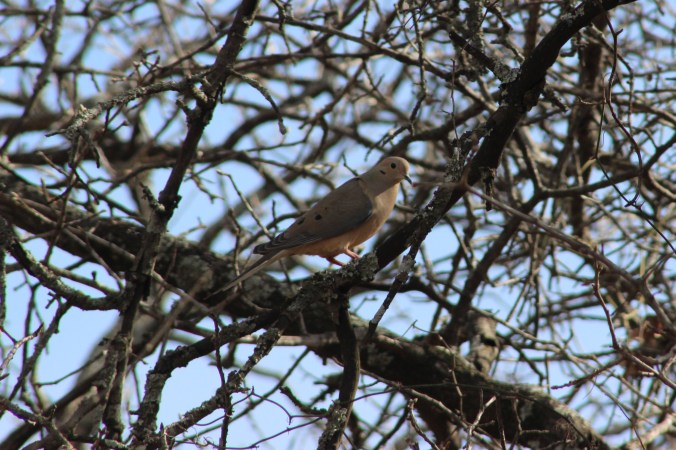
It was time to walk up the hill to visit all the familiar spots, the oaks and “toothache” trees, the bee tree, and all the rest. At the base of the hill a mourning dove walked the trail and then flew up into a tree. He called that familiar, soft call: “oo-woo-oo” followed by “oo-oo.” The notes sound as though they might be made by an alto recorder, that wooden, flute-like instrument you hear in some baroque and renaissance music.
Mourning dove
The call is very musical and we usually hear it as lonely or mournful, and so the bird is called a “mourning” dove. If we heard those notes from a human voice, low and soft, dropping a little, most of us would hear some sadness and loss. That is how our brains are tuned to recognize emotion in voices, but it’s good to be aware that it reflects our brains, not a dove’s brain. Perhaps the bird is saying, “hey, let’s hang out together, maybe get a pizza.” We can still be moved by hearing mourning doves at sunset, imaging a lonely voice in the gathering darkness singing about the weight on its soul. I’m sure the doves don’t mind.
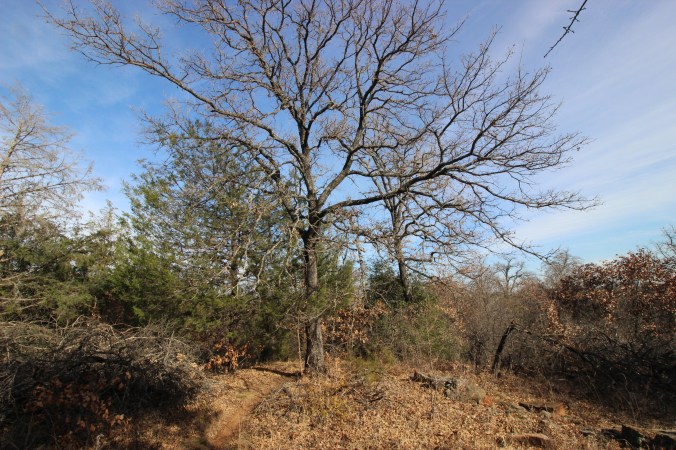
From the top of the hill, one trail threads past some boulders on its way down, and I sat for a while soaking in the low sunlight reflected off sandstone, bare trees, and dried grasses and forbs. I will miss this quality of light as spring arrives and the sun stays higher in the sky. I also noticed another smaller trail that disappeared under the trees and low juniper branches. And I imagined other lives in other bodies using that trail, the raccoons or the occasional fox or rabbit who wander this place, mostly when the people go home.
The little trail beneath the tree
I wonder what they think of the big people who share this space with them, who seem not to hunt, not to fear predators, but just move among the trees and prairie patches. Some jog, some walk their dogs (triggering wariness and fear among the animals that live here), and some go from flower to tree, from dragonfly to moss, stone to bird, as if they cannot get enough of this patch of creation. “Oh hi, rabbit – I see you watching me. Thank you for being part of this place.”
So that was another day wandering this little patch of creation for a while, having the privilege of sharing the pond with the egret and seeing some of the beautiful shapes and forms of plants in winter. It never becomes repetitive, and hopefully these words and photos convey some of that freshness and beauty.
* That word, “forb,” is not one that most of us easily recognize. Nature folks may know it, and certainly botanists would know it. According to Etymology World Online, forb comes from the Old Norse word “forbær”, which meant a fodder plant. Back then it referred to any of the plants used for animal feed, but later it came to mean a herbaceous plant other than grasses and sedges.
I have experimented with writing letters to you, because I want to communicate about nature and I love the idea of doing so in a personal way. I started with Letters to Nature Kids, which are short and informal “letters” about being out somewhere, or about how nature experience is related to gratitude or coping with fear, and so on.
This latest one has to do with all the small wonders we can notice when out for a winter’s walk. Finding a half-hidden lizard or noticing a tiny shell and tracking its identity down (it was a Texas liptooth) make a walk fascinating, even when the discoveries aren’t very dramatic. Being able to notice and appreciate small things is a valuable skill, and the letter is an attempt to show that this is true.
I notice that these letters get downloaded fairly regularly, but I rarely hear from anyone about them. That makes the whole thing very experimental – writing for the reader who I imagine might read it but not really knowing how a reader felt about it. If you wanted to bring the whole idea of a letter closer to reality, you could write back to me. One way would be to use the contact page here, or there is an email address at the end of the letter. Then we would be having something closer to a conversation, and I would be very grateful for that.
But if not, it’s OK. My hope is that the letter gets read, and that it gets the reader thinking about things and wanting to get outside for a walk.
We had black-eyed peas and cornbread at my house today, like many people do on New Year’s Day. It’s supposed to bring luck, and we can use all the luck we can get in the coming year, so I’ll throw a bit of salt over my shoulder if it will help.
And after lunch I took a walk in a lucky place, a familiar place that I thought should be visited at the start of the year. Sheri Capehart Nature Preserve is clearly a lucky place. It escaped the bulldozer and remains a little fragment of the original oak woodlands and little prairie openings while everything around it has been scraped, paved, and built to become streets and houses. It’s a survivor. And it’s a talisman for all the people who have spent time there and become rejuvenated, charmed, educated about the living world, calmed, or inspired during their visit. So, to start the year off right, I made a loop to the north pond, up to the bluff, and back down the south side of the hill.
It felt somewhat warm but looked like winter. It was 72 degrees in the area, but long, gray clouds with filmy edges stretched across the sky, and the sun shone in a diffused way through part of them, like a light behind a thin cloth. This sky would have been a match for a winter day with temperatures in the 30s.
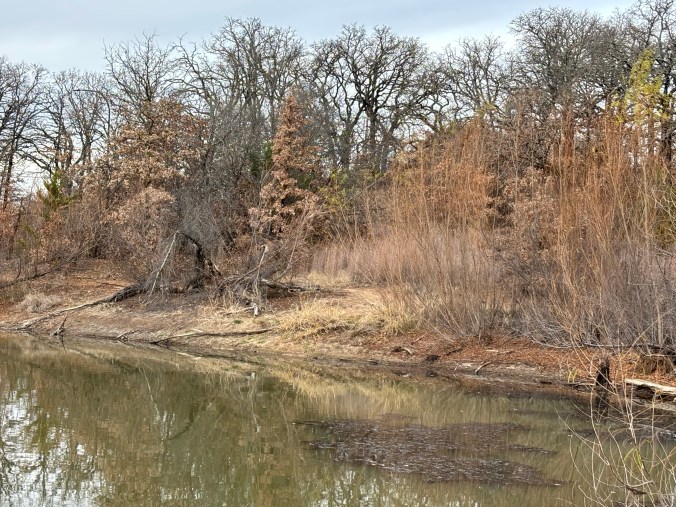
The shrinking north pond
The north pond has become smaller and more shrunken as the weeks have gone by with no rain. I skirted the water and climbed the hill behind it, and then sat for a little.
Sitting looking south toward the pond
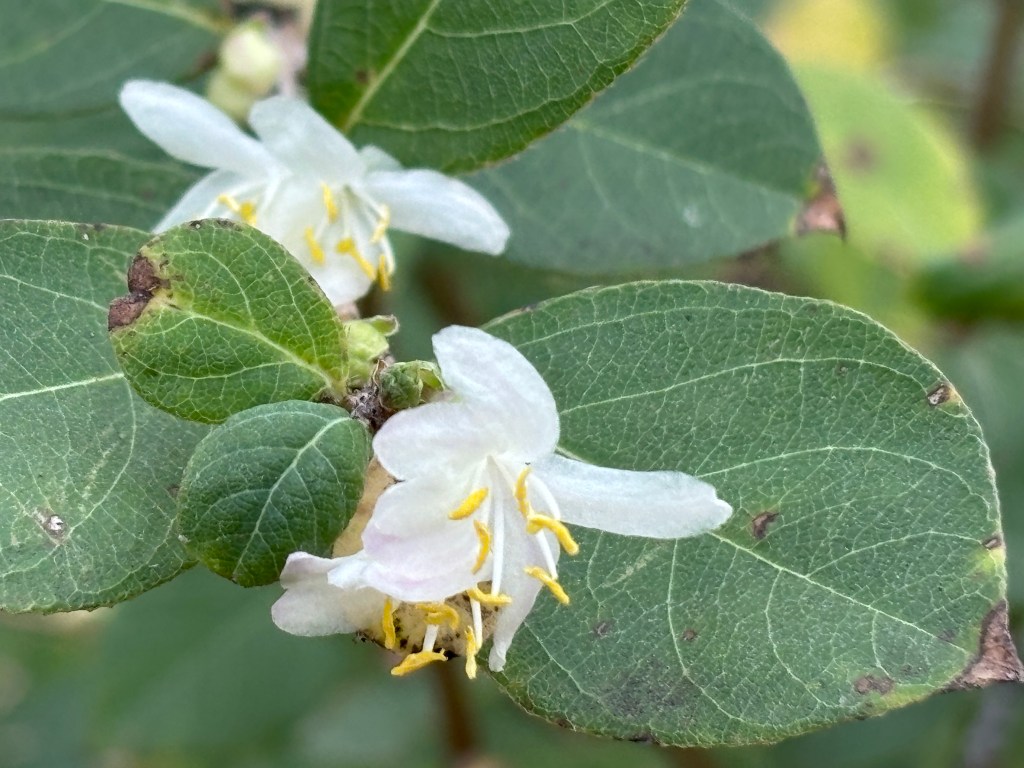
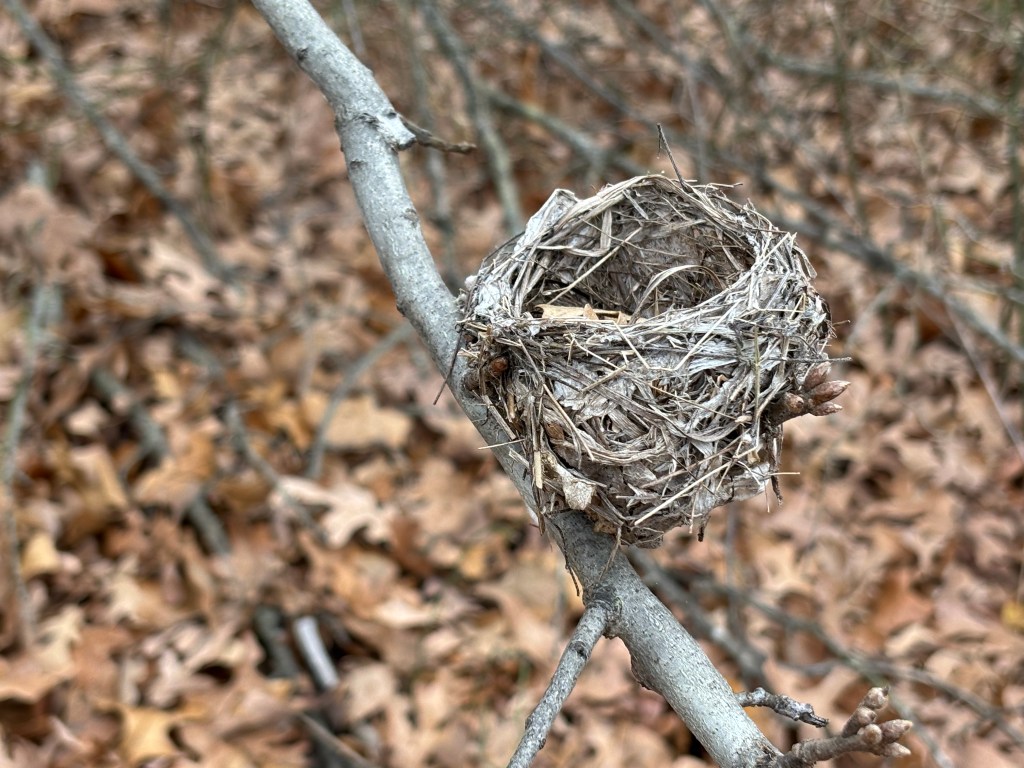
After that, I walked eastward along the north prairie. On that walk at the edge of the woodland, honeysuckle was beginning to bloom. And really, how can you blame the honeysuckle for such a crazy thing, when we’ve been breaking records for warmth. So the preserve can be forgiven for sending out mixed signals like this. I also noticed a very small bird nest from last year, now plainly exposed in a low branch after the leaves have dropped. I hope it brought the birds good luck.
I climbed up to the bluff, where there is a spot nearby that is great for sitting, writing, or just being there. As I sat, pulses of breeze came through, a whoosh of air or hiss in the branches and a papery rattle as the breeze scattered a few leaves on the ground. And a butterfly blew in, a painted lady (or maybe American lady) that landed about eight feet away and rested briefly before taking flight on the wind.
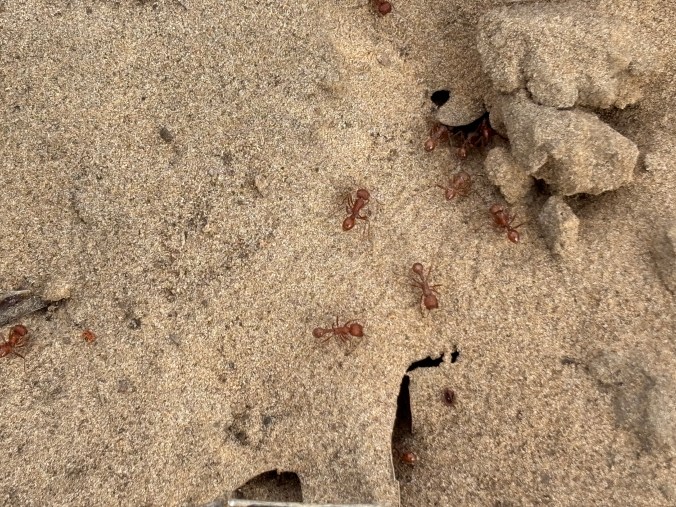
Comanche harvester ants
More insects were busy today, like the bees coming into and out of the bee tree. Maybe they found the blooms of honeysuckle, or maybe they were bringing water from the pond back to the hive. The colony of Comanche harvester ants was clearing another opening at trailside and maybe searching for a few more seeds.
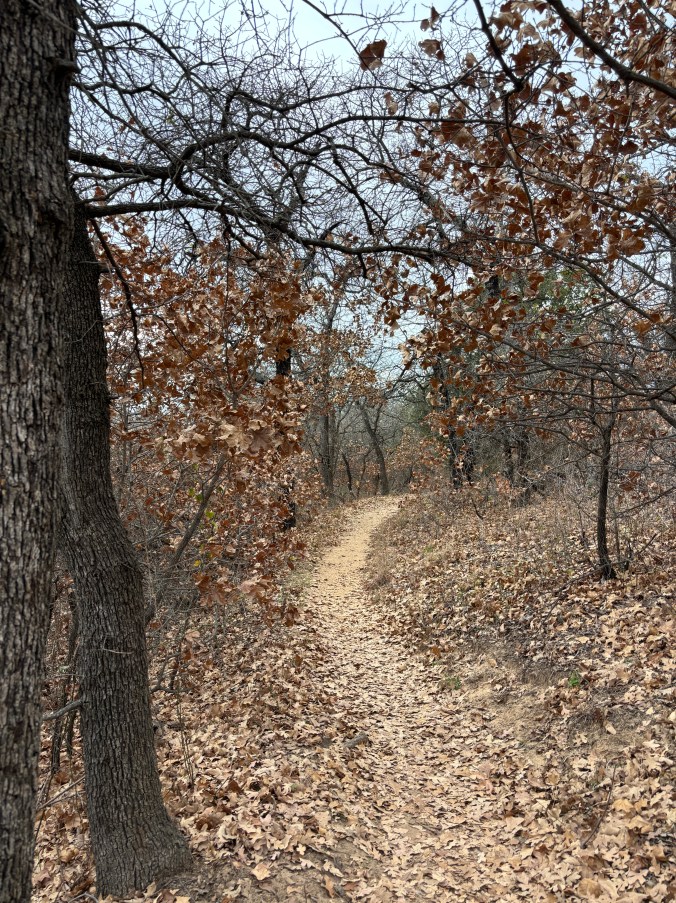
Path curving around the hillside
My walk lasted just over an hour, but it was enough. Now 2026 is off on the right footing, with a little time in nature along with that southern tradition of black-eyed peas and cornbread. May we all have a good, healthy, peaceful year in the coming months. It’s not too late for a walk at the preserve, and you can come by for some peas.
After the warm days of October and November, now we are seeing a bit of cold with a first freeze (barely, in some places) yesterday morning. And it is December now; in the “meteorological” way of tracking seasons, winter starts on December 1st. Most of us use the winter solstice, December 21st this year, as the boundary between autumn and winter, but North Texas is at least hearing a few rumors of the winter to come. And that calls for a walk somewhere, putting our ear to the ground to listen.
I walked at Sheri Capehart Nature Preserve, eastward along the “yellow” trail near the big pond and then turned and walked up through a tangle of woods to the “blue loop” and back toward the boulders. It was 63 degrees, a jacket needed only when the breeze blew. The place was full of sun and damp sand, native grasses going dormant and a coolness that balanced the sun perfectly.
In my journal I wrote “Phenology Note” on a sketched calendar page, and made a few notes about the trees and leaves. “The trees are still mostly leafed out and green. Many oak leaves are tinged with caramel …. Some trees look ragged but we’re still waiting for autumn color and/or leaf drop.” Back near the parking lot, many of the cedar elm trees are becoming bare, but the oaks seemed barely touched by autumn.
Phenology is the study of seasonal events in nature, and so looking back through a nature journal can show how the seasons change from year to year in a place. What’s the average time when trees lose their leaves, and how much is climate change pushing such events to new places on the calendar?
Some caramel color or a tinge of red in leaves that are mostly still green
Using a journal in that way puts me in the mode of science and data, my thoughts separated from emotions about climate change as if severed by a scalpel. But journaling can – and I think should – be more than intellectualizing. On a good day I’ll make room in those pages for what I miss from a time when life was anchored by things you could count on. Winters could be hard or they could be mild; summers might vary in how hot or dry they got; but after whatever variation in the weather, we always returned to an arithmetic mean, an average that we all recognized as something we could count on. But now the math isn’t our friend, and the arithmetic mean is shifting upward and we don’t know what we can count on.
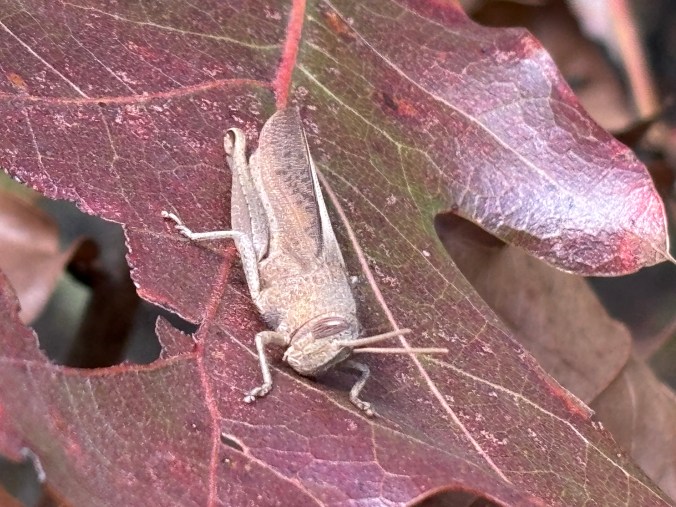
I kept walking, looking and listening for wildlife. A one-minute sample using the Merlin app detected no sounds of birds. I did find a delightful grasshopper resting on a leaf turned nicely red. Uploading a photo to the nature app iNaturalist, the insect was identified as a “mischievous bird grasshopper.”
The mischievous bird grasshopper
Now this was a find – what kind of mischief does this sort of grasshopper get into? This particular one was sitting motionless, perhaps too cool for tomfoolery and just feeling lucky to have survived yesterday’s freeze. Adult grasshoppers often don’t survive winter except as eggs deposited in some protected spot, although with increasingly mild winters, more adults like this one might get lucky.
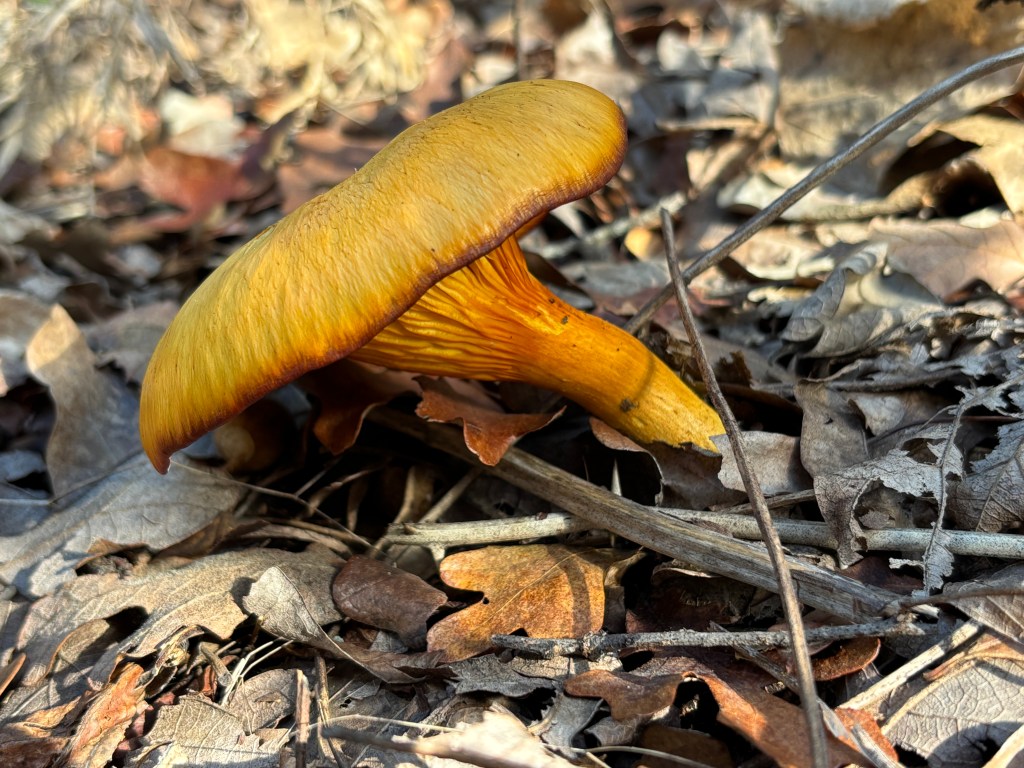
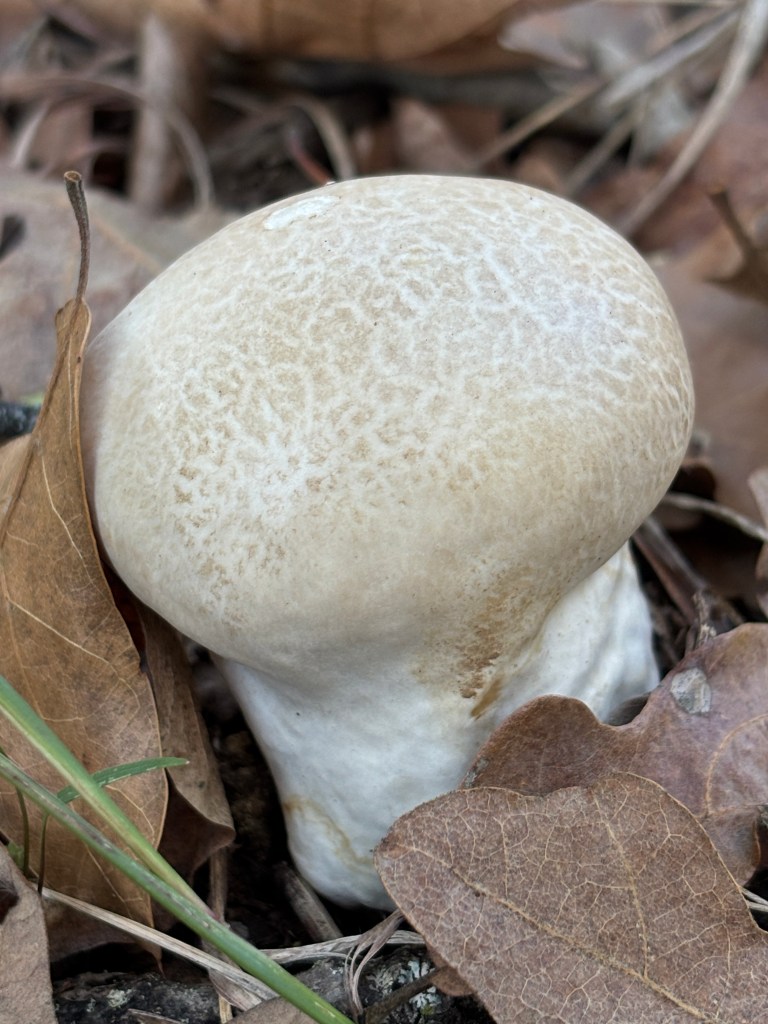
southern jack o’ lanternunidentified mushroom, probably genus Calvatia
I wanted to follow up on the walk with Logan a few days ago in which we saw southern jack o’ lantern mushrooms. In that particular spot we visited, mushrooms were still there. It might be some particular combination of the right soil, shade, and moisture, but that place stood out with all those mushrooms. There was even a new one of a different sort. According to iNaturalist, it was a type of puffball mushroom. I want to go back to see if it matures to rupture and release a tiny cloud of spores.
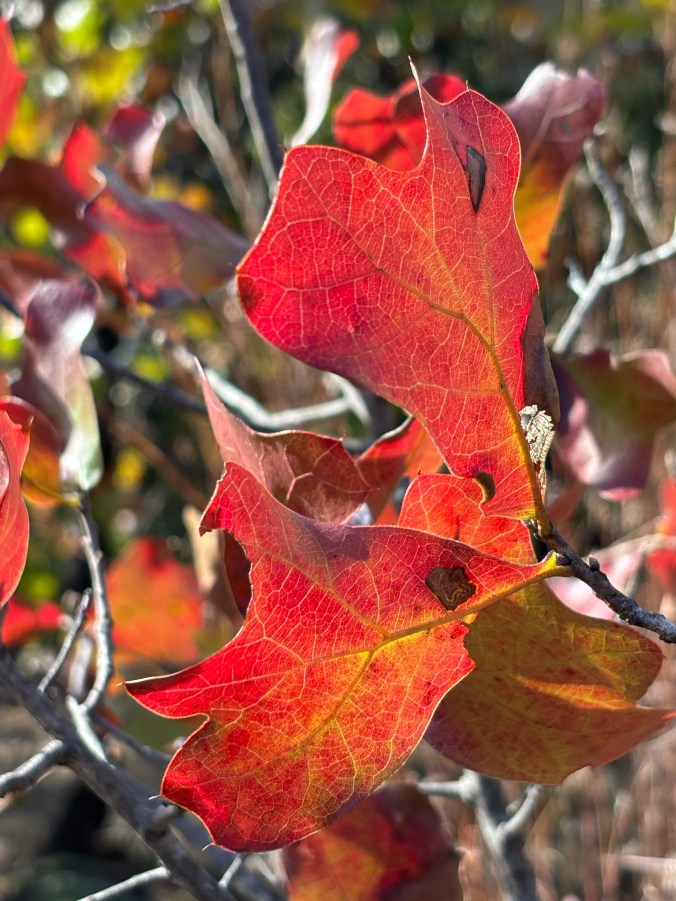
Even without a lot of fall color, there were places where the bright, slanting December sunlight backlit a group of leaves and created a dramatic display of color. Going slow, we can notice so many small and wonderful things.
Beautiful blackjack leaves
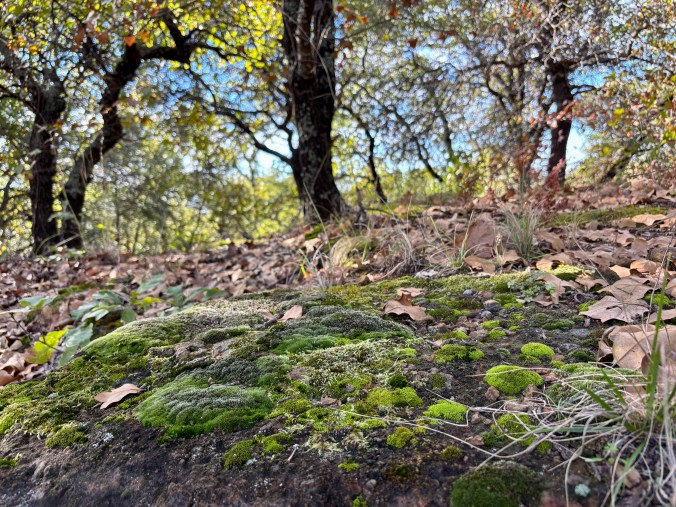
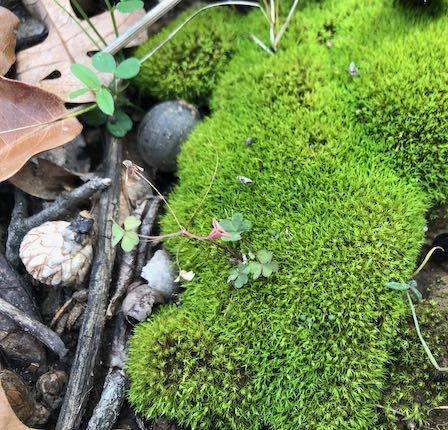
And that includes the mosses. After the way Logan brightened with every new patch of moss he found, I was attuned to them today and really appreciated how they grow on the sandstone up at the bluff. Looking at some boulders was like seeing a miniature topography of meadows and hills.
I also noticed, on the way down the hillside, that the bee tree is active again (there were no bees visible on that cool and cloudy November 29th). I stood for a moment, imagining the extent of the hollow space within that tree, and all the honeycomb built within the spaces, and all that honey!
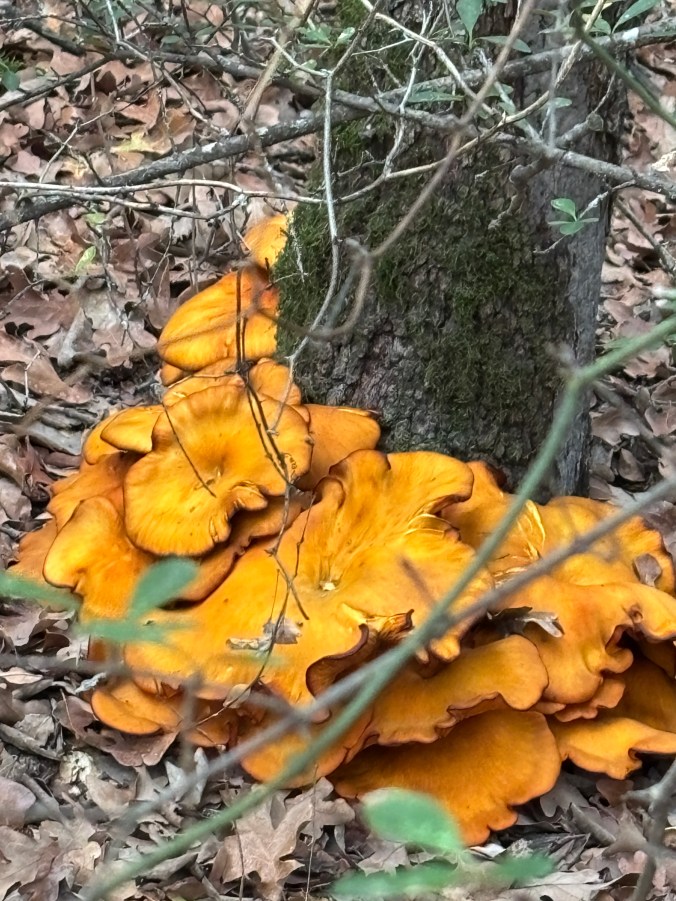
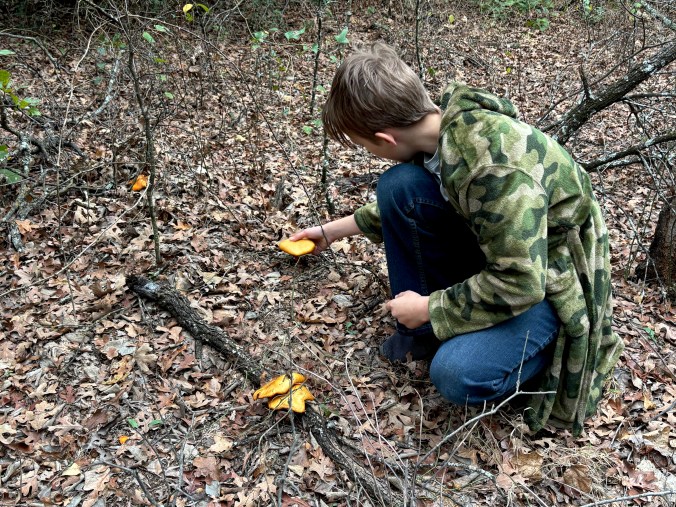
Yesterday we found several golden orange jack o’ lanterns in the woods, though it’s been a month since Halloween. There were no carved faces, just smooth clumps of orange. My young friend was delighted to find all these mushrooms, just as he was with all the mosses growing in the woodlands. And I was, in turn, delighted to watch his excited discovery of these small wonders.
Southern Jack o’ Lanterns
The “southern jack o’ lantern” is a large mushroom that grows from wood, often in clusters at a fallen tree limb or at the base of a tree. They’re common from summer through autumn at Sheri Capehart Nature Preserve, which is where we were. It has been very dry from late summer through much of autumn, but now that rains have come, orange mushrooms are popping up.
A Missouri Department of Conservation website says that the southern jack o’ lantern is bioluminescent, so that “the gills of fresh specimens may sometimes give off a faint greenish glow at night or in a darkened room.” It would be fun to return at night and see if we could observe that.
A big cluster of jack o’ lanterns that Logan found and photographed
We are used to seeing a plant or animal that we can point to, whose body or structure is gathered together in one place as one “thing.” However, with fungi it’s more complicated. For much of the year, the jack o’ lantern is a network of tiny filaments and threads running through soil and decaying wood – the mycelium. If I said, “show me a jack o’ lantern,” you would have to dig in the soil or turn over a rotting log to find those little fungal threads and say, “well, there’s part of one.” The mushroom itself is just the reproductive structure, producing spores that are almost (not quite) like seeds that will grow tissues that will become a new fungus. So a mushroom is a little like a flower – the part that catches our attention but is only the reproductive part of a larger organism.
Logan takes a closer look at a jack o’ lantern
Logan wanted to know if it was edible, so I looked it up using iNaturalist and found that it is poisonous. Not like a death cap mushroom that might be fatal, but the jack o’ lantern would give you the sort of upset stomach that one website said might “make you wish you were dead.” Definitely a mushroom to admire just where it is.
The other thing that really captured Logan’s imagination were the mosses. These little soft, green mounds growing along the ground in protected places can bring many of us into miniature worlds, sitting beside a butterfly and drinking from an acorn cup. They are plants, but without true roots and without the little tubes (vascular tissue) that flowers and trees use to move fluid and sap around. And so they must grow in short, compact mats or mounds. In shady places, an oak tree may grow a garden of moss along one of its bigger branches or at the base of the trunk. At the preserve, the sandstone at the bluff can also provide good growing conditions. The porous rock can hold moisture and is easy for moss to anchor itself to.
Mosses can survive periods of drought to an amazing degree, seeming to spring back to life after a rain. At the top of the preserve there are many partially-shaded places where mosses grow. In the heat of summer, especially when it is quite dry, they become dark green crusts along the rocks, waiting for rain. Then, the plant’s cells fill with fluid and they become green and springy.
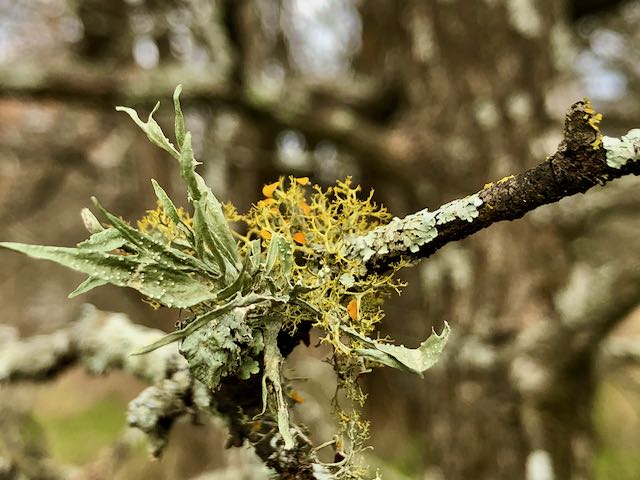
Another small growing thing that can produce a sort of miniature garden is lichen. Dead oak branches provide a great substrate for lichen to grow, either as the greenish- or bluish-gray foliose lichens that cover the surface in a ruffled coating, or else as little shrub-like fruticose lichens. One of the latter, the golden-eye lichen, is a favorite of mine.
Lichens are not plants. They are partnerships between two things. Not just a fungus, and not just an alga, but the two things fused together (or sometimes a fungus and a cyanobacterium). The fungus provides a structure and anchors the partners to a rock, a branch of wood, or other suitable place. The algae provide a means to manufacture food via photosynthesis. Together, they can survive sun, drought, freezing, and keep on going.
Several forms of lichen growing on a twig
Regardless of the biological details, these living things add wonder to a walk in the woods. To pause and get on the same level as a moss or mushroom shifts our focus from the everyday world down to a small scale and we see everything in new ways. The details of leaves and the texture of moss, or drops of dew like tiny crystal orbs on the strands of a spider’s web, these things can transport our imagination to new places. It was wonderful to watch Logan find each new patch of moss and each new mushroom with that sense of delight. It was a little like what I see when I take my granddaughter to such places; the emotion and fascination isn’t tied to a particular age (you might see it in me if we took a walk together).
Experiencing nature in this way with children is just the best. It can be a window back into our own childhood, or the childhood we would wish for our younger selves or for others. It is also a hopeful sign for our future, that children can still find magic and connection in nature. And if they carry that forward, we might protect wild places and heal some of the Earth’s hurts.
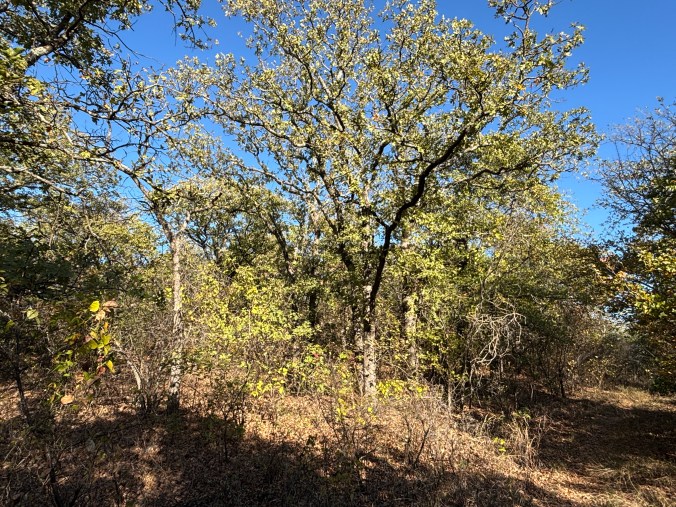
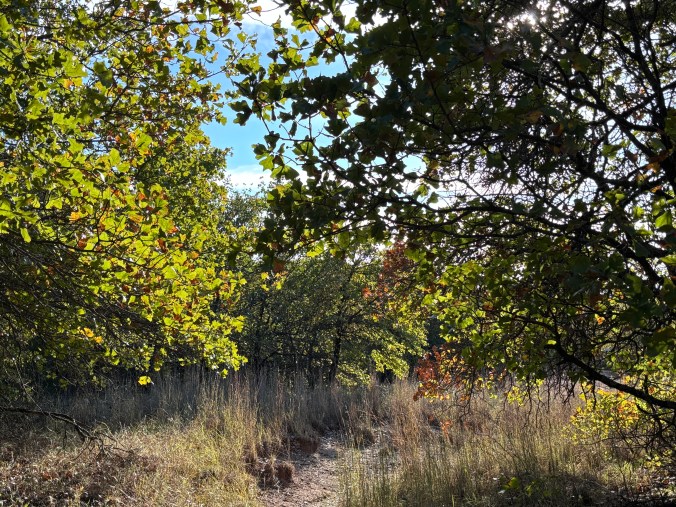
I went for a walk at Sheri Capehart Nature Preserve with gratitude for the warm day and yet wanting very much to find autumn. That’s a season I look forward to each year, and in this changing climate it is apt to hide behind 80 degree days and dusty drought.
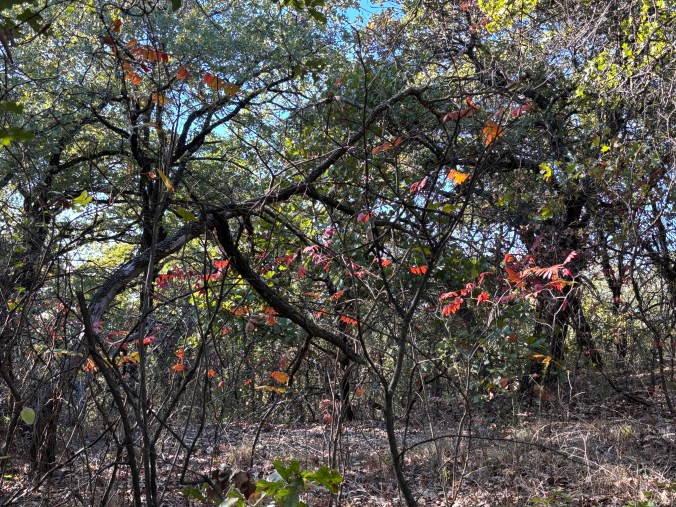
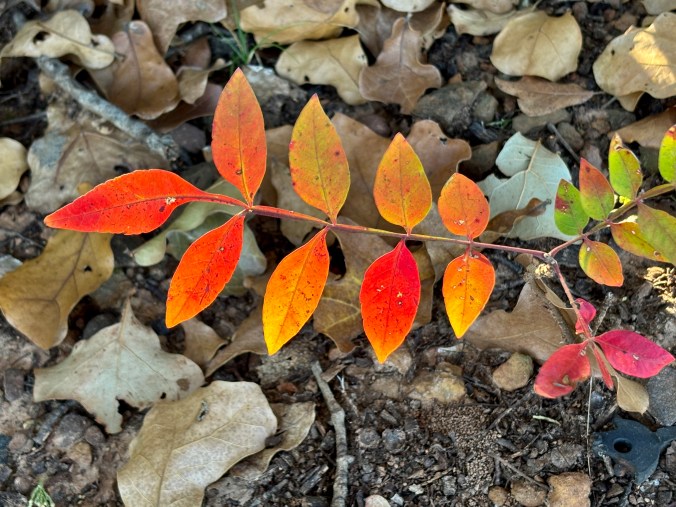
Starting at 3:00pm under sunny skies, I walked up to the top of the hill and sat down to watch, listen, and write a little. it was 82.7F in the shade, with the crowns of post oak trees still covered in green leaves and swaying in the breeze. A little sumac shrub in front of me was brightly backlit by the sun in vibrant green with a little red. Other sumacs had mostly just dropped their leaves, skipping the part where they might live up to names like “flameleaf.”
A few red leaves on some sumac along the hillside
After a while I walked over to the boulder trail and watched a couple of gulls wheeling and hovering above me. There was some wispy high clouds like a feathery splash of cream in the pale blue sky, while on the ground the shadows were lengthening as 4 o’clock approached.
There was some red in nearby sumacs and a few red leaves of some other plant species. The scarcity of colorful leaves made them that much more welcome. Part of my wish for autumn is the hope of seeing yellows, reds, and oranges as the retreating chlorophyll exposes whatever other colors were masked behind the green. Those colors are part of what confirms that autumn is here, and so I’m grateful for each turning leaf. The rest of the woodland, in somewhat desiccated shades of green, seemed stripped of their place within the season, a shadow of summer.
A patch of sunlight backlit this sumac so that it glowed like fire
The clouds drifted, and a few had a hook or curve before stretching out southward or westward, caught and pulled by the currents flowing across the sky. This would be a great afternoon for lying back and watching how clouds are pulled along or drift with the upper winds. Yesterday they seemed in a hurry, but now their movement played out in slow motion.
Merlin reported a blue jay and a hermit thrush, though I did not hear them. Overall it seemed quiet; the traffic seemed to be some distance off and the preserve itself was nearly silent. At 4:12pm it felt like sunset was approaching, and the breeze had come up a little.
In a few days, things will change. There are reports that it will rain, maybe quite a lot. After that, the high temperatures are supposed to remain in the 60s for a while, like we might expect in late November. I will keep walking regardless, because these places like Sheri Capehart Nature Preserve, Tandy Hills Natural Area, the Fort Worth Nature Center and Refuge, are gifts that must not be neglected in any season.
I walked back to the trailhead and was gone at 4:30pm. But I won’t be gone for long.
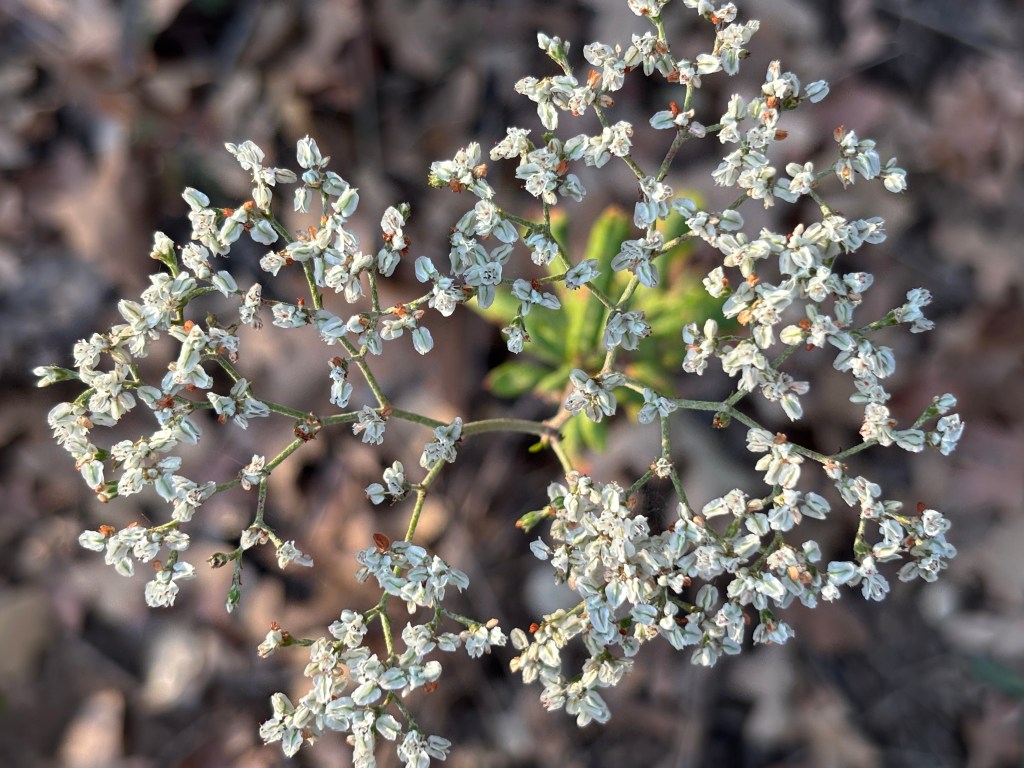
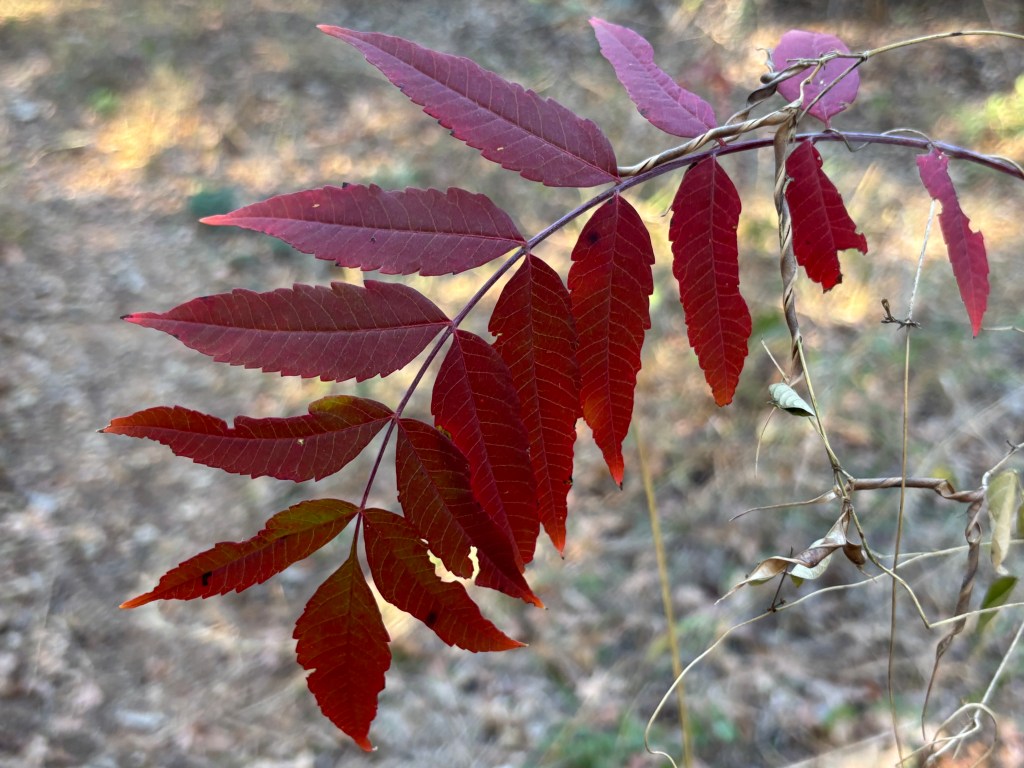
The top of a heart-sepal wild buckwheatA sumac in darker red
This morning I walked at Sheri Capehart Nature Preserve for about 45 minutes, underneath a blue sky with the almost-full moon still floating up there, reminding us that we’re just objects in space. And so I remember; we’re on a big, round, blue planet, ever so gradually circling Brother Sun. And we can watch Sister Moon and almost detect her falling and rising as she circles us, mirroring some of the sunlight back to us in the middle of the night so that we won’t forget the day. Or in this case continuing to reflect the sun, framed in morning sunlight, because sometimes it’s better to shine than to go dark.
To shine seems easy and natural for Sister Moon, at least the way we understand it in terms of science. Does she sometimes struggle to do so, like we do? Maybe get up in the morning and say to herself, “I just can’t do this today.” If she is a barren sphere of rock and dust, then I suppose not. But we don’t have to reduce everything to such understanding. Native American wisdom recognizes the moon as a source of wisdom and guidance, and in the Haudenosaunee Thanksgiving Address she is the oldest grandmother, governing tides, watching over the arrival of children, and serving as a leader of women. In the Canticle of Brother Sun and Sister Moon of Saint Francis, the Earth and the heavens – all of nature – are precious gifts reflecting a wonderful Creator. And so in multiple wisdom traditions, the moon is more than what we can measure with instruments.
And she shines throughout the year. Even when our planet is so dark, when human hatred and fear threaten to extinguish every light, Sister Moon gives us light in the darkness. When masked, armed men kidnap the innocent and march zip-tied children into the cold, and when soldiers carry out genocide, she does what I often cannot do: continue to provide light, not be overwhelmed by the darkness.
I would like to be as constant as Sister Moon, but we are not made for such constancy. Being human means simultaneously holding on to the light, doing our best to shine, while also accepting how complicated and imperfect we are. There are times when climate catastrophe, cruelty, runaway greed – the various crises we are facing – temporarily rob us of light. Some days our faces do not reflect the light, even if we want to shine. The important thing is not to accept defeat, to let the light die. We still can imagine something better, we still recognize truth, and we still have within us compassion and empathy, even if some people have discarded it. Such things are our light, and we must let it illuminate us and all those around us.





 Our Lives In Nature