I shared part of a weirdly warm winter afternoon at Sheri Capehart Nature Preserve with a wading bird who was hunting fish in the pond. As usual, on the way to the pond I found strange and beautiful shapes in the winter grasses and forbs*.
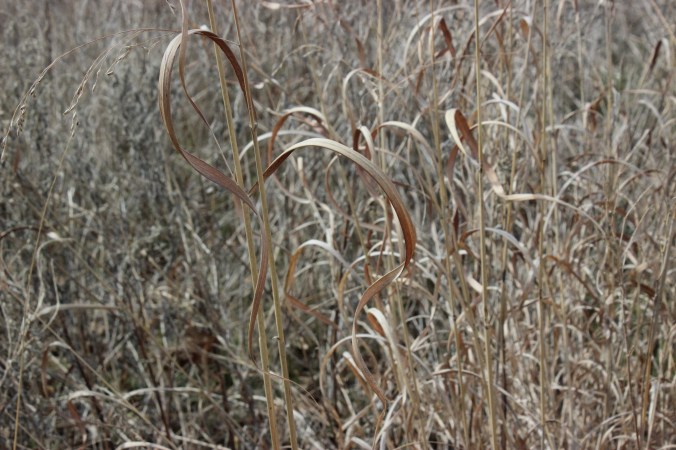
Winter highlights some of the graceful and interesting shapes that we can find in plants. For example, the leaves of switchgrass remind me of curled ribbons. Many of them arc downward in graceful twists. The Lady Bird Johnson Wildflower Center describes switchgrass as one of the primary native grasses of the tallgrass prairie, growing an amazing three to ten feet. You can get a sense of that at Fort Worth Nature Center and Refuge. There are places within the demonstration prairie where the fine, slender seedheads of switchgrass tower overhead.
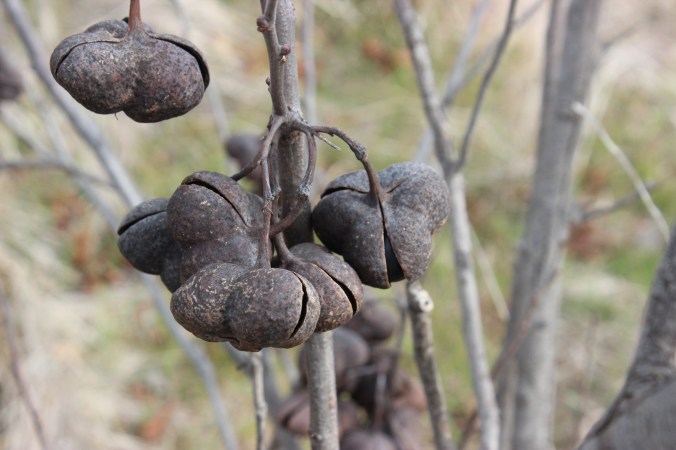
I also saw one of the Mexican buckeyes that grows on the preserve. The trees are typically small and are recognizable in winter by their clusters of big, three-lobed seed pods. By now the pods have cracked and the toxic seeds the size of small marbles are still inside. Parts of the plant may be toxic, but the clusters of pink flowers that will emerge in a month or so are beautiful.
It is a short walk to the south pond, but these things hijack my attention and so the walk takes some time – and it is time well-spent.
The great egret was wading the pond when I arrived, searching in the water for small fish or the bigger invertebrates that live there. Spotting me, he (or she) flew a little further away and continued his fishing. What an amazing bird! The great egret spends time in shallow water, mud, and algae while remaining white as snow. The bird moves forward in the most deliberate, stealthy way, with those yellow eyes watching and a bill like a long, yellow dagger ready to stab into the water, propelled by an impossibly long neck.
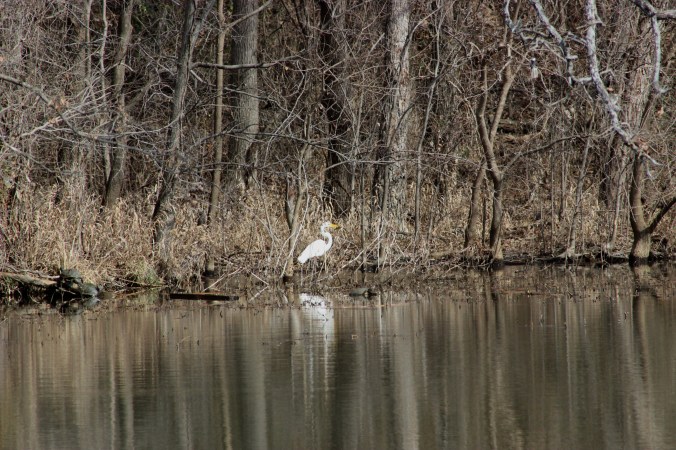
Sometimes the egret was motionless, a bright white ghost seen through dried yellow and brown reeds and brush. And then he moved like an apparition, lifting one black leg and taking a step, and then the other, soundlessly gliding across the shallows. Without warning the yellow dagger stabbed into the water and brought out a small sunfish.
If you have noticed sunfish, you have seen that there is a dorsal fin on top of the fish, and that fin starts with a series of tough, sharp spines. When caught, that fin is pulled forward so that it is erect, hard and sharp. The fish itself is tall, not bullet-shaped, so that it is painful to imagine swallowing one. But that is what great egrets do.
There was a minute or so in which the bird’s neck twitched, perhaps as the fish struggled going down or as that long neck tried to shift the fish to a more comfortable position. I figured that the egret had been able to get the fish into a head-first position in its mouth, because any other way seemed so much more difficult.
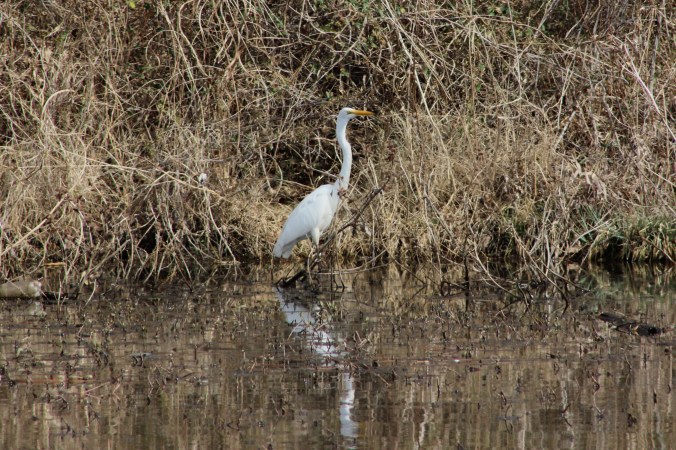
And then the egret resumed that patient, slow strategy of fishing, moving like a ghost into some emergent vegetation and remaining motionless.
It was time to walk up the hill to visit all the familiar spots, the oaks and “toothache” trees, the bee tree, and all the rest. At the base of the hill a mourning dove walked the trail and then flew up into a tree. He called that familiar, soft call: “oo-woo-oo” followed by “oo-oo.” The notes sound as though they might be made by an alto recorder, that wooden, flute-like instrument you hear in some baroque and renaissance music.
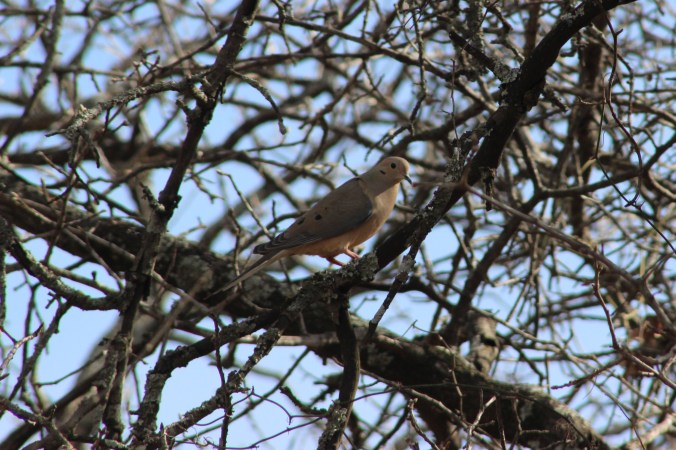
The call is very musical and we usually hear it as lonely or mournful, and so the bird is called a “mourning” dove. If we heard those notes from a human voice, low and soft, dropping a little, most of us would hear some sadness and loss. That is how our brains are tuned to recognize emotion in voices, but it’s good to be aware that it reflects our brains, not a dove’s brain. Perhaps the bird is saying, “hey, let’s hang out together, maybe get a pizza.” We can still be moved by hearing mourning doves at sunset, imaging a lonely voice in the gathering darkness singing about the weight on its soul. I’m sure the doves don’t mind.
From the top of the hill, one trail threads past some boulders on its way down, and I sat for a while soaking in the low sunlight reflected off sandstone, bare trees, and dried grasses and forbs. I will miss this quality of light as spring arrives and the sun stays higher in the sky. I also noticed another smaller trail that disappeared under the trees and low juniper branches. And I imagined other lives in other bodies using that trail, the raccoons or the occasional fox or rabbit who wander this place, mostly when the people go home.
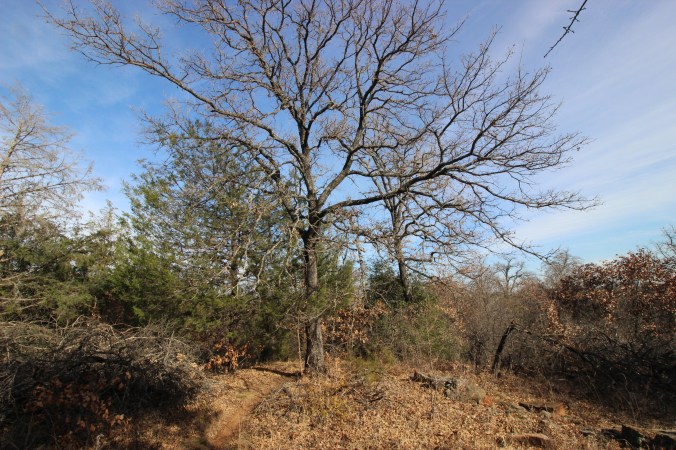
I wonder what they think of the big people who share this space with them, who seem not to hunt, not to fear predators, but just move among the trees and prairie patches. Some jog, some walk their dogs (triggering wariness and fear among the animals that live here), and some go from flower to tree, from dragonfly to moss, stone to bird, as if they cannot get enough of this patch of creation. “Oh hi, rabbit – I see you watching me. Thank you for being part of this place.”
So that was another day wandering this little patch of creation for a while, having the privilege of sharing the pond with the egret and seeing some of the beautiful shapes and forms of plants in winter. It never becomes repetitive, and hopefully these words and photos convey some of that freshness and beauty.
* That word, “forb,” is not one that most of us easily recognize. Nature folks may know it, and certainly botanists would know it. According to Etymology World Online, forb comes from the Old Norse word “forbær”, which meant a fodder plant. Back then it referred to any of the plants used for animal feed, but later it came to mean a herbaceous plant other than grasses and sedges.

 Our Lives In Nature