I had to go to the woods today. Among my frequent visits to those places, some are for spiritual and psychological first aid. Today was a day like that.
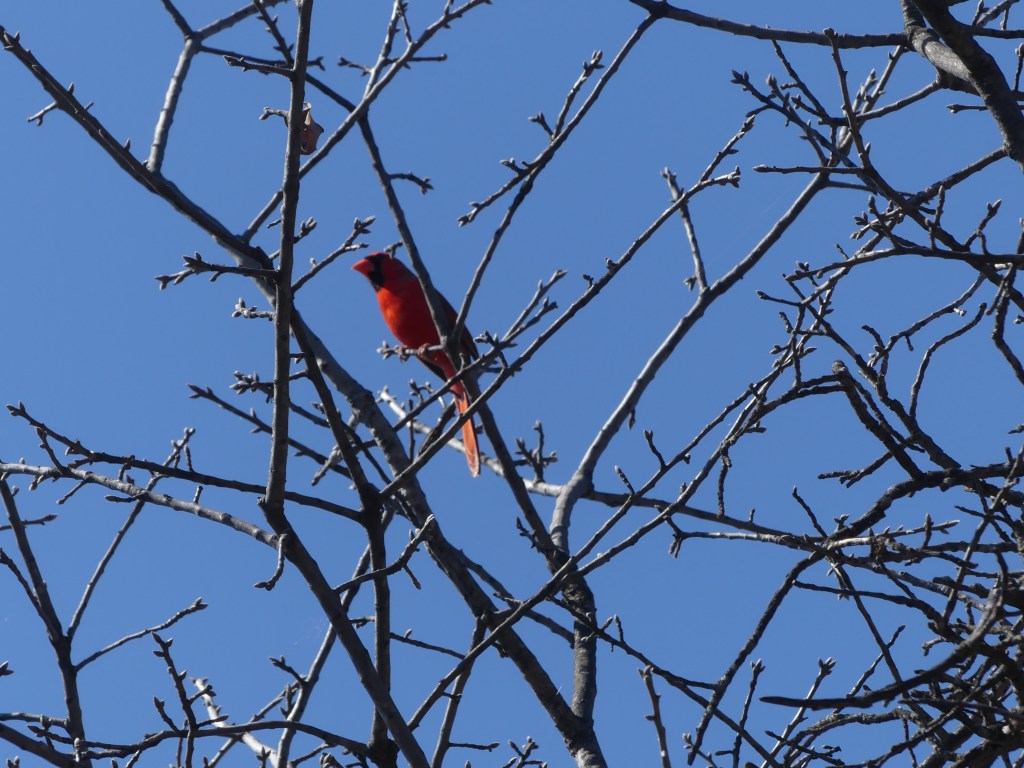
Cardinals like this male were singing throughout the preserve
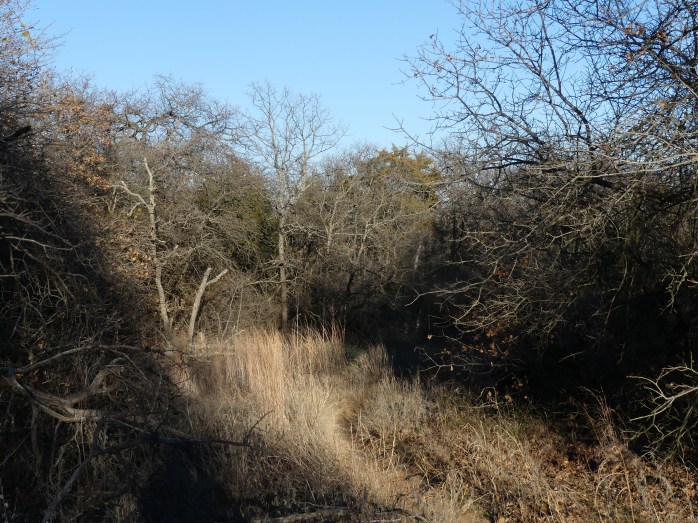
Here at Sheri Capehart Nature Preserve, I can sit on the ridge and look down into the brown and gray woods, still in those colors for a while before the leaves appear. There are some glimpses of green, bits of juniper seen through oak branches, and patches of moss at the base of tree trunks. And there is a flash of reddish feathers from a female northern cardinal.
Yes, there is traffic noise and a barking dog somewhere, but it feels quiet and there is a stillness to the dormant woods, here at the edge of spring. I needed this respite. Not a respite from my home, except that home is where the news arrives. Home is where I get sucked into the Internet, with stories from the world: destruction, corruption, and bullying. Here, I don’t allow the news to appear on my phone, which is used only for photos or checking the Merlin app to identify some unseen bird.
The sun is at my back and a butterfly dances by. Mosses and lichens growing on the stones of the ridge provide endless color, life, and art. And there is the stillness that hardly seems able to be found in the city.
Butterflies agree that spring is ready to arrive. On the trail from the ridge to the boulders, a fritillary glides in toward me on rigid orange wings. It sails on past, wings now flapping to carry it up to the treetops. Nearby, a pair of butterflies suddenly appear and spiral up in their fluttering flight, above the crown of the nearest tree. When I reach the boulders, a pair of sulfurs chase each other down the path. The fluttering, erratic flight of butterflies might make us think they cannot control their flight very well, but have you noticed how often they can weave among obstacles without hitting them? That erratic flight seems to be a gift, an ability to make quick turns and maneuvers that help them escape predators.
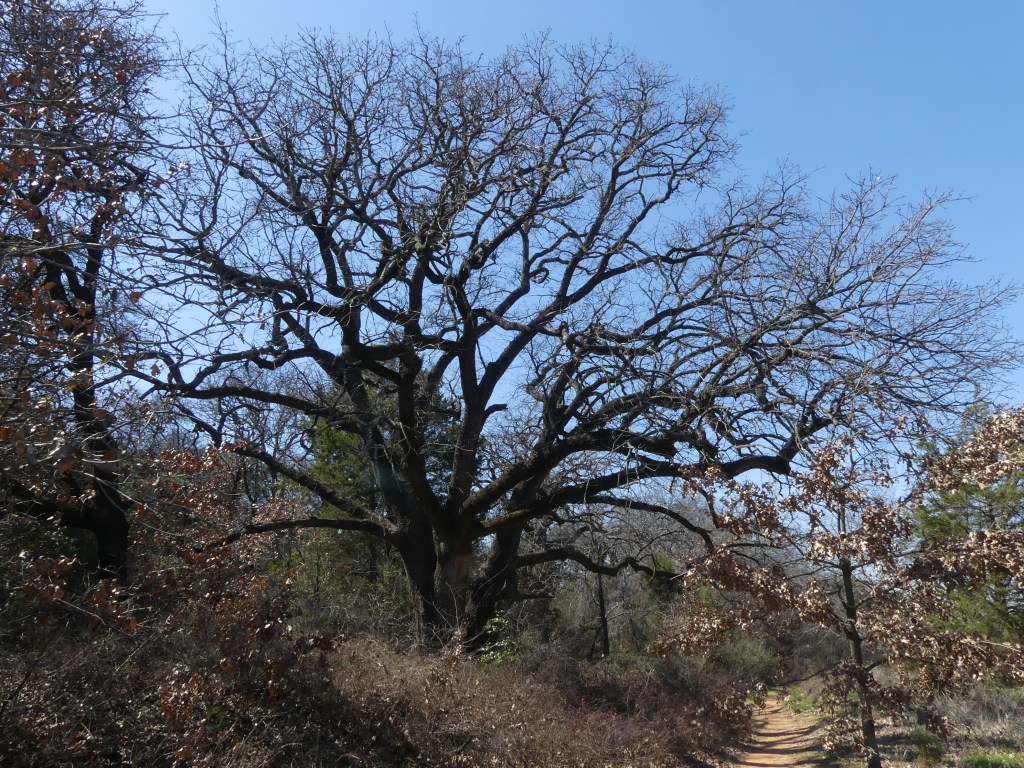
The historic 200-year-old post oak referred to as the Caddo oak
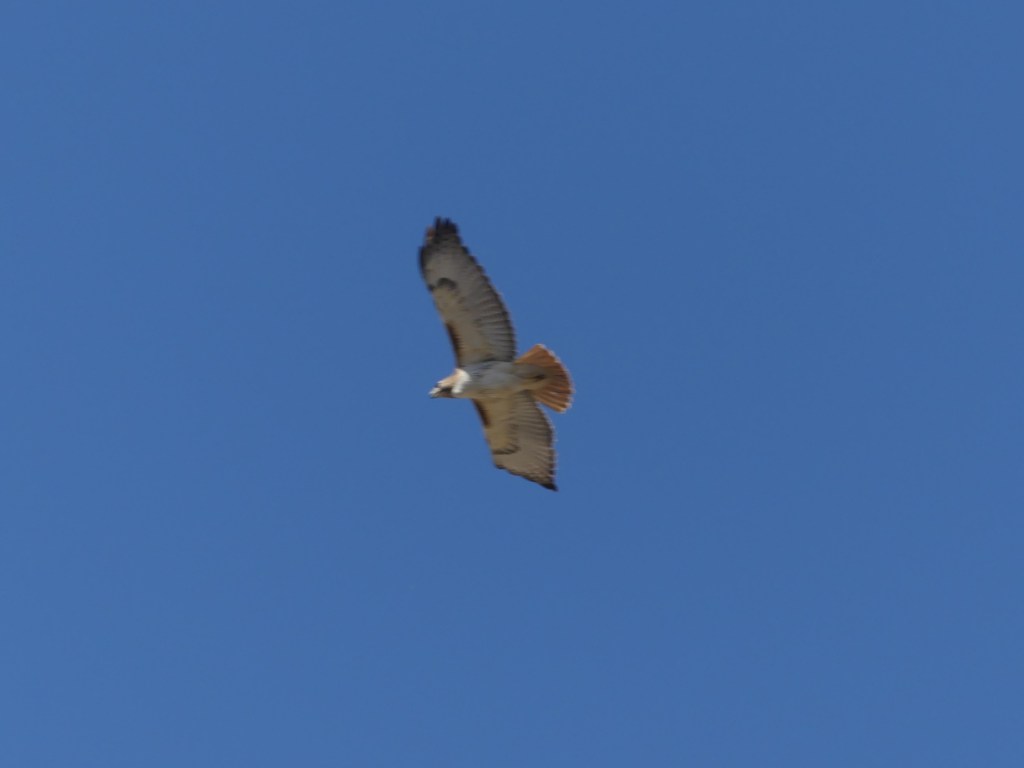
I walk around the preserve, past the historic Caddo oak, seeing many more butterflies and hearing a number of bird species: Carolina wrens, tufted titmice, a chickadee or two, an eastern phoebe, and many northern cardinals. I see a red-tailed hawk overhead, soaring and then turning on powerful wings.
A slightly fuzzy photo of the red-tailed hawk
Arriving near the north pond, I think about how much data we have about the benefits of mindfulness and time spent in nature. There is the reduction in stress, the cardiovascular benefits, an immunologic boost, reduction in depressive rumination, and increases in empathy among other gifts. Those things make time in the woods not some privileged escape or ignorance of the troubles of the world. It is a sort of refueling for the work that lies ahead. It is restorative – a little like sleep – and so it should not be undervalued.
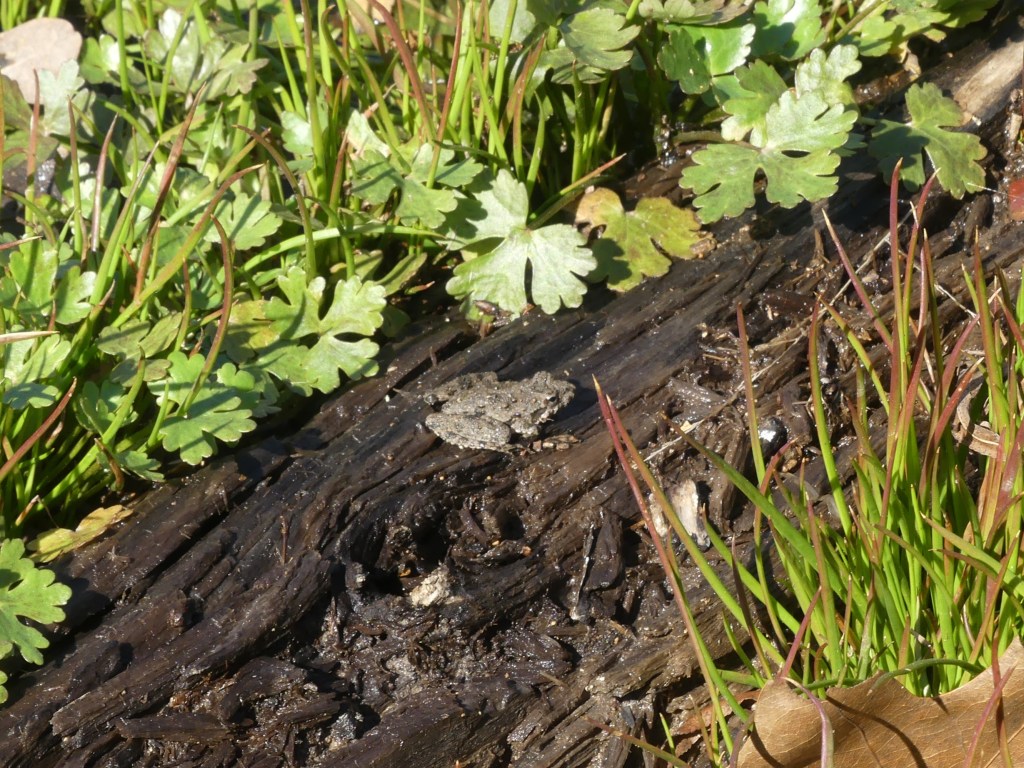
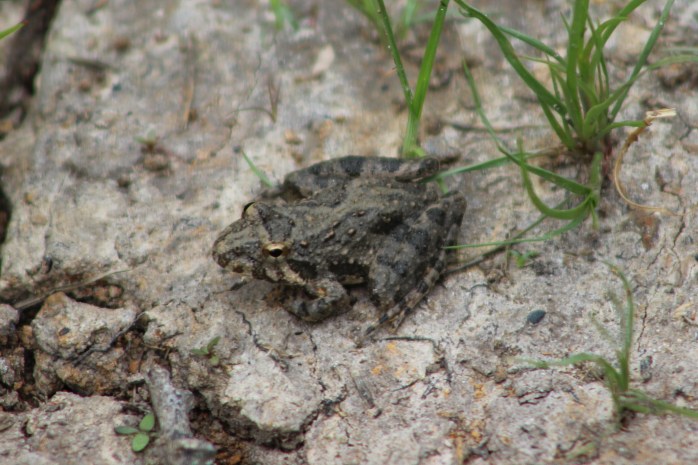
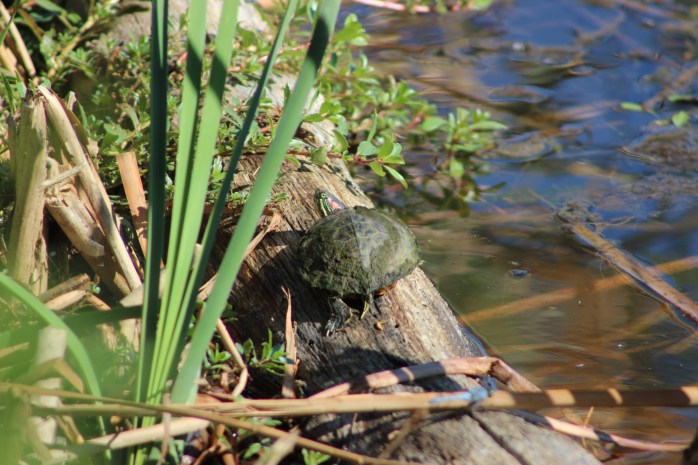
Blanchard’s cricket frog at the pond’s edgeA young red-eared slider, basking
It is now 77F in the shade. Down at the north pond, life is in full swing. red-eared sliders swimming or pulling out and basking in sunshine. Cricket frogs jumping into the water as I get too close to them. All that is needed is the emergence of dragonflies, and the pond will seem complete. I walk back to the car after nearly two hours of walking, sitting, and noticing things in a world that seems so different from the big events of the wider world. It has been a small but important restoration.
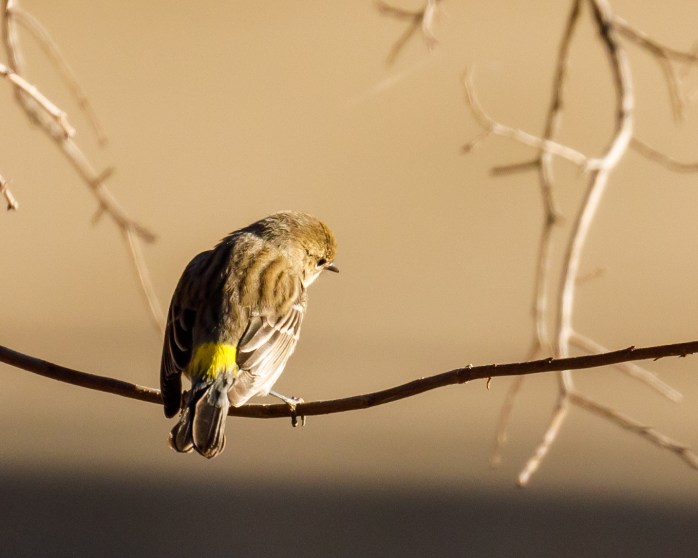
Yellow-rumped Warbler in Dallas County (photo by Meghan Cassidy)
Yesterday was sunny and clear, and Southwest Nature Preserve was the right place to take a walk. Its 52 acres are hemmed in by a major freeway and suburban development, and many visitors walk its trails and drop fishing lines into its waters. Despite all that, it’s a pretty resilient little remainder of the oak woodlands and sandstone that are the calling cards of the Eastern Cross Timbers.
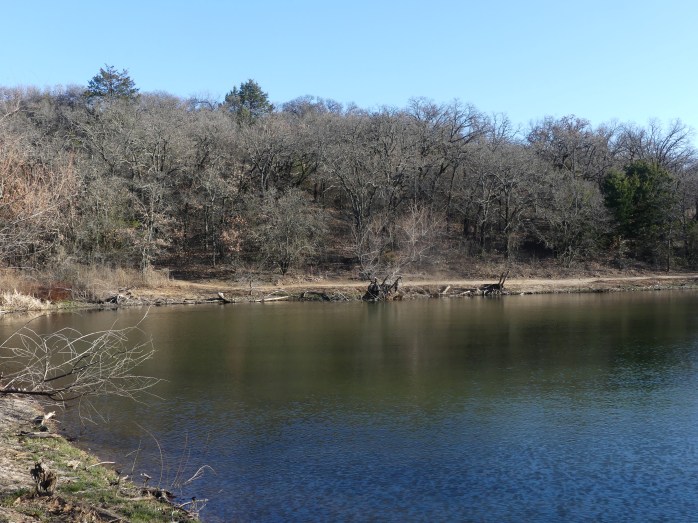
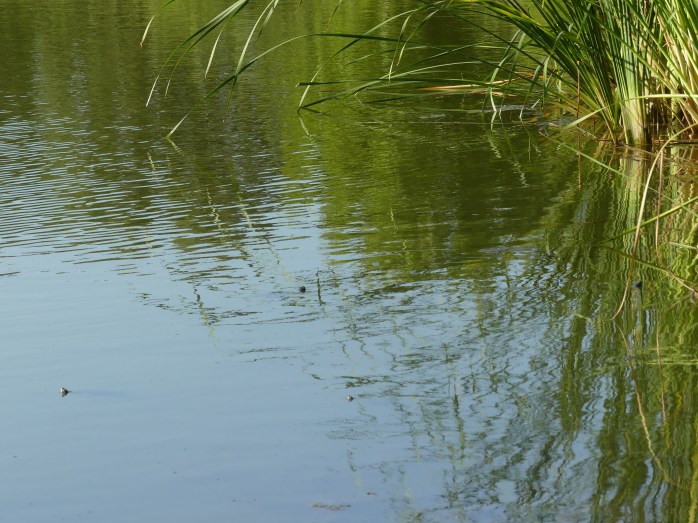
There’s something about winter-bare oak woodlands, with the sun shining through branches and lighting up the layer of leaves on the ground. And ponds, with clear water shading into a deeper gloom with aquatic plants and the waterlogged wood of fallen branches, hidden in the dark. Depending on where you stand, the pond’s surface may be a sapphire reflection of sunlight, and the surface may have shifting rough patches where cold winter breezes blow across it. Southwest Nature Preserve has those things.
The north pond
It also has birds, and this winter there have been a lot of them. I have paid better attention, or this has been a season with good bird numbers and diversity, or both. And as a result, I’ve learned more about them this year, although I’m no expert. I’m also better able to put aside the old herpetologist’s habit of active searching. Instead of staying on the move, I can sit and blend in with the habitat for a while. Mindfulness and advancing age have helped with that.
I visited the smallest pond, expecting a little dried mud bowl because of the very dry conditions. Instead, it had several inches of clear water. As I watched, several small nondescript birds took turns flying out over the water. Often one of them would fly into the breeze and momentarily be held there, fifteen feet above the water, until it turned and in a ball of wind-splayed feathers it was pushed back to a nearby tree.
I sat on the banks of the pond for a while, watching these birds and listening to their calls back and forth: a single “cheet” repeated frequently. In my binoculars I would see gray-brown on the head and wings, with white and dark wing bars, and then that little patch of yellow on the side of the body. When one perched on a nearby twig, the binoculars showed a highlighter-yellow patch of feathers on the rump, more than justifying the name “butter-butt” that some birders give them. More properly, they are Yellow-rumped Warblers.
Yellow-rumped Warbler half-hidden in vegetation
As I watched, my naturalist’s reasoning suspected that they were catching insects too small for me to see. I imagined them to be having fun, as if their forays out over the water might start with a call to their neighbor to “watch this!” Sometimes they found a place to perch very close to the surface of the pond, but mostly they flew out above the water and returned to the winter-dry stalks of vegetation or up into the branches of an oak. A later check with some birding sources, including Cornell’s All About Birds site, seemed to confirm that their flight would have been in pursuit of insects. I don’t think this negates my suspicion that they were enjoying themselves.
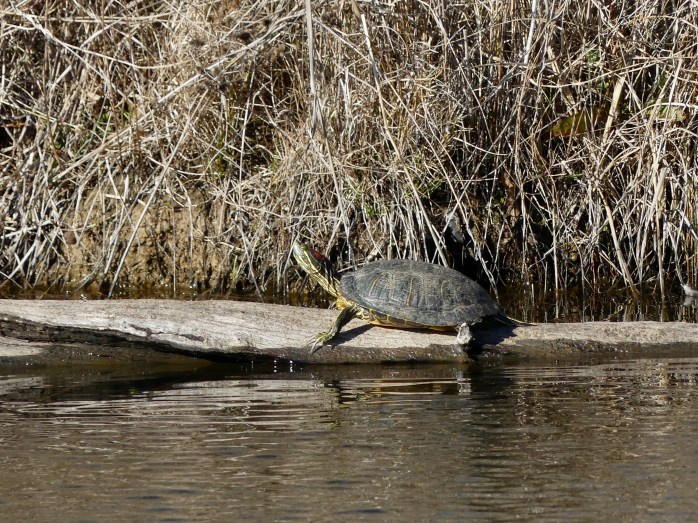
Red-eared Slider, basking at one of the ponds
There were other things to see on this sunny afternoon. In an adjacent pond, a male Red-eared Slider was basking on a log at the water’s edge, across from the fishing pier that extends out over part of the pond. He was unconcerned about my photographing him. In warmer circumstances, these turtles are shy and quick to drop into the water, but this guy was unwilling to give up the bright sunshine of a cool winter day.
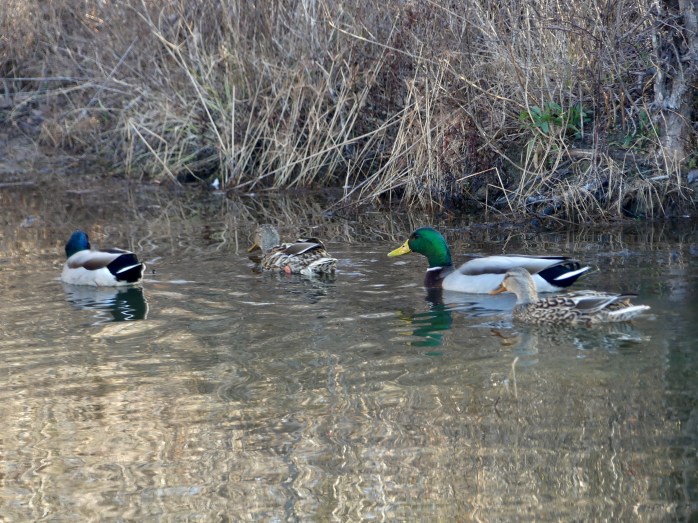
Mallards
Nearby, a couple of pairs of Mallards were cruising across the surface of a small pool, periodically going “tail-up” to dabble through the material along the bottom and extract whatever was good to eat. In contrast, there was no activity on the surface of the north pond, which often has its share of ducks and turtles. Today not even the cricket frogs were out, despite plenty of sunshine along the northeast banks of the pond.
It was a good day to wander along the ponds of the preserve and up over the ridge and through the woods. I learned more about its birds today and got to visit with the willows and oaks and pay my respects to the boulders and grasses.
I knew that having Jim Frisinger join us would be a harbinger of good birding. Jim teaches birding at Southwest Nature Preserve and is the first one we think of when we think about birds at the preserve. And sure enough, even though this morning’s walk was part of a survey of reptiles and amphibians, it turned into a pretty good birding walk as well.
We got started just after 7:00am, meaning that I had to get up before sunrise, but that’s OK, we needed to get there before the day heated up. It is now mid-August, with serious summer heat, and it climbed to 102°F later in the day, with the heat index feeling like 107°F. The survey plan is to walk in one of three habitats, either in the morning, mid-day, or evening, and we rotate among those options. Last week, Jim Domke and I did a mid-day walk, trying to avoid heat exhaustion and clearly demonstrating what Jim figured any idiot would know – the blistering mid-day heat of an August day is not the best time to see wildlife. This morning was much better.
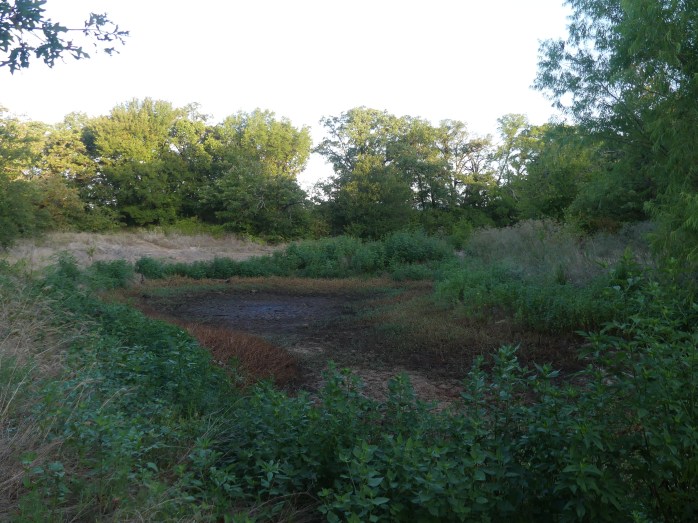
What remained of the smallest middle pond
One of our destinations, the smallest pond at the preserve, was a casualty of summer. The water had completely evaporated, leaving concentric rings – an outer one of drying Water Primrose, surrounding an area of cracked, dry mud, with a bulls-eye center of wet mud. The temperature was 74°F and the humidity a steamy 89%. I walked through some of the vegetation and around the circle of dried mud, scaring up grasshoppers but no Blanchard’s Cricket Frogs. The two Jim’s (Domke and Frisinger) and I talked about where the frogs and turtles would have gone. Maybe the frogs dug under the mud, expecting to estivate during a period of drought. In a pond this small, I said I thought that the turtles may have migrated the short distance to the nearest pond with water. I did notice that several seed pods of Halberd-leaf Rosemallow (see the July 18 entry) had dried and cracked open.
Halberd-leaf Rosemallow
Next, we walked to the north pond, whose water level has dropped but not by much. A group of about six young anglers were fishing, and Jim Domke extracted a promise that they would clean up before leaving. Domke carries a bag in each visit and picks up the litter left by visitors to the preserve. He is an unsung hero for this and deserves appreciation from all of us, because people leave a surprising amount of trash around the preserve. The kids did indeed pick up their stuff!
On the trail a few feet from the water, we saw two Little Brown Skinks. They were roughly two-inch juveniles, little even as Little Brown Skinks go. These lizards did not slow down for photographs, and quickly disappeared into leaf litter and cracks in the mud. And as always, there were Blanchard’s Cricket Frogs hopping around at the water’s edge, and at least one amorous boy was calling, trying to attract females. His episodic “grick-grick-grick” calls were a Call Index of one in frog monitoring jargon, an isolated call not overlapping with other Cricket Frog calls.
Various turtle heads popped up in the water and using binoculars I could see on many of them the tell-tale red patch behind the eye that defines the Red-eared Slider. River Cooters are sometimes seen at the preserve, so it is important to try to observe the head pattern.
At this point the tops of the trees were bright from the rising sun, though the ground was still in shadow. The temperature was 79°F and the relative humidity 76%. Walking back, at the same spot where we saw skinks a few minutes before, we saw a large Little Brown Skink and a couple of juveniles. As before, they spotted us and were in frantic flight back across the trail to the trees by the time we saw them. I tried to capture one of them for a photo, but as soon as I tried to gently pin one down with my hand, it slipped into the cracks in the mud and was gone. These little lizards have very smooth, glossy scales and small legs, so that they shimmy across the ground almost like little snakes.
We wondered why we were seeing skinks in groups, and Jim Domke raised the possibility of a mama herding her babies to safety. I am less quick than I used to be to dismiss such ideas, though I doubt this is what we were seeing here. Researchers are increasingly documenting maternal care among pit-vipers (a group of venomous snakes that are pretty advanced among reptiles, in terms of their evolutionary status). Rattlesnake mothers have been documented to keep their young with her after they are born for a brief time until they shed their skin the first time. They may gather in rookeries to give birth and seem to have some ability to recognize kin. Clearly, some reptiles are capable of much more advanced social behavior than we typically expect. Were we seeing a family group of skinks on the trail? A possibility that seems more likely to me is that as the woodland floor becomes quite dry, these lizards come to the pond’s edge to drink and/or hunt the tiny invertebrates that congregate there. However, there is not much cover at the pond’s edge and when confronted with a predator (or lumbering human observers) they run for the cover of the leaf litter and cracks down into the soil. This is just speculation. My best answer is: “I don’t know.”
Turtle heads in the big pond
Our final destination was the north shore of the biggest pond, where the preserve has the north and west shores and residential housing has the east and south shores. As we arrived, a Great Egret took off with slow, powerful strokes of its snow-white wings. Turtle heads emerged from the water and looked around, a group of eight or so curious reptiles that watched the egret fly off as the humans arrived.
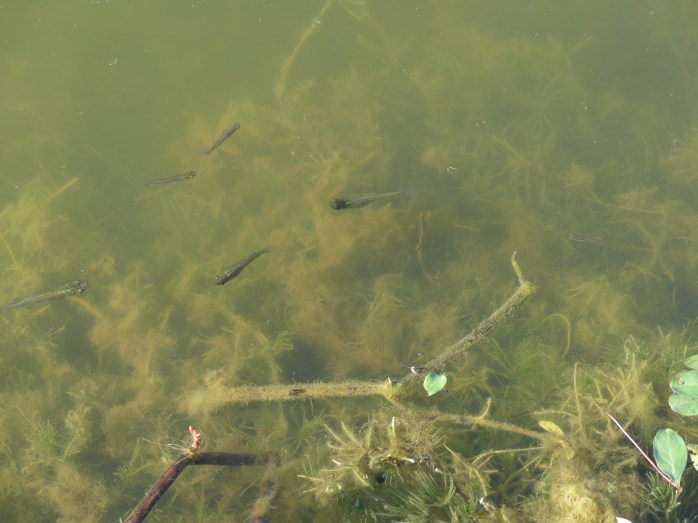
Western Mosquitofish
Along the water’s edge, a group of small fish foraged along the surface and among the submerged stems of Water Primrose. These were surely Western Mosquitofish, though I did not net any to confirm it. Their size, shape, and movements all indicated that they were mosquitofish, those surface-feeding fish that feed voraciously on zooplankton and invertebrates, including mosquito larvae. Females grow much larger and bulkier than males and may have a black spot at the back of the body cavity where the ovaries are located. They are not particularly colorful, though there is a bluish iridescence you can see in the right light.
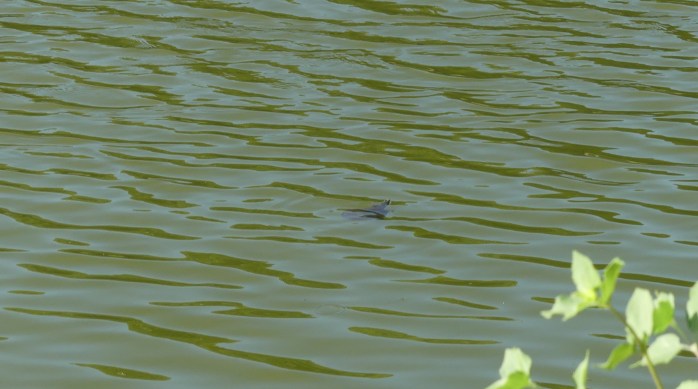
A glimpse at a Spiny Softshell
Further along the shore, a turtle in the water just offshore caught my eye. It was that round shell and a curious head shape that grabbed my attention, and it did not hang around for a photo. It must have been a softshell! I was sure I’d seen a snorkel nose and a pancake-shaped shell – and then it returned to the surface to breathe, staying just long enough for me to take a quick and rather poor photo. It was fairly small, either immature or a young male (females grow quite a bit larger). There is only one other iNaturalist record of the Spiny Softshell at the preserve, and this was another!
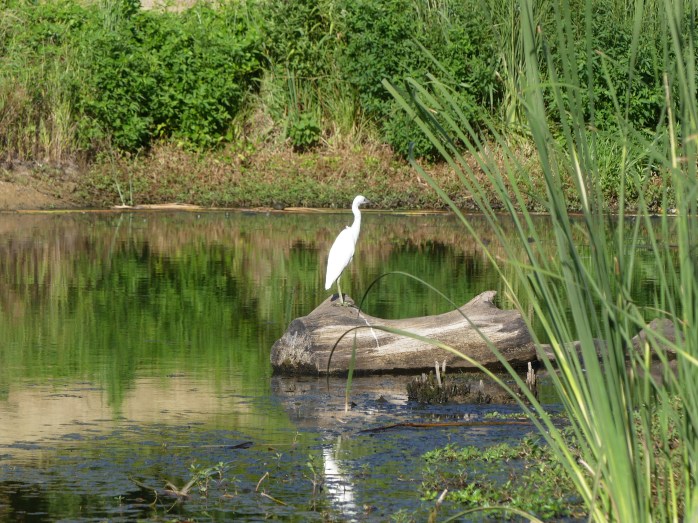
Great EgretOn his way to the concert?
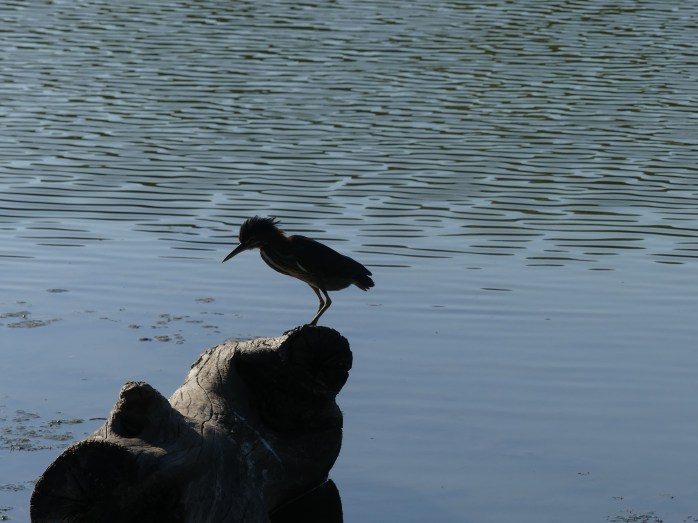
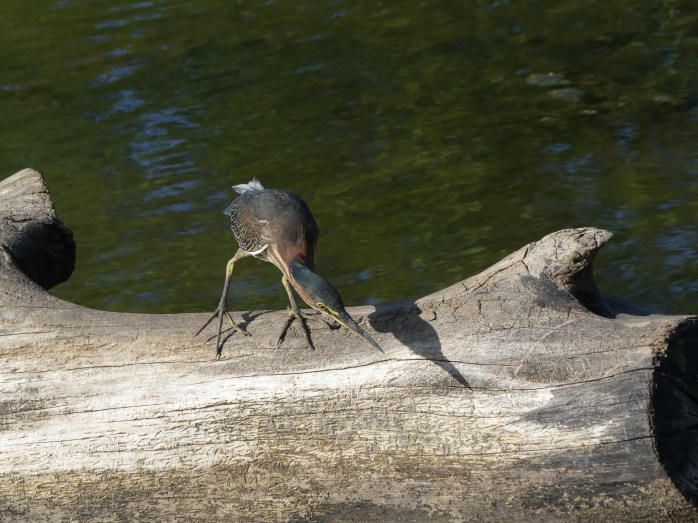
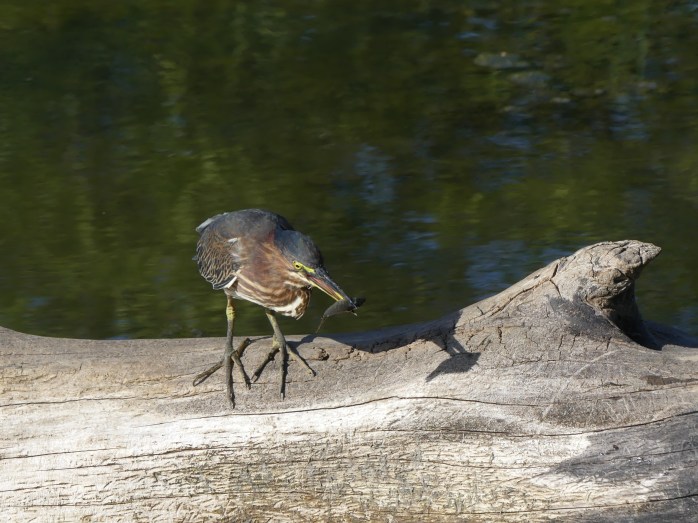
That observation made this a really successful survey walk – what could be better? Well, a really fine bird observation would not make it better, but it would sure round out our walk in a beautiful way. On the walk back, we saw a couple of Great Egrets again, standing in their tall, bright white elegance along the shore. And then, after they had flown, a smaller bird flew in to take the place of the one who had been standing on a log in the water. His crest of feathers suggested a young man with a Mohawk on his way to see Green Day perform Jesus of Suburbia, as he landed on his log and eyed us with suspicion. His Mohawk flattened and he began to look at the water around him, periodically glancing up at us just to make sure he wasn’t going to have any trouble from us. He (or she) was a Green Heron, maybe a young bird whose brown and white streaked chest had not filled in from the sides with the reddish-chestnut brown of an adult.
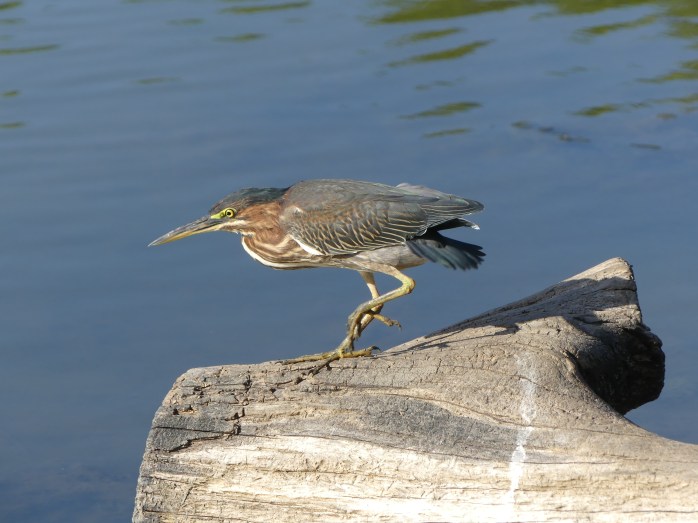
Green Heron
This heron was surprisingly tolerant of three old guys hanging around, two of them taking photos. While we watched, he hopped down as low as he could get on the log and watched the water intently. We waited – he waited, and then there was a quick stab of his long bill into the water, bringing back a juvenile sunfish. Was there a hint of a self-satisfied smile on that long beak, and a glint in his eye as he looked up at us? Probably not, but his skillfulness was impressive. In fact, the Cornell Lab of Ornithology tells us that these birds sometimes even drop bits of bread or insects on the water to lure a fish in close enough to be caught.
A talented fisherman
The temperature had risen to 84°F and 74% humidity and it was time to leave before it became really hot. This had been a great walk, with the thought-provoking observations of Little Brown Skinks, finding a Spiny Softshell, and then the chance to share a few minutes with the Green Heron. I knew Jim Frisinger would be some kind of good luck charm!
The long, hot day was surrendering to darkness at the preserve. The trees and shrubs around the edge of the pond were black silhouettes and the sunset was fading. Shades of gold and rose would soon slip into the dusty gray-black that passes for night sky in a big city whose lights perpetually fight the darkness. We had listened to frog calls and scanned the pond margin with flashlights to look for frogs or a watersnake beginning its nightly hunt. In that last rosy light above the pond, things were dipping and flying, feeding on the insects that buzz around the water. Some of the acrobats had the strong, angular wings of swallows, birds whose flying maneuvers are amazing. But then we noticed that others had stubbier outlines with more flapping. Bats! It was not surprising to find them, but since I rarely get a chance to actually observe them, it was a wonderful treat!
The pond in daylight
This walk was part of what is becoming a survey of the reptiles and amphibians (“herps”) of the 59-acre preserve, with incidental observations of whatever else we find. I plan to visit the place every week, with walks that include trails through primarily wetland, woodland, and open or “edge” habitat where meadows or glades open up in the Cross Timbers forest. We will note the time of day as well as temperature, humidity, and sky conditions. Over time, we will have looked for herps in each of these habitats at least once a month, as the seasons change and hopefully as the years roll by. Could we glean some information about whether things are changing? I hope we can offer some educated guesses. The survey is a citizen-science effort by people who are not trained researchers, but what we record can be valuable.
On this particular evening, “we” were Jim Domke, Annabelle Corboy, and me. Jim is a newspaper guy, and now a freelance writer and photographer. He writes about nature and cares a lot about the preserve; Jim is the guy who always brings a trash bag to help clean the place up while hanging out with nature nerds. Annabelle is a retired IT person who is now part of Friends of Southwest Nature Preserve. She is a curator for the preserve’s project at iNaturalist and is a great advocate for the citizen science efforts that help document the plants and animals at the preserve.
Blanchard’s Cricket Frog
We started our survey visit on the trails at the edge of the big pond. The shoreline is dotted with cattails, the occasional willow, and plenty of water primrose along the edge of the water. In that tangle of primrose and other low plants, Blanchard’s Cricket Frogs hopped and then disappeared against the dark mud or dove under the water and tangled plant matter. As I watched for a chance to take a photo, a disturbance in the water caught my eye. An adult common Snapping Turtle had come up for air but pulled back down upon seeing me. There was no time for a photo, but that face was unmistakable – the chunky head, the almost-smiling jaws, and those yellow-green eyes with the dark dashes radiating out from the pupil to break up the pattern. In a moment, it was gone, but I was delighted since this was the first common snapper I had seen at the preserve.
That illustrates one reason for doing this kind of survey – to confirm observations of infrequently-seen species. People have reported sightings of the Snapping Turtle at the preserve three times in three separate years. It is very plausible that Snapping Turtles keep to themselves under the water and simply are not seen very often. More observations of them would help to confirm whether a stable population of this species is living in the ponds at the preserve.
Red-eared Slider
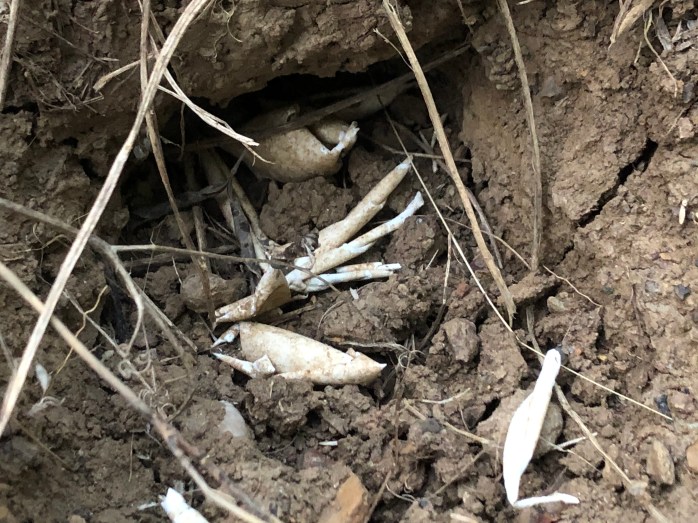
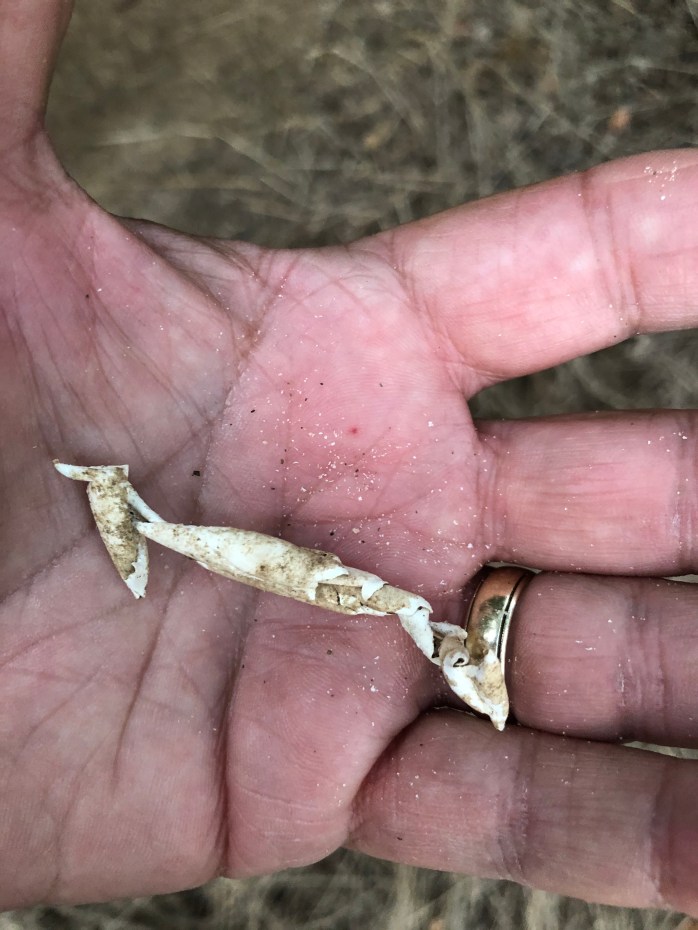
Other turtles such as the Red-eared Slider are common in those ponds, and we observed a big female being pursued by several smaller turtles, presumably males courting her. The frequency with which this species is documented, including individuals of different ages (I recently photographed a baby at one of the ponds, and we see half-grown individuals as well as big females and old melanistic males) strongly suggests a healthy reproducing population. And they manage this despite heavy predation on their nests. At the next pond we visited, we saw three excavated turtle nests with broken, dried eggshells. Chances are good that female sliders wandered away from the water until they found a suitable spot, dug nests and deposited eggs, and then covered them with soil and a wish for good luck. Nevertheless, predators such as raccoons are avid nest-raiders and help themselves to turtle eggs, over-easy. I don’t know what the odds are for a turtle nest to successfully incubate and hatch at the preserve, but clearly it is a roll of the dice.
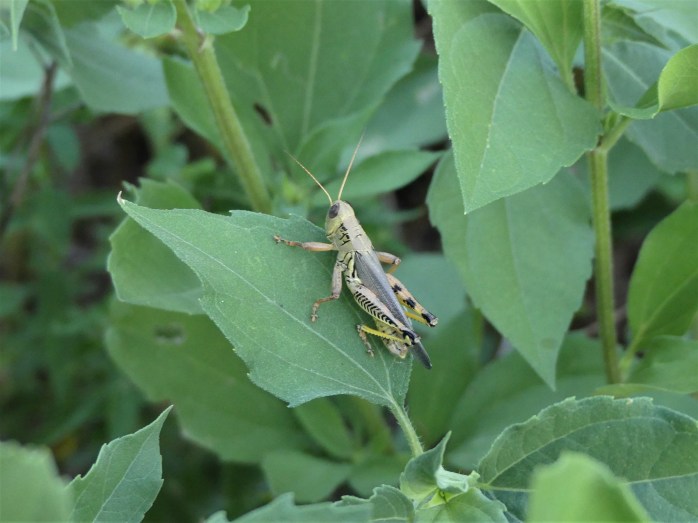
An excavated turtle nestBroken and dried turtle eggDifferential Grasshopper
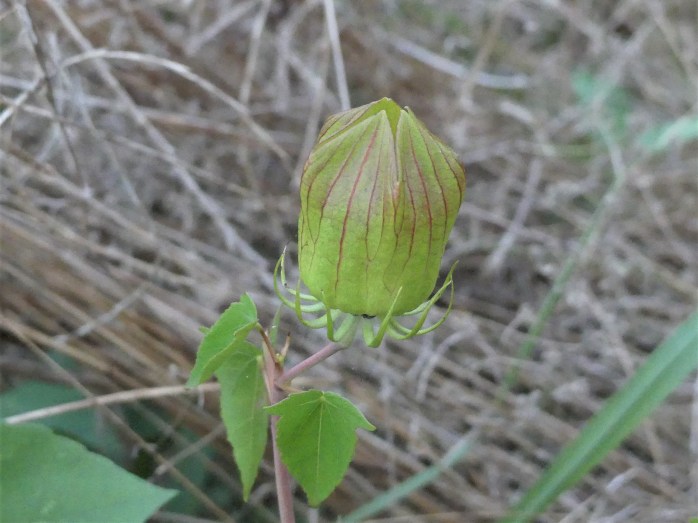
Along the way, there are many other species to see. I photographed a number of grasshoppers such as the big Differential Grasshopper in vegetation around the first pond. That and the delicate little Forktail Damselfly and the orb-weaving spider whose web shone brightly in the flashlight beam all made our walk richer, but none of us are invertebrate experts, and so we added them as incidental observations. The same is true with plants, although Annabelle and I were delighted by the Halberd-leaf Rosemallow that we photographed at the smallest pond. Annabelle knows a good bit about plants, but it would take a dedicated team to systematically survey the plants at the preserve.
Halberd-leaf Rosemallow
We ended up walking most of the way around the pond at the north end of the preserve, and as I mentioned, it was rapidly becoming dark. We spent five minutes monitoring any frog calls, standing quietly with flashlights off. Blanchard’s Cricket Frogs began calling with their quick little “clicks,” sounding like two pebbles being hit against each other. There is a system for grading how many frogs of a given species are calling. This evening, the “call index” for these cricket frogs was a “2,” meaning that multiple individuals were calling and their calls overlapped some, but it was still possible to count how many frogs were calling.
It had been an interesting two hours, with the exciting observation of the Snapping Turtle, then finding the raided turtle nests, and that last leg of our visit with bats, swallows, and frog calls. We heard a Chuck Will’s Widow with its high, whistling call in the distance. I can’t wait to come back for another visit!





 Our Lives In Nature