Gratitude and Reverence

We headed south, full of optimism that the sprinkles and mist would not get in the way of a good walk at Pedernales Falls State Park. Being in good company outweighs getting wet, and after the drought we have been going through, none of us were complaining. When we arrived at the park the river was softened by a little mist and the trees were dripping. It was going to be great.
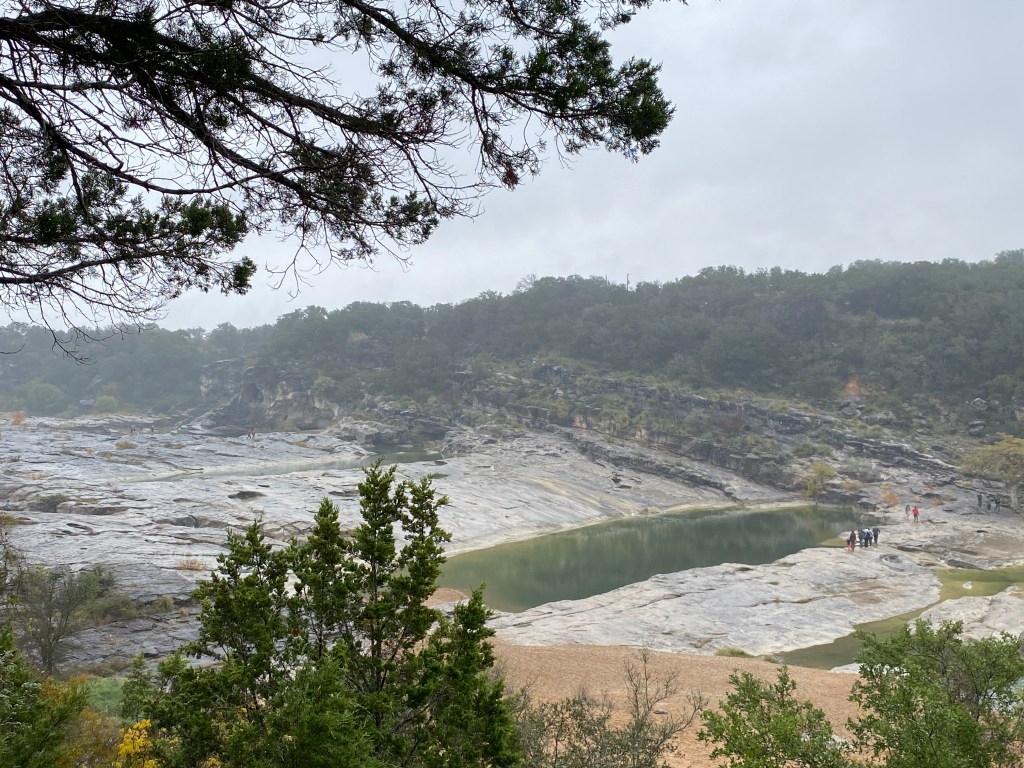
The path, on its way down to a place overlooking the falls, goes through a juniper woodland where every small plant, mushroom, or insect snagged our attention like velcro. Among nature folks, it’s called “walking at the speed of botany.” We kept up that pace, weaving around boulders all the way down the stone steps to the riverbed. Sheryl took beautiful photos of water drops on leaves, and Kat and Alaina examined seeds and leaves and discovered a straggling monarch butterfly feeding near the steps.
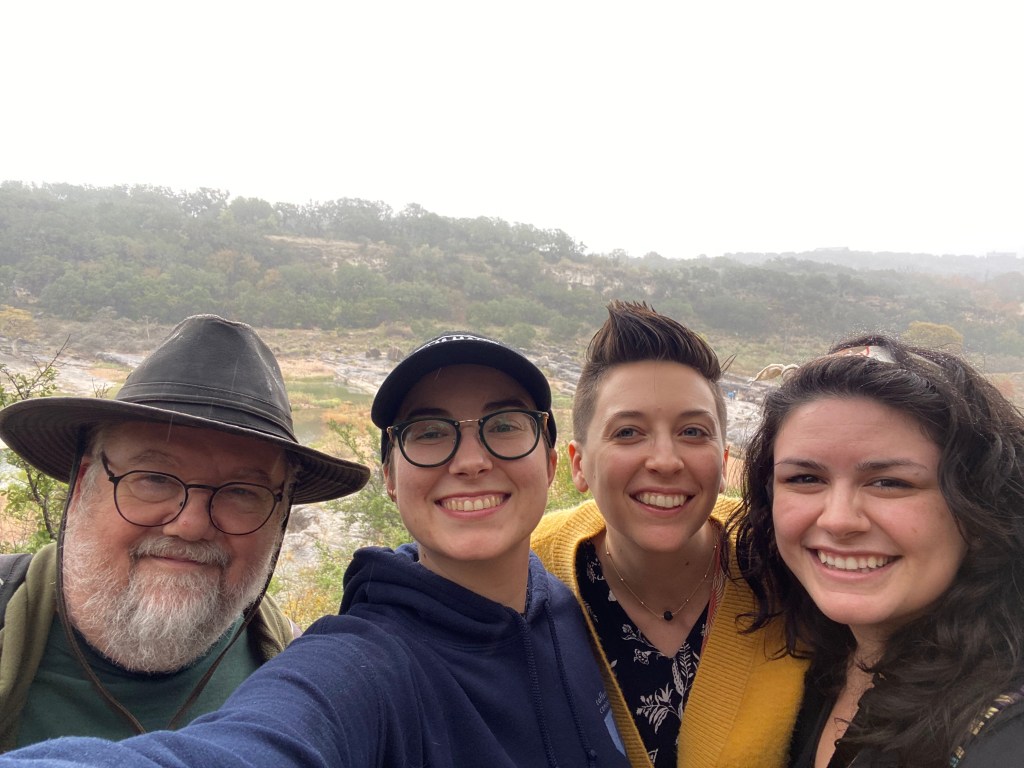
L to R: me, Alaina, Kat, & Sheryl (photo courtesy of Alaina Graff)

This leaning into fascination and wonder is a trait shared by many friends and family, as if hard-wired into our being. Love and gratitude follow as naturally as rain lilies after rainstorms. So many things for us to be grateful for – the sound of tumbling water in the river, the red and orange autumn colors of cypresses and Virginia creeper, and spiders whose webs still held beautiful water droplets.

Water on stems and leaves (photo courtesy of Sheryl Joiner)

Gratitude and affection for the natural world (and for each other) is, along with wonder, what fuels all my visits to places in Texas. There are a handful of people with whom visiting a forest, wetland, or prairie is like worship. Not worship as a practice of religion, but simply a shared reverence. Together we re-connect with something bigger than us, yet part of us, and which nurtures each of us. This creates what Robin Wall Kimmerer describes as a sacred bond:

Knowing that you love the earth changes you, activates you to defend and protect and celebrate. But when you feel that the earth loves you in return, that feeling transforms the relationship from a one-way street into a sacred bond.

Robin Wall Kimmerer, Braiding Sweetgrass

This is a good week to talk about these things, because the Thanksgiving holiday should be about recognizing what we’ve been given and what sustains us. A big feast, all that turkey and pumpkin pie, should just be a metaphor for the abundance that so many of us have been given, and which can be answered with gratitude and thanks. We can give thanks to the land that gives food, water and shelter. We can give thanks to each other for the ways we care for one another and embody what religious folks would call the image of God or a spark of the divine. Another way of saying that we are made of stardust and should recognize that in each other.

The Pedernales River (photo courtesy of Sheryl Joiner)

We walked downstream, along a beautiful stretch of river lined with cypress trees. I wrote in my journal:

“The sound of the riffles – a deep tumbling noise – was mesmerizing. The river corridor is lined with old cypresses and boulders and stones with roots winding among them. … There is the river and the conversation among Alaina, Sheryl, and Kat, and no mechanical noise (not even a plane). Beautifully musical.”

Roots seeking the water (photo courtesy of Sheryl Joiner)

On Thanksgiving Day, I will think about this place and the friends who were with me, remembering them with gratitude and joy. I will be thankful for so much – my human family as well as those other wild relatives out there without whom our lives would be so much smaller.
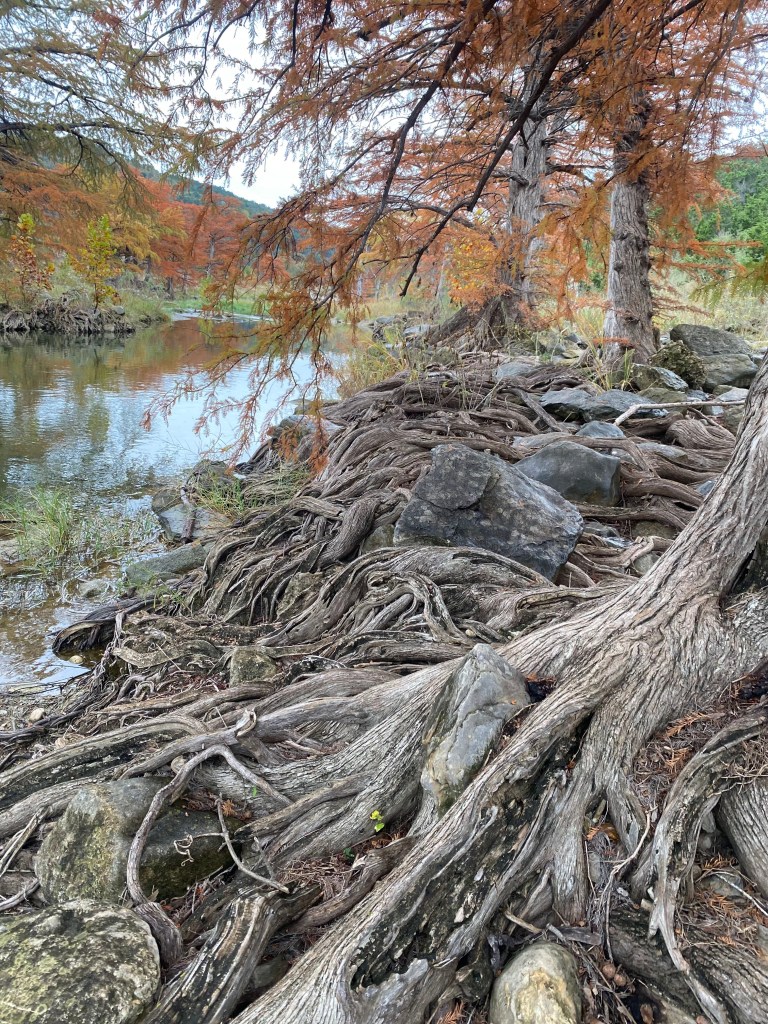
Cypress roots (photo courtesy of Alaina Graff)

At Pedernales Falls

The Texas Hill Country is a beautiful region, and Meghan Cassidy and I finally got around to visiting it in mid-October. In our work on a forthcoming book on mindfulness in Texas’ nature, we have been to a lot of places around the “edges” of Texas but not the central region, dominated by the massive uplift known as the Edwards Plateau. We were never going to leave it out, though, because that would mean missing out on lovely and important places.

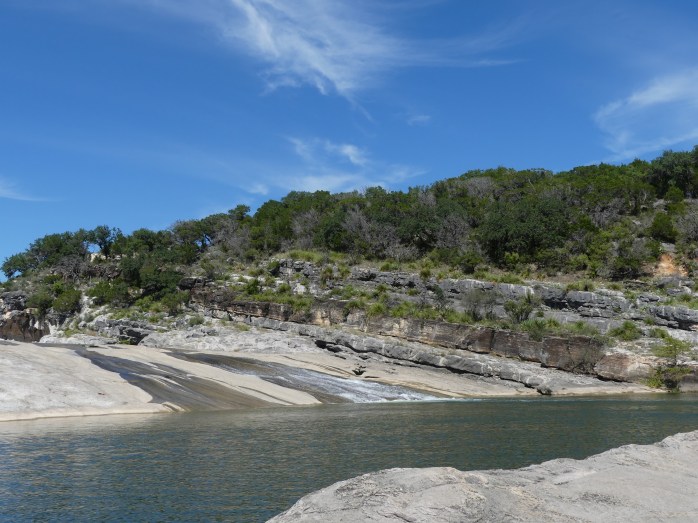
Water slides over rock and into a pool

The eastern part of that plateau has limestone ridges and canyons formed when water dissolved the rock and created caves and underground waters that emerge in springs and grottos. Such places may be ringed by maidenhair fern and lush vegetation, with crystal clear pools and streams flowing over stone. This is the Hill Country, with rocky hillsides covered with Ashe juniper, small prairies and pockets of grassland, and beautiful rivers.

Our friend Ruthann Panipinto nominated Pedernales Falls State Park as the right place to spend the limited time we had. I’ve known Ruthann for years as someone whose knowledge and interest has, like mine, expanded from herpetology into an even broader love of natural history. Her choice of Pedernales Falls was perfect.

Traveling to Pedernales Falls, one of the first questions that occurred to me was how Texans came to pronounce it as “Purdenales.” Spelling and ways of speaking are sometimes out of sync, and English-speakers don’t always have a good track record when dealing with some Spanish words. As it turns out, the Spanish word “pedernal” means “flint,” and the Pedernales River got its name from the flinty stone in its riverbed. Much of the Edwards Plateau rests on layers of limestone, some of which is Cretaceous (66-144 million years ago). Some of the rocks exposed by the Pedernales go back unimaginably earlier, to the Ordovician (438-505 million years ago)[i].

Pedernales Falls

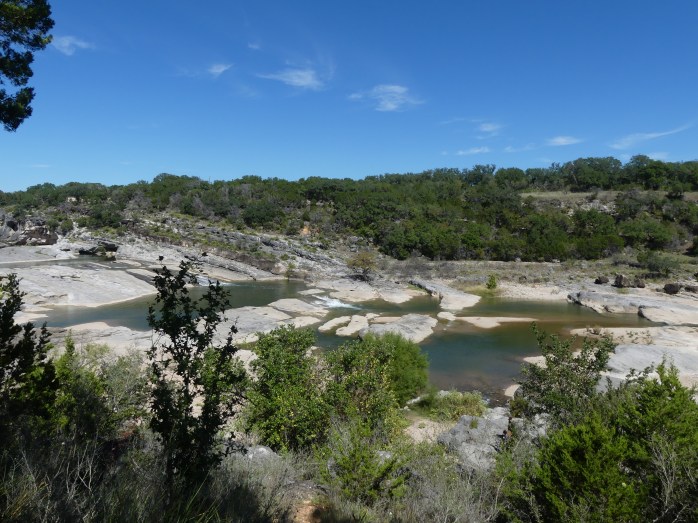
We arrived and walked down to an overlook from which we could see a beautiful river cascading over the top of a huge apron of gray rock into a pool, and then pouring over a small gap into lower pools. The water then worked its way through a line of boulders and on downstream. We followed a long series of stone stairs down to the river and sat down to watch and listen. 

It was a surround-sound experience of flowing water. From a small tributary on one side was the sound of riffles, shallow water tumbling over small stones and gravel. Behind us was the upper falls, with the main part of the river sliding down a long expanse of stone. In the middle was the spot where the water pours several feet from one pool to the next, with a deep, thunderous sound reminding me of surf breaking at the seashore. 

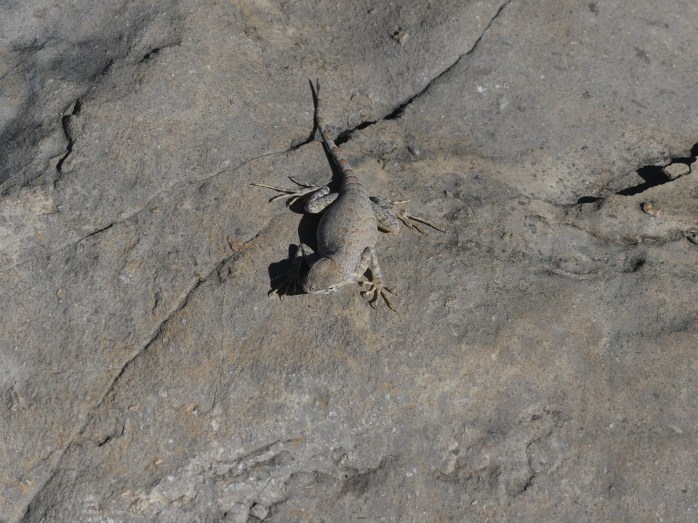
Above us there were long wisps of clouds as if the upper winds stretched water vapor across the sky in white calligraphy. The sun was warm and intense but the air was cool in just the way you would expect on a mid-October day. Texas earless lizards basked in the sunshine, taking notice if we got too close and scampering away to wave their tails in the air, exposing the black-and-white bars underneath. 

Texas earless lizard

It was fairly busy, but did not really feel crowded, as couples and families and even a geology class made their way down to the river to walk, sit, and sometimes wade. The voices of people were masked by the falls and (thankfully) no one brought a boom box. Visitors came and went, and there were times when you could look across a substantial area without seeing people. And in the next part of the visit, we had the river to ourselves.

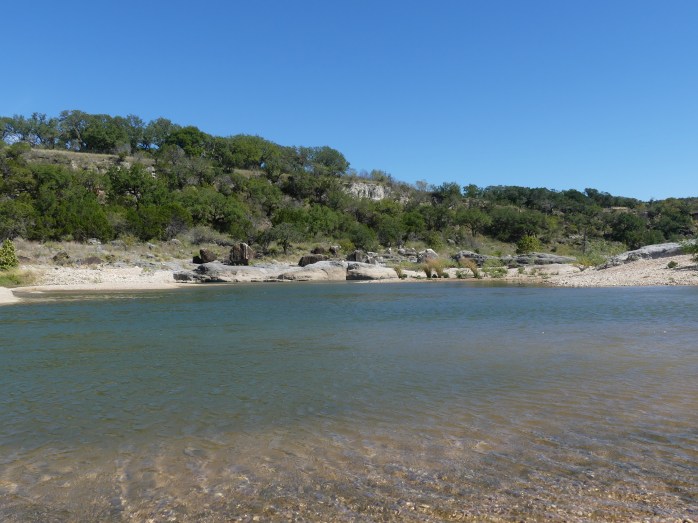
Ruthann led us further downstream, over boulders and across gravel bars to a place where a huge cypress tree stands like a sentinel, roots wound around the rocks to create something like a tiny peninsula or island in the river. The almost-clear water passed over large rocks, heaved up in places and then falling into small troughs. It flowed among the boulders and between grassy banks and broke into noisy whitewater in shallower places. 

Along the course of the river were more cypress trees, their feathery leaves beginning to show a bit of rusty yellow in the low afternoon sun. Autumn might be slow to take hold, but it was beginning.


[i] Spearing, D. 1991. Roadside Geology of Texas. Missoula, MT: Mountain Press Publishing Co.

Ruthann on “Cypress Island”