A Story – Journaling at the Creek

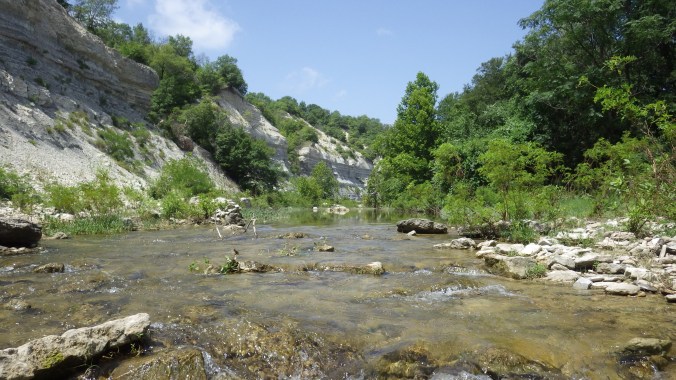
The creek bed was slippery as Elliott and Kate waded upstream. Ahead of them they could see several Sunfish, huddled in one spot where the clear water was a couple of feet deep. Then the blue-green fish decided that the two humans were getting too close, and they made a break for it, darting one at a time past Kate and then practically between Elliott’s legs. 

“I could have caught one in my hands if I was fast enough!” Elliott claimed. He added, “But I’d probably have fallen on my butt. This spot is really slip…”

Before he could finish, his legs slipped out from under him and he really did land on his butt. The water cushioned his fall, and he sat on the algae-coated limestone, spluttering. Kate came back to help.

She extended her hand to him. “If I fall in, I swear you’re going back down too,” she teased. 

Elliott managed to get up without pulling her in, and they kept wading upstream, past schools of little silver fish and a small Red-eared Slider turtle hiding in the shallows. His shorts and shirt were wet, but they would soon dry in the sun. And to have Kate take his hand and help him get back up, he thought it made falling down worth it, though he wasn’t going to say that to Kate. 

It was October, but in Texas all that meant was that it was warm rather than hot. As Halloween got closer there were no golden or orange leaves, no autumn color yet although some leaves were falling just from being worn out by a long, mostly dry summer. 

At a bend in the creek, the two of them waded out onto the exposed white limestone bank of the creek. Another, higher layer formed a sort of bench where they could sit in the shade, facing the water. Elliott went through his backpack, which had stayed mostly dry inside when he went in the water. He found his journal still sealed in a plastic bag, protected against just that kind of accident.

Kate looked back at him. “Are you getting your journal out? This looks like a pretty good place to do it, right?”

Elliott agreed. The teacher in their 10th grade science class had given this as an assignment: Take a notebook somewhere out in nature and write or draw about what you find. Kate liked this creek and so after they got the assignment, she asked Elliott to come along. 

Each of them opened their notebook and wrote the date at the top, followed by the location of the creek and the time they started walking and wading. There were a list of prompts included with the assignment, suggesting what to include. 

“Let’s see,” Kate began, “there’s weather stuff. The sky is kinda deep blue today, with a few clouds, right?”

Elliott looked at the clouds. “Yep. I think those are high clouds, a forget what you call them, but they’re sort of like a little bit of milk swirled across the sky with the tip of your spoon.”

“OK, ‘milk clouds,’ I’m sure that will win us the weather expert prize.”

“Whatever,” Elliott responded. “Remember she said it doesn’t have to be technical. She said just describe, put what you experience into words.”

’Elliott stinks like creek water.’ There, I’ve put my experience into words.”

Both of them were quiet for a minute. Then Kate said, “OK, sorry, I’ve written about blue sky and swirly clouds. Did you bring a thermometer?”

“No, but I’m going to check the nearby weather.” Elliott pulled out his phone. “So it’s 78 degrees nearby. Feels warmer when you’re out in the sun, huh?” Then he pulled a section of his T-shirt up and sniffed it. 

“That does not stink.”

Each of them wrote in his or her journal for a while. And then Elliott asked, “Remember that big white wading bird we saw back there? Do you know what it was?”

“Yeah, a Great Egret. I think I remember that they eat stuff that they can spear in shallow water, like fish or frogs. They’re so pretty when they fly.”

Elliott added, “I guess I can say something about the fish even though I don’t know what they are.”

“Ms. Martin said that was fine, that it was more important to put into words what you noticed – just what it looked like or sounded like. What did she say? ‘It helps you remember it and really notice and learn about it.’ So you could say they were silvery little shooting stars that flashed in the water, and that would be OK,” Kate commented.

Elliott smiled. “I remember – actually she’d really like that ‘shooting star’ bit, because she said it should capture how it came across to you, how you felt about it.”

They kept writing, including a little about the creek itself and the sparkling reflections of the sun when the shallow water ran over the rocks. There was the sound that water made when it ran fast and shallow, and an occasional bird call. They included the feel of the water, a cool swirl around their ankles and a slight push against their legs as they waded upstream (and Elliott could mention how hard they worked to keep their balance and that cool, sudden immersion when he fell in).

“I started to quit a few minutes ago,” Kate said, “but when you stop and think about it, there is so much to notice. I guess that was the point, huh, to get us to pay attention to all this.”

“Yeah,” Elliott answered, “How long do we have to keep going? I know she said there was no specific number of lines or words, but I keep thinking of stuff. If we weren’t doing this nature journal, I think I wouldn’t have noticed a lot of it.”

“Are you drawing anything?” Kate asked. “She said that would be good, too. Maybe I’ll draw your swirly clouds.”

“There’s that fossil snail or whatever that I saw back there. Maybe I can find another.” Elliott wandered around, looking at the exposed limestone, until he saw the exposed coil of a ribbed spiral shell, a limestone fossil embedded in the creek bed. He carefully worked it free and brought it back to where they were sitting. 

“I see at least a piece of one of those every time I’m here,” Kate said. “All this used to be a sea bed, in prehistoric times, and these were kinda like a squid living in a snail shell, is what I heard.”

As Elliott began drawing, Kate continued, “We’re supposed to say if we’re grateful, or maybe write something like if we were talking to the place, telling it what we think. Let’s see … I’m grateful that you fell in.

“Hey, we gotta wade back out of here, so don’t be so sure you won’t do the slip and slide and go for a swim.” At this point Elliott was hoping for it; paybacks were gonna be fun.

“Maybe this,” Kate went on, “’I’m glad we can visit this place, that it has so much cool stuff. It has had amazing animals since prehistoric times, and it’s still here. I hope people can wade this creek in a hundred years.’” 

“I like that,” Elliott said. “Do you want to try this again, even after the assignment is done? I usually keep on the move, and writing and drawing kind of slows me down. But maybe it would be fun to try again.”

“It slowed you down but it made you think about stuff you would have walked right past,” Kate replied. “So we could go to that preserve with the open grasslands and woods and maybe if we wrote in the journal, we would notice more things and think about them in new ways.” 

“OK, it’s a deal,” Elliott said. “We can give it a try.”

And on the way back … neither of them fell in the water. Elliott was a little disappointed.


(Recommending nature journaling might sound a little like a school assignment – which wouldn’t exactly get everyone rushing out to pick up a notebook and pen. So what is a good way to introduce it?

I decided that maybe a story would be a good approach, and in this story it literally is a school assignment. But it turns out well, and I’d like to think Kate’s and Elliott’s interest in trying some more journaling might also work out well. What I had in mind about the teacher’s prompts and suggestions to deepen their journaling is shown below – I took it along to the preserve and gave it a try. You could write something shorter; like Elliott said, there’s no prescribed number of words.)

Nature journal page with prompts or suggestions

Kids in Nature – Mindfully

I will be focusing more time on inviting others to some semi-wild place and experiencing it mindfully, doing some nature journaling, and learning a little about the plants and animals that live there. I’ve led nature walks before (with the LBJ Grasslands Project, for example), but these outings will more explicitly focus on mindfulness and nature journaling. If you are reading this in the North Texas area and would like to join me, please use the Contact page to send me an inquiry. At this point there is no fee, but I’ll check the status of the “tip jar” at this website in case anyone would like to contribute! Some of these outings may be more for adults, but some will be for families with kids at least ten years old or older.

Getting children out to experience nature mindfully involves their being less “somewhere else” and more “right here, now.” Somewhere else is thinking about something that happened this morning or hoping you can do something tonight, wishing your friend was here with you, and imagining how Batman could knock that tree down. Being right here is noticing the shapes of clouds, feeling how the ground feels under your feet, listening to a frog call, and recognizing prickly pear cactus and walking around rather than through it. Mindfulness involves paying attention to the present moment, without judging it as good or bad and without wishing it was different. 

Some kids may like the idea of taking a walk in which we will see everything more clearly, hear more things, notice smells, and touch a few things to see how they feel. I might explain to them that we will “turn down the background noise” of our thinking and talking while on the walk, so that we can experience the walk more fully. I will mention that this is not always easy for any of us. Our brain wants to turn the volume back up, and that’s normal, it’s what brains do. So when we notice that we’re thinking about something else, we just let the thought go, let it float away, and bring our attention back to what is happening now. We may have to do that over and over, and that’s OK.

Some kids may be used to blasting through a nature walk while talking to friends. If a nature walk seems unfamiliar or boring, they may be escaping by thinking of other things and going through the walk on autopilot. The job of a teacher or parent is to invite them in and make it seem worth a try. One way to do that is with nature games that provide a little structure for paying attention to the things around them. Or it might add interest to offer some natural history information (“That bird over there is getting ready to fly to South America!” “That rock is the silt and seashells from a beach where dinosaurs walked”). We may want to alternate periods of quiet attention with times when kids talk with each other and with us.

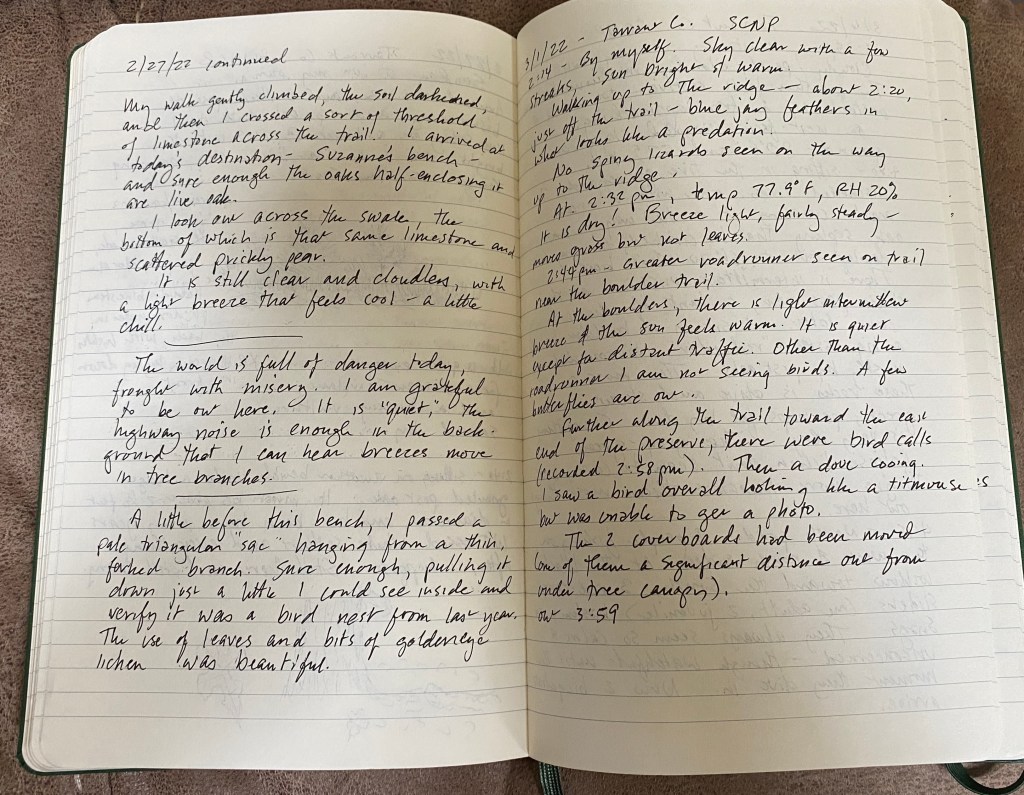
A nature journal is your own personal story, in words and pictures, of places you visited and things you experienced. You write a little and maybe draw a few pictures in a blank book or notebook – nothing fancy is needed. The idea is to stop and think about what you’re experiencing and preserve a little bit of it on paper. For some people, an entry might be mostly contain information about the place, the weather that day, and seeing a kingfisher fly over the pond. Someone else might write a poem about sun reflected on the water and the flight of that kingfisher, or maybe they would just draw the bird with a few notes about seeing it. There’s more than one way to keep a nature journal.

The only way I know to do this with kids is to have a responsible adult (family member or family friend) who brings the child and stays with us. It really cannot be a drop-off, but we would be happy for the adults to join in the activities. The ideal group, with kids or adults, is small – perhaps five or six. A small group just seems quieter, more focused, and better able to get to know each other, and so I will limit the group size.

What is my background for doing this? I have been licensed as a Psychological Associate for over 38 years and have led walks in nature for adults and kids. I’ve written two books about reptiles and amphibians and, most recently, a book about mindfulness in nature.

We’ll plan a walk when we are edging toward spring and have some sunny, warm-ish days. I will either use urban preserves and parks like Fort Worth Nature Center & Refuge, Tandy Hills Natural Area, or Sheri Capehart Nature Preserve, or places that are a little bigger and away from the city like LBJ National Grasslands. I hope you can join us!

Nature Journaling at Sheri Capehart Nature Preserve

Today, Jessica Smith and I had the privilege of talking with twelve people who came to the nature journaling workshop. Jessica and I shared what we knew and participants asked great questions and then headed out to see what they could draw or write about.

It was a perfect day to work on nature journaling – some midday sun and warm temperatures

We talked about the connection between nature journaling and mindfulness. I think we all agreed that it helps to be unhurried and pay attention so that the experience can really be absorbed. Our experiences in nature are complex and they involve all the senses, and if we don’t give ourselves time to become aware of all of it, we’ll probably miss a lot.

Another topic was how our experience can be encoded into memory when we really pay attention, think about it, interact with it, or draw and write about it. Otherwise our time in nature may be remembered vaguely, if at all.

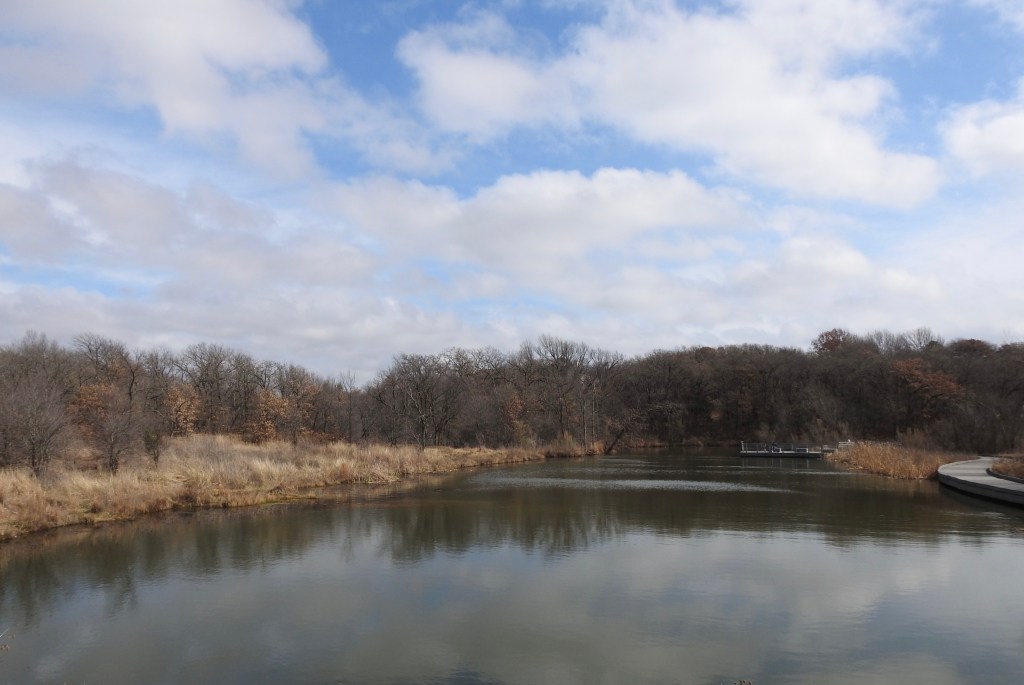
The meetings and discussion happened at the fishing pond, where a belted kingfisher had just visited and turtles basked

I recalled how I was taught to record biological field notes years ago. When some noteworthy specimen was found, what was the date, time, county and local landmarks? The identity of the specimen, size and gender would be recorded. There was no place for what it reminded me of or what emotions the experience might spark. Such field notes, or our entries in iNaturalist, are very valuable. But a nature journal is a personal record, and subjective impressions are welcome. Your nature journal tells the story of your time in a particular place. It need not be a series of disembodied facts, as if pretending that you were not even present. It’s your story, and you have a place in it.

Jessica talked about the art you can include in a nature journal, how it emphasizes what you are drawn to and how the time you spend drawing pulls you into your subject and connects you more strongly with it. She also commented and answered questions about practical matters. For her, much of what you do in the field can be done with a pencil. Take materials that are practical to use, or else you may not get them out and use them. She talked about a strip of cloth with individual places for pens and colored pencils that can be rolled up when not in use.

Jessica and I both emphasized that journaling should be a flexible thing, and each person’s way of responding to their experience and recording it in a journal is meaningful, regardless of how it is done.

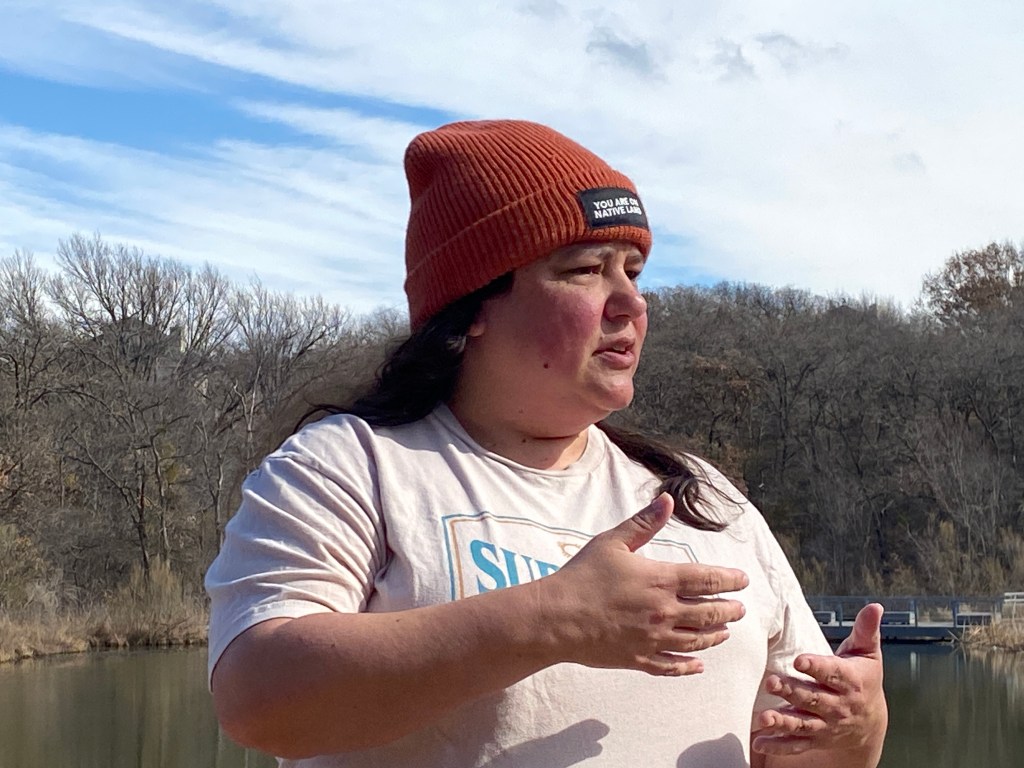
Jessica Smith

After some time to walk and sit, write and draw, people came back with lots of wonderful results. One person said he typically walks without stopping, and so this time he sat and drew the dried stems, leaves, and flower heads of a plant in front of him, becoming absorbed in details and enjoying things he ordinarily would never have experienced. Another person said she approached today’s journaling in a poetic way, and read a beautiful entry about a sort of conversation with nature about the coming renewal of life in spring.

We were so happy to hear these things, and grateful for everyone’s time and attention. When we asked, it seemed that the group would like to do this again, so watch for another session on nature journaling at the preserve. Newcomers will be as welcome as the returning participants will be.

(See Jessica’s artwork on Facebook at Good Earth Art.)

What Part Do We Play in a Nature Journal?

In a talk about ways of being in nature, someone asked me if writing in a nature journal might make the experience too much about him. I hadn’t considered that question before and struggled to answer. On one level, the answer was clear to me: No, what he writes about the time he spent in nature would not be self-centered. But his question deserves more thought, as it helps clarify what a nature journal is for. It might help us decide whether and how to keep a journal. 

I had mentioned that I started out keeping field notes as I had been taught by biologists. County and state, date and time, species, age class, sex – a very terse style of recording data that might accompany a specimen as it was catalogued into a scientific collection. We, the observers, had no place in those notes beyond the listing of our names. Years later, looking back at such notes might give information about where and under what conditions I found a particular kind of lizard, but it would convey little or nothing about what it was like for us to walk across a rocky ridge in a particular place in Texas.

Journaling, as most of us understand it, involves a more personal account of time spent in some place. There are more incidental and subjective details of how the sunshine felt, or the yipping and howling of coyotes as the last of a sunset faded to darkness. Subjective impressions are welcome, perhaps exploring a sense of solitude and what it means for us.

In the talk I had also emphasized that journaling makes it more likely that we will recall our day in nature in more detail. As we write (or draw), we think about and visualize again what we saw. It’s the same sort of thing we would do if we wanted to commit something to memory. Bringing sounds and sensations back to awareness, telling ourselves the story of what we have just experienced, weaves together a pattern of brain activity that can become part of our long-term memory. Even if we never looked at the page again, chances are we would remember the day with greater richness.

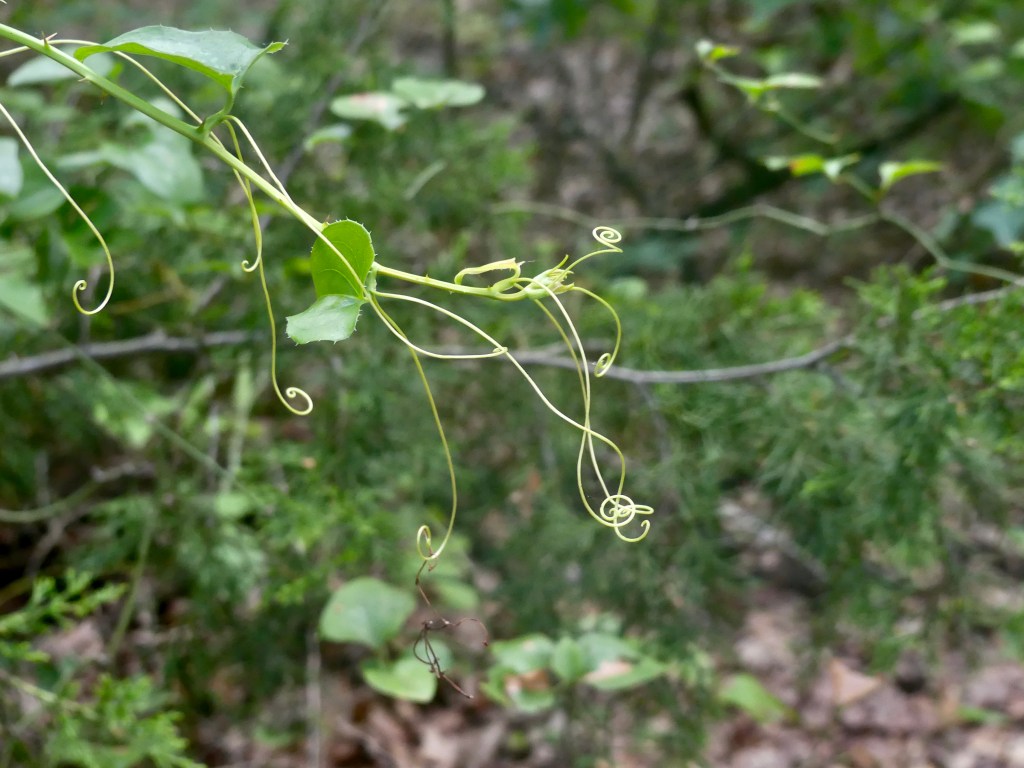
So with that in mind, maybe the journal is, in part, something we do for ourselves right then, while we are still in the woods or on some rocky bluff. It’s not a way to look back years from now, but a way to process the experience for ourselves while it is in front of us. By “process” it, I mean to reflect on it, sort out what happened, and sift through its meanings. Even a short walk may bring up meanings for us to consider. Walking through a small preserve, I was struck by how the delicate curling tendrils of a greenbrier reminded me of some elvish scripts in Tolkien’s work. Another time in the same place, I thought about my dissatisfaction with the nearby highway noise and how it contrasted with a mindful acceptance of my walk just as it was. Such issues may be small, but sometimes they add worthwhile perspectives to our understanding of the world and how we live in it.

I said that in one respect, writing in a journal is something we do for ourselves, so we return to the issue of whether it would make the experience “all about me.” Would it? I don’t think so, if that means a self-centered focus with no room in the story for anything but us. I think the question I was asked was really about the opposite: whether, in an account of trees, grasses, insects and clouds, there is room for us. Do we belong in the story of our walk in the woods? 

When we go for a walk in the woods, what is created is a relationship between ourselves, the trees, the ground beneath us, birds and butterflies around us, and the whole community of life in that place. We are, for a while anyway, a member of that community. We may have little physical impact, but we are not a disembodied presence there. We leave the imprint of our feet, perhaps eat a few berries, and send a few animals into hiding or draw them out in curiosity. We exchange with the plants the gasses we each need for respiration. We receive experiences of beauty and wonder, water in which to wade or swim, paths to explore and places to rest. And this is just part of a wider relationship in which the earth nurtures us and we take care of the earth (or not).

What I’m saying is that we do belong in the story of our walk or our backpacking trip. We are at least temporary members of that community. We might seem like alien gawkers, we who live in the “built” world and arrive clothed in the products of that world. The longer we are estranged from nature, the more it might seem like we are visiting a foreign world, but in some sense what we are doing is coming home. So why wouldn’t we have a part in the story of that reunion? 

If we’re fortunate enough to watch a heron stalking a fish or a coachwhip snake effortlessly climb a tree, we would be eager to write about it in our journal. Why not write about our own behavior as we explore or wait patiently for something to emerge? Why not put down an account of how we felt about something, or how it reminded us of some other thing? This might initially make us self-conscious because it isn’t a familiar way of taking notes in the field, and maybe it would seem too self-focused. I think that including ourselves gives helpful context to what we are writing about and helps us reflect on and sort out our experience in a more complete way. It’s a way of telling the whole narrative of our day.