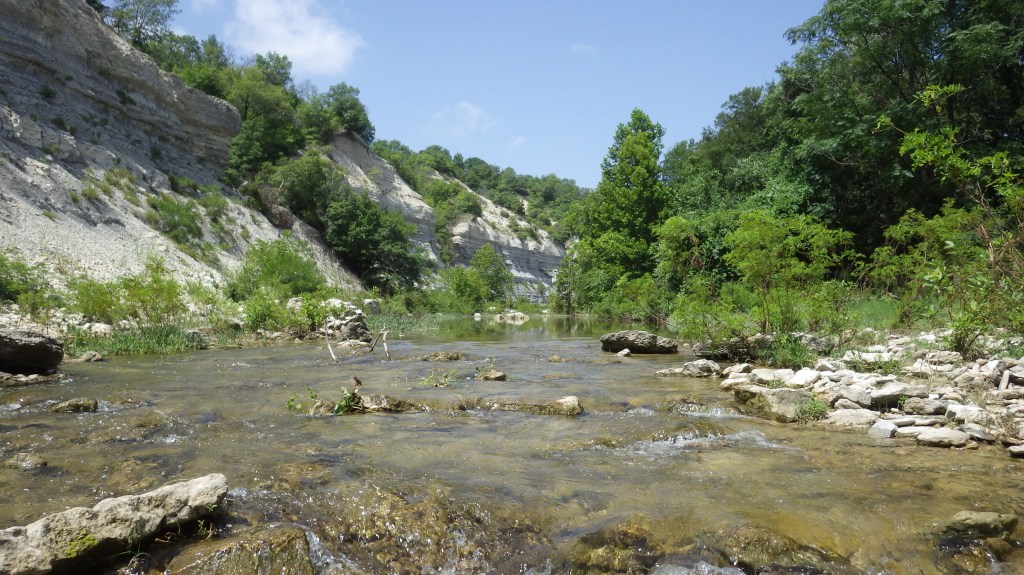
What do we do when we take a walk in the woods? On a winter walk, seeing the nearly black, rough bark on the trunk of a blackjack oak and the paler, warty trunks of hackberries? Crossing a creek and looking at sudden tiny swirls at the water’s surface, where groups of mosquitofish dart away from our shadow. On sunny days when we stop and look upward toward the songs of small birds – titmice and chickadees flitting from one tree limb to the next. What we do is notice what is around us. Chances are that we pause for a little and soak in the experience, trying to get a good look and a good listen.
What should we call that kind of noticing? Being tuned in to the land and sky, the animals we find, the plants and trees, is the sort of thing that naturalists do. A naturalist is someone who pays attention to all those things and wants to understand how it all works together. So if you are doing that, we might say you’re using a naturalist’s attention.
We don’t always use our attention that way. Sometimes we could jog along the trail with ear buds in, listening to music or a podcast. Or we could walk through trees and grasses with a friend, talking about each other’s lives and getting “lost” in conversation. That’s a different experience. It can be great, but it is different than what we experience with a naturalist’s attention to our surroundings.
I think I learned to use a naturalist’s attention long ago as I looked for reptiles and amphibians and learned about how things work in nature, predators and prey, and also species that return used up bodies to the soil, the choreography of the seasons, and so on. As the years have passed, my preferred way of being in nature emphasizes quiet and stillness. I don’t necessarily mean lack of movement; for me, stillness is a quality of mind. I could be sitting or I might be walking along, but with luck I can have that quality of stillness as I move.
Mindfulness
I began to learn more about mindfulness and then to practice and write about it (for example, in Mindfulness in Texas Nature). When practiced in nature, mindfulness is very similar to what I’ve described as a naturalist’s attention. Mindfulness involves being aware of and paying attention to whatever is happening here and now, and doing so without judgment. We do not try to push anything out of awareness or notice only what we consider good; instead of trying to control our experience, we accept it as it is.
This attention to what we are experiencing includes both external and internal experience. What happens internally includes, of course, thoughts and emotions, and we cannot “empty our minds” of all thoughts. The human brain generates lots of thoughts, and during mindfulness practice we notice and then let them go. We stay in the present moment by not letting them take hold of us and lead us into distraction. If I’m sitting in the woods and something occurs to me about an appointment tomorrow, I can notice that I’m having a thought and then bring myself back to where I am sitting among the trees. I will probably need to do that multiple times. When a person is just beginning mindfulness practice, they do this over and over again, and that is normal. With more experience, those thoughts may be less persistent.
People often think of mindfulness meditation as something that occurs while seated on a cushion in some quiet room. That is one way to practice mindfulness, but it also can be practiced while sitting in nature or while moving about – with that quality of stillness I mentioned earlier. The important things include staying in the present, aware of our experience. We try not to wind up spending our time on autopilot, lost in thoughts (or conversation).
An important strategy in mindfulness practice is paying attention to our breathing. The breath is always there, always available as a part of our experience in this moment. Focusing our awareness on each breath in and each breath out is a way of anchoring ourselves in the present. If we begin in this way for a few minutes, then we can shift our attention to everything else, such as clouds, water, the feel of the ground under our feet, and so on. When our minds begin to wander, we can bring our attention back to our breathing which anchors us in the present moment.
Typically, this breath awareness meditation involves breathing in a natural and comfortable way, noticing every sensation of air in our nostrils and throat, the expansion of our chest and abdomen. The in-breath fills our awareness with a cool rush of air through our nostrils and the expansion of our lungs. We might let our attention center on how our abdomen expands or any of the other sensations. Then with the out-breath we feel our abdomen and chest contract and the slightly warmed air leaving our nostrils. And every time our mind brings up other things, we take note of it with patience and the understanding that this is perfectly normal, and return our attention to our breath.
When we do this during an outing in nature, after focusing on breathing for a short time, we can move the focus of our attention outside ourselves to what is nearby. We notice sounds, smells and sights around us and then see what we notice further away. When our mind wanders, we gently bring it back to what is happening right now. If it will help, we can return to focusing on our breathing for a while.
The significance of this in a world in crisis
Most of us look around and we see a society in crisis. We look for what we can do to resist the destruction that threatens us, and our days can be full of watching, waiting, and worrying. I believe that we should remain engaged and informed and try to make things better, and yet if we become overwhelmed, we cannot do much good. It will help if we find time to be immersed in good things – people and places we love.
In his book, Peace is Every Step, the Zen master and mindfulness teacher Thich Nhat Hanh says that we should learn to ask, “What’s not wrong?”
There are so many elements in the world and within our bodies, feelings, perceptions, and consciousness that are wholesome, refreshing, and healing. If we block ourselves, if we stay in the prison of our sorrow, we will not be in touch with these healing elements. (p. 77)
We need these healing elements, even as we stay engaged in a world that needs our voices right now. We must not forget to visit what is not wrong, what we love, and what gives our lives meaning. We need each other, and that includes the other than human lives we find in nature. For me, being absorbed in the sound, sight, smell, and feel of the world around me, with attention focused on a spider’s web, sunlight filtered through leaves, the call and answer of nearby crows, and the color of a small cluster of mushrooms, is a lifeline. I think such things are lifelines for many of us.
 Our Lives In Nature