Crows and Compass Plants at Tandy Hills

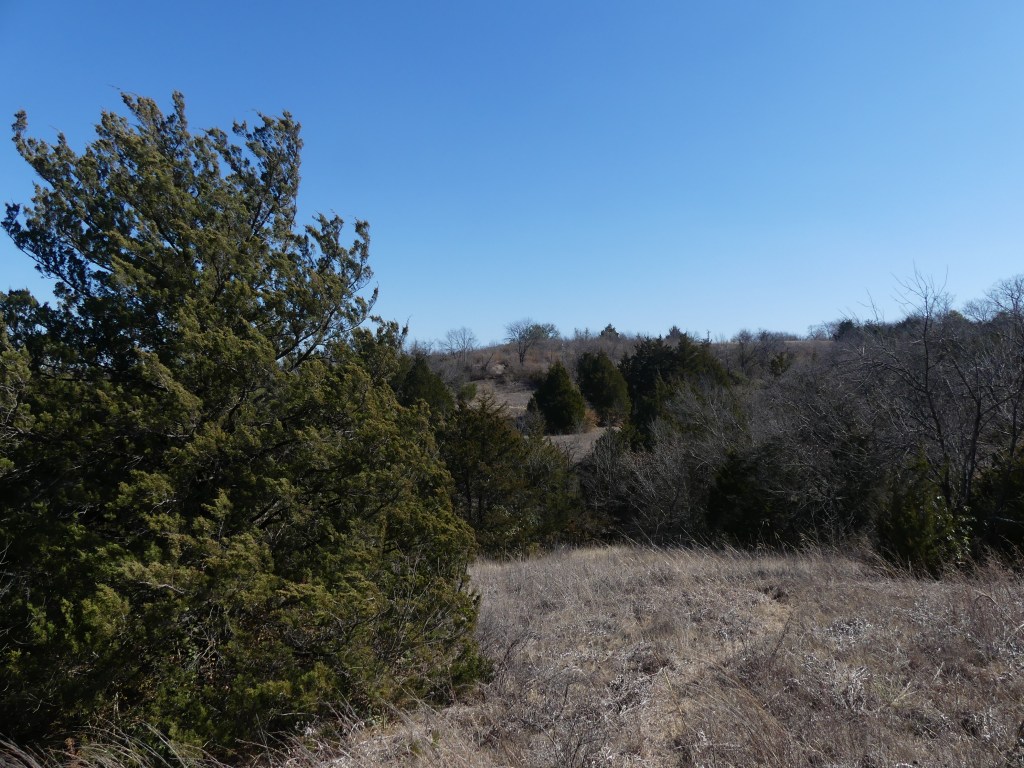
On a bright February afternoon, Tandy Hills Natural Area was a great place to walk through the prairie. A couple of hours of mindful awareness of limestone ridges, junipers, crows and compass plants was just what I needed. I put my phone away and, when my mind strayed, I brought it back to this moment with these grasses and these junipers. The afternoon here was valuable; it deserved my full attention.

Really, any afternoon (and morning, too) deserves our full attention. That is one of the messages of the practice of mindfulness, a discipline that can help us go through our days awake to what is happening around us and within us. In contrast, if I walked through the prairie while looking at my phone or thinking about something coming up tomorrow, I would be on a sort of autopilot and would hardly notice what happened on my walk.
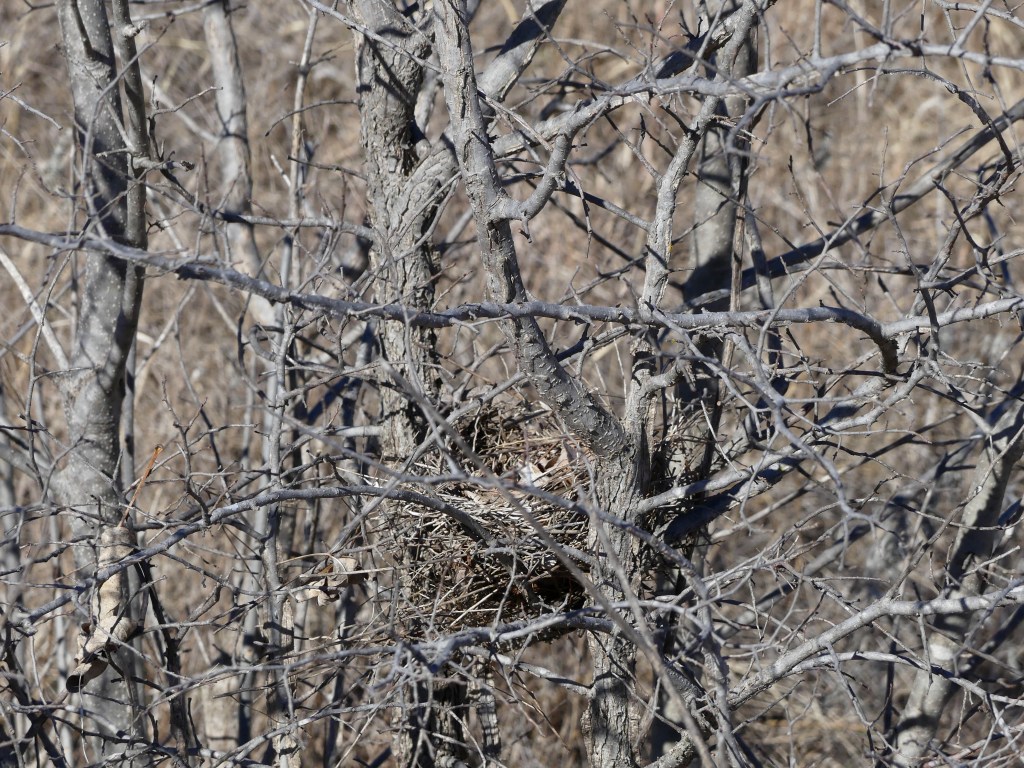
There was a lot to notice in the more than 200 acres of prairie and savannah in east Fort Worth. Wandering along the trail, I noticed a small bird nest in a young tree, only a couple of feet off the ground. Last year, a little bird chose this tangle of branches as the safest spot for her family. I thought of the amazing ability of that avian brain and nimble wings to coordinate a landing within those branches. Routinely coming and going from the nest would have required an Olympian athletic ability.
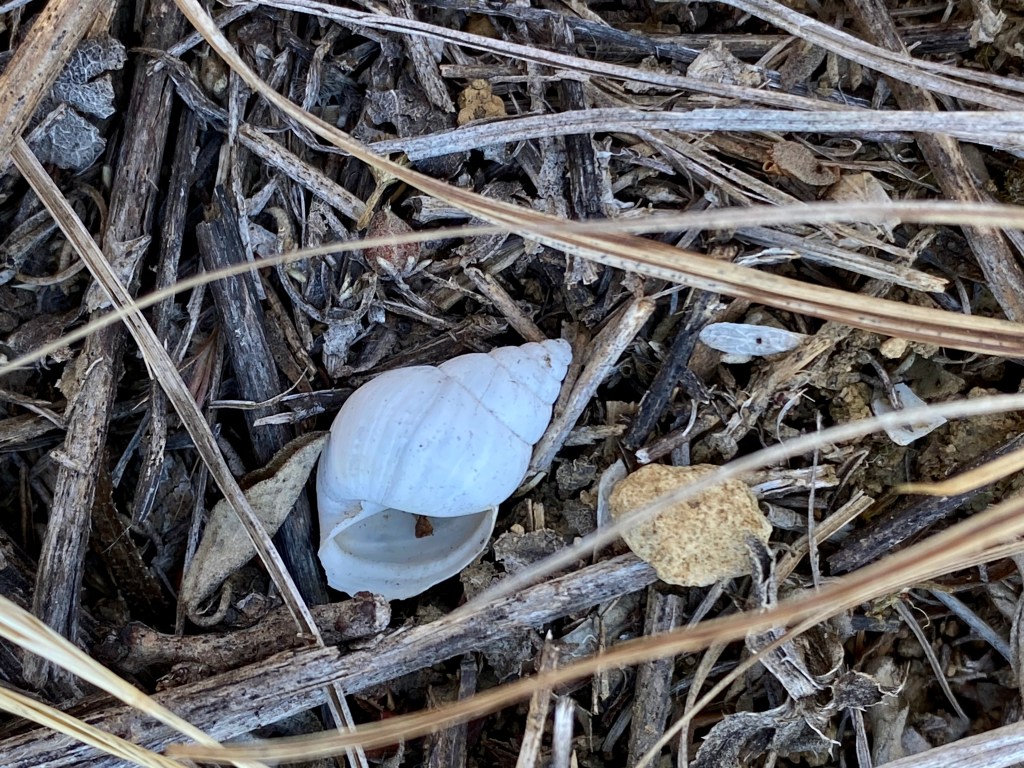
The shell of a Rabdotus snail

Sometimes my pace resembles what Suzanne Tuttle calls “walking at the speed of botany.” Being unhurried and shifting between the wide view of the landscape and the narrow view of small patches of ground, you find wonders hidden in plain view. For example, there were the small gleaming white shells tucked away in the thatch of last year’s grass. The land snail called Rabdotus generates a beautiful spiral shell, growing bigger as the curve expands below its conical tip. 

There are some spots within open patches of prairie where the sun exposure, drainage, and surrounding community of species is just right for the compass plant. Its name reflects the tendency for the leaves to grow facing north and south. Not that the plant cares much for cartography, but when the leaves grow in this way, they do not absorb so much of the sun’s heat in summer. And what leaves! Compass plant leaves are big and deeply cut into lobes, and the leaf is very stiff and sandpapery. Even in winter when the plant is dormant, the dead leaves persist on the ground as pale ghosts of their summer selves. They are brittle but still stiff and gritty.
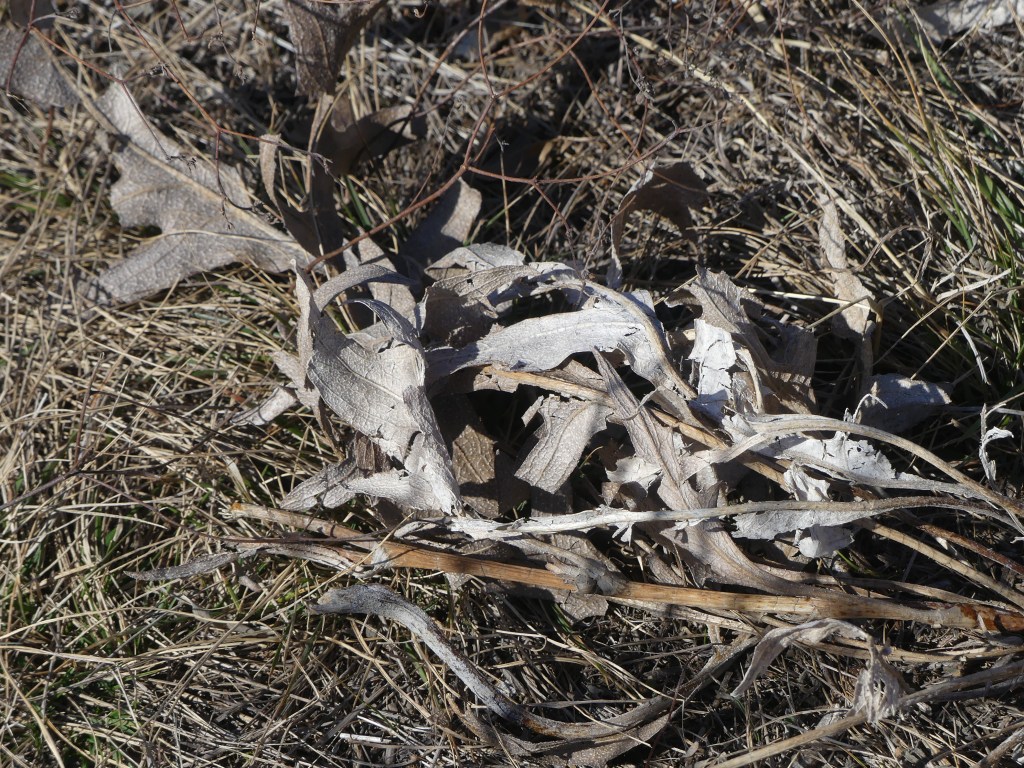
One of last year’s compass plants

I walked the trails down to the boundary of the place, just south of I-30. At that point, the traffic noise is pretty distracting to me, and I am ready to head for quieter places. To the east is Broadcast Hill with more rolling prairie added to Tandy Hills in 2020, and beside it is a tall broadcast tower. Looking around, it is clear that this remnant prairie is an island of nature surrounded by the “built world” of freeways, technology, and houses. It is all the more a treasure because outside of its boundaries, all the grasslands, meadows full of flowers, and woodlands are gone. 

Tandy Hills without the “built world’

The challenge for me is to fully accept all the wonders together with the freeways, the 1500-plus species of plants growing on beautiful limestone ridges along with the views of houses and streets. My camera is a snitch that blurts out my denial of the full reality of the place. I focus on some grasslands with a stand of juniper in the background and I shift the camera so that the broadcast tower is not in the view. I frame a photo so that the buildings beyond the preserve are not visible. 

I will be better off when I can accept that Tandy Hills lives here, among the freeways and houses, a stubborn, wonderful survivor where children can learn about the beautiful spiral shells of land snails and the amazing leaves and beautiful white flowers of compass plants. Perhaps I will progress past the denial phase of my grief at the loss of so much that is wild and natural in Texas. 
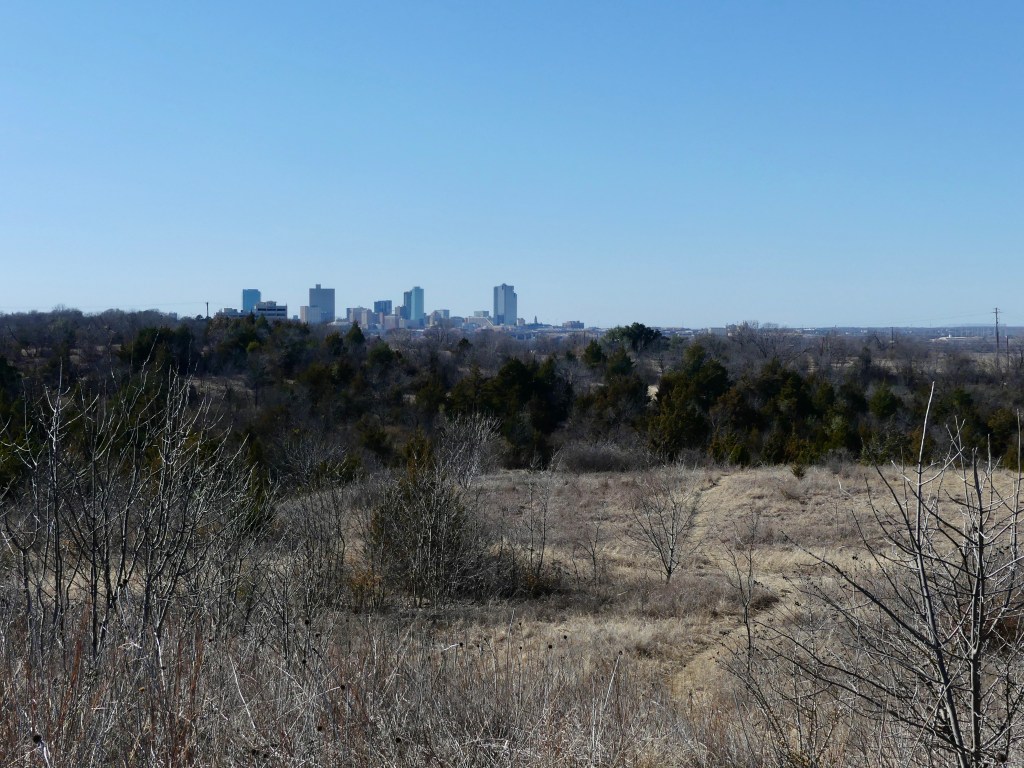
Beyond the boundaries

Mindfulness will help with this because it depends on an attitude of acceptance. To practice mindfulness is to work on being open to what we experience, non-judgmentally. That does not mean that I should not work to support conservation of what is left, or to encourage rules that keep off-road vehicles from tearing up the place. However, on a walk like this one, this afternoon, the full appreciation of the place needs me to accept the sound of trucks and the view of the city just past the nearby hills.

Butterflies appear to accept Tandy Hills just as it is. As I looked over a patch of dormant prairie grasses, a small yellow butterfly bounced across the field. This little sulphur had survived the recent temperatures in the teens and emerged with boundless energy, flying among the little bluestem and Indiangrass and disappearing over the ridge.
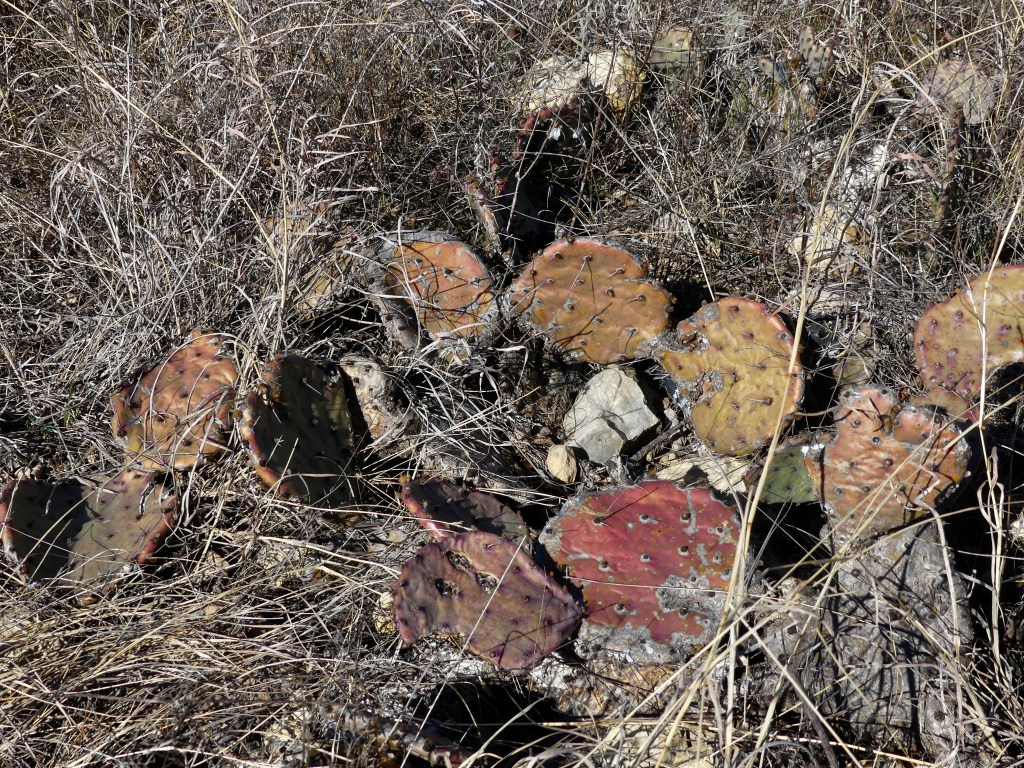
Prickly pear in an array of soft colors

Somewhere along the way was a clump of prickly pear cactus, its pads weakly standing up to the winter and the lack of rainfall. But those pads were the loveliest shades of terra cotta and pale green shading into gold. Walking at the speed of botany brings so many beautiful things into view.

Eventually I sat on a bench on one side of a ridge and looked across junipers and oaks to a small tree or shrub around a hundred yards away. It had a smear of reddish color, perhaps leftover autumn leaves or a possumhaw with clusters of red berries. I wanted to focus my awareness on my breathing and on this one spot in the distance. Bringing attention to each breath is a way, in mindfulness practice, to let go of distractions and focus on moment-to-moment experience.

In my greater stillness and openness, I was more aware of the depth and distance to the next ridge and the green and reddish-gold junipers swaying in the breeze. The hills seemed a little quieter; cars were still moving and somewhere there was an airplane, but they seemed more in the background, more distant. 

A crow flew between the ridges on broad black wings, pulling up to rest on the branches of a skeletal oak tree. Then two more crows flew in from another direction, perching in nearby trees. After a minute of silence there were a couple of rounds of crow-talk, “caw-caw-caw-caw.” The afternoon deepened and the shadows grew longer as I listened to the comings and goings of crows. There was a sense of peace and belonging here with the crows and butterflies and everything else that lives at Tandy Hills. We are all fortunate to be able to spend some time in this patch of prairie.
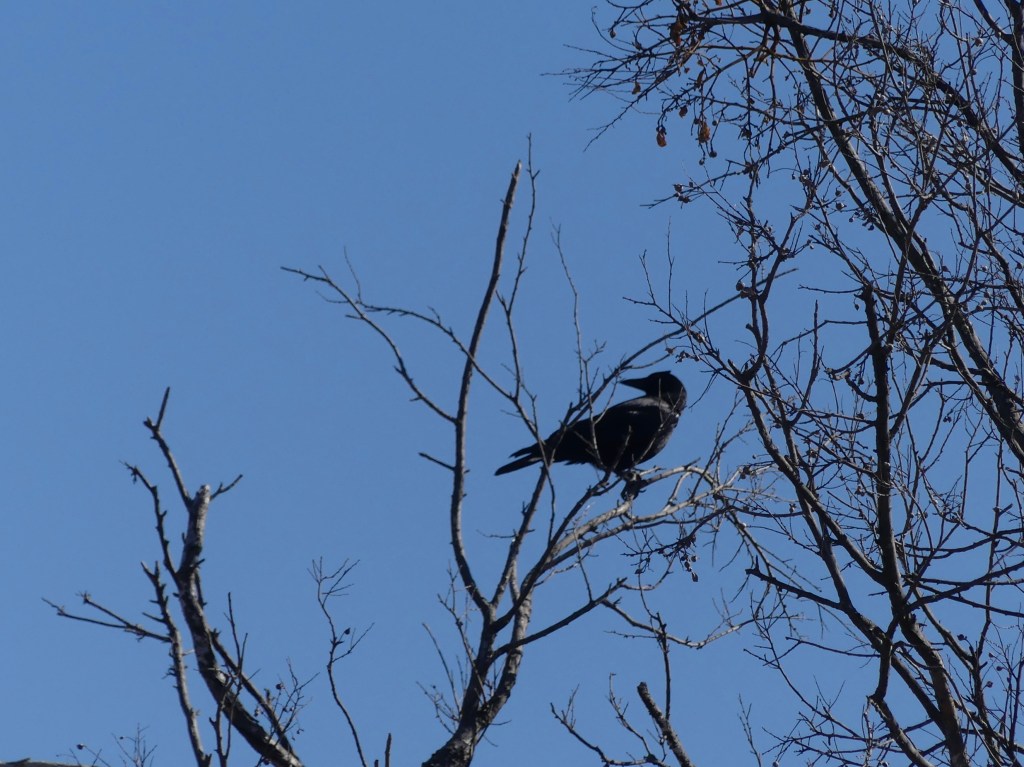
An American crow

Being Open to the Benefits of Nature

We need nature. Flowing water, plants, sunshine or clouds, the simple sounds of birds and breezes.

Research is confirming the substance of what most of us intuit: we are better when we spend time in nature – happier, healthier, freer from the darkness that clings to us when we are closed within our own contraptions.

Some people benefit from playing in nature, and some benefit from the quiet focus of mindfulness. Some embrace the study of animals or plants, or how their lives are entwined to make ecological communities, and others draw, paint, or write about it. There is certainly more than one way to spend time in nature and be renewed and nurtured by it.

I love quiet periods of mindful attention, and also taking the time to write about it while sitting at the edge of a meadow or prairie. Studying nature is also important to me. Someone else might want to play music in some open spot in the woods or spend the afternoon fishing. Is nature good for us regardless of what we do while we’re there? 

I have some educated guesses about how we may get the most benefit from our time in nature. These are informed by what I’ve read and what I know about psychology and the research on the benefits of nature.

Taking time to notice and reflect. Whether it’s play, study, meditation or art, taking time to notice details and enjoy the experience is likely to be an important part of how nature benefits us. Related to noticing is pausing to reflect on it. In general the ability to reflect, to be aware of what we are perceiving and feeling, is beneficial. 

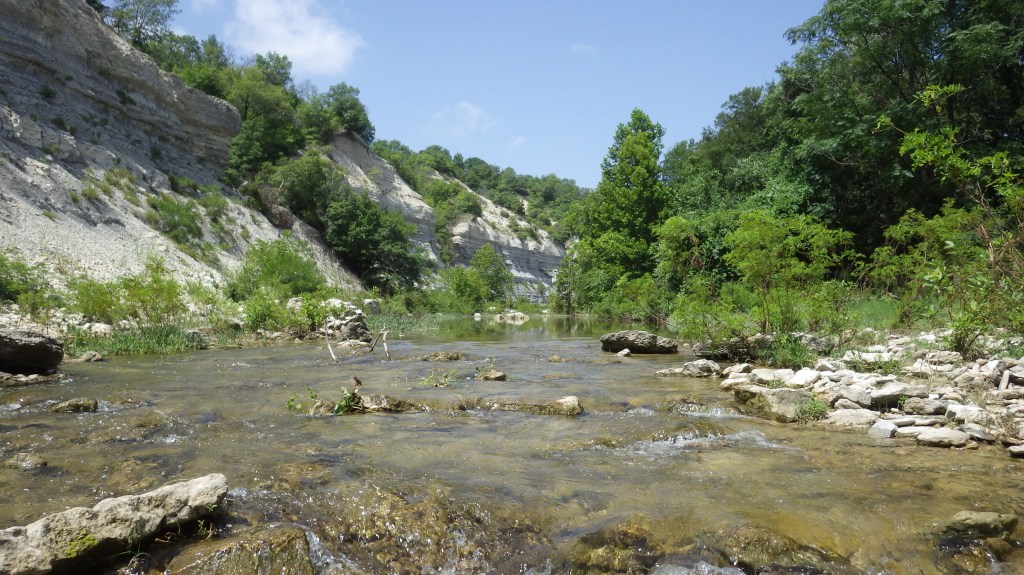
Presence. If we are playing in the creek, we genuinely feel our connection with the rocks and water. You don’t have to read that in any mystical way; it is simply a kind of awareness of, and intentional interaction with, where you are at that moment. You are present in that creek. It is not just a “stand in” for every other stream – it is not a generic experience, like a creek video on an exercise machine.

Quiet mind. Except in some kinds of mindfulness practice, we don’t have to be silent. In a walk in the woods, people often talk with each other, and when we write in a nature journal, words come to us. A few comments and questions about what we are experiencing do not take us far from where we are, in the way that other thoughts and conversations do. In other words, “I think this is Glen Rose Yucca” keeps us in nature, while “What movie should we see tonight” separates us from it. When it comes to our busy, worried, chatty minds, quieter is probably better.

Acceptance and kindness. The more open and accepting we are towards what we are experiencing, the better off we are. The less we see something through the lens of our preferences and wants (and the more we can see it as it is), the more we benefit. This goes hand-in-hand with kindness, the wish for ourselves and everything around us to live in wellness and peace, with as few struggles as possible. These attitudes are closely connected with the practice of mindfulness. I think they are beneficial in visits to nature and in any other context.

The Road to the Big Bend

June 16, 2021

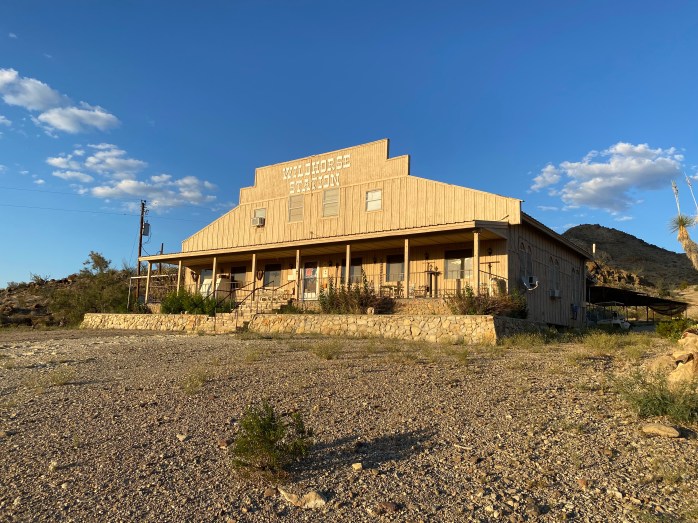
Wild Horse Station
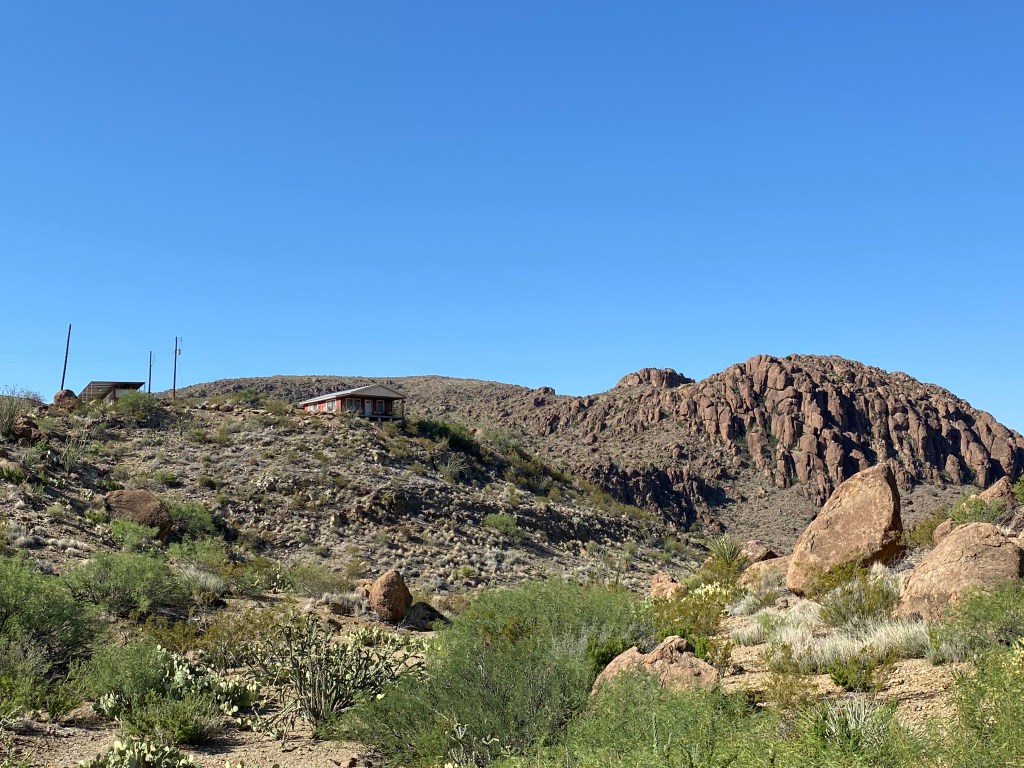
Cabin number one

The day-long drive set the stage for our arrival in the Big Bend country. The land became flatter and more arid, and the stretches between towns lengthened. We began to see dust devils spinning across short distances among the mesquite and cactus. Somewhere south of Pecos, the shadowy line of the Davis Mountains gradually emerged from the haze. We were now far from the big cities, and we were leaving the desolate world of Permian Basin oil and gas extraction. Our travels from here would bring us into the Chihuahuan Desert, passing through mountain ranges and dropping down into desert basins.

Finally, south of Alpine, the two-lane road cut through a landscape with no town ahead for nearly a hundred miles. The sun was sinking toward distant mountains and buttes, and the road threaded through hills and rocky ridges that gradually flattened into huge expanses of gravelly desert dotted with creosote bush and yucca. Here was wildness and remoteness such as you rarely find in the United States, and opportunities to be unplugged from the modern world. 

There was no way to fully prepare Barbara and her kids for this place and its disconnection from the rest of the world. There was no phone service and little traffic. For nearly a hundred miles there are no gas stations, no stores, no fast food. There are occasional small structures – a cabin or a trailer – scattered among the brush and cacti or nestled at the foot of a hill, and occasionally a car or a pickup truck passes you. Nothing else disturbs the sense of being completely alone from one horizon to the other.

Sunset, south of Alpine

We stopped to photograph the sunset, and the deepening orange behind the layered mountains and hills was beautiful. For me it was a welcome return to a place whose openness and enormous scale has always offered peace and endless fascination. The isolation was probably a plus for fifteen-year-old Dani, who is often seeks out quiet moments with a little distance from others. Nicholas, who just turned thirteen, is outwardly an easygoing guy with an infectious smile. Barbara is an artist and media designer whose attention was drawn to this beautiful sunset, while at the same time her attention is never far from Dani and Nicholas. We were all filled with anticipation of the wildlife we hoped to see and hear, and as long as Barbara could get a text to the kids’ dad, telling him that we were OK, she would be fine. 

We stayed at Wild Horse Station, a collection of several cabins and mobile homes perched in different places on a hillside. I knew that cabin number one at the top of the ridge would be a good place to stay, but to get there we had to climb a rutted dirt road up the hill in the dark. There were sharp turns and a section where the path dropped off sharply to our right, but we made it.

It was dark, despite the light from this night’s nearly half moon. This part of Texas has traditionally had little light pollution and the dark skies make it a good place for the McDonald Observatory, in the Davis Mountains. With no blazing lights from cities and limited traffic, the nights are often clear and very dark. When there is no haze, the Milky Way stretches overhead just as it might have looked when it spanned some prehistoric landscape, and the sky seems like a limitless depth of black, with an infinity of stars. This was a moment to shake car-cramped muscles free and let go of thoughts and plans about tomorrow. It was a time for standing quietly under the night sky, surrounded on this hilltop by miles of desert, cool night air, and little else but a few friends and a welcoming shelter.

In mindfulness terms, it would seem to be easy to stop doing something on this night and in this place. How natural to just be still and notice the quiet, correct? But with darkness hiding much of what would catch the eye and hold our attention during the day, sometimes our internal thoughts, judgments and plans push the door open and insist on being heard. To practice mindfulness while the mind tries to smother our awareness under a thousand different things, we must observe ourselves having the thought, decide to let go of it rather than get caught up in it, and return our attention to that dark night in the desert as well as to our internal feelings and perceptions. It does take discipline to keep our attention in the present moment!

If we have enough of that discipline, what can result is a longer and deeper immersion in that night sky and the quiet desert around us. Any of us could stand there outside the cabin and notice the vast scale and the depth of the dark night, getting a short peek into that experience before the mind carried us off somewhere else. Mindful attention lets us live in those moments longer, continuing to be present for the full story of the stars, the sense of height on the hilltop, the soft breezes, the dimly seen desert plants around us, and much more.

A desert kingsnake with a stubbed tail, found later that night, photographed the next morning and released the next night.

We made this trip to introduce friends to the Big Bend region, to look for and photograph reptiles, and find some opportunities for mindfulness. More to come!

Walks in the Woods – Are You Out of Your Mind?

Three people took a walk in the woods. One of them loved being outside, but spent most of her time texting and checking Facebook. At the end of her walk, she hardly felt like she had been in the woods at all. She had been in the woods, but her mind was somewhere else.

“Her mind was somewhere else.” That’s a strange thing to say, isn’t it? As if her mind could be somewhere else, in a different place than her body. Would that mean that she was out of her mind? It’s hard to say.

The second one wasn’t using his phone, but he spend a lot of time thinking about how he was going to talk with his friend about something that happened at school. He saw a frog at the edge of a pond, but then began to think about his friend again. He kept imagining different things his friend might say, turning it over and over in his mind. He hardly noticed the birdsong in the trees above him.

Sometimes a worry can pull us away from ourselves, so that we don’t notice what is going on around us. We can be lost in uncomfortable thoughts, and not even notice what is right in front of us. On a walk in the woods we would like our minds and bodies to be right where we really are, able to be connected with everything around us and “tuned in” to it.

That’s how it was for the third person who walked in the woods. Here is how she did it: She started her walk by going to a quiet place and looking around, at the same time paying attention to each breath she took. Each breath brought in the air of that place, and its oxygen became part of her. Every time she breathed out, the carbon dioxide from her breath joined the air around her, ready for the trees and other plants to use in order to grow. “It’s like I’m becoming part of this place,” she said to herself. She noticed her thought and let it go. She didn’t want to get tangled up in her thoughts – she wanted to stay here, connected to this place.

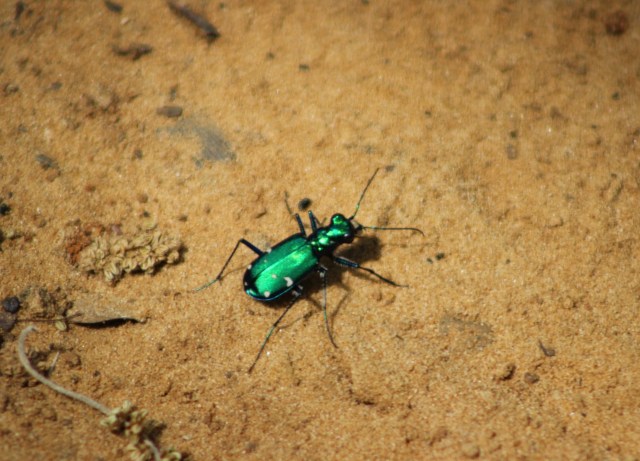
A Six-spotted Tiger Beetle

As she started to walk around, she noticed a beetle running along the sandy trail ahead of her. It was brilliant metallic-green from its antennae to the back of its abdomen. It took off and flew a few feet away, and the girl noticed that the green was on the wing covers – called the “elytra.” When the beetle landed, she noticed that six little white spots were scattered on the back half of those elytra. She watched the beetle for several minutes, noticing how amazingly fast it could run on those little legs, and how it flew just out of reach whenever she got too near.

Further down the trail, she saw a butterfly being tossed around in the autumn breeze. And yet, maybe the butterfly was going where it wanted to go. She noticed that it sailed behind some trees, then came back around near her. The breeze didn’t do that. Maybe those fluttering wings knew what they were doing, even though the butterfly looked almost exactly like a yellow leaf being blown around by the breeze. A big dragonfly came on the scene, heading straight for the butterfly. Bouncing around on thin butterfly wings, it maneuvered around the tree branches and disappeared, leaving the dragonfly behind.

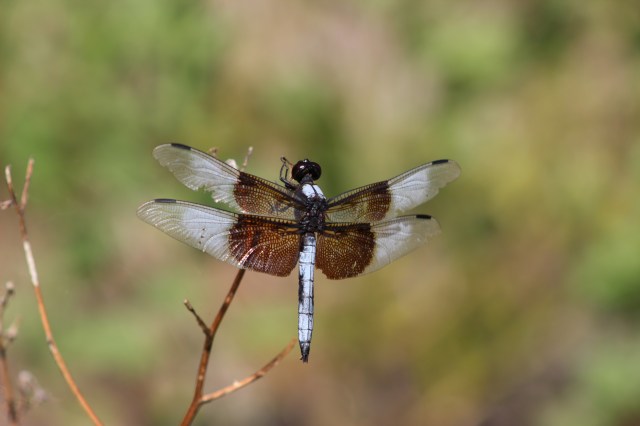
One of our common dragonflies

The walk continued in this way, as the girl took in the sights, sounds, and smells of the place. When she found some animal, she stopped to follow what it was doing, and found that with a little patience – with the ability to just be there without hurrying – she noticed lots of things that she might have missed. She didn’t even have to know all the facts behind what she saw. With a little checking, she could discover that the green beetle was a six-spotted tiger beetle, a fierce predator of smaller insects. But she could also just appreciate it as a beautiful, fast creature with whom she shared the path on that wonderful walk in the woods.

She and her mind and body had all been together that day, open and ready to see, hear, feel and smell everything that the place could offer. It was a walk that she remembered for a long time.

(This article also appears in the October, 2019 issue of “The Treefrog Times,” a young readers publication available free at www.jsdragons.com)

Being Mindful of Oaks and Hawks at Summer’s End

It was almost two weeks into autumn, and summer’s heat held on. On October 6th, when the high temperature in Arlington reached 97ºF, a cold front was scheduled to roll through late in the day. It would be an interesting time to be at the Southwest Nature Preserve. Would the change take the form of a whisper of cool air, or a line of storms? A good friend, Shelsea Sanchez, came with me to witness what might be the end of summer heat and drought. We got there a little after 5:00pm and stayed for a couple of hours.

Juvenile Texas Spiny Lizard

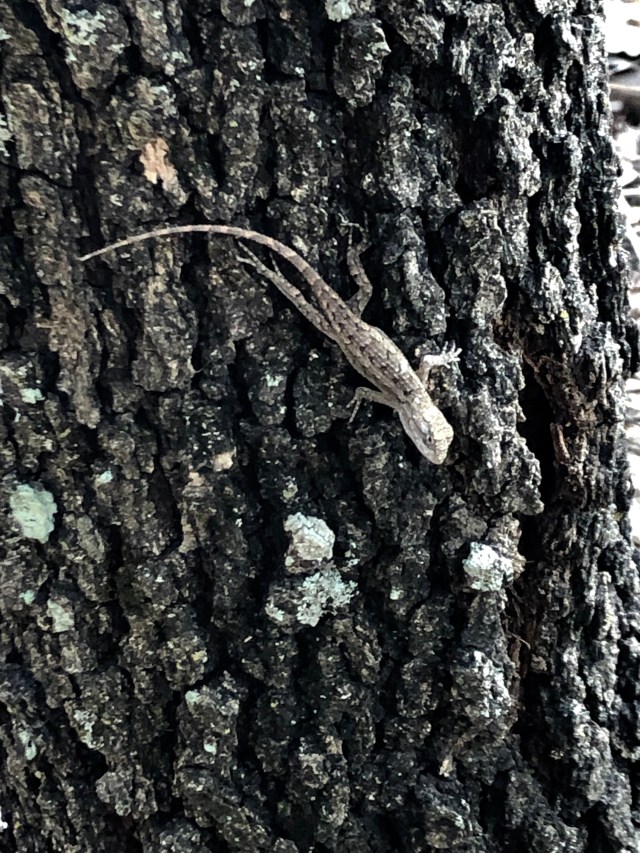
The initial walk around the north pond felt like a late afternoon in summer. We passed a little Texas Spiny Lizard positioned on a tree trunk, stalking insects in the hot sunshine as if it was back in August. Actually, two months ago this very young lizard might not yet have hatched from the egg, but now he or she was feeding and growing as it if was endless summer.


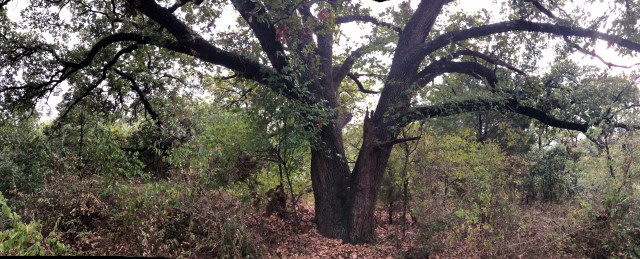
We followed the path up the gentle climb on the back side of the preserve, to pay a visit to a Post Oak that will be proclaimed as a Texas “historic tree” later this month. It is estimated to be over two hundred years old, with huge twin trunks and massive limbs that stretch out over the surrounding vegetation. It is being called the “Caddo Oak,” recognizing that it would have been an adult tree when the people who lived on this land were Caddo hunters and farmers. 

The Caddo Oak, a very old Post Oak

A good way to spend time in a place like this is to clear our minds of the mental traffic that pulls us to past worries or future plans, so that we can simply be open to the present experience. A good strategy for this is to notice our breathing, how the body expands and relaxes with each breath. From this focus on present experience, we can connect more deeply with our surroundings – in this case a massive old tree with deeply furrowed bark and a giant canopy of leaves. There is a lot to notice and appreciate when practicing mindfulness in nature, simply opening oneself to the present experience without judging it or being tugged away from the moment by the internal “chatter” that often captures our lives.

We stood for a while, taking in the tree, the sky, and all the surroundings. Later we talked about what we had noticed: Shelsea’s perception was that those big limbs would just go on reaching out to the woods and sky, ever wider. It impressed her as a “wise” tree, something that had lived a long time and experienced a great deal. The branching limbs of our oak trees often suggest to me a parallel with blood vessels, extending into the surrounding air, supporting life in the process.


Following the trail as it turned and skirted a yucca meadow with deep sand, beyond a thicket of sumac and past a big juniper, we talked about how trees are linked together below the soil. A fine network of fungal threads, called mycorrhizae, connects with the roots and helps provide water and minerals. In exchange, the fungus gets nutrients from plant roots. It is a mutually beneficial relationship, and it is thought that mycorrhizae make possible a sort of communication between trees. For example, a tree that is attacked by insects may respond by releasing volatile organic compounds, and the surrounding trees connected by the fungal network respond in a similar way.

We spent some time in stillness and quiet, looking to the west toward some oaks in the background, and a scrubby open area with prickly pear cactus and a thicket of greenbriar. The front was coming, and darker blue-gray clouds were massing, and the distant thunder was a welcome and soothing sound. A couple of doves flew overhead, as we continued to absorb what we were experiencing. Afterward, Shelsea commented about how a nearby greenbriar was overtaking and pressing a shrub closer to the ground. Greenbriar is a strong, tough vine that I’ve described as like botanical barbed-wire, and this particular one was attempting to climb a shrub that could not support the vine’s weight. However, the main thing that we had both noticed in the last few minutes was the occasional low rumble from the advancing clouds.


You hear distant thunder when it is quiet – when there are no airplanes, no car engines, no roar of freeway traffic, no loud humming air conditioners. At an urban preserve, some of those things are inescapable, but if those noises are muffled – or if you are in a wild natural place away from mechanized sounds – you can hear breezes, birds, insects, and distant thunder. Through most of our history as humans, those sounds have usually been audible to us. We could hear coyotes howling on a nearby ridge, or a chorus of frogs a quarter-mile away. In a quiet glade we could hear water moving in a creek, and bees buzzing in nearby flowers. The sigh of wind in tree leaves was familiar. It makes you wonder if the loss of all those “quiet sounds” leaves an important gap in our lives, and if constant mechanized sounds and the ever-present TV and video sounds might be a source of low-level stress for us. The answer is yes, it is a source of stress, based on studies showing poorer concentration, increased anxiety and depression, and disrupted sleep because of noise pollution. Even low-level noise tends to increase the body’s levels of the stress hormone cortisol, and chronically elevated levels of cortisol interfere with the brain’s ability to focus and plan, as well as putting us at risk of digestive and cardiac problems, weight gain, headache, and other problems. And so I place a very high value on those experiences of quiet, when a bird’s song or a breeze stirring leaves in a tree can be heard.


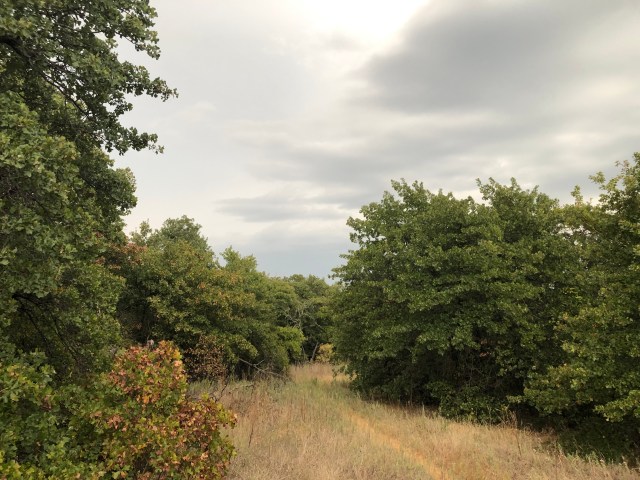
Southwest Nature Preserve, October 6, 2019

Looking up the trail toward the west at 6:30pm, we saw a hawk rise above the tree line, soaring in the turbulent air below the oncoming clouds. A second hawk emerged near the first one. As they flew, the sun shone through a break in the clouds and highlighted the wings of these birds. Another couple of birds joined the group, which flew higher and stayed visible above the tree line. The aerial dance continued and rose higher, with other hawks coming into view. Shelsea and I needed a real birder with us; I did not see rusty reddish tail feathers that would have identified a bird as a Red-tailed Hawk, and so I was at a loss. I could tell that the underparts were light-colored, but my eyes and brain could not follow the movement well enough to remember their color patterns as they rode the fast-moving air currents.

A kettle of hawks

As the number of hawks grew and they spiraled higher, Shelsea pulled out her phone and began recording video. I began doing the same thing, framing the swirling “kettle” of hawks. The Cornell Lab of Ornithology reminds us that hawks sometimes gather in “kettles,” using rising air currents to gain altitude, especially when migrating. In his book, The Birds of Texas, John Tveten notes that in early fall, Broad-winged Hawks begin their migration south into tropical America, rising on air currents and forming large swirling flocks. I do not know if these were Broad-winged Hawks, but it seems quite plausible.

We stood for a moment, taking all this in. Life at the preserve was in sudden motion, as the cold front came through with distant thunder and the promise of rain, and this seemed to have spurred the soaring, wheeling kettle of birds to rise into the sky.

And then, raindrops began to fall. After the heat and drought, it was delightful, and we stood there enjoying the feel of a few cool drops of water on our skin. In our state of fascination with every detail of experience, I noticed that every drop created a little dimpled medallion of mud as it struck the fine red sand of the trail. If the rain continued, those little mud-craters would join and the preserve would get the water it needed. In the meantime, we walked through these sprinkles and enjoyed the feel of the rain.

We spent two hours there, but we had little awareness of the passage of time. It didn’t seem to go quickly or last a long time, because we tried to let go of the past and future so that we could fully experience the present. Although we didn’t pay attention to the passage of time, we had a great time!

Shelsea

Our Lives in Nature

Caddo National Grasslands

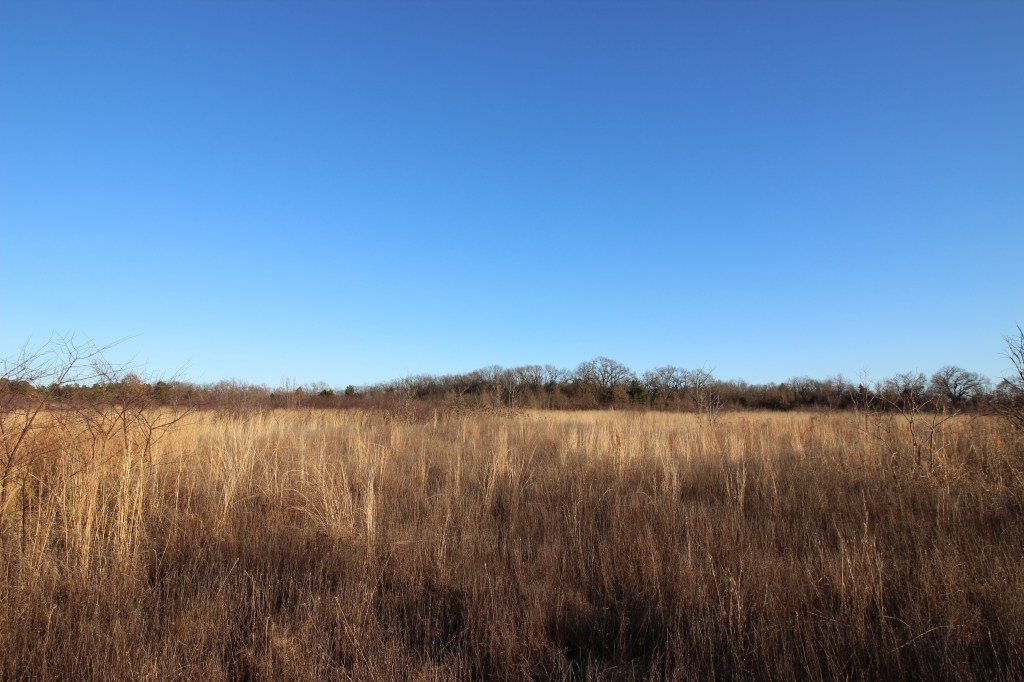
In late January of 2018 I visited Caddo National Grasslands for the first time. I walked through the quiet winter forest alone, enjoying the solitude but also wanting to see the open patches of grassland that I knew had to be there. I finally found it at the end of the day, and later I wrote about those moments:

“The sparrows called with their high-pitched ‘stip,’ and dormant grasses crunched as I walked, and such sounds did not have to compete with highway noise or other mechanized sounds. It was quiet, in a way that perfectly framed the occasional bird call. Here was a refuge, a sanctuary in that original sense of a sacred place. Like so many other natural places that have barely been touched by human activity, it was a place where the ‘noise’ of everyday life could be stripped away, down to the experience of the garden in which we originally lived. That garden feels like home, even if most of us would not know how to live there now. It can be a brutal world of predator and prey, unforgiving of accidents or sickness, but in our sprint through the modern world we might be forgiven if we romanticize that world just a little, and want to step away and stand in the late afternoon sunlight and listen to the birds.”

Moments like those are important to me, and worth sharing with others. I didn’t see anything of great biological importance, but I experienced something of psychological, maybe spiritual importance. It might be some individual quirk of mine, that the solitude and golden light in the savannah grassland worked such magic, but I don’t think so. Many other people have similar experiences in nature, perceptions and feelings that transcend the simple reality of grasses and leaves. They may experience a sense of peace and joy, wrapped in that moment and that place. Past and future concerns drop away and for a while do not exist – only the present, only right here and right now.

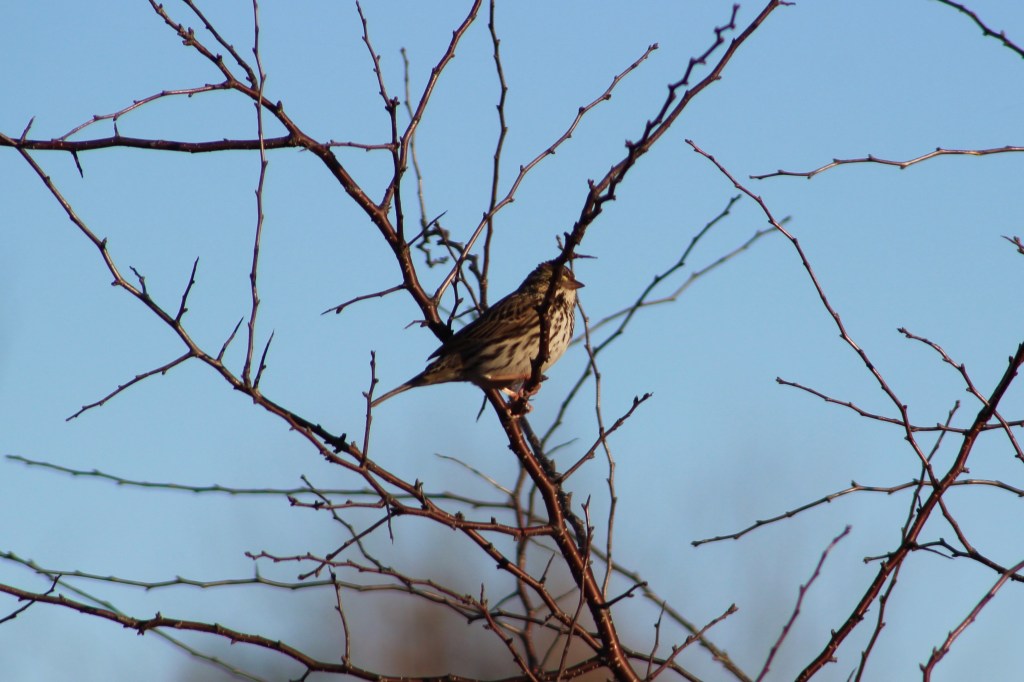
Savannah Sparrow

This is an example of what is referred to as “mindfulness,” a practice that is now widely used in therapy and mental health. It is not new; it has much in common with meditation techniques that have been used for centuries. A focus on the present moment, letting go of thoughts about the past or future, quieting the inner discussion in which we evaluate what is happening, simply accepting our current experience – these things happen in meditation. You do not have to be out in some quiet, isolated spot in nature to practice mindfulness, but for many of us, nature makes it easy to let everything go and be at peace.

Our connection with nature has been explored by lots of people, in many ways. Famed biologist Edward O. Wilson wrote about the “biophilia hypothesis,” the idea that our species is wired to be attracted to other life as a result of evolution. Researchers are testing how humans respond to experiences in nature, compared with experiences in urban settings. They are finding numerous benefits, in terms of stress hormones, ruminative or depressive thinking, and so on, when we spend time in nature. 

In this blog, I want to explore some of these ideas. What does it mean to say that a particular time spent in nature was “spiritual” or gave rise to states of mind that seem spiritual? Are the health benefits of time in nature (such as in the Japanese practice of Shinrin-yoku, or “forest bathing”) real and significant, or just the opinions and testimonials of people who simply want to believe?

I also want to simply share experiences in the field. I have written a lot about the natural history of reptiles and amphibians and I often wear the “natural scientist” hat while writing about nature facts. As important as the objective findings of science are, the subjective experience might be just as important. Words are usually inadequate to communicate the beauty and meaning of these experiences, but I have to try to do so because such things cannot be kept quiet. 

I hope you will join me in this exploration, and I hope that you post a comment if something resonates with you or if you have another way of looking at something that can expand the discussion.