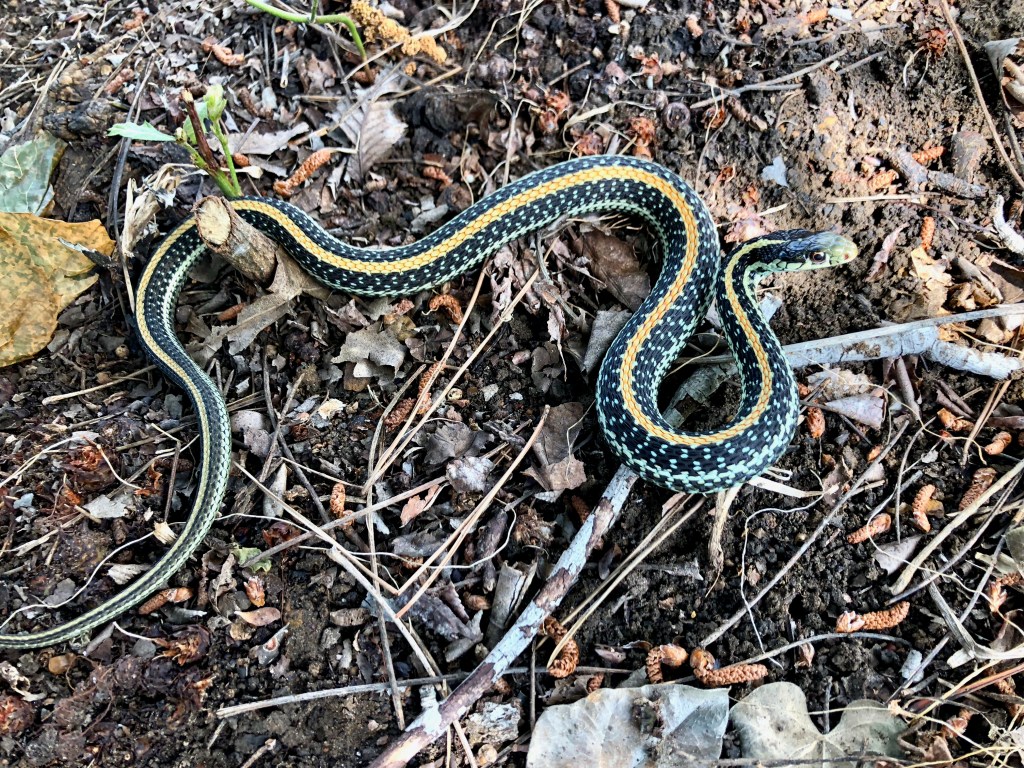
Nearly ten years ago, I was given a young Texas garter snake. A landowner in North Texas had picked him up on his land (where he reported seeing that subspecies regularly) and wanted verification of which kind he was seeing. I drove there with a friend and was delighted to hear that this farm seemed to be one of those little pockets where the Texas garter snake was doing OK. They have always been pretty hard to find, but some places are better than others. Texas Parks & Wildlife Department considers them to be “critically imperiled.”
Tex, back in 2018
I accepted this young one because it evidently would not be a noteworthy loss for that local population, and because he could be an ambassador for threatened Texas snakes. I’ve taken him to quite a few talks and presentations to new groups of Master Naturalists and to school or summer camp groups. Seeing Tex was a good way for people to learn how being a striped snake helps you escape by giving the appearance of being stationary – the stripe doesn’t seem to move – while you are slipping away. And of course he was a living example of an animal I said was in serious trouble and might disappear, for reasons that no one is sure about. It could involve things like habitat loss, habitats fragmented by roads, fire ants, and maybe other things.
In a study in the 2019 issue of Southwestern Naturalist, researchers looked at the genetic status of The Texas garter snake (Thamnophis sirtalis annectens) and two other related garter snakes that occur in Texas. They also looked at suitable habitat, finding that in Texas, where T. s. annectens does better than the other subspecies is in the area of the Cross Timbers, parts of the Blackland Prairie, and some of the Post Oak Savannah and down toward the coast. The study did not look at why it is imperiled.
I wrote about one of the times I took Tex to meet some kids at River Legacy Nature Center, when a girl had commented that she hoped one day they would be protected. On days like that I felt like Tex living in captivity (rather than living out his life on that farm) was worth it. Tex, of course, was silent on the matter.
But he was happy to nap under a piece of bark, cruise around the cage and eat the occasional mouse. His siblings and cousins in the wild were probably snacking on small frogs and earthworms, but most garter snakes can be convinced to eat thawed mice from the store. He grew and seemed to thrive, and living about ten years is not bad for a garter snake. (Their life span in the wild is assumed to be less than that, and sometimes in captivity they may live longer than ten years, but the evidence about their longevity is fairly spotty.)
And now he has died, I presume from something akin to “old age.” RIP, Tex. You charmed a lot of kids; a lot of Master Naturalists around here know your kind based on getting a look at you. I’ll miss you.
Yesterday, on a slightly muggy early September day, I walked the bottomlands at Fort Worth Nature Center & Refuge with this year’s class of Cross Timbers Master Naturalists. We “met” last week via Zoom as I conducted the class covering reptiles and amphibians, mostly looking at Powerpoint slides in which I tried to convey as much as possible about what these animals are, how they live, and how to find them. As usual, they are a great group of people who bring a lot of intelligence and curiosity to the class.
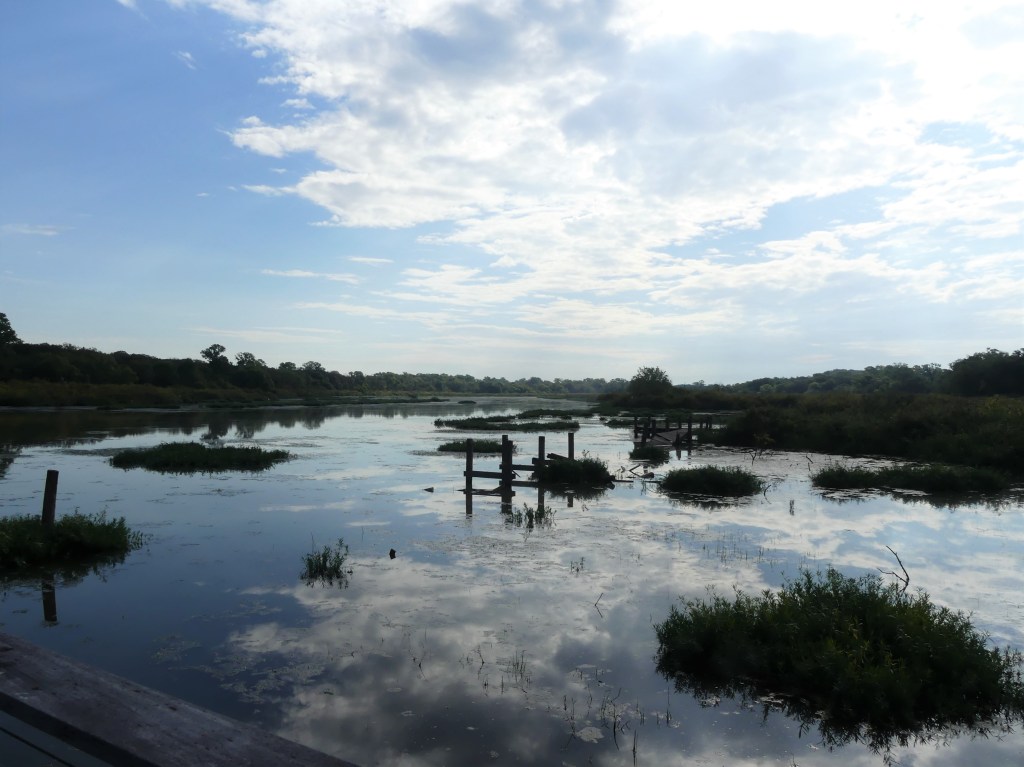
From the marsh boardwalk on a sunny Saturday morning
Last year, I wrote about Master Naturalists as the “rangers” of north Texas’ wild places, a reference to the Dunedain of J.R.R. Tolkien’s Middle Earth. These rangers were solitary folk who lived in wild places and knew the languages and ways of animals and the lore and uses of plants. They were watchers and protectors of the land. I admit that it is a nerdy reference, but I believe it fits well enough. People who devote themselves to the study and protection of nature are all too scarce, and they protect places and species by preserving the knowledge of them and passing that knowledge along to anyone who wants to know.
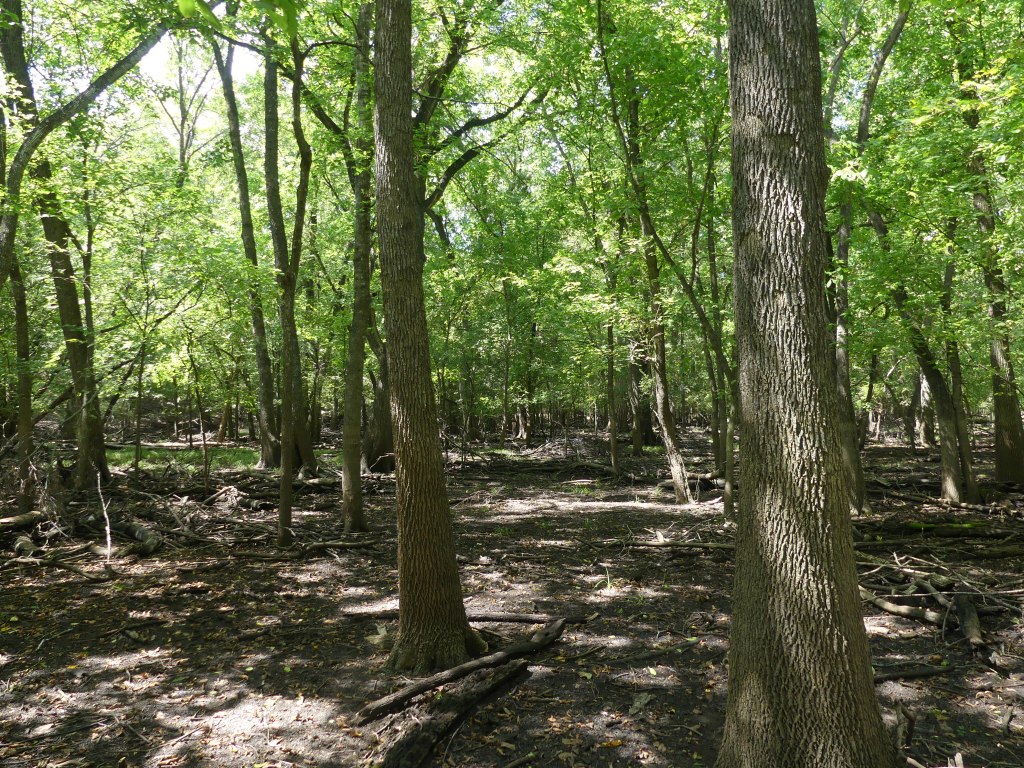
On this day I would join these rangers and go into the field to learn more about the herps that live here. The bottomland forest near the marsh is a good spot for finding a variety of reptiles and amphibians. The seasonal floods create fertile soil and create stacks and piles of downed branches that offer shelter for small animals, which in turn serve as prey for larger ones.
The bottomland forest
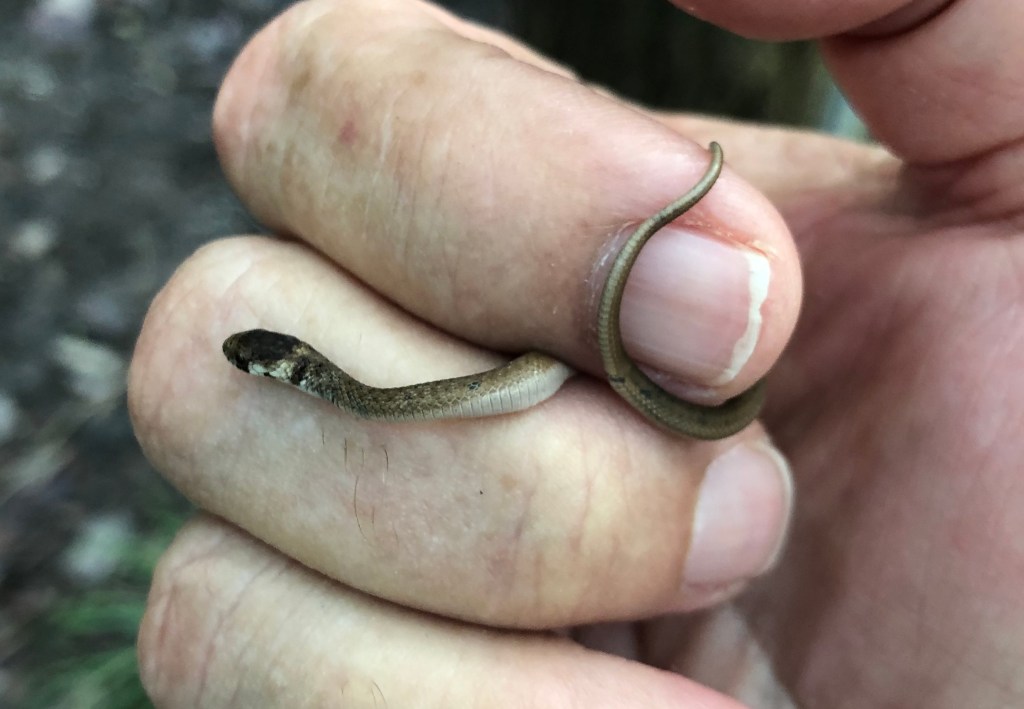
Not all of the herps to be found in the bottomlands are big and charismatic – as a matter of fact most of them are small creatures with a small-scale repertoire of traits and skills with which they go through life. One of them is DeKay’s Brownsnake, previously known as the Texas Brown Snake. It is a fairly nondescript brown-colored snake that grows to about a foot long, with a faded brown stripe down the middle of the back and a suggestion of little dark spots down the back on either side of the stripe. Babies are live-born, and unlike the adults they have a light collar of cream-colored scales just back of the head. August appeared to have been the due dates for these snakes throughout the bottomland, because we found several of the roughly four-inch babies.
Although small and humble, these snakes are well-adapted to find food in the soil and leaf litter of the forest floor. Along with worms, slugs, and soft-bodied insects, Brownsnakes eat snails, but they do not consume the shell. The account of these snakes in Werler & Dixon (2000) tells of research by Rossman and colleagues in Louisiana on snail-eating in Brownsnakes and the related Red-bellied Snakes. They noted that the snakes had teeth that were long and slender, perfect for grasping the soft parts of snails. After biting the snail, the snake pushes its prey until the shell becomes braced against some object. Next, the snake twists its head and neck, holding the position for ten minutes or more, until the exhausted snail relaxes the muscle holding it to its shell. At that point the snake can pull the snail’s body out and swallow it.
Baby DeKay’s Brownsnake
In every respect except size, this snake is an impressive predator with a fascinating adaptation of structure and behavior, allowing it to tackle an animal whose shell should keep it safe from predation. One of them I caught to show students wanted to disregard even its small size in demanding my respect. It flattened its little head and body and struck at me several times, despite its inability (at about 3-and-a-half inches) to harm me in any way, even with those extra-long teeth. After everyone had a look, I released it to find refuge below the branches and leaves on the forest floor.
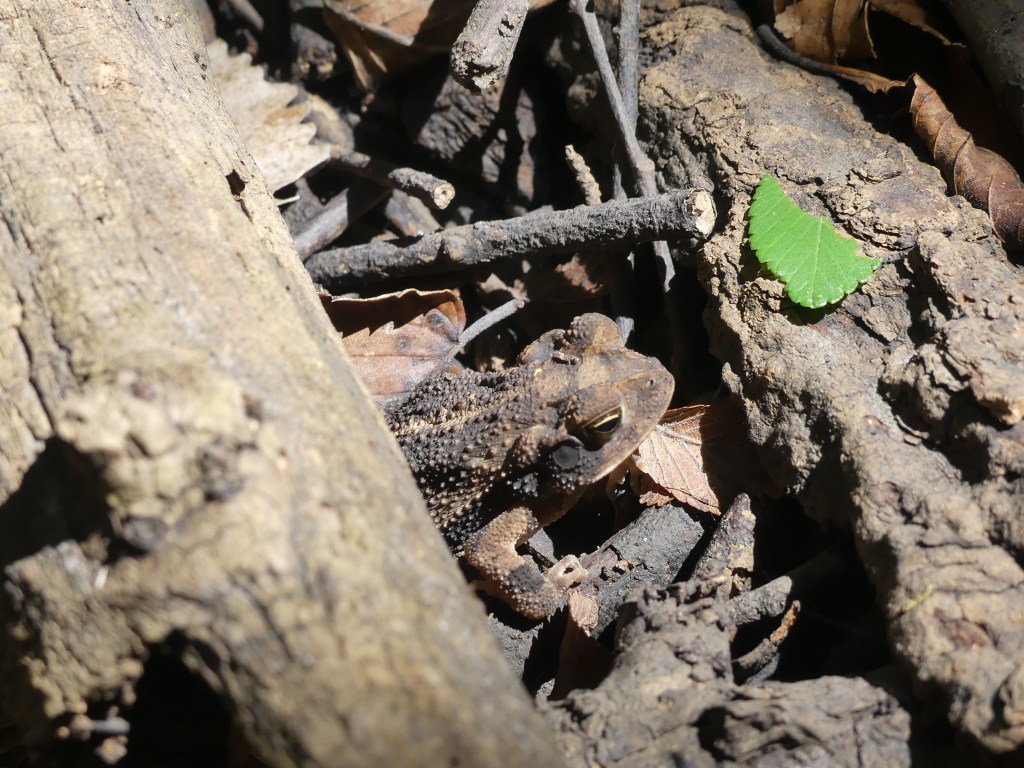
The really common amphibian was the Coastal Plains (aka Gulf Coast) Toad. We found many of these, ranging from very small metamorphs – just recently transformed from tadpoles – to young toads that were not fully grown. Dustin McBride, a Nature Center staff member who was with us, could make out the tiny identifying marks such as the shapes of parotoid glands better than I could. As they grow, these little toads develop a characteristic dark pattern with a light stripe down the back and dark bands down the sides, with very prominent cranial crests (bony ridges on the head) and raised parotoid glands behind the eye and eardrum that are fairly triangular in shape.
A Coastal Plains or Gulf Coast Toad
We lifted or turned large branches or pieces of bark to see what was beneath, always careful to return these pieces like they were. We picked those pieces because they looked like good refuges for an animal to use, and we didn’t want to mess up those qualities of size, placement, and humidity underneath that makes a log or branch a useful refuge. Under one of them was a beautiful little Western Ribbonsnake.
I love Ribbonsnakes and all the other members, like the Gartersnakes, of the genus Thamnophis. The Ribbonsnakes are slender and graceful swimmers and wanderers through creeks and marshes, and they particularly like to eat frogs. I suspect this one was taking a few of those little toadlets for meals, and it will gladly chase the Cricket Frogs that will show up in the bottomlands now that we have had some rain.
The Western Ribbonsnake
There were also Leopard Frogs and a Little Brown Skink that managed to get away from us before everyone got to see it. The bottomland forest had once again been a good place to learn about some reptiles and amphibians and how to find them. I hope the Master Naturalists, those rangers of the Cross Timbers, will remember this day and the stories and life histories of little things like the DeKay’s Brownsnake.
Werler, J.E., & J.R. Dixon, 2000. Texas Snakes: Identification, Distribution, and Natural History. Austin: University of Texas Press.
Once again this year I had the privilege of teaching herpetology to an incoming group of Master Naturalists. Today I led them on a short walk into the bottomland forest at Fort Worth Nature Center & Refuge. Each year, I appreciate the Texas Master Naturalists even more; they are the “rangers” of the remaining wild lands and creatures of our state.
Flooded bottomlands in April of 2010
By “rangers,” I am drawing upon the stories within The Lord of the Rings, and referring to the Dunedain, the people who wandered the lands in the north of Middle Earth. The rangers knew those lands and protected them as best they could, just as the Master Naturalists learn about the land, animals, and the plants around us. Maybe you’ll forgive what could seem like an overly stretched analogy, but in a world increasingly separated from nature, we need to celebrate those who understand and are drawn to nature and who might help advocate for it. Who else studies the intricacies of natural history and spends time wandering in the forests and fields?
Becoming a Master Naturalist involves a series of classes and readings; you do not sign up, pay your money, and now you get the title just for joining the “club.” There are classes and field experiences, and after certification there are activities and ongoing training. Some of the people in the Master Naturalist program are quite expert in one or perhaps several areas of nature study.
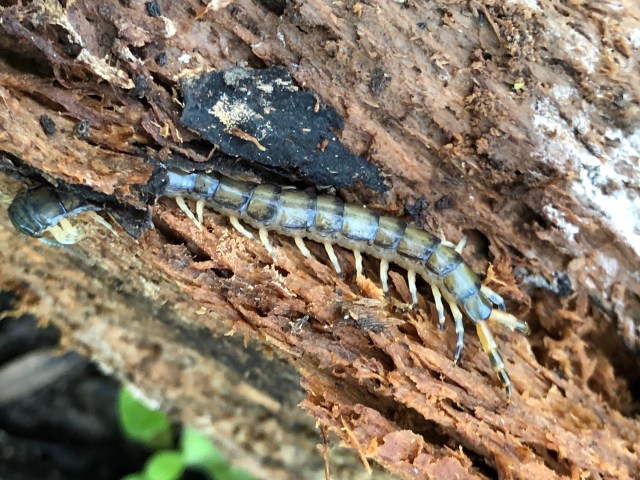
A centipede, surprised under a fallen log
What did we do today? We walked down through the bottomlands, past huge cottonwoods and other trees and in areas that periodically flood. Fallen logs and branches shelter numerous herp species, along with lots of wolf spiders and other invertebrates.
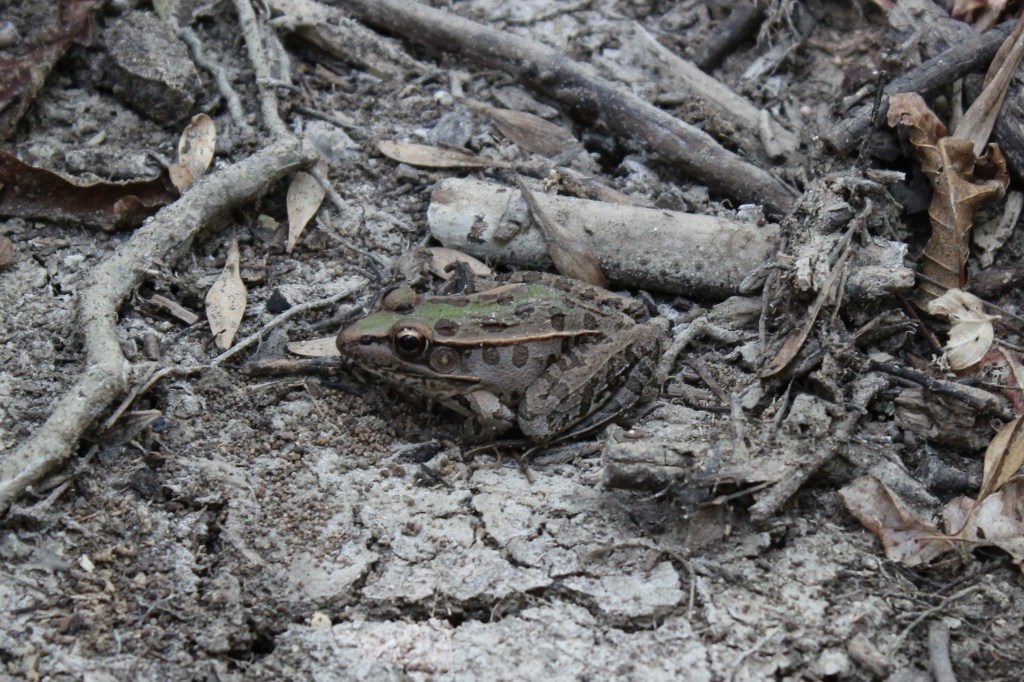
Two amphibian species dominated our walk today: The Southern Leopard Frog and the Gulf Coast (or Coastal Plains) Toad. The ranges of three species of leopard frogs converge near here, and some hybridization occurs, but the ones we saw appeared to be Southern Leopard Frogs (Lithobathes sphenocephalus). They are medium-sized spotted frogs that can leap long distances. Today’s leopard frogs had continuous, unbroken sets of dorsolateral ridges, no spot on the snout, and the light line on the upper jaw was not particularly bold – and that set them apart as the Southern species.
Southern Leopard Frog
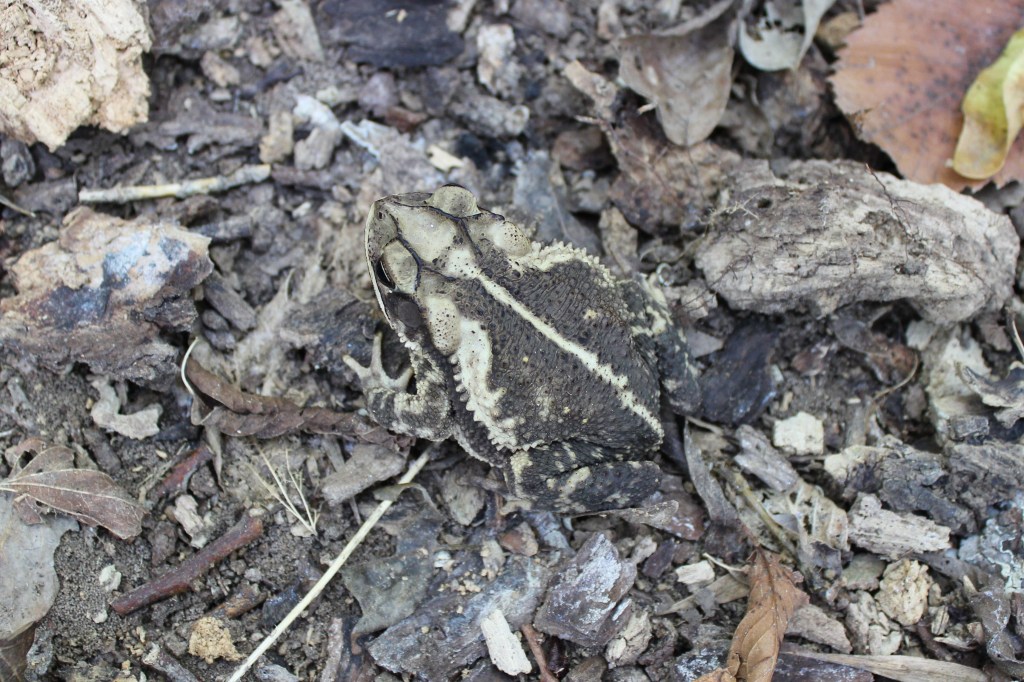
The other common amphibian was what I’ll just call the Gulf Coast Toad, since that’s what a number of sources continue to call it. Others refer to it as the “Coastal Plains” Toad, which is only one of many name changes. This toad’s scientific name has gone through considerable taxonomic chaos, seeming to land at the name Incilius nebulifer. It is a dark toad with a light stripe down the back and a light band on either side. The cranial crests – those bony ridges that the “true” toads have on the crown of the head – are dark and very obvious.
A Gulf Coast Toad … ok, if you insist – a Coastal Plains Toad
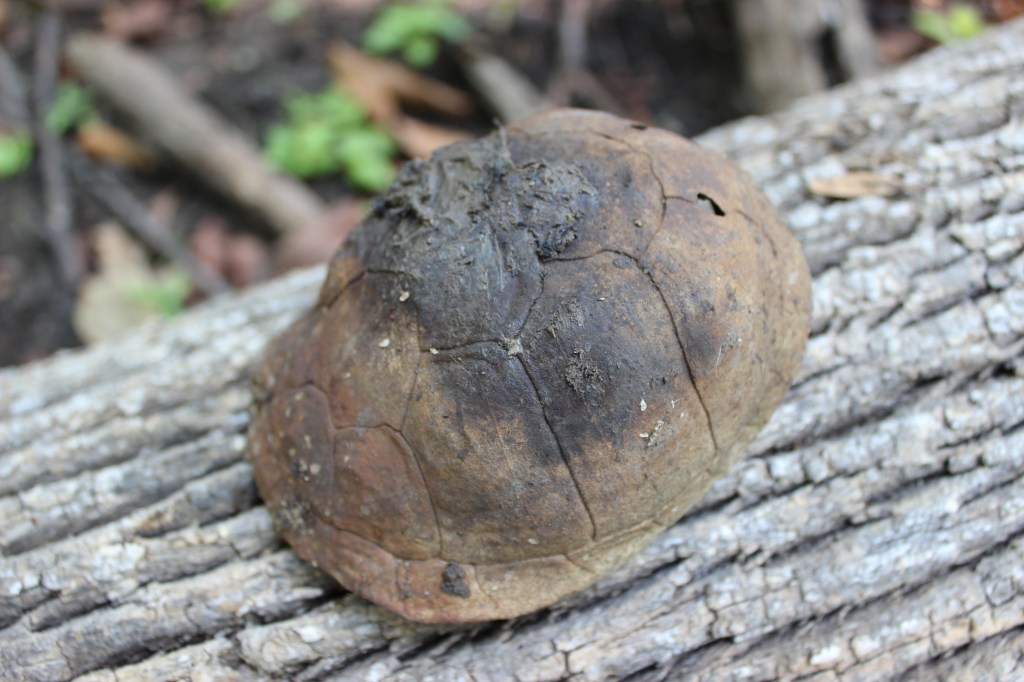
What about reptiles? There were a few, though no snakes today (a source of some disappointment to me). One really nice find was made by a very observant ranger who spotted the skeletal carapace (the bones of the upper shell) of a box turtle. To my eye this was pretty clearly the Three-toed Box Turtle species, not only from the shape of the shell but because a bottomland forest would much more likely have the Three-toed species than our other species, the Ornate Box Turtle. And because box turtles have become more scarce over the years, finding one here was exciting.
The skeletal shell of a box turtle
We also saw several young Little Brown Skinks – aka the “Ground Skink” (Scincella lateralis) in many field guides. The body length (not counting the tail) might be a little over two inches in a fully grown Little Brown Skink, but the ones we saw were smaller and younger.
A Little Brown Skink, with a little of its tail lost (before we found it)
They are brown or coppery-colored along the top, with a darker band along the side that fades toward the belly. Little Brown Skinks have small legs but move quickly, virtually “swimming” through the leaf litter to disappear under cover.
There was another lizard, for which I have no photo, but which I was excited to see. I had just talked with the group about the Prairie Racerunner, a beautiful lizard within the “whiptail” genus. Then, a small movement caught my eye along the edge of the trail and it was a little miniature striped lizard – a recently hatched baby with thin little light lines on a dark background and a tail that shaded from a sort of tan to a slightly bluish color (not typical of adults in our area). It was probably a Prairie Racerunner, but it’s not so easy to tell with a hatchling. The other related species is the Texas Spotted Whiptail, and those have spots between the stripes as adults and they do not have the lime green wash over the front of the body that the Prairie Racerunner has. Whichever species he “grows up” to be, I hope he does in fact grow up. I don’t see those lizards that much, and would love to see more.
Our short walk was over all too soon, and I hope these new Master Naturalists enjoyed seeing what we saw and will continue to get to know the Cross Timbers with the familiarity of one of Tolkien’s Dunedain. I’m encouraged by them, at a time when there’s not a lot of encouragement to go around. Congratulations to the group on becoming Master Naturalists … and rangers!



 Our Lives In Nature