The Children of Maria’s Meadow

The First Walk in the Wildscape

The morning of July 25 was very mild compared to the afternoon’s heat. It was a great morning for a group of about 14 kids and several adults to take a walk in the wildscape of a local Montessori school. I hoped that these mostly fourth through sixth-graders were ready to playfully explore the nature of their wildscape, and they were more than ready.
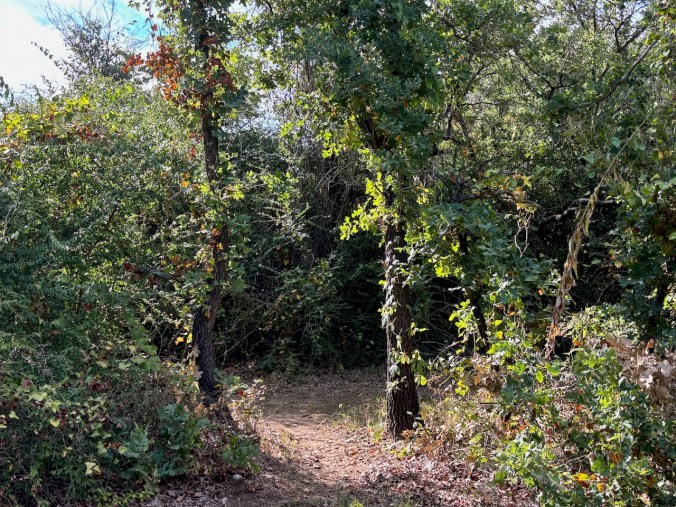
Like a gateway – to Terabithia?

They knew the place better than Marylee and me. We were nominally in charge of leading the group and teaching about nature, but these kids would have been happy to have led the get-acquainted walk. They, or their predecessors at the school, had named the places within it: the Dark Forest, the Ranger Circle, Maria’s Meadow, and other spots within this little fragment of Eastern Cross Timbers woodland and prairie.

It’s such good news that the kids had named it and made it their own, that their school had this delightful patch of wildness and let each new group of kids belong in it and get to know it. So our role would be to help them get more deeply familiar with it, more acquainted with the lives that live there.
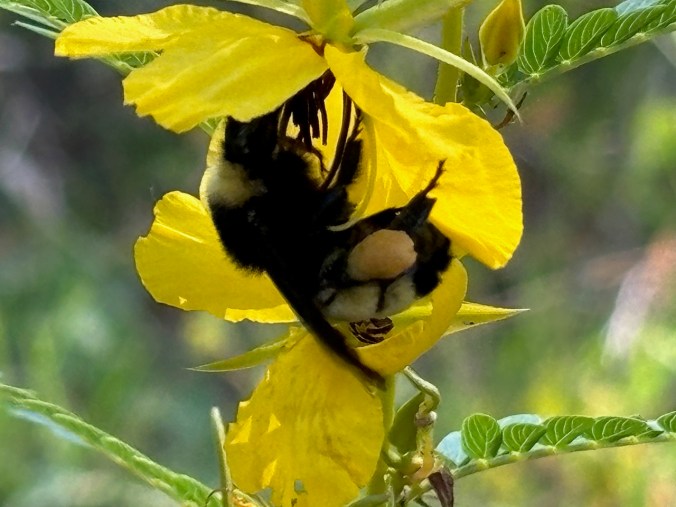
An American Bumblebee, feeding from a Partridge Pea

More acquainted with the bumblebees, for example. When everyone gathered in a circle around the old stump and we talked about likes and fears in nature, the dislikes were primarily spiders, snakes, and bees (which closely mirrors the things in nature that most nature fears are focused on). So when the group came to some flowering Partridge Pea that a bumblebee was feeding on, we didn’t pull back. We also, of course, did not swat at or otherwise make the bee feel that it was under attack. Any doubters might have seen that the bumblebee ignored us, even though I was pretty close.

This is an adult funnel-weaving spider, seen at Sheri Capehart Nature Preserve. They are all just as shy as the little one we found on our walk, and if one were to bite us, the bite is not medically significant.

Speaking of spiders, we came upon a small one in the low branches of a bush, within her web. One of the kids suggested that it was probably a wolf spider, and I agreed that the overall look was kind of like one of those. But, I commented, wolf spiders don’t trap prey with webs, they just chase down what they eat. This one’s body and web made me think of a young funnel-weaving spider, and just as I pointed toward where I thought her funnel was, she quickly scuttled down the hole made by her web.

We found and heard a lot that everyone could appreciate without overcoming a fear or aversion that they had been carrying. Bird song – especially from Northern Cardinals – rang out through the woods, and plenty of plants were still flowering. We found a butterfly and one of the boys looked for the extension of the hindwing that would make it some kind of swallowtail. (I noted to myself, “they know about swallowtails, how wonderful!”) It was a Gulf Fritillary, and when I asked if butterflies like this benefit us in some way, the kids quickly answered, “they’re pollinators!”

Did I mention that it was a real treat to be with these kids?
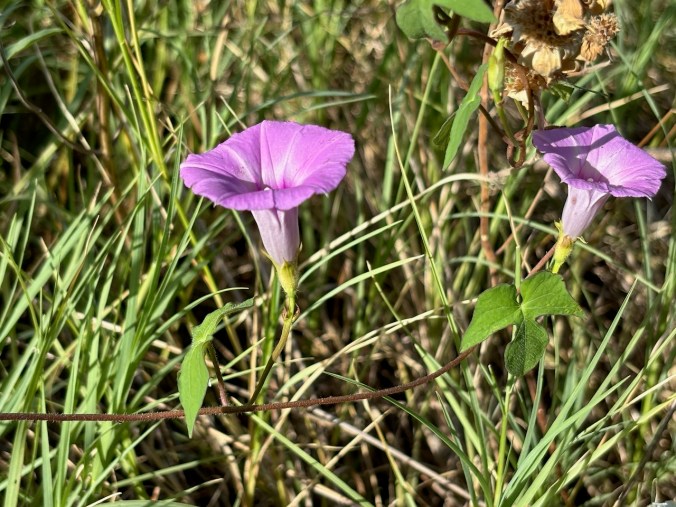
Flowers of Tievine, a type of Morning Glory, seen in the prairie patch

As we walked down the trail, I saw a telltale squiggle in the short grass at my feet. It was familiar enough that I dropped down immediately and tried to gently pin this little lizard so that we could have a look and then release him or her. It was a small Little Brown Skink. They already live up to the name – they are little and they are a coppery, two-tone brown, and this was a young one. I had it pinned briefly but could not get to where I could pick it up without risking breaking off the tail. And so it got away.

And that raises an interesting question: how much interference with nature is acceptable in a discovery walk such as this? It was important to me not to accidentally make the lizard lose its tail, but is it OK to catch wildlife? There is a kind of hierarchy of permissibility regarding what you can catch and handle. It runs up and down the phylogenetic ladder. We wouldn’t catch mammals, or birds like those Northern Cardinals. But starting with reptiles and amphibians and continuing through fish and then insects, it seems alright to most people. Catching frogs and bugs seems normal. And maybe that’s because many of them are harder to get a good look at unless we catch them. Frogs hop away, and so do grasshoppers. Also, briefly capturing them or scooping them up in a net can be pretty easy much of the time.

I wanted the kids to see the lizard I was talking about, but being captured is stressful. I make the assumption that briefly capturing such an animal for the sake of teaching, and then immediately releasing it unharmed, is completely fine. We want to teach kids compassion and respect for the lives they find out here (and anywhere), and so I’m open to revisiting and re-thinking this question.
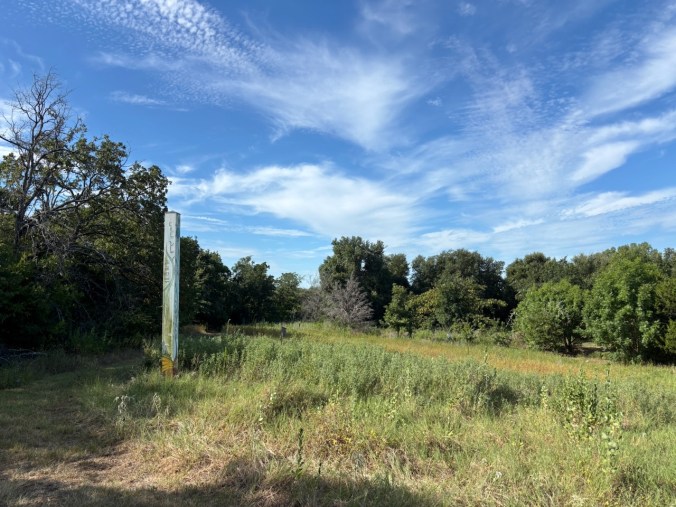
The Prairie

In a world in which most kids can recognize far more fast food logos than wildlife or plants, it was wonderful to be with these kids, who said at the end that they want to do more of it. It looks like Marylee and I will lead walks here about every four to eight weeks in the coming school year. We will get to know the wildscape through the seasons, and I look forward to all the discoveries we will make.

Skinks, Turtles and Birds on a Summer Morning

8/13/20

Two Jims

I knew that having Jim Frisinger join us would be a harbinger of good birding. Jim teaches birding at Southwest Nature Preserve and is the first one we think of when we think about birds at the preserve. And sure enough, even though this morning’s walk was part of a survey of reptiles and amphibians, it turned into a pretty good birding walk as well.

We got started just after 7:00am, meaning that I had to get up before sunrise, but that’s OK, we needed to get there before the day heated up. It is now mid-August, with serious summer heat, and it climbed to 102°F later in the day, with the heat index feeling like 107°F. The survey plan is to walk in one of three habitats, either in the morning, mid-day, or evening, and we rotate among those options. Last week, Jim Domke and I did a mid-day walk, trying to avoid heat exhaustion and clearly demonstrating what Jim figured any idiot would know – the blistering mid-day heat of an August day is not the best time to see wildlife. This morning was much better.

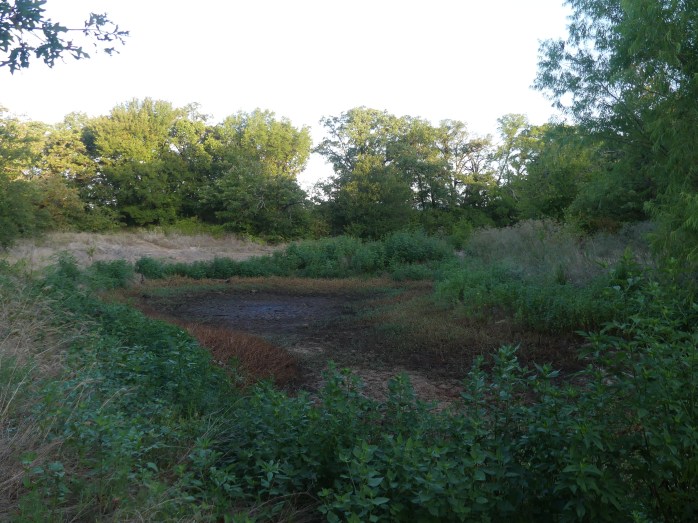
What remained of the smallest middle pond

One of our destinations, the smallest pond at the preserve, was a casualty of summer. The water had completely evaporated, leaving concentric rings – an outer one of drying Water Primrose, surrounding an area of cracked, dry mud, with a bulls-eye center of wet mud. The temperature was 74°F and the humidity a steamy 89%. I walked through some of the vegetation and around the circle of dried mud, scaring up grasshoppers but no Blanchard’s Cricket Frogs. The two Jim’s (Domke and Frisinger) and I talked about where the frogs and turtles would have gone. Maybe the frogs dug under the mud, expecting to estivate during a period of drought. In a pond this small, I said I thought that the turtles may have migrated the short distance to the nearest pond with water. I did notice that several seed pods of Halberd-leaf Rosemallow (see the July 18 entry) had dried and cracked open.

Halberd-leaf Rosemallow

Next, we walked to the north pond, whose water level has dropped but not by much. A group of about six young anglers were fishing, and Jim Domke extracted a promise that they would clean up before leaving. Domke carries a bag in each visit and picks up the litter left by visitors to the preserve. He is an unsung hero for this and deserves appreciation from all of us, because people leave a surprising amount of trash around the preserve. The kids did indeed pick up their stuff!

On the trail a few feet from the water, we saw two Little Brown Skinks. They were roughly two-inch juveniles, little even as Little Brown Skinks go. These lizards did not slow down for photographs, and quickly disappeared into leaf litter and cracks in the mud. And as always, there were Blanchard’s Cricket Frogs hopping around at the water’s edge, and at least one amorous boy was calling, trying to attract females. His episodic “grick-grick-grick” calls were a Call Index of one in frog monitoring jargon, an isolated call not overlapping with other Cricket Frog calls.

Various turtle heads popped up in the water and using binoculars I could see on many of them the tell-tale red patch behind the eye that defines the Red-eared Slider. River Cooters are sometimes seen at the preserve, so it is important to try to observe the head pattern.

At this point the tops of the trees were bright from the rising sun, though the ground was still in shadow. The temperature was 79°F and the relative humidity 76%. Walking back, at the same spot where we saw skinks a few minutes before, we saw a large Little Brown Skink and a couple of juveniles. As before, they spotted us and were in frantic flight back across the trail to the trees by the time we saw them. I tried to capture one of them for a photo, but as soon as I tried to gently pin one down with my hand, it slipped into the cracks in the mud and was gone. These little lizards have very smooth, glossy scales and small legs, so that they shimmy across the ground almost like little snakes.

We wondered why we were seeing skinks in groups, and Jim Domke raised the possibility of a mama herding her babies to safety. I am less quick than I used to be to dismiss such ideas, though I doubt this is what we were seeing here. Researchers are increasingly documenting maternal care among pit-vipers (a group of venomous snakes that are pretty advanced among reptiles, in terms of their evolutionary status). Rattlesnake mothers have been documented to keep their young with her after they are born for a brief time until they shed their skin the first time. They may gather in rookeries to give birth and seem to have some ability to recognize kin. Clearly, some reptiles are capable of much more advanced social behavior than we typically expect. Were we seeing a family group of skinks on the trail? A possibility that seems more likely to me is that as the woodland floor becomes quite dry, these lizards come to the pond’s edge to drink and/or hunt the tiny invertebrates that congregate there. However, there is not much cover at the pond’s edge and when confronted with a predator (or lumbering human observers) they run for the cover of the leaf litter and cracks down into the soil. This is just speculation. My best answer is: “I don’t know.”

Turtle heads in the big pond

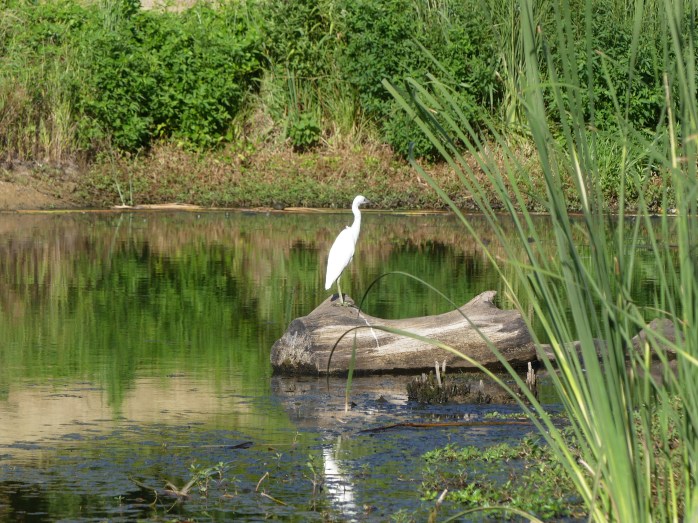
Our final destination was the north shore of the biggest pond, where the preserve has the north and west shores and residential housing has the east and south shores. As we arrived, a Great Egret took off with slow, powerful strokes of its snow-white wings. Turtle heads emerged from the water and looked around, a group of eight or so curious reptiles that watched the egret fly off as the humans arrived.

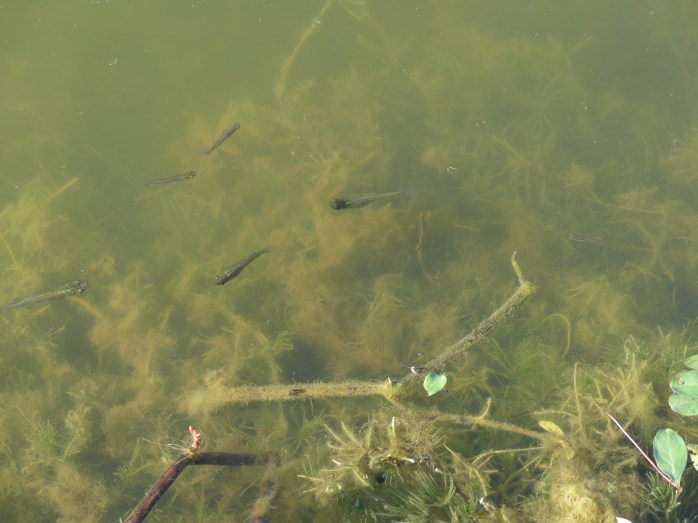
Western Mosquitofish

Along the water’s edge, a group of small fish foraged along the surface and among the submerged stems of Water Primrose. These were surely Western Mosquitofish, though I did not net any to confirm it. Their size, shape, and movements all indicated that they were mosquitofish, those surface-feeding fish that feed voraciously on zooplankton and invertebrates, including mosquito larvae. Females grow much larger and bulkier than males and may have a black spot at the back of the body cavity where the ovaries are located. They are not particularly colorful, though there is a bluish iridescence you can see in the right light.

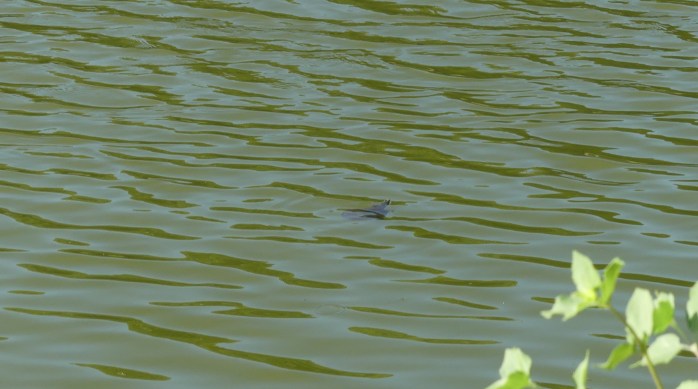
A glimpse at a Spiny Softshell

Further along the shore, a turtle in the water just offshore caught my eye. It was that round shell and a curious head shape that grabbed my attention, and it did not hang around for a photo. It must have been a softshell! I was sure I’d seen a snorkel nose and a pancake-shaped shell – and then it returned to the surface to breathe, staying just long enough for me to take a quick and rather poor photo. It was fairly small, either immature or a young male (females grow quite a bit larger). There is only one other iNaturalist record of the Spiny Softshell at the preserve, and this was another!

Great Egret
On his way to the concert?

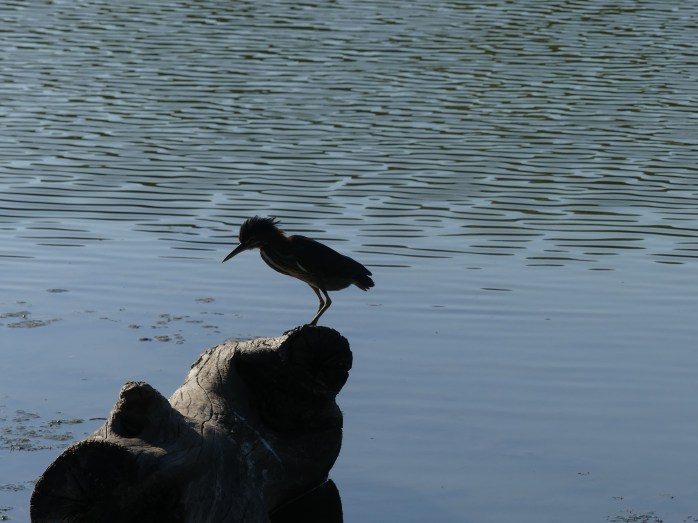
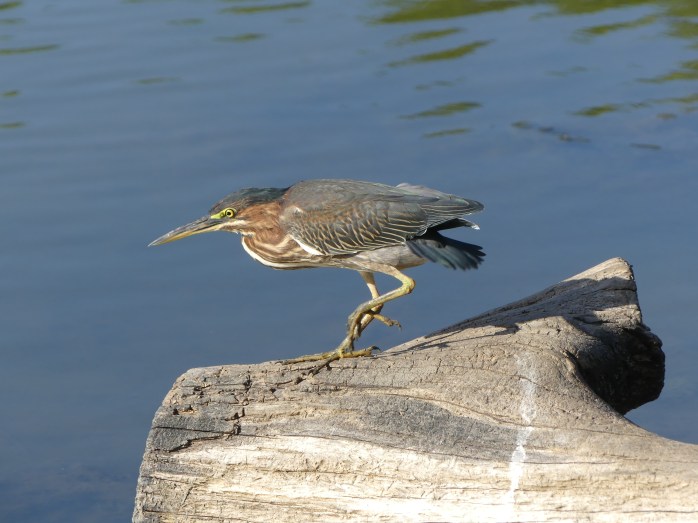
That observation made this a really successful survey walk – what could be better? Well, a really fine bird observation would not make it better, but it would sure round out our walk in a beautiful way. On the walk back, we saw a couple of Great Egrets again, standing in their tall, bright white elegance along the shore. And then, after they had flown, a smaller bird flew in to take the place of the one who had been standing on a log in the water. His crest of feathers suggested a young man with a Mohawk on his way to see Green Day perform Jesus of Suburbia, as he landed on his log and eyed us with suspicion. His Mohawk flattened and he began to look at the water around him, periodically glancing up at us just to make sure he wasn’t going to have any trouble from us. He (or she) was a Green Heron, maybe a young bird whose brown and white streaked chest had not filled in from the sides with the reddish-chestnut brown of an adult.

Green Heron

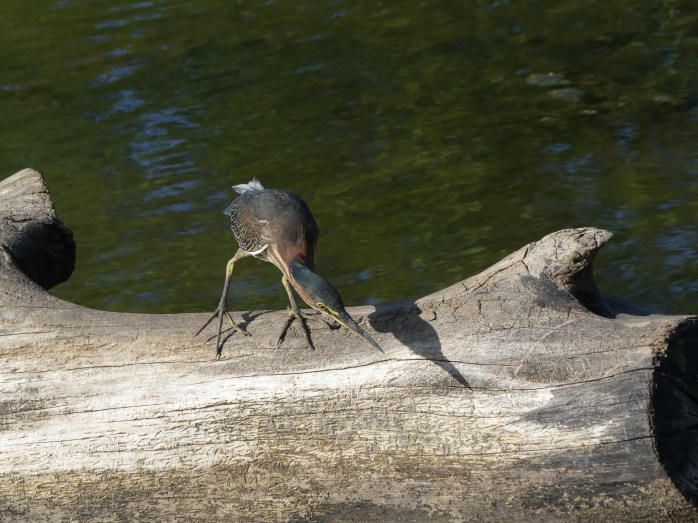
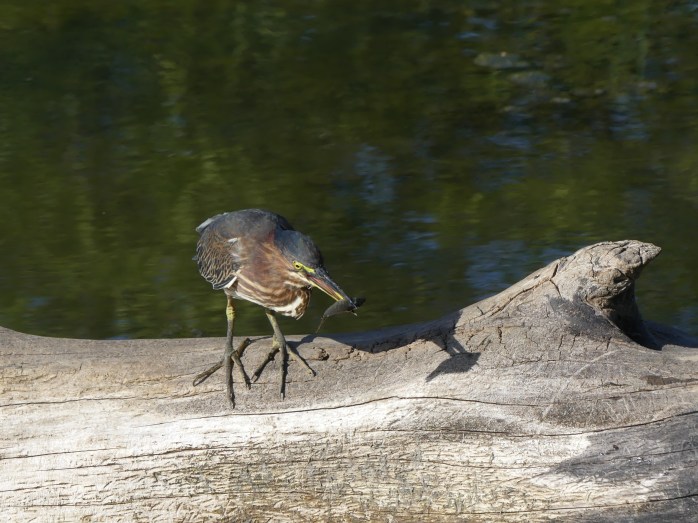
This heron was surprisingly tolerant of three old guys hanging around, two of them taking photos. While we watched, he hopped down as low as he could get on the log and watched the water intently. We waited – he waited, and then there was a quick stab of his long bill into the water, bringing back a juvenile sunfish. Was there a hint of a self-satisfied smile on that long beak, and a glint in his eye as he looked up at us? Probably not, but his skillfulness was impressive. In fact, the Cornell Lab of Ornithology tells us that these birds sometimes even drop bits of bread or insects on the water to lure a fish in close enough to be caught.

A talented fisherman

The temperature had risen to 84°F and 74% humidity and it was time to leave before it became really hot. This had been a great walk, with the thought-provoking observations of Little Brown Skinks, finding a Spiny Softshell, and then the chance to share a few minutes with the Green Heron. I knew Jim Frisinger would be some kind of good luck charm!

The “Dunedain” of the Cross Timbers

All that is gold does not glitter,

Not all those who wander are lost;

The old that is strong does not wither,

Deep roots are not reached by the frost.

J.R.R. Tolkien, Lord of the Rings

Once again this year I had the privilege of teaching herpetology to an incoming group of Master Naturalists. Today I led them on a short walk into the bottomland forest at Fort Worth Nature Center & Refuge. Each year, I appreciate the Texas Master Naturalists even more; they are the “rangers” of the remaining wild lands and creatures of our state.

Flooded bottomlands in April of 2010

By “rangers,” I am drawing upon the stories within The Lord of the Rings, and referring to the Dunedain, the people who wandered the lands in the north of Middle Earth. The rangers knew those lands and protected them as best they could, just as the Master Naturalists learn about the land, animals, and the plants around us. Maybe you’ll forgive what could seem like an overly stretched analogy, but in a world increasingly separated from nature, we need to celebrate those who understand and are drawn to nature and who might help advocate for it. Who else studies the intricacies of natural history and spends time wandering in the forests and fields?

Becoming a Master Naturalist involves a series of classes and readings; you do not sign up, pay your money, and now you get the title just for joining the “club.” There are classes and field experiences, and after certification there are activities and ongoing training. Some of the people in the Master Naturalist program are quite expert in one or perhaps several areas of nature study.

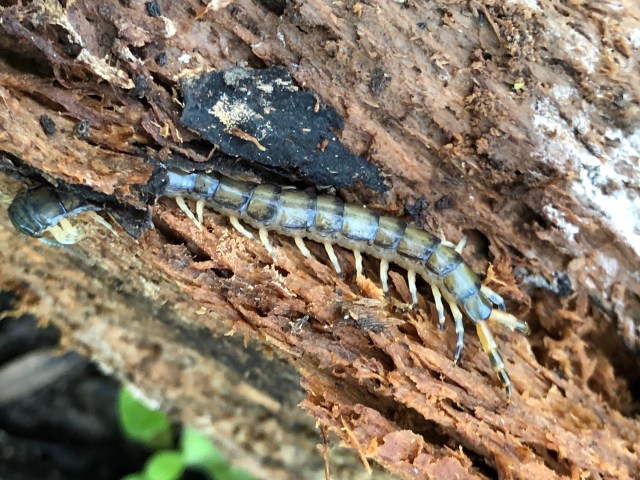
A centipede, surprised under a fallen log

What did we do today? We walked down through the bottomlands, past huge cottonwoods and other trees and in areas that periodically flood. Fallen logs and branches shelter numerous herp species, along with lots of wolf spiders and other invertebrates.

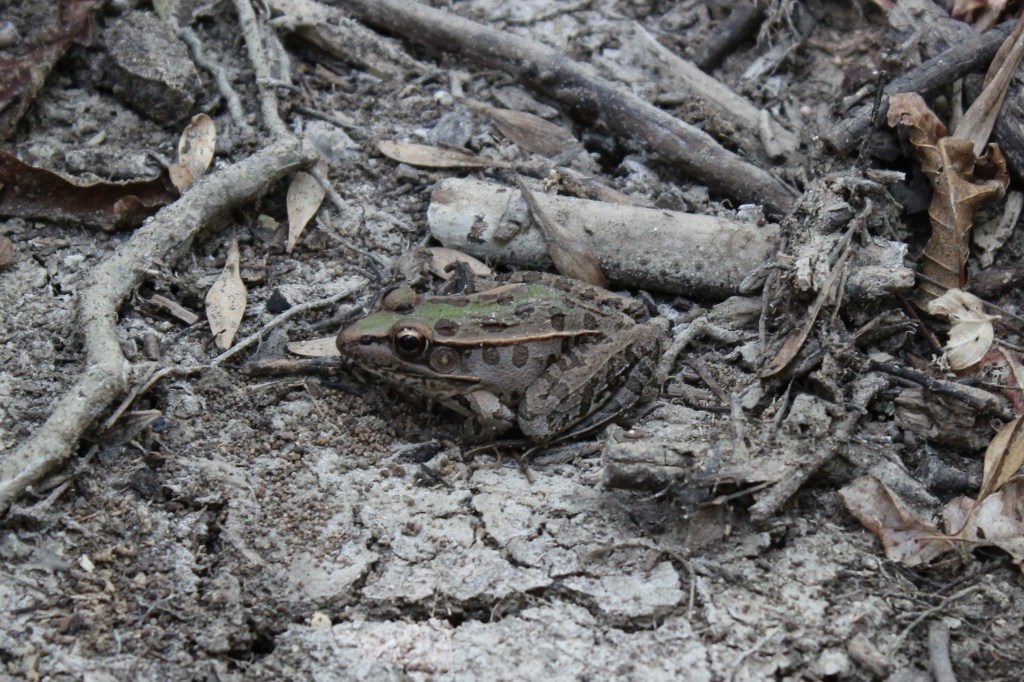
Two amphibian species dominated our walk today: The Southern Leopard Frog and the Gulf Coast (or Coastal Plains) Toad. The ranges of three species of leopard frogs converge near here, and some hybridization occurs, but the ones we saw appeared to be Southern Leopard Frogs (Lithobathes sphenocephalus). They are medium-sized spotted frogs that can leap long distances. Today’s leopard frogs had continuous, unbroken sets of dorsolateral ridges, no spot on the snout, and the light line on the upper jaw was not particularly bold – and that set them apart as the Southern species.

Southern Leopard Frog

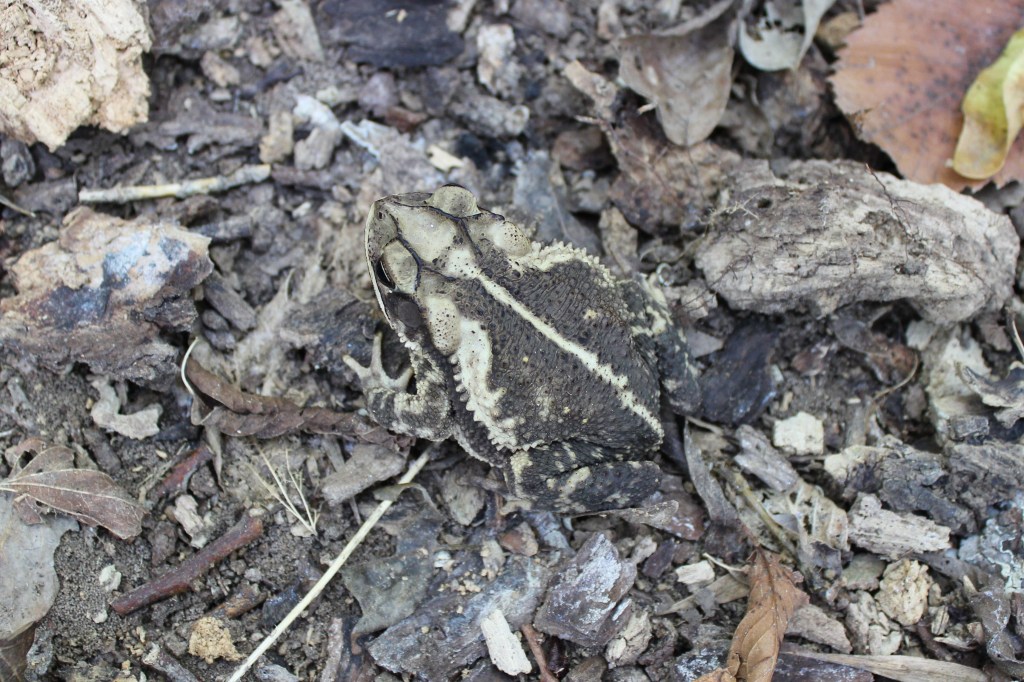
The other common amphibian was what I’ll just call the Gulf Coast Toad, since that’s what a number of sources continue to call it. Others refer to it as the “Coastal Plains” Toad, which is only one of many name changes. This toad’s scientific name has gone through considerable taxonomic chaos, seeming to land at the name Incilius nebulifer. It is a dark toad with a light stripe down the back and a light band on either side. The cranial crests – those bony ridges that the “true” toads have on the crown of the head – are dark and very obvious.

A Gulf Coast Toad … ok, if you insist – a Coastal Plains Toad

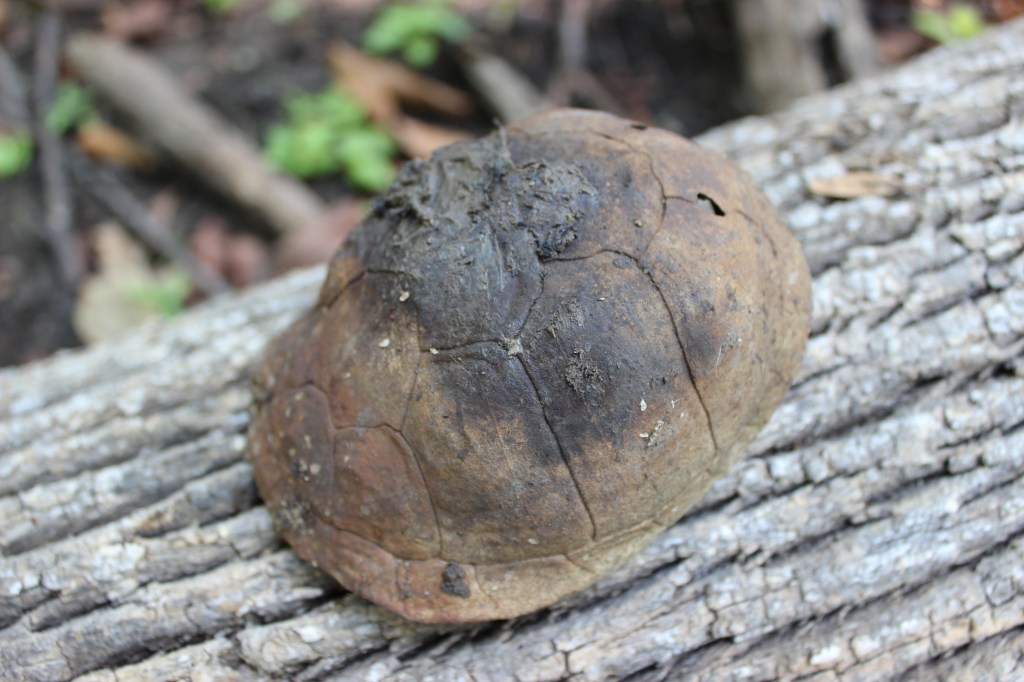
What about reptiles? There were a few, though no snakes today (a source of some disappointment to me). One really nice find was made by a very observant ranger who spotted the skeletal carapace (the bones of the upper shell) of a box turtle. To my eye this was pretty clearly the Three-toed Box Turtle species, not only from the shape of the shell but because a bottomland forest would much more likely have the Three-toed species than our other species, the Ornate Box Turtle. And because box turtles have become more scarce over the years, finding one here was exciting.

The skeletal shell of a box turtle

We also saw several young Little Brown Skinks – aka the “Ground Skink” (Scincella lateralis) in many field guides. The body length (not counting the tail) might be a little over two inches in a fully grown Little Brown Skink, but the ones we saw were smaller and younger.

A Little Brown Skink, with a little of its tail lost (before we found it)

They are brown or coppery-colored along the top, with a darker band along the side that fades toward the belly. Little Brown Skinks have small legs but move quickly, virtually “swimming” through the leaf litter to disappear under cover.

There was another lizard, for which I have no photo, but which I was excited to see. I had just talked with the group about the Prairie Racerunner, a beautiful lizard within the “whiptail” genus. Then, a small movement caught my eye along the edge of the trail and it was a little miniature striped lizard – a recently hatched baby with thin little light lines on a dark background and a tail that shaded from a sort of tan to a slightly bluish color (not typical of adults in our area). It was probably a Prairie Racerunner, but it’s not so easy to tell with a hatchling. The other related species is the Texas Spotted Whiptail, and those have spots between the stripes as adults and they do not have the lime green wash over the front of the body that the Prairie Racerunner has. Whichever species he “grows up” to be, I hope he does in fact grow up. I don’t see those lizards that much, and would love to see more.

Our short walk was over all too soon, and I hope these new Master Naturalists enjoyed seeing what we saw and will continue to get to know the Cross Timbers with the familiarity of one of Tolkien’s Dunedain. I’m encouraged by them, at a time when there’s not a lot of encouragement to go around. Congratulations to the group on becoming Master Naturalists … and rangers!