The latest of the “Letters to Nature Kids” is about how I like to use my attention when taking a walk in nature. It describes noticing your breathing and then imagining that your attention is like a light that you can turn toward one thing and another.
I wrote, “When you are outside, try imagining that your attention is a light that you can shine on one thing or another. Put the light on a tree and keep it there for a count of five (or more). Then turn the light toward something nearby and count how long you can keep your attention there.”
This is borrowed from mindfulness, though I’m not trying to teach meditation in this letter. I just want to share some ways to really notice and enjoy things and help strengthen the ability to pay attention.
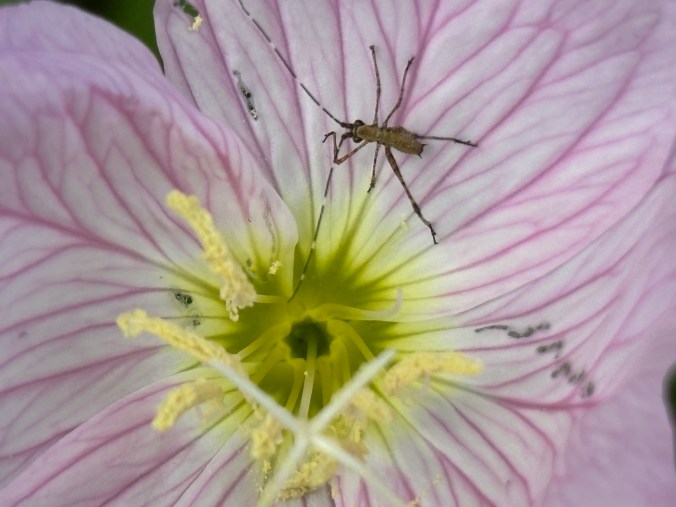
In the letter, I wrote, “You start narrowing your attention – your flashlight – to a particular flower that has something in it. The flashlight beam gets so narrow that you have to get down near the flower to focus attention that much. The insect is a tiny baby form of a katydid, and look at those black-and-white antennae! Keep the focused light of your attention there a little longer.” The point is to be able to direct our attention purposefully and stay with something long enough to really explore it, like the colors and structure of that primrose flower.
If you know someone who might be interested in this, please share it. Letters to Nature Kids is always a free download (there’s a donation button in the right column of the website for anyone who feels inclined). You can browse all those 25+ letters on the Letters to You page.
You may recall that I write periodically to “nature kids.” It’s a free pdf download from the Letters To You page, written for older kids and teens who are drawn to wild places and the things that live there.
This time I included a bit about why I write these letters. Some of it is about sharing places and experiences that may encourage young people to go see preserves, parks, and such places themselves. As an example, I talked about Ruthann’s and my trip to Palmetto State Park in 2022. (I also blogged about it here.)
If you know any kids who would be interested in this current letter, please share it with them (in print or via a link). I mentioned that I’m currently writing about nature kids in several articles for Green Source Texas and noted that – with parent permission – I very much would like to talk with a couple of serious nature kids. And thanks!
This week I met several groups of kids in a little patch of wildness at their school, looking for the various ways that plants make seeds, or, with younger ones, playing a game of “Food Chain” (no one was eaten, even during the wild rumpus). The kids know the place well, and many of them have explored the Ranger Circle, the Dark Forest, Maria’s Meadow, and other spots many times over several years at the private school.
The climbing tree – a juniper with well-worn limbs perfect for climbing
My role is to channel some of their energy into new forms of discovery and understanding of what lives there. I can be a counterweight to a child’s fantasy about “poisonous” spiders or aggressive snakes, trying to replace such ideas with realistic caution and a sense that, overall, nature here is a safe place. I can invite them to think in new ways about animals in nature.
For example, the third and fourth graders know a lot of animals, but their knowledge of what the animal eats – and in turn what eats it – is limited. And so, in the “Food Chain” game, when we name one of the animals that the kids have seen there, a child who can name that critter’s predator or prey comes over to the “naturalist’s corner” and we ask about the next animal, until all the kids have come over to the naturalist’s corner.
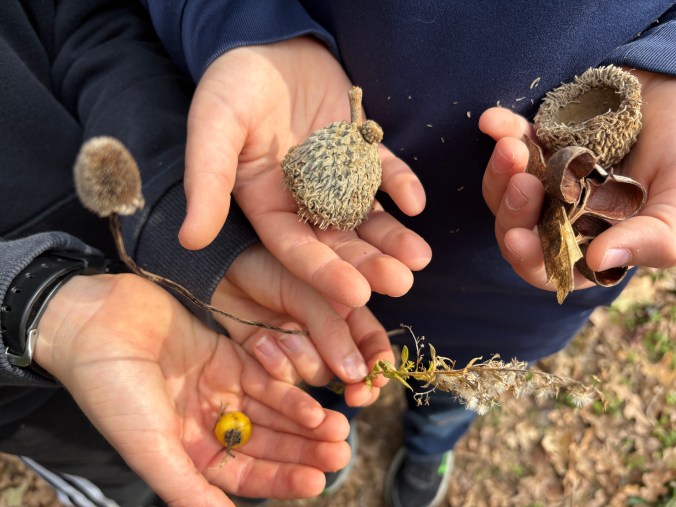
But running around and exploring is part of it. When I sent the older kids out in groups of three or four, they sprang into the woods and fields as if shot from a slingshot. They scoured the place and came up with lots of wonderful examples of seeds. There were huge bur oak acorns with the stiff, curly fringe around the acorn cup. They found the small, dried pods of the partridge pea that was flowering just a couple of months ago. They noticed all the yellow, fleshy berries of horse nettle that we had talked about on an earlier outing. Yes, they look a little like tiny tomatoes, and they are even related (but poisonous). There were mimosa pods and the dark blue berries of privet, and I mentioned how invasive and destructive privet is in a place like this. They found seed heads of Indian grass and a couple of other grasses. One girl brought a sprig of juniper, so I mentioned that this species has separate male and female trees (and the sprig with the yellowish tips was from a male plant).
The kids found acorns, berries, dried flowers, a buckeye pod, and other things
The younger kids were ready to run well before I was able to tell them what they should do. They would have been delighted to simply run. There was a lot of “wait, sit back down – no, you’ve got to stay with your group.” The instructions were as short as I could make them. “This group goes to this area, your group goes this way … and look for animals or signs that the animal was there, like a bird nest.” Then I sent them out. I might as well have said, “Let the wild rumpus start.” And kids started coming to me in excitement, “We found a bird nest! Also a beaver nest!” I had to see what this last really was, and they led me to some piled up brush someone had cut. That’s fine; the important thing was excitement about finding things. A spider web. A hole or burrow of some kind (armadillos had been digging in various spots). A dragonfly.
If you’re looking for evidence of animals, you might find these
The trick which I do not claim to have mastered is to allow and even join a bit of wild rumpus while keeping things structured enough to accomplish what we set out to do. Some kids are quieter and are already locked in on the goal, and usually they bring a good bit of knowledge to the activity. For other kids, nature study is not on their “to do” list, but running and discharging energy is. I think that we won’t get anywhere without some kind of curiosity and joy, so I would never turn any of this into “nature boot camp.” Working with groups of kids gives me additional appreciation for what teachers do (and they do it every day, not occasionally as a volunteer).
But it’s great to hear a kid say they look forward to these outings, or ask hopefully if we’re going to “play that game again” (from last month, an activity drawn from Joseph Cornell’s book, Sharing Nature).
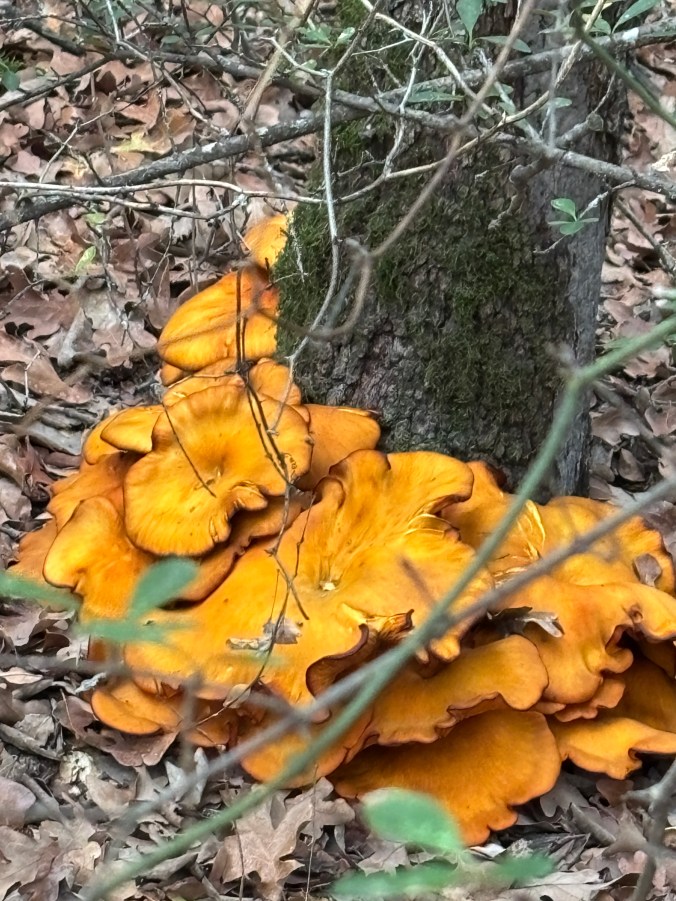
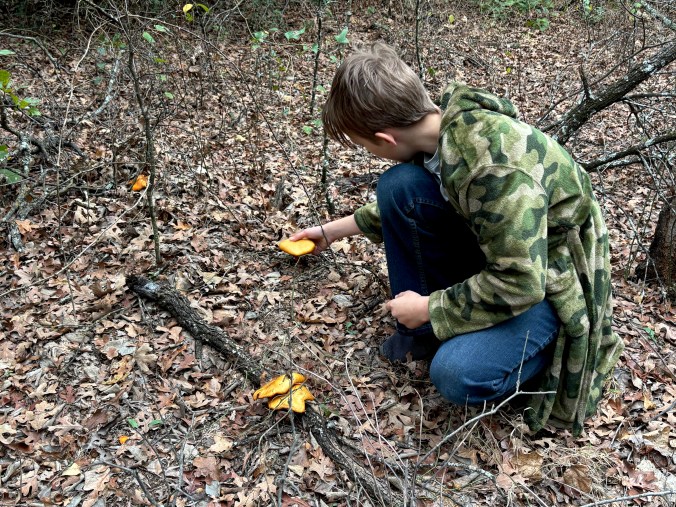
Yesterday we found several golden orange jack o’ lanterns in the woods, though it’s been a month since Halloween. There were no carved faces, just smooth clumps of orange. My young friend was delighted to find all these mushrooms, just as he was with all the mosses growing in the woodlands. And I was, in turn, delighted to watch his excited discovery of these small wonders.
Southern Jack o’ Lanterns
The “southern jack o’ lantern” is a large mushroom that grows from wood, often in clusters at a fallen tree limb or at the base of a tree. They’re common from summer through autumn at Sheri Capehart Nature Preserve, which is where we were. It has been very dry from late summer through much of autumn, but now that rains have come, orange mushrooms are popping up.
A Missouri Department of Conservation website says that the southern jack o’ lantern is bioluminescent, so that “the gills of fresh specimens may sometimes give off a faint greenish glow at night or in a darkened room.” It would be fun to return at night and see if we could observe that.
A big cluster of jack o’ lanterns that Logan found and photographed
We are used to seeing a plant or animal that we can point to, whose body or structure is gathered together in one place as one “thing.” However, with fungi it’s more complicated. For much of the year, the jack o’ lantern is a network of tiny filaments and threads running through soil and decaying wood – the mycelium. If I said, “show me a jack o’ lantern,” you would have to dig in the soil or turn over a rotting log to find those little fungal threads and say, “well, there’s part of one.” The mushroom itself is just the reproductive structure, producing spores that are almost (not quite) like seeds that will grow tissues that will become a new fungus. So a mushroom is a little like a flower – the part that catches our attention but is only the reproductive part of a larger organism.
Logan takes a closer look at a jack o’ lantern
Logan wanted to know if it was edible, so I looked it up using iNaturalist and found that it is poisonous. Not like a death cap mushroom that might be fatal, but the jack o’ lantern would give you the sort of upset stomach that one website said might “make you wish you were dead.” Definitely a mushroom to admire just where it is.
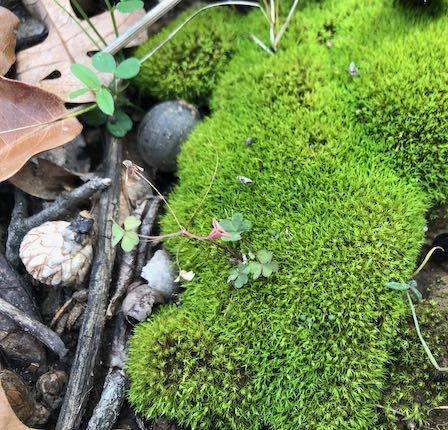
The other thing that really captured Logan’s imagination were the mosses. These little soft, green mounds growing along the ground in protected places can bring many of us into miniature worlds, sitting beside a butterfly and drinking from an acorn cup. They are plants, but without true roots and without the little tubes (vascular tissue) that flowers and trees use to move fluid and sap around. And so they must grow in short, compact mats or mounds. In shady places, an oak tree may grow a garden of moss along one of its bigger branches or at the base of the trunk. At the preserve, the sandstone at the bluff can also provide good growing conditions. The porous rock can hold moisture and is easy for moss to anchor itself to.
Mosses can survive periods of drought to an amazing degree, seeming to spring back to life after a rain. At the top of the preserve there are many partially-shaded places where mosses grow. In the heat of summer, especially when it is quite dry, they become dark green crusts along the rocks, waiting for rain. Then, the plant’s cells fill with fluid and they become green and springy.
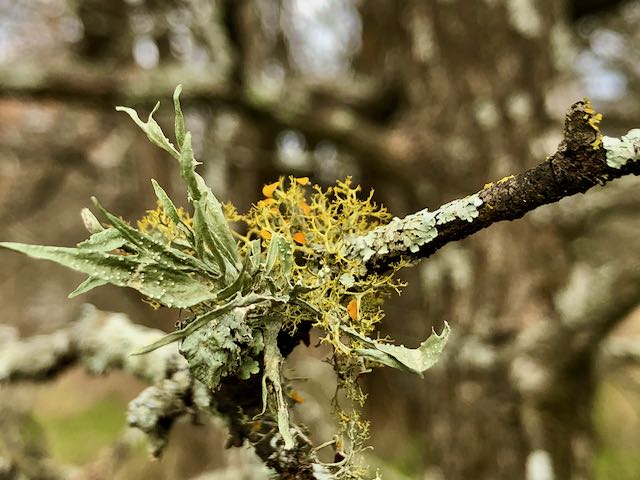
Another small growing thing that can produce a sort of miniature garden is lichen. Dead oak branches provide a great substrate for lichen to grow, either as the greenish- or bluish-gray foliose lichens that cover the surface in a ruffled coating, or else as little shrub-like fruticose lichens. One of the latter, the golden-eye lichen, is a favorite of mine.
Lichens are not plants. They are partnerships between two things. Not just a fungus, and not just an alga, but the two things fused together (or sometimes a fungus and a cyanobacterium). The fungus provides a structure and anchors the partners to a rock, a branch of wood, or other suitable place. The algae provide a means to manufacture food via photosynthesis. Together, they can survive sun, drought, freezing, and keep on going.
Several forms of lichen growing on a twig
Regardless of the biological details, these living things add wonder to a walk in the woods. To pause and get on the same level as a moss or mushroom shifts our focus from the everyday world down to a small scale and we see everything in new ways. The details of leaves and the texture of moss, or drops of dew like tiny crystal orbs on the strands of a spider’s web, these things can transport our imagination to new places. It was wonderful to watch Logan find each new patch of moss and each new mushroom with that sense of delight. It was a little like what I see when I take my granddaughter to such places; the emotion and fascination isn’t tied to a particular age (you might see it in me if we took a walk together).
Experiencing nature in this way with children is just the best. It can be a window back into our own childhood, or the childhood we would wish for our younger selves or for others. It is also a hopeful sign for our future, that children can still find magic and connection in nature. And if they carry that forward, we might protect wild places and heal some of the Earth’s hurts.
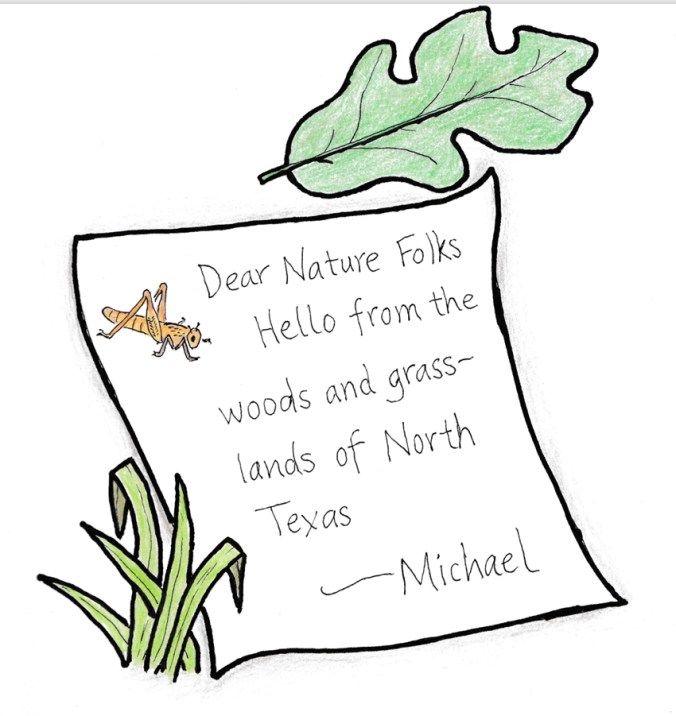
I enjoy writing to you, especially to kids who love nature or are curious about it. I’ve been writing these “Letters to Nature Kids” or “Letters to Nature Folks” for over three years. Sometimes I describe a particular walk or a kind of animal or plant I found, and always there’s some connection to something in nature.
As I sit in my back yard, there are birds in nearby trees, and their songs are complex and beautiful together. Repeated notes, rising and falling whistles and whirring trills. They seem to be in the Sweetgum and Pine trees here, as the branches gently sway in the morning sun.
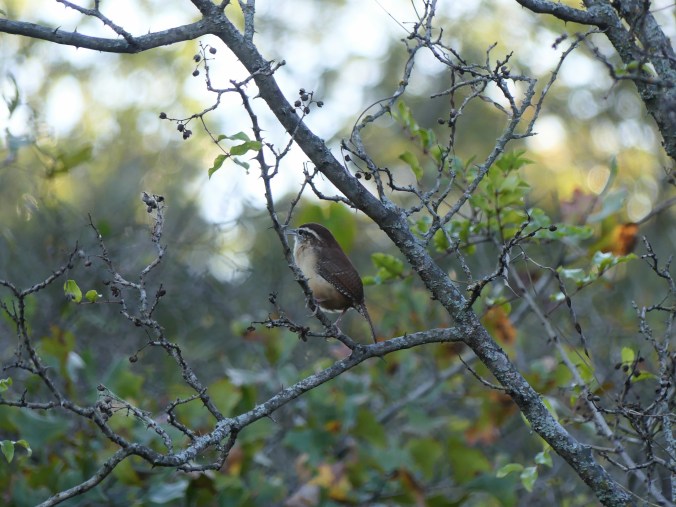
Merlin, the bird identification app, identified them as a Northern Cardinal and a Bewick’s and a Carolina Wren. Meanwhile somewhere there is a Carolina Chickadee and a Blue Jay. After a short time, the nearby birds have gone quiet. Was it just a brief stopover? Or have they finished saying what they had to say? What were they communicating, and to whom? Inviting someone in, or maybe telling someone to stay away?
A Wren at nearby Sheri Capehart Nature Preserve
We tend to think that birds sing from pure joy at being alive on a quiet sunny morning like this. People who study birds say that they’re mostly inviting a potential mate in or claiming some spot as theirs and telling others to stay away. But that doesn’t mean there’s no joy in it. Perhaps there’s a gratitude for being alive that feeds the impulse to find mates and claim their place in the woods and fields.
There’s also joy in my sharing what I find and what the Earth teaches me when I’m in wild places (and places that are just a little bit wild). If I can share that with you and encourage you to go see for yourself, I imagine that there would be smiles on both of our faces. And that’s the reason for these letters.
Two kids in particular have given lots of happiness and have played a part in these letters: Eli and Lilly. My granddaughter is too young to read letters, but maybe she will do so someday. She might read this letter about our visit to the Fort Worth Nature Center on November 5, 2024:
On a beautiful early November day, Lilly and I went to see bison and butterflies. When we climbed the ramp up onto the bison viewing deck, she noticed some bison that were eating grass and others that looked like they were napping. We had a snack in the shade of the oak trees up on that platform while the bison snacked on grasses below.
American Bison at Fort Worth Nature Center & Refuge
Is it “bison,” or “buffalo”? What some people call a buffalo in North America is really the American Bison. But if you call them buffalo, everyone will probably understand you. If you are interested, I wrote about bison and that viewing deck Lilly and I were standing on for Green Source DFW.
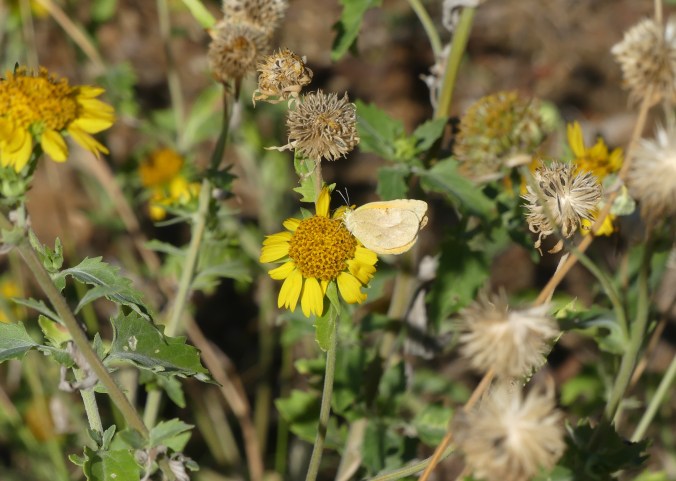
When we were back on the ground, Lilly loved seeing caterpillars making their way across the ground, “going home,” she figured. We watched small butterflies feeding on yellow wildflowers, and she gently touched one of them. Her delight in finding these small things made me feel some of the same delight.
Lilly, on the bison deck
She and I have gone on a number of these “adventure walks,” starting shortly after her second birthday. Now, with her fourth birthday coming up, we took this walk at Fort Worth Nature Center & Refuge (FWNCR). She has climbed onto boulders – small ones – at Sheri Capehart Nature Preserve and Oliver Nature Park and admired a harmless DeKay’s Brown Snake at FWNCR. She is fearless, curious, and gentle, three wonderful things to be.
Being together and sharing experiences of joy and discovery – those times are very important. You may have noticed that happiness grows even bigger when it is shared. What are some things that bring you joy? Maybe they are beautiful places, music, things that grab your attention, or put you at peace. Do you share those things with people that you love?
One of the butterflies that we saw
You and I both know that not everyone likes the same things, so we might offer to share something and the other person is not interested. That’s OK, you may find other things that you both like. But if you love nature, I hope you will find someone who is eager to go on an adventure walk with you.
In April of 2020 when he was six, I took Elijah (who is more family than friend) to my favorite creek. We waded in the clear water and noticed mosquitofish and shiners. The mosquitofish swam in little groups at the surface of the water, and shiners took off with a flash of silver scales. In later walks we have found turtles, cricket frogs, and many wonderful things (see the Letters to Nature Kids in January of 2022).
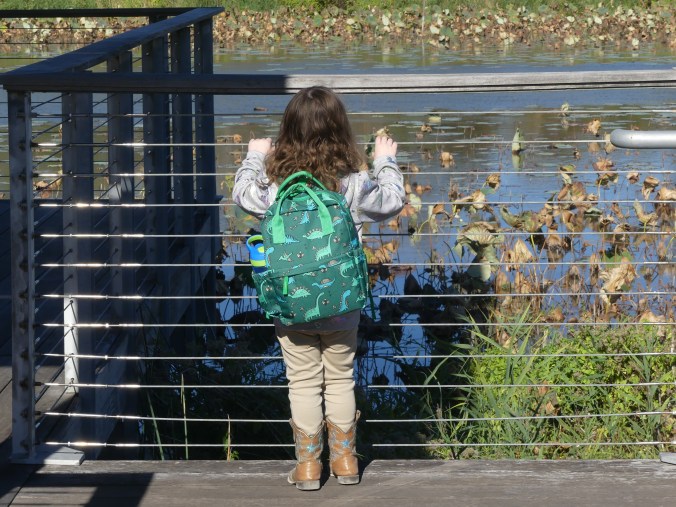
Lilly at the marsh boardwalk
After seeing the bison, Lilly and I went to the marsh boardwalk. A marsh is a place with fairly shallow water and plants that grow out of that water. This one is a lotus marsh, with many big round lotus leaves. It’s getting toward late autumn, and so lots of the leaves are turning brown.
That was a really wonderful walk. And at other times, I lead walks at Sheri Capehart Nature Preserve. Almost everyone on those walks is an adult and most are people I have just met, but sharing nature still brings joy. I suppose each one is an “adventure walk,” although adults don’t give them that name. But each of them is a kind of adventure, because we never know what we will see. And if we are lucky, we can see what we find as if it is a new discovery – even if it is a dragonfly we know well or a Carolina Chickadee we have heard many times before.
I hope you can go on a walk or two, somewhere a little bit wild. Find someone you can share some of those walks with!
I continue to think about bringing up kids with the skills and values that are needed. I see the world that kids are growing up in, how it is changing, and I wish for a better world. The way we make that better world is through compassion, integrity, and other qualities that are hard to hold onto with so much going on. I wrote about empathy last month, and I’d like to talk about truth this time. (I started this at Rain Lilies on Substack and reprint it here.)
“Did you finish your homework?” “Are you really friends with that person?” Those can be difficult questions. Sometimes being liked or staying out of trouble can make truth-telling hard, for adults and kids. Does it really hurt anything to “bend” the truth?
Little kids may automatically give the answer that the other person wants, the “right” answer, even if it’s not really what happened. “Did you hit your sister?” The right answer, the one that the questioner wants to hear, is “no.” For a very young child that may be the only answer that occurs to them.
In other words, in those first few years kids don’t necessarily sort things into categories like lying and telling the truth. It might not occur to them that the thing that really happened is different from the thing that the other person wants to hear. They simply give the desired right answer. Only later do they understand that they’re choosing to lie.
Teaching honesty usually begins early, before we can discuss things like building trust. Parents might say, “Thank you for admitting what you did; I know that was hard.” They might still get in some trouble, but hopefully they see themselves as a kid who made a mistake but handled it honorably. And that’s important to see yourself (and for others to see you) as a basically good person who made a mistake.
If the consequences of making mistakes are really harsh, then a kid may lie even when they know it’s a lie. They become so afraid of a parent’s or teacher’s anger that they will take a chance on lying. What does this child do? Tell the truth and let awful things happen, or lie and hope they don’t find out? The child may decide to make it a very convincing lie and hope for the best.
If this keeps on going, lying can become a habit. There can be other ways for habitual lying to develop, but this is one. Screwing up gets you in bad trouble, maybe scary trouble, so you just get good at making things up to stay out of trouble. You become good enough at lying that you often don’t get caught. It becomes second nature to make stuff up.
Is lying ever acceptable? It is possible that it could be okay to tell a lie in order to protect someone or save them from needless hurt? There is a wonderful story by Mark Twain that I hope you will read. It’s “Was It Heaven? Or Hell?” and it shows how compassion and caring sometimes outweigh truth-telling. It’s not long and it illustrates the point really well.
But there is that other kind of lying, done only to help ourselves regardless of who is hurt. The lie that is designed to harm someone, or intended to help us get away with something that is wrong. The bully who beats someone up but then claims to have been nowhere nearby when the beating happened. The person who calls folks up pretending to sell impossibly good insurance and tricks them into giving up their bank access and then steals their savings. The leader of a country who tells the citizens that he really won an election that he actually lost, claiming that immigrants voted illegally and bad people stole or dumped votes that were for him.
And when too many people easily tell lies like that, we might begin to feel like we are foolish to tell the truth. Especially when people who should be respectable go on TV and say things that aren’t true and say it easily (wanting us to think “of course, that’s obvious”) and become offended if someone challenges them. We begin to be not so sure what is truth and what is a lie, and to wonder if lying isn’t just what everyone does to get by in the world.
But if that’s who we become, how will we ever be able to trust anyone? Already too many people only trust folks in a small circle of friends and family. We should be able to talk with someone we don’t know and decide to give them at least a little trust. We could start off seeing them as trustworthy unless there is a reason to think they are not, while at the same time being careful not to trust them with too much.
In other words, we want to think that most people have integrity. Someone with integrity tells the truth and does not mislead people about who they are. They don’t pretend to be one kind of person for some people and act like a different sort of person for others. Think of it as “doing the right thing even when no one is looking.”
Being able to trust others and to believe that they have integrity is important. It allows us to live in a community where people are ready to accept each other as neighbors and maybe friends. I hope that more of us can live in such communities.
How do we remain ready to extend a little trust but at the same time protect ourselves against people who would use lies to hurt us? How do we maintain our own integrity when we see many others getting by through deception and lies? How do our kids manage it? I suppose part of it is finding trustworthy people as friends and acquaintances, reminding us what good, caring, honest relationships look like.
And we can develop the skill of being good observers of others, reflecting on what we see in them and listening to ourselves about what those observations mean. It’s a mistake to jump into things on a whim or listen too much to peer pressure or wishful thinking. Get to know people and think about what you’re learning about them.
All of that is easy to say and suggest to others. It can be harder for us to put all that thinking and reflecting and listening into practice in our own lives. But it really pays off.
I’m writing again to kids and to anyone else who is interested, about the values that can shape our lives if we choose them. Like empathy.
So – empathy. The thing that lets us know that a classmate is going through something bad, even if they say they’re “fine.” And also lets us share a friend’s joy. The ability that lets us connect with each other, lets us care about each other in a meaningful way.
Empathy is our ability to understand what it is like to be another person in their situation – to sense what their emotions and thoughts might be. If you see someone being bullied, see their expressions and hear their voice, you might feel some of their fear, pain, and anger, and want to help them.
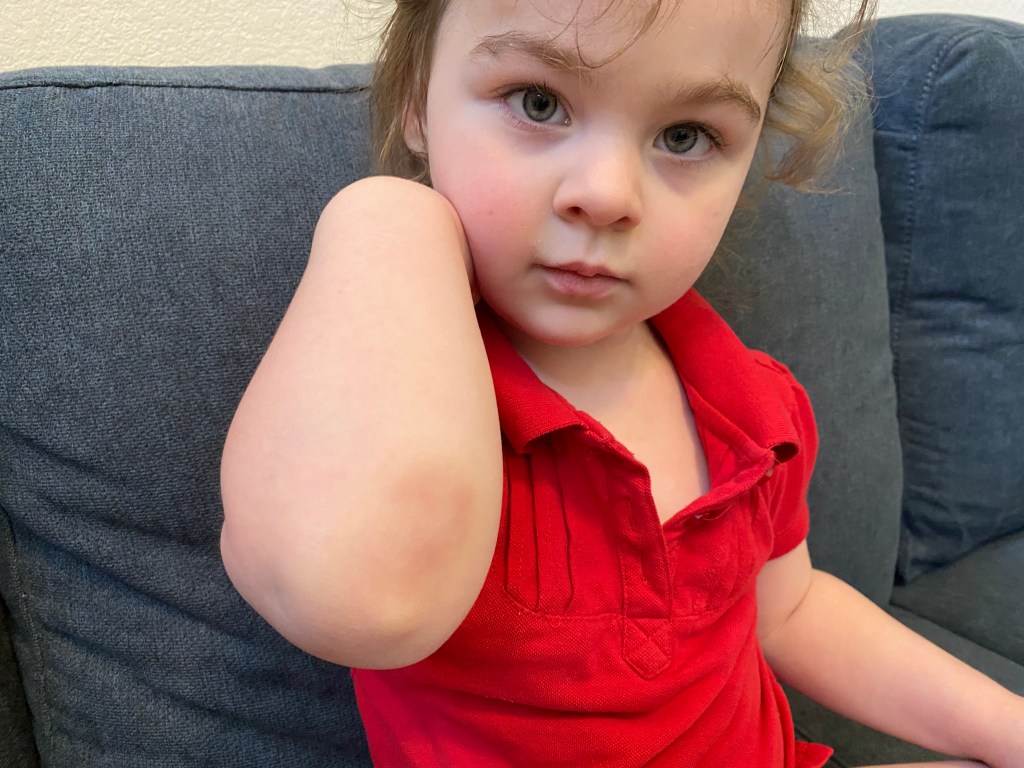
What is it like to be small and have a hurt? And to have someone who is there for you?
It’s not the same as “sympathy,” which is having concern for someone but without the emotional part that happens when we feel what they are feeling. Empathy connects us through emotional understanding, while sympathy really does not.
If you look these things up online, some places in social media and websites don’t get it quite right. There’s some good information here and here. And I learned a good bit about these things during my career as a Psychological Associate. Empathy is crucial to what was required in that career.
I guess a person who is worried about being seen as weak or vulnerable has no use for empathy or else would find it hard or uncomfortable. It amazes me that some politicians and some churches are saying that empathy is a problem, or even a sin.
When Elon Musk says that empathy is a “bug” and a “weakness,” he is wrong. Empathy helps bring about the kind of connection and trust that holds relationships, communities, and societies together. Right now, as a society, very many people are isolated from each other and mistrustful of most others. We need to have relationships in which the other person “gets” us.
It would be great to have more face-to-face relationships that include empathy, making us feel understood by a wider group of friends and people in the community. I think we would feel less isolated and mistrustful of everyone else we see. And wouldn’t that be a wonderful thing?
Looking around me right now, I see too many people who have no time or desire to understand others except to use them, who act as though getting through the day means shoving people aside, and who desperately want to be invulnerable, untouchable, armor-plated like a superhero. Empathy would mean sometimes opening yourself to difficult feelings, connecting so that it could matter – a lot – how another person is doing. You can’t do that with armor on. (You can and should do it while maintaining some sort of “boundary,” but that’s for another discussion.)
So I hope you will grow up being strong enough and wise enough to have empathy for others. Being with someone when they need it, without giving advice or trying to “fix it” and quickly move on, but instead just being present so they don’t carry what they’re carrying all by themselves.
I’m not sure how I managed to write the above without bringing in one of Bruce Perry’s books, Born for Love (written with Maia Szalavitz). Not that I wanted it to be a long essay with a lot of references, but this is a popular, readable book by a psychiatrist who I regarded as a rockstar earlier in my career when I heard him speak and read his books and articles. So, if you can take the time, go get this book!
This is heartfelt but maybe preachy, so bear with me. And it’s particularly for Eli and Lilly, should they want to read it at some future time. I was thinking of boys in particular as I wrote it, but it’s for anyone. Especially for those raising boys or having influence in their lives, and for anyone whose life is woven together with the lives of boys.
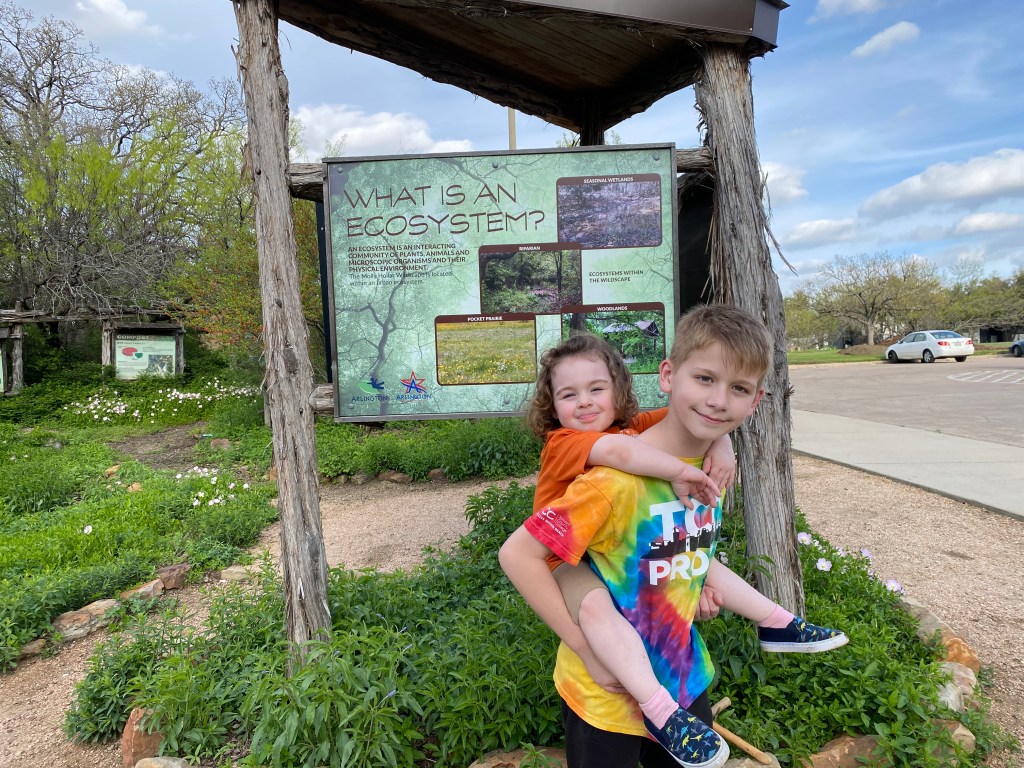
Lilly and Eli
I hope you will question what means to be a boy, and a man. Don’t just absorb what the culture teaches without some careful thought.
The culture (schools, places of worship, movies, social media, etc.) shapes what we expect of boys and men. But we don’t have to follow the culture when it holds up domination or aggression as ideals. We can turn away when it yells, “do it!” because stopping to think before acting is supposed to be weak. We don’t have to end up as men who are hardened, isolated, determined to win no matter who gets hurt. And we don’t have to raise our sons that way.
So … who do you want to be? I don’t mean work or a career, I mean what values could guide you as you make your way through the world?
Here are a few that are worth thinking carefully about: equality, empathy, truthfulness, integrity, compassion, kindness, and work as well as play.
Equality ought to be easy, right? People talk about it, even in our Declaration of Independence, the part about believing that “all men are created equal.” Nobody is above another person. It’s a great idea, and yet they wrote “men” and left out women. They left out people of color, too. Over the next couple of centuries, we began recognizing what we left out, and a lot of people have tried to correct that.
I hope you’ll think about equality on a very personal level, about you and the people around you. They way you are with girls, women, people of color, people with less money. Older people, like me, often used the right words about others being equal, but didn’t act like it. Our sisters and girlfriends were equal, but … boys and men needed to do things for them, speak for them, and make the important decisions. We said one thing but acted like it wasn’t true. Equality was mainly just a nice word. I think many younger people are doing better, but the problem is still here. In fact, some churches and politicians want to go back to the time when women were supposed to be quiet and obedient.
Women and girls should matter just the same as men and boys. Neither one should try to control the other, as if they were better. This especially includes the old problem of men and boys thinking they can control the bodies and the affection of women and girls. If we really mean it about being created equal, then we each make our own decisions about what to wear, who to hug, when it’s OK to touch or be touched. And of course that goes for any gender, gay, straight, transgender, or other way of recognizing who we are.
And being treated equally goes for any other person who is different in ways like race and skin color, or what country you are from, or how much money you have. I’m not better than a person who is different in those ways, and neither are you.
People who are opposed to these ideas may try to make it seem like we are saying that everybody has more rights than men or boys, like we are getting left out and these others are getting special rights. I guess what bothers them is that we men have less of a special privilege than before. We are used to having a special status, and so just being equal to everyone feels like we lost something. But the deal is, no one has more rights or is “more” equal than anyone else.
With equality, being female doesn’t give girls and women special rights, just the same rights.
And it doesn’t give Black people special rights over White ones, just the same rights.
And so on, with other kinds of differences.
So I hope you will think about the values that you want to guide your life, and I hope that equality is one of them.
I want to write more about these issues, maybe touch on those things like empathy, truthfulness, integrity, compassion, kindness, work, and play. What is happening in our country right now seems to challenge and distort those qualities, and some people are glorifying power and even violence. They would give special privileges to the rich and make women conform to mistaken ideas of what is required to be virtuous. They would re-define truth to be whatever is convenient at the moment. If we think such ideas are wrong, we have to speak up.
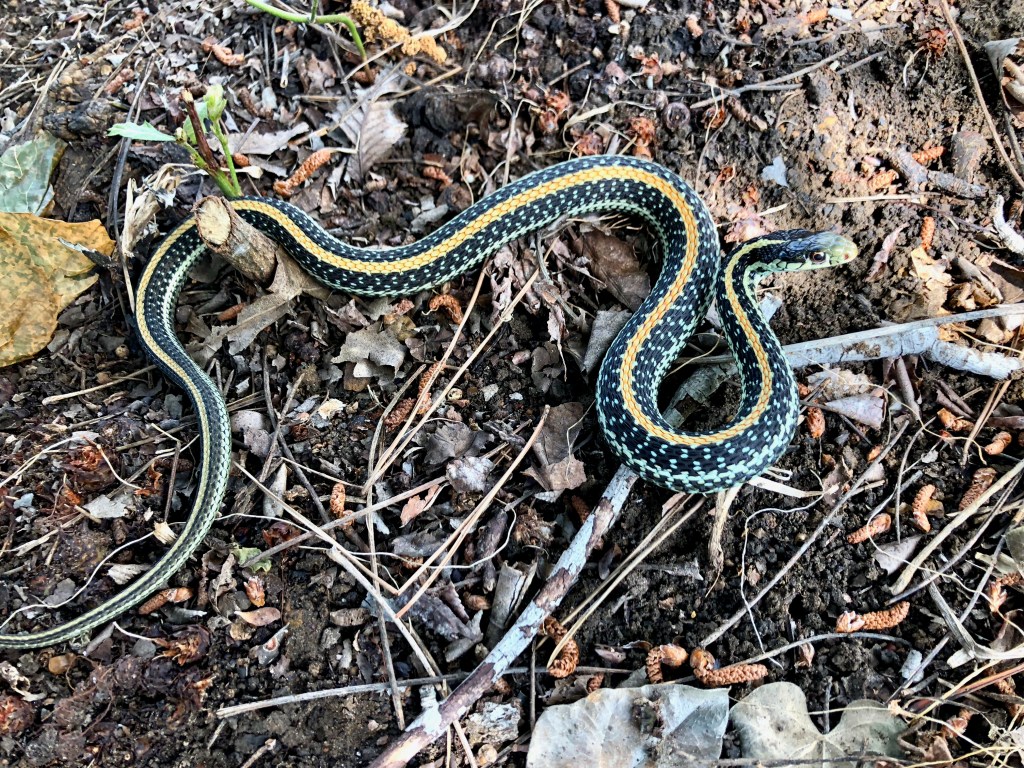
Nearly ten years ago, I was given a young Texas garter snake. A landowner in North Texas had picked him up on his land (where he reported seeing that subspecies regularly) and wanted verification of which kind he was seeing. I drove there with a friend and was delighted to hear that this farm seemed to be one of those little pockets where the Texas garter snake was doing OK. They have always been pretty hard to find, but some places are better than others. Texas Parks & Wildlife Department considers them to be “critically imperiled.”
Tex, back in 2018
I accepted this young one because it evidently would not be a noteworthy loss for that local population, and because he could be an ambassador for threatened Texas snakes. I’ve taken him to quite a few talks and presentations to new groups of Master Naturalists and to school or summer camp groups. Seeing Tex was a good way for people to learn how being a striped snake helps you escape by giving the appearance of being stationary – the stripe doesn’t seem to move – while you are slipping away. And of course he was a living example of an animal I said was in serious trouble and might disappear, for reasons that no one is sure about. It could involve things like habitat loss, habitats fragmented by roads, fire ants, and maybe other things.
In a study in the 2019 issue of Southwestern Naturalist, researchers looked at the genetic status of The Texas garter snake (Thamnophis sirtalis annectens) and two other related garter snakes that occur in Texas. They also looked at suitable habitat, finding that in Texas, where T. s. annectens does better than the other subspecies is in the area of the Cross Timbers, parts of the Blackland Prairie, and some of the Post Oak Savannah and down toward the coast. The study did not look at why it is imperiled.
I wrote about one of the times I took Tex to meet some kids at River Legacy Nature Center, when a girl had commented that she hoped one day they would be protected. On days like that I felt like Tex living in captivity (rather than living out his life on that farm) was worth it. Tex, of course, was silent on the matter.
But he was happy to nap under a piece of bark, cruise around the cage and eat the occasional mouse. His siblings and cousins in the wild were probably snacking on small frogs and earthworms, but most garter snakes can be convinced to eat thawed mice from the store. He grew and seemed to thrive, and living about ten years is not bad for a garter snake. (Their life span in the wild is assumed to be less than that, and sometimes in captivity they may live longer than ten years, but the evidence about their longevity is fairly spotty.)
And now he has died, I presume from something akin to “old age.” RIP, Tex. You charmed a lot of kids; a lot of Master Naturalists around here know your kind based on getting a look at you. I’ll miss you.
In her book, Wild DFW, Amy Martin says that people like her and me are “creek kids.” Each of us spent some formative years wandering nearby creeks. In my case the creek was my second home from about age 12 until high school, sometimes going with a friend or two and sometimes spending most of the day there by myself. For Amy and for me, the creek played a part in creating a lifelong love of nature. What would have happened, had we not had a creek, or a woods, or a prairie? I strongly suspect that if childhood slips away before we have had a close acquaintance with some place in nature, it might be too late. If there had been no creek, maybe I would have an intellectual or aesthetic interest in nature, but I don’t see how it could ever feel like home. For a creek kid, the attachment to places in nature and the things that live there is visceral. It’s like a beloved sibling, not a casual acquaintance.
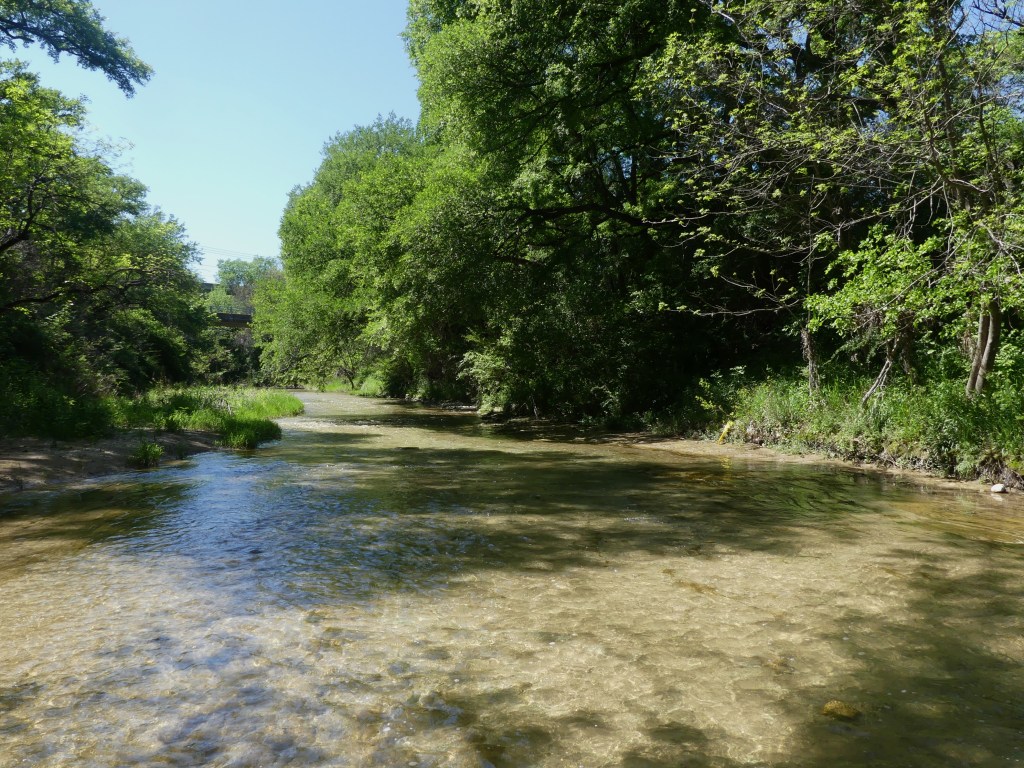
The creek in early April of this year
My creek was and is in western Tarrant County in what originally was prairie with black soil above white limestone. It sometimes filled up and ran like a raging river, but mostly it flowed quietly in a small stream from one pool to the next over that limestone. Under overhanging tree branches the water was sometimes crystal clear and cool, and mostly I had sense enough not to drink it. It was, in the early 1960s, full of wildlife, enough to keep me coming back day after day during the summer. My passionate interest was herpetology, but I was learning to love the armadillos, herons, and sunfish along with the reptiles and amphibians.
The creek is still there, but much has been lost in the 60 years since I first walked and waded it. The spaces between pools, those broad gravel bars and broken slabs of limestone, were inhabited by greater earless lizards in colors of pale gray and chalk white. They would run ahead and stop, waving their tails to expose black bars underneath (perhaps meant to confuse or disorient a predator). I haven’t seen one at the creek in many years. Ribbonsnakes used to thread their way through stream side vegetation, hunting for cricket frogs. When spooked, these slender harmless snakes would swim across the pools with bright orange and cream-colored stripes glistening in the sunlight. They seem mostly to be gone as well, at least at my creek. As populations of wildlife disappear here and there, younger generations know of them only through the memories of us older naturalists, or they may never know what is missing (see the article on shifting baseline syndrome).
I keep coming back, though the city’s development has forced me to find access points further upstream. Occasionally I will bring someone, but it’s a little like in Mary Oliver’s poem, “How I Go to the Woods” – those who smile and talk too much are kind of unsuitable, and if I do take someone, it is a person with whom I feel comfortable and close.
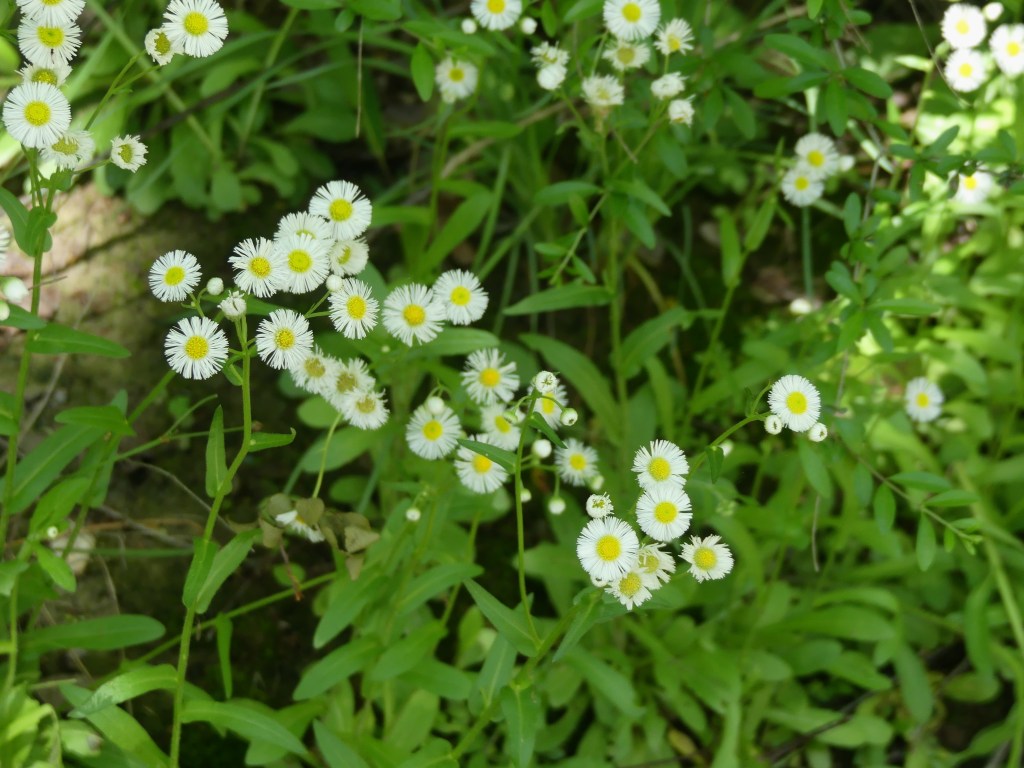
Fleabane growing on the banks of the creek
In particular, my visits there with Elijah have been important to me and, I think, to him. He is not quite a grandson but I’ve known him since he was born, so he’s family. I first took him to see the creek when he was six, and we’ve visited on and off since then. I described one such visit in an issue of “Letters to Nature Kids.” Giving kids time in nature, introducing them to the turtles and fish and other things that set the engines of curiosity and wonder in motion, that feels like part privilege and part responsibility. Taking my granddaughter for a walk to see birds and draw in the sand on the path through the woods is a great pleasure, and I think it is more than that. It is planting seeds that might, if she chooses, grow into a source of joy and connection with the world around her.
Blackstripe topminnows at my creek
So my creek is still there and has not been swallowed up by the city. I imagine kids playing in that creek and exploring it as I once did. I imagine it, but I do not see it. I have not seen anyone who appeared to be playing or learning about the life of that creek in a long time. Is this part of the cultural trend that Richard Louv wrote about in Last Child in the Woods? He documented the increasing tendency for children to play inside, to spend their time in front of screens, with little time in woods and fields. As parents, we may worry that no place out of our sight is safe. For a child to be outdoors for an extended time away from contact with a parent seems neglectful to many people. Yet I survived and thrived at the creek with no cell phone, just a watch and a rendezvous time for mom to pick me up.
I hope you have a creek, and that you take your kids or somebody’s kids there. I know that it might not be a creek; it could be a woods or a pond or some other place in nature. I would love to hear about it in the comments – either a place in your memory or some place you can visit right now. And I hope that you can visit it, for an hour or a day.
A near-perfectly camouflaged cricket frog, hoping that I’ll walk on byBlue water-speedwell, according to iNaturalist, growing along the creek






 Our Lives In Nature