A recent mid-August Sunday was the hottest so far in 2024, with a high of 104F. When Kat and I walked up the trail at Sheri Capehart Nature Preserve to the sandstone ridge, the stone was quite warm to the touch. Regardless of the day’s heat, we wanted to experience a summer sunset there, and we arrived at the ridge about 8:00pm with the sun still glaring yellow through the leaves of oaks. Those trees grow immediately below the sandstone ridge, a curtain that hides the Fort Worth skyline and offers some shade.
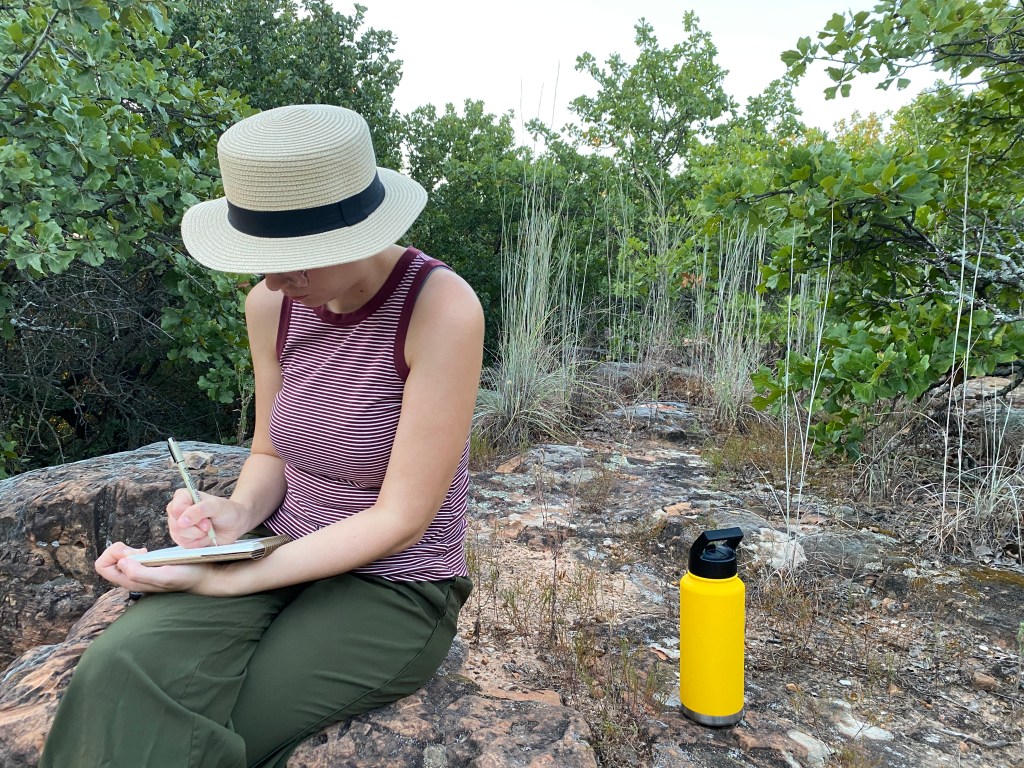
We sat on the stone ledge with water bottles and notebooks at our sides. Looking behind where Kat was sitting, there were tall stems of little bluestem reaching above our heads, and with each little breeze they waved as if they were the tops of trees. The breeze was welcome, of course, but for the most part the air was still and with the humidity at 50%, it felt sticky. Turning back to the west, the disk of the sun peeked through branches and leaves in yellow-orange sparkles, as if coming from the facets of a jewel.
The constant nearby traffic sounds dominated, but at 8:10pm a wave of insect calls moved through the area and then stopped. Although at some point the Merlin app picked up the call of a northern cardinal, I could hear no birds. After a few minutes another wave of insect sounds lasted several seconds and then abruptly stopped.
Meanwhile, a pastel yellow sky at the horizon filtered through the trees, silhouetting leaves and branches. I reclined on the still-warm rocks to be able to see the whole field of the pale blue sky, watching for birds or insects and hoping to see the first star become visible. I saw none of those. At 8:26pm the temperature at the ridge was still 92F, with humidity dropping a little. The western horizon was a deeper orange.
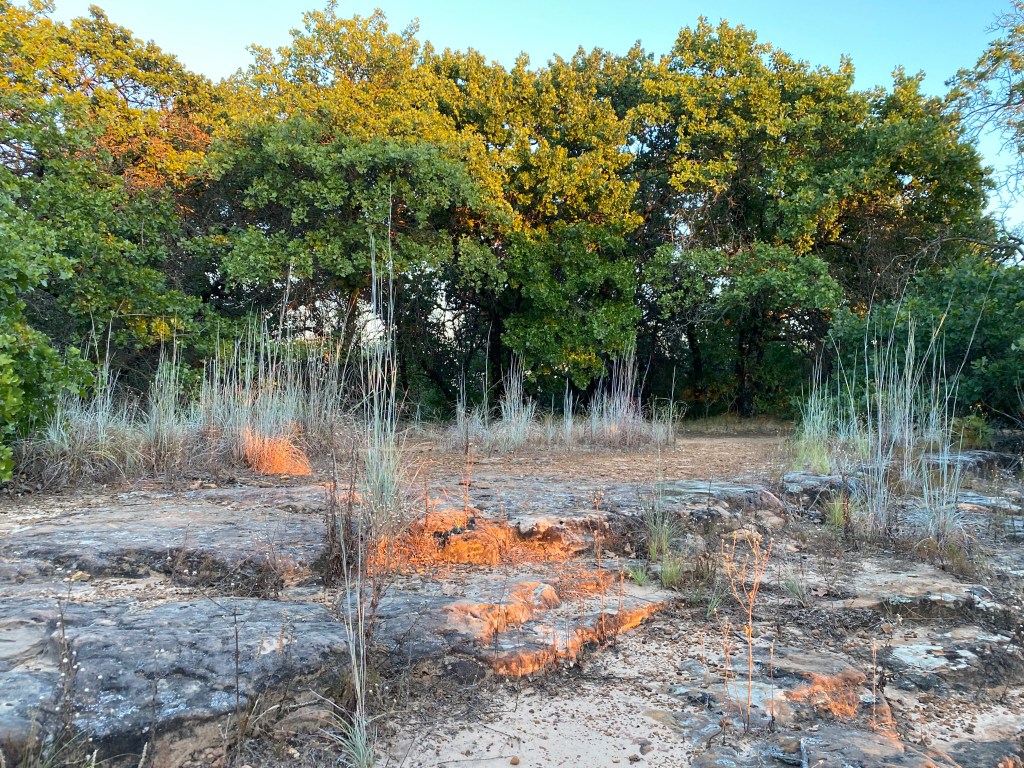
Behind us, the canopies of blackjack oak were dimly lit by the remaining light from the western horizon, almost glowing with a yellow tint that contrasted a little with the surrounding vegetation. And when we looked lower down in those blackjacks, through bare branches we could see the bright, round full moon rising.
It was about ten minutes later that we could see the first glimmers of a couple of stars. “Star light, star bright, first star I see tonight,” but these tiny bright pinholes in the not-yet-dark heavens did not seem bright. Kat’s younger and more perceptive eyes could soon make out four stars.
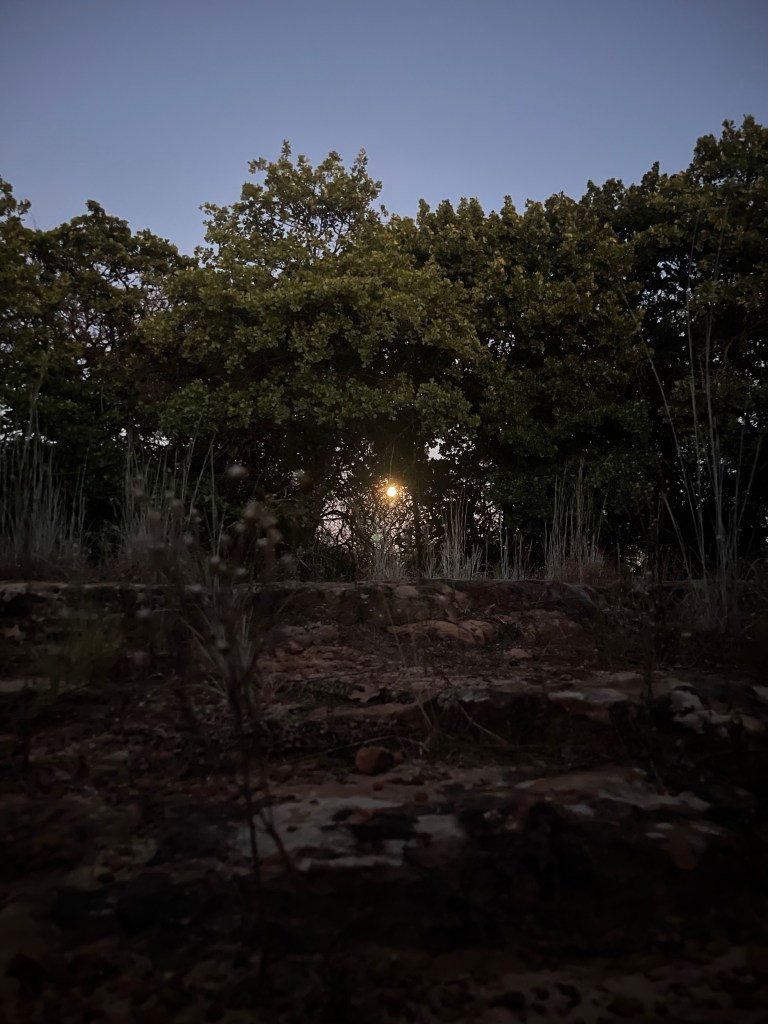
Shortly after that, we started walking back in the relative darkness, much darker under the trees. But in open areas, the full moon had risen higher and provided enough light for walking. When the moon is bright enough to light your way, and you walk along a path just visible, it may bring to mind childhood adventures in back yards or campgrounds. Something about it makes it seem special, a moonlit faery world much different from the bright daylight colors.
And what is the attraction of sitting with the sunset, riding that transition between day and night? The world rides along with us as we notice the settling of birds, the emergence of insects or frogs, the way any clouds transform the last light of the sun. Most days we declare our independence from the rhythm of the Earth, turning on our lights and continuing whatever we are doing while the sun disappears and gives the night to the moon and stars. Sitting outside with the sunset is a way of reconnecting with that rhythm. Through such a connection, perhaps we synchronize ourselves with something important.
 Our Lives In Nature