My interest in nature has been dominated by reptiles and amphibians (herps) starting when I was nine or ten and the girl across the street invited me to come along and find garter snakes in Colorado. I was active in herpetological societies twenty-five years ago and I’ve been teaching incoming Master Naturalists about these animals for some years. I’m interested in the “big picture” of ecology and natural history, but herps are still an important focus.
Herp conservation is very important to me. If you’d like to learn more and support some important work, please check out the Amphibian and Reptile Conservancy and the Orianne Society, among other organizations (such as Texas’ own Texas Turtles). I’ll be giving talks about reptile and amphibian conservation in Texas over the next few months, and while preparing, I’ve added some species profiles to the downloadable pdf files on my herpetology page.
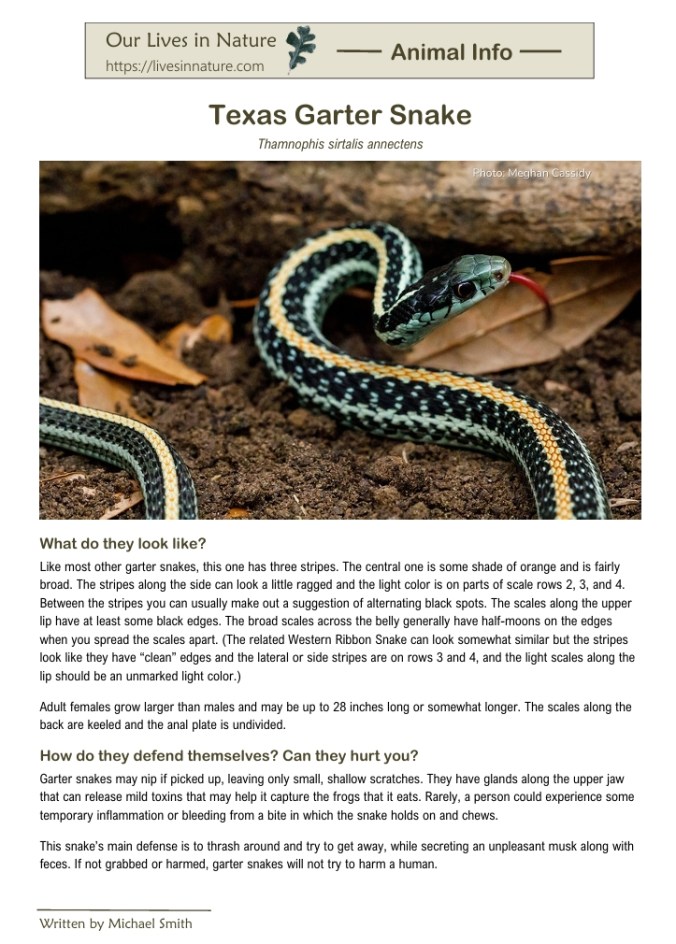
Among them is information about the Texas Garter Snake, a subspecies of the “Common” Garter Snake. Across the years, I have found a handful of Texas Garter Snakes, and they turn up occasionally on iNaturalist, but as far as I can tell they have never been common. There seemed to be particular spots or areas where they had viable populations, but even in those places a search for them was always hit-and-miss. That turned out to be the case in 2013 and 2014 when a group from UT Tyler started a project to investigate its genetics and preferred habitat. They did not find any, and had to rely on a few museum specimens in order to finish the project (published in The Southwestern Naturalist in 2019).
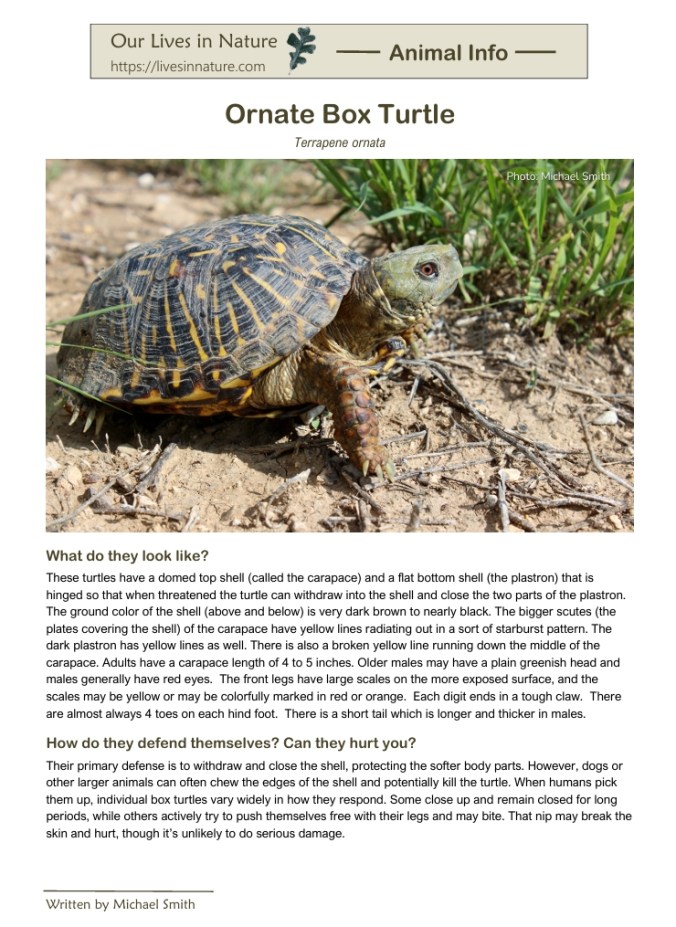
Another profile covers the Ornate Box Turtle. I have loved box turtles since I was a kid (and at least half of Texas would say the same thing, until they became uncommon enough that kids didn’t get many chances to see them). They have suffered from habitat loss and fragmentation, road mortality, and the unfortunate tendency of our species to want to collect and keep interesting and cute animals. In recent years, Texas protected box turtles from commercial collection. However, people still pick them up and take them home. Like turtles generally, their success depends on living long lives once they become adults. Collecting one is like running it over on the road – it is “dead” to the reproductive population of turtles.
And Texans of a certain age recall when the Texas Horned Lizard could be found in back yards and local parks. In the 1960s these places were often dotted with Harvester Ant colonies with a big bare circle of ground around the opening to the colony. These were the horned lizard’s food, and when people poisoned the ants (and later when the fire ants largely replaced them), there was nothing for horny toads to eat. Also in the 1960s, large numbers of these lizards were collected and shipped off to the pet trade where they inevitably died. But probably the biggest deal, according to Andy Gluesenkamp, was the loss and degradation of habitat. Native Texas prairies, with bunch grasses, open areas, ants, and the right combination of shelters and wildlife “neighbors,” were great for them. Monoculture pastures of non-native grasses, the increasing network of roads, the invasion of fire ants, and other factors have eliminated Texas Horned Lizards from many of the places where they used to be found. (Gluesenkamp led the San Antonio Zoo effort to captive breed and release young horned lizards in suitable habitat – an effort that is working.)
So far, the sole amphibian I’ve profiled is also one that biologists are concerned about. There is little real data concerning how Woodhouse’s Toad is doing, but it is the species that many of us used to see on spring and summer nights in North Texas. It has largely been replaced by the Gulf Coast Toad, but away from the cities there are places (like the LBJ National Grasslands) where Woodhouse’s Toad seems to be the predominate species. Overall, the species is considered secure, but are we sure? Wildlife agencies and universities have limited resources and cannot study everything. Everyday folks documenting what they see on iNaturalist help a great deal, but there are still enormous gaps in our knowledge of the status of most of our herps.
There are other species with these two-page downloadable pdf profiles, including the Texas (Western) Rat Snake, the Great Plains Rat Snake, the Long-nosed Snake, Rough Earth Snake, and Checkered Garter Snake. I hope you’ll use them to share with home schoolers, scout troops, or anyone else who would like them. I’d be happy if you’d like to leave a contribution, but if you can’t, that’s fine. And maybe leave me a note about anything else you’d like to see. Our venomous snakes are briefly summarized in my “Identification Guide to Venomous Snakes of North Central Texas,” found on the same page.
I just got back from a couple of days in the Rolling Plains with three wonderful friends. We saw Texas horned lizards, snakes, and a beautiful springtime landscape out there past the city of Vernon. This note is a “heads up” that my friends and I plan to collaborate on the story of our visits to Copper Breaks State Park and Matador Wildlife Management Area. Stay tuned and consider subscribing to Rain Lilies on Substack.
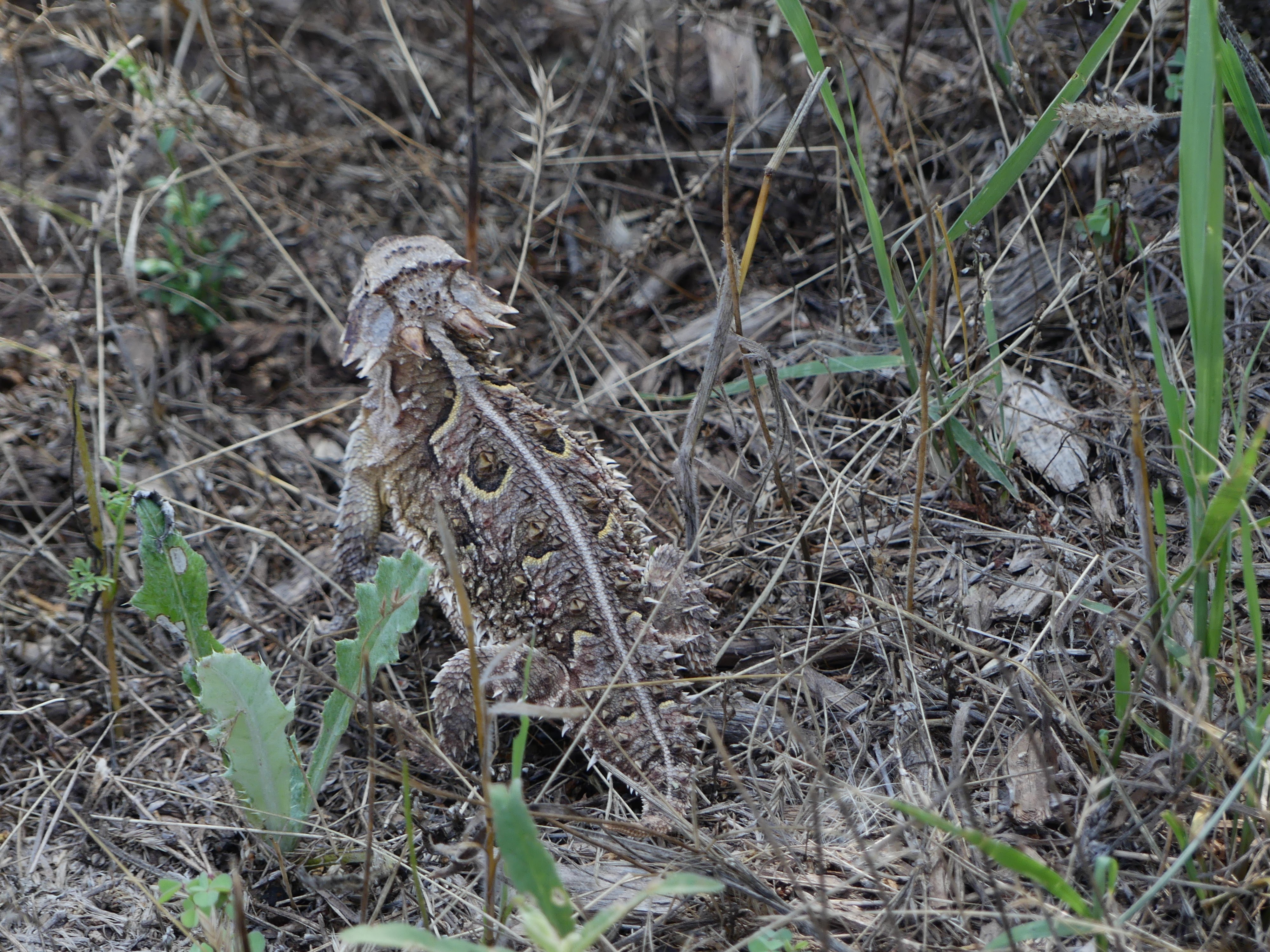
Texas horned lizard
Road trips alone are OK, and there can be a wonderful quality to solitude out in some natural place. For me, going with like-minded friends is probably the best. There were times when we were the eyes and ears for each other. If I’m more focused on the ground where lizards skitter off the trail and Kat is attentive to a more distant view where Mississippi kites soar and buntings perch, we complement each other. Alaina is particularly attuned to the insect and spider life, and Sheryl takes in the birds but also those miniature worlds of flowers, fungi, and insects. One of us commented that together we’re like one organism, because we are closely attuned to each other while focusing on different aspects of our surroundings.
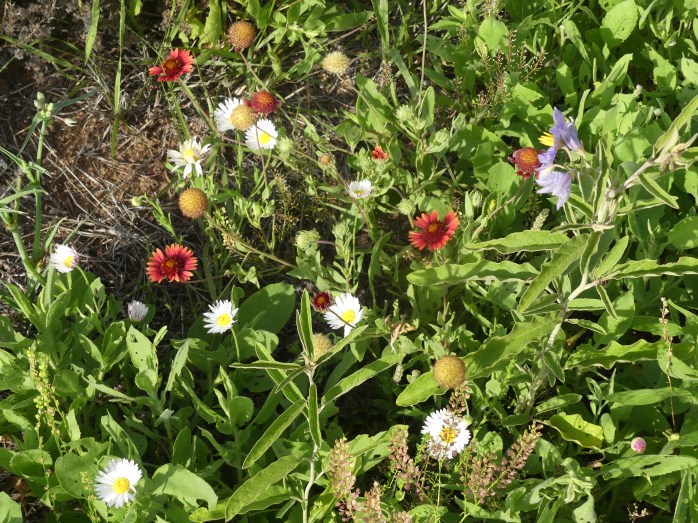
Where we went, the Texas horned lizard is doing well, and we saw six or seven of them. At night, we found three massasauga rattlesnakes along with other snake species. The landscape is thick with blooming thistles and basketflowers as well as (in places) skeleton plant, lemon beebalm, firewheel, and other flowers. It was a beautiful trip, and we’ll have more of the story – and lots of photos – at Rain Lilies soon.
We were driving west, toward a respite from the city, a quiet refuge out in the Rolling Plains. That part of Texas shows us how much beauty there is in openness and how much richness and life can be contained in a sparse landscape. Along with me were Meghan Cassidy, a wonderful naturalist, photographer, and book collaborator, and Carly Aulicky, a field biologist with an amazing understanding of birds and prairies, and with a quiet wisdom and humor that makes you want to sit and keep listening. If only for a few hours, we would wander among prickly poppies and horned lizards and watch Mississippi kites and roadrunners.
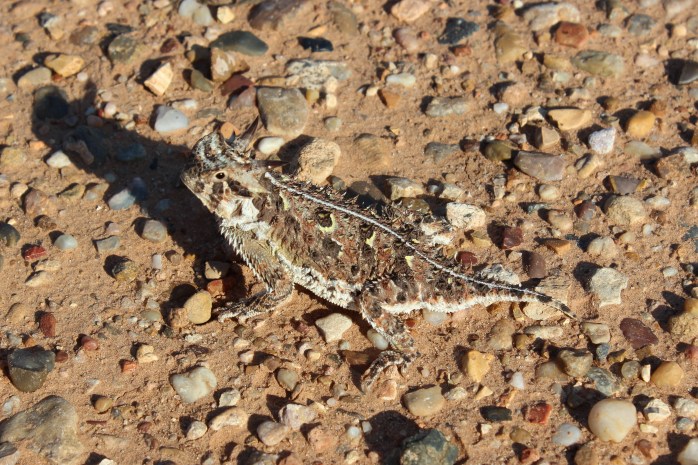
Texas horned lizard seen in 2014
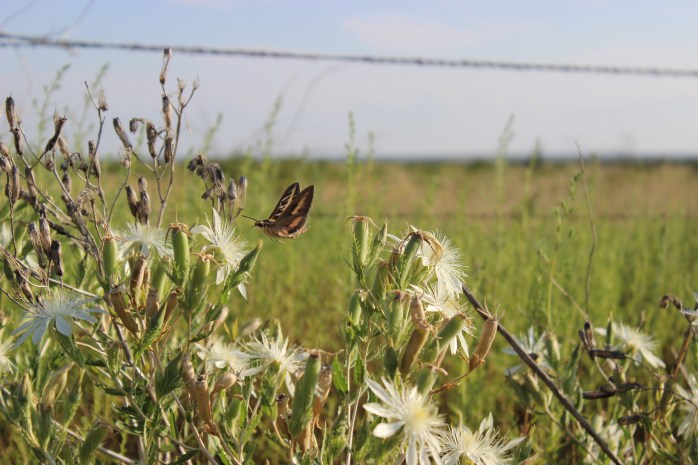
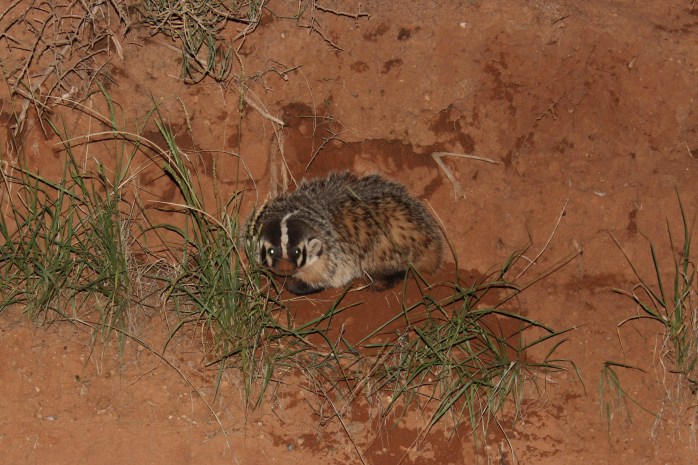
It had been seven years since Clint King and I visited the area between Lubbock and Abilene, finding a half-dozen Texas horned lizards along the red dirt roads that cut through the ranchland. There was no park or preserve to visit there, but we spent a very enjoyable afternoon driving and walking road rights-of-way. The big red harvester ants are still doing well in the area, and so the horned lizards have lots of food. We found big sphinx moths hovering like hummingbirds around beautiful white flowers, and greater roadrunners hunting along the roadside and either running off or jumping into low, short flight into a nearby thicket when we approached. At the end of the day we had surprised a pair of badgers, one of whom could not climb an embankment and was unable to dig quickly enough into the red dirt, and so he faced us menacingly until we drove off. Getting too close to a cornered badger would have been a really bad end to a wonderful day.
Sphinx moth (2014)American badger(2014)
I told those stories as we headed northwest from Abilene past ranchland, a few small towns, and a huge array of solar collectors. That solar array is good news in a world desperately needing to break the addiction to fossil fuels. But it replaces many acres of prairie and Carly talked about the reflective surfaces leading some birds to crash into them. A small example of our imperfect solutions to problems that must be solved, as the clock keeps ticking. All those interrelated crises with climate, loss of biodiversity, the rigged competition between corporate profit and human well-being, and an increasingly crowded world where a mutating microorganism can easily spread into a pandemic. We are even losing our shared fragile agreement about the nature of truth and how we should find it. Much of the world seems to be flirting with the false solution of authoritarian government. In my seventy years, I do not remember a time when the world seemed in so much trouble from so many directions, with hope for the future so hard to come by. Some of us experience grief from the losses that we have already sustained, along with grief and stress as we anticipate future losses.
Grief is a universal part of life because we all experience losses of significant people, loss of our health or physical integrity, loss of jobs or important roles in our community, and loss of emotionally significant places. When we have attachments to particular places in nature, then the loss (even the anticipated loss) of such a place is termed “ecological grief.” When that loss feels like homesickness for a place, not because we are distant but because the place itself has been lost, the experience is called “solastalgia.” Additionally, the sense of helplessness and anxiety at the impending loss of nature is referred to as “eco-anxiety.” These concepts and experiences are being given serious scholarly study1 as well as exploration of their ethical and spiritual significance.2 Within the discussion is an acknowledgement that grief should lead to understanding of what the loss means to us, how our lives will now be different, and whether there is guilt or anger regarding how the loss occurred.
While Exxon was discovering the truth about climate change and concealing that truth from the public,3 when forests and prairies were cut down, and life on earth was being assaulted in many ways, what did we do? I ask myself questions like that more seriously and more often these days. Among the tasks of growing older is to reflect back on our lives and decide whether it was well spent. What kind of a life did we make out of the chances that were given us? Did we build a life with things to celebrate and with relatively few regrets, or do we desperately wish there was a chance to do it over? Psychoanalyst Erik Erikson described these as the fundamental issues of the final stage of our lives: ego integrity vs. despair.4 Part of the work of this stage of life, for many of us, is to decide if we made things better for those who came after, and to wonder whether it was enough.
Riding through the Rolling Plains with Meghan and Carly, talking about our love for nature and the challenges ahead of us, how could I think that my past actions were enough? Is this the world I want them – and many other young people – to inherit? I say to myself: “I have done what I could,” but I know that we must do more. The problems we face are embedded within large systems and widespread practices, and the isolated actions of one or a few of us are swallowed up and amount to nearly nothing. I could stop driving my car, and climate change would continue advancing. It takes a great many of us acting together to bring about meaningful change. Thus do we individually feel helpless, and thus do we continue sleepwalking through our days. And thus might we experience what Erikson termed despair.
We are not destined to sleepwalk through the destruction of nature. Our individual efforts can make a difference when they help shape and sustain little communities that value nature. Those little communities are the molecules that can link together and create change on a meaningful scale. Bringing someone along to experience a day on a river or in a woodland may be one of the most powerful ways to build those little networks and communities. And in the process, we experience joy when we share nature with another person.
Joy, connection, purpose, even transcendence can happen when you walk through a wild and diverse place like the ranchland we found on this trip. Those things are what hold a love of nature together, in a more visceral way than do ecosystem services like pollination or clean air. Those benefits are more abstract, and they operate in the background, mostly out of our awareness. A day spent in a fairly intact ecosystem fully engages your awareness, your body and spirit. As a result, you can fall in love with a place. As you spend more days in more places, you can come to love landscapes and ecosystems. And once you love them, grief becomes a possibility when they are threatened. It is analogous to love for a friend or family member – they complete you and enrich you beyond imagining, and you would grieve their loss.
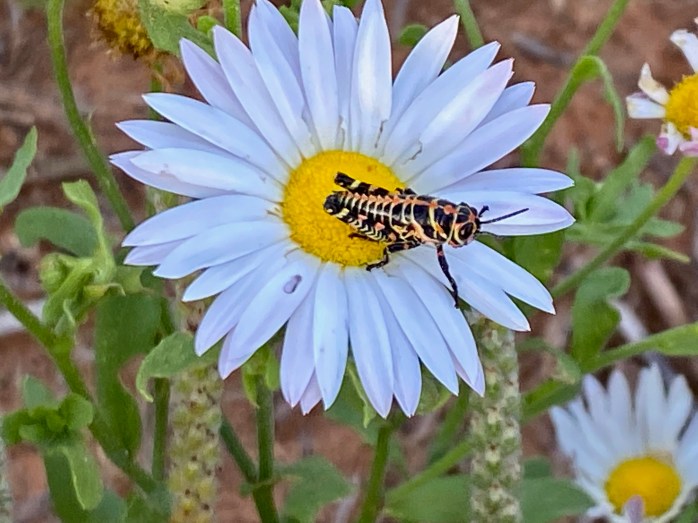
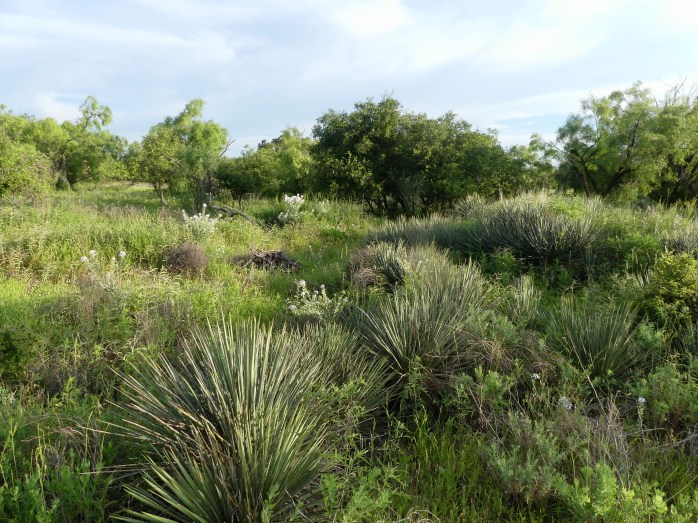
We discussed these issues along with many less-serious things as we drove, and eventually we arrived at quiet farm roads through mostly flat plains. A huge variety of plants were blooming, visited by large numbers of insects. Roadsides were covered with daisies, white prickly poppy, peppergrasses, and many other flowers. Grasshoppers were abundant, including at least one rainbow grasshopper. Meghan found multiple species of velvet ant, which is really a wingless wasp. The common name for one of them, “cow-killer,” conveys something of the power of their sting. Around the fenceline there was low-growing Havard oak, and yuccas grew here and there.
Rainbow grasshopper
It was quiet, and the absence of highway noise and planes flying overhead made it that much easier to be immersed in the experience. It also framed the natural sounds clearly (especially for those whose hearing is better than mine), and bird calls were beautiful and distinct. A nearby group of coyotes began to yip and howl before moving off. It is a strangely haunting and wonderful thing to listen to the song-dogs at sunset.
Mississippi kites appeared here and there, and Carly talked about these sleek raptors being pretty social, often roosting or hunting in small groups. I loved seeing scissortail flycatchers, and Carly spotted a male painted bunting. Many other birds, including nightjars and a red-tailed hawk, enriched our visit.
Along those red dirt roads we saw the occasional broad circle that signaled a harvester ant colony. A central opening was surrounded by a scattering of pebbles and material that the ants have excavated, and the ants were busily coming and going. If you watch their movements, you find little ant trails that the workers use like highways linking the colony to the areas where they forage for food. Along those ant highways you sometimes find the Texas horned lizard. We walked around the colonies and followed ant trails, and Meghan spotted a young horned lizard. It disappeared into the base of some vegetation and we were not able to find it. The lizard might have been tucked away in some refuge under the plants or may have sneaked away while we weren’t looking. Although Meghan only got a brief look, it was reassuring to know that the horned lizards are still there.
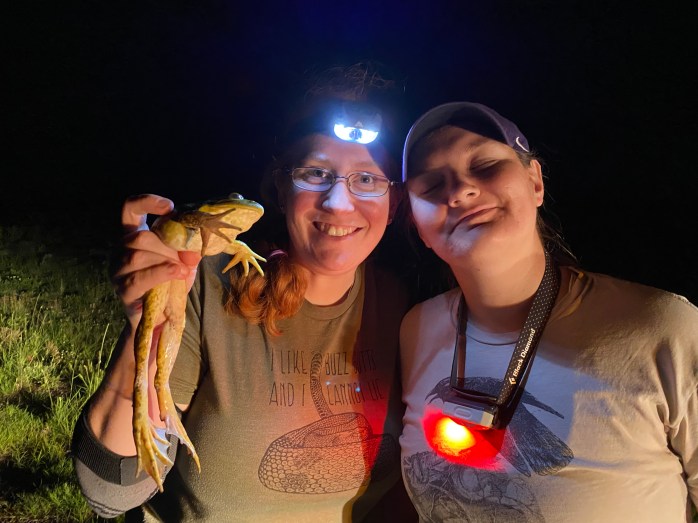
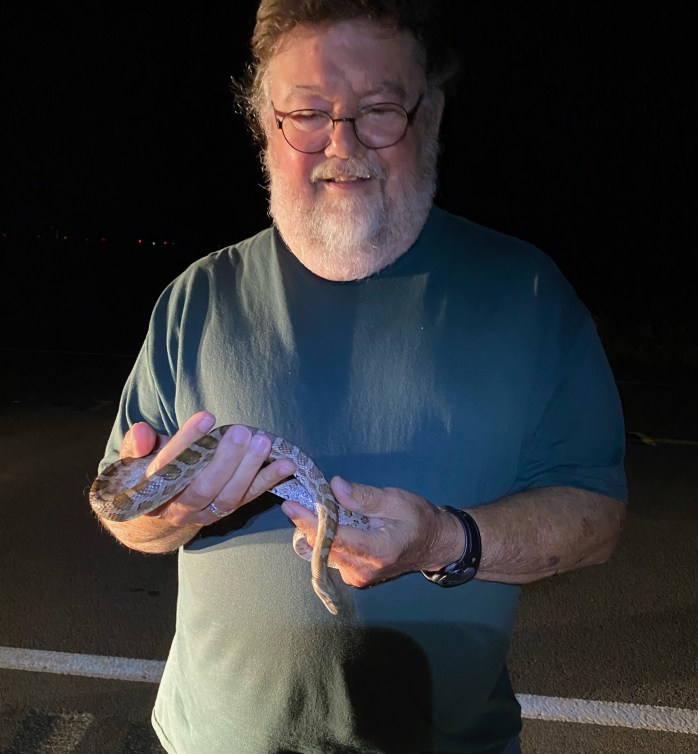
With the American bullfrogMe, with Great Plains ratsnake (photo by Meghan Cassidy)
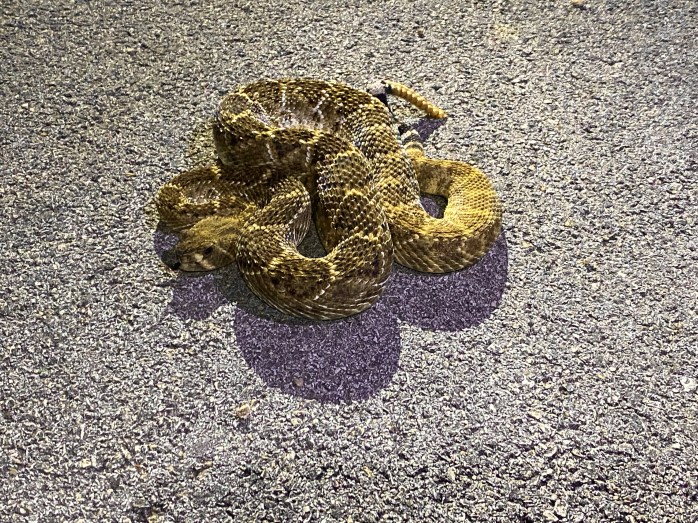
Darkness arrived, and we looked for reptiles and amphibians on the roads. Early on, there was a Woodhouse’s toad and then a Couch’s spadefoot (an odd sort of toad with vertically elliptical pupils and a hard spade-like structure on each back foot to facilitate digging). Then we came upon a sizable American bullfrog – you have to be impressed at the ability of a frog like this to make a living on the semi-arid plains with only a few scattered ponds to sustain you. As we made our way home there were Great Plains ratsnakes and a nice western diamond-backed rattlesnake who tolerated my using the snake hook to move him back onto the road so that we could get a good look. Meghan then used her hook to carry him to the other side of the road, where he had been heading. Throughout all that, he never even rattled.
Western diamond-backed rattlesnake(photo by Meghan Cassidy)
The richness of life in this region is both invigorating and reassuring. There was so much to see and understand, and there seemed to be little chance that all that life would be cut short by a housing development. We hold out the hope that not much of it will be plowed and planted in row crops, although we did see some of that. Today was a beautiful gift, a chance to be in the present where ghosts of loss do not live. Tomorrow we can think about the future and think about what we can do, while at the same time carrying the hope of more days like today.
References
Comtesse, H., Ertl, V., Hengst, S.M.C., Rosner, R., & G.E. Smid. 2021. Ecological Grief as a Response to Environmental Change: A Mental Health Risk or Functional Response? International Journal of Environmental Research and Public Health. Online: https://doi.org/10.3390/ijerph18020734



 Our Lives In Nature