18 March 2026 – Fort Worth Nature Center & Refuge 12:10-2:16pm
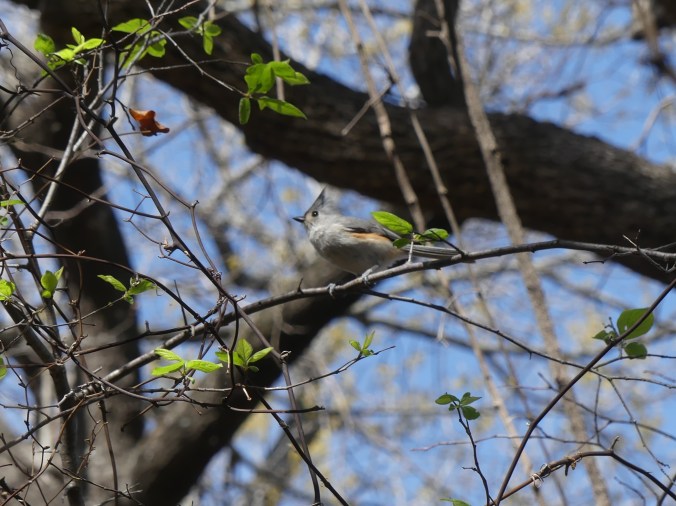
Along the Canyon Ridge Trail, Lone Point and the surrounding area is a favorite. The rocky remains of the old CCC structure are atop the ridge with limestone, yucca, and live oak. Today I started my walk from below the ridge, near the lakeshore, where a pair of tufted titmice were hopping around in understory and low tree branches.
Tufted titmouse
On the way up to the ridge, there were lots of bird calls in the woodland. Merlin identified the calls of red-shouldered hawk, tufted titmouse, white-eyed vireo, Carolina wren, red-bellied woodpecker, and northern cardinal. Once I reached the ridge, there was also blue jay, red-winged blackbird, and ruby-crowned kinglet.
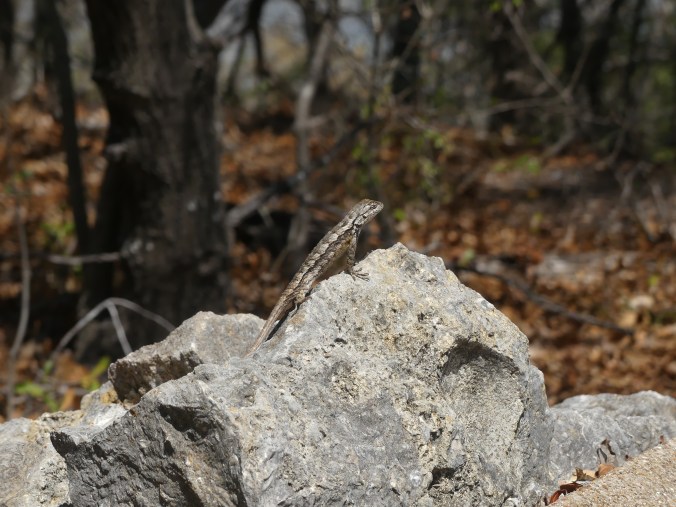
Right away I saw a young Texas spiny lizard who ducked under the old concrete picnic table. I would see the same lizard on my way out, and a couple of others elsewhere on the ridge. Just one more way in which spring seems already to be going strong.
The ridge top
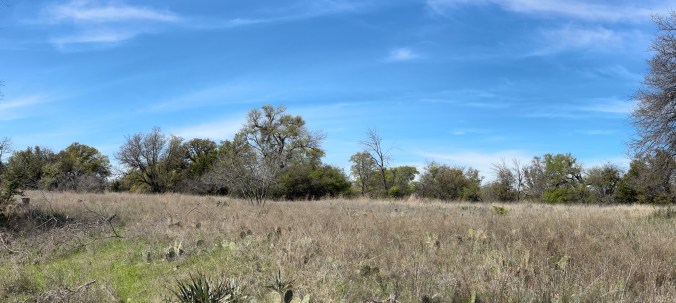
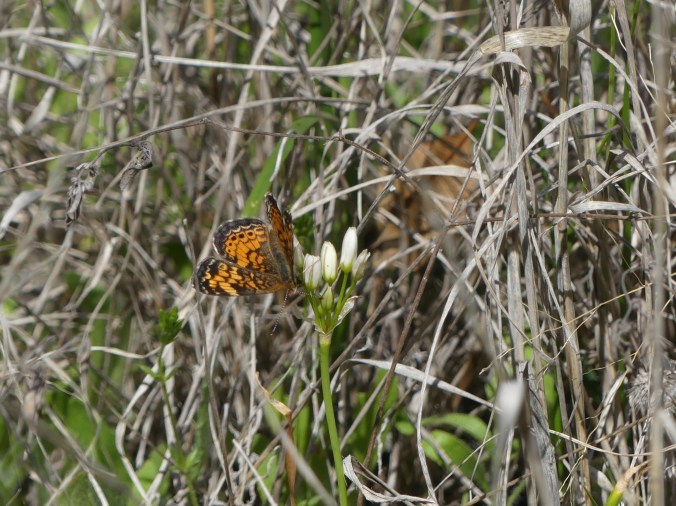
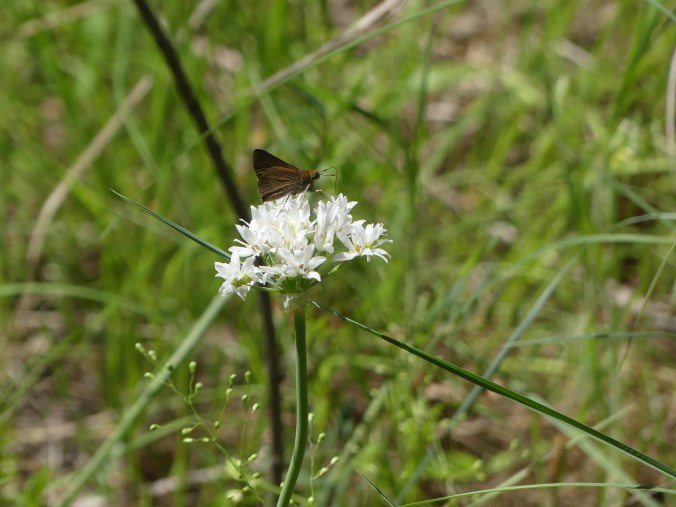
The top of the ridge is a limestone-based savanna with live oak, pale leaf yucca, and prickly pear. Butterflies were active, including sulphurs, goatweed leafwings, and a little crescent visiting what appeared to be crow poison beginning to flower.
Crescent butterfly
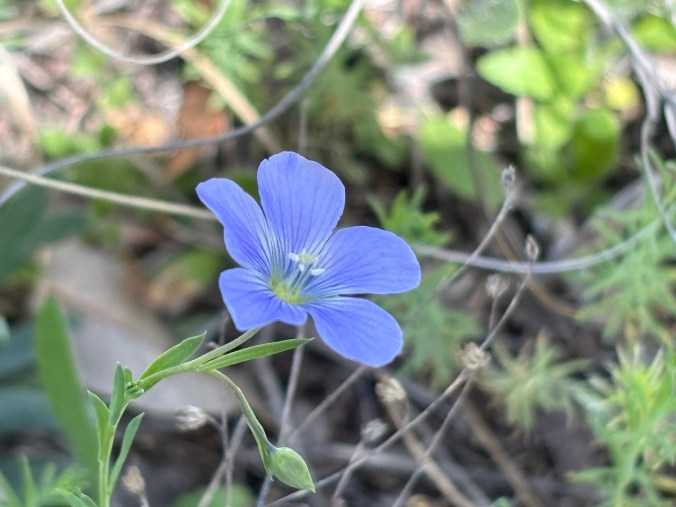
There are not a lot of flowers yet, but a small blue flower caught my eye along the trail. It was meadow flax, according to iNaturalist, an annual with either white or blue flowers. It’s new to me, but with my limited knowledge that’s not saying much.
Meadow flax
Back at the Lone Point structure, I sat for a while and noticed that Texas spiny lizard I had seen earlier. She or he was back at the top of the toppled stone picnic table, basking and reminding me just a little bit of the collared lizards I’ve seen playing king-of-the-hill on boulders at Palo Duro Canyon. Very impressive, little lizard – and thanks for sharing a bit of your afternoon with me.
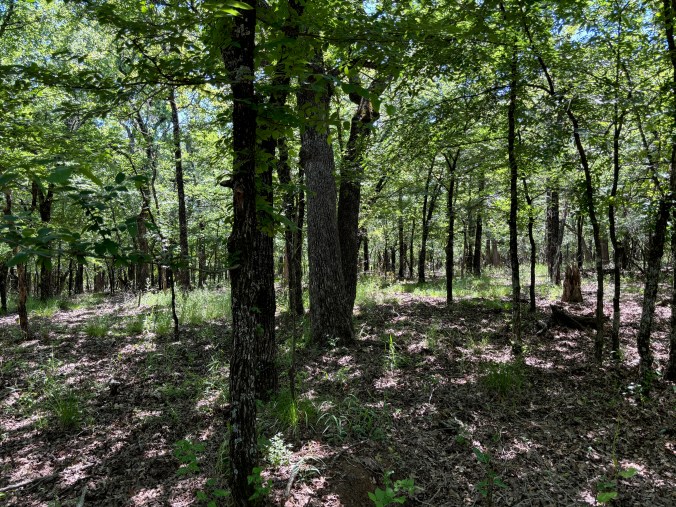
This new trail at Fort Worth Nature Center & Refuge is a favorite. I have walked it in winter with those bare tree limbs reaching up towards the sky and beautiful patterns of shed leaves on the ground. Now I have been there when it is greener and darker with all those new leaves shading the ground. The trail winds among the tree trunks and I can hear the quiet and the birds and the soft crunch of footsteps. That quiet and the new leaves as well as the carpet of old ones makes for a woodland sanctuary. A protected woods becomes a protective place for all who walk there.
I remember the 1939 film – “The Hunchback of Notre Dame” – in which Quasimodo rescues the wrongly condemned Esmeralda and flees to the cathedral, crying “Sanctuary! Sanctuary!” Notre Dame is a place of safety and protection from a corrupt French Chief Justice. Both the disfigured Quasimodo and the Romani girl Esmeralda are safe within its walls.
I respond to the prairies, woods, and wetlands as places of safety and protection, sanctuaries from thinking about the current regime and worrying about how it will play out. Extrajudicial abduction, defiance of courts, hate and scapegoating, wrecking the economy that sustains us, and on and on. We might imagine that, like Esmeralda, we all need to be taken to some place of safety, away from the worst of our fellow humans.
At the same time that such things are going on in human society, the sun keeps rising each morning, birds sing, water flows, plants give us oxygen and food, and there is quiet and peace in the woods and fields. I am very thankful that they are part of the world. As Robin Wall Kimmerer said, “Even a wounded world holds us, giving us moments of wonder and joy” (Braiding Sweetgrass, p. 327).
Sanctuary! I need to be in such places. I must do whatever good that I can in the world, and then for a time I need the shelter of nature.
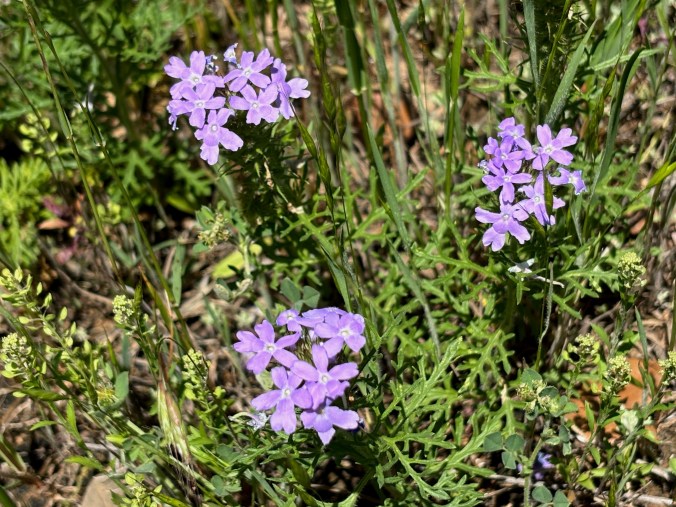
Flowers of Dakota Mock Vervain
And so I went to the nature center yesterday, the day before Earth Day. The sun was shining in a clear blue sky, and a Northern Cardinal’s call was joined with those of other birds in the patch of prairie where I started. The temperature was still in the 70s, but not for long.
In the meadow with butterflies and bird song
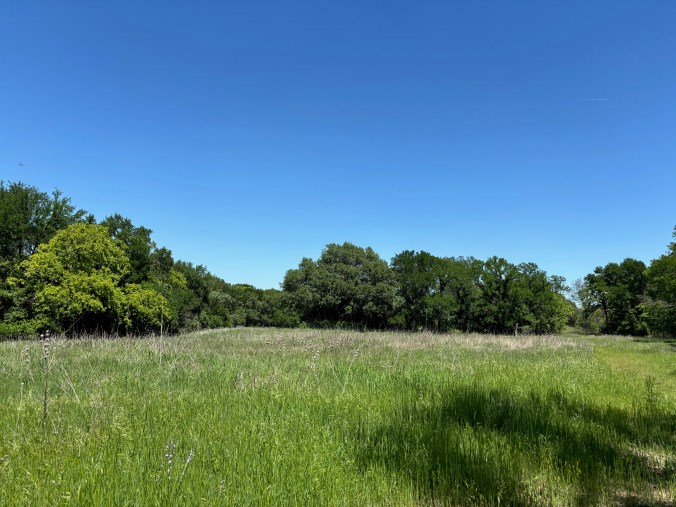
After a time in the trees, the trail entered a big meadow or prairie surrounded by trees. This, to me, is the heart of this trail. There were flowers visited by butterflies – a Common Buckeye, several Goatweed Leafwings, and over by the bench, a Painted Lady. Once I settled in, I saw some species of sulfur flying and fluttering a little above the tops of the grasses. Most of the time the nearby air traffic did not disturb the place, so I could hear the Northern Cardinals and also Carolina Wren, Carolina Chickadee, White-throated Sparrow, and Tufted Titmouse (much of the identifying was with the Merlin app, but even if they were not identified the songs in the meadow were beautiful).
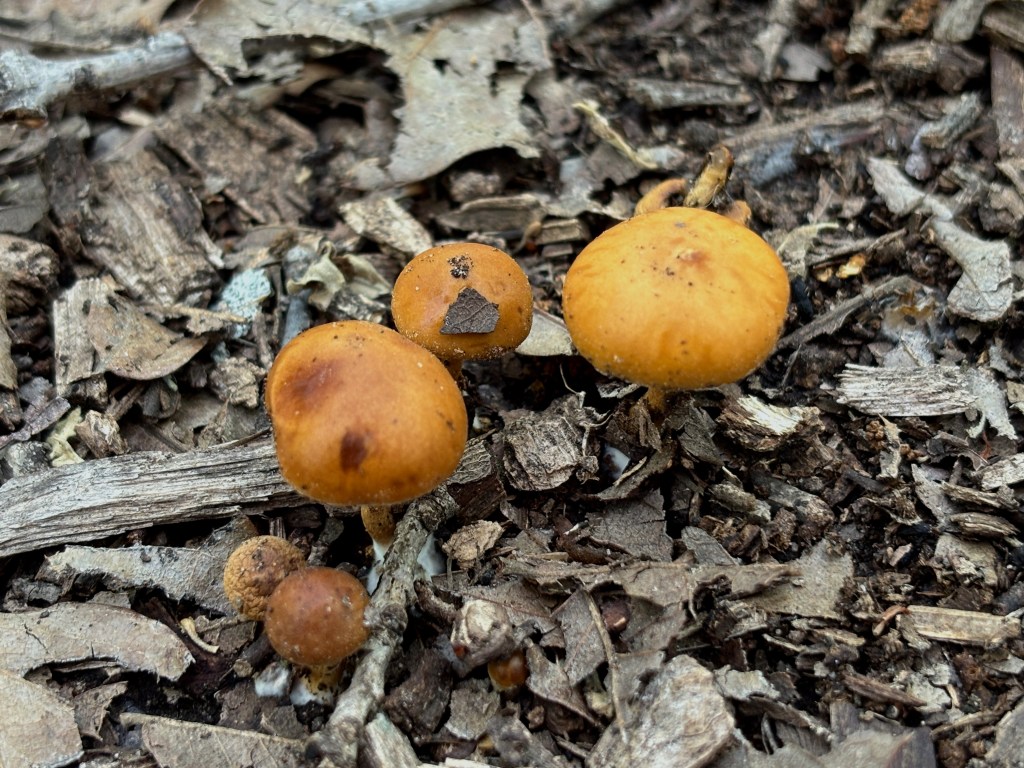
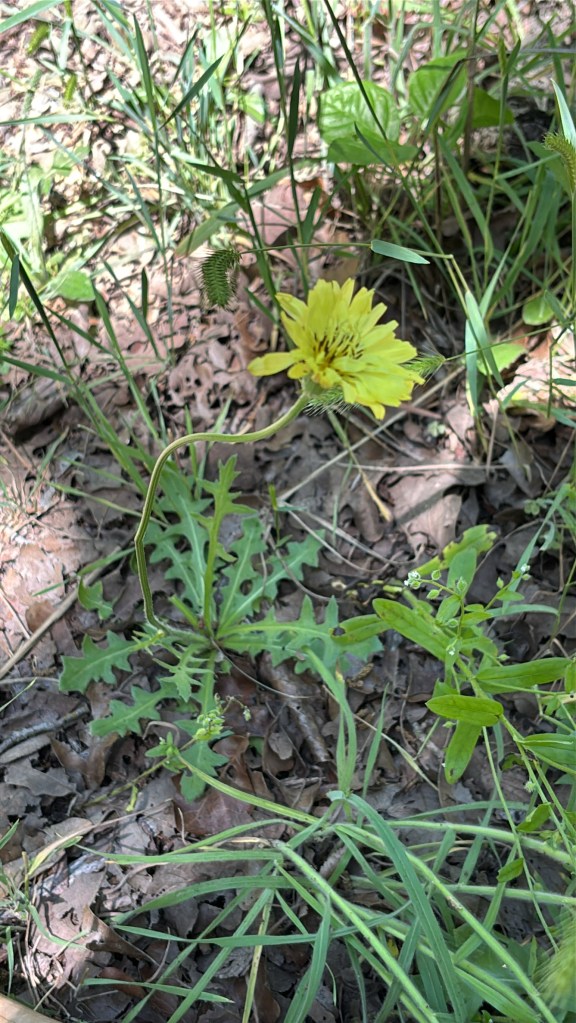
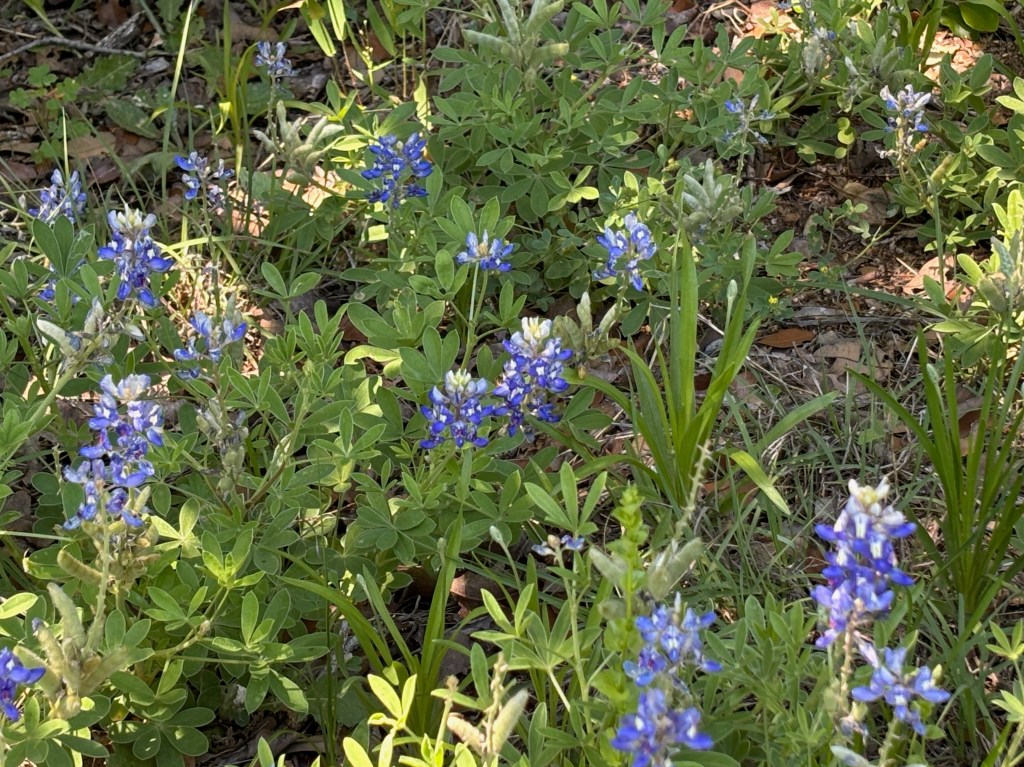
From there, the trail meandered through the woods some more. Sometimes I got on the ground to examine mushrooms; other times it was to see a small jumping spider. There were more flowers: Smallflower Desert-Chicory, Fraser’s Wild Onion, and at the end, a few patches of Texas Bluebonnet in clearings as the woods opened onto another prairie.
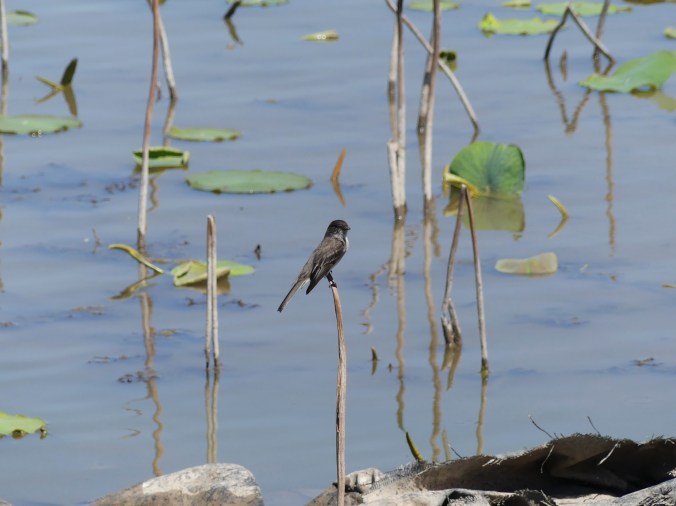
When I reached the end of the trail, the marsh boardwalk was a short walk away, and so I headed down to the marsh. Black Vultures were examining some exposed mud, a Great Egret flew by close to the boardwalk, and at some lotus stems in the shallow water an Eastern Phoebe perched. Then it flew to a nearby spot, disappeared, and returned. Once it dipped to the water’s surface, apparently to capture something. It is a busy life for a Phoebe on the hunt.
The Eastern Phoebe, scanning for insects
It was three hours well-spent. We all need this kind of sanctuary, and such places can be an important sort of self-care. I wish everyone could take an hour or so and be held in the peace and beauty of places like this. If you can, go and sit for a while in mindful stillness or walk the trails and notice the unending stream of wonderful things that you will find.
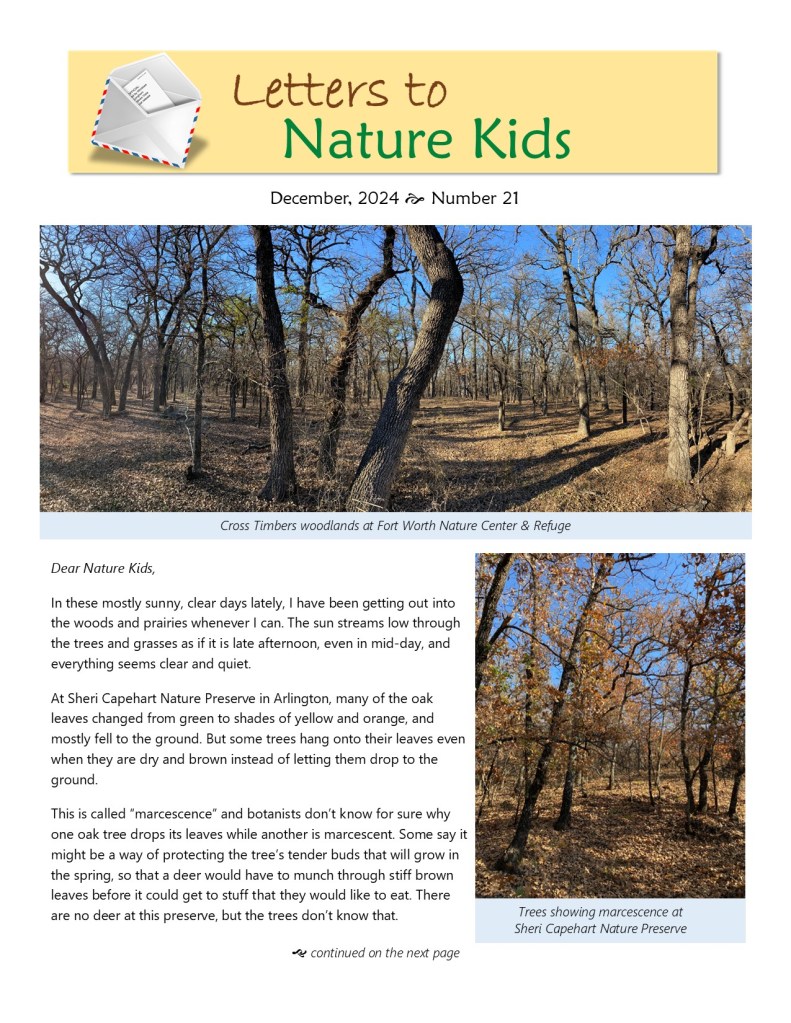
I hope everyone has a wonderful holiday, however you celebrate it. We’ll be sticking close, avoiding traffic, and getting together with family. I’ve recently been walking at Sheri Capehart Nature Preserve and Fort Worth Nature Center & Refuge (FWNCR), and wrote a “Letter to Nature Kids” (See December, 2024 End of Autumn) about those walks and some of the birds and other wonders I saw.
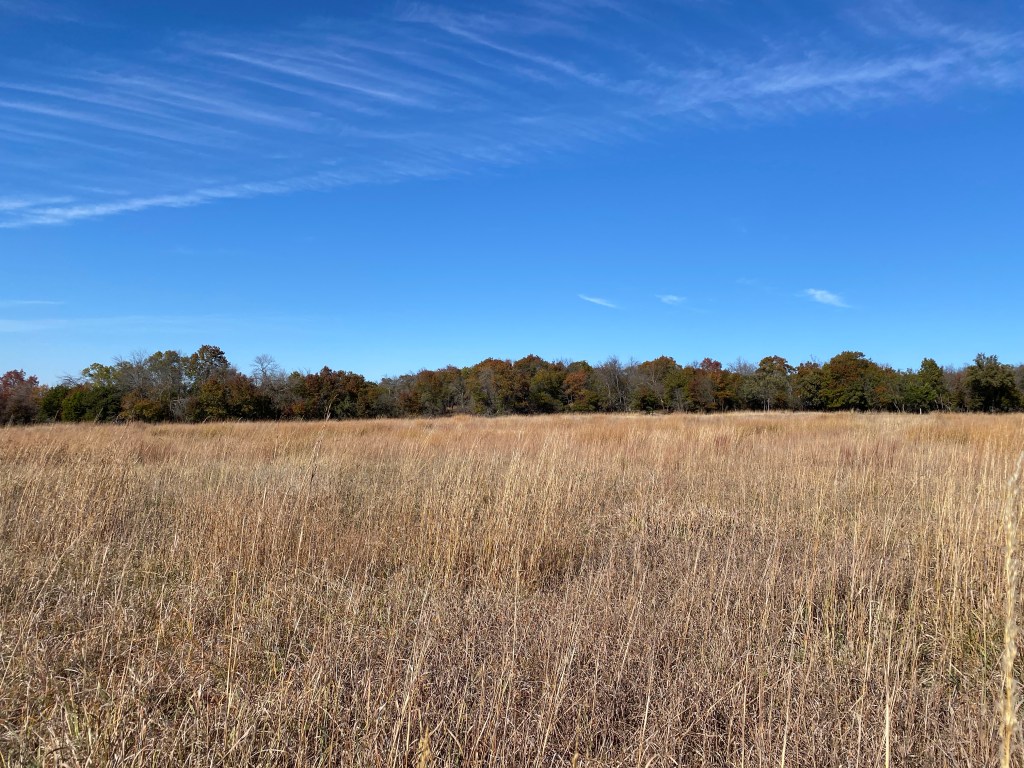
If you can, I hope you can take a walk that is as wonderful as mine yesterday at FWNCR. “It was a day at the edge of winter, getting late in the afternoon. A crow’s call echoed through the woods and a few dragonflies flew low around the edge of the grasslands. Other than that, this place felt like it could be sleeping – still, quiet and peaceful. We all need to sit quietly in a place like that sometimes, don’t we?”
I’ve walked trails and sat on benches at the Fort Worth Nature Center & Refuge (FWNCR) a couple of times in the last week or so and cannot get it out of my mind. I’m happy to let the marsh, the woodlands, prairies, and bottomland forests take up space in my brain. It’s the worries on their behalf that I’d like to shake off.
The marsh at FWNCR
I recently wrote about the FWNCR and its 3,650 acres where a substantial bit of North Texas wildness lives on. Green Source DFW had just published my article about discussions between the City of Fort Worth, the Botanical Research Institute of Texas (BRIT), and the Friends of Fort Worth Nature Center & Refuge about the future of the nature center. BRIT now manages the Botanic Gardens and is now eyeing the nature center.
The City of Fort Worth website quotes BRIT CEO Patrick Newman saying, “The biodiversity crisis is affecting plants that are our food and possible cures for diseases. As we try to identify these plants, we want to link arms with the Nature Center and continue their great work as we move towards and create this possible partnership.” Does this mean BRIT wants to study the biodiversity crisis? Medicinal plants? Wouldn’t the easiest thing, the thing that would call for them to “link arms,” be to work together with the nature center through a research partnership? Without either one taking over the other, that is.
But the stated goals for the nature center, again quoting the city website, are, “increasing attendance and use of the center, membership, educational programs, and private support for research, conservation and investment.” One of the three issues being considered is, “Economic benefits for the City and BRIT.” In my Green Source article, I noted that the city’s Mark McDaniel said the plan was for attracting more visitors, ramping up marketing, and enabling more facilities and capital improvements.
You can see how I might worry about whether the nature center and refuge would stay wild. It’s not that we shouldn’t let more people know about FWNCR and invite them to visit. As I said a month ago, “We want everyone to share the refuge, learn from it, and fall in love with it. But not everyone all at once, and not by offering so many built attractions that people miss the point, which is the wildness.”
A pocket prairie along the Deer Mouse trail
Please do not let this issue be buried in all the other news that we are preoccupied with. Let the City of Fort Worth Park & Recreation Department know what you think. Speak up for the nature center.
The gallery of photos below is from my recent visits to FWNCR. If you click the photo you can see it full-size.
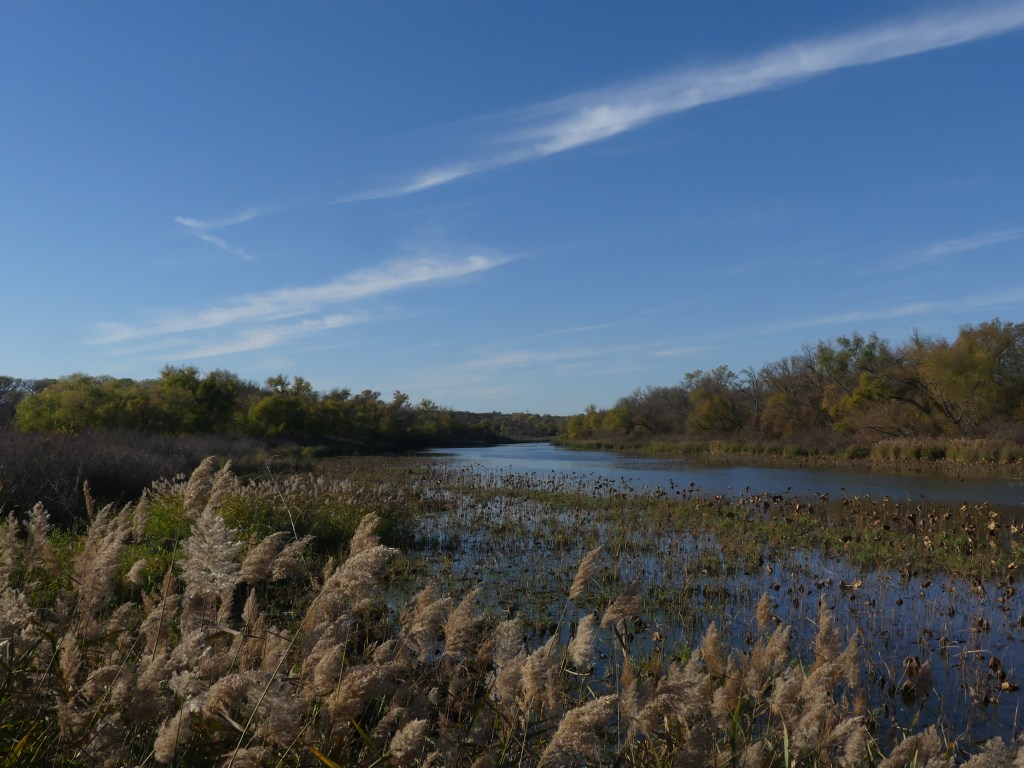
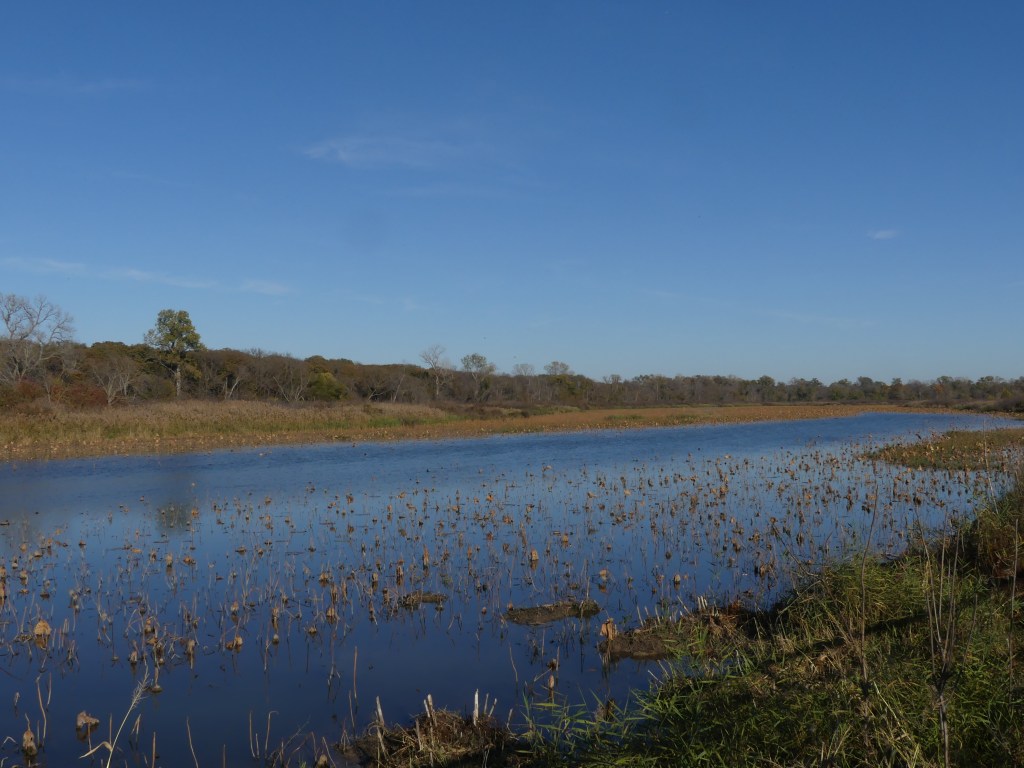
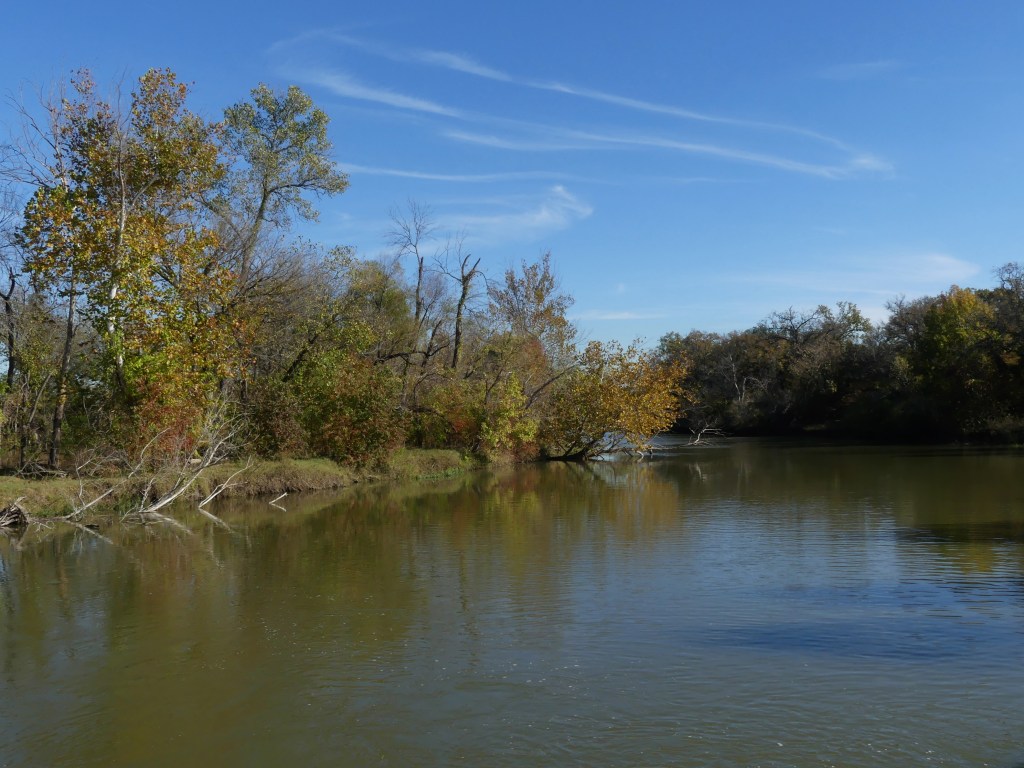
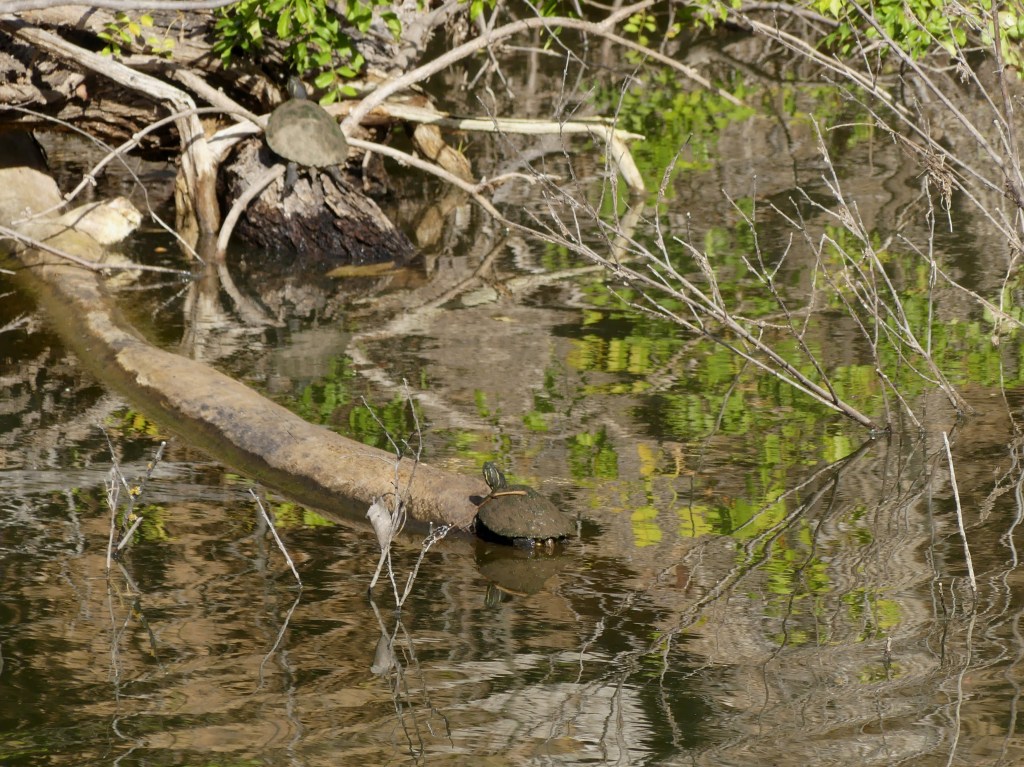
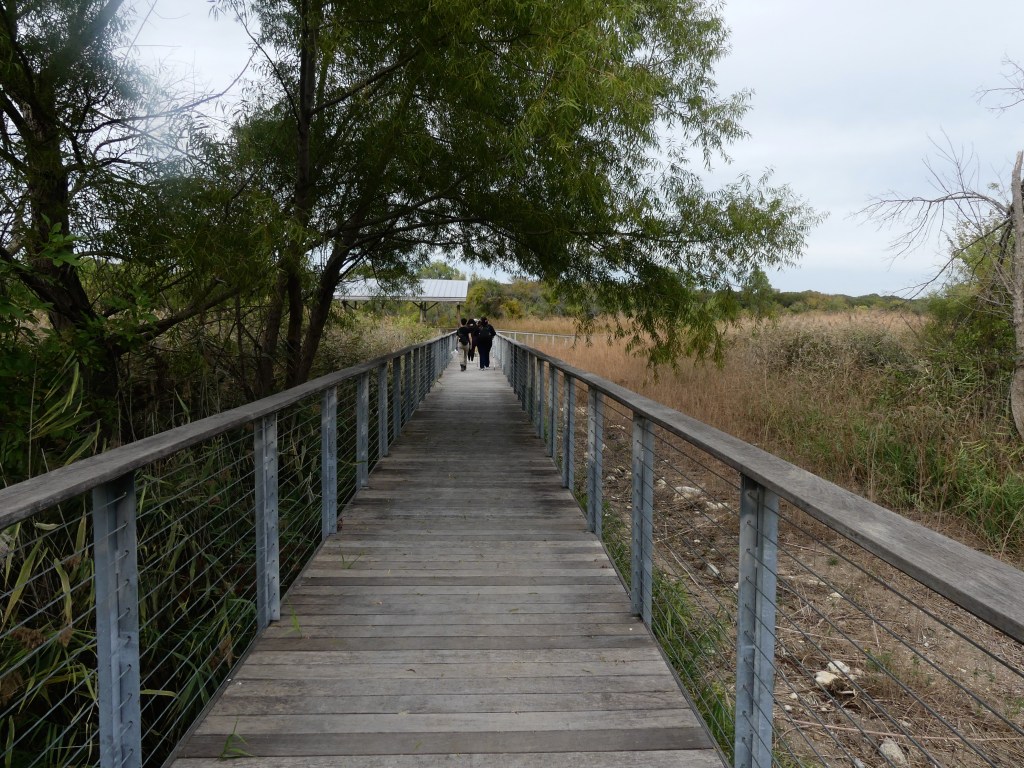
Prairie below the Hardwicke visitor centerPocket prairie near the marshThe Deer Mouse trailSavannah along the Deer Mouse trailSumac near the bottomlandsThe road through the bottomland forestIn the bottomlandsView from the marsh boardwalkThe lotus marshTrinity RiverTwo river cooters (turtles) in the Trinity
I’ve lived in North Texas for a long time, and the Nature Center and I go back many years. In the opening pages of Mindfulness in Texas Nature, the very first words are, “I went home on Christmas Eve 2019 to the Fort Worth Nature Center and Refuge.” I meant that those prairies and woodlands have shared so many days with me over the years that it feels like home. And so, sitting on a bench there on Christmas Eve was like visiting an old friend.
And the very first words in Herping Texas (published 2018) bring back a memory of surveying the reptiles and amphibians there: “Toward the end of March a few years back, a group of us took a walk through a bottomland forest at the Fort Worth Nature Center and Refuge.” I described the group of us walking through that forest and one member of the group accidentally discovering a rat snake making its way down the tree trunk where she was about to lean.
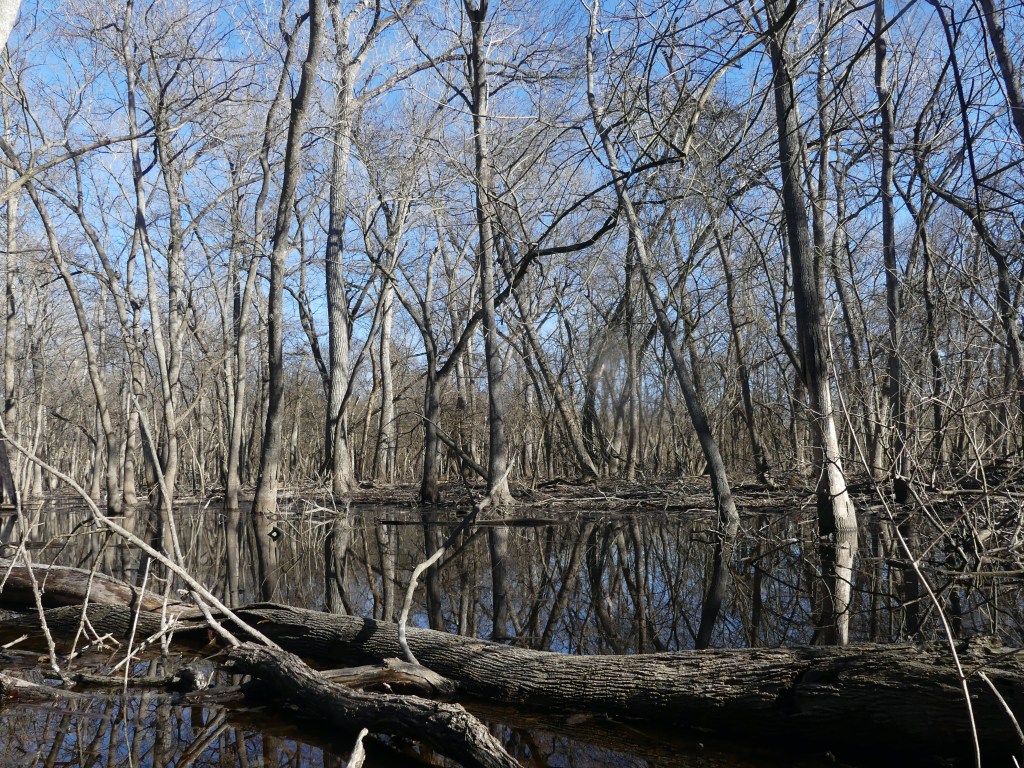
Flooded bottomland
In recent years I have written about the place many times for the online publication Green Source DFW. As a reporter I’ve covered the re-building of the marsh boardwalk, the bison deck overlooking bison pastures, the recognition of some of its woodland as an old growth forest, the statue honoring the work of the Civilian Conservation Corps on refuge property, and the re-introduction of prairie dogs there.
Now the City of Fort Worth is considering handing over the management of the Nature Center to the Botanical Research Institute of Texas (BRIT). The city would still own it, but BRIT would be in charge of some – or all – of its management and direction. I wrote about the issue in an article for Green Source DFW, which I hope you will read – “Should BRIT Take Over the Fort Worth Nature Center?“
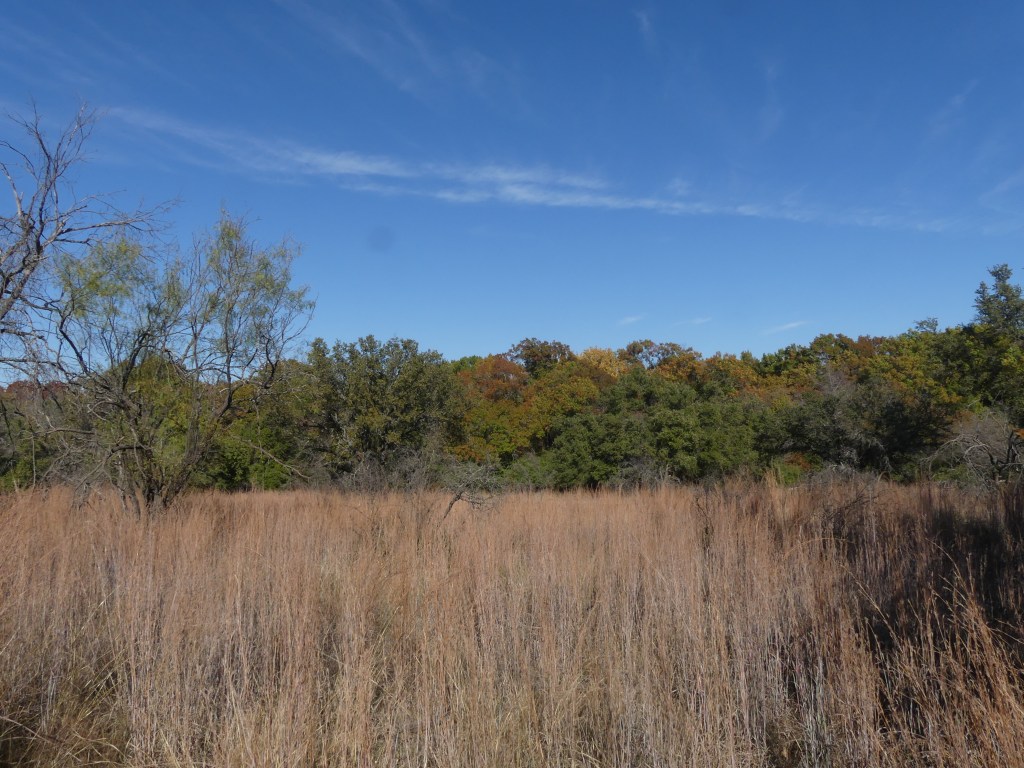
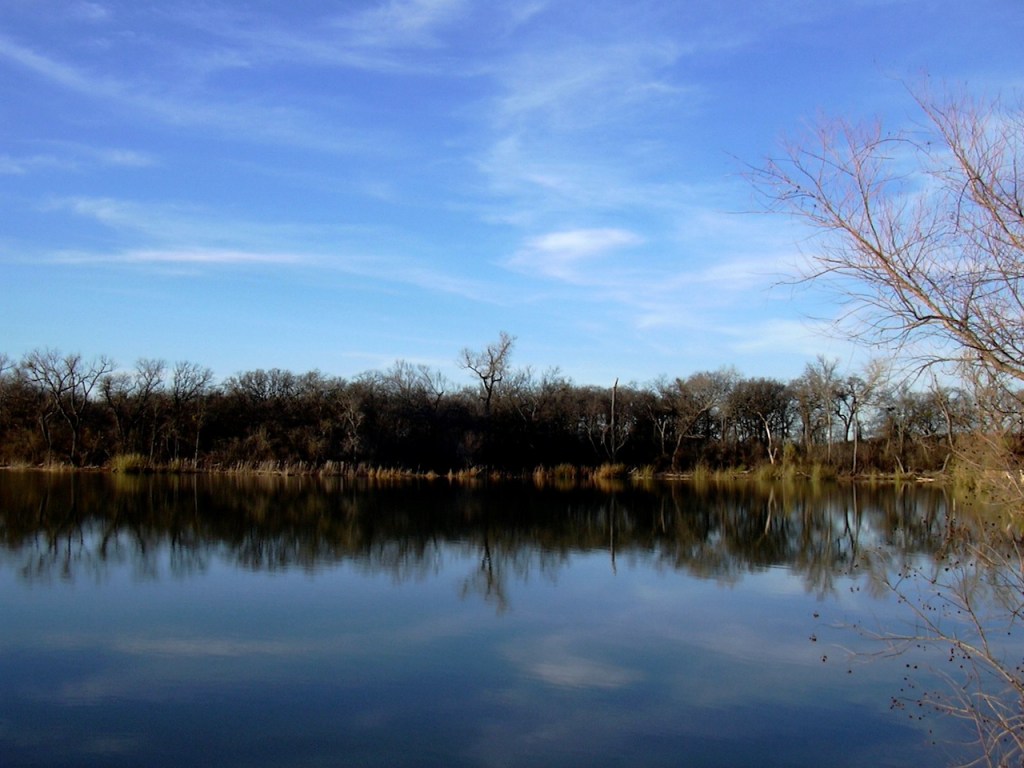
A November hillside at FWNCR
The Fort Worth Nature Center & Refuge (FWNCR) has been managed by a series of dedicated, smart, and creative individuals. At its inception it had the guidance of my friend Rick Pratt, and in later years there have been people like Wayne Clark, Suzanne Tuttle, Rob Denkhaus, and now Acting Manager Jared Wood. Those are big boots to fill, and I hope that any management changes leave such people in charge. They are people whose first commitment is to the integrity of the refuge as a relatively wild remnant of the Cross Timbers and prairies that were here before White settlers.
As I see it, the FWNCR connects us to the wildlife, woods, and prairies that are like our extended family. That family includes the trees and other plants that give us oxygen, pull carbon dioxide out of the air and sink it into the soil, the wetlands that filter our water, the insects that pollinate our crops. The land, water, and all the living things provide a spark of wonder that adds joy to our lives.
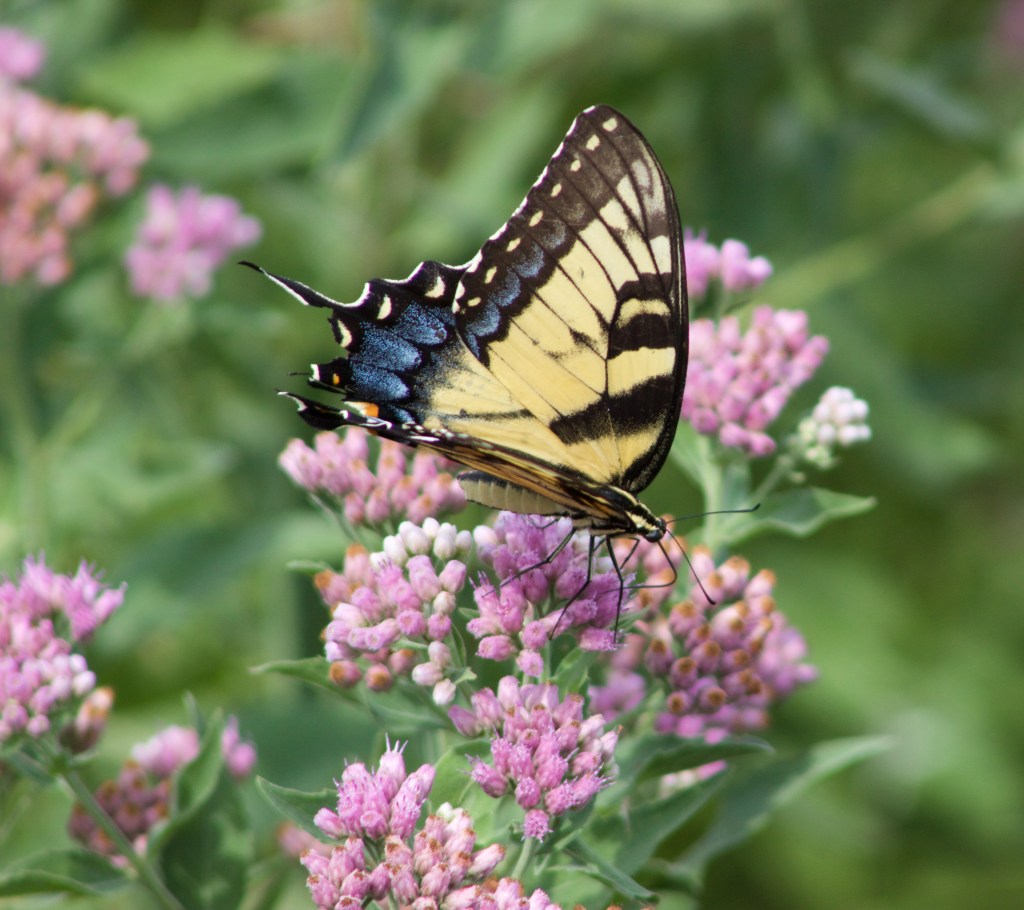
A swallowtail at the edge of the lotus marsh
When we walk through the preserve, we become part of the land for a little bit, sharing a kinship with the rest of nature. We might even come to see our separation from nature as an illusion that we create, while the woods and prairies are the authentic reality.
What does the future hold? Can that authentic reality of the refuge hold its own against the urge to build more and more attractions, drawing in so many paying customers that the wildness is gone? We want everyone to share the refuge, learn from it, and fall in love with it. But not everyone all at once, and not by offering so many built attractions that people miss the point, which is the wildness.
I hope you will read my story at Green Source DFW and keep track of plans for what direction the city will take with FWNCR. Please step up and offer comments when the time comes, if you feel that your input is needed (and input from those who love nature is always needed!).
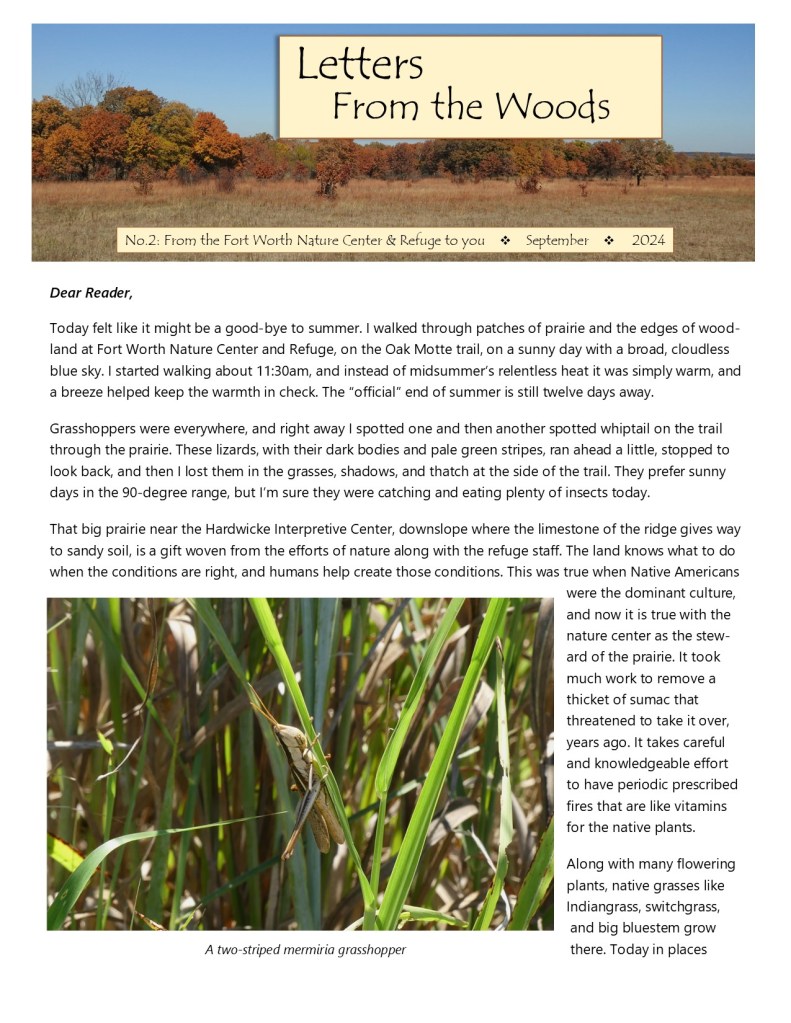
On Tuesday I took a walk at Fort Worth Nature Center & Refuge, and wrote about it as a “Letter From the Woods.” I took the trail across the demonstration prairie and up the Oak Motte trail a ways, seeing lots of insects, a couple of spotted whiptail lizards, and an eastern phoebe that appeared to divide its time between dropping down and catching insects and moving ahead of me.
I hope you’ll have a look (it’s the September letter that you can download here). And I’d love to hear any thoughts you might have, including whether you’d rather see it as a blog post. There’s just a little about the importance of insects, and E.O. Wilson’s great phrase, “the little things that run the world.” And there’s the dung beetle, whose name might be Sisyphus.
On May 5th I started the latest round of The Wild Lives of Texas Reptiles & Amphibians, a four-part training that I offer with slides and discussion in class as well as time in the field. The idea is to dig down a little deeper about herp (reptile and amphibian) natural history, more than I’m able to when training incoming Master Naturalists. And the people participating get several sessions in the field, which is both fun and important when learning about how to find and interact with herps.
And so I got to meet several new people, one of them a 15-year-old who is new to all this and one a Master Naturalist in her 80s. They were all delightful. I covered some very practical issues like watching out for bull nettle and how wild snakes, including venomous species, usually respond when we encounter them. I also gave a quick overview of taxonomy and scientific names, though the discussion about why some of these names keep changing might have gotten a little thick – but it was brief.
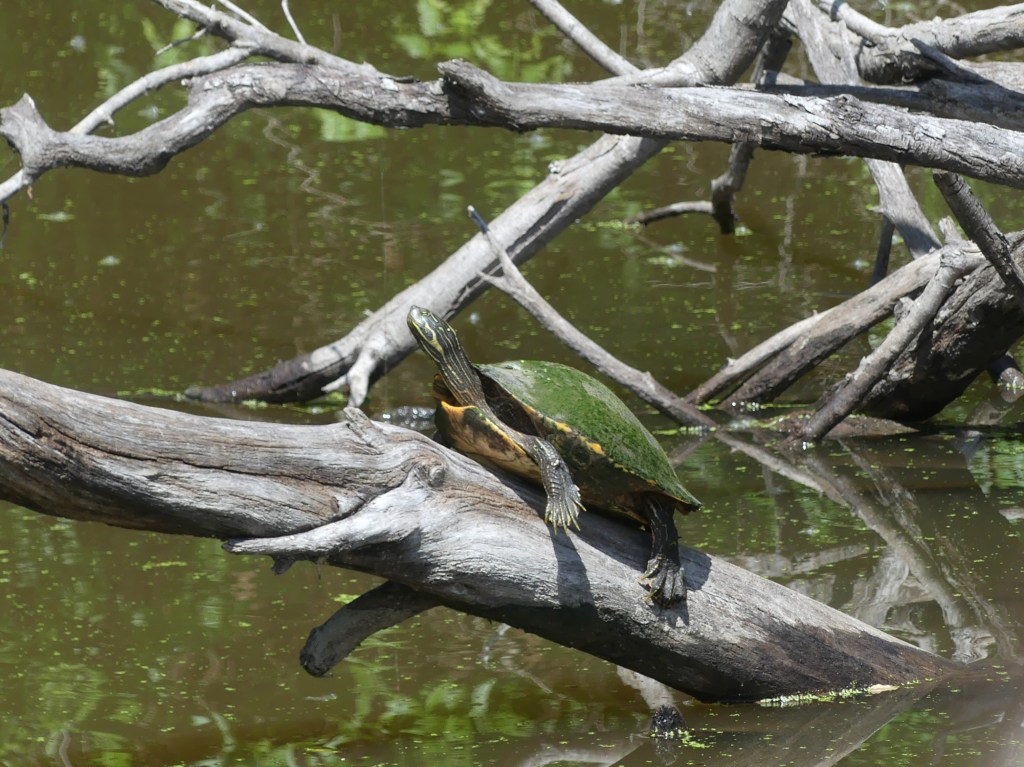
An eastern river cooter basking in the warm sunshine
At 3:00 it was time to take a walk; the rain clouds had parted and it was a sunny and beautiful day at Fort Worth Nature Center & Refuge. We walked up the Cross Timbers trail along the Trinity River for a while, with the long, torpedo bodies of gar easily visible and the big scales and reddish fins of carp breaking the water’s surface. Our first herps were the turtles swimming or basking on branches of fallen trees. I am used to seeing more red-eared sliders, but today the river cooters were more common.
Witches’ butter, a type of jelly fungus
Meanwhile our group of 8 or 9 people were captivated by everything around us. After all the recent rain, the fungi were proliferating. Sheryl told us about some of the mushrooms as well as the jelly fungi like witch’s butter and wood ear. Soon, Caleb found a little brown skink. Those words serve as the actual name of the lizard as well as a description of it; they’re small and have a broad, coppery-brown band down the back, edged with a darker brown band on each side. They are sometimes described as “elfin,” perhaps because they are woodland creatures that are sometimes glimpsed for a moment as they make their way through the leaf litter.
Sara gently restrains the little brown skink so we can get a good look before releasing it
Across the river channel along the opposite bank, I spotted an American alligator that we estimated to be a bit more than five feet long. This one was half-submerged and presumably basking in the afternoon sunshine. Sometimes people are surprised that we have alligators in the DFW metroplex, thinking that they belong in the swamps of Louisiana or Florida. But the American alligator has made a significant recovery from the days when it was hunted to near-extinction.
American alligator
Our ‘gators are generally found in secluded spots in or near the Trinity River. They are mostly shy around humans, though people on Lake Worth sometimes see them basking out in the open, seemingly without a care in the world. What I had shared with the group is that alligators should be admired from a distance (Texas Parks & Wildlife Dept. advises staying 30 feet away), and that alligators can run faster than we can for short distances. And yet, there are no records of people in Texas being killed by alligators and relatively few injuries.
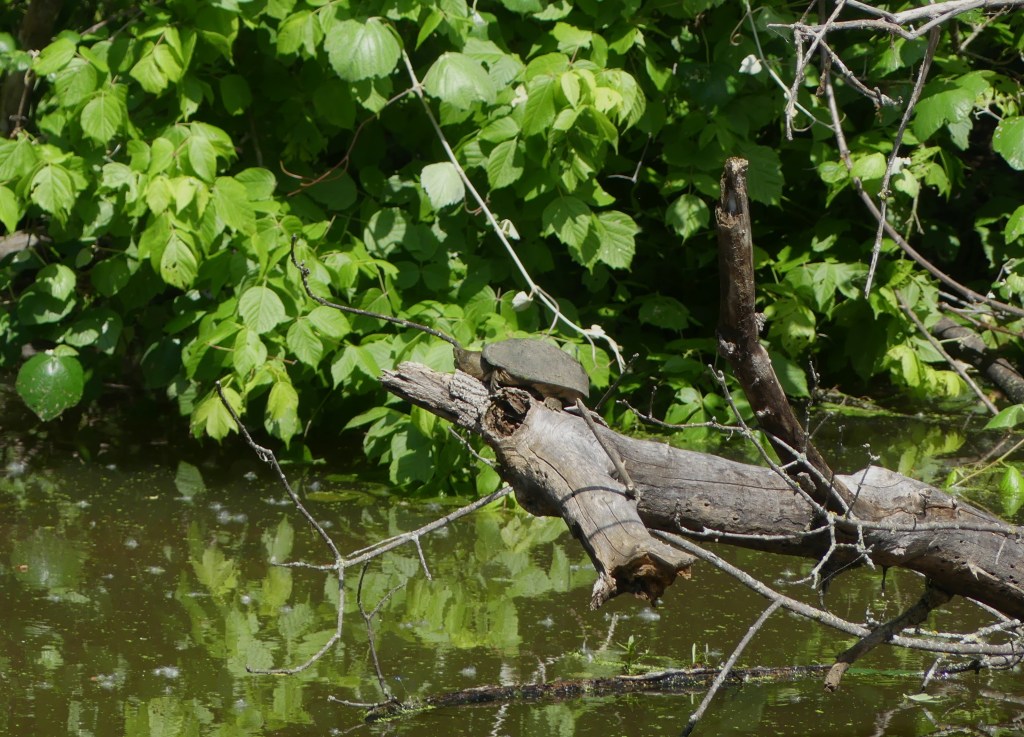
The razor-backed musk turtle
One of the turtles basking over the water was clearly not a cooter or slider, but my camera lens was not pulling in enough detail. Caleb took a look and said he thought it was a musk turtle, and with the head and neck more visible in his photo I agreed. It appears to be a razor-backed musk turtle, a small turtle with a carapace (top shell) a little like a peaked roof. Such turtles are on the menu for lots of other animals, including that alligator we had seen. As a result, they are pretty wary and I’m a little surprised that this one didn’t drop into the water before we could take a photo.
Sheryl (right) investigates a cluster of wood ear fungus, swollen and rubbery from the recent rain
While I checked the local temperature and humidity (87.6F and 45%), Eleanor brought me the first snake, a rough earthsnake. These small snakes are found in leaf litter and under logs, as well as under boards or rocks in old fields and in gardens. In those places they find earthworms and small, soft-bodied insects that are their food.
A pallid spiny softshell, pulled mostly out of the water to bask
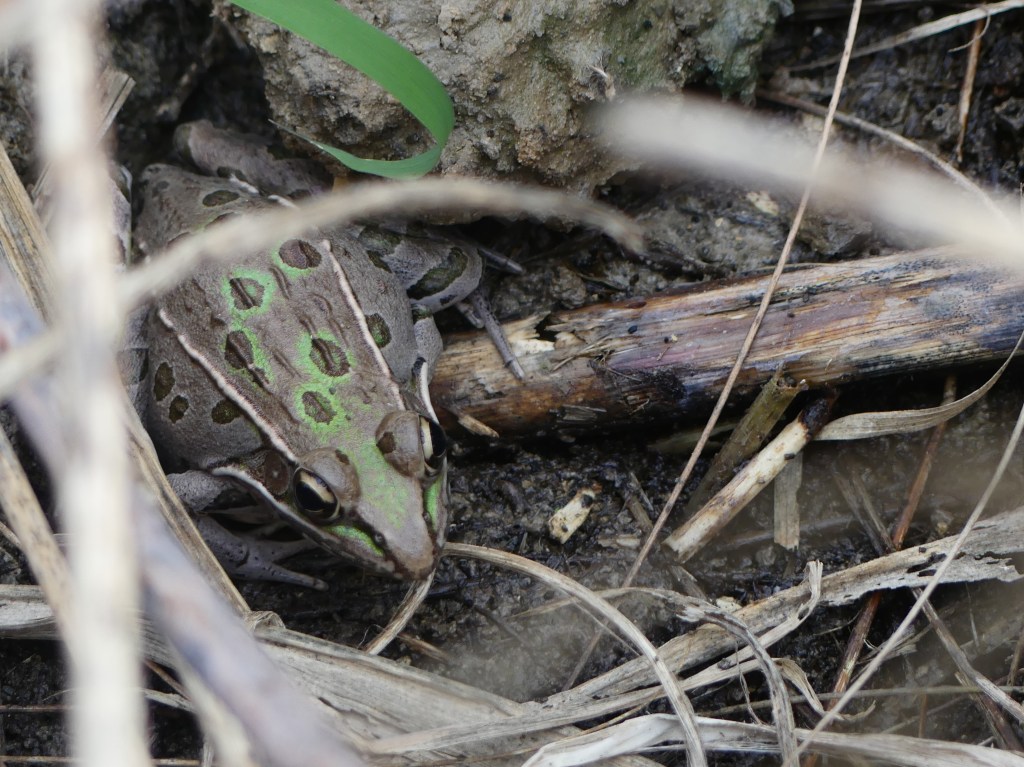
Meanwhile we continued finding lots of caterpillars as well as a variety of spiders. When the trail led us away from the river and into the woodland there were little refuges to investigate, in the form of fallen branches and logs. Could we find a frog or toad under one? Alaina did spot a leopard frog and chased it but it was soon lost in vegetation. The best things to turn over are bigger pieces that offer a larger area of shelter. Those are the ones that might conceal a ribbonsnake or cottonmouth (I brought a snake hook to insure that nobody turned a log by sticking their fingers under it).
I talked about the absence of small-mouthed salamanders in these places at the refuge. Intermittently flooded bottomlands are where I would expect them, and some persist along the Trinity River floodplain in Arlington. There are 93 observations in iNaturalist (55 of them just since the year 2020), all clustered in that area, but no observations are in the vicinity of Lake Worth and Fort Worth Nature Center & Refuge. Why would that be the case? What difference in microhabitats, predators, water quality, or something else would account for it? That would be an interesting puzzle to solve.
Everyone seemed to enjoy the walk and all that we found. This class is off to a great start, and I’ll post updates after future meetings. The next session is about amphibians, and we will look for frogs and toads around sunset and listen for frog calls. I think it will be magical!
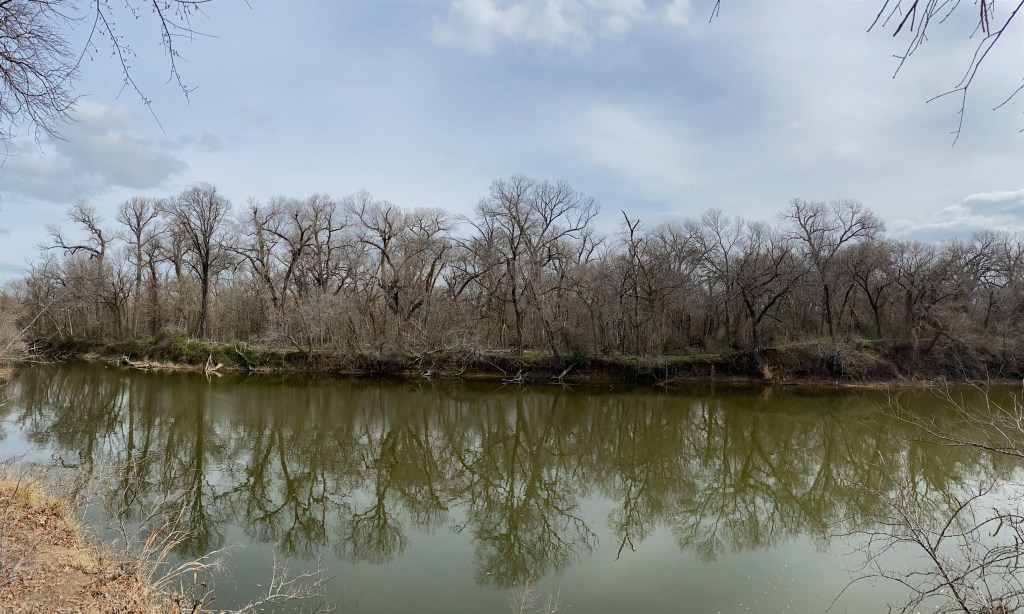
Sitting beside the Trinity River, on the Crosstimbers Trail, I wrote, “The place is so big that it makes the voices of the occasional human visitors seem small.” On a warm Friday in February, there were quite a few people at the Fort Worth Nature Center and Refuge, making bigness an important quality if the trail was going to live up to the name “refuge.”
This is a big place, as nature centers go. Its 3,621 acres are loved by many, and that is partly because it is big enough for a little solitude. The Crosstimbers trail borders the river for the first half-mile or so, and that’s a popular walk for people who want to see the water and maybe hope to see a ‘gator. Once the trail bends back into the woods, there are fewer people, and once you get pretty far back on that loop trail, you might be on your own for a good while.
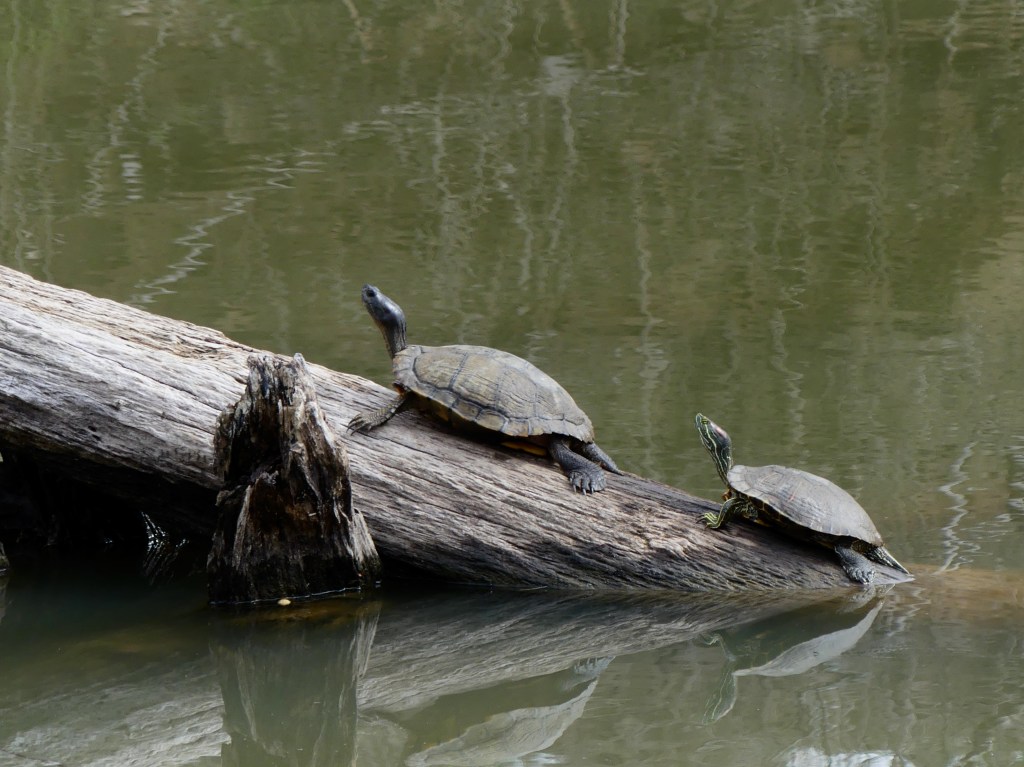
Two red-eared sliders – an old melanistic male and a younger one on the log below him
I got started at 10:40am on a day when thin clouds could not hide the sun and you could walk comfortably in a t-shirt. I watched a great blue heron fly over the nearby marsh and said hello to the cooters and sliders basking on fallen logs and branches in the water. There were plenty of American coots swimming nearby.
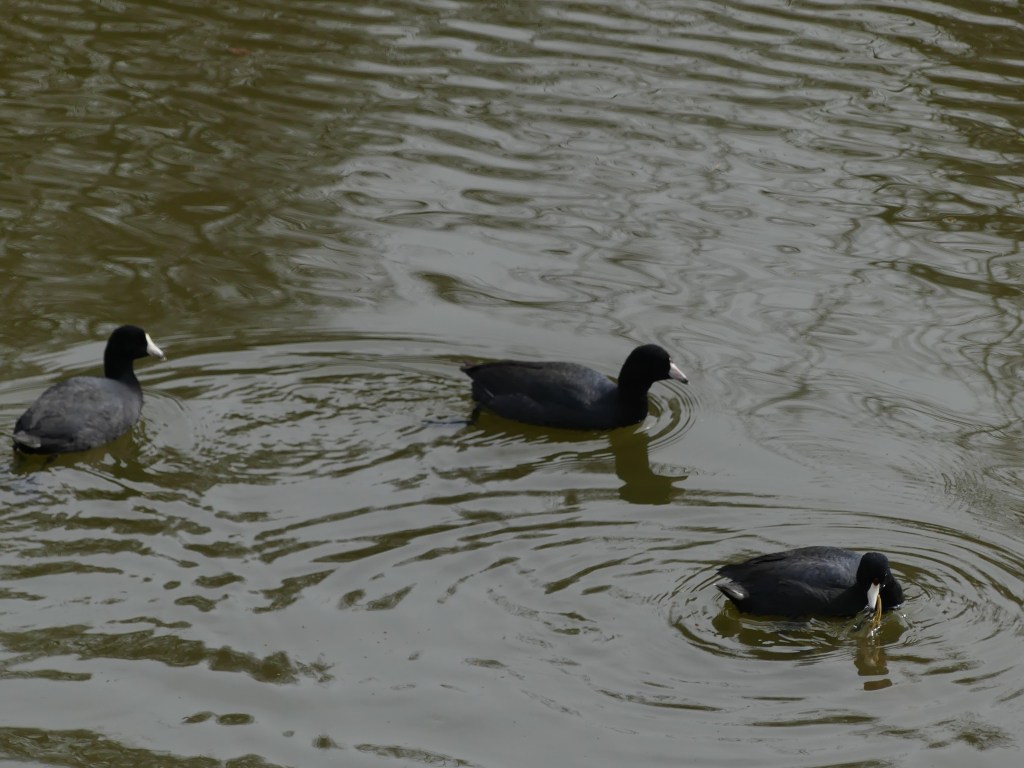
Three American coots swimming in the river
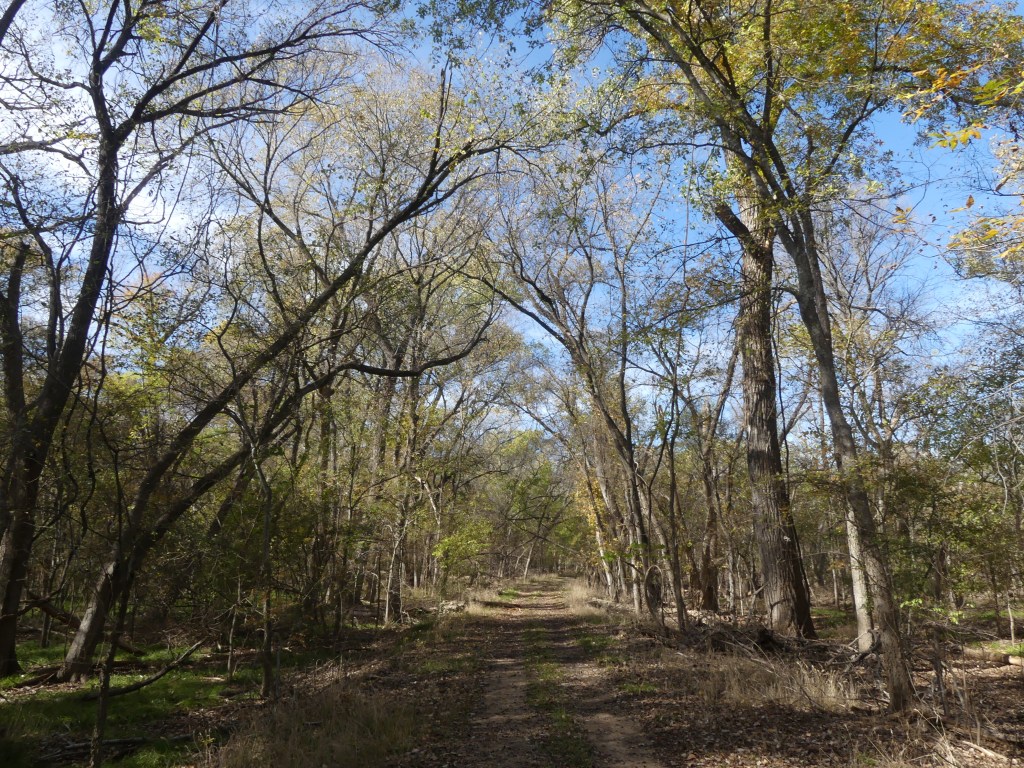
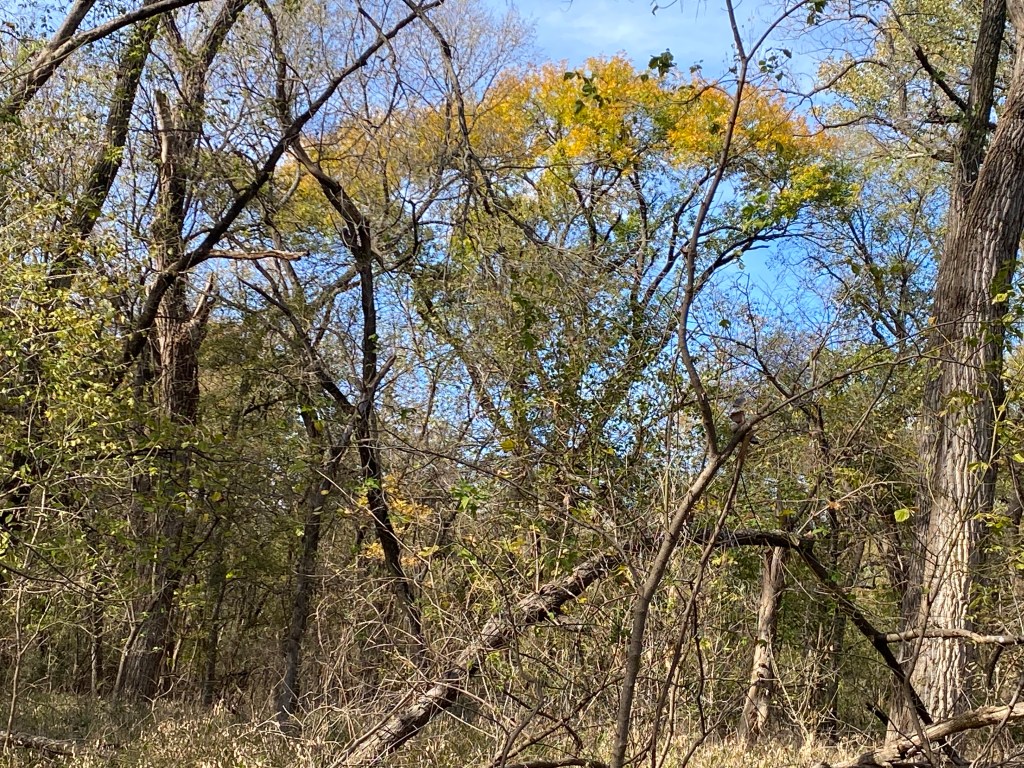
The bottomland forests beside the river were full of stately old trees – cottonwoods and other species – and they are often entwined with one or another climbing vine including poison ivy. One old cottonwood tree has huge vines braiding around its trunk.
Bare woody branches of shrubs frequently contained a spray of bright red berries where a kind of holly called possumhaw grows. And around me in the woods were the calls of many birds, including Carolina chickadee, tufted titmouse, and northern cardinal (identified by the Merlin bird ID app). My thermometer showed that it was 71.8F at 11:25am.
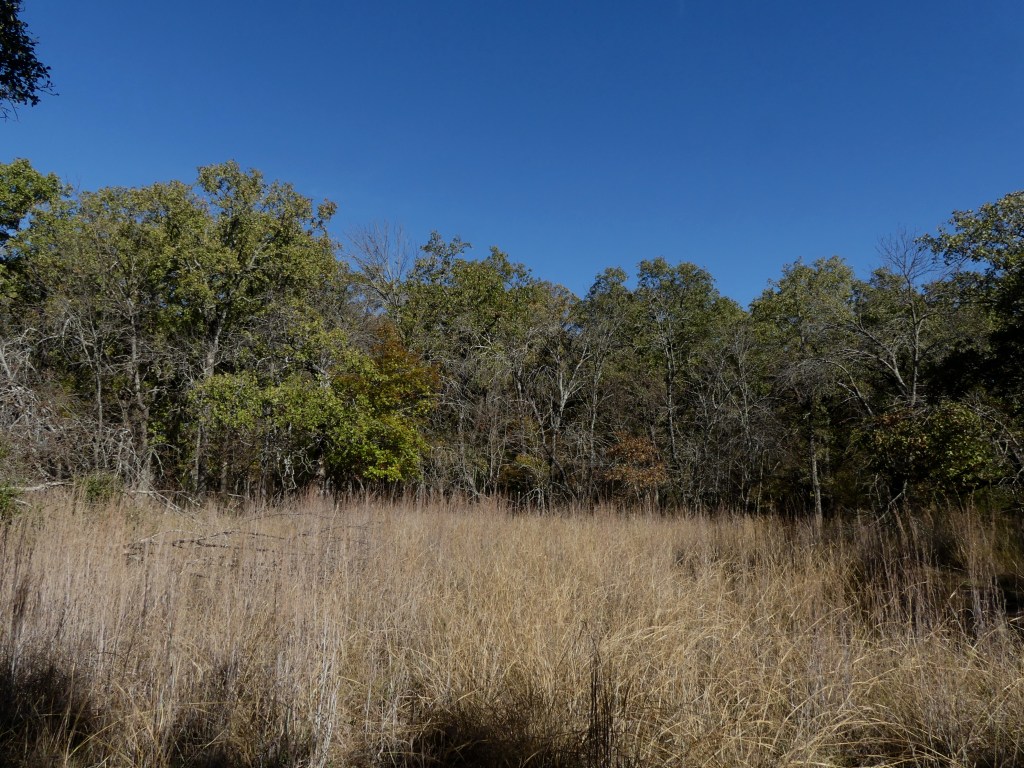
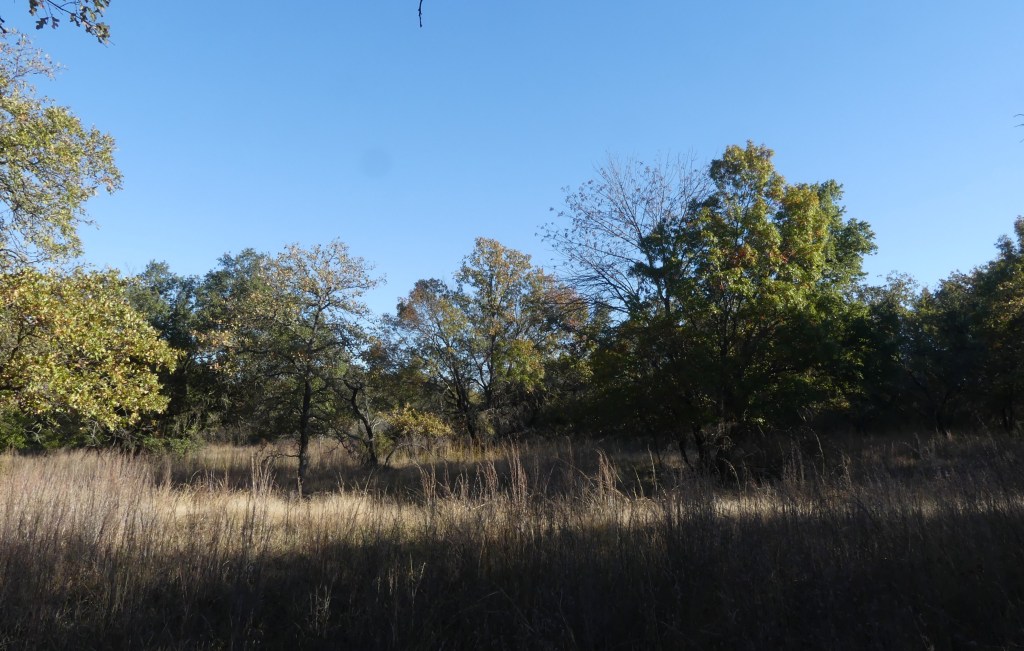
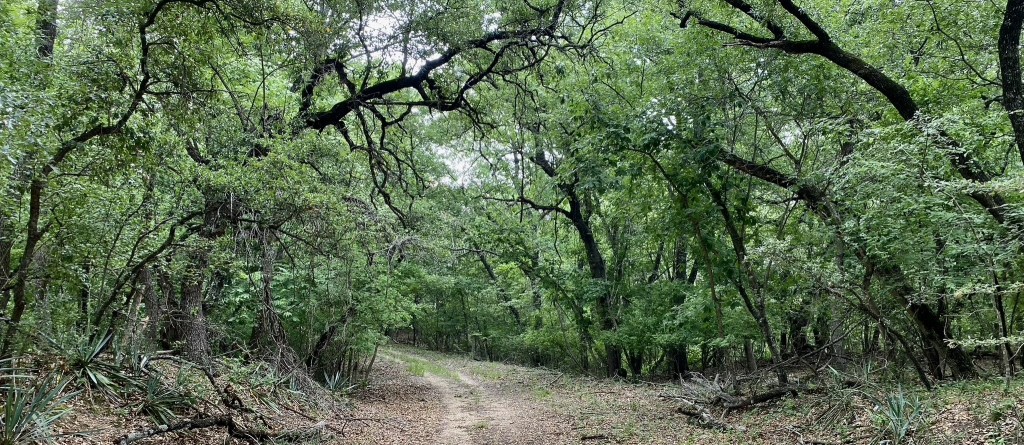
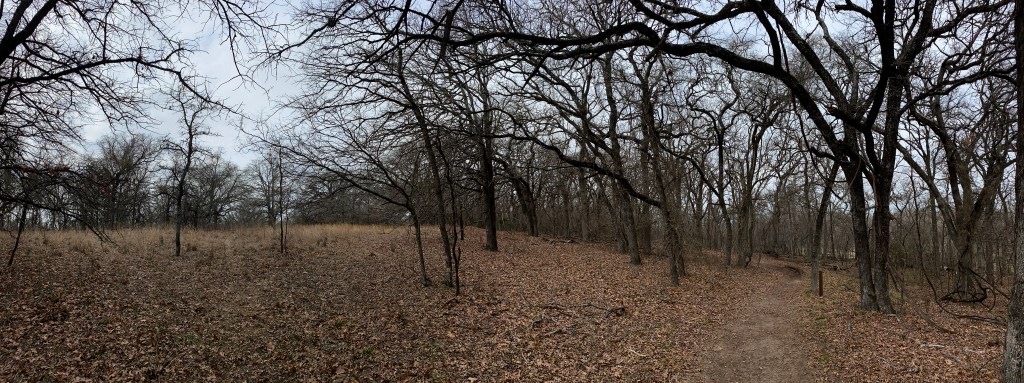
Then it was time to follow the trail back into the woods. There are plenty of oaks; big bur oaks with big notched leaves and the post oaks that are a signature species of the Cross Timbers region. There is ash, cedar elm, and some hackberry trees. Here and there the woodland opens up to a little glade or pocket prairie with native grasses. I took a few photos on the “pano” setting because today the place seemed so big that only a very wide photo might do it justice.
The trail leads through galleries of old trees and the land slopes away to the north toward a wetland. On the other side, the woodlands and open grassy patches gently climb toward a high place. On my walk, the winds seemed to shift around 11:35am and become cooler.
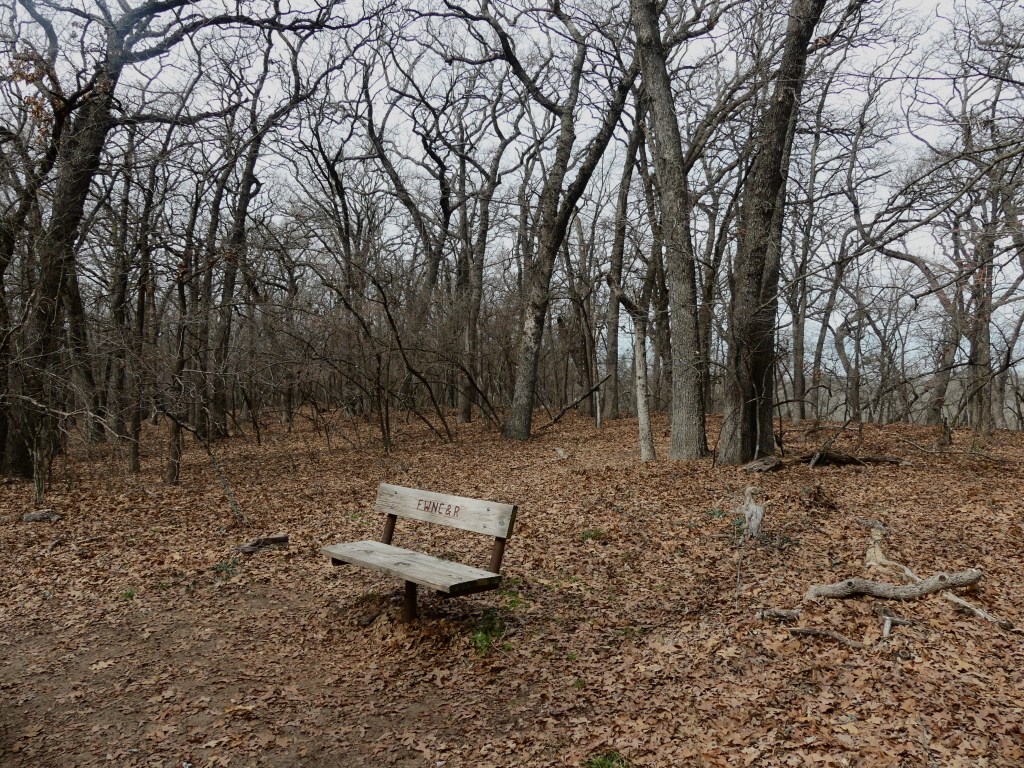
At what seems to be the highest point, there is a bench, perfect for sitting and taking in the wonderful forms of the trees, the carpet of dropped leaves, and the birds. Today it was very quiet and peaceful.
I started back, and as I walked the breeze scattered leaves ahead of me on the trail. That breeze was strengthening and making its voice heard through the tangle of trees. The branches shredded the current of air. Sometimes it was a whoosh and sometimes a soft roar, falling away to silence.
As I got further along, at one point I looked down the trail to see two deer looking back at me. They were silent and still as statues, sizing me up and deciding if I was a source of trouble. After a moment, the group took off, with those white tails flashing a warning to the rest of the group.
Two white-tailed deer froze on the trail as I came into view
When I reached the river and sat on a bench, there was the chatter of a belted kingfisher somewhere nearby (though I could not see it). Merlin also identified the call of a northern flicker. The thin clouds were pulling apart, and when the sun shone down it felt warm. The temperature had fallen a little to 67.6F, but in the little nook where I sat on my bench, the sunshine felt good.
The kingfisher clattered persistently. Another bird came in for a dramatic fast landing, wingbeats skimming the surface of the river. The bird then paddled around as if nothing had happened, sometimes diving down into the water. With the lens on my camera I got a good enough look to see that it was a pied-billed grebe.
Pied-billed grebe
The relatively thick bill with a dark ring around it was a giveaway. The Cornell website gave more information about what I observed about its diving: it was hunting. This bird likes crayfish and also eats small fish, dragonfly larvae, and it would not mind a leech or a small frog.
In that last hour I was grateful to have seen no one along the trail, and was happy to be by myself. I do like walking with others, but on some days like today, the solitude was peaceful. I am so thankful that Fort Worth has one of the biggest urban preserves in the country – and that it “feels” big.
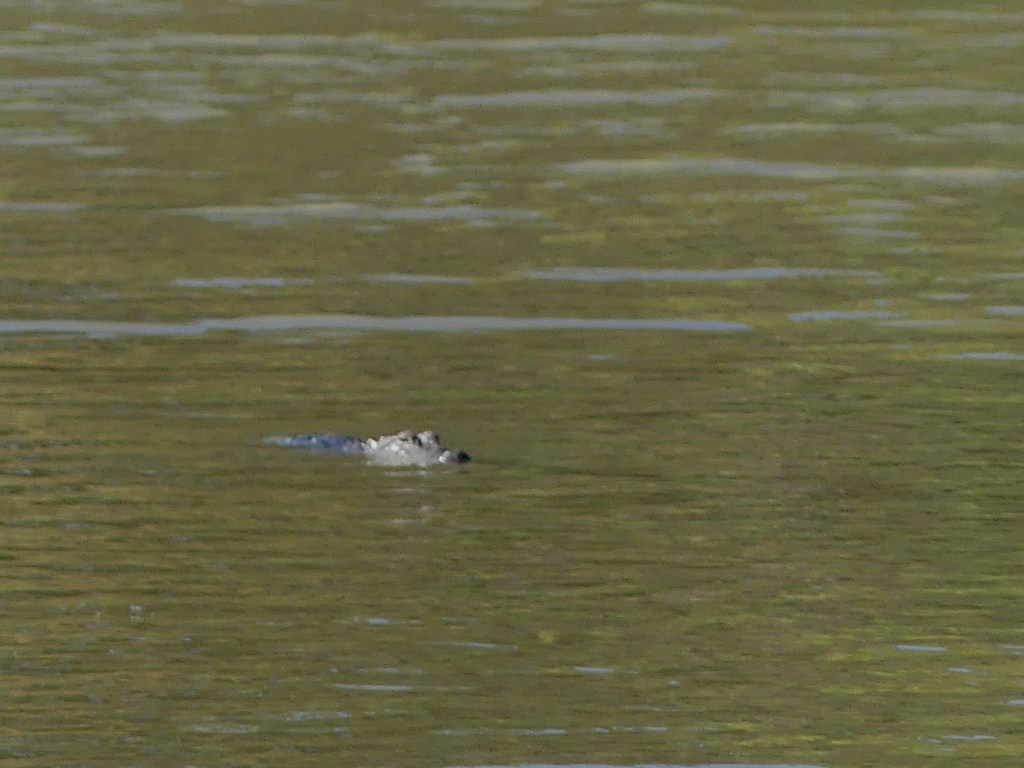
An American alligator (Alligator mississippiensis) seen by the group on our first field trip
It is fun to learn some of the details about the reptiles and amphibians that live in North Texas, getting a grasp of how they live in woodlands, marshes, and other places. It’s great when people get comfortable being around these animals and understand the conservation challenges they face. Those have been my goals as I’ve been teaching a great group of people about reptiles and amphibians (herps) and how to look for them in the field (herping).
Almost all the participants are Master Naturalists, so they start with a certain level of understanding about nature and wildlife. Because I teach incoming trainees for a couple of Master Naturalist chapters on the subject of herps, I had already met some of these folks. But two or three hours introducing herps seems like just scratching the surface. So I came up with a plan that involved four class sessions and several field sessions.
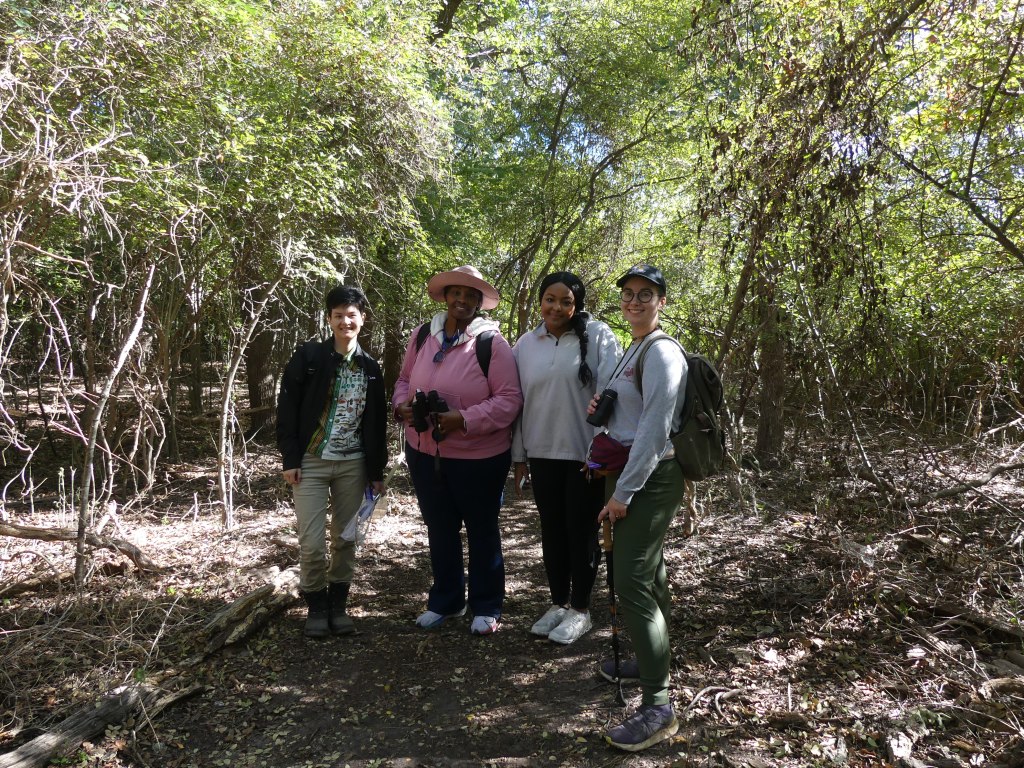
Alex, Kristina, Triniti, and Alaina
I have offered it in October and November as a sort of trial run. This is not exactly prime time for finding herps in North Texas, though we’re doing OK. We’re grateful to Fort Worth Nature Center & Refuge for offering facilities and time in the field. In the first session, after we talked about some basic concepts, Dr. Jared Wood (Natural Resource Manager at the refuge) shared some of his knowledge of the American alligator. He has been studying these reptiles in southeastern Oklahoma and will continue the nature center’s research on the alligators of Lake Worth.
We then headed for Greer Island to look for good herp habitat. While walking down the causeway, members of the group spotted a small American alligator cruising along a few hundred feet out in the water. What a wonderful follow-up to the discussion by Dr. Wood!
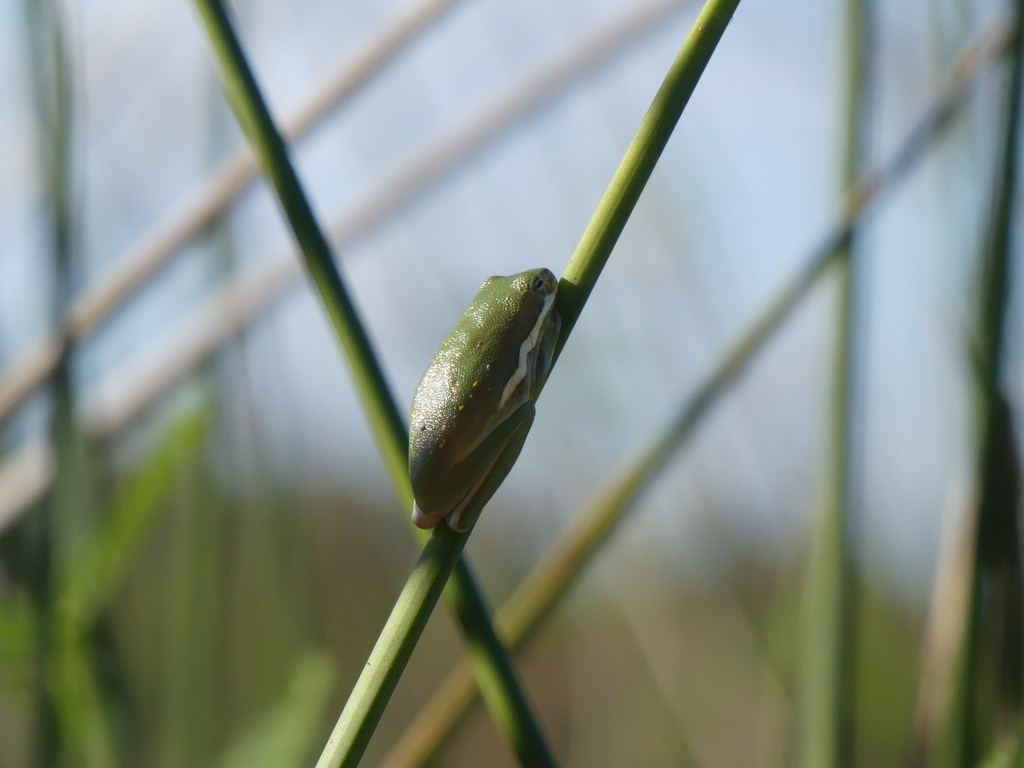
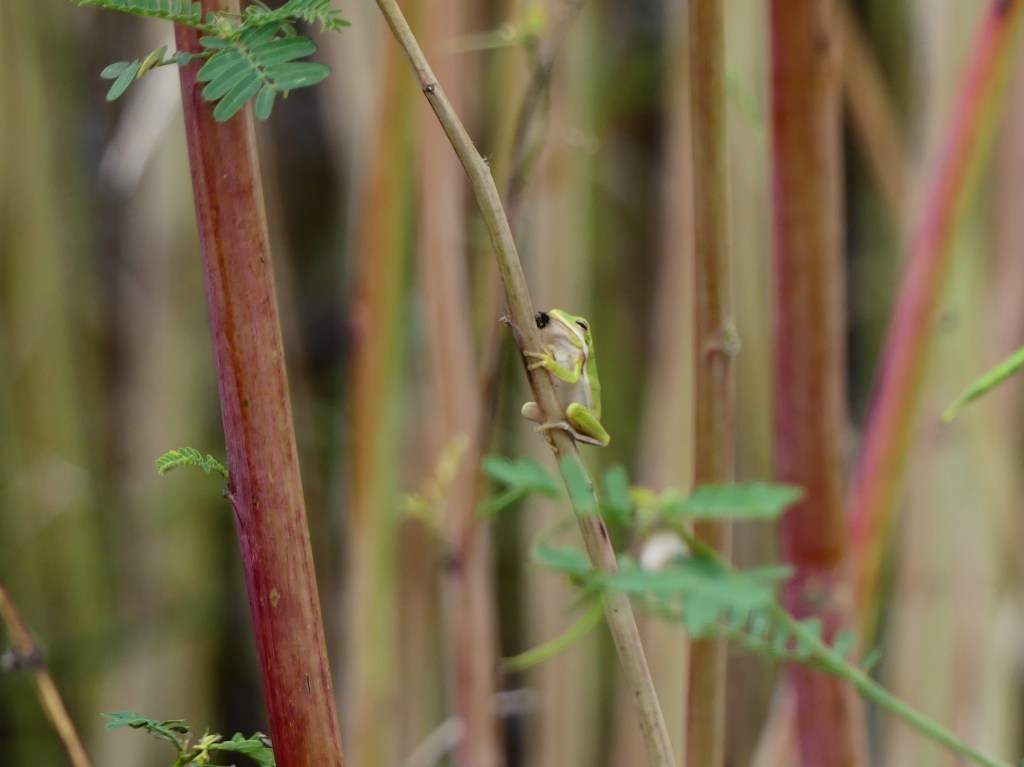
Green treefrog (Hyla cinerea)
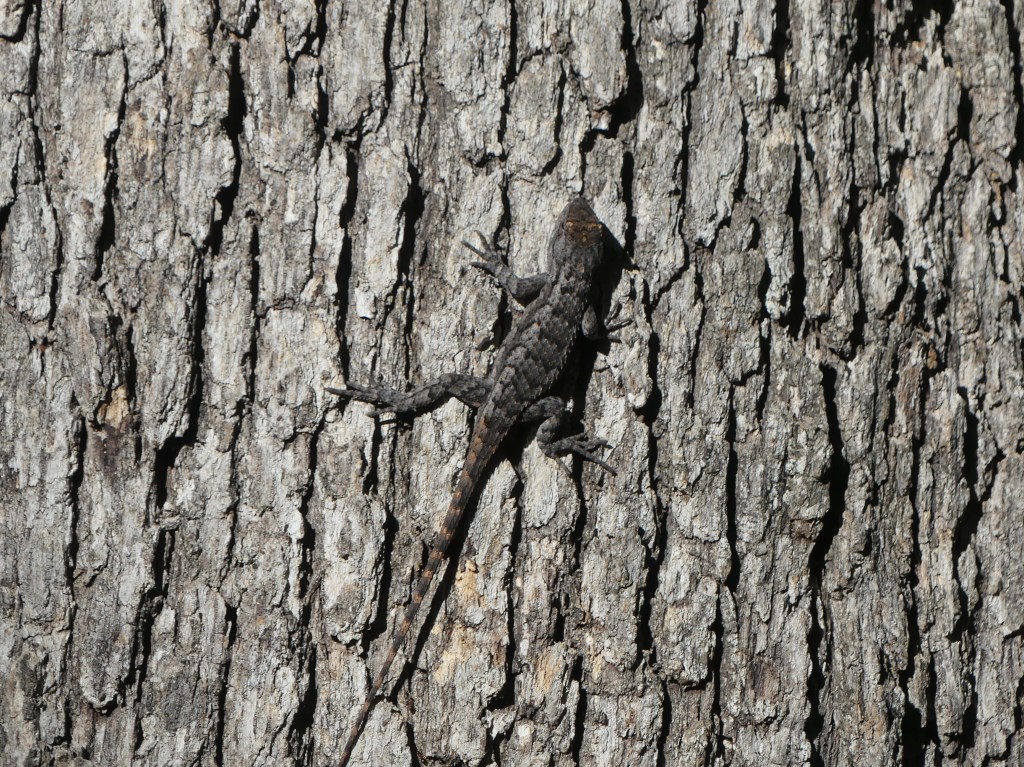
On the island, we wanted to see what we could find without damaging habitat or collecting anything. Our goal was to identify fallen logs that offered good refuge underneath and could be investigated without tearing them up. We also talked about what species would more likely be seen in spots like the water’s edge among tall reeds, or dense mid-story vegetation in the woodland. We did not really expect to see much on a cool October day, but these are very observant folks. We found a little brown skink, a green treefrog sleeping on a reed at the water’s edge, and a Texas spiny lizard before we were done.
Texas spiny lizard (Sceloporus olivaceus)
In our next session we focused on the amphibians of North Texas. We are fortunate to have a number of frogs and toads, and even a few salamanders (occasionally seen in a few locations). We talked about diet, drinking through the skin, secreting toxins through the skin that may confer some protection from infection as well as from some predators. We talked about frog calls and played audio samples of many of them. And then we headed out into the field.
The group, on their way to finding frogs and toads at the marsh
One of our goals was to practice the amphibian monitoring protocol that involves systematically listening for frog or toad calls, identifying for each species whether we heard a few individuals (isolated and non-overlapping calls, which would be Call Index = 1), a larger group (numerous overlapping calls but you can identify individuals calling, which is Call Index = 2), or a full chorus (lots of overlapping calls and individuals cannot be identified, Call Index = 3). The end of October was not the best time for frog breeding, so we were not surprised when we did not hear any calls.
But earlier we had seen several species; they were present but not breeding. People in the group saw leopard frogs, and then we found a small green treefrog. As we watched, it spotted an insect, then jumped, caught it and gulped it down. More green treefrogs were seen, and Alex found a juvenile western ribbonsnake and a couple of cricket frogs. Sheryl found a Gulf Coast toad.
Young green treefrog, in the moment just after catching a “bug”
We’ll turn our attention to turtles next, and in the last session tackle lizards and snakes. To get some good field time for these last species, we may have to reconvene next spring when snakes and lizards are more active.
I’m having a great time getting to know this group of herpers and sharing what I know. They are showing me what good observers they are, and how willing to ignore some mosquitos as we sit in darkness, listening for frogs. Kristina held a snake for the very first time. Some of them are interested in volunteering in the nature center’s alligator research efforts. All of this is great news for reptiles and amphibians and for the broader natural world.
(For Halloween, I’m sharing a story I wrote some years back, based on a favorite place, a crazy legend of the ‘goat man,’ and those who may get a little too caught up in such stories, crouching over a fire and gibbering to themselves.)
The car windows were down as I crossed the bridge back over Lake Worth, and the Allman Brothers were on the CD player. After all this time, still putting out high-energy rock and roll, with the new release taking me back to 1969 when “Eat a Peach” came out. The wind whipped by as I exited for the Nature Center.
After an autumn day looking for reptiles and amphibians, a group of us had called it quits and headed home. However, once on the road I realized we had not picked up some minnow traps we put out at Greer Island. A minnow trap is a sort of wire mesh bucket with a wire funnel leading in from each end. In the hands of herpetologists, minnow traps don’t catch minnows so much as frogs and snakes. We placed several of them in shallow water along the island’s shore, partly exposed so that anything that got in could breathe. However, I could not leave any animals trapped, and so I was headed back into the Fort Worth Nature Center and Refuge.
As I drove along the road at the edge of the lake, Greg Allman sang:
“Can’t you feel a cold wind is howlin’ down, blowin’ my song?
Well I ain’t an old man, but you know my time ain’t long.”
I thought about the cold wind that would soon be blowing on the refuge as fall changed to winter. Oh well, I was ready for a change. The end of summer had been unusually humid, and cool weather would feel good.
The sunset glow still provided some light as I walked the causeway to Greer Island. The wind picked up, scattering yellow cottonwood leaves to drift down through the remaining light. I felt a slight shiver. The thought of walking around alone on Greer Island in the gathering dark did not bother me, did it? I’ve been on the island many times, and it is as peaceful as any other part of the refuge. Maybe that Allman Brothers line about a cold wind howling down had gotten to me.
On the island, I pulled the first minnow trap up from where it had been nestled beside a fallen tree branch at the water’s edge. Inside was a water snake, its chocolate brown scales glistening as it frantically tried to find a way out. I put on the gloves, unfastened the trap and reached inside. The snake writhed and bit at the glove, with the small needle-sharp teeth barely penetrating to my skin. Although nonvenomous, water snakes defend themselves by repeatedly biting and by expelling a nasty-smelling musk. I wanted to get this done as soon as I could. Just before I released him, up came a small leopard frog the snake had eaten earlier in the day. “More data for the survey,” I thought, as I recorded the details of both snake and frog.
I searched for the next minnow trap with my flashlight, as it had now gotten dark. Pushing through buttonbush and stepping carefully among the deadfall, I squished through the saturated ground to the next trap. When I found it, it was open. This was very puzzling, because the two halves of the trap fasten pretty securely. I looked around, certainly not expecting to see something. No one else should be on the island at night, and besides, it was ridiculous to think that just because the trap was open, someone had opened it.
More wind whispered and sighed through the treetops, and the flashlight’s beam caught the flicker of a few more leaves fluttering to the forest floor. I reached the site of the third trap, but did not see it in the water. I moved the light around and caught a flash of metal. There! Hanging from a tree branch was a tangle of smashed wire dripping in the flashlight beam – the minnow trap! My hands felt numb and the two other traps dropped from my fingers to the ground. Not bothering to pick them up, I turned and walked quickly back toward the trail. I wanted out of there in a hurry. I pushed through underbrush and spider web, resisting the urge to run and trying to keep my bearings. The flashlight illuminated a narrow section of woods, and everywhere else the darkness seemed menacing. Some of the fear dissipated as I walked, and I emerged into an upland area where the woodland was less thick and the image of the mangled minnow trap was less immediate.
Finding the trail, I set out toward the causeway. Just a little bit now, I reassured myself, and I would be walking on that narrow strip of dirt and gravel under the stars toward the safety of the car. The path re-entered thicker forest and I concentrated on the circle of light from the flashlight. I kept it on the trail, unwilling to risk a glance to either side. The dirt path narrowed, understory shrubs and then tree trunks increasingly closing in. The trail ended! I must have gotten turned around, I told myself, but there were no trails on the island that simply ended. I turned, backtracked, and shone the light around. Nothing but oak and understory shrubs around me. Finally it occurred to me to get into the backpack for the GPS. It constantly plotted my path on its screen, like an electronic version of the trail of bread crumbs in “Hansel & Gretel.” I had used it on more than one occasion to help me backtrack through the forest. As I felt inside the pack for the GPS, I heard something some distance away. It was something like the wail of a large animal, rising in misery and then strangled in a series of barking or coughing sounds. I was frozen for a moment, staring stupidly at the flashlight beam shining where I had set it down, illuminating a tangle of greenbrier and Virginia creeper. Another wail pierced the forest, greater in intensity and ending in several guttural cries like shouts of rage.
Snatching up the flashlight, I ran back along the trail and then cut through a small clearing in the direction I thought I should go. My mind raced back to another memory from 1969 – what was it? The Lake Worth monster? A goat-man that had been seen numerous times but never found? The memory was cut short as I tripped over a downed branch and fell. I picked myself up and tried to run again, but a snare of entangling greenbrier brought me down like a staked dog reaching the end of its tether. I made a bleeding mess of my hands trying to pull the tough, thorny vines away and then finally yanked free. Back on my feet, I set off in a blind panic, the GPS lying useless in the dirt somewhere behind me.
I’m not sure how far I ran, and I’m even less sure of the direction. As I staggered breathlessly up to a higher elevation, the roof of a small pavilion came into view. My heart sank. This structure, with its concrete slab and two protective walls, was far from where I wanted to be. I took a few more steps up the slope, and saw the glow of a small fire burning on the concrete floor. The fire itself was obscured by someone or something sitting with its back to me.
I hesitated. The figure poked the small fire in front of it, without turning toward me.
“Ain’t no gittin away, try as y’might.” The high, thin voice spoke as if we were in mid-conversation. It had some of the hard edge of a threat, but the unsteady quality of a man barely containing his excitement, or maybe fear. Still I stood immobile, wary of doing anything.
“Sit right still, he’ll come,” he added, while drawing distractedly on the concrete with his stick.
I turned and ran, and after me came his high, unsteady shout: “Ain’t no gittin away!” And as if in answer, over to my left came another screeching cry, clipped off and followed by two short bellows of fury. I heard a large branch snap, up in the treetops. I turned and focused the light to see a large figure in the trees, eyeshine reflecting back at me. And then it dropped straight out of the treetops and out of sight. Running away from it would take me away from the causeway. My way out was blocked.
I crouched by a log in dense brush, waiting and trying to think. Bits and pieces of old news accounts returned to me. In 1969 there had been a series of frightening encounters with residents describing something half-man, half-goat covered with light gray fur and scales. Once it was said to have jumped out of a tree and onto a car parked at Greer Island. On another occasion, several bystanders at Lake Worth watched it until it supposedly hurled a car wheel (tire, rim and all) 500 feet in their direction. The mystery had never been solved.
My thoughts were shattered by a voice right beside me – “Ain’t no gittin away, told ye.” I jumped and fell backward in leaf litter and twigs, and when I was able to sit up I saw the old man from the pavilion. His eyes were too wide open and they darted around, not really connecting with mine. He had a desperate look about him, and he was covered with filth. As I started to say something, he swung a bag with something heavy in it, like gravel, and clubbed me.
In my next moment of awareness, I was slung over his shoulder watching the ground go by as he carried me. My wrists were bound. My captor was muttering crazily, “Billy brekkist, Billy lunch, he’ll come, oh yes.” We reached the pavilion and he put me down, and then set busily to work tying me to a support pole. Here and there he paused to look at me with a sick grin that exposed broken teeth and receding gums.
He sat down beside the flickering little fire and looked at me expectantly, as if waiting for some sort of performance. Away and to the side, I saw lightning flash on the horizon.
“Billy! He’ll come – oh yes oh yes. You’ll see.”
In the nearby woods, another wail – chopped, at the end, into staccato yells. The old man became agitated, gibbering “Billy, Billy, Billy, no gittin – no!” He backed away and stumbled into the darkness, eyes as big as saucers.
Why did he keep repeating that name? And suddenly it hit me! It was the children’s story about the goats who try to cross the bridge where the troll lives. I was the bait, and he was going to catch his billy goat.
I exhaled as far as I could, rolled my shoulders forward, and dropped down. The first loop of rope slipped, and I started working out of the bonds that held me. My captor flew into a rage, squealing “No gittin, no gittin!” as he jumped back up onto the concrete. As he got close enough, I kicked him away. I slid further down, escaping more of the rope and then was able to get free. My tormentor made another run at me, screeching “No gittin! No – no!”
Just then, an enormous form jumped in front of me, hitting the old man with such force that they both rolled ten feet away. There was a sickening sound of snapping bones. I looked toward them and in the dim firelight I got a glimpse of fur and horn – and a head turned and stared at me for an instant with the horizontal slitted eyes of a goat.
I leapt away from this horror and ran through the woods, branches and vines slapping me as I went. Somewhere I found the trail and was able to go faster. Behind me a long wail arose, riding on a gust of wind. Lightning flashed. I was aware of noise in the treetops, but could not tell if the trees were disturbed by wind or by some terror pursuing me. The trail widened and big raindrops began to spatter down among the leaves. I followed the bend in the road and emerged onto the causeway.
The rain came down in sheets as I reached the car and got in. As the cold wind blew through the treetops, I made my way out of the refuge. I could not get the old man’s shrill voice out of my head as I drove along Shoreline Drive. I had not gone very far through the heavy rain when a gust of wind blew something onto the road in front of me. I stopped the car and leaned over the steering wheel to look. It was a minnow trap.














 Our Lives In Nature