Turning Away from What’s Essential for Humanity

The news is full of war, hatred, assassination, and cruelty. Right wing media, from what I can see, appears to be telling people that what we need is power, domination, and ruthlessness. Much of American Christianity is saying that empathy and compassion are weaknesses at a time when we need strength. Our neighbor, we might infer, is whoever is in our tribe and thinks like us. Everyone else is expendable or perhaps needs to be eliminated (by deportation or deadlier means).

The thing is that the world’s major religions disagree. Or – wait – the major teachings of major religions disagree, while the practices of their followers may not. The history of how religion has been expressed in different cultures contains plenty of hatred and murder, war, torture, and slavery. But what do you find in the teachings of Buddhism? You find compassion playing a major role, relief from suffering alongside not being held captive by possessions or attachment to the way things are. What do you find in Christianity, by which I mean the actual teachings of Jesus? Compassion, forgiveness, empathy, and love.

One of my heroes, the farmer, writer, and poet Wendell Berry, put together a small book on the subject of “Christ’s teachings about love, compassion, and forgiveness.” It is titled Blessed Are the Peacemakers, and it is in print and inexpensive. He wrote that in the U.S., Christianity seems to be fashionable, but “It seems to have remarkably little to do with the things that Jesus Christ actually taught.” He went on to write that “…I know of no Christian nation and no Christian leader from whose conduct the teachings of Christ could be inferred.” And so, he decided to put together this little book containing Gospel passages in which Jesus addressed issues of “human strife, forgiveness, compassion, and peacemaking.” It’s a good antidote for those politicians who paint a portrait of Jesus as a Proud Boy, storming the Capital and proclaiming white supremacy.

Similarly, the books of Thich Nhat Hanh spell out the wisdom of the Buddhist tradition. He was born in Vietnam and became a Buddhist monk, then went on to teach at Columbia and Princeton, to write numerous books, and work tirelessly for peace. In Peace is Every Step, he wrote that, “Real strength is not in power, money, or weapons, but in deep, inner peace.” In The Art of Living, he wrote about mindfulness, the ways we are connected with everything around us, and the importance of transforming pain and suffering.

What does science have to say about these things that I’m claiming are essential for our humanity? One place to look is in the work of Dr. Bruce Perry, a child psychiatrist who knows a thing or two about love and connection, and what damage trauma and neglect can do. Using neuroscience and our understanding of human attachment relationships, he writes (in The Boy Who Was Raised as a Dog) that humans “…could never have survived without deeply interconnected and interdependent human contact. The truth is, you cannot love yourself unless you have been loved and are loved. The capacity to love cannot be built in isolation.” He goes on to write about love and empathy in Born for Love: Why Empathy Is Essential-and Endangered. As a retired psychological associate, it troubles me to see popular culture asserting that empathy is a defect, and this book is an excellent answer to that claim. We need each other. The ideal of the tough guy who is entirely self-reliant is not a healthy model for raising children. It typically results in adults whose idea of love is more like transaction and manipulation.

Like many people, I look at what our popular culture and right-wing politics is promoting and I fear for how the future will go. Fear, but not despair – not yet. For my brothers and sisters who feel like they are bystanders to the world’s death spiral, I suggest reading Rebecca Solnit (titles like Hope in the Dark) as well as Joanna Macy (for example, Coming Back to Life, with Molly Brown).

What does all this have to do with Our Lives in Nature, the title and theme of this blog? It is all related; how we see ourselves shapes our relationship with the Earth, how we treat each other and how we treat nature are intimately related.

Connection and Compassion With Lives Unlike Ours

An article at a UC Berkeley website reports that “We are currently losing species hundreds or thousands of times faster than normal background extinction rates. If this continues, Earth’s biodiversity will plummet.” And biodiversity is a big deal, supporting the healthy functioning of the Earth. Animals, plants, bacteria, fungi, bryophytes – all these lives are interrelated, creating complex systems that keep the Earth going. The way the survival of every species is related to the well-being of the rest makes ecosystems resemble very complicated jenga games. You can remove a few pieces and the structure still stands, but it gets progressively more unstable. It could reach a tipping point in which further species loss brings whole ecosystems down.

Playing Jenga. Photo by Ron Lach on Pexels.com

Slowing the rates of extinction and leaving ecosystems in greater health will depend on us. Among the things we can do is to recognize which species are in trouble and take actions to conserve them. How do we encourage those things? How do we get enough people to care what happens so that they help fund conservation efforts and agree to limit some of the extraction and development so that species can survive?

An important insight from Senegalese conservationist Baba Dioum is:

“In the end we will conserve only what we love, we will love only what we understand, and we will understand only what we are taught.”

We conserve what we love. And it is easier for us to love some species than others. Part of our biological inheritance is that we are drawn to such things as big, expressive eyes, soft sounds and soft touch. And so we want to pick up and cuddle babies, we make cooing noises back to them and describe them as cute. (I don’t want to reduce the love of babies and children solely to genetic wiring, but the wiring helps.) And that response is usually extended at least a little toward cute puppies and kittens. And to baby tigers and bears, wolves and other furry, expressive animals.

Animals with strange faces, fixed expressions, and unusual body forms don’t pull us in so much, unless they are beautiful to look at or hear. A Monarch butterfly doesn’t have a face a human mother would love, but its beautiful wings and flight win our affection. Bird faces are less expressive than those of puppies, but many of us associate wings and flight with such spiritually uplifting things as heaven and angels. And there’s the beauty of their feathers and songs as well.

Reptiles and amphibians are a harder sell. For most people, they are among the less-charismatic animals to worry about and go out of our way to protect. In a world of soft and furry animals like ocelots and wolves with their expressive faces, can turtles or frogs pull at our hearts? Could the handsome colors and patterns of a Louisiana Pinesnake have a place in our affections alongside the lovely feathers of a Golden-cheeked Warbler? Could the nighttime calls of a Gray Treefrog have a place alongside the songs of Bewick’s Wren? For me, the answers are all “yes.” Part of the wonder of the natural world, and a key to its magic, is the diversity of forms, sounds, colors, and lives. Everything belongs. It’s the natural world’s equivalent of the way some of us talk about human inclusion: “Y’all means all.”

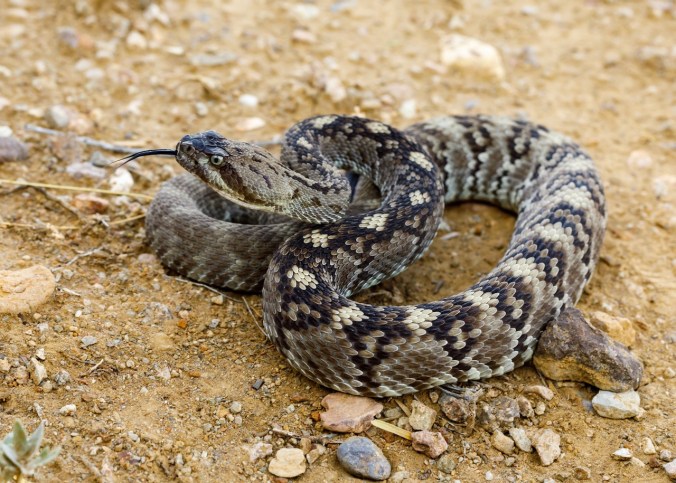
A black-tailed rattlesnake, whose very different face and body form, not to mention being venomous, might make it harder to see its beauty (photo by Meghan Cassidy)

It is important to consider why all of this matters, and why “y’all” should be interpreted so broadly. Everything matters because of that ecosystem jenga game mentioned earlier. And what about the tangible benefits that many species provide for us?

We are accustomed to environmentalists citing the many ecosystem services that various species provide, including cleansing the water and air, providing food, controlling agricultural pests and pollinating crops, breaking down the tissues of things after they die and returning nutrients to the soil, making new medicines possible, and so on. I’m grateful for all those ecosystem services – glad that the Earth and all those living things take care of us. The problem is when we take and do not give back, when we place ourselves at the center of everything. Believing that everything revolves around us is part of how the Earth got into so much trouble. We matter; humans are a part of all that glorious biodiversity, but the rest of the Earth matters, too, even when we don’t seem to get anything out of it.

The old story tells us that the Earth was given to us to use as we wish. That story led most of us into a relationship with the world in which we are the shopper and the Earth is the store as well as the sewer. We are the owners and the planet is our house, to be remade as we would like it. But there are other stories, other wisdom. We might find truth in the ones saying that all those other lives are our brothers and sisters, that we are all related such that when we treat others with respect and affection, we get a great deal in return. In that story, told by many Indigenous cultures, the world operates based on reciprocity and love, and when that breaks down, things fall apart. You can find a beautiful exploration of those ideas in Robin Wall Kimmerer’s recent book, The Serviceberry: Abundance and Reciprocity in the Natural World.

Those beloved, despised, ignored reptiles and amphibians provide beauty, pest control, medicines, and cultural meaning – and regardless of what they provide for us they have value. They are members and sometimes key players in communities of plants and animals. The great ecologist Aldo Leopold taught us that none of the members of ecosystems can be discarded:

“If the land mechanism as a whole is good, then every part is good, whether we understand it or not. If the biota, in the course of aeons, has built something we like but do not understand, then who but a fool would discard seemingly useless parts?” – Aldo Leopold, Round River

For those who see the world through a spiritual or religious lens, the quote carries the same wisdom. It changes only how we name the creator; substitute “God” or “Great Spirit” for “biota,” and discarding the parts still seems foolish and arrogant.

So if we conserve what we love, and we love what we understand, how do we bring about that understanding? It’s through experience and information, the teaching that Dioum mentioned. The more time I spend with rattlesnakes, for example, the more I am able to notice how they move through the world without malice (though their bite is dangerous if threatened), but rather with curiosity and skill. We increasingly read researchers’ accounts of problem-solving ability and maternal care. In Tracks and Shadows, herpetologist Harry Greene reports on observations of baby rattlesnakes staying with their mother, basking together, and retreating behind her if disturbed. Then, after their first shed skin, the babies disperse and mother finally has a chance to hunt for a meal (Pp.165-166). With information such as this together with my own field experience, I have plenty of respect for and caution around these animals, and also considerable affection.

It is not necessary to seek encounters with rattlesnakes or read extensively about them in order to support their continued existence. But some level of familiarity, some acquaintance with wildlife and nature is needed. The more we understand the lives around us and the places they depend on, perhaps the more we will understand the importance of the whole thing. We need to hear the stories and hopefully have firsthand experience with some of the hard-to-love, non-charismatic wildlife, showing us that they, too, have some of the qualities that stir our compassion and empathy.

About Empathy

I’m writing again to kids and to anyone else who is interested, about the values that can shape our lives if we choose them. Like empathy.

So – empathy. The thing that lets us know that a classmate is going through something bad, even if they say they’re “fine.” And also lets us share a friend’s joy. The ability that lets us connect with each other, lets us care about each other in a meaningful way.

Empathy is our ability to understand what it is like to be another person in their situation – to sense what their emotions and thoughts might be. If you see someone being bullied, see their expressions and hear their voice, you might feel some of their fear, pain, and anger, and want to help them.

What is it like to be small and have a hurt? And to have someone who is there for you?

It’s not the same as “sympathy,” which is having concern for someone but without the emotional part that happens when we feel what they are feeling. Empathy connects us through emotional understanding, while sympathy really does not.

If you look these things up online, some places in social media and websites don’t get it quite right. There’s some good information here and here. And I learned a good bit about these things during my career as a Psychological Associate. Empathy is crucial to what was required in that career.

I guess a person who is worried about being seen as weak or vulnerable has no use for empathy or else would find it hard or uncomfortable. It amazes me that some politicians and some churches are saying that empathy is a problem, or even a sin.

When Elon Musk says that empathy is a “bug” and a “weakness,” he is wrong. Empathy helps bring about the kind of connection and trust that holds relationships, communities, and societies together. Right now, as a society, very many people are isolated from each other and mistrustful of most others. We need to have relationships in which the other person “gets” us.

It would be great to have more face-to-face relationships that include empathy, making us feel understood by a wider group of friends and people in the community. I think we would feel less isolated and mistrustful of everyone else we see. And wouldn’t that be a wonderful thing?

Looking around me right now, I see too many people who have no time or desire to understand others except to use them, who act as though getting through the day means shoving people aside, and who desperately want to be invulnerable, untouchable, armor-plated like a superhero. Empathy would mean sometimes opening yourself to difficult feelings, connecting so that it could matter – a lot – how another person is doing. You can’t do that with armor on. (You can and should do it while maintaining some sort of “boundary,” but that’s for another discussion.)

So I hope you will grow up being strong enough and wise enough to have empathy for others. Being with someone when they need it, without giving advice or trying to “fix it” and quickly move on, but instead just being present so they don’t carry what they’re carrying all by themselves.


I’m not sure how I managed to write the above without bringing in one of Bruce Perry’s books, Born for Love (written with Maia Szalavitz). Not that I wanted it to be a long essay with a lot of references, but this is a popular, readable book by a psychiatrist who I regarded as a rockstar earlier in my career when I heard him speak and read his books and articles. So, if you can take the time, go get this book!