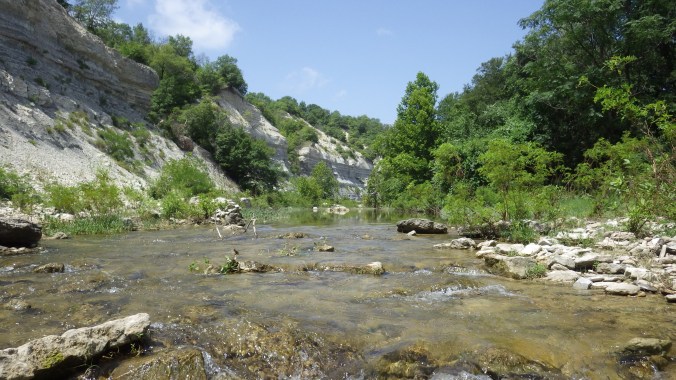
A Story – Journaling at the Creek

The creek bed was slippery as Elliott and Kate waded upstream. Ahead of them they could see several Sunfish, huddled in one spot where the clear water was a couple of feet deep. Then the blue-green fish decided that the two humans were getting too close, and they made a break for it, darting one at a time past Kate and then practically between Elliott’s legs. 

“I could have caught one in my hands if I was fast enough!” Elliott claimed. He added, “But I’d probably have fallen on my butt. This spot is really slip…”

Before he could finish, his legs slipped out from under him and he really did land on his butt. The water cushioned his fall, and he sat on the algae-coated limestone, spluttering. Kate came back to help.

She extended her hand to him. “If I fall in, I swear you’re going back down too,” she teased. 

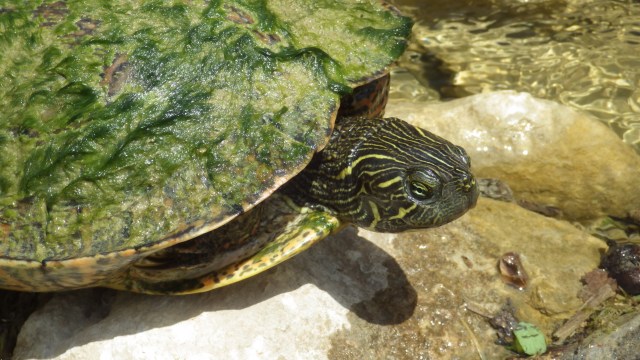
Elliott managed to get up without pulling her in, and they kept wading upstream, past schools of little silver fish and a small Red-eared Slider turtle hiding in the shallows. His shorts and shirt were wet, but they would soon dry in the sun. And to have Kate take his hand and help him get back up, he thought it made falling down worth it, though he wasn’t going to say that to Kate. 

It was October, but in Texas all that meant was that it was warm rather than hot. As Halloween got closer there were no golden or orange leaves, no autumn color yet although some leaves were falling just from being worn out by a long, mostly dry summer. 

At a bend in the creek, the two of them waded out onto the exposed white limestone bank of the creek. Another, higher layer formed a sort of bench where they could sit in the shade, facing the water. Elliott went through his backpack, which had stayed mostly dry inside when he went in the water. He found his journal still sealed in a plastic bag, protected against just that kind of accident.

Kate looked back at him. “Are you getting your journal out? This looks like a pretty good place to do it, right?”

Elliott agreed. The teacher in their 10th grade science class had given this as an assignment: Take a notebook somewhere out in nature and write or draw about what you find. Kate liked this creek and so after they got the assignment, she asked Elliott to come along. 

Each of them opened their notebook and wrote the date at the top, followed by the location of the creek and the time they started walking and wading. There were a list of prompts included with the assignment, suggesting what to include. 

“Let’s see,” Kate began, “there’s weather stuff. The sky is kinda deep blue today, with a few clouds, right?”

Elliott looked at the clouds. “Yep. I think those are high clouds, a forget what you call them, but they’re sort of like a little bit of milk swirled across the sky with the tip of your spoon.”

“OK, ‘milk clouds,’ I’m sure that will win us the weather expert prize.”

“Whatever,” Elliott responded. “Remember she said it doesn’t have to be technical. She said just describe, put what you experience into words.”

’Elliott stinks like creek water.’ There, I’ve put my experience into words.”

Both of them were quiet for a minute. Then Kate said, “OK, sorry, I’ve written about blue sky and swirly clouds. Did you bring a thermometer?”

“No, but I’m going to check the nearby weather.” Elliott pulled out his phone. “So it’s 78 degrees nearby. Feels warmer when you’re out in the sun, huh?” Then he pulled a section of his T-shirt up and sniffed it. 

“That does not stink.”

Each of them wrote in his or her journal for a while. And then Elliott asked, “Remember that big white wading bird we saw back there? Do you know what it was?”

“Yeah, a Great Egret. I think I remember that they eat stuff that they can spear in shallow water, like fish or frogs. They’re so pretty when they fly.”

Elliott added, “I guess I can say something about the fish even though I don’t know what they are.”

“Ms. Martin said that was fine, that it was more important to put into words what you noticed – just what it looked like or sounded like. What did she say? ‘It helps you remember it and really notice and learn about it.’ So you could say they were silvery little shooting stars that flashed in the water, and that would be OK,” Kate commented.

Elliott smiled. “I remember – actually she’d really like that ‘shooting star’ bit, because she said it should capture how it came across to you, how you felt about it.”

They kept writing, including a little about the creek itself and the sparkling reflections of the sun when the shallow water ran over the rocks. There was the sound that water made when it ran fast and shallow, and an occasional bird call. They included the feel of the water, a cool swirl around their ankles and a slight push against their legs as they waded upstream (and Elliott could mention how hard they worked to keep their balance and that cool, sudden immersion when he fell in).

“I started to quit a few minutes ago,” Kate said, “but when you stop and think about it, there is so much to notice. I guess that was the point, huh, to get us to pay attention to all this.”

“Yeah,” Elliott answered, “How long do we have to keep going? I know she said there was no specific number of lines or words, but I keep thinking of stuff. If we weren’t doing this nature journal, I think I wouldn’t have noticed a lot of it.”

“Are you drawing anything?” Kate asked. “She said that would be good, too. Maybe I’ll draw your swirly clouds.”

“There’s that fossil snail or whatever that I saw back there. Maybe I can find another.” Elliott wandered around, looking at the exposed limestone, until he saw the exposed coil of a ribbed spiral shell, a limestone fossil embedded in the creek bed. He carefully worked it free and brought it back to where they were sitting. 

“I see at least a piece of one of those every time I’m here,” Kate said. “All this used to be a sea bed, in prehistoric times, and these were kinda like a squid living in a snail shell, is what I heard.”

As Elliott began drawing, Kate continued, “We’re supposed to say if we’re grateful, or maybe write something like if we were talking to the place, telling it what we think. Let’s see … I’m grateful that you fell in.

“Hey, we gotta wade back out of here, so don’t be so sure you won’t do the slip and slide and go for a swim.” At this point Elliott was hoping for it; paybacks were gonna be fun.

“Maybe this,” Kate went on, “’I’m glad we can visit this place, that it has so much cool stuff. It has had amazing animals since prehistoric times, and it’s still here. I hope people can wade this creek in a hundred years.’” 

“I like that,” Elliott said. “Do you want to try this again, even after the assignment is done? I usually keep on the move, and writing and drawing kind of slows me down. But maybe it would be fun to try again.”

“It slowed you down but it made you think about stuff you would have walked right past,” Kate replied. “So we could go to that preserve with the open grasslands and woods and maybe if we wrote in the journal, we would notice more things and think about them in new ways.” 

“OK, it’s a deal,” Elliott said. “We can give it a try.”

And on the way back … neither of them fell in the water. Elliott was a little disappointed.


(Recommending nature journaling might sound a little like a school assignment – which wouldn’t exactly get everyone rushing out to pick up a notebook and pen. So what is a good way to introduce it?

I decided that maybe a story would be a good approach, and in this story it literally is a school assignment. But it turns out well, and I’d like to think Kate’s and Elliott’s interest in trying some more journaling might also work out well. What I had in mind about the teacher’s prompts and suggestions to deepen their journaling is shown below – I took it along to the preserve and gave it a try. You could write something shorter; like Elliott said, there’s no prescribed number of words.)

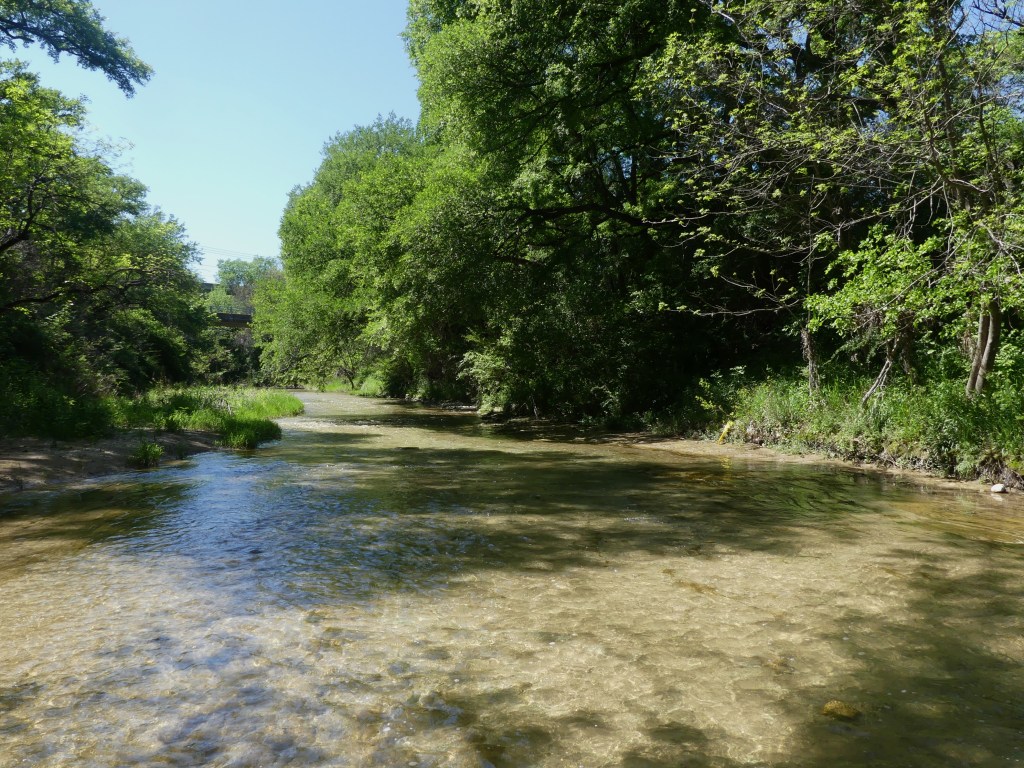
Nature journal page with prompts or suggestions

With Elijah – Creek Stuff and Stories

Yesterday afternoon there was water, fossils, clams, and Elijah’s creative mythology of tiny people living at the creek, riding mosquitofish, cultivating moss, and using leaves as currency. Elijah and I have a five year history – on and off – of discovery and play in this place.

I wrote about it on Rain Lilies (at Substack – the link should take you there), where I have been writing about children and nature.

Creek Kids

In her book, Wild DFW, Amy Martin says that people like her and me are “creek kids.” Each of us spent some formative years wandering nearby creeks. In my case the creek was my second home from about age 12 until high school, sometimes going with a friend or two and sometimes spending most of the day there by myself. For Amy and for me, the creek played a part in creating a lifelong love of nature. What would have happened, had we not had a creek, or a woods, or a prairie? I strongly suspect that if childhood slips away before we have had a close acquaintance with some place in nature, it might be too late. If there had been no creek, maybe I would have an intellectual or aesthetic interest in nature, but I don’t see how it could ever feel like home. For a creek kid, the attachment to places in nature and the things that live there is visceral. It’s like a beloved sibling, not a casual acquaintance.

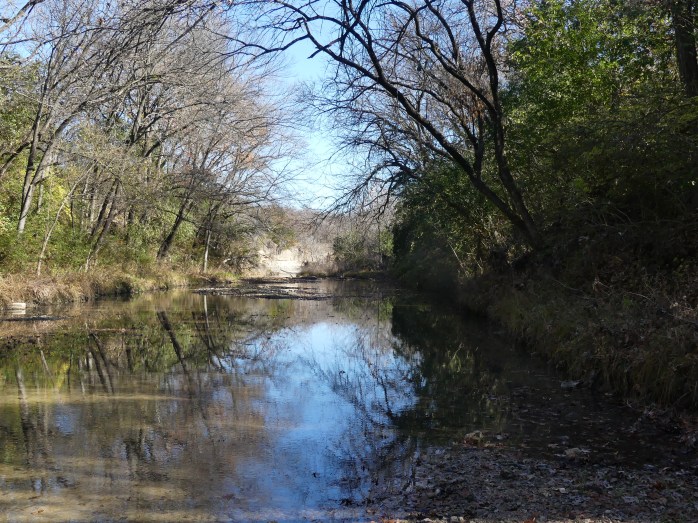
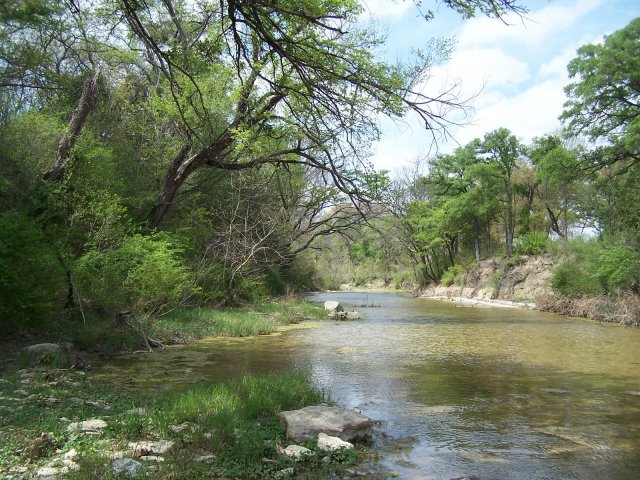
The creek in early April of this year

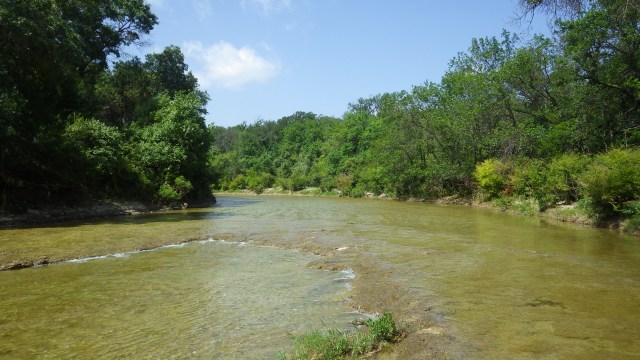
My creek was and is in western Tarrant County in what originally was prairie with black soil above white limestone. It sometimes filled up and ran like a raging river, but mostly it flowed quietly in a small stream from one pool to the next over that limestone. Under overhanging tree branches the water was sometimes crystal clear and cool, and mostly I had sense enough not to drink it. It was, in the early 1960s, full of wildlife, enough to keep me coming back day after day during the summer. My passionate interest was herpetology, but I was learning to love the armadillos, herons, and sunfish along with the reptiles and amphibians.

The creek is still there, but much has been lost in the 60 years since I first walked and waded it. The spaces between pools, those broad gravel bars and broken slabs of limestone, were inhabited by greater earless lizards in colors of pale gray and chalk white. They would run ahead and stop, waving their tails to expose black bars underneath (perhaps meant to confuse or disorient a predator). I haven’t seen one at the creek in many years. Ribbonsnakes used to thread their way through stream side vegetation, hunting for cricket frogs. When spooked, these slender harmless snakes would swim across the pools with bright orange and cream-colored stripes glistening in the sunlight. They seem mostly to be gone as well, at least at my creek. As populations of wildlife disappear here and there, younger generations know of them only through the memories of us older naturalists, or they may never know what is missing (see the article on shifting baseline syndrome).

I keep coming back, though the city’s development has forced me to find access points further upstream. Occasionally I will bring someone, but it’s a little like in Mary Oliver’s poem, “How I Go to the Woods” – those who smile and talk too much are kind of unsuitable, and if I do take someone, it is a person with whom I feel comfortable and close.

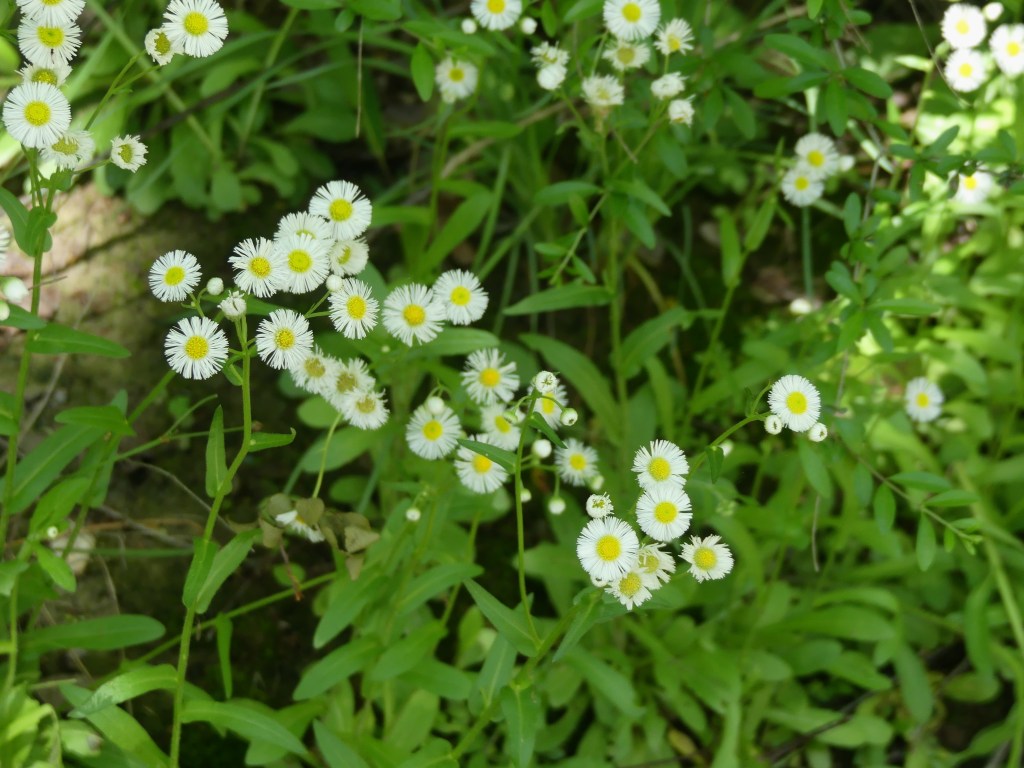
Fleabane growing on the banks of the creek

In particular, my visits there with Elijah have been important to me and, I think, to him. He is not quite a grandson but I’ve known him since he was born, so he’s family. I first took him to see the creek when he was six, and we’ve visited on and off since then. I described one such visit in an issue of “Letters to Nature Kids.” Giving kids time in nature, introducing them to the turtles and fish and other things that set the engines of curiosity and wonder in motion, that feels like part privilege and part responsibility. Taking my granddaughter for a walk to see birds and draw in the sand on the path through the woods is a great pleasure, and I think it is more than that. It is planting seeds that might, if she chooses, grow into a source of joy and connection with the world around her.

Blackstripe topminnows at my creek

So my creek is still there and has not been swallowed up by the city. I imagine kids playing in that creek and exploring it as I once did. I imagine it, but I do not see it. I have not seen anyone who appeared to be playing or learning about the life of that creek in a long time. Is this part of the cultural trend that Richard Louv wrote about in Last Child in the Woods? He documented the increasing tendency for children to play inside, to spend their time in front of screens, with little time in woods and fields. As parents, we may worry that no place out of our sight is safe. For a child to be outdoors for an extended time away from contact with a parent seems neglectful to many people. Yet I survived and thrived at the creek with no cell phone, just a watch and a rendezvous time for mom to pick me up.

I hope you have a creek, and that you take your kids or somebody’s kids there. I know that it might not be a creek; it could be a woods or a pond or some other place in nature. I would love to hear about it in the comments – either a place in your memory or some place you can visit right now. And I hope that you can visit it, for an hour or a day.

A near-perfectly camouflaged cricket frog, hoping that I’ll walk on by
Blue water-speedwell, according to iNaturalist, growing along the creek

Wading a Winter Creek

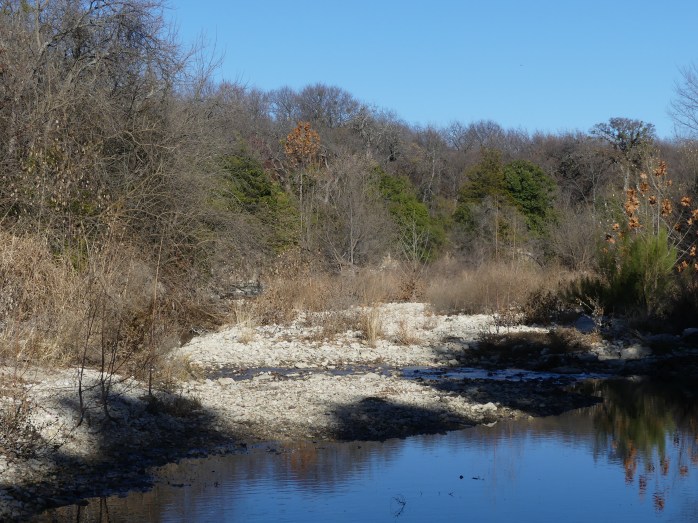
On a day when the temperatures reached the upper 70s, under bright sunshine, we took a walk and a wade through a cold creek, ten days into winter (using the December 1st meteorological beginning). It was delightful.

It probably seemed ridiculous to Barbara’s kids when we arrived at the creek bed and found much more water flowing than I had predicted. They followed me upstream a short distance until I reached a broad pool that would require serious wading. I volunteered to go ahead and see how deep it would be, and when it became thigh deep, frigid and numbing, I glanced back toward them. Barbara was gamely ready to give it a shot; Nicholas stood with his infectious grin as if to say, “you gotta be crazy.” Dani looked like she was figuring out how she could quietly slip back to the car. 

“OK, well how about downstream?” I asked, and everyone quickly assented. By the time we got back to our entry point, I could not feel my feet. Above the water was a different story. There could hardly be a more comfortable, sunny day as we made our way downstream over dry limestone rock and water only an inch or two deep. 

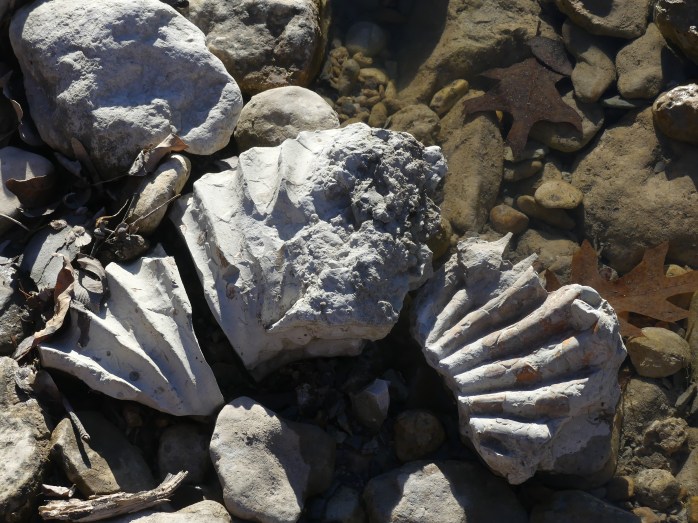
Fragments of ammonite (the piece on the right is a cast, not a piece of the ammonite itself)

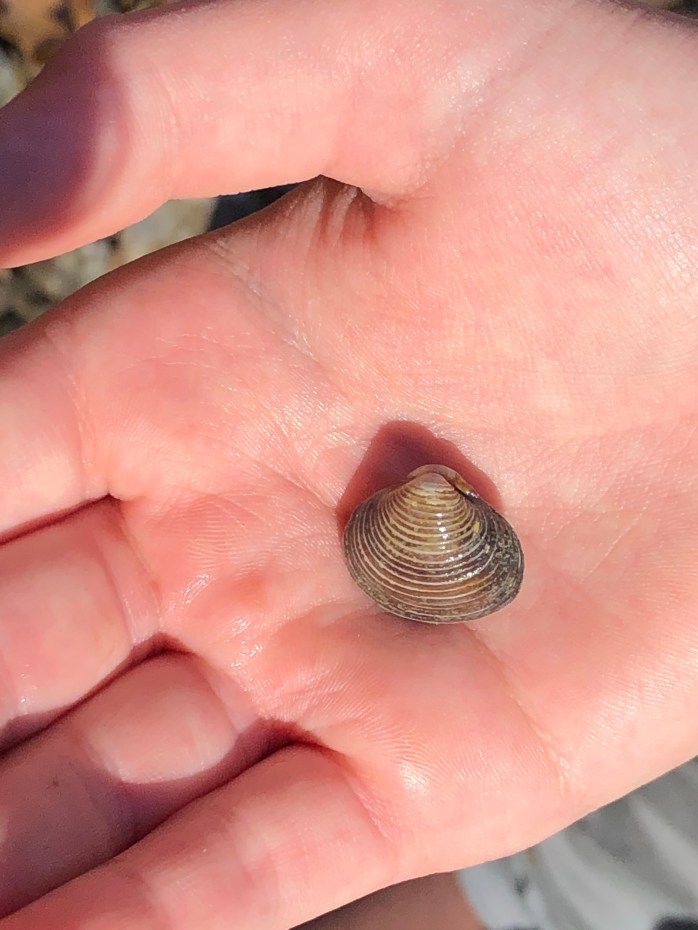
I talked about finding fossils in this white Cretaceous limestone, including echinoids (like sea urchins), conical snails, and ammonites. The most dramatic fossils are the ammonites with their ribbed, coiled shells resembling today’s nautilus and related to the squid or octopus. I rarely find intact ammonites but it is exciting to find even a portion of one. We soon found a fragment or two, along with some fossil oysters and other bivalves. Nicholas soon found a living modern bivalve, that is, a freshwater clam that a friend identified as a species originally brought here from Asia. 

The water got deeper, and that give me a chance to net up some fish for us to examine. What I netted were mosquitofish, a sort of minnow that often swims in groups searching for something edible on the surface of the water. I showed the others the little ones among the wet leaves in the net and mentioned one of the things that charms me about these fish. While they are basically colorless, when seen in the right light a blue color is evident. It might be a sort of iridescence, though it seems to come from within the fish. I noticed it when I first caught and kept them as a teenager – mosquitofish and I go back a long way – and it is still one of the first things I think of when I see them.

Throughout autumn the leaves fall, spinning and sailing down to the water’s surface where they become saturated and sink to the bottom. Bur oaks, beeches, red oaks and sycamores all contribute to a beautiful collection resting under the clear water. The pale silt from limestone and shale lightly dusts these leaves, making them the creek equivalent of a sepia-toned photo.

We found a place where the creek has cut straight down through sand and shale, forming a sort of wall. Some layers and spots erode more easily, so during floods the current has carved a shallow pocket into the wall, leaving a bench of gravelly soil that we sat on for a while. I wrote notes while Barbara sketched sections of ammonite and leaves. Dani found a comfortable place in the sun. 

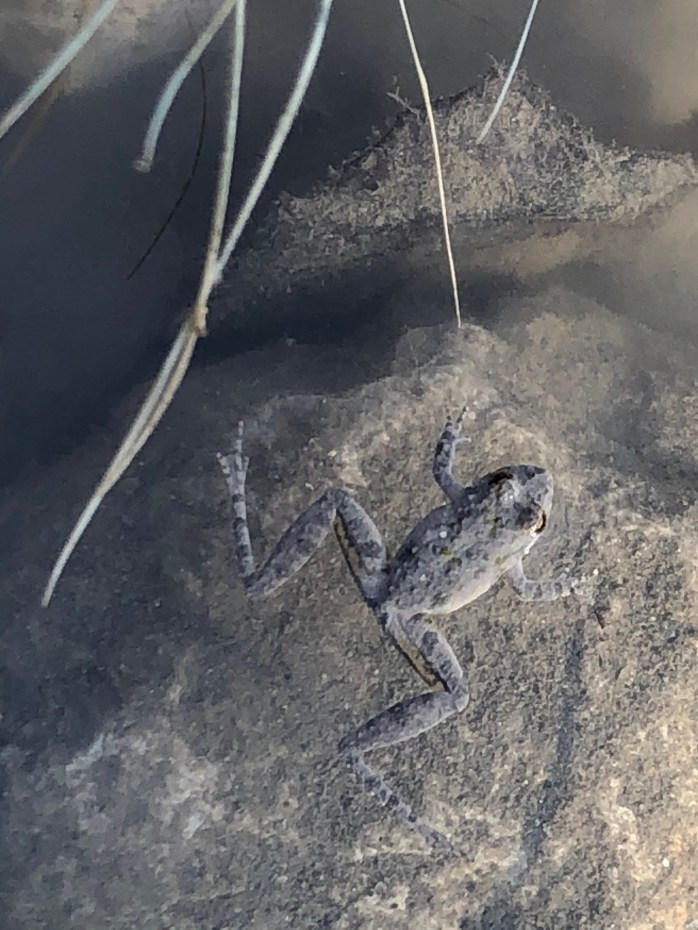
As Dani enjoyed the sunshine, the rest of us waded further downstream. Because it was sunny, the cricket frogs were sitting at the water’s edge, waiting to ambush tiny invertebrates to eat. These thumbnail-sized frogs may seek shelter when it’s truly cold and when it’s overcast or raining, but otherwise they are active year-round in our area. In summer they seem impossibly fast, jumping into the water and swimming to some place of concealment almost faster than your eyes can follow. Today their “cold-blooded” metabolisms could not generate that kind of energy. 

A Blanchard’s cricket frog floating in the water

Nicholas caught a couple of cricket frogs by hand, a pretty cool trick in summer but much easier today. When one slipped away and jumped into the creek, it hung in that clear, numbing cold water and floated over the rocks and leaves of the creek bottom. A few minutes later it would be sunning on the creek bank and hoping for a little hunting success.

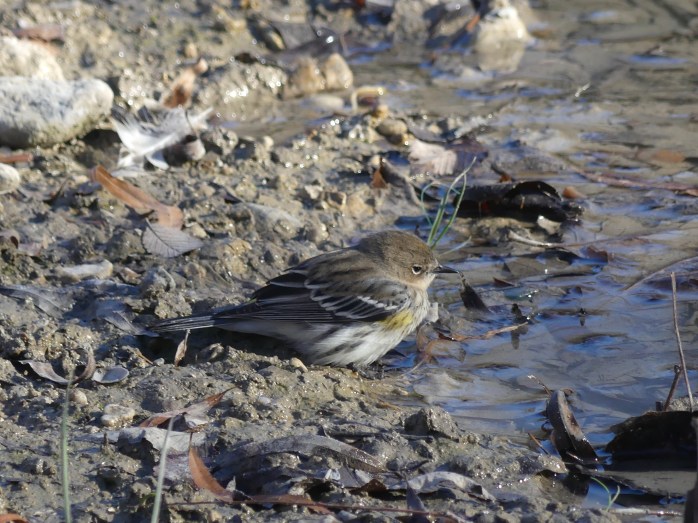
Further down the creek, Nicholas spotted a small bird getting a drink at the water’s edge. It dipped it’s slender beak into the water a couple of times and soon flew away. I got a good photo but struggled to know this bird’s identity, but with the help if iNaturalist I found that it was a yellow-rumped warbler. The narrow beak, a bit of a white ring around the eye, and the wing bars helped, but there was only a suggestion of a yellow patch on its breast. It turns out that in its winter plumage, there’s not a lot of yellow to be seen, and this bird’s position obscured whatever yellow may have been evident on its rump. 

Yellow-rumped warbler

There were no clouds in the sky, and in shallow riffles the sun and water created the most beautiful patterns of light. Each ripple in the water focused sunlight onto the pale limestone creek bottom in a shimmering, dancing line. Sometimes they moved in the direction of the current and they swirled when the water was disturbed as it passed through troughs and over stones. At times through some trick of the light they seemed to move back against the current. It might be a small and ordinary thing to watch what the bright sunlight creates in clear, moving water, but it was a wonderful gift today.

And then it was time to head back. This creek has been such a treasure over the fifty-plus years that I have visited it, and I look forward to seeing another spring there when the new green growth and spring rains transform it into one more wonderful version of itself. 

Passing the Creek Along to a New Generation

In about 1962 or ’63 I was given a gift that lasts a lifetime. I was introduced to a certain creek in western Tarrant County with clear running water rippling over white limestone and gathering in shaded pools. In deeper, still water the sunfish guarded their nests and hid in shadows. At about twelve years old, I would spend entire days there, chasing chalk-white earless lizards over jumbled limestone rocks and plunging into the water to catch the nonvenomous watersnakes that were common at the creek. With a friend or two, I’d wander the fields along the creek and sit where the grass and soil ended and the creek flowed twenty or thirty feet below us, watching turtles basking in the sun. It’s hard to imagine a more carefree existence than spending a day discovering the life of that creek.

I brought home mosquitofish, a surface-feeding little fish looking like a guppy without the fancy tail. Their blue iridescence, seen only with light at certain angles, is subtle but definitely caught my imagination. I was also drawn to the blackstripe topminnow, another surface-feeding fish like a little torpedo with a thick black line down its side.

The snakes, however, were the real prize. I was already hooked on gartersnakes, but the creek was home to incredibly graceful ribbonsnakes, seeming to trace calligraphy over the water as they swam. The bright orange and cream-colored stripes glowed in the sunlight when one of those slender little snakes swam across the water and traced its way through the streamside vegetation.

The creek was a place I returned to over and over. I walked it in summer heat when drought stopped the water’s flow and turned the pools into algae-choked saunas of warm water. I walked it in late fall when the water was almost too cold to wade, and flowed over yellow, brown, and rust-colored layers of dropped leaves. In the winter, I kept visiting even though most reptiles and amphibians were dormant in burrows and crevices. Cricket frogs, however, were out on almost any sunny day that gave them a chance to bask and hunt whatever tiny invertebrates were out and about. Fish didn’t seem to mind the winter’s chill and I could observe them while threading my way along limestone shelves and earthen embankments, trying not to step in the cold water.

Going to college spaced my visits out more but did not stop them. When we lived in Houston, work and distance kept me away. However, when we moved back to Arlington, I found times to visit. The creeping expansion of Fort Worth required that I enter the creek further out. Gradually, the city was gnawing away at my creek, as more land was sold to developers who turned perfectly good nature into bricks, concrete, and turf grass.

Casey examining a Red-eared Slider at the creek

This isn’t the story of the loss of the creek, however. It is the story of sharing it and passing it along to new generations. The connection I formed with the creek was forged in childhood, while spending day after day there when school was out for the summer, exploring and discovering as if that time would never end. Maybe it never did end, at least for that place as I internalized it and made it an important part of who I am. I have taken friends to that creek many times over the years. Most of them share a sense that this is a special place, and I hope that they return or else find some place to make theirs. It is too late for the adults to form the same kind of connection that I have with the creek. I am pretty sure that such a bond happens only during childhood, when a place seems to be what people call “larger than life.” What I really mean is “as large as life,” completely occupying that wide open space we give it when we live in it regularly and get to know it intimately. As we become adults, that space narrows; by then we have spent our lives in a lot of places, often in brief and fragmented chunks, making use of places in utilitarian ways. Usually there is little room left in which we can open ourselves to some beautiful place and live in it, getting to know its little mysteries and its seasons in an unhurried way.

Elijah at the creek

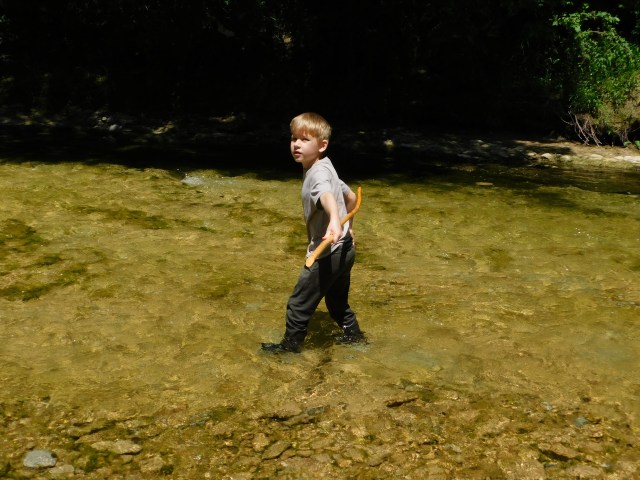
I recently took Elijah for a little exploring at the creek. He is in many ways a grandson. I saw him on the day he was born and have watched him grow into a wonderful six-year-old who has been on many walks in nature preserves with his parents and me. I dedicated my forthcoming book to him and to an old mentor of mine, once again mindful of how a love of the natural world is passed along from one generation to the next. And on the day of the walk at the creek, it was just Elijah and me. We were prepared with a net and walking sticks. When wading the creek, the stick becomes a third leg to help balance on algae-coated limestone, and while the old man didn’t fall, Elijah did get a couple of soakings.

Water pennywort

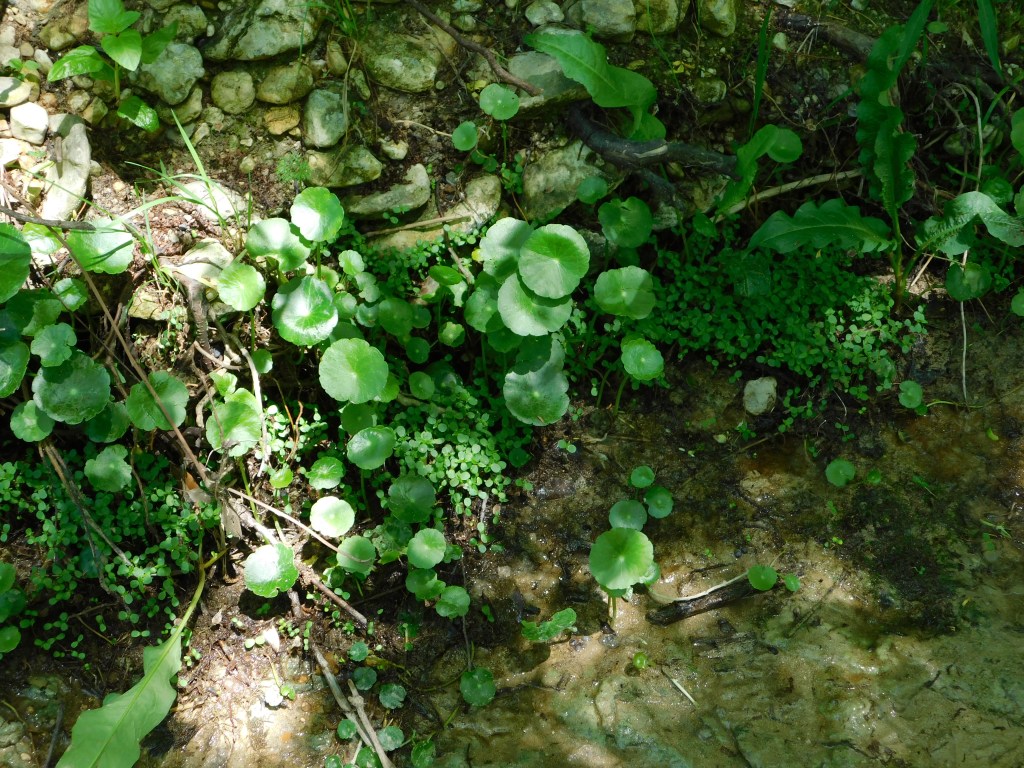
Along a part of one side of the creek, in dappled shade, I saw some water pennyworts like parasols on thin little stems. I called Elijah over, saying “Look, they’re like little umbrellas.” At the time, I didn’t know what name to call them when Elijah asked. They were just some kind of pennywort. After another question or two, we moved on. He was on a Pokemon jag so that the dragonflies sailing on the sun-warmed air were “dragonfly-Pokemon,” and the turtles we looked for would have been “turtle-Pokemon.” We did find fish, all of which were too fast for our net. The group of shiners swimming close to the bottom scattered in front of the net, and the sunfish scooted out of reach with a flick of its caudal fin. We saw a small bass as well, but it was getting nowhere near the net.

A turtle-Pokemon?

We had to decide whether to walk into an area where the water was forced into a small channel and ran swiftly – the equivalent of whitewater for the creek. I let him test his strength without getting into the biggest and fastest part and being pulled down. It’s good to get just enough real-life lesson about the power of moving water so that you know when it’s safe to wade and when it will drag you into the current.

After our explore was done and we were back at the car, Elijah asked how I knew so much about nature. I explained that I had been doing it for a lot of years, had read many books, and had hung out with people who knew a lot, just as he was doing with me today. He told me, “When I’m older and I can read better, we will find things and I’ll look them up in the books and we’ll know which plant we saw.” Such a beautiful dream only comes along once in a great while, and I would gladly see it come true. Elijah, you’ve got a deal. I promise. If I can give you the gift of this creek, or a woods or prairie somewhere, I will surely do it.