Getting to Know Some Reptiles

… and at least one amphibian

My interest in nature has been dominated by reptiles and amphibians (herps) starting when I was nine or ten and the girl across the street invited me to come along and find garter snakes in Colorado. I was active in herpetological societies twenty-five years ago and I’ve been teaching incoming Master Naturalists about these animals for some years. I’m interested in the “big picture” of ecology and natural history, but herps are still an important focus.
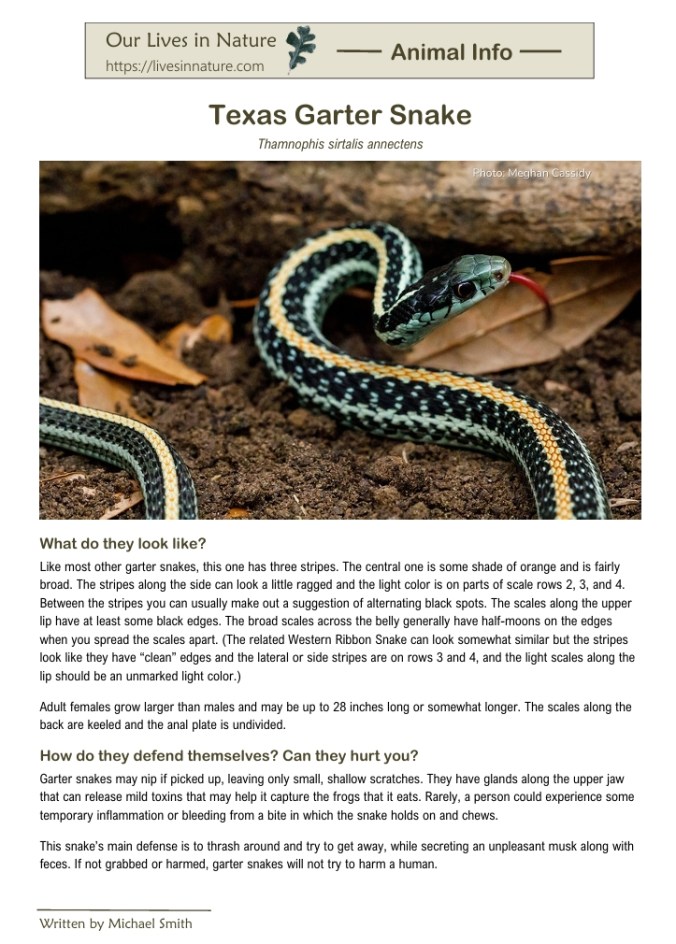
Herp conservation is very important to me. If you’d like to learn more and support some important work, please check out the Amphibian and Reptile Conservancy and the Orianne Society, among other organizations (such as Texas’ own Texas Turtles). I’ll be giving talks about reptile and amphibian conservation in Texas over the next few months, and while preparing, I’ve added some species profiles to the downloadable pdf files on my herpetology page.

Among them is information about the Texas Garter Snake, a subspecies of the “Common” Garter Snake. Across the years, I have found a handful of Texas Garter Snakes, and they turn up occasionally on iNaturalist, but as far as I can tell they have never been common. There seemed to be particular spots or areas where they had viable populations, but even in those places a search for them was always hit-and-miss. That turned out to be the case in 2013 and 2014 when a group from UT Tyler started a project to investigate its genetics and preferred habitat. They did not find any, and had to rely on a few museum specimens in order to finish the project (published in The Southwestern Naturalist in 2019).
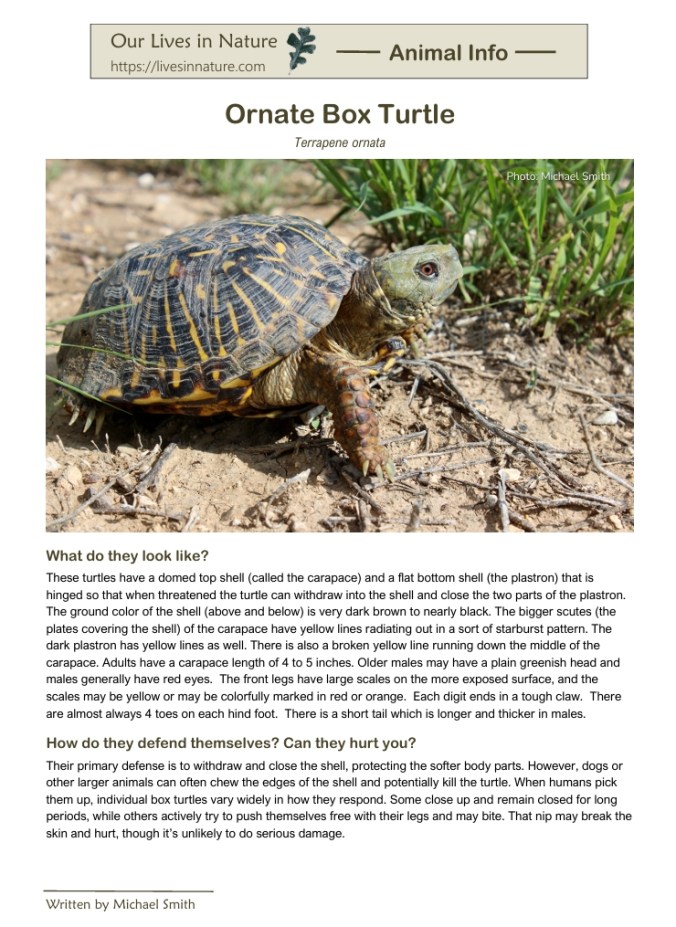
Another profile covers the Ornate Box Turtle. I have loved box turtles since I was a kid (and at least half of Texas would say the same thing, until they became uncommon enough that kids didn’t get many chances to see them). They have suffered from habitat loss and fragmentation, road mortality, and the unfortunate tendency of our species to want to collect and keep interesting and cute animals. In recent years, Texas protected box turtles from commercial collection. However, people still pick them up and take them home. Like turtles generally, their success depends on living long lives once they become adults. Collecting one is like running it over on the road – it is “dead” to the reproductive population of turtles.

And Texans of a certain age recall when the Texas Horned Lizard could be found in back yards and local parks. In the 1960s these places were often dotted with Harvester Ant colonies with a big bare circle of ground around the opening to the colony. These were the horned lizard’s food, and when people poisoned the ants (and later when the fire ants largely replaced them), there was nothing for horny toads to eat. Also in the 1960s, large numbers of these lizards were collected and shipped off to the pet trade where they inevitably died. But probably the biggest deal, according to Andy Gluesenkamp, was the loss and degradation of habitat. Native Texas prairies, with bunch grasses, open areas, ants, and the right combination of shelters and wildlife “neighbors,” were great for them. Monoculture pastures of non-native grasses, the increasing network of roads, the invasion of fire ants, and other factors have eliminated Texas Horned Lizards from many of the places where they used to be found. (Gluesenkamp led the San Antonio Zoo effort to captive breed and release young horned lizards in suitable habitat – an effort that is working.)

So far, the sole amphibian I’ve profiled is also one that biologists are concerned about. There is little real data concerning how Woodhouse’s Toad is doing, but it is the species that many of us used to see on spring and summer nights in North Texas. It has largely been replaced by the Gulf Coast Toad, but away from the cities there are places (like the LBJ National Grasslands) where Woodhouse’s Toad seems to be the predominate species. Overall, the species is considered secure, but are we sure? Wildlife agencies and universities have limited resources and cannot study everything. Everyday folks documenting what they see on iNaturalist help a great deal, but there are still enormous gaps in our knowledge of the status of most of our herps.

There are other species with these two-page downloadable pdf profiles, including the Texas (Western) Rat Snake, the Great Plains Rat Snake, the Long-nosed Snake, Rough Earth Snake, and Checkered Garter Snake. I hope you’ll use them to share with home schoolers, scout troops, or anyone else who would like them. I’d be happy if you’d like to leave a contribution, but if you can’t, that’s fine. And maybe leave me a note about anything else you’d like to see. Our venomous snakes are briefly summarized in my “Identification Guide to Venomous Snakes of North Central Texas,” found on the same page.

Connection and Compassion With Lives Unlike Ours

An article at a UC Berkeley website reports that “We are currently losing species hundreds or thousands of times faster than normal background extinction rates. If this continues, Earth’s biodiversity will plummet.” And biodiversity is a big deal, supporting the healthy functioning of the Earth. Animals, plants, bacteria, fungi, bryophytes – all these lives are interrelated, creating complex systems that keep the Earth going. The way the survival of every species is related to the well-being of the rest makes ecosystems resemble very complicated jenga games. You can remove a few pieces and the structure still stands, but it gets progressively more unstable. It could reach a tipping point in which further species loss brings whole ecosystems down.

Playing Jenga. Photo by Ron Lach on Pexels.com

Slowing the rates of extinction and leaving ecosystems in greater health will depend on us. Among the things we can do is to recognize which species are in trouble and take actions to conserve them. How do we encourage those things? How do we get enough people to care what happens so that they help fund conservation efforts and agree to limit some of the extraction and development so that species can survive?

An important insight from Senegalese conservationist Baba Dioum is:

“In the end we will conserve only what we love, we will love only what we understand, and we will understand only what we are taught.”

We conserve what we love. And it is easier for us to love some species than others. Part of our biological inheritance is that we are drawn to such things as big, expressive eyes, soft sounds and soft touch. And so we want to pick up and cuddle babies, we make cooing noises back to them and describe them as cute. (I don’t want to reduce the love of babies and children solely to genetic wiring, but the wiring helps.) And that response is usually extended at least a little toward cute puppies and kittens. And to baby tigers and bears, wolves and other furry, expressive animals.

Animals with strange faces, fixed expressions, and unusual body forms don’t pull us in so much, unless they are beautiful to look at or hear. A Monarch butterfly doesn’t have a face a human mother would love, but its beautiful wings and flight win our affection. Bird faces are less expressive than those of puppies, but many of us associate wings and flight with such spiritually uplifting things as heaven and angels. And there’s the beauty of their feathers and songs as well.

Reptiles and amphibians are a harder sell. For most people, they are among the less-charismatic animals to worry about and go out of our way to protect. In a world of soft and furry animals like ocelots and wolves with their expressive faces, can turtles or frogs pull at our hearts? Could the handsome colors and patterns of a Louisiana Pinesnake have a place in our affections alongside the lovely feathers of a Golden-cheeked Warbler? Could the nighttime calls of a Gray Treefrog have a place alongside the songs of Bewick’s Wren? For me, the answers are all “yes.” Part of the wonder of the natural world, and a key to its magic, is the diversity of forms, sounds, colors, and lives. Everything belongs. It’s the natural world’s equivalent of the way some of us talk about human inclusion: “Y’all means all.”

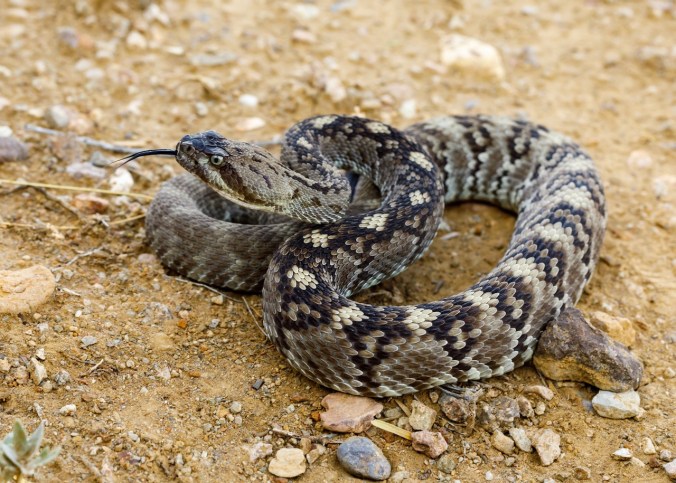
A black-tailed rattlesnake, whose very different face and body form, not to mention being venomous, might make it harder to see its beauty (photo by Meghan Cassidy)

It is important to consider why all of this matters, and why “y’all” should be interpreted so broadly. Everything matters because of that ecosystem jenga game mentioned earlier. And what about the tangible benefits that many species provide for us?

We are accustomed to environmentalists citing the many ecosystem services that various species provide, including cleansing the water and air, providing food, controlling agricultural pests and pollinating crops, breaking down the tissues of things after they die and returning nutrients to the soil, making new medicines possible, and so on. I’m grateful for all those ecosystem services – glad that the Earth and all those living things take care of us. The problem is when we take and do not give back, when we place ourselves at the center of everything. Believing that everything revolves around us is part of how the Earth got into so much trouble. We matter; humans are a part of all that glorious biodiversity, but the rest of the Earth matters, too, even when we don’t seem to get anything out of it.

The old story tells us that the Earth was given to us to use as we wish. That story led most of us into a relationship with the world in which we are the shopper and the Earth is the store as well as the sewer. We are the owners and the planet is our house, to be remade as we would like it. But there are other stories, other wisdom. We might find truth in the ones saying that all those other lives are our brothers and sisters, that we are all related such that when we treat others with respect and affection, we get a great deal in return. In that story, told by many Indigenous cultures, the world operates based on reciprocity and love, and when that breaks down, things fall apart. You can find a beautiful exploration of those ideas in Robin Wall Kimmerer’s recent book, The Serviceberry: Abundance and Reciprocity in the Natural World.

Those beloved, despised, ignored reptiles and amphibians provide beauty, pest control, medicines, and cultural meaning – and regardless of what they provide for us they have value. They are members and sometimes key players in communities of plants and animals. The great ecologist Aldo Leopold taught us that none of the members of ecosystems can be discarded:

“If the land mechanism as a whole is good, then every part is good, whether we understand it or not. If the biota, in the course of aeons, has built something we like but do not understand, then who but a fool would discard seemingly useless parts?” – Aldo Leopold, Round River

For those who see the world through a spiritual or religious lens, the quote carries the same wisdom. It changes only how we name the creator; substitute “God” or “Great Spirit” for “biota,” and discarding the parts still seems foolish and arrogant.

So if we conserve what we love, and we love what we understand, how do we bring about that understanding? It’s through experience and information, the teaching that Dioum mentioned. The more time I spend with rattlesnakes, for example, the more I am able to notice how they move through the world without malice (though their bite is dangerous if threatened), but rather with curiosity and skill. We increasingly read researchers’ accounts of problem-solving ability and maternal care. In Tracks and Shadows, herpetologist Harry Greene reports on observations of baby rattlesnakes staying with their mother, basking together, and retreating behind her if disturbed. Then, after their first shed skin, the babies disperse and mother finally has a chance to hunt for a meal (Pp.165-166). With information such as this together with my own field experience, I have plenty of respect for and caution around these animals, and also considerable affection.

It is not necessary to seek encounters with rattlesnakes or read extensively about them in order to support their continued existence. But some level of familiarity, some acquaintance with wildlife and nature is needed. The more we understand the lives around us and the places they depend on, perhaps the more we will understand the importance of the whole thing. We need to hear the stories and hopefully have firsthand experience with some of the hard-to-love, non-charismatic wildlife, showing us that they, too, have some of the qualities that stir our compassion and empathy.

“No Direction Home”

(I recently wrote this over at Substack – yes, I’m still struggling with where to land – but I felt the post ought to be here, too, because of its importance. I hope you will read and go to the Federal Register site and comment. Thanks.)

Suppose a group of people came to your house and stole the roof from over your head. “What??!” you might protest, but they tell you they needed the shingles. Shortly after, a crew plows up the easement in front of your house, and water shoots up from the broken pipes, then subsides to a trickle. Eventually you sit in your house, unharmed, but with no protection from the elements and no water. The police tell you that you have no recourse, because none of these people physically hurt you.

That is what the Trump regime plans to do to species protected under the Endangered Species Act. A proposed rule would re-define “harm” to only mean “taking” a protected plant or animal. Changing or degrading its habitat would not fall under the definition of harm. Only such things as trapping or killing the animal, or digging up an endangered plant, would qualify as “harm.”

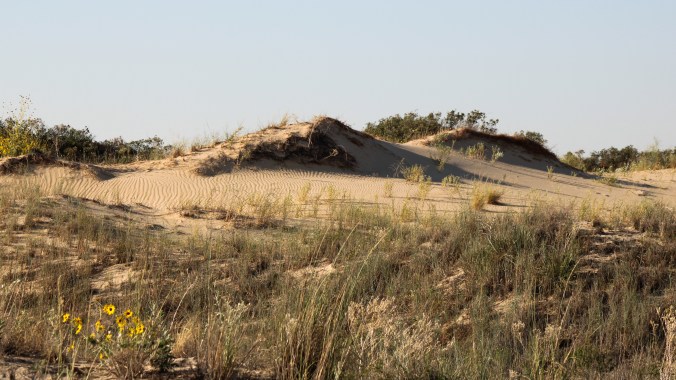
Sand dune/shinnery oak habitat in Monahans Sandhills State Park

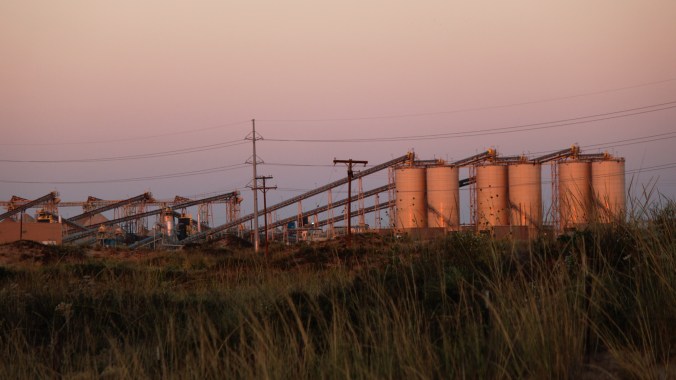
The beneficiaries of this, of course, are extractive industries. Loggers can log and the spotted owls just have to deal with it, because if nobody is shooting owls out of the sky, no harm done. In the Permian Basin of Texas, industries can go on mining sand for fracking, and the Dunes Sagebrush Lizard will have to learn to live on caliche roads and patches of remaining bare sand. I visited the area last year, writing about the Dunes Sagebrush Lizard for Green Source DFW. Researchers have found that this lizard requires very specific habitat that includes sand dunes and a low, shrubby oak species called shinnery oak. If you remove that habitat, the species cannot survive.

Over a year ago, the U.S. Fish and Wildlife Service listed the Dunes Sagebrush Lizard as endangered, but a loophole in the law allowed them to defer setting aside any habitat for it. (The Monahans Sandhills State Park provides some good habitat, but the whole park is only 3,840 acres.) The land in Texas west of Midland and Odessa is like a big outdoor industrial park crisscrossed with roads and sand trucks, sand mining sites in the spotty areas where dunes are found, drilling sites and the network of caliche roads connecting them. A lizard could look around in most places out there and see no direction home.

Sand mining operation near Kermit, TX

So, back to our analogy, if you were an endangered species, industry could come steal your roof, dig up your water pipes, and leave you with no food, water, or shelter, and according to the current regime you would be completely unharmed. To further quote Bob Dylan, “How does it feel?”

From a conservation biology perspective, it’s fair to say that all species depend on certain conditions to survive. The more they are habitat specialists, the narrower the range of conditions that they need in order to survive. That is, if they are adapted to very specialized diets or ways of living, they can’t just decide to be more flexible and live outside those requirements. The Dunes Sagebrush Lizard did not just decide it liked sand dunes and shinnery oak and would be annoyed if they couldn’t get them. Over a long span of time, generations of these lizards survived by making use of that habitat and only that one.

Regarding this proposed rule change, you can submit a public comment before May 19th here. I really hope that you will. With the Musk-Trump regime, it is too easy to conclude that since they don’t care what we think, it’s a waste of time. But that’s not quite true. They don’t care unless we speak up in large numbers, signifying a big wave of opposition that they cannot ignore. Enough of us, acting together and persistently, might still have an impact.

Also, giving up on telling them what we think reminds me of the first of Timothy Snyder’s lessons for resisting tyranny: do not obey in advance. Staying quiet teaches them the extent of their power, and it is also a kind of signal to our neighbors and friends that there is no point in resisting.

There are over 1,300 species federally listed as threatened or endangered under the Endangered Species Act, and a number of them occur in Texas (including the Ocelot, Mexican Long-nosed Bat, Golden-cheeked Warbler, Red-cockaded Woodpecker, Louisiana Pinesnake, Salado Springs Salamander, Comal Springs Riffle Beetle, Hinckley’s oak, Neches River Rose-mallow, and many more). I hope we won’t leave them “on their own, like a complete unknown.”

(Apologies to Bob Dylan’s “Like a Rolling Stone”)

“I Hope One Day They Will Be Protected”

Today I talked with a great group of kids at River Legacy Nature Center in Arlington. The twenty or so children were in a week-long “Hands-On Herpetology” class, having fun and learning about native reptiles and amphibians. I brought a few snakes and we talked about things like how they live as well as being safe when around them.

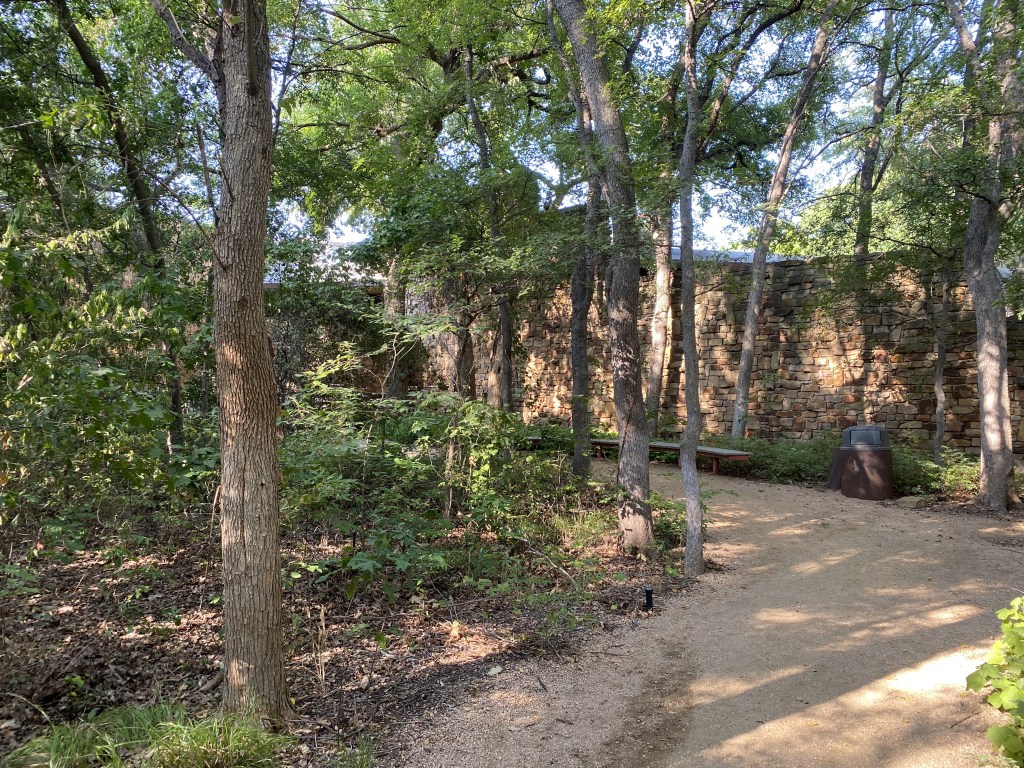
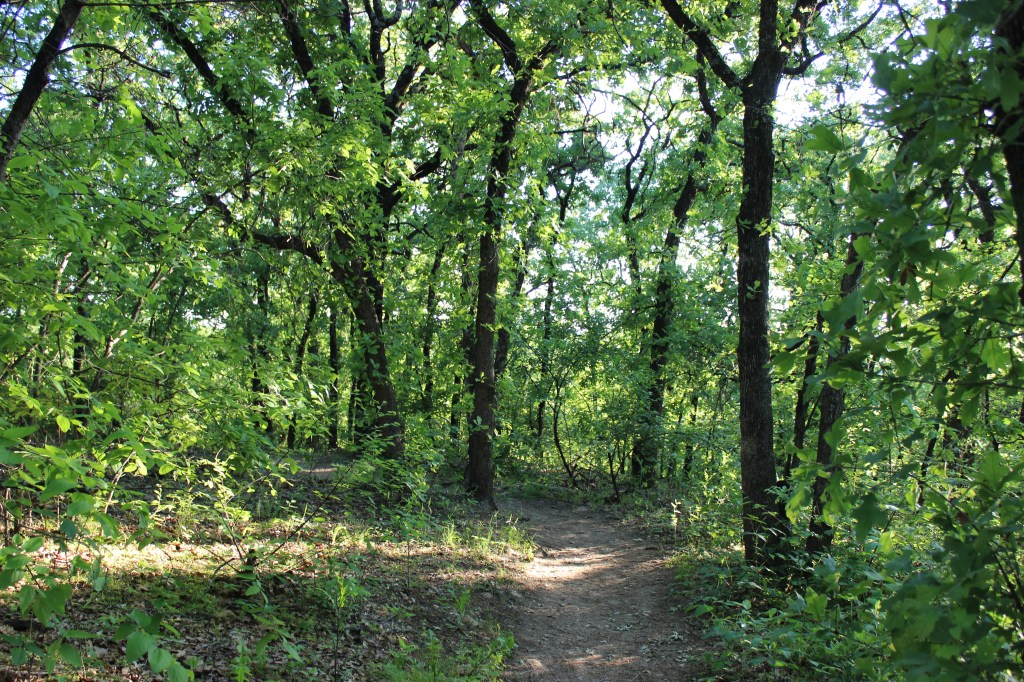
The trail approaching the River Legacy Living Science Center

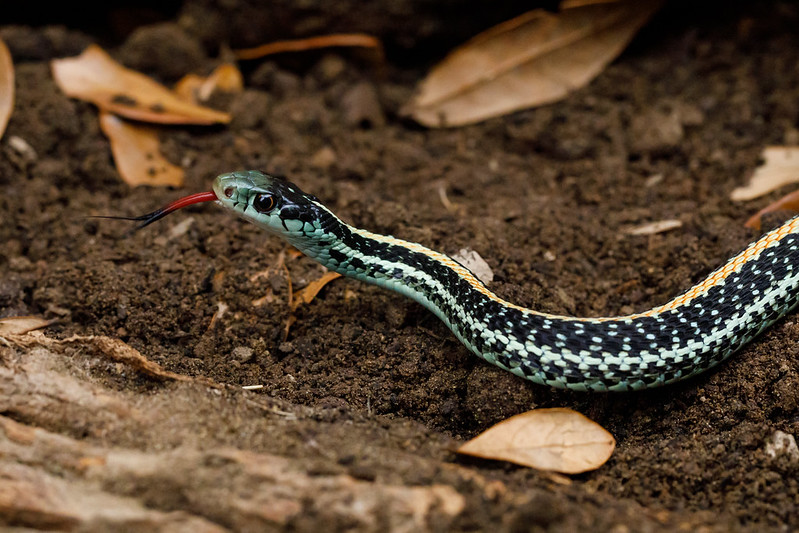
One of the snakes I brought is a Texas garter snake. He has a dark background color and three light stripes, big inquisitive eyes and an active, athletic build. We talked about how snakes with stripes generally rely on speed – and a sort of optical illusion – to get away from predators. The thing is that when “Tex” or other striped snakes move, it’s hard to see their motion. If they had spots, it would be easy to see the spots move as the snake’s body slipped away. The stripes, however, seem to stay where they are, until the stripes converge on the narrowing tail and then the snake is gone. The predator may be left empty-handed.

There’s a tendency for people to think of garter snakes as common “garden snakes,” but in the case of Tex it just ain’t so. He’s a member of an uncommon subspecies of garter snake whose fate is not well understood. The Texas Parks & Wildlife Department considers the Texas garter snake to be critically imperiled. It appears never to have been actually common, but there were places here and there (particularly within prairie habitat) in which they might be found at times. A recent study noted that despite trying to find these snakes in the field in 2013 and 2014, researchers were not able to find any. Tex is a long-term captive donated to me years ago by a landowner in Hill County so that more people might see and understand Texas garter snakes.

The Texas garter snake (“Tex”) – photo by Meghan Cassidy

My discussion about this was much more brief with the kids, but they got it that this is a snake that may be disappearing. When I mentioned that they are not legally protected, a girl commented, “I hope one day they will be protected.” Me too. I hope one day we will understand the reasons for the snake’s decline in more specific ways that allow us to protect it. And I hope we continue to have children who, when they learn about a species that is in trouble, want to protect it.

We talked about being safe when out in the field where there could be venomous snakes, and I showed the kids a prairie kingsnake and the young bullsnake that was a big hit with kids in Dallas earlier this week. The kids asked good questions and they already knew a number of things from their week at River Legacy. But nothing quite equalled that girl’s comment. It was an offhand remark that revealed her empathy or her capacity to care about a unique, lovely little member of the natural community. It made my day.

Dear Urban Hiker

We’ve spent way too much time in the house, binge-watched Netflix until we get pulled into the screen and sucked dry. We’re trying to get through a crisis where people are dying and others are wondering how they will make a living. Uncertainty and stress pile up, and we crave an escape from all of it. Some of the preserves and natural areas around the city are open – and your thought is: “put on the Nikes and grab the water bottles, let’s go!” I get it; those preserves and natural areas are places I want to go, too. I just hope we can use them in ways that let them survive in good shape.

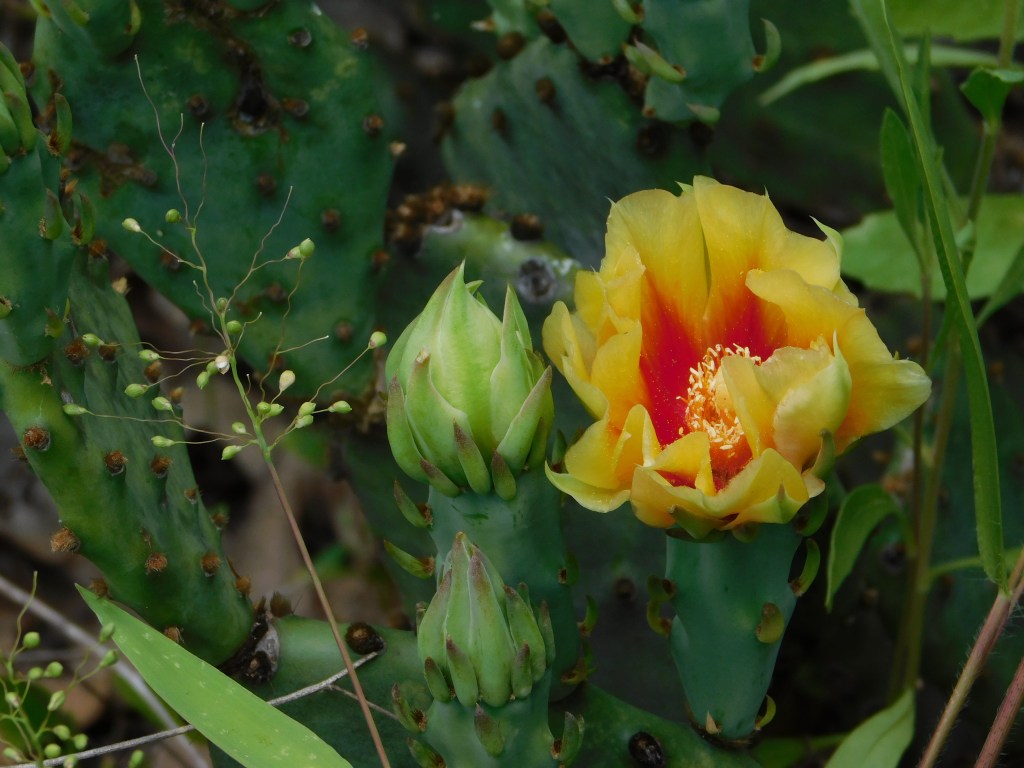
I watch you cut through the temporary fencing at the preserve so that you can take the short cut, climbing straight up the hill. You may not have noticed that this hill is composed of fine sand from the sandstone rock under the soil and exposed at the top as a scenic ridge. The oaks, yuccas, vines and other plants hold that sand together and create a thin soil. It is enough to support the cacti, wildflowers and other plants, but your footsteps break through that thin network holding the sand together, and the wind and rain wash it away. That happens later, and you do not see the consequences of your short cut, so it seems OK to you.

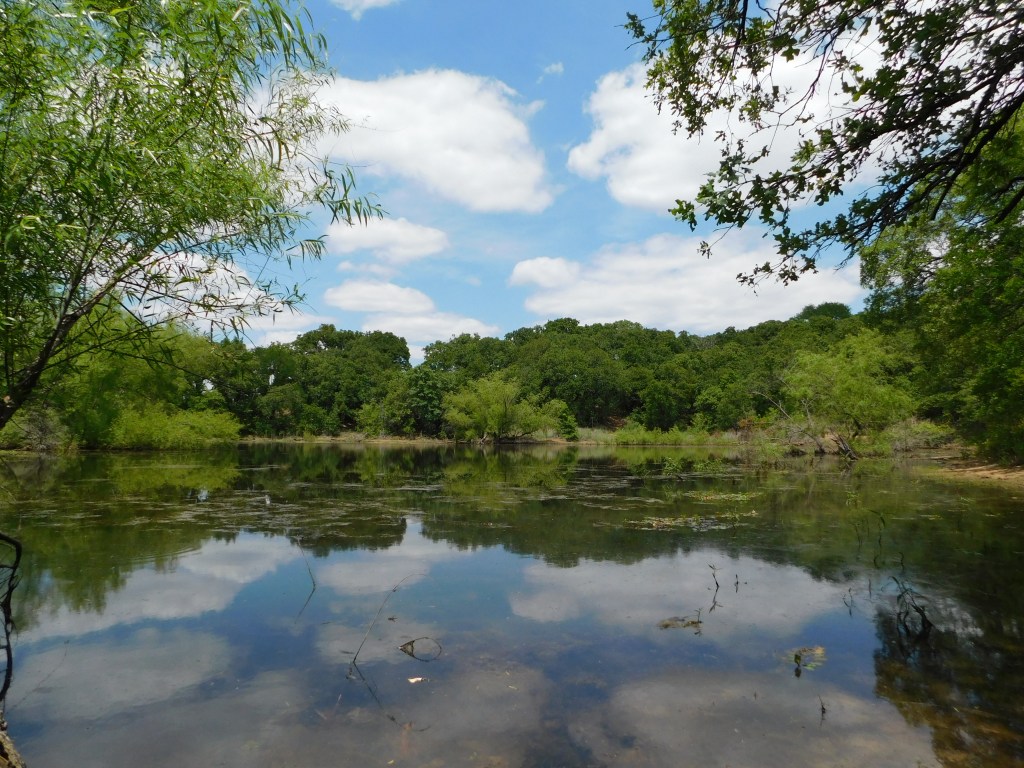
I also see you fishing at the ponds, maybe showing your child how to bait the hook and wait patiently for a bite. Sitting quietly with someone you care about, taking in the sights and the feel of the breeze, that is a wonderful experience that every child should have. I sure wish that you could bring a small trash bag with you, because the fast food wrappers and bait cups should not stay behind once you have left. It would also teach responsibility and thoughtfulness if you would pack out that broken fishing line and the floats and bobbers that we see caught in the shoreline vegetation. Small animals often get tangled in that fishing line and strangle or starve. This also happens later, and so again you do not see the consequences of what you leave behind.

We visit these places for a variety of reasons, and I know that this is OK. One of my reasons is to watch birds and other wildlife. Even urban preserves can support a good number of animals, from the cardinals, doves, and hawks in the air to lizards on the tree trunks, frogs on the banks of the ponds, and sunfish in the water. When your group passes me on the trail, loudly talking about the topic of the moment, I wonder if you know what we all just missed as the wildlife scatter. Keep in mind that I know you have the right to jog along the trail or amble along in social groups (although during this pandemic I very much wish that you would stay some distance from each other). Once you pass, I’ll wait for the wildlife to re-emerge. Lately, though, as everyone visits the preserves, it is more challenging because sometimes there is little break from the stream of hikers.

We all get to make use of these places, and I do try (I promise) to remember that different ways of using them can be just fine. Some of the things people do, though, are not so fine. Let’s compare some ways of visiting parks and refuges. Some visitors come for a little diversion and a workout opportunity, and going off-trail, moving  or destroying barriers, and ignoring signs asking people to stay on the trail seems like no big deal – “rules for other people, not for me.” For some it is a pleasant place to bring their burgers and onion rings, and since no one thought to station trash cans along the trails, what can you do but toss the Styrofoam cup and food wrappers into the woods. Who wants to carry a handful of trash for the rest of their walk?

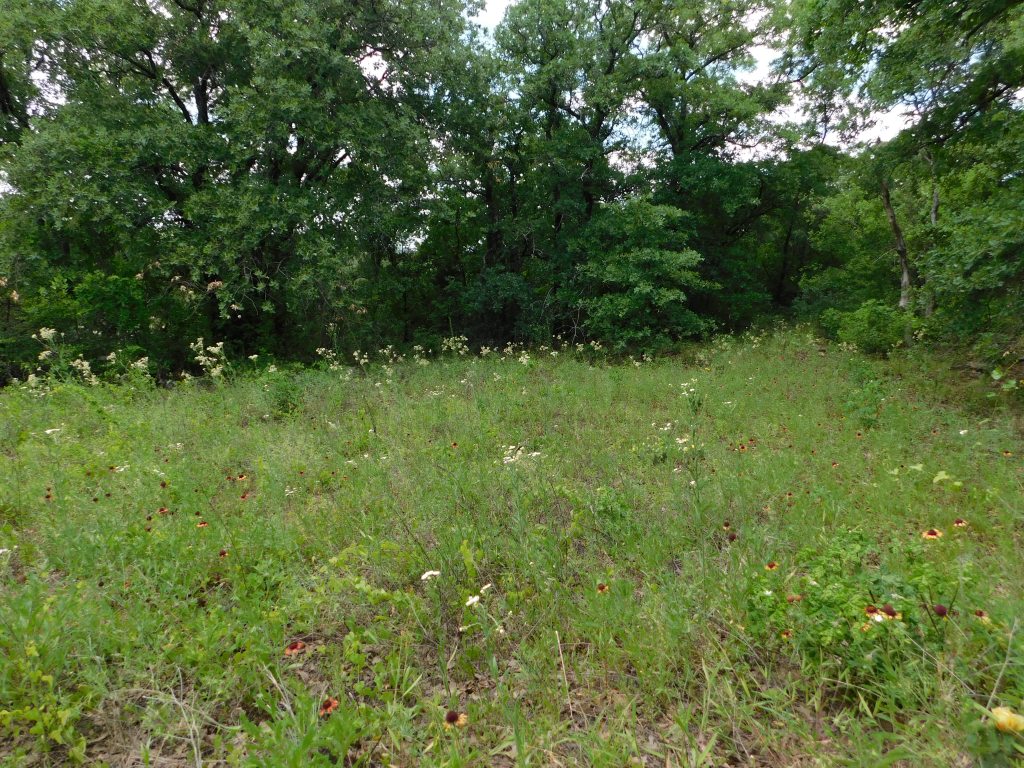
Other people come for exercise in beautiful surroundings, with a commitment to leaving the place like they found it. They may jog through the place without stopping to look for birds or flowers, but they stay on the trail. Others might come for the solitude – or relative solitude – of a walk through a woods or prairie. They may be birdwatching, or might be looking for particular plants or flowers, or some other part of the natural world that has survived the surrounding city. You might pass these people sitting quietly somewhere or squinting through some binoculars. Chances are they are not interested in taking short cuts, and they know that they should not go off-trail to see some particular plant or animal.

The two uses of preserves and parks – one as a momentary convenience and the other as a place valued because of relatively undisturbed nature – are not the same. That “relatively undisturbed” part is the key. Users who trample the plants and create erosion, paint or carve graffiti, or litter, those folks are using the preserve up. Each visit brings the place closer to just some urban vacant lot, although the process is very gradual so each discarded cup, each carved initial, each off-trail excursion seems like no big deal. There is much less damage from the other users who walk or jog along the trails, pack out anything they bring in, and leave the place just like they found it. Yes, the noise and presence of people may make wildlife more scarce, and even foot traffic on trails can do a little damage. But these are impacts from which nature can recover.

So, my friend, here’s what I ask, respectfully and in the hope that we can all use the lands that belong to all of us: please leave it like you found it, and please visit in ways that allow others who are present to use it too. You are in an uncommon and wonderful place, and the slower and quieter you are, the more you are likely to discover that. Quite often you are getting a glimpse of what the surrounding area used to be like before the land was settled and developed. You can get a look at things that are in many cases being lost to us. They are disappearing in our minds and in our imaginations, and often they are disappearing literally, in terms of numbers. So when you are there, remember that we get to use it but we do not get to use it up.