The morning of July 25 was very mild compared to the afternoon’s heat. It was a great morning for a group of about 14 kids and several adults to take a walk in the wildscape of a local Montessori school. I hoped that these mostly fourth through sixth-graders were ready to playfully explore the nature of their wildscape, and they were more than ready.
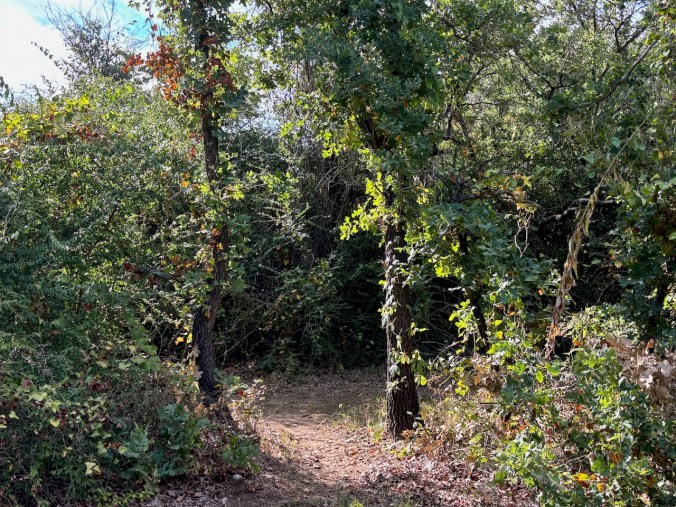
Like a gateway – to Terabithia?
They knew the place better than Marylee and me. We were nominally in charge of leading the group and teaching about nature, but these kids would have been happy to have led the get-acquainted walk. They, or their predecessors at the school, had named the places within it: the Dark Forest, the Ranger Circle, Maria’s Meadow, and other spots within this little fragment of Eastern Cross Timbers woodland and prairie.
It’s such good news that the kids had named it and made it their own, that their school had this delightful patch of wildness and let each new group of kids belong in it and get to know it. So our role would be to help them get more deeply familiar with it, more acquainted with the lives that live there.
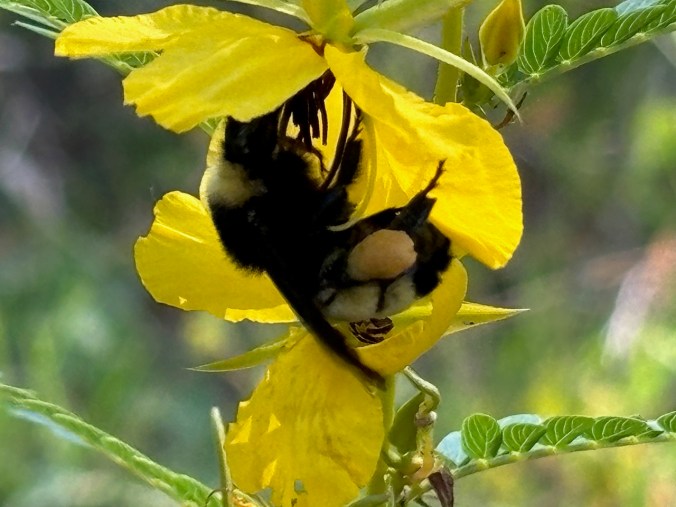
An American Bumblebee, feeding from a Partridge Pea
More acquainted with the bumblebees, for example. When everyone gathered in a circle around the old stump and we talked about likes and fears in nature, the dislikes were primarily spiders, snakes, and bees (which closely mirrors the things in nature that most nature fears are focused on). So when the group came to some flowering Partridge Pea that a bumblebee was feeding on, we didn’t pull back. We also, of course, did not swat at or otherwise make the bee feel that it was under attack. Any doubters might have seen that the bumblebee ignored us, even though I was pretty close.
This is an adult funnel-weaving spider, seen at Sheri Capehart Nature Preserve. They are all just as shy as the little one we found on our walk, and if one were to bite us, the bite is not medically significant.
Speaking of spiders, we came upon a small one in the low branches of a bush, within her web. One of the kids suggested that it was probably a wolf spider, and I agreed that the overall look was kind of like one of those. But, I commented, wolf spiders don’t trap prey with webs, they just chase down what they eat. This one’s body and web made me think of a young funnel-weaving spider, and just as I pointed toward where I thought her funnel was, she quickly scuttled down the hole made by her web.
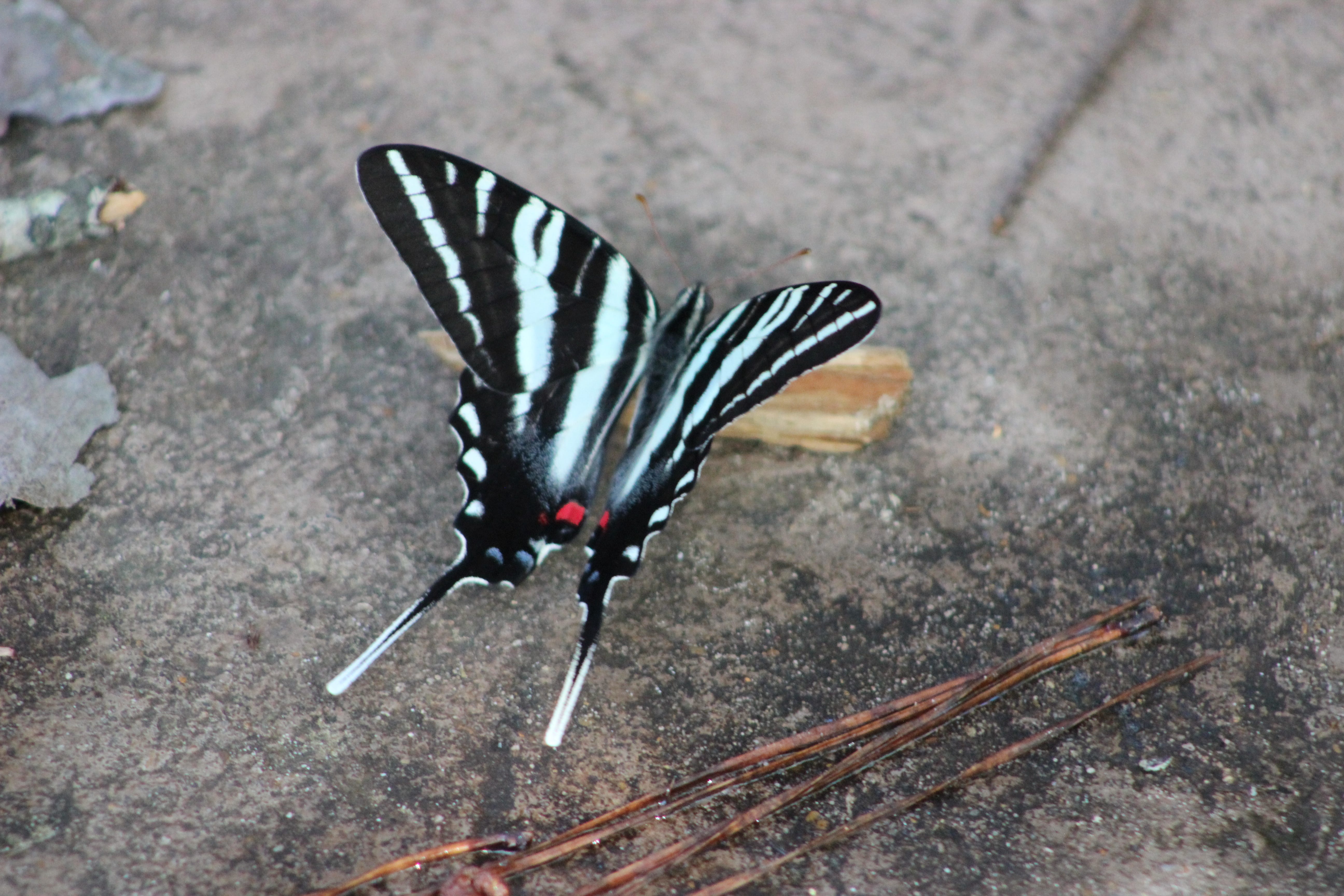
We found and heard a lot that everyone could appreciate without overcoming a fear or aversion that they had been carrying. Bird song – especially from Northern Cardinals – rang out through the woods, and plenty of plants were still flowering. We found a butterfly and one of the boys looked for the extension of the hindwing that would make it some kind of swallowtail. (I noted to myself, “they know about swallowtails, how wonderful!”) It was a Gulf Fritillary, and when I asked if butterflies like this benefit us in some way, the kids quickly answered, “they’re pollinators!”
Did I mention that it was a real treat to be with these kids?
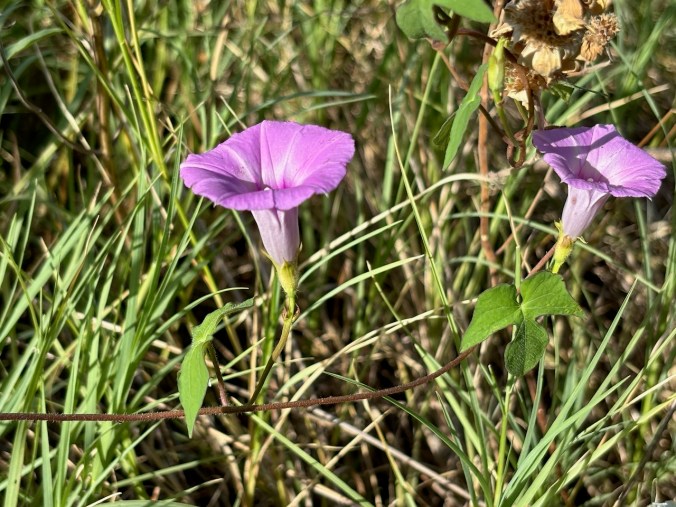
Flowers of Tievine, a type of Morning Glory, seen in the prairie patch
As we walked down the trail, I saw a telltale squiggle in the short grass at my feet. It was familiar enough that I dropped down immediately and tried to gently pin this little lizard so that we could have a look and then release him or her. It was a small Little Brown Skink. They already live up to the name – they are little and they are a coppery, two-tone brown, and this was a young one. I had it pinned briefly but could not get to where I could pick it up without risking breaking off the tail. And so it got away.
And that raises an interesting question: how much interference with nature is acceptable in a discovery walk such as this? It was important to me not to accidentally make the lizard lose its tail, but is it OK to catch wildlife? There is a kind of hierarchy of permissibility regarding what you can catch and handle. It runs up and down the phylogenetic ladder. We wouldn’t catch mammals, or birds like those Northern Cardinals. But starting with reptiles and amphibians and continuing through fish and then insects, it seems alright to most people. Catching frogs and bugs seems normal. And maybe that’s because many of them are harder to get a good look at unless we catch them. Frogs hop away, and so do grasshoppers. Also, briefly capturing them or scooping them up in a net can be pretty easy much of the time.
I wanted the kids to see the lizard I was talking about, but being captured is stressful. I make the assumption that briefly capturing such an animal for the sake of teaching, and then immediately releasing it unharmed, is completely fine. We want to teach kids compassion and respect for the lives they find out here (and anywhere), and so I’m open to revisiting and re-thinking this question.
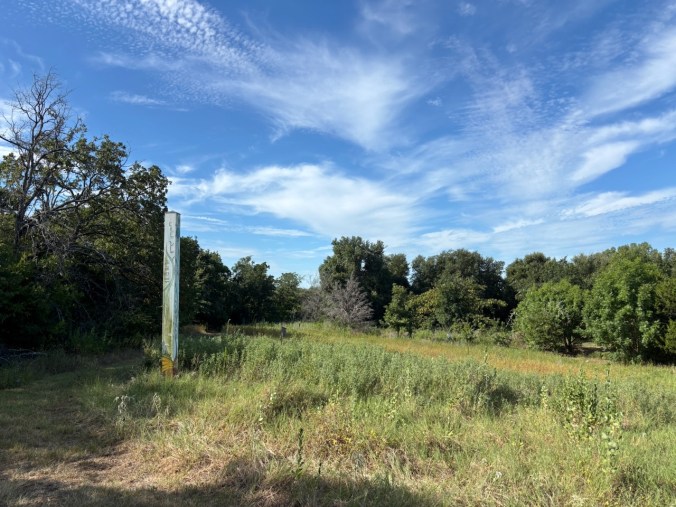
The Prairie
In a world in which most kids can recognize far more fast food logos than wildlife or plants, it was wonderful to be with these kids, who said at the end that they want to do more of it. It looks like Marylee and I will lead walks here about every four to eight weeks in the coming school year. We will get to know the wildscape through the seasons, and I look forward to all the discoveries we will make.
A lot of parents hope that their kids will enjoy being outside and maybe even become “nature kids” – the kids that love the trees, water, grasses, bugs or birds, and may have familiar and beloved places in nature. Some other parents have kids who, on their own, have become interested in nature and love getting out. Such parents may be willing to support their child’s interest. I screwed up my first attempts, but have better ideas now that I’d like to tell you about.
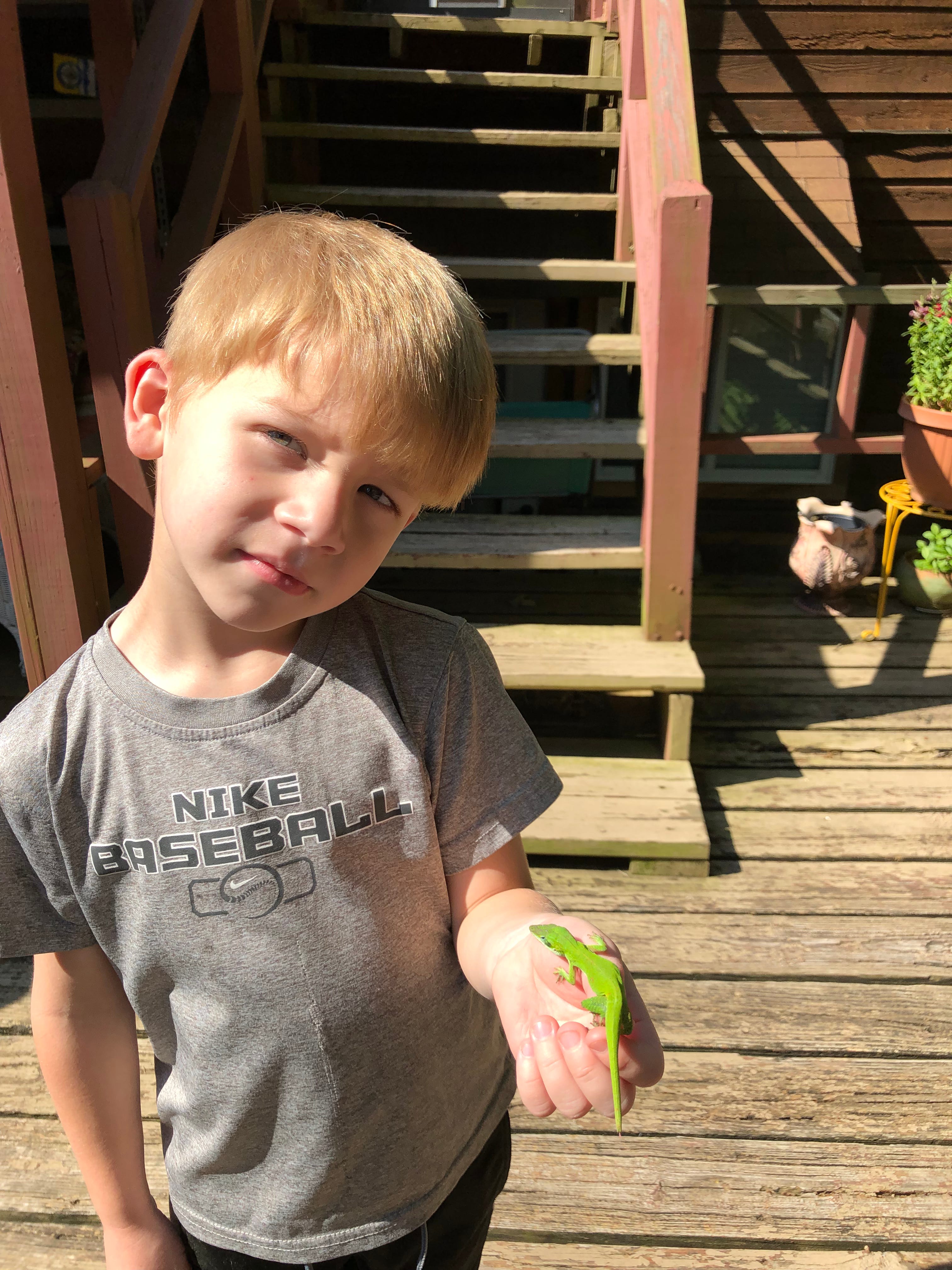
Elijah, holding a green anole
Like many other parents, I hoped my son would enjoy being in nature and even be a partner with me in exploring the woods and creeks. All these years later, I understand some things better than I did then. What is wonderful to me may not be attractive or interesting to someone else. To share an experience or a place with someone, it is important to be tuned in to how they will experience it. These ideas will seem obvious to you, and thirty years ago those ideas – put into those words – would have been obvious to me, too. But sometimes I was blind to their meaning.
So here’s what I did that may have sunk any chances of my raising a nature kid. When he was five, I took my son to the creek that meant so much to me when I was growing up. He rode on my shoulders through the tall grass, and then we walked the limestone creek bed where water trickled and gathered in pools. I turned over a piece of wood to find a couple of plain-bellied water snakes hiding beneath. They are harmless, so I grabbed for them and caught one.
For someone with a serious interest in field herpetology, “harmless” means “this snake is going to bite you if you pick it up, but there is no venom and it only leaves scratches.” Others might not necessarily agree that “harmless” is the right word, but there it is. Geoffrey was not thinking the snake was harmless as it repeatedly bit my arm and drew blood. I got control of the snake’s movement and it stopped thrashing, and Geoff’s eyes were wide with fear. I was clueless enough to offer to let him touch the snake somewhere away from its head.
“No-o-o-o-o-o,” was the answer.
I hadn’t bothered to ask if he wanted to find a snake, and then had not paid attention to how he was responding when I did find one. I was very mis-attuned to my son and too focused on what was a wonderful experience for me and thus I thought surely would be for him. Geoff tells me that he would not have become a nature kid regardless, but I’m sure this experience did not help.
Maybe if I had talked with him before our walk to see what he would like to get out of it, or at least prepared him for how it might go if we found a snake. And maybe if he shrank back as I discussed it, I would know that it’s better to just walk around the creek and not look for snakes this time. You would think that my Master’s degree in psychology would have told me this.
At a later point in my career, I was trained in parent-child attachment relationships and a program called the “Circle of Security,” a way for parents to pursue attuned, secure attachment with their children. The “circle” is a graphic that shows us as the secure base from which the child goes out to explore and grow but also comes back in for reconnection and help.
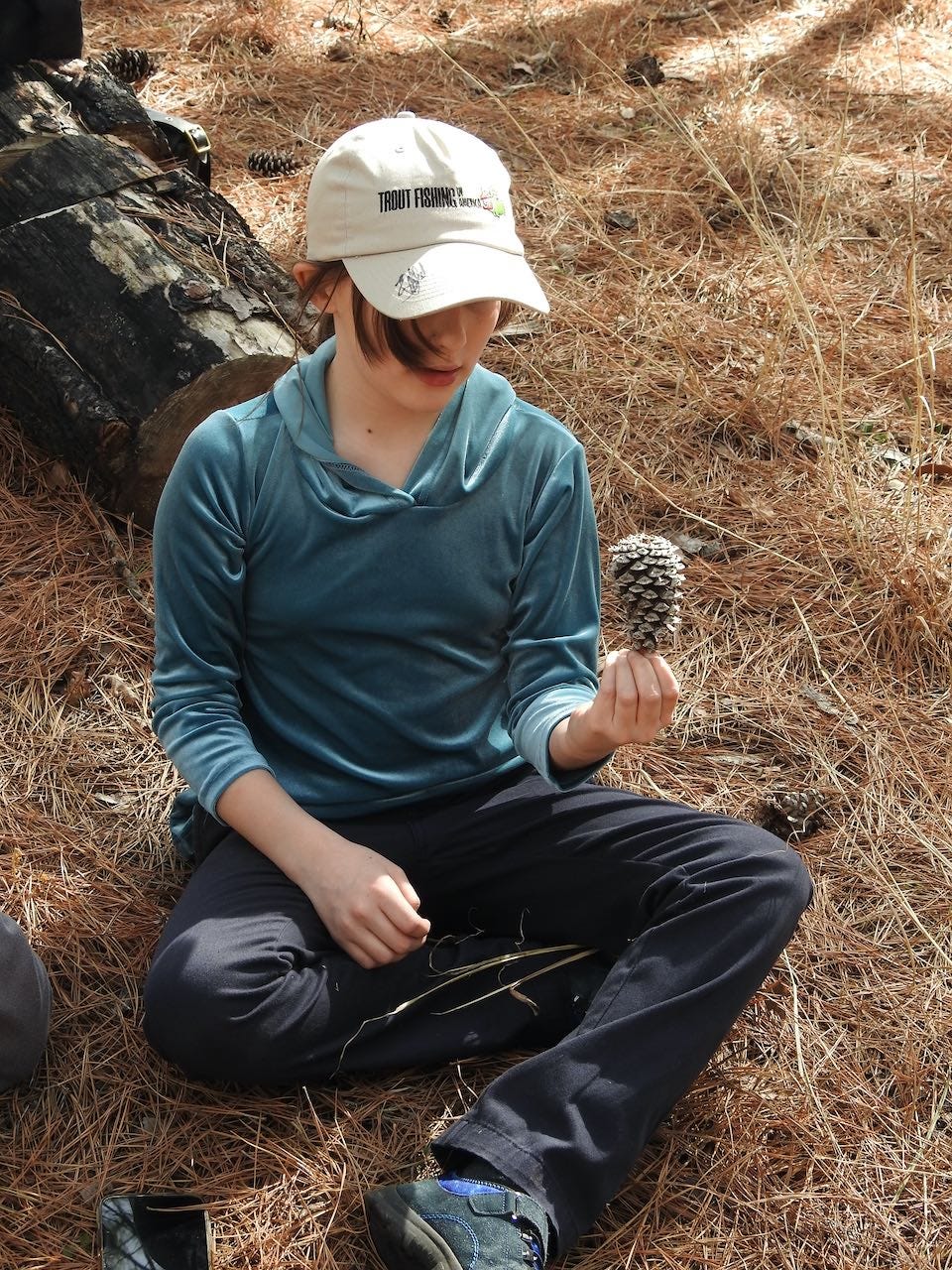
Sarah, examining a pine cone at LBJ National Grasslands
Having a secure relationship with someone means we work to be reliable partners for each other, whether we’re a parent with a child, two close friends, or a married couple. We try to respond to each other’s emotional cues and act in the other person’s best interest, and when we screw up, we try to fix it. We can take delight in each other without being overly controlling, but we can also step in and be protective when needed. We wish we could succeed at this all of the time but we never perfect it. There are mistakes in the relationship from time to time, and what counts is how we repair it. The cycle of rupture and repair can strengthen relationships in ways that perfection probably could not.
Early research on attachment involved mothers and babies or very young children, but the themes follow us into adulthood. Our relationships, how we trust others, how we maintain (or don’t maintain) boundaries with others, and how we handle conflicts, tend to reflect to one degree or another how those early relationships worked. And so these ideas are very relevant to our parenting of school-aged children and beyond.
Much of the Circle of Security approach seems relevant to encouraging children to spend time in nature. We surely don’t want to make it a battle, as if to say, “You’re going to march right out there and hang out with the birds, or you’re grounded!” I don’t think it works out well to make it a chore, a sort of outdoor homework in which we say, “Stop having fun, it’s time for nature; and remember, there will be a quiz afterward.” No one would really say that, but you know what I mean.
So what can happen when we take children to the prairies and woodlands? We can support their exploration while watching over them, staying closer when they’re younger and giving them more independence and space when they are older. We can give help when it is needed and genuinely wanted, and also enjoy the experience with them. With Lilly’s earliest walks in the woods, I stayed very close but I generally followed her lead. When she stopped to play in the sand of the trail, I stopped with her. I’ve taken older kids who also wanted to play in soft sand, and I’m happy to stay nearby and watch that happen. Once I joined an elementary school-age girl who was throwing a few small branches and sticks into a pond and describing the results, in one case creating a small wave in the water “like an angel’s wing.”
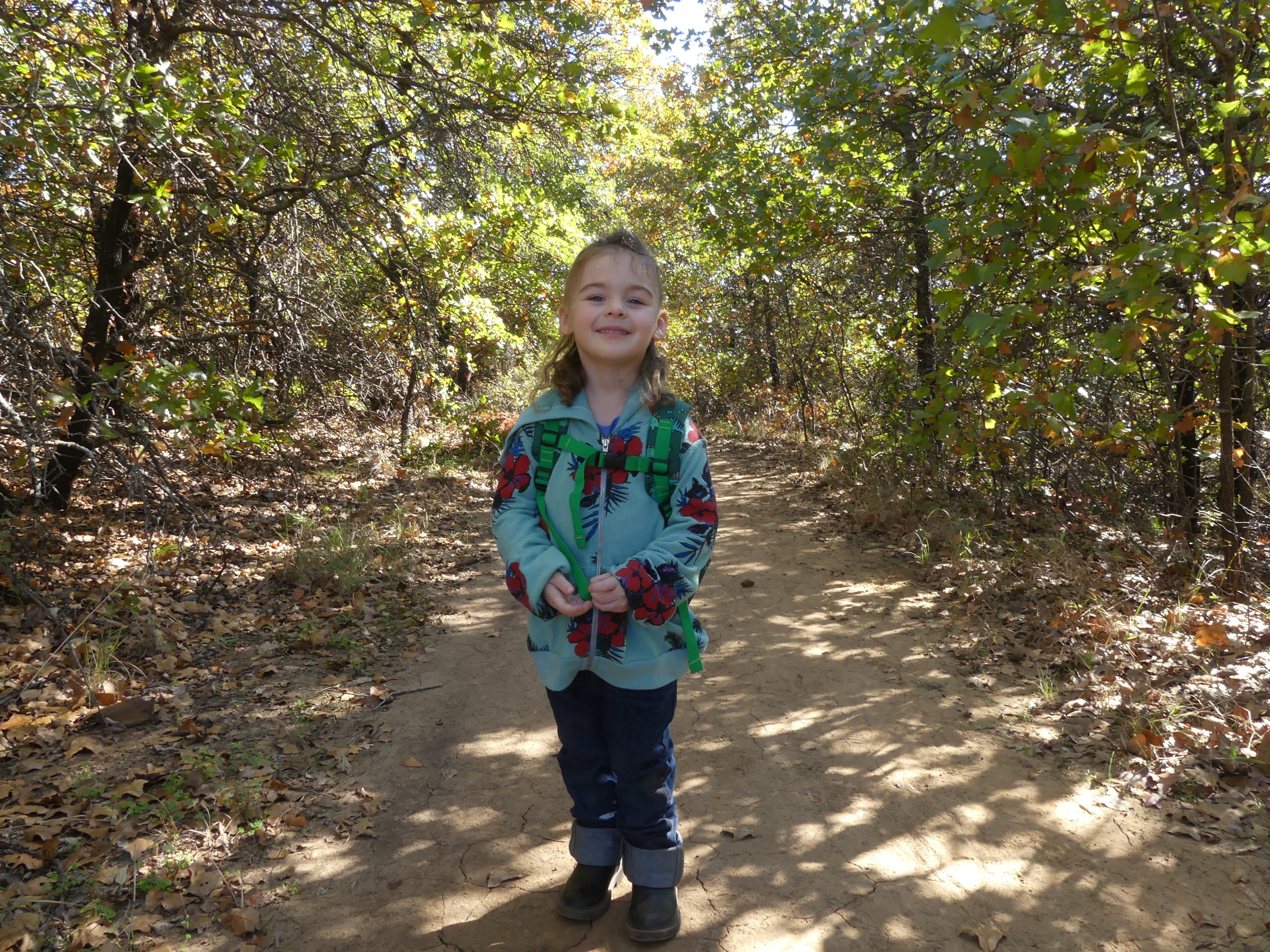
Lilly on a walk in the woods
In Circle of Security terms, these are things that happen on the top half of the circle, when the child is playing under our watchful eye and sometimes needing us to delight in what they are doing. It doesn’t all have to be free play; we can and should offer ideas and help. We can engage kids in some structured activities or games while in nature. But it helps if some of that time in nature involves following the child’s lead, and if our time in nature feels like something that we create together.
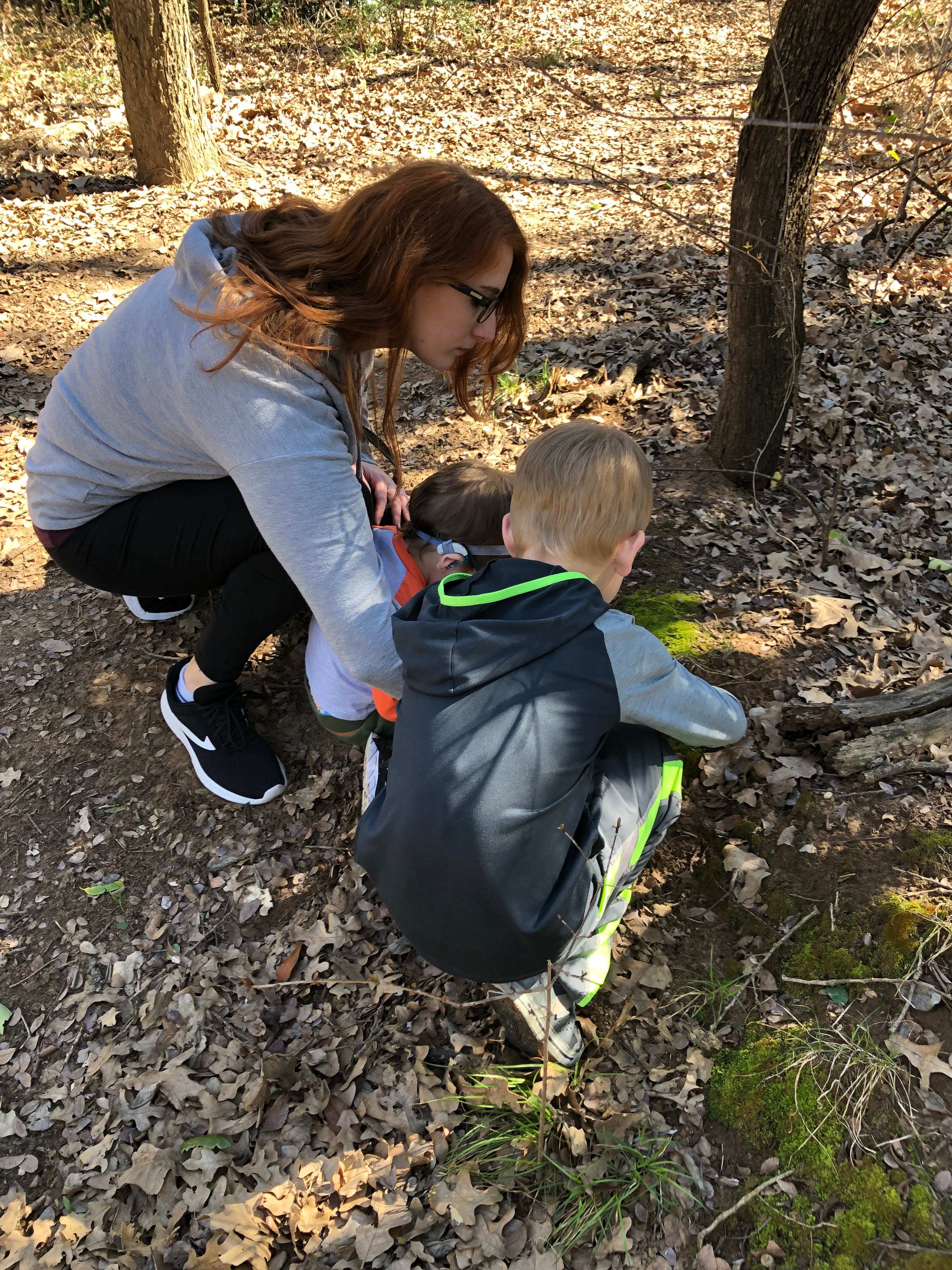
Kelby shares a moment of discovery with her kids
What about the bottom half of the Circle of Security? That’s when the child needs to return to you for support, to take out that splinter or reassure them that the bee that’s buzzing around isn’t trying to attack. Or maybe when the younger child falls apart in frustration or the older child has a conflict with another child. It might be when she or he is getting near some place that could be dangerous, and we have to step in and set limits. In Circle of Security terms, it’s when the child needs us to welcome them, protect them or comfort them, and help them manage overwhelming feelings.
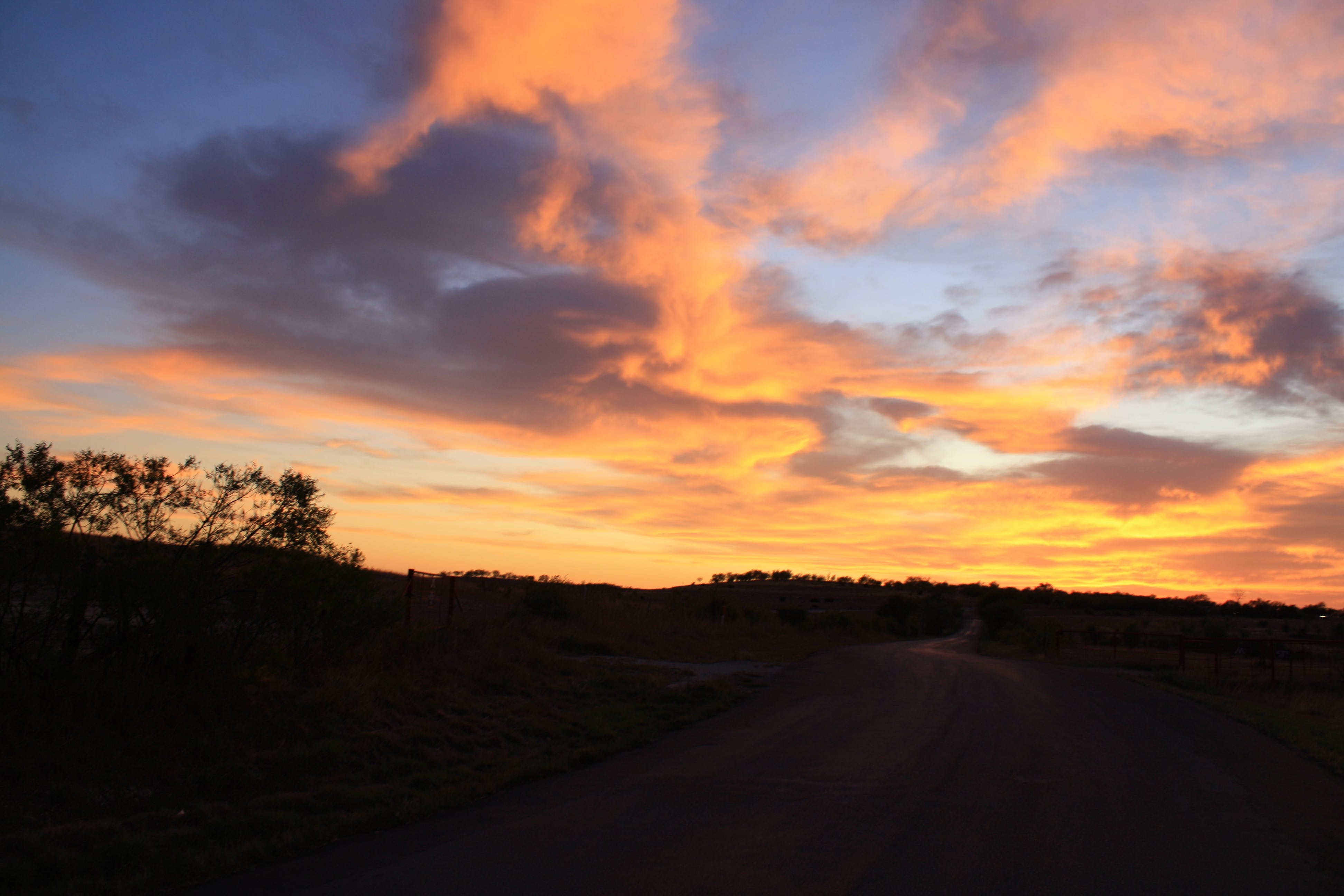
There are always hazards of some sort. Not long ago I stopped Lilly just before she walked into a patch of cactus. I took a group of people on a walk at sunset at LBJ National Grasslands (no young children on that walk). Copperheads are fairly common there, and I prepare folks accordingly and would set limits on risky things like walking around barefoot at such times. Coyotes began to yip and howl in the darkness, and a little reassurance was needed for one of the participants. These are all moments that occur on the bottom half of that circle, in which the other person wants to reconnect or needs help or limit-setting.
The helpful phrase that the program taught us was, “Always be bigger, stronger, wiser, and kind.” We are bigger and stronger in the protective sense – with four-year-old Lilly I will hold her hand as we cross an elevated walkway and would not let her fall. With young children it is also protective when, if necessary, we pick them up and move to a safer or quieter area in the middle of a tantrum. We also aim to be wiser in the sense that we decide when we can follow their lead and when it is necessary to step in and assume control. It takes wisdom and self-awareness to avoid using our strength just to “show them who’s boss.” And kindness is that crucial ingredient that can make the bigger and stronger part not frightening and (at least sometimes) not escalate emotions into a fight.
Taking kids out into nature needs the right blend of following the child’s lead, offering ideas, and making the outing a working partnership between adult and child. It also requires judgment and protectiveness on our part. If we can be a secure base for children, as described in the Circle of Security, and remember to be bigger, stronger, wiser, and kind, we will all benefit.
I published this post at Rainlilies.substack.com but wanted to make sure you could see it here.
I want to lead one or more groups for older children, walking through our woods and prairies, finding wonder, and feeling at home among trees and grasses. I have taken parents and children on walks like that, and I often lead groups of adults out into one or two of our nearby nature preserves. What is the attraction, for me and more importantly for the kids, in doing such a thing? Is there some benefit other than learning a couple of facts? And will kids want to go along on such walks?
Some of you will have read one or more of Richard Louv’s books (Last Child in the Woods and The Nature Principle are the ones I’m familiar with). If so, these questions and their possible answers are not new to you. Louv came up with the phrase “nature deficit disorder,” not as an actual diagnosis but as a way of talking about how children used to spend more time in nature and would benefit from doing that again now. I agree wholeheartedly.
I’ll offer myself as an example, and maybe I’m representative of how a lot of kids might benefit. In the 1960s, on most days during summer break I was at the creek or at a museum in Fort Worth. My parents took me to the museum for their “Natural History Club” because I had developed an interest in snakes. From there I was introduced to the creek and its harmless water snakes, ribbon snakes, turtles, frogs, bluegill sunfish … and the list could go on. I got acquainted with armadillos, spotted skunks, crayfish, and copperheads, with friendly guidance (and hands-off supervision with those copperheads) from John Preston and then Rick Pratt at the museum.
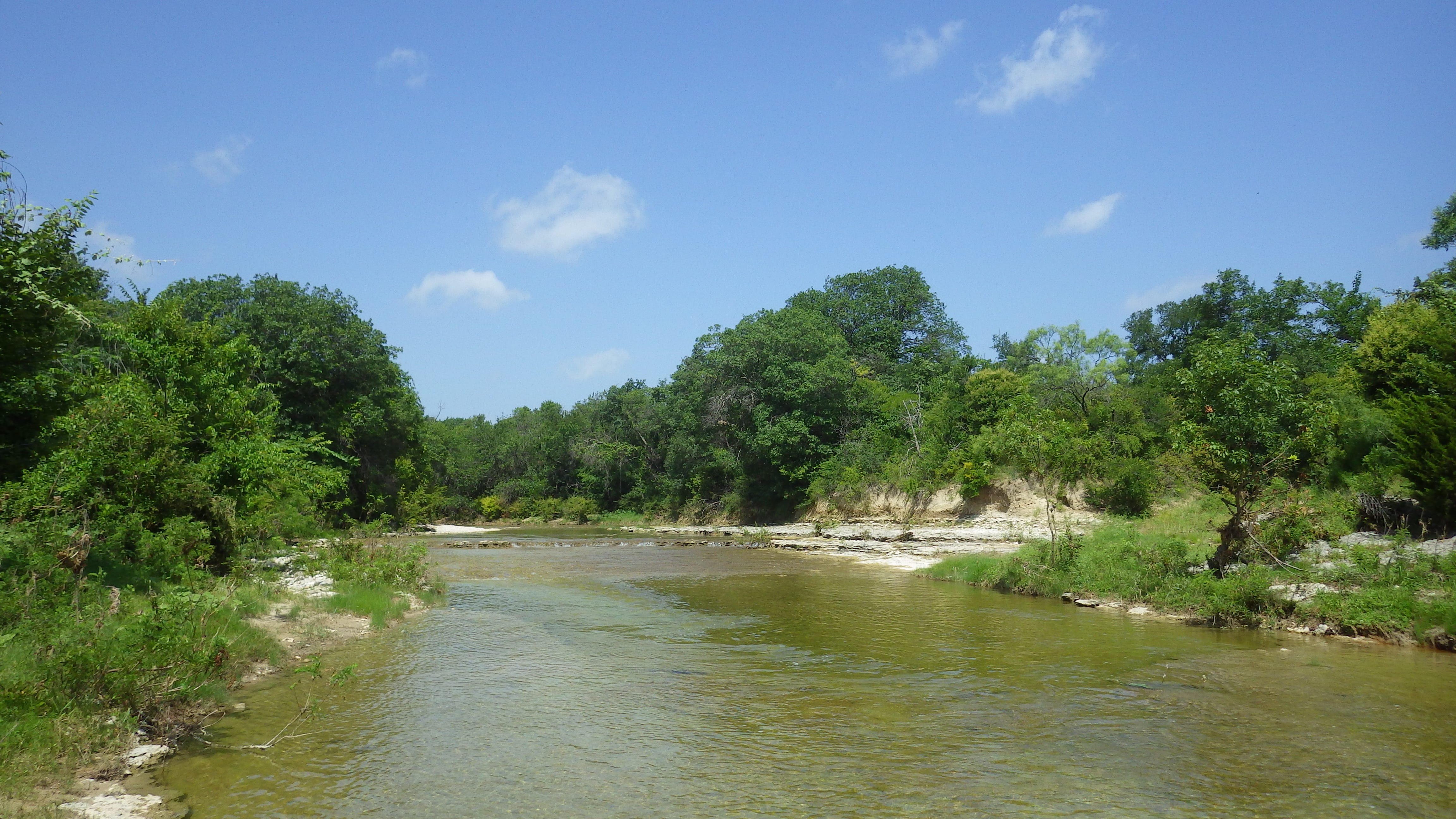
At the creek
And so I was outside in nature somewhere quite a bit, either on field trips with the museum or with friends in some nearby place. After a time, I felt most at home in the prairies, woods, and wetlands of North Texas. My home with my family was fine; I was not escaping from anything. It’s just that being outside in nature was familiar and felt safe and free with something new and fascinating around each bend in the trail. I knew how to wade or swim, where was safe to climb up a hillside and not fall, and how to investigate a hollow log or rock ledge without getting bitten or stung.
In other words, I became physically competent in those places, developed problem-solving and creative skills, experienced wonder, and had a few homes away from home that I could always count on, regardless of the ups and downs of school and society. Do those things seem important? They meant the world to me.
Some people would say that the world has changed so much that those experiences are now unworkable and maybe dangerous. And it is true that in the last fifty years, kids’ freedom to explore neighborhoods and parks on their own has been restricted by loving parents guarding against malignant strangers, traffic, and any number of hazards. Richard Louv makes the case, with logic and statistics, that we have overreacted. Others agree with him, but even if we wanted to return to the way it used to be, we’re not sure how much to ease up and still be responsible parents.
And so I would like to see kids have some supervised time in nature in which exploration and discovery can take place in a small group. It would not be freewheeling like some of my days at the creek, but more like the museum outings in which an adult could not only offer some guardrails but also help interpret and explain what we were finding among the trees, grasses, and ponds.
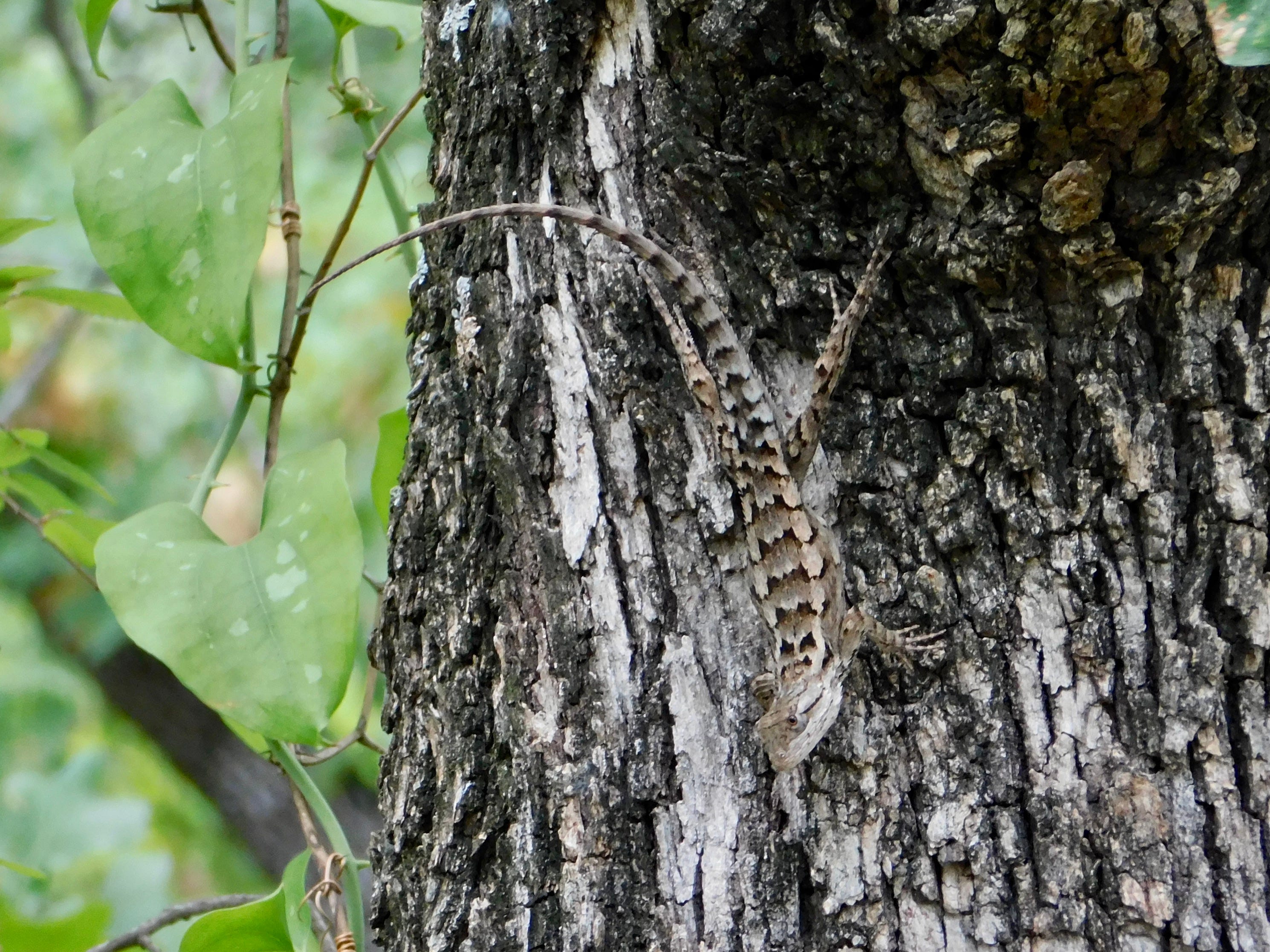
Texas spiny lizard on an oak tree
A growing number of studies have explored how time in nature benefits our bodies and minds. Many of them document lowered blood pressure and other cardiovascular benefits. Some show decreases in the stress hormone cortisol, and some document boosts to the immune system. Another gift from nature concerns how our attention systems can be restored. One group of researchers emphasizes how our executive attention, keeping us on task and dealing with multitasking, can become exhausted in today’s world. The kinds of experiences we have in nature turn out to be very good at letting that part of our attention system recover.
Further benefits have been documented in mood and stress. After walks in nature, people often experience improved mood and less ruminative thoughts (the angry, guilty, or shame-based thoughts that can get stuck in an endless loop). Anxiety may be diminished.
Such benefits are needed by a lot of our kids. A 2023 survey of kids in grades 9-12 showed 39.7% of those children with persistent sadness and hopelessness, and 20.4% had seriously considered suicide (this was a CDC study you can find here). That is, on average, one in five kids in those grades at some point thinking in a serious way about killing themselves. Another study found that between 2016 and 2020, there was an increase in anxiety and depression among kids up to age 17, as well as decreases in exercise and in the emotional well-being of parents. Those unfortunate trends with the children were occurring before the Covid pandemic began (this was in a JAMA Pediatrics study you can see here).
The benefits of nature are there for anyone, and may be especially helpful for those who struggle with stress, anxiety, or a number of other issues. I’m not suggesting it is a cure-all, and it’s no substitute for therapy when the issues are severe, but it can make a difference.
The walks I would like to lead for older kids, just like the other walks I currently lead, would not be offered as therapy. Their purpose would be to make a healthy life richer and fuller, and to make health challenges less likely.
Would kids want to go on such walks? To some extent it depends on kids’ comfort level when out in some place that is a little bit wild, and whether the walk includes fascination and active discovery. A lot would depend on children’s interests, preferences, and temperament. I’ll explore that question below.
Is Nature Boring?
After writing about my interest in taking older kids on nature walks, I said I wanted to follow up on was whether kids (or adults) would stay engaged and interested, or might they become bored. How do people maintain their interest and stay “present” to what nature offers? Let’s start by considering what nature does give to anyone who notices.
Every place in nature offers multiple levels of beauty and fascination, whether in the delicate, concentric rings of a shelf fungus, the color and structure of flowers, the call of a bird, or the flowing, muscular movement of a snake moving among rocks and fallen branches. Being fully present means noticing as much as we can and not being distracted by external things that can wait. When we bring knowledge and understanding to what we are experiencing, we may know that the fungus is helping return wood to the soil and that the color and shape of flowers is to attract pollinators like bees, wasps, and flies. One thing connects to another and another, and there is so much to imagine and think about.
Equally important, we can wonder about things that we don’t yet know. How can the snake coordinate movements to push forward and not just thrash around? Can all those pollinating insects see the flower’s color (and maybe some of the light spectrum that we cannot see, like ultraviolet)? Later, we look for answers that will add to our understanding.
Our adaptable brain
Does spending time in nature sound like a good idea except that it would be hard to stay focused and not get bored? If so, you (or your kids) would not be alone. We are a society of multitaskers and screen-watchers. We live at a time when working two jobs (just two?) may be necessary and our phones are with us everywhere we go. And our brain adapts to our habits and activities. If we live a life of constant input and multitasking, that builds a brain that expects it and even wants it.
Imagine all those neurons firing in response to rapidly shifting stimuli and a flood of information. And here’s an insight from neurology and psychology: “Neurons that fire together, wire together.” The parts of the brain that get lots of use become stronger, while areas that are not used a great deal have fewer connections. If our brain is wired for high stimulation, then in quieter times we may feel bored and restless, as if there’s not enough going on.
If you would like to be able to slow down when you are in the woods or at the pond, there is some good news – the brain can change in the other direction, too. The brain has the ability, called “brain plasticity,” to rewire itself in response to patterns of stimulation and activity. There are limits to this plasticity, but to some degree, our restlessness might begin to decrease if we practice being still and noticing things while in nature. A good strategy is to start small and easy, and find ways to make it enjoyable to notice things. Sometimes games like nature-based scavenger hunts may give kids or adults a structure for focusing on nature.
Attention
To talk about boredom we need to talk about what seems like its opposite – paying attention. When we notice something, choosing that thing to look at or listen to and letting everything else become background, we are paying attention to it. We may shift our attention often or we might stick with it for a while if we have a long enough attention span. There is some reason to think our attention spans are becoming shorter. I wonder if that is related to the fast-paced, multitasking lives I referred to above.
We can think of paying attention as a skill which develops during childhood. For example, by kindergarten age, most children can sit through fifteen minutes of circle time or listen to a couple of picture books, and by grades 4 or 5, they can usually spend between 30 and 60 minutes in homework (as reported in Dawson & Guare’s Smart but Scattered, 2009, Guilford). It is up to us to meet the child where s/he is for age and ability, and to encourage the child in a positive way.
Does it take effort to pay attention? Yes. Researchers describe two types of attention – one that requires effort to direct our attention and shut out distractions, sometimes called “executive attention,” and another that seems to respond pretty effortlessly to some things that are inherently interesting or attractive. Stephen Kaplan and his colleagues say that our executive or directed attention becomes exhausted and needs opportunities for recovery. Their research says that nature can play a role in this. What we experience among trees, water, sunsets, and such things offer what Kaplan calls “soft fascination.” That uses a kind of attention that is not particularly effortful and does not trigger the executive attention system to concentrate on something to the exclusion of other things.
Boredom
“Bored” can mean different things at different times. Sometimes “I’m bored” is what we say when we would like things to move faster in a more interesting way. At other times “bored” is probably about our preference for something different – “what’s going on is not what I wanted.” Boredom is a signal that we are not finding what is in front of us to be meaningful, and so we need to either change our surroundings or else see if we can discover meaning in our surroundings.
Sometimes a feeling of boredom is about brain chemistry. When we see something we like, or hear something interesting on television, or successfully respond to a challenge, our brain gets a little bit of dopamine, which feels good. If nothing is happening, maybe nothing is stimulating the release of this “feel good” neurotransmitter. Since dopamine is linked to pleasure and reward, when it gets low we may feel like nothing is fun, things seem gray and blah. At its worst, when we are stuck in boredom our mood may become depressed or irritable, we become impatient, and we might also feel slowed and drained of energy.
Is there anything at all good in being bored? Maybe. If we can respond to boredom by finding something meaningful and useful in our situation, we become better at coping with boredom. Lacking something to do may be a helpful trigger for us to learn to be flexible and creative. And that would suggest that we should not always rescue children from boredom. Maybe we can support them in finding other ways to respond to the surroundings that currently seem boring.
Temperament
Each person is a little different when it comes to their need for stimulation and activity. Some are more restless and become bored more easily than others. These qualities are, to one extent or another, part of who we are over the years. One person may be more adaptable while someone else is more rigid. We all know people who are outgoing and comfortable with some risk, just as we know people who are more inhibited and cautious. These things are part of our temperament. And so it’s not surprising that some people find it easier to sit quietly and take in their surroundings, while others seem to need shifting, high-energy stimulation or else they become bored.
Even these relatively stable traits can shift when the person is motivated and regularly engages in practices that can bring about change. A person who is ordinarily restless can become more comfortably still and quiet, at least to some extent. To work on this, it is best to start by choosing easier and shorter activities with lots of points of interest. If a parent tries to enforce more challenging activities as a required lesson, hoping the child will somehow shift from uncomfortable compliance to joyful engagement, they are likely to be disappointed. We have to start by meeting them where they are.
Emotions and trauma
A history of trauma, anxiety or depression sometimes makes it harder to be quiet and contemplative in nature. Being in a new place and simply taking in the experience might feel unsafe, like waiting for something to happen. Sometimes people feel that constant distractions help shut out troubling thoughts, and if they get quiet it opens the door to let all those worries and memories in. Such discomfort can also change with practice and time, but each person has to decide what their tolerance is and what support they need in order to venture into what might seem like unsafe territory.
In situations such as those, there is a need to consider whether psychotherapy can help. In my earlier post I mentioned that time in nature is very often helpful for depression and anxiety, but not necessarily a substitute for therapy. A person for whom trauma, depression, or anxiety are issues could think about how to create enough safety for nature to be the comfortable and secure refuge that it can be. Maybe it’s taking someone along for quiet companionship, or maybe it’s choosing the right spot, weather, and time of day.
The bottom line
Every person has a different level of comfort, interest, and motivation to do things that are quiet and involve paying attention. The capacity to pay attention (vs. experience boredom) changes with age and development, and it also varies according to the person’s inborn temperament. These things can change to one degree or another, especially if the person is motivated and they experience some success and enjoyment when they work on it.
Time spent in nature can help recharge our attentional abilities as well as lower stress, anxiety, and depression. However, it is important to respect a person’s interests and capabilities. I never want to take any child or adult on a walk if they don’t want to go or the demands of the walk will be higher than their ability to benefit from it.
I would like very much to hear your thoughts about this. Maybe you’re a parent or relative, or maybe you’re a kid with a point of view about what you like or do not like about nature. You can reply to this post and tell us what you think!

 Our Lives In Nature