Rumors of Winter

After the warm days of October and November, now we are seeing a bit of cold with a first freeze (barely, in some places) yesterday morning. And it is December now; in the “meteorological” way of tracking seasons, winter starts on December 1st. Most of us use the winter solstice, December 21st this year, as the boundary between autumn and winter, but North Texas is at least hearing a few rumors of the winter to come. And that calls for a walk somewhere, putting our ear to the ground to listen.

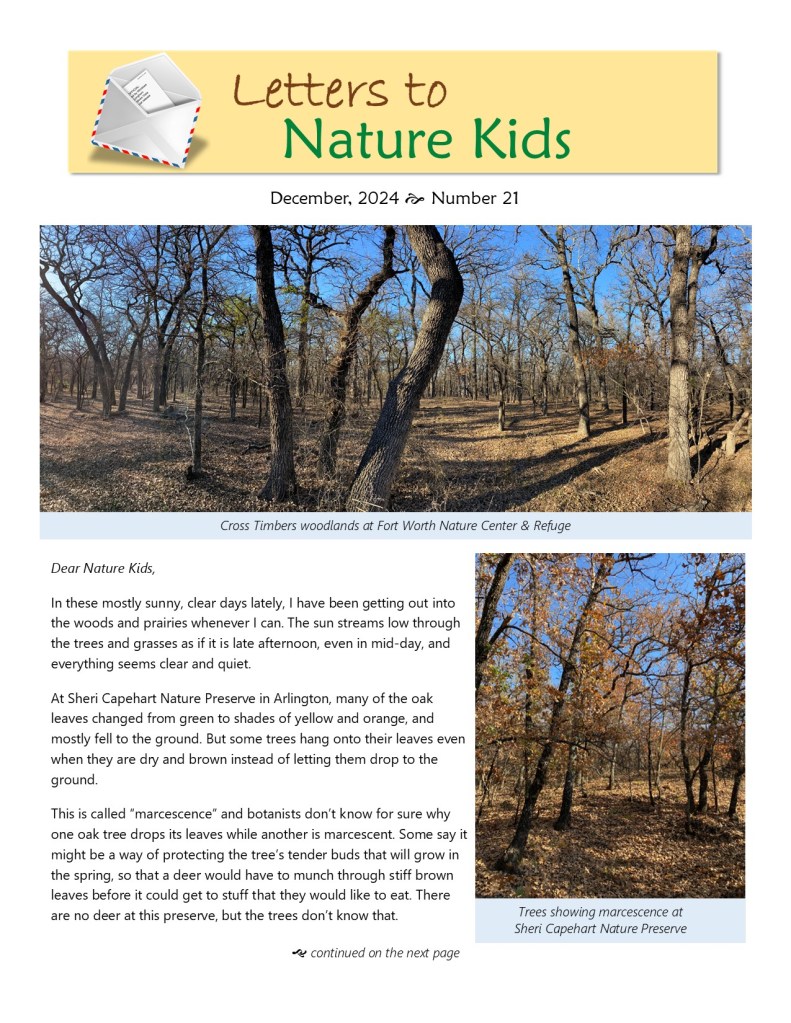
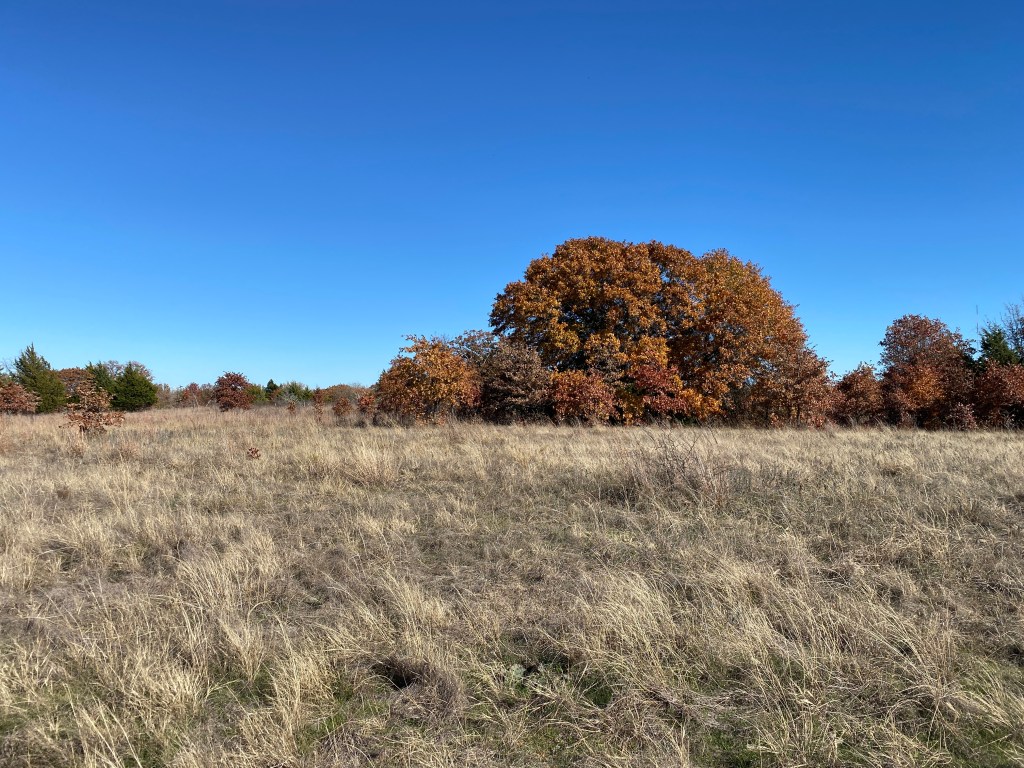
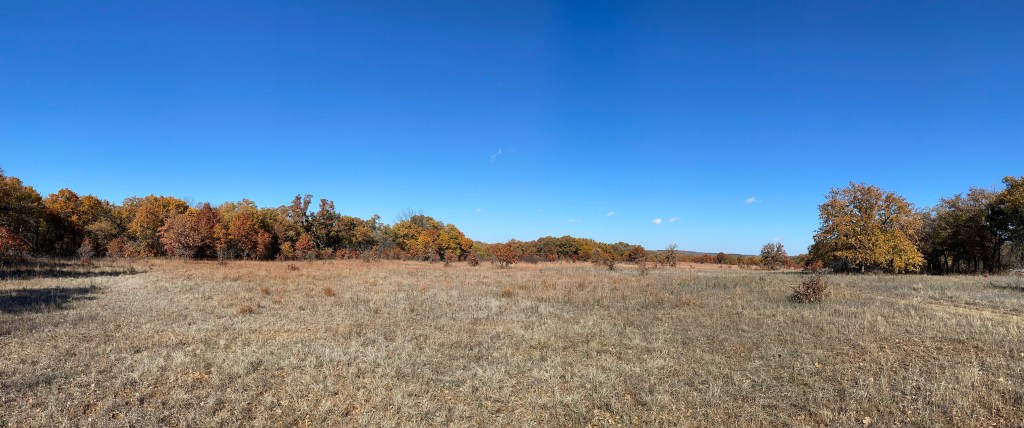
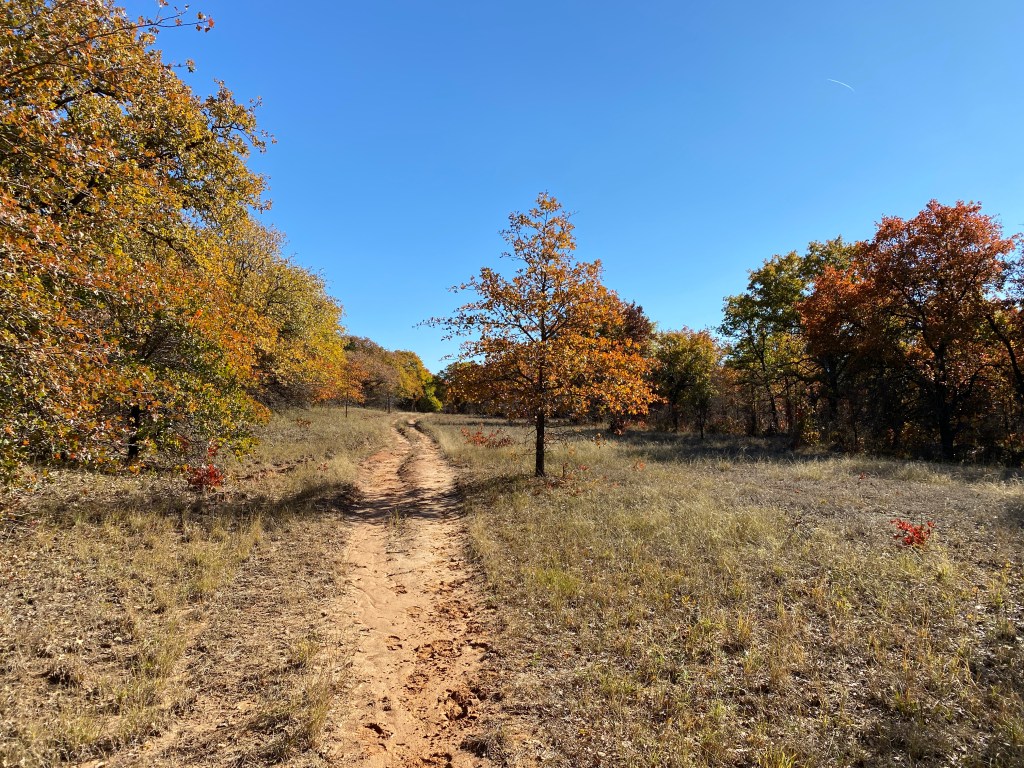
I walked at Sheri Capehart Nature Preserve, eastward along the “yellow” trail near the big pond and then turned and walked up through a tangle of woods to the “blue loop” and back toward the boulders. It was 63 degrees, a jacket needed only when the breeze blew. The place was full of sun and damp sand, native grasses going dormant and a coolness that balanced the sun perfectly.

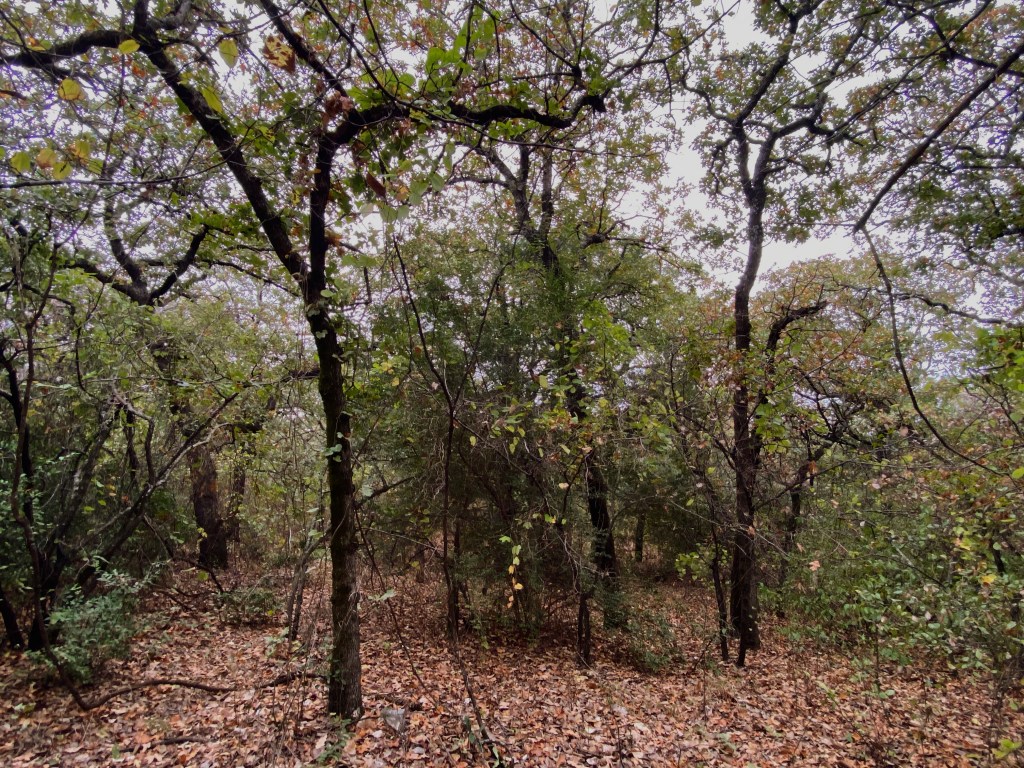
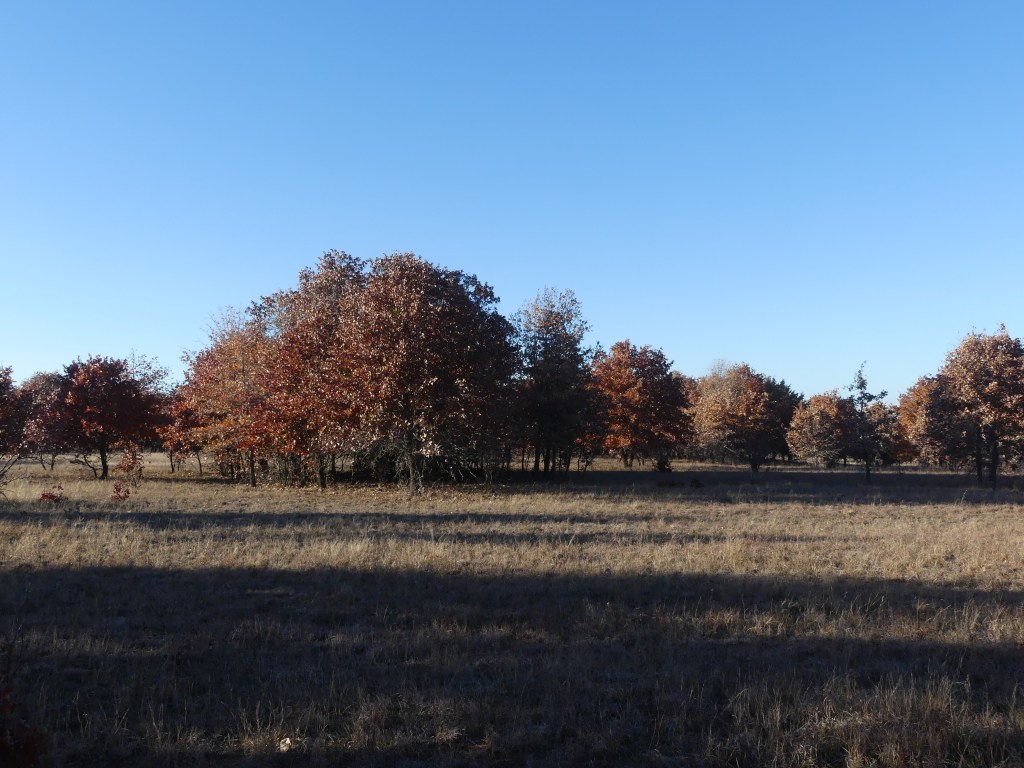
In my journal I wrote “Phenology Note” on a sketched calendar page, and made a few notes about the trees and leaves. “The trees are still mostly leafed out and green. Many oak leaves are tinged with caramel …. Some trees look ragged but we’re still waiting for autumn color and/or leaf drop.” Back near the parking lot, many of the cedar elm trees are becoming bare, but the oaks seemed barely touched by autumn.

Phenology is the study of seasonal events in nature, and so looking back through a nature journal can show how the seasons change from year to year in a place. What’s the average time when trees lose their leaves, and how much is climate change pushing such events to new places on the calendar?

Some caramel color or a tinge of red in leaves that are mostly still green

Using a journal in that way puts me in the mode of science and data, my thoughts separated from emotions about climate change as if severed by a scalpel. But journaling can – and I think should – be more than intellectualizing. On a good day I’ll make room in those pages for what I miss from a time when life was anchored by things you could count on. Winters could be hard or they could be mild; summers might vary in how hot or dry they got; but after whatever variation in the weather, we always returned to an arithmetic mean, an average that we all recognized as something we could count on. But now the math isn’t our friend, and the arithmetic mean is shifting upward and we don’t know what we can count on.

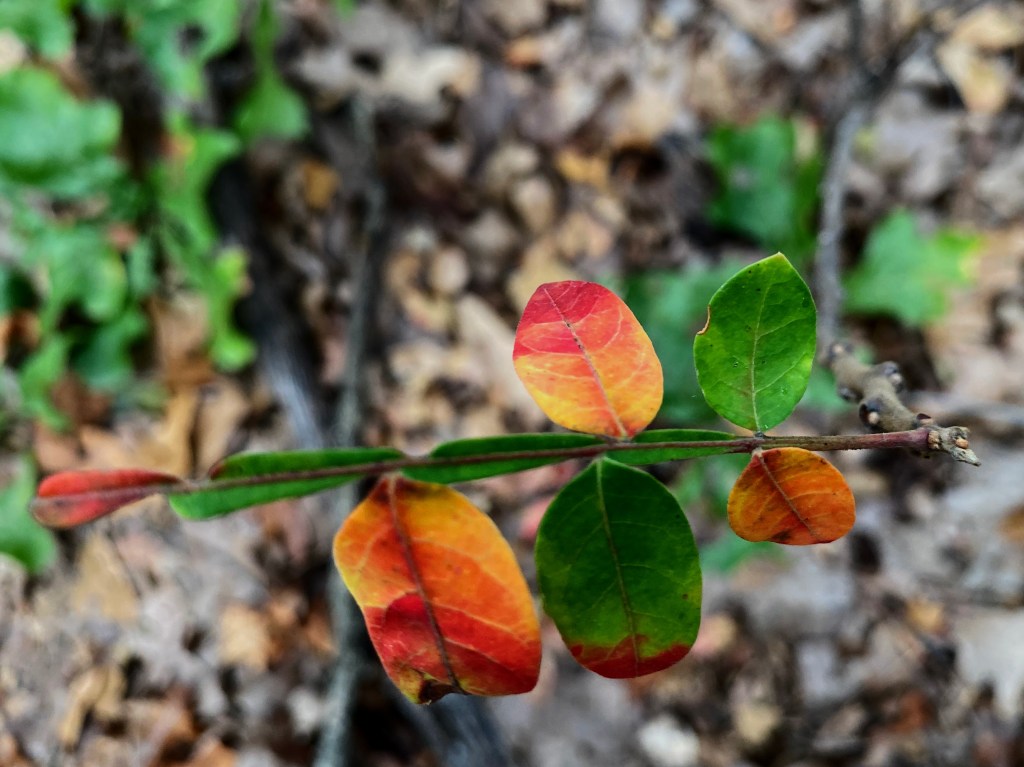
I kept walking, looking and listening for wildlife. A one-minute sample using the Merlin app detected no sounds of birds. I did find a delightful grasshopper resting on a leaf turned nicely red. Uploading a photo to the nature app iNaturalist, the insect was identified as a “mischievous bird grasshopper.”
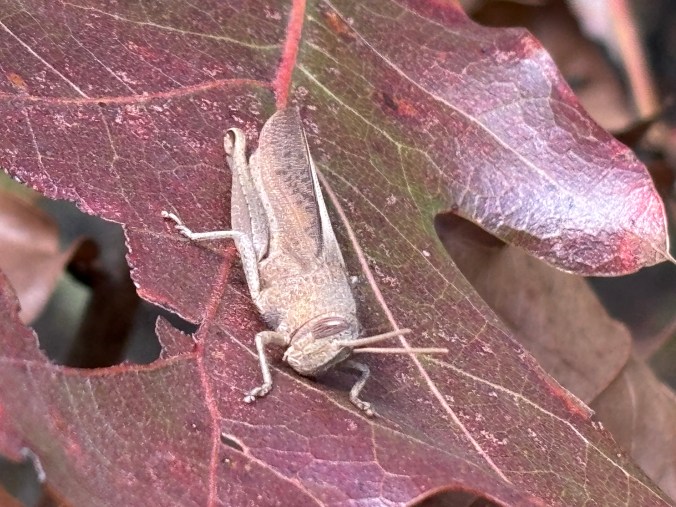
The mischievous bird grasshopper

Now this was a find – what kind of mischief does this sort of grasshopper get into? This particular one was sitting motionless, perhaps too cool for tomfoolery and just feeling lucky to have survived yesterday’s freeze. Adult grasshoppers often don’t survive winter except as eggs deposited in some protected spot, although with increasingly mild winters, more adults like this one might get lucky.
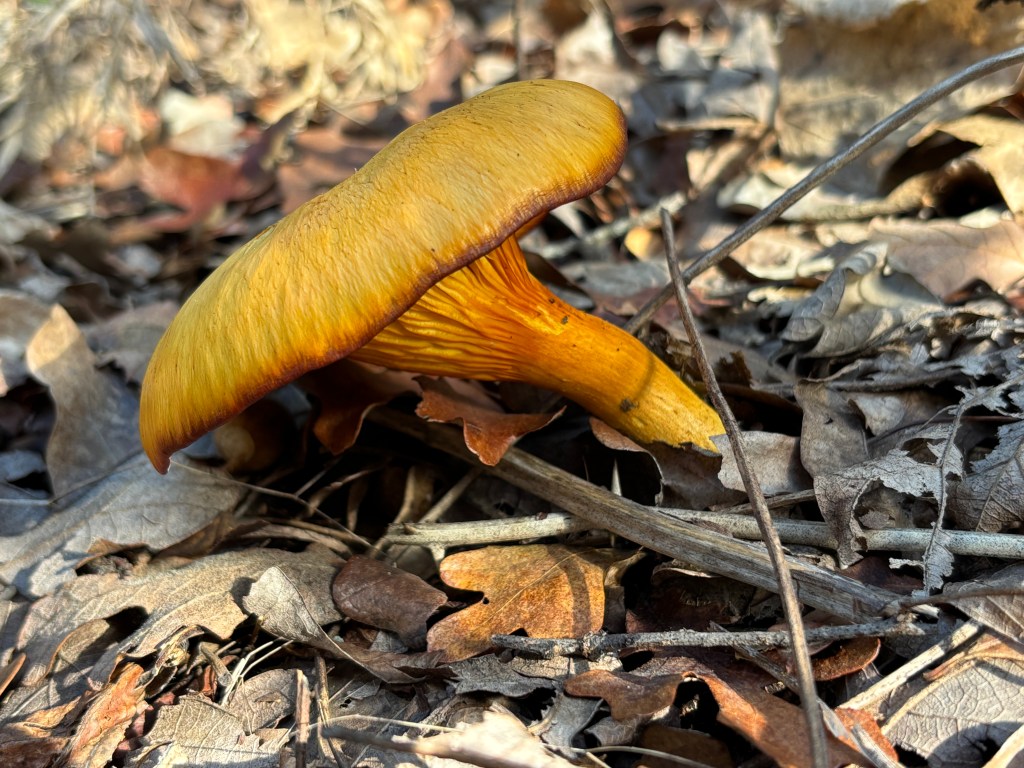
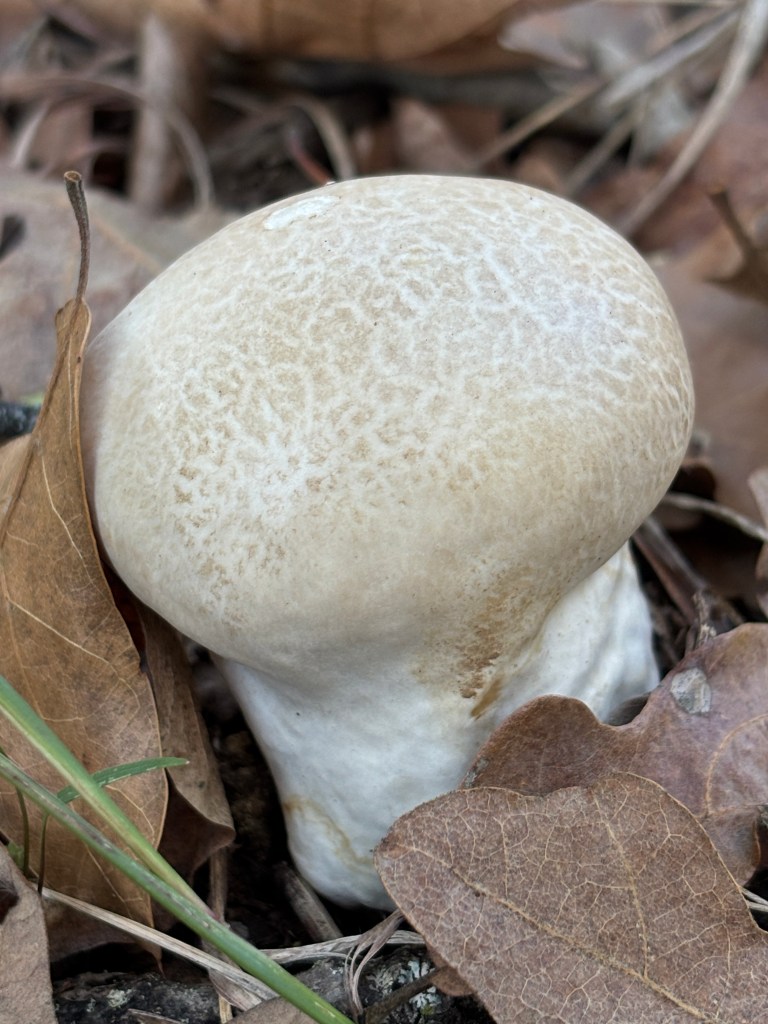
I wanted to follow up on the walk with Logan a few days ago in which we saw southern jack o’ lantern mushrooms. In that particular spot we visited, mushrooms were still there. It might be some particular combination of the right soil, shade, and moisture, but that place stood out with all those mushrooms. There was even a new one of a different sort. According to iNaturalist, it was a type of puffball mushroom. I want to go back to see if it matures to rupture and release a tiny cloud of spores.

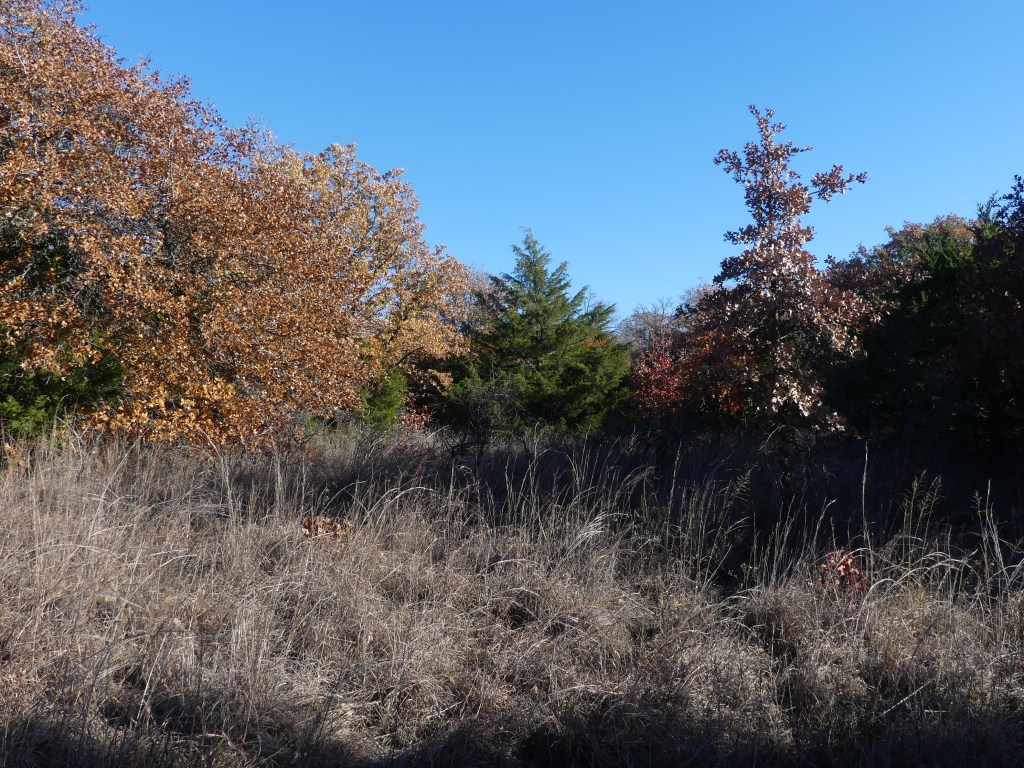
Even without a lot of fall color, there were places where the bright, slanting December sunlight backlit a group of leaves and created a dramatic display of color. Going slow, we can notice so many small and wonderful things.
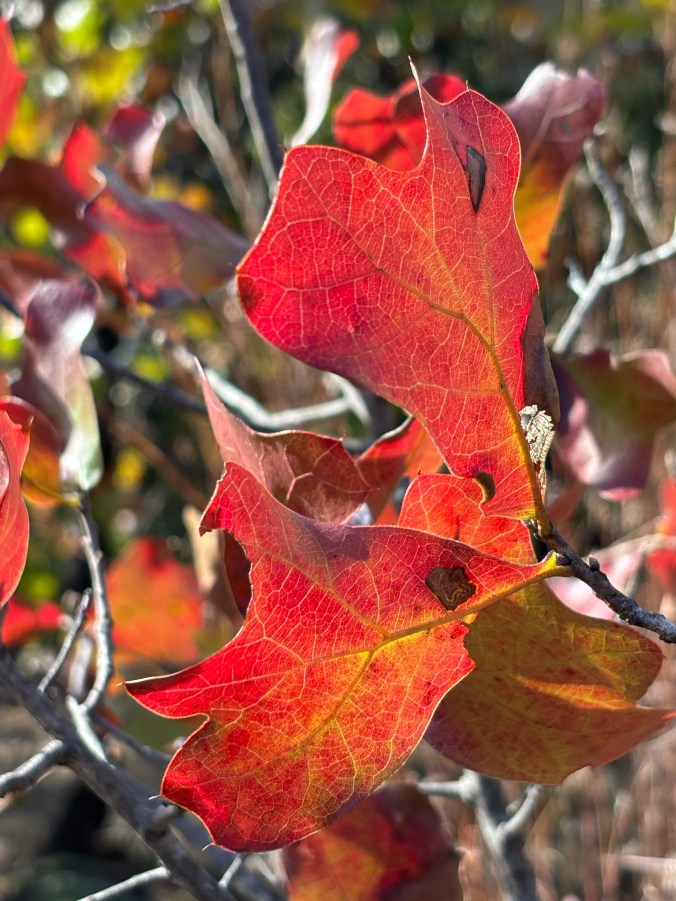
Beautiful blackjack leaves

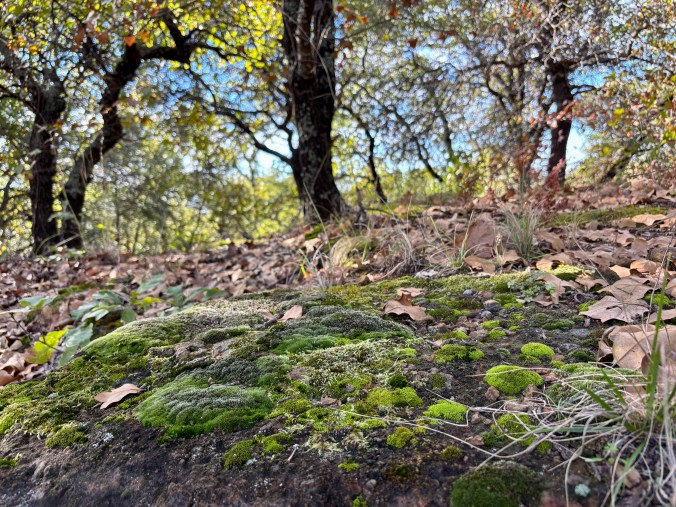
And that includes the mosses. After the way Logan brightened with every new patch of moss he found, I was attuned to them today and really appreciated how they grow on the sandstone up at the bluff. Looking at some boulders was like seeing a miniature topography of meadows and hills.
I also noticed, on the way down the hillside, that the bee tree is active again (there were no bees visible on that cool and cloudy November 29th). I stood for a moment, imagining the extent of the hollow space within that tree, and all the honeycomb built within the spaces, and all that honey!
Searching for Autumn

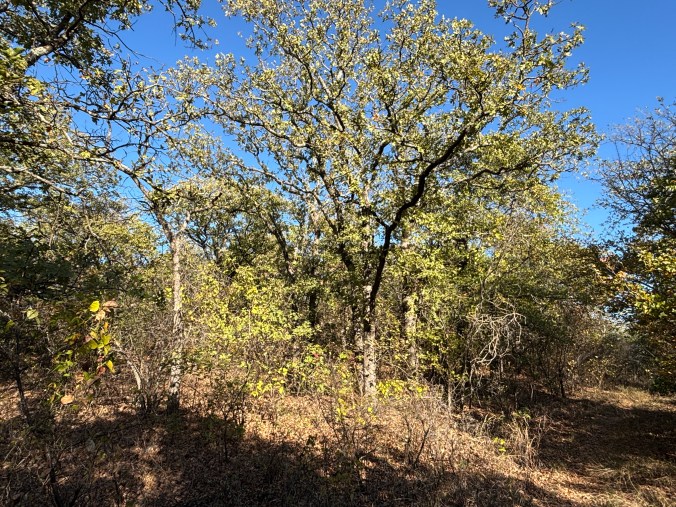
I went for a walk at Sheri Capehart Nature Preserve with gratitude for the warm day and yet wanting very much to find autumn. That’s a season I look forward to each year, and in this changing climate it is apt to hide behind 80 degree days and dusty drought.

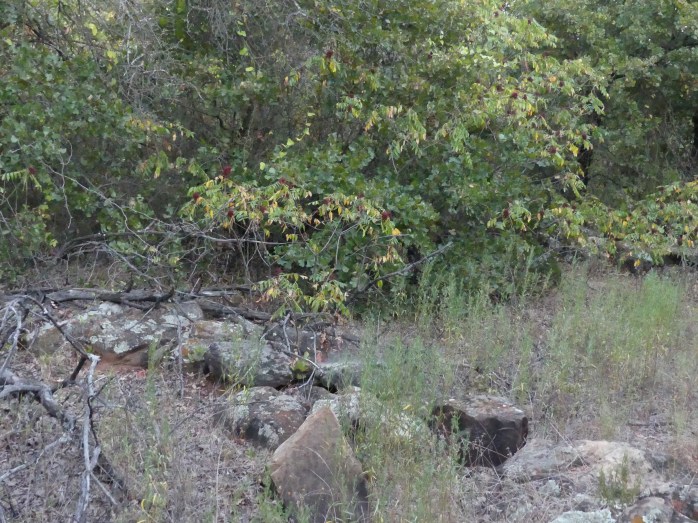
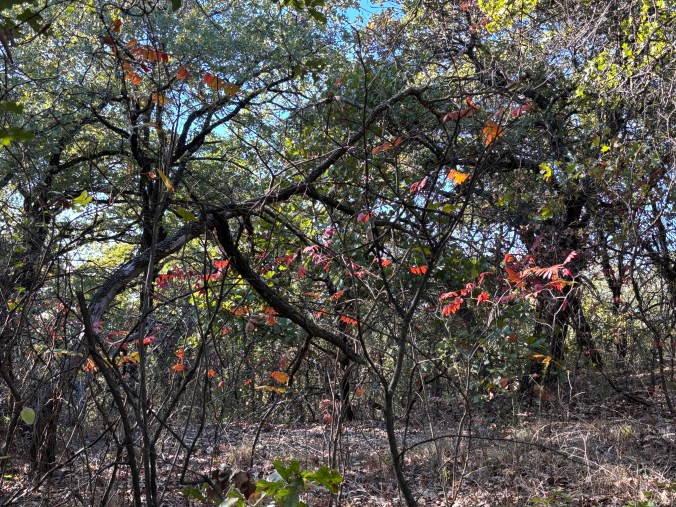
Starting at 3:00pm under sunny skies, I walked up to the top of the hill and sat down to watch, listen, and write a little. it was 82.7F in the shade, with the crowns of post oak trees still covered in green leaves and swaying in the breeze. A little sumac shrub in front of me was brightly backlit by the sun in vibrant green with a little red. Other sumacs had mostly just dropped their leaves, skipping the part where they might live up to names like “flameleaf.”

A few red leaves on some sumac along the hillside

After a while I walked over to the boulder trail and watched a couple of gulls wheeling and hovering above me. There was some wispy high clouds like a feathery splash of cream in the pale blue sky, while on the ground the shadows were lengthening as 4 o’clock approached.

There was some red in nearby sumacs and a few red leaves of some other plant species. The scarcity of colorful leaves made them that much more welcome. Part of my wish for autumn is the hope of seeing yellows, reds, and oranges as the retreating chlorophyll exposes whatever other colors were masked behind the green. Those colors are part of what confirms that autumn is here, and so I’m grateful for each turning leaf. The rest of the woodland, in somewhat desiccated shades of green, seemed stripped of their place within the season, a shadow of summer.

A patch of sunlight backlit this sumac so that it glowed like fire

The clouds drifted, and a few had a hook or curve before stretching out southward or westward, caught and pulled by the currents flowing across the sky. This would be a great afternoon for lying back and watching how clouds are pulled along or drift with the upper winds. Yesterday they seemed in a hurry, but now their movement played out in slow motion.

Merlin reported a blue jay and a hermit thrush, though I did not hear them. Overall it seemed quiet; the traffic seemed to be some distance off and the preserve itself was nearly silent. At 4:12pm it felt like sunset was approaching, and the breeze had come up a little.

In a few days, things will change. There are reports that it will rain, maybe quite a lot. After that, the high temperatures are supposed to remain in the 60s for a while, like we might expect in late November. I will keep walking regardless, because these places like Sheri Capehart Nature Preserve, Tandy Hills Natural Area, the Fort Worth Nature Center and Refuge, are gifts that must not be neglected in any season.

I walked back to the trailhead and was gone at 4:30pm. But I won’t be gone for long.

Happy Holidays – and a Letter

I hope everyone has a wonderful holiday, however you celebrate it. We’ll be sticking close, avoiding traffic, and getting together with family. I’ve recently been walking at Sheri Capehart Nature Preserve and Fort Worth Nature Center & Refuge (FWNCR), and wrote a “Letter to Nature Kids” (See December, 2024 End of Autumn) about those walks and some of the birds and other wonders I saw.

If you can, I hope you can take a walk that is as wonderful as mine yesterday at FWNCR. “It was a day at the edge of winter, getting late in the afternoon. A crow’s call echoed through the woods and a few dragonflies flew low around the edge of the grasslands. Other than that, this place felt like it could be sleeping – still, quiet and peaceful. We all need to sit quietly in a place like that sometimes, don’t we?”

Before the Storm

On Monday morning, November 4th I felt the uncertainty of the storms that were on the horizon. How soon, and how severe would they be? But that was the future, and beyond my doing anything about. A good alternative was to be in the present, and also in the presence of trees, soil, and other living things. What could be as trustworthy and reassuring as nature? There are some people in my life like that, and they are essential. There are also places like that, and I’m grateful for them.

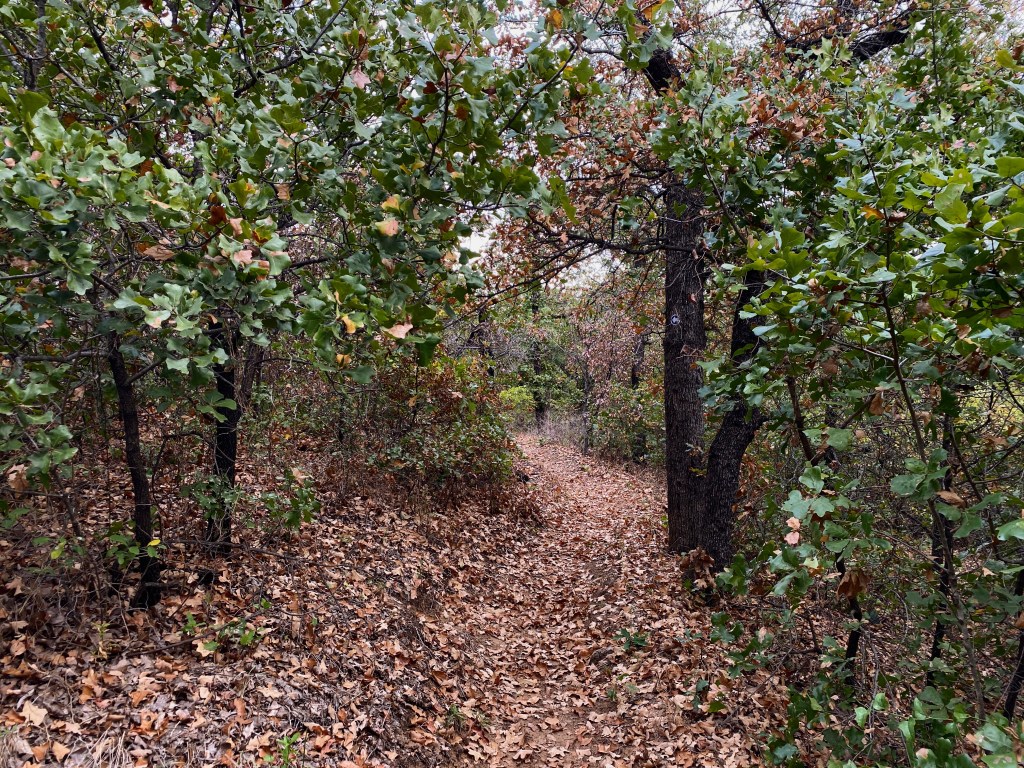
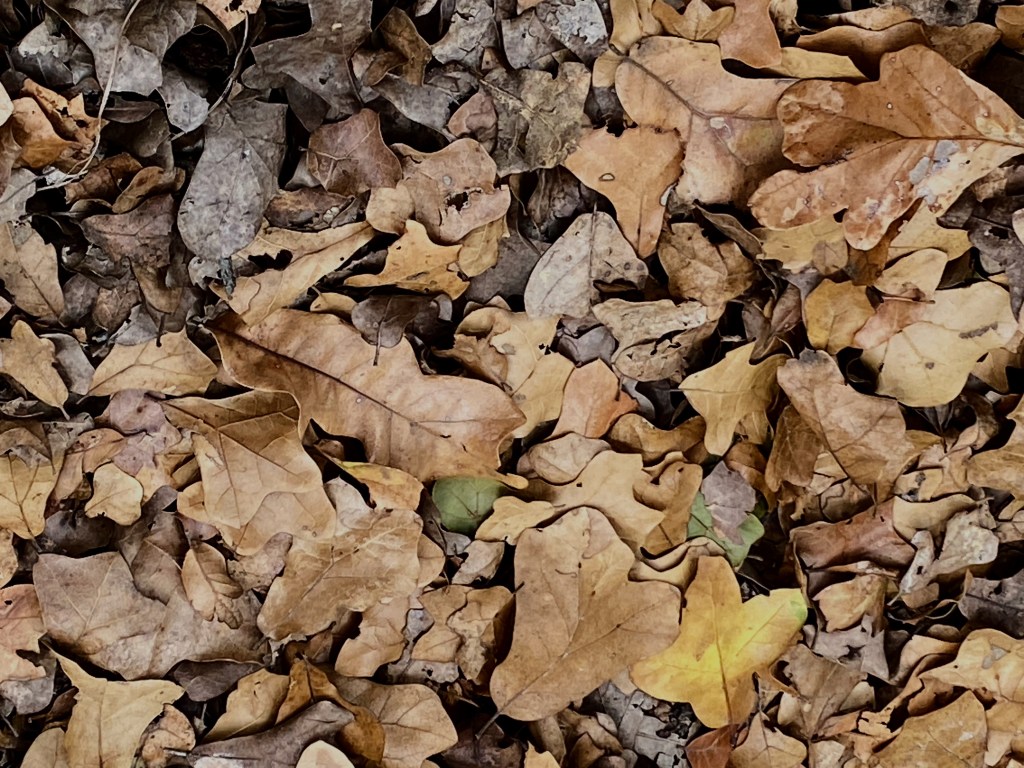
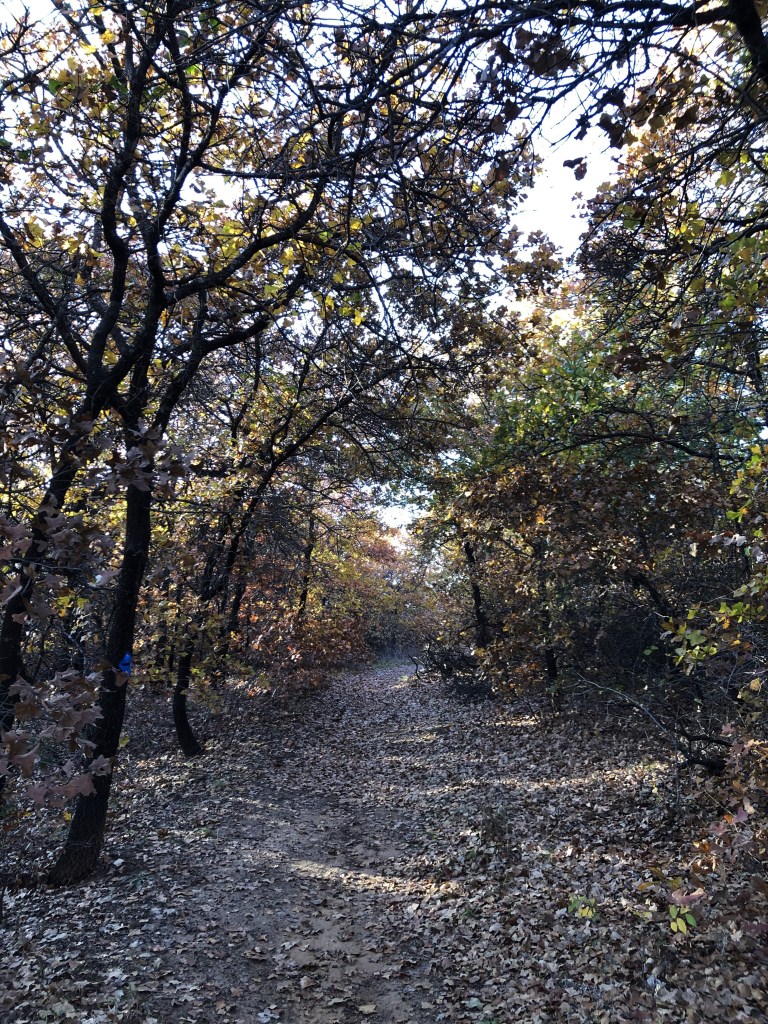
Oak leaves covering the trail – the oaks are dropping leaves without showing much autumn color

So, with storms still to the west, I took a walk at Sheri Capehart Nature Preserve. It was cloudy, with low cumulus clouds racing to the north and the occasional glimpse of blue sky between them. A couple of black vultures were overhead, careening back and forth in the wind with acrobatic turns and adjustments of flight feathers. From my camp stool near the bluff, it was 75.3F, continuing the above-average warmth that is becoming our new normal.

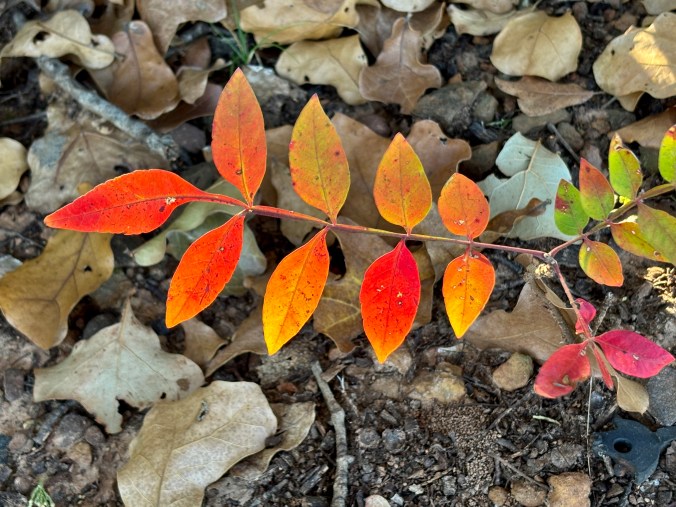
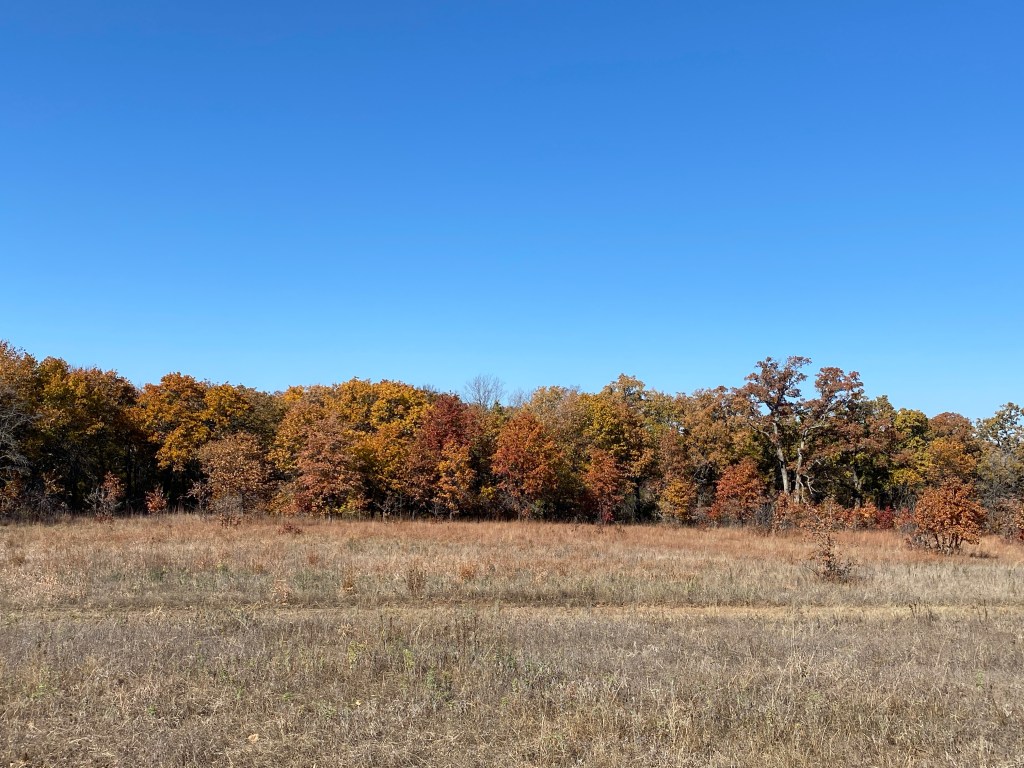
The “official” autumn colors: crimson and orange, yellow and green

At 9:20am I sat near the top of “Kennedale Mountain,” that hill that overlooks the lowland through which Village Creek drains. From the sandstone escarpment you can glimpse downtown Fort Worth through the oak branches, if you want to. I’d rather keep in the company of the blackjack oaks and sandstone, watching clouds or butterflies. Away from the bluff, on the back side of the hill is a place a bit more protected from traffic noise, where fewer visitors walk, and so it is a favorite with me.

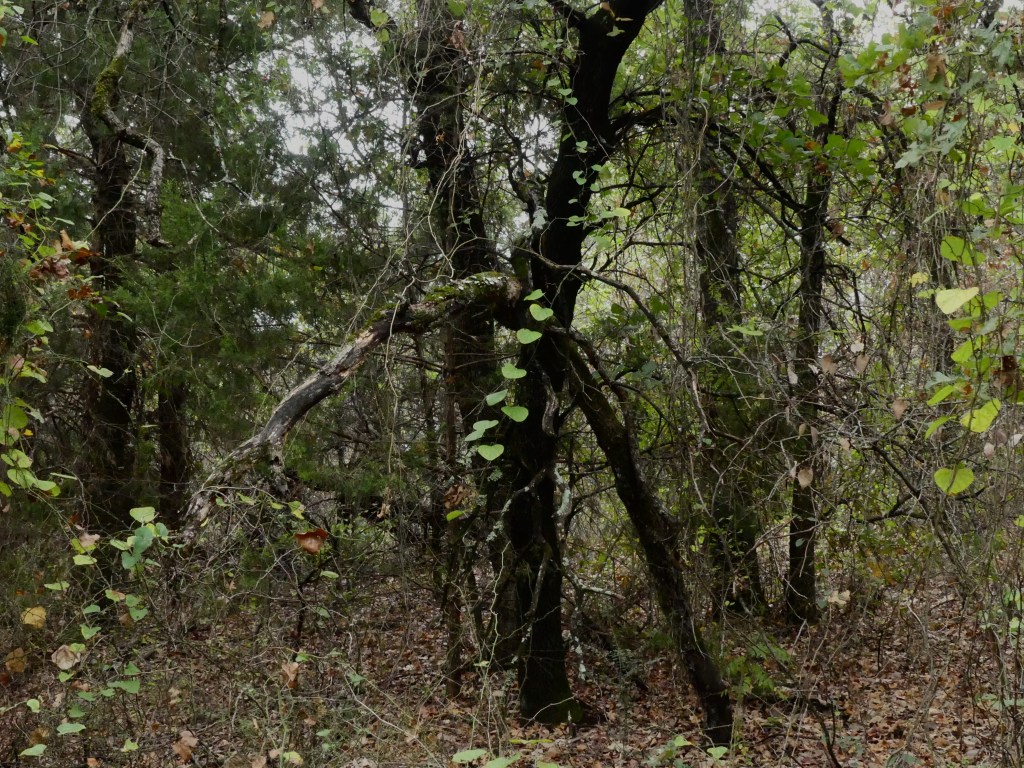
A place a little quieter, maybe a little wilder than other locations

As I sat, a crow flew past, cawing loudly, and clouds continued streaming to the north. The wind moved through the trees, and when stronger pulses of air came through the sound was like a rushing river. Downslope toward the east I heard a northern cardinal and a Carolina wren.

Some of us need natural sounds like these, and relief from the unremitting mechanical noises that so often mask them. The noises of human activity are certainly present at the preserve, as it is located a little south of the third-busiest airport in the world and sits right beside major highway construction. But some days, when we let go of the noise and focus on birds, breeze moving the trees, or the occasional frog calls, we get a little of the peace that natural sounds bring.

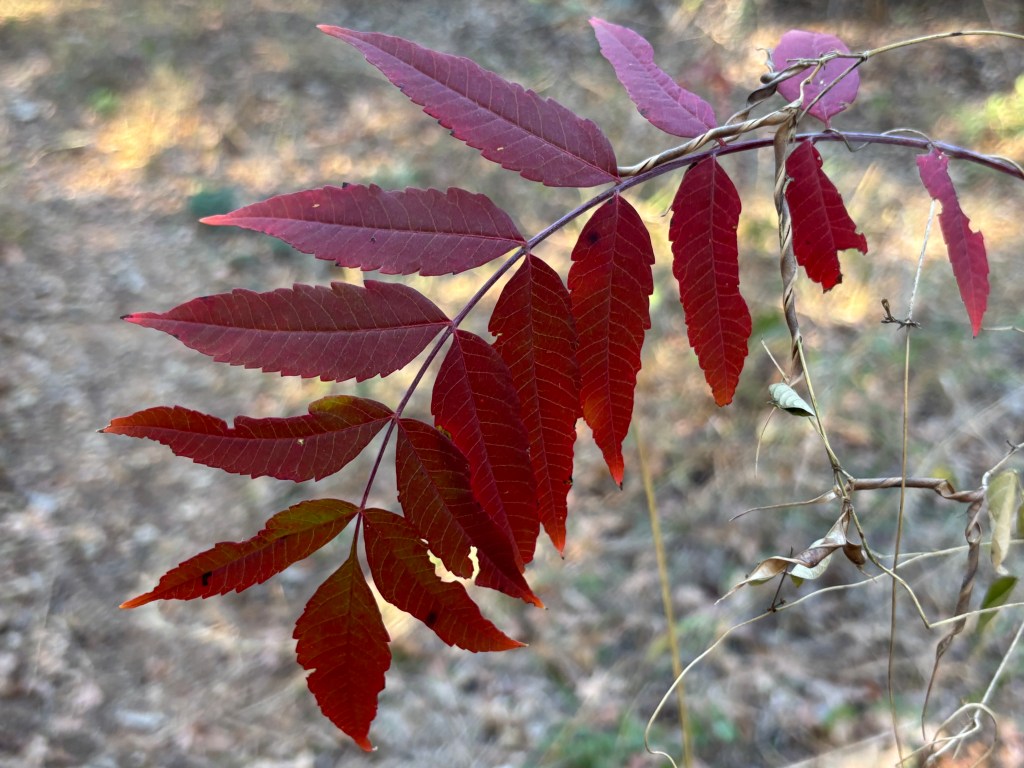
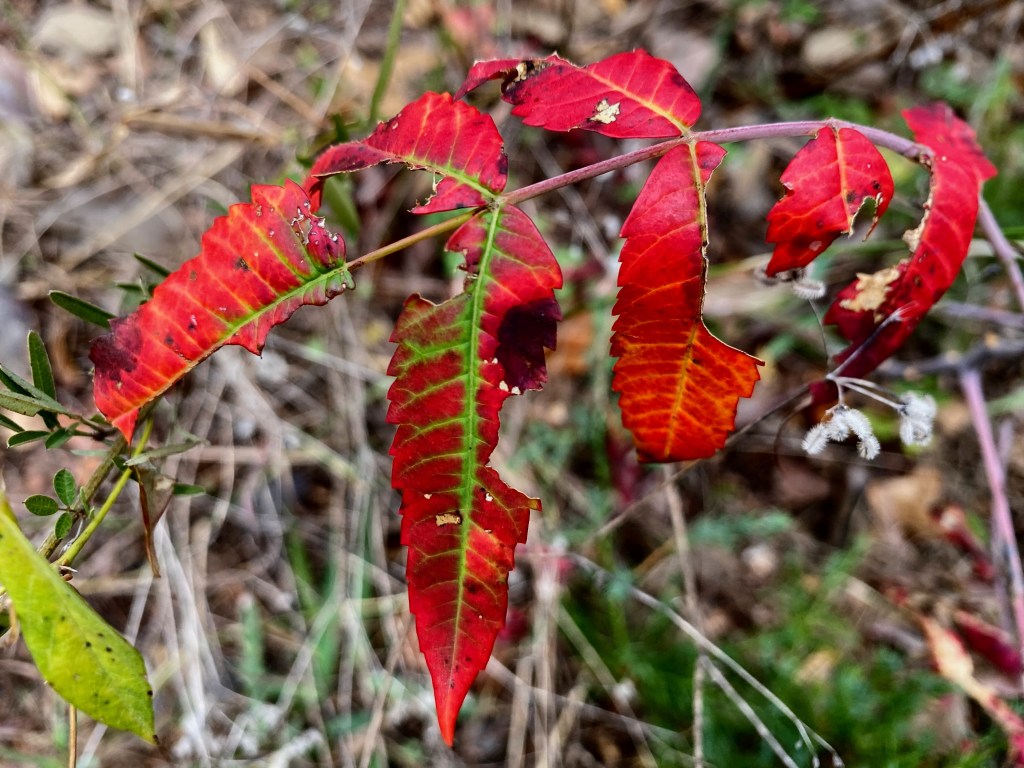
A tracing of green in the crimson leaves of a ragged sumac

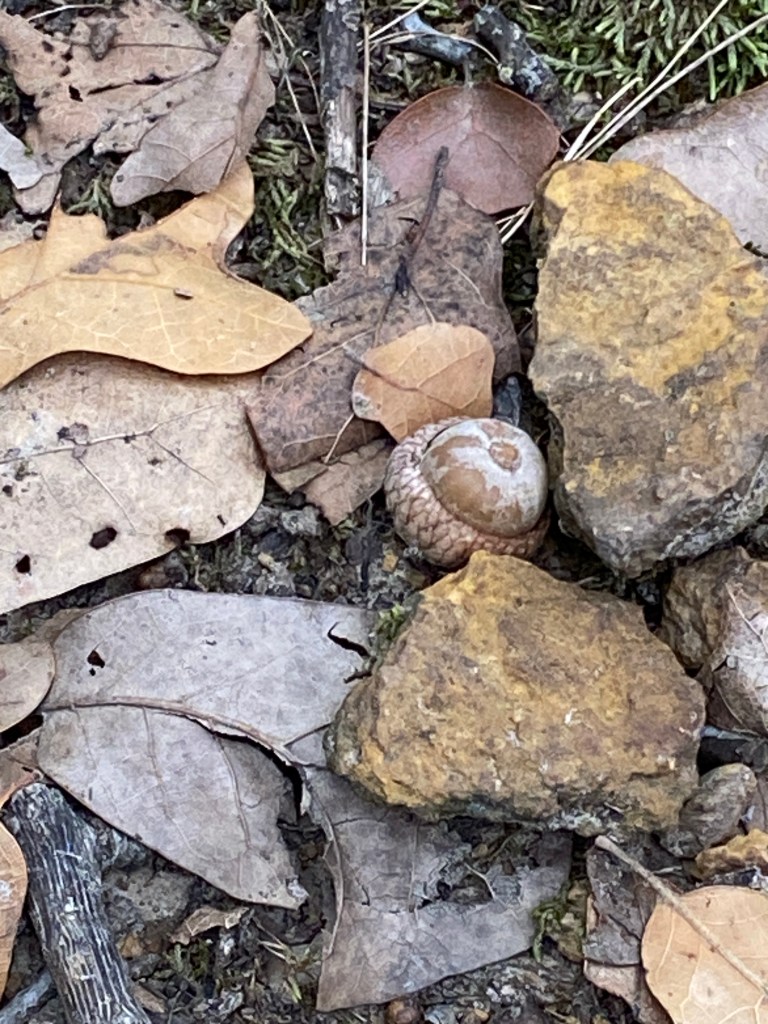
By 9:50am, back over on the bluff, the clouds seemed thicker and the sky a little darker. Here and there I noticed the pattern of fallen leaves on the ground; the variation in color and shape and things like acorns or moss always pull me in. It is art on a tiny scale, for those who are pulled toward such things.

The storms held off until after I left at 10:13am, and we can hope that they bring only the rain we need. A little thunder is always good – one of those natural sounds I like so much. Just under two hours at the preserve had brought some of the peace and wonder that are part of that place.

Autumn Sunlight

Right now the earth in our little spot is tilted about as far away from the sun as it ever is. Sunlight reaches us from lower in the sky, from a sharp angle rather than high overhead. Thursday, December 21st is our winter solstice, after which the days slowly begin to lengthen again. But in these shortest days the light is different; not only does midday seem like late afternoon, the light spectrum has shifted and is a bit more golden.

Not long after noon, the light looks like it is the end of the day, and I get a sense of things coming to a close. Daylight will soon end, and so will the year. What needs to be put in order before this season and this year is done? What has slipped away while we weren’t looking? It is only a vague emotional tone, nothing more, but it can bring an elegiac feeling to the day.

The light is beautiful, perhaps in part because it contains more of the warmer part of the color spectrum, and because its slanting angle produces more shadows and clearly defines what it touches.

On a recent walk I was particularly struck by all this. There was a large oak whose leaves were becoming quite yellow, and underneath it a small sumac with crimson leaves. The ground beneath was carpeted with leaves in shades of brown and yellow. I thought, “What is this trick of the light that makes everything so much more clear, deepens the colors and highlights things so that I see each one clearly? What is this, that makes it feel like the end of the day, things coming to a close, deepening the emotion along with the color?”

I would be interested in knowing the extent to which others experience these things. If you notice any of these qualities of autumn light, I encourage you to write a comment about it. If you haven’t thought much about it, then find a sunny day while the days remain very short and take a walk somewhere in nature. See what your perception tells you.

The Curmudgeon Returns

The story of this day has a connection to the story of climate change and the pandemics of Covid 19 and of violence. This was an afternoon of sanctuary that felt like freedom, and it was a paradoxical gift from our out-of-whack climate.

Yesterday’s high temperature for the Dallas-Fort Worth area, according to the National Weather Service, was 81F. With the usual caveat that it is hard to know if an individual weather event was caused by climate change, we all know (or should know) that our fossil fuels are harming the climate and bringing crazy weather. Occasionally that crazy weather is absolutely delightful for us humans, like the warm sunny day yesterday, December 5th.

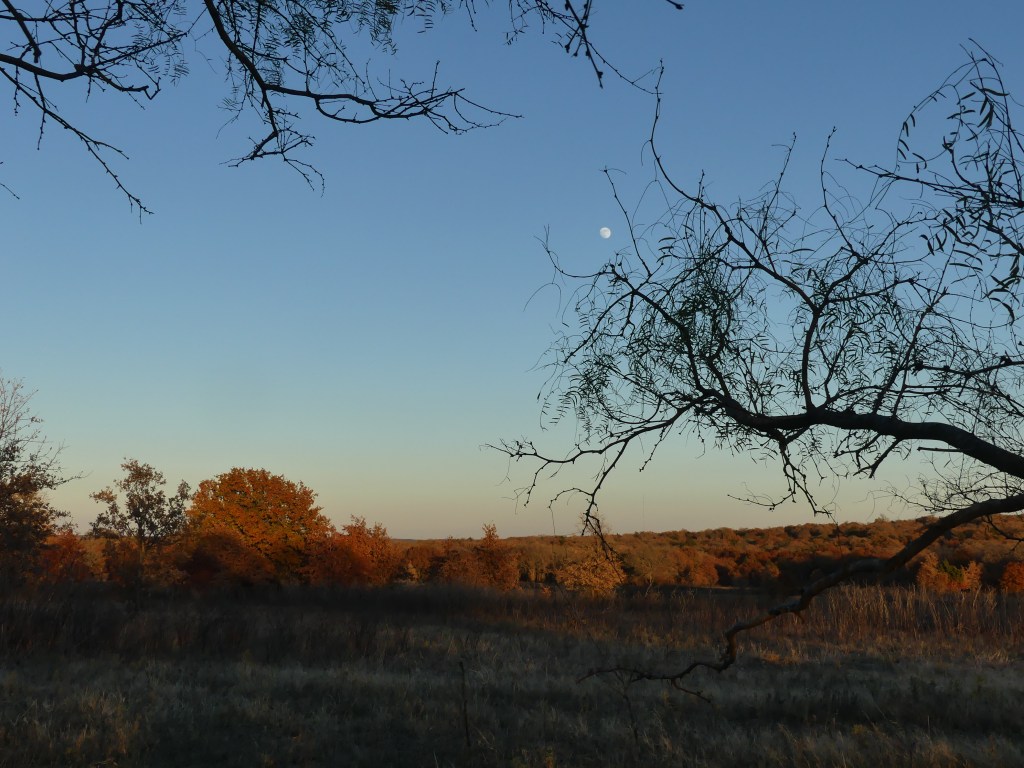
At around 4:00pm I was back at the LBJ National Grasslands in Unit 76 (near Alvord, TX). Under a sprawling mesquite tree, it was 79F under a sunny blue sky. A nearly full moon was rising above a line of oak trees in soft colors of caramel, orange, and yellow-green. I sat in my t-shirt, listening for crows to exchange greetings and thinking how fortunate I was to be there.

Weird to love weather that is a consequence of something monstrous. Warm, sunny weather in late autumn and in winter is among my favorite things. The light is beautiful and in the woods and prairies the range of colors is subtle, lovely and inviting. The smell of leaves returning to soil is like the fermenting of nature’s wine, recycling the year that is ending and preparing for new life. There can be an emotional tone of quiet reflection with a little nostalgia in the peaceful woods. For me, a bright sun and warmth brings all of this out even more strongly. Even a day that is an aberration, with temperatures outside what is normal, can feel this way.

Where is my guilt for loving a gift from climate change? Nowhere. I would gladly give up very warm winter days in return for a climate more like the one I grew up with, if I had that control. I do what I can for a healthy climate and then I enjoy beautiful days, even the weird ones.

The best way to experience a day like this is away from the mechanical grinding and whining from leaf blowers, air conditioners, highways, the constant soundtrack of the world we have built. It becomes a background noise that we pay little attention to and may forget about, but our auditory nerves and our brains are in constant reverberation with it. Go to some place where you are free of it, where it is quiet and the sounds that emerge are birds, water, and breeze, and see if the world doesn’t seem less chaotic and more sensible.

I stood just inside a woodland of oaks and junipers, watching a few stray leaves fall. A wave of breeze whispered and the trees replied “shhh,” while more leaves floated down like snow.

The LBJ National Grasslands can also be a place for solitude. On this day, a group of three people on horseback passed me on the trail, but these were the only people I saw in nearly four hours. Perhaps it’s not that I’m a grumpy old man, a would-be hermit. I’ve shared walks out there with people who have a similar style of walking slowly, noticing things, being attentive to the nature around us, and those are great walks. But there is also great value in just being by yourself.

It’s hard not to see that people are growing more out-of-whack just like the climate, with increasing extremes that do a great deal of harm. I don’t think the pandemic caused it, but it certainly gave a considerable boost to the troubles that are all around us. News reports say that children are in a mental health crisis. The news also tells of a pandemic of violence toward women. Anyone who is a little different (people of color, gay, immigrant, Jewish) is at greater risk. Whatever was going on before, the pandemic pushed us into greater isolation, more job loss, fears of getting sick and dying, and lots of toxic thinking about what and who was causing all this pain.

In the midst of all this, an afternoon in the company of crows and cricket frogs, blackjack oaks and bluestem grasses is an ideal sanctuary. I like it that the origin of that word refers to a holy or sacred and protected space. I remain engaged in the world of people, but for a time I rest in a place that feels like a refuge.

One of the small ponds feels very sheltered, and as you climb down through some erosion there is a gently sloping, sandy bank. I stayed at that pond for a while, sitting and then lying on this bank with my attention captured by little things. A tiny bee mimic fly landed inches from my face where I could see its thin yellow and black banded abdomen. A honeybee buzzed around as if looking for something inches above the sand and finally flew off. A few feet away, a cricket frog took a small hop but was in no hurry. A small snout butterfly swept in, landing on the sand. Intermittently it shifted position until it had turned itself around 360 degrees, and then it flew away. I was happy with these small and interesting companions.

Late in the day, I walked in Unit 76 where there are big open areas of grassland and a few more mesquite trees in higher, well-drained places. The sun was getting lower and the shadows longer. I sat under a mesquite looking across a patch of prairie at a line of oak trees lit by the setting sun. The rest of the landscape was darkening, and the world was still. A nearly full moon was rising in the east, and I watched it climb in the sky framed by mesquite leaves.

A Curmudgeon’s Day in the Grasslands

On November 29th the LBJ National Grasslands had such a fine day that I spent four or five hours there and could have stayed longer. I came away filled with sensory impressions and not a lot of observations of animals (there were some butterflies, a dragonfly, a few vultures, and humans – one with a dog and a gun). It was a mostly quiet day, filled with sunlight, color, the feel of damp sandy soil, and periods of solitude.

I got to the gate at unit 75 (above Cottonwood Lake) about 11:15am, and started down the trail to the northeast. It was sunny and bright, with temperatures already in the 70s. I was passed by a couple, he on his bicycle and she on her horse, who I would see multiple times. They said “hello” with cheerful smiles, and should have taken nothing away from my walk. And yet, solitude is what I was after, so I looked for spots a little off the trail.

A track took me away from the trail and through an ungated and unmarked opening in a fence and out into a long meadow. This seemed to be the separation from society that I was looking for, until the couple crossed in front of me down a small trail. Their momentary presence was no problem, and I got back to sitting and taking some notes. It was 75 degrees and 49% relative humidity in the shade, and it would warm a few more degrees as the day progressed.

I kept following the trail, now headed east through oaks and past small ponds with a few cottonwoods. Scattered yellow cottonwood leaves made a beautiful pathway flecked with gold. When the land rose into a big open prairie, I sought out an old bois d’arc tree and underneath I found clumps of old rose bushes and some green grass like that which might have grown in someone’s yard long ago. Although I didn’t see the remains of any structures, I expect this was once a homestead. Perhaps those rose bushes were planted in a spirit of optimism that did not survive the Dust Bowl and Great Depression.

And then, the couple on the bicycle and horse rode by. Now, every place I went there was an anticipation of their coming and going. I began to feel truly like a curmudgeon. They had as much right to be there as I did, and they were doing nothing to disturb my day. Except for that anticipation that now sat alongside my sense of stillness and openness.

The quiet sound of breeze in the tree tops was joined by a constant mechanical drone. On my way in, I had passed someone mowing the road right of way with a heavy blade on an arm mounted to a tractor. He had now resumed, sounding like heavy road construction going on just over the rise. I walked out of unit 75 and headed north.

Up in unit 15 the “orange” trail snakes along near one of the camping areas and through several other units east of Alvord. I joined the trail at a spot beside Forest Service road 908 and walked westward through woods and little pocket prairies. Here, at 2:00pm, was all the quiet and solitude I could wish for (making allowances for the occasional airplane going to or from DFW). I stretched out on the cool, sandy ground, shaded the sun with my hat and just listened to the sounds of leaves and breeze.

Like most introverts, I have relationships with some people I could not do without, and casual friendships that are important to me. But social gatherings are not a natural habitat for me, and frequently I need to retreat somewhere in nature and spend quiet time. This warm autumn day was so needed, and now the curmudgeon’s heart beats with a little more peace and well-being.

A Woods Full of Hackberry Emperors

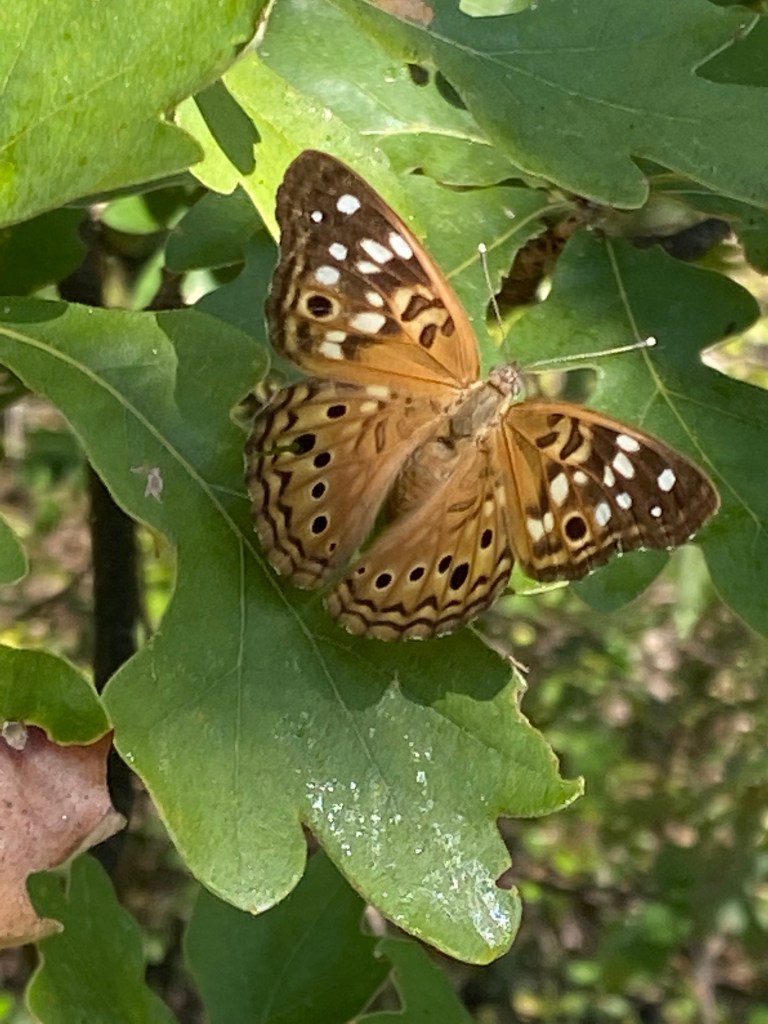
Sounds strange, right? What exactly is running around trying to be ruler of the woods? Butterfly folks know that the hackberry emperor is a butterfly whose earth-toned wings are beautifully spotted, not bright and showy like monarchs or fritillaries, but really lovely nonetheless. They are called hackberry emperors because the hackberry tree is the host plant that feeds the caterpillars of this species.

A hackberry emperor

Anyway, today the woods were alive with butterflies, mostly hackberry emperors but also snouts and others. There were small yellow butterflies and little gray-white ones flying near the ground. It was one more sign of autumn, as butterfly activity ramps up.

This afternoon I was at Sheri Capehart Nature Preserve, the wonderful little remnant of Eastern Cross Timbers in Arlington and an oasis for butterflies and many other things. It has been a difficult year at the preserve, full of drought and record high temperatures. Then, briefly, there was drenching rain, and a return to drought.

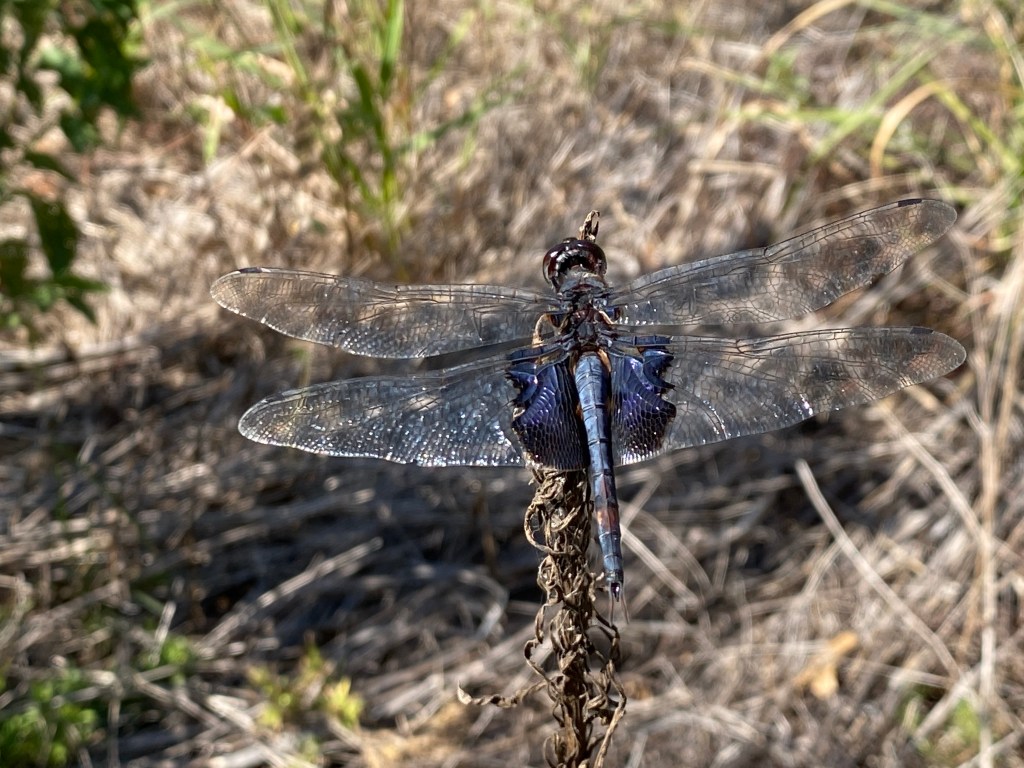
The water level in the north pond was low today, lower than I have seen it in quite a while. I could see the bottom, or at least could see the ragged layer of reddish algae growing along the bottom. Above the water were dozens of dragonflies darting and dipping, floating on the air and perching on twigs and reeds. They brought to the pond what the butterflies brought to the woods: a sort of dancing, whirling energy.

A black saddlebags, a species of dragonfly (note the dark “saddlebag” patches on the wings)

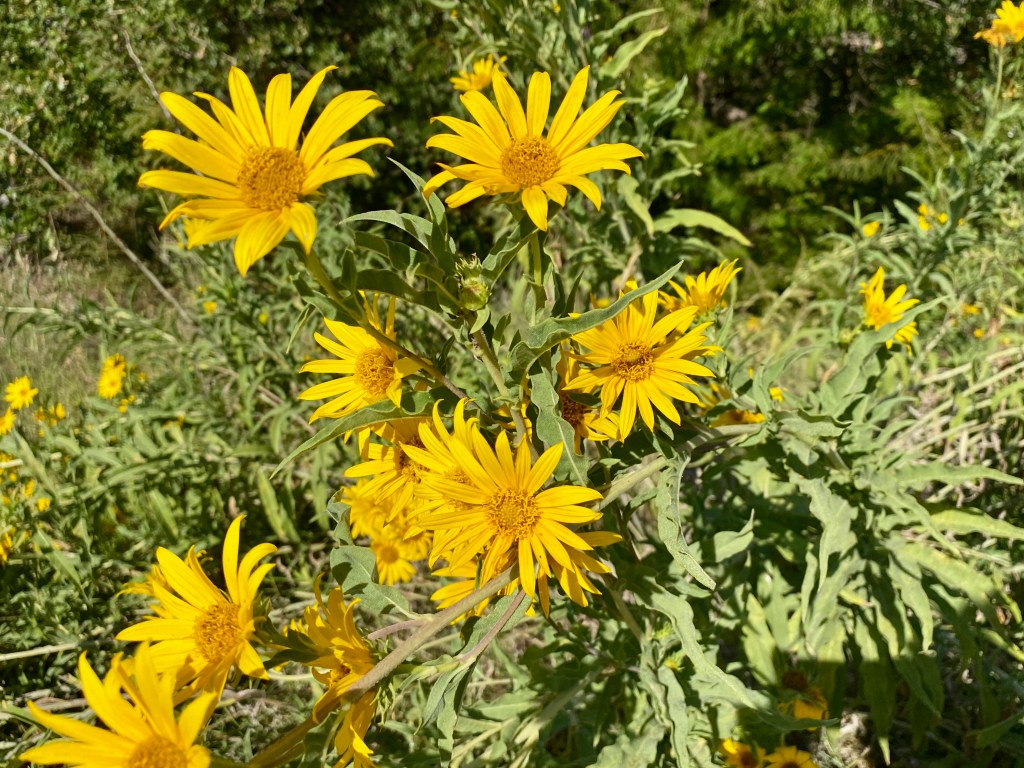
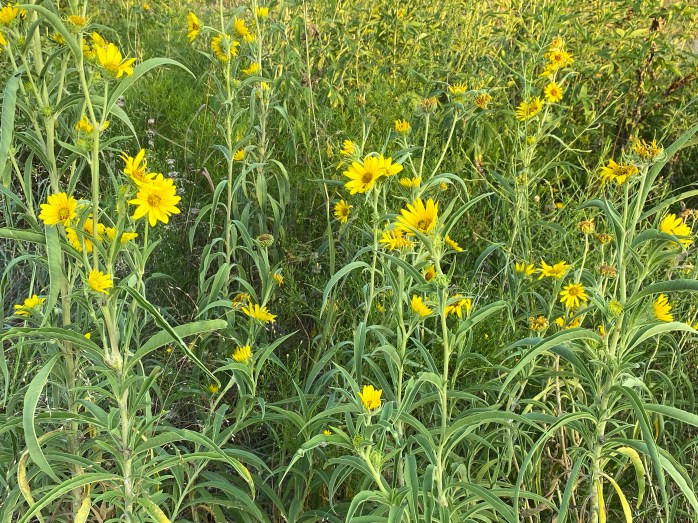
There was one last bit of autumn, adding just a little more charm to this afternoon with the sun at a low angle and cool breezes moderating the warm sun. Maximilian sunflower, a native prairie plant that blooms at the end of summer through the fall, was blooming at the preserve. Those clusters of big yellow flowers are a beautiful sight every year.

Maximilian sunflower

Is It Autumn Yet?

A patch of Maximilian sunflower is a reminder of summer

I climbed the switchback trail up to the ridge at Southwest Nature Preserve yesterday, and it felt a little different. The high temperature was still in the 90s and there were no clouds to deflect a little of the sun’s radiant warmth, but there was a barely perceptible difference. Through much of the summer, the humid air has wrapped us in a blanket of heat, but not so much today. The slight breeze that previously could not penetrate that sticky blanket was refreshing this time. I wondered if this was the first hint of autumn.

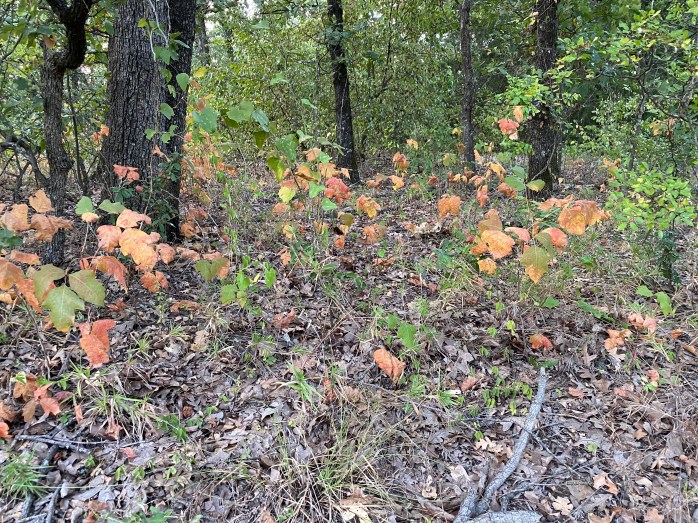
The orange tones of poison ivy leaves

Autumn has a distinct personality. The sensory world of autumn is one of cool breezes, even a little chill, and in the fields there is the faint smell of ripening and even decay as leaves come to the end of their usefulness and fall from trees and shrubs. It’s a good sort of decay; it’s the soil-creating process, the vintage bouquet of oak and ash leaves, with notes of hackberry and possumhaw. I look forward to bright, cool days in woods and prairies and the chance to smell that legacy of what grew in the summer.

Where I live, autumn’s sensory world includes leaves turning color, gradually and in varying degrees. There are the brilliant colors of sumac (one species of which is “flameleaf sumac,” which gives a clue as to its contribution to autumn color) as well as the varied colors of poison ivy. The oak leaves sometimes become very colorful, but only sometimes. And then when the leaves have fallen, we get a look into woodlands where before there were curtains of green. On through the coming winter, sunny days flood the ground around the tree trunks with light.

The quality of that light is an important part of autumn’s personality. Our part of the earth is tilting away from the sun, and light reaches us from a slanting angle. In a trick of physics, it is more golden, with an end-of-the-day feel, a suggestion of sunset all day long. In a verse that introduces autumn in a forthcoming book, I said, “Things come to an end / Be still in the golden autumn light.” The sense of the year coming to an end suggests a time for contemplation, to “consider how to make a good end of the year / With affection and acceptance.”

Is it autumn yet? One way of defining the seasons says that autumn begins with the first of September. The other way, based on the position of the sun, says that autumn begins when the shortening days and lengthening nights are of equal lengths. The equinox, typically on September 23, marks the beginning of autumn.

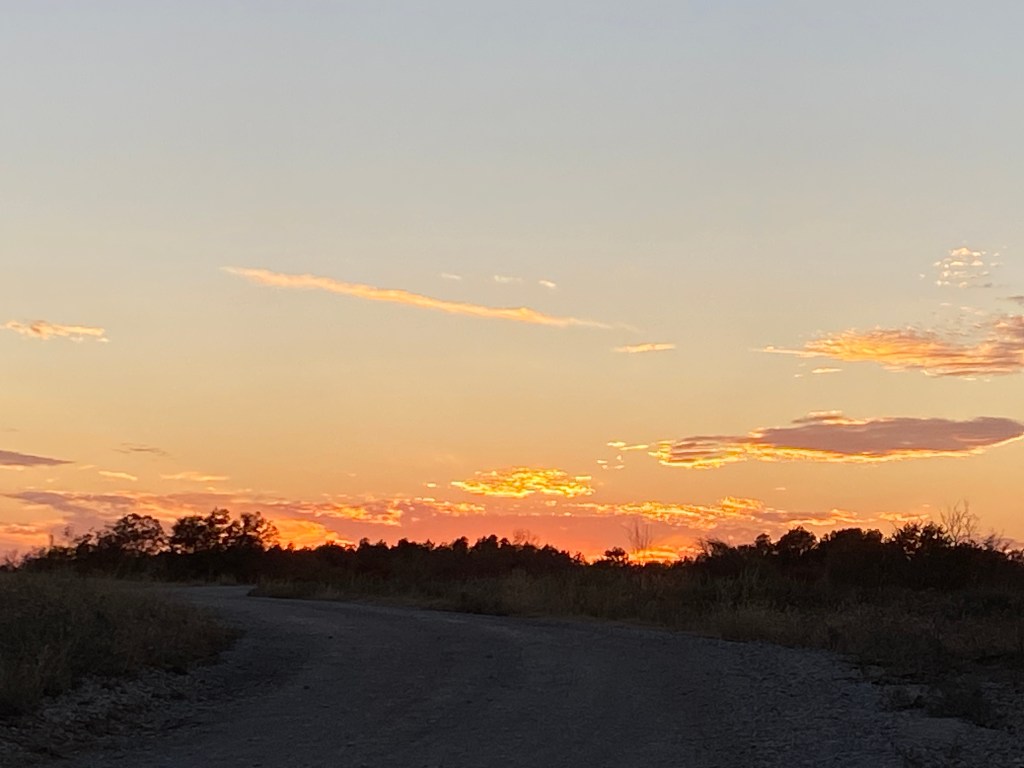
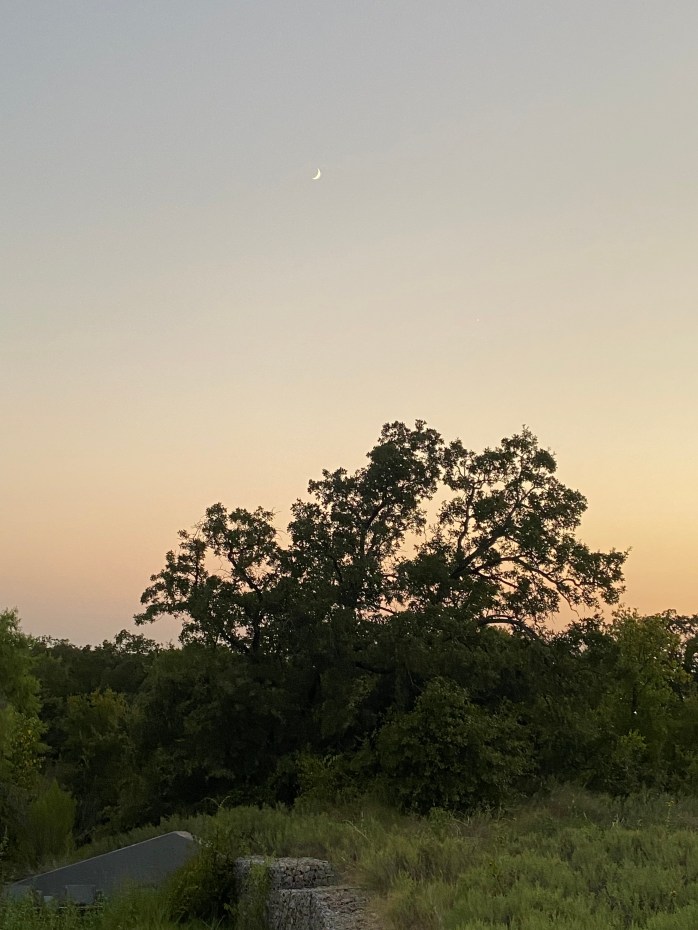
Sunset at the preserve, with a crescent moon riding high

That day is less than two weeks away. I look forward to that day and to every little sign that autumn is coming.

Endings and Renewals in the Woods

“It’s a dangerous business, Frodo, going out your door. You step onto the road, and if you don’t keep your feet, there’s no knowing where you might be swept off to.”

– Bilbo Baggins
The road goes ever on and on

My favorite way to dodge weekend chores and recharge for the coming week is to wander around in the woods somewhere, often at Southwest Nature Preserve. And autumn is my favorite time to disappear into the woods, being swept off (as Bilbo would put it) to some place where leaves are falling, the sun sneaks in at low angles and feels warm, and the air might be just a little chill.

Today was a day like that. For a little over an hour I walked trails that circle around the preserve, considering how some things come to an end – or seem to do so – at this time of year. The oak leaves fall, grasses are dry and dormant, and the sun looks like it might be leaving us as it rises for shorter times each day and stays low in the sky. No wonder ancient people feared the loss of the sun and had such celebrations when it started a little higher arc across the sky and the days began to lengthen a little.

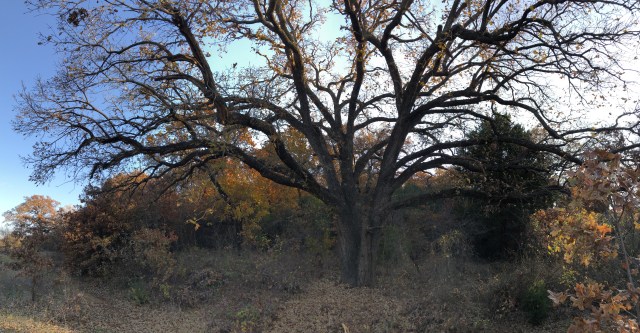
The giant “Caddo” oak has nearly lost its leaves

Autumn can seem like a time to slow down, to take stock of the year that is ending. The days are shorter, and many of the plants and some animals prepare for the long sleep through winter. Could it be that nature’s transition reminds us that all things end, that everything has its time and then passes into memory? Sometimes one of those memories seems near, like being brushed by the ghost of something that had its summer in full bloom and is now gone.

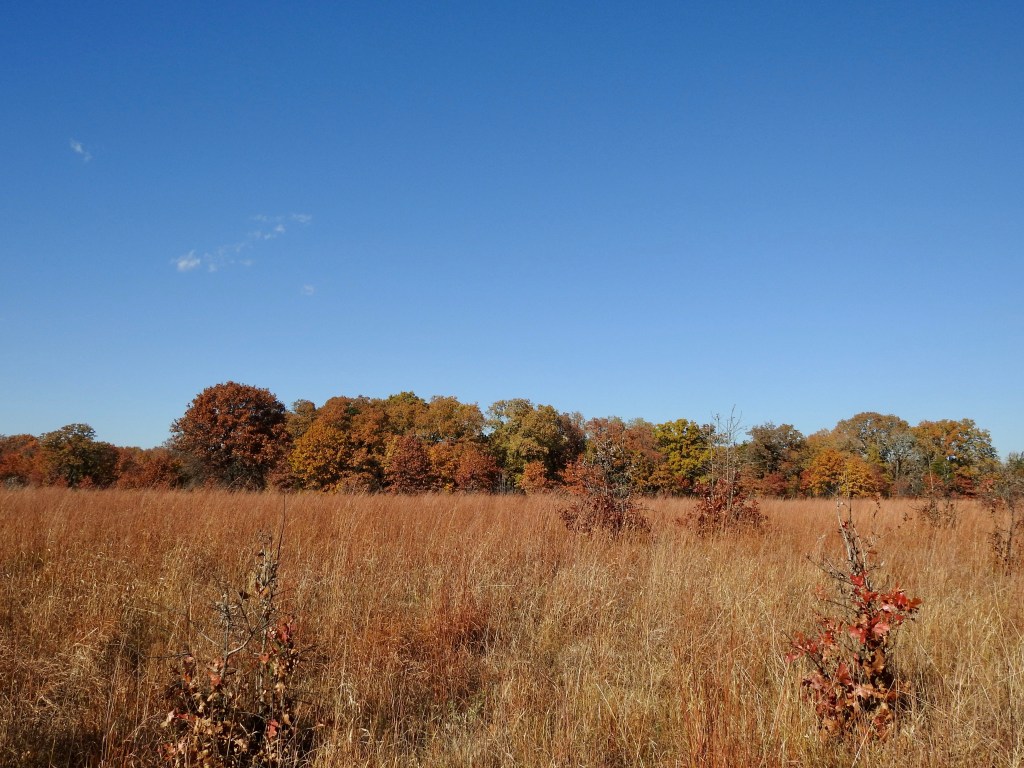
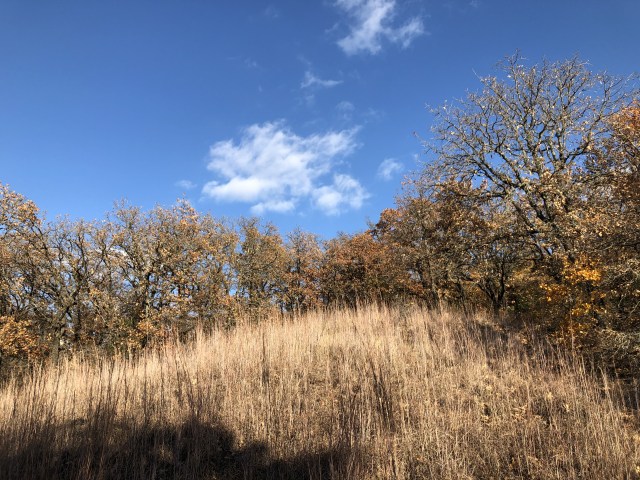
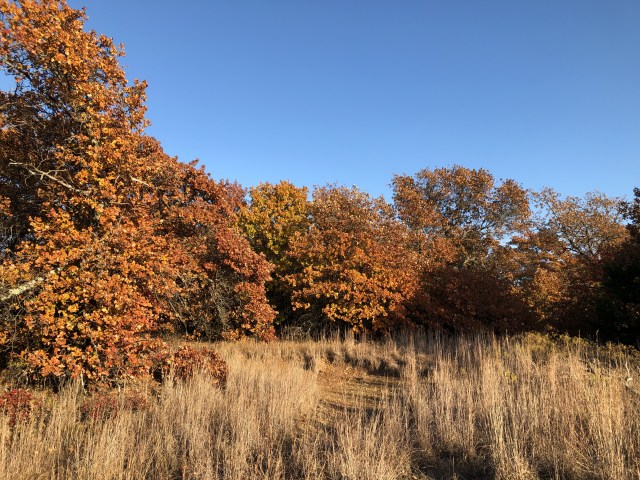
The sun warms a hillside with dormant Little Bluestem grass surrounded by oaks

What is happening on these hillsides of oak and Little Bluestem is not death, but dormancy and preparation for new life. Beneath the husks of grass stems, the rest of the plant is alive and waiting for spring. The bare trunks and branches of the trees are alive and have merely shed leaves that would not make it through winter. Those thin, broad leaves are great for exchanging gases and making food during the warm season, but they become damaged and would not do well in winter. As autumn arrives, the trees break down the green chlorophyll and reabsorb the nutrients in the leaves, and the yellow or red colors are what remains.

The green chlorophyll is nearly gone from these Post Oak leaves

I took a good look at some of those leaves today. Many were ragged and insect-chewed. But they have done their work well, and they end their time on this earth with a beautiful flourish. If I were a leaf, I would want my final days to shine like this.

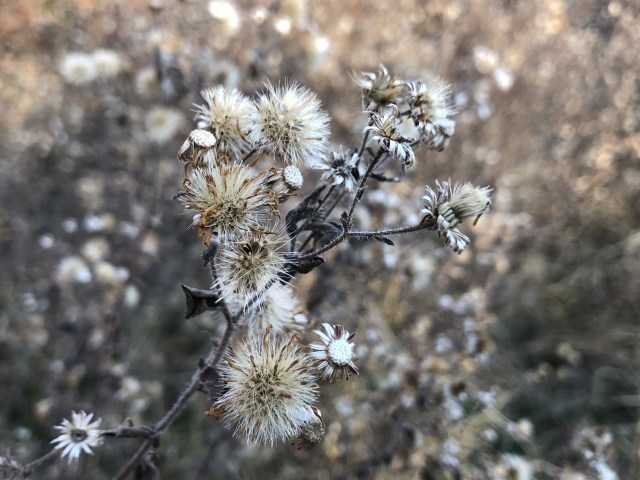
Further around the preserve, I came to a spot where a small field of weedy flowers, perhaps Camphorweed, had finished the season, gone to seed, and what was left was dry and dead. The little globes that looked like seed heads were light-colored and scattered around like a field of fuzzy stars above the soil. Dried flowers and seeds often have detailed shapes and textures that reward a few minutes spent examining them closely.

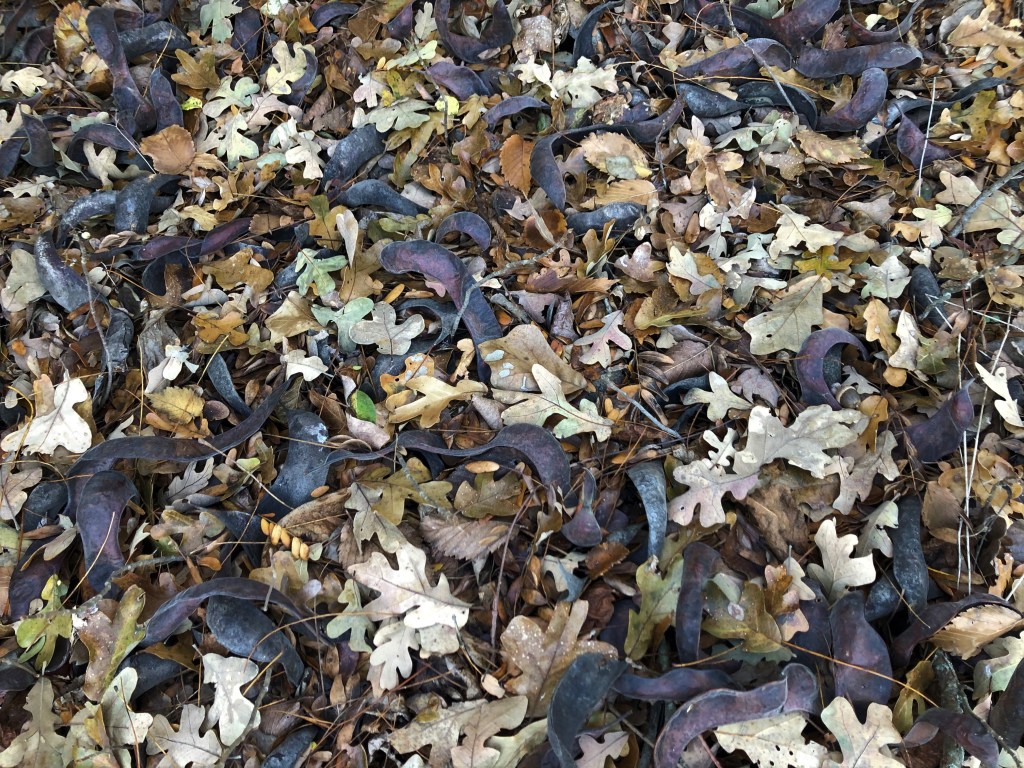
In another place there was an intricate and lovely mosaic of leaves and the flattened and curving seed pods of Honey Locust. A few remained on the tree, dangling like purplish-brown ornaments, but most had fallen. The pulp of those seed pods is said to be edible (but if you try it, be sure that it is a Honey Locust, not the Black Locust, which is toxic).

Honey Locust seed pods among the oak leaves

On one tree, two sinuously-curving seed pods remained side-by-side. Their twisting forms were well-matched, like dancers, like smoke curling as it rises, or like the twin snakes of a caduceus, signifying that this is a healing place.

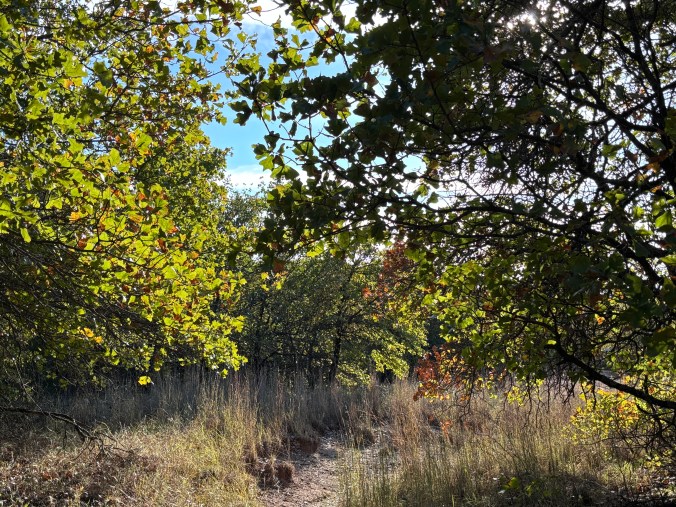
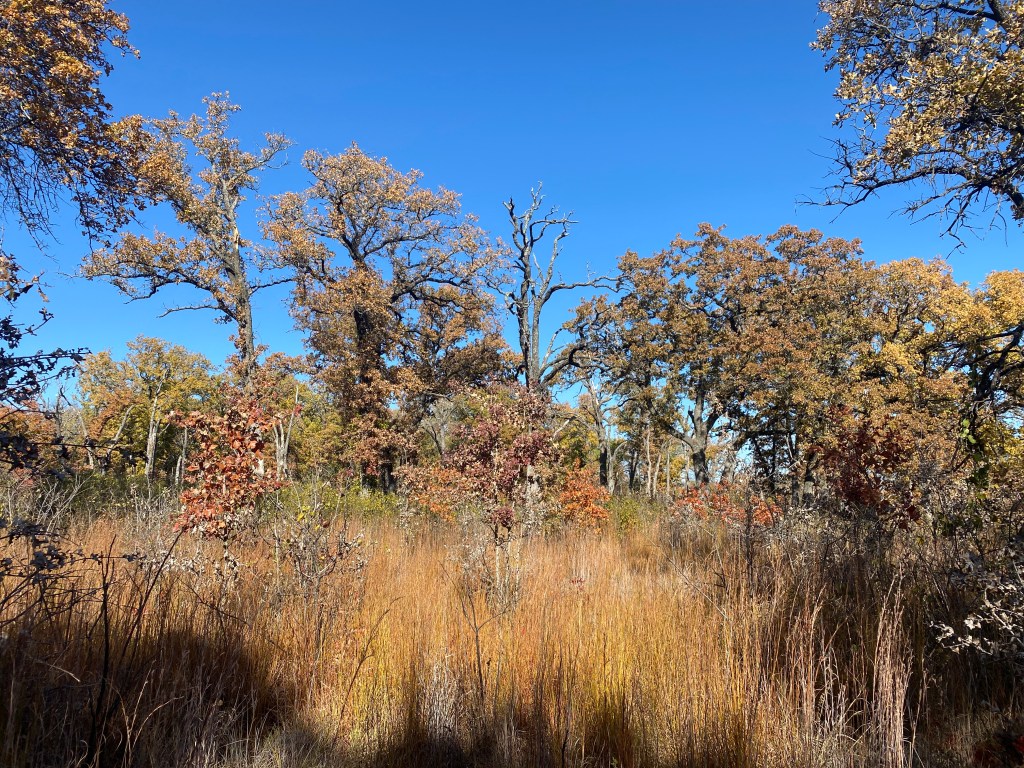
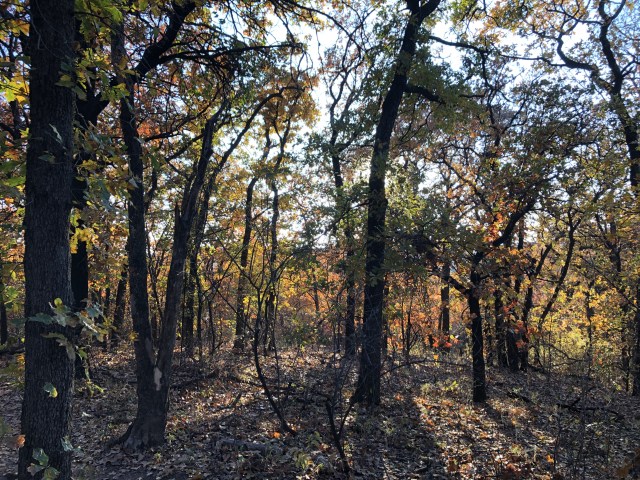
The afternoon sun behind the leaves made the woodland luminous

The preserve is not big in acreage, but it offers moments of loveliness and imagination on a grand scale. For those who really get to know it, each season brings new and wonderful experiences. Leaves fall and flowers die, but the woods and pockets of prairie are always alive and renewing themselves, which brings hope enough to see us through to spring.