This isn’t the usual sort of post for this blog. I’m looking through some of the literature about mindfulness, and I plan to post a few summaries of studies, at least for my own understanding of it. If you’d like to look at little more closely at mindfulness, please join me.
Shapiro, S.L., Carlson, L.E., Astin, J.A., & B. Freedman. 2006. Mechanisms of Mindfulness. Journal of Clinical Psychology, 62(3), 373-386.
This article reviewed the mechanisms by which mindfulness might work and proposed a model of mindfulness. Much of the research on mindfulness evaluates the effectiveness of interventions such as Mindfulness Based Stress Reduction, and shows that it can effectively treat psychological as well as physical symptoms. To examine how mindfulness works, the authors break the practice down into three “building blocks” of mindfulness:
Intention – the issue here is “why are you practicing mindfulness?” It could be for such purposes as self-regulation (e.g. to relieve a physical symptom), self-exploration, or self-liberation
Attention – observing one’s own moment-to-moment internal and external experience. It does not involve interpretation, but simply paying attention to the present experience.
Attitude – the qualities that one brings with them to paying attention. For example, is it cold and clinical or is it a friendly and compassionate presence? When one pays attention to their experience in an open, curious, and kind way, the result may be a capacity to not constantly strive for one kind of experience or push another kind away. The desired outcome is an acceptance of what is.
The authors suggest that intentionally attending to experience with openness and without judgment leads to a shift in perspective that they term “reperceiving.” Instead of being immersed in our life story, we can stand back and witness it from a little distance. This perspective changes the experience and makes us less likely to react automatically. The authors draw a parallel between this and the development of an ability, as a child grows older, to take the perspective of another person. We are no longer caught up in a subjective or self-centered view of the other person and can more accurately understand the other person’s world. Reperceiving strengthens a sort of “observing self” who can observe conscious experience without being fused with it or defined by it.
Some additional mechanisms or processes are described as following from reperceiving. One is self-regulation. Intentional, nonjudgmental attention to our experience allows us to connect with what is happening without having to react and avoid. Automatic and maladaptive responses may drop away if we can experience anxiety or pain from a little distance, seeing it as a temporary thing that will pass.
Reperceiving can help us be more purposeful about choosing what really is important to us. While we might have adopted values based on what our culture or family provided, mindful observations make it easier to consider what is truly meaningful for us, choosing values reflectively rather than reflexively.
Greater cognitive and behavioral flexibility may follow from our ability to see our experience clearly and observe our internal commentary about it. Our thoughts may become less automatic and, more objectively observing our experience, we have more choice over how we think about and respond to our circumstances.
Finally, reperceiving may allow for us to tolerate greater exposure to emotions, thoughts, or sensations that previously were experienced as intolerable. If we can remain still, so to speak, in the face of such experiences, their power over us diminishes. The benefits of such exposure, in terms of decreased anxiety and avoidance, are well-documented in research.
Walking down a moonlit path in the forest, the trees on either side were dark sentinels, dimly seen but keenly felt. They held this place together with an underground network of roots, weaving the soil and rocks of the bottomland into one tapestry of living things. The last season’s leaves gave that fabric its pattern and colors, visible tonight only as shades of dark and light. On the path, in the moonlight, the leaves were edged in a faint silver-blue.
But above the trees, there was light. The moon looked on, her face a pale disc. In the surrounding blue-black sky, an uncounted field of stars shone in frozen pinpoints of light. At the edges of the sky, the trees reached up with bare branches, like river deltas dividing into ever-smaller paths, like the blood vessels of the earth reaching toward the stars.
That field of stars reminded me of a summer night in this very spot when fireflies blinked into existence in the dark forest, three and then twenty, and then more, swirling among the tree branches. It was as if the stars had come down from heaven to dance for a time here on earth, before returning to their cold stillness.
A low, hooting call brought me back to this night. Somewhere in the distance, a barred owl was signaling his presence. The deep quiet resumed for a time, but then, toward the river, there was a sound like the cracking of a big branch. Was it the weight of time, finally bringing part of a dead tree to the ground? A powerful animal, passing through a tangle of brittle branches? It stirred some unquiet thing within me.
Still, the luminous moon sailed in the sky. No sound disturbed her. No calamity could change her serene expression. Paradoxically, in her stillness it was as if she was speaking to me.
“Peace! Do not be troubled. Nothing happens here that is not part of life’s story. Tomorrow the forest will be here, strong and beautiful. Let your troubles go, and see the sunrise!”
Everyone should have a home, a place where we feel like we belong. Ideally, home is a place where mostly good things happen over a long time, so that it feels comfortable and familiar. Americans move around a lot, so that long-term familiarity might not happen within the structure of one house. In my case, my family moved frequently until my middle teenage years, and after that there was college and other moves. But starting when I was about 11 or 12 years old, I visited the Greer Island Nature Center, which later expanded to become the Fort Worth Nature Center & Refuge. I have now been visiting that place for roughly 57 years, walking the trails alone or with friends and leading interpretive walks talking about reptiles and amphibians. I’ve had a lot of changes of houses, but a long and intimate familiarity with the oak woodlands, prairies, bottomland forest, marsh, and lake shore at the nature center. When I visit there, I’m where I belong. When it comes to people, I belong with my family; but if we’re talking about places, the Fort Worth Nature Center & Refuge is home.
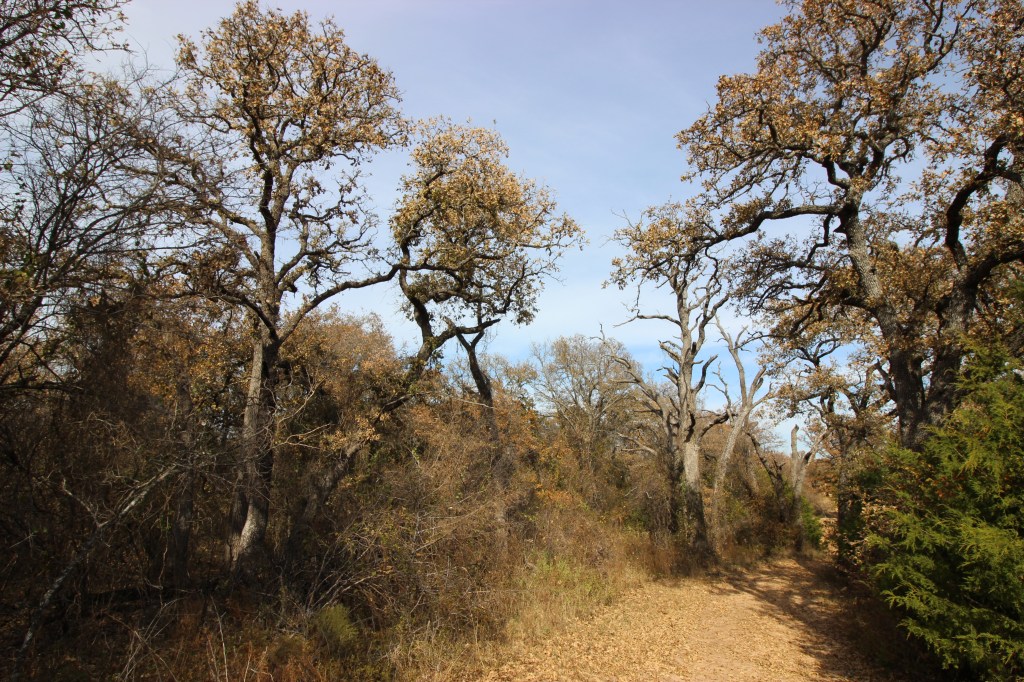
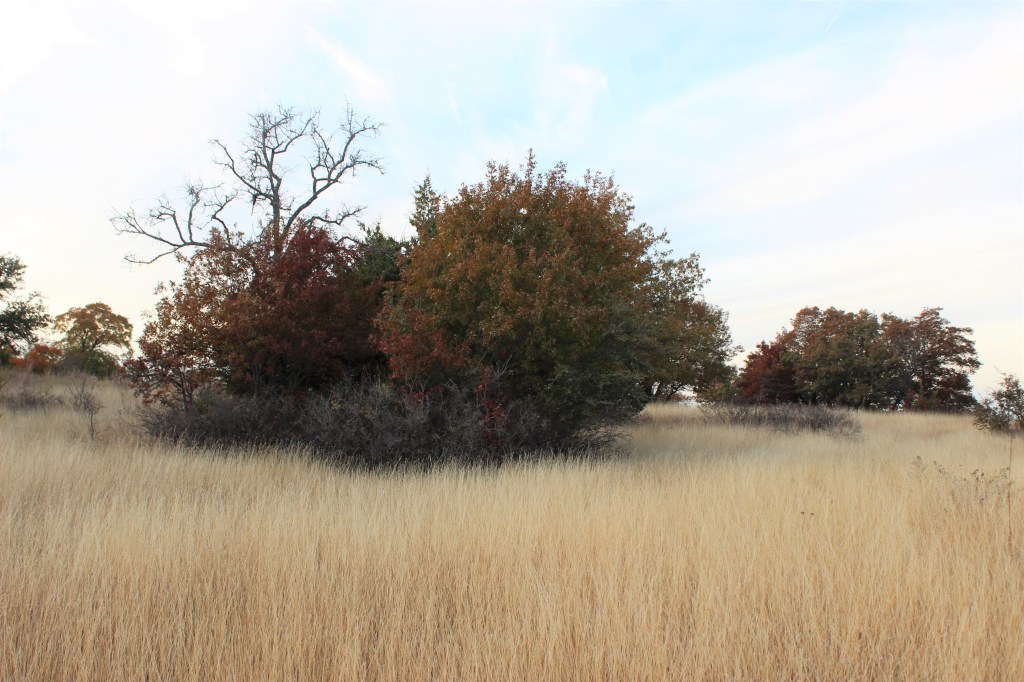
Woodland near the marshInland Sea Oats, within that woodland
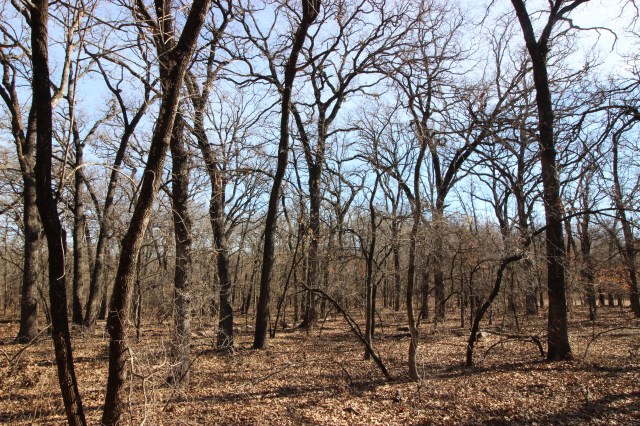
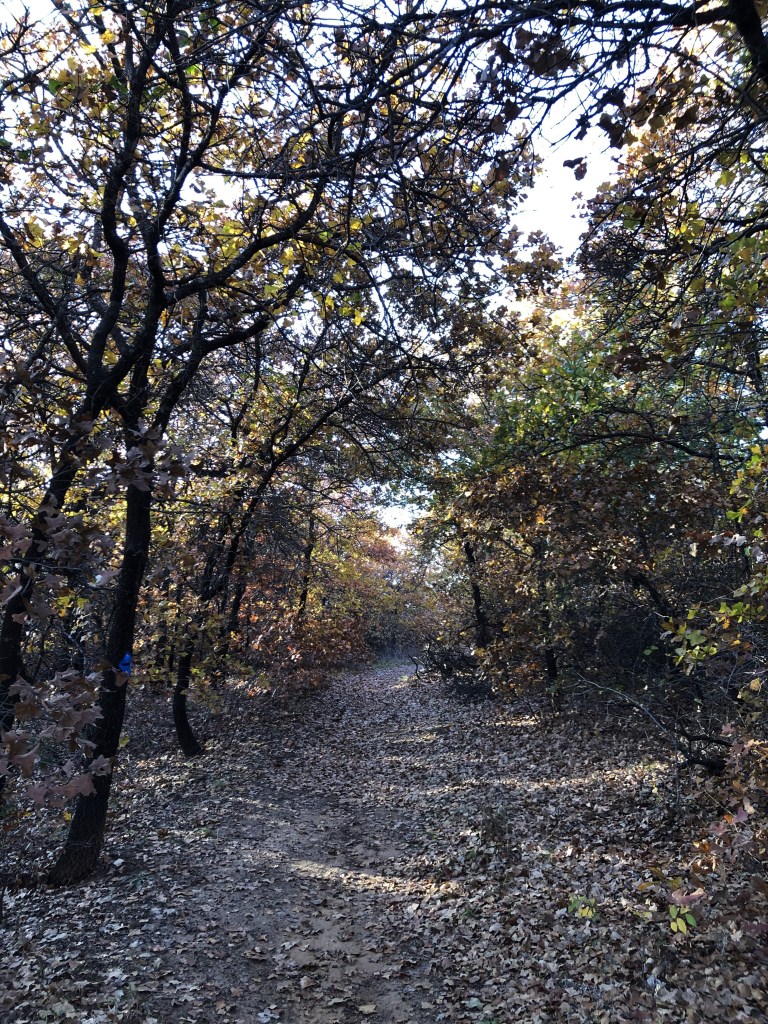
I went home yesterday, for Christmas Eve. I took advantage of another unusually warm day with clear skies and bright sunshine. The high temperature near the nature center was 71ºF, not a record high but definitely warmer than usual. So I needed no jacket as I walked down the Wild Plum Trail to Forked Tail Creek Trail, starting in relatively open woodlands with oak, honey locust, and patches of grassland and gradually dropping as it wound its way toward the marsh.
Fork Tailed Creek
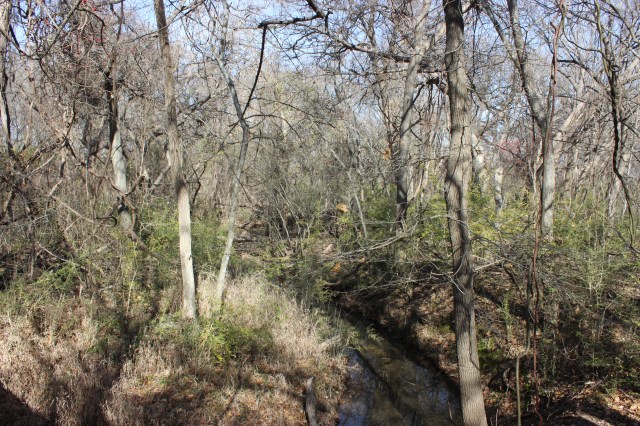
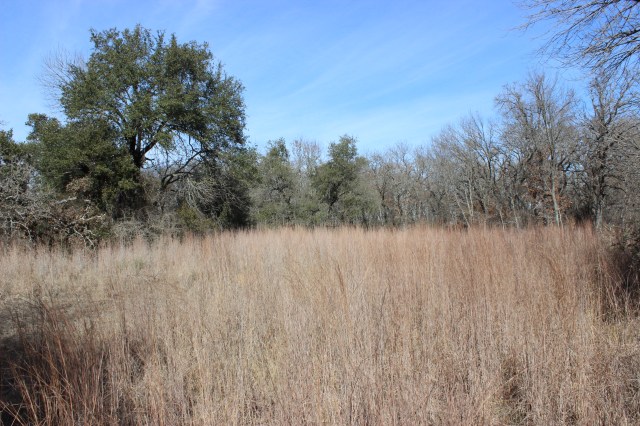
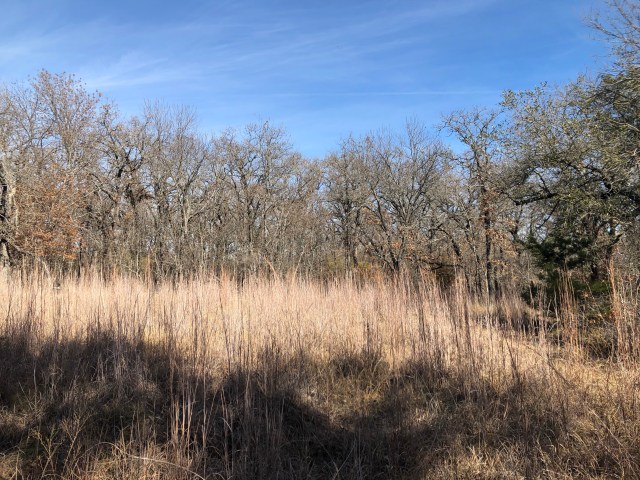
The trees got taller, and I walked over a wooden bridge crossing Fork Tailed Creek. A little further, and the trail suddenly opened onto a lovely savanna. Between the scattered trees were the dried and dormant leaves and stalks of prairie grasses, including the light rusty color of Little Bluestem. I stood for a while, taking in all the textures and colors, the pale rusty color of bluestem and the shades of straw where other grasses or plants were dominant. There were different textures: taller vertical brushstrokes, shorter grasses, curled leaves of the forbs mixed in among the grasses, and then there were the scattered trees with barren branches. Some branched out near the ground while a few sent straight, pale trunks upward before dividing to form a crown. So much detail to take in!
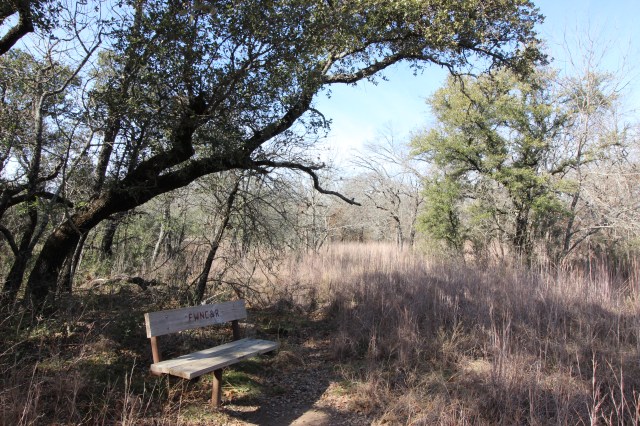
The trail led back through woodland and crossed a little patch with scattered Live Oaks among prairie grasses. Under one of the Live Oaks was a wooden bench with a patch of bluestem in front of it. The perfect destination for this walk, a place to sit and take in the tall grasses in the foreground and, further back, the line of Post Oaks with their gnarled branches dividing into thinner, more intricate fingers reaching into the clear, blue sky. A couple of Turkey Vultures soared above me, riding the air currents gracefully and searching for a meal. Often one would pass by low enough for me to see its head turn from side to side, scanning the ground. Others sailed through the sky far above, wheeling and flying on broad, strong wings. The sunlight was warm in its low angle, casting shadows as if it were late afternoon. I could hear the breeze gently stirring the trees, and despite the background highway noise it really seemed quiet and peaceful. It was a great moment to stop doing. Not even writing or putting thoughts together, just being still and surrendering to this place. I put away my field notes and just sat there, letting the warm sunlight and the beautiful woods wash over me.
The bench
Of course, some thoughts continued to occur to me, and I tried to let them come and then pass by, returning my attention to the sights, smells, sounds, and feel of the place. Periodically I would get restless, as if ready to go on down the trail, but then I would settle again. I could have moved on, but was I done here? Was there something else I needed? Actually, no, it was just the habit that I think most of us have of keeping on the move, doing, thinking, talking, and so on. But what I really wanted was for these moments – this sunlight, these trees, the grass and the breeze – to continue. And so they did, for a while.
Point the way to better days we can share with you.
-Jethro Tull, “Weathercock,” from Heavy Horses
The sun has set on the shortest day of the year; the sun is as far away from us as it will get. Although it is now winter, from here on out each day will have more daylight. The days will start getting longer, and perhaps the weathercock will point the way to better days.
It is now winter, by astronomical reckoning, although the climatologists count winter according to the three months with the coldest temperatures. By that reckoning, winter started on December 1.
It has felt more like winter today, but I wanted to take at least a short walk on this shortest day of the year, and so I was at Southwest Nature Preserve (my home away from home) at sunset. It was a moody, dark sunset with clouds obscuring the actual setting of the sun, but I have no complaints. Taking a walk at the pond and the woods is good regardless of weather, and that includes cool, cloudy, misty days like this one.
“It’s a dangerous business, Frodo, going out your door. You step onto the road, and if you don’t keep your feet, there’s no knowing where you might be swept off to.”
– Bilbo Baggins
The road goes ever on and on
My favorite way to dodge weekend chores and recharge for the coming week is to wander around in the woods somewhere, often at Southwest Nature Preserve. And autumn is my favorite time to disappear into the woods, being swept off (as Bilbo would put it) to some place where leaves are falling, the sun sneaks in at low angles and feels warm, and the air might be just a little chill.
Today was a day like that. For a little over an hour I walked trails that circle around the preserve, considering how some things come to an end – or seem to do so – at this time of year. The oak leaves fall, grasses are dry and dormant, and the sun looks like it might be leaving us as it rises for shorter times each day and stays low in the sky. No wonder ancient people feared the loss of the sun and had such celebrations when it started a little higher arc across the sky and the days began to lengthen a little.
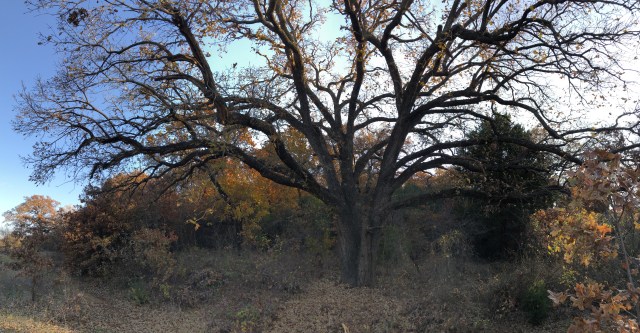
The giant “Caddo” oak has nearly lost its leaves
Autumn can seem like a time to slow down, to take stock of the year that is ending. The days are shorter, and many of the plants and some animals prepare for the long sleep through winter. Could it be that nature’s transition reminds us that all things end, that everything has its time and then passes into memory? Sometimes one of those memories seems near, like being brushed by the ghost of something that had its summer in full bloom and is now gone.
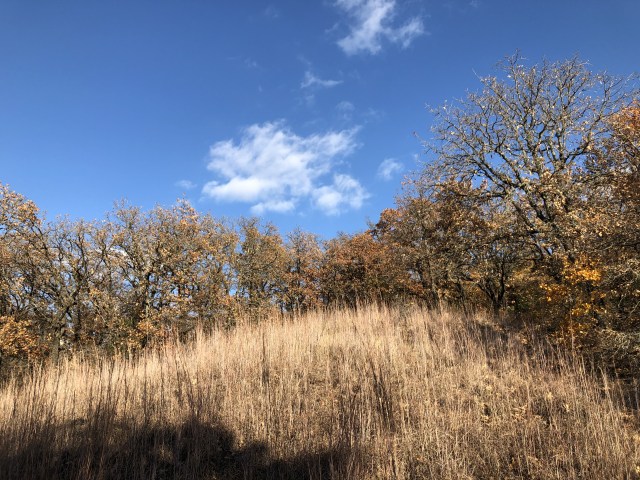
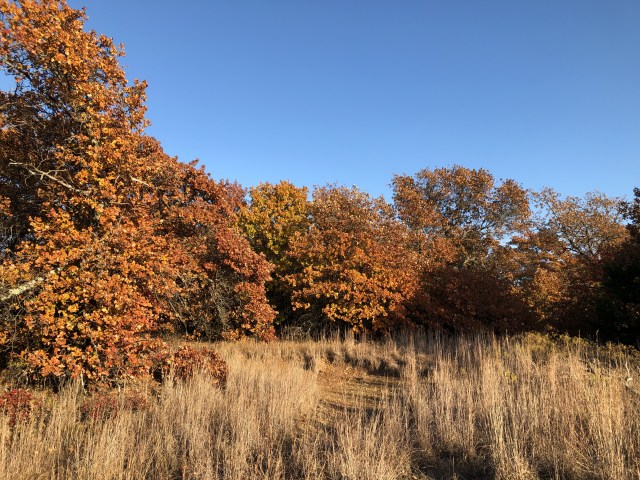
The sun warms a hillside with dormant Little Bluestem grass surrounded by oaks
What is happening on these hillsides of oak and Little Bluestem is not death, but dormancy and preparation for new life. Beneath the husks of grass stems, the rest of the plant is alive and waiting for spring. The bare trunks and branches of the trees are alive and have merely shed leaves that would not make it through winter. Those thin, broad leaves are great for exchanging gases and making food during the warm season, but they become damaged and would not do well in winter. As autumn arrives, the trees break down the green chlorophyll and reabsorb the nutrients in the leaves, and the yellow or red colors are what remains.
The green chlorophyll is nearly gone from these Post Oak leaves
I took a good look at some of those leaves today. Many were ragged and insect-chewed. But they have done their work well, and they end their time on this earth with a beautiful flourish. If I were a leaf, I would want my final days to shine like this.
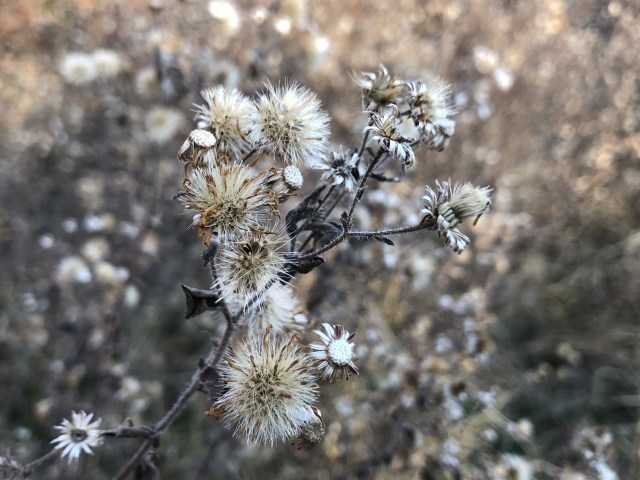
Further around the preserve, I came to a spot where a small field of weedy flowers, perhaps Camphorweed, had finished the season, gone to seed, and what was left was dry and dead. The little globes that looked like seed heads were light-colored and scattered around like a field of fuzzy stars above the soil. Dried flowers and seeds often have detailed shapes and textures that reward a few minutes spent examining them closely.
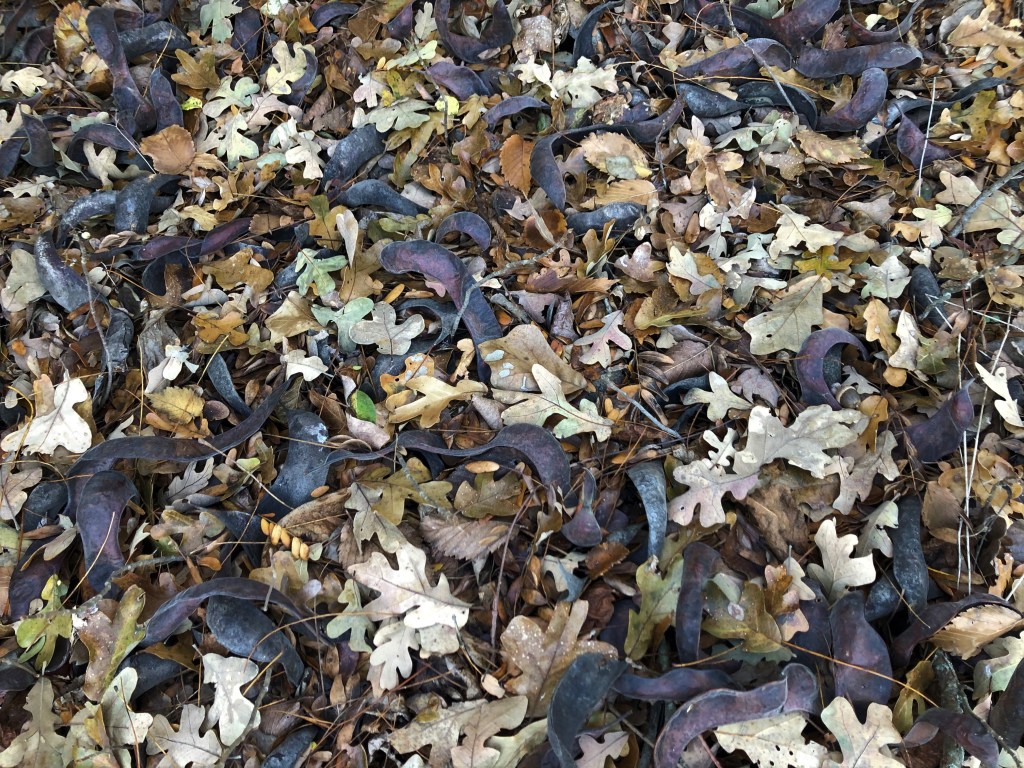
In another place there was an intricate and lovely mosaic of leaves and the flattened and curving seed pods of Honey Locust. A few remained on the tree, dangling like purplish-brown ornaments, but most had fallen. The pulp of those seed pods is said to be edible (but if you try it, be sure that it is a Honey Locust, not the Black Locust, which is toxic).
Honey Locust seed pods among the oak leaves
On one tree, two sinuously-curving seed pods remained side-by-side. Their twisting forms were well-matched, like dancers, like smoke curling as it rises, or like the twin snakes of a caduceus, signifying that this is a healing place.
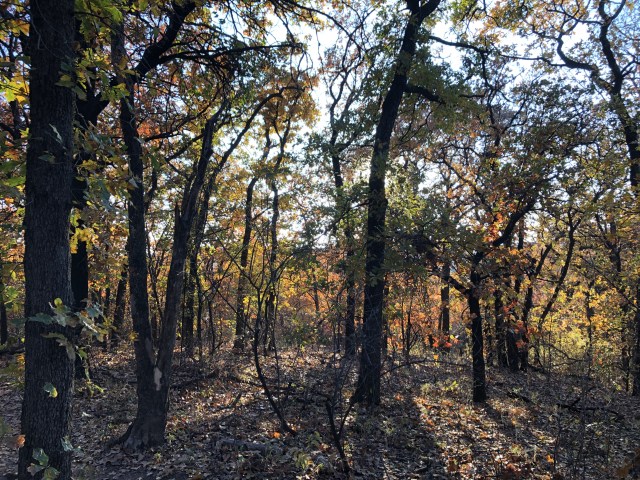
The afternoon sun behind the leaves made the woodland luminous
The preserve is not big in acreage, but it offers moments of loveliness and imagination on a grand scale. For those who really get to know it, each season brings new and wonderful experiences. Leaves fall and flowers die, but the woods and pockets of prairie are always alive and renewing themselves, which brings hope enough to see us through to spring.
(I’m very fortunate to be able to use some photos by Meghan Cassidy in this post. The captions identify which ones are hers, but basically the way to tell is to look for the really good ones – they’re hers!)
A patch of prairie at the LBJ National Grasslands
On a visit to the Lyndon B. Johnson National Grasslands in
Wise County, we walked a long trail through straw- and rust-colored grasses and
through the stands of oak trees that are the signature of the Western Cross
Timbers. Sunny days like this in autumn are perfect for walking in the woods
and prairies. The slanting sunlight and the colors of grasses and leaves (even
when they are mostly shades of straw and brown) result in the landscape having
a kind of warm glow, which seems like a comfortable complement to cool or even
cold temperatures.
It wasn’t cold, not even a little bit. The high temperatures
reached the middle sixties out in the grasslands, and the bright sunshine felt
wonderful as we hiked past post oaks and junipers. Juniper is no friend of the
grasslands, because without a combination of grazing and periodic fire, these
trees can spread and take over. Juniper is invasive, but here is the positive
side: the junipers at LBJ Grasslands are beautiful trees and really come to the
foreground in winter when they remain green amidst the bare branches of oaks.
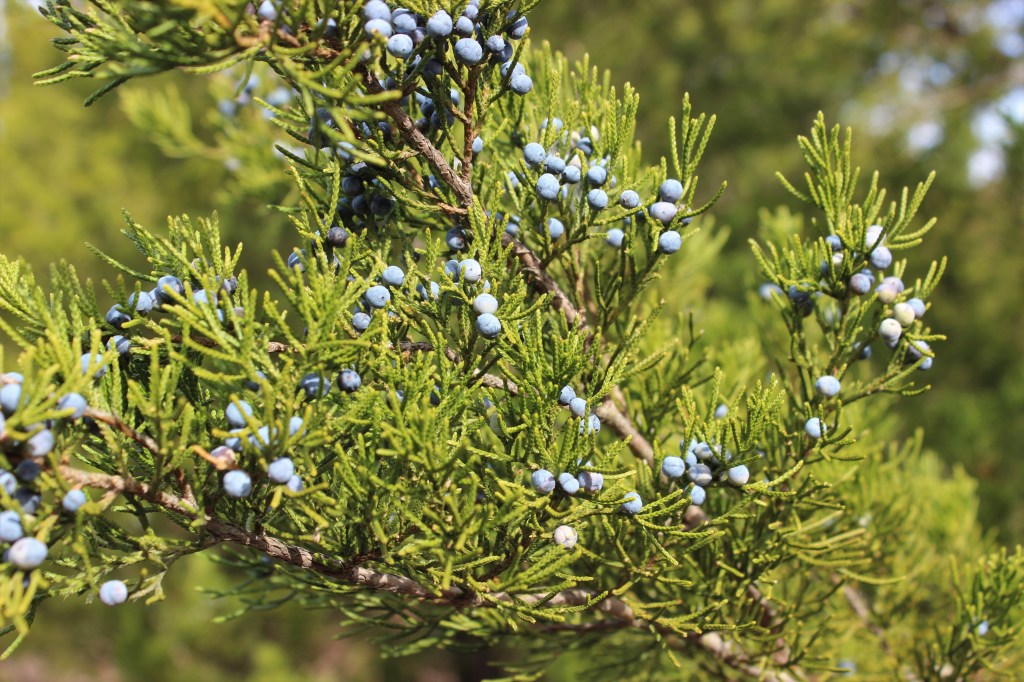
And the berries! Those little blue berries give a refreshing taste when you
chew a couple of them – there is a little sweetness and that aromatic juniper
flavor from camphor and other aromatic oils.
Juniper “berries”
The berries, we are told, are really modified seed cones and
not true berries at all. Sort of a blue, tasty variation on the pine cone
theme. But it’s only a little taste; much of what lies under that blue coating
is a seed, so there is not much to eat. Some junipers produce berries while
others produce pollen. In winter, some of those male junipers take on a golden
cast from all the pollen just waiting to be lifted by the breeze and carried to
the female plant.
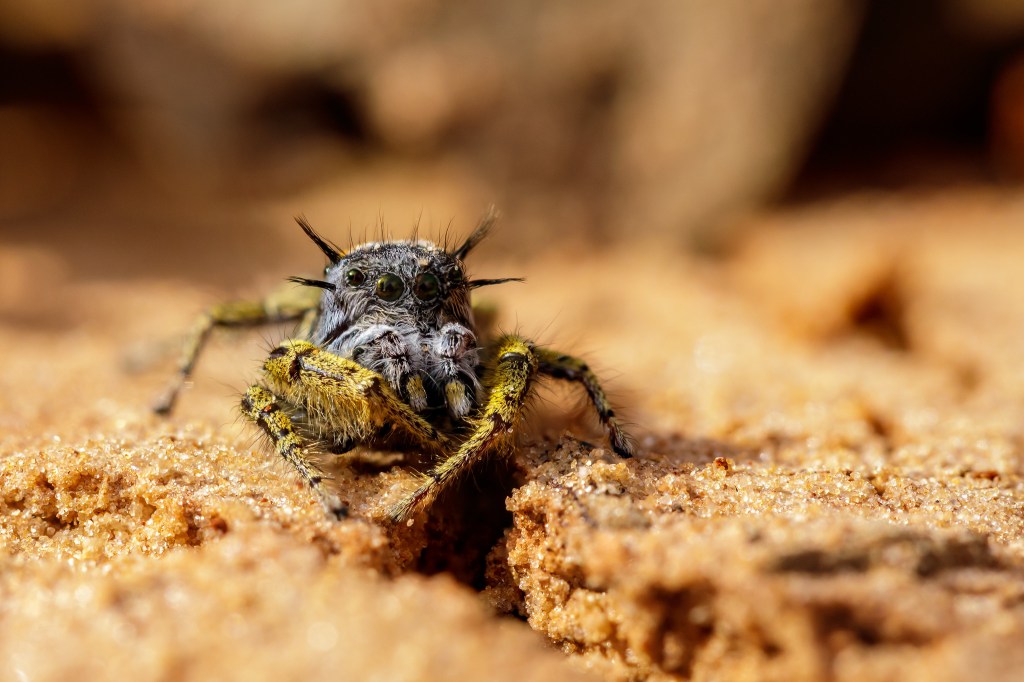
Meghan Cassidy’s photo of the jumping spider
My companions made the walk that much more enjoyable. Meghan Cassidy and Paul Mendoza are good company and knowledgeable about the natural world, particularly insects and arachnids. And those little jointy-legged critters came out to greet them in numbers greater than we would have expected. They discovered a little jumping spider on the trail which Meghan took great pains to get lots of photos of. All of us enjoyed seeing harvester ants out, and we wondered about the ones emerging from holes without the bare circle that usually marks the entrance to a colony. Lots of harvestmen were on the move. These might look a little like spiders but are only cousins. Everyone is familiar with “daddy long-legs” – the little dot of a body surrounded by eight long, impossibly delicate legs. None of them can spin webs and none have a venomous bite.
Another of Meghan’s photos: this is one of the harvestmen we saw
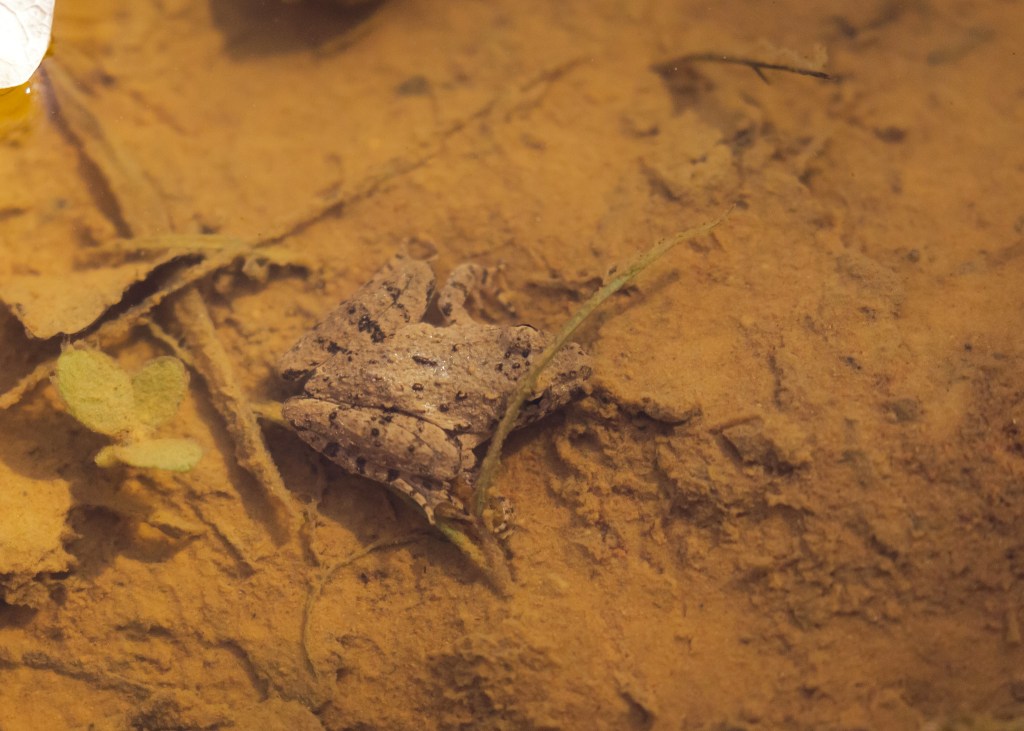
Despite being mid-November, a couple of herps graced us with
their presence. Cricket frogs were out at a pond and even in some small,
scooped out pools where rainwater had collected. And along one trail, a young
ribbonsnake slipped among the leaves, just long enough for me to see those
beautiful stripes but not long enough to capture it for a closer look. Happy
cricket frog hunting, my friend!
A cricket frog, hiding under the water (photo by Meghan Cassidy)
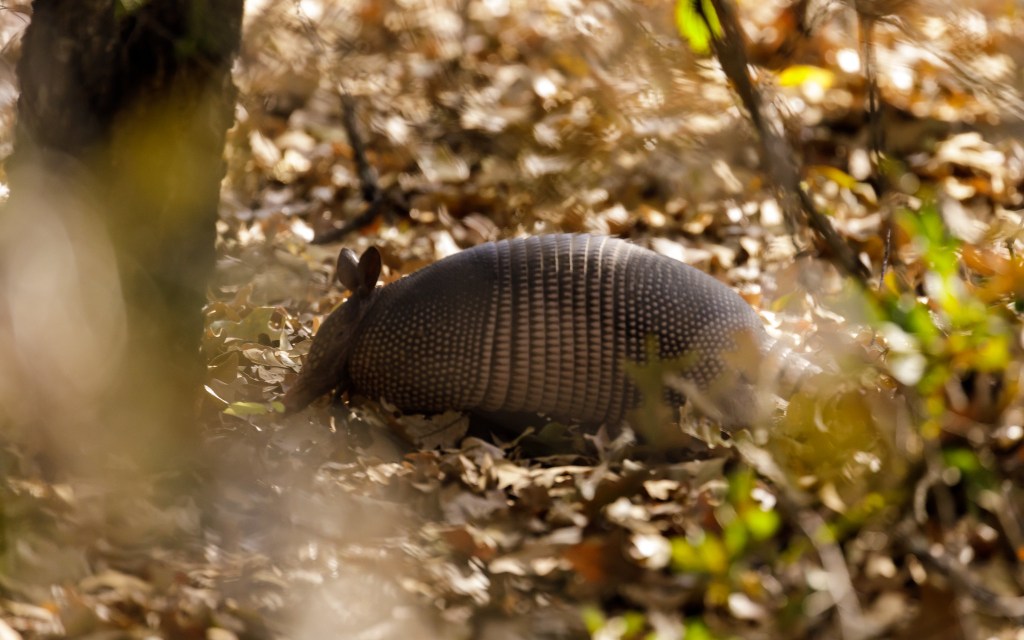
Several times we heard a little commotion in the leaf litter
and were able to see an armadillo digging for invertebrates. They stop and
probe the leaves and soil, sometimes scratching a short, conical excavation
into the soil as they look for insects, worms, and any other animal matter that
they may expose. After a short, snuffling exploration of one spot, they move a
short distance and try again. David Schmidly’s The Mammals of Texas (Revised
Edition) reports that much of their diet is larval and adult scarab
beetles, followed by termites and ants, and then caterpillars, earthworms,
millipedes, and other invertebrates. A few reptiles and amphibians are taken
occasionally, probably examples of small herps being in the wrong place at the
wrong time. An armadillo snuffling through the leaf litter can’t be too
particular about what they turn up.
Meghan’s photo of one of the armadillos
We enjoyed our opportunities for a little armadillo
watching, and sometimes we were able to get quite close. They cannot see well,
so if you are quiet and stay downwind so that they cannot detect you by smell,
you might get very near to one. Once they do detect you, they may jump in
surprise and then crash off through the underbrush, protected from thorns and
branches by their bony armor.
We talked a good bit about Blackjack Oak and Post Oak and
marveled at the variety of leaves that we saw. Some looked like hybrids and
there were other oak species scattered here and there. I recalled that
Blackjack acorns were said to be bitter, while those of the Post Oak were more
tasty and sweet. We put this to the test, as Paul cracked a Post Oak acorn and
Meghan trimmed the dark husk away. A little sample of the nut was delicious.
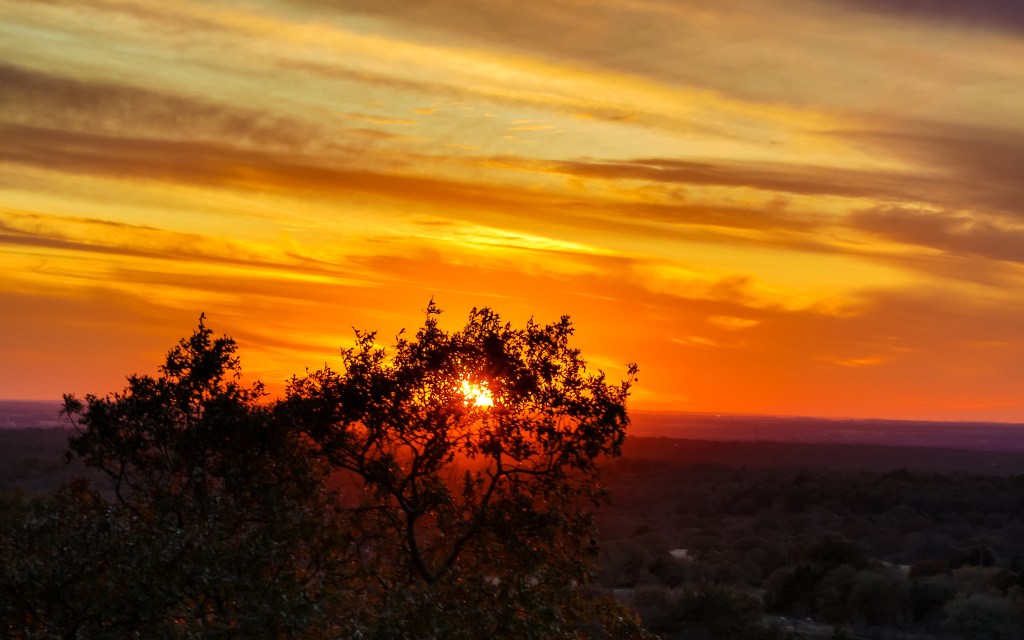
Near a limestone ridge at LBJ National GrasslandsA last blaze of grasses and oaks before sunset
At the end of the day, we visited a limestone ridge a few
miles away but still within LBJ Grasslands. Instead of Little Bluestem, the
grasses here were dominated by a shorter, uniformly straw-colored species
surrounding the scattered oaks and junipers. Numerous Grooved Nipple Cacti were
scattered on the ridge top, growing in small mounds in the thin soil barely
covering the “walnut shell” limestone. Here, we sat and watched the sun set, looking
out across an area of woodland and ranch land stretching into the distance. I
sat on that limestone, a conglomerate of ancient oyster shells cemented
together into gray slabs, and watched the sun make a nearby oak sapling glow
red-orange and then darken as the sun was obscured by some bands of clouds.
When the sun re-emerged, those beautiful oak leaves glowed brighter. Gradually
nature turned down the lights, and those leaves dimmed to dull red. The
horizon, however, was still a glowing ember, holding on for a time and painting
the undersides of the clouds red and then pink, and then they all faded to
blue-gray and closed a very beautiful day in the woods.
Three people took a walk in the woods. One of them loved being outside, but spent most of her time texting and checking Facebook. At the end of her walk, she hardly felt like she had been in the woods at all. She had been in the woods, but her mind was somewhere else.
“Her mind was somewhere else.” That’s a strange thing to say, isn’t it? As if her mind could be somewhere else, in a different place than her body. Would that mean that she was out of her mind? It’s hard to say.
The second one wasn’t using his phone, but he spend a lot of time thinking about how he was going to talk with his friend about something that happened at school. He saw a frog at the edge of a pond, but then began to think about his friend again. He kept imagining different things his friend might say, turning it over and over in his mind. He hardly noticed the birdsong in the trees above him.
Sometimes a worry can pull us away from ourselves, so that we don’t notice what is going on around us. We can be lost in uncomfortable thoughts, and not even notice what is right in front of us. On a walk in the woods we would like our minds and bodies to be right where we really are, able to be connected with everything around us and “tuned in” to it.
That’s how it was for the third person who walked in the woods. Here is how she did it: She started her walk by going to a quiet place and looking around, at the same time paying attention to each breath she took. Each breath brought in the air of that place, and its oxygen became part of her. Every time she breathed out, the carbon dioxide from her breath joined the air around her, ready for the trees and other plants to use in order to grow. “It’s like I’m becoming part of this place,” she said to herself. She noticed her thought and let it go. She didn’t want to get tangled up in her thoughts – she wanted to stay here, connected to this place.
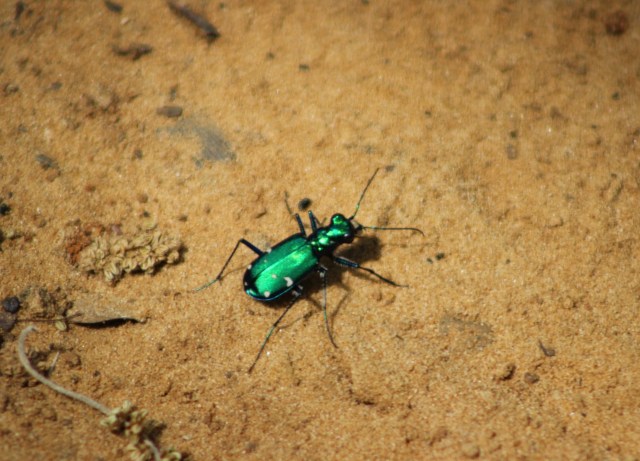
A Six-spotted Tiger Beetle
As she started to walk around, she noticed a beetle running along the sandy trail ahead of her. It was brilliant metallic-green from its antennae to the back of its abdomen. It took off and flew a few feet away, and the girl noticed that the green was on the wing covers – called the “elytra.” When the beetle landed, she noticed that six little white spots were scattered on the back half of those elytra. She watched the beetle for several minutes, noticing how amazingly fast it could run on those little legs, and how it flew just out of reach whenever she got too near.
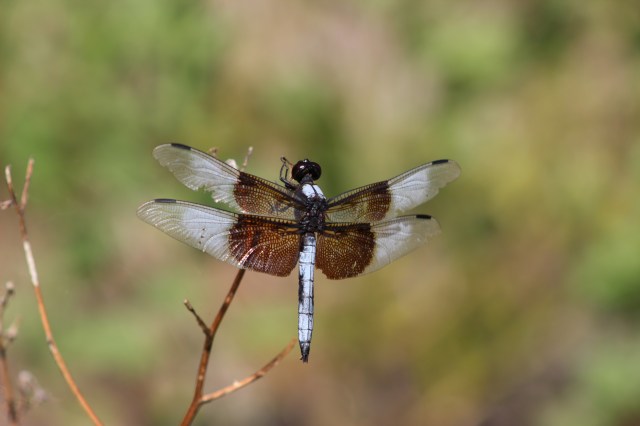
Further down the trail, she saw a butterfly being tossed around in the autumn breeze. And yet, maybe the butterfly was going where it wanted to go. She noticed that it sailed behind some trees, then came back around near her. The breeze didn’t do that. Maybe those fluttering wings knew what they were doing, even though the butterfly looked almost exactly like a yellow leaf being blown around by the breeze. A big dragonfly came on the scene, heading straight for the butterfly. Bouncing around on thin butterfly wings, it maneuvered around the tree branches and disappeared, leaving the dragonfly behind.
One of our common dragonflies
The walk continued in this way, as the girl took in the sights, sounds, and smells of the place. When she found some animal, she stopped to follow what it was doing, and found that with a little patience – with the ability to just be there without hurrying – she noticed lots of things that she might have missed. She didn’t even have to know all the facts behind what she saw. With a little checking, she could discover that the green beetle was a six-spotted tiger beetle, a fierce predator of smaller insects. But she could also just appreciate it as a beautiful, fast creature with whom she shared the path on that wonderful walk in the woods.
She and her mind and body had all been together that day, open and ready to see, hear, feel and smell everything that the place could offer. It was a walk that she remembered for a long time.
(This article also appears in the October, 2019 issue of “The Treefrog Times,” a young readers publication available free at www.jsdragons.com)
It was almost two weeks into autumn, and summer’s heat held on. On October 6th, when the high temperature in Arlington reached 97ºF, a cold front was scheduled to roll through late in the day. It would be an interesting time to be at the Southwest Nature Preserve. Would the change take the form of a whisper of cool air, or a line of storms? A good friend, Shelsea Sanchez, came with me to witness what might be the end of summer heat and drought. We got there a little after 5:00pm and stayed for a couple of hours.
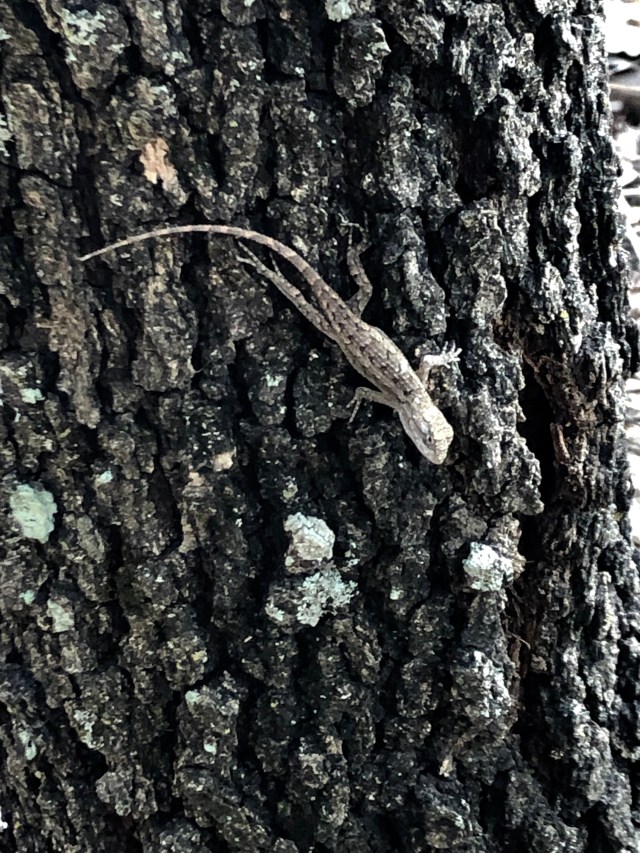
Juvenile Texas Spiny Lizard
The initial walk around the north pond felt like a late afternoon in summer. We passed a little Texas Spiny Lizard positioned on a tree trunk, stalking insects in the hot sunshine as if it was back in August. Actually, two months ago this very young lizard might not yet have hatched from the egg, but now he or she was feeding and growing as it if was endless summer.
We followed
the path up the gentle climb on the back side of the preserve, to pay a visit
to a Post Oak that will be proclaimed as a Texas “historic tree” later this
month. It is estimated to be over two hundred years old, with huge twin trunks
and massive limbs that stretch out over the surrounding vegetation. It is being
called the “Caddo Oak,” recognizing that it would have been an adult tree when
the people who lived on this land were Caddo hunters and farmers.
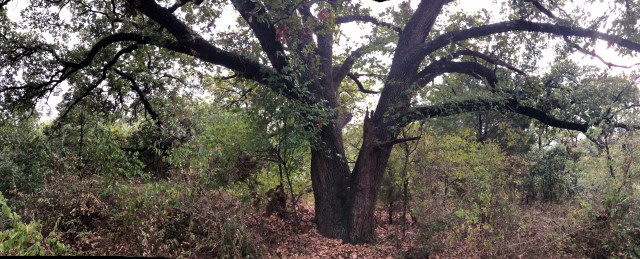
The Caddo Oak, a very old Post Oak
A good way to
spend time in a place like this is to clear our minds of the mental traffic
that pulls us to past worries or future plans, so that we can simply be open to
the present experience. A good strategy for this is to notice our breathing,
how the body expands and relaxes with each breath. From this focus on present
experience, we can connect more deeply with our surroundings – in this case a
massive old tree with deeply furrowed bark and a giant canopy of leaves. There
is a lot to notice and appreciate when practicing mindfulness in nature, simply
opening oneself to the present experience without judging it or being tugged
away from the moment by the internal “chatter” that often captures our lives.
We stood for a
while, taking in the tree, the sky, and all the surroundings. Later we talked
about what we had noticed: Shelsea’s perception was that those big limbs would
just go on reaching out to the woods and sky, ever wider. It impressed her as a
“wise” tree, something that had lived a long time and experienced a great deal.
The branching limbs of our oak trees often suggest to me a parallel with blood
vessels, extending into the surrounding air, supporting life in the process.
Following the trail as it turned and skirted a yucca meadow with deep sand, beyond a thicket of sumac and past a big juniper, we talked about how trees are linked together below the soil. A fine network of fungal threads, called mycorrhizae, connects with the roots and helps provide water and minerals. In exchange, the fungus gets nutrients from plant roots. It is a mutually beneficial relationship, and it is thought that mycorrhizae make possible a sort of communication between trees. For example, a tree that is attacked by insects may respond by releasing volatile organic compounds, and the surrounding trees connected by the fungal network respond in a similar way.
We spent some time in stillness and quiet, looking to the west toward some oaks in the background, and a scrubby open area with prickly pear cactus and a thicket of greenbriar. The front was coming, and darker blue-gray clouds were massing, and the distant thunder was a welcome and soothing sound. A couple of doves flew overhead, as we continued to absorb what we were experiencing. Afterward, Shelsea commented about how a nearby greenbriar was overtaking and pressing a shrub closer to the ground. Greenbriar is a strong, tough vine that I’ve described as like botanical barbed-wire, and this particular one was attempting to climb a shrub that could not support the vine’s weight. However, the main thing that we had both noticed in the last few minutes was the occasional low rumble from the advancing clouds.
You hear distant thunder when it is quiet – when there are no airplanes, no car engines, no roar of freeway traffic, no loud humming air conditioners. At an urban preserve, some of those things are inescapable, but if those noises are muffled – or if you are in a wild natural place away from mechanized sounds – you can hear breezes, birds, insects, and distant thunder. Through most of our history as humans, those sounds have usually been audible to us. We could hear coyotes howling on a nearby ridge, or a chorus of frogs a quarter-mile away. In a quiet glade we could hear water moving in a creek, and bees buzzing in nearby flowers. The sigh of wind in tree leaves was familiar. It makes you wonder if the loss of all those “quiet sounds” leaves an important gap in our lives, and if constant mechanized sounds and the ever-present TV and video sounds might be a source of low-level stress for us. The answer is yes, it is a source of stress, based on studies showing poorer concentration, increased anxiety and depression, and disrupted sleep because of noise pollution. Even low-level noise tends to increase the body’s levels of the stress hormone cortisol, and chronically elevated levels of cortisol interfere with the brain’s ability to focus and plan, as well as putting us at risk of digestive and cardiac problems, weight gain, headache, and other problems. And so I place a very high value on those experiences of quiet, when a bird’s song or a breeze stirring leaves in a tree can be heard.
Southwest Nature Preserve, October 6, 2019
Looking up the
trail toward the west at 6:30pm, we saw a hawk rise above the tree line,
soaring in the turbulent air below the oncoming clouds. A second hawk emerged
near the first one. As they flew, the sun shone through a break in the clouds
and highlighted the wings of these birds. Another couple of birds joined the
group, which flew higher and stayed visible above the tree line. The aerial
dance continued and rose higher, with other hawks coming into view. Shelsea and
I needed a real birder with us; I did not see rusty reddish tail feathers that
would have identified a bird as a Red-tailed Hawk, and so I was at a loss. I
could tell that the underparts were light-colored, but my eyes and brain could
not follow the movement well enough to remember their color patterns as they
rode the fast-moving air currents.
A kettle of hawks
As the number
of hawks grew and they spiraled higher, Shelsea pulled out her phone and began
recording video. I began doing the same thing, framing the swirling “kettle” of
hawks. The Cornell Lab of Ornithology reminds us that hawks sometimes gather in
“kettles,” using rising air currents to gain altitude, especially when
migrating. In his book, The Birds of Texas, John Tveten notes that in
early fall, Broad-winged Hawks begin their migration south into tropical
America, rising on air currents and forming large swirling flocks. I do not
know if these were Broad-winged Hawks, but it seems quite plausible.
We stood for a
moment, taking all this in. Life at the preserve was in sudden motion, as the
cold front came through with distant thunder and the promise of rain, and this
seemed to have spurred the soaring, wheeling kettle of birds to rise into the
sky.
And then, raindrops began to fall. After the heat and drought, it was delightful, and we stood there enjoying the feel of a few cool drops of water on our skin. In our state of fascination with every detail of experience, I noticed that every drop created a little dimpled medallion of mud as it struck the fine red sand of the trail. If the rain continued, those little mud-craters would join and the preserve would get the water it needed. In the meantime, we walked through these sprinkles and enjoyed the feel of the rain.
We spent two
hours there, but we had little awareness of the passage of time. It didn’t seem
to go quickly or last a long time, because we tried to let go of the past and
future so that we could fully experience the present. Although we didn’t pay
attention to the passage of time, we had a great time!
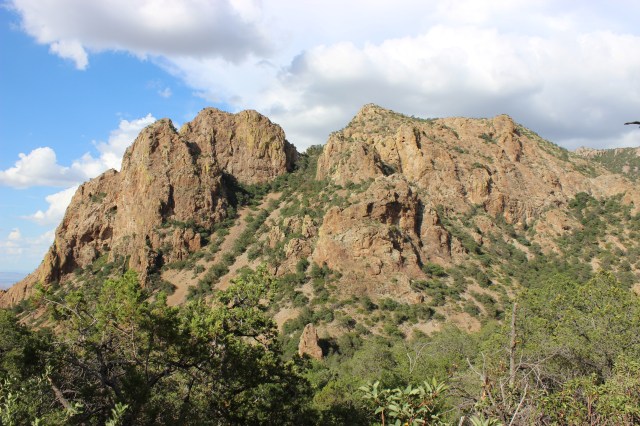
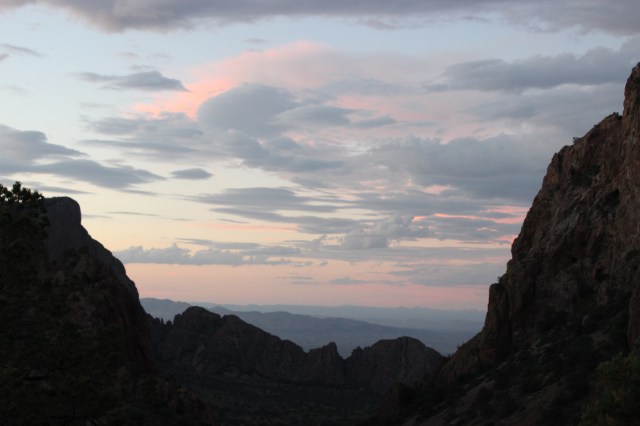
A view from the Lost Mine Trail, in the Chisos Mountains
On June 19 of 2018, I hiked most of the way up the Lost Mine Trail in the Chisos Mountains within Big Bend National Park, and lost myself for a while in the silence and beauty and peace of the place. I wrote the following:
In one of Beethoven’s final string quartets (Op. 132), he wrote a slow, hymn-like movement titled, “Song of Thanksgiving of a Convalescent to the Deity,” expressing his gratitude as he recovered from a serious illness. (An absolutely mind-blowing deconstruction and analysis of what Beethoven does in this incredible movement can be seen and heard here.) It is a profound, beautiful hymn, not sweet or sentimental, but exactly as I imagine how his soul would express what it means to be alive, in the full realization of how easily life could be gone.
I am hearing the opening notes of that quartet movement now, sitting on a bench in the Chisos Mountains. I have not had a close brush with death such as Beethoven had, but I do have deep gratitude for experiences like today’s walk up the Lost Mine Trail. Here, there is a sense of connection and healing of things that are broken, in a sanctuary where troubles cannot reach. No gift could be more appreciated than this.
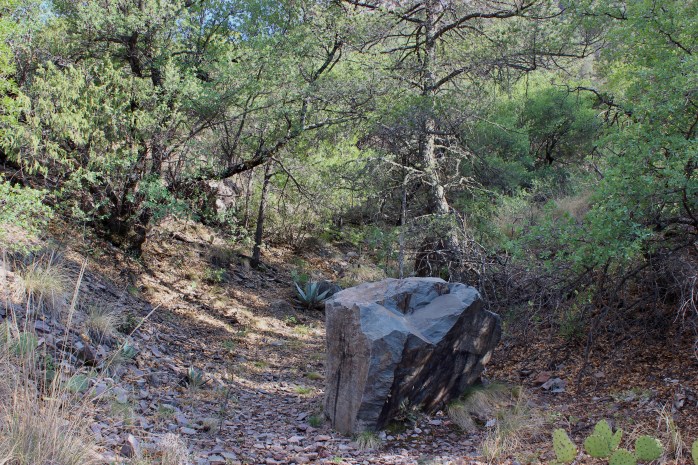
Within the mountain woodland
It is completely quiet except for occasional distant thunder, birdsong here and there, and the beginning sounds of insects here at the end of the day. I keep returning to this theme, how genuine quiet brings such tranquility. That is especially true here in the calm mountain woodland just before sunset. The hikers have gone. Even the knowledge that black bears live on these slopes does not cause concern, perhaps because it is one more indication of how raw and unspoiled this place is.
Here I am, after sixty-seven years still able to climb this trail – not that it is an especially difficult feat – and sit in the silence, watching the shadows lengthen and listening to the song of this earth, uninterrupted by noise. It is a rare privilege in a world that spins and spins, this opportunity to sit still.
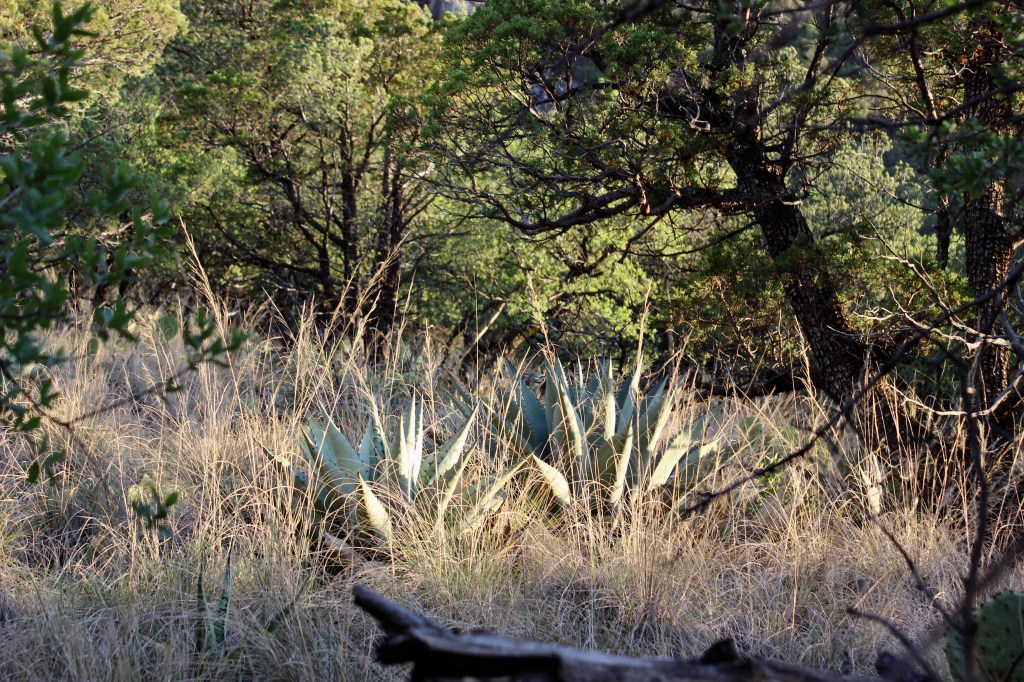
Blue-green spikes of Havard agaves on the mountain slopes
A thunderhead builds, and I watch it expand and drift this way. The thunder is still distant, one of those sounds that can be so relaxing from afar. The long, slanting rays of the sun highlight the tops of piñon pine and Emory oak. A nearby solitary bird trills and occasionally chirps, as the clouds turn rose-colored and the last light glows on the mountaintops. Soon it will be dark, and I will have to go, but I will remember these moments of solitude in the Chisos Mountains.
Once again this year I had the privilege of teaching herpetology to an incoming group of Master Naturalists. Today I led them on a short walk into the bottomland forest at Fort Worth Nature Center & Refuge. Each year, I appreciate the Texas Master Naturalists even more; they are the “rangers” of the remaining wild lands and creatures of our state.
Flooded bottomlands in April of 2010
By “rangers,” I am drawing upon the stories within The Lord of the Rings, and referring to the Dunedain, the people who wandered the lands in the north of Middle Earth. The rangers knew those lands and protected them as best they could, just as the Master Naturalists learn about the land, animals, and the plants around us. Maybe you’ll forgive what could seem like an overly stretched analogy, but in a world increasingly separated from nature, we need to celebrate those who understand and are drawn to nature and who might help advocate for it. Who else studies the intricacies of natural history and spends time wandering in the forests and fields?
Becoming a Master Naturalist involves a series of classes and readings; you do not sign up, pay your money, and now you get the title just for joining the “club.” There are classes and field experiences, and after certification there are activities and ongoing training. Some of the people in the Master Naturalist program are quite expert in one or perhaps several areas of nature study.
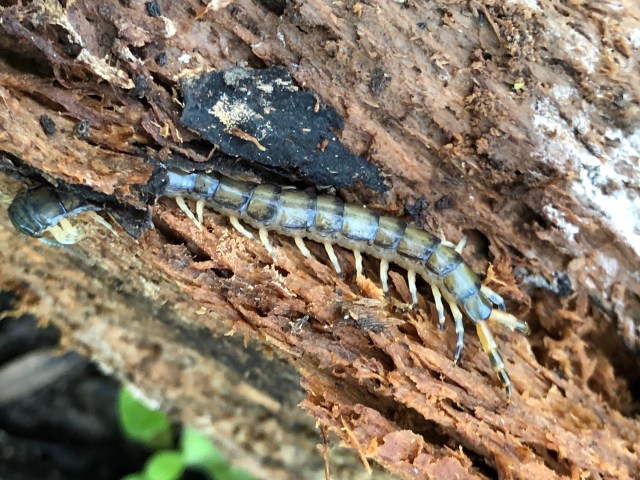
A centipede, surprised under a fallen log
What did we do today? We walked down through the bottomlands, past huge cottonwoods and other trees and in areas that periodically flood. Fallen logs and branches shelter numerous herp species, along with lots of wolf spiders and other invertebrates.
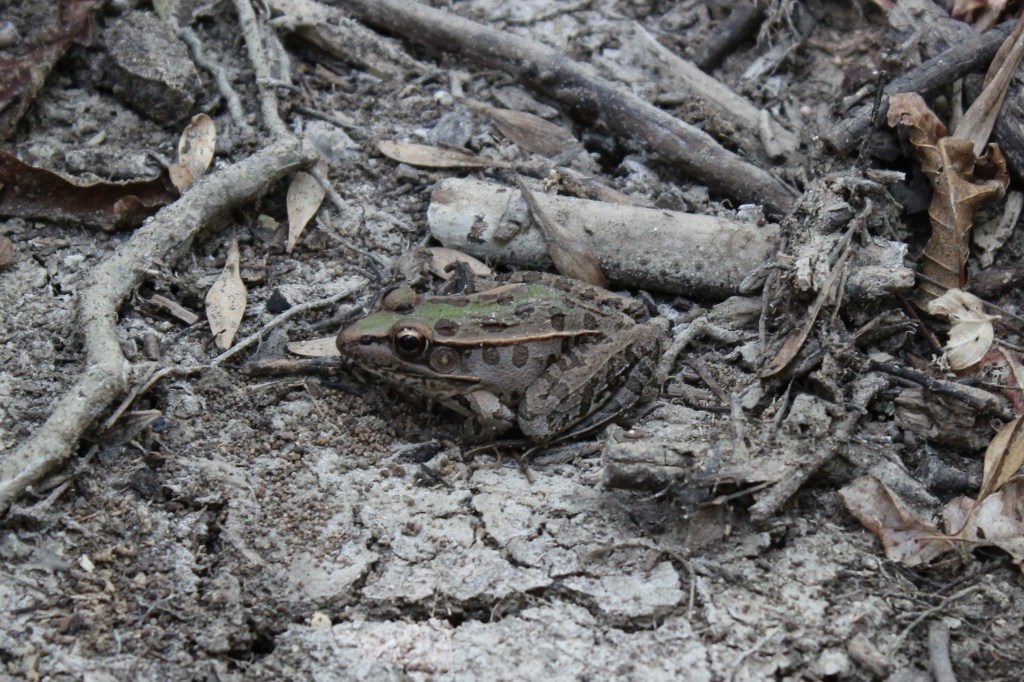
Two amphibian species dominated our walk today: The Southern Leopard Frog and the Gulf Coast (or Coastal Plains) Toad. The ranges of three species of leopard frogs converge near here, and some hybridization occurs, but the ones we saw appeared to be Southern Leopard Frogs (Lithobathes sphenocephalus). They are medium-sized spotted frogs that can leap long distances. Today’s leopard frogs had continuous, unbroken sets of dorsolateral ridges, no spot on the snout, and the light line on the upper jaw was not particularly bold – and that set them apart as the Southern species.
Southern Leopard Frog
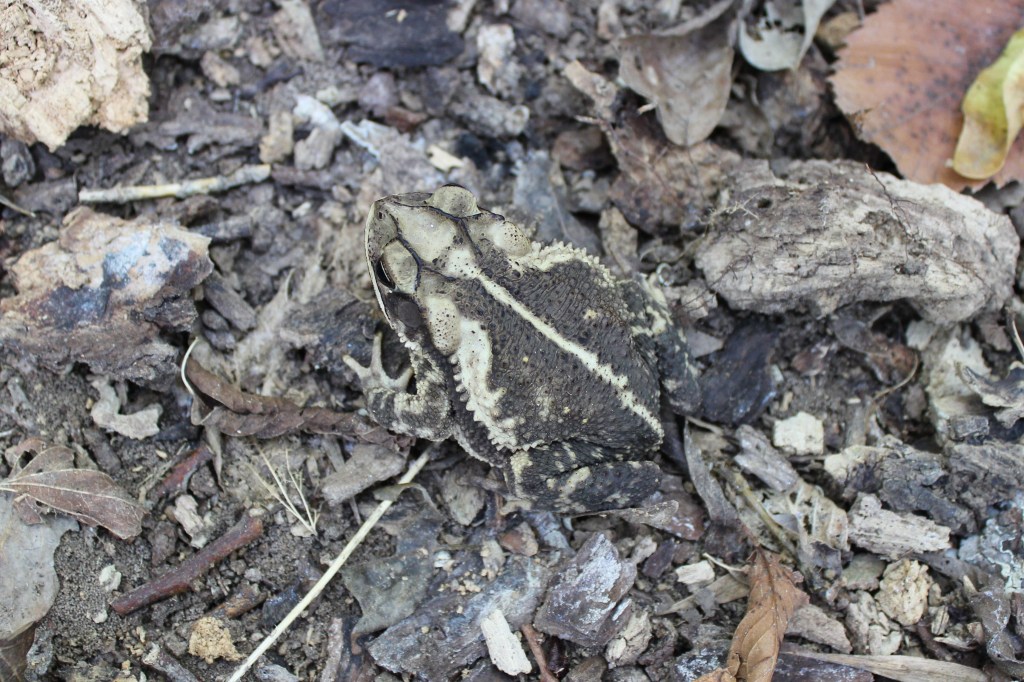
The other common amphibian was what I’ll just call the Gulf Coast Toad, since that’s what a number of sources continue to call it. Others refer to it as the “Coastal Plains” Toad, which is only one of many name changes. This toad’s scientific name has gone through considerable taxonomic chaos, seeming to land at the name Incilius nebulifer. It is a dark toad with a light stripe down the back and a light band on either side. The cranial crests – those bony ridges that the “true” toads have on the crown of the head – are dark and very obvious.
A Gulf Coast Toad … ok, if you insist – a Coastal Plains Toad
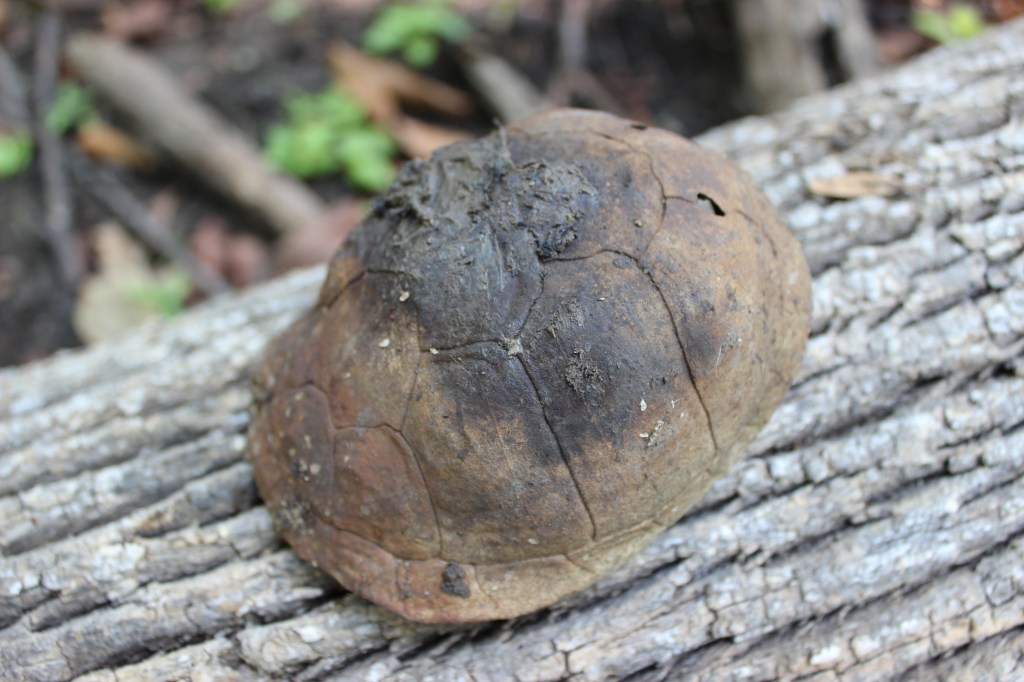
What about reptiles? There were a few, though no snakes today (a source of some disappointment to me). One really nice find was made by a very observant ranger who spotted the skeletal carapace (the bones of the upper shell) of a box turtle. To my eye this was pretty clearly the Three-toed Box Turtle species, not only from the shape of the shell but because a bottomland forest would much more likely have the Three-toed species than our other species, the Ornate Box Turtle. And because box turtles have become more scarce over the years, finding one here was exciting.
The skeletal shell of a box turtle
We also saw several young Little Brown Skinks – aka the “Ground Skink” (Scincella lateralis) in many field guides. The body length (not counting the tail) might be a little over two inches in a fully grown Little Brown Skink, but the ones we saw were smaller and younger.
A Little Brown Skink, with a little of its tail lost (before we found it)
They are brown or coppery-colored along the top, with a darker band along the side that fades toward the belly. Little Brown Skinks have small legs but move quickly, virtually “swimming” through the leaf litter to disappear under cover.
There was another lizard, for which I have no photo, but which I was excited to see. I had just talked with the group about the Prairie Racerunner, a beautiful lizard within the “whiptail” genus. Then, a small movement caught my eye along the edge of the trail and it was a little miniature striped lizard – a recently hatched baby with thin little light lines on a dark background and a tail that shaded from a sort of tan to a slightly bluish color (not typical of adults in our area). It was probably a Prairie Racerunner, but it’s not so easy to tell with a hatchling. The other related species is the Texas Spotted Whiptail, and those have spots between the stripes as adults and they do not have the lime green wash over the front of the body that the Prairie Racerunner has. Whichever species he “grows up” to be, I hope he does in fact grow up. I don’t see those lizards that much, and would love to see more.
Our short walk was over all too soon, and I hope these new Master Naturalists enjoyed seeing what we saw and will continue to get to know the Cross Timbers with the familiarity of one of Tolkien’s Dunedain. I’m encouraged by them, at a time when there’s not a lot of encouragement to go around. Congratulations to the group on becoming Master Naturalists … and rangers!











 Our Lives In Nature